Learning Strategies
Prepared By: TUMANA, WJ
What are Learning Strategies?
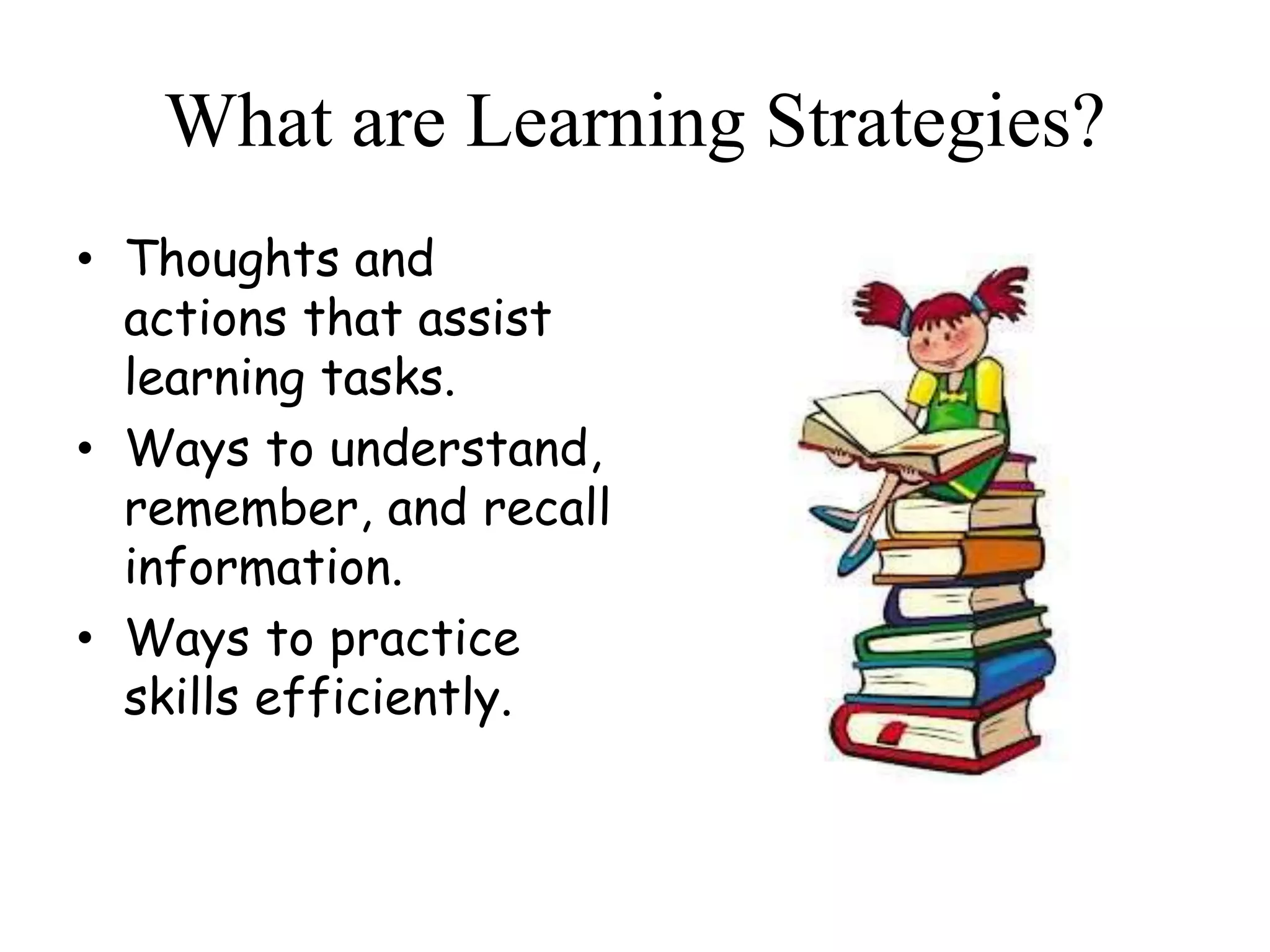
• Thoughts and
actions that assist
learning tasks.
• Ways to understand,
remember, and recall
information.
• Ways to practice
skills efficiently.
What does the research say?
• All second language learners use
strategies - BUT
• “Good” language learners use more
varied strategies and use them more
flexibly.
• Frequent use of learning strategies is
correlated to higher self-efficacy.
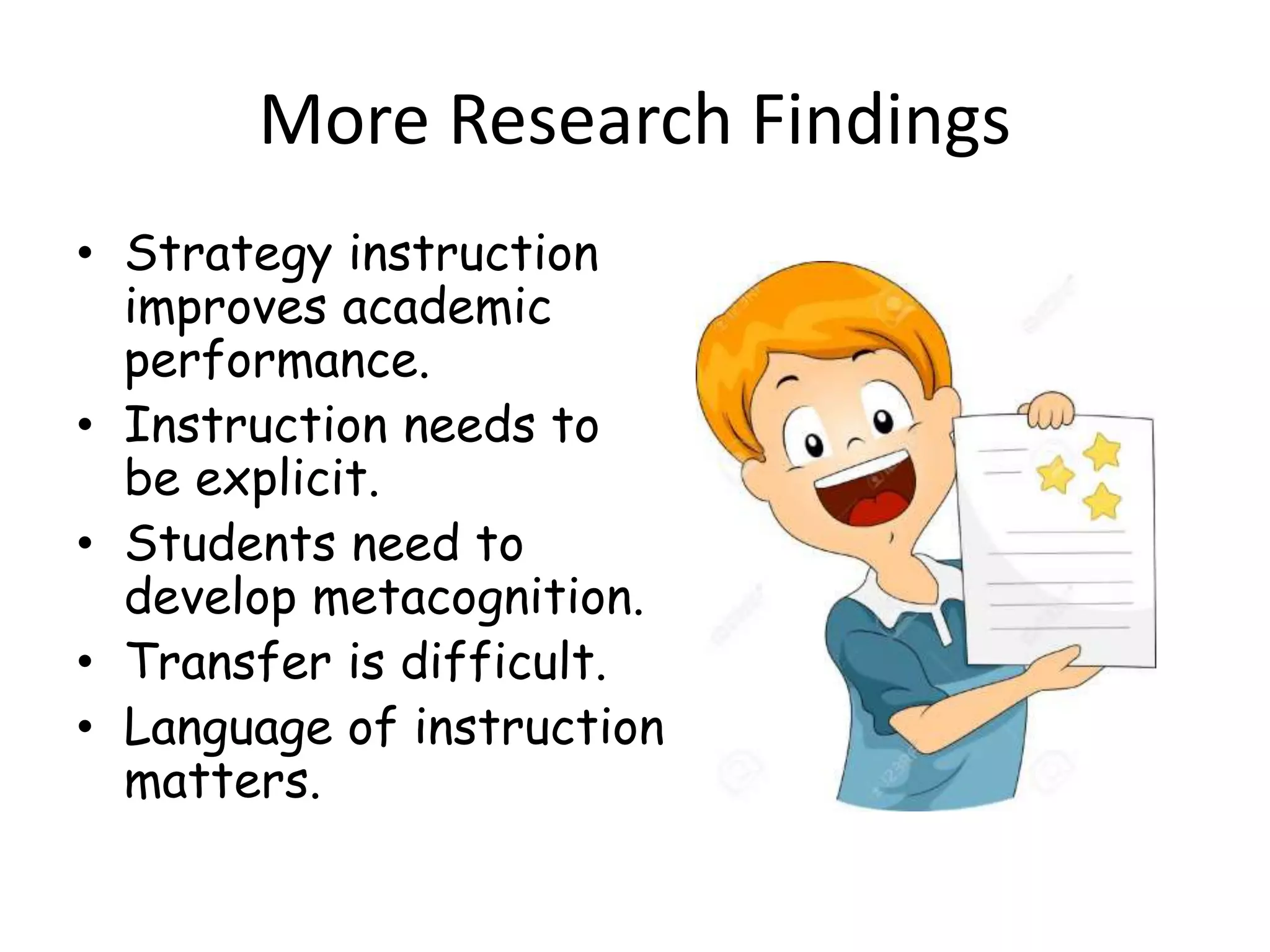
More Research Findings
• Strategy instruction
improves academic
performance.
• Instruction needs to
be explicit.
• Students need to
develop metacognition.
• Transfer is difficult.
• Language of instruction
matters.
Why teach Learning Strategies?
• Show students how
to be better
learners.
• Build students’ self-
efficacy.
• Increase student
motivation for
learning.
• Help students
become reflective
and critical thinkers.
Tips on teaching Learning Strategies
• Build on students’ current learning
strategies.
• Demonstrate how to use the learning
strategy by modeling.
• Give the strategy a name.
• Provide ample practice opportunities.
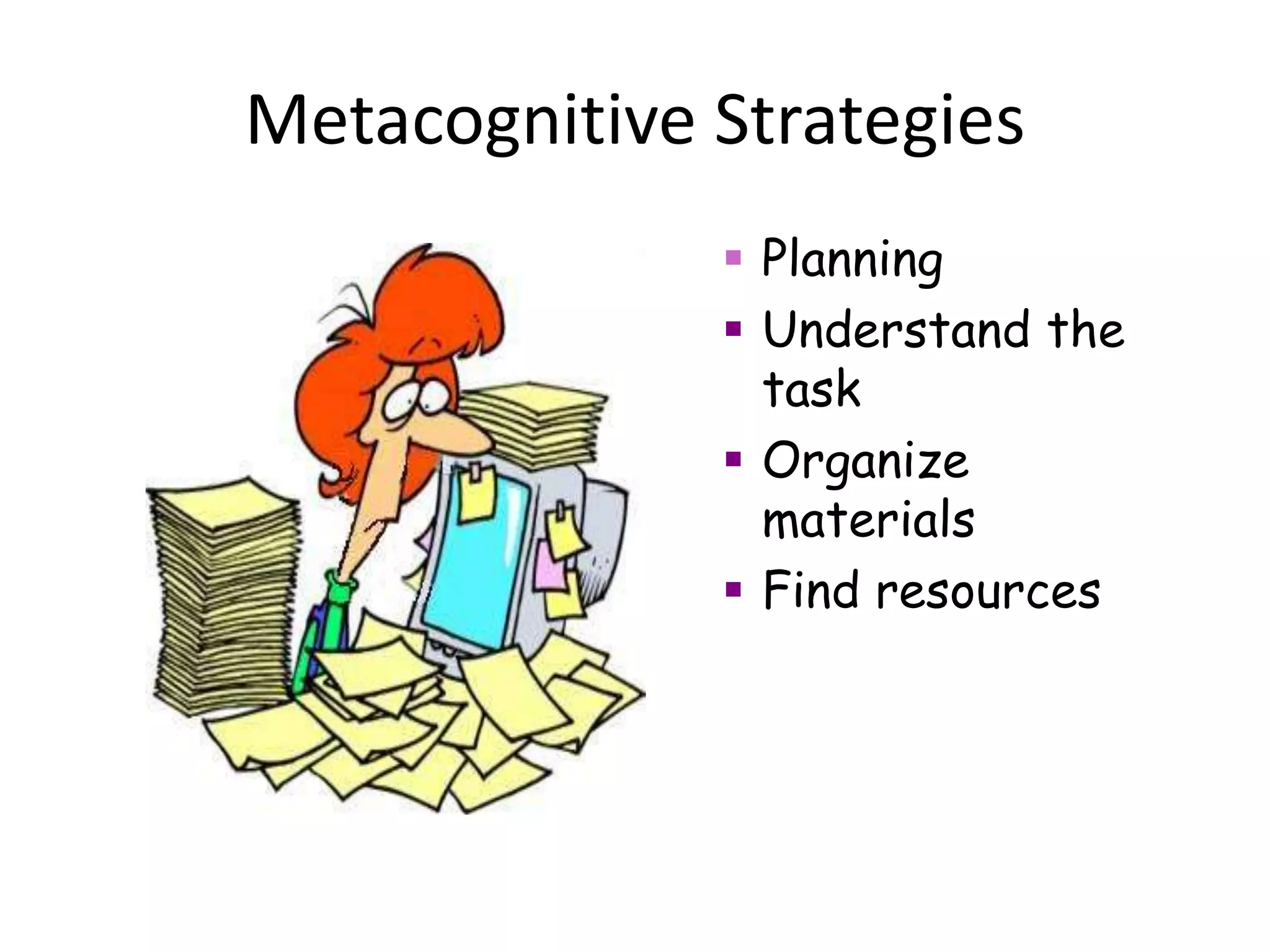
Metacognitive Strategies
 Planning
 Understand the
task
 Organize
materials
 Find resources
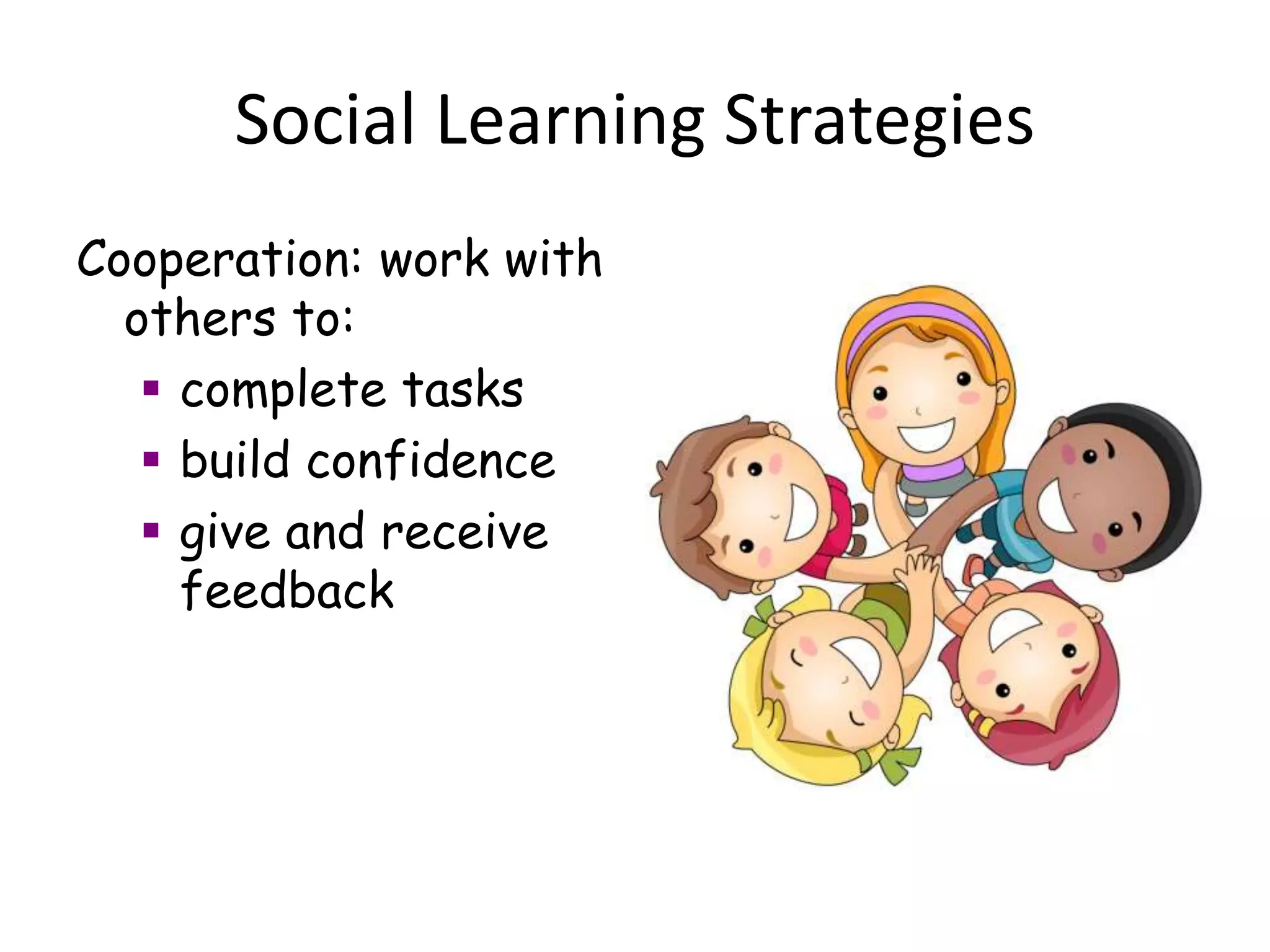
Social Learning Strategies
Cooperation: work with
others to:
 complete tasks
 build confidence
 give and receive
feedback
Twelve Active Learning Strategies
Example 1:
Opening Question
Opening Question
Take a moment to reflect on your experience
with PowerPoint.
Come up with a positive and negative example
Example 1 Explanation
• In order for students to learn effectively, they
must make connections between what they
already know (prior knowledge) and new
content to which they're exposed. The
opening of a lecture should facilitate these
connections by helping students exercise their
prior knowledge of the day's subject matter.
..
• One useful strategy is to open the lecture with a
question. Present an "opening question" on a
PowerPoint slide, give students a moment to
think about their response, and then ask a few
members of the class for answers.
• This strategy is easy to initiate, takes very little
time, works in small or large classes, and
effectively focuses students' attention on the
day's topic. It also provides the instructor with
useful feedback on what students know and don't
know about the material being presented
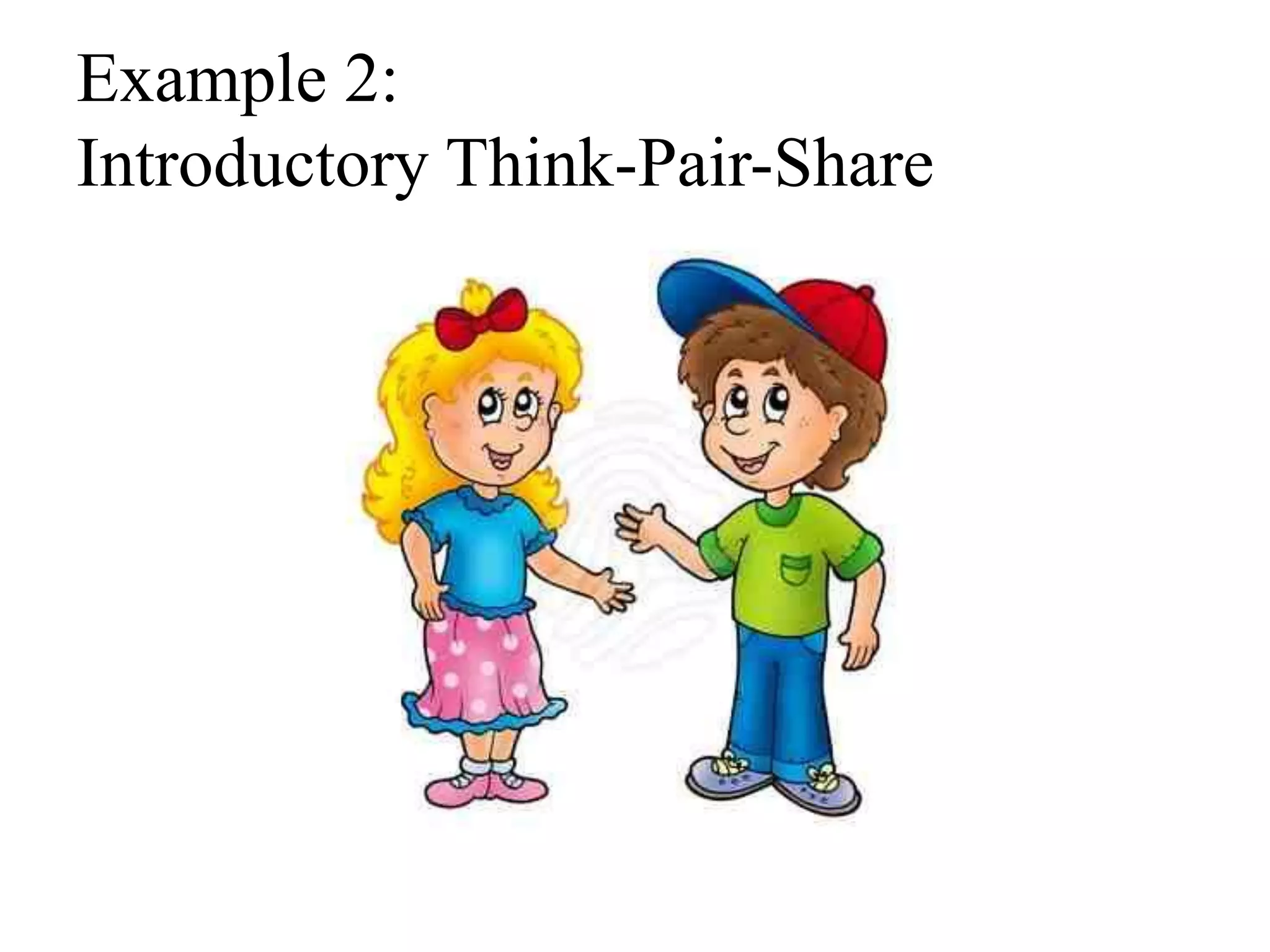
Example 2:
Introductory Think-Pair-Share
..
• Introductory Think-Pair-Share
Think of what you know about active learning
strategies.
Turn to your partner and share your knowledge
Do you have anything to share with the class?
Example 2 Explanation
• “Think-Pair-Share” is an active learning strategy
that engages students with material on an
individual level, in pairs, and finally as a group.
• It consists of three steps. First, the instructor
poses a prepared question and asks individuals to
think (or write) about it quietly. Second, students
pair up with someone sitting near them and
share their responses verbally. Third, the lecturer
chooses a few pairs to briefly summarize their
ideas for the benefit of the entire class
…
• When used at the beginning of a lecture, a Think-
Pair-Share strategy can help students organize
prior knowledge and brainstorm questions. When
used later in the session, the strategy can help
students summarize what they're learning, apply
it to novel situations, and integrate new
information with what they already know. The
strategy works well with groups of various sizes
and can be completed in as little as two or three
minutes, making it an ideal active learning
strategy for classes in which lecture is the primary
instructional method.
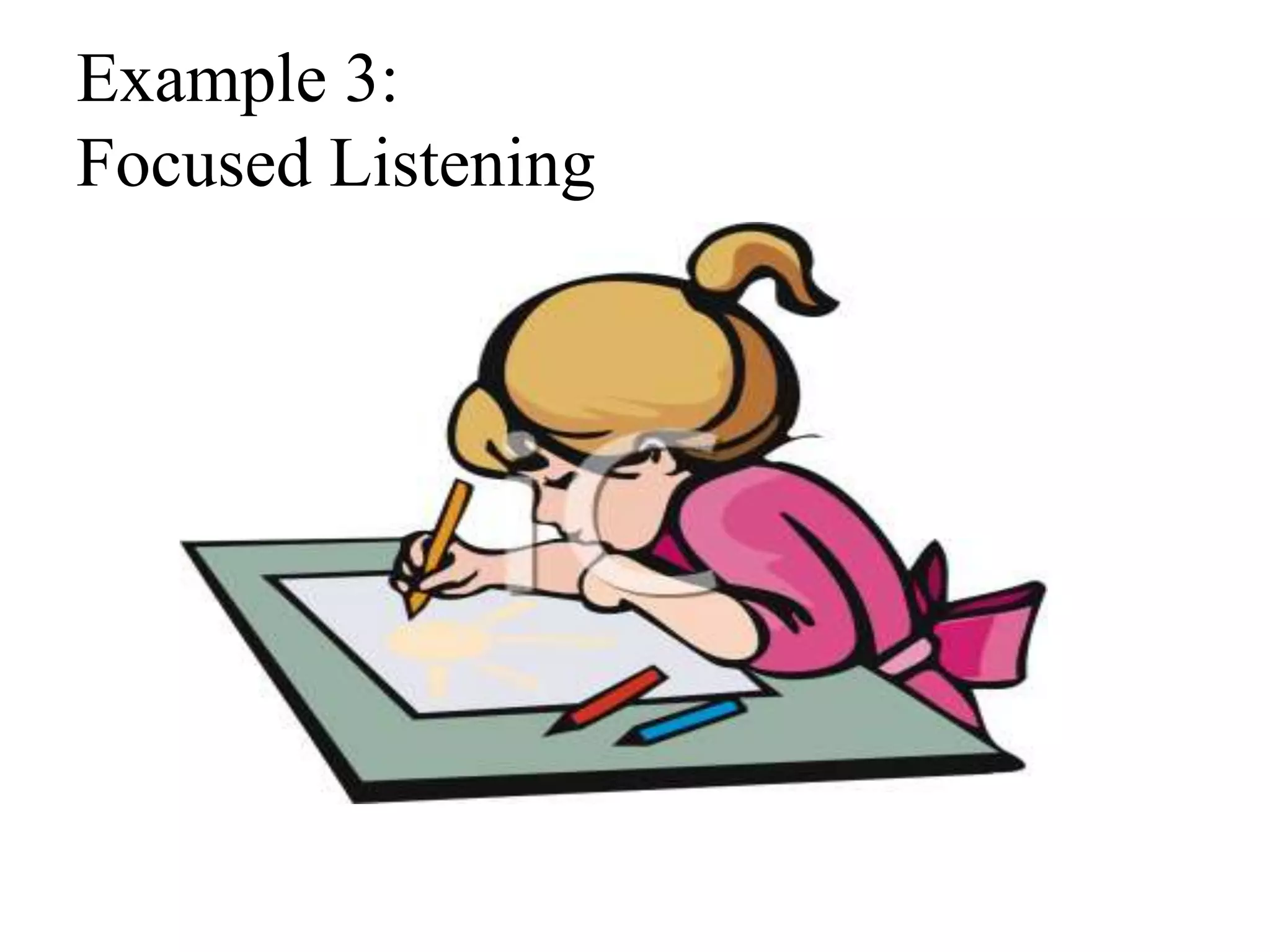
Example 3:
Focused Listening
Focused Listening
• Take our a sheet of paper and list as many
characteristics of good lecturing as you can.
Explanation
• Focused listing is a strategy in which students
recall what they know about a subject by creating
a list of terms or ideas related to it. To begin, the
instructor asks students to take out a sheet of
paper and begin generating a list based on a topic
presented on a PowerPoint slide. Topics might
relate to the day's assigned reading, to a previous
day's lecture material, or to the subject of the
current session. Instructors often move around
the room and look at students' lists as they write,
briefly summarizing major trends or themes as a
way of closing the exercise.
…
• Others ask students randomly to share the
contents of their lists before moving on with
their lecture. In either case, focused listing
need not take more than a few minutes. It's
an effective way to get students to actively
engage material, and it offer feedback that the
instructor can use to tailor the subsequent
presentation of material to students' needs
Example 4:
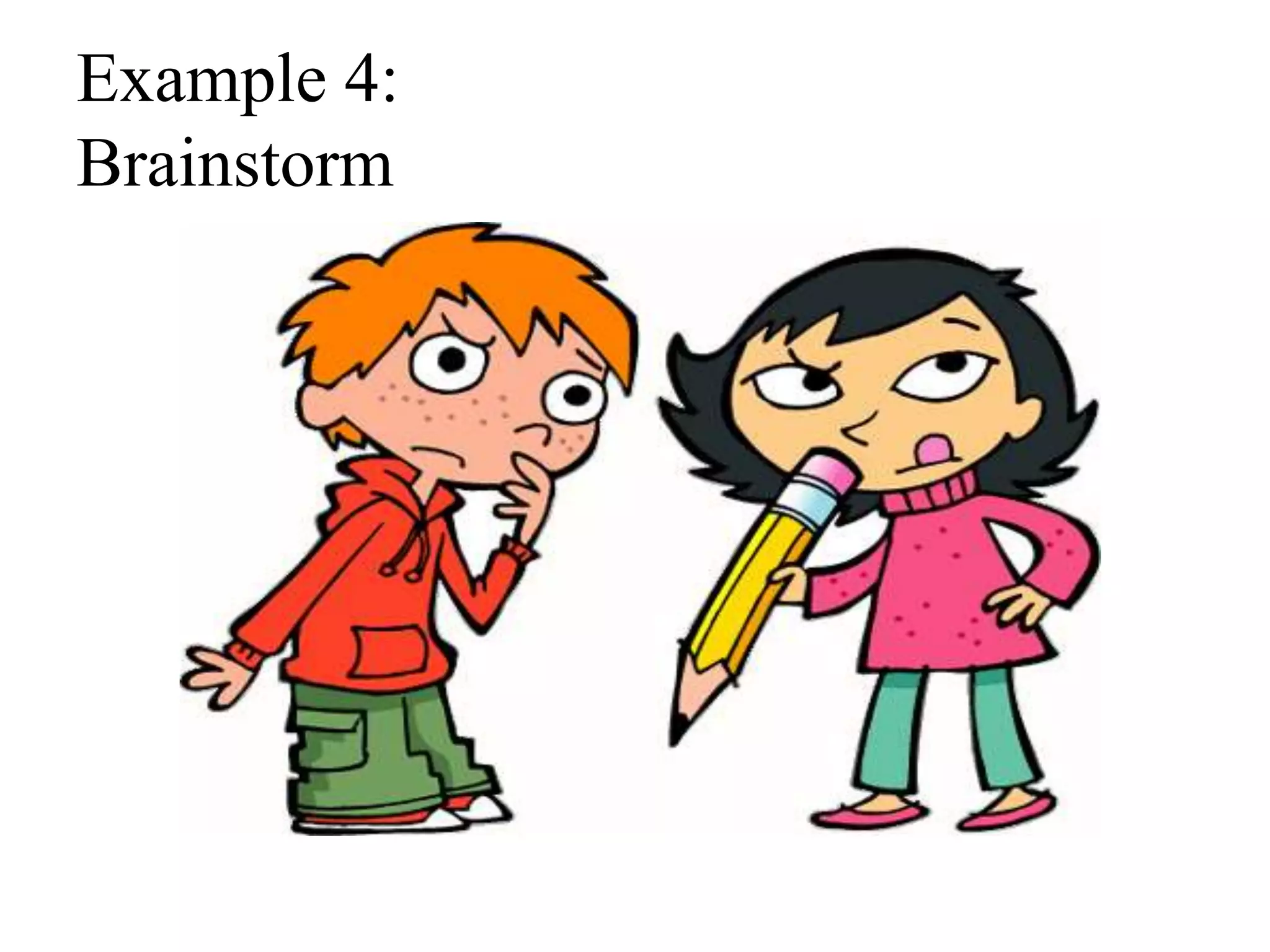
Brainstorm
Brainstorm
• What do you know about the ways students
learn?
• Start with your clearest thoughts and then
move on to those that are kind of out there!
Explanation
• Like focused listing, brainstorming is an active
learning strategy in which students are asked to
recall what they know about a subject by
generating terms and ideas related to it. In
brainstorming, however, students are encouraged
to stretch what they know by forming creative
connections between prior knowledge and new
possibilities. To initiate the strategy, the instructor
asks students, via a PowerPoint slide, what they
know about a topic. Students are instructed to
begin with those things they know to be true and
systematically work toward formulating
surprising relationships they hadn't considered
before.
…
• Brainstorming can work well at the beginning
of a lecture to gain students' attention and
prepare them to receive the day's material, or
it can be used at the end of a lecture to
summarize and help students formulate
connections between what they've just
learned and the world outside the classroom.
Like the previous strategies we've discussed,
brainstorming can be adapted to large or
small classes and can be completed in as little
as a minute.
Example 5:
Questions?
• Explanation:
• Most instructors set aside time for student
questions when planning their lectures. In the
heat of the moment, however, it's easy to
forget to ask them. One of the advantages of
PowerPoint is that the instructor can plan
breaks for student questions in advance. By
inserting a slide that asks for questions, the
instructor is reminded to step back from his
material and interact with his students.
…
• This is also an opportunity for students to
catch their breath and reflect on the material.
When brief question breaks or other active
learning strategies are planned every fifteen
minutes throughout the lecture, students'
attention is less likely to wander and they're
more likely to understand and remember the
material after the lecture is over.
Explanation:
• One way to gain students' attention and to
remind yourself to stop for questions is to
insert a blank slide into your presentation.
Imagine a lecture hall. The instructor is
discussing material, moving through slides,
and then the screen goes dark. Students are
immediately transfixed. Did the machine
break? What is the instructor going to do? At
this point you have your students' full
attention. You can ask for questions and move
on to the next part of your lecture
Example 7:
Think-Pair-Share
• Think about how you might use active
learning strategies in your lectures.
• Turn to a partner and discuss.
• Share your findings with the large group.
Explanation
• Think-Pair-Share and the other active learning
strategies we've discussed can be used at
transition points in the lecture. Employed in
this way, these strategies give students an
opportunity to think about and work with
material just presented before moving to new
information. They also help the instructor
gauge how well students have understood the
content, perhaps shaping what the instructor
discusses during the remainder of the period
Example 8:
Note Check
Note Check
• Take a few minutes to compare notes with a
partner:
• Summarize the most important information.
• Identify (and clarify if possible) any sticking
points.
Explanation
• The note check is a strategy in which the
instructor asks students to partner with
someone near by and compare their notes,
focusing on summarizing key information and
locating misconceptions. Students can also
generate questions or solve a problem posed
by the instructor. The exercise can be
completed in as little as two or three minutes
Example 9:
Question and Answer Pairs
• Take a minute to come up with one question.
• Then, see if you can stump your partner!
Explanation
• Question and answer pairs is an exercise in which
teams of students practice asking and answering
challenging questions. To begin, the instructor
asks students to partner with someone near by.
Each student takes a minute to formulate one
question based on the information presented in
the lecture or course readings. Student A begins
by posing her question for student B to answer.
Then the roles are reversed, with student B
becoming the questioner.
…
• The instructor may choose to ask for a sampling
of student questions, either verbally or by
collecting them at the end of the period.
Particularly good questions can be highlighted in
subsequent lectures or used on practice
examinations. The strategy is particularly useful
for teaching students how to frame good
questions. It can also be used to encourage
students to prepare for class if the instructor asks
students to formulate questions based on their
reading.
Example 10:
Two Minute Paper
• Summarize the most important points in
today’s lecture.
Explanation
• In this strategy, the instructor pauses and asks
students to write in response to a question
presented on a PowerPoint slide. The strategy
can be used at any point in a lecture, but it's
particularly useful at the end as a way of
encouraging students to summarize the day's
content. The minute paper forces students to
put information in their own words, helping
them internalize it and identify gaps in their
understanding.
…
• When collected at the end of the period, the
minute paper can serve as a classroom
assessment technique to help instructors
gauge how well students are learning the
material, what they understand, and what the
instructor needs to spend more time on
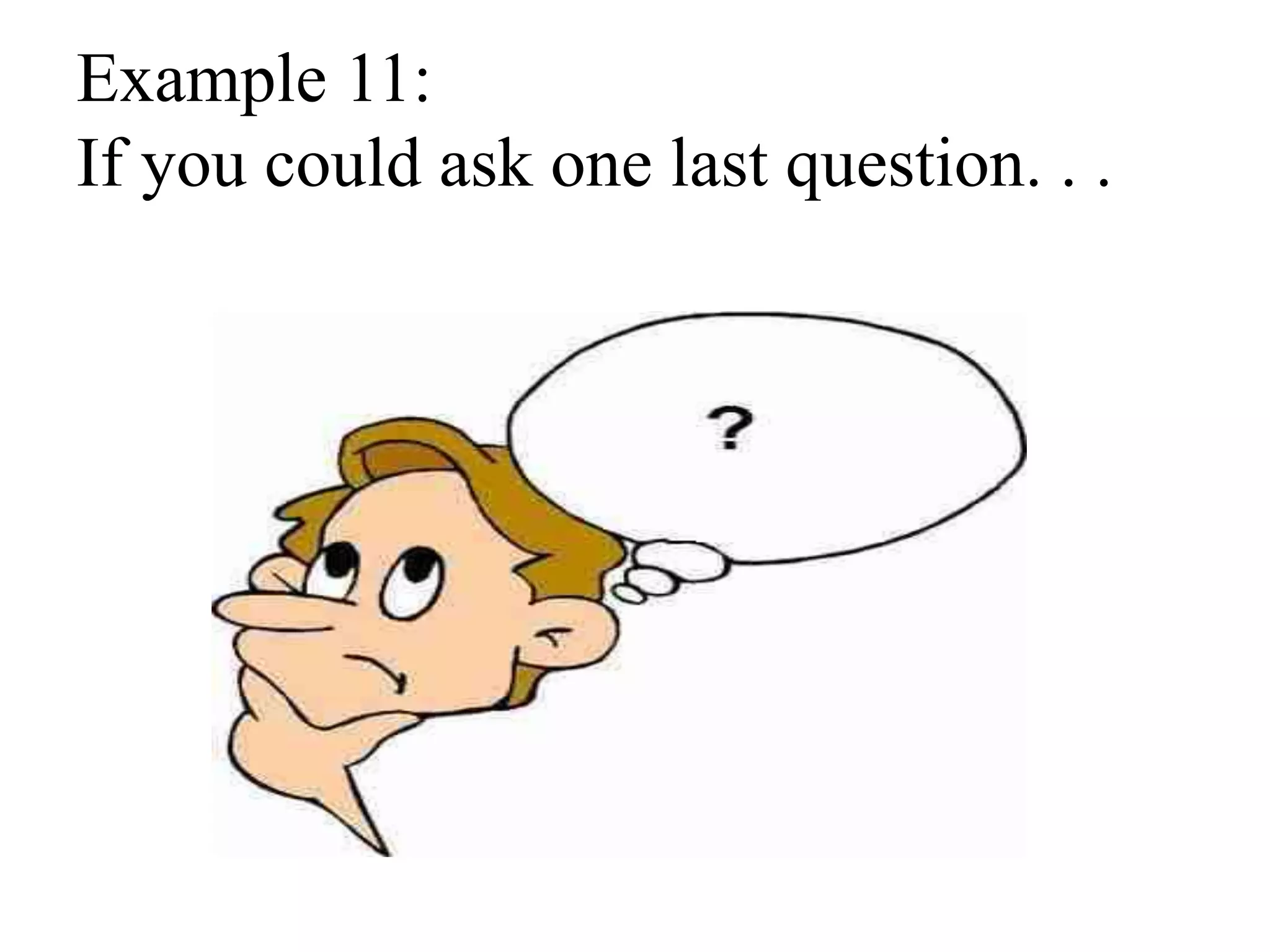
Example 11:
If you could ask one last question. . .
…
• What would it be?
Explanation
• Most instructors end their lectures by asking for
questions. To encourage students to think deeply
about the material before they leave the room,
create a PowerPoint slide which asks them to
come up with a final question. The instructor can
choose students randomly and answer their
questions in the time remaining. If collected in
writing, the questions can also serve as a
classroom assessment technique to help
instructors judge how well their students are
learning.
Example 12:
One Final Question . . .
Which of the strategies we’ve covered would
you like to try in your own class?
sources
• www.studygs.net/activelearn.htm
• Google images
Learning strategies

Learning strategies

  • 1.
  • 4.
    What are LearningStrategies? • Thoughts and actions that assist learning tasks. • Ways to understand, remember, and recall information. • Ways to practice skills efficiently.
  • 5.
    What does theresearch say? • All second language learners use strategies - BUT • “Good” language learners use more varied strategies and use them more flexibly. • Frequent use of learning strategies is correlated to higher self-efficacy.
  • 6.
    More Research Findings •Strategy instruction improves academic performance. • Instruction needs to be explicit. • Students need to develop metacognition. • Transfer is difficult. • Language of instruction matters.
  • 7.
    Why teach LearningStrategies? • Show students how to be better learners. • Build students’ self- efficacy. • Increase student motivation for learning. • Help students become reflective and critical thinkers.
  • 8.
    Tips on teachingLearning Strategies • Build on students’ current learning strategies. • Demonstrate how to use the learning strategy by modeling. • Give the strategy a name. • Provide ample practice opportunities.
  • 9.
    Metacognitive Strategies  Planning Understand the task  Organize materials  Find resources
  • 10.
    Social Learning Strategies Cooperation:work with others to:  complete tasks  build confidence  give and receive feedback
  • 11.
  • 12.
  • 13.
    Opening Question Take amoment to reflect on your experience with PowerPoint. Come up with a positive and negative example
  • 14.
    Example 1 Explanation •In order for students to learn effectively, they must make connections between what they already know (prior knowledge) and new content to which they're exposed. The opening of a lecture should facilitate these connections by helping students exercise their prior knowledge of the day's subject matter.
  • 15.
    .. • One usefulstrategy is to open the lecture with a question. Present an "opening question" on a PowerPoint slide, give students a moment to think about their response, and then ask a few members of the class for answers. • This strategy is easy to initiate, takes very little time, works in small or large classes, and effectively focuses students' attention on the day's topic. It also provides the instructor with useful feedback on what students know and don't know about the material being presented
  • 16.
  • 17.
    .. • Introductory Think-Pair-Share Thinkof what you know about active learning strategies. Turn to your partner and share your knowledge Do you have anything to share with the class?
  • 18.
    Example 2 Explanation •“Think-Pair-Share” is an active learning strategy that engages students with material on an individual level, in pairs, and finally as a group. • It consists of three steps. First, the instructor poses a prepared question and asks individuals to think (or write) about it quietly. Second, students pair up with someone sitting near them and share their responses verbally. Third, the lecturer chooses a few pairs to briefly summarize their ideas for the benefit of the entire class
  • 19.
    … • When usedat the beginning of a lecture, a Think- Pair-Share strategy can help students organize prior knowledge and brainstorm questions. When used later in the session, the strategy can help students summarize what they're learning, apply it to novel situations, and integrate new information with what they already know. The strategy works well with groups of various sizes and can be completed in as little as two or three minutes, making it an ideal active learning strategy for classes in which lecture is the primary instructional method.
  • 20.
  • 21.
    Focused Listening • Takeour a sheet of paper and list as many characteristics of good lecturing as you can.
  • 22.
    Explanation • Focused listingis a strategy in which students recall what they know about a subject by creating a list of terms or ideas related to it. To begin, the instructor asks students to take out a sheet of paper and begin generating a list based on a topic presented on a PowerPoint slide. Topics might relate to the day's assigned reading, to a previous day's lecture material, or to the subject of the current session. Instructors often move around the room and look at students' lists as they write, briefly summarizing major trends or themes as a way of closing the exercise.
  • 23.
    … • Others askstudents randomly to share the contents of their lists before moving on with their lecture. In either case, focused listing need not take more than a few minutes. It's an effective way to get students to actively engage material, and it offer feedback that the instructor can use to tailor the subsequent presentation of material to students' needs
  • 24.
  • 25.
    Brainstorm • What doyou know about the ways students learn? • Start with your clearest thoughts and then move on to those that are kind of out there!
  • 26.
    Explanation • Like focusedlisting, brainstorming is an active learning strategy in which students are asked to recall what they know about a subject by generating terms and ideas related to it. In brainstorming, however, students are encouraged to stretch what they know by forming creative connections between prior knowledge and new possibilities. To initiate the strategy, the instructor asks students, via a PowerPoint slide, what they know about a topic. Students are instructed to begin with those things they know to be true and systematically work toward formulating surprising relationships they hadn't considered before.
  • 27.
    … • Brainstorming canwork well at the beginning of a lecture to gain students' attention and prepare them to receive the day's material, or it can be used at the end of a lecture to summarize and help students formulate connections between what they've just learned and the world outside the classroom. Like the previous strategies we've discussed, brainstorming can be adapted to large or small classes and can be completed in as little as a minute.
  • 28.
    Example 5: Questions? • Explanation: •Most instructors set aside time for student questions when planning their lectures. In the heat of the moment, however, it's easy to forget to ask them. One of the advantages of PowerPoint is that the instructor can plan breaks for student questions in advance. By inserting a slide that asks for questions, the instructor is reminded to step back from his material and interact with his students.
  • 29.
    … • This isalso an opportunity for students to catch their breath and reflect on the material. When brief question breaks or other active learning strategies are planned every fifteen minutes throughout the lecture, students' attention is less likely to wander and they're more likely to understand and remember the material after the lecture is over.
  • 31.
    Explanation: • One wayto gain students' attention and to remind yourself to stop for questions is to insert a blank slide into your presentation. Imagine a lecture hall. The instructor is discussing material, moving through slides, and then the screen goes dark. Students are immediately transfixed. Did the machine break? What is the instructor going to do? At this point you have your students' full attention. You can ask for questions and move on to the next part of your lecture
  • 32.
    Example 7: Think-Pair-Share • Thinkabout how you might use active learning strategies in your lectures. • Turn to a partner and discuss. • Share your findings with the large group.
  • 33.
    Explanation • Think-Pair-Share andthe other active learning strategies we've discussed can be used at transition points in the lecture. Employed in this way, these strategies give students an opportunity to think about and work with material just presented before moving to new information. They also help the instructor gauge how well students have understood the content, perhaps shaping what the instructor discusses during the remainder of the period
  • 34.
  • 35.
    Note Check • Takea few minutes to compare notes with a partner: • Summarize the most important information. • Identify (and clarify if possible) any sticking points.
  • 36.
    Explanation • The notecheck is a strategy in which the instructor asks students to partner with someone near by and compare their notes, focusing on summarizing key information and locating misconceptions. Students can also generate questions or solve a problem posed by the instructor. The exercise can be completed in as little as two or three minutes
  • 37.
    Example 9: Question andAnswer Pairs • Take a minute to come up with one question. • Then, see if you can stump your partner!
  • 38.
    Explanation • Question andanswer pairs is an exercise in which teams of students practice asking and answering challenging questions. To begin, the instructor asks students to partner with someone near by. Each student takes a minute to formulate one question based on the information presented in the lecture or course readings. Student A begins by posing her question for student B to answer. Then the roles are reversed, with student B becoming the questioner.
  • 39.
    … • The instructormay choose to ask for a sampling of student questions, either verbally or by collecting them at the end of the period. Particularly good questions can be highlighted in subsequent lectures or used on practice examinations. The strategy is particularly useful for teaching students how to frame good questions. It can also be used to encourage students to prepare for class if the instructor asks students to formulate questions based on their reading.
  • 40.
    Example 10: Two MinutePaper • Summarize the most important points in today’s lecture.
  • 41.
    Explanation • In thisstrategy, the instructor pauses and asks students to write in response to a question presented on a PowerPoint slide. The strategy can be used at any point in a lecture, but it's particularly useful at the end as a way of encouraging students to summarize the day's content. The minute paper forces students to put information in their own words, helping them internalize it and identify gaps in their understanding.
  • 42.
    … • When collectedat the end of the period, the minute paper can serve as a classroom assessment technique to help instructors gauge how well students are learning the material, what they understand, and what the instructor needs to spend more time on
  • 43.
    Example 11: If youcould ask one last question. . .
  • 44.
  • 45.
    Explanation • Most instructorsend their lectures by asking for questions. To encourage students to think deeply about the material before they leave the room, create a PowerPoint slide which asks them to come up with a final question. The instructor can choose students randomly and answer their questions in the time remaining. If collected in writing, the questions can also serve as a classroom assessment technique to help instructors judge how well their students are learning.
  • 46.
    Example 12: One FinalQuestion . . . Which of the strategies we’ve covered would you like to try in your own class?
  • 47.