Chapter 6: Work, Energy and Power
Tuesday February 10th
Reading: up to page 88 in the text book (Ch. 6)
•Finish Newton’s laws and circular motion
•Energy
• Work (definition)
• Examples of work
•Work and Kinetic Energy
•Conservative and non-conservative forces
•Work and Potential Energy
•Conservation of Energy
•As usual – iclicker, examples and demonstrations
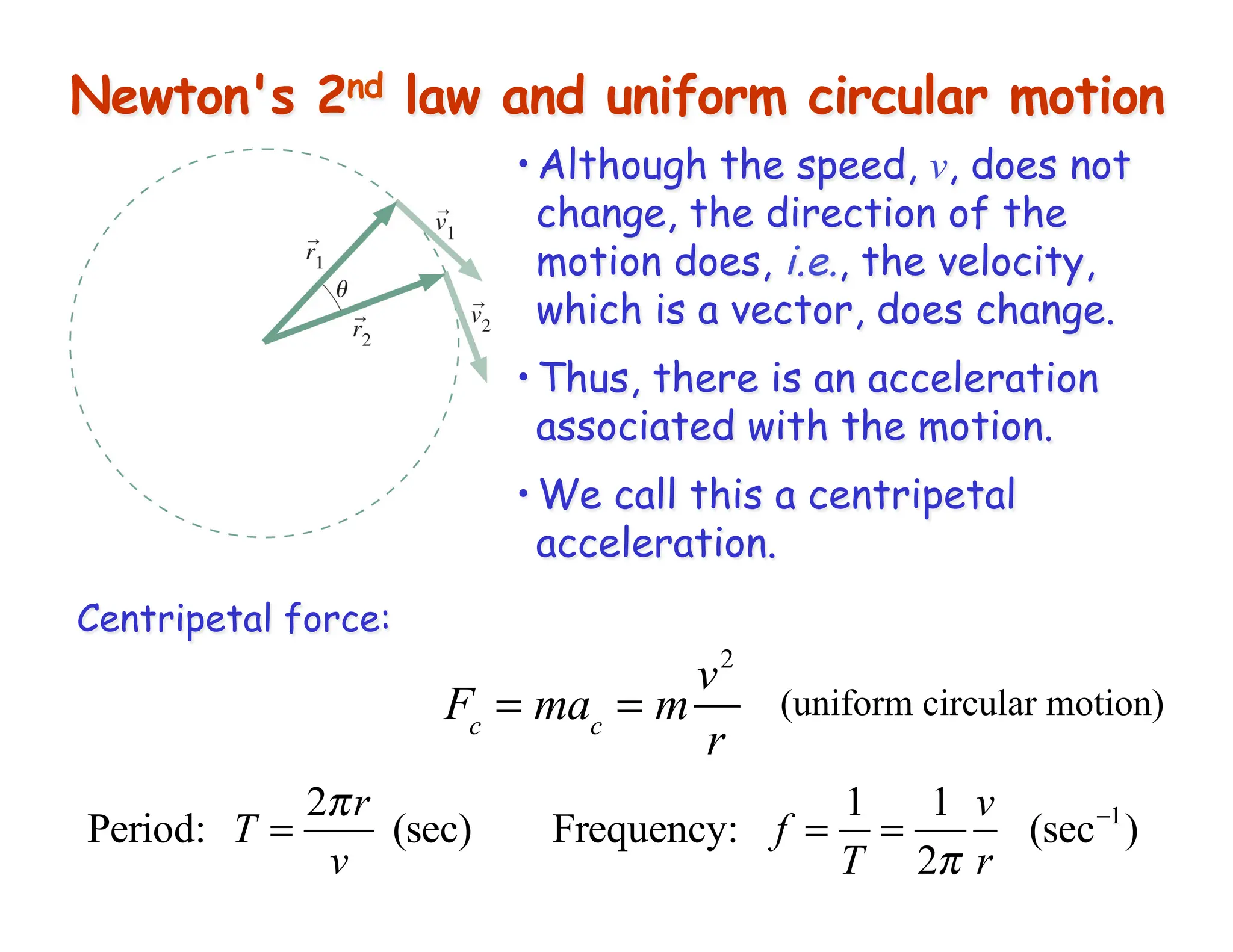
•Although the speed, v, does not
change, the direction of the
motion does, i.e., the velocity,
which is a vector, does change.
•Thus, there is an acceleration
associated with the motion.
•We call this a centripetal
acceleration.
ac
=
v2
r
Centripetal acceleration:
• A vector that is always directed towards the center of the
circular motion, i.e., it’s direction changes constantly.
Newton's 2nd law and uniform circular motion
(uniform circular motion)
•Although the speed, v, does not
change, the direction of the
motion does, i.e., the velocity,
which is a vector, does change.
•Thus, there is an acceleration
associated with the motion.
•We call this a centripetal
acceleration.
Fc
= mac
= m
v2
r
(uniform circular motion)
Centripetal force:
Period: T =
2πr
v
(sec) Frequency: f =
1
T
=
1
2π
v
r
(sec−1
)
Newton's 2nd law and uniform circular motion
The vectors
!
a,
!
F,
!
v and
!
r are constantly changing
•Examples of centripetal forces: gravity on an orbiting
body; the tension in a string when you swirl a mass in
around in a circle; friction between a car's tires and the
racetrack as a racing car makes a tight turn....
•The magnitudes a, F, v and r are constants of the motion.
•The frame in which the mass is moving is not inertial, i.e., it
is accelerating.
•Therefore, one cannot apply Newton's laws in the moving
frame associated with the mass.
•However, we can apply Newton's laws from the stationary
lab frame.
Newton's 2nd law and uniform circular motion
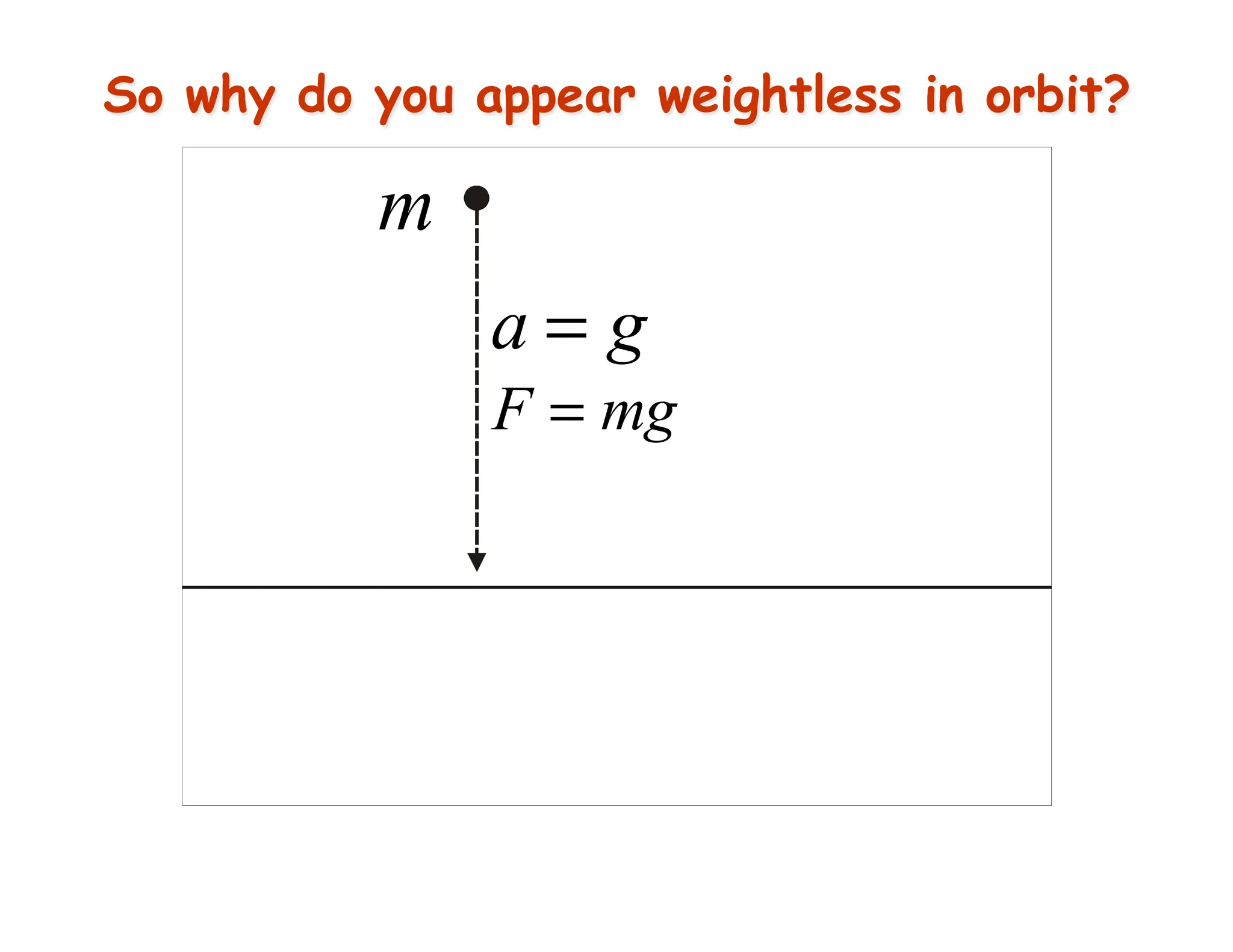
So why do you appear weightless in orbit?
m
a = g
F = mg
So why do you appear weightless in orbit?
m

vo
a = g
F = mg
So why do you appear weightless in orbit?
m

v (t )
a = g
F = mg
So why do you appear weightless in orbit?
m
So why do you appear weightless in orbit?
m
Fc
= mg
You are in constant free-fall!
Looping the loop

v (t )

Fg

N
2
v
a
r
=

v (t )

Fg
,

N
2
v
a
r
=
0
v
Daytona 500: the racetrack is covered in ice (!), so the physicist cannot
rely on friction to prevent him/her from sliding off. How is it that he/
she can continue the race?
N
0
v
Daytona 500: the racetrack is covered in ice (!), so the physicist cannot
rely on friction to prevent him/her from sliding off. How is it that he/
she can continue the race?
N
ac
Energy
•Energy is a scalar* quantity (a number) that we associate
with a system of objects, e.g., planets orbiting a sun, masses
attached to springs, electrons bound to nuclei, etc.
•Forms of energy: kinetic, chemical, nuclear, thermal,
electrostatic, gravitational....
•It turns out that energy possesses a fundamental
characteristic which makes it very useful for solving
problems in physics: **Energy is ALWAYS conserved**
Kinetic energy K is energy associated with the state
of motion of an object. The faster an object moves,
the greater its kinetic energy.
Potential energy U represents stored energy, e.g., in a
spring. It can be released later as kinetic energy.
*This can make certain kinds of problem much easier to solve mathematically.
•If you accelerate an object to a greater speed by
applying a force on the object, you increase its kinetic
energy K; you performed work on the object.
•Similarly, if you decelerate an object, you decrease its
kinetic energy; in this situation, the object actually did
work on you (equivalent to you doing negative work).
Work W is the energy transferred to or from an
object by means of a force acting on the object.
Energy transferred to the object is positive work, and
energy transferred from the object is negative work.
Work - Definition
Work - Definition
•If an object moves in response to your application of a
force, you have performed work.
•The further it moves under the influence of your force,
the more work you perform.
•There are only two relevant variables in one dimension:
the force, Fx, and the displacement, Δx.
Work W is the energy transferred to or from an
object by means of a force acting on the object.
Energy transferred to the object is positive work, and
energy transferred from the object is negative work.
Work - Definition
•There are only two relevant variables in one dimension:
the force, Fx, and the displacement, Δx.
Work W is the energy transferred to or from an
object by means of a force acting on the object.
Energy transferred to the object is positive work, and
energy transferred from the object is negative work.
W = Fx
Δx
Definition: [Units: N.m or Joule (J)]
Fx is the component of the force in the direction of the object’s
motion, and Δx is its displacement.
•Examples:
•Pushing furniture across a room;
•Carrying boxes up to your attic.
Work - Examples
N
Mg
Frictionless surface
Δx
W = Fx
Δx
Fx
Work - Examples
N
Mg
Rough surface
Δx
WPull
= Fx
Δx
Wfric.
= − fk
Δx
fk
These two seemingly similar examples are, in fact, quite different
Fx
Work - Examples
Fx
Frictionless surface
Δx
1
2
mvf
2
− 1
2
mvi
2
= 1
2
m× 2ax
Δx
ΔK = K f
− Ki
= max
Δx = Fx
Δx = W
What happens next?
vf
2
= v i
2
+2ax
Δx
Kinetic Energy - Definition
Fx
Frictionless surface
Δx
K = 1
2
mv2
1
2
mvf
2
− 1
2
mvi
2
= 1
2
m× 2ax
Δx
ΔK = K f
− Ki
= max
Δx = Fx
Δx = W
Work-Kinetic Energy Theorem
ΔK = K f
− Ki
= Wnet
change in the kinetic net work done on
energy of a particle the particle
⎛ ⎞ ⎛ ⎞
=
⎜ ⎟ ⎜ ⎟
⎜ ⎟ ⎜ ⎟
⎝ ⎠ ⎝ ⎠
K f
= Ki
+Wnet
kinetic energy after kinetic energy the net
the net work is done before the net work work done
⎛ ⎞ ⎛ ⎞ ⎛ ⎞
= +
⎜ ⎟ ⎜ ⎟ ⎜ ⎟
⎜ ⎟ ⎜ ⎟ ⎜ ⎟
⎝ ⎠ ⎝ ⎠ ⎝ ⎠
F
N
Mg
Frictionless surface
Δx
θ
W = Fx
Δx
= F cosθ ⋅Δx
More on Work
Fx
= F cosφ
W = Fd cosφ
W =
!
F ⋅
!
d
More on Work
To calculate the work done on an object by a force
during a displacement, we use only the force component
along the object's displacement. The force component
perpendicular to the displacement does zero work
•Caution: for all the equations we have derived so far, the
force must be constant, and the object must be rigid.
•I will discuss variable forces later.
The scalar product, or dot product
!
a ⋅
!
b = abcosφ
(a)(bcosφ) = (acosφ)(b)
cosφ = cos(−φ)
⇒
!
a ⋅
!
b =
!
b ⋅
!
a
•The scalar product represents the product of the
magnitude of one vector and the component of the
second vector along the direction of the first
If φ = 0o
, then
!
a ⋅
!
b = ab
If φ = 90o
, then
!
a ⋅
!
b = 0
The scalar product, or dot product
!
a ⋅
!
b = abcosφ
(a)(bcosφ) = (acosφ)(b)
cosφ = cos(−φ)
⇒
!
a ⋅
!
b =
!
b ⋅
!
a
•The scalar product becomes relevant in Chapter 6
(pages 88 and 97) when considering work and power.
•There is also a vector product, or cross product, which
becomes relevant in Chapter 11 (pages 176-178). I save
discussion of this until later in the semester.
•See also Appendix A.

Lecture10 Chapter 6 Work Energy and Power.pdf

  • 1.
    Chapter 6: Work,Energy and Power Tuesday February 10th Reading: up to page 88 in the text book (Ch. 6) •Finish Newton’s laws and circular motion •Energy • Work (definition) • Examples of work •Work and Kinetic Energy •Conservative and non-conservative forces •Work and Potential Energy •Conservation of Energy •As usual – iclicker, examples and demonstrations
  • 2.
    •Although the speed,v, does not change, the direction of the motion does, i.e., the velocity, which is a vector, does change. •Thus, there is an acceleration associated with the motion. •We call this a centripetal acceleration. ac = v2 r Centripetal acceleration: • A vector that is always directed towards the center of the circular motion, i.e., it’s direction changes constantly. Newton's 2nd law and uniform circular motion (uniform circular motion)
  • 3.
    •Although the speed,v, does not change, the direction of the motion does, i.e., the velocity, which is a vector, does change. •Thus, there is an acceleration associated with the motion. •We call this a centripetal acceleration. Fc = mac = m v2 r (uniform circular motion) Centripetal force: Period: T = 2πr v (sec) Frequency: f = 1 T = 1 2π v r (sec−1 ) Newton's 2nd law and uniform circular motion
  • 4.
    The vectors ! a, ! F, ! v and ! rare constantly changing •Examples of centripetal forces: gravity on an orbiting body; the tension in a string when you swirl a mass in around in a circle; friction between a car's tires and the racetrack as a racing car makes a tight turn.... •The magnitudes a, F, v and r are constants of the motion. •The frame in which the mass is moving is not inertial, i.e., it is accelerating. •Therefore, one cannot apply Newton's laws in the moving frame associated with the mass. •However, we can apply Newton's laws from the stationary lab frame. Newton's 2nd law and uniform circular motion
  • 5.
    So why doyou appear weightless in orbit? m a = g F = mg
  • 6.
    So why doyou appear weightless in orbit? m  vo a = g F = mg
  • 7.
    So why doyou appear weightless in orbit? m  v (t ) a = g F = mg
  • 8.
    So why doyou appear weightless in orbit? m
  • 9.
    So why doyou appear weightless in orbit? m Fc = mg You are in constant free-fall!
  • 10.
    Looping the loop  v(t )  Fg  N 2 v a r =
  • 11.
  • 12.
    0 v Daytona 500: theracetrack is covered in ice (!), so the physicist cannot rely on friction to prevent him/her from sliding off. How is it that he/ she can continue the race? N
  • 13.
    0 v Daytona 500: theracetrack is covered in ice (!), so the physicist cannot rely on friction to prevent him/her from sliding off. How is it that he/ she can continue the race? N ac
  • 14.
    Energy •Energy is ascalar* quantity (a number) that we associate with a system of objects, e.g., planets orbiting a sun, masses attached to springs, electrons bound to nuclei, etc. •Forms of energy: kinetic, chemical, nuclear, thermal, electrostatic, gravitational.... •It turns out that energy possesses a fundamental characteristic which makes it very useful for solving problems in physics: **Energy is ALWAYS conserved** Kinetic energy K is energy associated with the state of motion of an object. The faster an object moves, the greater its kinetic energy. Potential energy U represents stored energy, e.g., in a spring. It can be released later as kinetic energy. *This can make certain kinds of problem much easier to solve mathematically.
  • 15.
    •If you acceleratean object to a greater speed by applying a force on the object, you increase its kinetic energy K; you performed work on the object. •Similarly, if you decelerate an object, you decrease its kinetic energy; in this situation, the object actually did work on you (equivalent to you doing negative work). Work W is the energy transferred to or from an object by means of a force acting on the object. Energy transferred to the object is positive work, and energy transferred from the object is negative work. Work - Definition
  • 16.
    Work - Definition •Ifan object moves in response to your application of a force, you have performed work. •The further it moves under the influence of your force, the more work you perform. •There are only two relevant variables in one dimension: the force, Fx, and the displacement, Δx. Work W is the energy transferred to or from an object by means of a force acting on the object. Energy transferred to the object is positive work, and energy transferred from the object is negative work.
  • 17.
    Work - Definition •Thereare only two relevant variables in one dimension: the force, Fx, and the displacement, Δx. Work W is the energy transferred to or from an object by means of a force acting on the object. Energy transferred to the object is positive work, and energy transferred from the object is negative work. W = Fx Δx Definition: [Units: N.m or Joule (J)] Fx is the component of the force in the direction of the object’s motion, and Δx is its displacement. •Examples: •Pushing furniture across a room; •Carrying boxes up to your attic.
  • 18.
    Work - Examples N Mg Frictionlesssurface Δx W = Fx Δx Fx
  • 19.
    Work - Examples N Mg Roughsurface Δx WPull = Fx Δx Wfric. = − fk Δx fk These two seemingly similar examples are, in fact, quite different Fx
  • 20.
    Work - Examples Fx Frictionlesssurface Δx 1 2 mvf 2 − 1 2 mvi 2 = 1 2 m× 2ax Δx ΔK = K f − Ki = max Δx = Fx Δx = W What happens next? vf 2 = v i 2 +2ax Δx
  • 21.
    Kinetic Energy -Definition Fx Frictionless surface Δx K = 1 2 mv2 1 2 mvf 2 − 1 2 mvi 2 = 1 2 m× 2ax Δx ΔK = K f − Ki = max Δx = Fx Δx = W
  • 22.
    Work-Kinetic Energy Theorem ΔK= K f − Ki = Wnet change in the kinetic net work done on energy of a particle the particle ⎛ ⎞ ⎛ ⎞ = ⎜ ⎟ ⎜ ⎟ ⎜ ⎟ ⎜ ⎟ ⎝ ⎠ ⎝ ⎠ K f = Ki +Wnet kinetic energy after kinetic energy the net the net work is done before the net work work done ⎛ ⎞ ⎛ ⎞ ⎛ ⎞ = + ⎜ ⎟ ⎜ ⎟ ⎜ ⎟ ⎜ ⎟ ⎜ ⎟ ⎜ ⎟ ⎝ ⎠ ⎝ ⎠ ⎝ ⎠
  • 23.
    F N Mg Frictionless surface Δx θ W =Fx Δx = F cosθ ⋅Δx More on Work
  • 24.
    Fx = F cosφ W= Fd cosφ W = ! F ⋅ ! d More on Work To calculate the work done on an object by a force during a displacement, we use only the force component along the object's displacement. The force component perpendicular to the displacement does zero work •Caution: for all the equations we have derived so far, the force must be constant, and the object must be rigid. •I will discuss variable forces later.
  • 25.
    The scalar product,or dot product ! a ⋅ ! b = abcosφ (a)(bcosφ) = (acosφ)(b) cosφ = cos(−φ) ⇒ ! a ⋅ ! b = ! b ⋅ ! a •The scalar product represents the product of the magnitude of one vector and the component of the second vector along the direction of the first If φ = 0o , then ! a ⋅ ! b = ab If φ = 90o , then ! a ⋅ ! b = 0
  • 26.
    The scalar product,or dot product ! a ⋅ ! b = abcosφ (a)(bcosφ) = (acosφ)(b) cosφ = cos(−φ) ⇒ ! a ⋅ ! b = ! b ⋅ ! a •The scalar product becomes relevant in Chapter 6 (pages 88 and 97) when considering work and power. •There is also a vector product, or cross product, which becomes relevant in Chapter 11 (pages 176-178). I save discussion of this until later in the semester. •See also Appendix A.