Work, Force, and Energy Thermochemistry
Work, Force, and Energy
Work, Force, and Energy Work  is only accomplished when a  force  moves an object some distance Force  = a push or a pull Work  =  Force x distance Energy  =  the ability to do work The Newton – meter = the  joule
Energy from the Sun
Energy from the Sun Plants   are the only organisms that can make their own food. These are called  autotrophs Plants use sunlight, water, and minerals to make food in a process called  Photosynthesis The transfer of energy from the Sun, to the plants, to the animals is called a  Food Chain . Animals are  Heterotrophs .
Energy From the Sun The amount of energy food contains is measured in  Calories A  Calorimeter  is used to measure the energy in food. Stored energy from the Sun is found in the form of  Fossil Fuels .
Potential and Kinetic Energy
Potential and Kinetic Energy Potential Energy   is stored energy, or energy of position. A book lifted to the edge of a table has  Potential Energy . Kinetic Energy   is the energy of motion. A battery has  Chemical   potential energy.
Seven forms of energy
Seven forms of energy The seven forms of energy are: Mechanical Heat Chemical Radiant Electrical Sound Nuclear
Seven forms of energy Mechanical   energy   is the energy of motion. Heat   energy   is related to the movement of the particles that make up matter. Electrical   energy   is the movement of electrons. Radiant   energy   includes light, x-rays, and radio waves.
Seven forms of energy During  Photosynthesis  carbon dioxide, minerals, and water are turned into  Glucose  (which is a sugar) and oxygen.
Seven forms of energy Nuclear   energy   has to do with the nucleus.
Law of Conservation of Energy
Law of Conservation of Energy The law of conservation of energy states that energy cannot be  created  or  destroyed  just  converted  from one form to another.
Law of Conservation of Energy When we lift a ball to a certain point, we have given it  Potential  energy. When we release the ball, the potential energy is converted to  Kinetic  energy.
Measuring Energy Changes
Measuring Energy Changes Friction   is defined as the resistance to relative motion between two bodies in contanct. A Newton moved for one meter = one  Joule (J)
Measuring Energy Changes The energy required to raise the temperature of one gram of water by one degree Celsius is  4.19  J.  This is equal to 1  calorie . 1000  calories = 1  kilocalorie  = 1  Calorie
1. The energy in food is measured in _____. A) watts  B) newtons  C) calories  D) coulombs
2. Another word for a joule is a Newton-meter. A) true  B) false
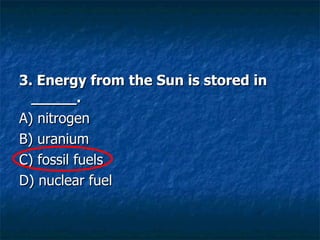
3. Energy from the Sun is stored in _____. A) nitrogen  B) uranium  C) fossil fuels  D) nuclear fuel
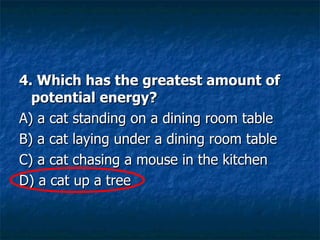
4. Which has the greatest amount of potential energy? A) a cat standing on a dining room table  B) a cat laying under a dining room table  C) a cat chasing a mouse in the kitchen  D) a cat up a tree
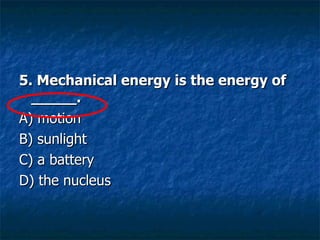
5. Mechanical energy is the energy of _____. A) motion  B) sunlight  C) a battery  D) the nucleus
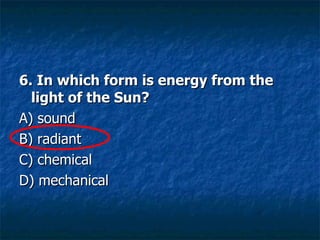
6. In which form is energy from the light of the Sun? A) sound  B) radiant  C) chemical  D) mechanical
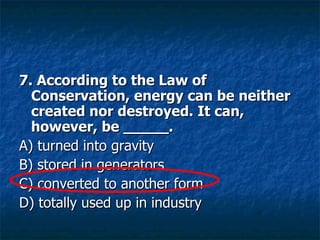
7. According to the Law of Conservation, energy can be neither created nor destroyed. It can, however, be _____. A) turned into gravity  B) stored in generators  C) converted to another form  D) totally used up in industry
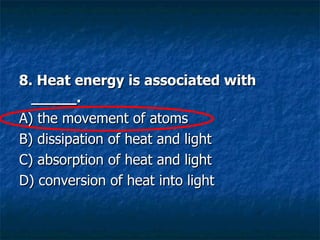
8. Heat energy is associated with _____. A) the movement of atoms  B) dissipation of heat and light  C) absorption of heat and light  D) conversion of heat into light
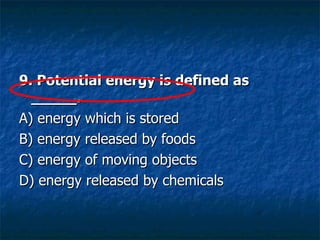
9. Potential energy is defined as _____. A) energy which is stored  B) energy released by foods  C) energy of moving objects  D) energy released by chemicals
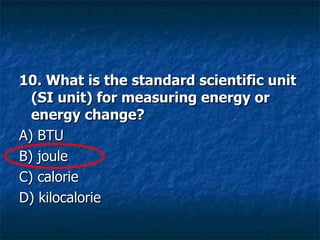
10. What is the standard scientific unit (SI unit) for measuring energy or energy change? A) BTU  B) joule  C) calorie  D) kilocalorie

Work, force, and energy

  • 1.
    Work, Force, andEnergy Thermochemistry
  • 2.
  • 3.
    Work, Force, andEnergy Work is only accomplished when a force moves an object some distance Force = a push or a pull Work = Force x distance Energy = the ability to do work The Newton – meter = the joule
  • 4.
  • 5.
    Energy from theSun Plants are the only organisms that can make their own food. These are called autotrophs Plants use sunlight, water, and minerals to make food in a process called Photosynthesis The transfer of energy from the Sun, to the plants, to the animals is called a Food Chain . Animals are Heterotrophs .
  • 6.
    Energy From theSun The amount of energy food contains is measured in Calories A Calorimeter is used to measure the energy in food. Stored energy from the Sun is found in the form of Fossil Fuels .
  • 7.
  • 8.
    Potential and KineticEnergy Potential Energy is stored energy, or energy of position. A book lifted to the edge of a table has Potential Energy . Kinetic Energy is the energy of motion. A battery has Chemical potential energy.
  • 9.
  • 10.
    Seven forms ofenergy The seven forms of energy are: Mechanical Heat Chemical Radiant Electrical Sound Nuclear
  • 11.
    Seven forms ofenergy Mechanical energy is the energy of motion. Heat energy is related to the movement of the particles that make up matter. Electrical energy is the movement of electrons. Radiant energy includes light, x-rays, and radio waves.
  • 12.
    Seven forms ofenergy During Photosynthesis carbon dioxide, minerals, and water are turned into Glucose (which is a sugar) and oxygen.
  • 13.
    Seven forms ofenergy Nuclear energy has to do with the nucleus.
  • 14.
  • 15.
    Law of Conservationof Energy The law of conservation of energy states that energy cannot be created or destroyed just converted from one form to another.
  • 16.
    Law of Conservationof Energy When we lift a ball to a certain point, we have given it Potential energy. When we release the ball, the potential energy is converted to Kinetic energy.
  • 17.
  • 18.
    Measuring Energy ChangesFriction is defined as the resistance to relative motion between two bodies in contanct. A Newton moved for one meter = one Joule (J)
  • 19.
    Measuring Energy ChangesThe energy required to raise the temperature of one gram of water by one degree Celsius is 4.19 J. This is equal to 1 calorie . 1000 calories = 1 kilocalorie = 1 Calorie
  • 20.
    1. The energy infood is measured in _____. A) watts B) newtons C) calories D) coulombs
  • 21.
    2. Another word fora joule is a Newton-meter. A) true B) false
  • 22.
    3. Energy from theSun is stored in _____. A) nitrogen B) uranium C) fossil fuels D) nuclear fuel
  • 23.
    4. Which has thegreatest amount of potential energy? A) a cat standing on a dining room table B) a cat laying under a dining room table C) a cat chasing a mouse in the kitchen D) a cat up a tree
  • 24.
    5. Mechanical energy isthe energy of _____. A) motion B) sunlight C) a battery D) the nucleus
  • 25.
    6. In which formis energy from the light of the Sun? A) sound B) radiant C) chemical D) mechanical
  • 26.
    7. According to theLaw of Conservation, energy can be neither created nor destroyed. It can, however, be _____. A) turned into gravity B) stored in generators C) converted to another form D) totally used up in industry
  • 27.
    8. Heat energy isassociated with _____. A) the movement of atoms B) dissipation of heat and light C) absorption of heat and light D) conversion of heat into light
  • 28.
    9. Potential energy isdefined as _____. A) energy which is stored B) energy released by foods C) energy of moving objects D) energy released by chemicals
  • 29.
    10. What is thestandard scientific unit (SI unit) for measuring energy or energy change? A) BTU B) joule C) calorie D) kilocalorie