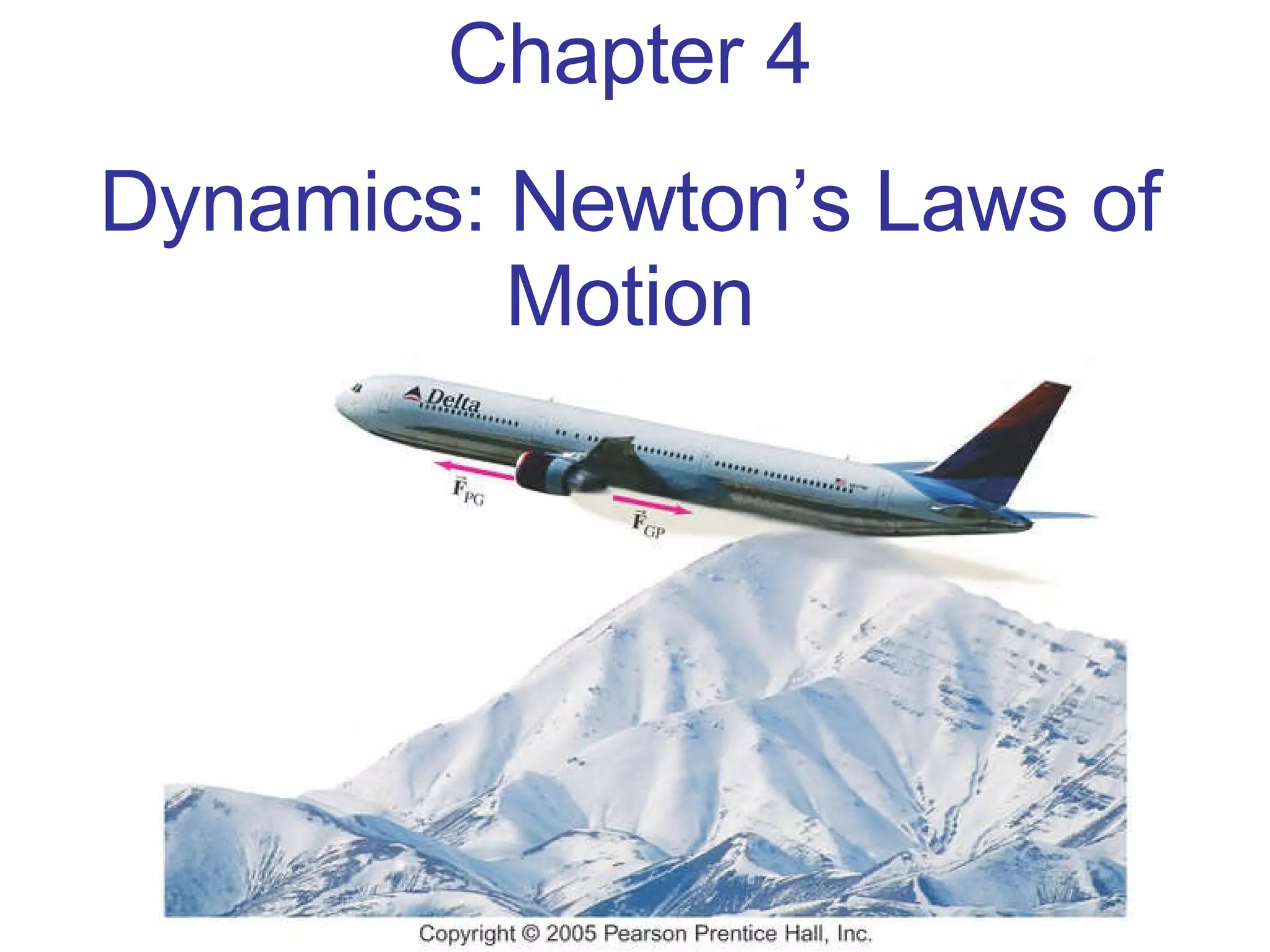
Chapter 4 Dynamics: Newton’s Laws of Motion
Units of Chapter 4 Force Newton’s First Law of Motion Mass Newton’s Second Law of Motion Newton’s Third Law of Motion Weight – the Force of Gravity; and the Normal Force
Units of Chapter 4 Solving Problems with Newton’s Laws: Free-Body Diagrams Applications Involving Friction, Inclines Problem Solving – A General Approach
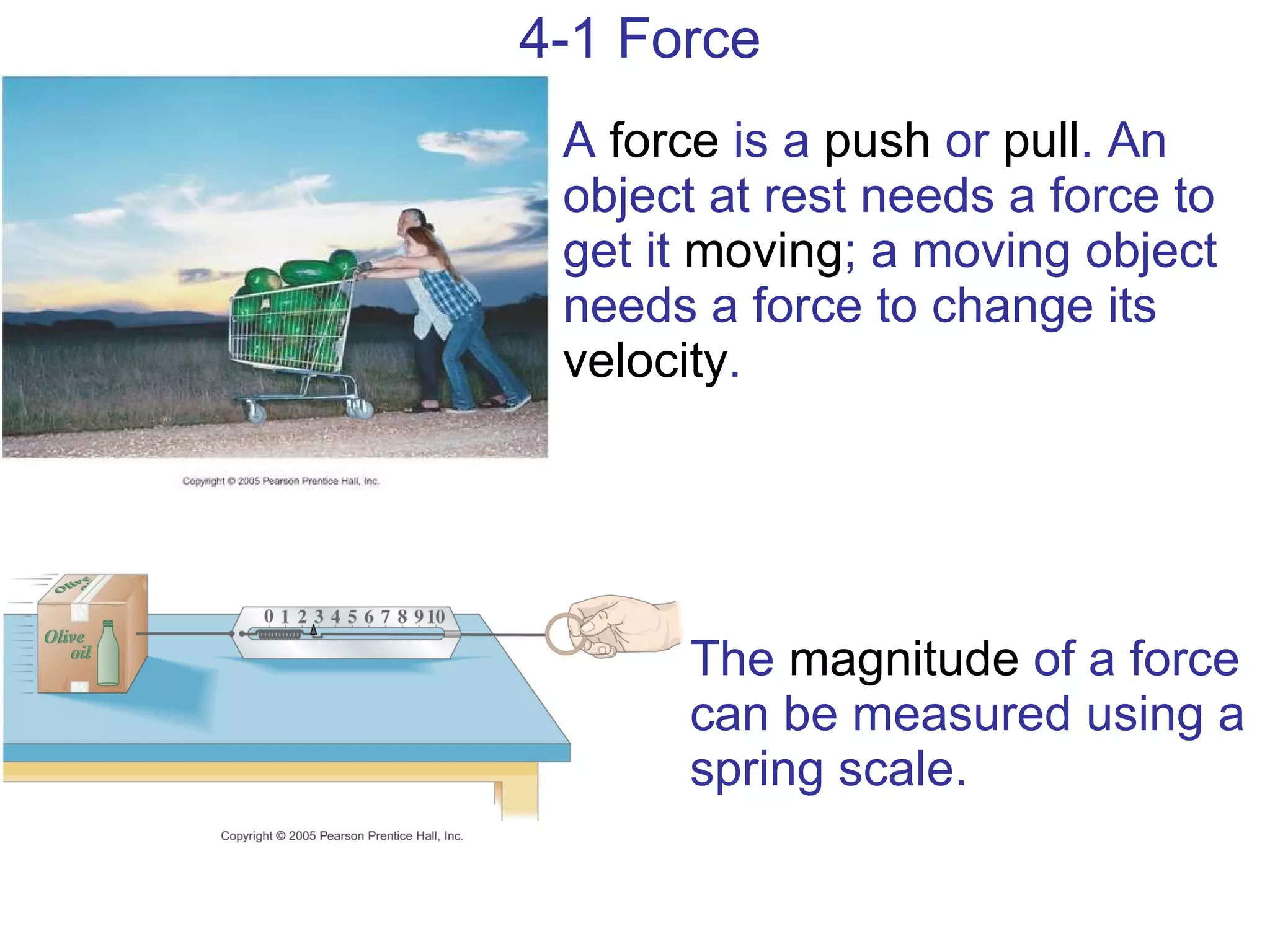
4-1 Force A  force  is a  push  or  pull . An object at rest needs a force to get it  moving ; a moving object needs a force to change its  velocity . The  magnitude  of a force can be measured using a spring scale.
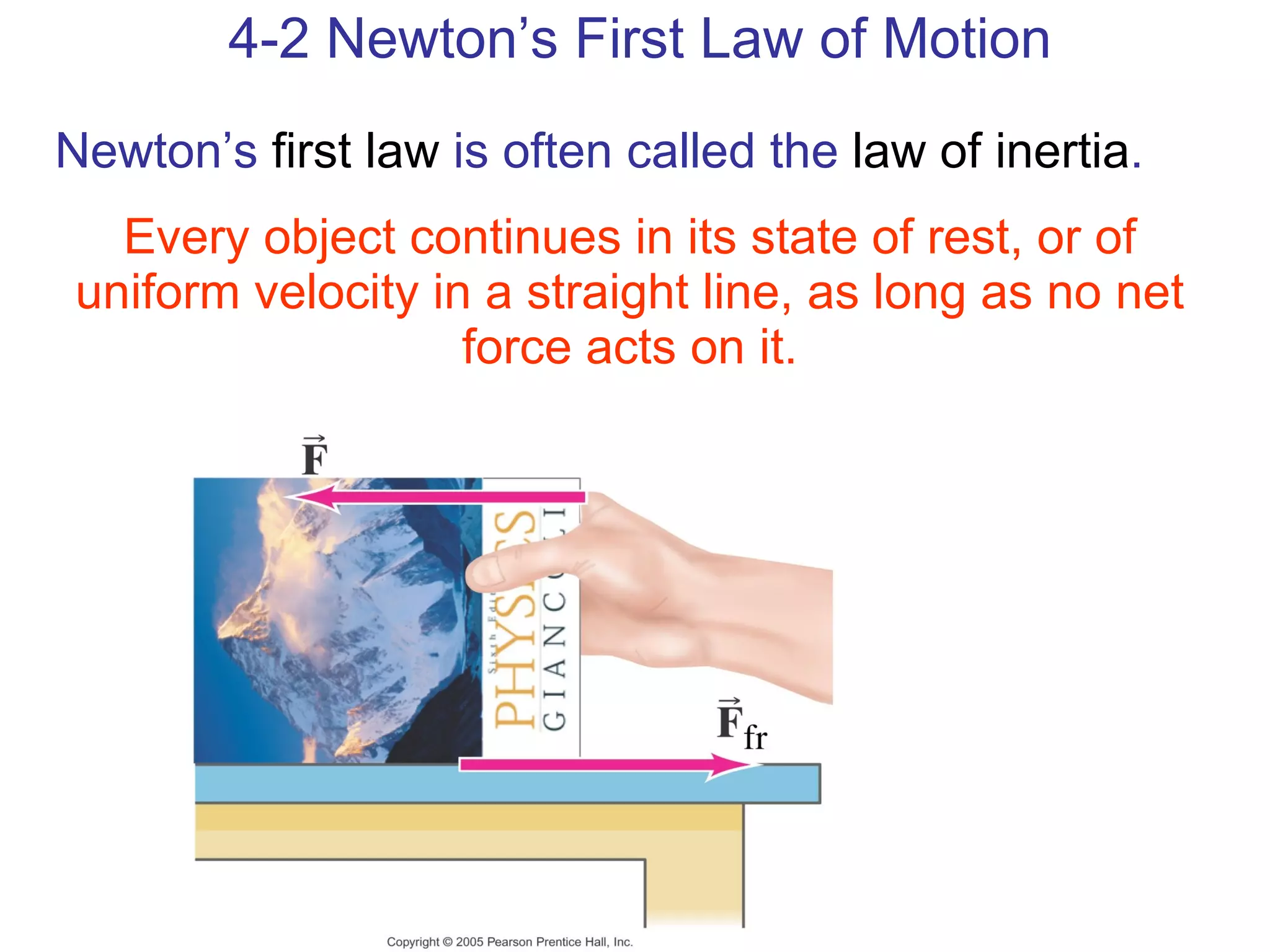
4-2 Newton’s First Law of Motion Newton’s  first law  is often called the  law of inertia . Every object continues in its state of rest, or of uniform velocity in a straight line, as long as no net force acts on it.
4-2 Newton’s First Law of Motion Inertial  reference frames :  An inertial reference frame is one in which  Newton’s first law  is valid. This excludes  rotating  and  accelerating  frames.
4-3 Mass Mass  is the measure of inertia of an object. In the SI system, mass is measured in  kilograms . Inertia     The tendency of a body to maintain its state of rest or motion. Mass is not  weight : Mass is a  property  of an object. Weight is the  force  exerted on that object by gravity. If you go to the moon, whose gravitational acceleration is about 1/6  g , you will weigh much less. Your mass, however, will be the same.
4-4 Newton’s Second Law of Motion 1 st  Law :  If no net force acts, object remains at rest or in uniform motion in straight line. What if a net force acts? Do   Experiments . Find, if the net force  F    0      The   velocity  v  changes (in magnitude or direction or both). A change in the velocity  v  ( Δ v )    There is an acceleration  a =  ( Δ v/ Δ t ) OR  A net force acting on a body produces an acceleration!   F    a
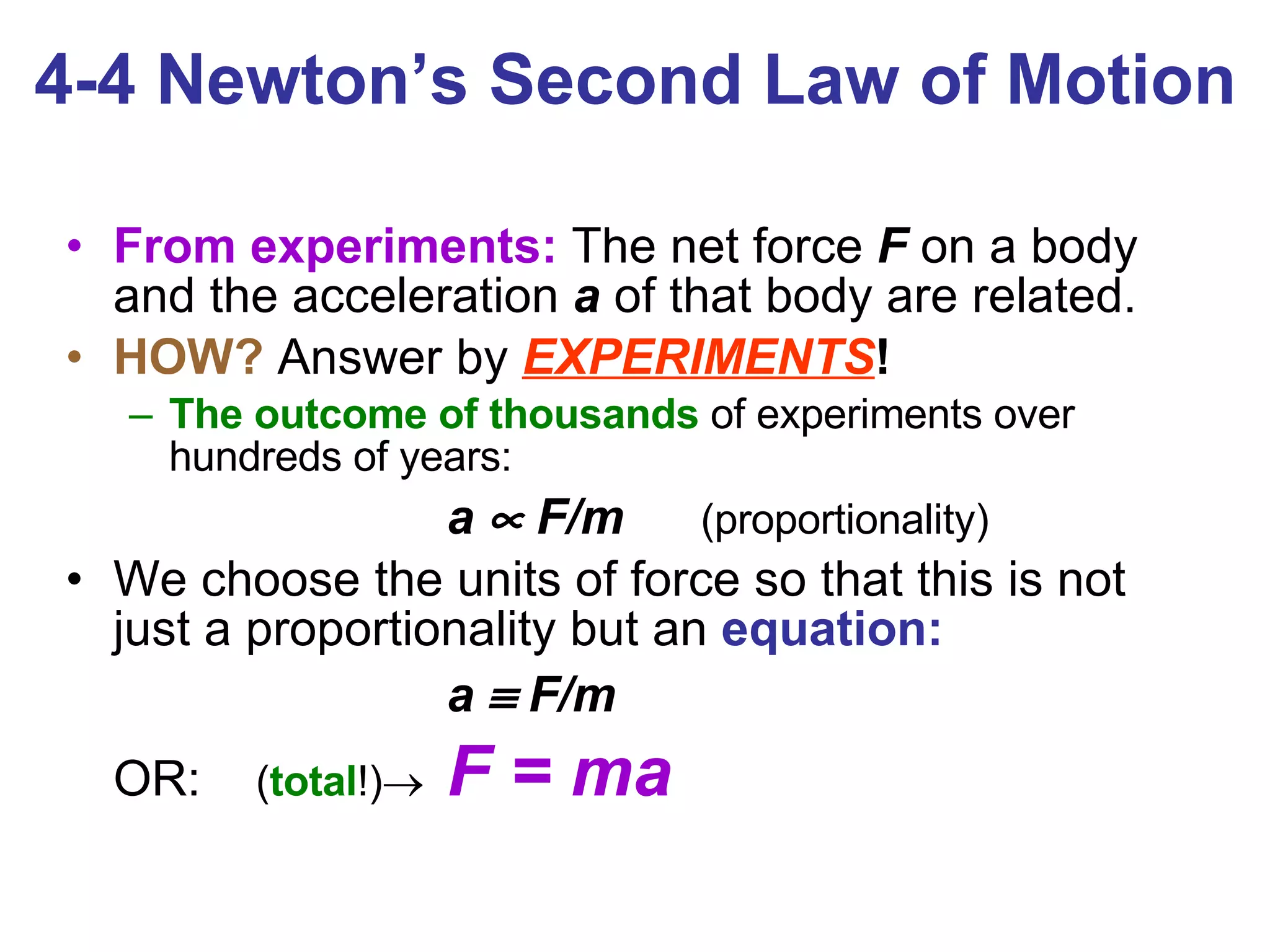
4-4 Newton’s Second Law of Motion From experiments:  The net force  F  on a body and the acceleration  a   of that body are related. HOW?  Answer by  EXPERIMENTS !   The outcome of thousands  of experiments over hundreds of years: a    F/m   (proportionality) We choose the units of force so that this is not just a proportionality but an  equation: a    F/m OR:  ( total !)  F = ma
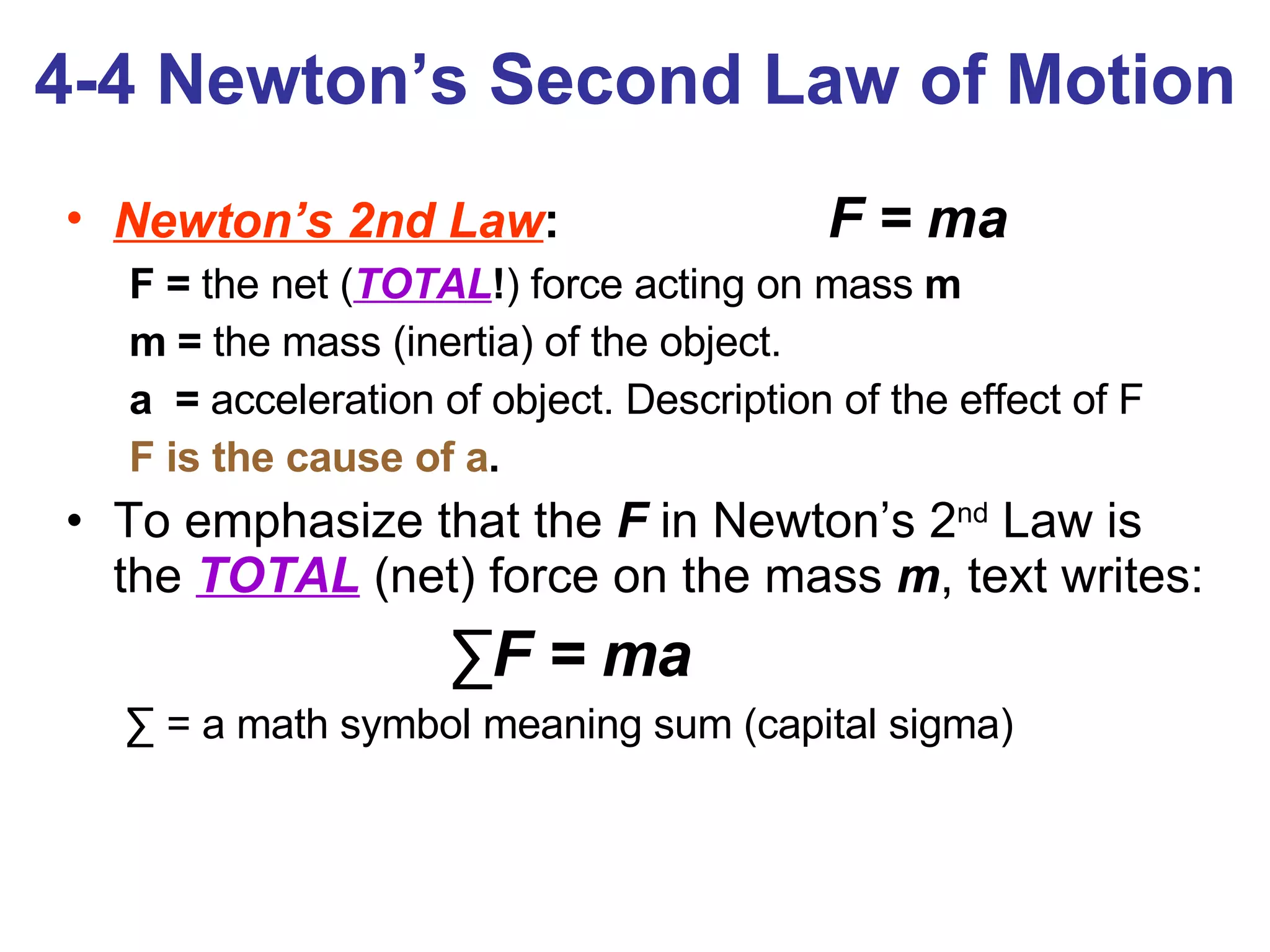
4-4 Newton’s Second Law of Motion Newton’s 2nd Law :  F = ma F =  the net ( TOTAL ! ) force acting on mass  m m =  the mass (inertia) of the object. a  =  acceleration of object. Description of the effect of F F is the cause of a .   To emphasize that the  F  in Newton’s 2 nd  Law is the  TOTAL  (net) force on the mass  m , text writes: ∑ F = ma   ∑   = a math symbol meaning sum (capital sigma)
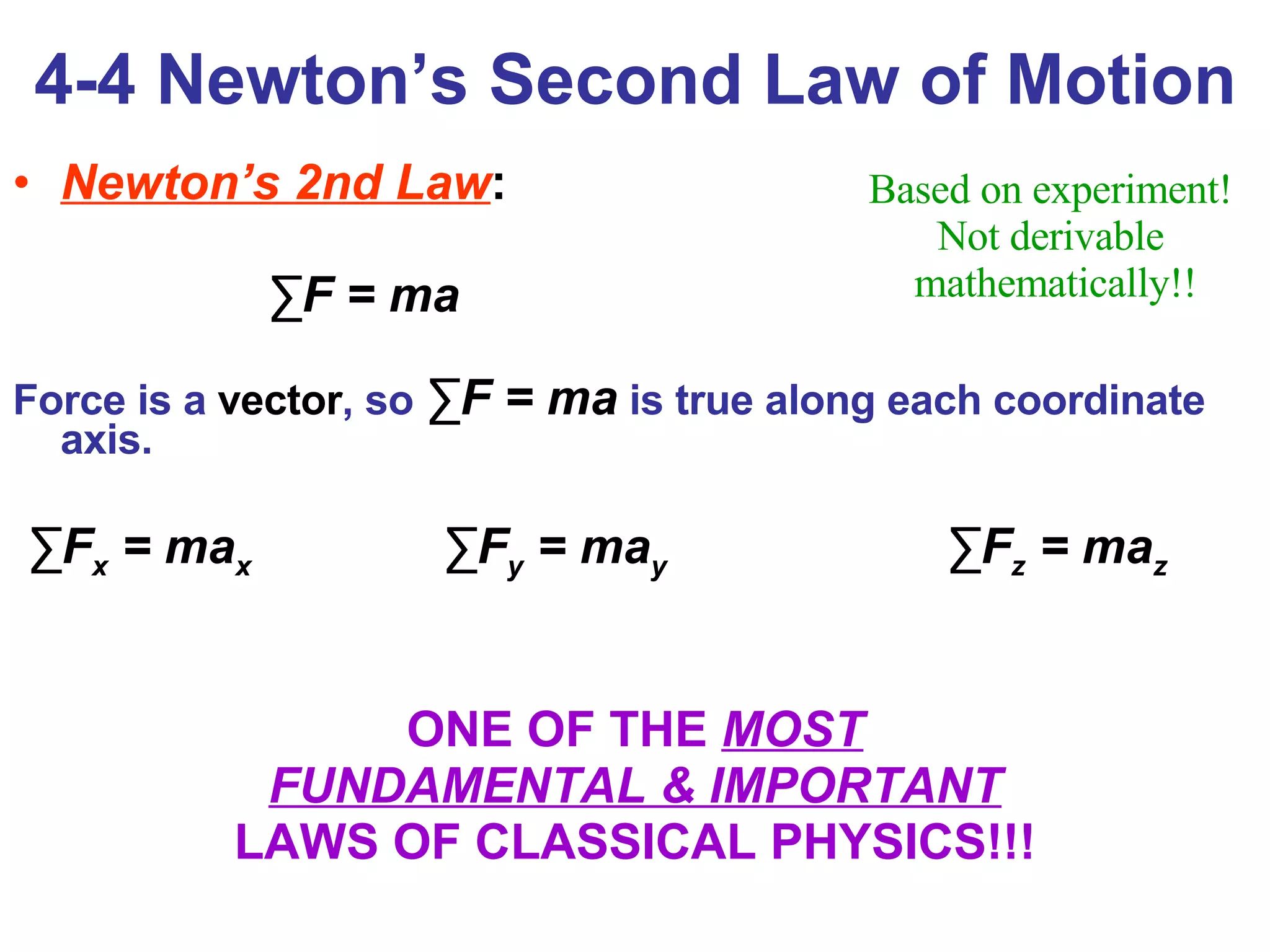
4-4 Newton’s Second Law of Motion Newton’s 2nd Law :   ∑ F = ma Force is a  vector , so  ∑ F = ma   is true along each coordinate axis. ∑ F x  = ma x  ∑ F y  = ma y  ∑ F z  = ma z ONE OF THE  MOST FUNDAMENTAL & IMPORTANT LAWS OF CLASSICAL PHYSICS!!! Based on experiment!  Not derivable  mathematically!!
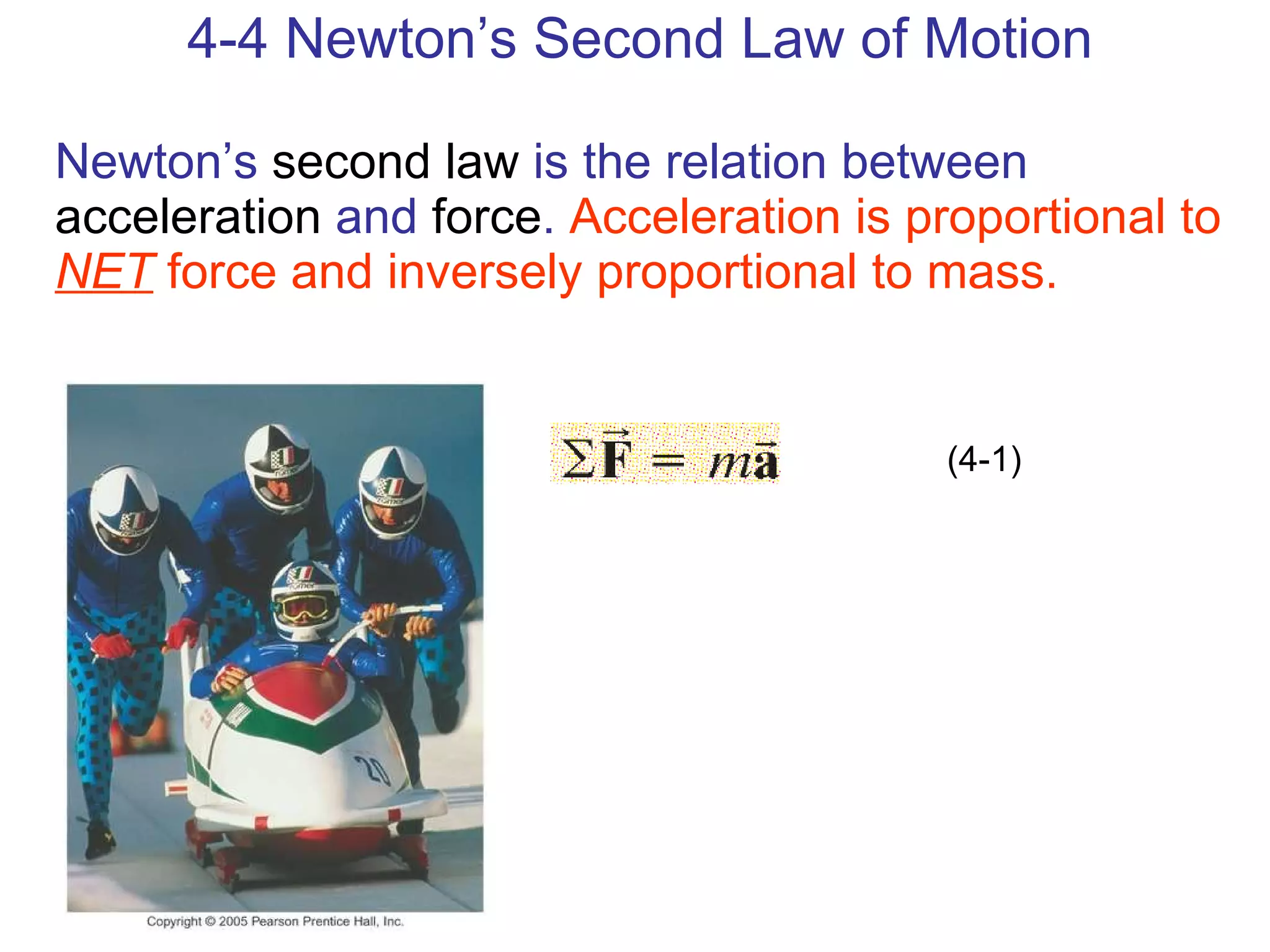
4-4 Newton’s Second Law of Motion Newton’s  second law  is the relation between  acceleration  and  force .  Acceleration is proportional to  NET  force and inversely proportional to mass. (4-1)
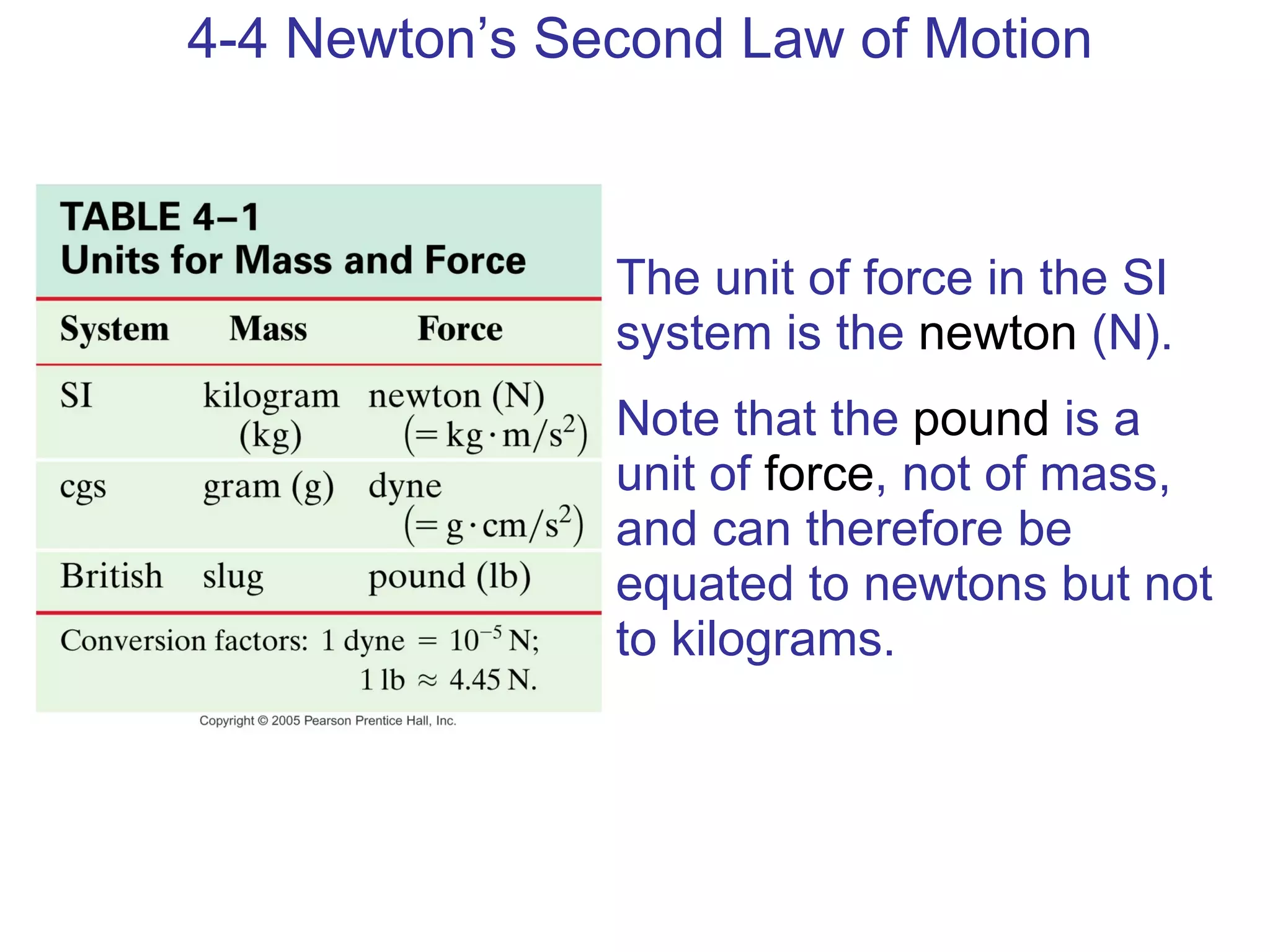
4-4 Newton’s Second Law of Motion The unit of force in the SI system is the  newton  (N). Note that the  pound  is a unit of  force , not of mass, and can therefore be equated to newtons but not to kilograms.
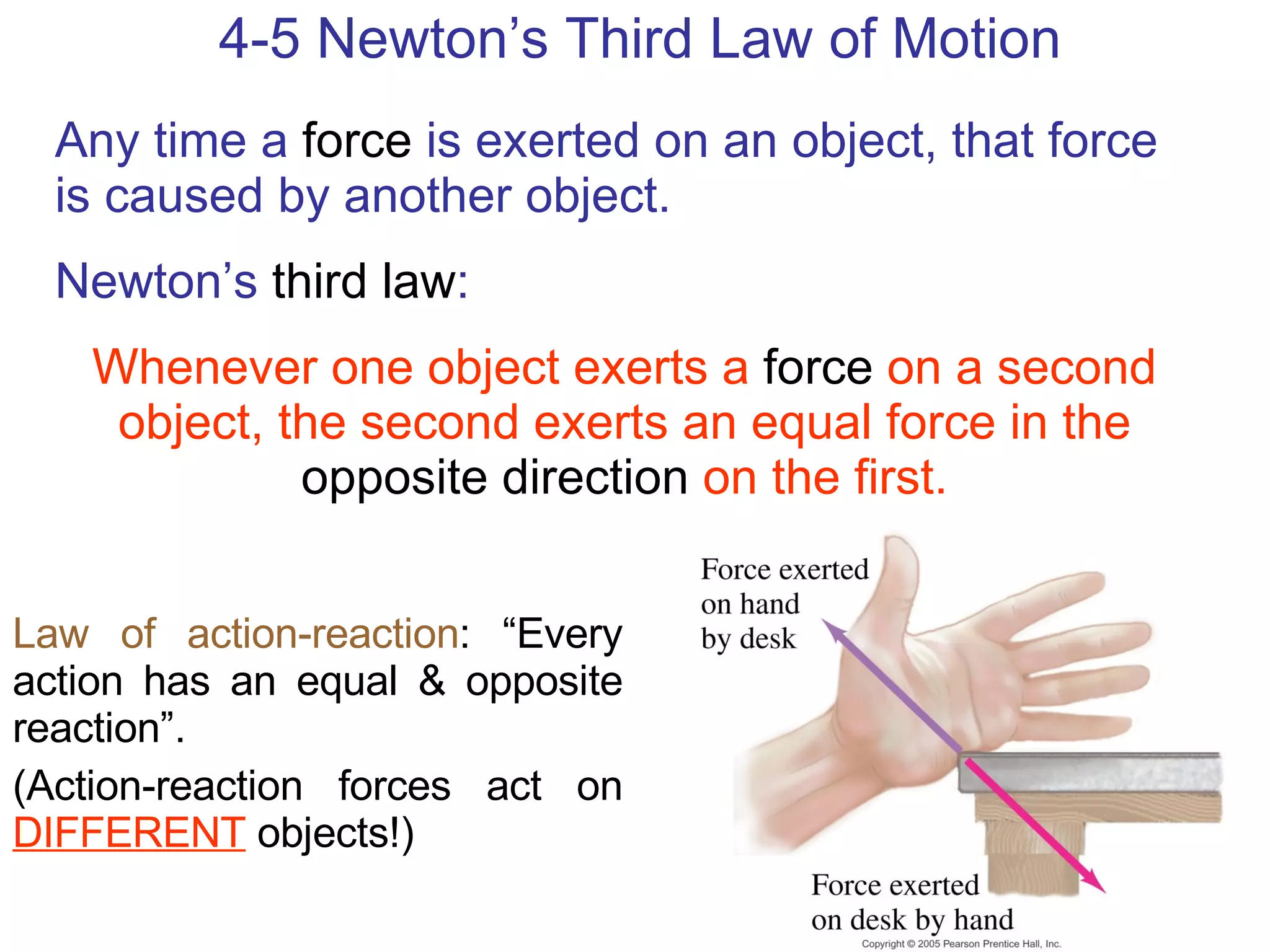
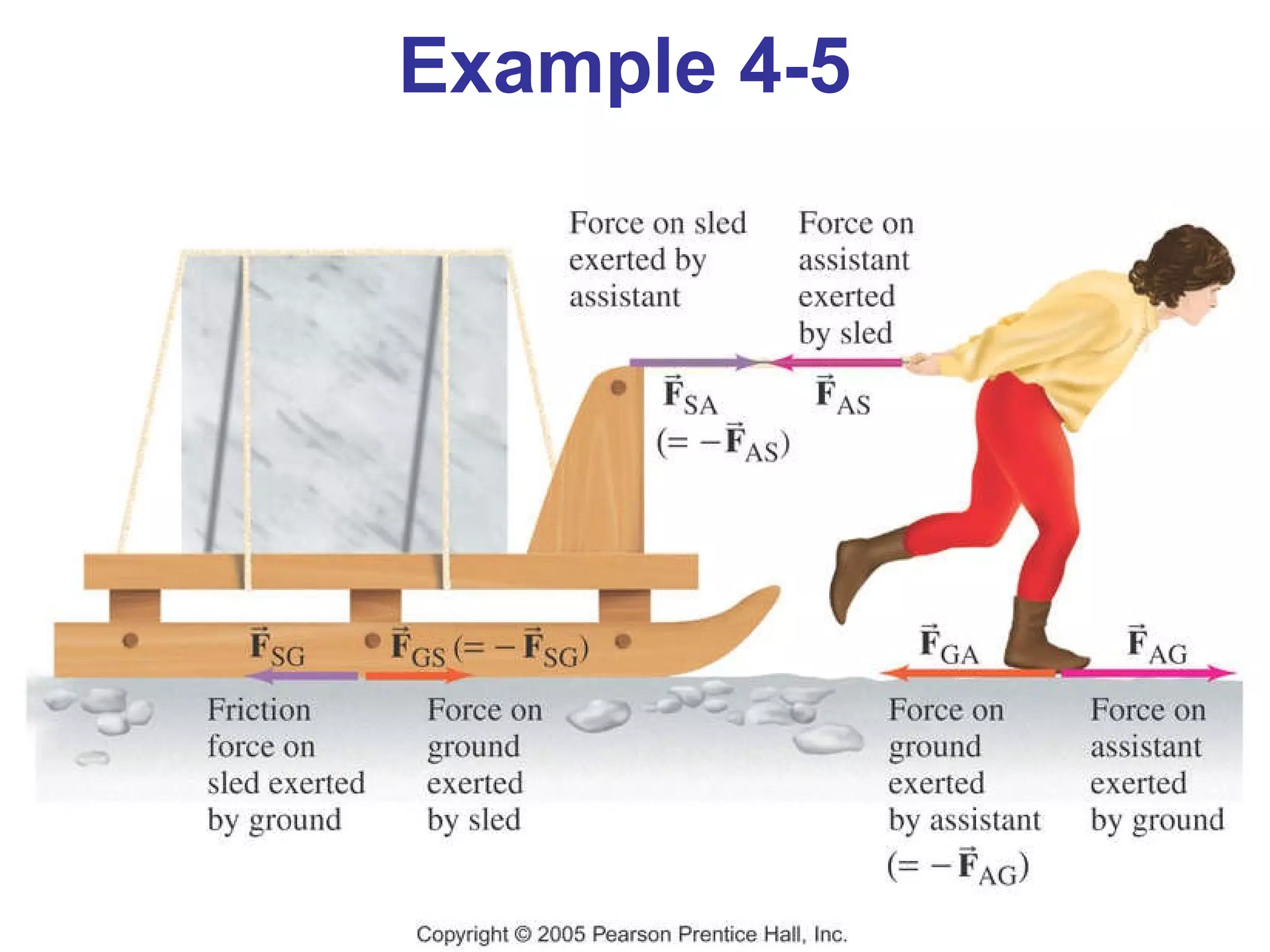
4-5 Newton’s Third Law of Motion Any time a  force  is exerted on an object, that force is caused by another object. Newton’s  third law : Whenever one object exerts a   force   on a second object, the second exerts an equal force in the   opposite direction   on the first. Law of action-reaction : “Every action has an equal & opposite reaction”. (Action-reaction forces act on  DIFFERENT  objects!)
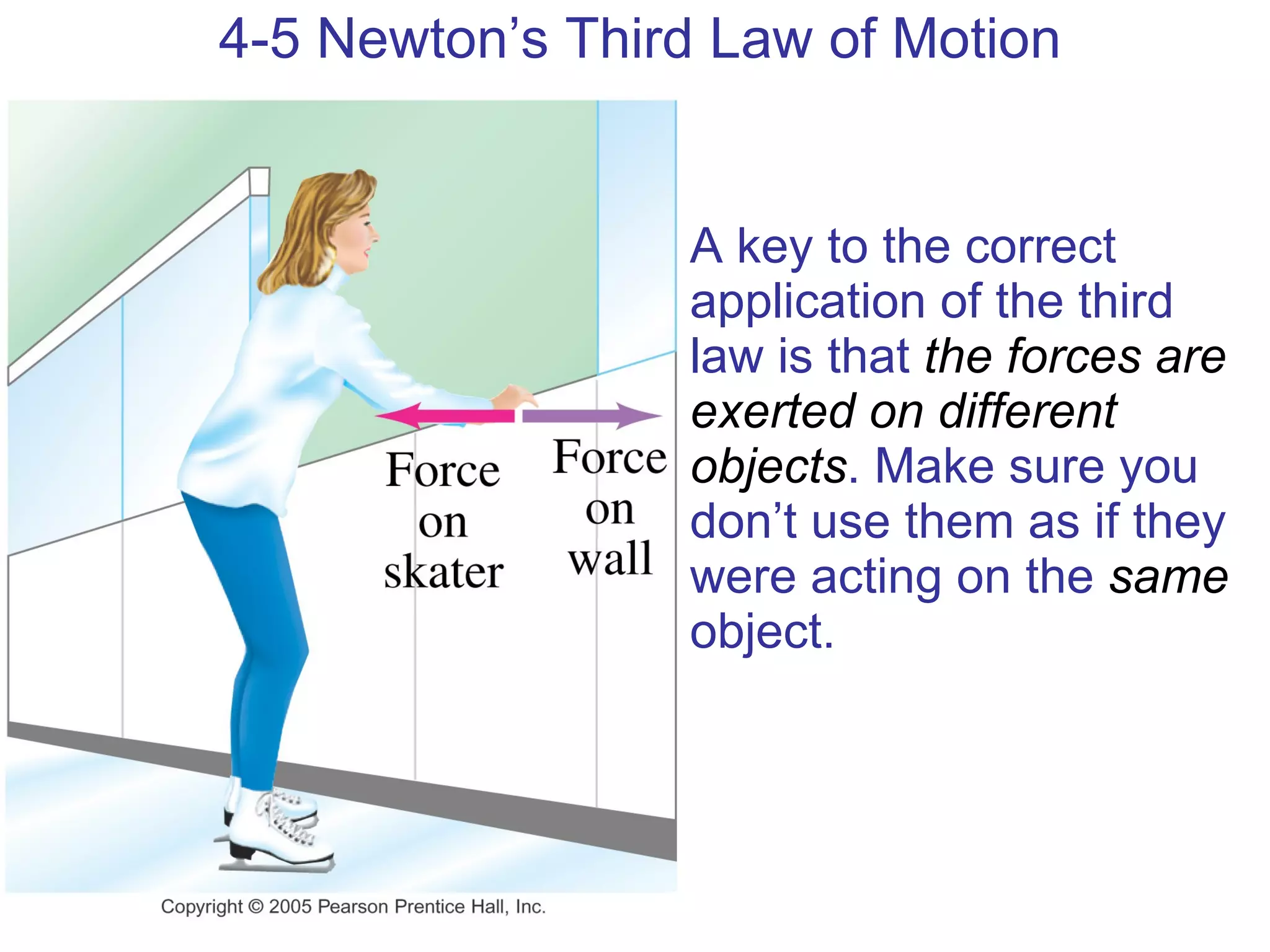
4-5 Newton’s Third Law of Motion A key to the correct application of the third law is that  the forces are exerted on different objects . Make sure you don’t use them as if they were acting on the  same  object.
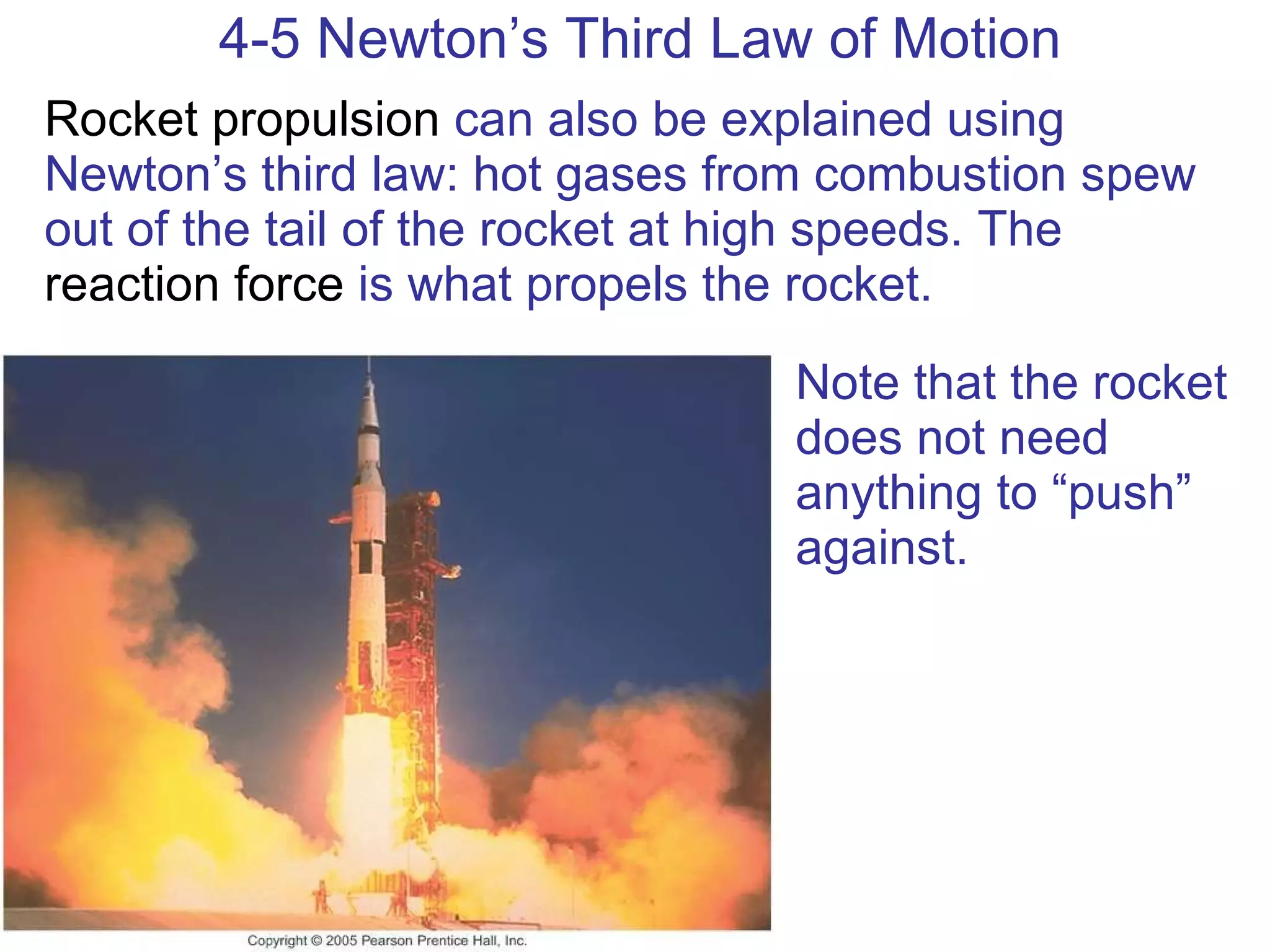
4-5 Newton’s Third Law of Motion Rocket propulsion  can also be explained using Newton’s third law: hot gases from combustion spew out of the tail of the rocket at high speeds. The  reaction force  is what propels the rocket. Note that the rocket does not need anything to “push” against.
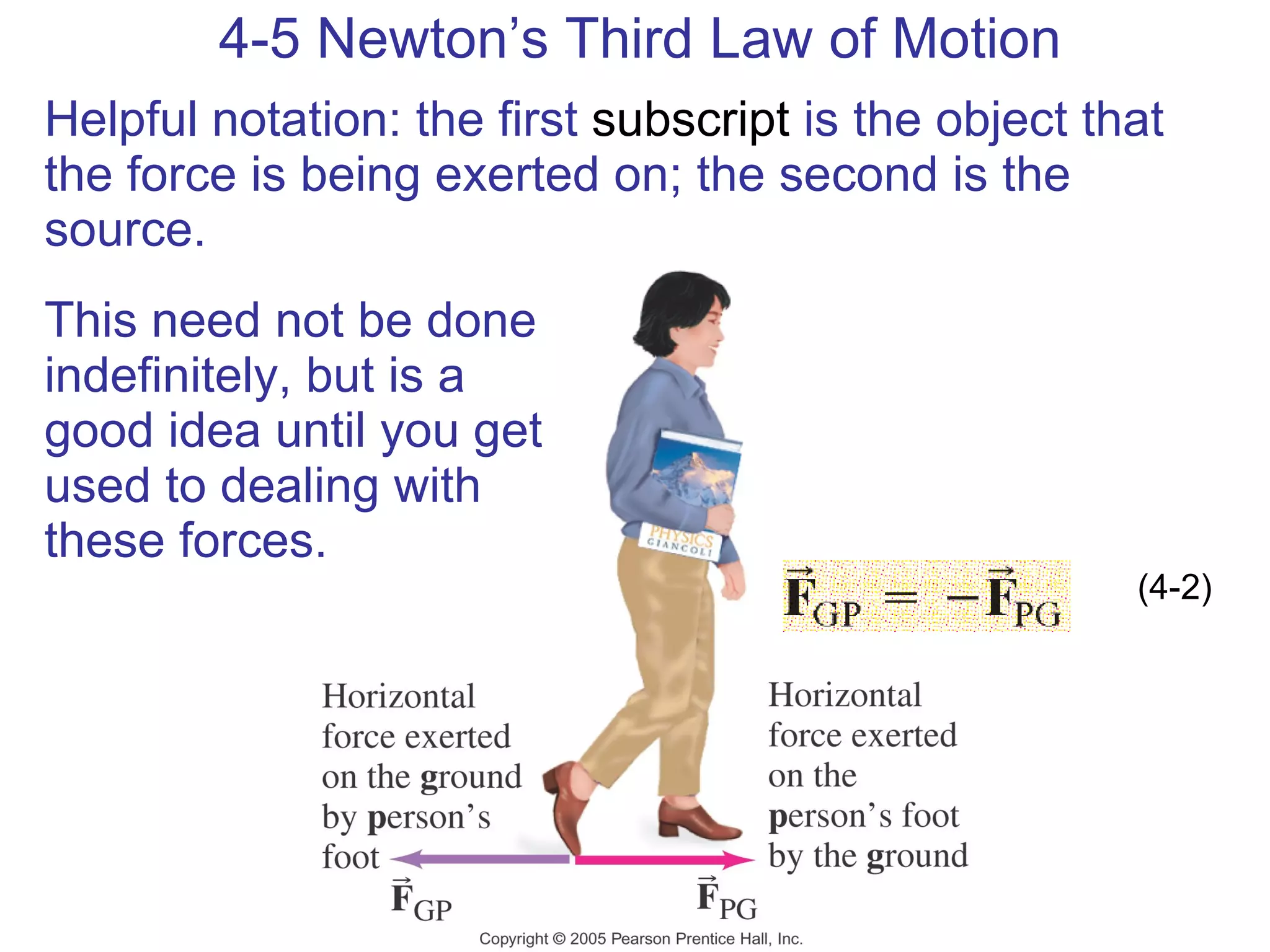
4-5 Newton’s Third Law of Motion Helpful notation: the first  subscript  is the object that the force is being exerted on; the second is the source.  This need not be done indefinitely, but is a good idea until you get used to dealing with these forces. (4-2)
Example 4-5
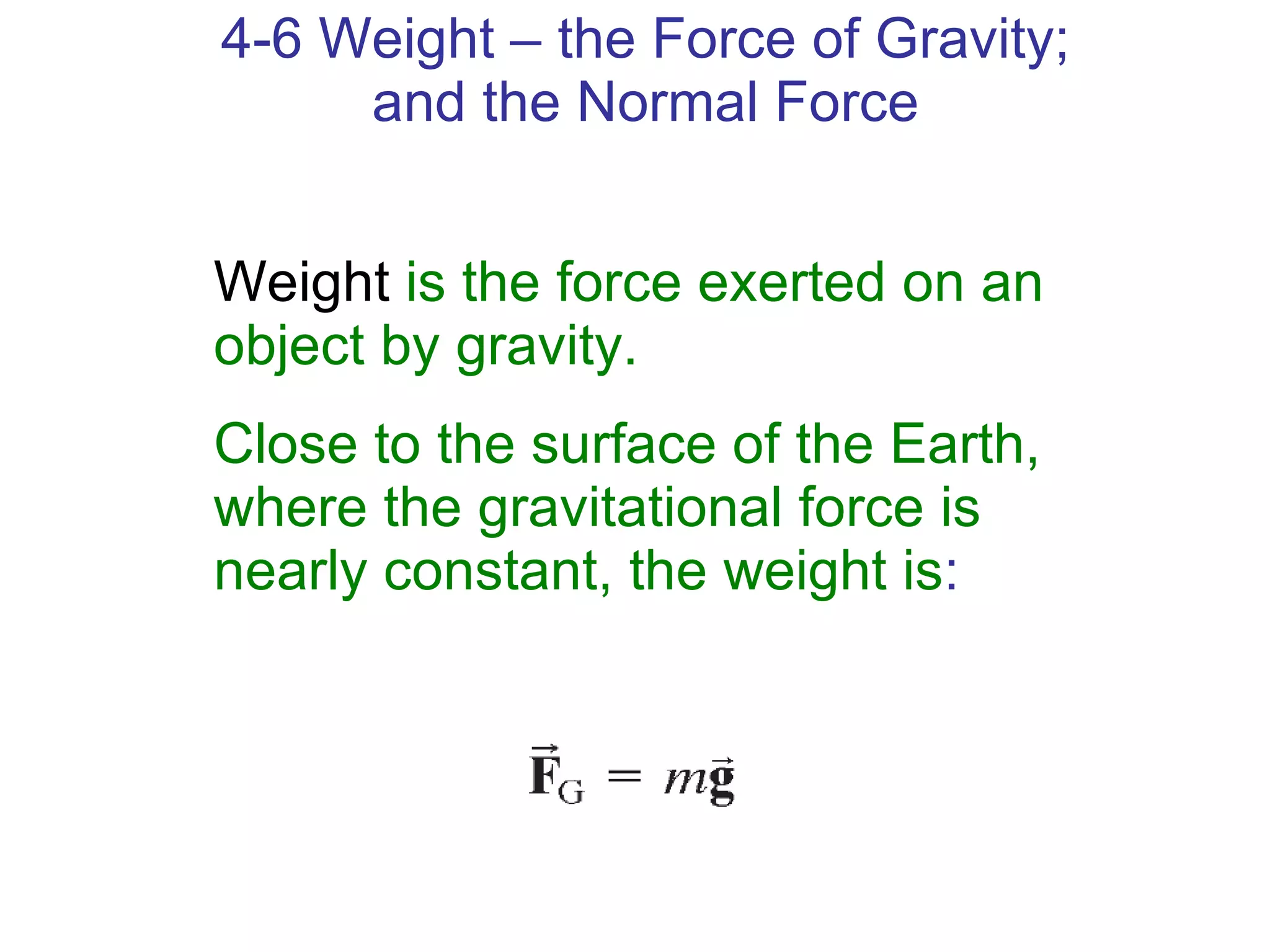
4-6 Weight – the Force of Gravity; and the Normal Force Weight   is the force exerted on an object by gravity.  Close to the surface of the Earth, where the gravitational force is nearly constant, the weight is :
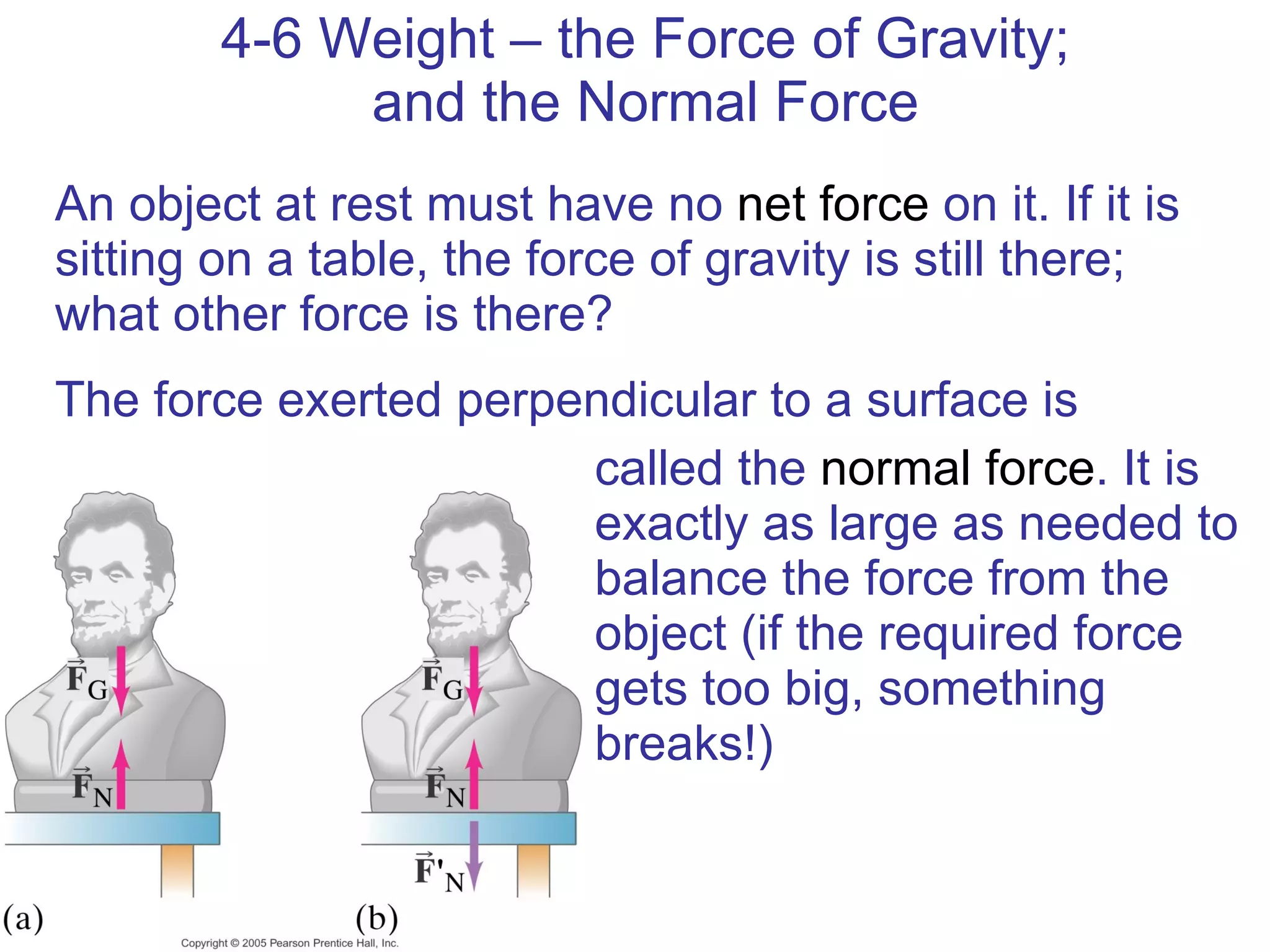
4-6 Weight – the Force of Gravity; and the Normal Force An object at rest must have no  net force  on it. If it is sitting on a table, the force of gravity is still there; what other force is there? The force exerted perpendicular to a surface is called the  normal force . It is exactly as large as needed to balance the force from the object (if the required force gets too big, something breaks!)
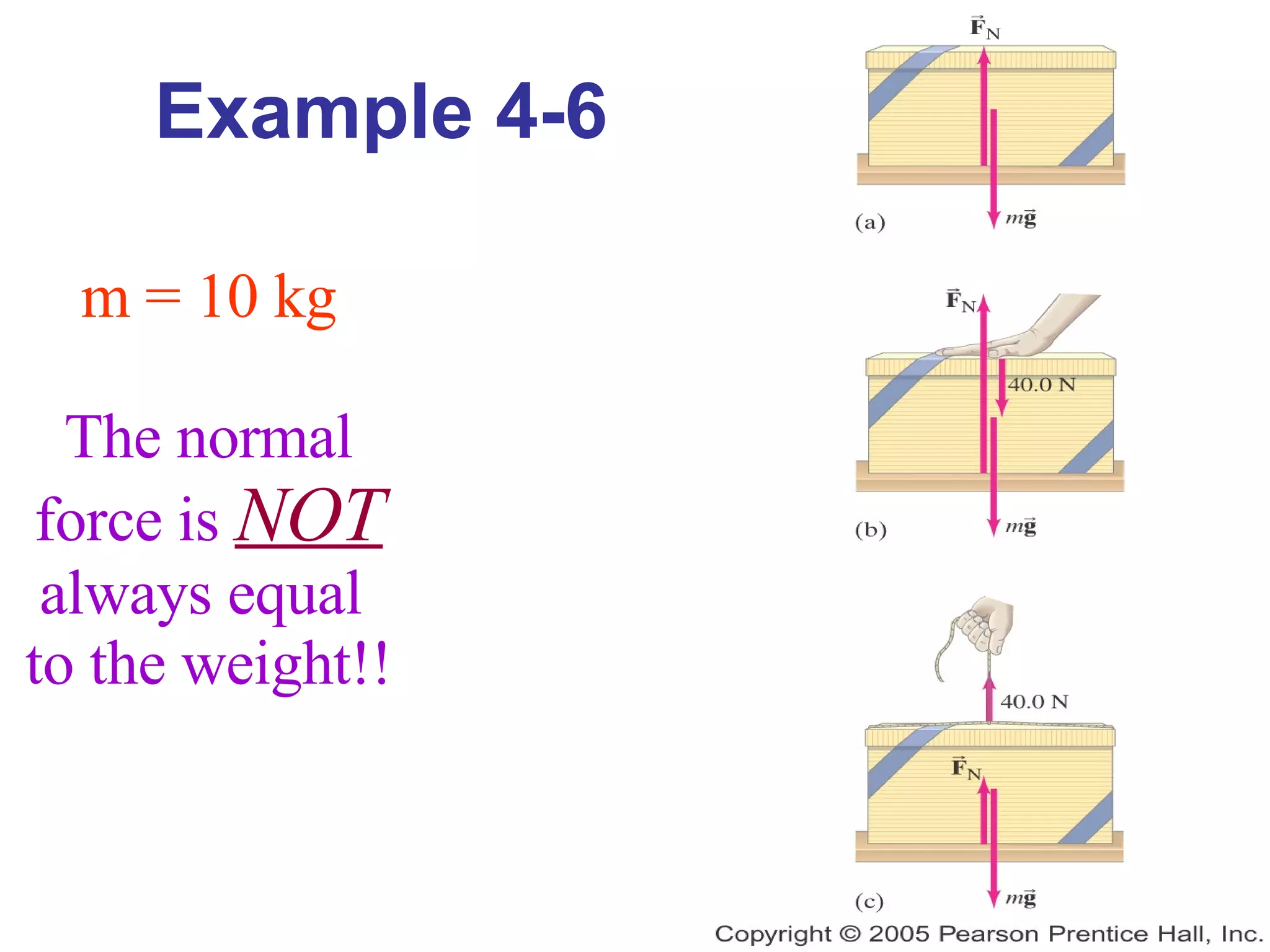
Example 4-6 m = 10 kg The normal force is  NOT always equal  to the weight!!
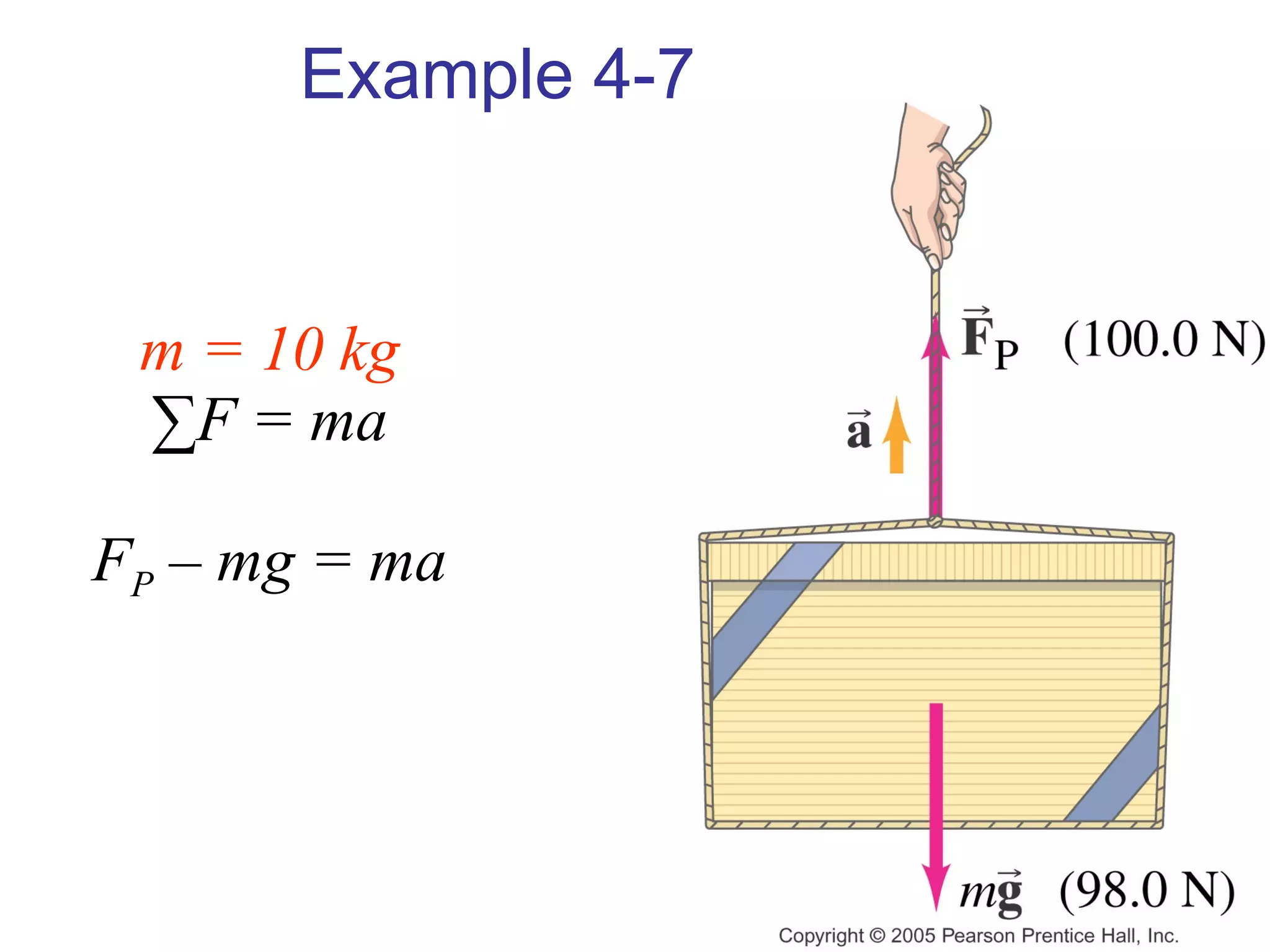
m = 10 kg ∑ F = ma F P  – mg = ma Example 4-7
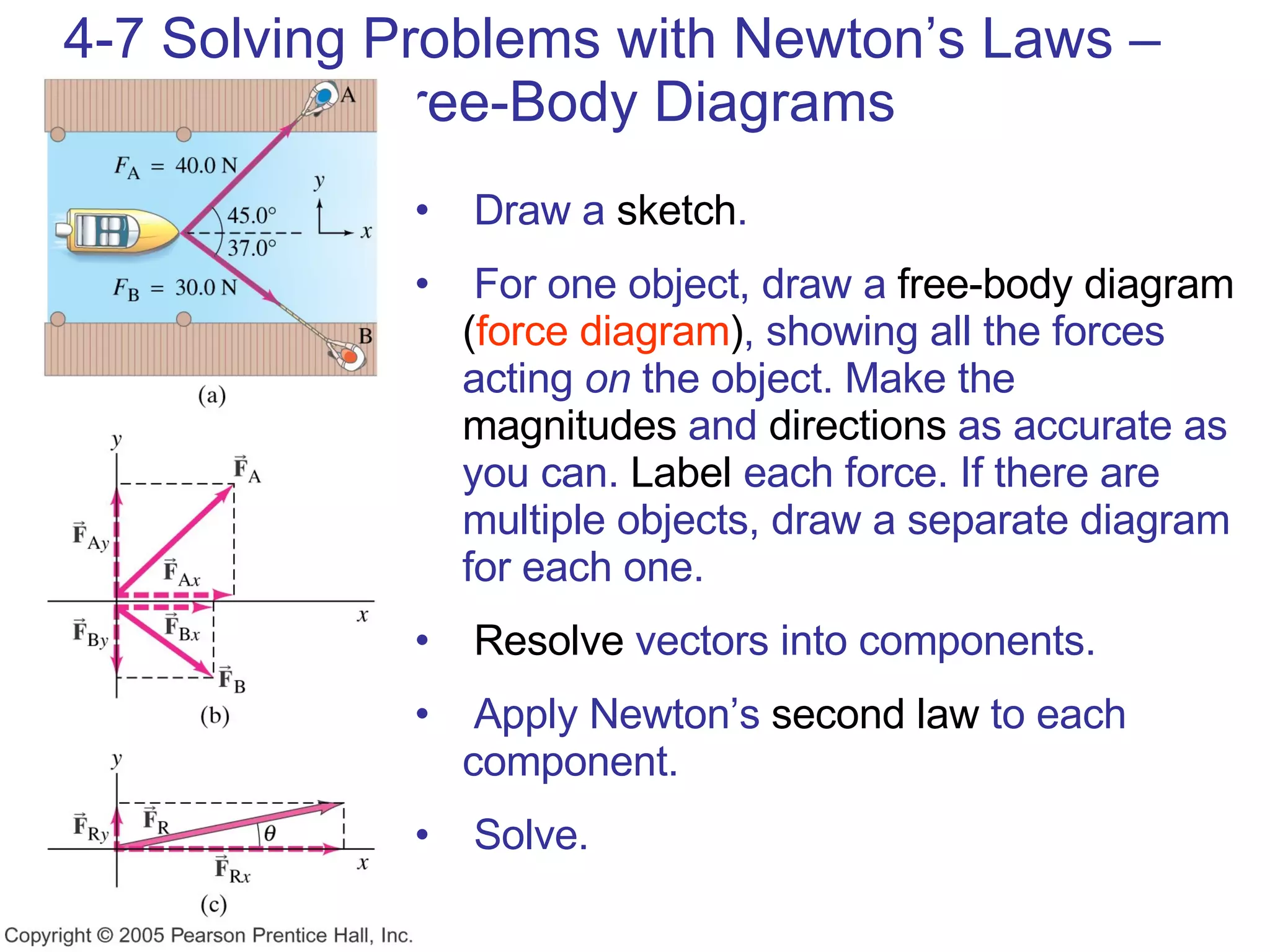
4-7 Solving Problems with Newton’s Laws –  Free-Body Diagrams Draw a  sketch . For one object, draw a  free-body diagram ( force diagram ) , showing all the forces acting  on  the object. Make the  magnitudes  and  directions  as accurate as you can.  Label  each force. If there are multiple objects, draw a separate diagram for each one. Resolve  vectors into components. Apply Newton’s  second law  to each component. Solve.
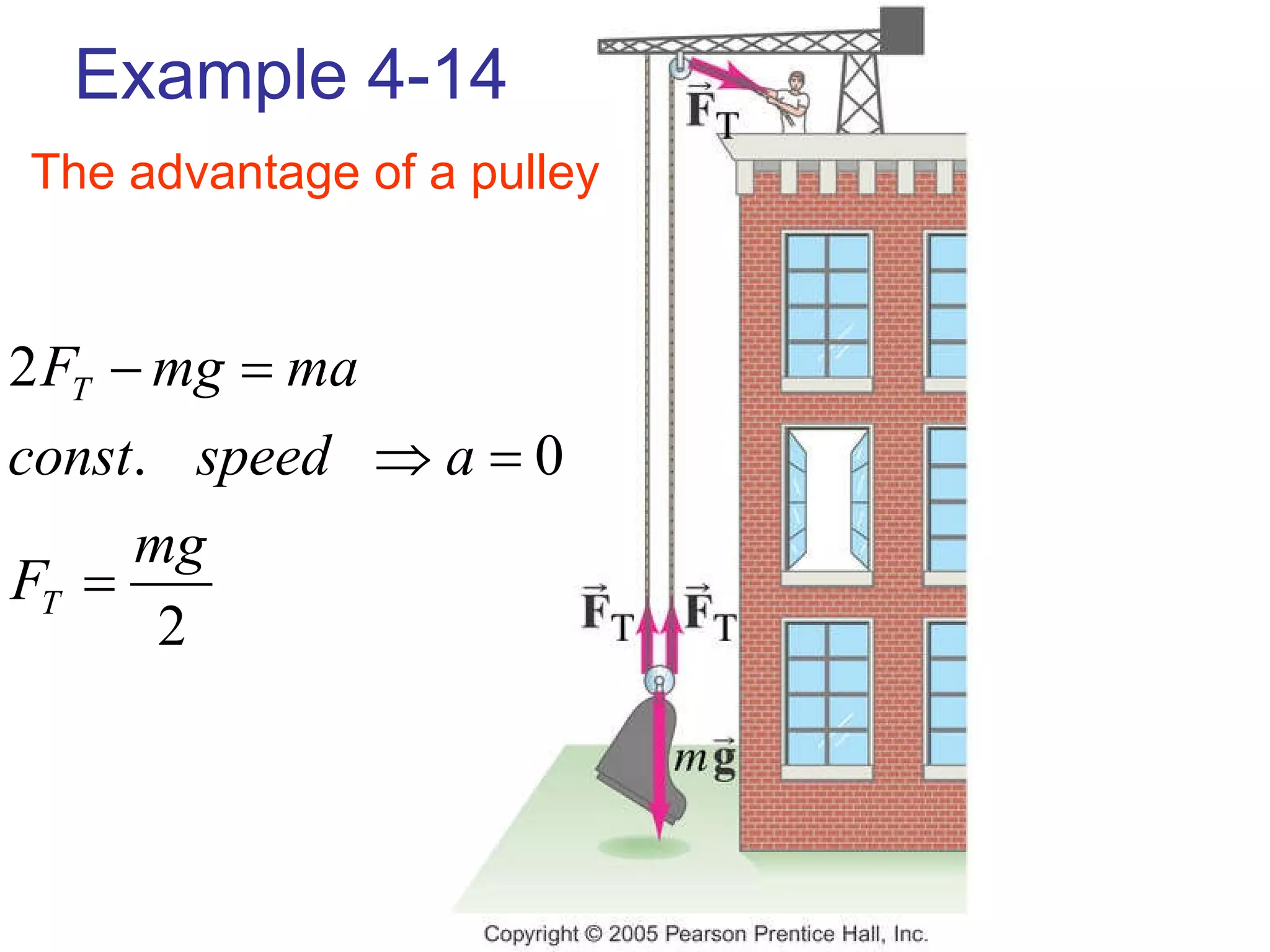
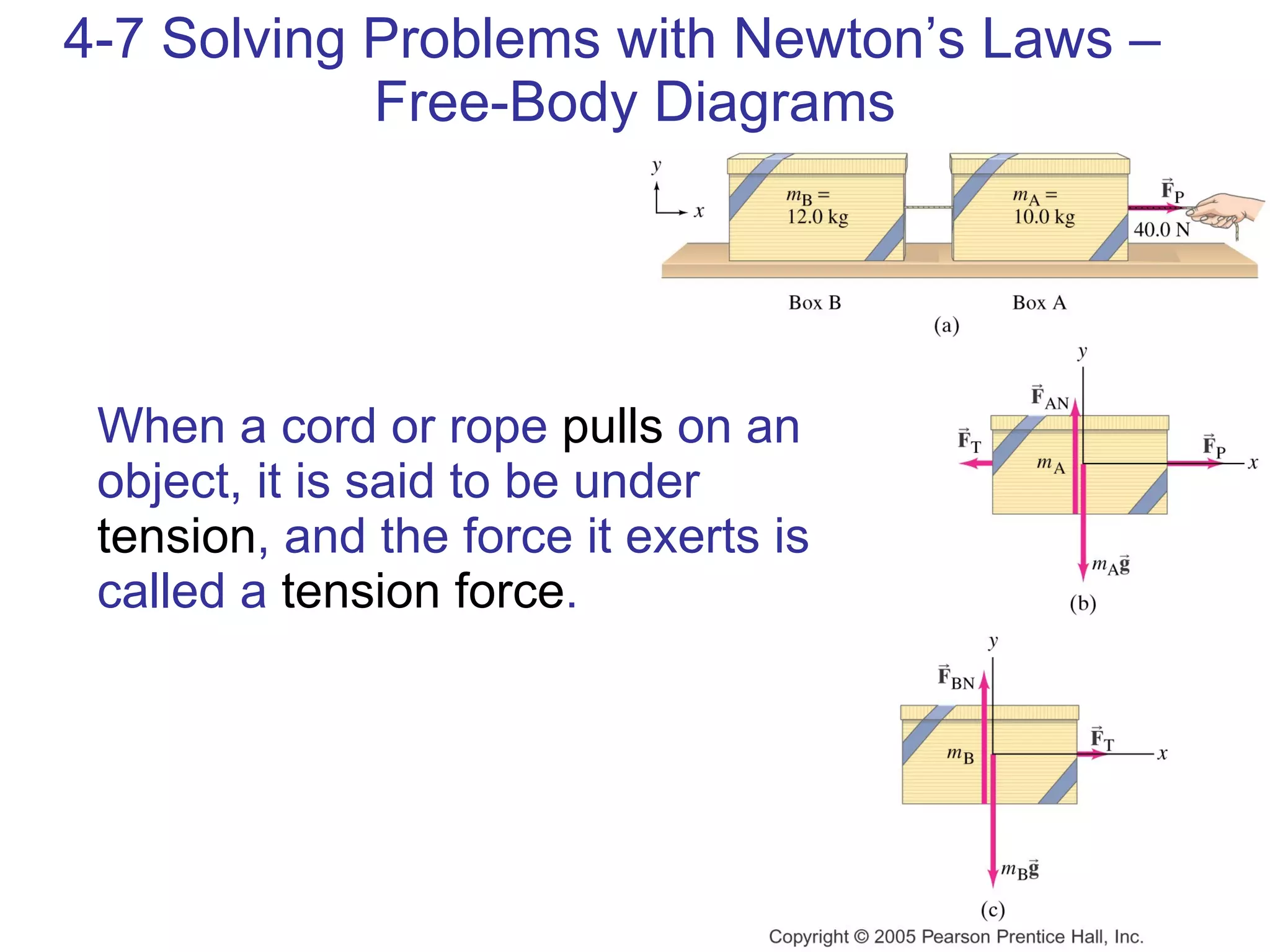
4-7 Solving Problems with Newton’s Laws –  Free-Body Diagrams When a cord or rope  pulls  on an object, it is said to be under  tension , and the force it exerts is called a  tension force .
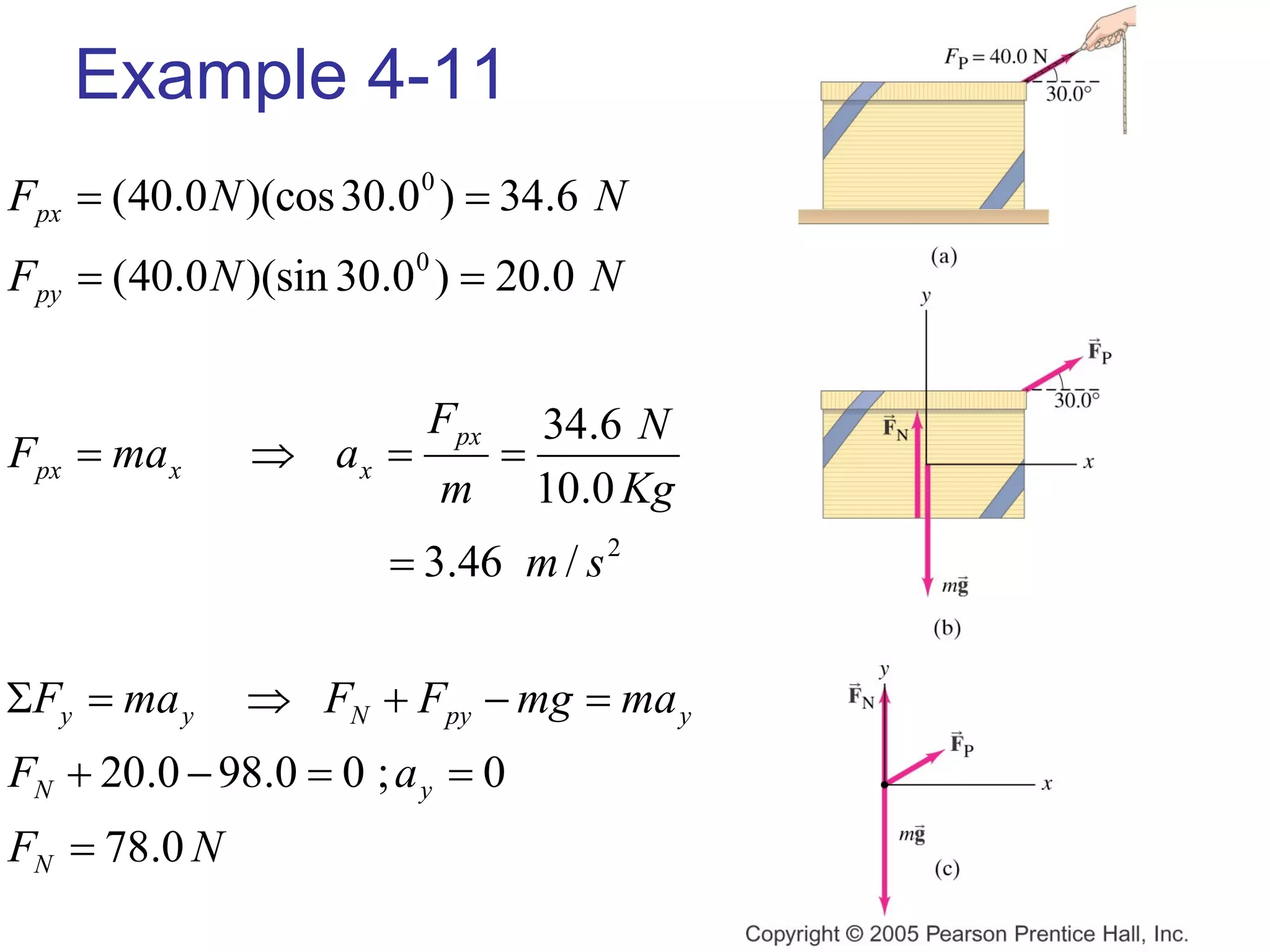
Example 4-11
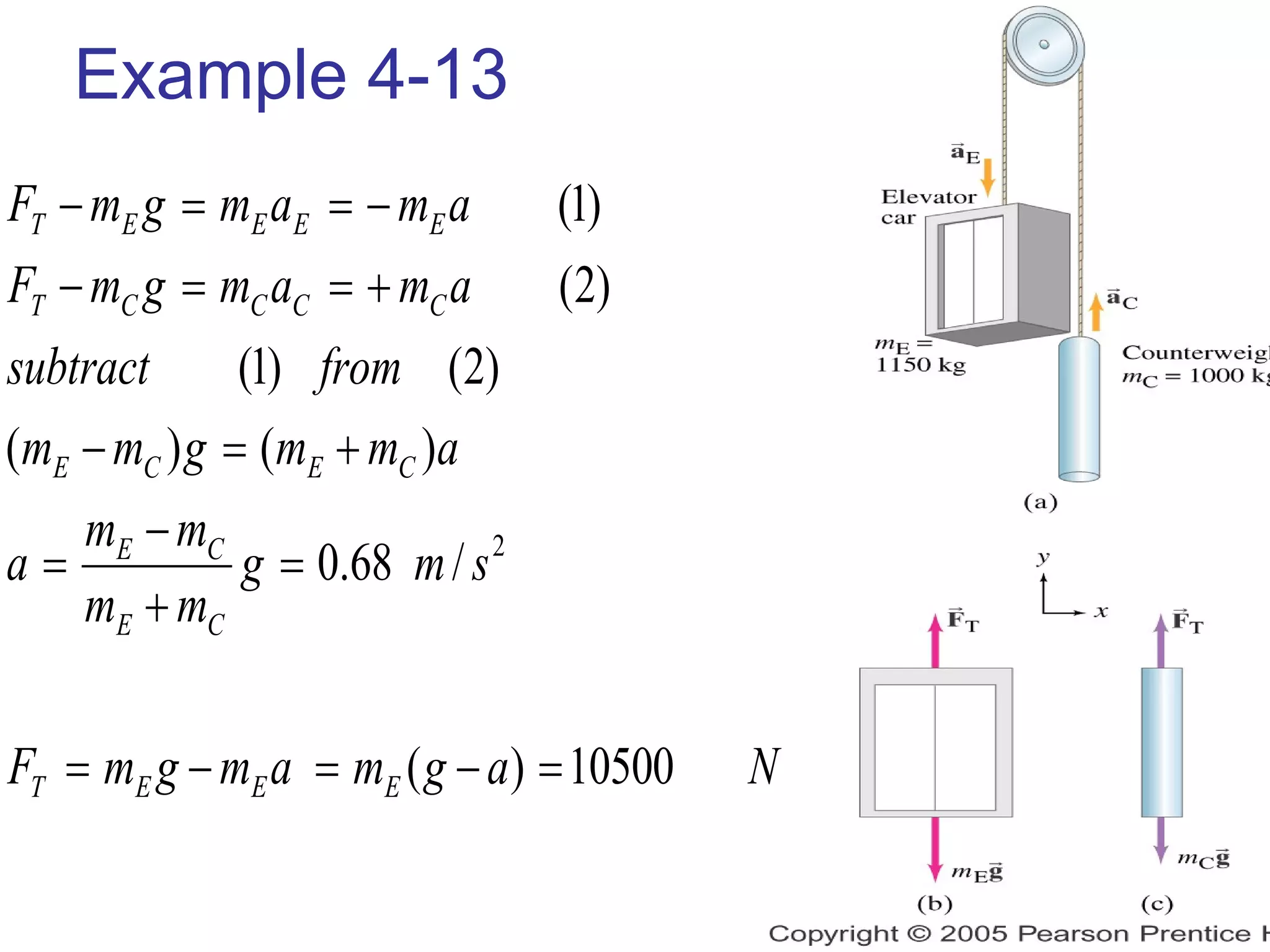
Example 4-13
Example 4-14 The advantage of a pulley
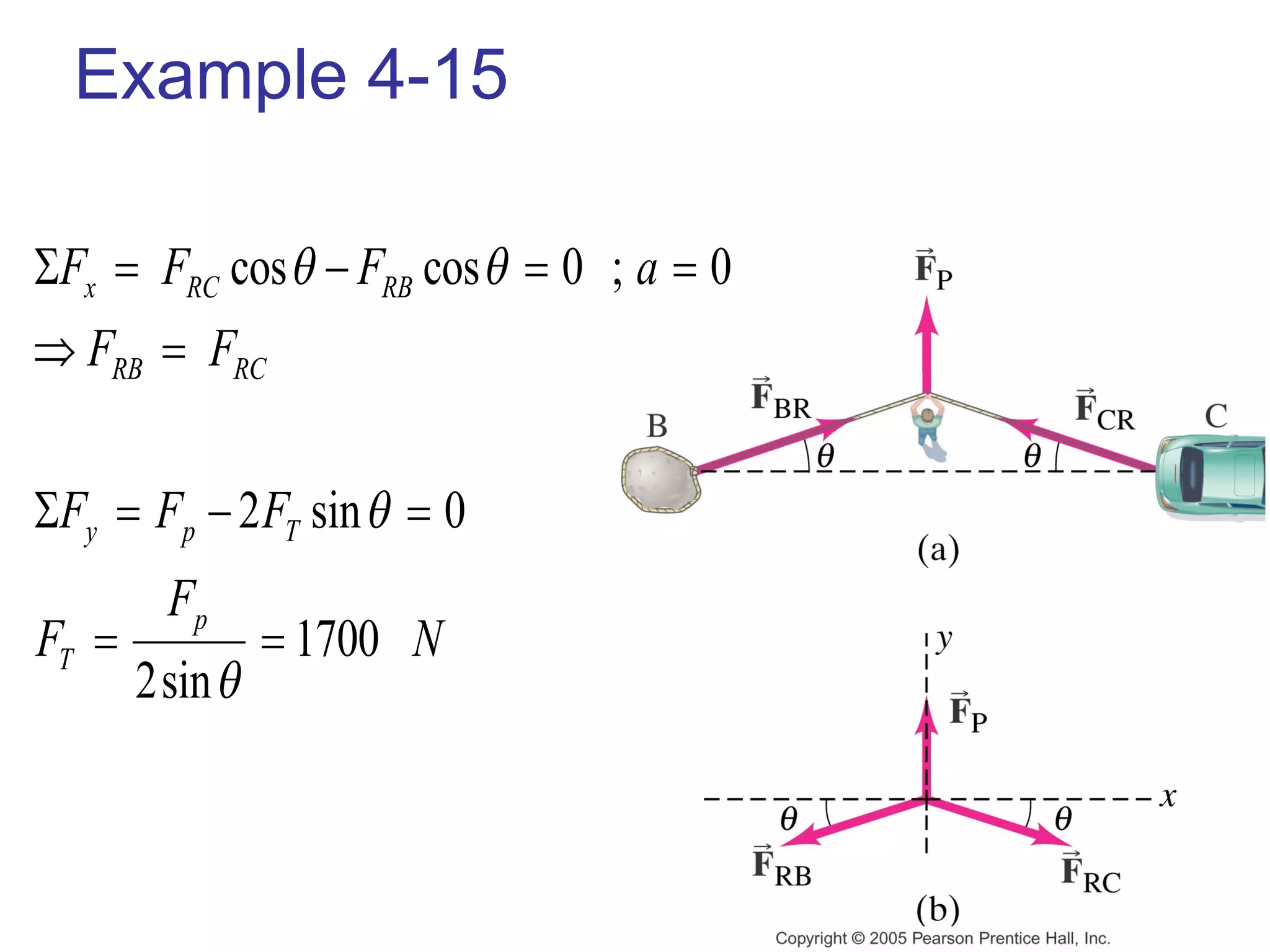
Example 4-15
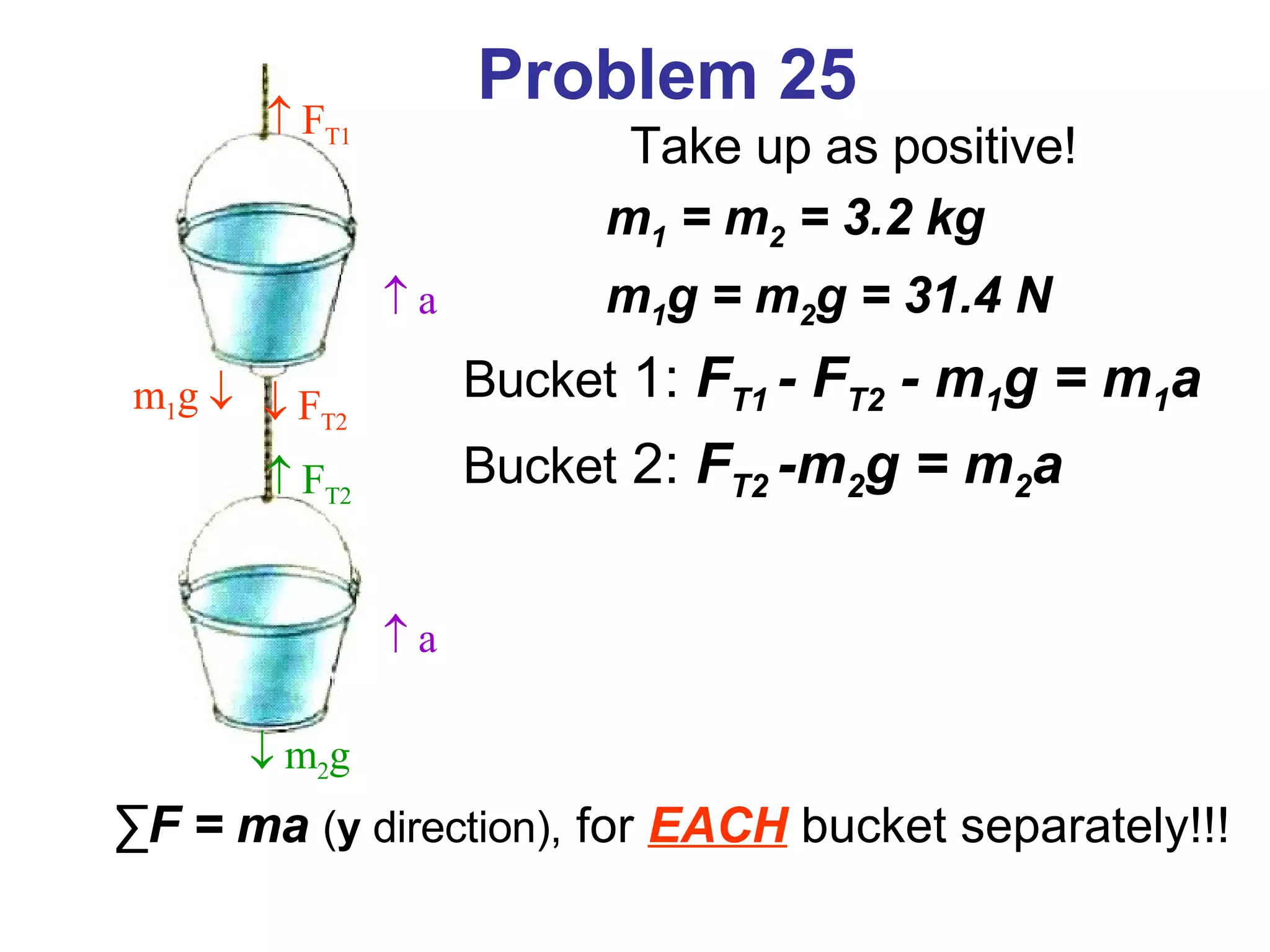
Problem 25 Take up as positive!  m 1  = m 2  = 3.2 kg m 1 g = m 2 g = 31.4 N   Bucket  1:  F T1  - F T2  - m 1 g = m 1 a   Bucket  2:  F T2  -m 2 g = m 2 a ∑ F = ma   ( y  direction),   for  EACH  bucket separately!!!    F T1    F T2    F T2    m 2 g m 1 g      a    a
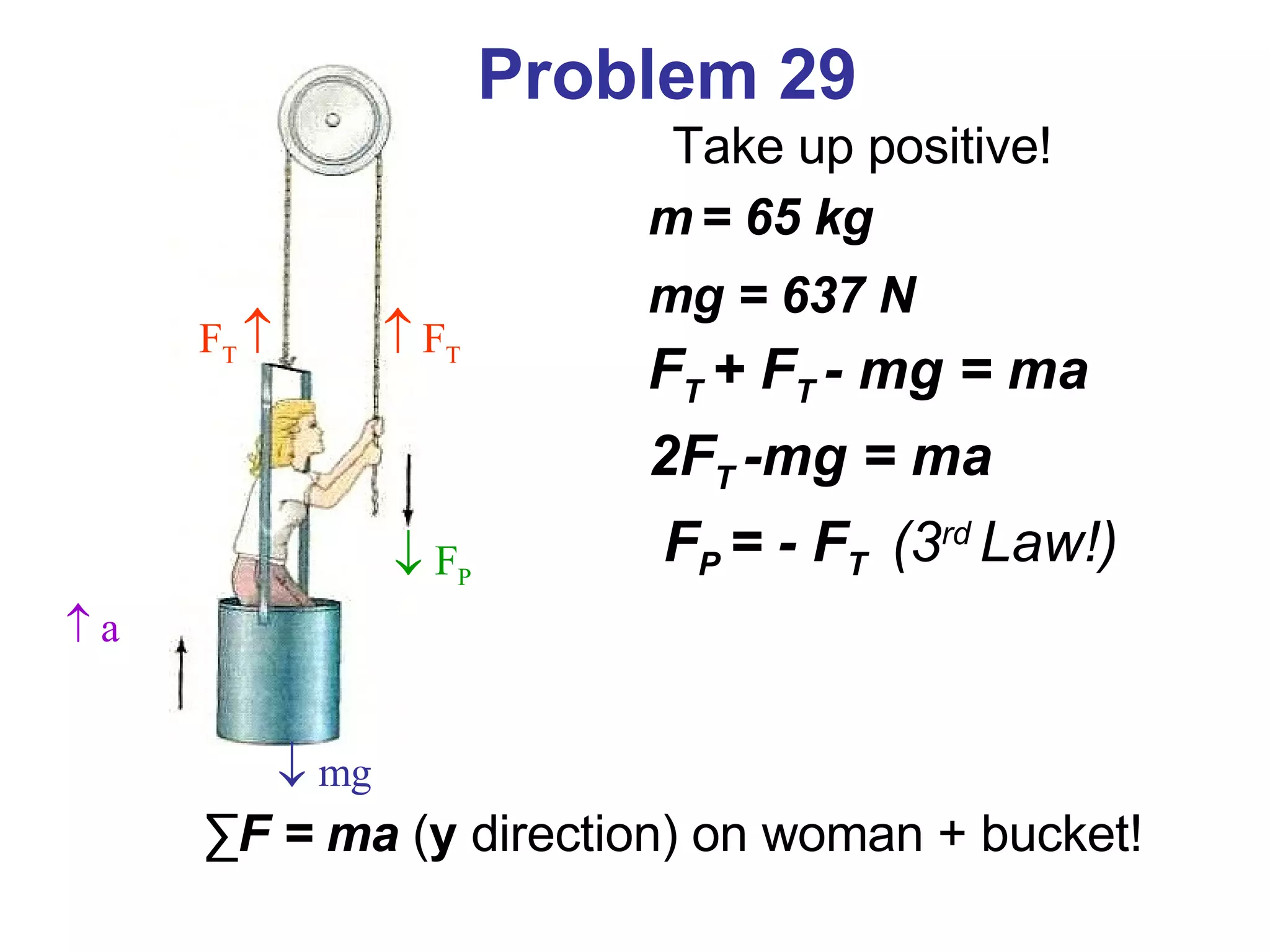
Problem 29 Take up positive!  m   = 65 kg mg = 637 N   F T  + F T  - mg = ma   2F T  -mg = ma   F P  = - F T  (3 rd  Law!)   ∑ F = ma   ( y  direction) on woman + bucket!    F T F T      a    F P    mg
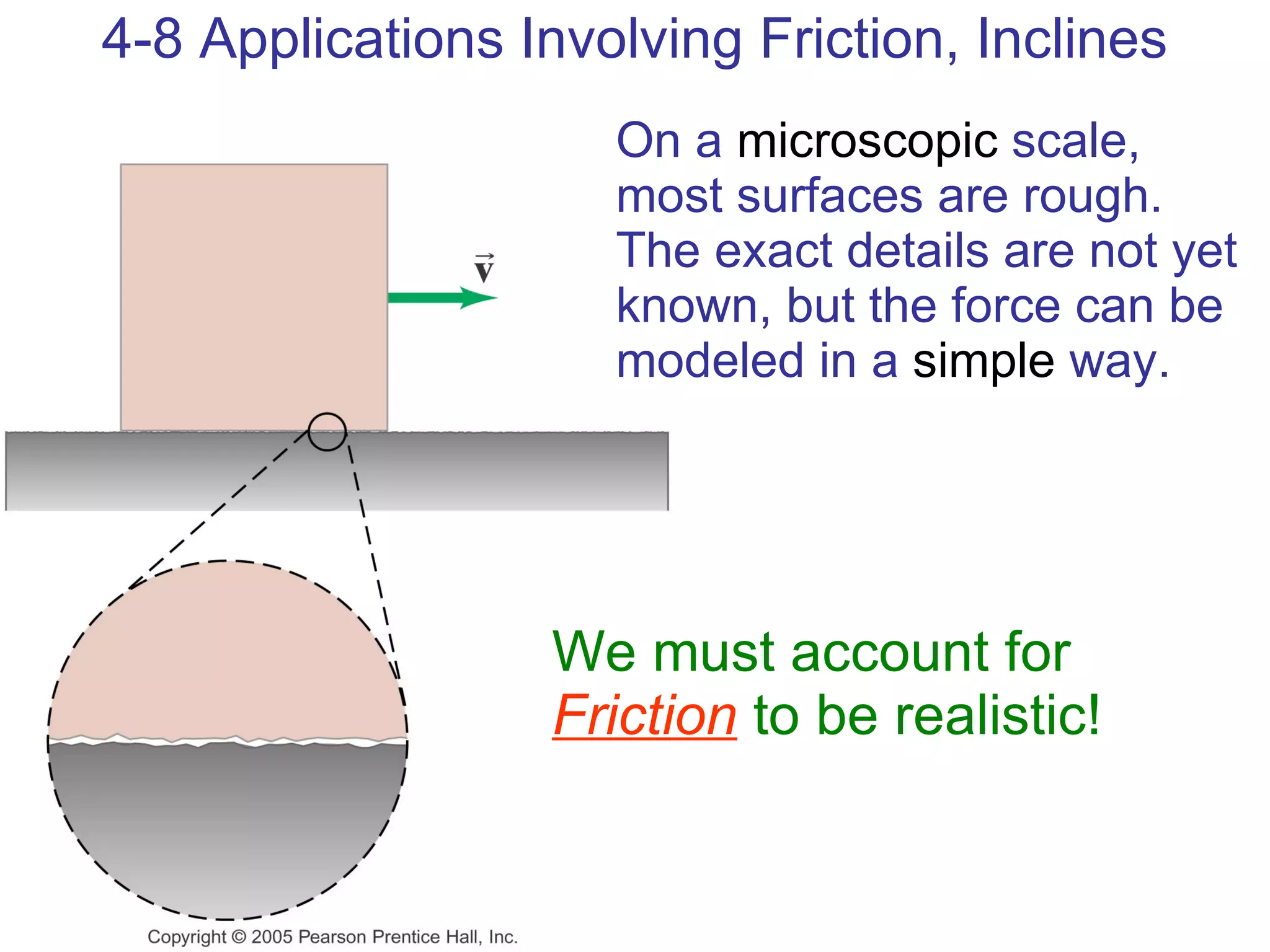
4-8 Applications Involving Friction, Inclines On a  microscopic  scale, most surfaces are rough. The exact details are not yet known, but the force can be modeled in a  simple  way. We must account for   Friction   to be realistic!
Exists between any 2 sliding surfaces. Two types of friction: Static  ( no motion ) friction Kinetic  ( motion ) friction The size of the friction force: Depends on the microscopic details of 2 sliding surfaces. The materials they are made of Are the surfaces smooth or rough?  Are they wet or dry? Etc., etc., etc. 4-8 Applications Involving Friction, Inclines
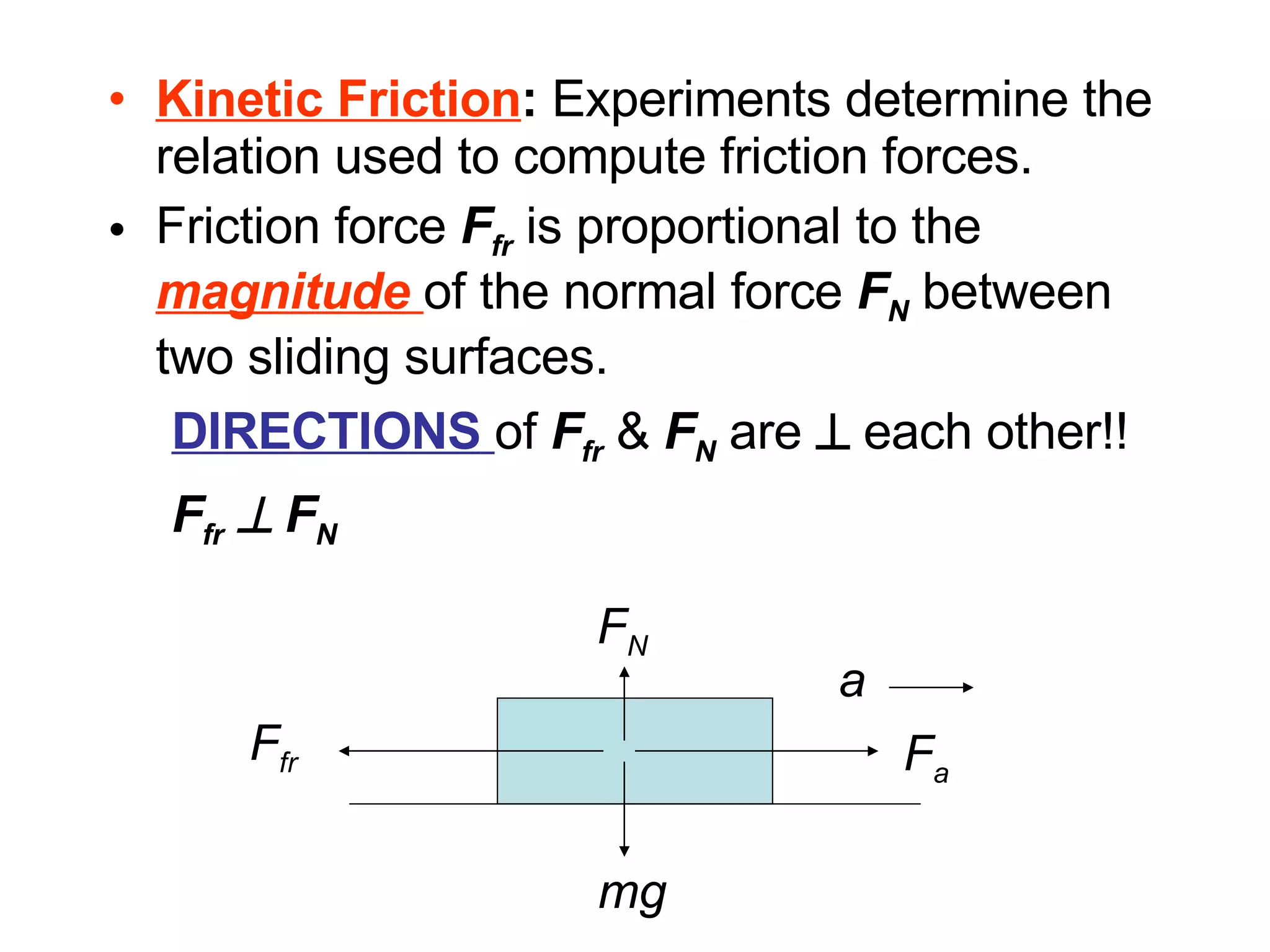
Kinetic Friction :  Experiments determine the relation used to compute friction forces. Friction force  F fr  is proportional to the  magnitude  of the normal force   F N  between two sliding surfaces. DIRECTIONS   of  F fr  &  F N  are      each other!! F fr      F N   F a F fr F N mg a
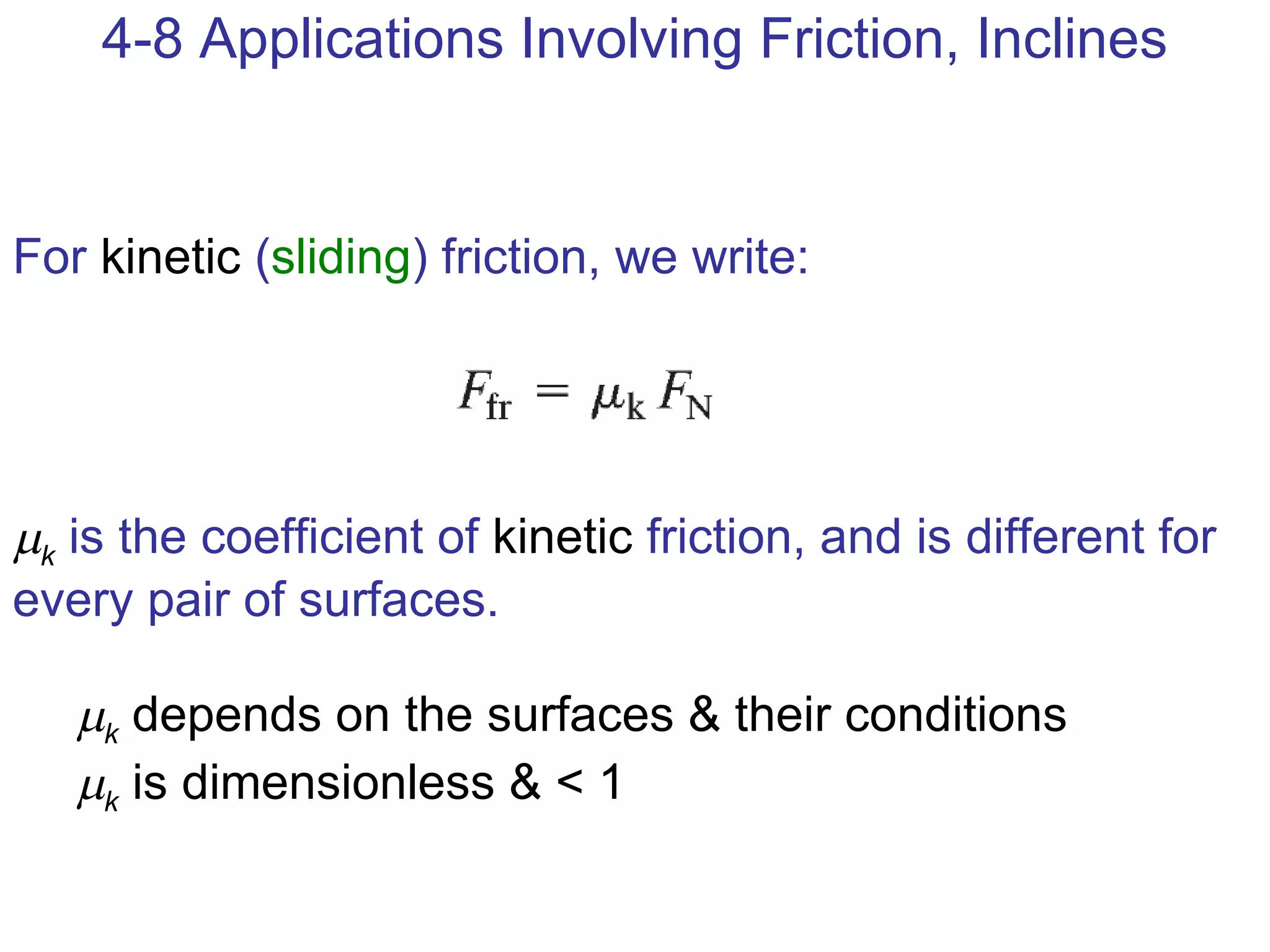
For  kinetic  ( sliding ) friction, we write:  k   is the coefficient of  kinetic  friction, and is different for every pair of surfaces.  k  depends on the surfaces & their conditions  k  is dimensionless & < 1  4-8 Applications Involving Friction, Inclines
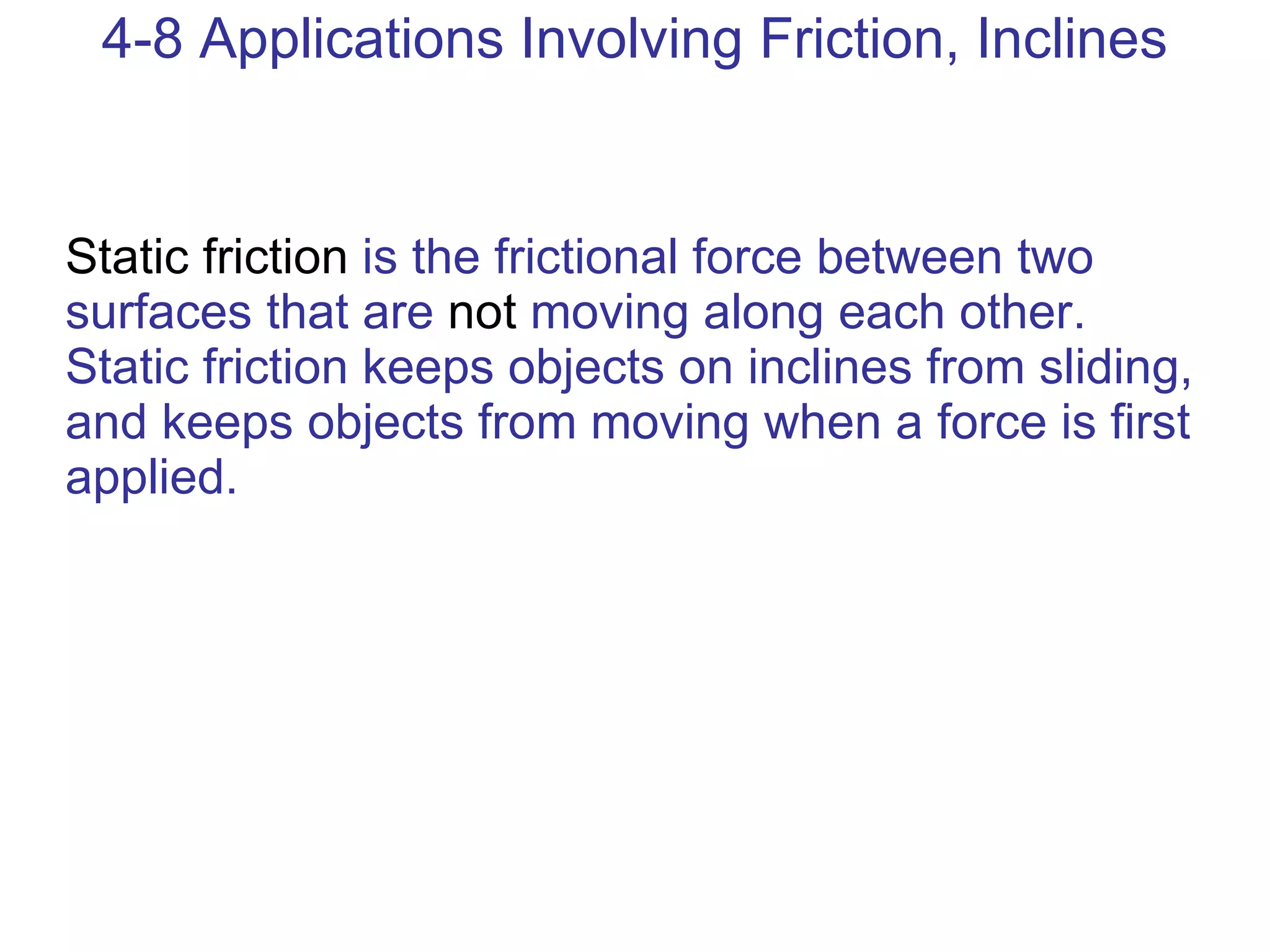
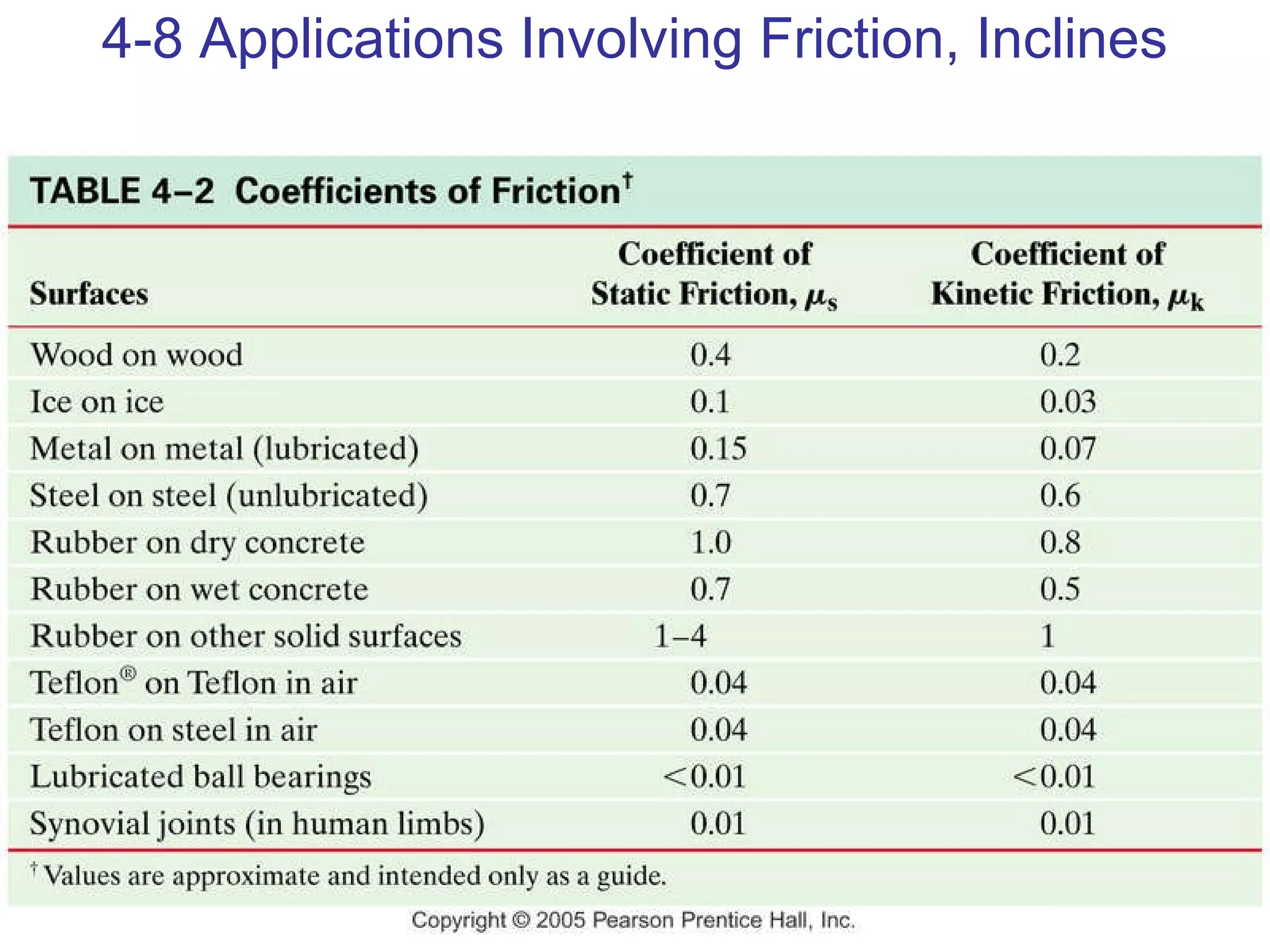
4-8 Applications Involving Friction, Inclines Static friction  is the frictional force between two surfaces that are  not  moving along each other. Static friction keeps objects on inclines from sliding, and keeps objects from moving when a force is first applied.
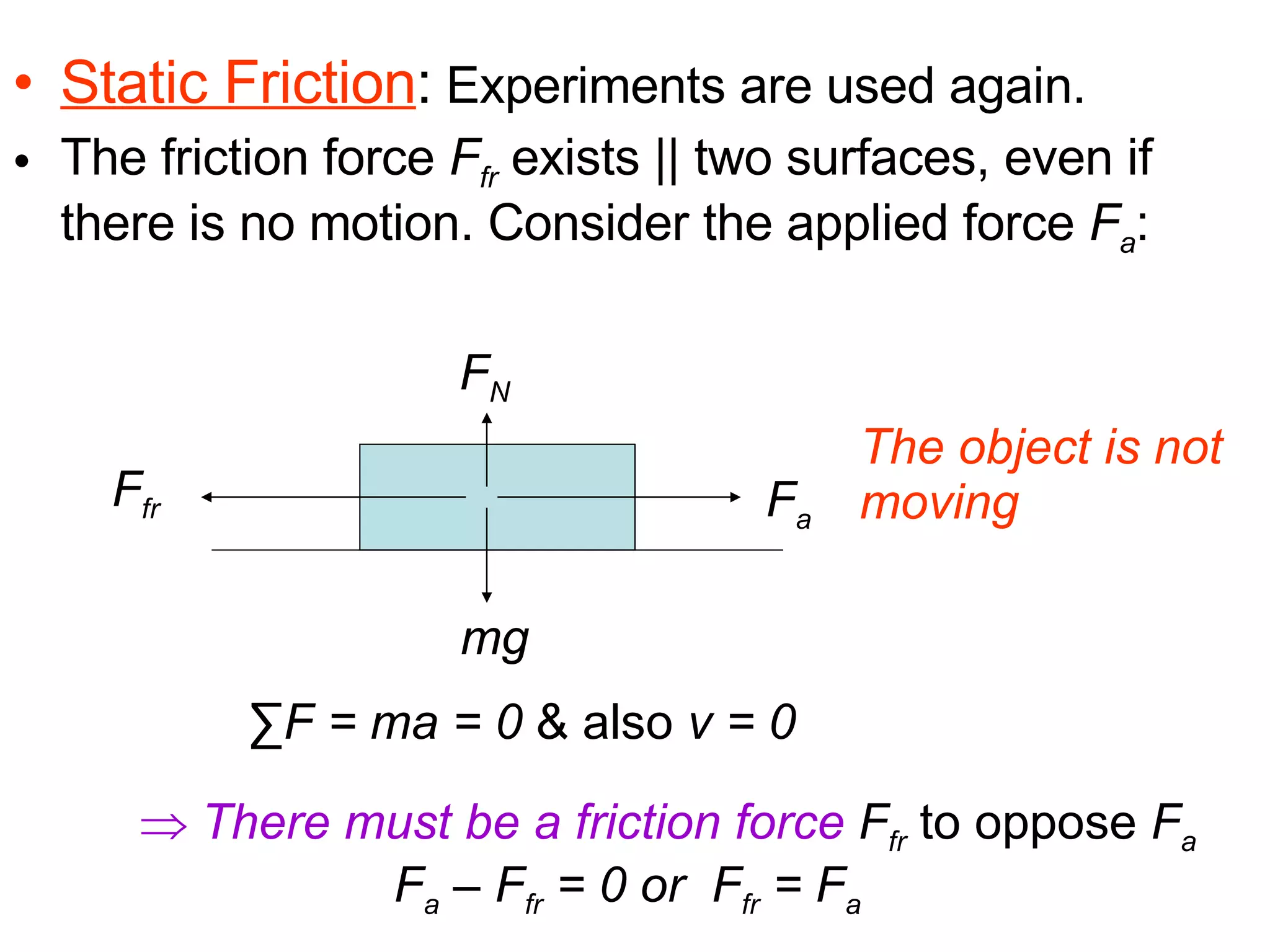
Static Friction :  Experiments are used again.  The friction force  F fr  exists || two surfaces, even if there is no motion. Consider the applied force  F a :    There must be a friction force   F fr  to oppose  F a   F a  – F fr  = 0 or  F fr  = F a   F a F fr F N mg The object is not moving ∑ F = ma = 0  & also  v = 0
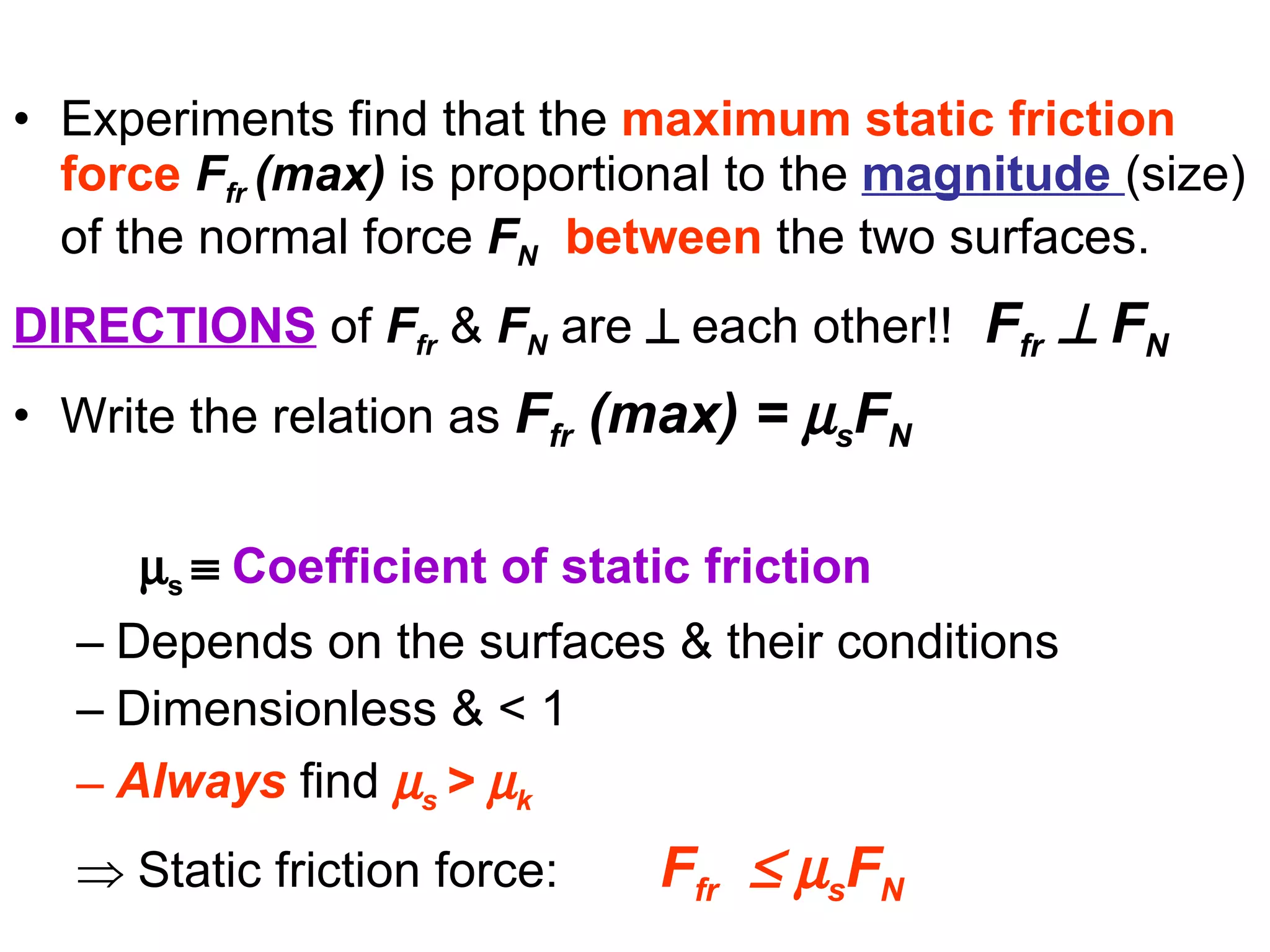
Experiments find that the  maximum static friction force   F fr  (max)  is proportional to the  magnitude  (size) of the normal force   F N   between  the two surfaces. DIRECTIONS  of  F fr  &   F N  are      each other!!   F fr      F N   Write the relation as  F fr   (max) =   s F N    s     Coefficient of static friction Depends on the surfaces & their conditions Dimensionless & < 1   Always  find   s  >   k      Static friction force:     F fr       s F N
4-8 Applications Involving Friction, Inclines
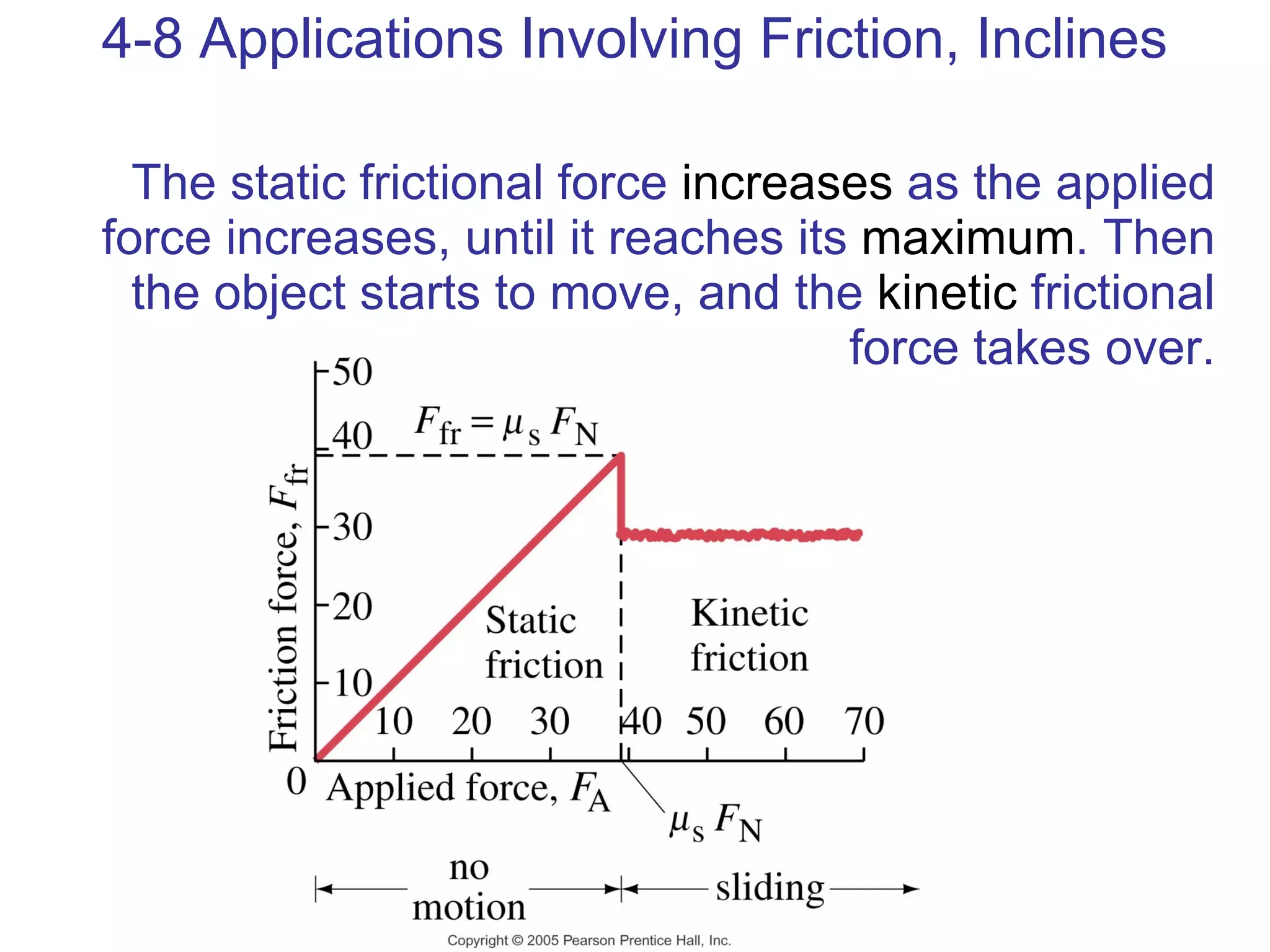
The static frictional force  increases  as the applied force increases, until it reaches its  maximum . Then the object starts to move, and the  kinetic  frictional force takes over. 4-8 Applications Involving Friction, Inclines
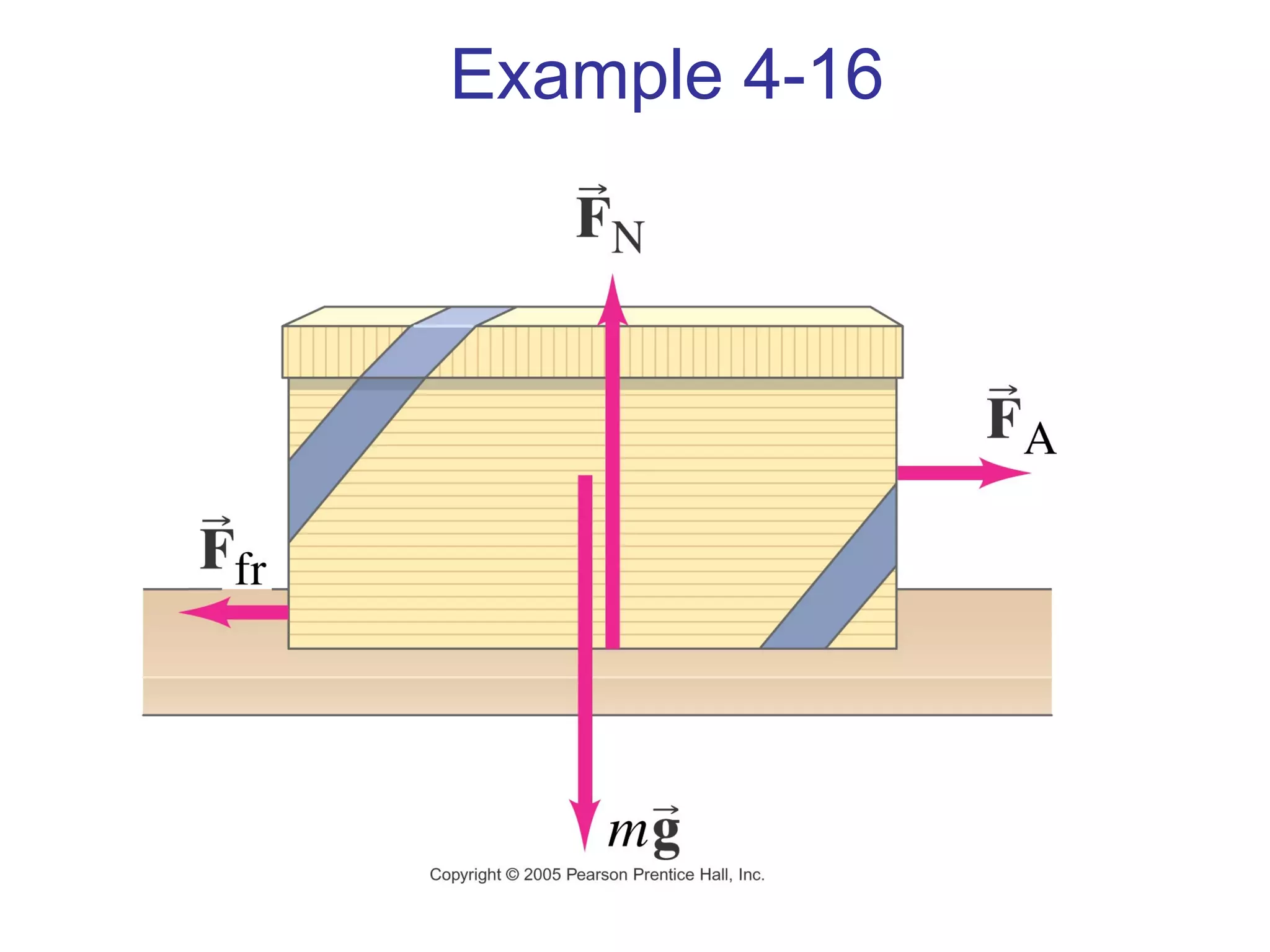
Example 4-16
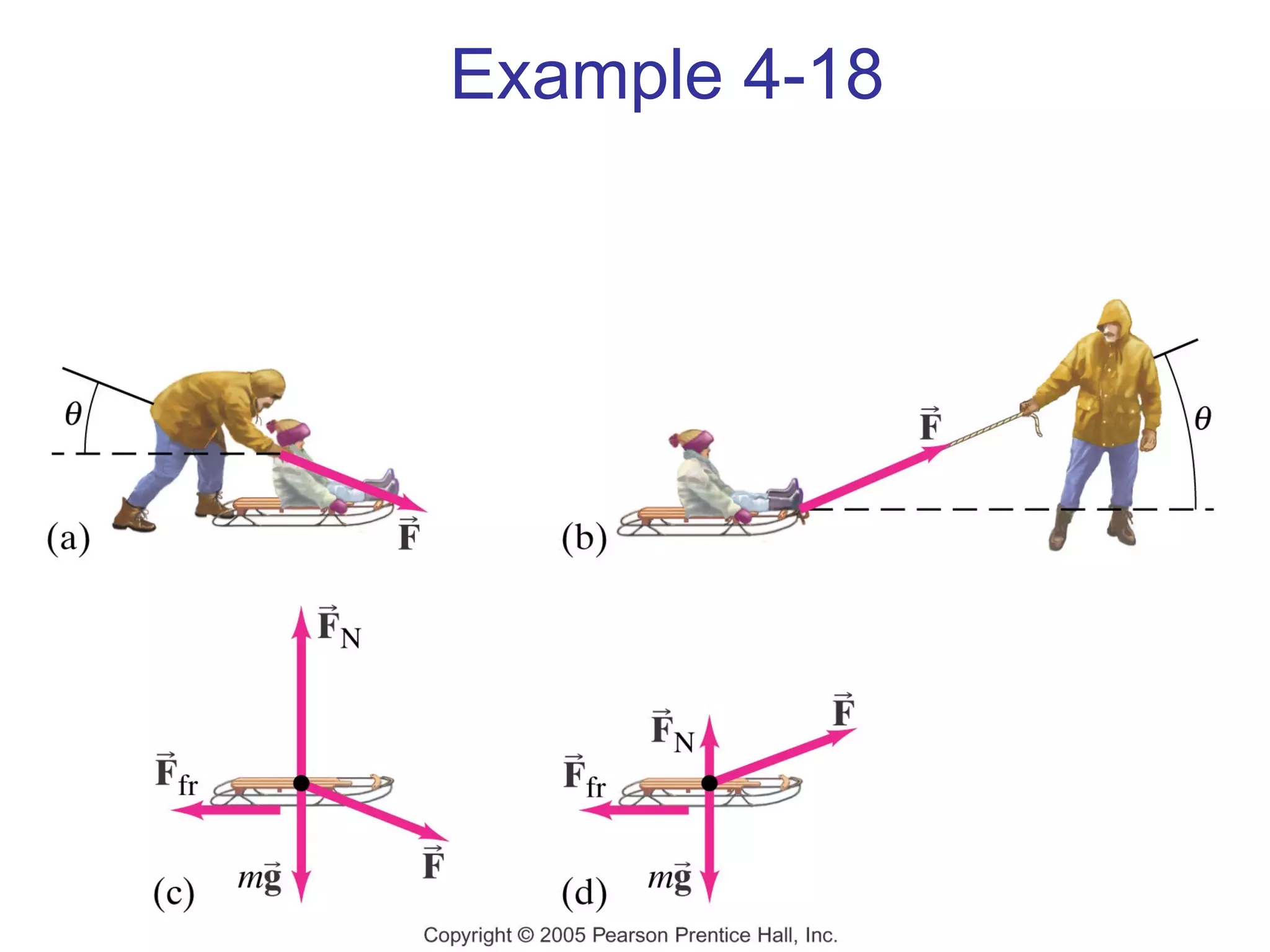
Example 4-18
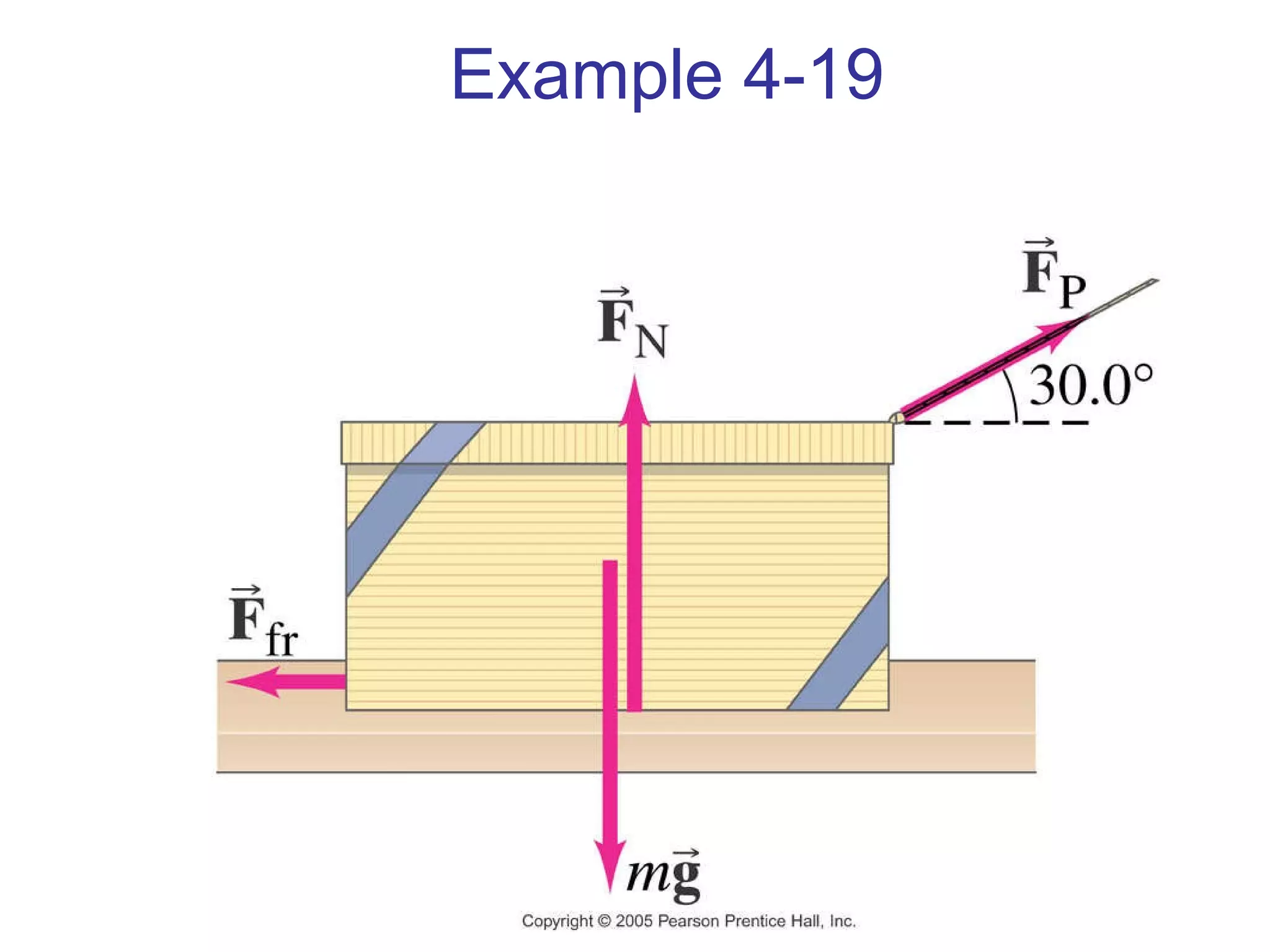
Example 4-19
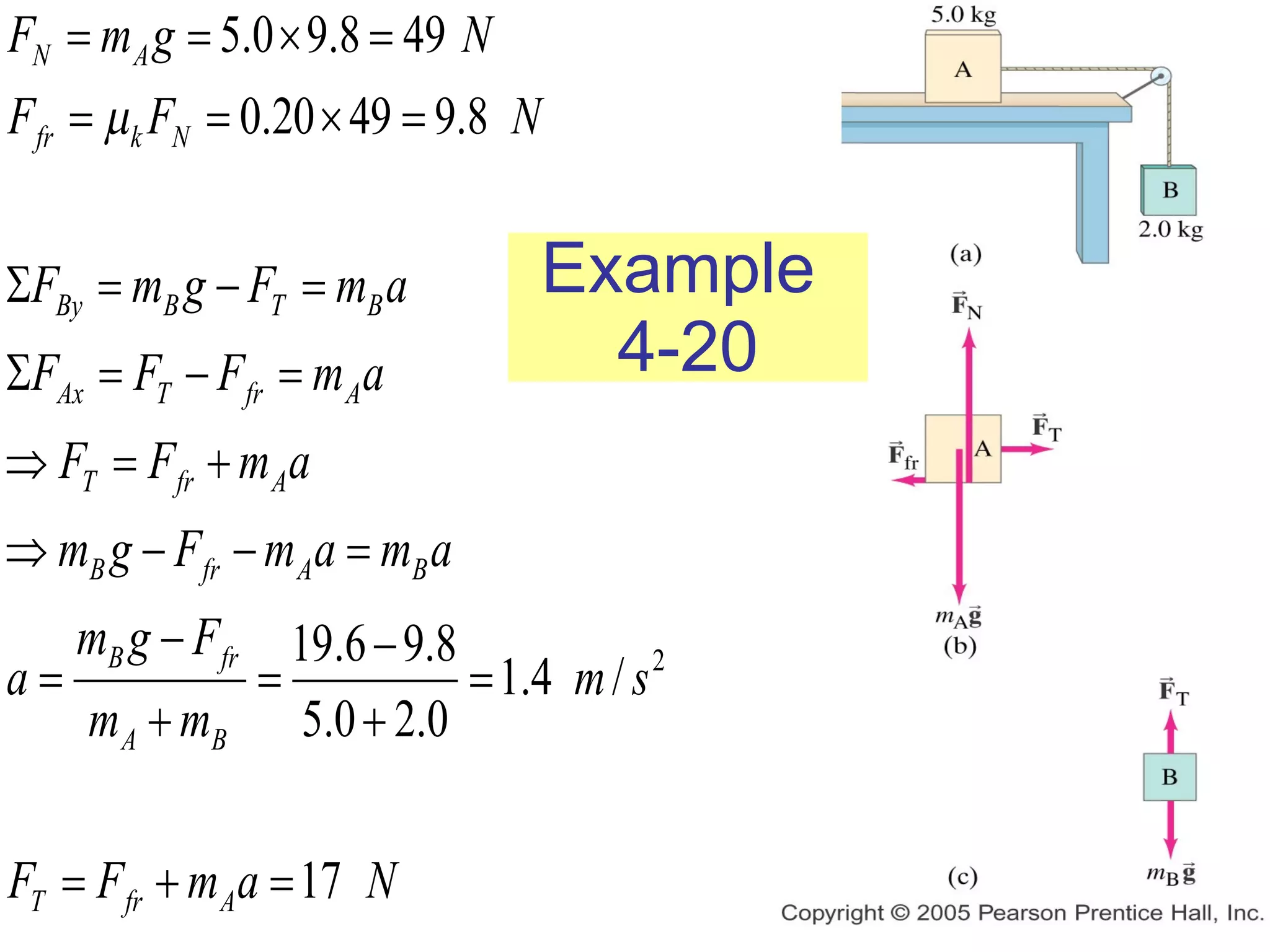
Example  4-20
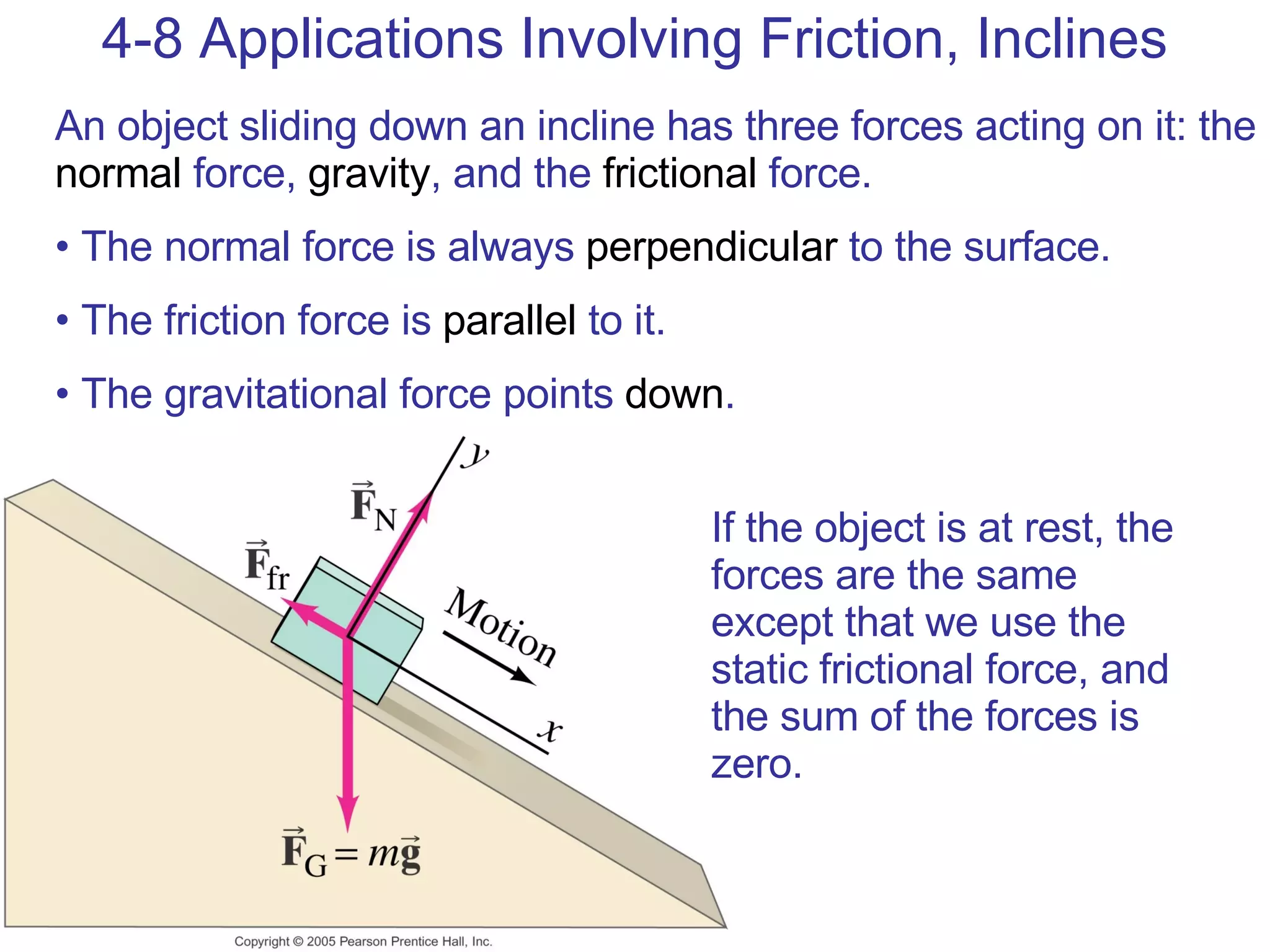
4-8 Applications Involving Friction, Inclines An object sliding down an incline has three forces acting on it: the  normal  force,  gravity , and the  frictional  force. The normal force is always  perpendicular  to the surface.  The friction force is  parallel  to it.  The gravitational force points  down . If the object is at rest, the forces are the same except that we use the static frictional force, and the sum of the forces is zero.
4-9 Problem Solving – A General Approach Read  the problem carefully; then read it again. Draw  a sketch, and then a free-body diagram. Choose a convenient  coordinate system . List the  known  and  unknown  quantities; find  relationships  between the knowns and the unknowns. Estimate  the answer. Solve the problem without putting in any numbers ( algebraically ); once you are satisfied, put the  numbers  in. Keep track of  dimensions . Make sure your answer is  reasonable .
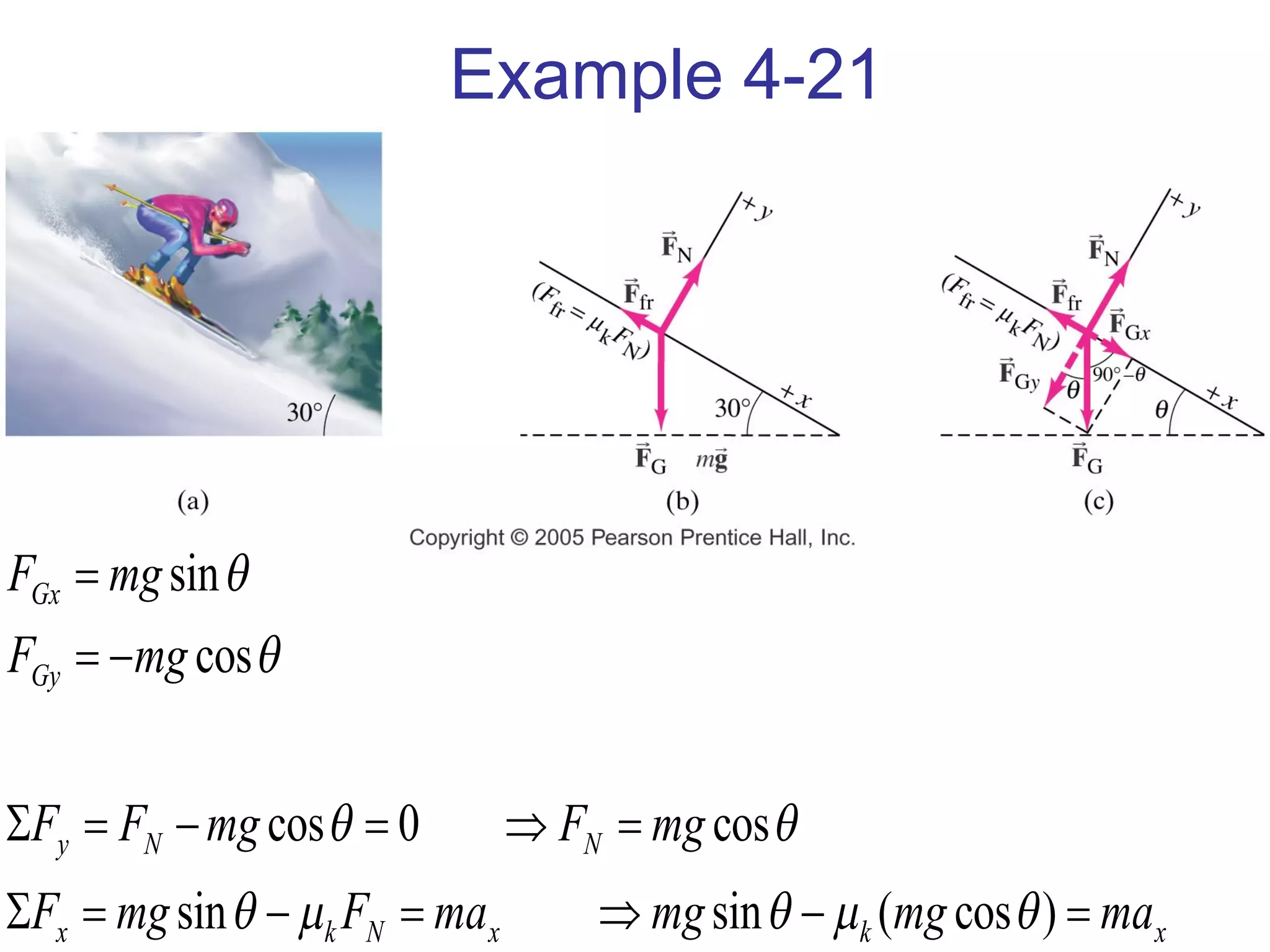
Example 4-21
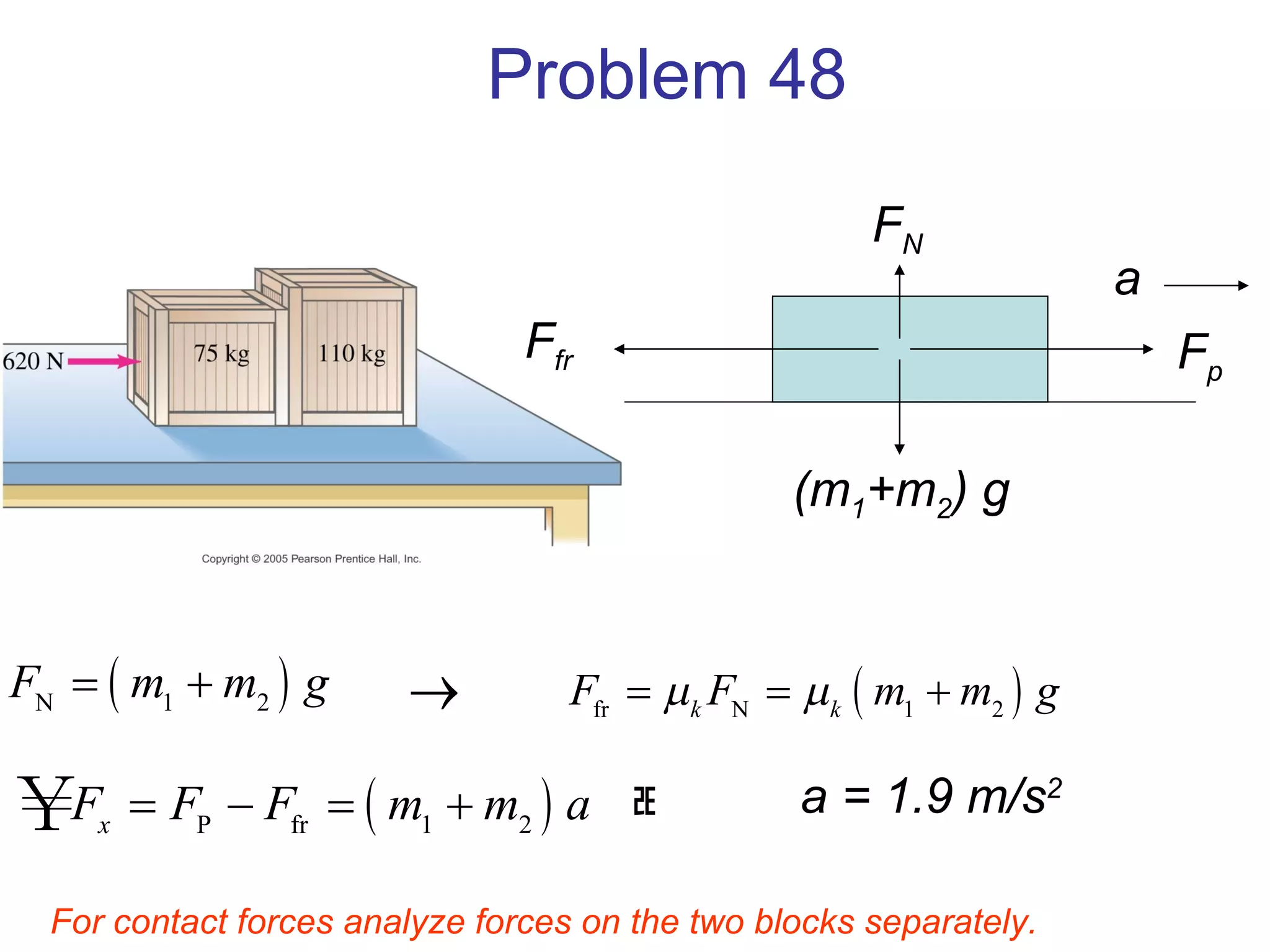
F p F fr F N (m 1 +m 2 ) g a a = 1.9 m/s 2 Problem 48 For contact forces analyze forces on the two blocks separately.
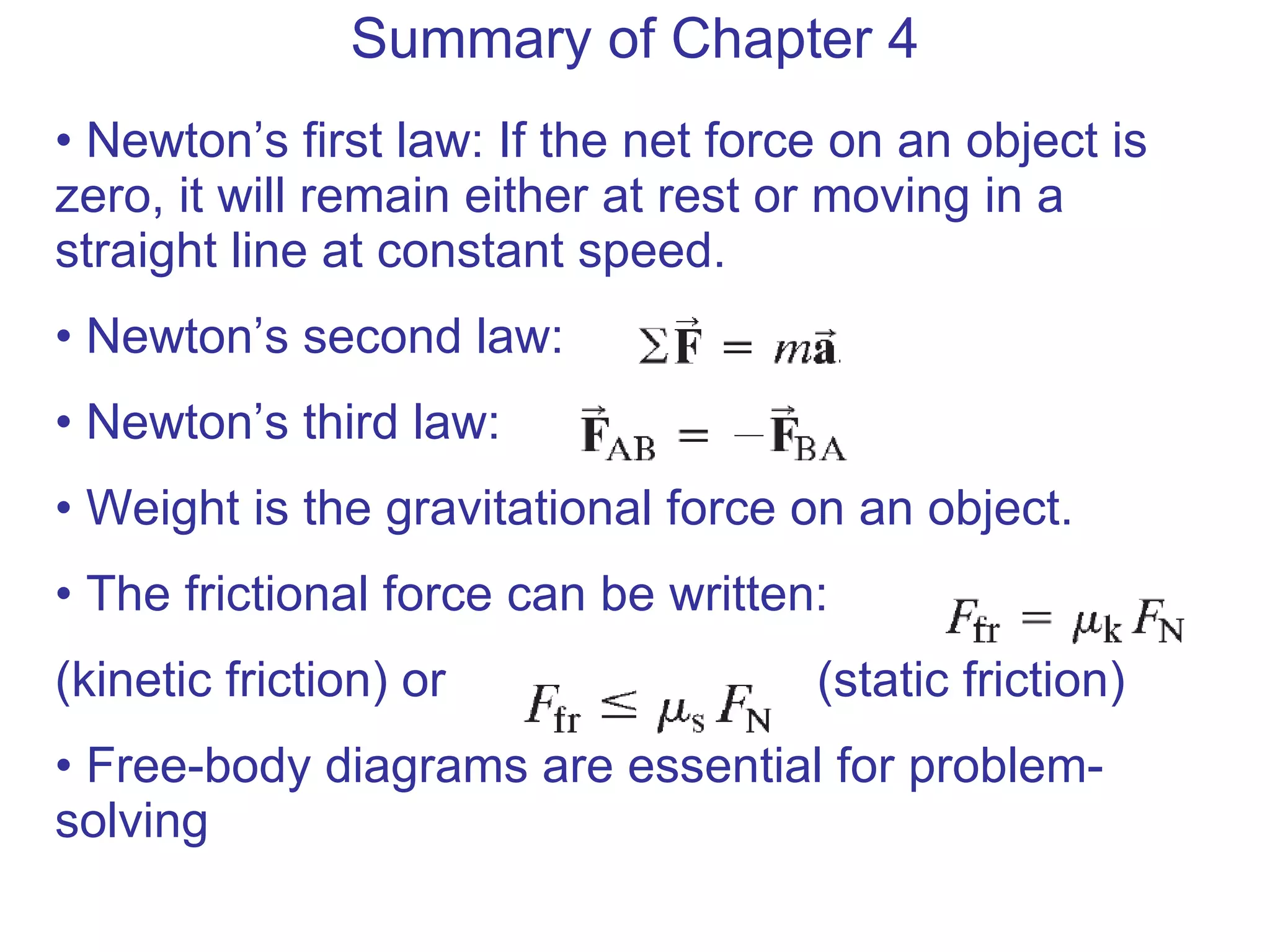
Summary of Chapter 4 Newton’s first law: If the net force on an object is zero, it will remain either at rest or moving in a straight line at constant speed. Newton’s second law: Newton’s third law: Weight is the gravitational force on an object. The frictional force can be written:  (kinetic friction)  or  (static friction) Free-body diagrams are essential for problem-solving

Lecture Ch 04

  • 1.
    Chapter 4 Dynamics:Newton’s Laws of Motion
  • 2.
    Units of Chapter4 Force Newton’s First Law of Motion Mass Newton’s Second Law of Motion Newton’s Third Law of Motion Weight – the Force of Gravity; and the Normal Force
  • 3.
    Units of Chapter4 Solving Problems with Newton’s Laws: Free-Body Diagrams Applications Involving Friction, Inclines Problem Solving – A General Approach
  • 4.
    4-1 Force A force is a push or pull . An object at rest needs a force to get it moving ; a moving object needs a force to change its velocity . The magnitude of a force can be measured using a spring scale.
  • 5.
    4-2 Newton’s FirstLaw of Motion Newton’s first law is often called the law of inertia . Every object continues in its state of rest, or of uniform velocity in a straight line, as long as no net force acts on it.
  • 6.
    4-2 Newton’s FirstLaw of Motion Inertial reference frames : An inertial reference frame is one in which Newton’s first law is valid. This excludes rotating and accelerating frames.
  • 7.
    4-3 Mass Mass is the measure of inertia of an object. In the SI system, mass is measured in kilograms . Inertia  The tendency of a body to maintain its state of rest or motion. Mass is not weight : Mass is a property of an object. Weight is the force exerted on that object by gravity. If you go to the moon, whose gravitational acceleration is about 1/6 g , you will weigh much less. Your mass, however, will be the same.
  • 8.
    4-4 Newton’s SecondLaw of Motion 1 st Law : If no net force acts, object remains at rest or in uniform motion in straight line. What if a net force acts? Do Experiments . Find, if the net force F  0  The velocity v changes (in magnitude or direction or both). A change in the velocity v ( Δ v )  There is an acceleration a = ( Δ v/ Δ t ) OR A net force acting on a body produces an acceleration! F  a
  • 9.
    4-4 Newton’s SecondLaw of Motion From experiments: The net force F on a body and the acceleration a of that body are related. HOW? Answer by EXPERIMENTS ! The outcome of thousands of experiments over hundreds of years: a  F/m (proportionality) We choose the units of force so that this is not just a proportionality but an equation: a  F/m OR: ( total !)  F = ma
  • 10.
    4-4 Newton’s SecondLaw of Motion Newton’s 2nd Law : F = ma F = the net ( TOTAL ! ) force acting on mass m m = the mass (inertia) of the object. a = acceleration of object. Description of the effect of F F is the cause of a . To emphasize that the F in Newton’s 2 nd Law is the TOTAL (net) force on the mass m , text writes: ∑ F = ma ∑ = a math symbol meaning sum (capital sigma)
  • 11.
    4-4 Newton’s SecondLaw of Motion Newton’s 2nd Law : ∑ F = ma Force is a vector , so ∑ F = ma is true along each coordinate axis. ∑ F x = ma x ∑ F y = ma y ∑ F z = ma z ONE OF THE MOST FUNDAMENTAL & IMPORTANT LAWS OF CLASSICAL PHYSICS!!! Based on experiment! Not derivable mathematically!!
  • 12.
    4-4 Newton’s SecondLaw of Motion Newton’s second law is the relation between acceleration and force . Acceleration is proportional to NET force and inversely proportional to mass. (4-1)
  • 13.
    4-4 Newton’s SecondLaw of Motion The unit of force in the SI system is the newton (N). Note that the pound is a unit of force , not of mass, and can therefore be equated to newtons but not to kilograms.
  • 14.
    4-5 Newton’s ThirdLaw of Motion Any time a force is exerted on an object, that force is caused by another object. Newton’s third law : Whenever one object exerts a force on a second object, the second exerts an equal force in the opposite direction on the first. Law of action-reaction : “Every action has an equal & opposite reaction”. (Action-reaction forces act on DIFFERENT objects!)
  • 15.
    4-5 Newton’s ThirdLaw of Motion A key to the correct application of the third law is that the forces are exerted on different objects . Make sure you don’t use them as if they were acting on the same object.
  • 16.
    4-5 Newton’s ThirdLaw of Motion Rocket propulsion can also be explained using Newton’s third law: hot gases from combustion spew out of the tail of the rocket at high speeds. The reaction force is what propels the rocket. Note that the rocket does not need anything to “push” against.
  • 17.
    4-5 Newton’s ThirdLaw of Motion Helpful notation: the first subscript is the object that the force is being exerted on; the second is the source. This need not be done indefinitely, but is a good idea until you get used to dealing with these forces. (4-2)
  • 18.
  • 19.
    4-6 Weight –the Force of Gravity; and the Normal Force Weight is the force exerted on an object by gravity. Close to the surface of the Earth, where the gravitational force is nearly constant, the weight is :
  • 20.
    4-6 Weight –the Force of Gravity; and the Normal Force An object at rest must have no net force on it. If it is sitting on a table, the force of gravity is still there; what other force is there? The force exerted perpendicular to a surface is called the normal force . It is exactly as large as needed to balance the force from the object (if the required force gets too big, something breaks!)
  • 21.
    Example 4-6 m= 10 kg The normal force is NOT always equal to the weight!!
  • 22.
    m = 10kg ∑ F = ma F P – mg = ma Example 4-7
  • 23.
    4-7 Solving Problemswith Newton’s Laws – Free-Body Diagrams Draw a sketch . For one object, draw a free-body diagram ( force diagram ) , showing all the forces acting on the object. Make the magnitudes and directions as accurate as you can. Label each force. If there are multiple objects, draw a separate diagram for each one. Resolve vectors into components. Apply Newton’s second law to each component. Solve.
  • 24.
    4-7 Solving Problemswith Newton’s Laws – Free-Body Diagrams When a cord or rope pulls on an object, it is said to be under tension , and the force it exerts is called a tension force .
  • 25.
  • 26.
  • 27.
    Example 4-14 Theadvantage of a pulley
  • 28.
  • 29.
    Problem 25 Takeup as positive! m 1 = m 2 = 3.2 kg m 1 g = m 2 g = 31.4 N Bucket 1: F T1 - F T2 - m 1 g = m 1 a Bucket 2: F T2 -m 2 g = m 2 a ∑ F = ma ( y direction), for EACH bucket separately!!!  F T1  F T2  F T2  m 2 g m 1 g   a  a
  • 30.
    Problem 29 Takeup positive! m = 65 kg mg = 637 N F T + F T - mg = ma 2F T -mg = ma F P = - F T (3 rd Law!) ∑ F = ma ( y direction) on woman + bucket!  F T F T   a  F P  mg
  • 31.
    4-8 Applications InvolvingFriction, Inclines On a microscopic scale, most surfaces are rough. The exact details are not yet known, but the force can be modeled in a simple way. We must account for Friction to be realistic!
  • 32.
    Exists between any2 sliding surfaces. Two types of friction: Static ( no motion ) friction Kinetic ( motion ) friction The size of the friction force: Depends on the microscopic details of 2 sliding surfaces. The materials they are made of Are the surfaces smooth or rough? Are they wet or dry? Etc., etc., etc. 4-8 Applications Involving Friction, Inclines
  • 33.
    Kinetic Friction : Experiments determine the relation used to compute friction forces. Friction force F fr is proportional to the magnitude of the normal force F N between two sliding surfaces. DIRECTIONS of F fr & F N are  each other!! F fr  F N F a F fr F N mg a
  • 34.
    For kinetic ( sliding ) friction, we write:  k is the coefficient of kinetic friction, and is different for every pair of surfaces.  k depends on the surfaces & their conditions  k is dimensionless & < 1 4-8 Applications Involving Friction, Inclines
  • 35.
    4-8 Applications InvolvingFriction, Inclines Static friction is the frictional force between two surfaces that are not moving along each other. Static friction keeps objects on inclines from sliding, and keeps objects from moving when a force is first applied.
  • 36.
    Static Friction : Experiments are used again. The friction force F fr exists || two surfaces, even if there is no motion. Consider the applied force F a :  There must be a friction force F fr to oppose F a F a – F fr = 0 or F fr = F a F a F fr F N mg The object is not moving ∑ F = ma = 0 & also v = 0
  • 37.
    Experiments find thatthe maximum static friction force F fr (max) is proportional to the magnitude (size) of the normal force F N between the two surfaces. DIRECTIONS of F fr & F N are  each other!! F fr  F N Write the relation as F fr (max) =  s F N  s  Coefficient of static friction Depends on the surfaces & their conditions Dimensionless & < 1 Always find  s >  k  Static friction force: F fr   s F N
  • 38.
    4-8 Applications InvolvingFriction, Inclines
  • 39.
    The static frictionalforce increases as the applied force increases, until it reaches its maximum . Then the object starts to move, and the kinetic frictional force takes over. 4-8 Applications Involving Friction, Inclines
  • 40.
  • 41.
  • 42.
  • 43.
  • 44.
    4-8 Applications InvolvingFriction, Inclines An object sliding down an incline has three forces acting on it: the normal force, gravity , and the frictional force. The normal force is always perpendicular to the surface. The friction force is parallel to it. The gravitational force points down . If the object is at rest, the forces are the same except that we use the static frictional force, and the sum of the forces is zero.
  • 45.
    4-9 Problem Solving– A General Approach Read the problem carefully; then read it again. Draw a sketch, and then a free-body diagram. Choose a convenient coordinate system . List the known and unknown quantities; find relationships between the knowns and the unknowns. Estimate the answer. Solve the problem without putting in any numbers ( algebraically ); once you are satisfied, put the numbers in. Keep track of dimensions . Make sure your answer is reasonable .
  • 46.
  • 47.
    F p Ffr F N (m 1 +m 2 ) g a a = 1.9 m/s 2 Problem 48 For contact forces analyze forces on the two blocks separately.
  • 48.
    Summary of Chapter4 Newton’s first law: If the net force on an object is zero, it will remain either at rest or moving in a straight line at constant speed. Newton’s second law: Newton’s third law: Weight is the gravitational force on an object. The frictional force can be written: (kinetic friction) or (static friction) Free-body diagrams are essential for problem-solving