Design
Thinking
Lecture 7
Copyrights Reserved by Fariza Hanis Abdul Razak UiTM Malaysia
Design Thinking
Design Thinking is a design methodology that provides a solution-based approach to solving
problems.
It’s extremely useful in tackling complex problems that are ill-defined or unknown, by
understanding the human needs involved, by reframing the problem in human-centric ways,
by creating many ideas in brainstorming sessions, and by adopting a hands-on approach in
prototyping and testing.
Understanding these five stages of Design Thinking will empower anyone to apply the Design
Thinking methods in order to solve complex problems that occur around us — in our
companies, our countries, and even our planet.
Copyrights Reserved by Fariza Hanis Abdul Razak UiTM Malaysia
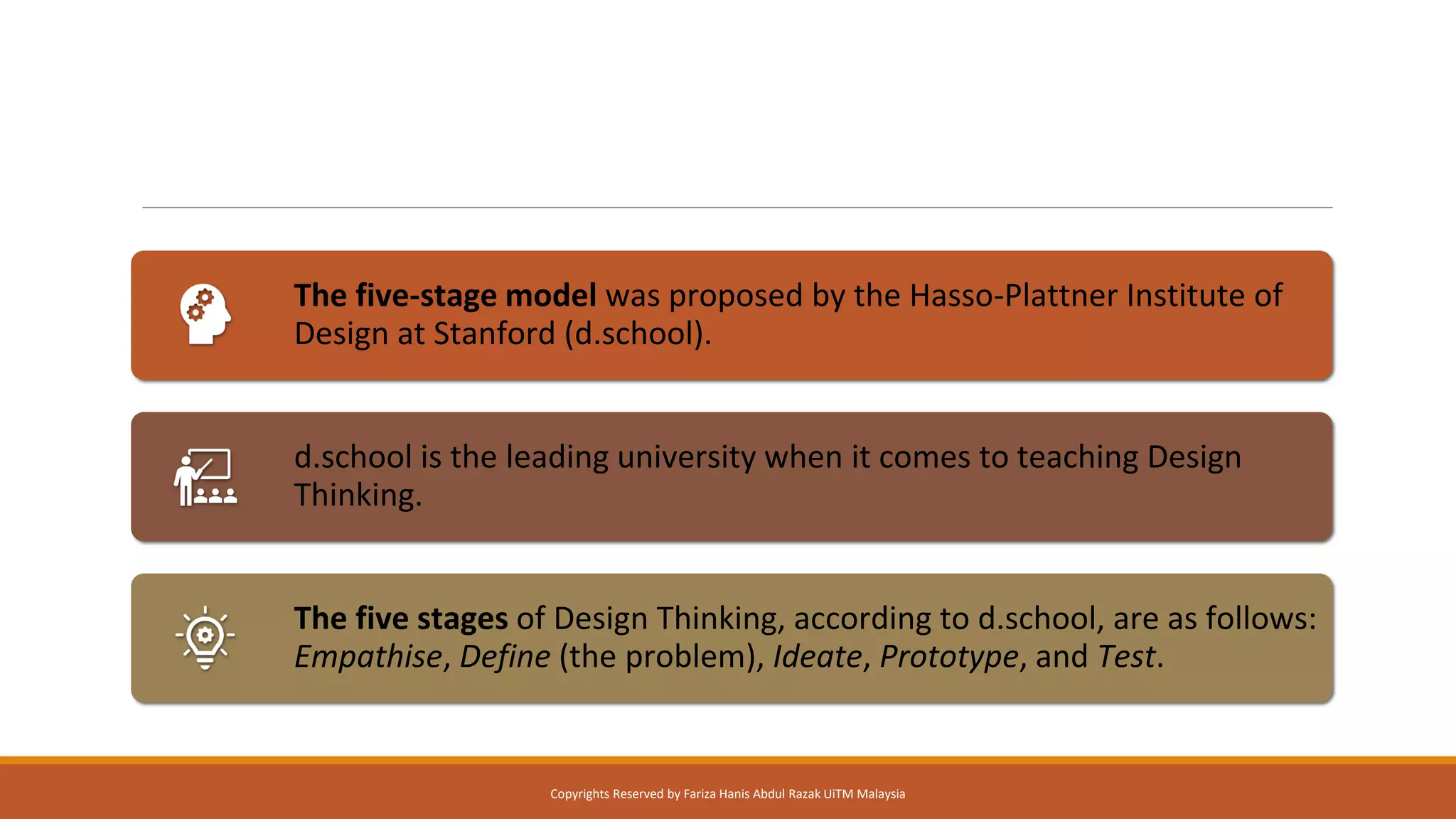
The five-stage model was proposed by the Hasso-Plattner Institute of
Design at Stanford (d.school).
d.school is the leading university when it comes to teaching Design
Thinking.
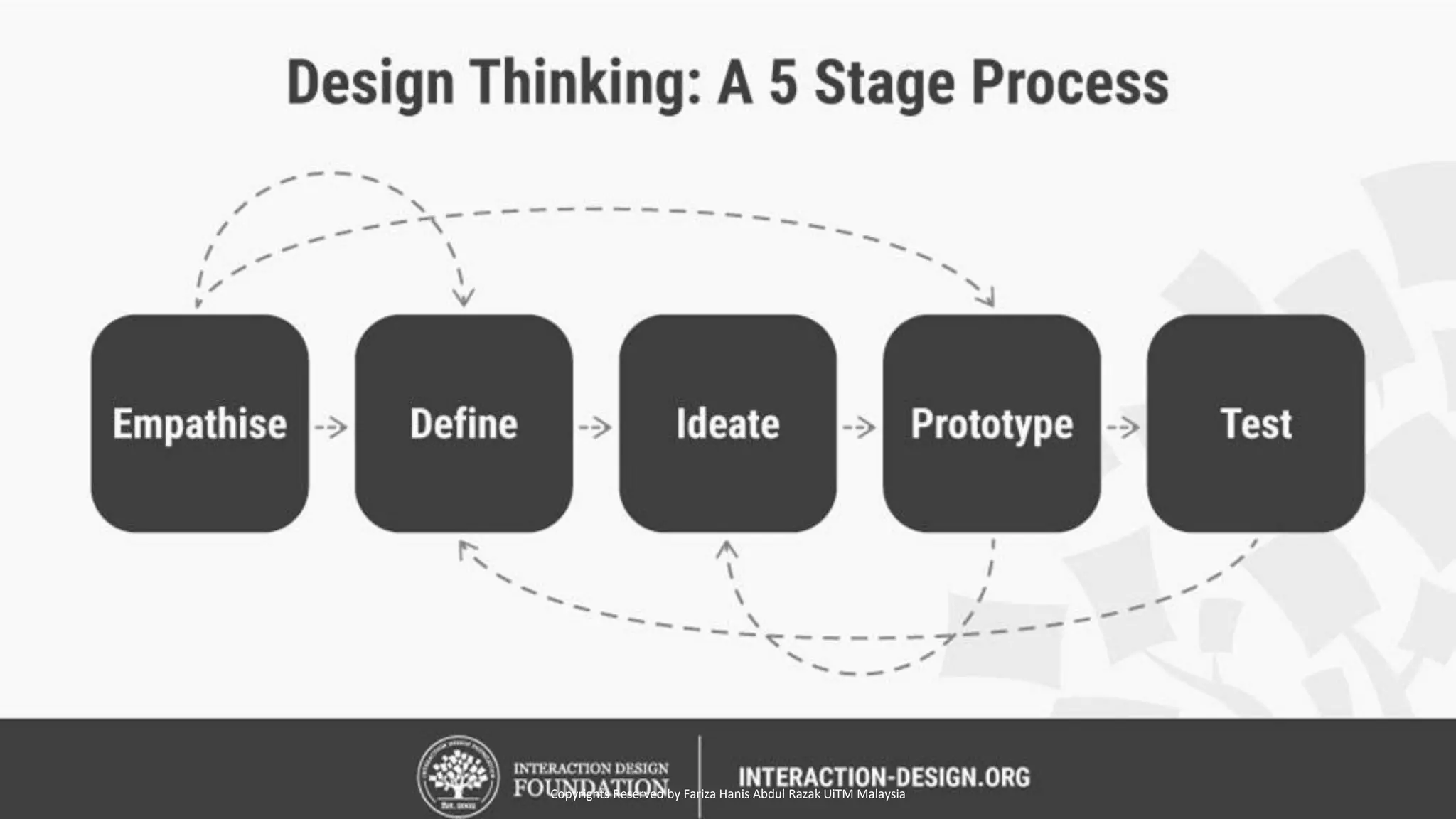
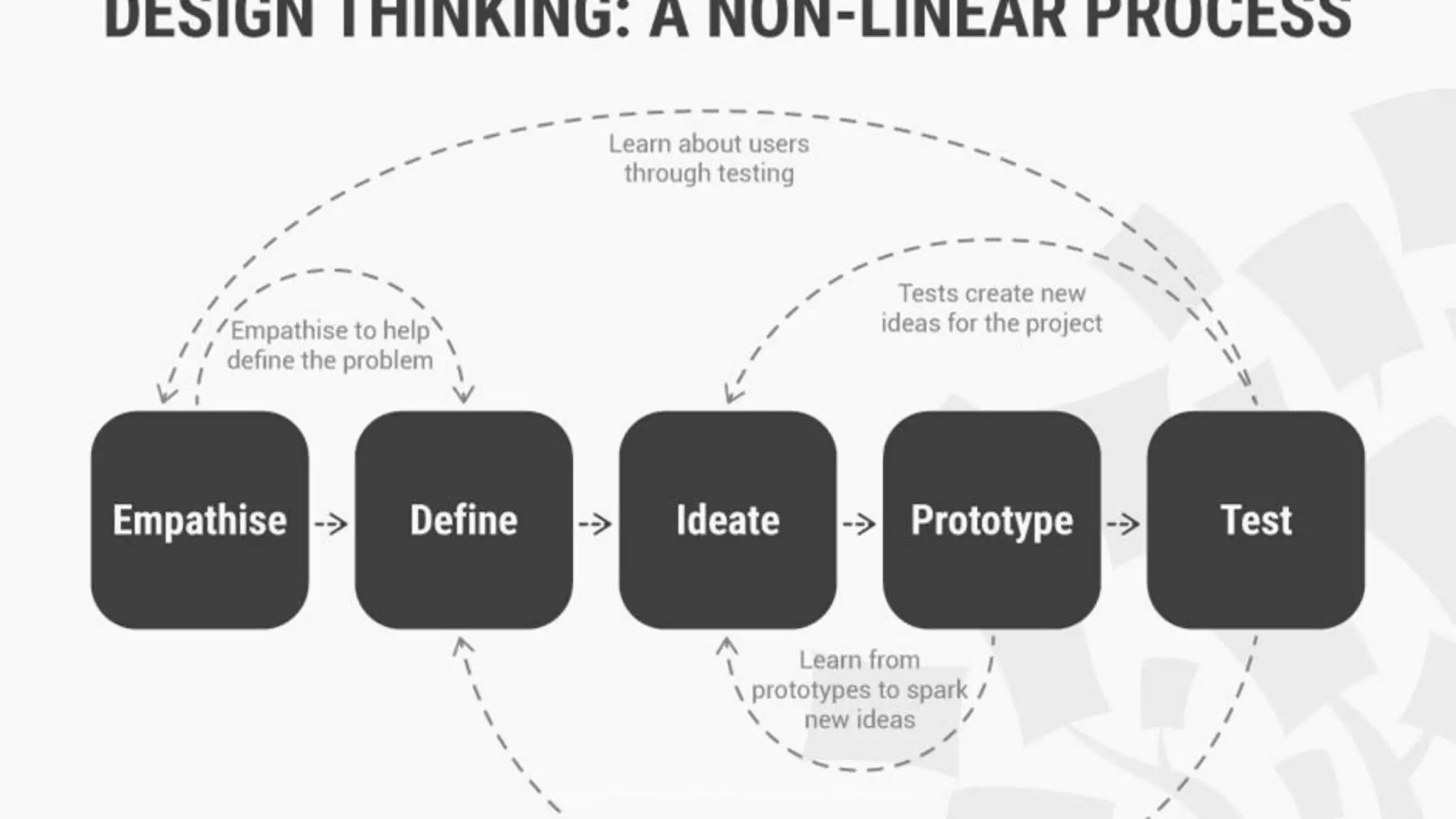
The five stages of Design Thinking, according to d.school, are as follows:
Empathise, Define (the problem), Ideate, Prototype, and Test.
Copyrights Reserved by Fariza Hanis Abdul Razak UiTM Malaysia
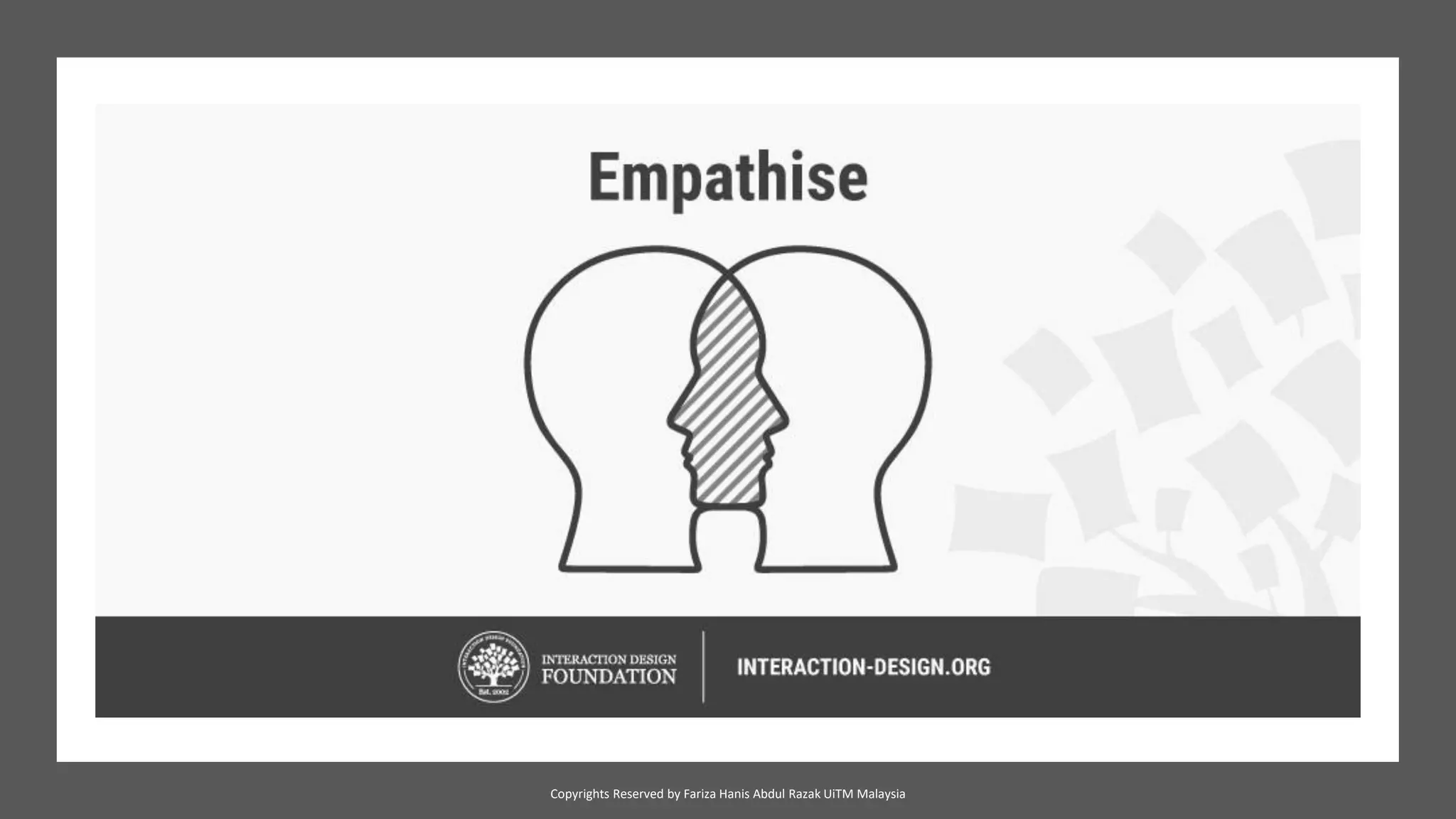
1. Empathise
To gain an empathic understanding of the
problem you are trying to solve.
◦ This involves consulting experts to find out more
about the area of concern through observing,
engaging and empathizing with people to
understand their experiences and motivations,
as well as immersing yourself in the physical
environment to have a deeper personal
understanding of the issues involved.
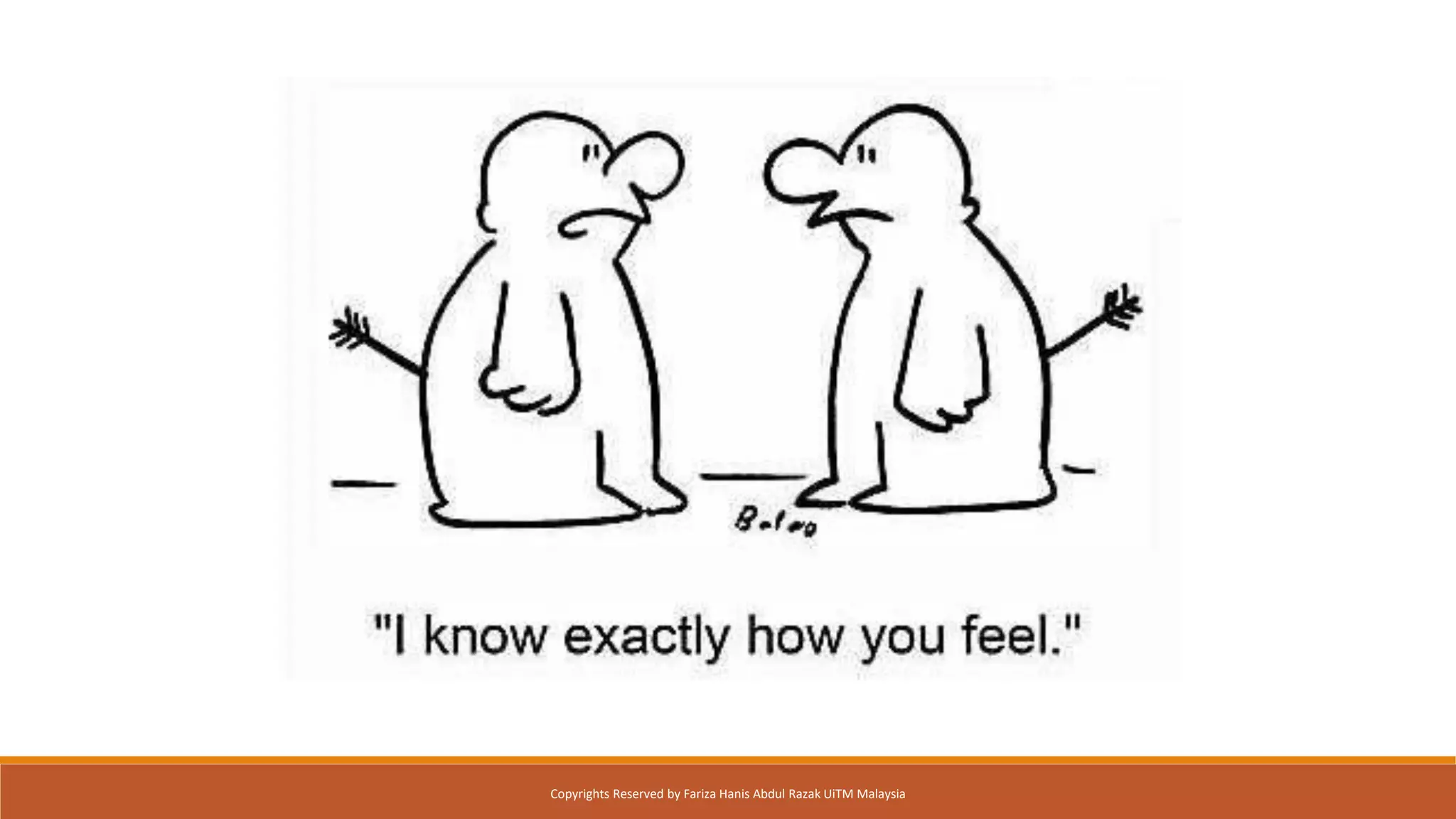
Empathy is crucial to a human-centred
design process such as Design Thinking
because it allows design thinkers to set
aside his or her own assumptions about the
world in order to gain insight into users and
their needs.
Copyrights Reserved by Fariza Hanis Abdul Razak UiTM Malaysia
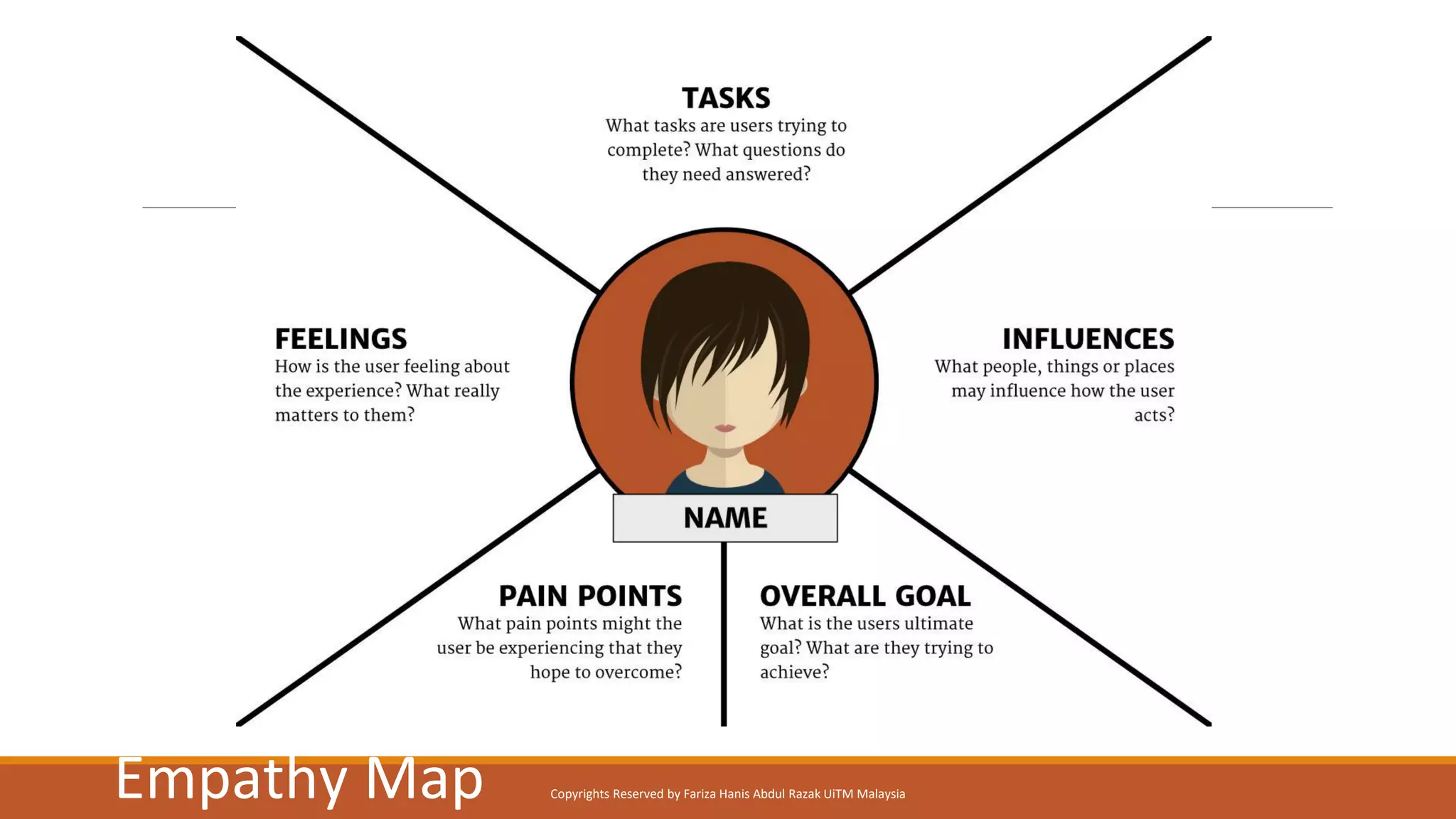
Empathy Map Copyrights Reserved by Fariza Hanis Abdul Razak UiTM Malaysia
Copyrights Reserved by Fariza Hanis Abdul Razak UiTM Malaysia
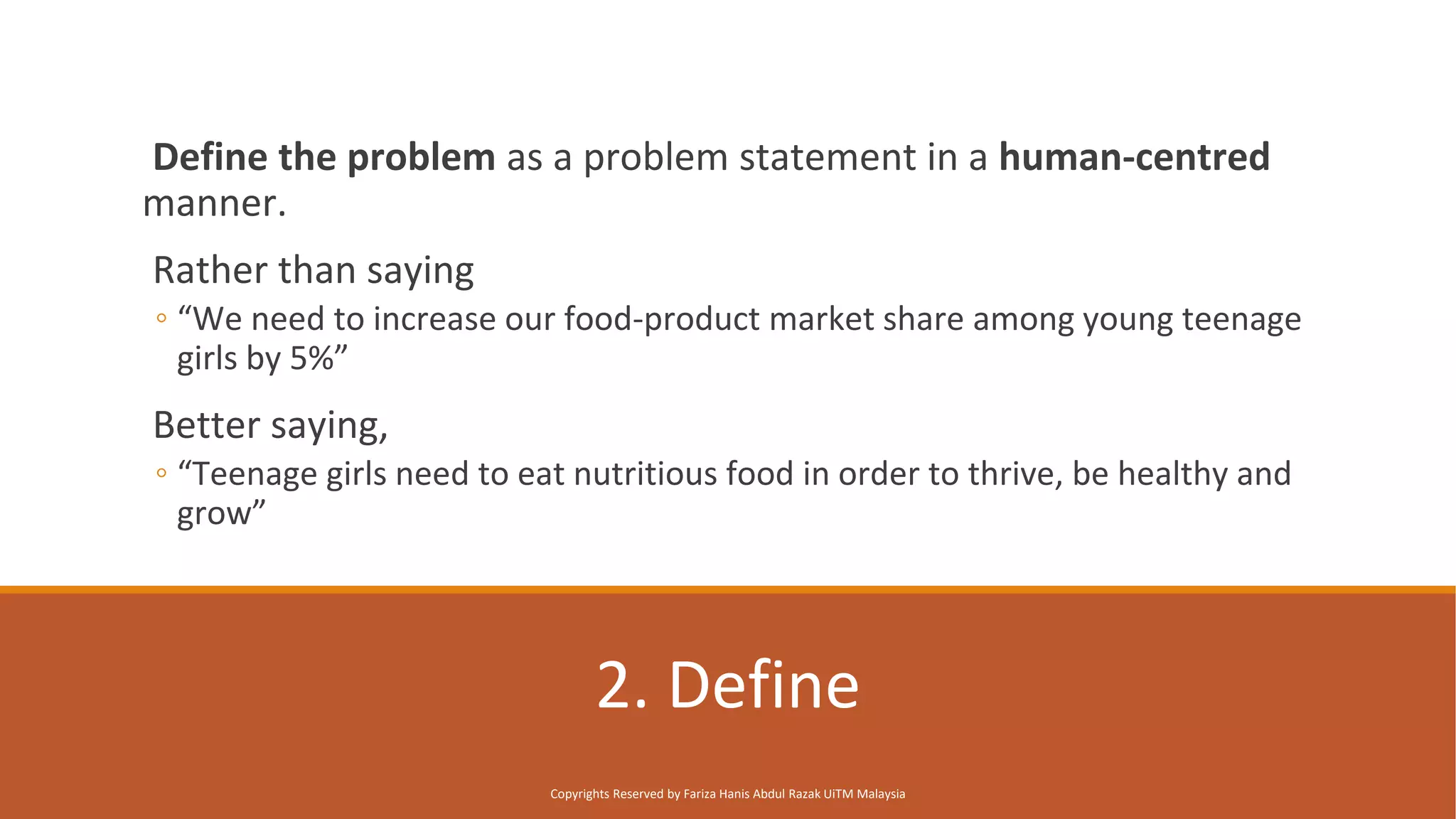
2. Define
Define the problem as a problem statement in a human-centred
manner.
Rather than saying
◦ “We need to increase our food-product market share among young teenage
girls by 5%”
Better saying,
◦ “Teenage girls need to eat nutritious food in order to thrive, be healthy and
grow”
Copyrights Reserved by Fariza Hanis Abdul Razak UiTM Malaysia
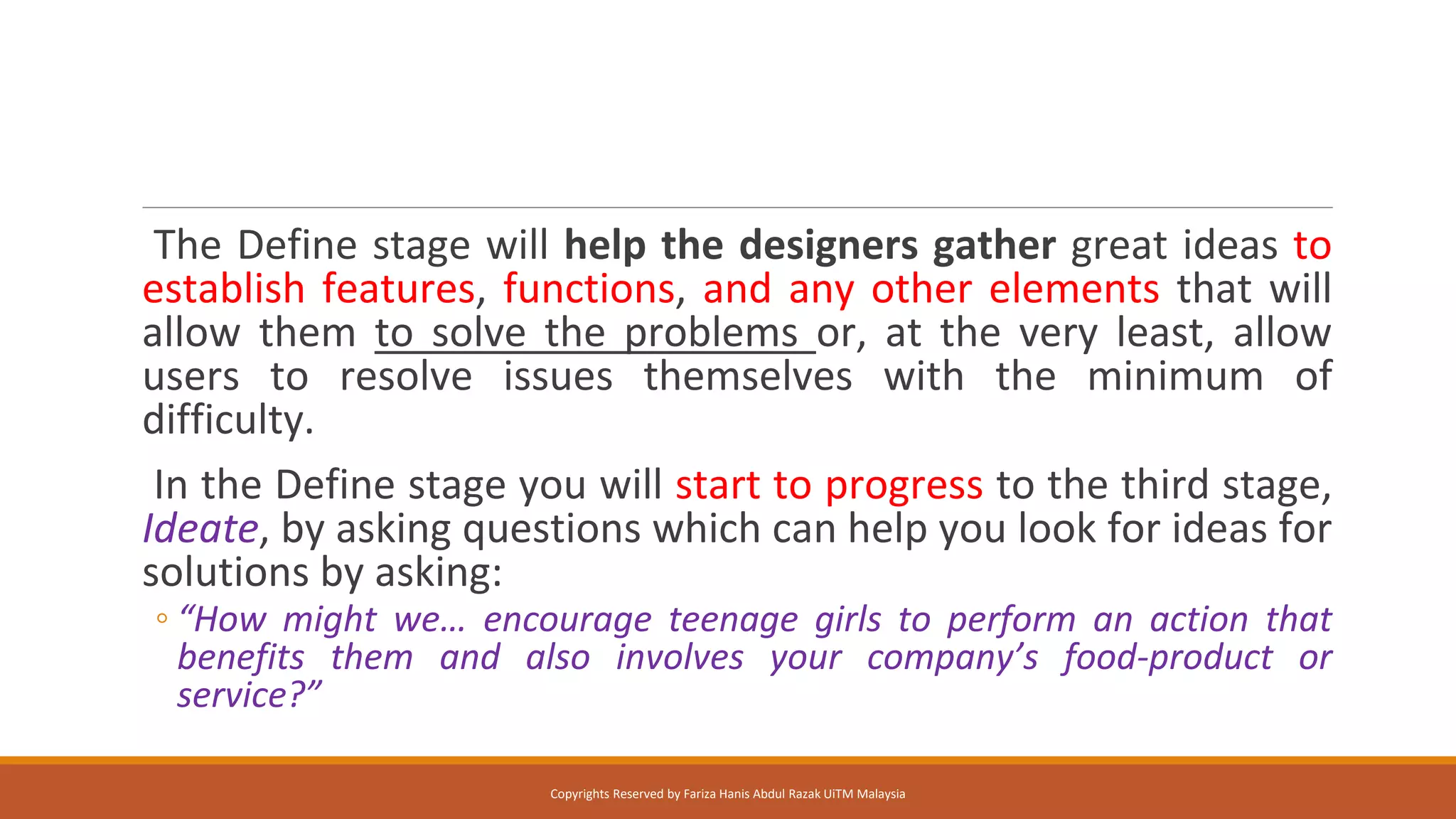
The Define stage will help the designers gather great ideas to
establish features, functions, and any other elements that will
allow them to solve the problems or, at the very least, allow
users to resolve issues themselves with the minimum of
difficulty.
In the Define stage you will start to progress to the third stage,
Ideate, by asking questions which can help you look for ideas for
solutions by asking:
◦ “How might we… encourage teenage girls to perform an action that
benefits them and also involves your company’s food-product or
service?”
Copyrights Reserved by Fariza Hanis Abdul Razak UiTM Malaysia
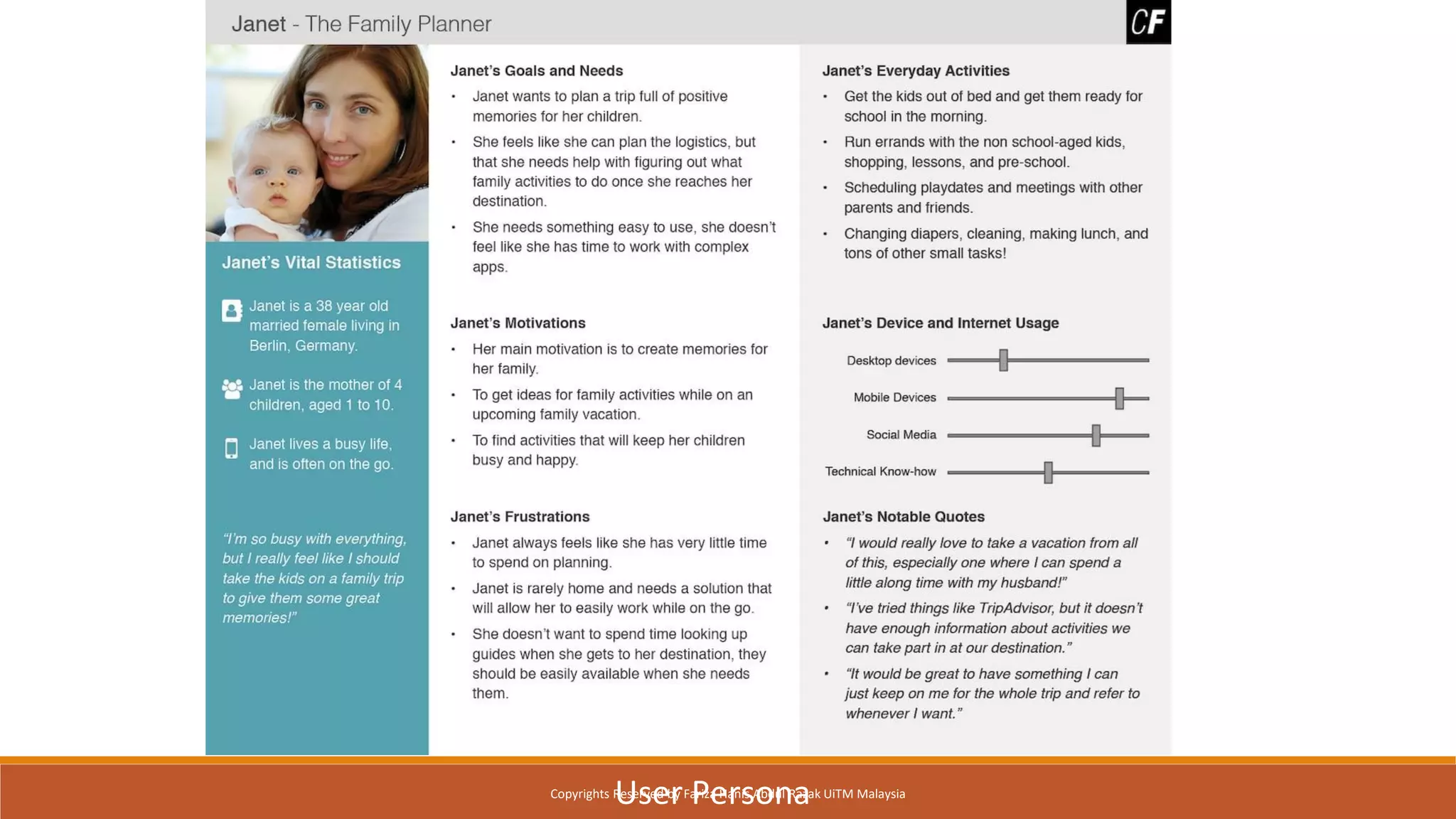
User Persona
Copyrights Reserved by Fariza Hanis Abdul Razak UiTM Malaysia
3. Ideate
Start to 'think outside the box' to identify
new solutions to the problem statement
you’ve created, and you can start to look for
alternative ways of viewing the problem.
There are hundreds of Ideation techniques
such as Brainstorm, Brainwrite, Worst
Possible Idea, and SCAMPER.
Brainstorm and Worst Possible Idea
sessions are typically used to stimulate free
thinking and to expand the problem space.
Copyrights Reserved by Fariza Hanis Abdul Razak UiTM Malaysia
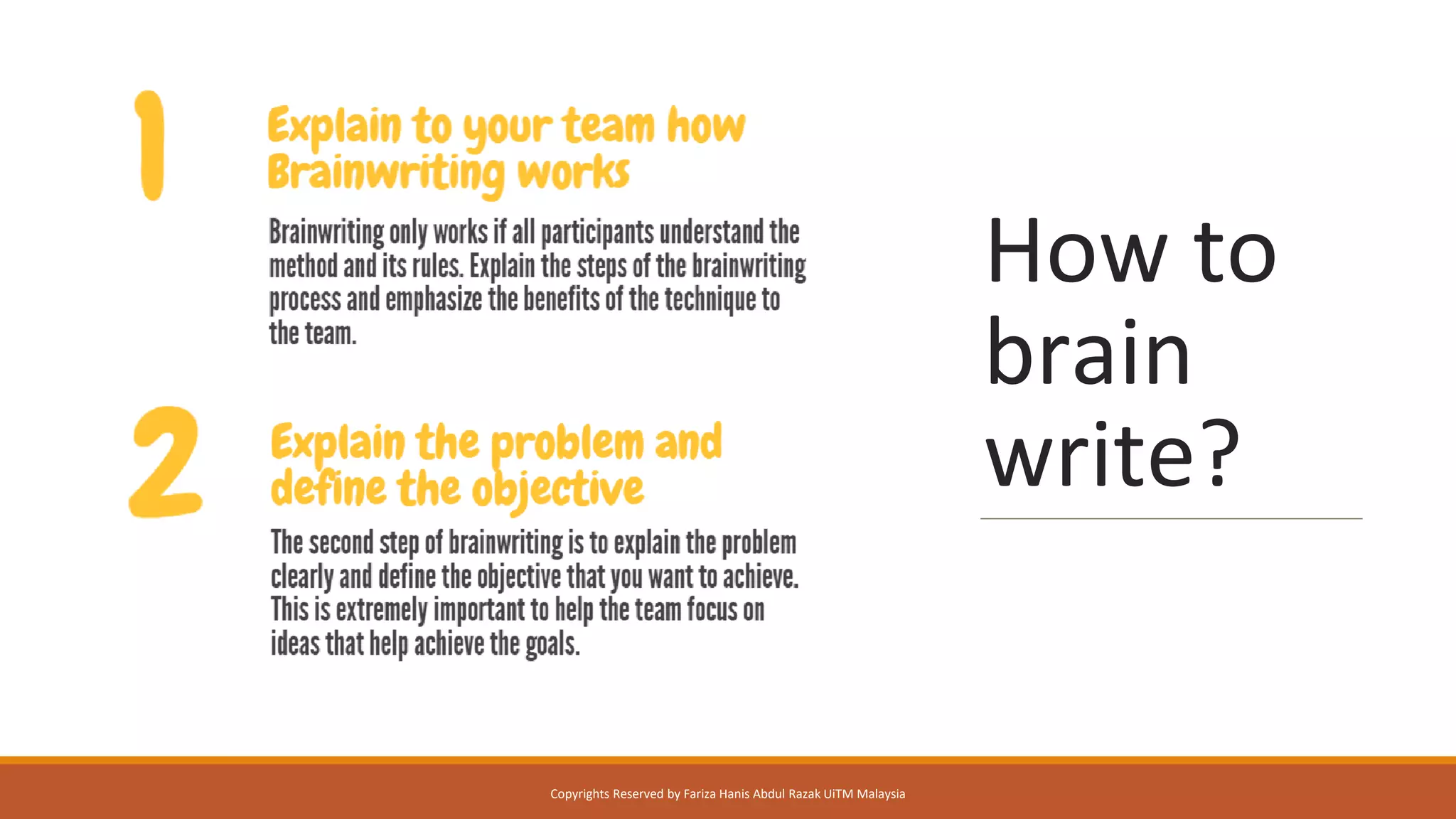
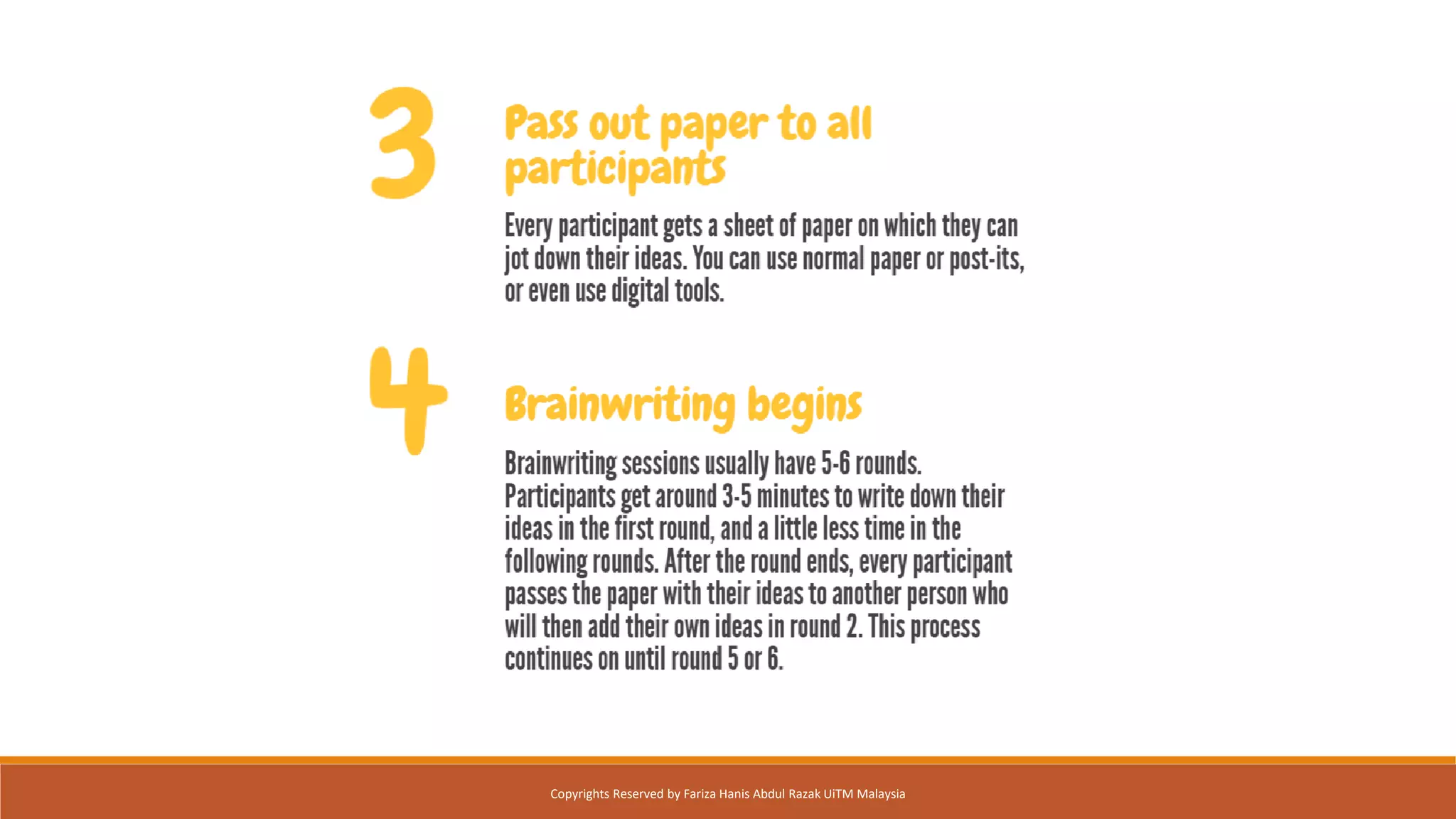
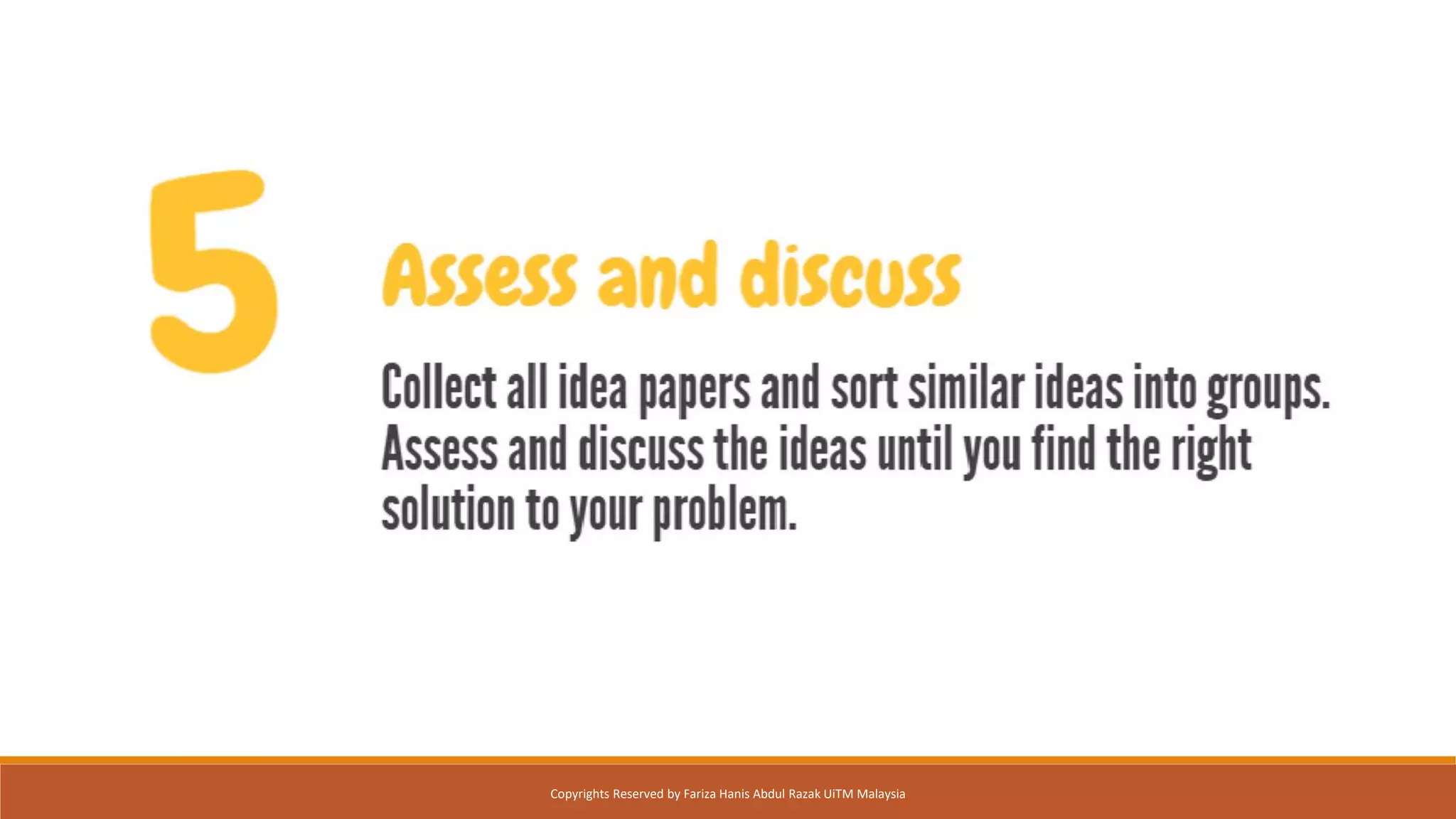
How to
brain
write?
Copyrights Reserved by Fariza Hanis Abdul Razak UiTM Malaysia
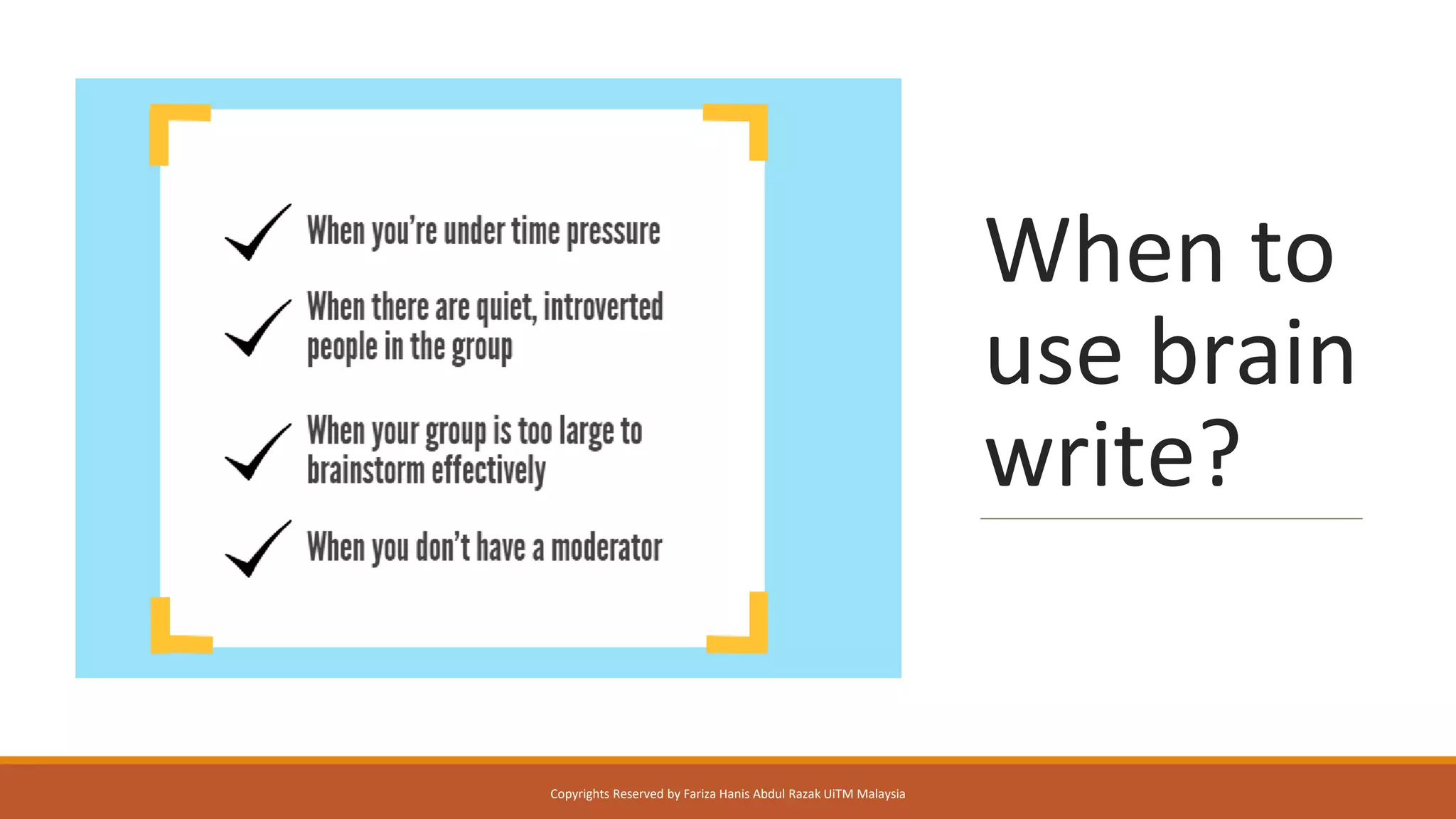
When to
use brain
write?
Copyrights Reserved by Fariza Hanis Abdul Razak UiTM Malaysia
Worst Possible Idea
The facilitator briefs ideation
session participants about the
problem statement, the overall
goals, and important user
insights.
Then the facilitator asks the
participants to come up with
extremely bad, terrible, stupid,
or even illegal ideas.
◦ Braindumping
Copyrights Reserved by Fariza Hanis Abdul Razak UiTM Malaysia
As the facilitator, be sure to push
your group to generate extremely
bad ideas!
◦ Open hearts and minds
◦ Use techniques that generate terrible
ideas including listing the attributes of
the worst ideas.
◦ Investigate which attributes of the
ideas make them really bad.
Copyrights Reserved by Fariza Hanis Abdul Razak UiTM Malaysia
Once the participants have generated a list of their worst ideas, you
as the facilitator should challenge the group to turn those horrible
ideas into good ones.
Copyrights Reserved by Fariza Hanis Abdul Razak UiTM Malaysia
Scamper
SCAMPER is an acronym that provides a structured way of assisting students
to think out of the box and enhance their knowledge.
SCAMPER was proposed by Alex Osborne in 1953, and was further developed
by Bob Elerle in 1971 in his book; SCAMPER: Games for Imagination
Development
Copyrights Reserved by Fariza Hanis Abdul Razak UiTM Malaysia
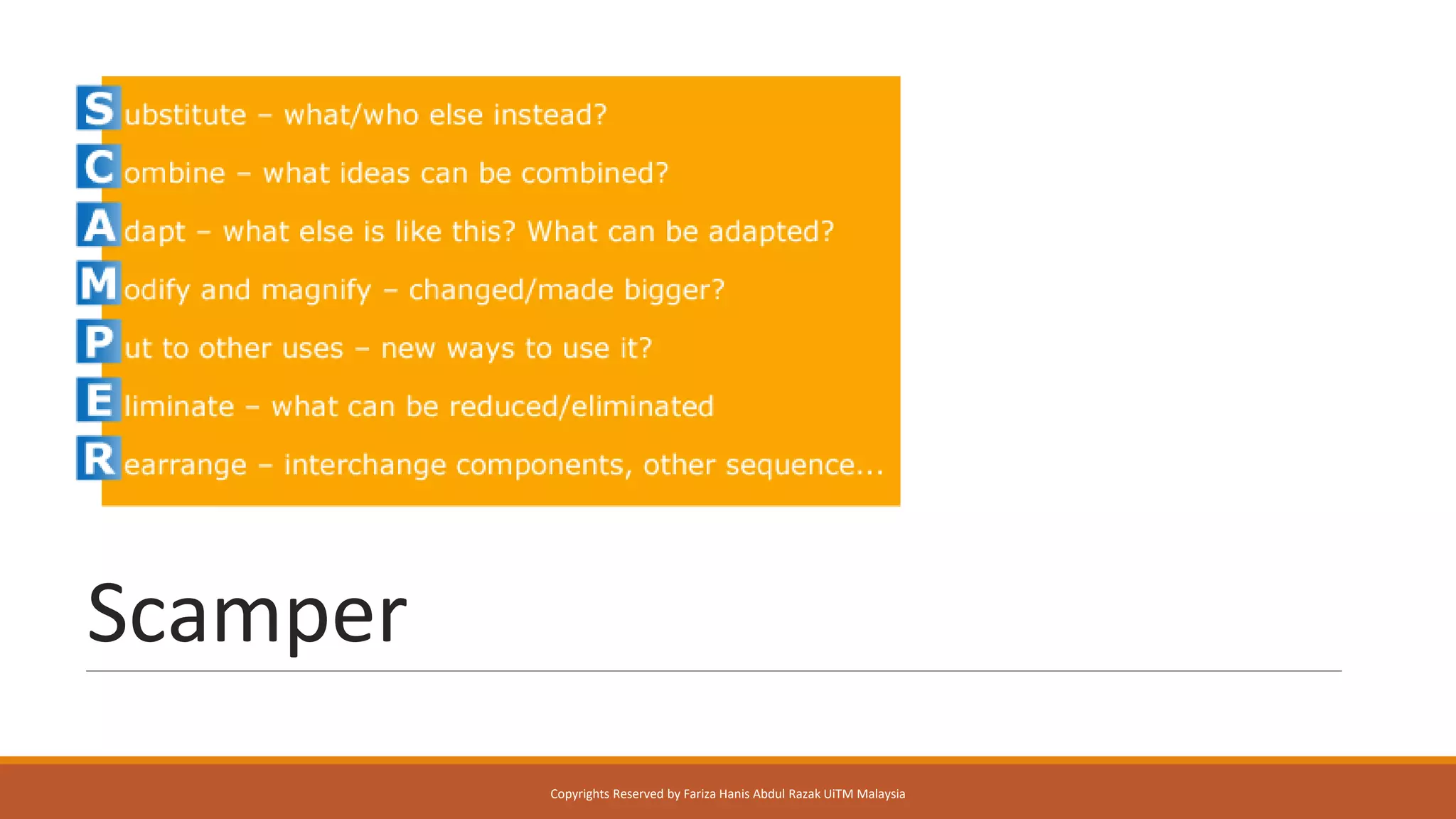
Scamper
Copyrights Reserved by Fariza Hanis Abdul Razak UiTM Malaysia
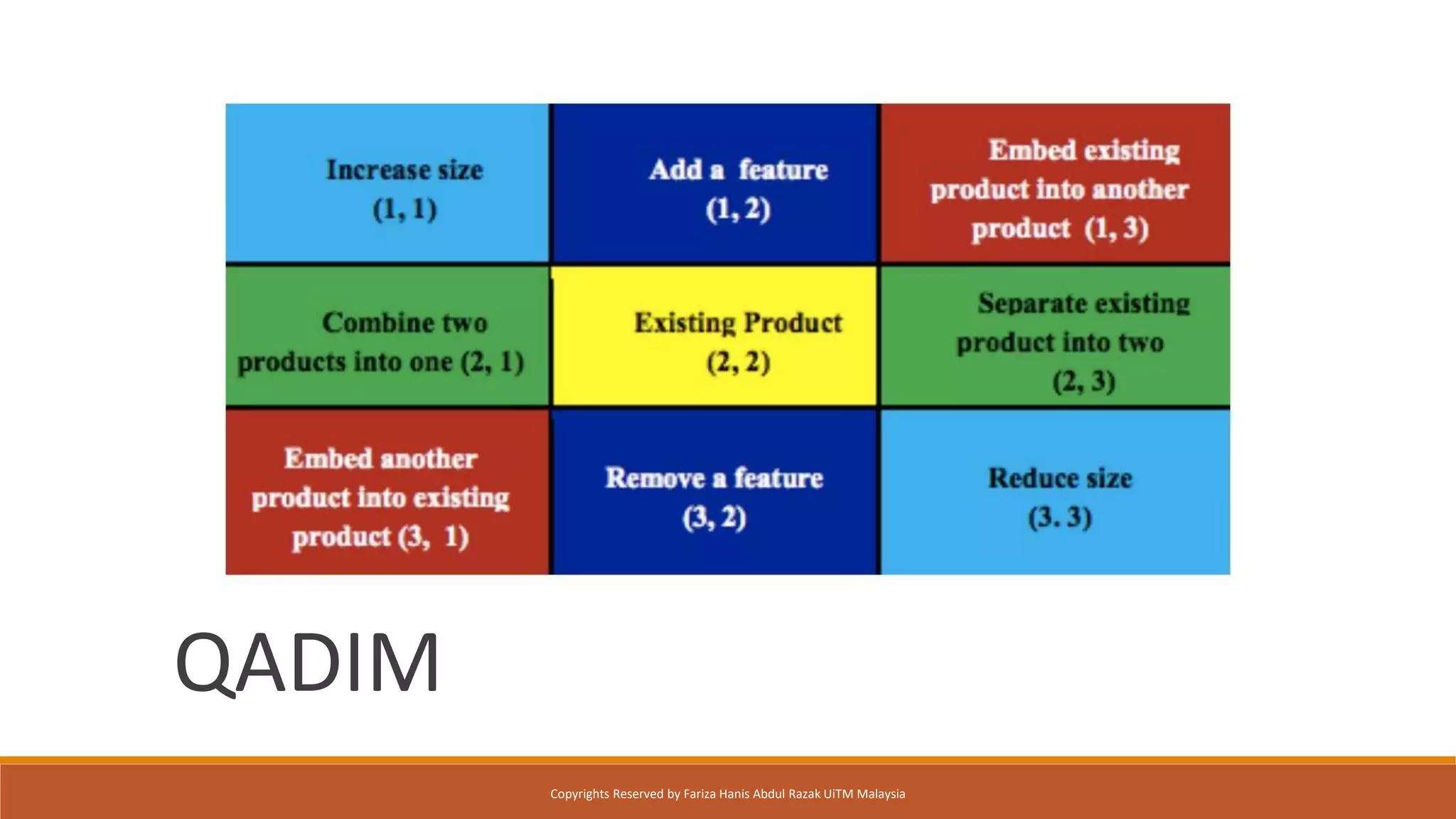
QADIM
Copyrights Reserved by Fariza Hanis Abdul Razak UiTM Malaysia
4. Prototype
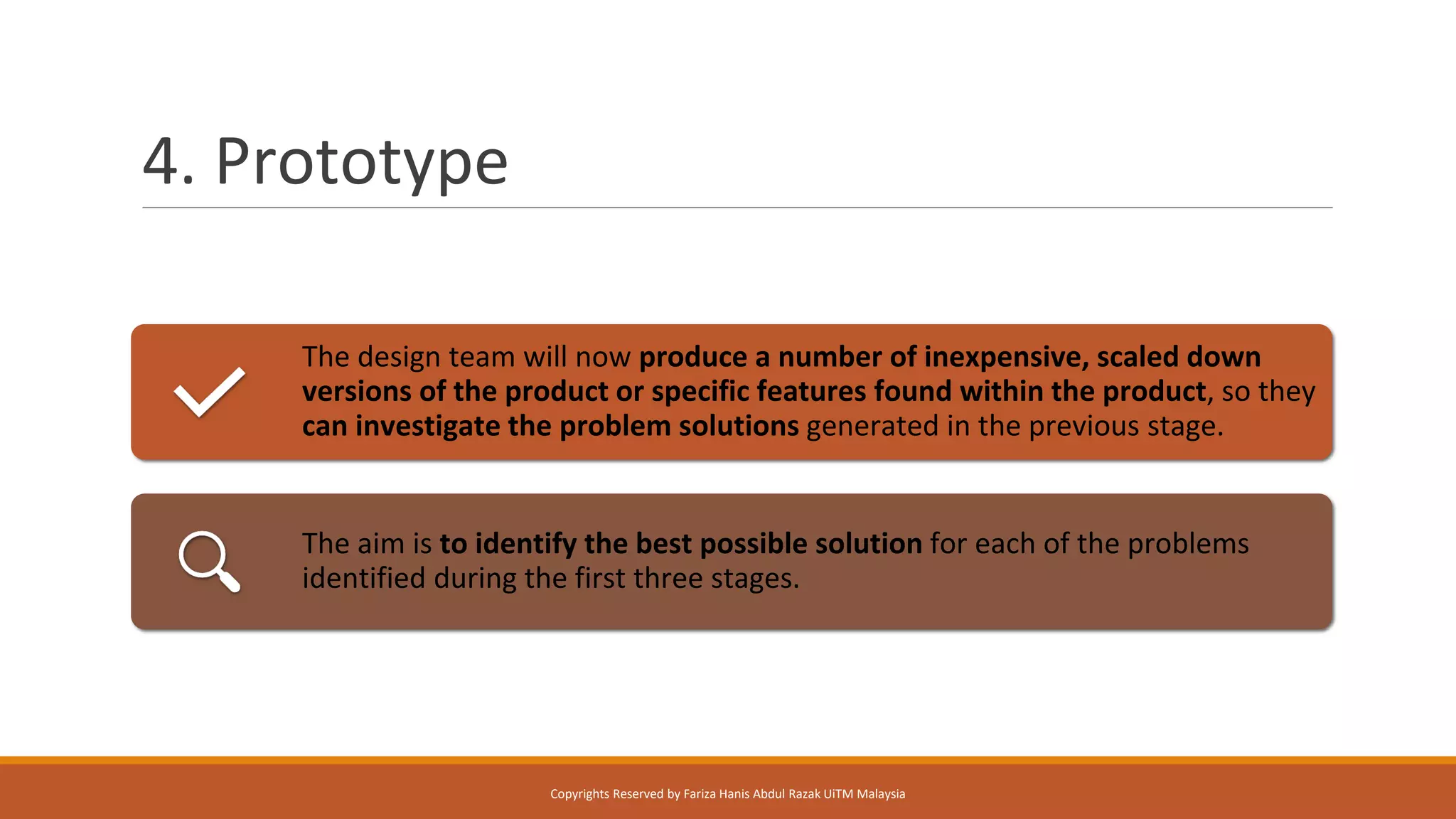
The design team will now produce a number of inexpensive, scaled down
versions of the product or specific features found within the product, so they
can investigate the problem solutions generated in the previous stage.
The aim is to identify the best possible solution for each of the problems
identified during the first three stages.
Copyrights Reserved by Fariza Hanis Abdul Razak UiTM Malaysia
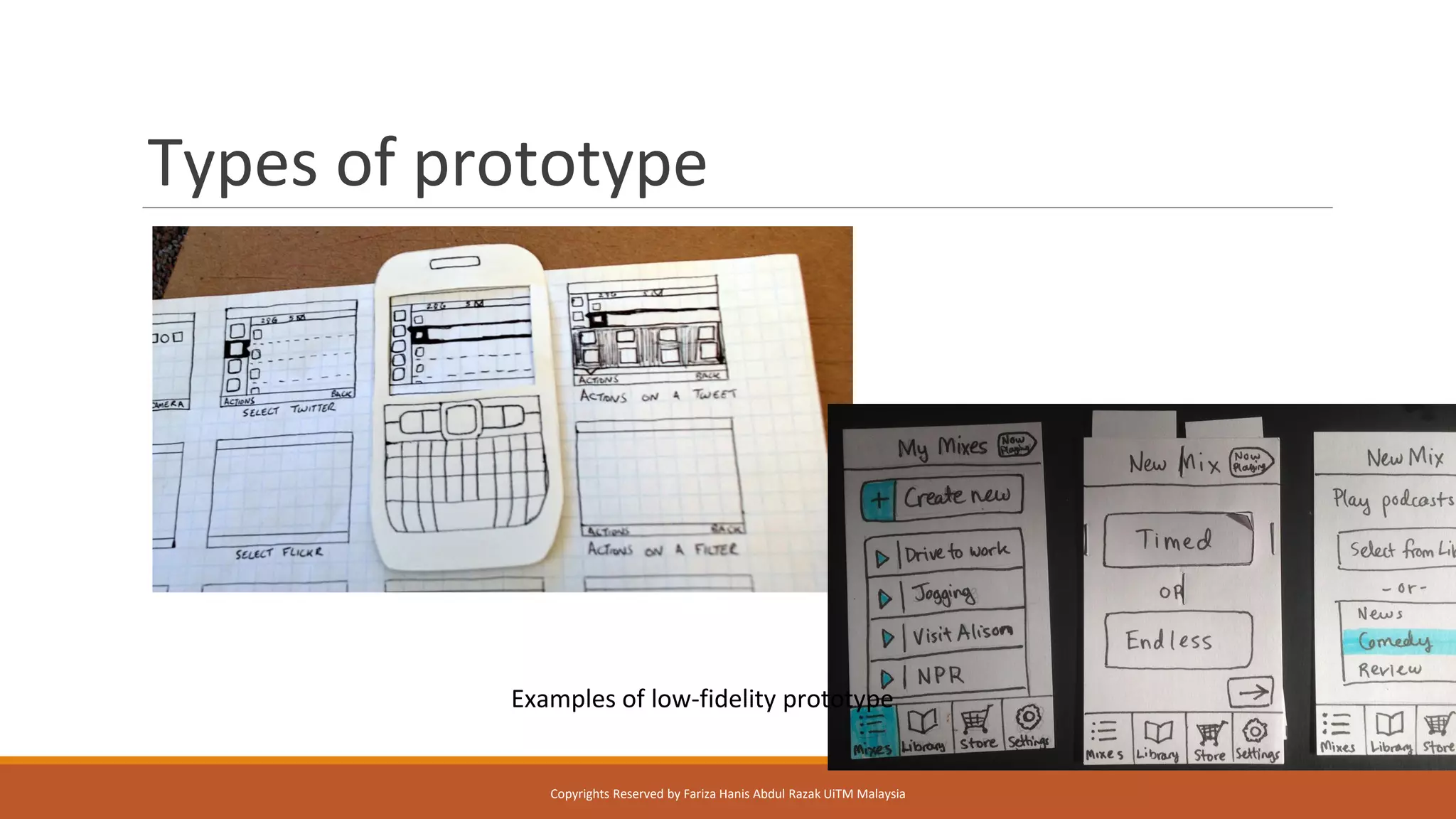
Types of prototype
Examples of low-fidelity prototype
Copyrights Reserved by Fariza Hanis Abdul Razak UiTM Malaysia
/
5. Test
Designers or evaluators rigorously test the
complete product using the best solutions
identified during the prototyping phase.
01
This is the final stage of the 5 stage-model,
but in an iterative process, the results
generated during the testing phase are
often used to redefine one or more
problems and inform the understanding of
the users, the conditions of use, how people
think, behave, and feel, and to empathise.
02
Copyrights Reserved by Fariza Hanis Abdul Razak UiTM Malaysia
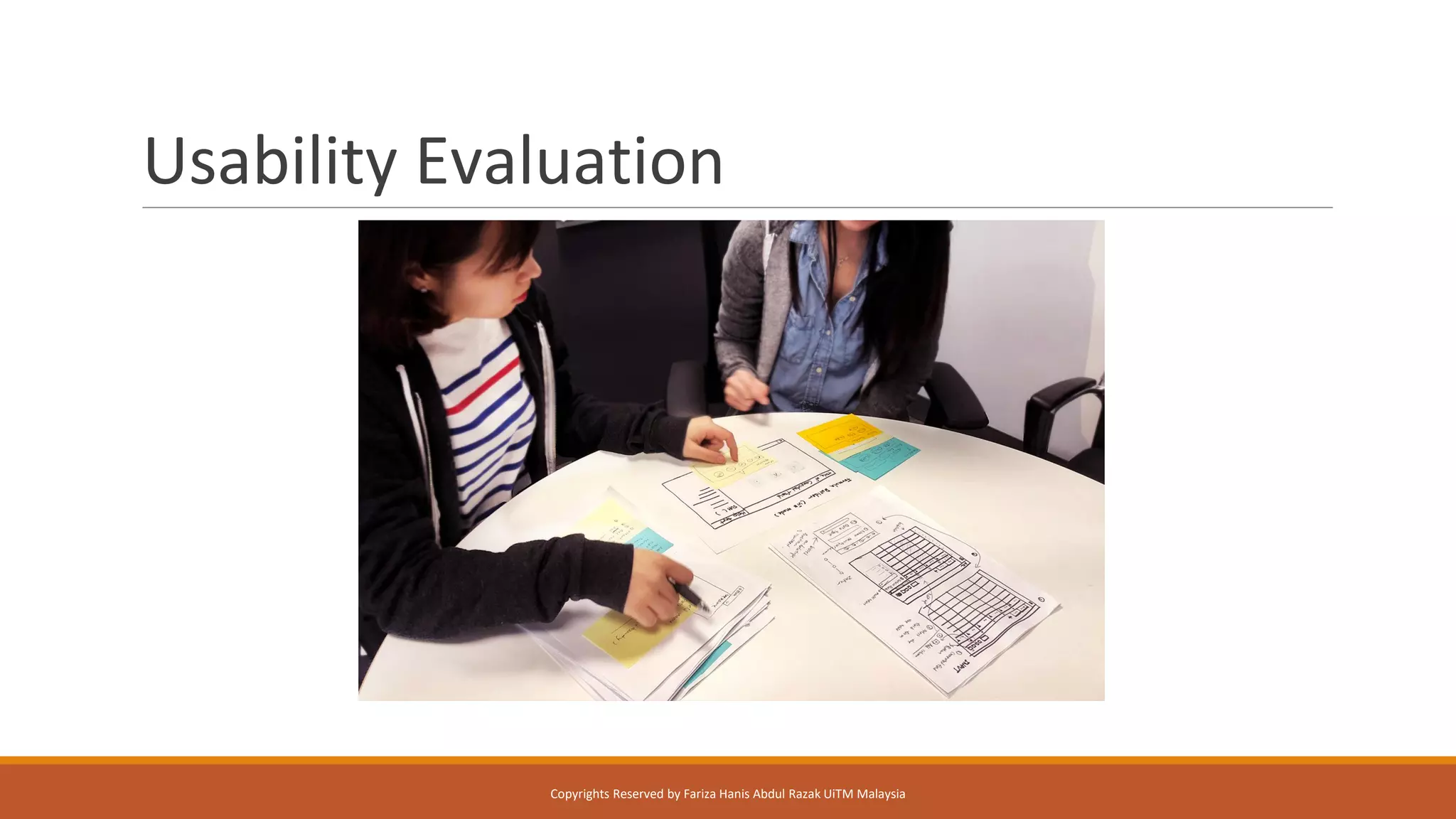
Usability Evaluation
Copyrights Reserved by Fariza Hanis Abdul Razak UiTM Malaysia

Lecture 8 - Design Thinking.pdf

  • 1.
    Design Thinking Lecture 7 Copyrights Reservedby Fariza Hanis Abdul Razak UiTM Malaysia
  • 2.
    Design Thinking Design Thinkingis a design methodology that provides a solution-based approach to solving problems. It’s extremely useful in tackling complex problems that are ill-defined or unknown, by understanding the human needs involved, by reframing the problem in human-centric ways, by creating many ideas in brainstorming sessions, and by adopting a hands-on approach in prototyping and testing. Understanding these five stages of Design Thinking will empower anyone to apply the Design Thinking methods in order to solve complex problems that occur around us — in our companies, our countries, and even our planet. Copyrights Reserved by Fariza Hanis Abdul Razak UiTM Malaysia
  • 3.
    The five-stage modelwas proposed by the Hasso-Plattner Institute of Design at Stanford (d.school). d.school is the leading university when it comes to teaching Design Thinking. The five stages of Design Thinking, according to d.school, are as follows: Empathise, Define (the problem), Ideate, Prototype, and Test. Copyrights Reserved by Fariza Hanis Abdul Razak UiTM Malaysia
  • 4.
    Copyrights Reserved byFariza Hanis Abdul Razak UiTM Malaysia
  • 5.
    Copyrights Reserved byFariza Hanis Abdul Razak UiTM Malaysia
  • 6.
    1. Empathise To gainan empathic understanding of the problem you are trying to solve. ◦ This involves consulting experts to find out more about the area of concern through observing, engaging and empathizing with people to understand their experiences and motivations, as well as immersing yourself in the physical environment to have a deeper personal understanding of the issues involved. Empathy is crucial to a human-centred design process such as Design Thinking because it allows design thinkers to set aside his or her own assumptions about the world in order to gain insight into users and their needs. Copyrights Reserved by Fariza Hanis Abdul Razak UiTM Malaysia
  • 7.
    Copyrights Reserved byFariza Hanis Abdul Razak UiTM Malaysia
  • 8.
    Empathy Map CopyrightsReserved by Fariza Hanis Abdul Razak UiTM Malaysia
  • 9.
    Copyrights Reserved byFariza Hanis Abdul Razak UiTM Malaysia
  • 10.
    2. Define Define theproblem as a problem statement in a human-centred manner. Rather than saying ◦ “We need to increase our food-product market share among young teenage girls by 5%” Better saying, ◦ “Teenage girls need to eat nutritious food in order to thrive, be healthy and grow” Copyrights Reserved by Fariza Hanis Abdul Razak UiTM Malaysia
  • 11.
    The Define stagewill help the designers gather great ideas to establish features, functions, and any other elements that will allow them to solve the problems or, at the very least, allow users to resolve issues themselves with the minimum of difficulty. In the Define stage you will start to progress to the third stage, Ideate, by asking questions which can help you look for ideas for solutions by asking: ◦ “How might we… encourage teenage girls to perform an action that benefits them and also involves your company’s food-product or service?” Copyrights Reserved by Fariza Hanis Abdul Razak UiTM Malaysia
  • 12.
    User Persona Copyrights Reservedby Fariza Hanis Abdul Razak UiTM Malaysia
  • 13.
    Copyrights Reserved byFariza Hanis Abdul Razak UiTM Malaysia
  • 14.
    3. Ideate Start to'think outside the box' to identify new solutions to the problem statement you’ve created, and you can start to look for alternative ways of viewing the problem. There are hundreds of Ideation techniques such as Brainstorm, Brainwrite, Worst Possible Idea, and SCAMPER. Brainstorm and Worst Possible Idea sessions are typically used to stimulate free thinking and to expand the problem space. Copyrights Reserved by Fariza Hanis Abdul Razak UiTM Malaysia
  • 15.
    Copyrights Reserved byFariza Hanis Abdul Razak UiTM Malaysia
  • 16.
    How to brain write? Copyrights Reservedby Fariza Hanis Abdul Razak UiTM Malaysia
  • 17.
    Copyrights Reserved byFariza Hanis Abdul Razak UiTM Malaysia
  • 18.
    Copyrights Reserved byFariza Hanis Abdul Razak UiTM Malaysia
  • 19.
    When to use brain write? CopyrightsReserved by Fariza Hanis Abdul Razak UiTM Malaysia
  • 20.
    Worst Possible Idea Thefacilitator briefs ideation session participants about the problem statement, the overall goals, and important user insights. Then the facilitator asks the participants to come up with extremely bad, terrible, stupid, or even illegal ideas. ◦ Braindumping Copyrights Reserved by Fariza Hanis Abdul Razak UiTM Malaysia
  • 21.
    As the facilitator,be sure to push your group to generate extremely bad ideas! ◦ Open hearts and minds ◦ Use techniques that generate terrible ideas including listing the attributes of the worst ideas. ◦ Investigate which attributes of the ideas make them really bad. Copyrights Reserved by Fariza Hanis Abdul Razak UiTM Malaysia
  • 22.
    Once the participantshave generated a list of their worst ideas, you as the facilitator should challenge the group to turn those horrible ideas into good ones. Copyrights Reserved by Fariza Hanis Abdul Razak UiTM Malaysia
  • 23.
    Scamper SCAMPER is anacronym that provides a structured way of assisting students to think out of the box and enhance their knowledge. SCAMPER was proposed by Alex Osborne in 1953, and was further developed by Bob Elerle in 1971 in his book; SCAMPER: Games for Imagination Development Copyrights Reserved by Fariza Hanis Abdul Razak UiTM Malaysia
  • 24.
    Scamper Copyrights Reserved byFariza Hanis Abdul Razak UiTM Malaysia
  • 25.
    QADIM Copyrights Reserved byFariza Hanis Abdul Razak UiTM Malaysia
  • 26.
    Copyrights Reserved byFariza Hanis Abdul Razak UiTM Malaysia
  • 27.
    4. Prototype The designteam will now produce a number of inexpensive, scaled down versions of the product or specific features found within the product, so they can investigate the problem solutions generated in the previous stage. The aim is to identify the best possible solution for each of the problems identified during the first three stages. Copyrights Reserved by Fariza Hanis Abdul Razak UiTM Malaysia
  • 28.
    Types of prototype Examplesof low-fidelity prototype Copyrights Reserved by Fariza Hanis Abdul Razak UiTM Malaysia
  • 29.
    Copyrights Reserved byFariza Hanis Abdul Razak UiTM Malaysia
  • 30.
    / 5. Test Designers orevaluators rigorously test the complete product using the best solutions identified during the prototyping phase. 01 This is the final stage of the 5 stage-model, but in an iterative process, the results generated during the testing phase are often used to redefine one or more problems and inform the understanding of the users, the conditions of use, how people think, behave, and feel, and to empathise. 02 Copyrights Reserved by Fariza Hanis Abdul Razak UiTM Malaysia
  • 31.
    Usability Evaluation Copyrights Reservedby Fariza Hanis Abdul Razak UiTM Malaysia
  • 32.
    Copyrights Reserved byFariza Hanis Abdul Razak UiTM Malaysia