Diaries for
Data
Collection
Fariza Hanis Abdul Razak
Universiti Teknologi MARA (UiTM)
MALAYSIA
17 December 2020
What is a diary?
• Diaries capture life as it is lived by an individual over time.
• “Provide a record of an ever-changing present” (Allport, 1942)
• author’s thoughts, internal and external events &
observations
• a chronological composite of snapshots and reflections a
few minutes, a day, or a week at a time
• non-textual “accessories to a life story” (Plummer, 2001),
such as photographs and other material/digital objects
• Construed broadly, a diary might be a collage of text and non-
text, or might consist solely of non-textual materials. (Allport,
1942; Plummer, 2001)
What is a research diary?
• A research method used to collect qualitative data about user behaviors, activities, and experiences
over time.
• In a diary study, data is self-reported by participants longitudinally — that is, over an extended period
of time that can range from a few days to even a month or longer.
• During the defined reporting period, study participants are asked to keep a diary and log specific
information about activities being studied.
• To help participants remember to fill in their diary, sometimes they are periodically prompted (for
example, through a notification received daily or at select times during the day).
When to conduct a
diary study
• Habits — What time of day do users engage with a product? If and how they
choose to share content with others?
• Usage scenarios — In what capacity do users engage with a product? What
are their primary tasks? What are their workflows for completing longer-term
tasks? (These scenarios can be used for user testing later in the process.)
• Attitudes and motivations — What motivates people to perform specific
tasks? How are users feeling and thinking?
• Changes in behaviors and perceptions — How learnable is a system? How
loyal are customers over time? How do they perceive a brand after engaging
with the corresponding organization?
• Customer journeys — What is the typical customer journey and cross-
channel user experience as customers interact with your organization using
different devices and channels such as, email, phone, websites, mobile
applications, kiosks, social media, and online chat? What is the cumulative
effect of multiple service touchpoints?
Scope of diary study
Product or Website —
Understanding all
interactions with a site
(e.g., an intranet) over
the course of a month.
Behavior — Gathering
general information
about user behavior (e.g.,
smartphone usage,
college-student web-
visitation patterns)
General activity —
Understanding how
people complete general
activities (e.g., sharing
information via social
tools or shopping online)
A specific activity —
Understanding how
people complete specific
activities (e.g., buying a
new car or planning a
vacation)
Diary study methodology
• Define the focus of the study and the long-term behaviors that you need to
understand.
• Define a timeline, select tools for participants to report data, recruit participants, and
prepare instructions or support materials.
Planning and Preparation.
• Schedule a face-to-face meeting or phone call with each participant to discuss the
details of the study.
Pre-study brief.
• Create clear and detailed instructions for logging. Give users example log entries to
help them understand the level of detail you need from them.
Logging period.
Type of logging: In-Situ
• When participants engage in a relevant activity, they must report all important details about that
activity right away. Participants are asked to log information about relevant activities in the situation
they occur (or in situ).
• Since this technique requires participants to take the time to report this information at the time of
the event, this technique is best reserved for situations when you don’t foresee a large volume of
diary entries occurring or if the context is such that participant’s daily activities will not be adversely
affected by logging in situ.
• In-situ logging is best supported by channels and devices that can handle structured long-form text
entry such as, email, web-form questionnaires, traditional paper diaries, or digital customer-insight
tools. Audio or video diaries are also great tools for participants, but the output may need to be
transcribed for analysis.
Type of logging: Snippet
• Participants only record short snippets of information about activities as they occur. Then, at the end of
each day, or when participants have time, they elaborate on each snippet by providing additional details
about the activity.
• This 2-step technique ensures that relevant information is captured in situ, before being forgotten but
without requiring participants to provide extensive detail at the time of capture, which can be intrusive
and unnatural in certain situations.
• Common channels for study participants to report snippets to researchers include email, text message,
Twitter, or Facebook. These channels are widely familiar for short-form communication.
• Participants are encouraged to use their mobile phones to report events as they happen, since these
devices are accessible. Expanding upon reported snippets can be accomplished with the channels and
tools mentioned above for more in-depth reporting.
• Consider asking participants to expand on their snippets by filling out a questionnaire about each of
them. This will enable you to get specific and consistent insights about each snippet.
Diary study methodology (cont’d)
• After the study, evaluate all the information provided by each
participant.
• Plan a follow-up interview to discuss logs in detail.
Post-study interview.
• Because diary studies are longitudinal, they generate a large
amount of qualitative data.
• Evaluate the behaviors you’ve targeted throughout the study.
Data Analysis.
Our Experience
1: Children &
Social Media
(Azmi, N. H.,
2018)
1) With whom are you access SNS and where do
you access SNS
2) Something that attracts you in SNS and
something that bothers you in SNS
4) Image you want to put as profile picture in SNS
To pursue
hobby
To follow
celebrity
To keep in
touch
Our Experience 2: Elderly & Mobile Quran
(Ahmad, N. A., 2018)
Peaceful Calm Connectedness Fear God Motivated Energised
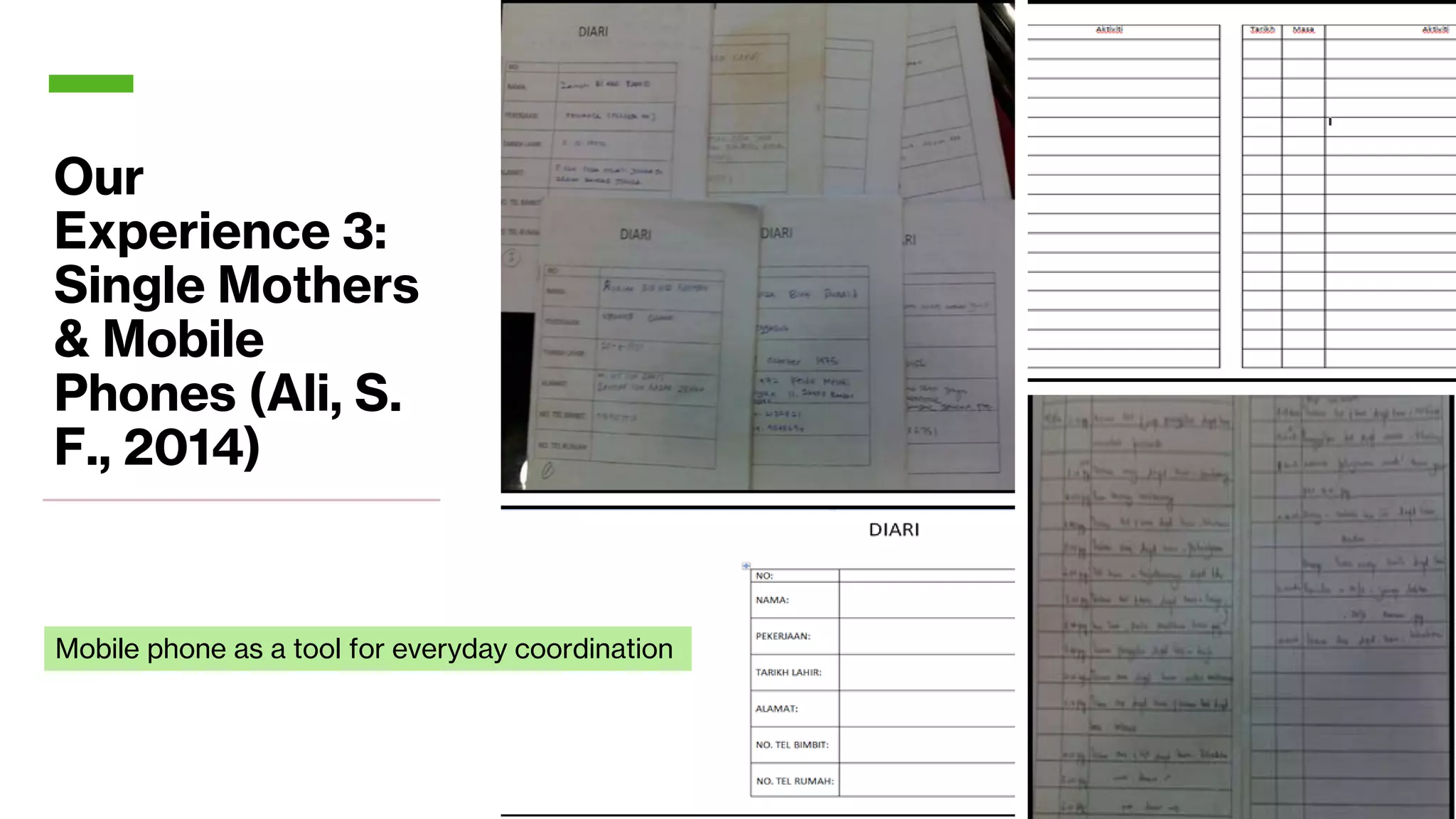
Our
Experience 3:
Single Mothers
& Mobile
Phones (Ali, S.
F., 2014)
Mobile phone as a tool for everyday coordination
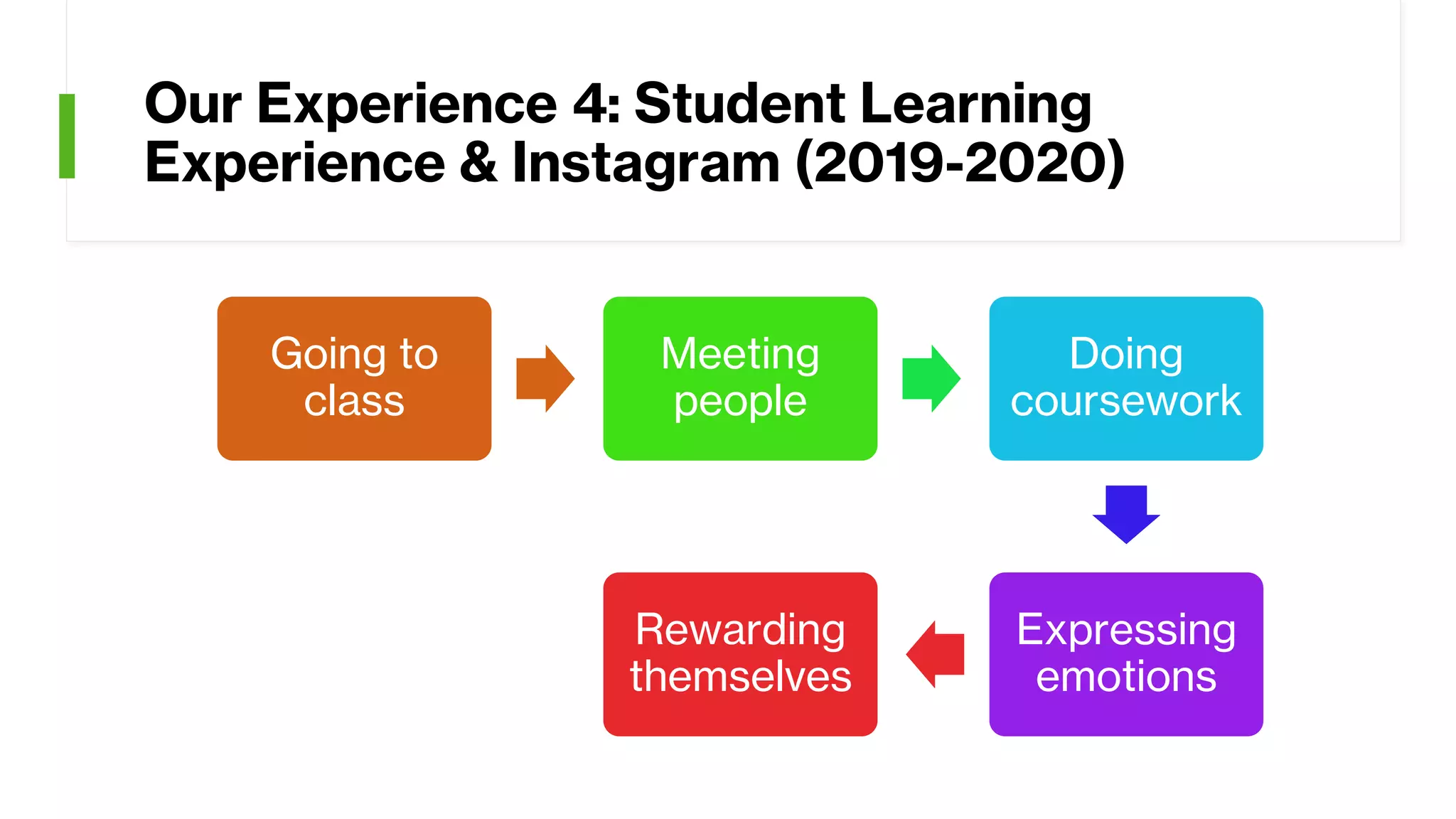
Our Experience 4: Student Learning
Experience & Instagram (2019-2020)
Going to
class
Meeting
people
Doing
coursework
Expressing
emotions
Rewarding
themselves
Motivating participants
• Diary studies require time and dedication from participants. To ensure you get
the level of involvement you need from participants, provide an incentive that
will keep them engaged.
• For participants that are engaged, recognize their efforts and ask them to
keep up the good work.
• For participants that are less engaged, give encouragement or offer to answer
any questions they may have to get them on track.
Advice for conducting a diary study
Plan for an
appropriate
reporting
period.
01
Recruit
dedicated
users.
02
Be on top of
the data as it
comes in.
03
Conduct a
pilot study.
04
References
• Ahmad, N. A. 2018. Islamic Spiritual User Experience (iSUX) Model: A Case Study
of Muslim Older Adults Using Al-Quran Mobile Application, PhD Thesis, UiTM
• Ali, S. F. 2014. Use of Mobile Phone by Single Mothers, MscIT Dissertation, UiTM
• Azmi, N. H. 2017. Modelling Child Persona for Social Behaviour in Social Network
Sites, PhD Thesis, UiTM
• Salazar, K. 2016. Diary Studies: Understanding Long-Term User Behavior and
Experiences. Retrieved at https://www.nngroup.com/articles/diary-studies/
• Shelbe, L. & Wildemuth, B. 2009. Research Diaries in Applications of social
research methods to questions in information and library science, Libraries
Unlimited.
Contact:
Assoc. Prof. Dr. Fariza Hanis Abdul Razak
fariza@tmsk.uitm.edu.my
Diaries for data collection

Diaries for data collection

  • 1.
    Diaries for Data Collection Fariza HanisAbdul Razak Universiti Teknologi MARA (UiTM) MALAYSIA 17 December 2020
  • 2.
    What is adiary? • Diaries capture life as it is lived by an individual over time. • “Provide a record of an ever-changing present” (Allport, 1942) • author’s thoughts, internal and external events & observations • a chronological composite of snapshots and reflections a few minutes, a day, or a week at a time • non-textual “accessories to a life story” (Plummer, 2001), such as photographs and other material/digital objects • Construed broadly, a diary might be a collage of text and non- text, or might consist solely of non-textual materials. (Allport, 1942; Plummer, 2001)
  • 4.
    What is aresearch diary? • A research method used to collect qualitative data about user behaviors, activities, and experiences over time. • In a diary study, data is self-reported by participants longitudinally — that is, over an extended period of time that can range from a few days to even a month or longer. • During the defined reporting period, study participants are asked to keep a diary and log specific information about activities being studied. • To help participants remember to fill in their diary, sometimes they are periodically prompted (for example, through a notification received daily or at select times during the day).
  • 5.
    When to conducta diary study • Habits — What time of day do users engage with a product? If and how they choose to share content with others? • Usage scenarios — In what capacity do users engage with a product? What are their primary tasks? What are their workflows for completing longer-term tasks? (These scenarios can be used for user testing later in the process.) • Attitudes and motivations — What motivates people to perform specific tasks? How are users feeling and thinking? • Changes in behaviors and perceptions — How learnable is a system? How loyal are customers over time? How do they perceive a brand after engaging with the corresponding organization? • Customer journeys — What is the typical customer journey and cross- channel user experience as customers interact with your organization using different devices and channels such as, email, phone, websites, mobile applications, kiosks, social media, and online chat? What is the cumulative effect of multiple service touchpoints?
  • 6.
    Scope of diarystudy Product or Website — Understanding all interactions with a site (e.g., an intranet) over the course of a month. Behavior — Gathering general information about user behavior (e.g., smartphone usage, college-student web- visitation patterns) General activity — Understanding how people complete general activities (e.g., sharing information via social tools or shopping online) A specific activity — Understanding how people complete specific activities (e.g., buying a new car or planning a vacation)
  • 7.
    Diary study methodology •Define the focus of the study and the long-term behaviors that you need to understand. • Define a timeline, select tools for participants to report data, recruit participants, and prepare instructions or support materials. Planning and Preparation. • Schedule a face-to-face meeting or phone call with each participant to discuss the details of the study. Pre-study brief. • Create clear and detailed instructions for logging. Give users example log entries to help them understand the level of detail you need from them. Logging period.
  • 8.
    Type of logging:In-Situ • When participants engage in a relevant activity, they must report all important details about that activity right away. Participants are asked to log information about relevant activities in the situation they occur (or in situ). • Since this technique requires participants to take the time to report this information at the time of the event, this technique is best reserved for situations when you don’t foresee a large volume of diary entries occurring or if the context is such that participant’s daily activities will not be adversely affected by logging in situ. • In-situ logging is best supported by channels and devices that can handle structured long-form text entry such as, email, web-form questionnaires, traditional paper diaries, or digital customer-insight tools. Audio or video diaries are also great tools for participants, but the output may need to be transcribed for analysis.
  • 9.
    Type of logging:Snippet • Participants only record short snippets of information about activities as they occur. Then, at the end of each day, or when participants have time, they elaborate on each snippet by providing additional details about the activity. • This 2-step technique ensures that relevant information is captured in situ, before being forgotten but without requiring participants to provide extensive detail at the time of capture, which can be intrusive and unnatural in certain situations. • Common channels for study participants to report snippets to researchers include email, text message, Twitter, or Facebook. These channels are widely familiar for short-form communication. • Participants are encouraged to use their mobile phones to report events as they happen, since these devices are accessible. Expanding upon reported snippets can be accomplished with the channels and tools mentioned above for more in-depth reporting. • Consider asking participants to expand on their snippets by filling out a questionnaire about each of them. This will enable you to get specific and consistent insights about each snippet.
  • 10.
    Diary study methodology(cont’d) • After the study, evaluate all the information provided by each participant. • Plan a follow-up interview to discuss logs in detail. Post-study interview. • Because diary studies are longitudinal, they generate a large amount of qualitative data. • Evaluate the behaviors you’ve targeted throughout the study. Data Analysis.
  • 11.
    Our Experience 1: Children& Social Media (Azmi, N. H., 2018) 1) With whom are you access SNS and where do you access SNS 2) Something that attracts you in SNS and something that bothers you in SNS 4) Image you want to put as profile picture in SNS To pursue hobby To follow celebrity To keep in touch
  • 12.
    Our Experience 2:Elderly & Mobile Quran (Ahmad, N. A., 2018) Peaceful Calm Connectedness Fear God Motivated Energised
  • 13.
    Our Experience 3: Single Mothers &Mobile Phones (Ali, S. F., 2014) Mobile phone as a tool for everyday coordination
  • 14.
    Our Experience 4:Student Learning Experience & Instagram (2019-2020) Going to class Meeting people Doing coursework Expressing emotions Rewarding themselves
  • 15.
    Motivating participants • Diarystudies require time and dedication from participants. To ensure you get the level of involvement you need from participants, provide an incentive that will keep them engaged. • For participants that are engaged, recognize their efforts and ask them to keep up the good work. • For participants that are less engaged, give encouragement or offer to answer any questions they may have to get them on track.
  • 16.
    Advice for conductinga diary study Plan for an appropriate reporting period. 01 Recruit dedicated users. 02 Be on top of the data as it comes in. 03 Conduct a pilot study. 04
  • 17.
    References • Ahmad, N.A. 2018. Islamic Spiritual User Experience (iSUX) Model: A Case Study of Muslim Older Adults Using Al-Quran Mobile Application, PhD Thesis, UiTM • Ali, S. F. 2014. Use of Mobile Phone by Single Mothers, MscIT Dissertation, UiTM • Azmi, N. H. 2017. Modelling Child Persona for Social Behaviour in Social Network Sites, PhD Thesis, UiTM • Salazar, K. 2016. Diary Studies: Understanding Long-Term User Behavior and Experiences. Retrieved at https://www.nngroup.com/articles/diary-studies/ • Shelbe, L. & Wildemuth, B. 2009. Research Diaries in Applications of social research methods to questions in information and library science, Libraries Unlimited.
  • 18.
    Contact: Assoc. Prof. Dr.Fariza Hanis Abdul Razak fariza@tmsk.uitm.edu.my