Dr. Sonal Sharma
Associate Professor
JIMS, Vasant Kunj
 What is Design Thinking?
 What are the benefits of Design Thinking?
 Who is using Design Thinking?
 A structured process for
problem solving
 Developed to address problems
I. Complex problems with
multiple stakeholder groups
II. Can be used for technology,
process, policy, etc.
 Purpose is to
I. Facilitate innovative
solutions
II. Reduce Risk
 Design thinking is a human centered approach to problem solving.
 Its a process built from People - inspiration gained by looking & listening to them.
 Prototyping - ideating quickly to make things real.
 Stories - getting things implemented by selling compelling narratives not
"concepts".
 Herbert Simon, in the Sciences of the Artificial has defined "design" as the
"transformation of existing conditions into preferred ones".
 Design thinking is, then, always linked to an improved future..
 Unlike critical thinking, which is a process of analysis and is associated with the
'breaking down' of ideas, design thinking is a creative process based around the
'building up' of ideas.
 There are no judgments in design thinking. This eliminates the fear of failure and
encourages maximum input and participation. Wild ideas are welcome, since these
often lead to the most creative solutions.
 Structured process, focusing on the users
I. Use steps and methods that are defined
II. Power is in the whole process, not individual steps
 Scientific method
I. Consider ideas to be hypotheses to be tested, not definite solutions
 Diverse teams
I. Diversity in terms of roles to maximize the knowledge, erspectives, and
connections of team members
II. Demographic diversity not as critical here
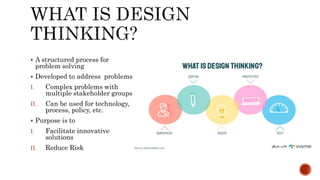
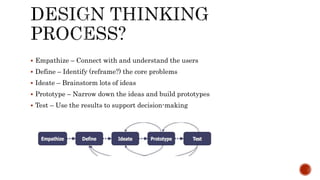
 Empathize – Connect with and understand the users
 Define – Identify (reframe?) the core problems
 Ideate – Brainstorm lots of ideas
 Prototype – Narrow down the ideas and build prototypes
 Test – Use the results to support decision-making
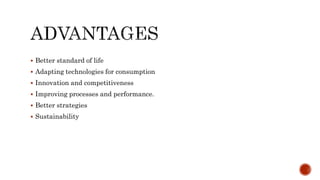
 Better standard of life
 Adapting technologies for consumption
 Innovation and competitiveness
 Improving processes and performance.
 Better strategies
 Sustainability
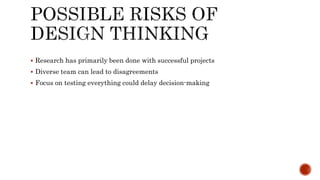
 Research has primarily been done with successful projects
 Diverse team can lead to disagreements
 Focus on testing everything could delay decision-making
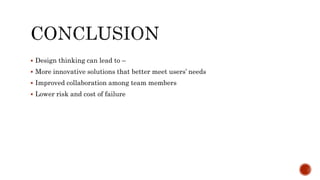
 Design thinking can lead to –
 More innovative solutions that better meet users’ needs
 Improved collaboration among team members
 Lower risk and cost of failure
 Liedtka, J. (2017). Evaluating the Impact of Design Thinking in Action. In Academy of
Management Proceedings, Vol. 2017, No. 1, pp 1-6.
 Webinar by Jeanne Liedtka on Design Thinking in the government sponsored by OPM:
https://www.youtube.com/watch?v=HffIKCrTB1Y&feature=youtu.be.
 Stanford’s Design Thinking framework:https://dschool-old.stanford.edu/sandbox/groups/
designresources/wiki/36873/attachments/74b3d/ModeGuideBOOTCAMP2010L.pdf?session
ID=8af88fee76ecd1fb7879c915073461486c425622
 DOL Customer Centered Design Challenge https://blog.dol.gov/2016/02/18/how-wioa-is inspiring-
innovation-locally
 USDA’s program : https://obamawhitehouse.archives.gov/blog/2015/09/04/using-human-centered-
designmake-government-work-better-and-cost-less
 VA’s Design Thinking program: https://www.blogs.va.gov/VAntage/25450/a-toolkit-for-design-
innovation-puttingveterans-needs-firs

Design Thinking For Innovation.pptx

  • 1.
    Dr. Sonal Sharma AssociateProfessor JIMS, Vasant Kunj
  • 2.
     What isDesign Thinking?  What are the benefits of Design Thinking?  Who is using Design Thinking?
  • 3.
     A structuredprocess for problem solving  Developed to address problems I. Complex problems with multiple stakeholder groups II. Can be used for technology, process, policy, etc.  Purpose is to I. Facilitate innovative solutions II. Reduce Risk
  • 4.
     Design thinkingis a human centered approach to problem solving.  Its a process built from People - inspiration gained by looking & listening to them.  Prototyping - ideating quickly to make things real.  Stories - getting things implemented by selling compelling narratives not "concepts".
  • 5.
     Herbert Simon,in the Sciences of the Artificial has defined "design" as the "transformation of existing conditions into preferred ones".  Design thinking is, then, always linked to an improved future..  Unlike critical thinking, which is a process of analysis and is associated with the 'breaking down' of ideas, design thinking is a creative process based around the 'building up' of ideas.  There are no judgments in design thinking. This eliminates the fear of failure and encourages maximum input and participation. Wild ideas are welcome, since these often lead to the most creative solutions.
  • 6.
     Structured process,focusing on the users I. Use steps and methods that are defined II. Power is in the whole process, not individual steps  Scientific method I. Consider ideas to be hypotheses to be tested, not definite solutions  Diverse teams I. Diversity in terms of roles to maximize the knowledge, erspectives, and connections of team members II. Demographic diversity not as critical here
  • 7.
     Empathize –Connect with and understand the users  Define – Identify (reframe?) the core problems  Ideate – Brainstorm lots of ideas  Prototype – Narrow down the ideas and build prototypes  Test – Use the results to support decision-making
  • 10.
     Better standardof life  Adapting technologies for consumption  Innovation and competitiveness  Improving processes and performance.  Better strategies  Sustainability
  • 11.
     Research hasprimarily been done with successful projects  Diverse team can lead to disagreements  Focus on testing everything could delay decision-making
  • 12.
     Design thinkingcan lead to –  More innovative solutions that better meet users’ needs  Improved collaboration among team members  Lower risk and cost of failure
  • 13.
     Liedtka, J.(2017). Evaluating the Impact of Design Thinking in Action. In Academy of Management Proceedings, Vol. 2017, No. 1, pp 1-6.  Webinar by Jeanne Liedtka on Design Thinking in the government sponsored by OPM: https://www.youtube.com/watch?v=HffIKCrTB1Y&feature=youtu.be.  Stanford’s Design Thinking framework:https://dschool-old.stanford.edu/sandbox/groups/ designresources/wiki/36873/attachments/74b3d/ModeGuideBOOTCAMP2010L.pdf?session ID=8af88fee76ecd1fb7879c915073461486c425622  DOL Customer Centered Design Challenge https://blog.dol.gov/2016/02/18/how-wioa-is inspiring- innovation-locally  USDA’s program : https://obamawhitehouse.archives.gov/blog/2015/09/04/using-human-centered- designmake-government-work-better-and-cost-less  VA’s Design Thinking program: https://www.blogs.va.gov/VAntage/25450/a-toolkit-for-design- innovation-puttingveterans-needs-firs