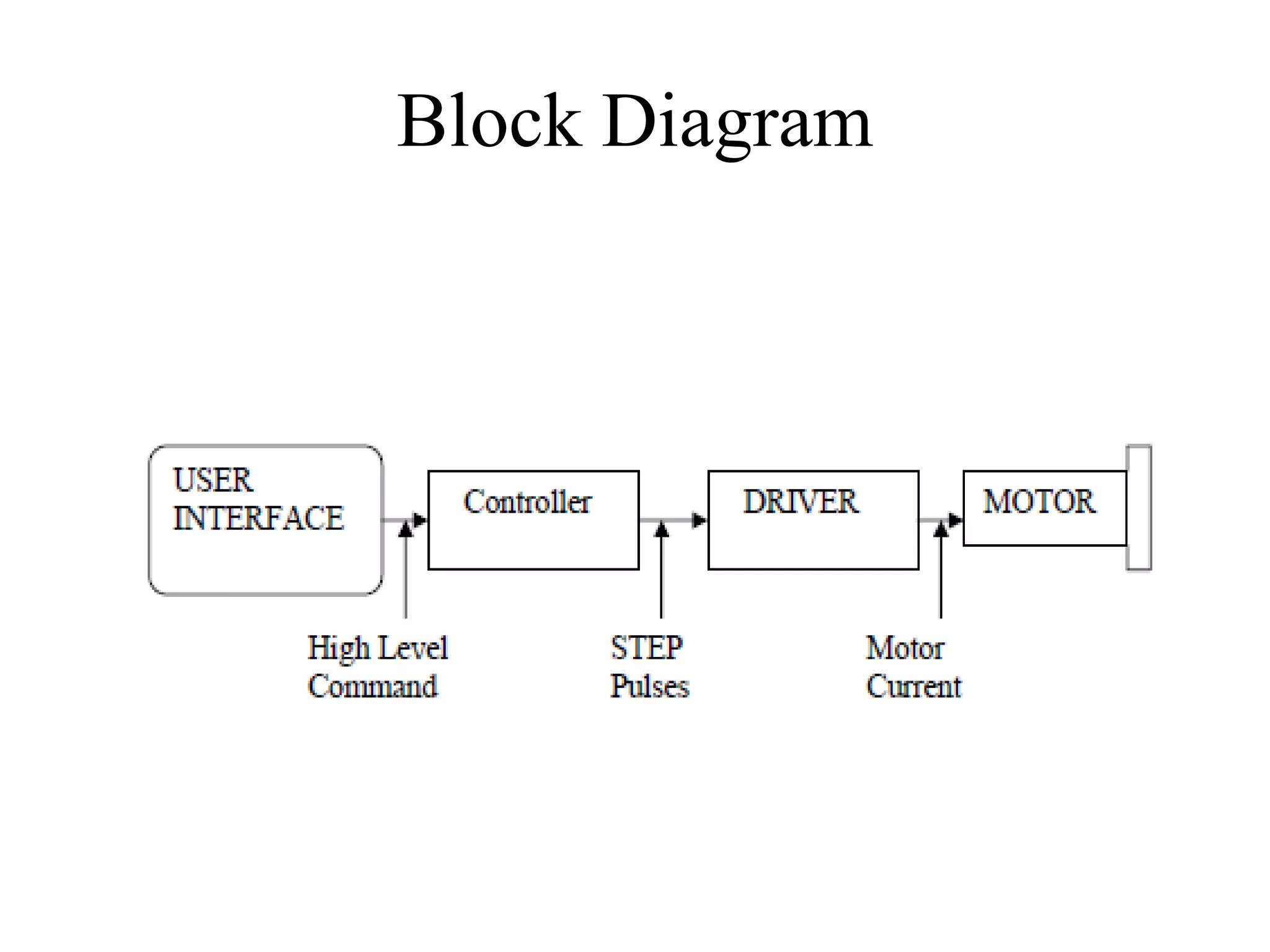
This document describes a microcontroller-based stepper motor controller that can control the motor's direction, speed, and number of revolutions using tactile switches. It includes a block diagram and descriptions of the main components - an AT89C51 microcontroller, voltage regulator, crystal oscillator, hex converter, and bipolar stepper motor. The controller uses half-step drive to accurately control the motor. It can be simulated using Proteus software and interfaced with a computer for keyboard control of the motor's speed. Stepper motors are described in comparison to conventional motors.
Speed Control ofstepper Motor
PROJECT GUIDE-
Mr. Pramod Kumar
Gangwar
Electrical & Electronics
Engg. Dept.
S.R.M.S.C.E.T, Bareilly
SUBMITTED BY-
Jatin Arora
Gaurav Singh
Ameer- Uz -Zama
2.
Introduction
• Stepper motorsare used for precision
position control in many applications like
floppy drives, printers, process control
instruments, robotics and machine tool control.
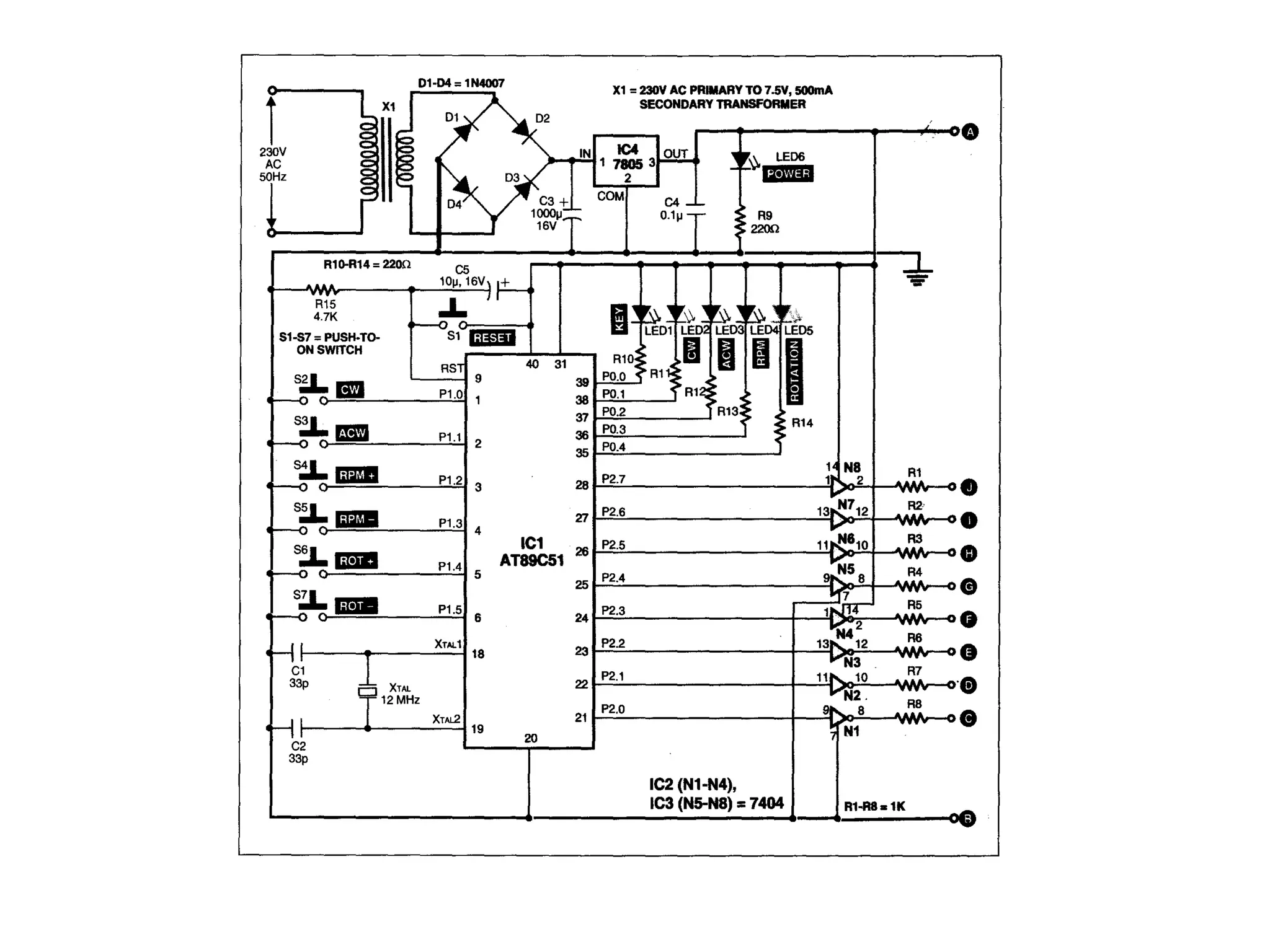
• Here is a microcontroller AT89C51-based
stepper motor controller that can accurately
control the rotation direction, speed and
number of revolutions with help of six tactile
switches.
Components Used
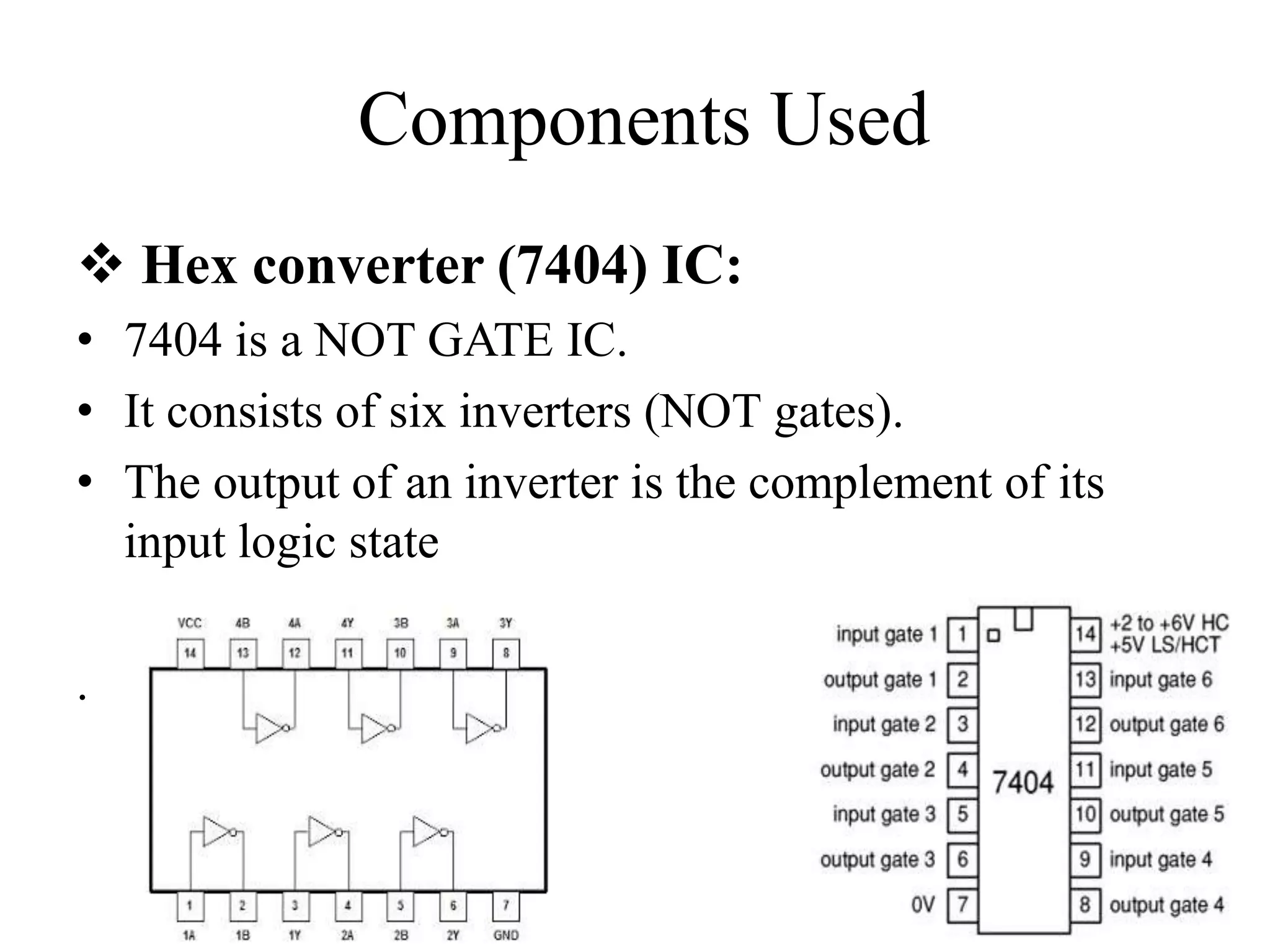
Hexconverter (7404) IC:
• 7404 is a NOT GATE IC.
• It consists of six inverters (NOT gates).
• The output of an inverter is the complement of its
input logic state
.
5.
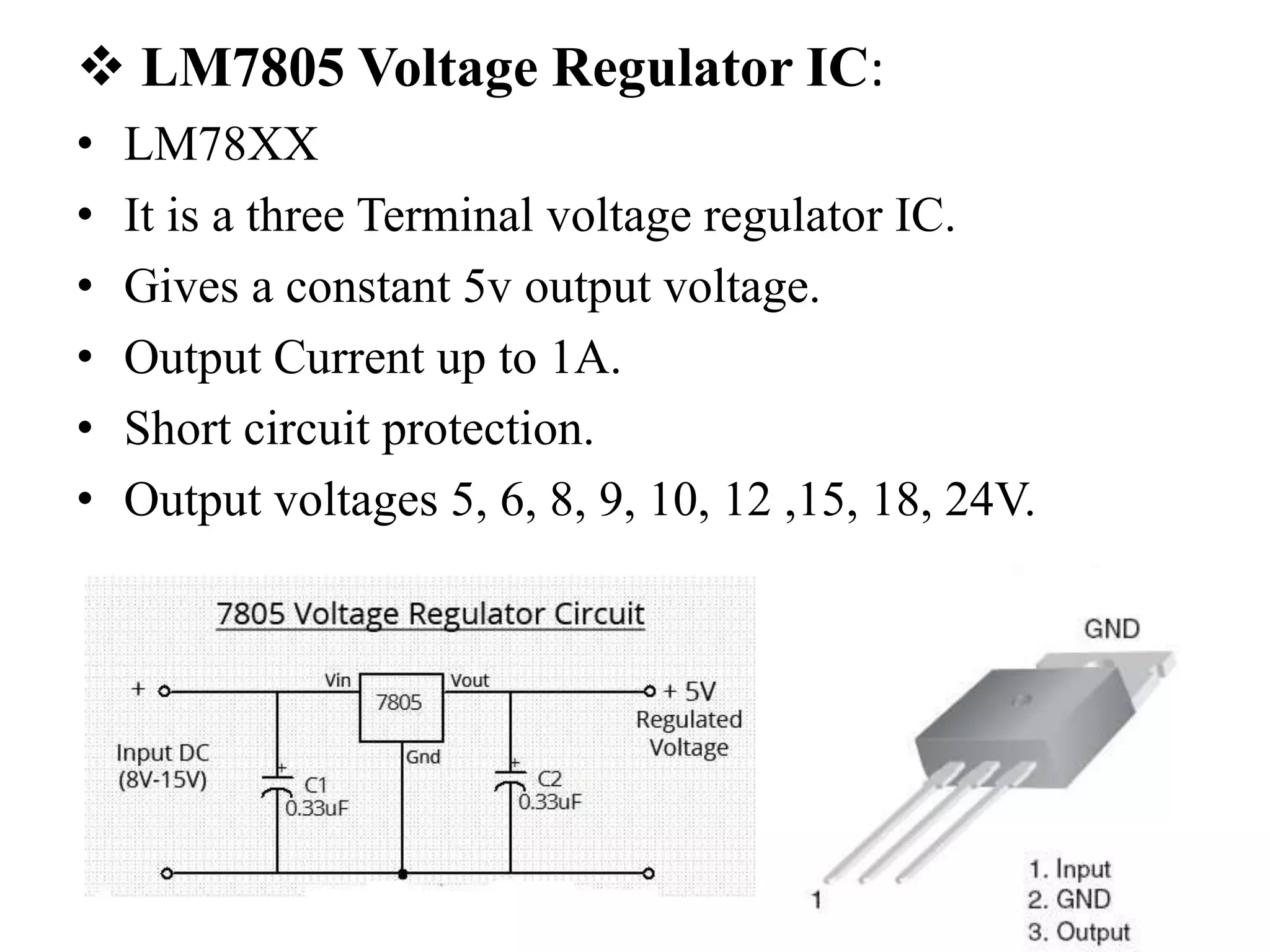
LM7805 VoltageRegulator IC:
• LM78XX
• It is a three Terminal voltage regulator IC.
• Gives a constant 5v output voltage.
• Output Current up to 1A.
• Short circuit protection.
• Output voltages 5, 6, 8, 9, 10, 12 ,15, 18, 24V.
6.
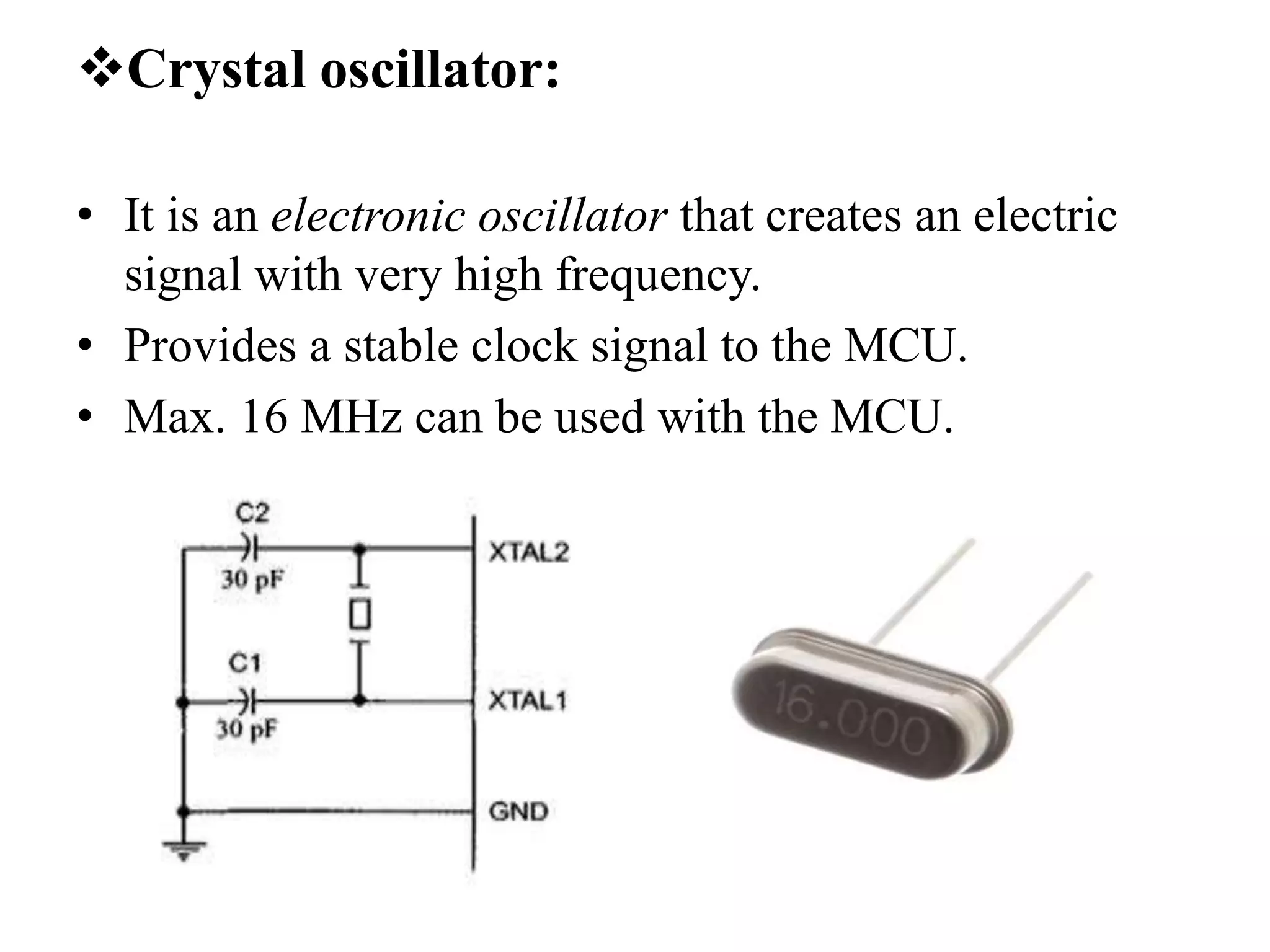
Crystal oscillator:
• Itis an electronic oscillator that creates an electric
signal with very high frequency.
• Provides a stable clock signal to the MCU.
• Max. 16 MHz can be used with the MCU.
7.
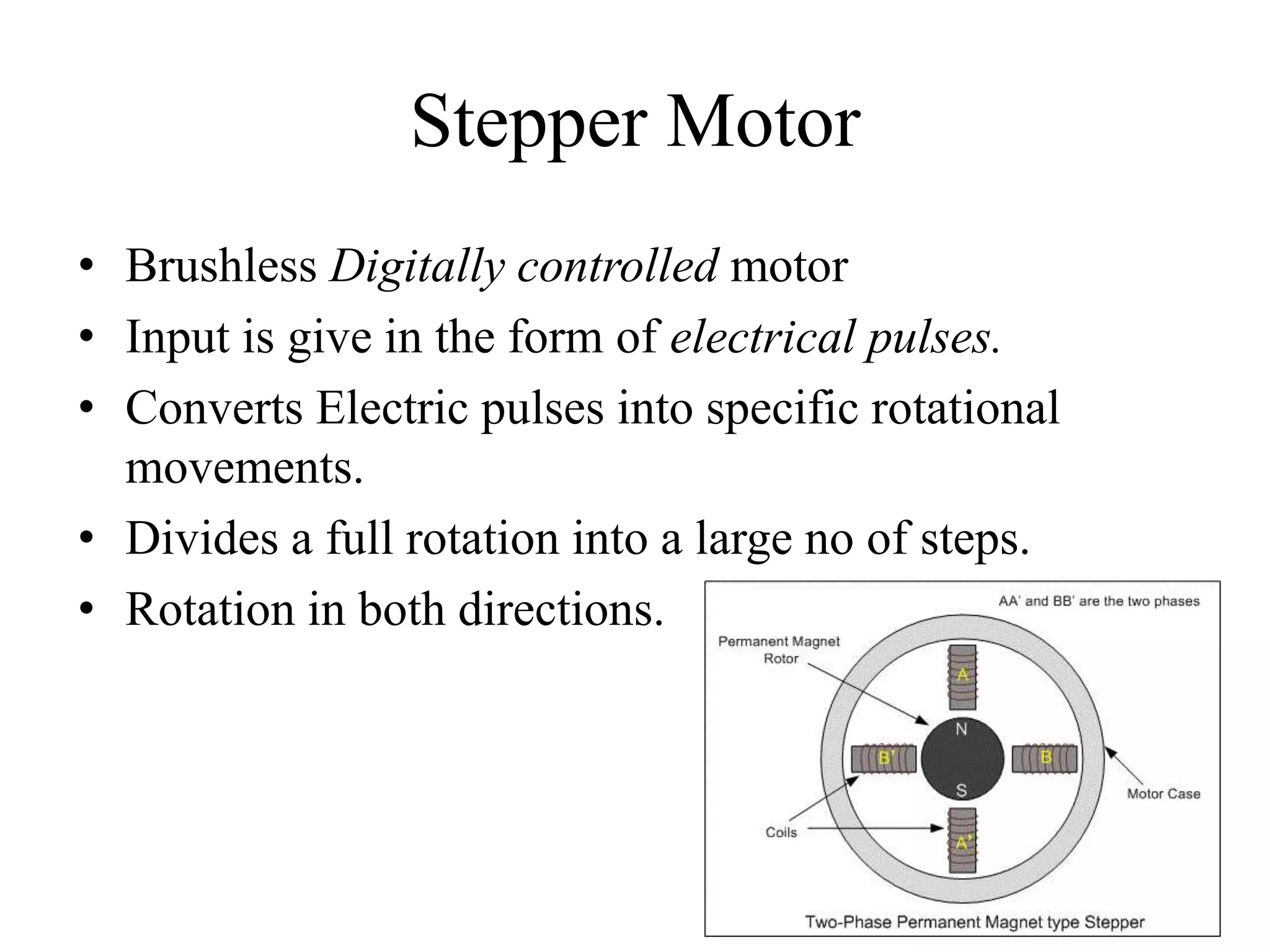
Stepper Motor
• BrushlessDigitally controlled motor
• Input is give in the form of electrical pulses.
• Converts Electric pulses into specific rotational
movements.
• Divides a full rotation into a large no of steps.
• Rotation in both directions.
8.
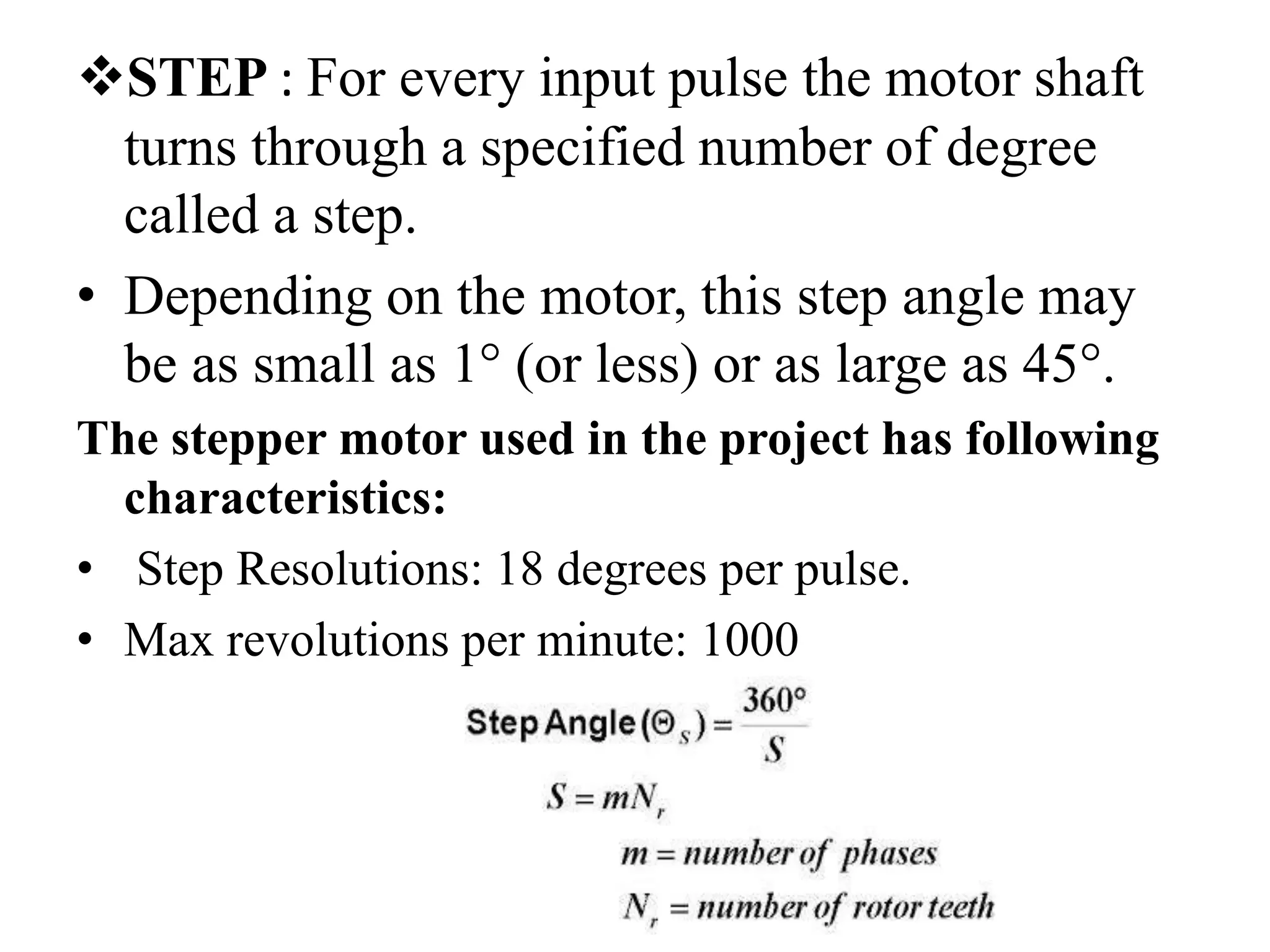
STEP : Forevery input pulse the motor shaft
turns through a specified number of degree
called a step.
• Depending on the motor, this step angle may
be as small as 1 (or less) or as large as 45.
The stepper motor used in the project has following
characteristics:
• Step Resolutions: 18 degrees per pulse.
• Max revolutions per minute: 1000
9.
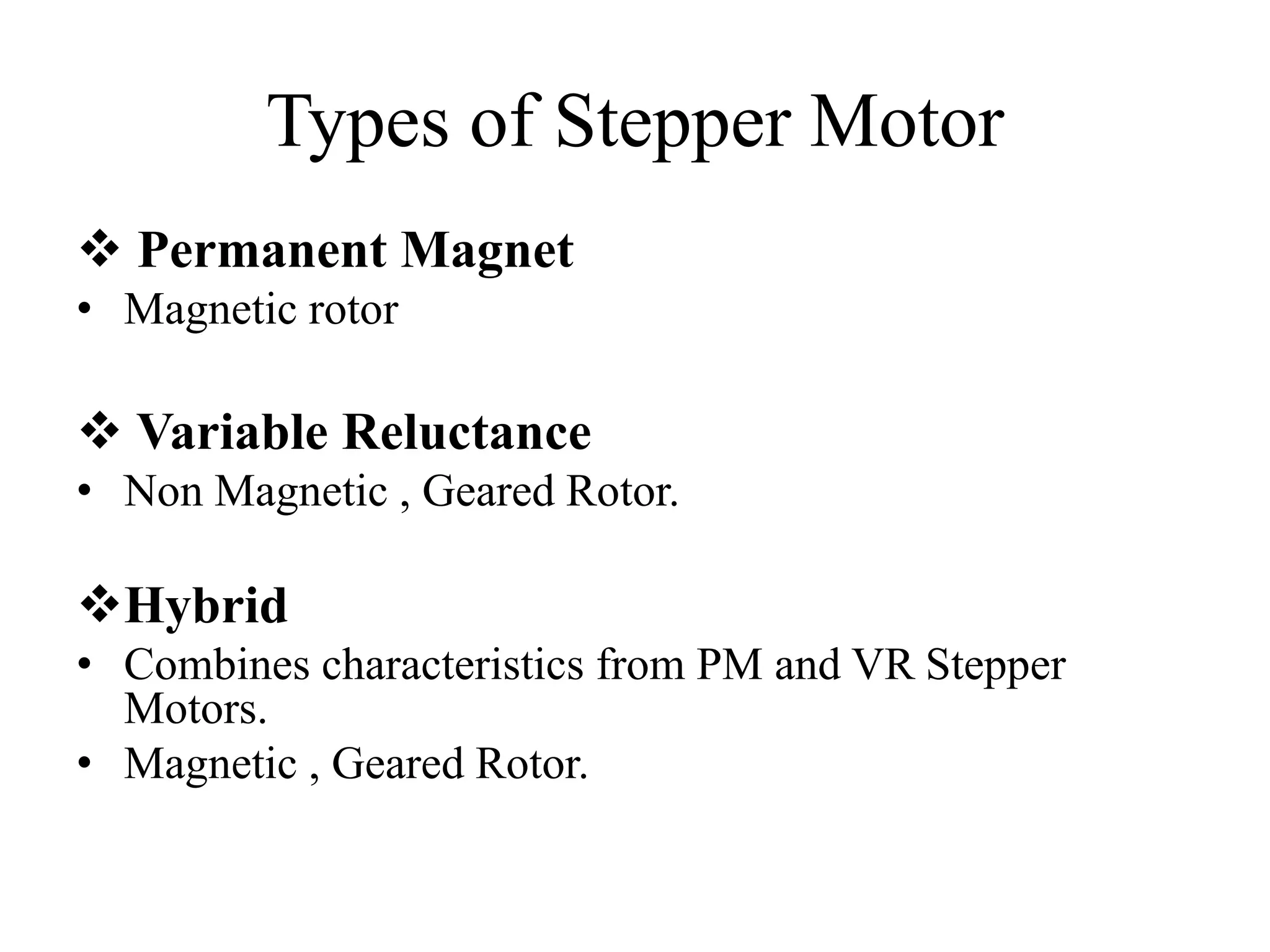
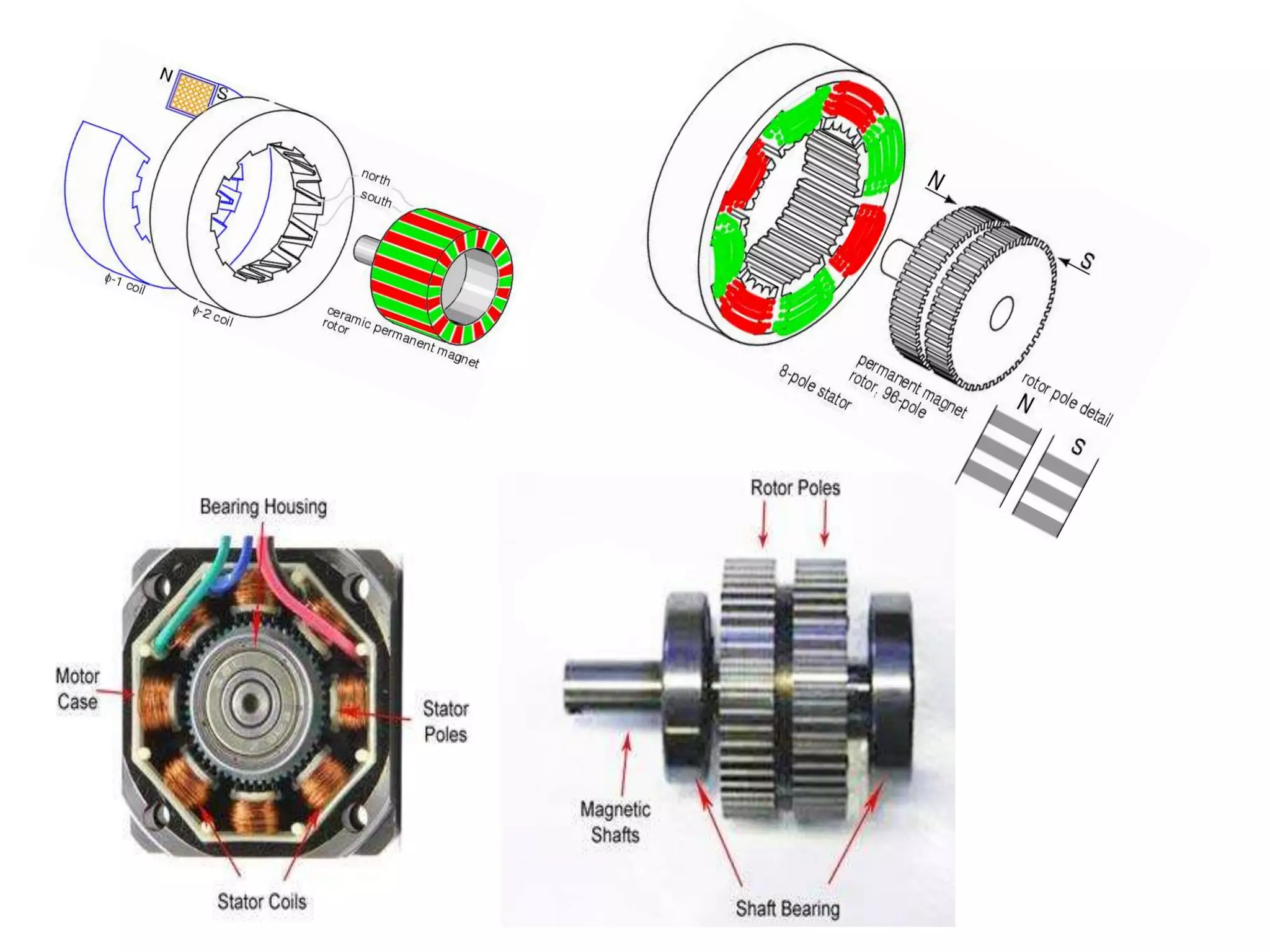
Types of StepperMotor
Permanent Magnet
• Magnetic rotor
Variable Reluctance
• Non Magnetic , Geared Rotor.
Hybrid
• Combines characteristics from PM and VR Stepper
Motors.
• Magnetic , Geared Rotor.
11.
Types of PermanentMagnet Stepper
Motor
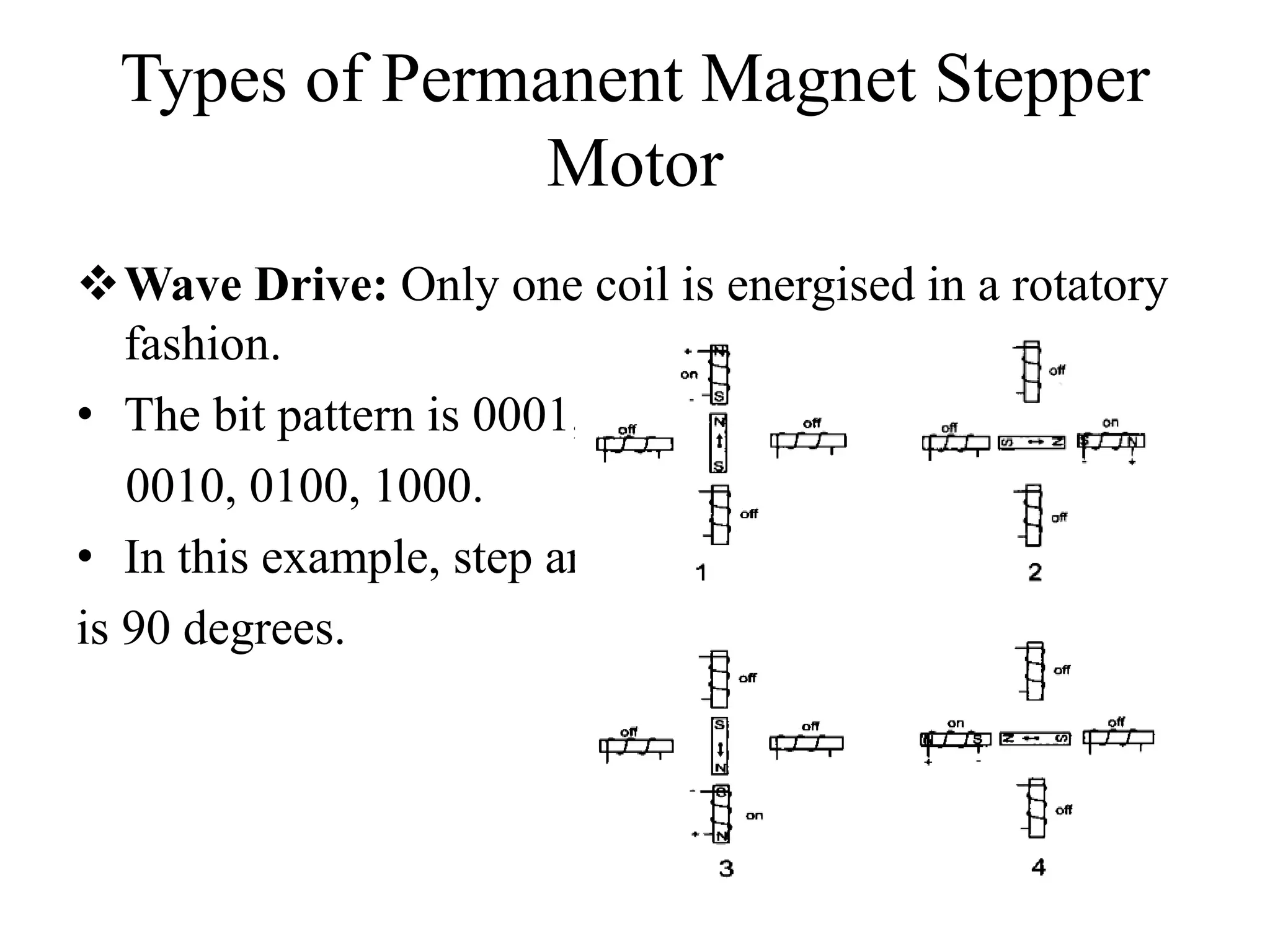
Wave Drive: Only one coil is energised in a rotatory
fashion.
• The bit pattern is 0001,
0010, 0100, 1000.
• In this example, step angle
is 90 degrees.
12.
Full stepdrive :
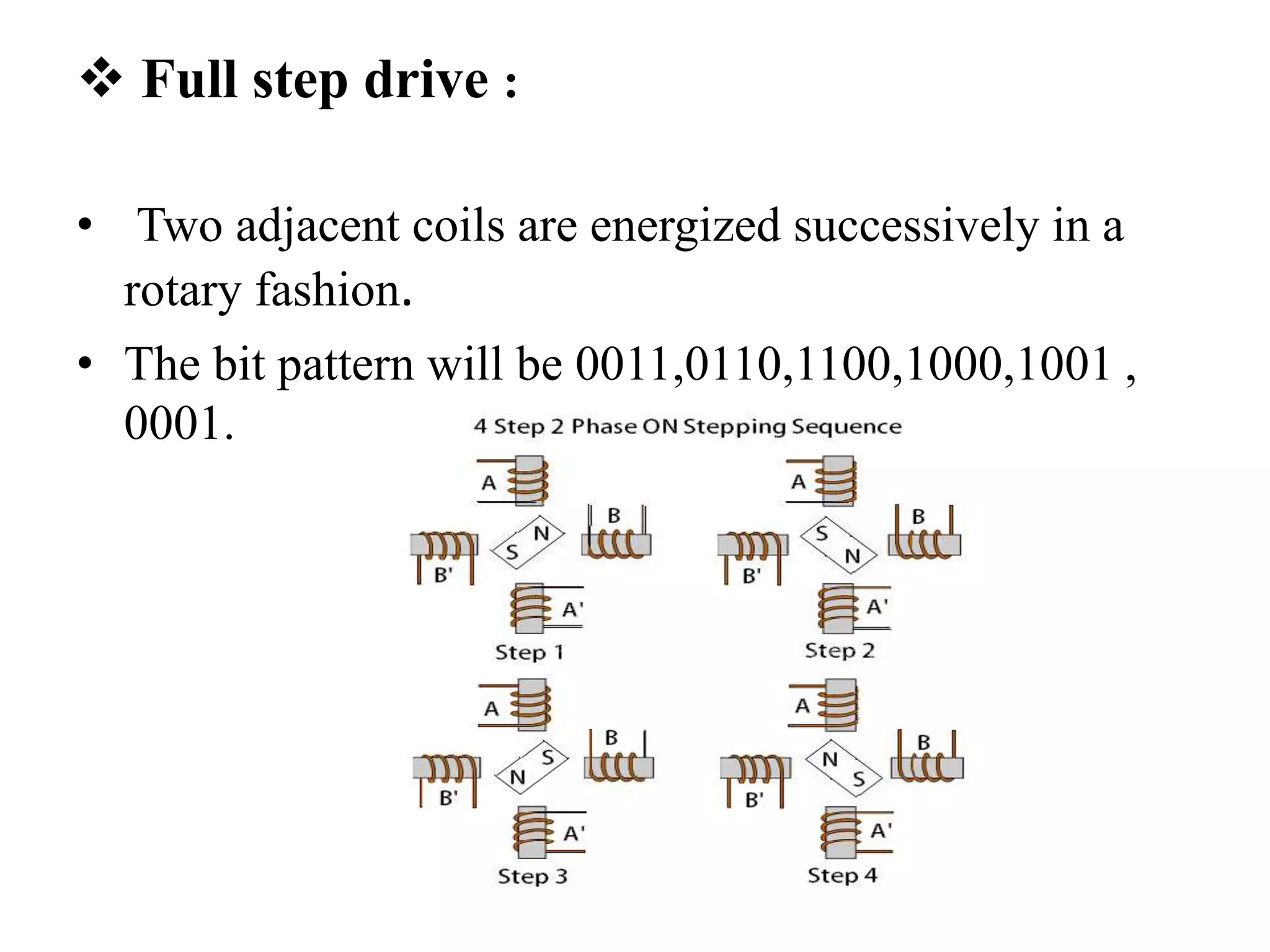
• Two adjacent coils are energized successively in a
rotary fashion.
• The bit pattern will be 0011,0110,1100,1000,1001 ,
0001.
13.
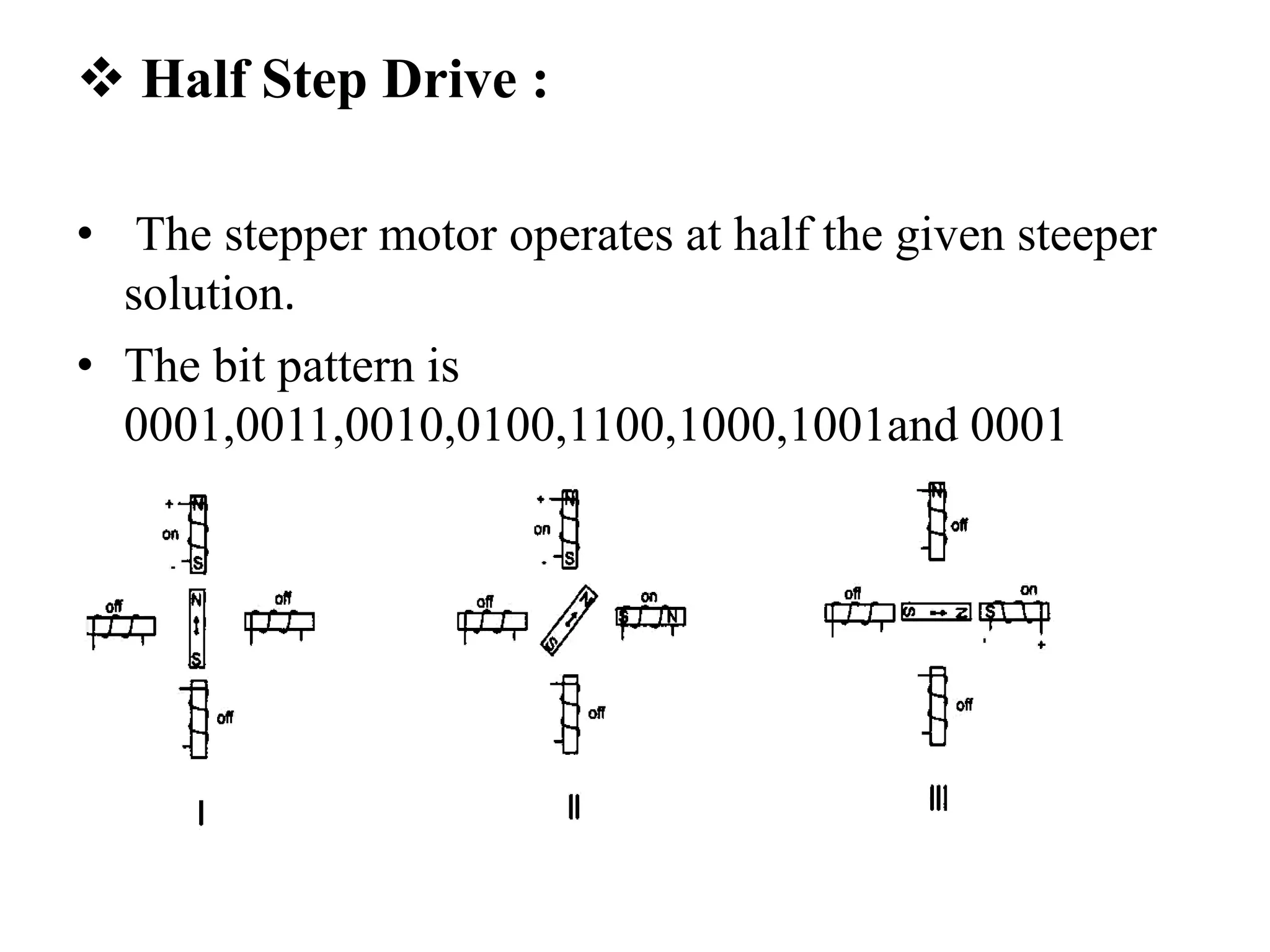
Half StepDrive :
• The stepper motor operates at half the given steeper
solution.
• The bit pattern is
0001,0011,0010,0100,1100,1000,1001and 0001
14.
Unipolar and BipolarStepper Motor
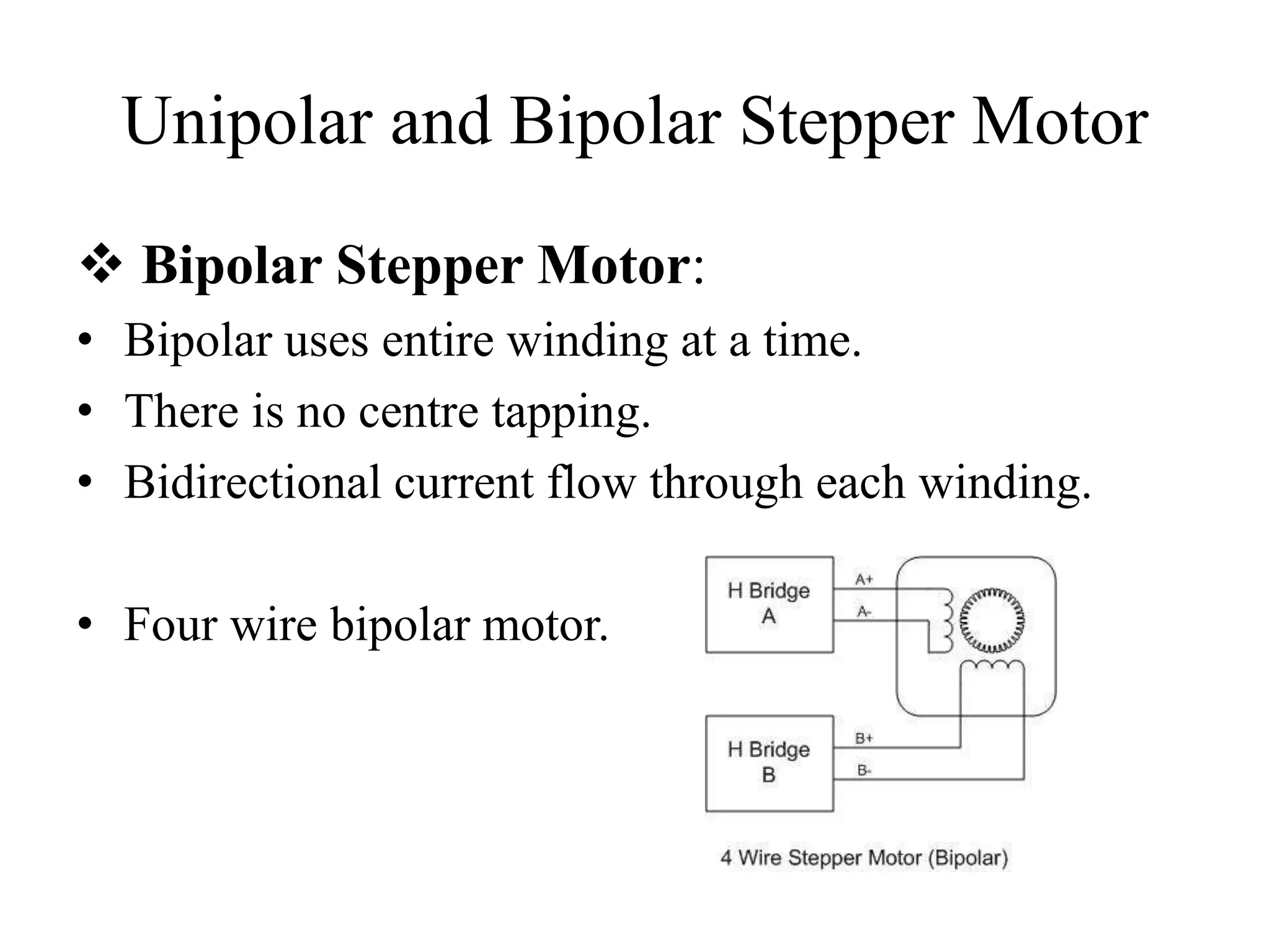
Bipolar Stepper Motor:
• Bipolar uses entire winding at a time.
• There is no centre tapping.
• Bidirectional current flow through each winding.
• Four wire bipolar motor.
15.
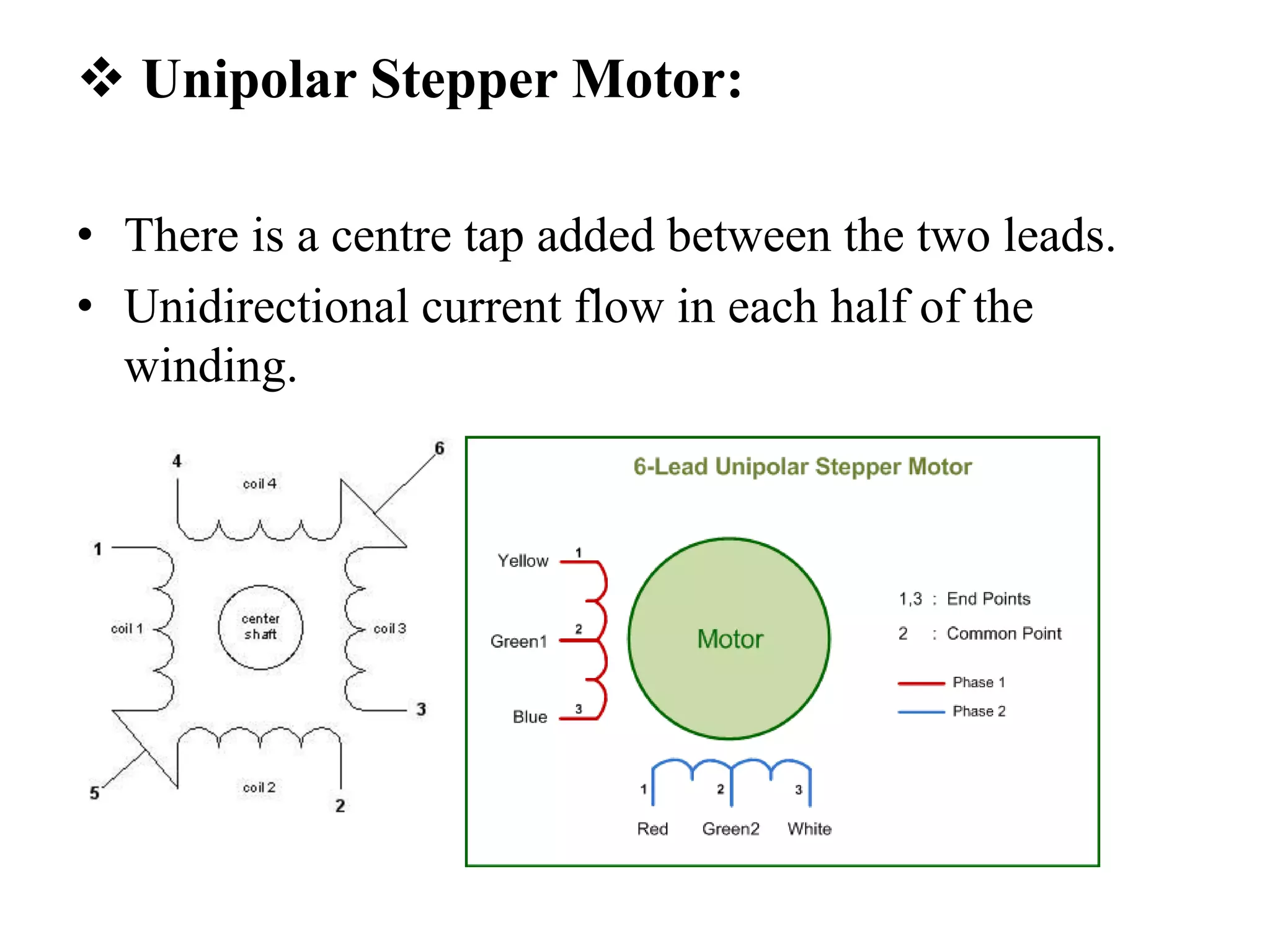
Unipolar StepperMotor:
• There is a centre tap added between the two leads.
• Unidirectional current flow in each half of the
winding.
16.
Microcontrollers
• Special purposecomputers.
• Dedicated to one task ( i.e no Multitasking).
• Low power device.
• Operates on 5v dc.
• In our project we are using AT89C51
MICROCONTROLLER.
17.
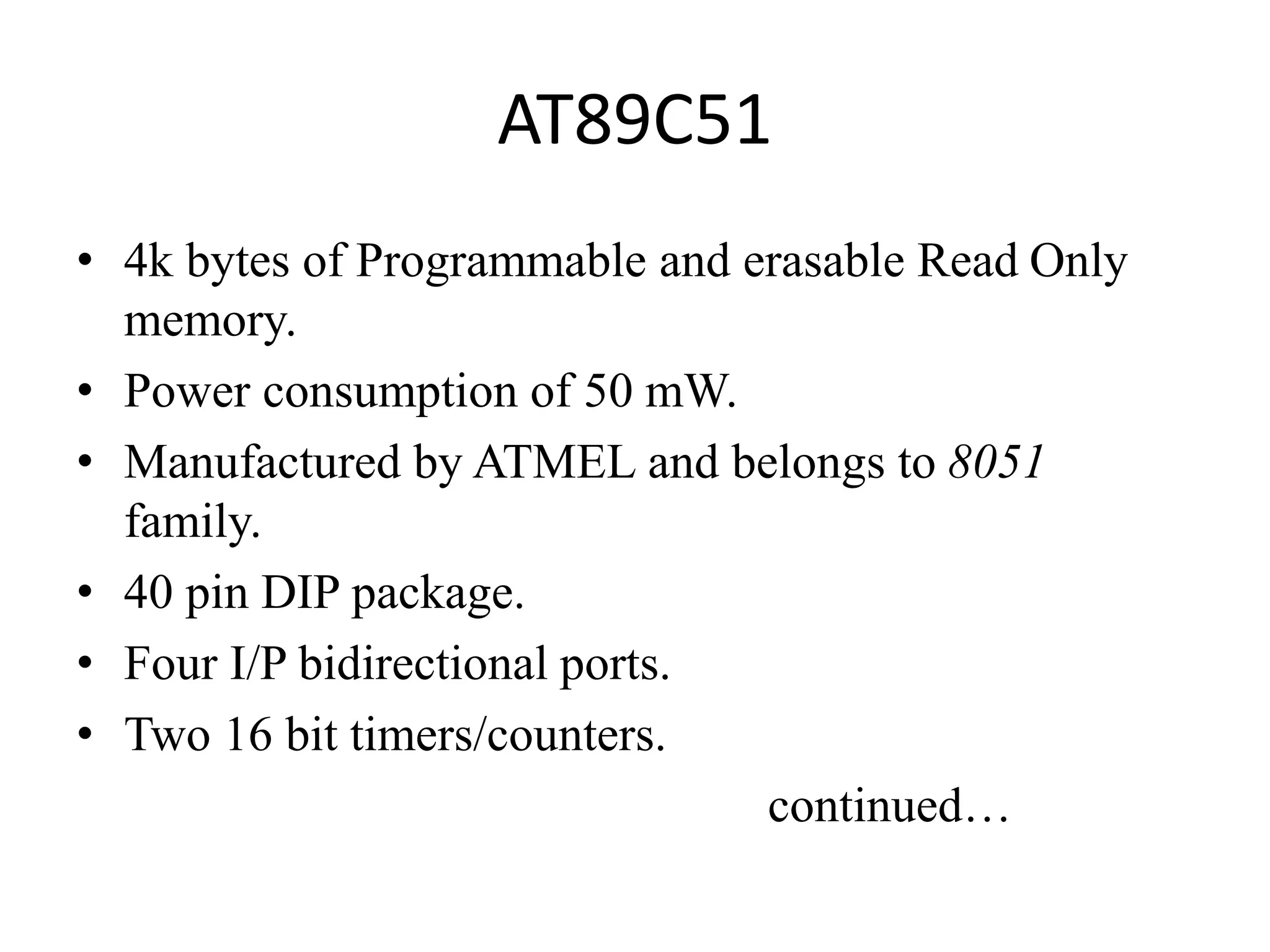
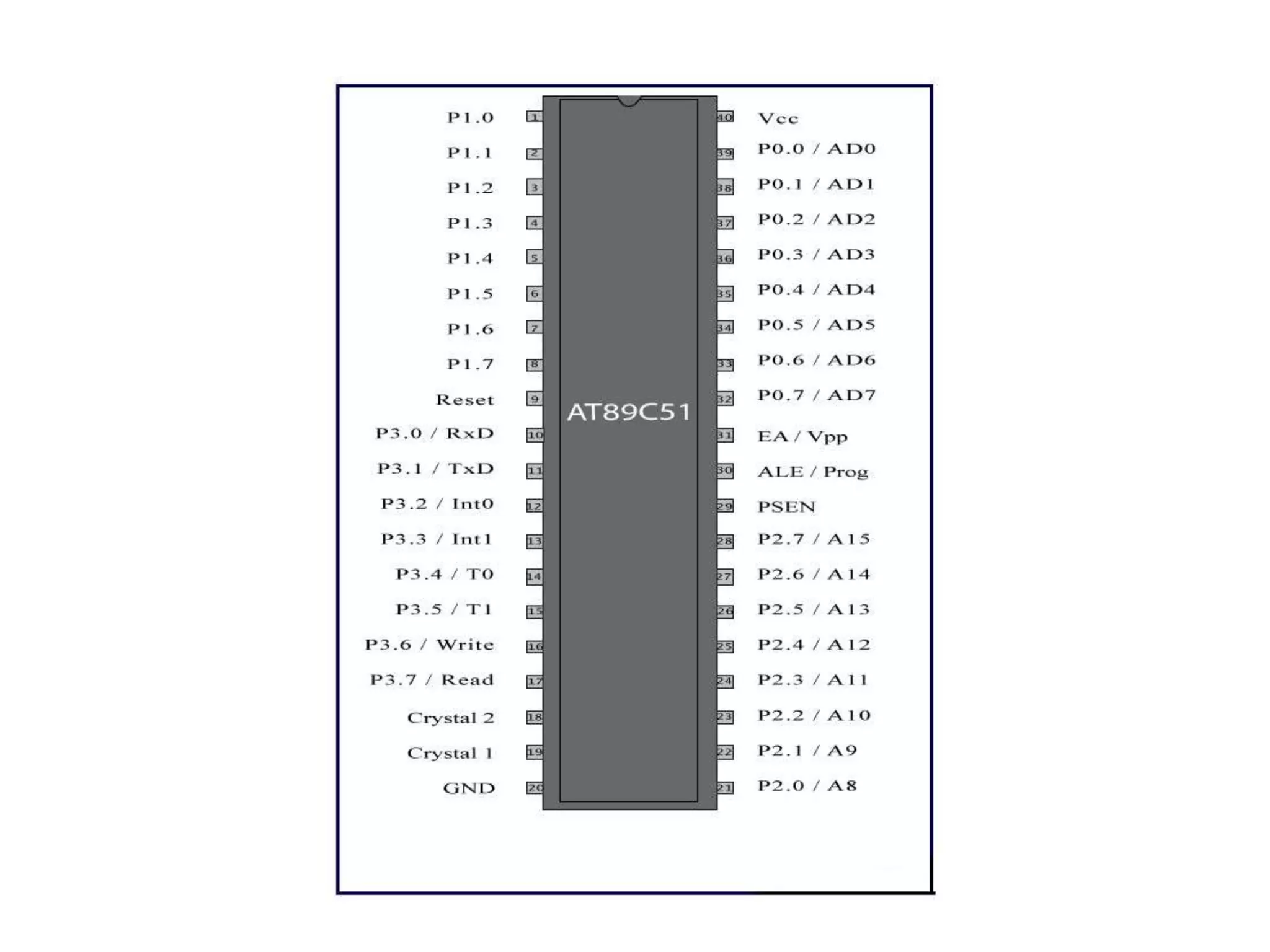
AT89C51
• 4k bytesof Programmable and erasable Read Only
memory.
• Power consumption of 50 mW.
• Manufactured by ATMEL and belongs to 8051
family.
• 40 pin DIP package.
• Four I/P bidirectional ports.
• Two 16 bit timers/counters.
continued…
19.
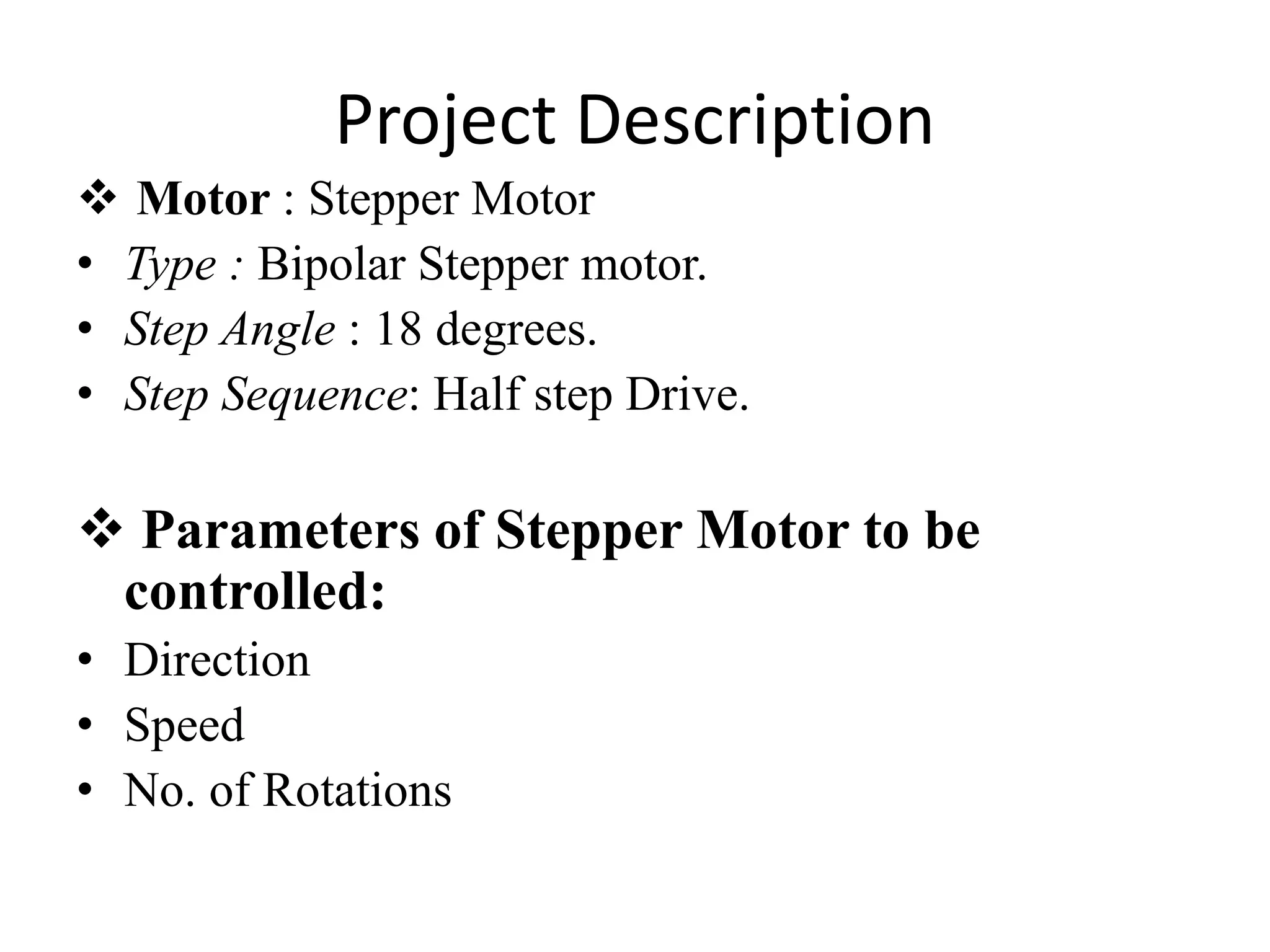
Project Description
Motor: Stepper Motor
• Type : Bipolar Stepper motor.
• Step Angle : 18 degrees.
• Step Sequence: Half step Drive.
Parameters of Stepper Motor to be
controlled:
• Direction
• Speed
• No. of Rotations
21.
Software Simulation
•We havesimulated our project on
Proteus 8 Professional software.
•The project underlines the complete
controlling of Stepper Motor.
22.
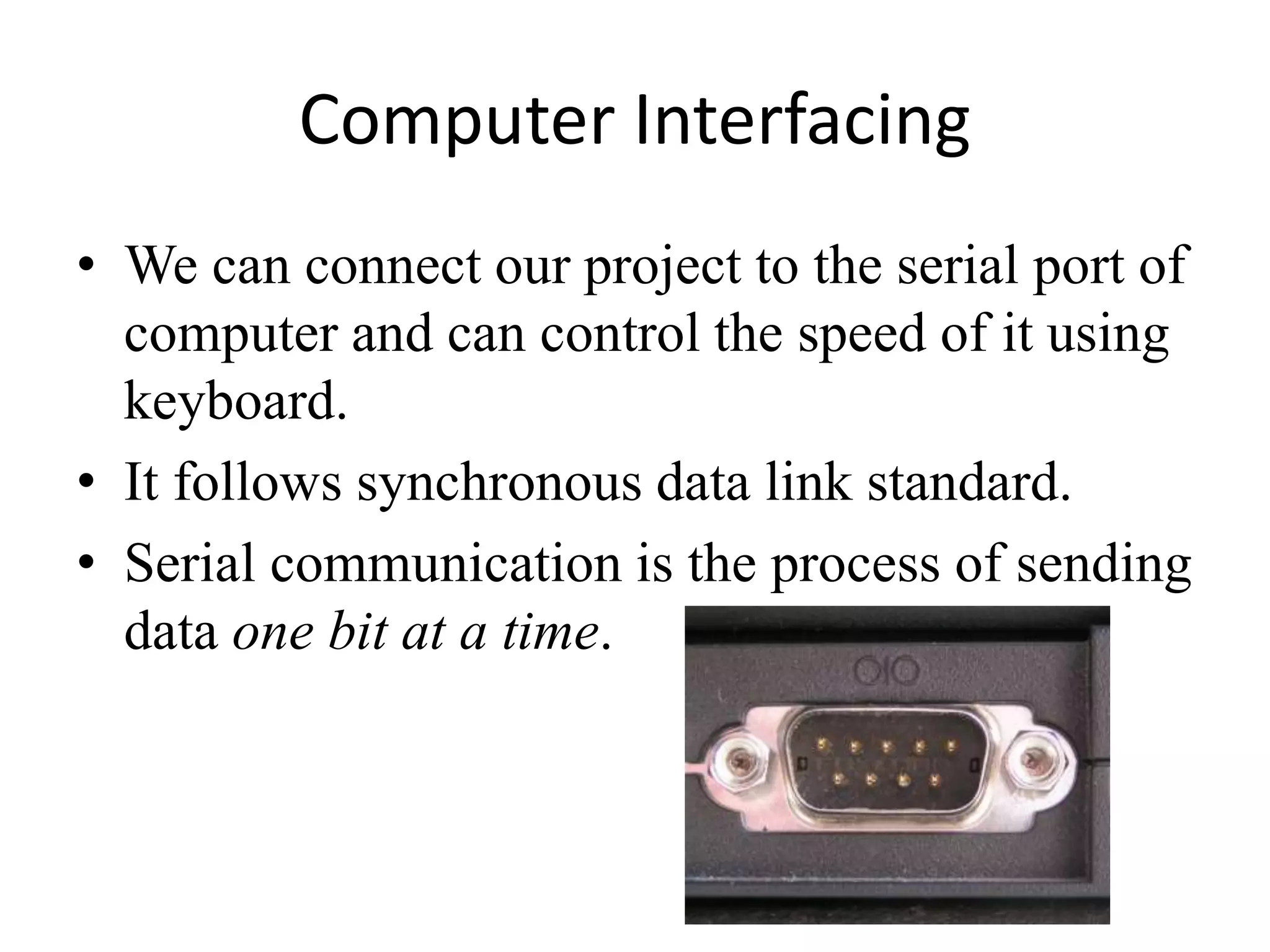
Computer Interfacing
• Wecan connect our project to the serial port of
computer and can control the speed of it using
keyboard.
• It follows synchronous data link standard.
• Serial communication is the process of sending
data one bit at a time.
23.
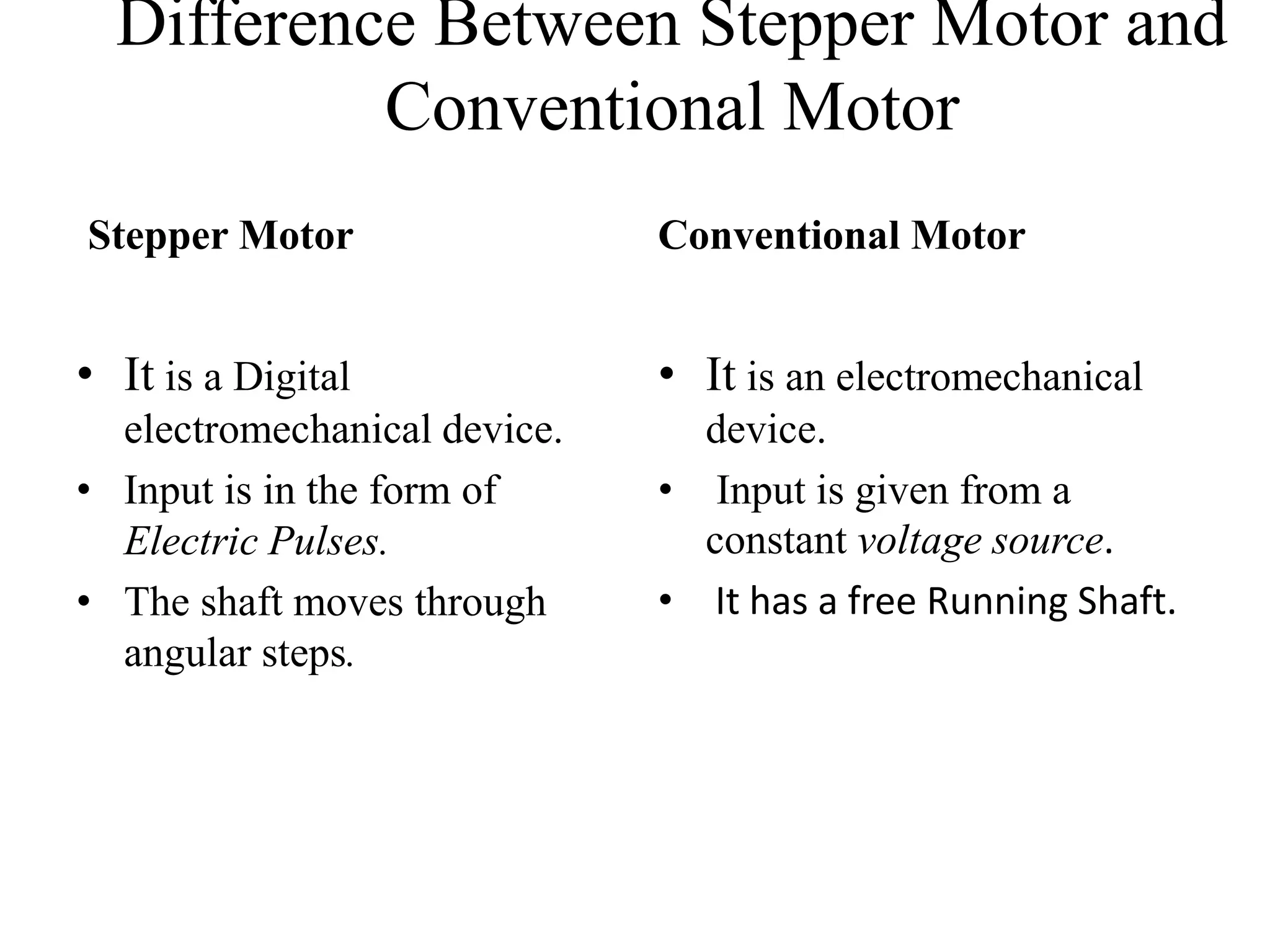
Difference Between StepperMotor and
Conventional Motor
Stepper Motor
• It is a Digital
electromechanical device.
• Input is in the form of
Electric Pulses.
• The shaft moves through
angular steps.
Conventional Motor
• It is an electromechanical
device.
• Input is given from a
constant voltage source.
• It has a free Running Shaft.
24.
Industrial Applications OfStepper
Motor
• Floppy Disk Drives.
• Hard Disk Drives.
• Printers, Plotters.
• Electronic Watches.
• Electronic Typewriters.
• Teleprinter, Telex-machines.
• Robotics.
• Instrumentation control.
25.
Conclusion
• The projectcan be used perfectly in many
areas.
• The device is easy to implement in hardware
and software means.
• The circuit is cost effective , consume less
power and take minimum time.