ChemicalChemical
ProcessingProcessing
Prepared byPrepared by
ROHIT SINGHROHIT SINGH
nitragzb20152019@gmail.comnitragzb20152019@gmail.com
+91 9450316927+91 9450316927
NITRA TECHNICALNITRA TECHNICAL
CAMPUSCAMPUS
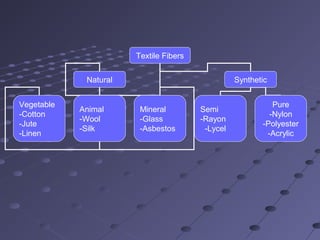
Textile Fibers
Natural Synthetic
Vegetable
-Cotton
-Jute
-Linen
Mineral
-Glass
-Asbestos
Animal
-Wool
-Silk
Semi
-Rayon
-Lycel
Pure
-Nylon
-Polyester
-Acrylic
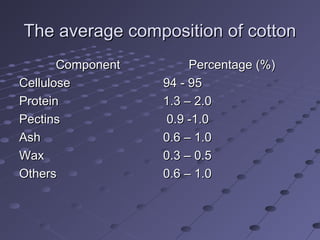
The average composition of cottonThe average composition of cotton
ComponentComponent Percentage (%)Percentage (%)
CelluloseCellulose 94 - 9594 - 95
ProteinProtein 1.3 – 2.01.3 – 2.0
PectinsPectins 0.9 -1.00.9 -1.0
AshAsh 0.6 – 1.00.6 – 1.0
WaxWax 0.3 – 0.50.3 – 0.5
OthersOthers 0.6 – 1.00.6 – 1.0
PropertiesProperties
• Cotton fabric is fairly resistant to moderate heatCotton fabric is fairly resistant to moderate heat
but prolonged exposure causes brown colorationbut prolonged exposure causes brown coloration
and may cause tendering also.and may cause tendering also.
• Presence of moisture and warm temperaturePresence of moisture and warm temperature
causes fungus/bacteria to grow and causecauses fungus/bacteria to grow and cause
mildew attack and discolor the fabric.mildew attack and discolor the fabric.
• Exposure to sunlight for long hours causesExposure to sunlight for long hours causes
strength loss.strength loss.
• Cotton is sensitive to mineral acids but canCotton is sensitive to mineral acids but can
withstand action of alkali.withstand action of alkali.
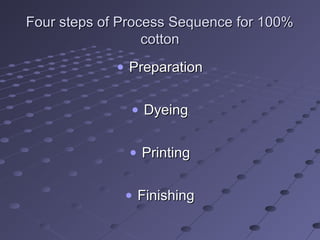
Four steps of Process Sequence for 100%Four steps of Process Sequence for 100%
cottoncotton
• PreparationPreparation
• DyeingDyeing
• PrintingPrinting
• FinishingFinishing
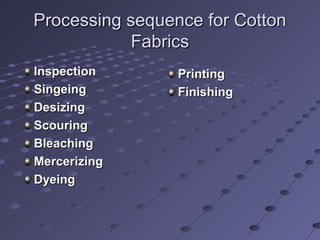
Processing sequence for CottonProcessing sequence for Cotton
FabricsFabrics
InspectionInspection
SingeingSingeing
DesizingDesizing
ScouringScouring
BleachingBleaching
MercerizingMercerizing
DyeingDyeing
PrintingPrinting
FinishingFinishing
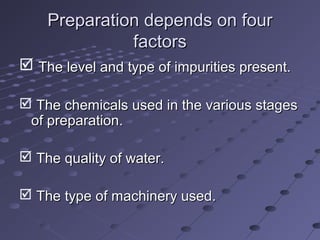
Preparation depends on fourPreparation depends on four
factorsfactors
 The level and type of impurities present.The level and type of impurities present.
 The chemicals used in the various stagesThe chemicals used in the various stages
of preparation.of preparation.
 The quality of water.The quality of water.
 The type of machinery used.The type of machinery used.
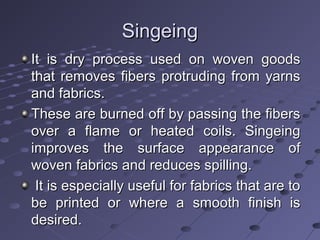
SingeingSingeing
It is dry process used on woven goodsIt is dry process used on woven goods
that removes fibers protruding from yarnsthat removes fibers protruding from yarns
and fabrics.and fabrics.
These are burned off by passing the fibersThese are burned off by passing the fibers
over a flame or heated coils. Singeingover a flame or heated coils. Singeing
improves the surface appearance ofimproves the surface appearance of
woven fabrics and reduces spilling.woven fabrics and reduces spilling.
It is especially useful for fabrics that are toIt is especially useful for fabrics that are to
be printed or where a smooth finish isbe printed or where a smooth finish is
desired.desired.
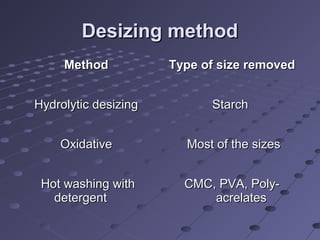
Desizing methodDesizing method
MethodMethod Type of size removedType of size removed
Hydrolytic desizingHydrolytic desizing StarchStarch
OxidativeOxidative Most of the sizesMost of the sizes
Hot washing withHot washing with
detergentdetergent
CMC, PVA, Poly-CMC, PVA, Poly-
acrelatesacrelates
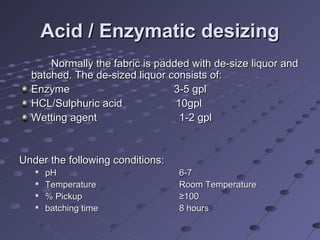
Acid / Enzymatic desizingAcid / Enzymatic desizing
Normally the fabric is padded with de-size liquor andNormally the fabric is padded with de-size liquor and
batched. The de-sized liquor consists of:batched. The de-sized liquor consists of:
EnzymeEnzyme 3-5 gpl3-5 gpl
HCL/Sulphuric acid 10gplHCL/Sulphuric acid 10gpl
Wetting agentWetting agent 1-2 gpl1-2 gpl
Under the following conditions:Under the following conditions:

pHpH 6-76-7

TemperatureTemperature Room TemperatureRoom Temperature

% Pickup% Pickup ≥100≥100

batching timebatching time 8 hours8 hours
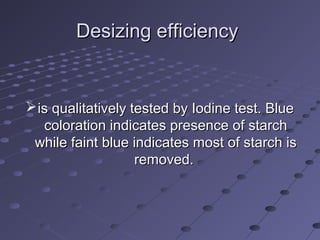
Desizing efficiencyDesizing efficiency
is qualitatively tested by Iodine test. Blueis qualitatively tested by Iodine test. Blue
coloration indicates presence of starchcoloration indicates presence of starch
while faint blue indicates most of starch iswhile faint blue indicates most of starch is
removed.removed.
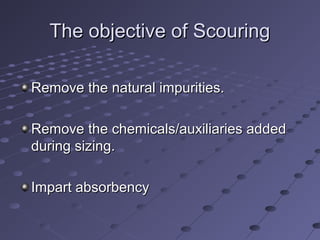
The objective of ScouringThe objective of Scouring
Remove the natural impurities.Remove the natural impurities.
Remove the chemicals/auxiliaries addedRemove the chemicals/auxiliaries added
during sizing.during sizing.
Impart absorbencyImpart absorbency
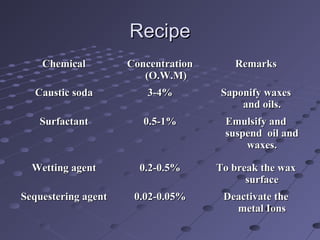
RecipeRecipe
ChemicalChemical ConcentrationConcentration
(O.W.M)(O.W.M)
RemarksRemarks
Caustic sodaCaustic soda 3-4%3-4% Saponify waxesSaponify waxes
and oils.and oils.
SurfactantSurfactant 0.5-1%0.5-1% Emulsify andEmulsify and
suspend oil andsuspend oil and
waxes.waxes.
Wetting agentWetting agent 0.2-0.5%0.2-0.5% To break the waxTo break the wax
surfacesurface
Sequestering agentSequestering agent 0.02-0.05%0.02-0.05% Deactivate theDeactivate the
metal Ionsmetal Ions
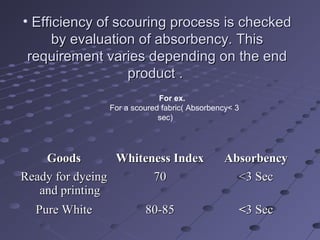
• Efficiency of scouring process is checkedEfficiency of scouring process is checked
by evaluation of absorbency. Thisby evaluation of absorbency. This
requirement varies depending on the endrequirement varies depending on the end
product .product .
For ex.
For a scoured fabric( Absorbency< 3
sec)
GoodsGoods Whiteness IndexWhiteness Index AbsorbencyAbsorbency
Ready for dyeingReady for dyeing
and printingand printing
7070 <3 Sec<3 Sec
Pure WhitePure White 80-8580-85 <<33 SecSec
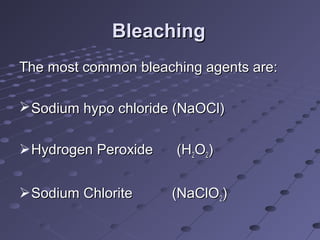
BleachingBleaching
The most common bleaching agents are:The most common bleaching agents are:
Sodium hypo chloride (NaOCl)Sodium hypo chloride (NaOCl)
Hydrogen Peroxide (HHydrogen Peroxide (H22OO22))
Sodium Chlorite (NaClOSodium Chlorite (NaClO22))
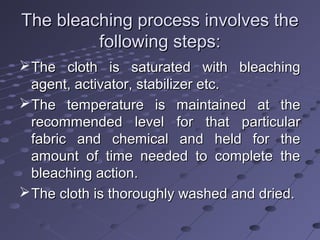
The bleaching process involves theThe bleaching process involves the
following steps:following steps:
The cloth is saturated with bleachingThe cloth is saturated with bleaching
agent, activator, stabilizer etc.agent, activator, stabilizer etc.
The temperature is maintained at theThe temperature is maintained at the
recommended level for that particularrecommended level for that particular
fabric and chemical and held for thefabric and chemical and held for the
amount of time needed to complete theamount of time needed to complete the
bleaching action.bleaching action.
The cloth is thoroughly washed and dried.The cloth is thoroughly washed and dried.
Process ParametersProcess Parameters
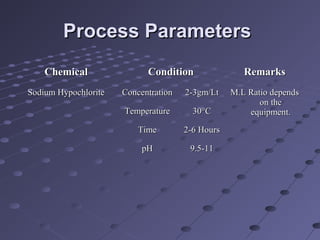
ChemicalChemical ConditionCondition RemarksRemarks
Sodium HypochloriteSodium Hypochlorite ConcentrationConcentration 2-3gm/Lt2-3gm/Lt M.L Ratio dependsM.L Ratio depends
on theon the
equipment.equipment.TemperatureTemperature 30°C30°C
TimeTime 2-6 Hours2-6 Hours
pHpH 9.5-119.5-11
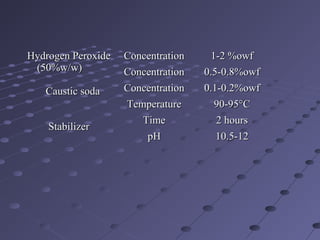
Hydrogen PeroxideHydrogen Peroxide
(50%w/w)(50%w/w)
Caustic sodaCaustic soda
StabilizerStabilizer
ConcentrationConcentration 1-2 %owf1-2 %owf
ConcentrationConcentration 0.5-0.8%owf0.5-0.8%owf
ConcentrationConcentration 0.1-0.2%owf0.1-0.2%owf
TemperatureTemperature 90-95°C90-95°C
TimeTime 2 hours2 hours
pHpH 10.5-1210.5-12
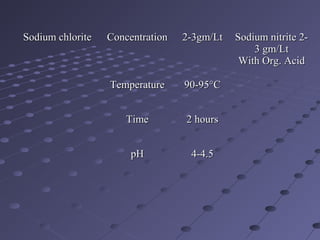
Sodium chloriteSodium chlorite ConcentrationConcentration 2-3gm/Lt2-3gm/Lt Sodium nitrite 2-Sodium nitrite 2-
3 gm/Lt3 gm/Lt
With Org. AcidWith Org. Acid
TemperatureTemperature 90-95°C90-95°C
TimeTime 2 hours2 hours
pHpH 4-4.54-4.5
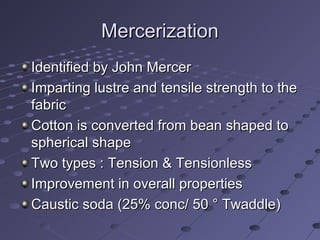
MercerizationMercerization
Identified by John MercerIdentified by John Mercer
Imparting lustre and tensile strength to theImparting lustre and tensile strength to the
fabricfabric
Cotton is converted from bean shaped toCotton is converted from bean shaped to
spherical shapespherical shape
Two types : Tension & TensionlessTwo types : Tension & Tensionless
Improvement in overall propertiesImprovement in overall properties
Caustic soda (25% conc/ 50 ° Twaddle)Caustic soda (25% conc/ 50 ° Twaddle)
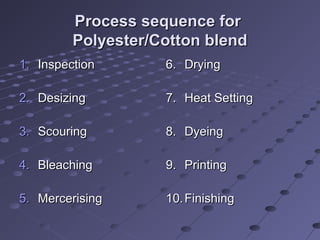
Process sequence forProcess sequence for
Polyester/Cotton blendPolyester/Cotton blend
1.1. InspectionInspection
2.2. DesizingDesizing
3.3. ScouringScouring
4.4. BleachingBleaching
5.5. MercerisingMercerising
6.6. DryingDrying
7.7. Heat SettingHeat Setting
8.8. DyeingDyeing
9.9. PrintingPrinting
10.10. FinishingFinishing
1 chemical processing.ppt

1 chemical processing.ppt

  • 1.
    ChemicalChemical ProcessingProcessing Prepared byPrepared by ROHITSINGHROHIT SINGH nitragzb20152019@gmail.comnitragzb20152019@gmail.com +91 9450316927+91 9450316927 NITRA TECHNICALNITRA TECHNICAL CAMPUSCAMPUS
  • 2.
  • 3.
    The average compositionof cottonThe average composition of cotton ComponentComponent Percentage (%)Percentage (%) CelluloseCellulose 94 - 9594 - 95 ProteinProtein 1.3 – 2.01.3 – 2.0 PectinsPectins 0.9 -1.00.9 -1.0 AshAsh 0.6 – 1.00.6 – 1.0 WaxWax 0.3 – 0.50.3 – 0.5 OthersOthers 0.6 – 1.00.6 – 1.0
  • 4.
    PropertiesProperties • Cotton fabricis fairly resistant to moderate heatCotton fabric is fairly resistant to moderate heat but prolonged exposure causes brown colorationbut prolonged exposure causes brown coloration and may cause tendering also.and may cause tendering also. • Presence of moisture and warm temperaturePresence of moisture and warm temperature causes fungus/bacteria to grow and causecauses fungus/bacteria to grow and cause mildew attack and discolor the fabric.mildew attack and discolor the fabric. • Exposure to sunlight for long hours causesExposure to sunlight for long hours causes strength loss.strength loss. • Cotton is sensitive to mineral acids but canCotton is sensitive to mineral acids but can withstand action of alkali.withstand action of alkali.
  • 5.
    Four steps ofProcess Sequence for 100%Four steps of Process Sequence for 100% cottoncotton • PreparationPreparation • DyeingDyeing • PrintingPrinting • FinishingFinishing
  • 6.
    Processing sequence forCottonProcessing sequence for Cotton FabricsFabrics InspectionInspection SingeingSingeing DesizingDesizing ScouringScouring BleachingBleaching MercerizingMercerizing DyeingDyeing PrintingPrinting FinishingFinishing
  • 7.
    Preparation depends onfourPreparation depends on four factorsfactors  The level and type of impurities present.The level and type of impurities present.  The chemicals used in the various stagesThe chemicals used in the various stages of preparation.of preparation.  The quality of water.The quality of water.  The type of machinery used.The type of machinery used.
  • 8.
    SingeingSingeing It is dryprocess used on woven goodsIt is dry process used on woven goods that removes fibers protruding from yarnsthat removes fibers protruding from yarns and fabrics.and fabrics. These are burned off by passing the fibersThese are burned off by passing the fibers over a flame or heated coils. Singeingover a flame or heated coils. Singeing improves the surface appearance ofimproves the surface appearance of woven fabrics and reduces spilling.woven fabrics and reduces spilling. It is especially useful for fabrics that are toIt is especially useful for fabrics that are to be printed or where a smooth finish isbe printed or where a smooth finish is desired.desired.
  • 9.
    Desizing methodDesizing method MethodMethodType of size removedType of size removed Hydrolytic desizingHydrolytic desizing StarchStarch OxidativeOxidative Most of the sizesMost of the sizes Hot washing withHot washing with detergentdetergent CMC, PVA, Poly-CMC, PVA, Poly- acrelatesacrelates
  • 10.
    Acid / EnzymaticdesizingAcid / Enzymatic desizing Normally the fabric is padded with de-size liquor andNormally the fabric is padded with de-size liquor and batched. The de-sized liquor consists of:batched. The de-sized liquor consists of: EnzymeEnzyme 3-5 gpl3-5 gpl HCL/Sulphuric acid 10gplHCL/Sulphuric acid 10gpl Wetting agentWetting agent 1-2 gpl1-2 gpl Under the following conditions:Under the following conditions:  pHpH 6-76-7  TemperatureTemperature Room TemperatureRoom Temperature  % Pickup% Pickup ≥100≥100  batching timebatching time 8 hours8 hours
  • 11.
    Desizing efficiencyDesizing efficiency isqualitatively tested by Iodine test. Blueis qualitatively tested by Iodine test. Blue coloration indicates presence of starchcoloration indicates presence of starch while faint blue indicates most of starch iswhile faint blue indicates most of starch is removed.removed.
  • 12.
    The objective ofScouringThe objective of Scouring Remove the natural impurities.Remove the natural impurities. Remove the chemicals/auxiliaries addedRemove the chemicals/auxiliaries added during sizing.during sizing. Impart absorbencyImpart absorbency
  • 13.
    RecipeRecipe ChemicalChemical ConcentrationConcentration (O.W.M)(O.W.M) RemarksRemarks Caustic sodaCausticsoda 3-4%3-4% Saponify waxesSaponify waxes and oils.and oils. SurfactantSurfactant 0.5-1%0.5-1% Emulsify andEmulsify and suspend oil andsuspend oil and waxes.waxes. Wetting agentWetting agent 0.2-0.5%0.2-0.5% To break the waxTo break the wax surfacesurface Sequestering agentSequestering agent 0.02-0.05%0.02-0.05% Deactivate theDeactivate the metal Ionsmetal Ions
  • 14.
    • Efficiency ofscouring process is checkedEfficiency of scouring process is checked by evaluation of absorbency. Thisby evaluation of absorbency. This requirement varies depending on the endrequirement varies depending on the end product .product . For ex. For a scoured fabric( Absorbency< 3 sec) GoodsGoods Whiteness IndexWhiteness Index AbsorbencyAbsorbency Ready for dyeingReady for dyeing and printingand printing 7070 <3 Sec<3 Sec Pure WhitePure White 80-8580-85 <<33 SecSec
  • 15.
    BleachingBleaching The most commonbleaching agents are:The most common bleaching agents are: Sodium hypo chloride (NaOCl)Sodium hypo chloride (NaOCl) Hydrogen Peroxide (HHydrogen Peroxide (H22OO22)) Sodium Chlorite (NaClOSodium Chlorite (NaClO22))
  • 16.
    The bleaching processinvolves theThe bleaching process involves the following steps:following steps: The cloth is saturated with bleachingThe cloth is saturated with bleaching agent, activator, stabilizer etc.agent, activator, stabilizer etc. The temperature is maintained at theThe temperature is maintained at the recommended level for that particularrecommended level for that particular fabric and chemical and held for thefabric and chemical and held for the amount of time needed to complete theamount of time needed to complete the bleaching action.bleaching action. The cloth is thoroughly washed and dried.The cloth is thoroughly washed and dried.
  • 17.
    Process ParametersProcess Parameters ChemicalChemicalConditionCondition RemarksRemarks Sodium HypochloriteSodium Hypochlorite ConcentrationConcentration 2-3gm/Lt2-3gm/Lt M.L Ratio dependsM.L Ratio depends on theon the equipment.equipment.TemperatureTemperature 30°C30°C TimeTime 2-6 Hours2-6 Hours pHpH 9.5-119.5-11
  • 18.
    Hydrogen PeroxideHydrogen Peroxide (50%w/w)(50%w/w) CausticsodaCaustic soda StabilizerStabilizer ConcentrationConcentration 1-2 %owf1-2 %owf ConcentrationConcentration 0.5-0.8%owf0.5-0.8%owf ConcentrationConcentration 0.1-0.2%owf0.1-0.2%owf TemperatureTemperature 90-95°C90-95°C TimeTime 2 hours2 hours pHpH 10.5-1210.5-12
  • 19.
    Sodium chloriteSodium chloriteConcentrationConcentration 2-3gm/Lt2-3gm/Lt Sodium nitrite 2-Sodium nitrite 2- 3 gm/Lt3 gm/Lt With Org. AcidWith Org. Acid TemperatureTemperature 90-95°C90-95°C TimeTime 2 hours2 hours pHpH 4-4.54-4.5
  • 20.
    MercerizationMercerization Identified by JohnMercerIdentified by John Mercer Imparting lustre and tensile strength to theImparting lustre and tensile strength to the fabricfabric Cotton is converted from bean shaped toCotton is converted from bean shaped to spherical shapespherical shape Two types : Tension & TensionlessTwo types : Tension & Tensionless Improvement in overall propertiesImprovement in overall properties Caustic soda (25% conc/ 50 ° Twaddle)Caustic soda (25% conc/ 50 ° Twaddle)
  • 21.
    Process sequence forProcesssequence for Polyester/Cotton blendPolyester/Cotton blend 1.1. InspectionInspection 2.2. DesizingDesizing 3.3. ScouringScouring 4.4. BleachingBleaching 5.5. MercerisingMercerising 6.6. DryingDrying 7.7. Heat SettingHeat Setting 8.8. DyeingDyeing 9.9. PrintingPrinting 10.10. FinishingFinishing