Wireless Transport Network Optimization:
Solving the 4G Backhaul Challenge


                       This document is confidential and is intended solely for the use and
                                         information of the client to whom it is addressed.
Solving the 4G Backhaul Challenge


   Clearly 4G requires more fiber and microwave in the backhaul network
  
   But how much, and how much of each?
  
   Where and how do I get it cost effectively? ILECs, CLECs, MSOs, AAVs?
  
   When and how much do I deploy?
  
   Do I deploy as TDM or Ethernet?

   The answer of course depends on your particular situation
  
   How much bandwidth do I need today, next year, in 5 years?
  
   Am I migrating an existing network or building out “greenfield?”
  
   Do I have voice traffic considerations or is this purely broadband data?
  
   Am I deploying high density urban sites or lower density in rural markets?


        This document is proprietary and is intended solely for the use and information of the client to whom it is addressed.   CFN Services   2
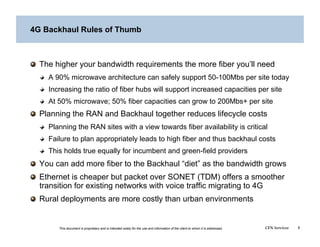
4G Backhaul Rules of Thumb


   The higher your bandwidth requirements the more fiber you’ll need
  
   A 90% microwave architecture can safely support 50-100Mbs per site today
  
   Increasing the ratio of fiber hubs will support increased capacities per site
  
   At 50% microwave; 50% fiber capacities can grow to 200Mbs+ per site

   Planning the RAN and Backhaul together reduces lifecycle costs
  
   Planning the RAN sites with a view towards fiber availability is critical
  
   Failure to plan appropriately leads to high fiber and thus backhaul costs
  
   This holds true equally for incumbent and green-field providers

   You can add more fiber to the Backhaul “diet” as the bandwidth grows

   Ethernet is cheaper but packet over SONET (TDM) offers a smoother
    transition for existing networks with voice traffic migrating to 4G

   Rural deployments are more costly than urban environments


        This document is proprietary and is intended solely for the use and information of the client to whom it is addressed.   CFN Services   3
Fiber Access for 4G Backhaul - Where Do I Get It?


   ILECs and MSOs are aggressively building out the fiber infrastructure
  
   Verizon (ILEC) will have fiber to 80%+ of all sites in region by 2012
  
   AT&T (ILEC) has fiber deployed or planned to most high capacity sites
  
   Time Warner, Comcast, COX, and other MSOs are adding cell sites to their
      existing (typically Ethernet) fiber networks
  
   These alternatives will offer broad coverage, but uncertain lifecycle costs

   CLECs, Utilities, and other Alternative Access Vendors
  
   Over 200 non-ILEC/MSO fiber operators nationwide, over 500 when you
      count municipal fiber deployments
  
   More limited fiber footprint than incumbents but better economics
  
   Better opportunity to leverage ‘owners economics’ via dark fiber and/or
      shared build outs, thus providing more predictable lifecycle costs


        This document is proprietary and is intended solely for the use and information of the client to whom it is addressed.   CFN Services   4
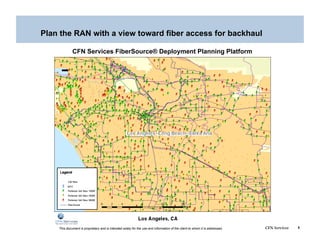
Plan the RAN with a view toward fiber access for backhaul

             CFN Services FiberSource® Deployment Planning Platform


    This document is proprietary and is intended solely for the use and information of the client to whom it is addressed.   CFN Services   5
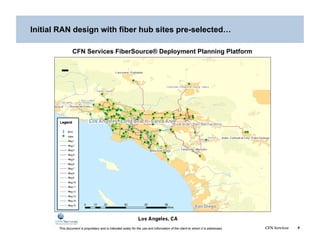
Initial RAN design with fiber hub sites pre-selected…

                CFN Services FiberSource® Deployment Planning Platform


       This document is proprietary and is intended solely for the use and information of the client to whom it is addressed.   CFN Services   6
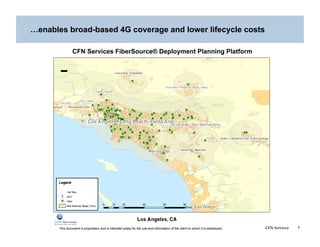
…enables broad-based 4G coverage and lower lifecycle costs

                CFN Services FiberSource® Deployment Planning Platform


       This document is proprietary and is intended solely for the use and information of the client to whom it is addressed.   CFN Services   7
4G World Conference
Mobile Backhaul Summit Panel Discussion

Mike Dodson
Utopian Wireless
September 15th, 2009
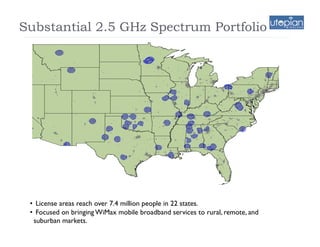
Substantial 2.5 GHz Spectrum Portfolio


 •  License areas reach over 7.4 million people in 22 states.
 •  Focused on bringing WiMax mobile broadband services to rural, remote, and
   suburban markets.
     9
Utopian’s Approach to Market Planning
  WiMax as the Technology Choice
        True mobile internet, available TODAY with the momentum and developing ecosystem
         necessary to deliver high value products and solutions for our customers.
  RAN and Backhaul Considerations
        Native Ethernet is the desired backhaul choice.
        Must achieve owner’s economics to make business cases work.
        Wireless backhaul, ring vs. hub architectures.
        RAN designed to deliver targeted services and data rates over the designated footprint.
        Sites selected not just on best RAN coverage, but also to satisfy backhaul needs.
  IP Core Considerations
        Central vs distributed traffic aggregation, internet handoff.
        Quality of Service tradeoffs.
        Security, harmful content management considerations.
  Vendor & Services Partners
        No time or funds available to “re-invent the wheel”.
        Partners who can scale as required to achieve rural, remote, and suburban market business
         objectives are critical to success.

   10
Utopian’s Broadband Landscape
Suburban Markets
      Roughly 80k pops and greater, higher population density supports a more efficient network
      Significant spectrum depth
      Competitive fixed and wireless incumbent providers
      Attractive demographics, strong demand for wireless broadband services
      Highly mobile usage
Rural & Remote Markets
      Limited or no broadband service (fixed or wireless)
      Sparse population
      Social and economic need for broadband services
      Fixed and nomadic usage over mobility
Challenges in both cases
      Time to market
      Minimize capital and operating expenses
      Bandwidth is the commodity


 11
Backhaul Challenges
Wireless Backhaul
       Delivers scalable bandwidth with owner’s economics.
       Many options in terms of vendors, path length, capacity, licensed vs unlicensed, etc.
       Licensing, site entitlements add time and cost to the deployment.
       Good RAN sites won’t all be good microwave sites; microwave backhaul will drive higher candidate
        site fallout as compared to traditional wired backhaul.
Traditional Leased Services
       T-1s are commonly available from the LEC, even in underserved areas.
       CLEC and Cable MSO native ethernet services may be great for on-net sites.
       Special construction adds time, cost, and overall risk to the deployment.
       Bandwidth for leased TDM or “Lit Fiber” services are “pay by the drink”; as bandwidth needs
        increase, so do operating costs.
Dark Fiber
       Great for on net sites and establishing fixed cost for nearly unlimited bandwidth.
       Limited availability, higher cost, and rural market bandwidth long term needs likely rules out “dark
        fiber to the site” as a viable backhaul solution.


  12
Solutions & How to Get There
Source the Fiber First
       Successful deployment requires a pool of on-net locations suitable for microwave hubs.
       Dark fiber always the preference, provided the market (or groups of markets) can make
        the economics work.
       Lit services or even TDM hubs can be viable, so long as the economics support the
        business case and time to market advantage offsets higher operating costs.
IP Core Design Approach
       Hybrid centralized / distributed architecture
       Nodes selected based on access to fiber providers and the internet
In-Market Microwave Backhaul
       Hub and spoke vs ring architecture choice depends on the market.
            Hub & spoke OK for smaller markets where the number of “spokes” are few.
            For larger markets, ring offers many more choices for fiber aggregation points, more tolerant of site
             candidate fallout, and higher reliability.


  13
CFN as a Key Services Partner
Rural Broadband Stimulus Funding Opportunity
      Federal Government’s Broadband Stimulus Funding Program administered by RUS and
       NTIA aims to deliver broadband services to unserved and underserved areas across the
       US.
      Utopian Wireless developed a proprietary methodology for determining underserved
       areas in its licensed Geographic Service Areas (GSAs).
      Utopian engaged it’s infrastructure vendor partner to collaborate in the development of
       RAN and Backhaul designs for each area as key elements of the application process.
      Applications require project-specific details for complete end to end designs which
       demonstrate connectivity from the end user to the internet backbone.
The Challenge: Integrate Underserved Area Designs with the IP Core
      CFN supported Utopian’s efforts via it’s in-house expertise and tools including
       FiberSource.
      From a list of over 140 target service areas, CFN was able to rapidly identify for each area
       the fiber providers, on-net locations, mileage and cost.
      This data enabled Utopian to develop preliminary end to end designs for each of the area
       and produce very high quality funding applications fully compliant with the criteria set out
       by the agencies.


 14
4G World
   Backhaul Summit
     Doug Smith
Chief Information Officer
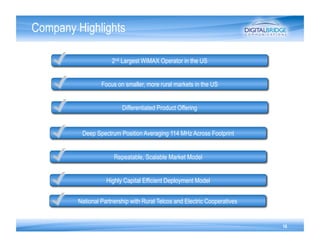
Company Highlights

                     2nd Largest WiMAX Operator in the US


                 Focus on smaller, more rural markets in the US


                         Differentiated Product Offering


         Deep Spectrum Position Averaging 114 MHz Across Footprint


                      Repeatable, Scalable Market Model


                   Highly Capital Efficient Deployment Model


        National Partnership with Rural Telcos and Electric Cooperatives


                                                                           16
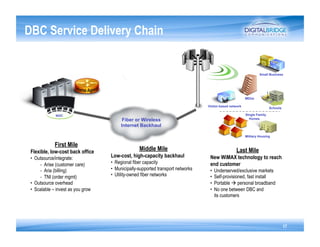
Small Business


                                                                                                         MDUs

                                                                                 Visitor-based network
                                                                                                                         Schools

             NOC                                                                                         Single Family
                                         Fiber or Wireless                                                 Homes

                                        Internet Backhaul

                                                                                                         Military Housing

            First Mile
Flexible, low-cost back office                    Middle Mile                                     Last Mile
•  Outsource/integrate:            Low-cost, high-capacity backhaul               New WiMAX technology to reach
     ‐  Arise (customer care)      •  Regional fiber capacity                     end customer
     ‐  Aria (billing)             •  Municipally-supported transport networks    •  Underserved/exclusive markets
     ‐  TNI (order mgmt)           •  Utility-owned fiber networks                •  Self-provisioned, fast install
•  Outsource overhead                                                             •  Portable  personal broadband
•  Scalable – invest as you grow                                                  •  No one between DBC and
                                                                                     its customers


                                                                                                                                   17
Backhaul Best Practices

•  DigitalBridge employs an array of backhaul solutions:
        - Fiber and microwave are most often deployed.


•  Cost-efficiency is a primary driver in the selection process.

•  Reliability determines the ultimate network solution.


                                                                   18
Unique Challenges of Backhaul

•  Operators have to think differently about backhaul solutions in context
   of 4G broadband delivery.


•  Rural markets present unique challenges and backhaul requirements:

    –  High-capacity circuit backhaul solutions needed for 4G broadband delivery are
       not always present.


                                                                                       19
The Future of Backhaul

Backhaul technology is evolving…

   –  Wireless point-to-point solutions are improving.

   –  Fiber solutions continue to be enhanced.

   –  Other creative in-band solutions are being developed.


                                                              20
LEAP Wireless
Dan Graf

       4G World Mobile Backhaul Summit

                  Dan Graf

                Leap Wireless
Company Background

•  Leap Wireless provides innovative, high-value wireless services to a
   fast-growing, young and ethnically diverse customer base through its
   subsidiary, Cricket Communications, Inc.

•  Leap is primarily the company’s financial brand, used mostly with
   investment and industry audiences, not consumers.

•  Leap is traded on the NASDAQ Global Select Market under the ticker
   symbol “LEAP”.

•  Leap is headquartered in San Diego, Calif.

•  For more information, please visit www.leapwireless.com.


22 Confidential/Proprietary
Cricket Communications, Inc.

•  Cricket Communications, Inc. is the operating subsidiary of Leap
   Wireless.

•  Cricket is a simple, affordable, flat-rate wireless service offering unlimited
   usage with no long-term commitments or credit checks.

•  Cricket offers customers access to a variety of the latest handsets and
   feature-rich mobile applications such as popular games, ringtones,
   ringback tones and wallpapers.

•  Cricket’s phone service is available on a monthly pay-in-advance basis or
   daily with Cricket PAYGo, a traditional prepaid service for consumers who
   want unlimited services on a more flexible payment schedule.


  23 Confidential/Proprietary
Cricket Communications, Inc.

•  Cricket also offers an unlimited wireless internet service, Cricket
   Broadband.

•  Cricket is designed to make wireless communications simple, affordable
   and worry-free. Predictability, simplicity and value are the foundations of
   our business.

•  Cricket owns and operates its own high-quality, all-digital CDMA2000 1X
   and 1xEV-DO network that regularly ranks 1st or 2nd in overall market
   quality from independent tests.

•  The company and its joint ventures now operate in 30 states and hold
   licenses for 35 of the top 50 U.S. markets.


  24 Confidential/Proprietary
Current Challenges in Planning for 4G


•  4G will require bandwidth that current TDM networks cannot provide
   economically.

•  How do we cost effectively build and maintain 3G and 4G networks
   simultaneously.

•  How do we provide seamless transition between 3G and 4G networks.

•  Competition for last mile backhaul including alternative providers and
   technologies.

•  Some alternate technologies are new and may not be ready for prime
   time.

  25 Confidential/Proprietary
Best Practices in Planning for 4G

•  Trials
    –  Feasibility testing of Ethernet and other technologies
    –  Integration of equipment with new technologies
    –  Training and knowledge base


•  Partnering with vendors on solutions and trials.

•  Backhaul RFQ – What’s available and where available.

•  Create a by market Playbook that includes a set of solutions.

•  Plan solutions based on what’s available and geographical topologies.


26 Confidential/Proprietary
Future Challenges


•  How to manage current networks while migrating to 4G networks.

•  Thinking IP and cost per bit.

•  Maintain quality while reducing costs per MB.

•  Reduce legacy TDM networks with least impact to customers.

•  Overall challenge of migration to an all IP network.


27 Confidential/Proprietary

Solving the Mobile Backhaul Challenge

  • 1.
    Wireless Transport NetworkOptimization: Solving the 4G Backhaul Challenge This document is confidential and is intended solely for the use and information of the client to whom it is addressed.
  • 2.
    Solving the 4GBackhaul Challenge   Clearly 4G requires more fiber and microwave in the backhaul network   But how much, and how much of each?   Where and how do I get it cost effectively? ILECs, CLECs, MSOs, AAVs?   When and how much do I deploy?   Do I deploy as TDM or Ethernet?   The answer of course depends on your particular situation   How much bandwidth do I need today, next year, in 5 years?   Am I migrating an existing network or building out “greenfield?”   Do I have voice traffic considerations or is this purely broadband data?   Am I deploying high density urban sites or lower density in rural markets? This document is proprietary and is intended solely for the use and information of the client to whom it is addressed. CFN Services 2
  • 3.
    4G Backhaul Rulesof Thumb   The higher your bandwidth requirements the more fiber you’ll need   A 90% microwave architecture can safely support 50-100Mbs per site today   Increasing the ratio of fiber hubs will support increased capacities per site   At 50% microwave; 50% fiber capacities can grow to 200Mbs+ per site   Planning the RAN and Backhaul together reduces lifecycle costs   Planning the RAN sites with a view towards fiber availability is critical   Failure to plan appropriately leads to high fiber and thus backhaul costs   This holds true equally for incumbent and green-field providers   You can add more fiber to the Backhaul “diet” as the bandwidth grows   Ethernet is cheaper but packet over SONET (TDM) offers a smoother transition for existing networks with voice traffic migrating to 4G   Rural deployments are more costly than urban environments This document is proprietary and is intended solely for the use and information of the client to whom it is addressed. CFN Services 3
  • 4.
    Fiber Access for4G Backhaul - Where Do I Get It?   ILECs and MSOs are aggressively building out the fiber infrastructure   Verizon (ILEC) will have fiber to 80%+ of all sites in region by 2012   AT&T (ILEC) has fiber deployed or planned to most high capacity sites   Time Warner, Comcast, COX, and other MSOs are adding cell sites to their existing (typically Ethernet) fiber networks   These alternatives will offer broad coverage, but uncertain lifecycle costs   CLECs, Utilities, and other Alternative Access Vendors   Over 200 non-ILEC/MSO fiber operators nationwide, over 500 when you count municipal fiber deployments   More limited fiber footprint than incumbents but better economics   Better opportunity to leverage ‘owners economics’ via dark fiber and/or shared build outs, thus providing more predictable lifecycle costs This document is proprietary and is intended solely for the use and information of the client to whom it is addressed. CFN Services 4
  • 5.
    Plan the RANwith a view toward fiber access for backhaul CFN Services FiberSource® Deployment Planning Platform This document is proprietary and is intended solely for the use and information of the client to whom it is addressed. CFN Services 5
  • 6.
    Initial RAN designwith fiber hub sites pre-selected… CFN Services FiberSource® Deployment Planning Platform This document is proprietary and is intended solely for the use and information of the client to whom it is addressed. CFN Services 6
  • 7.
    …enables broad-based 4Gcoverage and lower lifecycle costs CFN Services FiberSource® Deployment Planning Platform This document is proprietary and is intended solely for the use and information of the client to whom it is addressed. CFN Services 7
  • 8.
    4G World Conference MobileBackhaul Summit Panel Discussion Mike Dodson Utopian Wireless September 15th, 2009
  • 9.
    Substantial 2.5 GHzSpectrum Portfolio •  License areas reach over 7.4 million people in 22 states. •  Focused on bringing WiMax mobile broadband services to rural, remote, and suburban markets. 9
  • 10.
    Utopian’s Approach toMarket Planning WiMax as the Technology Choice   True mobile internet, available TODAY with the momentum and developing ecosystem necessary to deliver high value products and solutions for our customers. RAN and Backhaul Considerations   Native Ethernet is the desired backhaul choice.   Must achieve owner’s economics to make business cases work.   Wireless backhaul, ring vs. hub architectures.   RAN designed to deliver targeted services and data rates over the designated footprint.   Sites selected not just on best RAN coverage, but also to satisfy backhaul needs. IP Core Considerations   Central vs distributed traffic aggregation, internet handoff.   Quality of Service tradeoffs.   Security, harmful content management considerations. Vendor & Services Partners   No time or funds available to “re-invent the wheel”.   Partners who can scale as required to achieve rural, remote, and suburban market business objectives are critical to success. 10
  • 11.
    Utopian’s Broadband Landscape SuburbanMarkets   Roughly 80k pops and greater, higher population density supports a more efficient network   Significant spectrum depth   Competitive fixed and wireless incumbent providers   Attractive demographics, strong demand for wireless broadband services   Highly mobile usage Rural & Remote Markets   Limited or no broadband service (fixed or wireless)   Sparse population   Social and economic need for broadband services   Fixed and nomadic usage over mobility Challenges in both cases   Time to market   Minimize capital and operating expenses   Bandwidth is the commodity 11
  • 12.
    Backhaul Challenges Wireless Backhaul   Delivers scalable bandwidth with owner’s economics.   Many options in terms of vendors, path length, capacity, licensed vs unlicensed, etc.   Licensing, site entitlements add time and cost to the deployment.   Good RAN sites won’t all be good microwave sites; microwave backhaul will drive higher candidate site fallout as compared to traditional wired backhaul. Traditional Leased Services   T-1s are commonly available from the LEC, even in underserved areas.   CLEC and Cable MSO native ethernet services may be great for on-net sites.   Special construction adds time, cost, and overall risk to the deployment.   Bandwidth for leased TDM or “Lit Fiber” services are “pay by the drink”; as bandwidth needs increase, so do operating costs. Dark Fiber   Great for on net sites and establishing fixed cost for nearly unlimited bandwidth.   Limited availability, higher cost, and rural market bandwidth long term needs likely rules out “dark fiber to the site” as a viable backhaul solution. 12
  • 13.
    Solutions & Howto Get There Source the Fiber First   Successful deployment requires a pool of on-net locations suitable for microwave hubs.   Dark fiber always the preference, provided the market (or groups of markets) can make the economics work.   Lit services or even TDM hubs can be viable, so long as the economics support the business case and time to market advantage offsets higher operating costs. IP Core Design Approach   Hybrid centralized / distributed architecture   Nodes selected based on access to fiber providers and the internet In-Market Microwave Backhaul   Hub and spoke vs ring architecture choice depends on the market.   Hub & spoke OK for smaller markets where the number of “spokes” are few.   For larger markets, ring offers many more choices for fiber aggregation points, more tolerant of site candidate fallout, and higher reliability. 13
  • 14.
    CFN as aKey Services Partner Rural Broadband Stimulus Funding Opportunity   Federal Government’s Broadband Stimulus Funding Program administered by RUS and NTIA aims to deliver broadband services to unserved and underserved areas across the US.   Utopian Wireless developed a proprietary methodology for determining underserved areas in its licensed Geographic Service Areas (GSAs).   Utopian engaged it’s infrastructure vendor partner to collaborate in the development of RAN and Backhaul designs for each area as key elements of the application process.   Applications require project-specific details for complete end to end designs which demonstrate connectivity from the end user to the internet backbone. The Challenge: Integrate Underserved Area Designs with the IP Core   CFN supported Utopian’s efforts via it’s in-house expertise and tools including FiberSource.   From a list of over 140 target service areas, CFN was able to rapidly identify for each area the fiber providers, on-net locations, mileage and cost.   This data enabled Utopian to develop preliminary end to end designs for each of the area and produce very high quality funding applications fully compliant with the criteria set out by the agencies. 14
  • 15.
    4G World Backhaul Summit Doug Smith Chief Information Officer
  • 16.
    Company Highlights 2nd Largest WiMAX Operator in the US Focus on smaller, more rural markets in the US Differentiated Product Offering Deep Spectrum Position Averaging 114 MHz Across Footprint Repeatable, Scalable Market Model Highly Capital Efficient Deployment Model National Partnership with Rural Telcos and Electric Cooperatives 16
  • 17.
    Small Business MDUs Visitor-based network Schools NOC Single Family Fiber or Wireless Homes Internet Backhaul Military Housing First Mile Flexible, low-cost back office Middle Mile Last Mile •  Outsource/integrate: Low-cost, high-capacity backhaul New WiMAX technology to reach ‐  Arise (customer care) •  Regional fiber capacity end customer ‐  Aria (billing) •  Municipally-supported transport networks •  Underserved/exclusive markets ‐  TNI (order mgmt) •  Utility-owned fiber networks •  Self-provisioned, fast install •  Outsource overhead •  Portable  personal broadband •  Scalable – invest as you grow •  No one between DBC and its customers 17
  • 18.
    Backhaul Best Practices • DigitalBridge employs an array of backhaul solutions: - Fiber and microwave are most often deployed. •  Cost-efficiency is a primary driver in the selection process. •  Reliability determines the ultimate network solution. 18
  • 19.
    Unique Challenges ofBackhaul •  Operators have to think differently about backhaul solutions in context of 4G broadband delivery. •  Rural markets present unique challenges and backhaul requirements: –  High-capacity circuit backhaul solutions needed for 4G broadband delivery are not always present. 19
  • 20.
    The Future ofBackhaul Backhaul technology is evolving… –  Wireless point-to-point solutions are improving. –  Fiber solutions continue to be enhanced. –  Other creative in-band solutions are being developed. 20
  • 21.
    LEAP Wireless Dan Graf 4G World Mobile Backhaul Summit Dan Graf Leap Wireless
  • 22.
    Company Background •  LeapWireless provides innovative, high-value wireless services to a fast-growing, young and ethnically diverse customer base through its subsidiary, Cricket Communications, Inc. •  Leap is primarily the company’s financial brand, used mostly with investment and industry audiences, not consumers. •  Leap is traded on the NASDAQ Global Select Market under the ticker symbol “LEAP”. •  Leap is headquartered in San Diego, Calif. •  For more information, please visit www.leapwireless.com. 22 Confidential/Proprietary
  • 23.
    Cricket Communications, Inc. • Cricket Communications, Inc. is the operating subsidiary of Leap Wireless. •  Cricket is a simple, affordable, flat-rate wireless service offering unlimited usage with no long-term commitments or credit checks. •  Cricket offers customers access to a variety of the latest handsets and feature-rich mobile applications such as popular games, ringtones, ringback tones and wallpapers. •  Cricket’s phone service is available on a monthly pay-in-advance basis or daily with Cricket PAYGo, a traditional prepaid service for consumers who want unlimited services on a more flexible payment schedule. 23 Confidential/Proprietary
  • 24.
    Cricket Communications, Inc. • Cricket also offers an unlimited wireless internet service, Cricket Broadband. •  Cricket is designed to make wireless communications simple, affordable and worry-free. Predictability, simplicity and value are the foundations of our business. •  Cricket owns and operates its own high-quality, all-digital CDMA2000 1X and 1xEV-DO network that regularly ranks 1st or 2nd in overall market quality from independent tests. •  The company and its joint ventures now operate in 30 states and hold licenses for 35 of the top 50 U.S. markets. 24 Confidential/Proprietary
  • 25.
    Current Challenges inPlanning for 4G •  4G will require bandwidth that current TDM networks cannot provide economically. •  How do we cost effectively build and maintain 3G and 4G networks simultaneously. •  How do we provide seamless transition between 3G and 4G networks. •  Competition for last mile backhaul including alternative providers and technologies. •  Some alternate technologies are new and may not be ready for prime time. 25 Confidential/Proprietary
  • 26.
    Best Practices inPlanning for 4G •  Trials –  Feasibility testing of Ethernet and other technologies –  Integration of equipment with new technologies –  Training and knowledge base •  Partnering with vendors on solutions and trials. •  Backhaul RFQ – What’s available and where available. •  Create a by market Playbook that includes a set of solutions. •  Plan solutions based on what’s available and geographical topologies. 26 Confidential/Proprietary
  • 27.
    Future Challenges •  Howto manage current networks while migrating to 4G networks. •  Thinking IP and cost per bit. •  Maintain quality while reducing costs per MB. •  Reduce legacy TDM networks with least impact to customers. •  Overall challenge of migration to an all IP network. 27 Confidential/Proprietary