PREPARATORY PROCESSES R.B.CHAVAN Dept. of Textile Technology Indian Institute of Technology Hauz-Khas, New Delhi 110016
CLASSIFICATION OF TEXTILE FIBRES Minor Classifiction Natural   Synthetic   Regenerated  Vegetable Animal Polyester   Viscose Rayon Cotton Silk Nylon Jute  Wool Acrylic
CLASSIFICATION OF TEXTILE FIBRES Major Basis  Textile fibre product identification act 1960 Considerations: Principal origin of fibre (Natural or man-made) Generic term (Seed, hair, rayon) Common names (cotton, viscose, nylon etc.)
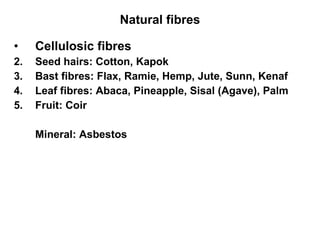
Natural fibres Cellulosic fibres Seed hairs: Cotton, Kapok Bast fibres: Flax, Ramie, Hemp, Jute, Sunn, Kenaf Leaf fibres: Abaca, Pineapple, Sisal (Agave), Palm Fruit: Coir  Mineral: Asbestos
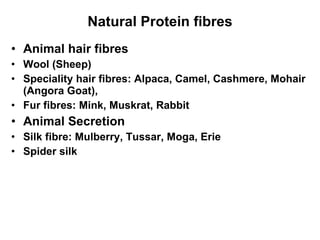
Natural Protein fibres Animal hair fibres Wool (Sheep) Speciality hair fibres: Alpaca, Camel, Cashmere, Mohair (Angora Goat),  Fur fibres: Mink, Muskrat, Rabbit Animal Secretion Silk fibre: Mulberry, Tussar, Moga, Erie Spider silk
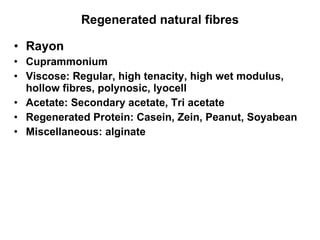
Regenerated natural fibres Rayon  Cuprammonium Viscose: Regular, high tenacity, high wet modulus, hollow fibres, polynosic, lyocell  Acetate: Secondary acetate, Tri acetate Regenerated Protein: Casein, Zein, Peanut, Soyabean Miscellaneous: alginate
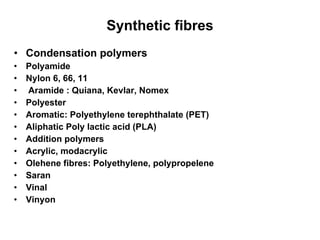
Synthetic fibres Condensation polymers Polyamide Nylon 6, 66, 11 Aramide : Quiana, Kevlar, Nomex Polyester Aromatic: Polyethylene terephthalate (PET) Aliphatic Poly lactic acid (PLA) Addition polymers Acrylic, modacrylic Olehene fibres: Polyethylene, polypropelene Saran Vinal Vinyon
Synthetic fibres Elastomers Spandex Synthetic Rubber Lastrile Man-made (Mineral) Glass Metallic
Chemical processing Give value addition  Can be carried out in  Fibre Yarn Fabric Garment or other ready made forms.
Chemical processing operations Preparatory Dyeing  Printing Finishing
Preparatory Processes  Purpose To remove Natural and added impurities To improve the appearance of fabric To impart certain desirable properties To make it suitable for subsequent processes like dyeing, printing finishing
Fabric manufacturing   Fibre    Yarn     Fabric   Fabric for sale  Spinning:   Fibre to yarn Weaving:   Yarn to fabric by interlacement of yarn in length direction and width direction Length direction yarn Warp Weft direction yarn: Weft Grey fabric  for sale or  chemiccal processing
Operations before Preparatory Processes Weaving: Conversion of yarn to fabric Machine used: Loom Fabric known as  Loom state fabric or Grey fabric Grey fabric length: 80
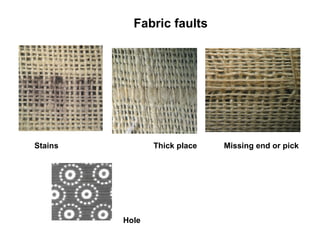
Grey fabric inspection  Major fabric defects Oil stains: formed accidentally during weaving and handling Holes Thick places due to yarn defect Warp  or  weft thread breaks Long thread of fabric surface others  Chemical processing step
Fabric faults Stains   Thick place  Missing end or pick  Hole
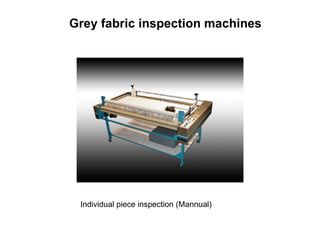
Grey fabric inspection machines Individual piece inspection (Mannual)
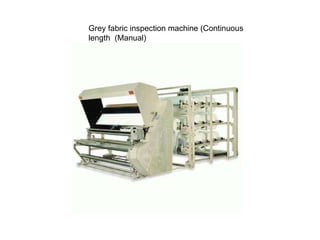
Grey fabric inspection machine (Continuous length  (Manual)
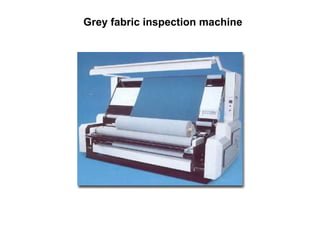
Grey fabric inspection machine
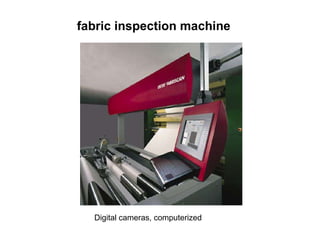
fabric inspection machine  Digital cameras, computerized
Stamping   Lot card Lot Number  Placing the code mark in the form of lot No. with marking ink  Ink should withstand chemical processing operations Lot No. mark helps to identify the fabric lot at any stage of processing. Stitching of individual non-defective pieces
Lot card Lot No. Yarn count  Fabric construction details such as Ends and Picks per inch or per cm. Fabric weight g/sq.m (gsm) Processing sequence Date and time on which the lot has been received Date and time of subjecting the lot to different processing sequence along with signature of supervisor  The information helps  in knowing the status of lot at any time and analysis of processing problems if there are any.
Mechanical operations Brushing Shearing/Cropping Singeing
Brushing   Purpose To remove short loose threads from fabric surface Operation Fabric moves in contact with Cylinders (2-4) covered with fine bristles (Brush Roller). The loose threads are picked up by the brush rollers. Removed by vacuum.  In this operation only loose threads are removed Threads attached to the fabric surface removed by shearing/cropping operation.
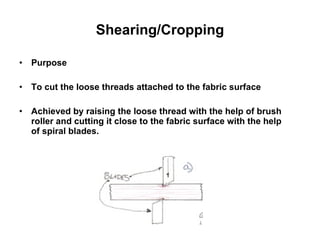
Shearing/Cropping Purpose To cut the loose threads attached to the fabric surface Achieved by raising the loose thread with the help of brush roller and cutting it close to the fabric surface with the help of spiral blades.
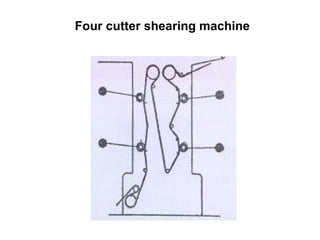
Four cutter shearing machine
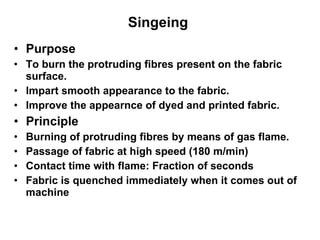
Singeing  Purpose To burn the protruding fibres present on the fabric surface. Impart smooth appearance to the fabric. Improve the appearnce of dyed and printed fabric.  Principle  Burning of protruding fibres by means of gas flame. Passage of fabric at high speed (180 m/min) Contact time with flame: Fraction of seconds Fabric is quenched immediately when it comes out of machine
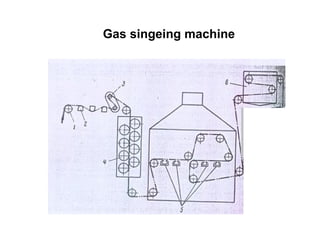
Gas singeing machine
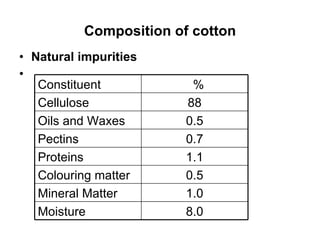
Composition of cotton Natural impurities Constituent % Cellulose 88 Oils and Waxes 0.5 Pectins 0.7 Proteins 1.1 Colouring matter 0.5 Mineral Matter  1.0 Moisture 8.0
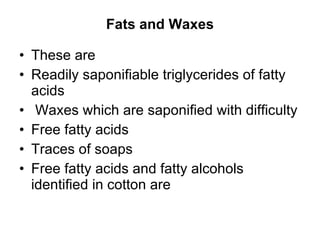
Fats and Waxes These are  Readily saponifiable triglycerides of fatty acids Waxes which are saponified with difficulty Free fatty acids Traces of soaps Free fatty acids and fatty alcohols identified in cotton are
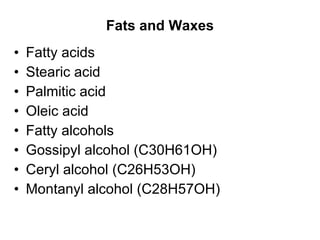
Fats and Waxes Fatty acids Stearic acid Palmitic acid Oleic acid Fatty alcohols Gossipyl alcohol (C30H61OH) Ceryl alcohol (C26H53OH) Montanyl alcohol (C28H57OH)
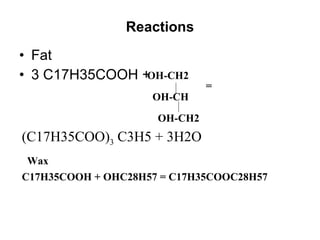
Reactions Fat 3 C17H35COOH +  OH-CH2 OH-CH OH-CH2 = (C17H35COO) 3  C3H5 + 3H2O Wax C17H35COOH + OHC28H57 = C17H35COOC28H57
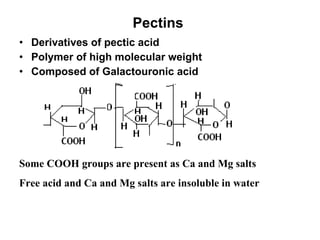
Pectins  Derivatives of pectic acid  Polymer of high molecular weight Composed of Galactouronic acid Some COOH groups are present as Ca and Mg salts Free acid and Ca and Mg salts are insoluble in water
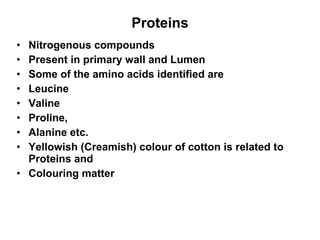
Proteins Nitrogenous compounds Present in primary wall and Lumen Some of the amino acids identified are Leucine Valine Proline,  Alanine etc. Yellowish (Creamish) colour of cotton is related to Proteins and  Colouring matter
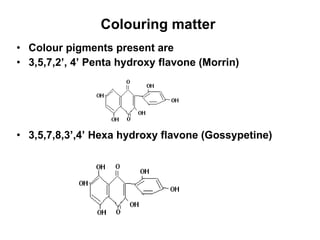
Colouring matter  Colour pigments present are 3,5,7,2’, 4’ Penta hydroxy flavone (Morrin) 3,5,7,8,3’,4’ Hexa hydroxy flavone (Gossypetine)
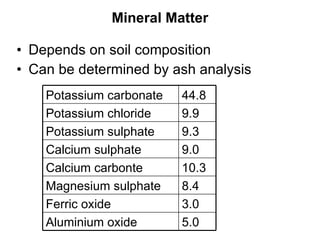
Mineral Matter Depends on soil composition Can be determined by ash analysis Potassium carbonate 44.8 Potassium chloride 9.9 Potassium sulphate 9.3 Calcium sulphate 9.0 Calcium carbonte  10.3 Magnesium sulphate 8.4 Ferric oxide 3.0 Aluminium oxide 5.0

Lecture 1 tt 241 introduction

  • 1.
    PREPARATORY PROCESSES R.B.CHAVANDept. of Textile Technology Indian Institute of Technology Hauz-Khas, New Delhi 110016
  • 2.
    CLASSIFICATION OF TEXTILEFIBRES Minor Classifiction Natural Synthetic Regenerated Vegetable Animal Polyester Viscose Rayon Cotton Silk Nylon Jute Wool Acrylic
  • 3.
    CLASSIFICATION OF TEXTILEFIBRES Major Basis Textile fibre product identification act 1960 Considerations: Principal origin of fibre (Natural or man-made) Generic term (Seed, hair, rayon) Common names (cotton, viscose, nylon etc.)
  • 4.
    Natural fibres Cellulosicfibres Seed hairs: Cotton, Kapok Bast fibres: Flax, Ramie, Hemp, Jute, Sunn, Kenaf Leaf fibres: Abaca, Pineapple, Sisal (Agave), Palm Fruit: Coir Mineral: Asbestos
  • 5.
    Natural Protein fibresAnimal hair fibres Wool (Sheep) Speciality hair fibres: Alpaca, Camel, Cashmere, Mohair (Angora Goat), Fur fibres: Mink, Muskrat, Rabbit Animal Secretion Silk fibre: Mulberry, Tussar, Moga, Erie Spider silk
  • 6.
    Regenerated natural fibresRayon Cuprammonium Viscose: Regular, high tenacity, high wet modulus, hollow fibres, polynosic, lyocell Acetate: Secondary acetate, Tri acetate Regenerated Protein: Casein, Zein, Peanut, Soyabean Miscellaneous: alginate
  • 7.
    Synthetic fibres Condensationpolymers Polyamide Nylon 6, 66, 11 Aramide : Quiana, Kevlar, Nomex Polyester Aromatic: Polyethylene terephthalate (PET) Aliphatic Poly lactic acid (PLA) Addition polymers Acrylic, modacrylic Olehene fibres: Polyethylene, polypropelene Saran Vinal Vinyon
  • 8.
    Synthetic fibres ElastomersSpandex Synthetic Rubber Lastrile Man-made (Mineral) Glass Metallic
  • 9.
    Chemical processing Givevalue addition Can be carried out in Fibre Yarn Fabric Garment or other ready made forms.
  • 10.
    Chemical processing operationsPreparatory Dyeing Printing Finishing
  • 11.
    Preparatory Processes Purpose To remove Natural and added impurities To improve the appearance of fabric To impart certain desirable properties To make it suitable for subsequent processes like dyeing, printing finishing
  • 12.
    Fabric manufacturing Fibre  Yarn  Fabric  Fabric for sale Spinning: Fibre to yarn Weaving: Yarn to fabric by interlacement of yarn in length direction and width direction Length direction yarn Warp Weft direction yarn: Weft Grey fabric for sale or chemiccal processing
  • 13.
    Operations before PreparatoryProcesses Weaving: Conversion of yarn to fabric Machine used: Loom Fabric known as Loom state fabric or Grey fabric Grey fabric length: 80
  • 14.
    Grey fabric inspection Major fabric defects Oil stains: formed accidentally during weaving and handling Holes Thick places due to yarn defect Warp or weft thread breaks Long thread of fabric surface others Chemical processing step
  • 15.
    Fabric faults Stains Thick place Missing end or pick Hole
  • 16.
    Grey fabric inspectionmachines Individual piece inspection (Mannual)
  • 17.
    Grey fabric inspectionmachine (Continuous length (Manual)
  • 18.
  • 19.
    fabric inspection machine Digital cameras, computerized
  • 20.
    Stamping Lot card Lot Number Placing the code mark in the form of lot No. with marking ink Ink should withstand chemical processing operations Lot No. mark helps to identify the fabric lot at any stage of processing. Stitching of individual non-defective pieces
  • 21.
    Lot card LotNo. Yarn count Fabric construction details such as Ends and Picks per inch or per cm. Fabric weight g/sq.m (gsm) Processing sequence Date and time on which the lot has been received Date and time of subjecting the lot to different processing sequence along with signature of supervisor The information helps in knowing the status of lot at any time and analysis of processing problems if there are any.
  • 22.
    Mechanical operations BrushingShearing/Cropping Singeing
  • 23.
    Brushing Purpose To remove short loose threads from fabric surface Operation Fabric moves in contact with Cylinders (2-4) covered with fine bristles (Brush Roller). The loose threads are picked up by the brush rollers. Removed by vacuum. In this operation only loose threads are removed Threads attached to the fabric surface removed by shearing/cropping operation.
  • 24.
    Shearing/Cropping Purpose Tocut the loose threads attached to the fabric surface Achieved by raising the loose thread with the help of brush roller and cutting it close to the fabric surface with the help of spiral blades.
  • 25.
  • 26.
    Singeing PurposeTo burn the protruding fibres present on the fabric surface. Impart smooth appearance to the fabric. Improve the appearnce of dyed and printed fabric. Principle Burning of protruding fibres by means of gas flame. Passage of fabric at high speed (180 m/min) Contact time with flame: Fraction of seconds Fabric is quenched immediately when it comes out of machine
  • 27.
  • 28.
    Composition of cottonNatural impurities Constituent % Cellulose 88 Oils and Waxes 0.5 Pectins 0.7 Proteins 1.1 Colouring matter 0.5 Mineral Matter 1.0 Moisture 8.0
  • 29.
    Fats and WaxesThese are Readily saponifiable triglycerides of fatty acids Waxes which are saponified with difficulty Free fatty acids Traces of soaps Free fatty acids and fatty alcohols identified in cotton are
  • 30.
    Fats and WaxesFatty acids Stearic acid Palmitic acid Oleic acid Fatty alcohols Gossipyl alcohol (C30H61OH) Ceryl alcohol (C26H53OH) Montanyl alcohol (C28H57OH)
  • 31.
    Reactions Fat 3C17H35COOH + OH-CH2 OH-CH OH-CH2 = (C17H35COO) 3 C3H5 + 3H2O Wax C17H35COOH + OHC28H57 = C17H35COOC28H57
  • 32.
    Pectins Derivativesof pectic acid Polymer of high molecular weight Composed of Galactouronic acid Some COOH groups are present as Ca and Mg salts Free acid and Ca and Mg salts are insoluble in water
  • 33.
    Proteins Nitrogenous compoundsPresent in primary wall and Lumen Some of the amino acids identified are Leucine Valine Proline, Alanine etc. Yellowish (Creamish) colour of cotton is related to Proteins and Colouring matter
  • 34.
    Colouring matter Colour pigments present are 3,5,7,2’, 4’ Penta hydroxy flavone (Morrin) 3,5,7,8,3’,4’ Hexa hydroxy flavone (Gossypetine)
  • 35.
    Mineral Matter Dependson soil composition Can be determined by ash analysis Potassium carbonate 44.8 Potassium chloride 9.9 Potassium sulphate 9.3 Calcium sulphate 9.0 Calcium carbonte 10.3 Magnesium sulphate 8.4 Ferric oxide 3.0 Aluminium oxide 5.0