Dr. Jayanta Kr. Mahato
Assistant Professor
Mechanical Engineering Dept.
Shobhit Deemed to-be University
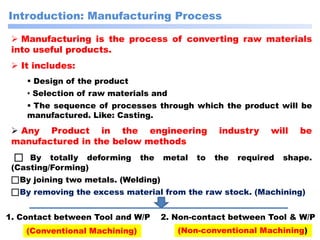
 Manufacturing is the process of converting raw materials
into useful products.
 It includes:
 Design of the product
• Selection of raw materials and
 The sequence of processes through which the product will be
manufactured. Like: Casting.
 Any Product in the engineering industry will be
manufactured in the below methods
 By totally deforming the metal to the required shape.
(Casting/Forming)
By joining two metals. (Welding)
By removing the excess material from the raw stock. (Machining)
Introduction: Manufacturing Process
1. Contact between Tool and W/P 2. Non-contact between Tool & W/P
(Conventional Machining) (Non-conventional Machining)
Introduction: Manufacturing Process
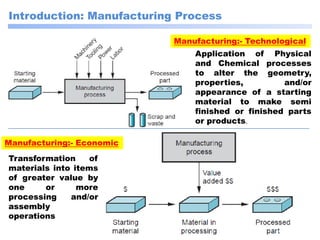
Application of Physical
and Chemical processes
to alter the geometry,
properties, and/or
appearance of a starting
material to make semi
finished or finished parts
or products.
Manufacturing:- Technological
Manufacturing:- Economic
Transformation of
materials into items
of greater value by
one or more
processing and/or
assembly
operations
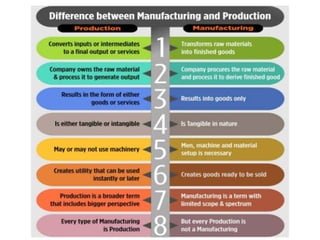
Manufacturing Vs. Production Process
Manufacturing Vs. Production Process Process
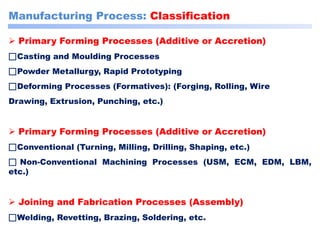
Manufacturing Process: Classification
 Primary Forming Processes (Additive or Accretion)
Casting and Moulding Processes
Powder Metallurgy, Rapid Prototyping
Deforming Processes (Formatives): (Forging, Rolling, Wire
Drawing, Extrusion, Punching, etc.)
 Primary Forming Processes (Additive or Accretion)
Conventional (Turning, Milling, Drilling, Shaping, etc.)
 Non-Conventional Machining Processes (USM, ECM, EDM, LBM,
etc.)
 Joining and Fabrication Processes (Assembly)
Welding, Revetting, Brazing, Soldering, etc.
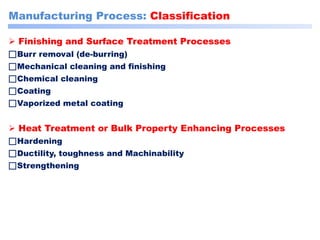
Manufacturing Process: Classification
 Finishing and Surface Treatment Processes
Burr removal (de-burring)
Mechanical cleaning and finishing
Chemical cleaning
Coating
Vaporized metal coating
 Heat Treatment or Bulk Property Enhancing Processes
Hardening
Ductility, toughness and Machinability
Strengthening
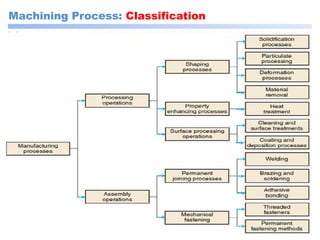
Machining Process: Classification
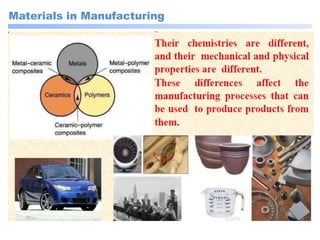
Materials in Manufacturing
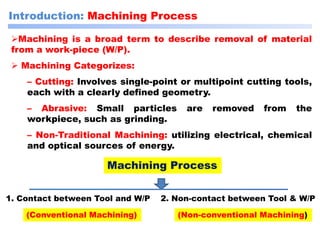
Machining is a broad term to describe removal of material
from a work-piece (W/P).
 Machining Categorizes:
– Cutting: Involves single-point or multipoint cutting tools,
each with a clearly defined geometry.
– Abrasive: Small particles are removed from the
workpiece, such as grinding.
– Non-Traditional Machining: utilizing electrical, chemical
and optical sources of energy.
Introduction: Machining Process
1. Contact between Tool and W/P 2. Non-contact between Tool & W/P
(Conventional Machining) (Non-conventional Machining)
Machining Process
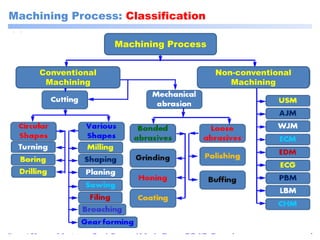
Machining Process: Classification
Conventional
Machining
Non-conventional
Machining
Machining Process
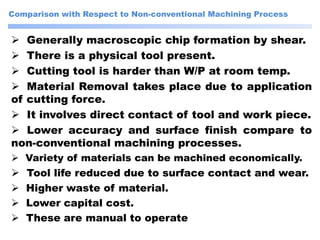
 Generally macroscopic chip formation by shear.
 There is a physical tool present.
 Cutting tool is harder than W/P at room temp.
 Material Removal takes place due to application
of cutting force.
 It involves direct contact of tool and work piece.
 Lower accuracy and surface finish compare to
non-conventional machining processes.
 Variety of materials can be machined economically.
 Tool life reduced due to surface contact and wear.
 Higher waste of material.
 Lower capital cost.
 These are manual to operate
Comparison with Respect to Non-conventional Machining Process
 Machining is the process of removal of excess
material in the forms of chips to give the desire
shape, size, surface finish and tolerance on the WP.
 Wide shape tool used.
 Wide range of materials can be
manufactured/machined with close tolerance level.
 Variety of part shape & special geometric
feature possible such as:
a) Screw threads
b) Accurate round holes
c) Very straight edges and surface finish
Purpose of Conventional Machining Process
 What is manufacturing Process?
 Classification of manufacturing process
 What is machining process?
 Classification of machining process
 What is production process?
 Differences between manufacturing and
machining process
 Differences between manufacturing and
production process
 Conventional and non-conventional machining
process
Summary
Lecture 1_Introduction to Manufacturing Processes.pdf

Lecture 1_Introduction to Manufacturing Processes.pdf

  • 1.
    Dr. Jayanta Kr.Mahato Assistant Professor Mechanical Engineering Dept. Shobhit Deemed to-be University
  • 2.
     Manufacturing isthe process of converting raw materials into useful products.  It includes:  Design of the product • Selection of raw materials and  The sequence of processes through which the product will be manufactured. Like: Casting.  Any Product in the engineering industry will be manufactured in the below methods  By totally deforming the metal to the required shape. (Casting/Forming) By joining two metals. (Welding) By removing the excess material from the raw stock. (Machining) Introduction: Manufacturing Process 1. Contact between Tool and W/P 2. Non-contact between Tool & W/P (Conventional Machining) (Non-conventional Machining)
  • 3.
    Introduction: Manufacturing Process Applicationof Physical and Chemical processes to alter the geometry, properties, and/or appearance of a starting material to make semi finished or finished parts or products. Manufacturing:- Technological Manufacturing:- Economic Transformation of materials into items of greater value by one or more processing and/or assembly operations
  • 4.
  • 5.
  • 6.
    Manufacturing Process: Classification Primary Forming Processes (Additive or Accretion) Casting and Moulding Processes Powder Metallurgy, Rapid Prototyping Deforming Processes (Formatives): (Forging, Rolling, Wire Drawing, Extrusion, Punching, etc.)  Primary Forming Processes (Additive or Accretion) Conventional (Turning, Milling, Drilling, Shaping, etc.)  Non-Conventional Machining Processes (USM, ECM, EDM, LBM, etc.)  Joining and Fabrication Processes (Assembly) Welding, Revetting, Brazing, Soldering, etc.
  • 7.
    Manufacturing Process: Classification Finishing and Surface Treatment Processes Burr removal (de-burring) Mechanical cleaning and finishing Chemical cleaning Coating Vaporized metal coating  Heat Treatment or Bulk Property Enhancing Processes Hardening Ductility, toughness and Machinability Strengthening
  • 8.
  • 9.
  • 10.
    Machining is abroad term to describe removal of material from a work-piece (W/P).  Machining Categorizes: – Cutting: Involves single-point or multipoint cutting tools, each with a clearly defined geometry. – Abrasive: Small particles are removed from the workpiece, such as grinding. – Non-Traditional Machining: utilizing electrical, chemical and optical sources of energy. Introduction: Machining Process 1. Contact between Tool and W/P 2. Non-contact between Tool & W/P (Conventional Machining) (Non-conventional Machining) Machining Process
  • 11.
  • 12.
     Generally macroscopicchip formation by shear.  There is a physical tool present.  Cutting tool is harder than W/P at room temp.  Material Removal takes place due to application of cutting force.  It involves direct contact of tool and work piece.  Lower accuracy and surface finish compare to non-conventional machining processes.  Variety of materials can be machined economically.  Tool life reduced due to surface contact and wear.  Higher waste of material.  Lower capital cost.  These are manual to operate Comparison with Respect to Non-conventional Machining Process
  • 13.
     Machining isthe process of removal of excess material in the forms of chips to give the desire shape, size, surface finish and tolerance on the WP.  Wide shape tool used.  Wide range of materials can be manufactured/machined with close tolerance level.  Variety of part shape & special geometric feature possible such as: a) Screw threads b) Accurate round holes c) Very straight edges and surface finish Purpose of Conventional Machining Process
  • 14.
     What ismanufacturing Process?  Classification of manufacturing process  What is machining process?  Classification of machining process  What is production process?  Differences between manufacturing and machining process  Differences between manufacturing and production process  Conventional and non-conventional machining process Summary