NEWER MATERIAL PROCESSING
Presented by
Gidla Vinay
17ME320
1st yr M.Tech(PDM)
PEC.
Subject staff
Dr. Mahadevan
HOD & Professor
Mechanical Engg Dept.
PEC
Topics: Surface coating - Hardfacing , Thermal Spraying.
PONDICHERRY ENGINEERING COLLEGE
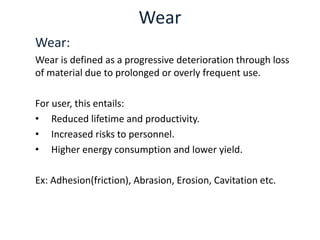
Wear:
Wear is defined as a progressive deterioration through loss
of material due to prolonged or overly frequent use.
For user, this entails:
• Reduced lifetime and productivity.
• Increased risks to personnel.
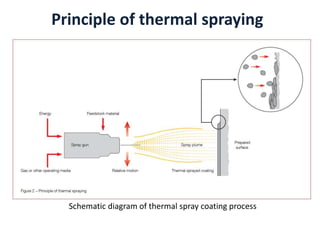
• Higher energy consumption and lower yield.
Ex: Adhesion(friction), Abrasion, Erosion, Cavitation etc.
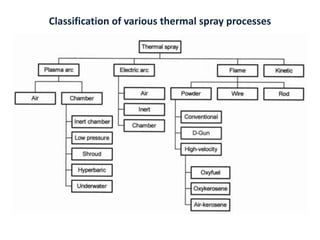
Wear
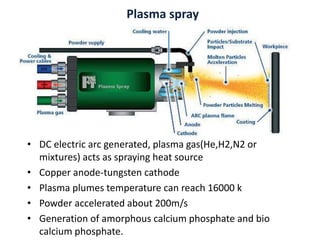
Types of wear
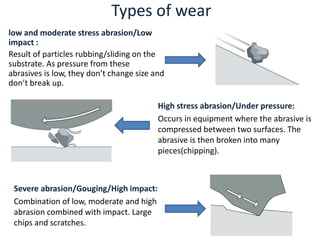
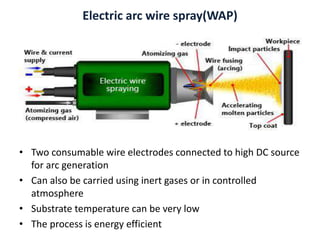
low and moderate stress abrasion/Low
impact :
Result of particles rubbing/sliding on the
substrate. As pressure from these
abrasives is low, they don’t change size and
don’t break up.
High stress abrasion/Under pressure:
Occurs in equipment where the abrasive is
compressed between two surfaces. The
abrasive is then broken into many
pieces(chipping).
Severe abrasion/Gouging/High impact:
Combination of low, moderate and high
abrasion combined with impact. Large
chips and scratches.
Adhesion:
When two metal bodies rub each other and
material is transferred from one substrate
to the other, this is known as “adhesion
wear”.
Occurs under conditions of high
temperature, high pressure and friction.
Erosion:
This occurs when solid particles or drops of
liquid strike a surface at high speed.
Rate depends on the angle of attack and at
which it is projected.
Fretting:
Caused when there is recurrent rolling or
sliding action between two components.
Under such conditions a sudden loss of
material, in the form of pitting or chipping
will be observed.
Ex: gear teeth, rails, roller presses.
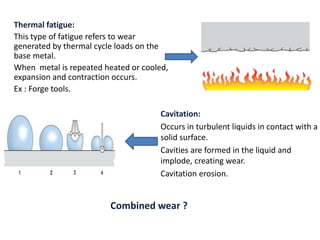
Thermal fatigue:
This type of fatigue refers to wear
generated by thermal cycle loads on the
base metal.
When metal is repeated heated or cooled,
expansion and contraction occurs.
Ex : Forge tools.
Cavitation:
Occurs in turbulent liquids in contact with a
solid surface.
Cavities are formed in the liquid and
implode, creating wear.
Cavitation erosion.
Combined wear ?
SURFACE COATING
An economic method for the production of materials , tools and
machine parts that required the desired surface properties such as
corrosion, erosion and wear resistance.
Different coatings are used to achieve the different properties.
Some methods:
Hard facing
Thermal spraying
Vapor deposition
Ion implantation
Hot dipping
Why surface coatings?
Principle of “Better-faster-cheaper”
Either the entire component can be
coated or just the area prone to
attack, which ever best fulfills the
requirements
Chrome plated steel pelton turbine nozzle needle after
service
Surface properties
Depends on service environment
• Wear
• Corrosion resistance
• Thermal insulation
• Electrical insulation
• Improved aesthetic appearance
Usually a combination is present
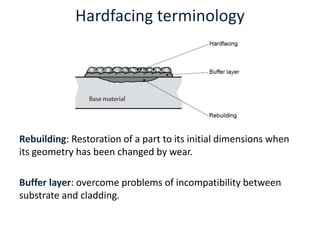
Hardfacing terminology
Rebuilding: Restoration of a part to its initial dimensions when
its geometry has been changed by wear.
Buffer layer: overcome problems of incompatibility between
substrate and cladding.
Hardfacing
Hardfacing is the deposition of a surface layer by welding, which
is harder than the base material. Its purpose is to give wear
resistance.
Preventive hardfacing
Hardfacing
Remedial hardfacing
Characterized by
→ Soundness
→ Toughness
→ Environmental stresses like corrosion and high temperatures
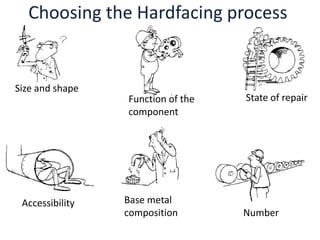
Choosing the Hardfacing process
Function of the
component
Base metal
composition
Size and shape
Accessibility
State of repair
Number
Benefits of Hardfacing
Following benefits can be obtained
 Reduced maintenance
 Reduced operation costs
 Lower repair costs
 Extended equipment lifetime
Process types
 Gas tungsten Arc welding process
 Shielded metal arc welding
 Flux cored arc welding
 Submerged arc welding
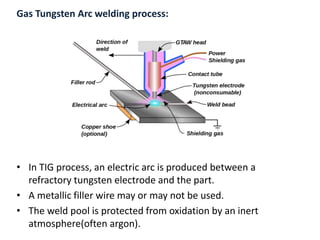
Gas Tungsten Arc welding process:
• In TIG process, an electric arc is produced between a
refractory tungsten electrode and the part.
• A metallic filler wire may or may not be used.
• The weld pool is protected from oxidation by an inert
atmosphere(often argon).
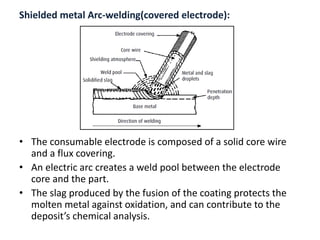
Shielded metal Arc-welding(covered electrode):
• The consumable electrode is composed of a solid core wire
and a flux covering.
• An electric arc creates a weld pool between the electrode
core and the part.
• The slag produced by the fusion of the coating protects the
molten metal against oxidation, and can contribute to the
deposit’s chemical analysis.
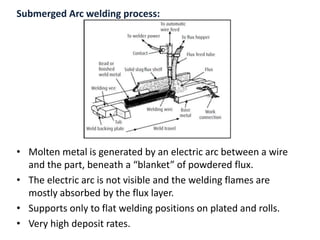
Submerged Arc welding process:
• Molten metal is generated by an electric arc between a wire
and the part, beneath a “blanket” of powdered flux.
• The electric arc is not visible and the welding flames are
mostly absorbed by the flux layer.
• Supports only to flat welding positions on plated and rolls.
• Very high deposit rates.
Gas Shielded Metal Arc Welding Process:
• Molten metal is obtained by creating an electric arc between
a wire electrode(solid or tubular cored) and the base metal.
• Metal Inert Gas(MIG)-Metal Active Gas(MAG)
• Easy to automate
Flux cored wires:
 Improve fusion characteristics.
 Protect the molten metal against excessive oxidation.
 Offer a wider range of alloys that can be deposited.
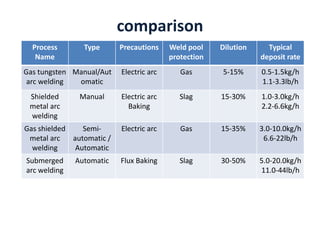
comparison
Process
Name
Type Precautions Weld pool
protection
Dilution Typical
deposit rate
Gas tungsten
arc welding
Manual/Aut
omatic
Electric arc Gas 5-15% 0.5-1.5kg/h
1.1-3.3lb/h
Shielded
metal arc
welding
Manual Electric arc
Baking
Slag 15-30% 1.0-3.0kg/h
2.2-6.6kg/h
Gas shielded
metal arc
welding
Semi-
automatic /
Automatic
Electric arc Gas 15-35% 3.0-10.0kg/h
6.6-22lb/h
Submerged
arc welding
Automatic Flux Baking Slag 30-50% 5.0-20.0kg/h
11.0-44lb/h
Dilution:
Dilution affects the chemical composition of the
deposit, hardness, and quality.
During welding some of the base metal dissolves
into the weld pool, diluting it.
% Dilution =
𝐵
𝐴+𝐵
∗ 100
During surfacing operations, dilution should be limited to
optimize deposit characteristics, whilst ensuring a good fusion
with the substrate.
Thermal spraying
“Thermal spray is a generic term for a group of processes in
which metallic, ceramic, cermet, and some polymeric materials
in the form of powder, wire, rod are fed to a torch or gun with
which they are heated to near or somewhat above their melting
point”.
Projected against the surface to be coated(substrate).
Principle of thermal spraying
Schematic diagram of thermal spray coating process
Classification of various thermal spray processes
Plasma spray
• DC electric arc generated, plasma gas(He,H2,N2 or
mixtures) acts as spraying heat source
• Copper anode-tungsten cathode
• Plasma plumes temperature can reach 16000 k
• Powder accelerated about 200m/s
• Generation of amorphous calcium phosphate and bio
calcium phosphate.
Electric arc wire spray(WAP)
• Two consumable wire electrodes connected to high DC source
for arc generation
• Can also be carried using inert gases or in controlled
atmosphere
• Substrate temperature can be very low
• The process is energy efficient
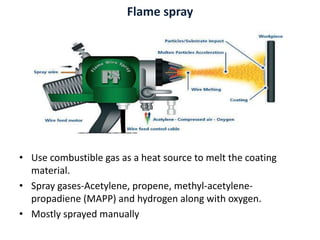
Flame spray
• Use combustible gas as a heat source to melt the coating
material.
• Spray gases-Acetylene, propene, methyl-acetylene-
propadiene (MAPP) and hydrogen along with oxygen.
• Mostly sprayed manually
• Flame temperature and characteristics depend on oxygen-to-
fuel ratio.
• A wide variety of materials can be deposited in rod, wire or
powder form as coatings using this process.
High Velocity Oxy-Fuel Spray(HVOF)
• Uses combination of oxygen with various fuel gases like
hydrogen, propene, propylene, kerosene.
• Spray powder is used.
• Flame temperature varies in range 2500c-3200c based on
combination.
• Different from flame spray
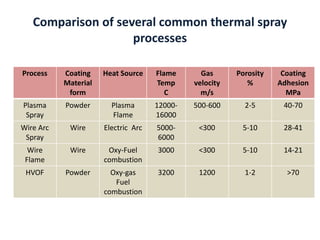
Comparison of several common thermal spray
processes
Process Coating
Material
form
Heat Source Flame
Temp
C
Gas
velocity
m/s
Porosity
%
Coating
Adhesion
MPa
Plasma
Spray
Powder Plasma
Flame
12000-
16000
500-600 2-5 40-70
Wire Arc
Spray
Wire Electric Arc 5000-
6000
<300 5-10 28-41
Wire
Flame
Wire Oxy-Fuel
combustion
3000 <300 5-10 14-21
HVOF Powder Oxy-gas
Fuel
combustion
3200 1200 1-2 >70
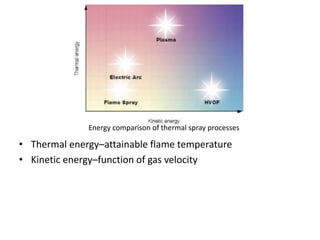
Energy comparison of thermal spray processes
• Thermal energy–attainable flame temperature
• Kinetic energy–function of gas velocity
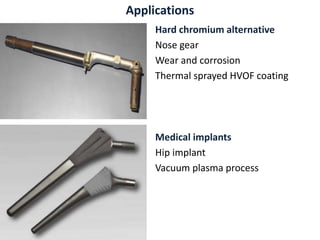
Applications
Hard chromium alternative
Nose gear
Wear and corrosion
Thermal sprayed HVOF coating
Medical implants
Hip implant
Vacuum plasma process
Gas turbines
Stationary and flight gas turbines.
Thermal sprayed coating.
High temp corrosion resistance,
thermally insulating coatings, repair
of super alloy components.
Salvage and restoration
Repair procedures to restore
components to their dimensions
Case study
COMPANY PROFILE
Thermico GmbH & Co.KG, a German-based company, develops,
produces and distributes robot-based coating centers.
They specialize in plasma and high velocity flame spray systems that
provide coatings for a wide range of products from aircraft turbine
blades to Teflon® frying pans.
CHALLENGE
Thermico required a new extraction system to handle the dust and
fumes from the plasma and HVOF spray systems that were being
installed in their new premises.
APPROACHED COMPANY:
Camfil Air Pollution Control (APC)
PRODUCT INFORMATION
Product: Farr Gold Series® dust collector
Size: GS40 ATEX Compliant
Air Volume: 30.000 m3/hr
Application: Thermal spray processes,
HVOF, plasma
Customer: Thermico GmbH & Co.KG,
Dortmund, Germany
Installation date: January 2011
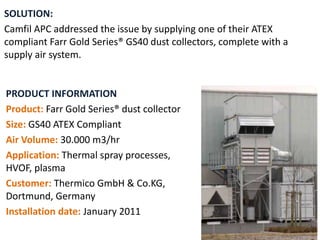
SOLUTION:
Camfil APC addressed the issue by supplying one of their ATEX
compliant Farr Gold Series® GS40 dust collectors, complete with a
supply air system.
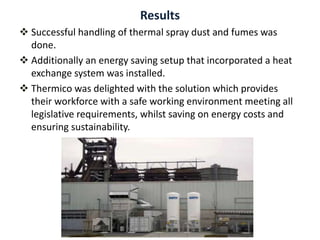
Results
 Successful handling of thermal spray dust and fumes was
done.
 Additionally an energy saving setup that incorporated a heat
exchange system was installed.
 Thermico was delighted with the solution which provides
their workforce with a safe working environment meeting all
legislative requirements, whilst saving on energy costs and
ensuring sustainability.
An interesting fact
According to Centers for Disease control and Prevention,
in 2014 alone there have been approximately 7,19,000 knee
replacements and 3,32,000 hip replacements.
References
• Fundamentals of Hardfacing by arc welding-Welding alloys group.
• Welding consumables, hardfacing-Afrox product reference manual.
• Thermal spray advanced technology solutions and services –oerlikon
metco.
• A review on Thermal spray coating processes by Sagar Amin.
• Case study on Thermal spray by Camfil Air Pollution Control (APC).
• Official website of Centers for Disease control and Prevention.
• www.Wikipedia.com
• Google images.
Surface coatings, hardfacing,thermal spraying

Surface coatings, hardfacing,thermal spraying

  • 1.
    NEWER MATERIAL PROCESSING Presentedby Gidla Vinay 17ME320 1st yr M.Tech(PDM) PEC. Subject staff Dr. Mahadevan HOD & Professor Mechanical Engg Dept. PEC Topics: Surface coating - Hardfacing , Thermal Spraying. PONDICHERRY ENGINEERING COLLEGE
  • 2.
    Wear: Wear is definedas a progressive deterioration through loss of material due to prolonged or overly frequent use. For user, this entails: • Reduced lifetime and productivity. • Increased risks to personnel. • Higher energy consumption and lower yield. Ex: Adhesion(friction), Abrasion, Erosion, Cavitation etc. Wear
  • 3.
    Types of wear lowand moderate stress abrasion/Low impact : Result of particles rubbing/sliding on the substrate. As pressure from these abrasives is low, they don’t change size and don’t break up. High stress abrasion/Under pressure: Occurs in equipment where the abrasive is compressed between two surfaces. The abrasive is then broken into many pieces(chipping). Severe abrasion/Gouging/High impact: Combination of low, moderate and high abrasion combined with impact. Large chips and scratches.
  • 4.
    Adhesion: When two metalbodies rub each other and material is transferred from one substrate to the other, this is known as “adhesion wear”. Occurs under conditions of high temperature, high pressure and friction. Erosion: This occurs when solid particles or drops of liquid strike a surface at high speed. Rate depends on the angle of attack and at which it is projected. Fretting: Caused when there is recurrent rolling or sliding action between two components. Under such conditions a sudden loss of material, in the form of pitting or chipping will be observed. Ex: gear teeth, rails, roller presses.
  • 5.
    Thermal fatigue: This typeof fatigue refers to wear generated by thermal cycle loads on the base metal. When metal is repeated heated or cooled, expansion and contraction occurs. Ex : Forge tools. Cavitation: Occurs in turbulent liquids in contact with a solid surface. Cavities are formed in the liquid and implode, creating wear. Cavitation erosion. Combined wear ?
  • 6.
    SURFACE COATING An economicmethod for the production of materials , tools and machine parts that required the desired surface properties such as corrosion, erosion and wear resistance. Different coatings are used to achieve the different properties. Some methods: Hard facing Thermal spraying Vapor deposition Ion implantation Hot dipping
  • 7.
    Why surface coatings? Principleof “Better-faster-cheaper” Either the entire component can be coated or just the area prone to attack, which ever best fulfills the requirements Chrome plated steel pelton turbine nozzle needle after service
  • 8.
    Surface properties Depends onservice environment • Wear • Corrosion resistance • Thermal insulation • Electrical insulation • Improved aesthetic appearance Usually a combination is present
  • 9.
    Hardfacing terminology Rebuilding: Restorationof a part to its initial dimensions when its geometry has been changed by wear. Buffer layer: overcome problems of incompatibility between substrate and cladding.
  • 10.
    Hardfacing Hardfacing is thedeposition of a surface layer by welding, which is harder than the base material. Its purpose is to give wear resistance. Preventive hardfacing Hardfacing Remedial hardfacing Characterized by → Soundness → Toughness → Environmental stresses like corrosion and high temperatures
  • 11.
    Choosing the Hardfacingprocess Function of the component Base metal composition Size and shape Accessibility State of repair Number
  • 12.
    Benefits of Hardfacing Followingbenefits can be obtained  Reduced maintenance  Reduced operation costs  Lower repair costs  Extended equipment lifetime Process types  Gas tungsten Arc welding process  Shielded metal arc welding  Flux cored arc welding  Submerged arc welding
  • 13.
    Gas Tungsten Arcwelding process: • In TIG process, an electric arc is produced between a refractory tungsten electrode and the part. • A metallic filler wire may or may not be used. • The weld pool is protected from oxidation by an inert atmosphere(often argon).
  • 14.
    Shielded metal Arc-welding(coveredelectrode): • The consumable electrode is composed of a solid core wire and a flux covering. • An electric arc creates a weld pool between the electrode core and the part. • The slag produced by the fusion of the coating protects the molten metal against oxidation, and can contribute to the deposit’s chemical analysis.
  • 15.
    Submerged Arc weldingprocess: • Molten metal is generated by an electric arc between a wire and the part, beneath a “blanket” of powdered flux. • The electric arc is not visible and the welding flames are mostly absorbed by the flux layer. • Supports only to flat welding positions on plated and rolls. • Very high deposit rates.
  • 16.
    Gas Shielded MetalArc Welding Process: • Molten metal is obtained by creating an electric arc between a wire electrode(solid or tubular cored) and the base metal. • Metal Inert Gas(MIG)-Metal Active Gas(MAG) • Easy to automate Flux cored wires:  Improve fusion characteristics.  Protect the molten metal against excessive oxidation.  Offer a wider range of alloys that can be deposited.
  • 17.
    comparison Process Name Type Precautions Weldpool protection Dilution Typical deposit rate Gas tungsten arc welding Manual/Aut omatic Electric arc Gas 5-15% 0.5-1.5kg/h 1.1-3.3lb/h Shielded metal arc welding Manual Electric arc Baking Slag 15-30% 1.0-3.0kg/h 2.2-6.6kg/h Gas shielded metal arc welding Semi- automatic / Automatic Electric arc Gas 15-35% 3.0-10.0kg/h 6.6-22lb/h Submerged arc welding Automatic Flux Baking Slag 30-50% 5.0-20.0kg/h 11.0-44lb/h
  • 18.
    Dilution: Dilution affects thechemical composition of the deposit, hardness, and quality. During welding some of the base metal dissolves into the weld pool, diluting it. % Dilution = 𝐵 𝐴+𝐵 ∗ 100 During surfacing operations, dilution should be limited to optimize deposit characteristics, whilst ensuring a good fusion with the substrate.
  • 19.
    Thermal spraying “Thermal sprayis a generic term for a group of processes in which metallic, ceramic, cermet, and some polymeric materials in the form of powder, wire, rod are fed to a torch or gun with which they are heated to near or somewhat above their melting point”. Projected against the surface to be coated(substrate).
  • 20.
    Principle of thermalspraying Schematic diagram of thermal spray coating process
  • 21.
    Classification of variousthermal spray processes
  • 22.
    Plasma spray • DCelectric arc generated, plasma gas(He,H2,N2 or mixtures) acts as spraying heat source • Copper anode-tungsten cathode • Plasma plumes temperature can reach 16000 k • Powder accelerated about 200m/s • Generation of amorphous calcium phosphate and bio calcium phosphate.
  • 23.
    Electric arc wirespray(WAP) • Two consumable wire electrodes connected to high DC source for arc generation • Can also be carried using inert gases or in controlled atmosphere • Substrate temperature can be very low • The process is energy efficient
  • 24.
    Flame spray • Usecombustible gas as a heat source to melt the coating material. • Spray gases-Acetylene, propene, methyl-acetylene- propadiene (MAPP) and hydrogen along with oxygen. • Mostly sprayed manually
  • 25.
    • Flame temperatureand characteristics depend on oxygen-to- fuel ratio. • A wide variety of materials can be deposited in rod, wire or powder form as coatings using this process.
  • 26.
    High Velocity Oxy-FuelSpray(HVOF) • Uses combination of oxygen with various fuel gases like hydrogen, propene, propylene, kerosene. • Spray powder is used. • Flame temperature varies in range 2500c-3200c based on combination. • Different from flame spray
  • 27.
    Comparison of severalcommon thermal spray processes Process Coating Material form Heat Source Flame Temp C Gas velocity m/s Porosity % Coating Adhesion MPa Plasma Spray Powder Plasma Flame 12000- 16000 500-600 2-5 40-70 Wire Arc Spray Wire Electric Arc 5000- 6000 <300 5-10 28-41 Wire Flame Wire Oxy-Fuel combustion 3000 <300 5-10 14-21 HVOF Powder Oxy-gas Fuel combustion 3200 1200 1-2 >70
  • 28.
    Energy comparison ofthermal spray processes • Thermal energy–attainable flame temperature • Kinetic energy–function of gas velocity
  • 29.
    Applications Hard chromium alternative Nosegear Wear and corrosion Thermal sprayed HVOF coating Medical implants Hip implant Vacuum plasma process
  • 30.
    Gas turbines Stationary andflight gas turbines. Thermal sprayed coating. High temp corrosion resistance, thermally insulating coatings, repair of super alloy components. Salvage and restoration Repair procedures to restore components to their dimensions
  • 31.
    Case study COMPANY PROFILE ThermicoGmbH & Co.KG, a German-based company, develops, produces and distributes robot-based coating centers. They specialize in plasma and high velocity flame spray systems that provide coatings for a wide range of products from aircraft turbine blades to Teflon® frying pans. CHALLENGE Thermico required a new extraction system to handle the dust and fumes from the plasma and HVOF spray systems that were being installed in their new premises. APPROACHED COMPANY: Camfil Air Pollution Control (APC)
  • 32.
    PRODUCT INFORMATION Product: FarrGold Series® dust collector Size: GS40 ATEX Compliant Air Volume: 30.000 m3/hr Application: Thermal spray processes, HVOF, plasma Customer: Thermico GmbH & Co.KG, Dortmund, Germany Installation date: January 2011 SOLUTION: Camfil APC addressed the issue by supplying one of their ATEX compliant Farr Gold Series® GS40 dust collectors, complete with a supply air system.
  • 33.
    Results  Successful handlingof thermal spray dust and fumes was done.  Additionally an energy saving setup that incorporated a heat exchange system was installed.  Thermico was delighted with the solution which provides their workforce with a safe working environment meeting all legislative requirements, whilst saving on energy costs and ensuring sustainability.
  • 34.
    An interesting fact Accordingto Centers for Disease control and Prevention, in 2014 alone there have been approximately 7,19,000 knee replacements and 3,32,000 hip replacements.
  • 35.
    References • Fundamentals ofHardfacing by arc welding-Welding alloys group. • Welding consumables, hardfacing-Afrox product reference manual. • Thermal spray advanced technology solutions and services –oerlikon metco. • A review on Thermal spray coating processes by Sagar Amin. • Case study on Thermal spray by Camfil Air Pollution Control (APC). • Official website of Centers for Disease control and Prevention. • www.Wikipedia.com • Google images.

Editor's Notes

  • #19 How dilution can be controlled? Selecting the right welding procedure(particularly heat input). Choosing the right polarity(DC+;DC-;AC) Welding technique Welding position
  • #23 Parameters: Gun design, plasma gases, powder injection schemes, and material properties like size, distribution, melting point, morphology, and apparent density. Dis adv: Mechanical and adhesive instabilities of the coating-generation of amorphous calcium phosphate and bioactive calcium phosphate phase.
  • #24 The process is energy efficient because all of the input energy is used to melt the metal. Molten metal is atomized and propelled towards the substrate by a steam of air. Spray rates are driven primarily by operating current and vary as a function of both melting point and conductivity.
  • #27 In HVOF process the particles melt completely or only partially based on FLAME TEMPERATURE, PARTICLE DWELL TIME, MATERIAL MELTING POINT AND THEMAL CONDUCTIVITY. SUPERSONIC JET-results in much higher particle impact on substrate. which is a big benefit. Mach number>5(results in super sonic)