Unconventional Machining Processes
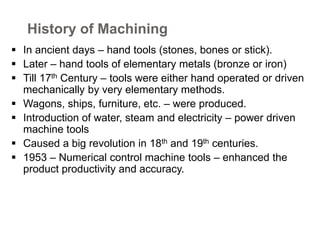
History of Machining
2
 In ancient days – hand tools (stones, bones or stick).
 Later – hand tools of elementary metals (bronze or iron)
 Till 17th Century – tools were either hand operated or driven
mechanically by very elementary methods.
 Wagons, ships, furniture, etc. – were produced.
 Introduction of water, steam and electricity – power driven
machine tools
 Caused a big revolution in 18th and 19th centuries.
 1953 – Numerical control machine tools – enhanced the
product productivity and accuracy.
DEMERITS OF CONVENTIONAL
MACHINING PROCESSES
3
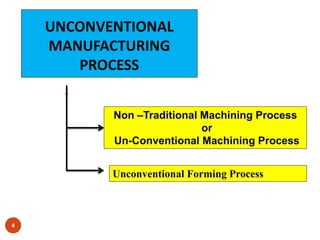
UNCONVENTIONAL
MANUFACTURING
PROCESS
4
Non –Traditional Machining Process
or
Un-Conventional Machining Process
Unconventional Forming Process
UNCONVENTIONAL MACHINING
PROCESS
5
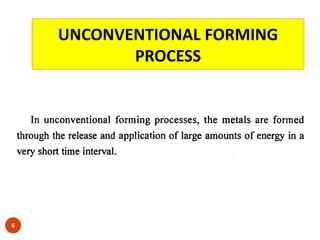
UNCONVENTIONAL FORMING
PROCESS
6
Traditional or Conventional Machining
7
Metal Cutting Processes
8
Abrasive Machining
9
Cylindrical grinding
Flat surface grinding
Abrasive Machining
10
Centreless grinding
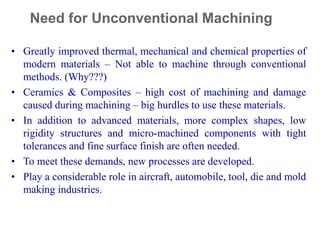
Need for Unconventional Machining
11
• Greatly improved thermal, mechanical and chemical properties of
modern materials – Not able to machine through conventional
methods. (Why???)
• Ceramics & Composites – high cost of machining and damage
caused during machining – big hurdles to use these materials.
• In addition to advanced materials, more complex shapes, low
rigidity structures and micro-machined components with tight
tolerances and fine surface finish are often needed.
• To meet these demands, new processes are developed.
• Play a considerable role in aircraft, automobile, tool, die and mold
making industries.
Need for Unconventional Machining
12
• Very high hardness and strength of the material. (above 400 HB.)
• The work piece is too flexible or slender to support the cutting or
grinding forces.
• The shape of the part is complex, such as internal and external
profiles, or small diameter holes.
• Surface finish or tolerance better than those obtainable
conventional process.
• Temperature rise or residual stress in the work piece are
undesirable.
13
Unconventional Machining Processes -
Classification
Electrical
Mechanical Based Processes
14
AJM - Abrasive Jet Machining
WJM – Water Jet Machining
AWJM – Abrasive Water Jet Machining
USM – Ultrasonic Machining
15
Electrical Based Processes
Electrical
EDM - Electrical Discharge Machining
WEDM - Wire Cut Electrical Discharge Machining
16
Chemical & Electrochemical Based Processes
ECM - Electro –Chemical Machining
ECD - Electro Chemical Deburring
ECG – Electro –Chemical Grinding
ECH – Electro – Chemical Honing
17
Thermal Based Processes
LBM - Laser Beam Machining
PAM – Plasma Arc Machining
EBM - Electron Beam Machining
Mechanical based Unconventional Processes
18
USM – thru mechanical abrasion in a
medium (solid abrasive particles
suspended in the fluid)
WJM – Cutting by a jet of fluid
AWJM – Abrasives in fluid jet.
IJM – Ice particles in fluid jet.
Abrasives or ice – Enhances
cutting action.
CLASSIFICATION
CLASSIFICATION
20
CLASSIFICATION
21
CLASSIFICATION
22
THERMAL ENERGY METHODS
23
Thermal based Unconventional Processes
24
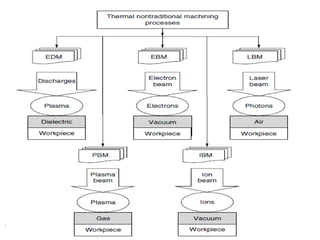
Thru – melting & vaporizing
Heat Source:
Plasma – EDM and PBM.
Photons – LBM
Electrons – EBM
Ions – IBM
Machining medium:
different for different processes.
.
25
ELECTRO CHEMICAL ENERGY METHODS
26
CHEMICAL ENERGY METHODS
These methods involve controlled etching of the work
piece material in contact with a chemical solution
Chemical & Electrochemical
based Unconventional Processes
27
CHM – uses Chemical
dissolution action in
an etchant.
ECM – uses Electrochemical
dissolution action in
an electrolytic cell.
MATERIAL – METHOD OF MACHINING
28
PROCESS SELECTION
29
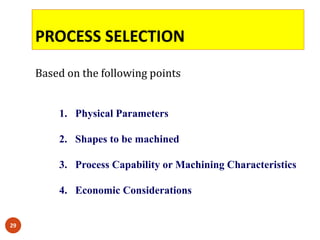
Based on the following points
1. Physical Parameters
2. Shapes to be machined
3. Process Capability or Machining Characteristics
4. Economic Considerations
Physical Parameters
30
Shapes to be
machined
31
.
32
Process Capability
or
Machining Characteristics
1. Material Removal rate
2. Tolerance Maintained
3. Surface Finish
4. Depth of surface Damage
5. Power required for
machining
33
Process Economy
MRR – Material Removal Rate
34
Tolerance
35
. Engineering tolerance is the permissible limit or limits
of variation in manufacturing
Surface Roughness / Finish
36
. Surface texture is one of the important factors that
control friction and transfer layer formation during
sliding.
Parts from EDM process
37
Wire EDM Process
38
Parts from ECM process
39
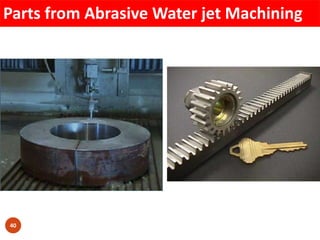
Parts from Abrasive Water jet Machining
40
Parts from LASER Beam Machining
41
LIMITATIONS OF Un Conventional Machining
42
1. More expensive process
2. Low Material Removal Rate (MRR)
3. AJM, CHM , PAM and EBM are not commercially
economical Process
ADVANTAGES of UCM
43
 High Accuracy and surface finish in process
 Less Rejected pieces
 Increase productivity
 Tool material need not be harder than work piece material.
 Easy to machine harder and brittle materials
 There is no residual stresses in the machined material

I unit -_introduction_to_unconventional_machining_processes