SAURABH NEGI
2061443 (02)
mechanical ENGG. V SEM
CONTINUOUS
CASTING
SUBMITTED TO: SUBMITTED BY:
CONTINUOUS CASTING
Continuous casting, also referred to as strand casting, is a process used in
manufacturing industry to cast a continuous length of metal
Molten metal is cast through a mold, the casting takes the two dimensional
profile of the mold but its length is indeterminate.
The casting will keep traveling downward, its length increasing with time.
New molten metal is constantly supplied to the mold, at exactly the correct rate,
to keep up with the solidifying casting.
Industrial manufacture of continuous castings is a very precisely calculated
operation.
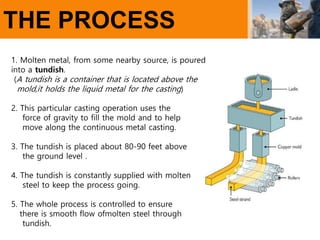
1. Molten metal, from some nearby source, is poured
into a tundish.
(A tundish is a container that is located above the
mold,it holds the liquid metal for the casting)
2. This particular casting operation uses the
force of gravity to fill the mold and to help
move along the continuous metal casting.
3. The tundish is placed about 80-90 feet above
the ground level .
4. The tundish is constantly supplied with molten
steel to keep the process going.
5. The whole process is controlled to ensure
there is smooth flow ofmolten steel through
tundish.
THE PROCESS
CONT.
6. Further, the impurities and slag are filtered
in tundish before they move into the mold.
7. The entrance of the mold is filled with inert
gases to prevent reaction of molten steel with
the gases in the environment like oxygen.
8. The molten metal moves swiftly through the
mold and it does not completely solidify in it.
9. The entire mold is cooled with water that fl
ows along the outer surface.
CONT.
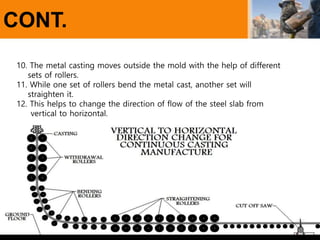
10. The metal casting moves outside the mold with the help of different
sets of rollers.
11. While one set of rollers bend the metal cast, another set will
straighten it.
12. This helps to change the direction of flow of the steel slab from
vertical to horizontal.
ADVANTAGES OF CONTINUOUS
CASTING
(i) The process is cheaper than rolling.
(ii) 100% casting yield.
(iii) The process can be easily mechanized and thus unit labor cost is less.
(iv) Casting surfaces are better.
(v) Grain size and structure of the casting can be easily controlled.
(vi)High roduction rates.
DISADVANTAGES
1.Continous and capable cooling of mould is required.
2.Just simple shapes can be cast.
3.Last capital investment is necessary to set up process.
4.Not proper for small scale production.
5.Require large ground space.
APPLICATION OF CONTINUOUS
CASTING
1. A great tonnage of continuous casting is done using cast steel.
2. Other metals that are continuous casting are copper, aluminum, grey cast iron
s, white cast irons, aluminum bronzes, oxygen-free copper, etc.
3. Metals are cast as ingot for rolling, extrusion, or forging, and long shapes of
simple cross section are cast as round, square, hexagonal rods, etc.
Continuous casting

Continuous casting

  • 1.
    SAURABH NEGI 2061443 (02) mechanicalENGG. V SEM CONTINUOUS CASTING SUBMITTED TO: SUBMITTED BY:
  • 2.
    CONTINUOUS CASTING Continuous casting,also referred to as strand casting, is a process used in manufacturing industry to cast a continuous length of metal Molten metal is cast through a mold, the casting takes the two dimensional profile of the mold but its length is indeterminate. The casting will keep traveling downward, its length increasing with time. New molten metal is constantly supplied to the mold, at exactly the correct rate, to keep up with the solidifying casting. Industrial manufacture of continuous castings is a very precisely calculated operation.
  • 3.
    1. Molten metal,from some nearby source, is poured into a tundish. (A tundish is a container that is located above the mold,it holds the liquid metal for the casting) 2. This particular casting operation uses the force of gravity to fill the mold and to help move along the continuous metal casting. 3. The tundish is placed about 80-90 feet above the ground level . 4. The tundish is constantly supplied with molten steel to keep the process going. 5. The whole process is controlled to ensure there is smooth flow ofmolten steel through tundish. THE PROCESS
  • 4.
    CONT. 6. Further, theimpurities and slag are filtered in tundish before they move into the mold. 7. The entrance of the mold is filled with inert gases to prevent reaction of molten steel with the gases in the environment like oxygen. 8. The molten metal moves swiftly through the mold and it does not completely solidify in it. 9. The entire mold is cooled with water that fl ows along the outer surface.
  • 5.
    CONT. 10. The metalcasting moves outside the mold with the help of different sets of rollers. 11. While one set of rollers bend the metal cast, another set will straighten it. 12. This helps to change the direction of flow of the steel slab from vertical to horizontal.
  • 6.
    ADVANTAGES OF CONTINUOUS CASTING (i)The process is cheaper than rolling. (ii) 100% casting yield. (iii) The process can be easily mechanized and thus unit labor cost is less. (iv) Casting surfaces are better. (v) Grain size and structure of the casting can be easily controlled. (vi)High roduction rates.
  • 7.
    DISADVANTAGES 1.Continous and capablecooling of mould is required. 2.Just simple shapes can be cast. 3.Last capital investment is necessary to set up process. 4.Not proper for small scale production. 5.Require large ground space.
  • 8.
    APPLICATION OF CONTINUOUS CASTING 1.A great tonnage of continuous casting is done using cast steel. 2. Other metals that are continuous casting are copper, aluminum, grey cast iron s, white cast irons, aluminum bronzes, oxygen-free copper, etc. 3. Metals are cast as ingot for rolling, extrusion, or forging, and long shapes of simple cross section are cast as round, square, hexagonal rods, etc.