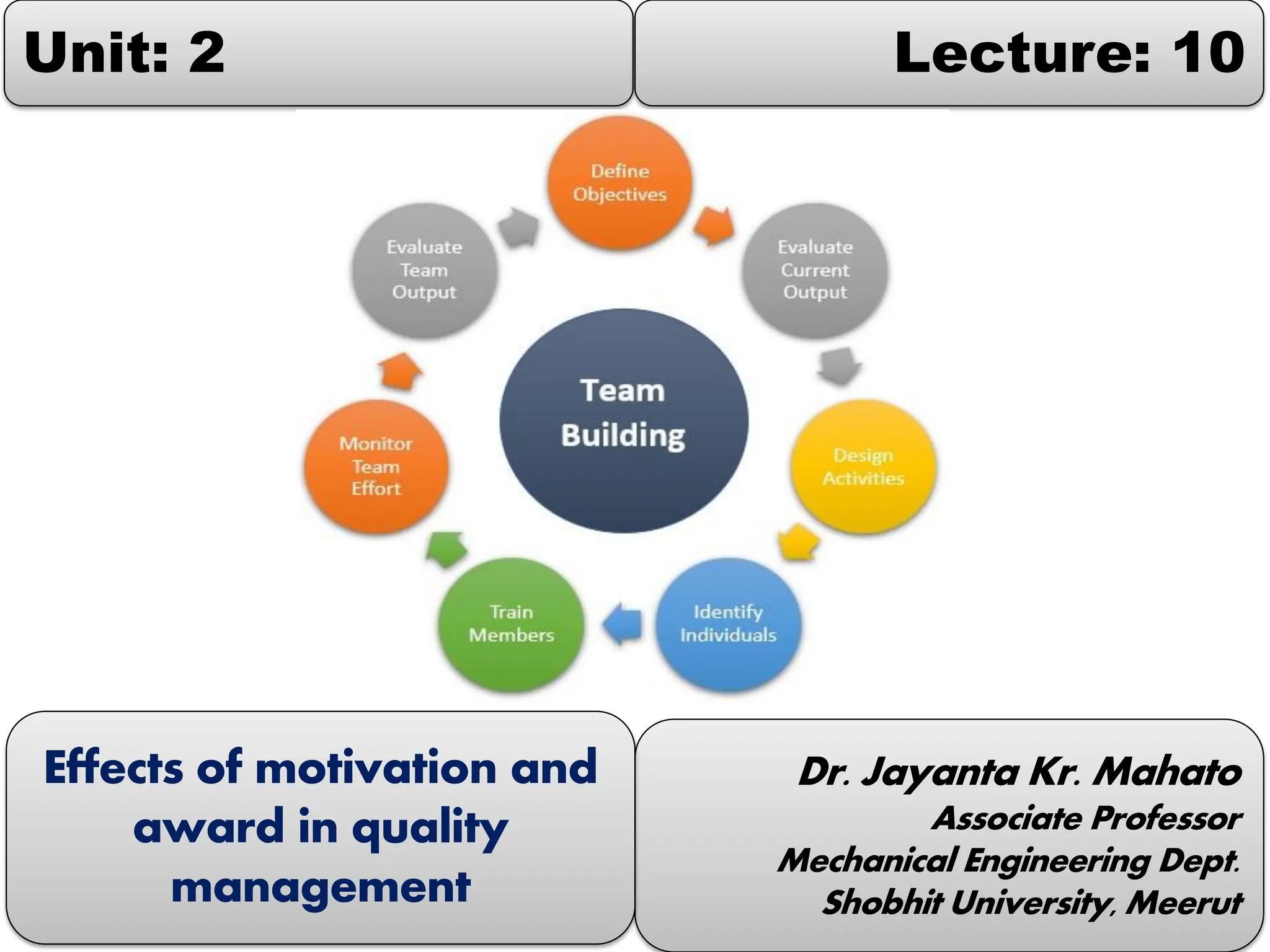
Unit: 2 Lecture: 10
Dr. Jayanta Kr. Mahato
Associate Professor
Mechanical Engineering Dept.
Shobhit University, Meerut
Effects of motivation and
award in quality
management
TABLE OF CONTENTS
 Motivation
Organization reward systems
Financial reward system
Different studies and researches toward financial
reward systems
Non financial reward system
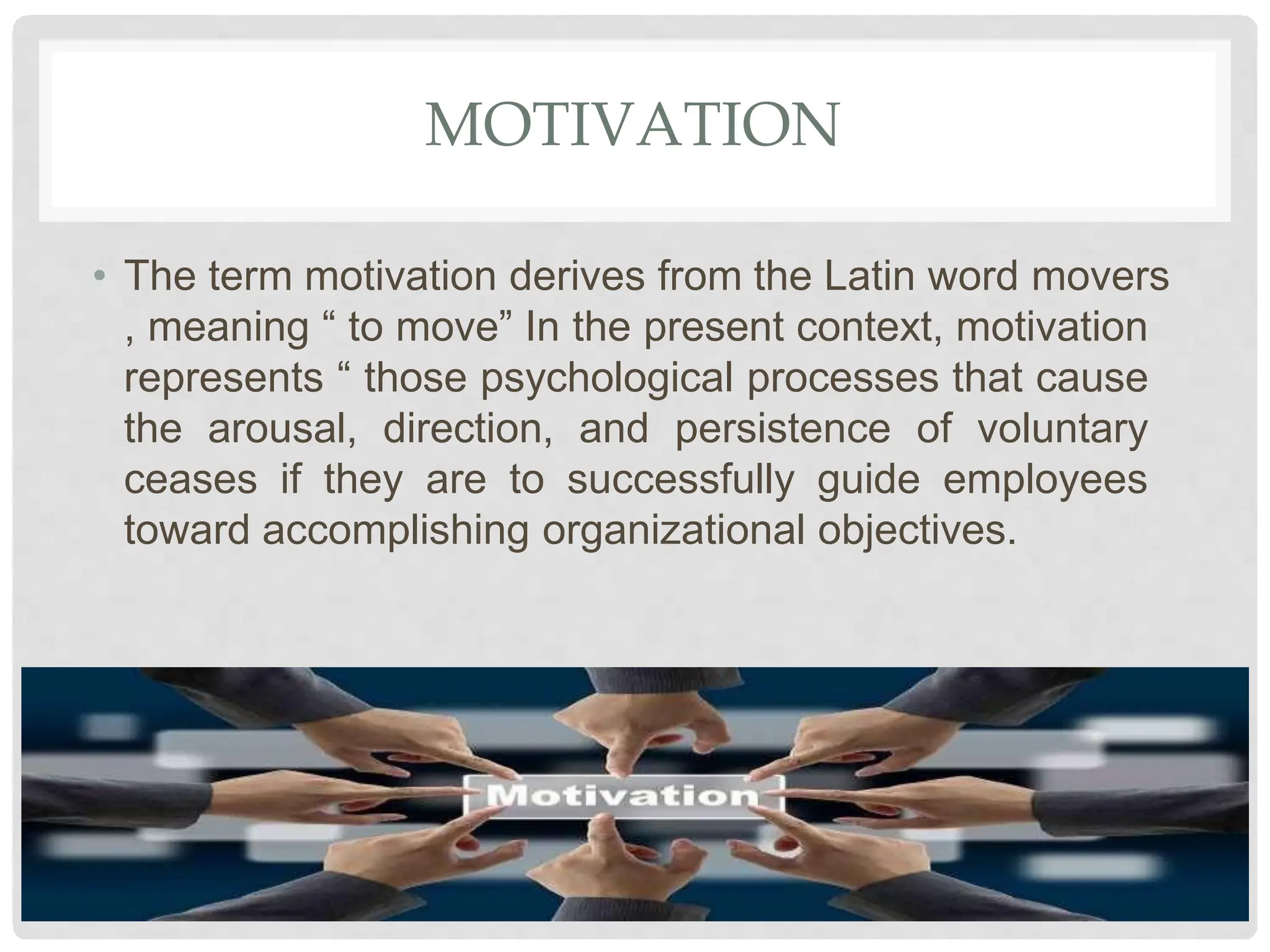
MOTIVATION
• The term motivation derives from the Latin word movers
, meaning “ to move” In the present context, motivation
represents “ those psychological processes that cause
the arousal, direction, and persistence of voluntary
ceases if they are to successfully guide employees
toward accomplishing organizational objectives.
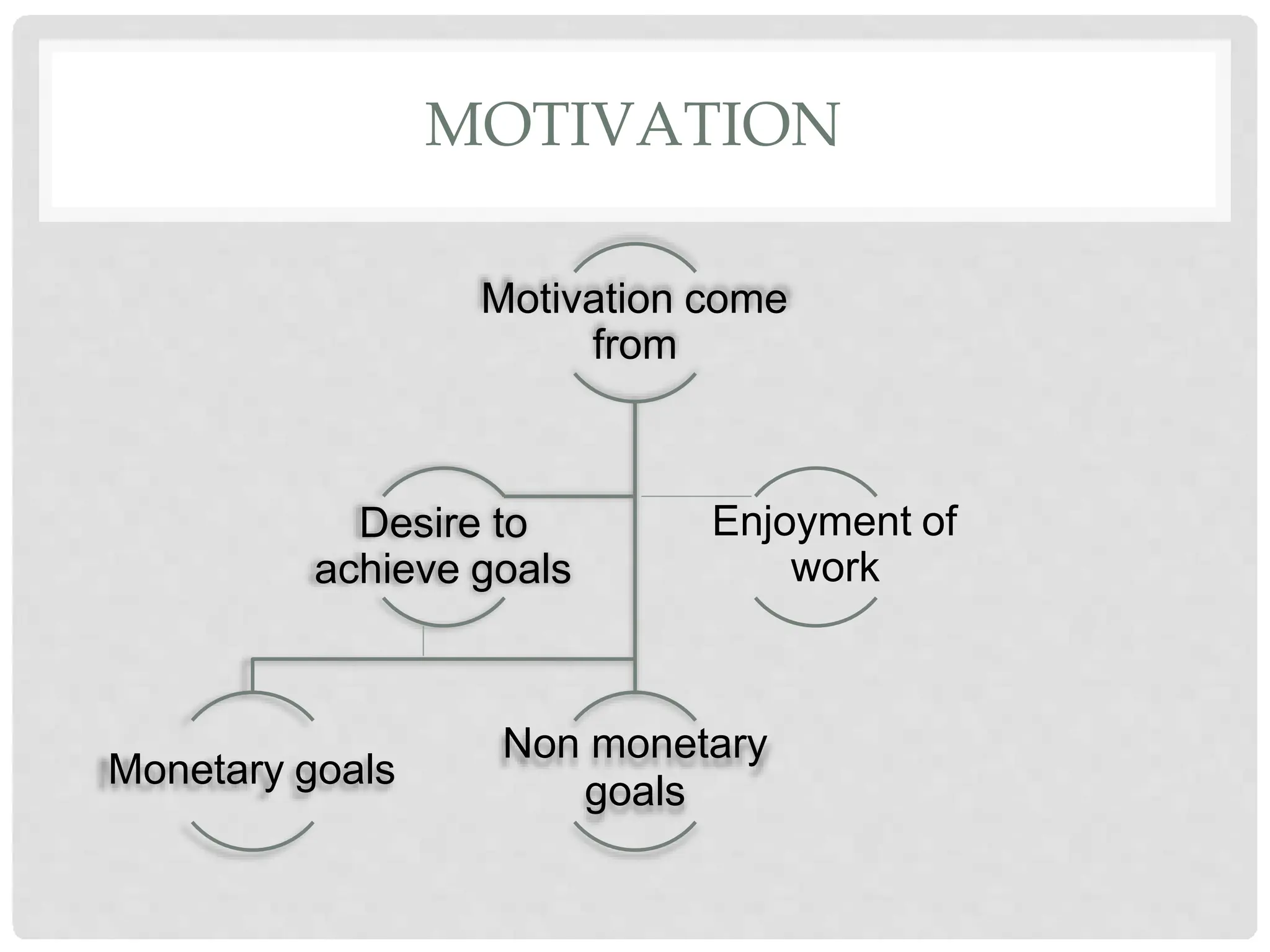
MOTIVATION
Motivation come
from
Monetary goals
Non monetary
goals
Desire to
achieve goals
Enjoyment of
work
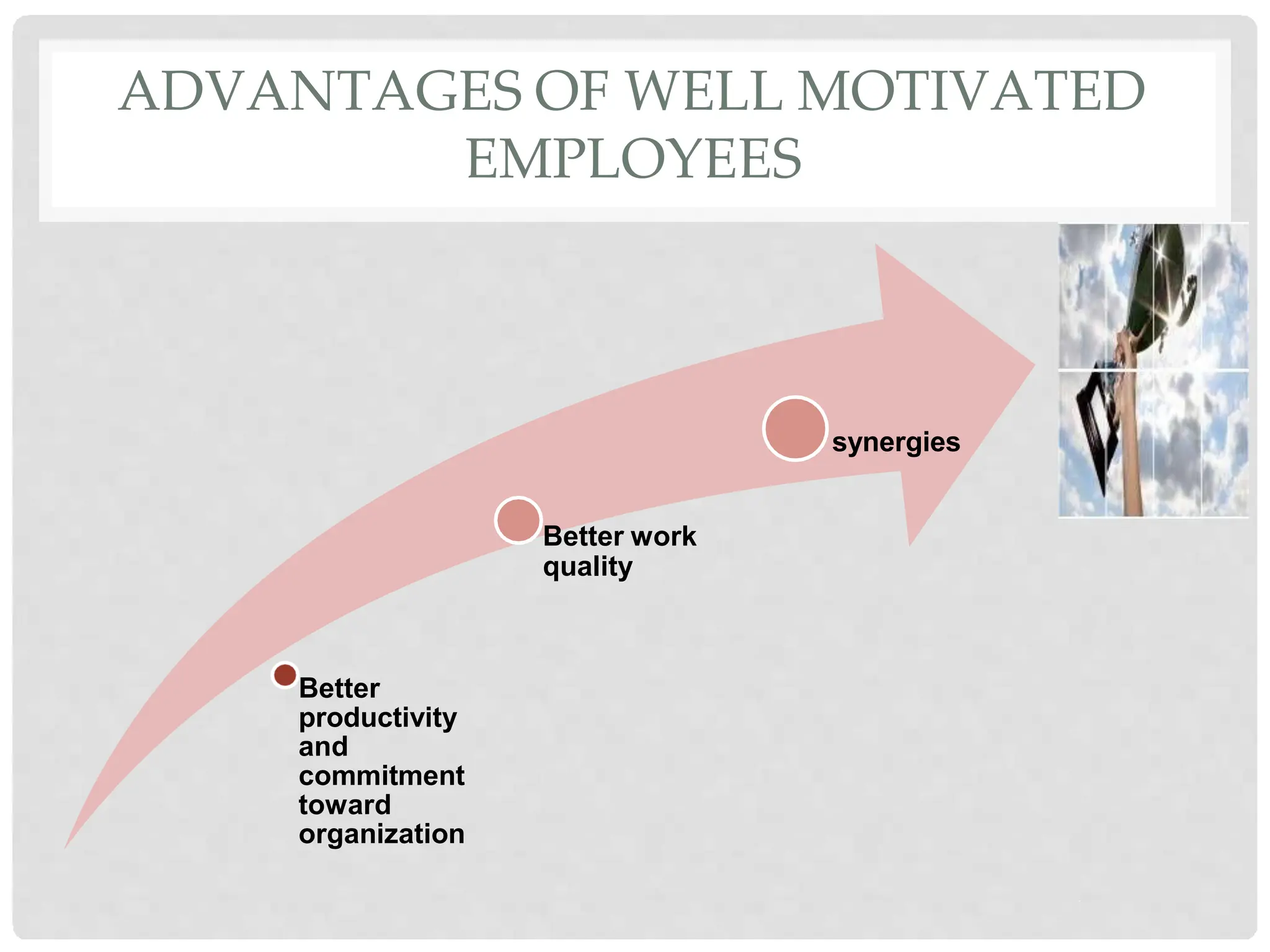
ADVANTAGES OF WELL MOTIVATED
EMPLOYEES
Better
productivity
and
commitment
toward
organization
synergies
Better work
quality
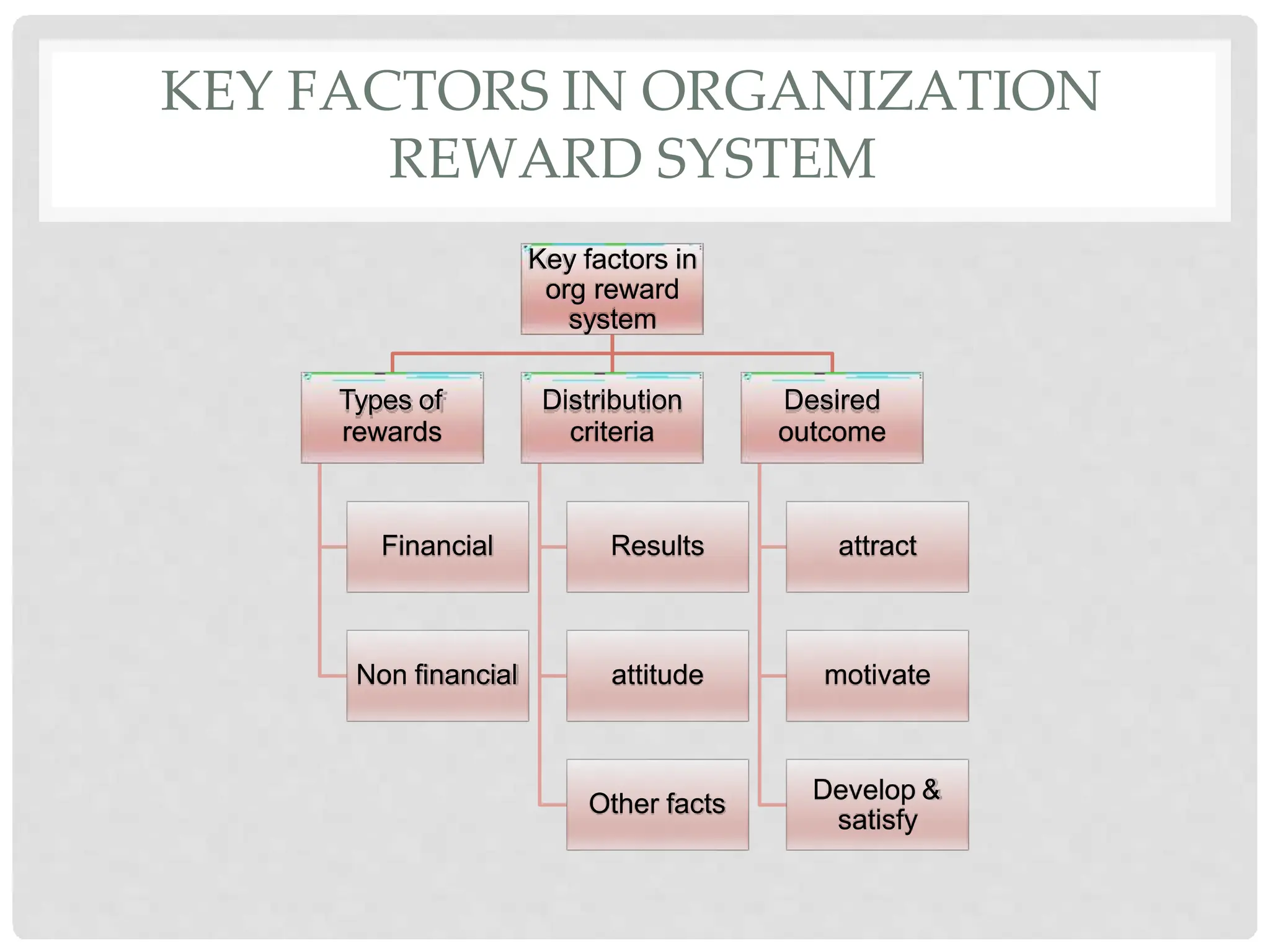
KEY FACTORS IN ORGANIZATION
REWARD SYSTEM
Key factors in
org reward
system
Types of
rewards
Financial
Non financial
Distribution
criteria
Results
attitude
Other facts
Desired
outcome
attract
motivate
Develop &
satisfy
FINANCIAL REWARDS
• Monetary incentives that an employee earns as a result
of good performance. These rewards are aligned with
organizational goals. When an employee helps an
organization in the achievement of its goals .
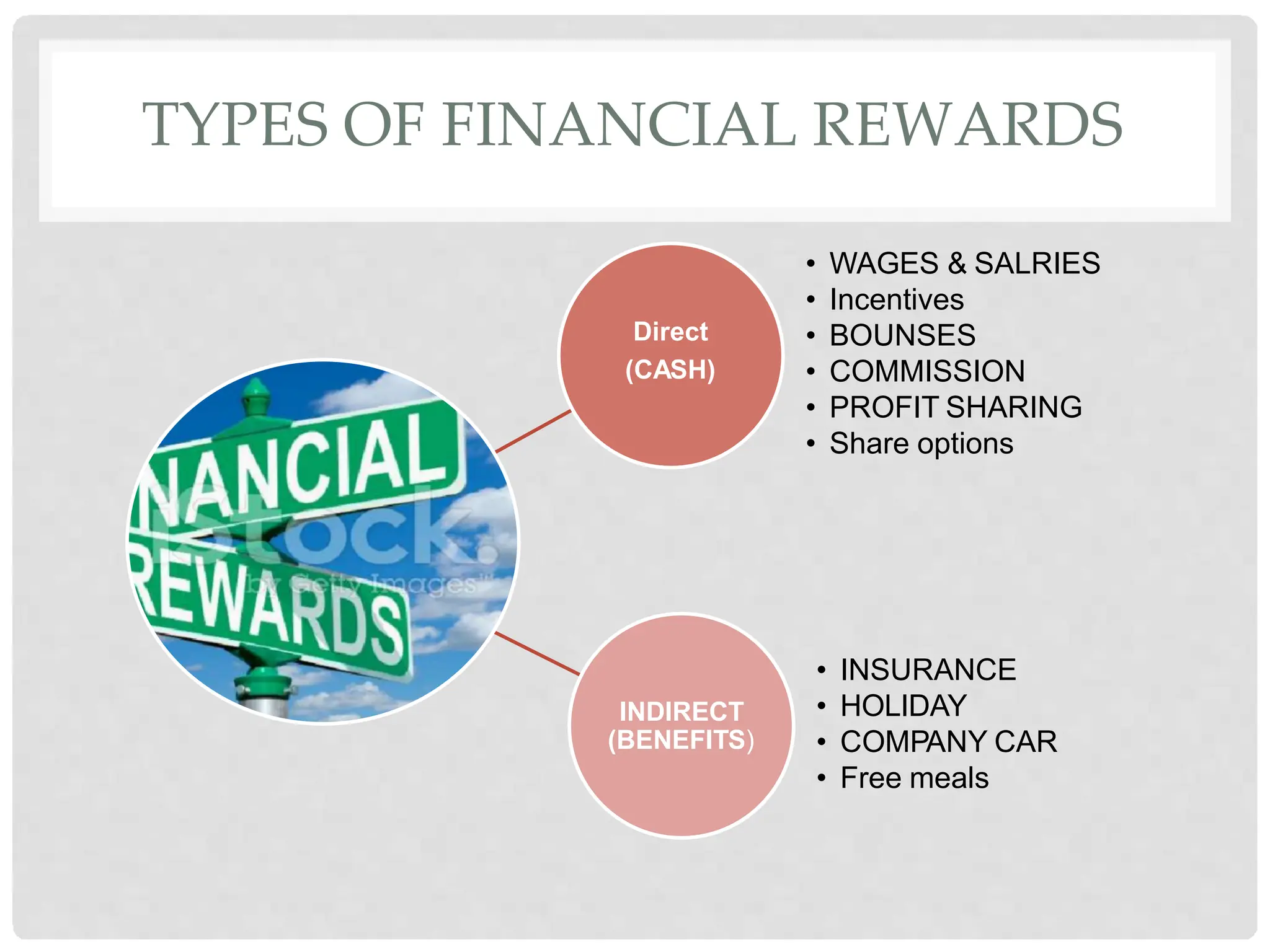
TYPES OF FINANCIAL REWARDS
Direct
(CASH)
• WAGES & SALRIES
• Incentives
• BOUNSES
• COMMISSION
• PROFIT SHARING
• Share options
INDIRECT
(BENEFITS)
• INSURANCE
• HOLIDAY
• COMPANY CAR
• Free meals
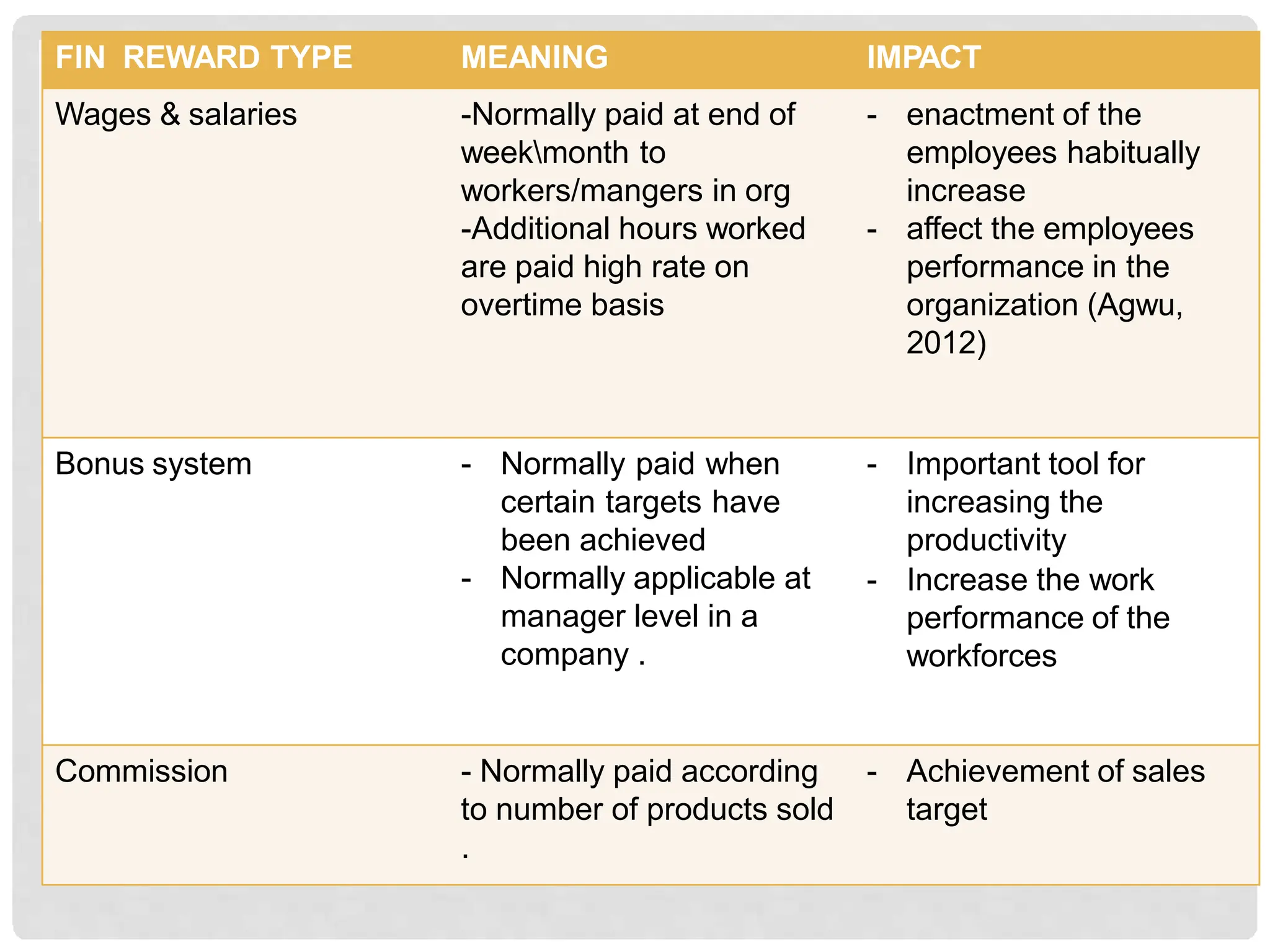
FIN REWARD TYPE MEANING IMPACT
Wages & salaries -Normally paid at end of
weekmonth to
workers/mangers in org
-Additional hours worked
are paid high rate on
overtime basis
- enactment of the
employees habitually
increase
- affect the employees
performance in the
organization (Agwu,
2012)
Bonus system - Normally paid when
certain targets have
been achieved
- Normally applicable at
manager level in a
company .
- Important tool for
increasing the
productivity
- Increase the work
performance of the
workforces
Commission - Normally paid according
to number of products sold
.
- Achievement of sales
target
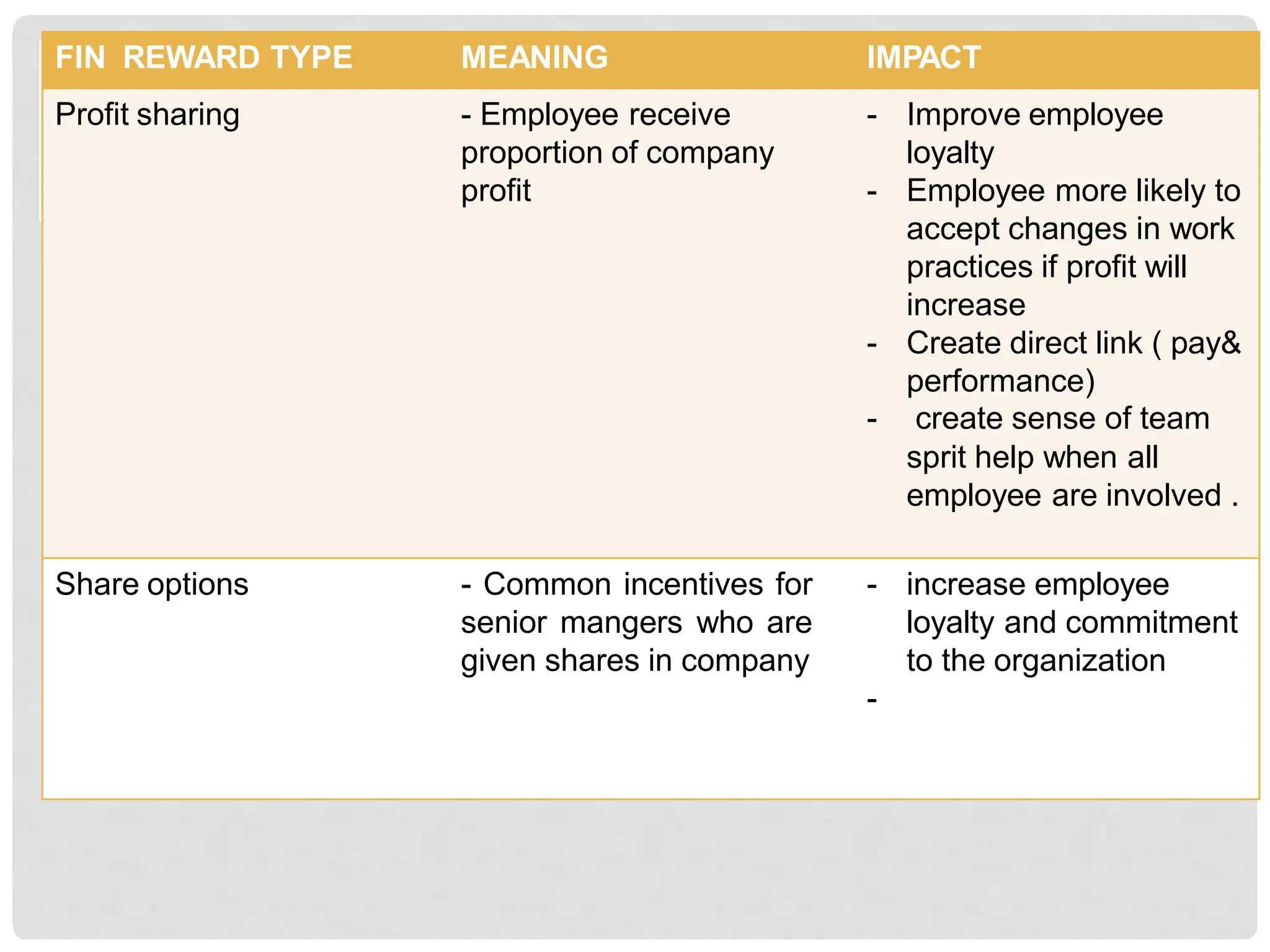
FIN REWARD TYPE MEANING IMPACT
Profit sharing - Employee receive
proportion of company
profit
- Improve employee
loyalty
- Employee more likely to
accept changes in work
practices if profit will
increase
- Create direct link ( pay&
performance)
- create sense of team
sprit help when all
employee are involved .
Share options - Common incentives for
senior mangers who are
given shares in company
- increase employee
loyalty and commitment
to the organization
-
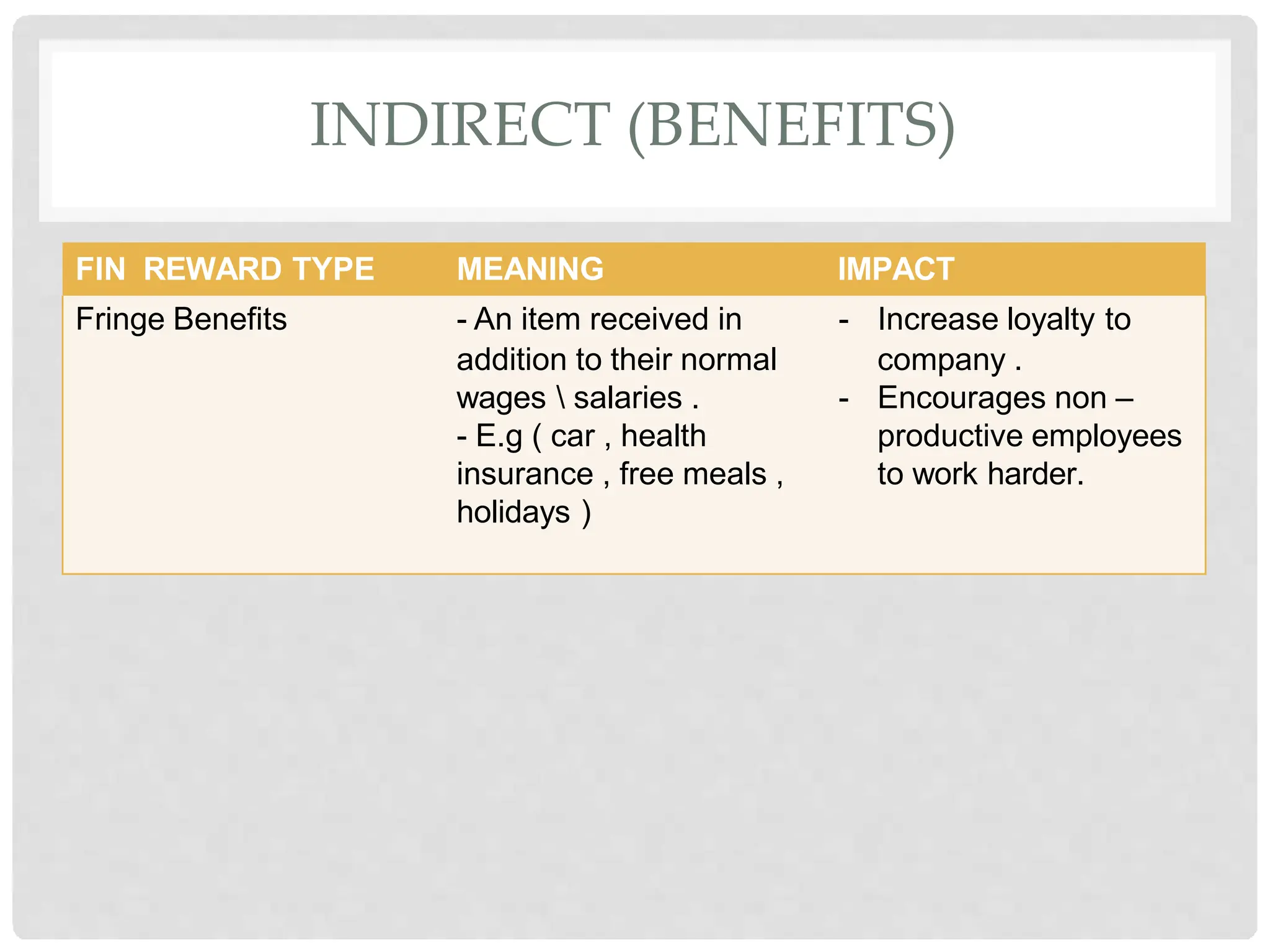
INDIRECT (BENEFITS)
FIN REWARD TYPE MEANING IMPACT
Fringe Benefits - An item received in - Increase loyalty to
addition to their normal company .
wages  salaries . - Encourages non –
- E.g ( car , health productive employees
insurance , free meals , to work harder.
holidays )
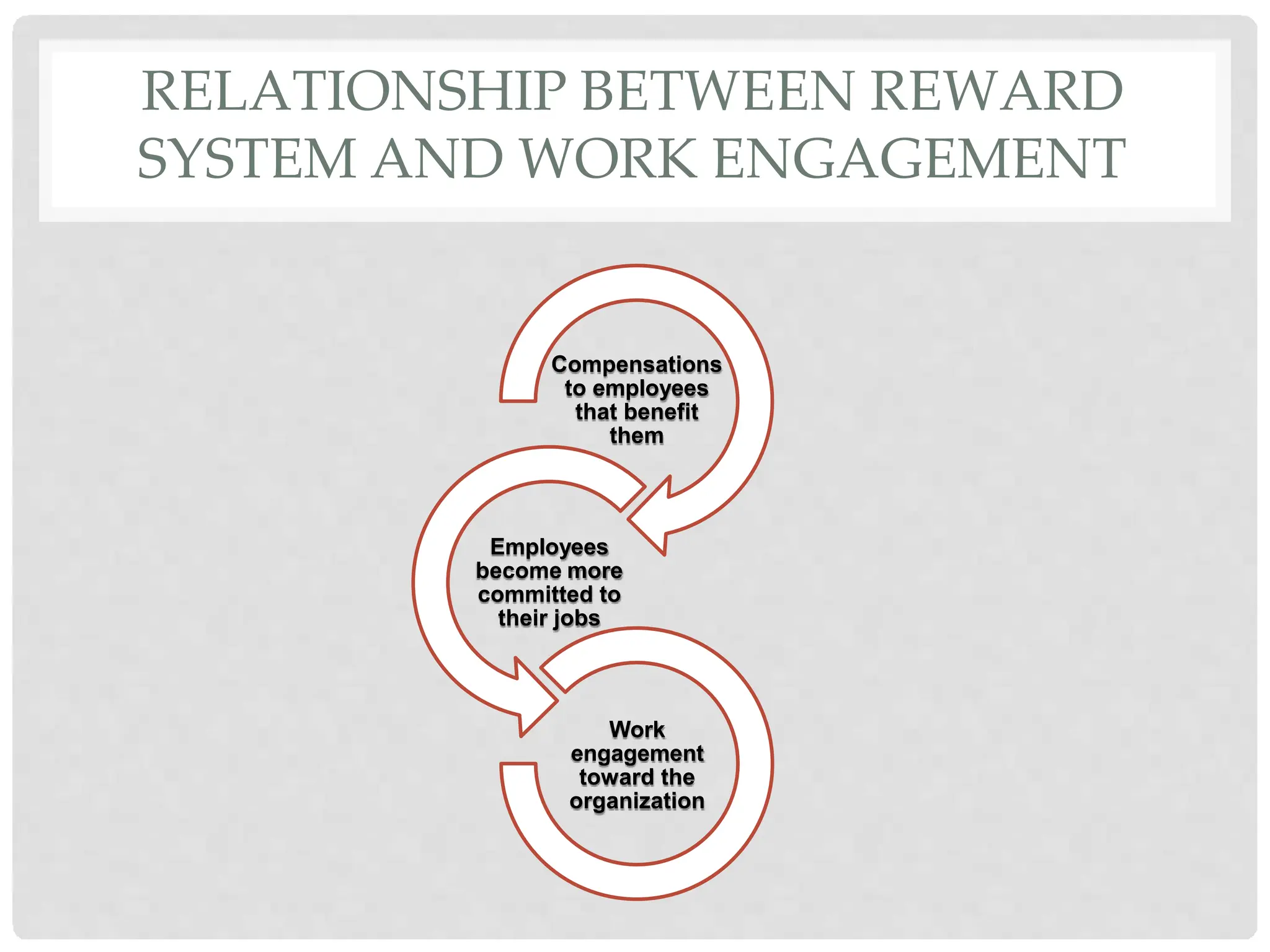
RELATIONSHIP BETWEEN REWARD
SYSTEM AND WORK ENGAGEMENT
Compensations
to employees
that benefit
them
Employees
become more
committed to
their jobs
Work
engagement
toward the
organization
AGE RELATED DIFFERENCES IN
REWARD PREFERENCES
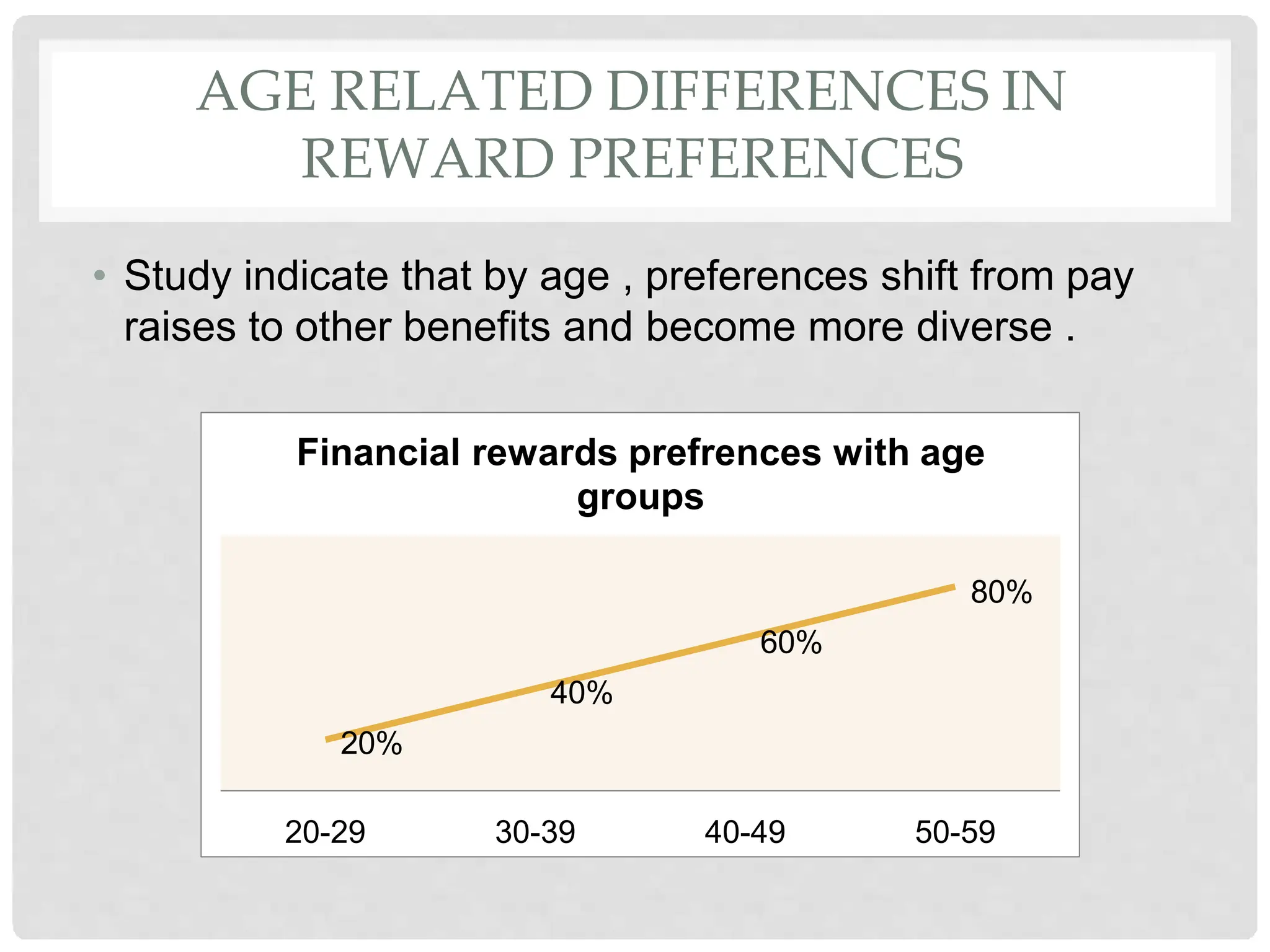
• Study indicate that by age , preferences shift from pay
raises to other benefits and become more diverse .
Financial rewards prefrences with age
groups
80%
60%
40%
20%
20-29 30-39 40-49 50-59
NON FINANCIAL REWARDS
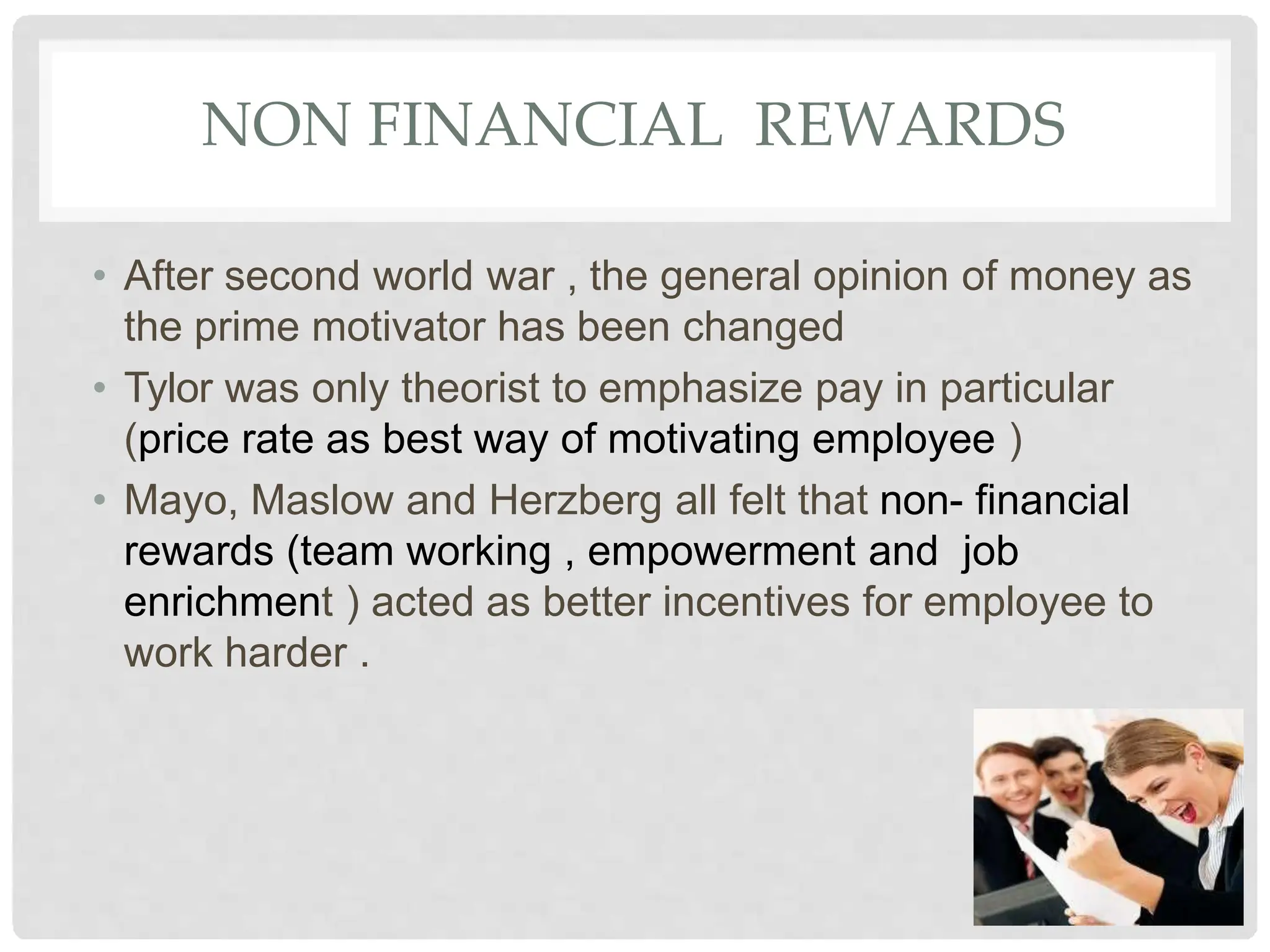
• After second world war , the general opinion of money as
the prime motivator has been changed
• Tylor was only theorist to emphasize pay in particular
(price rate as best way of motivating employee )
• Mayo, Maslow and Herzberg all felt that non- financial
rewards (team working , empowerment and job
enrichment ) acted as better incentives for employee to
work harder .
LEADS TO…
• Directs employee behavior towards productivity and
satisfaction.
• Enhance success of organization
• Leads to innovation
• Competence in achieving strategic objectives
• Internal motivation attained through desire to achieve and
perform
WHAT IS NON-FINANCIAL REWARD?
• Passing responsibility or giving non-monetary rewards
• Do not generally mean non-financial value
• Simply the reward is non-monetary
• Tangible experience, promotion, etc.
• Trainings
• Favorable working conditions
• Improved communication
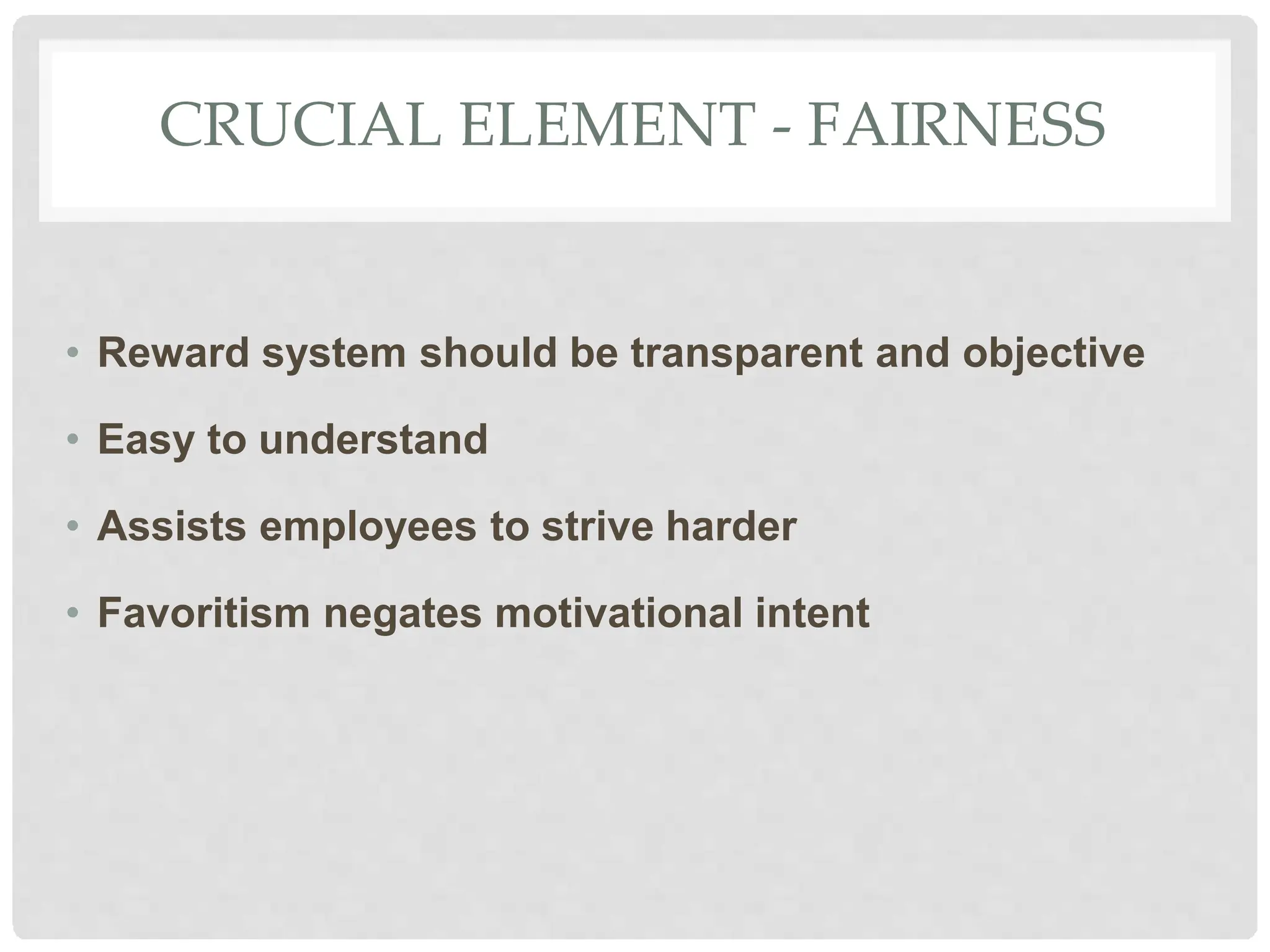
CRUCIAL ELEMENT - FAIRNESS
• Reward system should be transparent and objective
• Easy to understand
• Assists employees to strive harder
• Favoritism negates motivational intent
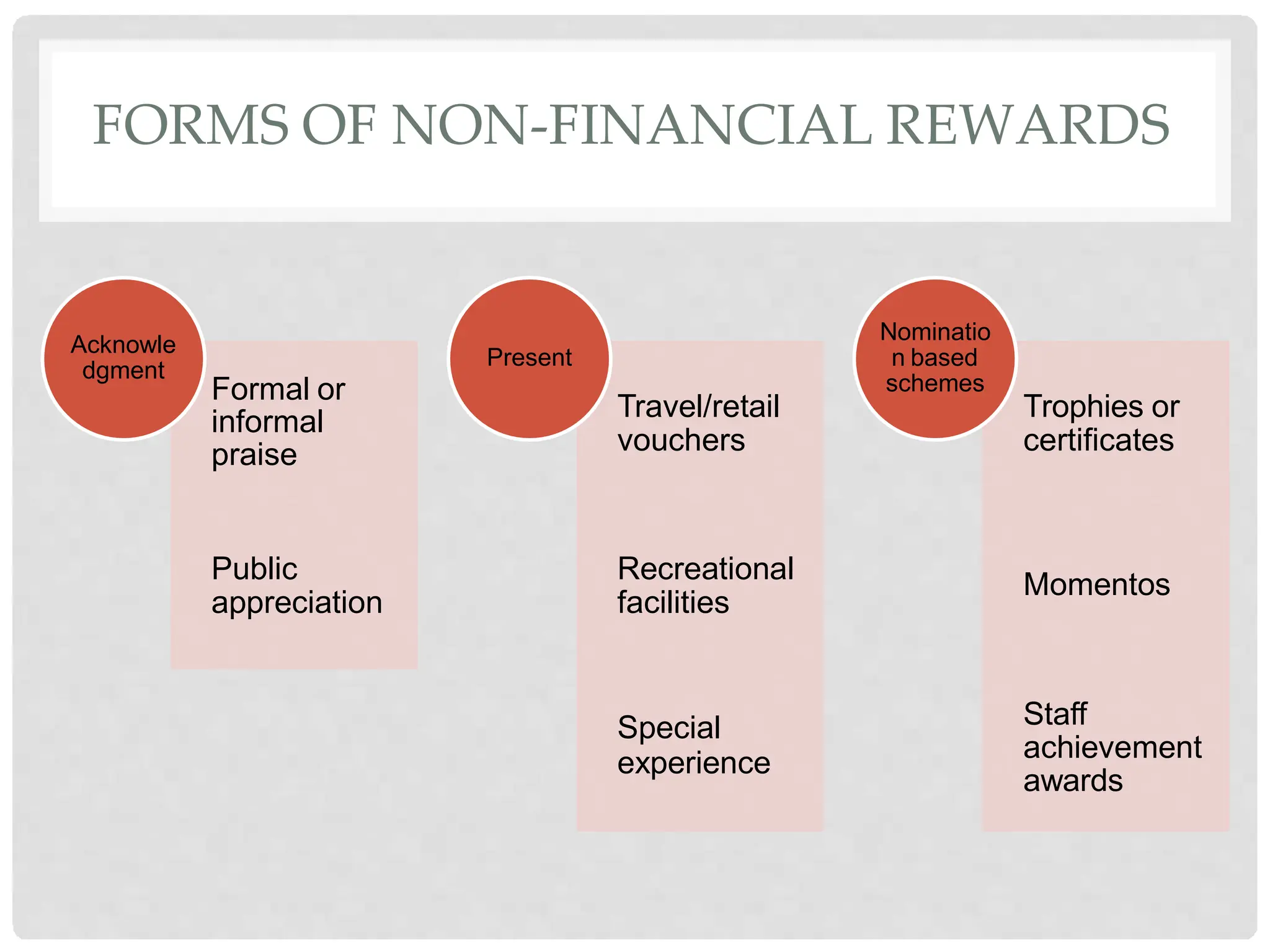
FORMS OF NON-FINANCIAL REWARDS
Formal or
informal
praise
Public
appreciation
Acknowle
dgment
Travel/retail
vouchers
Recreational
facilities
Special
experience
Present
Trophies or
certificates
Momentos
Staff
achievement
awards
Nominatio
n based
schemes
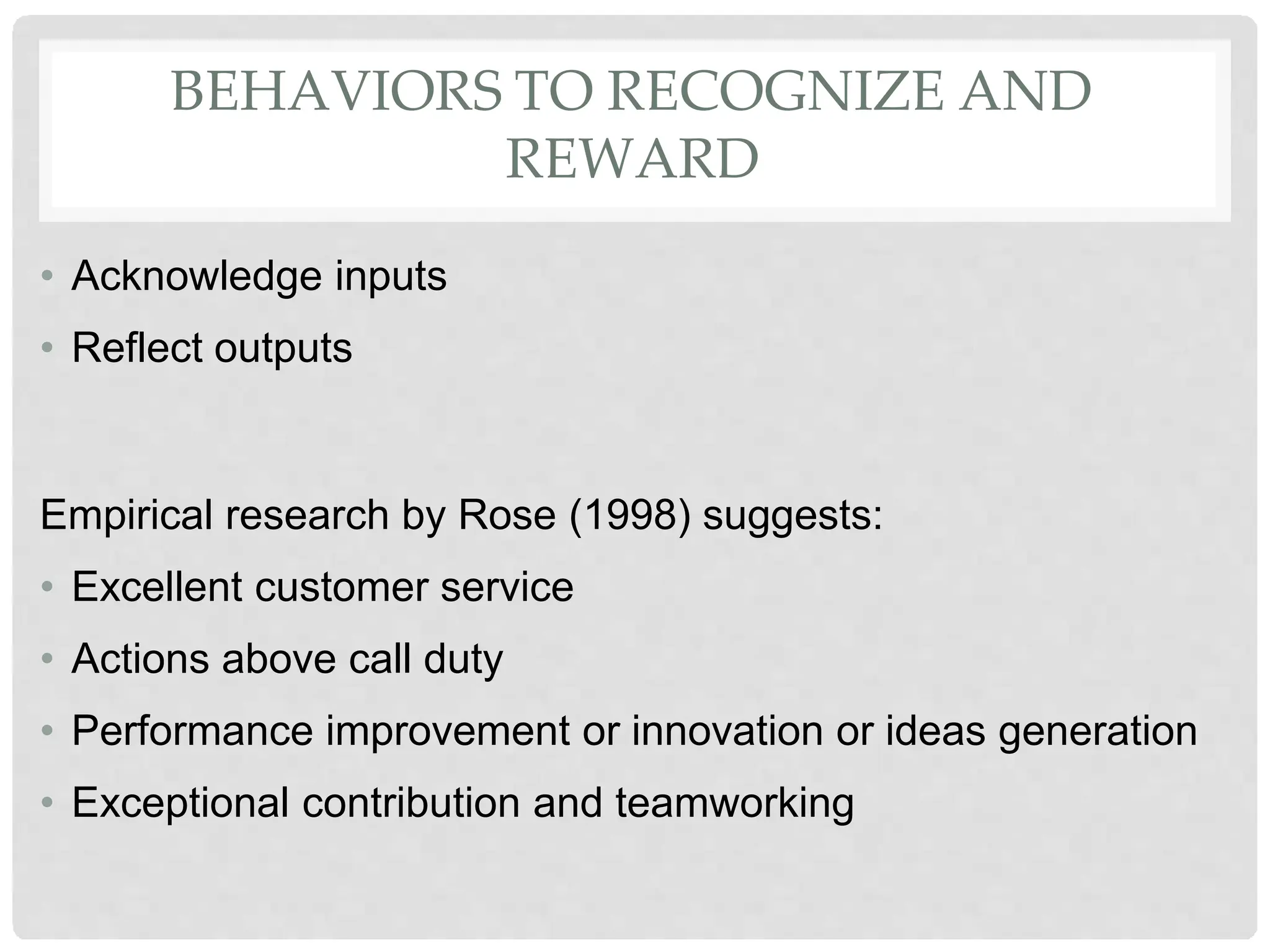
BEHAVIORS TO RECOGNIZE AND
REWARD
• Acknowledge inputs
• Reflect outputs
Empirical research by Rose (1998) suggests:
• Excellent customer service
• Actions above call duty
• Performance improvement or innovation or ideas generation
• Exceptional contribution and teamworking
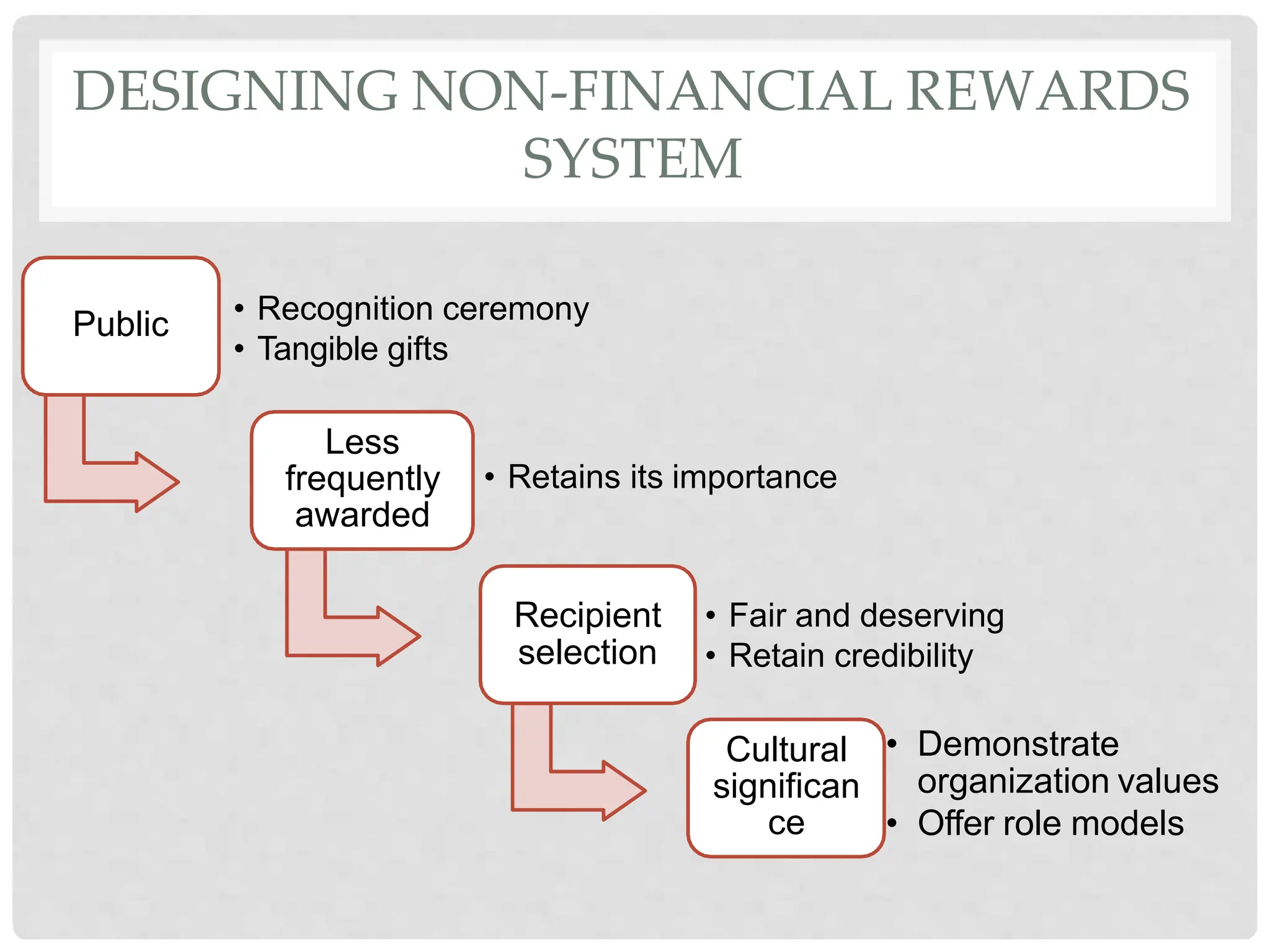
DESIGNING NON-FINANCIAL REWARDS
SYSTEM
Public • Recognition ceremony
• Tangible gifts
Less
frequently
awarded
• Retains its importance
Recipient
selection
• Fair and deserving
• Retain credibility
Cultural
significan
ce
• Demonstrate
organization values
• Offer role models
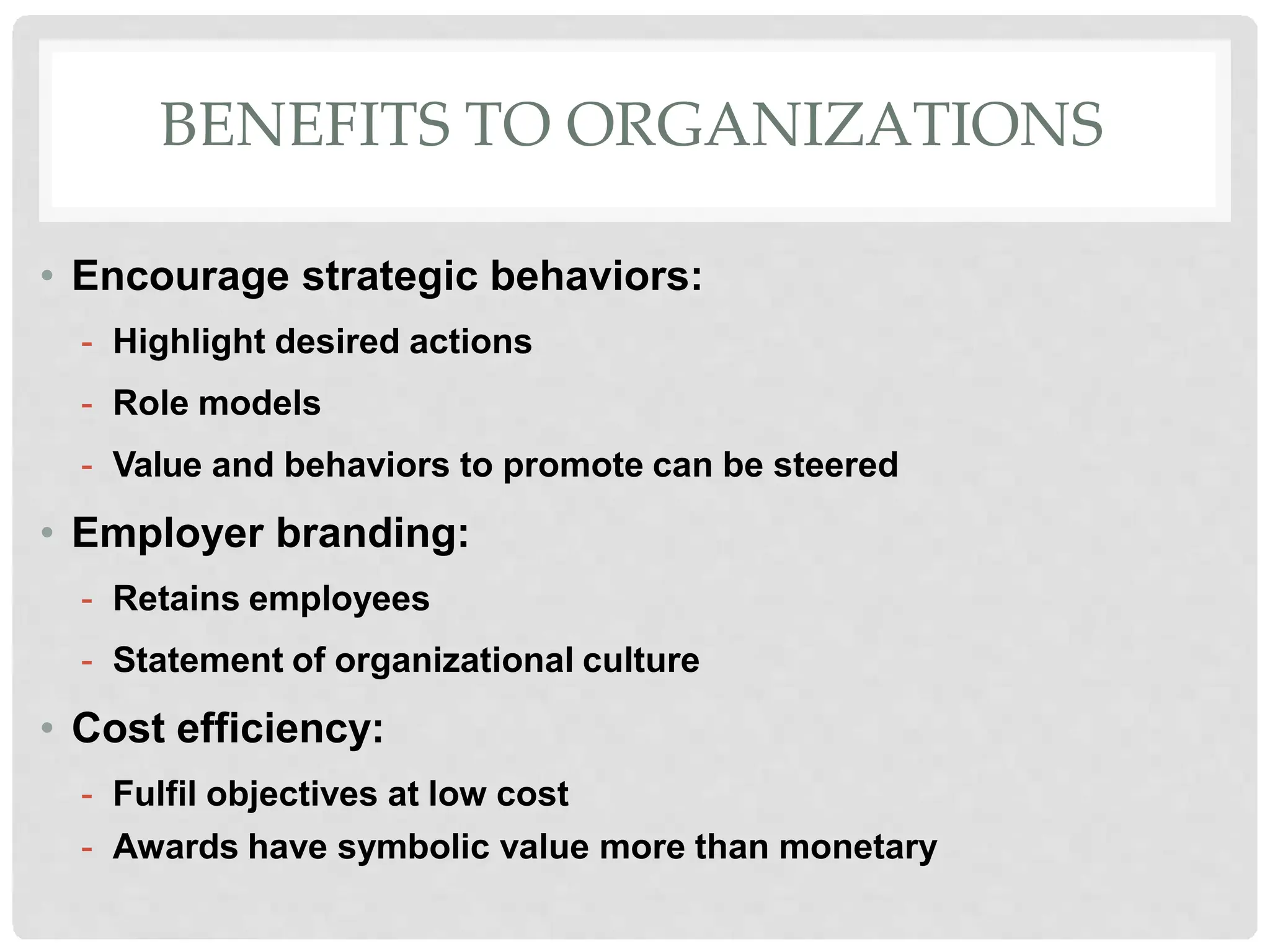
BENEFITS TO ORGANIZATIONS
• Encourage strategic behaviors:
- Highlight desired actions
- Role models
- Value and behaviors to promote can be steered
• Employer branding:
- Retains employees
- Statement of organizational culture
• Cost efficiency:
- Fulfil objectives at low cost
- Awards have symbolic value more than monetary
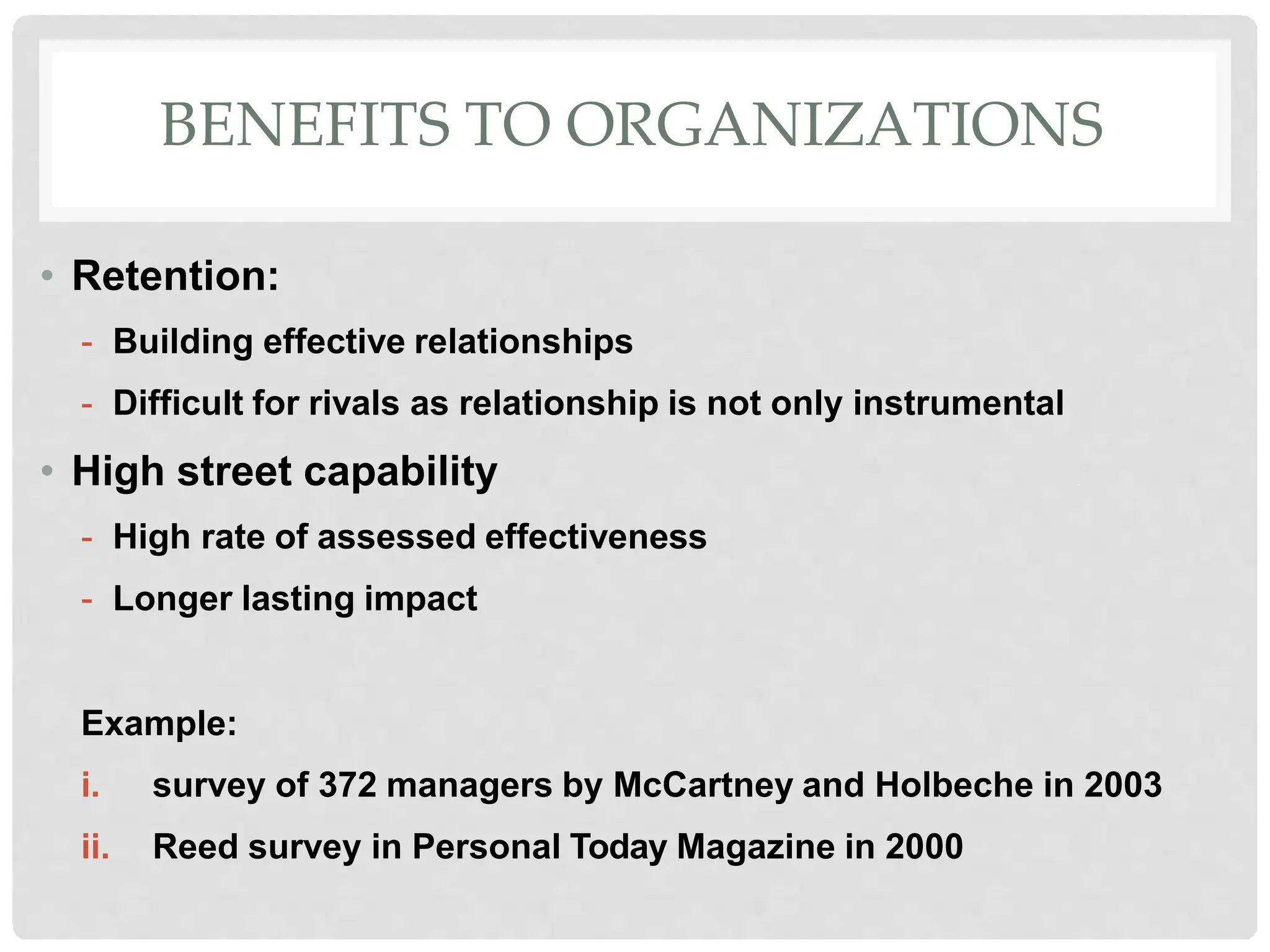
BENEFITS TO ORGANIZATIONS
• Retention:
- Building effective relationships
- Difficult for rivals as relationship is not only instrumental
• High street capability
- High rate of assessed effectiveness
- Longer lasting impact
Example:
i. survey of 372 managers by McCartney and Holbeche in 2003
ii. Reed survey in Personal Today Magazine in 2000
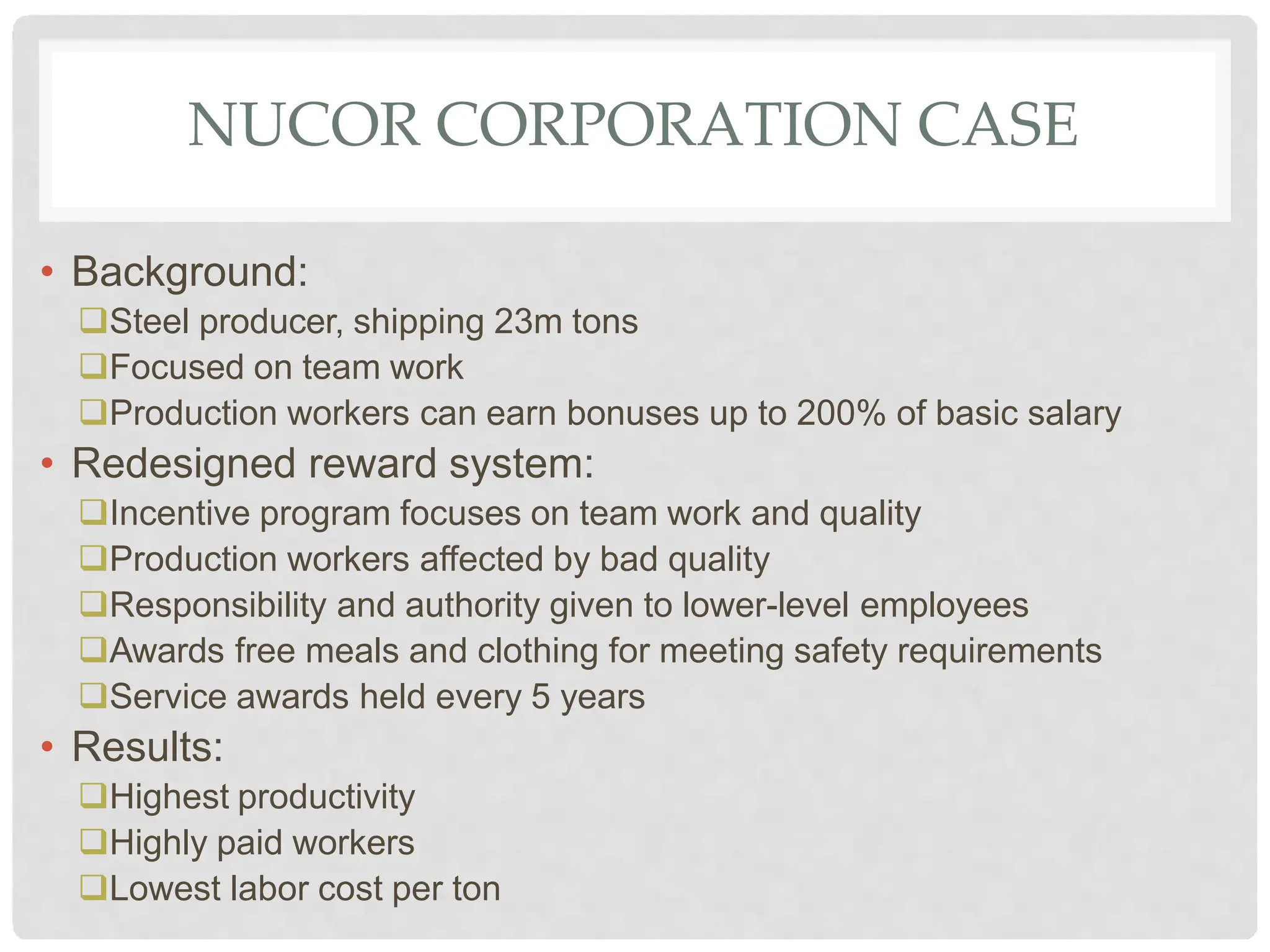
NUCOR CORPORATION CASE
• Background:
Steel producer, shipping 23m tons
Focused on team work
Production workers can earn bonuses up to 200% of basic salary
• Redesigned reward system:
Incentive program focuses on team work and quality
Production workers affected by bad quality
Responsibility and authority given to lower-level employees
Awards free meals and clothing for meeting safety requirements
Service awards held every 5 years
• Results:
Highest productivity
Highly paid workers
Lowest labor cost per ton
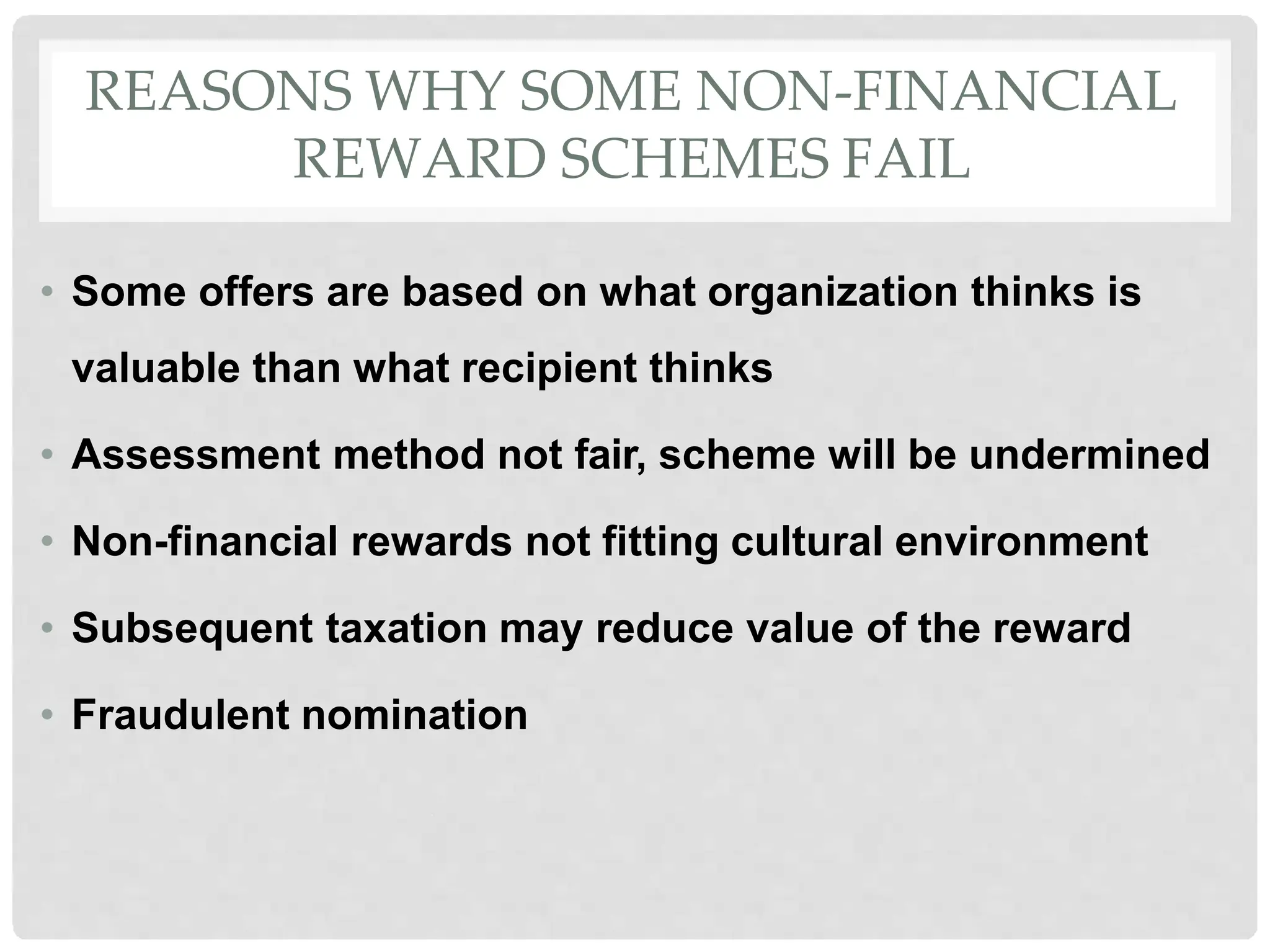
REASONS WHY SOME NON-FINANCIAL
REWARD SCHEMES FAIL
• Some offers are based on what organization thinks is
valuable than what recipient thinks
• Assessment method not fair, scheme will be undermined
• Non-financial rewards not fitting cultural environment
• Subsequent taxation may reduce value of the reward
• Fraudulent nomination

Effect of Motivation in Total Quality Management

  • 1.
    Unit: 2 Lecture:10 Dr. Jayanta Kr. Mahato Associate Professor Mechanical Engineering Dept. Shobhit University, Meerut Effects of motivation and award in quality management
  • 2.
    TABLE OF CONTENTS Motivation Organization reward systems Financial reward system Different studies and researches toward financial reward systems Non financial reward system
  • 3.
    MOTIVATION • The termmotivation derives from the Latin word movers , meaning “ to move” In the present context, motivation represents “ those psychological processes that cause the arousal, direction, and persistence of voluntary ceases if they are to successfully guide employees toward accomplishing organizational objectives.
  • 4.
    MOTIVATION Motivation come from Monetary goals Nonmonetary goals Desire to achieve goals Enjoyment of work
  • 5.
    ADVANTAGES OF WELLMOTIVATED EMPLOYEES Better productivity and commitment toward organization synergies Better work quality
  • 6.
    KEY FACTORS INORGANIZATION REWARD SYSTEM Key factors in org reward system Types of rewards Financial Non financial Distribution criteria Results attitude Other facts Desired outcome attract motivate Develop & satisfy
  • 7.
    FINANCIAL REWARDS • Monetaryincentives that an employee earns as a result of good performance. These rewards are aligned with organizational goals. When an employee helps an organization in the achievement of its goals .
  • 8.
    TYPES OF FINANCIALREWARDS Direct (CASH) • WAGES & SALRIES • Incentives • BOUNSES • COMMISSION • PROFIT SHARING • Share options INDIRECT (BENEFITS) • INSURANCE • HOLIDAY • COMPANY CAR • Free meals
  • 9.
    FIN REWARD TYPEMEANING IMPACT Wages & salaries -Normally paid at end of weekmonth to workers/mangers in org -Additional hours worked are paid high rate on overtime basis - enactment of the employees habitually increase - affect the employees performance in the organization (Agwu, 2012) Bonus system - Normally paid when certain targets have been achieved - Normally applicable at manager level in a company . - Important tool for increasing the productivity - Increase the work performance of the workforces Commission - Normally paid according to number of products sold . - Achievement of sales target
  • 10.
    FIN REWARD TYPEMEANING IMPACT Profit sharing - Employee receive proportion of company profit - Improve employee loyalty - Employee more likely to accept changes in work practices if profit will increase - Create direct link ( pay& performance) - create sense of team sprit help when all employee are involved . Share options - Common incentives for senior mangers who are given shares in company - increase employee loyalty and commitment to the organization -
  • 11.
    INDIRECT (BENEFITS) FIN REWARDTYPE MEANING IMPACT Fringe Benefits - An item received in - Increase loyalty to addition to their normal company . wages salaries . - Encourages non – - E.g ( car , health productive employees insurance , free meals , to work harder. holidays )
  • 12.
    RELATIONSHIP BETWEEN REWARD SYSTEMAND WORK ENGAGEMENT Compensations to employees that benefit them Employees become more committed to their jobs Work engagement toward the organization
  • 13.
    AGE RELATED DIFFERENCESIN REWARD PREFERENCES • Study indicate that by age , preferences shift from pay raises to other benefits and become more diverse . Financial rewards prefrences with age groups 80% 60% 40% 20% 20-29 30-39 40-49 50-59
  • 14.
    NON FINANCIAL REWARDS •After second world war , the general opinion of money as the prime motivator has been changed • Tylor was only theorist to emphasize pay in particular (price rate as best way of motivating employee ) • Mayo, Maslow and Herzberg all felt that non- financial rewards (team working , empowerment and job enrichment ) acted as better incentives for employee to work harder .
  • 15.
    LEADS TO… • Directsemployee behavior towards productivity and satisfaction. • Enhance success of organization • Leads to innovation • Competence in achieving strategic objectives • Internal motivation attained through desire to achieve and perform
  • 16.
    WHAT IS NON-FINANCIALREWARD? • Passing responsibility or giving non-monetary rewards • Do not generally mean non-financial value • Simply the reward is non-monetary • Tangible experience, promotion, etc. • Trainings • Favorable working conditions • Improved communication
  • 17.
    CRUCIAL ELEMENT -FAIRNESS • Reward system should be transparent and objective • Easy to understand • Assists employees to strive harder • Favoritism negates motivational intent
  • 18.
    FORMS OF NON-FINANCIALREWARDS Formal or informal praise Public appreciation Acknowle dgment Travel/retail vouchers Recreational facilities Special experience Present Trophies or certificates Momentos Staff achievement awards Nominatio n based schemes
  • 19.
    BEHAVIORS TO RECOGNIZEAND REWARD • Acknowledge inputs • Reflect outputs Empirical research by Rose (1998) suggests: • Excellent customer service • Actions above call duty • Performance improvement or innovation or ideas generation • Exceptional contribution and teamworking
  • 20.
    DESIGNING NON-FINANCIAL REWARDS SYSTEM Public• Recognition ceremony • Tangible gifts Less frequently awarded • Retains its importance Recipient selection • Fair and deserving • Retain credibility Cultural significan ce • Demonstrate organization values • Offer role models
  • 21.
    BENEFITS TO ORGANIZATIONS •Encourage strategic behaviors: - Highlight desired actions - Role models - Value and behaviors to promote can be steered • Employer branding: - Retains employees - Statement of organizational culture • Cost efficiency: - Fulfil objectives at low cost - Awards have symbolic value more than monetary
  • 22.
    BENEFITS TO ORGANIZATIONS •Retention: - Building effective relationships - Difficult for rivals as relationship is not only instrumental • High street capability - High rate of assessed effectiveness - Longer lasting impact Example: i. survey of 372 managers by McCartney and Holbeche in 2003 ii. Reed survey in Personal Today Magazine in 2000
  • 23.
    NUCOR CORPORATION CASE •Background: Steel producer, shipping 23m tons Focused on team work Production workers can earn bonuses up to 200% of basic salary • Redesigned reward system: Incentive program focuses on team work and quality Production workers affected by bad quality Responsibility and authority given to lower-level employees Awards free meals and clothing for meeting safety requirements Service awards held every 5 years • Results: Highest productivity Highly paid workers Lowest labor cost per ton
  • 24.
    REASONS WHY SOMENON-FINANCIAL REWARD SCHEMES FAIL • Some offers are based on what organization thinks is valuable than what recipient thinks • Assessment method not fair, scheme will be undermined • Non-financial rewards not fitting cultural environment • Subsequent taxation may reduce value of the reward • Fraudulent nomination