Disorders of the heart valves
Lecture 10
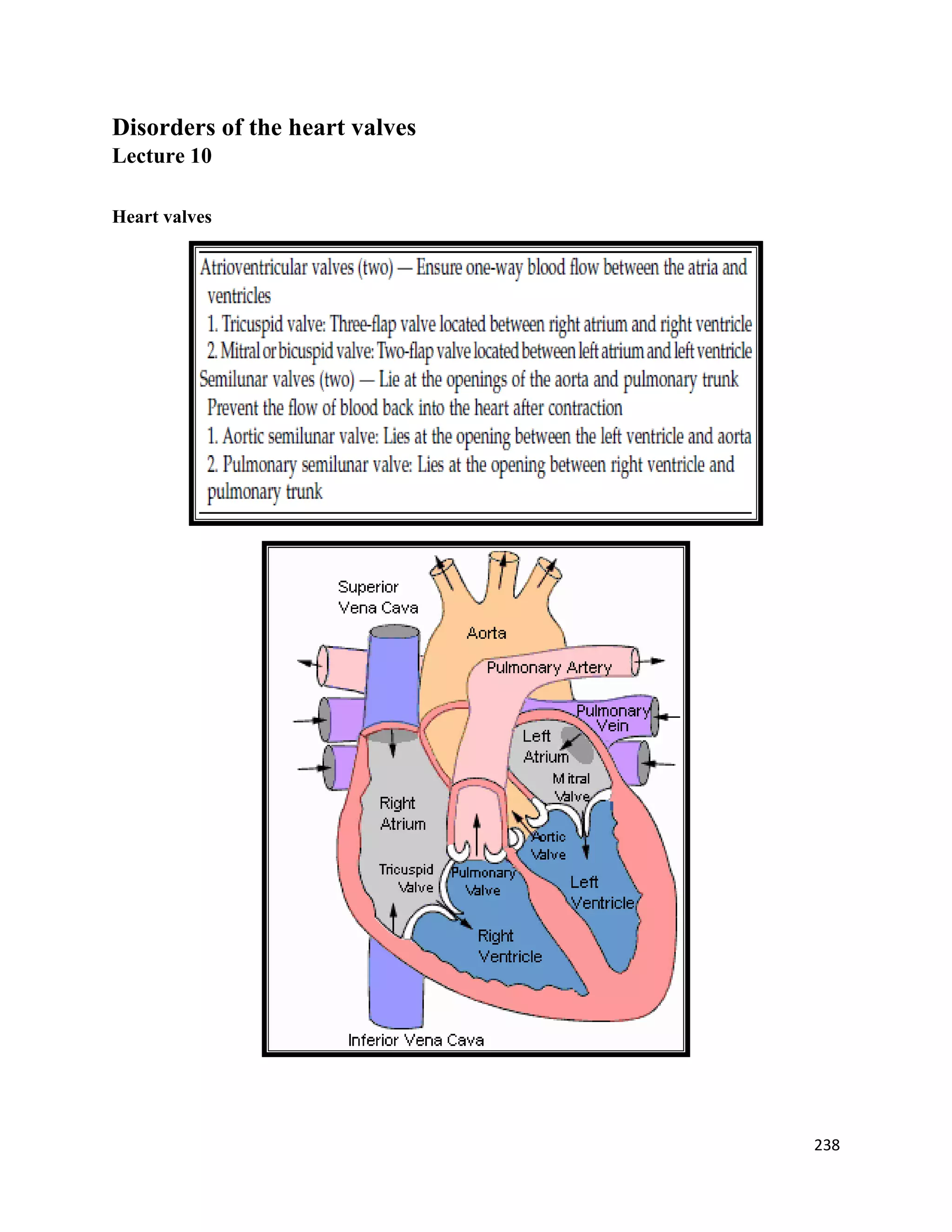
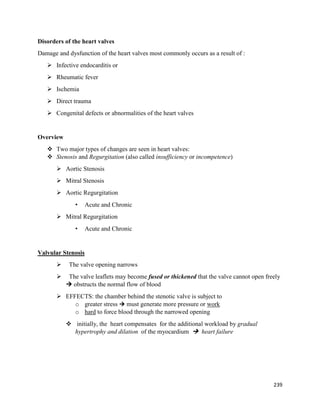
Heart valves
238
Disorders of the heart valves
Damage and dysfunction of the heart valves most commonly occurs as a result of :
 Infective endocarditis or
 Rheumatic fever
 Ischemia
 Direct trauma
 Congenital defects or abnormalities of the heart valves
Overview
 Two major types of changes are seen in heart valves:
 Stenosis and Regurgitation (also called insufficiency or incompetence)
 Aortic Stenosis
 Mitral Stenosis
 Aortic Regurgitation
• Acute and Chronic
 Mitral Regurgitation
• Acute and Chronic
Valvular Stenosis
 The valve opening narrows
 The valve leaflets may become fused or thickened that the valve cannot open freely
 obstructs the normal flow of blood
 EFFECTS: the chamber behind the stenotic valve is subject to
o greater stress  must generate more pressure or work
o hard to force blood through the narrowed opening
 initially, the heart compensates for the additional workload by gradual
hypertrophy and dilation of the myocardium  heart failure
239
Valvular Insufficiency or Regurgitation
 Scarring and retraction of valve leaflets or weakening of supporting structures 
incomplete closure of the valve result to leakage or backflow of blood from the previous
chamber
 EFFECTS:
o causes the Heart to pump the same blood twice (as the blood comes back into the
chamber)
o the Heart dilates to accommodate more blood (the usual blood it needs to pump
+ regurgitated blood)
o ventricular dilation and hypertrophy  eventually leads to heart failure
Heart sounds
240
Heart Murmur: is an extra or unusual sound heard during a heartbeat.
Mnemonic: Systolic Murmurs ( ASaMR) Diastolic Murmurs (ARMS)
Aortic Stenosis
Aortic Stenosis Overview:
 Normal Aortic Valve Area: 3-4 cm2
 Symptoms: Occur when valve area is 1/4th
of normal area.
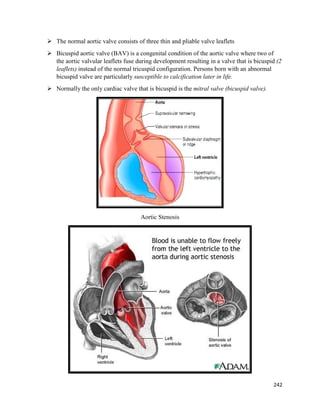
 Types:
o Supravalvular
o Subvalvular
o Valvular
241
 The normal aortic valve consists of three thin and pliable valve leaflets
 Bicuspid aortic valve (BAV) is a congenital condition of the aortic valve where two of
the aortic valvular leaflets fuse during development resulting in a valve that is bicuspid (2
leaflets) instead of the normal tricuspid configuration. Persons born with an abnormal
bicuspid valve are particularly susceptible to calcification later in life.
 Normally the only cardiac valve that is bicuspid is the mitral valve (bicuspid valve).
Aortic Stenosis
242
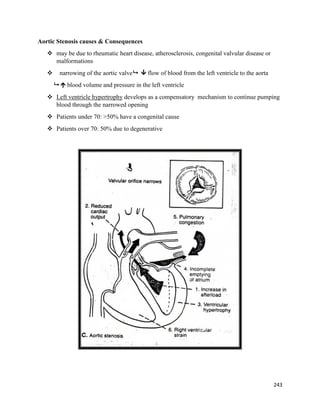
Aortic Stenosis causes & Consequences
 may be due to rheumatic heart disease, atherosclerosis, congenital valvular disease or
malformations
 narrowing of the aortic valve  flow of blood from the left ventricle to the aorta
  blood volume and pressure in the left ventricle
 Left ventricle hypertrophy develops as a compensatory mechanism to continue pumping
blood through the narrowed opening
 Patients under 70: >50% have a congenital cause
 Patients over 70: 50% due to degenerative
243
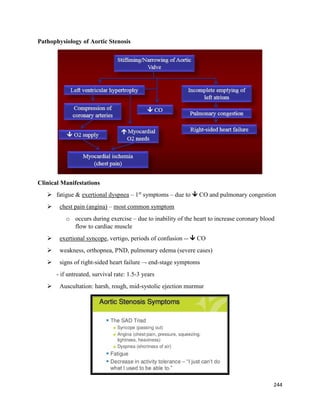
Pathophysiology of Aortic Stenosis
Clinical Manifestations
 fatigue & exertional dyspnea – 1st
symptoms – due to  CO and pulmonary congestion
 chest pain (angina) – most common symptom
o occurs during exercise – due to inability of the heart to increase coronary blood
flow to cardiac muscle
 exertional syncope, vertigo, periods of confusion --  CO
 weakness, orthopnea, PND, pulmonary edema (severe cases)
 signs of right-sided heart failure –- end-stage symptoms
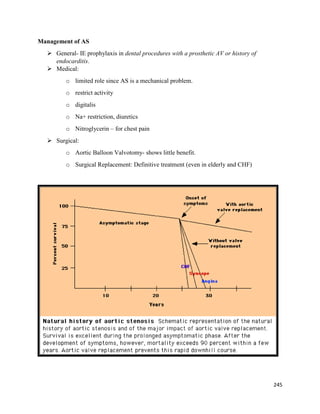
- if untreated, survival rate: 1.5-3 years
 Auscultation: harsh, rough, mid-systolic ejection murmur
244
Management of AS
 General- IE prophylaxis in dental procedures with a prosthetic AV or history of
endocarditis.
 Medical:
o limited role since AS is a mechanical problem.
o restrict activity
o digitalis
o Na+ restriction, diuretics
o Nitroglycerin – for chest pain
 Surgical:
o Aortic Balloon Valvotomy- shows little benefit.
o Surgical Replacement: Definitive treatment (even in elderly and CHF)
245
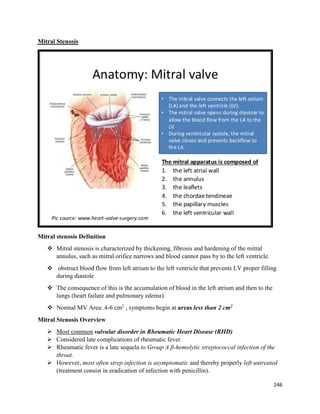
Mitral Stenosis
Mitral stenosis Definition
 Mitral stenosis is characterized by thickening, fibrosis and hardening of the mitral
annulus, such as mitral orifice narrows and blood cannot pass by to the left ventricle.
 obstruct blood flow from left atrium to the left ventricle that prevents LV proper filling
during diastole
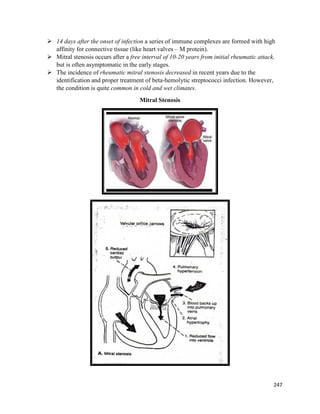
 The consequence of this is the accumulation of blood in the left atrium and then to the
lungs (heart failure and pulmonary edema).
 Normal MV Area: 4-6 cm2
, symptoms begin at areas less than 2 cm2
Mitral Stenosis Overview
 Most common valvular disorder in Rheumatic Heart Disease (RHD)
 Considered late complications of rheumatic fever.
 Rheumatic fever is a late sequela to Group A β-hemolytic streptococcal infection of the
throat.
 However, most often strep infection is asymptomatic and thereby properly left untreated
(treatment consist in eradication of infection with penicillin).
246
 14 days after the onset of infection a series of immune complexes are formed with high
affinity for connective tissue (like heart valves – M protein).
 Mitral stenosis occurs after a free interval of 10-20 years from initial rheumatic attack,
but is often asymptomatic in the early stages.
 The incidence of rheumatic mitral stenosis decreased in recent years due to the
identification and proper treatment of beta-hemolytic streptococci infection. However,
the condition is quite common in cold and wet climates.
Mitral Stenosis
247
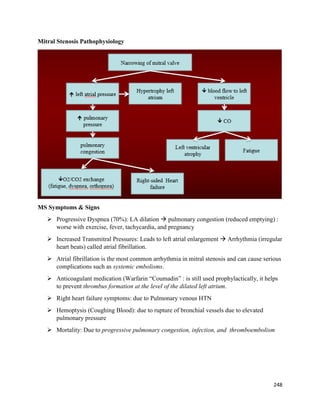
Mitral Stenosis Pathophysiology
MS Symptoms & Signs
 Progressive Dyspnea (70%): LA dilation  pulmonary congestion (reduced emptying) :
worse with exercise, fever, tachycardia, and pregnancy
 Increased Transmitral Pressures: Leads to left atrial enlargement  Arrhythmia (irregular
heart beats) called atrial fibrillation.
 Atrial fibrillation is the most common arrhythmia in mitral stenosis and can cause serious
complications such as systemic embolisms.
 Anticoagulant medication (Warfarin “Coumadin” : is still used prophylactically, it helps
to prevent thrombus formation at the level of the dilated left atrium.
 Right heart failure symptoms: due to Pulmonary venous HTN
 Hemoptysis (Coughing Blood): due to rupture of bronchial vessels due to elevated
pulmonary pressure
 Mortality: Due to progressive pulmonary congestion, infection, and thromboembolism
248
Physical Exam Findings of MS
 Presence of bilateral peripheral edema, especially in the ankle, with warm skin, slightly
cyanotic;
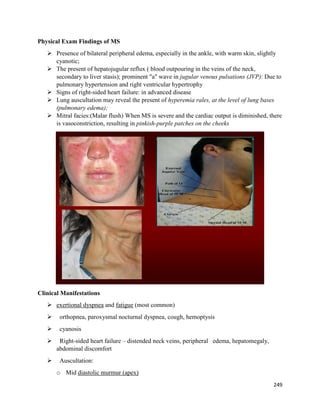
 The present of hepatojugular reflux ( blood outpouring in the veins of the neck,
secondary to liver stasis); prominent "a" wave in jugular venous pulsations (JVP): Due to
pulmonary hypertension and right ventricular hypertrophy
 Signs of right-sided heart failure: in advanced disease
 Lung auscultation may reveal the present of hyperemia rales, at the level of lung bases
(pulmonary edema);
 Mitral facies:(Malar flush) When MS is severe and the cardiac output is diminished, there
is vasoconstriction, resulting in pinkish-purple patches on the cheeks
Clinical Manifestations
 exertional dyspnea and fatigue (most common)
 orthopnea, paroxysmal nocturnal dyspnea, cough, hemoptysis
 cyanosis
 Right-sided heart failure – distended neck veins, peripheral edema, hepatomegaly,
abdominal discomfort
 Auscultation:
o Mid diastolic murmur (apex)
249
Evaluation of MS
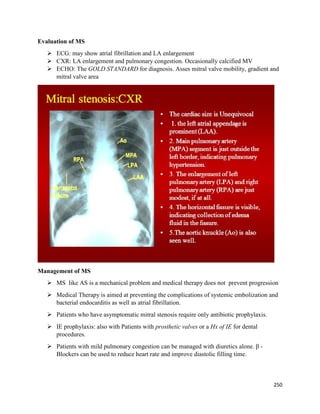
 ECG: may show atrial fibrillation and LA enlargement
 CXR: LA enlargement and pulmonary congestion. Occasionally calcified MV
 ECHO: The GOLD STANDARD for diagnosis. Asses mitral valve mobility, gradient and
mitral valve area
Management of MS
 MS like AS is a mechanical problem and medical therapy does not prevent progression
 Medical Therapy is aimed at preventing the complications of systemic embolization and
bacterial endocarditis as well as atrial fibrillation.
 Patients who have asymptomatic mitral stenosis require only antibiotic prophylaxis.
 IE prophylaxis: also with Patients with prosthetic valves or a Hx of IE for dental
procedures.
 Patients with mild pulmonary congestion can be managed with diuretics alone. β -
Blockers can be used to reduce heart rate and improve diastolic filling time.
250
 When patients have atrial fibrillation, digoxin, β-blockers, or calcium channel blockers
can be used for ventricular response rate control.
 Patients with atrial fibrillation require anticoagulation to prevent thrombus formation in
the atrium.
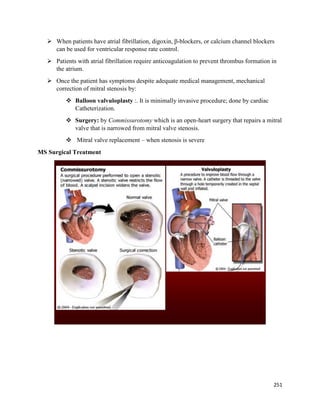
 Once the patient has symptoms despite adequate medical management, mechanical
correction of mitral stenosis by:
 Balloon valvuloplasty :. It is minimally invasive procedure; done by cardiac
Catheterization.
 Surgery: by Commissurotomy which is an open-heart surgery that repairs a mitral
valve that is narrowed from mitral valve stenosis.
 Mitral valve replacement – when stenosis is severe
MS Surgical Treatment
251
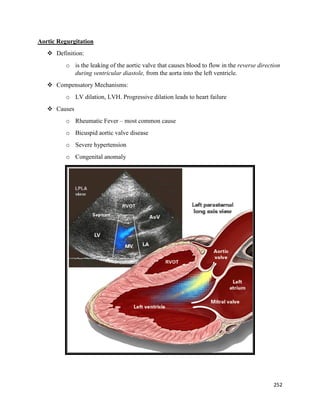
Aortic Regurgitation
 Definition:
o is the leaking of the aortic valve that causes blood to flow in the reverse direction
during ventricular diastole, from the aorta into the left ventricle.
 Compensatory Mechanisms:
o LV dilation, LVH. Progressive dilation leads to heart failure
 Causes
o Rheumatic Fever – most common cause
o Bicuspid aortic valve disease
o Severe hypertension
o Congenital anomaly
252
Symptoms & Signs of AR
 Asymptomatic until 4th
or 5th
decade
 Rate of Progression: 4-6% per year
 Progressive Symptoms include:
o Dyspnea: Shortness of breath
o Orthopnea : is shortness of breath which occurs when lying flat, causing the
person to have to sleep propped up in bed or sitting in a chair
o Paroxsymal Nocturnal Dyspnea (PND): refers to attacks of severe shortness of
breath and coughing that generally occur at night.
o Nocturnal angina: due to slowing of heart rate and reduction of diastolic blood
pressure
o Palpitations: due to increased force of contraction
Physical Findings of AR
 Wide pulse pressure : most sensitive
 Auscultation:
 Diastolic blowing murmur at the left sternal border
 Austin flint murmur (apex) -mid-diastolic or presystolic murmur:
 Due to diastolic displacement of the anterior leaflet of the mitral valve by the
aortic regurgitation stream causing it to vibrate.
 Systolic ejection murmur: due to increased flow across the aortic valve
 Florid pulmonary edema
 Pulmonary edema is accumulation of fluid in the interstitial spaces of the lungs
(Interstitial Edema) due to an imbalance in the oncotic and hydrostatic pressure in
the lungs.
 Florid pulmonary edema: the excess fluid is filled in the space between the
capillary and lung interstitial spaces.
253
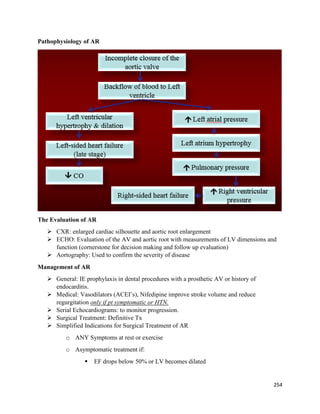
Pathophysiology of AR
The Evaluation of AR
 CXR: enlarged cardiac silhouette and aortic root enlargement
 ECHO: Evaluation of the AV and aortic root with measurements of LV dimensions and
function (cornerstone for decision making and follow up evaluation)
 Aortography: Used to confirm the severity of disease
Management of AR
 General: IE prophylaxis in dental procedures with a prosthetic AV or history of
endocarditis.
 Medical: Vasodilators (ACEI’s), Nifedipine improve stroke volume and reduce
regurgitation only if pt symptomatic or HTN.
 Serial Echocardiograms: to monitor progression.
 Surgical Treatment: Definitive Tx
 Simplified Indications for Surgical Treatment of AR
o ANY Symptoms at rest or exercise
o Asymptomatic treatment if:
 EF drops below 50% or LV becomes dilated
254
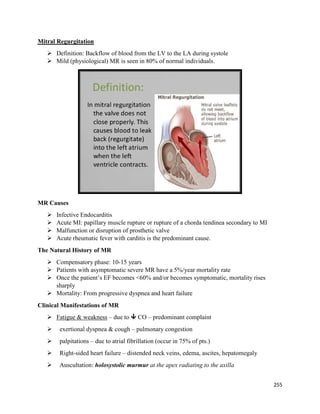
Mitral Regurgitation
 Definition: Backflow of blood from the LV to the LA during systole
 Mild (physiological) MR is seen in 80% of normal individuals.
MR Causes
 Infective Endocarditis
 Acute MI: papillary muscle rupture or rupture of a chorda tendinea secondary to MI
 Malfunction or disruption of prosthetic valve
 Acute rheumatic fever with carditis is the predominant cause.
The Natural History of MR
 Compensatory phase: 10-15 years
 Patients with asymptomatic severe MR have a 5%/year mortality rate
 Once the patient’s EF becomes <60% and/or becomes symptomatic, mortality rises
sharply
 Mortality: From progressive dyspnea and heart failure
Clinical Manifestations of MR
 Fatigue & weakness – due to  CO – predominant complaint
 exertional dyspnea & cough – pulmonary congestion
 palpitations – due to atrial fibrillation (occur in 75% of pts.)
 Right-sided heart failure – distended neck veins, edema, ascites, hepatomegaly
 Auscultation: holosystolic murmur at the apex radiating to the axilla
255
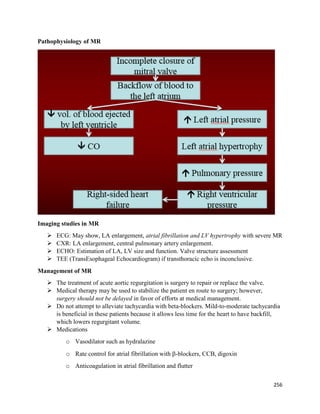
Pathophysiology of MR
Imaging studies in MR
 ECG: May show, LA enlargement, atrial fibrillation and LV hypertrophy with severe MR
 CXR: LA enlargement, central pulmonary artery enlargement.
 ECHO: Estimation of LA, LV size and function. Valve structure assessment
 TEE (TransEsophageal Echocardiogram) if transthoracic echo is inconclusive.
Management of MR
 The treatment of acute aortic regurgitation is surgery to repair or replace the valve.
 Medical therapy may be used to stabilize the patient en route to surgery; however,
surgery should not be delayed in favor of efforts at medical management.
 Do not attempt to alleviate tachycardia with beta-blockers. Mild-to-moderate tachycardia
is beneficial in these patients because it allows less time for the heart to have backfill,
which lowers regurgitant volume.
 Medications
o Vasodilator such as hydralazine
o Rate control for atrial fibrillation with β-blockers, CCB, digoxin
o Anticoagulation in atrial fibrillation and flutter
256
o Diuretics for fluid overload
 Serial Echocardiography:
o Mild: 2-3 years, Moderate: 1-2 years, Severe: 6-12 months
 IE prophylaxis: Patients with prosthetic valves or a Hx of IE for dental procedures.
 MV Replacement in Severe MR
Mitral Valve Prolapse
 When 1 or both of the valve leaflets bulge into the left atrium during ventricular
contraction
 more common in women
 Cause: due to an inherited connective tissue disorder  enlargement of one or both
valve leaflets
 Elongates/stretches the chordae tendinae & papillary muscles  regurgitation may occur
 usually asymptomatic
 Extra heart sound (Mitral click) – an early sign that a valve leaflet is ballooning into the
left atrium
 fatigue, shortness of breath
 arrhythmias may develop – dizziness, chest pain, dyspnea, palpitations, syncope
 high-pitched late systolic murmur
257
Mitral Valve Prolapse
Interventions:
 antibiotic prophylaxis to prevent endocarditis
 If w/ dysrhythmia – avoid caffeine, alcohol, stop smoking
 anti-arrhythmic drugs
 for chest pain – nitrates, calcium channel blockers, beta blockers
 surgery not indicated
Tricuspid Stenosis
 usually occurs together w/ aortic or mitral stenosis
 may be due to rheumatic heart disease
  blood flow from right atrium to right ventricle
  right ventricular output
  left ventricular filling   CO
 blood accumulates in systemic circulation
  systemic pressure
 S/Sx: symptoms of right-sided heart failure
o hepatomegaly
o peripheral edema
o neck vein engorgement
o  CO – fatigue, hypotension
Tricuspid Regurgitation
 Uncommon
 TR is most commonly secondary, caused by dilation of the right ventricle (RV) with
malfunction of a normal valve, RV dysfunction–induced heart failure (HF), and
pulmonary outflow tract obstruction.
 TR is less commonly primary, due to valvular abnormalities caused by infective
endocarditis in users of illicit IV drugs, blunt chest trauma, rheumatic fever, congenital
defects.
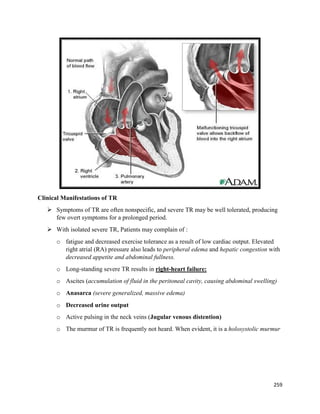
 An insufficient tricuspid valve allows blood to flow back into the right atrium  venous
congestion &  right ventricular output   blood flow towards the lungs
258
Clinical Manifestations of TR
 Symptoms of TR are often nonspecific, and severe TR may be well tolerated, producing
few overt symptoms for a prolonged period.
 With isolated severe TR, Patients may complain of :
o fatigue and decreased exercise tolerance as a result of low cardiac output. Elevated
right atrial (RA) pressure also leads to peripheral edema and hepatic congestion with
decreased appetite and abdominal fullness.
o Long-standing severe TR results in right-heart failure:
o Ascites (accumulation of fluid in the peritoneal cavity, causing abdominal swelling)
o Anasarca (severe generalized, massive edema)
o Decreased urine output
o Active pulsing in the neck veins (Jugular venous distention)
o The murmur of TR is frequently not heard. When evident, it is a holosystolic murmur
259
Pulmonary Stenosis
 rare, usually congenital in origin
  flow of blood to the pulmonary artery due to narrowing

blood flows back to right ventricle and right atrium

right ventricle hypertrophy to compensate for
 blood volume and force blood to the pulmonary artery
 Symptoms & Signs
 harsh systolic murmur
 fatigue, dyspnea on exertion, cyanosis
 poor weight gain or failure to thrive in infants
 hepatomegaly, ascites, edema
Pulmonary Regurgitation
 a rare condition caused by infective endocarditis, tumors or RF
 blood flows back into Right ventricle  Right ventricle and atrium hypertrphy 
symptoms of Right-sided heart failure
Valve Repair
 Valvuloplasty
 Is repair of cardiac valve
 patient does not require continuous anti-coagulant medication
 usually require cardiopulmonary bypass machine
1. Commissurotomy – to separate the fused leaflets
 Balloon Valvuloplasty
 performed in the cardiac cath. lab.
 balloon inflated for 10-30 secs., w/ multiple inflations
 common used for mitral and aortic stenosis
260
 Closed surgical valvuloplasty
 done in the OR under GA
 Midsternal incision, a small hole is cut into the heart, the surgeon’s finger or a
dilator is used to open the commissure
 Open Commissurotomy
 done w/ direct visualization of the valve, thrombus and calcifications may be
identified and removed
2. Annuloplasty
 Is repair of valve annulus (junction of the valve leaflets and the muscular heart
wall)
 narrows the diameter of the valve’s orifice, useful for valvular regurgitation
3. Chordoplasty
 Is repair of chordae tendineae , done for mitral valve regurgitation
 caused by stretched, torn or shortened chordae tendineae
Valve Replacement
 Mechanical valves
 Example: Caged ball valve, Tilting-disk valve
 more durable, used for younger pts.
 risk of thromboembolism – long-term use of anti-coagulants
 Tissue or biological valves:
 xenografts – porcine or bovine heterografts (7-10 yrs viability)
 homografts – from cadaver tissue donations (10-15 yrs)
 autografts – excising the pts.’s own pulmonic valve and portion of pulmonary artery
for use as the aortic valve
 Long-term anticoagulant therapy
 Antibiotic prophylaxis
---------------------------
261

Lecture 10 valvular heart disease - Pathology

  • 1.
    Disorders of theheart valves Lecture 10 Heart valves 238
  • 2.
    Disorders of theheart valves Damage and dysfunction of the heart valves most commonly occurs as a result of :  Infective endocarditis or  Rheumatic fever  Ischemia  Direct trauma  Congenital defects or abnormalities of the heart valves Overview  Two major types of changes are seen in heart valves:  Stenosis and Regurgitation (also called insufficiency or incompetence)  Aortic Stenosis  Mitral Stenosis  Aortic Regurgitation • Acute and Chronic  Mitral Regurgitation • Acute and Chronic Valvular Stenosis  The valve opening narrows  The valve leaflets may become fused or thickened that the valve cannot open freely  obstructs the normal flow of blood  EFFECTS: the chamber behind the stenotic valve is subject to o greater stress  must generate more pressure or work o hard to force blood through the narrowed opening  initially, the heart compensates for the additional workload by gradual hypertrophy and dilation of the myocardium  heart failure 239
  • 3.
    Valvular Insufficiency orRegurgitation  Scarring and retraction of valve leaflets or weakening of supporting structures  incomplete closure of the valve result to leakage or backflow of blood from the previous chamber  EFFECTS: o causes the Heart to pump the same blood twice (as the blood comes back into the chamber) o the Heart dilates to accommodate more blood (the usual blood it needs to pump + regurgitated blood) o ventricular dilation and hypertrophy  eventually leads to heart failure Heart sounds 240
  • 4.
    Heart Murmur: isan extra or unusual sound heard during a heartbeat. Mnemonic: Systolic Murmurs ( ASaMR) Diastolic Murmurs (ARMS) Aortic Stenosis Aortic Stenosis Overview:  Normal Aortic Valve Area: 3-4 cm2  Symptoms: Occur when valve area is 1/4th of normal area.  Types: o Supravalvular o Subvalvular o Valvular 241
  • 5.
     The normalaortic valve consists of three thin and pliable valve leaflets  Bicuspid aortic valve (BAV) is a congenital condition of the aortic valve where two of the aortic valvular leaflets fuse during development resulting in a valve that is bicuspid (2 leaflets) instead of the normal tricuspid configuration. Persons born with an abnormal bicuspid valve are particularly susceptible to calcification later in life.  Normally the only cardiac valve that is bicuspid is the mitral valve (bicuspid valve). Aortic Stenosis 242
  • 6.
    Aortic Stenosis causes& Consequences  may be due to rheumatic heart disease, atherosclerosis, congenital valvular disease or malformations  narrowing of the aortic valve  flow of blood from the left ventricle to the aorta   blood volume and pressure in the left ventricle  Left ventricle hypertrophy develops as a compensatory mechanism to continue pumping blood through the narrowed opening  Patients under 70: >50% have a congenital cause  Patients over 70: 50% due to degenerative 243
  • 7.
    Pathophysiology of AorticStenosis Clinical Manifestations  fatigue & exertional dyspnea – 1st symptoms – due to  CO and pulmonary congestion  chest pain (angina) – most common symptom o occurs during exercise – due to inability of the heart to increase coronary blood flow to cardiac muscle  exertional syncope, vertigo, periods of confusion --  CO  weakness, orthopnea, PND, pulmonary edema (severe cases)  signs of right-sided heart failure –- end-stage symptoms - if untreated, survival rate: 1.5-3 years  Auscultation: harsh, rough, mid-systolic ejection murmur 244
  • 8.
    Management of AS General- IE prophylaxis in dental procedures with a prosthetic AV or history of endocarditis.  Medical: o limited role since AS is a mechanical problem. o restrict activity o digitalis o Na+ restriction, diuretics o Nitroglycerin – for chest pain  Surgical: o Aortic Balloon Valvotomy- shows little benefit. o Surgical Replacement: Definitive treatment (even in elderly and CHF) 245
  • 9.
    Mitral Stenosis Mitral stenosisDefinition  Mitral stenosis is characterized by thickening, fibrosis and hardening of the mitral annulus, such as mitral orifice narrows and blood cannot pass by to the left ventricle.  obstruct blood flow from left atrium to the left ventricle that prevents LV proper filling during diastole  The consequence of this is the accumulation of blood in the left atrium and then to the lungs (heart failure and pulmonary edema).  Normal MV Area: 4-6 cm2 , symptoms begin at areas less than 2 cm2 Mitral Stenosis Overview  Most common valvular disorder in Rheumatic Heart Disease (RHD)  Considered late complications of rheumatic fever.  Rheumatic fever is a late sequela to Group A β-hemolytic streptococcal infection of the throat.  However, most often strep infection is asymptomatic and thereby properly left untreated (treatment consist in eradication of infection with penicillin). 246
  • 10.
     14 daysafter the onset of infection a series of immune complexes are formed with high affinity for connective tissue (like heart valves – M protein).  Mitral stenosis occurs after a free interval of 10-20 years from initial rheumatic attack, but is often asymptomatic in the early stages.  The incidence of rheumatic mitral stenosis decreased in recent years due to the identification and proper treatment of beta-hemolytic streptococci infection. However, the condition is quite common in cold and wet climates. Mitral Stenosis 247
  • 11.
    Mitral Stenosis Pathophysiology MSSymptoms & Signs  Progressive Dyspnea (70%): LA dilation  pulmonary congestion (reduced emptying) : worse with exercise, fever, tachycardia, and pregnancy  Increased Transmitral Pressures: Leads to left atrial enlargement  Arrhythmia (irregular heart beats) called atrial fibrillation.  Atrial fibrillation is the most common arrhythmia in mitral stenosis and can cause serious complications such as systemic embolisms.  Anticoagulant medication (Warfarin “Coumadin” : is still used prophylactically, it helps to prevent thrombus formation at the level of the dilated left atrium.  Right heart failure symptoms: due to Pulmonary venous HTN  Hemoptysis (Coughing Blood): due to rupture of bronchial vessels due to elevated pulmonary pressure  Mortality: Due to progressive pulmonary congestion, infection, and thromboembolism 248
  • 12.
    Physical Exam Findingsof MS  Presence of bilateral peripheral edema, especially in the ankle, with warm skin, slightly cyanotic;  The present of hepatojugular reflux ( blood outpouring in the veins of the neck, secondary to liver stasis); prominent "a" wave in jugular venous pulsations (JVP): Due to pulmonary hypertension and right ventricular hypertrophy  Signs of right-sided heart failure: in advanced disease  Lung auscultation may reveal the present of hyperemia rales, at the level of lung bases (pulmonary edema);  Mitral facies:(Malar flush) When MS is severe and the cardiac output is diminished, there is vasoconstriction, resulting in pinkish-purple patches on the cheeks Clinical Manifestations  exertional dyspnea and fatigue (most common)  orthopnea, paroxysmal nocturnal dyspnea, cough, hemoptysis  cyanosis  Right-sided heart failure – distended neck veins, peripheral edema, hepatomegaly, abdominal discomfort  Auscultation: o Mid diastolic murmur (apex) 249
  • 13.
    Evaluation of MS ECG: may show atrial fibrillation and LA enlargement  CXR: LA enlargement and pulmonary congestion. Occasionally calcified MV  ECHO: The GOLD STANDARD for diagnosis. Asses mitral valve mobility, gradient and mitral valve area Management of MS  MS like AS is a mechanical problem and medical therapy does not prevent progression  Medical Therapy is aimed at preventing the complications of systemic embolization and bacterial endocarditis as well as atrial fibrillation.  Patients who have asymptomatic mitral stenosis require only antibiotic prophylaxis.  IE prophylaxis: also with Patients with prosthetic valves or a Hx of IE for dental procedures.  Patients with mild pulmonary congestion can be managed with diuretics alone. β - Blockers can be used to reduce heart rate and improve diastolic filling time. 250
  • 14.
     When patientshave atrial fibrillation, digoxin, β-blockers, or calcium channel blockers can be used for ventricular response rate control.  Patients with atrial fibrillation require anticoagulation to prevent thrombus formation in the atrium.  Once the patient has symptoms despite adequate medical management, mechanical correction of mitral stenosis by:  Balloon valvuloplasty :. It is minimally invasive procedure; done by cardiac Catheterization.  Surgery: by Commissurotomy which is an open-heart surgery that repairs a mitral valve that is narrowed from mitral valve stenosis.  Mitral valve replacement – when stenosis is severe MS Surgical Treatment 251
  • 15.
    Aortic Regurgitation  Definition: ois the leaking of the aortic valve that causes blood to flow in the reverse direction during ventricular diastole, from the aorta into the left ventricle.  Compensatory Mechanisms: o LV dilation, LVH. Progressive dilation leads to heart failure  Causes o Rheumatic Fever – most common cause o Bicuspid aortic valve disease o Severe hypertension o Congenital anomaly 252
  • 16.
    Symptoms & Signsof AR  Asymptomatic until 4th or 5th decade  Rate of Progression: 4-6% per year  Progressive Symptoms include: o Dyspnea: Shortness of breath o Orthopnea : is shortness of breath which occurs when lying flat, causing the person to have to sleep propped up in bed or sitting in a chair o Paroxsymal Nocturnal Dyspnea (PND): refers to attacks of severe shortness of breath and coughing that generally occur at night. o Nocturnal angina: due to slowing of heart rate and reduction of diastolic blood pressure o Palpitations: due to increased force of contraction Physical Findings of AR  Wide pulse pressure : most sensitive  Auscultation:  Diastolic blowing murmur at the left sternal border  Austin flint murmur (apex) -mid-diastolic or presystolic murmur:  Due to diastolic displacement of the anterior leaflet of the mitral valve by the aortic regurgitation stream causing it to vibrate.  Systolic ejection murmur: due to increased flow across the aortic valve  Florid pulmonary edema  Pulmonary edema is accumulation of fluid in the interstitial spaces of the lungs (Interstitial Edema) due to an imbalance in the oncotic and hydrostatic pressure in the lungs.  Florid pulmonary edema: the excess fluid is filled in the space between the capillary and lung interstitial spaces. 253
  • 17.
    Pathophysiology of AR TheEvaluation of AR  CXR: enlarged cardiac silhouette and aortic root enlargement  ECHO: Evaluation of the AV and aortic root with measurements of LV dimensions and function (cornerstone for decision making and follow up evaluation)  Aortography: Used to confirm the severity of disease Management of AR  General: IE prophylaxis in dental procedures with a prosthetic AV or history of endocarditis.  Medical: Vasodilators (ACEI’s), Nifedipine improve stroke volume and reduce regurgitation only if pt symptomatic or HTN.  Serial Echocardiograms: to monitor progression.  Surgical Treatment: Definitive Tx  Simplified Indications for Surgical Treatment of AR o ANY Symptoms at rest or exercise o Asymptomatic treatment if:  EF drops below 50% or LV becomes dilated 254
  • 18.
    Mitral Regurgitation  Definition:Backflow of blood from the LV to the LA during systole  Mild (physiological) MR is seen in 80% of normal individuals. MR Causes  Infective Endocarditis  Acute MI: papillary muscle rupture or rupture of a chorda tendinea secondary to MI  Malfunction or disruption of prosthetic valve  Acute rheumatic fever with carditis is the predominant cause. The Natural History of MR  Compensatory phase: 10-15 years  Patients with asymptomatic severe MR have a 5%/year mortality rate  Once the patient’s EF becomes <60% and/or becomes symptomatic, mortality rises sharply  Mortality: From progressive dyspnea and heart failure Clinical Manifestations of MR  Fatigue & weakness – due to  CO – predominant complaint  exertional dyspnea & cough – pulmonary congestion  palpitations – due to atrial fibrillation (occur in 75% of pts.)  Right-sided heart failure – distended neck veins, edema, ascites, hepatomegaly  Auscultation: holosystolic murmur at the apex radiating to the axilla 255
  • 19.
    Pathophysiology of MR Imagingstudies in MR  ECG: May show, LA enlargement, atrial fibrillation and LV hypertrophy with severe MR  CXR: LA enlargement, central pulmonary artery enlargement.  ECHO: Estimation of LA, LV size and function. Valve structure assessment  TEE (TransEsophageal Echocardiogram) if transthoracic echo is inconclusive. Management of MR  The treatment of acute aortic regurgitation is surgery to repair or replace the valve.  Medical therapy may be used to stabilize the patient en route to surgery; however, surgery should not be delayed in favor of efforts at medical management.  Do not attempt to alleviate tachycardia with beta-blockers. Mild-to-moderate tachycardia is beneficial in these patients because it allows less time for the heart to have backfill, which lowers regurgitant volume.  Medications o Vasodilator such as hydralazine o Rate control for atrial fibrillation with β-blockers, CCB, digoxin o Anticoagulation in atrial fibrillation and flutter 256
  • 20.
    o Diuretics forfluid overload  Serial Echocardiography: o Mild: 2-3 years, Moderate: 1-2 years, Severe: 6-12 months  IE prophylaxis: Patients with prosthetic valves or a Hx of IE for dental procedures.  MV Replacement in Severe MR Mitral Valve Prolapse  When 1 or both of the valve leaflets bulge into the left atrium during ventricular contraction  more common in women  Cause: due to an inherited connective tissue disorder  enlargement of one or both valve leaflets  Elongates/stretches the chordae tendinae & papillary muscles  regurgitation may occur  usually asymptomatic  Extra heart sound (Mitral click) – an early sign that a valve leaflet is ballooning into the left atrium  fatigue, shortness of breath  arrhythmias may develop – dizziness, chest pain, dyspnea, palpitations, syncope  high-pitched late systolic murmur 257
  • 21.
    Mitral Valve Prolapse Interventions: antibiotic prophylaxis to prevent endocarditis  If w/ dysrhythmia – avoid caffeine, alcohol, stop smoking  anti-arrhythmic drugs  for chest pain – nitrates, calcium channel blockers, beta blockers  surgery not indicated Tricuspid Stenosis  usually occurs together w/ aortic or mitral stenosis  may be due to rheumatic heart disease   blood flow from right atrium to right ventricle   right ventricular output   left ventricular filling   CO  blood accumulates in systemic circulation   systemic pressure  S/Sx: symptoms of right-sided heart failure o hepatomegaly o peripheral edema o neck vein engorgement o  CO – fatigue, hypotension Tricuspid Regurgitation  Uncommon  TR is most commonly secondary, caused by dilation of the right ventricle (RV) with malfunction of a normal valve, RV dysfunction–induced heart failure (HF), and pulmonary outflow tract obstruction.  TR is less commonly primary, due to valvular abnormalities caused by infective endocarditis in users of illicit IV drugs, blunt chest trauma, rheumatic fever, congenital defects.  An insufficient tricuspid valve allows blood to flow back into the right atrium  venous congestion &  right ventricular output   blood flow towards the lungs 258
  • 22.
    Clinical Manifestations ofTR  Symptoms of TR are often nonspecific, and severe TR may be well tolerated, producing few overt symptoms for a prolonged period.  With isolated severe TR, Patients may complain of : o fatigue and decreased exercise tolerance as a result of low cardiac output. Elevated right atrial (RA) pressure also leads to peripheral edema and hepatic congestion with decreased appetite and abdominal fullness. o Long-standing severe TR results in right-heart failure: o Ascites (accumulation of fluid in the peritoneal cavity, causing abdominal swelling) o Anasarca (severe generalized, massive edema) o Decreased urine output o Active pulsing in the neck veins (Jugular venous distention) o The murmur of TR is frequently not heard. When evident, it is a holosystolic murmur 259
  • 23.
    Pulmonary Stenosis  rare,usually congenital in origin   flow of blood to the pulmonary artery due to narrowing  blood flows back to right ventricle and right atrium  right ventricle hypertrophy to compensate for  blood volume and force blood to the pulmonary artery  Symptoms & Signs  harsh systolic murmur  fatigue, dyspnea on exertion, cyanosis  poor weight gain or failure to thrive in infants  hepatomegaly, ascites, edema Pulmonary Regurgitation  a rare condition caused by infective endocarditis, tumors or RF  blood flows back into Right ventricle  Right ventricle and atrium hypertrphy  symptoms of Right-sided heart failure Valve Repair  Valvuloplasty  Is repair of cardiac valve  patient does not require continuous anti-coagulant medication  usually require cardiopulmonary bypass machine 1. Commissurotomy – to separate the fused leaflets  Balloon Valvuloplasty  performed in the cardiac cath. lab.  balloon inflated for 10-30 secs., w/ multiple inflations  common used for mitral and aortic stenosis 260
  • 24.
     Closed surgicalvalvuloplasty  done in the OR under GA  Midsternal incision, a small hole is cut into the heart, the surgeon’s finger or a dilator is used to open the commissure  Open Commissurotomy  done w/ direct visualization of the valve, thrombus and calcifications may be identified and removed 2. Annuloplasty  Is repair of valve annulus (junction of the valve leaflets and the muscular heart wall)  narrows the diameter of the valve’s orifice, useful for valvular regurgitation 3. Chordoplasty  Is repair of chordae tendineae , done for mitral valve regurgitation  caused by stretched, torn or shortened chordae tendineae Valve Replacement  Mechanical valves  Example: Caged ball valve, Tilting-disk valve  more durable, used for younger pts.  risk of thromboembolism – long-term use of anti-coagulants  Tissue or biological valves:  xenografts – porcine or bovine heterografts (7-10 yrs viability)  homografts – from cadaver tissue donations (10-15 yrs)  autografts – excising the pts.’s own pulmonic valve and portion of pulmonary artery for use as the aortic valve  Long-term anticoagulant therapy  Antibiotic prophylaxis --------------------------- 261