MYOCARDITIS IN CHILDREN 
Dr. Pradeep Singh
TO BE COVER….. 
• DEFINITION 
• EPIDEMIOLOGY AND ETIOLOGY 
• PATHOPHYSIOLOGY 
• CLINICAL PRESENTATION 
• DIFFERENTIAL DIAGNOSIS 
• DIAGNOSIS 
• TREATMENT 
• PROGNOSIS
definition 
• Acute myocarditis -inflammation, necrosis, or 
myocytolysis and caused by many infectious, conn. 
tissue, granulomatous, toxic, or idiopathic processes 
affecting the myocardium with or without associated 
systemic manifest of the disease process or 
involvement of the endocardium or pericardium 
Nelson Textbook of Pediatrics, 18th ed. 
• Acute fulm myocarditis - myocellular necrosis, lead 
to sudden onset of heart failure, arrhythmia and 
sudden death
Epidemiology 
•True incidence is difficult to determine 
•Incidence of biopsy documented myocarditis in 
patients with unexplained heart failure is 9.6%. 
Progress in Cardiovascular Diseases 52 (2010) 274–288 
• 29 children with DCM 
-38% have histopatho evidence of ‘definite’ or 
-borderline’ myocarditis accord to the Dallas criteria. 
Cardiac symposium on Viral myocarditis in childhood:Juan Pablo Kaski , 
Michael Burch
ETIOLOGY
Adenovirus - common cause of myocarditis 
• 624 patients with 
-biopsy-proven myocarditis (66%) 
-borderline myocarditis (34%). 
- viral genome of adenovirus 
-enterovirus 
-cmv in dec freq 
• detected in 239 (38%) 
Bowles NE, et al Detection of viruses in myocardial tissues by PCR: 
J Am Coll Cardiol. 2003;42:466–472.
DENGUE VIRUS – CAUSE OF MYOCARDITIS 
• DHF/DSS- poor LVEF 
• Worsened by the hypotension and shock 
• Sinus node dysfunction reported 
Wali JP, Biswas A, Chandra S, Malhotra A, Aggarwal P, Handa R, et al. 
Cardiac involvement in dengue haemorrhagic fever. Int J Cardiol 
1998;64:31-
RISK FACTORS 
• Increased risk of virus-induced myocarditis 
• The course is hyperacute 
– Young males 
– pregnant women 
– children ( neonates) 
– immunocompromised patients 
– selenium deficiency 
-vitamin E deficiency 
Beck MA, Levander OA, Handy J: Selenium deficiency and viral 
infection. J Nutr 2003;133(5 Suppl 1):1463-1467
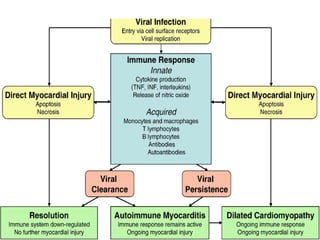
PATHOPHYSIOLOGY
Toxins & hypersensitivity reactions 
• Direct toxic effect on the heart 
or 
by hypersensitivity reactions 
•Hypersensitivity reactions – eosinophilic myocarditis 
•Responds to withdrawal of the offending medication
myocardial injury 
cardiac enlargement and an inc. in the vent end-diastolic 
volu. 
myocardium is unable to respond to these stimuli 
reduced cardiac output 
Moss and Adams' Heart Disease in Infants, Children, and Adolescents: 
Including the Fetus and Young Adults, 7th Edition
Preserve systemic blood flow via vasoconstriction 
& elevated afterload. 
intact sympathetic nervous system input 
tachycardia and diaphoresis,CHF 
prog ventricular end-diastolic volu 
left atrial pres 
pulmonary edema.
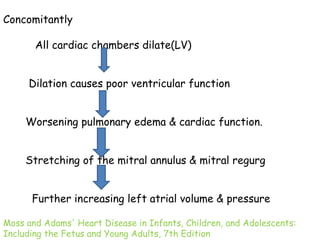
Concomitantly 
All cardiac chambers dilate(LV) 
Dilation causes poor ventricular function 
Worsening pulmonary edema & cardiac function. 
Stretching of the mitral annulus & mitral regurg 
Further increasing left atrial volume & pressure 
Moss and Adams' Heart Disease in Infants, Children, and Adolescents: 
Including the Fetus and Young Adults, 7th Edition
Clinical features 
• Presentation in children varies according to 
age. 
• Lesser the age ,poor prognosis 
• Newborns or infants- poor appetite, fever, 
irritability or listlessness 
• Pallor and diaphoresis,Sudden death 
• Mild cyanosis to sympts of CHF
Children and Adolescents 
• Recent history of viral disease 10 to 14 days prior 
to presentation 
•Lethargy, low-grade fever, pallor decreased appetite 
• Diaphoresis, palpitations, rashes, exercise 
intolerance 
•Raised JVP,Rales,with resting techycardia 
• Respiratory symptoms become predominant; syncope 
or sudden death 
Moss and Adams' Heart Disease in Infants, Children, and Adolescents: 
Including the Fetus and Young Adults, 7th Edition
• Presentation at the emerg. department 
-Respiratory distress (68%); 
-Tachycardia (58%) 
- Lethargy (39%) 
-Hepatomegaly (36%) 
-Abnormal heart sounds, murmur (32%); 
-Fever (30%) 
Progress in Cardiovascular Diseases 52 (2010) 274–288 Lori A. 
Blauwet, Leslie T. Cooper† 
Division of Cardiovascular Diseases, Mayo Clinic, Rochester, MN
DIFFERENTIAL 
DIAGNOSIS
Newborn and Infant Child 
• Sepsis 
• Hypoxia 
• Hypoglycemia 
• Hypocalcemia 
• Idiopathic dialated 
cardiomyopathy 
• Endocardial 
fibroelastosis 
• Anomalous left coronary 
artery from Pulm artery 
• Idiopathic dilated 
cardiomyopathy 
• X-linked dilated 
cardiomyopathy 
• Autosomal dominant dilated 
cardiomyopathy 
• Endocardial fibroelastosis 
• Chronic tachyarrhythmia 
• Pericarditis 
• Cerebral arteriovenous 
malformation
Laboratory 
• CBC, Blood c/s 
• E.S.R, C-reactive protein and leukocyte count are 
elevated BUT nonspecific 
• (TnI) or troponin T (TnT) are more common than 
inc.CPK-MB with acute myocarditis 
• In children, TnT have a specificity of 83% and a 
sensitivity of 71% 
• Higher levels of TnT poor prognostic marker 
• Viral serology n viral PCR Myocarditis 
Lori A. Blauwet, Leslie T. Cooper† Division of Cardiovascular 
Diseases, Mayo Clinic, Rochester, MN
VIRAL GENOMES IN TRACHEAL SECRETION 
DISEASE NO. OF 
SAMPLES 
NO. OF 
POSITIVE 
PCR SAMPLES 
NO. OF PCR 
AMPLIMERS 
MYOCARDITIS 624 239(38%) Adenovirus 142 
(23%) 
Enterovirus 85 (14%) 
CMV 18 (3%) 
Parvovirus 6 (<1%) 
Influenza A 5 (<1%) 
HSV 5 (<1%) 
EBV 3 (<1%) 
DCM 149 30(20%) RASdeVn 1o v(<ir1u%s) 18 (12%) 
Enterovirus 12 (8% 
CONTROLS 215 3(1.4%) Enterovirus 1 (<1%) 
CMV 2 (<1%) 
Moss and Adams' Heart Disease in Infants, Children, and Adolescents: 
Including the Fetus and Young Adults, 7th Edition
newer markers 
 serum Fas and Fas ligand on initial presentation 
asso.with increased mortality 
 IL-10 has a poor prognosis in fulminant 
myocarditis 
Progress in Cardiovascular Diseases 52 (2010) 274–288 .Myocarditis,Lori A. 
Blauwet, Leslie T. Cooper† 
Division of Cardiovascular Diseases, Mayo Clinic, Rochester, MN
Electrocardiogram 
• Sensitivity is only 47% 
• Findings are nonspecific 
- PR depression, 
-Pathologic Q waves. 
-ST-segment elevation/ depression 
-T-wave changes 
• Low QRS voltages (< 5mm in any precordial lead) 
• New-onset supraventricular or ventricular 
arrhythmias in up to 55%
Chest x-ray 
• Cardiomegaly due to chamber dilatation, 
pericardial effusion or both. 
• Pulmonary venous congestion, interstitial 
infiltrates 
• Pleural effusions.
Echocardiography 
• Chamber size, wall thickness,systolic diastolic 
functions & intracavitary thrombi 
• Rule out other causes of heart failure 
• LV systolic dysfunction is common 
• Rt ventricular dysfunction is relatively uncommon 
• Rt vent dysfunction most powerful predictor of 
death or need for cardiac transplantation in a 
series of 23 patients with biopsy-confirmed 
myocarditis 
Mendes LA, Dec GW, Picard MH, et al: Right ventricular dysfunction: an 
independent predictor of adverse outcome inpatients with 
myocarditis. Am Heart J 1994;128:301-307.
• Segmental or global wall motion abnormalities 
• Diastolic filling patterns are abnormal 
Moss and Adams' Heart Disease in Infants, Children, and 
Adolescents: Including the Fetus and Young Adults, 7th Edition
Cardiac MRI 
• Intracellular and interstitial edema,hyperemia and 
capillary leakage,necrosis and fibrosis 
• symptomatic patients with clinical suspicion of 
myocarditis 
• Diagnostic accuracy of 78%
Proposed cardiac MRI diagnostic criteria for 
myocarditis(Lake Louise Criteria ) 
A. In clinically suspected myocarditis-consistent with 
myocardial inflammation if at least 2 of the following criteria 
are present: 
1.Regional or global myocardial signal intensity increase in T2- 
weighted images 
2. Increased global myocardial early enhancement ratio 
between myocardium and skeletal muscle in gadolinium-enhanced 
T1-weighted images 
3. There is at least 1 focal lesion with non ischemic regional 
distribution in inversion recovery-prepared gadolinium-enhanced 
T1-weighted images (delayed enhancement) 
Progress in Cardiovascular Diseases 52 (2010) 274–288 .Myocarditis,Lori A. 
Blauwet, Leslie T. Cooper†
Lake Louise Criteria contd.. 
• B. Cardiac MRI study is consistent with myocyte 
injury and/or scar caused by myocardial 
inflammation if criterion 3 is present 
• C. A repeat cardiac MRI study between 1 to 2 
weeks after the initial,cardiac MRI study is 
recommended if 
• None of the criteria are present, but onset of 
symptoms is very recent and there is strong 
clinical evidence for myocardial inflammation 
One of the criteria is present 
• D. The presence of LV dysfunction or pericardial 
effusion provides additional supportive evidence 
for myocarditis
Endomyocardial biopsy 
• Recommended in--- 
1. Fulminant myocarditis- unexplained new-onset CHF 
symptoms < 2 weeks in duration a/w 
- normal sized or dilated left ventricle 
-hemodynamic compromise 
2.Unexplained new onset CHF symptoms 2 weeks to 3 
months in duration a/w with a 
-dilated left ventricle 
-new ventricular arrhythmias, 
-high-degree AV heart block, or 
-failure to respond to usual care within 1 to 2 
weeks
The Dallas criteria(1986)- based on the presence of histological 
evidence 
Four types of myocarditis are recognised: 
Active myocarditis- the presence of both myocyte degeneration 
or necrosis and definite cellular infiltrate, with 
or without fibrosis; 
Borderline myocarditis-when there is a definite cellular 
infiltrate but no evidence of myocyte injury; 
Persistent myocarditis- continued active myocarditis 
on repeat EMB; 
Resolving/resolved myocarditis, determined by diminished or 
absent infiltrate with evidence of connective tissue healing
LIMITATIONS OF DALLAS CRITERIA 
• Lack of prognostic value 
• Discrepancy with other markers of 
viral infection and immune activation in 
the myocardium, 
• Low sensitivity that is at least partly 
due to sampling error
World Health Organization 
(Marburg) Classification 
Cooper LT Jr. Myocarditis. N Engl J Med. 2009 
Apr 9;360(15):1526-38.
First biopsy: 
•Acute (active) myocarditis: a clear-cut infiltrate (diffuse, focal 
or confluent) of >14 leukocytes/mm Infiltrate quantified by 
immunohistochemistry. Necrosis or degeneration is compulsory; 
• fibrosis- absent or present and should be graded. 
•Chronic myocarditis: Infiltrate of >14 leukocytes/mm2 (diffuse, 
focal or confluent), Quantified by immunohistochemistry. 
Necrosis or degeneration not + usually. 
•No myocarditis: No infiltrating cells or <14 leukocytes/mm2.
Subsequent biopsies: 
•Ongoing (persistent) myocarditis. Criteria as in acute 
or chronic myocarditis 
•Resolving (healing) myocarditis. Criteria as in acute 
or chronic myocarditis, but the immunologic process 
is sparser than in the first biopsy. 
•Resolved (healed) myocarditis. Corresponds to the 
Dallas classification
Expanded criteria for diagnosis of myocarditis 
•Suspected= 2 positive categories 
•Compatible = 3 positive categories 
•High probability = all 4 categories positive. 
NOTE: Any matching feature in category = positive for category 
Category I: symptoms: 
•Clinical heart failure 
•Fever 
•Viral prodrome 
•Fatigue 
•Dyspnoea on exertion 
•Chest pain 
•Palpitations 
•Pre-syncope or syncope
Category II: evidence of cardiac 
structural/functional perturbation in the absence of 
regional coronary ischaemia 
•Echo evidence 
•Regional wall motion abnormalities 
•Cardiac dilation 
•Regional cardiac hypertrophy 
•Troponin release 
•Troponin result has high sensitivity (>0.1 
nanogram/mL) 
•+ve indium-111 antimyosin scintigraphy and normal 
coronary angiography or 
-sence of reversible ischaemia on perfusion 
scan
Category III: cardiac MRI 
•Increased myocardial T2 signal on inversion 
recovery sequence 
•Delayed contrast enhancement following 
gadolinium- DTPA infusion. 
Category IV: myocardial biopsy, pathologic or 
molecular analysis 
•Pathology findings compatible with Dallas 
criteria 
•Presence of viral genome by PCR or in situ 
hybridisation.
Treatment
•Stabilze the patient- ABC 
•Any previously well child with a viral prodrome and non-specific 
organ dysfunction 
• A/w dysrhythmias, shock or acute heart failure 
•Even in the absence of cardiomegaly 
Early mechanical support can be very favourable 
•Delay in diagnosis may result in poor outcome. 
The Challenges of Prompt Identification and Resuscitation in Children with 
Acute Fulminant Myocarditis: Geethanjali Ramachandra; Lynn Shields et al 
Journal of Paediatrics and Child Health Vol: 46, No: 10, October, 2010
Heart failure therapy 
• Ac. myocarditis - standard heart failure therapy 
- diuretics-furosemide 
-ACE Inhibitor -captopril (1 to 3 mg/kg/dX8hrly ) 
enalapril (0.2 mg/kg/d x 12h) 
• Introduction of β-blockers such as bisoprolol, 
metoprolol or carvedilol in clinically stable 
• Digoxin should be used with caution and only in low 
doses in patients with viral myocarditis 
Braunwald's Heart Disease: A Textbook of Cardiovascular 
Medicine, 8th ed.
Antiviral therapy 
• Data in humanbeing not available 
• In the single case series of antiviral therapy use in 
humans with fulminant myocarditis, ribavirin therapy 
did not prove effective 
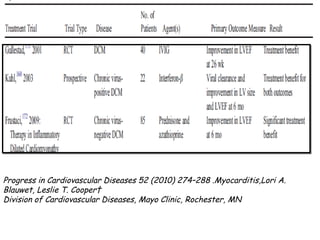
• T/t with interferon b resulted in the elimination of 
the viral genomes and improved LVEF is in trials 
Kuhl U, Pauschinger M, Schwimmbeck PL, et al. Interferon- b treatment 
eliminates cardiotropic viruses and improves LVF in patients with 
myocardial persistence of viral genomes and left ventricular dysfunction. 
Circulation 2003;107:2793
Immunosuppressive therapy 
• Prednisone (2 mg/kg daily, tapered to 0.3 mg/kg 
daily over a period of 3 mo) 
• Reduce myocardial inflammation and improvedcardiac 
function. 
• Relapse -in some patient on discontinuation 
• Beneficial in treating patients with chronic DCM 
unresponsive to standard heart failure therapy. 
Nelson Textbook of Pediatrics, 18th ed.
• Prednisolone given 3-month duration 
•44 prednisolone group & control group of 
24children. 
•Prednisolone-treated group increased EF > 40% 
• Prednisolone improved EF and cure in persistent 
LVF 
Acute Viral Myocarditis: Role of Immunosuppression: A Prospective 
Randomised Study Kalim U. Aziz; Najma Patel; et al Cardiology in the 
Young Vol: 20, No: 5, October, 8 2010
Role of iv Ig 
•No randomized controlled trials in children 
•Case series shown that use of high-dose IVIG 
improved recovery of left ventricular function and 
better survival. 
• Routine use of IVIG is not recommended in adults 
•Consider in acute myocarditis in children
Intravenous Ig for Severe Acute Myocarditis in 
Children 
• high-dose (2g/kg) IVIG in 13 children 
•12 children treated with only conventional therapy. 
•Both groups had poor LVEF on admission. 
The mortality rate was 8% in the IVIG treated 
children as compared to 46% in controls. 
Anwarul Haque, Samreen Bhatti et al, Indian paediatrics,volume 
46,september17, 2009
 report two children with fulminant myocarditis 
successfully treated with a 10-h infusion of high-dose 
IVIG.
I.V Ig inT/t of Acute Myocarditis in the 
Pediatric Population 
•IVIG is a/w improved recovery of left vent. 
function 
•Better survival during the first year 
Nancy A. Drucker, MD; Steven D. Colan, MD; 
(Circulation. 1994;89:252-257.)
•Patients with recent-onset DCM IVIG does not 
augment the improvement in LVEF . 
• LVEF improved significantly during follow-up. 
Controlled Trial of Intravenous Immune Globulin in recent- 
Onset Dilated Cardiomyopathy. Dennis M. McNamara, MD; 
Richard Holubkov, PhD; Randall C. Starling, MD; G. William 
Dec, MD Circulation. 2001;103:2254-2259.)
•Lupus Myocarditis: Marked Improvement in Cardiac 
Function after IVIg Therapy 
• 18-year-old man of active lupus with worse cardiac systolic 
function who did not respond to pulse 
methylprednisolone and cyclophosphamide, 
•Improved cardiac function after IVIg 
• IVIg -dermatomyositis/polymyositis, Kawasaki dis, and viral 
myocarditis 
Vikas Suri; S.Verma; Sanjay Jain etal PGIMER chandigarh 
Rheumatology International Vol: 30, No:11, September, 2010
Ant arrhythmic treatment 
•AV block & tachyarrhythmias treated with approp. 
medications 
• Placement of a temporary or permanent pacemaker 
•Arrhythmias resolve after several weeks. 
• Symptomatic or sustained vent tachycardia require 
antiarrhythmic therapy or 
• Implantable cardioverter-defibrillator or cardiac 
transplantation if arrhythmias persist after the 
acute inflammatory phase.
Patient with myocarditis 
Stablize 
with 
diuretics/vas 
odilator 
Inotrope/balloon 
pump/VAD 
Remodelling 
therapy(ACE/ARB-, 
BETA BLOCKER 
Immune Rx, consider bx, 
Steroids/azathiopri/IFs 
F/U repeat echo 
If LVEF <35%- 
CONSIDER AICD 
Cardiac transplantation 
Mechanical assist 
unstable 
stable 
stable 
unstable 
unstable 
unstable 
stable
FUTURE TRENDS 
•Sophora flavescens (SF) - viral hepatitis, cancer, viral 
myocarditis, gastrointestinal hemorrhage, and skin disease 
•SF up-regulates CYP3A expression. 
• Cetirizine- beneficial in viral myocarditis by suppressing 
expression of pro-inflammatory cytokines 
•Antiviral Effect of Bosentan and Valsartan during 
Coxsackievirus B3 Infection of Human Endothelial Cells 
•CAR-downregulation in human umbilical vein endothelial cells 
(HUVEC) & helpful in viral myocarditis 
•Cinnamaldehyde has antiviral effects on VMC & 
directly reduces the inflammation by inhibiting the 
TLR4
Physical activity 
• Withdraw from competitive sports & vigorous 
exercise >6months or longer 
OR 
• Recovery of left ventricular function. 
Moss and Adams' Heart Disease in Infants, Children, and 
Adolescents: Including the Fetus and Young Adults, 7th Edition
Prognosis 
• fulm myocarditis-excellent long-term prognosis 
complete recovery of LVF than patients with acute 
myocardit- after acute phase over 
• 70 children with acute myocarditis 
- 73%had histologic resolution of myocarditis at 6 
month 
- 96% survived to 1 year 
Moss and Adams' Heart Disease in Infants, Children, and Adolescents: Including 
the Fetus and Young Adults, 7th Edition
Outcome of acute fulminant myocarditis in children 
•Diagnostic criteria- +sence of severe and acute heart failure; 
-LV dysfunction on echo 
- recent history of viral illness 
-no history of cardiomyopathy. 
•Results: 11 pt from 1998 to 2003, median age 0 to 9 yr. 
•LVEF was 22 at presentation 
• Inotropic support required in 9 pt & 8 ventilated. 
• All patients received corticosteroid, IVIg in seven. 
•5 pt had arrest & revived in four. 
•F/U of 58.7 (33.8–83.1) months 
• 10 survivors are asymptomatic with normal LVEF 
Heart 2006;92:1269-1273
Prognosis….. 
With severe left ventricular dysfunction 
-25% progress to transplantation 
-50% develop chronic DCM 
- 25% recover spontaneously 
• 41 children with acute myocarditis treated with 
immunosuppressive Rx, 
• At 5 years, 3/4 th patients had complete recovery 
• 1/4th died or required cardiac transplantation 
Gagliardi MG, Bevilacqua M, Bassano C, et al: Long term followup of children with 
myocarditis treated by immunosuppression and of children with dilated 
cardiomyopathy. Heart (British CardiacSociety) 2004;90:1167-1171.
THANKS
Taylor and Jennifer J. Kimberly Haladyn, Alejandro Floh, Joel A. Kirsh, Glenn 
Pediatrics 2007;120;1278-1285 
,
MOST COMMON 
• Viral- Adenovirus 9% to 39% of cases. 
• Enterovirus 71 (coxsackie B) hepatitis C 
virus,herpes viruses (HHV-6) HIV,Parvovirus B 19 
• BACTERIAL-Coryne. Diphtheriae, Mycobac. 
tuberculosis Strept A,Strept. pneumoniae 
• Spirochetal: Borrelia burgdorferi 
• Hypoxia, hypothermia in neonates 
Moss and Adams' Heart Disease in Infants, Children, and Adolescents: 
Including the Fetus and Young Adults, 7th Edition
Progress in Cardiovascular Diseases 52 (2010) 274–288 .Myocarditis,Lori A. 
Blauwet, Leslie T. Cooper† 
Division of Cardiovascular Diseases, Mayo Clinic, Rochester, MN

Myocarditis in children

  • 1.
    MYOCARDITIS IN CHILDREN Dr. Pradeep Singh
  • 2.
    TO BE COVER….. • DEFINITION • EPIDEMIOLOGY AND ETIOLOGY • PATHOPHYSIOLOGY • CLINICAL PRESENTATION • DIFFERENTIAL DIAGNOSIS • DIAGNOSIS • TREATMENT • PROGNOSIS
  • 3.
    definition • Acutemyocarditis -inflammation, necrosis, or myocytolysis and caused by many infectious, conn. tissue, granulomatous, toxic, or idiopathic processes affecting the myocardium with or without associated systemic manifest of the disease process or involvement of the endocardium or pericardium Nelson Textbook of Pediatrics, 18th ed. • Acute fulm myocarditis - myocellular necrosis, lead to sudden onset of heart failure, arrhythmia and sudden death
  • 4.
    Epidemiology •True incidenceis difficult to determine •Incidence of biopsy documented myocarditis in patients with unexplained heart failure is 9.6%. Progress in Cardiovascular Diseases 52 (2010) 274–288 • 29 children with DCM -38% have histopatho evidence of ‘definite’ or -borderline’ myocarditis accord to the Dallas criteria. Cardiac symposium on Viral myocarditis in childhood:Juan Pablo Kaski , Michael Burch
  • 5.
  • 7.
    Adenovirus - commoncause of myocarditis • 624 patients with -biopsy-proven myocarditis (66%) -borderline myocarditis (34%). - viral genome of adenovirus -enterovirus -cmv in dec freq • detected in 239 (38%) Bowles NE, et al Detection of viruses in myocardial tissues by PCR: J Am Coll Cardiol. 2003;42:466–472.
  • 8.
    DENGUE VIRUS –CAUSE OF MYOCARDITIS • DHF/DSS- poor LVEF • Worsened by the hypotension and shock • Sinus node dysfunction reported Wali JP, Biswas A, Chandra S, Malhotra A, Aggarwal P, Handa R, et al. Cardiac involvement in dengue haemorrhagic fever. Int J Cardiol 1998;64:31-
  • 9.
    RISK FACTORS •Increased risk of virus-induced myocarditis • The course is hyperacute – Young males – pregnant women – children ( neonates) – immunocompromised patients – selenium deficiency -vitamin E deficiency Beck MA, Levander OA, Handy J: Selenium deficiency and viral infection. J Nutr 2003;133(5 Suppl 1):1463-1467
  • 10.
  • 12.
    Toxins & hypersensitivityreactions • Direct toxic effect on the heart or by hypersensitivity reactions •Hypersensitivity reactions – eosinophilic myocarditis •Responds to withdrawal of the offending medication
  • 13.
    myocardial injury cardiacenlargement and an inc. in the vent end-diastolic volu. myocardium is unable to respond to these stimuli reduced cardiac output Moss and Adams' Heart Disease in Infants, Children, and Adolescents: Including the Fetus and Young Adults, 7th Edition
  • 14.
    Preserve systemic bloodflow via vasoconstriction & elevated afterload. intact sympathetic nervous system input tachycardia and diaphoresis,CHF prog ventricular end-diastolic volu left atrial pres pulmonary edema.
  • 15.
    Concomitantly All cardiacchambers dilate(LV) Dilation causes poor ventricular function Worsening pulmonary edema & cardiac function. Stretching of the mitral annulus & mitral regurg Further increasing left atrial volume & pressure Moss and Adams' Heart Disease in Infants, Children, and Adolescents: Including the Fetus and Young Adults, 7th Edition
  • 16.
    Clinical features •Presentation in children varies according to age. • Lesser the age ,poor prognosis • Newborns or infants- poor appetite, fever, irritability or listlessness • Pallor and diaphoresis,Sudden death • Mild cyanosis to sympts of CHF
  • 17.
    Children and Adolescents • Recent history of viral disease 10 to 14 days prior to presentation •Lethargy, low-grade fever, pallor decreased appetite • Diaphoresis, palpitations, rashes, exercise intolerance •Raised JVP,Rales,with resting techycardia • Respiratory symptoms become predominant; syncope or sudden death Moss and Adams' Heart Disease in Infants, Children, and Adolescents: Including the Fetus and Young Adults, 7th Edition
  • 18.
    • Presentation atthe emerg. department -Respiratory distress (68%); -Tachycardia (58%) - Lethargy (39%) -Hepatomegaly (36%) -Abnormal heart sounds, murmur (32%); -Fever (30%) Progress in Cardiovascular Diseases 52 (2010) 274–288 Lori A. Blauwet, Leslie T. Cooper† Division of Cardiovascular Diseases, Mayo Clinic, Rochester, MN
  • 19.
  • 20.
    Newborn and InfantChild • Sepsis • Hypoxia • Hypoglycemia • Hypocalcemia • Idiopathic dialated cardiomyopathy • Endocardial fibroelastosis • Anomalous left coronary artery from Pulm artery • Idiopathic dilated cardiomyopathy • X-linked dilated cardiomyopathy • Autosomal dominant dilated cardiomyopathy • Endocardial fibroelastosis • Chronic tachyarrhythmia • Pericarditis • Cerebral arteriovenous malformation
  • 21.
    Laboratory • CBC,Blood c/s • E.S.R, C-reactive protein and leukocyte count are elevated BUT nonspecific • (TnI) or troponin T (TnT) are more common than inc.CPK-MB with acute myocarditis • In children, TnT have a specificity of 83% and a sensitivity of 71% • Higher levels of TnT poor prognostic marker • Viral serology n viral PCR Myocarditis Lori A. Blauwet, Leslie T. Cooper† Division of Cardiovascular Diseases, Mayo Clinic, Rochester, MN
  • 22.
    VIRAL GENOMES INTRACHEAL SECRETION DISEASE NO. OF SAMPLES NO. OF POSITIVE PCR SAMPLES NO. OF PCR AMPLIMERS MYOCARDITIS 624 239(38%) Adenovirus 142 (23%) Enterovirus 85 (14%) CMV 18 (3%) Parvovirus 6 (<1%) Influenza A 5 (<1%) HSV 5 (<1%) EBV 3 (<1%) DCM 149 30(20%) RASdeVn 1o v(<ir1u%s) 18 (12%) Enterovirus 12 (8% CONTROLS 215 3(1.4%) Enterovirus 1 (<1%) CMV 2 (<1%) Moss and Adams' Heart Disease in Infants, Children, and Adolescents: Including the Fetus and Young Adults, 7th Edition
  • 23.
    newer markers serum Fas and Fas ligand on initial presentation asso.with increased mortality  IL-10 has a poor prognosis in fulminant myocarditis Progress in Cardiovascular Diseases 52 (2010) 274–288 .Myocarditis,Lori A. Blauwet, Leslie T. Cooper† Division of Cardiovascular Diseases, Mayo Clinic, Rochester, MN
  • 24.
    Electrocardiogram • Sensitivityis only 47% • Findings are nonspecific - PR depression, -Pathologic Q waves. -ST-segment elevation/ depression -T-wave changes • Low QRS voltages (< 5mm in any precordial lead) • New-onset supraventricular or ventricular arrhythmias in up to 55%
  • 25.
    Chest x-ray •Cardiomegaly due to chamber dilatation, pericardial effusion or both. • Pulmonary venous congestion, interstitial infiltrates • Pleural effusions.
  • 27.
    Echocardiography • Chambersize, wall thickness,systolic diastolic functions & intracavitary thrombi • Rule out other causes of heart failure • LV systolic dysfunction is common • Rt ventricular dysfunction is relatively uncommon • Rt vent dysfunction most powerful predictor of death or need for cardiac transplantation in a series of 23 patients with biopsy-confirmed myocarditis Mendes LA, Dec GW, Picard MH, et al: Right ventricular dysfunction: an independent predictor of adverse outcome inpatients with myocarditis. Am Heart J 1994;128:301-307.
  • 28.
    • Segmental orglobal wall motion abnormalities • Diastolic filling patterns are abnormal Moss and Adams' Heart Disease in Infants, Children, and Adolescents: Including the Fetus and Young Adults, 7th Edition
  • 29.
    Cardiac MRI •Intracellular and interstitial edema,hyperemia and capillary leakage,necrosis and fibrosis • symptomatic patients with clinical suspicion of myocarditis • Diagnostic accuracy of 78%
  • 30.
    Proposed cardiac MRIdiagnostic criteria for myocarditis(Lake Louise Criteria ) A. In clinically suspected myocarditis-consistent with myocardial inflammation if at least 2 of the following criteria are present: 1.Regional or global myocardial signal intensity increase in T2- weighted images 2. Increased global myocardial early enhancement ratio between myocardium and skeletal muscle in gadolinium-enhanced T1-weighted images 3. There is at least 1 focal lesion with non ischemic regional distribution in inversion recovery-prepared gadolinium-enhanced T1-weighted images (delayed enhancement) Progress in Cardiovascular Diseases 52 (2010) 274–288 .Myocarditis,Lori A. Blauwet, Leslie T. Cooper†
  • 31.
    Lake Louise Criteriacontd.. • B. Cardiac MRI study is consistent with myocyte injury and/or scar caused by myocardial inflammation if criterion 3 is present • C. A repeat cardiac MRI study between 1 to 2 weeks after the initial,cardiac MRI study is recommended if • None of the criteria are present, but onset of symptoms is very recent and there is strong clinical evidence for myocardial inflammation One of the criteria is present • D. The presence of LV dysfunction or pericardial effusion provides additional supportive evidence for myocarditis
  • 32.
    Endomyocardial biopsy •Recommended in--- 1. Fulminant myocarditis- unexplained new-onset CHF symptoms < 2 weeks in duration a/w - normal sized or dilated left ventricle -hemodynamic compromise 2.Unexplained new onset CHF symptoms 2 weeks to 3 months in duration a/w with a -dilated left ventricle -new ventricular arrhythmias, -high-degree AV heart block, or -failure to respond to usual care within 1 to 2 weeks
  • 33.
    The Dallas criteria(1986)-based on the presence of histological evidence Four types of myocarditis are recognised: Active myocarditis- the presence of both myocyte degeneration or necrosis and definite cellular infiltrate, with or without fibrosis; Borderline myocarditis-when there is a definite cellular infiltrate but no evidence of myocyte injury; Persistent myocarditis- continued active myocarditis on repeat EMB; Resolving/resolved myocarditis, determined by diminished or absent infiltrate with evidence of connective tissue healing
  • 34.
    LIMITATIONS OF DALLASCRITERIA • Lack of prognostic value • Discrepancy with other markers of viral infection and immune activation in the myocardium, • Low sensitivity that is at least partly due to sampling error
  • 35.
    World Health Organization (Marburg) Classification Cooper LT Jr. Myocarditis. N Engl J Med. 2009 Apr 9;360(15):1526-38.
  • 36.
    First biopsy: •Acute(active) myocarditis: a clear-cut infiltrate (diffuse, focal or confluent) of >14 leukocytes/mm Infiltrate quantified by immunohistochemistry. Necrosis or degeneration is compulsory; • fibrosis- absent or present and should be graded. •Chronic myocarditis: Infiltrate of >14 leukocytes/mm2 (diffuse, focal or confluent), Quantified by immunohistochemistry. Necrosis or degeneration not + usually. •No myocarditis: No infiltrating cells or <14 leukocytes/mm2.
  • 37.
    Subsequent biopsies: •Ongoing(persistent) myocarditis. Criteria as in acute or chronic myocarditis •Resolving (healing) myocarditis. Criteria as in acute or chronic myocarditis, but the immunologic process is sparser than in the first biopsy. •Resolved (healed) myocarditis. Corresponds to the Dallas classification
  • 38.
    Expanded criteria fordiagnosis of myocarditis •Suspected= 2 positive categories •Compatible = 3 positive categories •High probability = all 4 categories positive. NOTE: Any matching feature in category = positive for category Category I: symptoms: •Clinical heart failure •Fever •Viral prodrome •Fatigue •Dyspnoea on exertion •Chest pain •Palpitations •Pre-syncope or syncope
  • 39.
    Category II: evidenceof cardiac structural/functional perturbation in the absence of regional coronary ischaemia •Echo evidence •Regional wall motion abnormalities •Cardiac dilation •Regional cardiac hypertrophy •Troponin release •Troponin result has high sensitivity (>0.1 nanogram/mL) •+ve indium-111 antimyosin scintigraphy and normal coronary angiography or -sence of reversible ischaemia on perfusion scan
  • 40.
    Category III: cardiacMRI •Increased myocardial T2 signal on inversion recovery sequence •Delayed contrast enhancement following gadolinium- DTPA infusion. Category IV: myocardial biopsy, pathologic or molecular analysis •Pathology findings compatible with Dallas criteria •Presence of viral genome by PCR or in situ hybridisation.
  • 41.
  • 42.
    •Stabilze the patient-ABC •Any previously well child with a viral prodrome and non-specific organ dysfunction • A/w dysrhythmias, shock or acute heart failure •Even in the absence of cardiomegaly Early mechanical support can be very favourable •Delay in diagnosis may result in poor outcome. The Challenges of Prompt Identification and Resuscitation in Children with Acute Fulminant Myocarditis: Geethanjali Ramachandra; Lynn Shields et al Journal of Paediatrics and Child Health Vol: 46, No: 10, October, 2010
  • 43.
    Heart failure therapy • Ac. myocarditis - standard heart failure therapy - diuretics-furosemide -ACE Inhibitor -captopril (1 to 3 mg/kg/dX8hrly ) enalapril (0.2 mg/kg/d x 12h) • Introduction of β-blockers such as bisoprolol, metoprolol or carvedilol in clinically stable • Digoxin should be used with caution and only in low doses in patients with viral myocarditis Braunwald's Heart Disease: A Textbook of Cardiovascular Medicine, 8th ed.
  • 44.
    Antiviral therapy •Data in humanbeing not available • In the single case series of antiviral therapy use in humans with fulminant myocarditis, ribavirin therapy did not prove effective • T/t with interferon b resulted in the elimination of the viral genomes and improved LVEF is in trials Kuhl U, Pauschinger M, Schwimmbeck PL, et al. Interferon- b treatment eliminates cardiotropic viruses and improves LVF in patients with myocardial persistence of viral genomes and left ventricular dysfunction. Circulation 2003;107:2793
  • 45.
    Immunosuppressive therapy •Prednisone (2 mg/kg daily, tapered to 0.3 mg/kg daily over a period of 3 mo) • Reduce myocardial inflammation and improvedcardiac function. • Relapse -in some patient on discontinuation • Beneficial in treating patients with chronic DCM unresponsive to standard heart failure therapy. Nelson Textbook of Pediatrics, 18th ed.
  • 46.
    • Prednisolone given3-month duration •44 prednisolone group & control group of 24children. •Prednisolone-treated group increased EF > 40% • Prednisolone improved EF and cure in persistent LVF Acute Viral Myocarditis: Role of Immunosuppression: A Prospective Randomised Study Kalim U. Aziz; Najma Patel; et al Cardiology in the Young Vol: 20, No: 5, October, 8 2010
  • 47.
    Role of ivIg •No randomized controlled trials in children •Case series shown that use of high-dose IVIG improved recovery of left ventricular function and better survival. • Routine use of IVIG is not recommended in adults •Consider in acute myocarditis in children
  • 48.
    Intravenous Ig forSevere Acute Myocarditis in Children • high-dose (2g/kg) IVIG in 13 children •12 children treated with only conventional therapy. •Both groups had poor LVEF on admission. The mortality rate was 8% in the IVIG treated children as compared to 46% in controls. Anwarul Haque, Samreen Bhatti et al, Indian paediatrics,volume 46,september17, 2009
  • 49.
     report twochildren with fulminant myocarditis successfully treated with a 10-h infusion of high-dose IVIG.
  • 50.
    I.V Ig inT/tof Acute Myocarditis in the Pediatric Population •IVIG is a/w improved recovery of left vent. function •Better survival during the first year Nancy A. Drucker, MD; Steven D. Colan, MD; (Circulation. 1994;89:252-257.)
  • 51.
    •Patients with recent-onsetDCM IVIG does not augment the improvement in LVEF . • LVEF improved significantly during follow-up. Controlled Trial of Intravenous Immune Globulin in recent- Onset Dilated Cardiomyopathy. Dennis M. McNamara, MD; Richard Holubkov, PhD; Randall C. Starling, MD; G. William Dec, MD Circulation. 2001;103:2254-2259.)
  • 52.
    •Lupus Myocarditis: MarkedImprovement in Cardiac Function after IVIg Therapy • 18-year-old man of active lupus with worse cardiac systolic function who did not respond to pulse methylprednisolone and cyclophosphamide, •Improved cardiac function after IVIg • IVIg -dermatomyositis/polymyositis, Kawasaki dis, and viral myocarditis Vikas Suri; S.Verma; Sanjay Jain etal PGIMER chandigarh Rheumatology International Vol: 30, No:11, September, 2010
  • 53.
    Ant arrhythmic treatment •AV block & tachyarrhythmias treated with approp. medications • Placement of a temporary or permanent pacemaker •Arrhythmias resolve after several weeks. • Symptomatic or sustained vent tachycardia require antiarrhythmic therapy or • Implantable cardioverter-defibrillator or cardiac transplantation if arrhythmias persist after the acute inflammatory phase.
  • 54.
    Patient with myocarditis Stablize with diuretics/vas odilator Inotrope/balloon pump/VAD Remodelling therapy(ACE/ARB-, BETA BLOCKER Immune Rx, consider bx, Steroids/azathiopri/IFs F/U repeat echo If LVEF <35%- CONSIDER AICD Cardiac transplantation Mechanical assist unstable stable stable unstable unstable unstable stable
  • 55.
    FUTURE TRENDS •Sophoraflavescens (SF) - viral hepatitis, cancer, viral myocarditis, gastrointestinal hemorrhage, and skin disease •SF up-regulates CYP3A expression. • Cetirizine- beneficial in viral myocarditis by suppressing expression of pro-inflammatory cytokines •Antiviral Effect of Bosentan and Valsartan during Coxsackievirus B3 Infection of Human Endothelial Cells •CAR-downregulation in human umbilical vein endothelial cells (HUVEC) & helpful in viral myocarditis •Cinnamaldehyde has antiviral effects on VMC & directly reduces the inflammation by inhibiting the TLR4
  • 56.
    Physical activity •Withdraw from competitive sports & vigorous exercise >6months or longer OR • Recovery of left ventricular function. Moss and Adams' Heart Disease in Infants, Children, and Adolescents: Including the Fetus and Young Adults, 7th Edition
  • 57.
    Prognosis • fulmmyocarditis-excellent long-term prognosis complete recovery of LVF than patients with acute myocardit- after acute phase over • 70 children with acute myocarditis - 73%had histologic resolution of myocarditis at 6 month - 96% survived to 1 year Moss and Adams' Heart Disease in Infants, Children, and Adolescents: Including the Fetus and Young Adults, 7th Edition
  • 58.
    Outcome of acutefulminant myocarditis in children •Diagnostic criteria- +sence of severe and acute heart failure; -LV dysfunction on echo - recent history of viral illness -no history of cardiomyopathy. •Results: 11 pt from 1998 to 2003, median age 0 to 9 yr. •LVEF was 22 at presentation • Inotropic support required in 9 pt & 8 ventilated. • All patients received corticosteroid, IVIg in seven. •5 pt had arrest & revived in four. •F/U of 58.7 (33.8–83.1) months • 10 survivors are asymptomatic with normal LVEF Heart 2006;92:1269-1273
  • 59.
    Prognosis….. With severeleft ventricular dysfunction -25% progress to transplantation -50% develop chronic DCM - 25% recover spontaneously • 41 children with acute myocarditis treated with immunosuppressive Rx, • At 5 years, 3/4 th patients had complete recovery • 1/4th died or required cardiac transplantation Gagliardi MG, Bevilacqua M, Bassano C, et al: Long term followup of children with myocarditis treated by immunosuppression and of children with dilated cardiomyopathy. Heart (British CardiacSociety) 2004;90:1167-1171.
  • 60.
  • 61.
    Taylor and JenniferJ. Kimberly Haladyn, Alejandro Floh, Joel A. Kirsh, Glenn Pediatrics 2007;120;1278-1285 ,
  • 62.
    MOST COMMON •Viral- Adenovirus 9% to 39% of cases. • Enterovirus 71 (coxsackie B) hepatitis C virus,herpes viruses (HHV-6) HIV,Parvovirus B 19 • BACTERIAL-Coryne. Diphtheriae, Mycobac. tuberculosis Strept A,Strept. pneumoniae • Spirochetal: Borrelia burgdorferi • Hypoxia, hypothermia in neonates Moss and Adams' Heart Disease in Infants, Children, and Adolescents: Including the Fetus and Young Adults, 7th Edition
  • 64.
    Progress in CardiovascularDiseases 52 (2010) 274–288 .Myocarditis,Lori A. Blauwet, Leslie T. Cooper† Division of Cardiovascular Diseases, Mayo Clinic, Rochester, MN