VALVULAR HEART DISEASES

8/1/2014
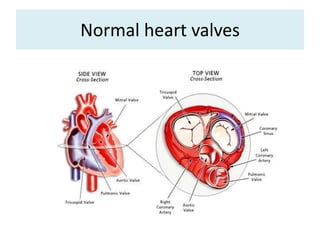
Normal heart valves
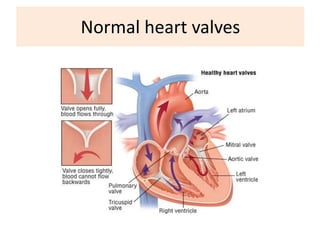
Normal heart valves
Valvular heart disease

• A major group of cardiac pathology affecting
cardiac valves.
Clinical consequences
1. Stenosis – failure of a valve to open completely,
obstructing forward flow.
2. Insufficiency (regurgitation ) - failure of a valve to

close completely, allowing (backflow) of blood.

Stenosis or regurgitation can occur alone or together in
the same valve.
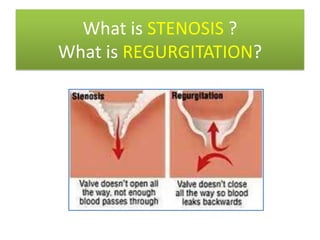
What is STENOSIS ?
What is REGURGITATION?
Clinical consequences
• Abnormal flow through diseased valves - produces
abnormal heart sounds (murmurs)
• severe lesions can even be palpated as thrills.
• severity - quality and timing of the murmur
(e.g., harsh systolic or soft diastolic murmurs)
Valvular heart disease

Types
1. Congenital valvular heart diseases
2. Acquired valvular heart diseases
Congenital valvular heart diseases
 most common – bicuspid aortic valve
• neither stenotic nor incompetent through early life
• more prone to early and progressive degenerative
calcification
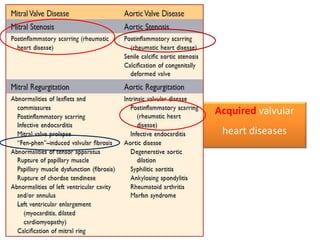
Acquired valvular
heart diseases
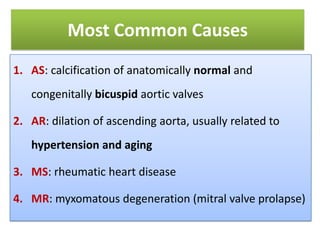
Most Common Causes
1. AS: calcification of anatomically normal and
congenitally bicuspid aortic valves
2. AR: dilation of ascending aorta, usually related to
hypertension and aging

3. MS: rheumatic heart disease
4. MR: myxomatous degeneration (mitral valve prolapse)
Aortic stenosis

Most common cause –

calcification of
1.

anatomically normal (senile calcific aortic stenosis) and

2.

congenitally bicuspid aortic valves
Pathogenesis
• Degenerative changes due to aging process (wear and tear)
• Repetitive mechanical stresses to valves —40 million
beats/yr
• chronic injury due to hyperlipidemia, hypertension,
inflammation, atherosclerosis leads to .......

• dystrophic calcification (deposits of calcium phosphate salts)
• Normal valves - Senile calcific aortic stenosis >70 yrs

• Bicuspid valves – more stress – earlier calcification <50 yrs
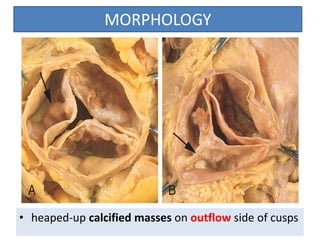
MORPHOLOGY

• heaped-up calcified masses on outflow side of cusps
Clinical Features
• gradual narrowing of the valve orifice ( 0.5 to 1 cm2 in severe
AS ; normal, ∼4 cm2 )
• Left ventricular pressures - > 200 mm Hg

• Pressure overload  concentric LVH
• hypertrophied myocardium -prone to ischemia and angina
• Systolic and diastolic dysfunction – CHF
calcific aortic stenosis
Prognosis

• Asymptomative at earlier stage – excellent
• Late stage - development of angina, CHF, or syncope
 poor prognosis
• without surgical intervention, 50% to 80% die within 2
to 3 years
Most Common Causes
1. AS: calcification of anatomically normal and
congenitally bicuspid aortic valves
2. AR: dilation of ascending aorta, usually related to
hypertension and aging

3. MS: rheumatic heart disease
4. MR: myxomatous degeneration (mitral valve prolapse)
Myxomatous Mitral Valve
• Mitral prolapse - parachute-like protrusion of value into the
left atrium

• “floppy” and prolapse— balloon back into LA during systole.
• Men = women
Two types
1. P
2. Secondary where MR due to others(e.g., IHD).
Myxomatous Mitral Valve
Causes

1. primary myxomatous degeneration
• intrinsic defect of connective tissue synthesis or remodeling
(e.g., Marfan syndrome)

2. Secondary

• results from injury to the valve myofibroblasts, by
chronically aberrant hemodynamic forces
Pathogenesis
 Myxoid degeneration due to accumulation
of glycosaminoglycan, within the connective tissue
matrix of the valve.
 many cases, degeneration limited to mitral valve
 Marfan syndrome - degeneration is more extensive
and involves other heart valves.
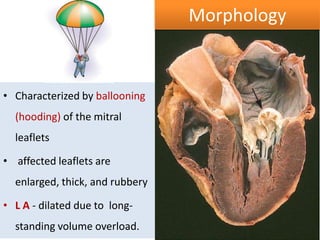
Morphology

• Characterized by ballooning
(hooding) of the mitral
leaflets
• affected leaflets are

enlarged, thick, and rubbery
• L A - dilated due to longstanding volume overload.
Clinical features
• Most – asymptomatic
• minority - palpitations, dyspnea, or atypical chest
pain
• Auscultation - midsystolic click, caused by abrupt

tension on valve leaflets as valve attempts to close
• diagnosis can be confirmed by echocardiography
complications
• 3% - develop complications
(1) IE
(2) MR , sometimes with chordal rupture
(3) stroke or systemic infarct, resulting from embolism
(4) arrhythmias, both ventricular and atrial
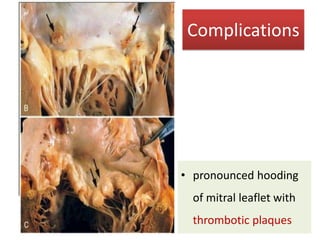
Complications

• pronounced hooding
of mitral leaflet with

thrombotic plaques
Most Common Causes
1. AS: calcification of anatomically normal and
congenitally bicuspid aortic valves
2. AR: dilation of ascending aorta, usually related to
hypertension and aging

3. MS: rheumatic heart disease
4. MR: myxomatous degeneration (mitral valve prolapse)
Rheumatic heart disease

1. cardiac manifestation of rheumatic fever.
2. Chronic rheumatic heart disease
Acute Rheumatic Fever
• acute, immunologically mediated, multisystem
inflammatory disease 2- to 3-weeks after group A βhemolytic streptococcal infections (pharyngitis)
• Occurs commonly in children (4 to 9 years)
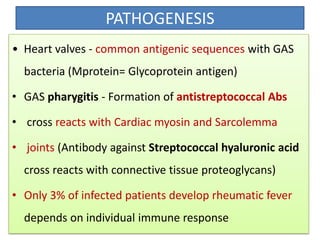
PATHOGENESIS
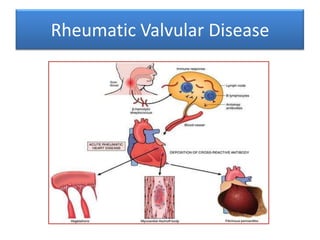
• Heart valves - common antigenic sequences with GAS
bacteria (Mprotein= Glycoprotein antigen)
• GAS pharygitis - Formation of antistreptococcal Abs
• cross reacts with Cardiac myosin and Sarcolemma
• joints (Antibody against Streptococcal hyaluronic acid
cross reacts with connective tissue proteoglycans)
• Only 3% of infected patients develop rheumatic fever

depends on individual immune response
Rheumatic Valvular Disease
Rheumatic heart disease

• Pathological Changes Of Heart In Acute Rhumatic
Fever
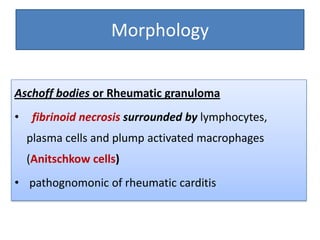
Morphology
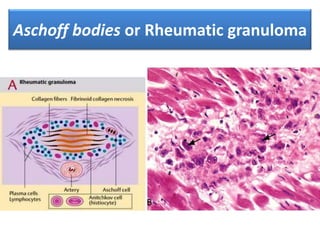
Aschoff bodies or Rheumatic granuloma
•

fibrinoid necrosis surrounded by lymphocytes,

plasma cells and plump activated macrophages
(Anitschkow cells)
• pathognomonic of rheumatic carditis
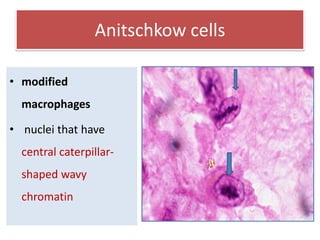
Anitschkow cells
• modified
macrophages
• nuclei that have

central caterpillarshaped wavy
chromatin
Aschoff bodies or Rheumatic granuloma
Morphology

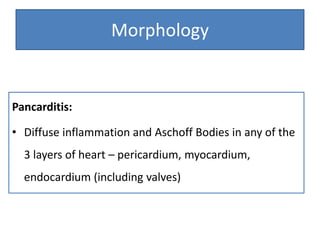
Pancarditis:

• Diffuse inflammation and Aschoff Bodies in any of the
3 layers of heart – pericardium, myocardium,

endocardium (including valves)
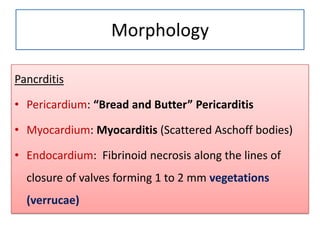
Morphology
Pancrditis
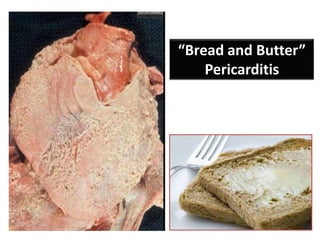
• Pericardium: “Bread and Butter” Pericarditis
• Myocardium: Myocarditis (Scattered Aschoff bodies)
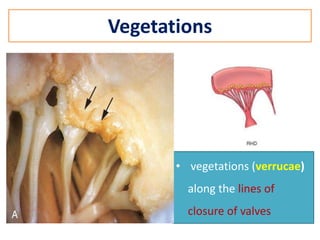
• Endocardium: Fibrinoid necrosis along the lines of
closure of valves forming 1 to 2 mm vegetations
(verrucae)
“Bread and Butter”
Pericarditis
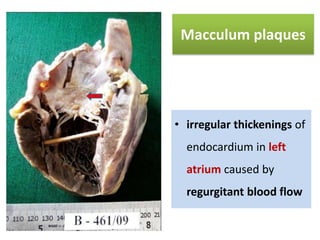
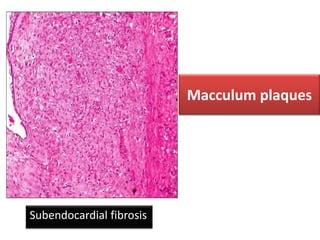
Macculum plaques

• irregular thickenings of
endocardium in left
atrium caused by

regurgitant blood flow
Macculum plaques

Subendocardial fibrosis
Vegetations

• vegetations (verrucae)
along the lines of
closure of valves
Clinical Features of ARF

• Following upper airway infection with GAS
• Silent period of 2 - 3 weeks

• Sudden onset of fever, pallor, malaise, fatigue
Arthritis - occurs in 75%
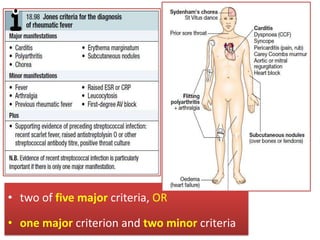
• two of five major criteria, OR
• one major criterion and two minor criteria
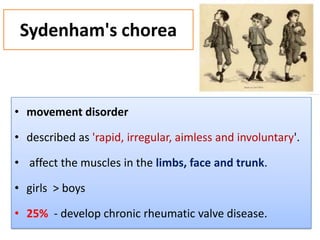
Sydenham's chorea

• movement disorder
• described as 'rapid, irregular, aimless and involuntary'.
• affect the muscles in the limbs, face and trunk.
• girls > boys

• 25% - develop chronic rheumatic valve disease.
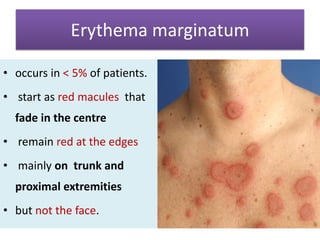
Erythema marginatum
• occurs in < 5% of patients.
• start as red macules that
fade in the centre

• remain red at the edges
• mainly on trunk and

proximal extremities
• but not the face.
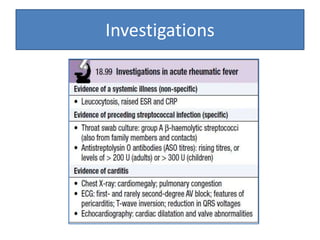
Investigations
Rheumatic heart disease

1. cardiac manifestation of rheumatic fever.
2. Chronic rheumatic heart disease
Chronic rheumatic heart disease
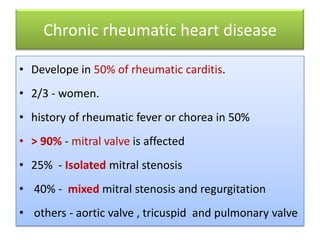
• Develope in 50% of rheumatic carditis.

• 2/3 - women.
• history of rheumatic fever or chorea in 50%

• > 90% - mitral valve is affected
• 25% - Isolated mitral stenosis
• 40% - mixed mitral stenosis and regurgitation
• others - aortic valve , tricuspid and pulmonary valve
Pathogenesis
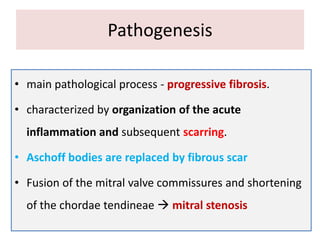
• main pathological process - progressive fibrosis.
• characterized by organization of the acute
inflammation and subsequent scarring.
• Aschoff bodies are replaced by fibrous scar
• Fusion of the mitral valve commissures and shortening
of the chordae tendineae  mitral stenosis
Morphology

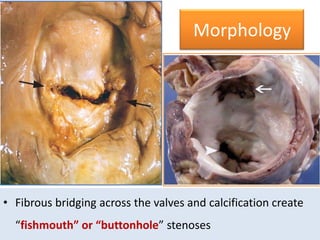
• Fibrous bridging across the valves and calcification create
“fishmouth” or “buttonhole” stenoses
Major causes of death in RHD
 Cardiac failure
• Bacterial Endocarditis

• Embolism
So…………

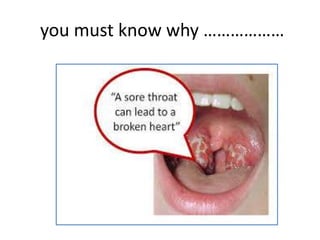
 The first step in preventing Rheumatic fever &
Rheumatic heart disease is to detect & treat
STREPTOCOCCAL PHARYNGITIS.
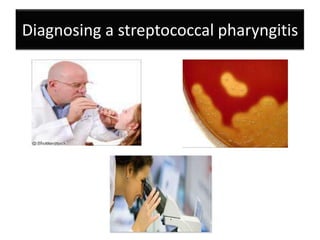
Diagnosing a streptococcal pharyngitis
you must know why ………………
Rheumatic heart disease

Rheumatic heart disease

  • 1.
  • 2.
  • 3.
  • 4.
    Valvular heart disease •A major group of cardiac pathology affecting cardiac valves.
  • 5.
    Clinical consequences 1. Stenosis– failure of a valve to open completely, obstructing forward flow. 2. Insufficiency (regurgitation ) - failure of a valve to close completely, allowing (backflow) of blood. Stenosis or regurgitation can occur alone or together in the same valve.
  • 6.
    What is STENOSIS? What is REGURGITATION?
  • 7.
    Clinical consequences • Abnormalflow through diseased valves - produces abnormal heart sounds (murmurs) • severe lesions can even be palpated as thrills. • severity - quality and timing of the murmur (e.g., harsh systolic or soft diastolic murmurs)
  • 8.
    Valvular heart disease Types 1.Congenital valvular heart diseases 2. Acquired valvular heart diseases
  • 9.
    Congenital valvular heartdiseases  most common – bicuspid aortic valve • neither stenotic nor incompetent through early life • more prone to early and progressive degenerative calcification
  • 10.
  • 11.
    Most Common Causes 1.AS: calcification of anatomically normal and congenitally bicuspid aortic valves 2. AR: dilation of ascending aorta, usually related to hypertension and aging 3. MS: rheumatic heart disease 4. MR: myxomatous degeneration (mitral valve prolapse)
  • 12.
    Aortic stenosis Most commoncause – calcification of 1. anatomically normal (senile calcific aortic stenosis) and 2. congenitally bicuspid aortic valves
  • 13.
    Pathogenesis • Degenerative changesdue to aging process (wear and tear) • Repetitive mechanical stresses to valves —40 million beats/yr • chronic injury due to hyperlipidemia, hypertension, inflammation, atherosclerosis leads to ....... • dystrophic calcification (deposits of calcium phosphate salts) • Normal valves - Senile calcific aortic stenosis >70 yrs • Bicuspid valves – more stress – earlier calcification <50 yrs
  • 14.
    MORPHOLOGY • heaped-up calcifiedmasses on outflow side of cusps
  • 15.
    Clinical Features • gradualnarrowing of the valve orifice ( 0.5 to 1 cm2 in severe AS ; normal, ∼4 cm2 ) • Left ventricular pressures - > 200 mm Hg • Pressure overload  concentric LVH • hypertrophied myocardium -prone to ischemia and angina • Systolic and diastolic dysfunction – CHF
  • 16.
    calcific aortic stenosis Prognosis •Asymptomative at earlier stage – excellent • Late stage - development of angina, CHF, or syncope  poor prognosis • without surgical intervention, 50% to 80% die within 2 to 3 years
  • 17.
    Most Common Causes 1.AS: calcification of anatomically normal and congenitally bicuspid aortic valves 2. AR: dilation of ascending aorta, usually related to hypertension and aging 3. MS: rheumatic heart disease 4. MR: myxomatous degeneration (mitral valve prolapse)
  • 18.
    Myxomatous Mitral Valve •Mitral prolapse - parachute-like protrusion of value into the left atrium • “floppy” and prolapse— balloon back into LA during systole. • Men = women Two types 1. P 2. Secondary where MR due to others(e.g., IHD).
  • 19.
    Myxomatous Mitral Valve Causes 1.primary myxomatous degeneration • intrinsic defect of connective tissue synthesis or remodeling (e.g., Marfan syndrome) 2. Secondary • results from injury to the valve myofibroblasts, by chronically aberrant hemodynamic forces
  • 20.
    Pathogenesis  Myxoid degenerationdue to accumulation of glycosaminoglycan, within the connective tissue matrix of the valve.  many cases, degeneration limited to mitral valve  Marfan syndrome - degeneration is more extensive and involves other heart valves.
  • 21.
    Morphology • Characterized byballooning (hooding) of the mitral leaflets • affected leaflets are enlarged, thick, and rubbery • L A - dilated due to longstanding volume overload.
  • 22.
    Clinical features • Most– asymptomatic • minority - palpitations, dyspnea, or atypical chest pain • Auscultation - midsystolic click, caused by abrupt tension on valve leaflets as valve attempts to close • diagnosis can be confirmed by echocardiography
  • 23.
    complications • 3% -develop complications (1) IE (2) MR , sometimes with chordal rupture (3) stroke or systemic infarct, resulting from embolism (4) arrhythmias, both ventricular and atrial
  • 24.
    Complications • pronounced hooding ofmitral leaflet with thrombotic plaques
  • 25.
    Most Common Causes 1.AS: calcification of anatomically normal and congenitally bicuspid aortic valves 2. AR: dilation of ascending aorta, usually related to hypertension and aging 3. MS: rheumatic heart disease 4. MR: myxomatous degeneration (mitral valve prolapse)
  • 26.
    Rheumatic heart disease 1.cardiac manifestation of rheumatic fever. 2. Chronic rheumatic heart disease
  • 27.
    Acute Rheumatic Fever •acute, immunologically mediated, multisystem inflammatory disease 2- to 3-weeks after group A βhemolytic streptococcal infections (pharyngitis) • Occurs commonly in children (4 to 9 years)
  • 28.
    PATHOGENESIS • Heart valves- common antigenic sequences with GAS bacteria (Mprotein= Glycoprotein antigen) • GAS pharygitis - Formation of antistreptococcal Abs • cross reacts with Cardiac myosin and Sarcolemma • joints (Antibody against Streptococcal hyaluronic acid cross reacts with connective tissue proteoglycans) • Only 3% of infected patients develop rheumatic fever depends on individual immune response
  • 29.
  • 30.
    Rheumatic heart disease •Pathological Changes Of Heart In Acute Rhumatic Fever
  • 31.
    Morphology Aschoff bodies orRheumatic granuloma • fibrinoid necrosis surrounded by lymphocytes, plasma cells and plump activated macrophages (Anitschkow cells) • pathognomonic of rheumatic carditis
  • 32.
    Anitschkow cells • modified macrophages •nuclei that have central caterpillarshaped wavy chromatin
  • 33.
    Aschoff bodies orRheumatic granuloma
  • 34.
    Morphology Pancarditis: • Diffuse inflammationand Aschoff Bodies in any of the 3 layers of heart – pericardium, myocardium, endocardium (including valves)
  • 35.
    Morphology Pancrditis • Pericardium: “Breadand Butter” Pericarditis • Myocardium: Myocarditis (Scattered Aschoff bodies) • Endocardium: Fibrinoid necrosis along the lines of closure of valves forming 1 to 2 mm vegetations (verrucae)
  • 36.
  • 37.
    Macculum plaques • irregularthickenings of endocardium in left atrium caused by regurgitant blood flow
  • 38.
  • 39.
    Vegetations • vegetations (verrucae) alongthe lines of closure of valves
  • 40.
    Clinical Features ofARF • Following upper airway infection with GAS • Silent period of 2 - 3 weeks • Sudden onset of fever, pallor, malaise, fatigue Arthritis - occurs in 75%
  • 41.
    • two offive major criteria, OR • one major criterion and two minor criteria
  • 42.
    Sydenham's chorea • movementdisorder • described as 'rapid, irregular, aimless and involuntary'. • affect the muscles in the limbs, face and trunk. • girls > boys • 25% - develop chronic rheumatic valve disease.
  • 43.
    Erythema marginatum • occursin < 5% of patients. • start as red macules that fade in the centre • remain red at the edges • mainly on trunk and proximal extremities • but not the face.
  • 44.
  • 45.
    Rheumatic heart disease 1.cardiac manifestation of rheumatic fever. 2. Chronic rheumatic heart disease
  • 46.
    Chronic rheumatic heartdisease • Develope in 50% of rheumatic carditis. • 2/3 - women. • history of rheumatic fever or chorea in 50% • > 90% - mitral valve is affected • 25% - Isolated mitral stenosis • 40% - mixed mitral stenosis and regurgitation • others - aortic valve , tricuspid and pulmonary valve
  • 47.
    Pathogenesis • main pathologicalprocess - progressive fibrosis. • characterized by organization of the acute inflammation and subsequent scarring. • Aschoff bodies are replaced by fibrous scar • Fusion of the mitral valve commissures and shortening of the chordae tendineae  mitral stenosis
  • 48.
    Morphology • Fibrous bridgingacross the valves and calcification create “fishmouth” or “buttonhole” stenoses
  • 49.
    Major causes ofdeath in RHD  Cardiac failure • Bacterial Endocarditis • Embolism
  • 50.
    So…………  The firststep in preventing Rheumatic fever & Rheumatic heart disease is to detect & treat STREPTOCOCCAL PHARYNGITIS.
  • 51.
  • 52.
    you must knowwhy ………………

Editor's Notes

  • #11 fenfluramine/phentermine