The Building Site Professor Richard Luxenburg, AIA Department of Architecture and Interior Design Anne Arundel Community College ACH 121  Materials and Methods of Construction 1
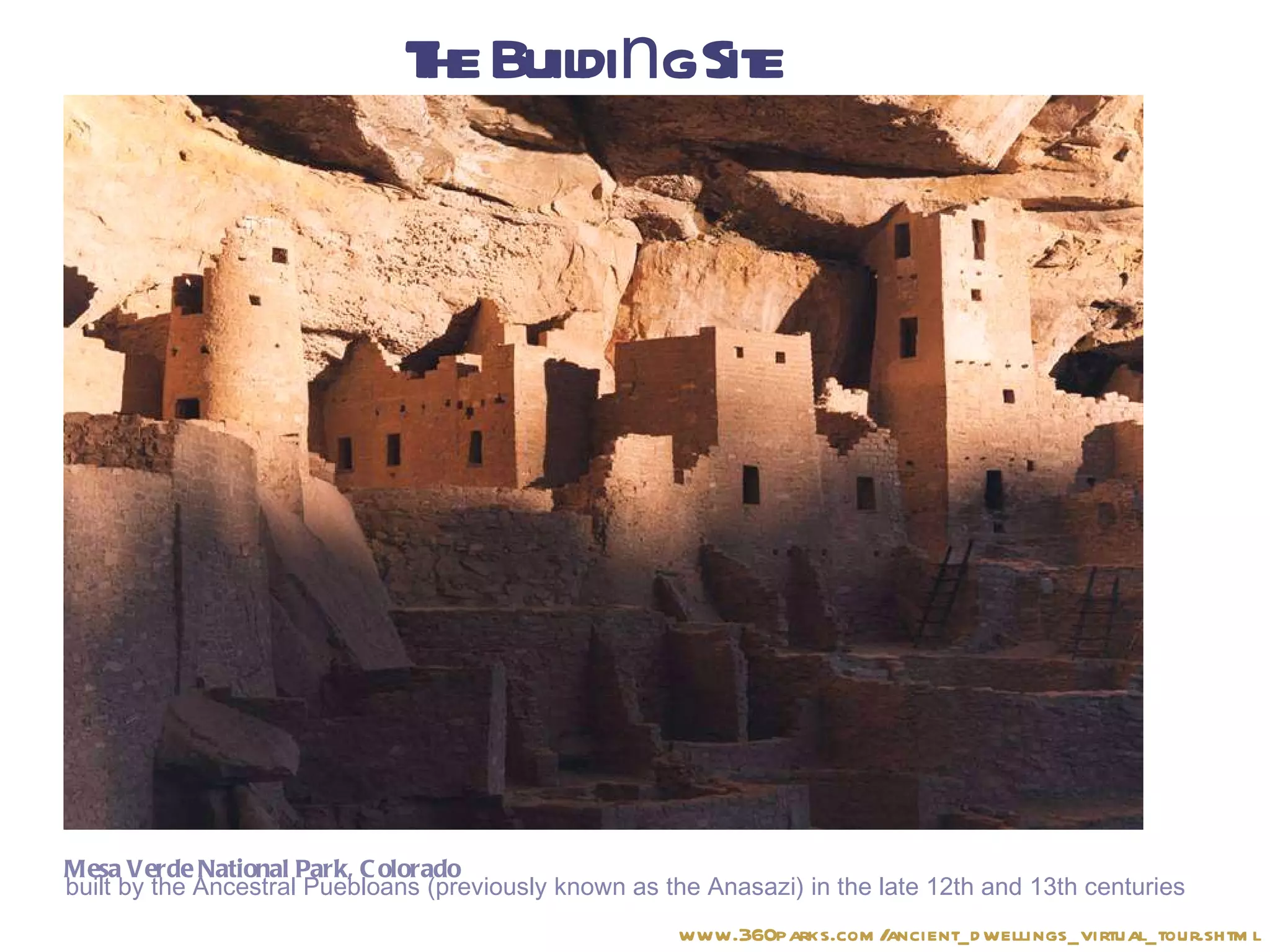
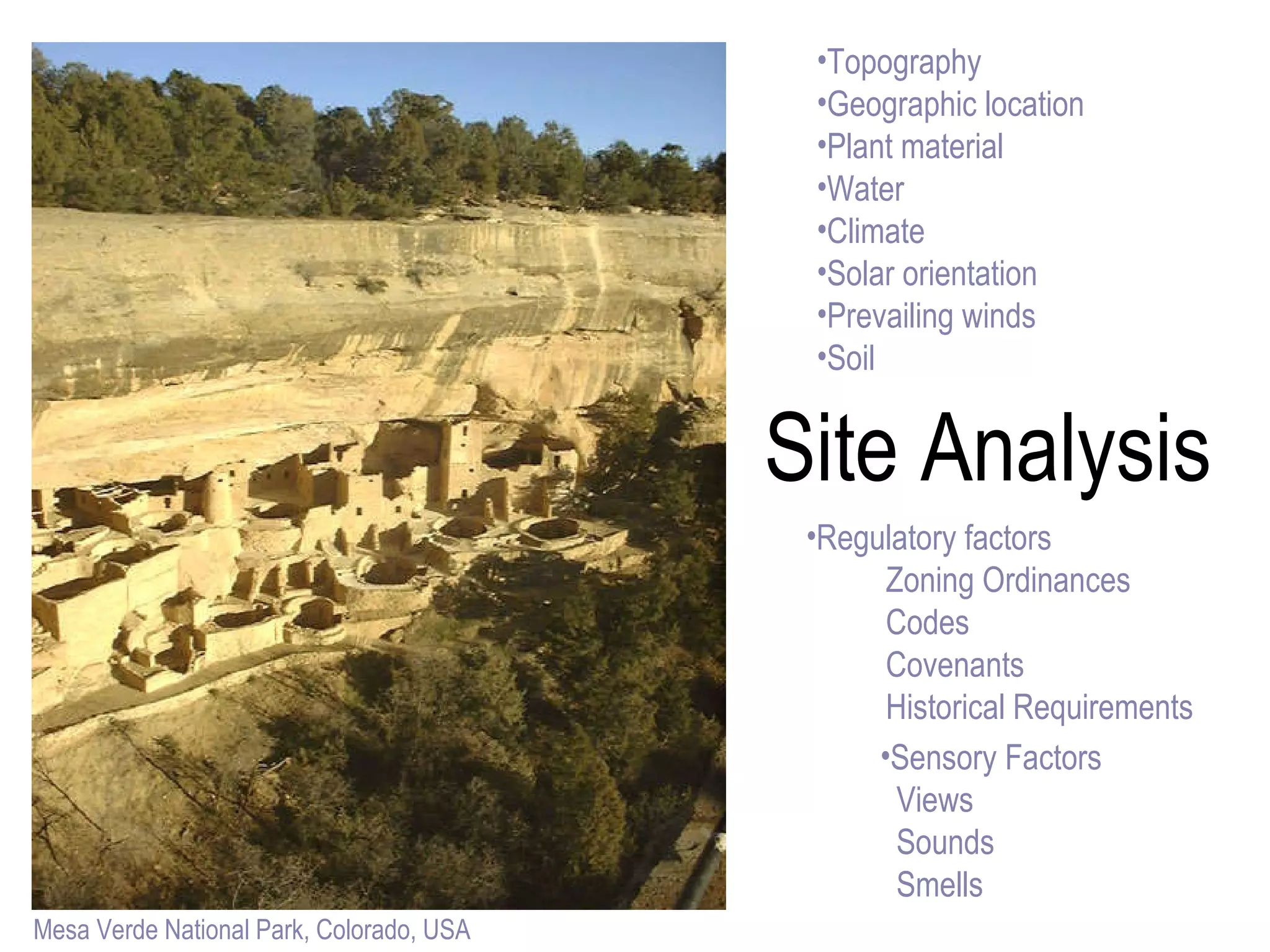
The Buildi n g Site Mesa Verde National Park, Colorado built by the Ancestral Puebloans (previously known as the Anasazi) in the late 12th and 13th centuries   www.360parks.com/ancient_dwellings_virtual_tour.shtml
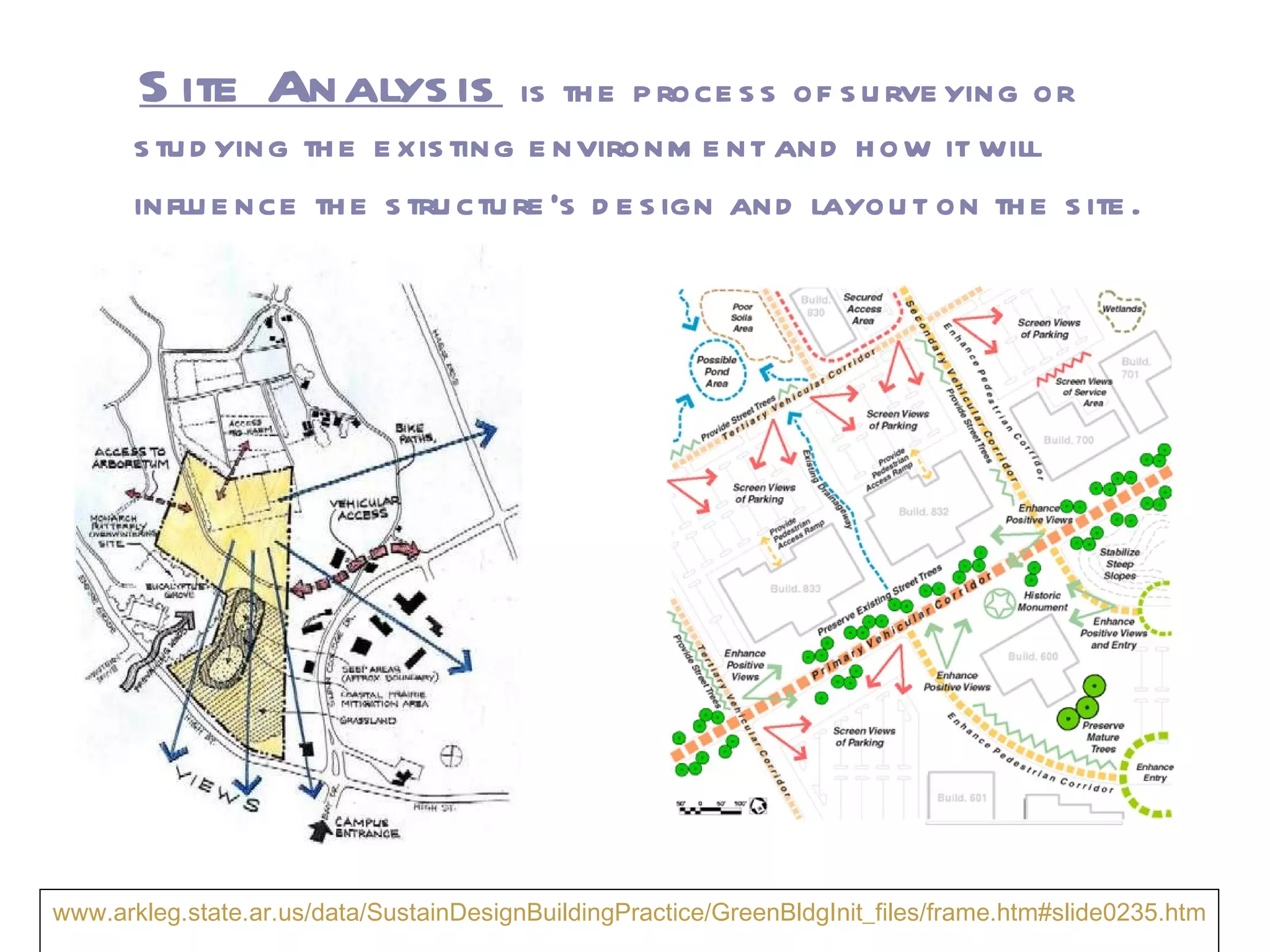
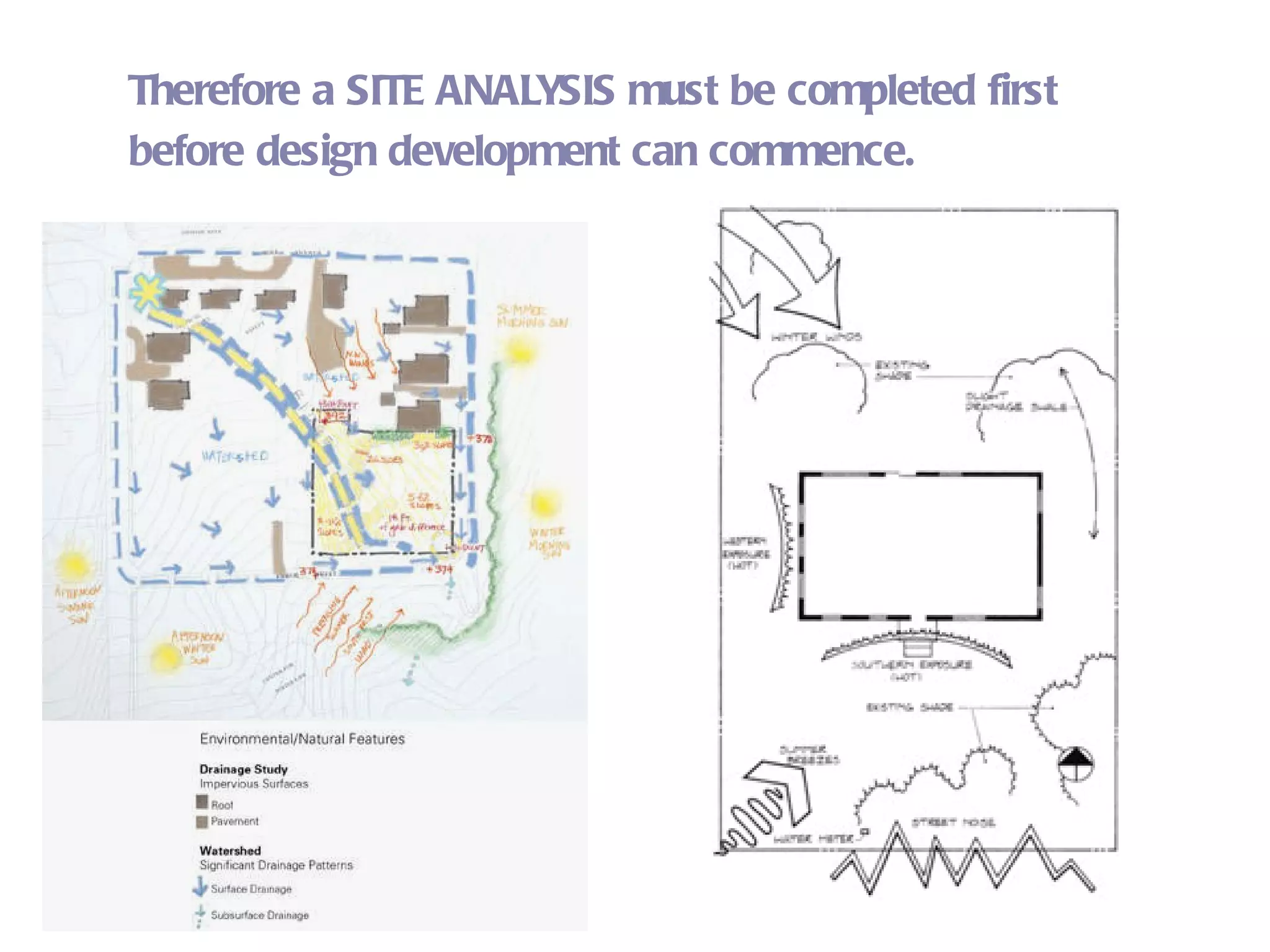
www.arkleg.state.ar.us/data/SustainDesignBuildingPractice/GreenBldgInit_files/frame.htm#slide0235.htm Site Analysis   is the process of surveying or studying the existing environment and how it will influence the structure’s design and layout on the site.
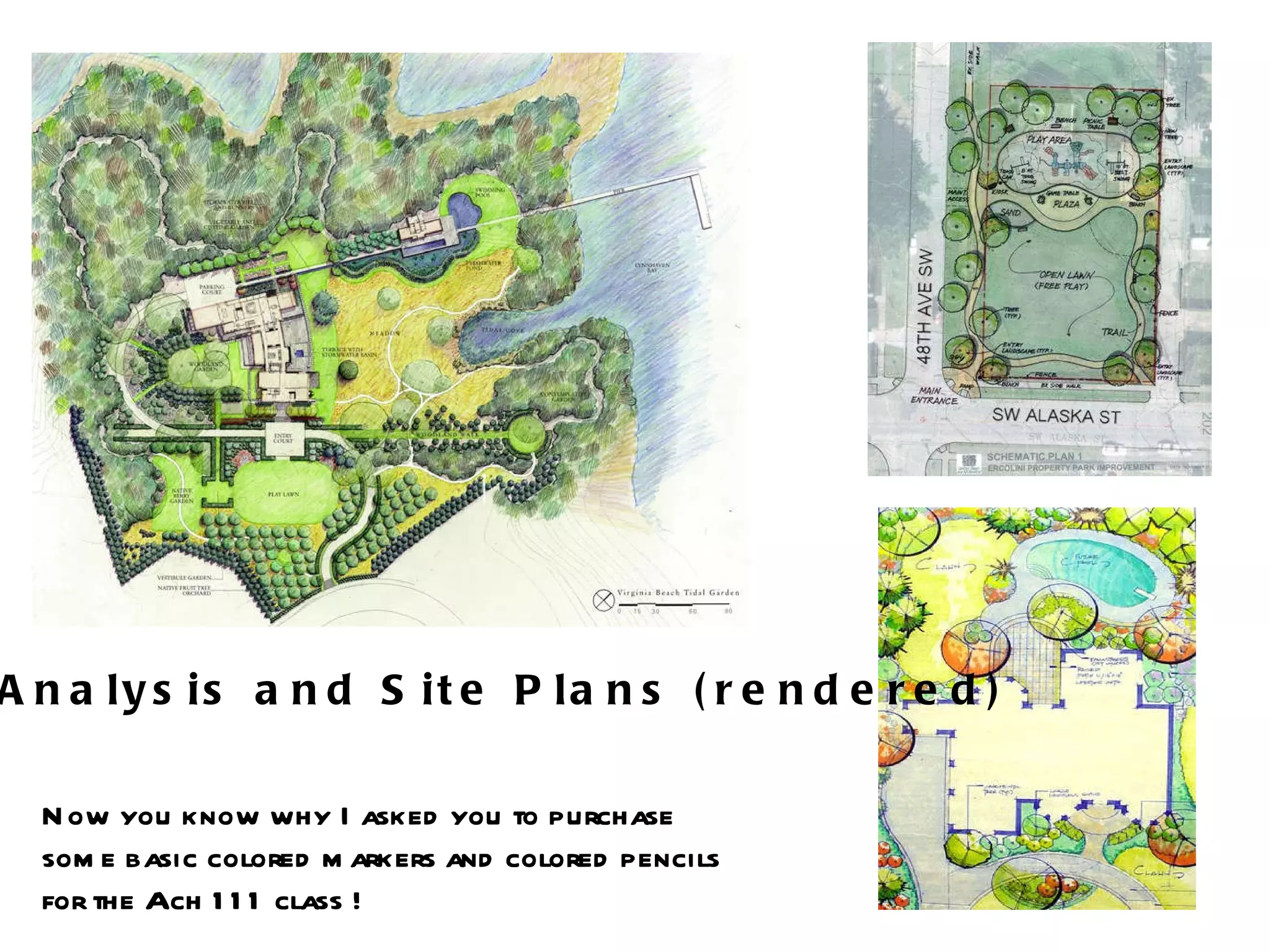
Now you know why I asked you to purchase some basic colored markers and colored pencils  for the Ach 111 class ! Site Analysis and Site Plans (rendered)
Site Analysis Topography Geographic location Plant material Water Climate Solar orientation Prevailing winds Soil Regulatory factors Zoning Ordinances Codes Covenants Historical Requirements Mesa Verde National Park, Colorado, USA Sensory Factors Views Sounds Smells
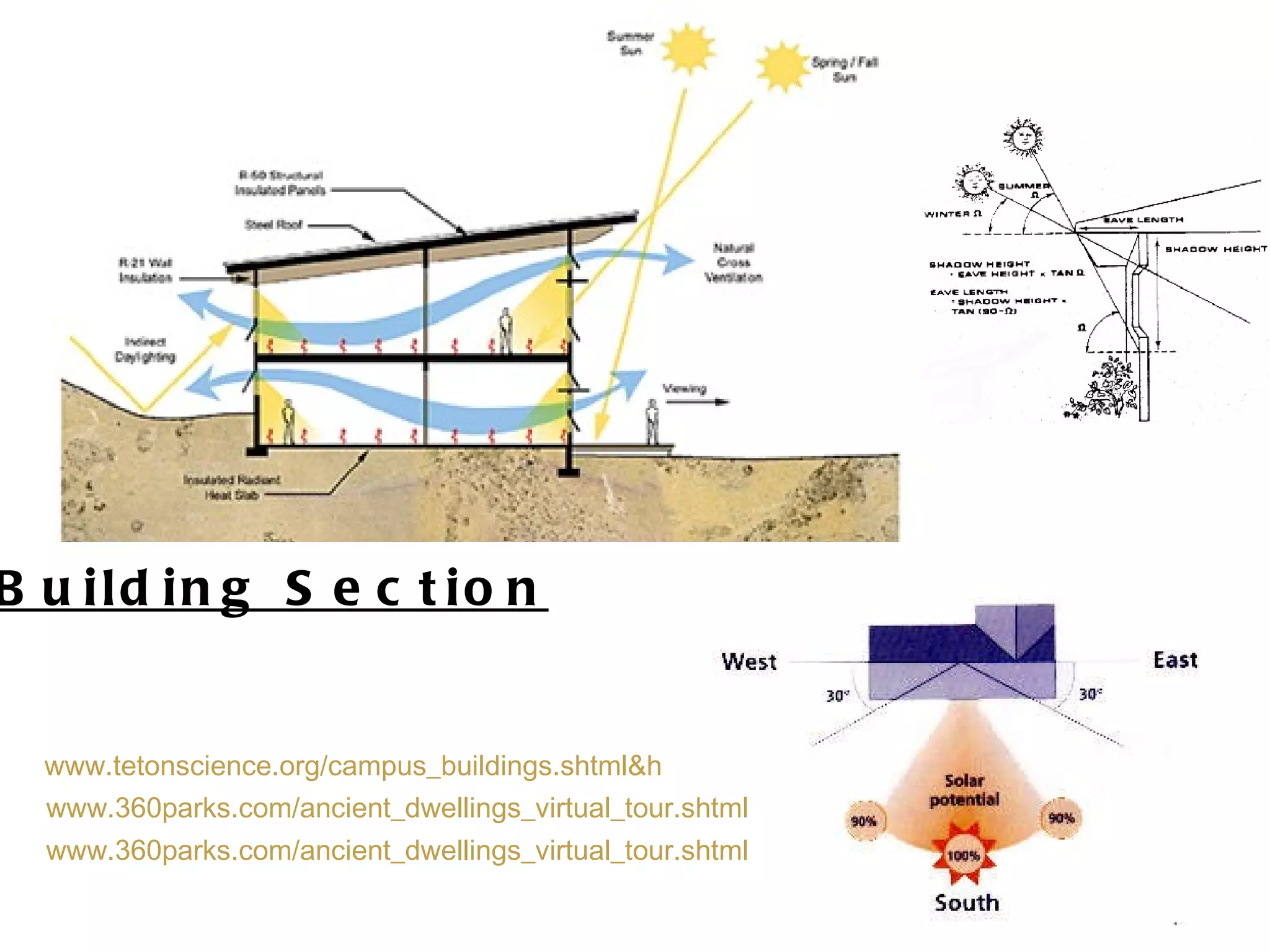
www.360parks.com/ancient_dwellings_virtual_tour.shtml www.360parks.com/ancient_dwellings_virtual_tour.shtml www.tetonscience.org/campus_buildings.shtml&h Building Section
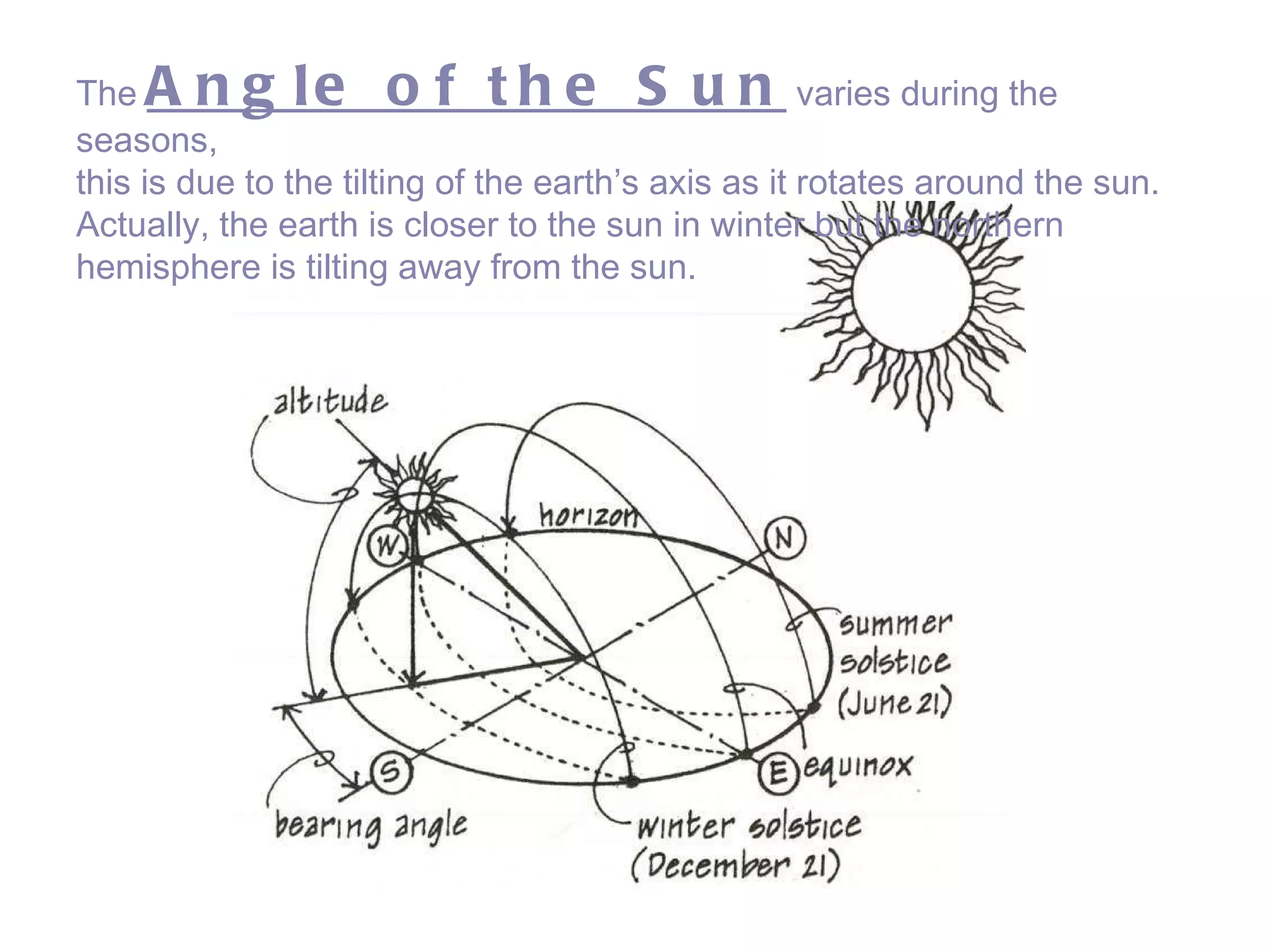
The  Angle of the Sun  varies during the seasons,  this is due to the tilting of the earth’s axis as it rotates around the sun. Actually, the earth is closer to the sun in winter but the northern hemisphere is tilting away from the sun.
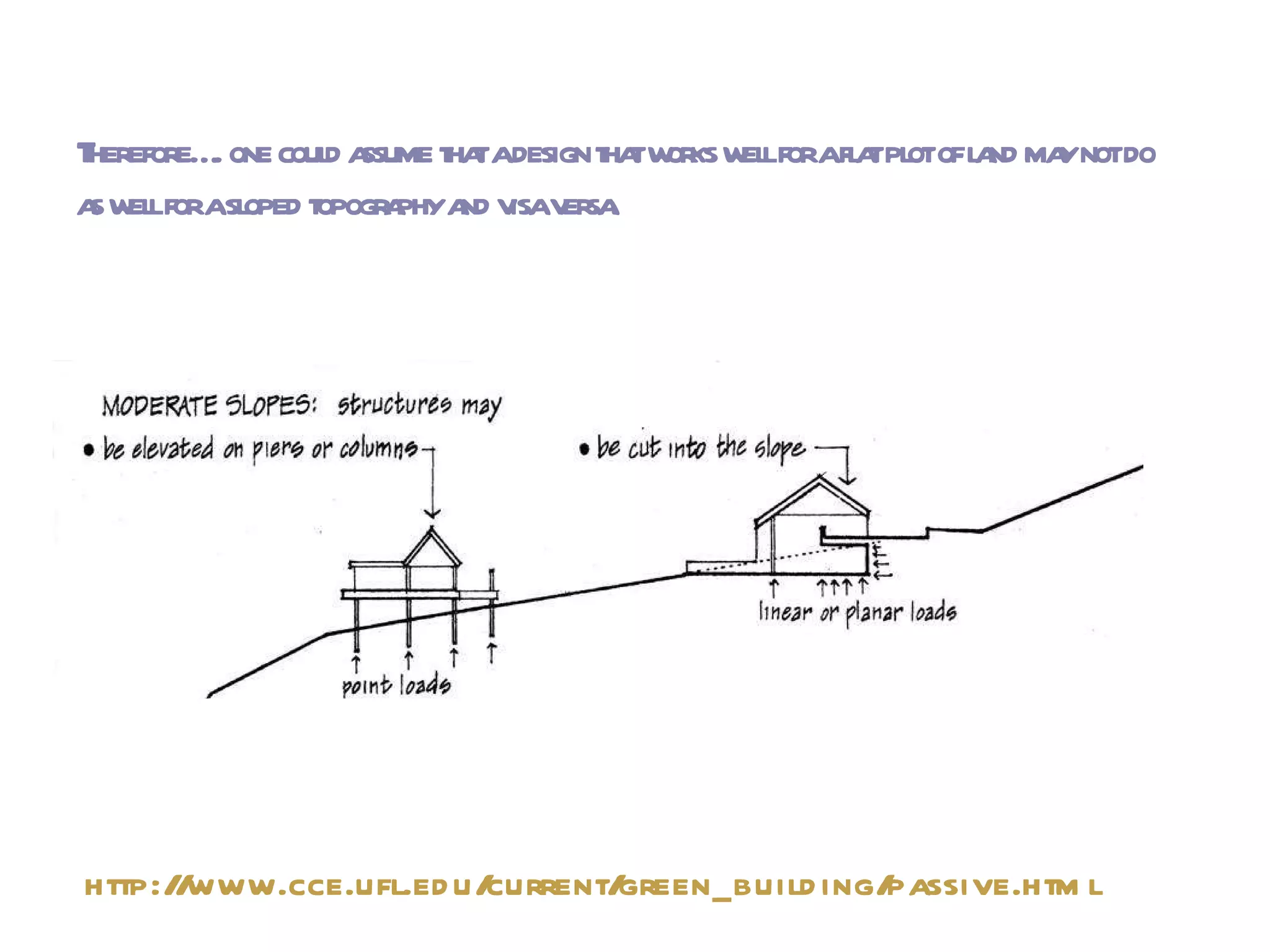
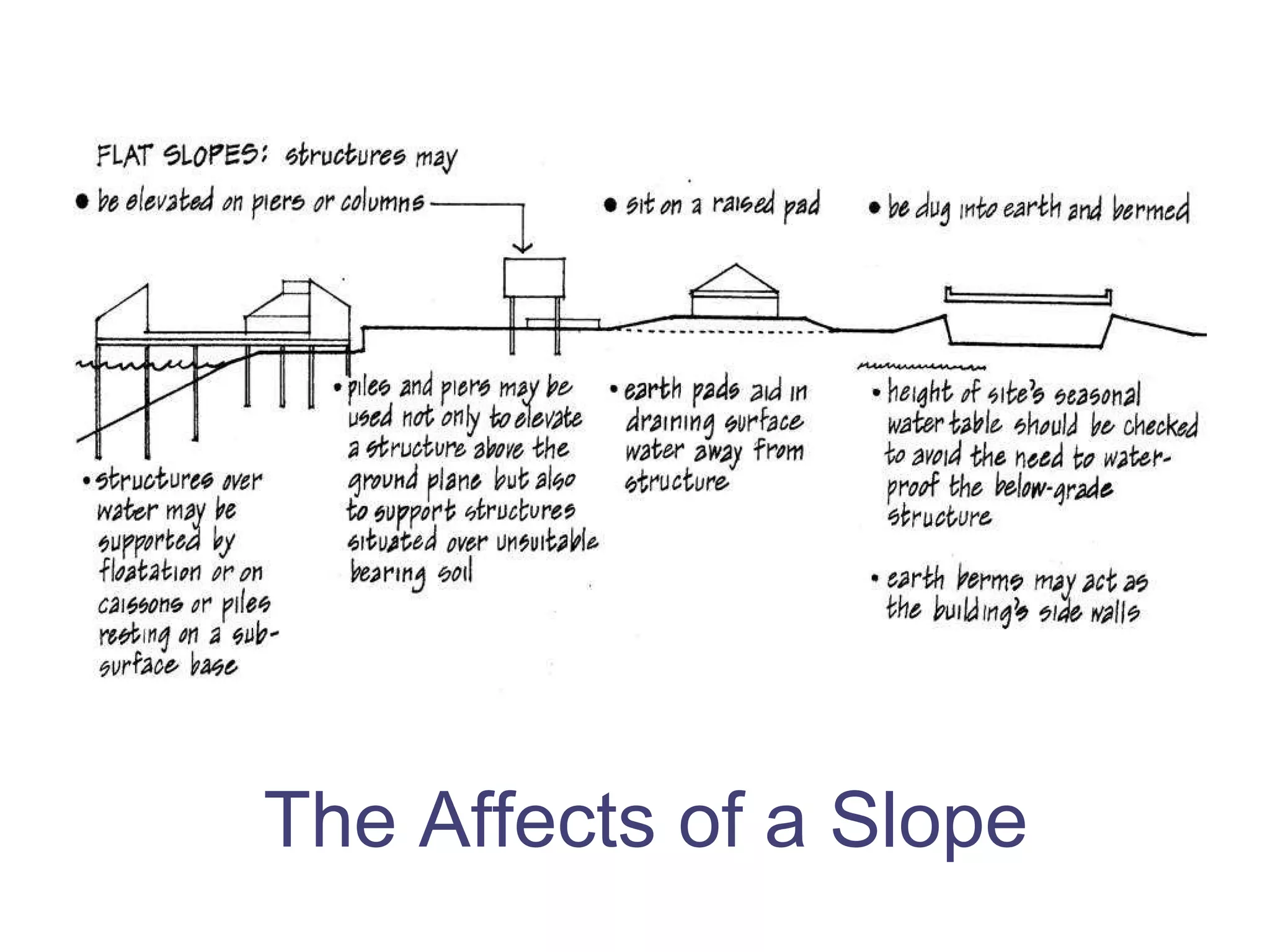
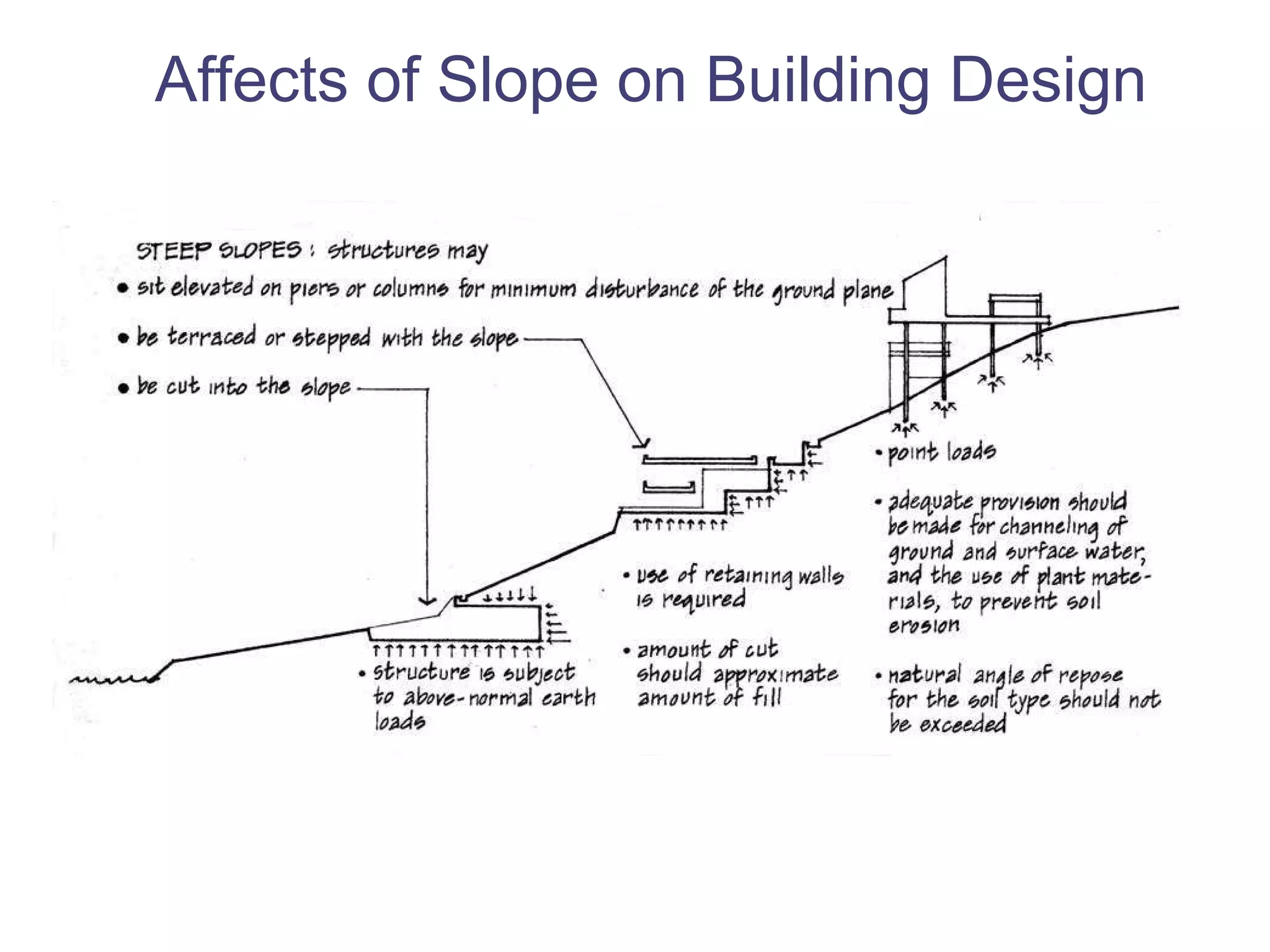
Therefore…. one could assume that a design that works well for a flat plot of land may not do as well for a sloped topography and visa versa. http://www.cce.ufl.edu/current/green_building/passive.html
The Affects of a Slope
Affects of Slope on Building Design
Therefore a SITE ANALYSIS must be completed first before design development can commence.
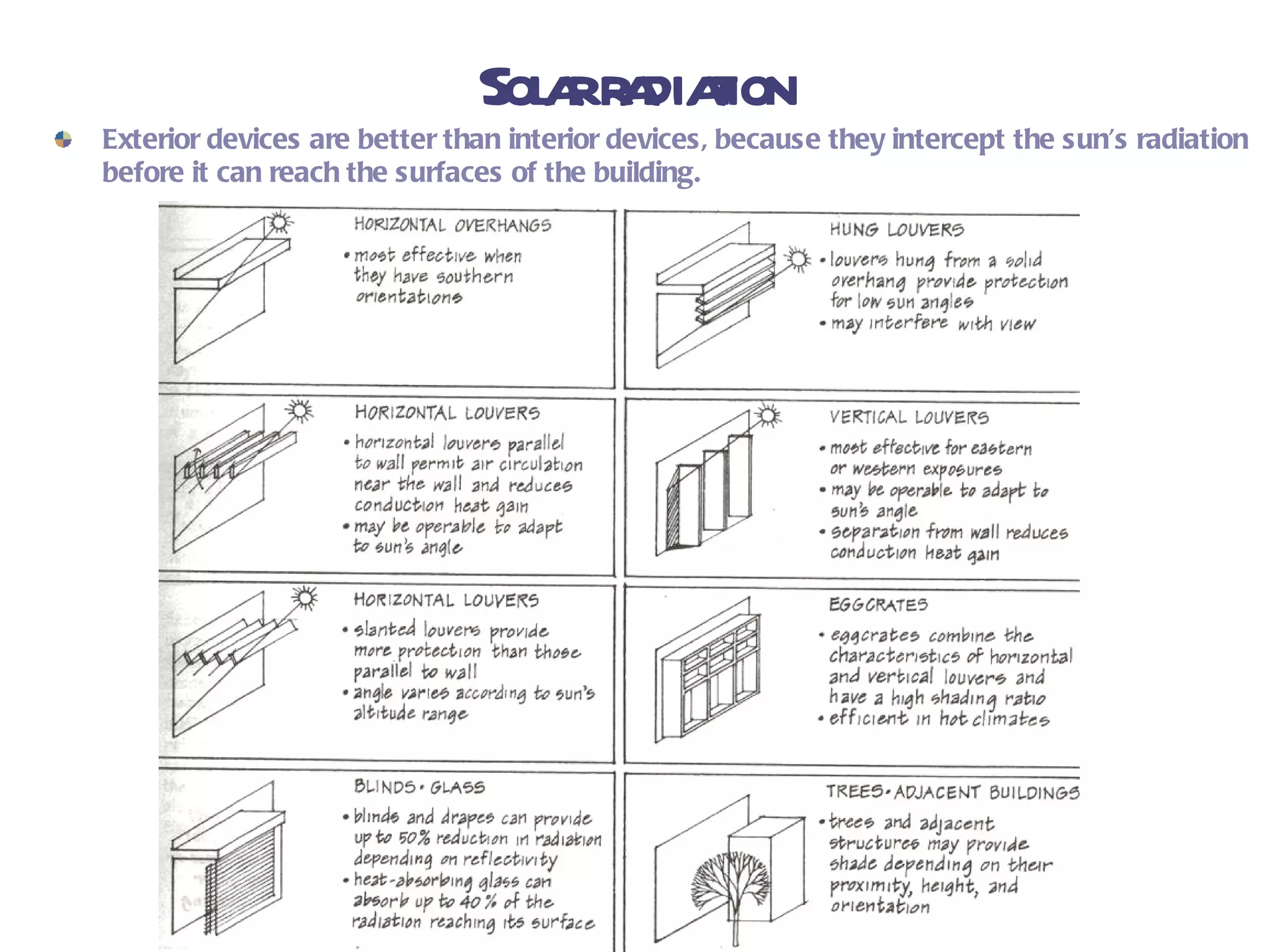
Solar radiation Exterior devices are better than interior devices, because they intercept the sun’s radiation before it can reach the surfaces of the building.
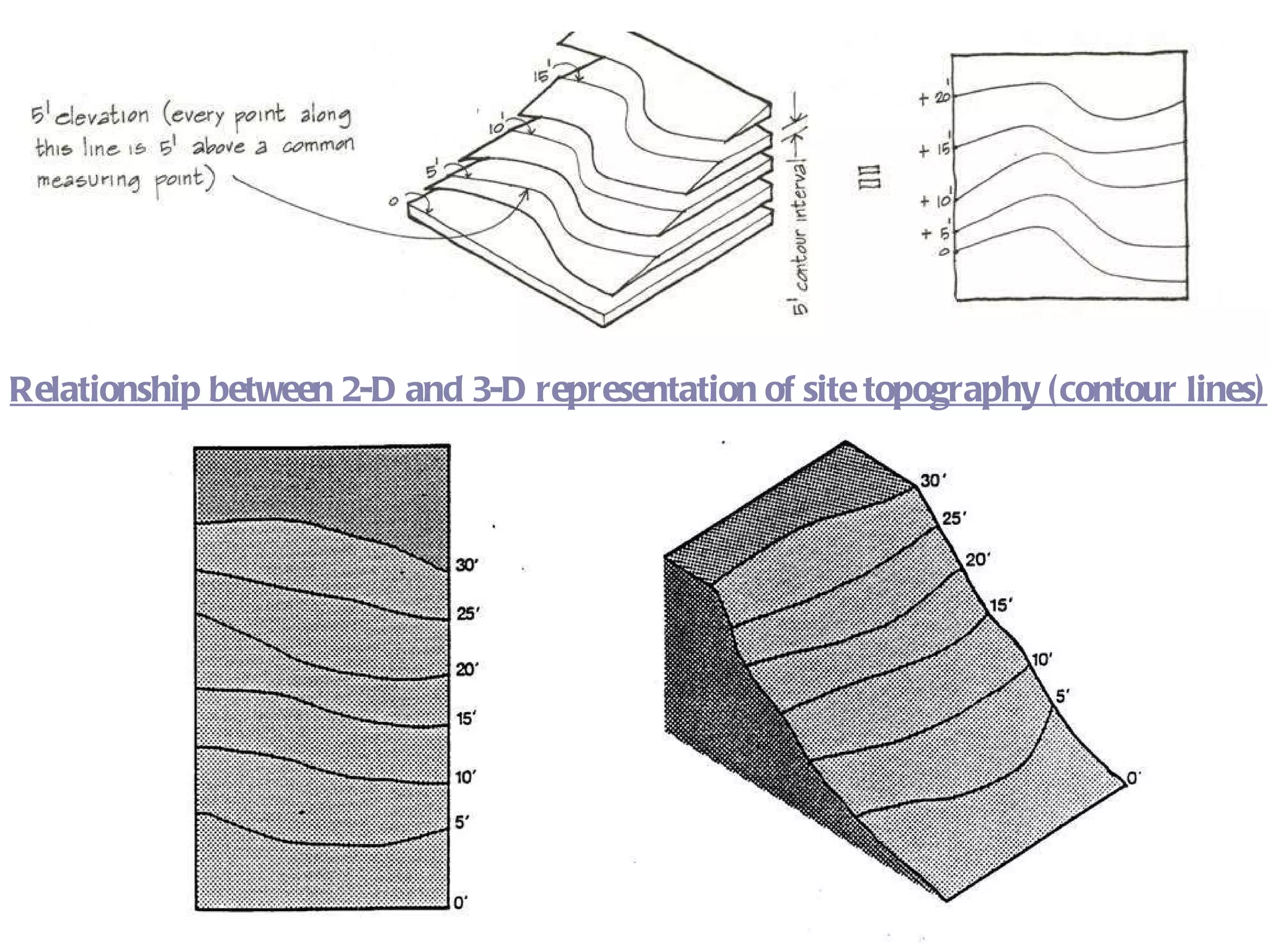
Relationship between 2-D and 3-D representation of site topography (contour lines)
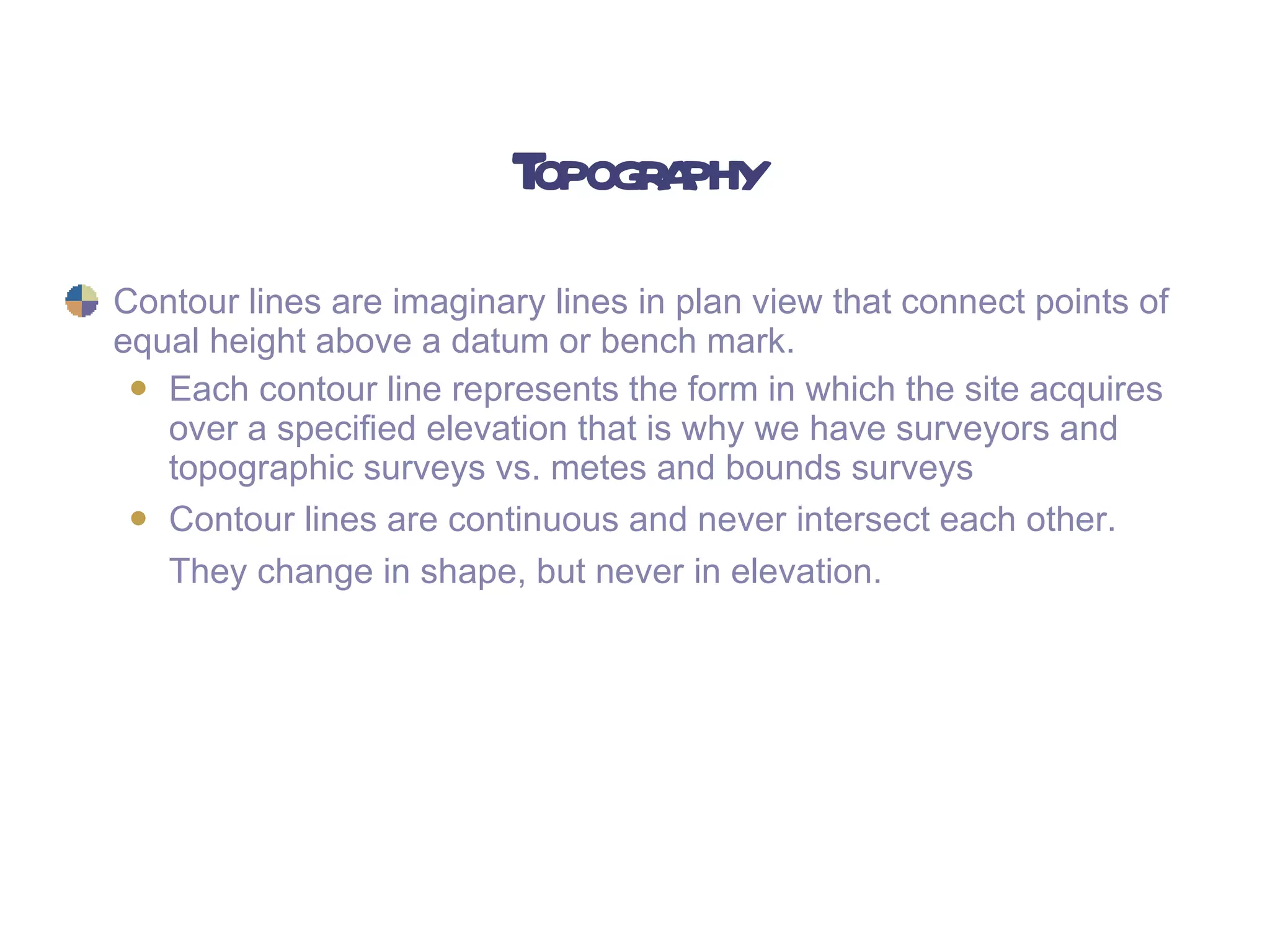
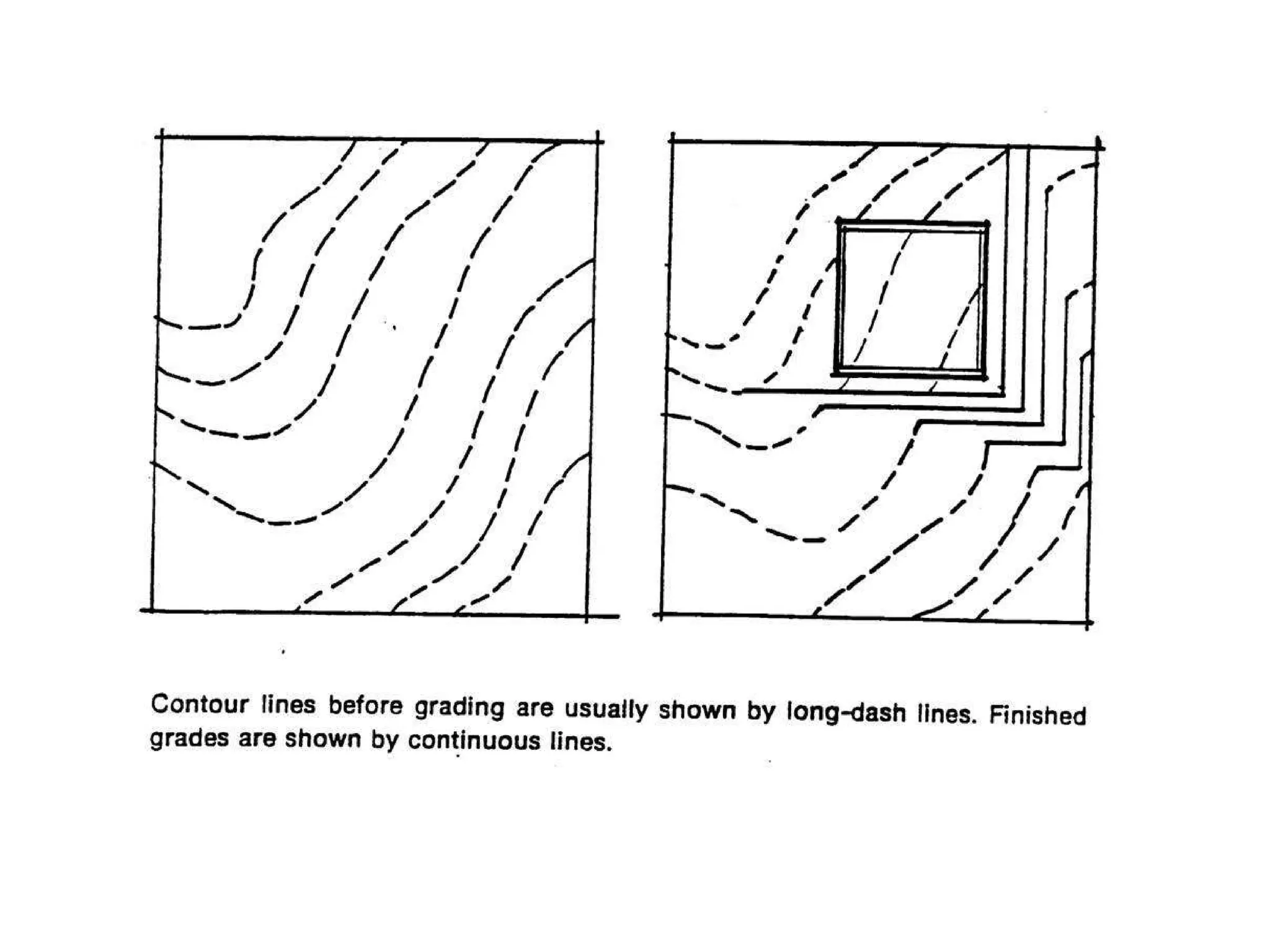
Topography Contour lines are imaginary lines in plan view that connect points of equal height above a datum or bench mark.   Each contour line represents the form in which the site acquires over a specified elevation that is why we have surveyors and topographic surveys vs. metes and bounds surveys Contour lines are continuous and never intersect each other.  They change in shape, but never in elevation.
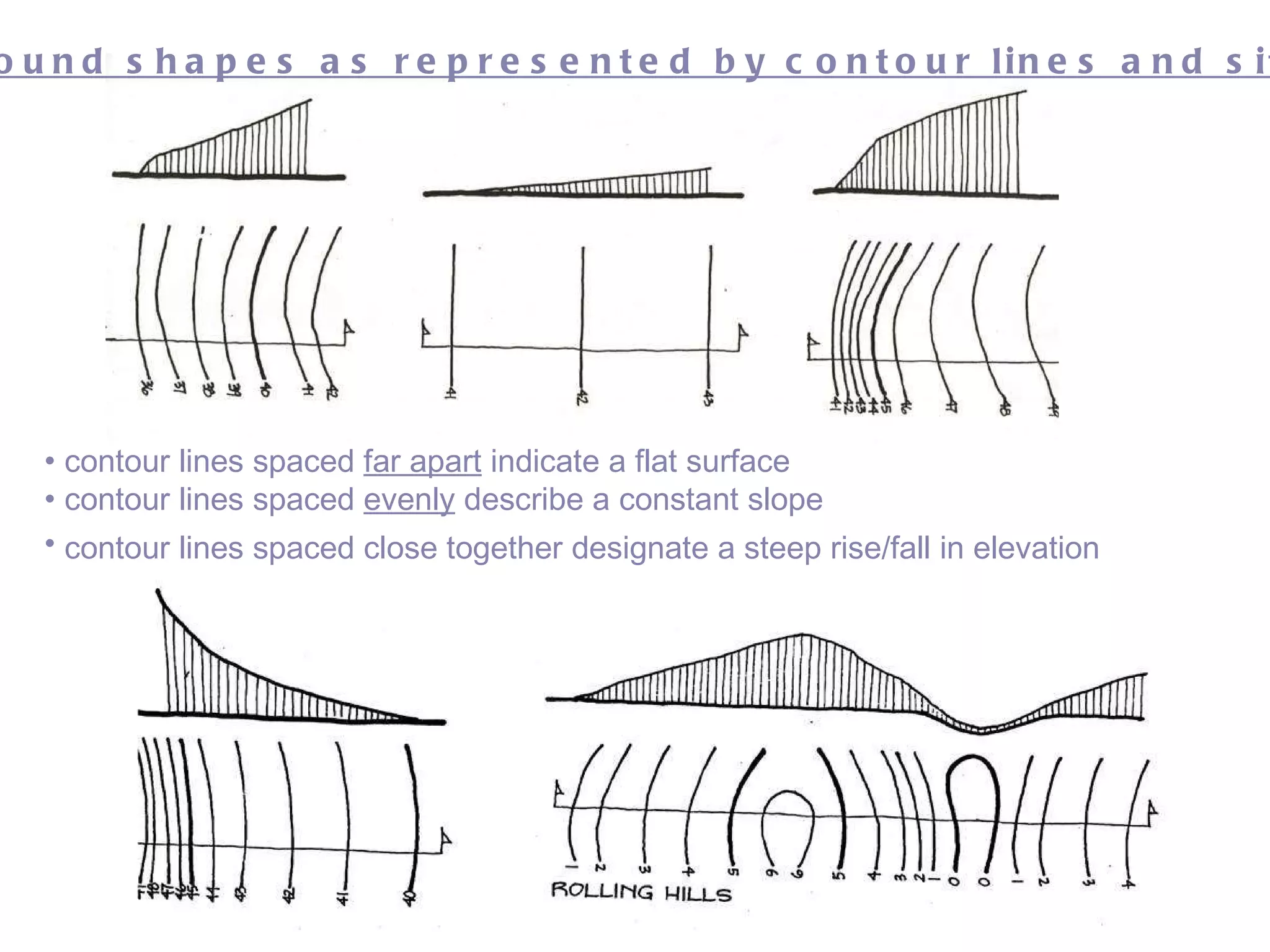
Various ground shapes as represented by contour lines and site sections contour lines spaced  far apart  indicate a flat surface   contour lines spaced  evenly  describe a constant slope contour lines spaced close together designate a steep rise/fall in elevation
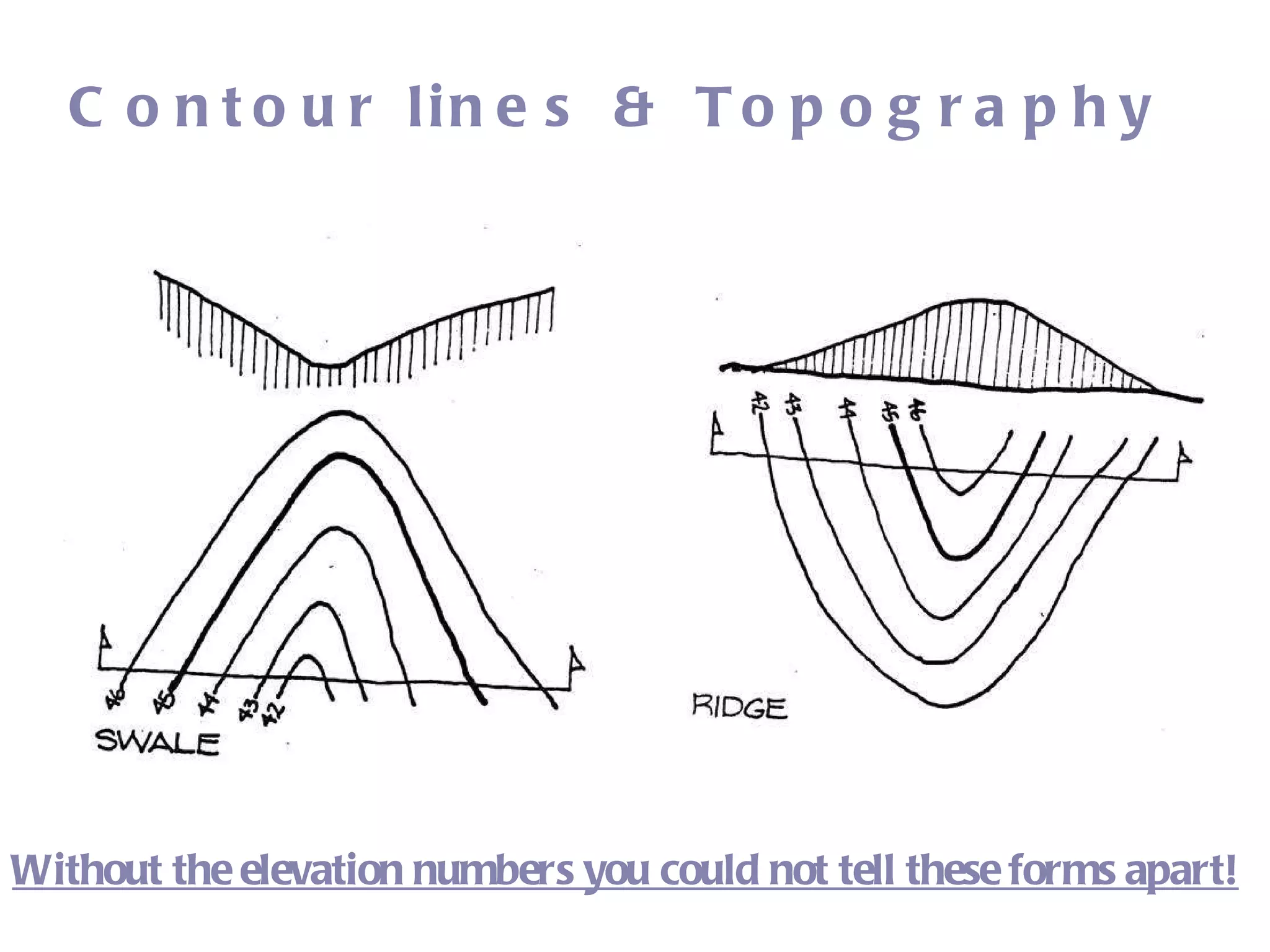
Without the elevation numbers you could not tell these forms apart! Contour lines & Topography
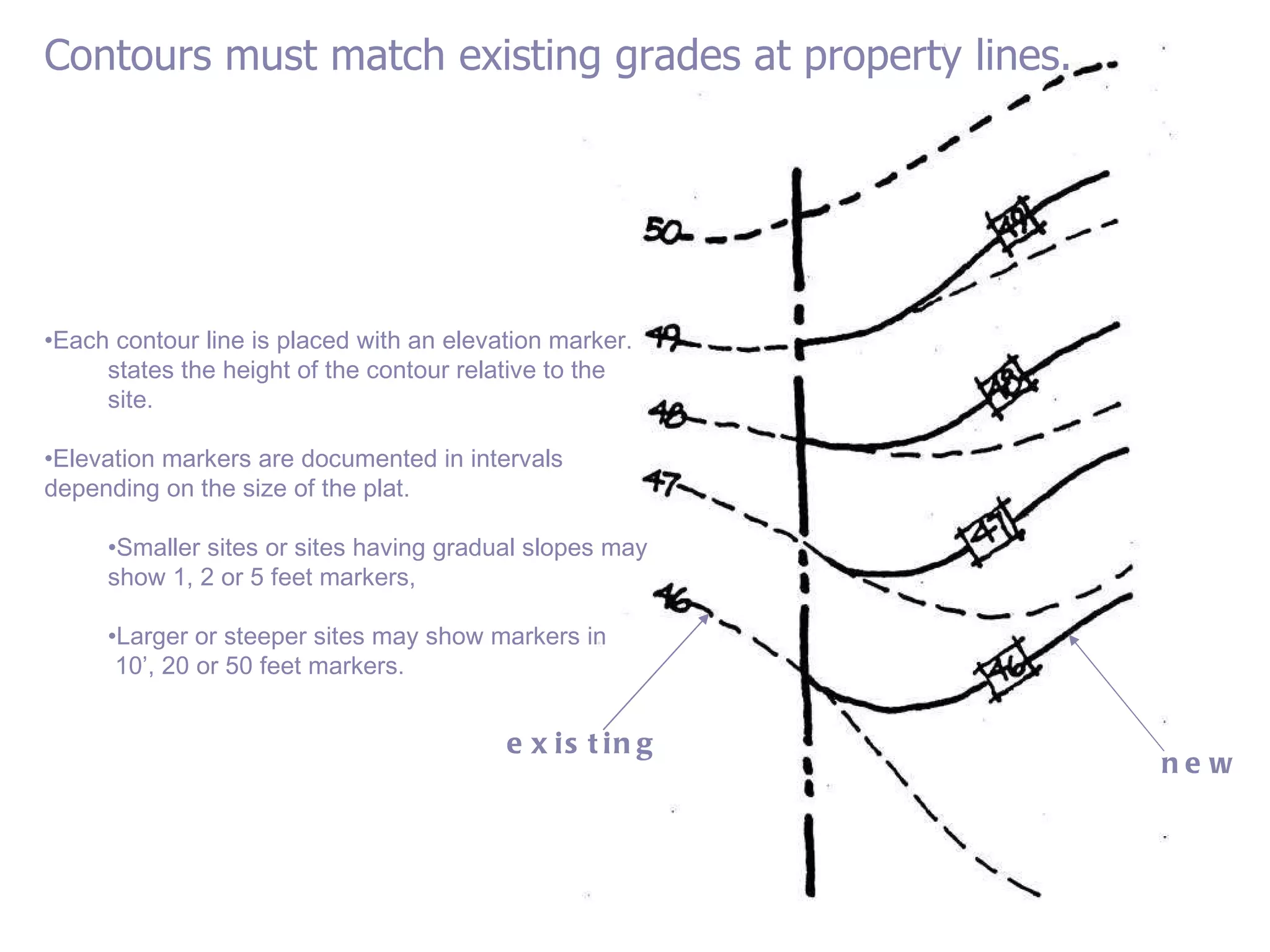
Contours must match existing grades at property lines. existing new Each contour line is placed with an elevation marker.  states the height of the contour relative to the site. Elevation markers are documented in intervals depending on the size of the plat. Smaller sites or sites having gradual slopes may show 1, 2 or 5 feet markers,  Larger or steeper sites may show markers in  10’, 20 or 50 feet markers.
 
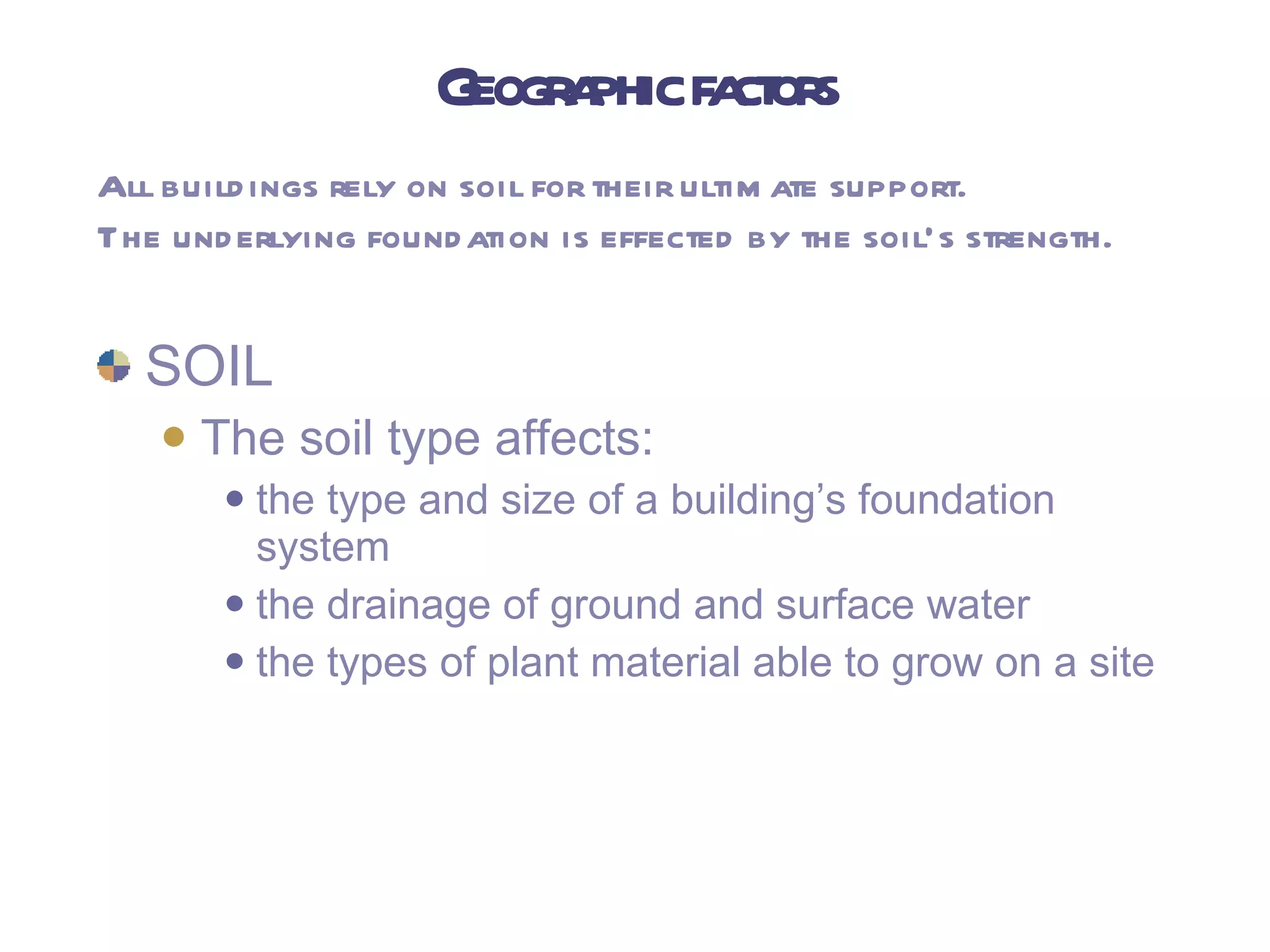
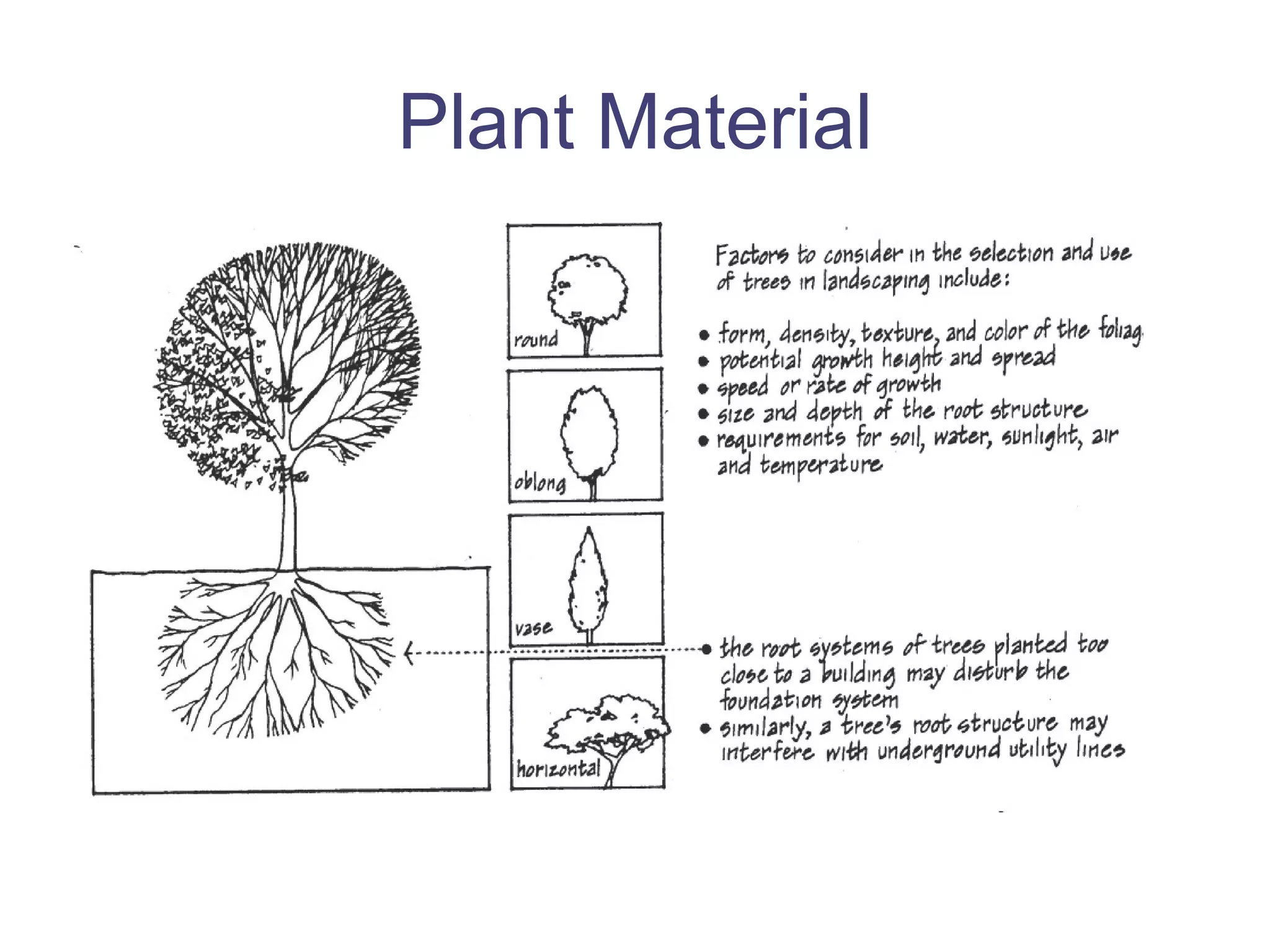
Geographic factors SOIL The soil type affects: the type and size of a building’s foundation system the drainage of ground and surface water the types of plant material able to grow on a site All buildings rely on soil for their ultimate support. The underlying foundation is effected by the soil’s strength.
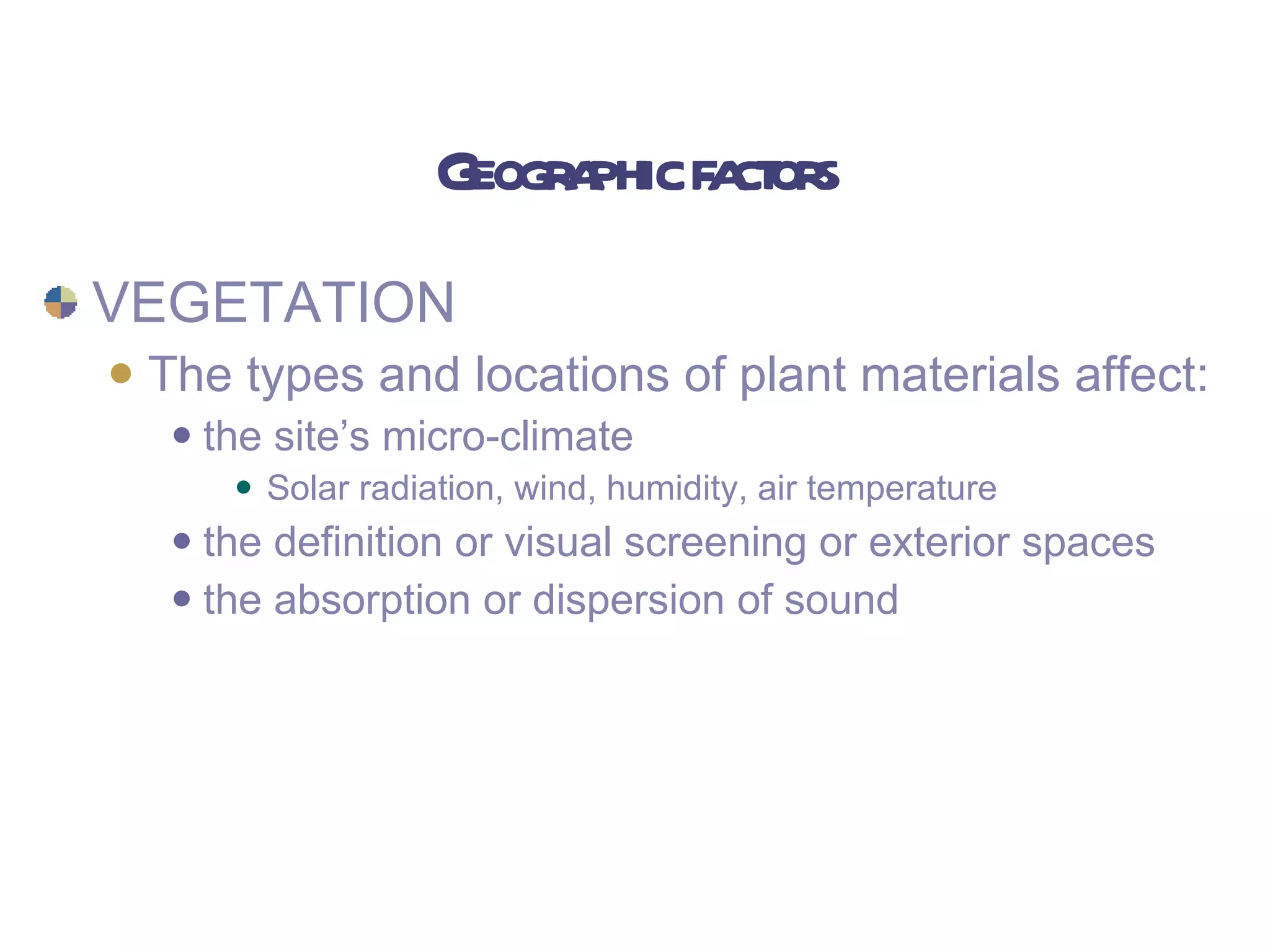
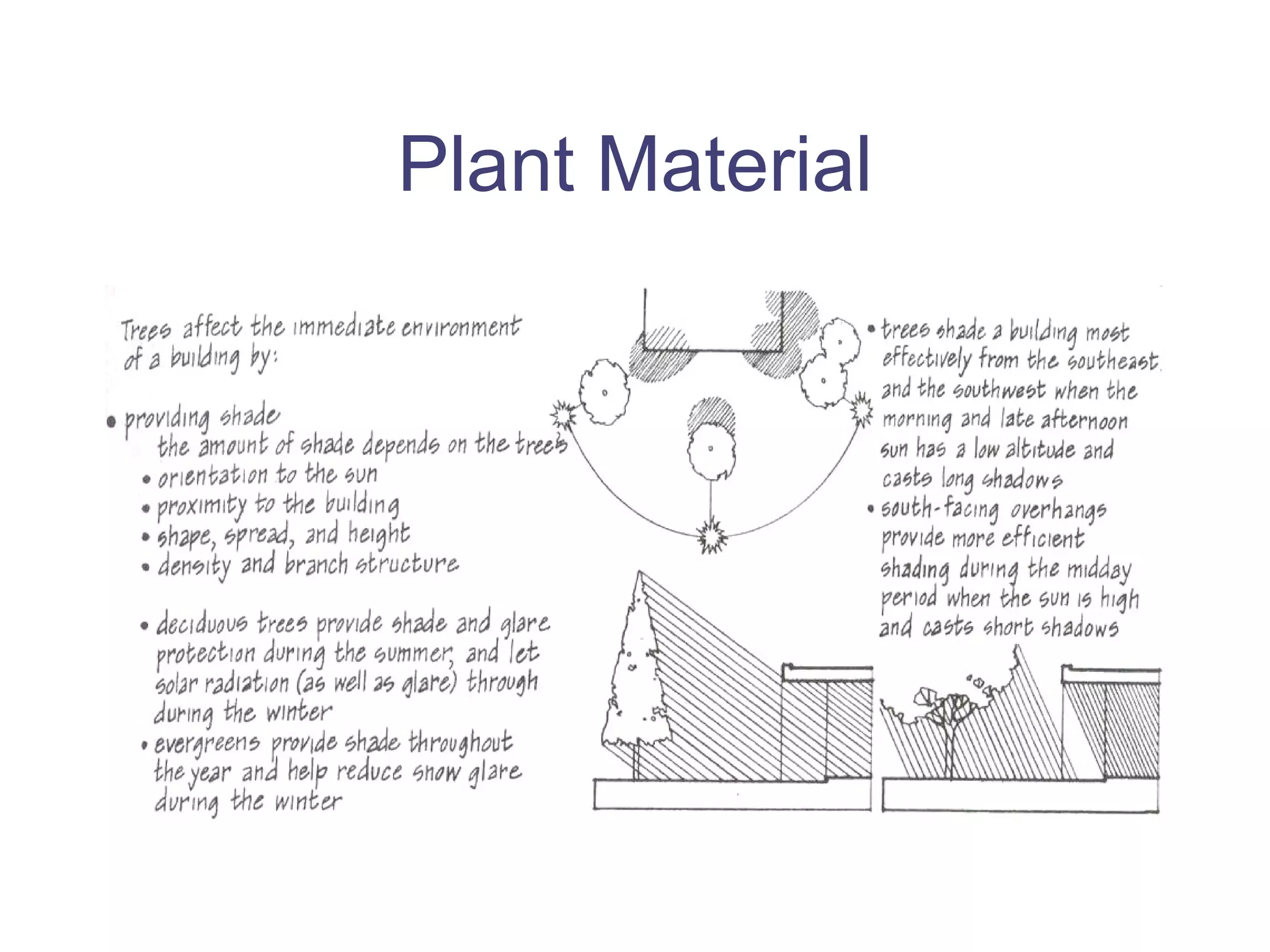
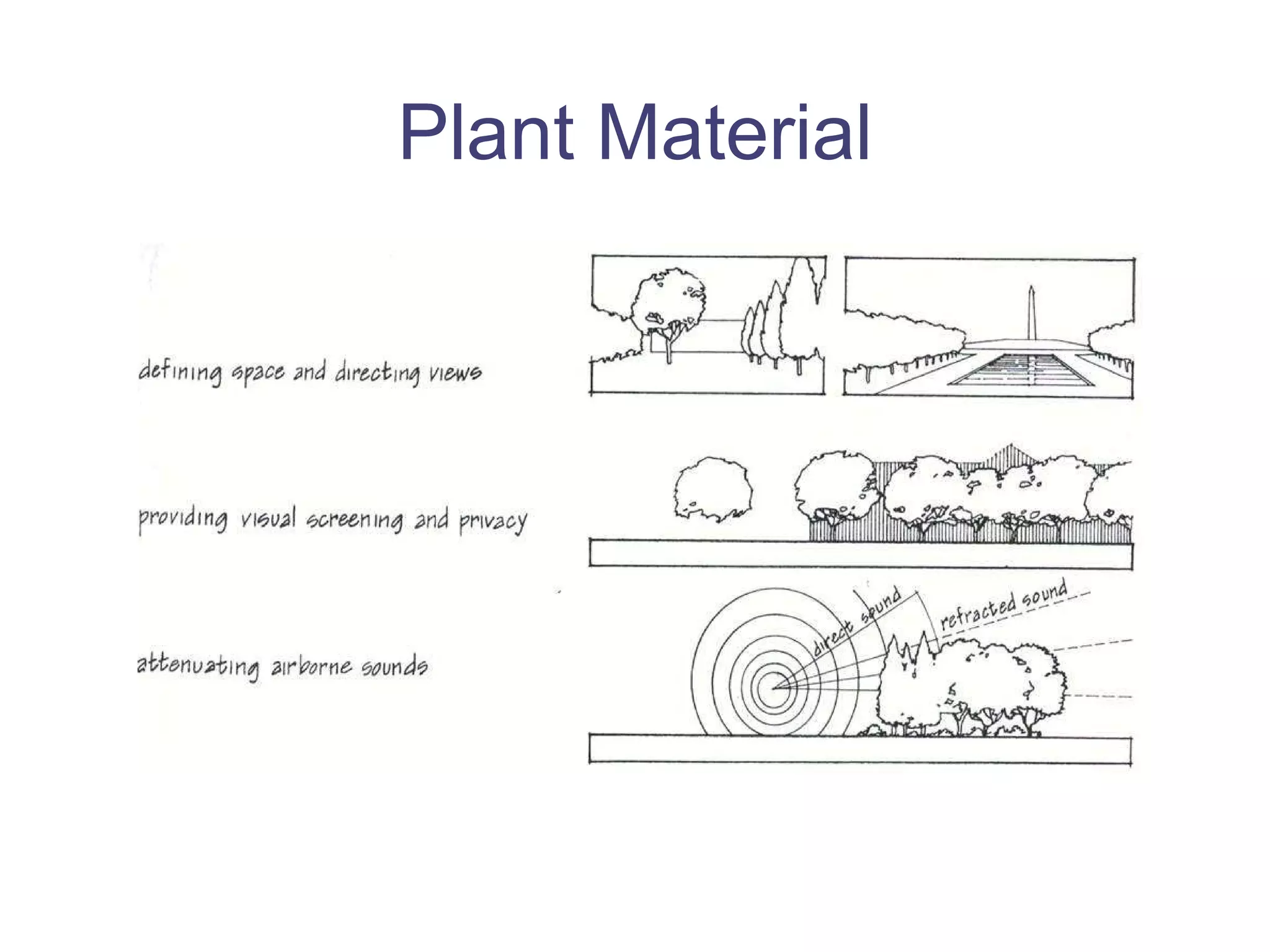
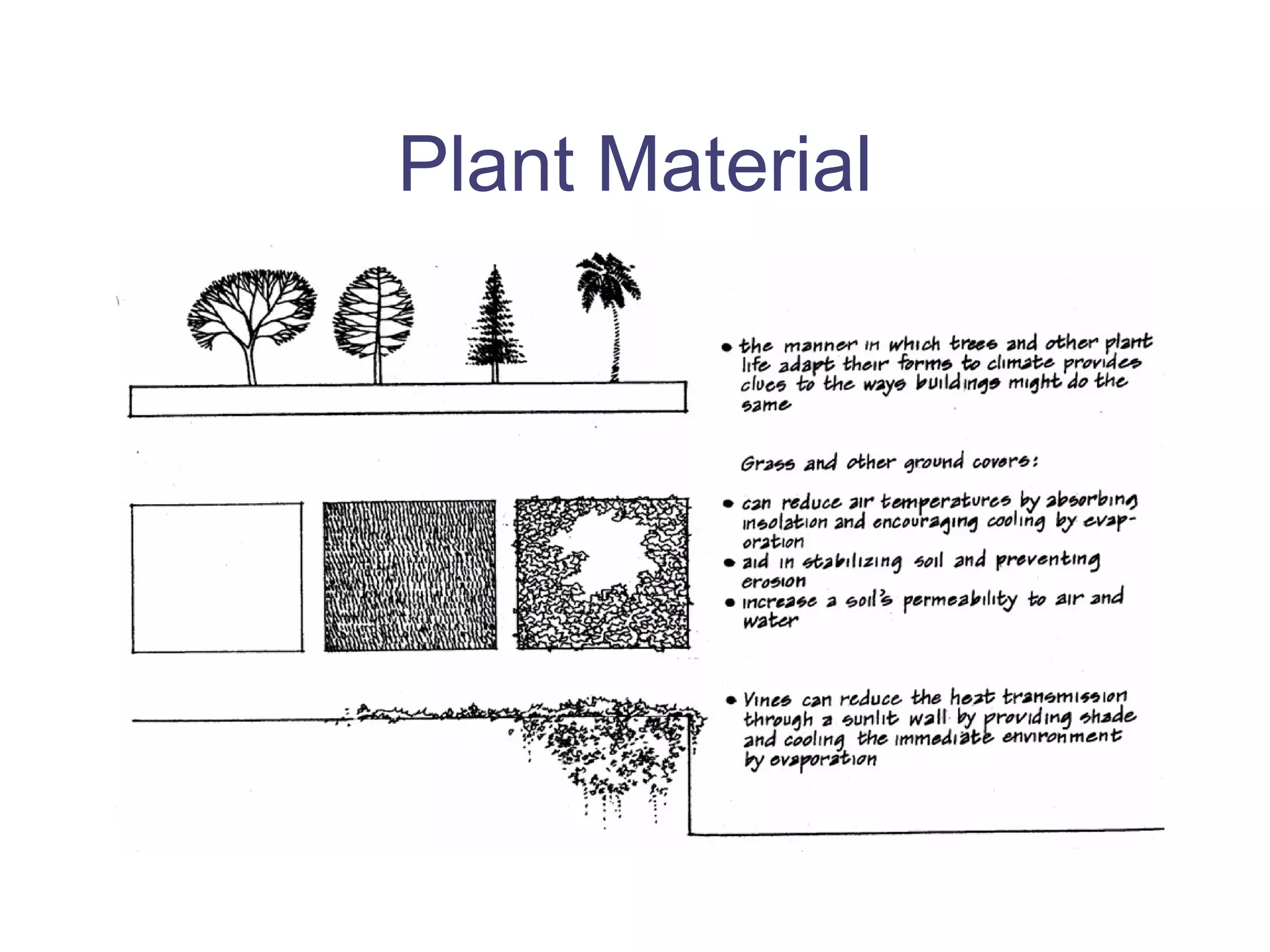
Geographic factors VEGETATION The types and locations of plant materials affect: the site’s micro-climate Solar radiation, wind, humidity, air temperature the definition or visual screening or exterior spaces the absorption or dispersion of sound
Plant Material
Plant Material
Plant Material
Plant Material
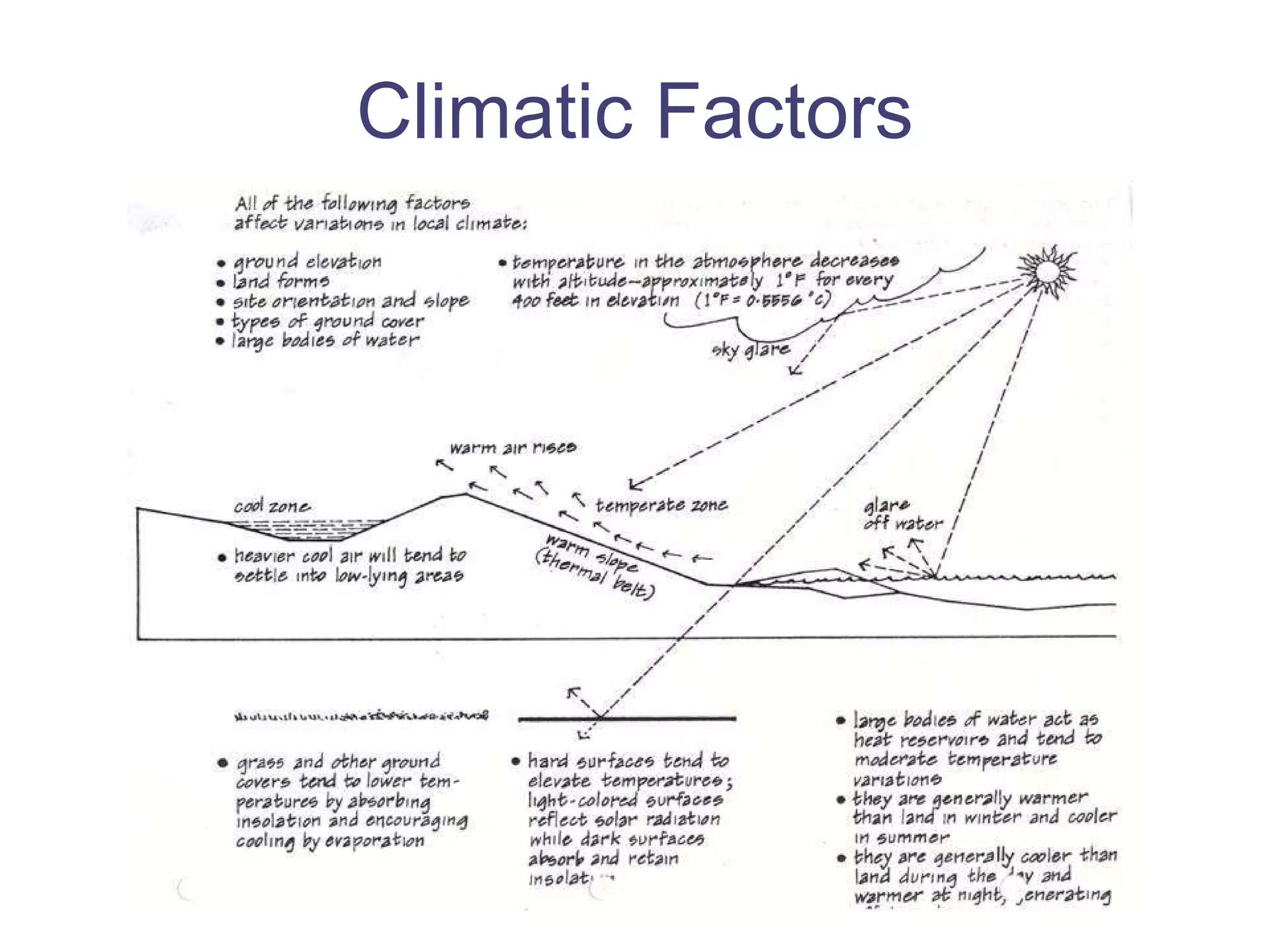
Climatic Factors
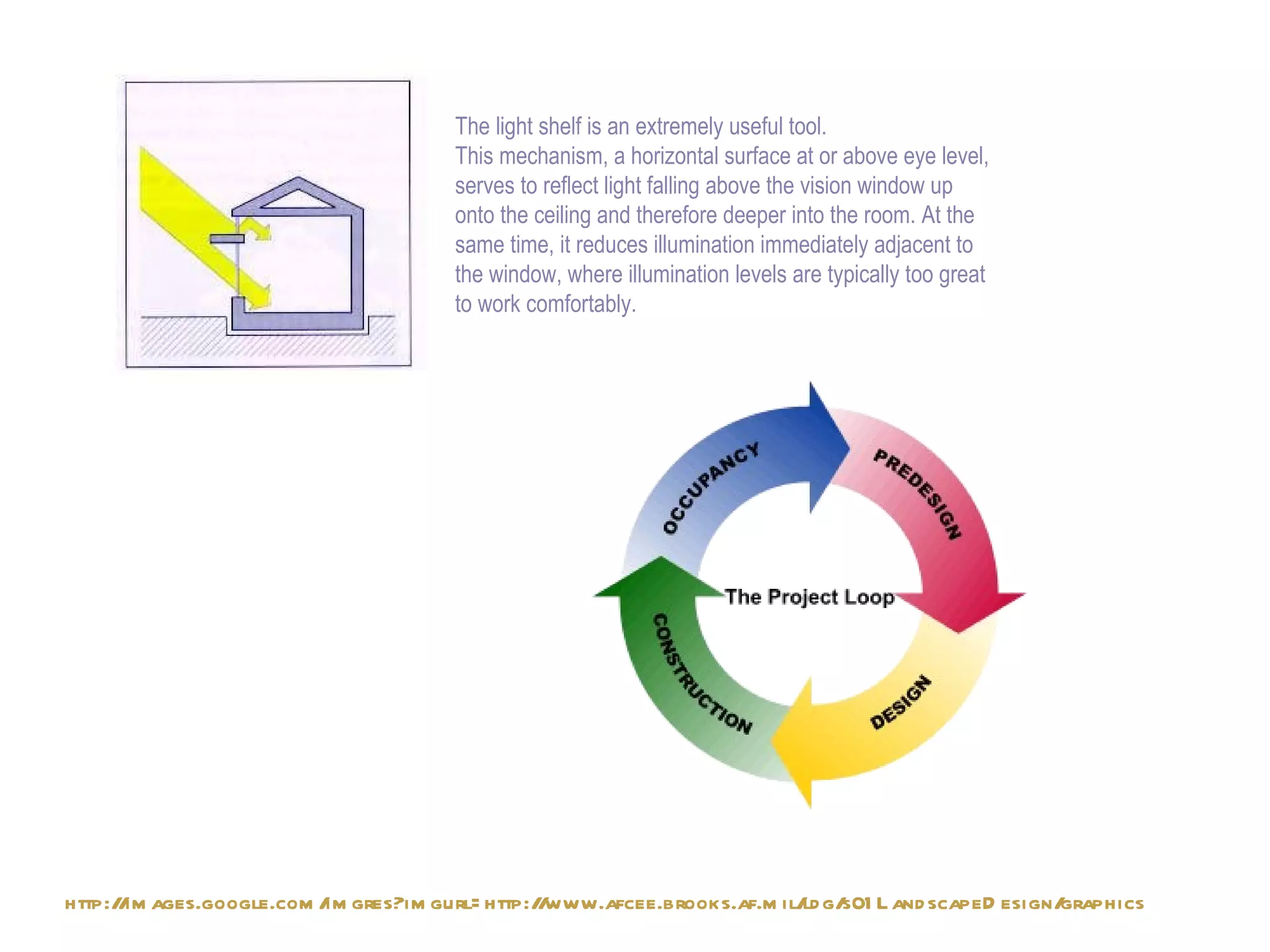
The light shelf is an extremely useful tool.  This mechanism, a horizontal surface at or above eye level, serves to reflect light falling above the vision window up onto the ceiling and therefore deeper into the room. At the same time, it reduces illumination immediately adjacent to the window, where illumination levels are typically too great to work comfortably.   http://images.google.com/imgres?imgurl=http://www.afcee.brooks.af.mil/ldg/s01LandscapeDesign/graphics

Lecture 1 site analysis

  • 1.
    The Building SiteProfessor Richard Luxenburg, AIA Department of Architecture and Interior Design Anne Arundel Community College ACH 121 Materials and Methods of Construction 1
  • 2.
    The Buildi ng Site Mesa Verde National Park, Colorado built by the Ancestral Puebloans (previously known as the Anasazi) in the late 12th and 13th centuries www.360parks.com/ancient_dwellings_virtual_tour.shtml
  • 3.
    www.arkleg.state.ar.us/data/SustainDesignBuildingPractice/GreenBldgInit_files/frame.htm#slide0235.htm Site Analysis is the process of surveying or studying the existing environment and how it will influence the structure’s design and layout on the site.
  • 4.
    Now you knowwhy I asked you to purchase some basic colored markers and colored pencils for the Ach 111 class ! Site Analysis and Site Plans (rendered)
  • 5.
    Site Analysis TopographyGeographic location Plant material Water Climate Solar orientation Prevailing winds Soil Regulatory factors Zoning Ordinances Codes Covenants Historical Requirements Mesa Verde National Park, Colorado, USA Sensory Factors Views Sounds Smells
  • 6.
  • 7.
    The Angleof the Sun varies during the seasons, this is due to the tilting of the earth’s axis as it rotates around the sun. Actually, the earth is closer to the sun in winter but the northern hemisphere is tilting away from the sun.
  • 8.
    Therefore…. one couldassume that a design that works well for a flat plot of land may not do as well for a sloped topography and visa versa. http://www.cce.ufl.edu/current/green_building/passive.html
  • 9.
  • 10.
    Affects of Slopeon Building Design
  • 11.
    Therefore a SITEANALYSIS must be completed first before design development can commence.
  • 12.
    Solar radiation Exteriordevices are better than interior devices, because they intercept the sun’s radiation before it can reach the surfaces of the building.
  • 13.
    Relationship between 2-Dand 3-D representation of site topography (contour lines)
  • 14.
    Topography Contour linesare imaginary lines in plan view that connect points of equal height above a datum or bench mark. Each contour line represents the form in which the site acquires over a specified elevation that is why we have surveyors and topographic surveys vs. metes and bounds surveys Contour lines are continuous and never intersect each other. They change in shape, but never in elevation.
  • 15.
    Various ground shapesas represented by contour lines and site sections contour lines spaced far apart indicate a flat surface contour lines spaced evenly describe a constant slope contour lines spaced close together designate a steep rise/fall in elevation
  • 16.
    Without the elevationnumbers you could not tell these forms apart! Contour lines & Topography
  • 17.
    Contours must matchexisting grades at property lines. existing new Each contour line is placed with an elevation marker. states the height of the contour relative to the site. Elevation markers are documented in intervals depending on the size of the plat. Smaller sites or sites having gradual slopes may show 1, 2 or 5 feet markers, Larger or steeper sites may show markers in 10’, 20 or 50 feet markers.
  • 18.
  • 19.
    Geographic factors SOILThe soil type affects: the type and size of a building’s foundation system the drainage of ground and surface water the types of plant material able to grow on a site All buildings rely on soil for their ultimate support. The underlying foundation is effected by the soil’s strength.
  • 20.
    Geographic factors VEGETATIONThe types and locations of plant materials affect: the site’s micro-climate Solar radiation, wind, humidity, air temperature the definition or visual screening or exterior spaces the absorption or dispersion of sound
  • 21.
  • 22.
  • 23.
  • 24.
  • 25.
  • 26.
    The light shelfis an extremely useful tool. This mechanism, a horizontal surface at or above eye level, serves to reflect light falling above the vision window up onto the ceiling and therefore deeper into the room. At the same time, it reduces illumination immediately adjacent to the window, where illumination levels are typically too great to work comfortably.  http://images.google.com/imgres?imgurl=http://www.afcee.brooks.af.mil/ldg/s01LandscapeDesign/graphics