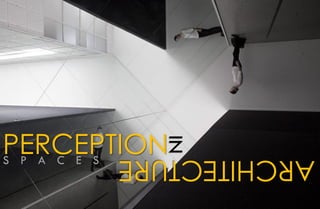
PERCEPTIONARCHITECTUREINS P A C E S
Different researches in the fields of psychology, behavioral
studies, E-B studies, architecture and other fields have tried to
define and explain the emotional impacts space has over a
person.
Studies show that different spaces evoke different emotions, yet
it is still hard to tell exactly how architecture induces them.
Conclusions have been drawn from several different research
fields in order to establish a methodology for exploring the
connection between space and human feelings. This is to produce
more scientific knowledge for the field in the future, using tools of
computation and simulations.
This study will enhance our capabilities to create more pleasant
environments –
a primary goal for designers, architects and urban planners.
INTRODUCTION
ALSON/ PAGE 1
PHYSIOLOGICAL EFFECTS OF SPACES
Space conveys both physiological and psychological effects.
• Physiologically, it contributes to illusion s of size. Filled space seems larger than
empty space.
• Spatial distance through which lines travel, as well as their angles, contributes
to inaccurate perceptions of their length.
• Psychologically, large, unbroken spaces are serene, yet bold and dramatic.
Small, broken spaces suggest delicacy and complexity.
• Divisions into long narrow vertical spaces will heighten, lengthen the space.
• Divisions into horizontal sections will shorten and widen the space.
• It provides rest and relief in patter, a visual interval similar to rest in music and
pause in speech.
• Appears behind shape this pushes the shape forward.
• Because it is less dense, more airy or hollow that the shape it surrounds and
gives the shape buoyancy.
• The cues that make enclose space appear solid are advancing curs. These cues
expand, create depth, and increase apparent distance between foreground and
background.
HARSHITHA/ PAGE 1
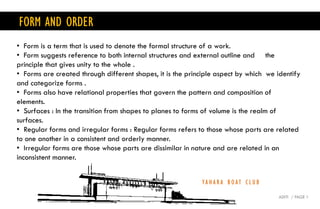
• Form is a term that is used to denote the formal structure of a work.
• Form suggests reference to both internal structures and external outline and the
principle that gives unity to the whole .
• Forms are created through different shapes, it is the principle aspect by which we identify
and categorize forms .
• Forms also have relational properties that govern the pattern and composition of
elements.
• Surfaces : In the transition from shapes to planes to forms of volume is the realm of
surfaces.
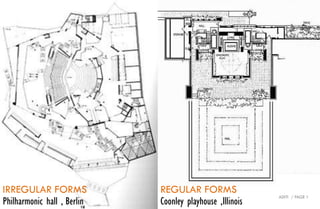
• Regular forms and irregular forms : Regular forms refers to those whose parts are related
to one another in a consistent and orderly manner.
• Irregular forms are those whose parts are dissimilar in nature and are related in an
inconsistent manner.
FORM AND ORDER
ADITI / PAGE 1
YA H A R A B O AT C L U B
ADITI / PAGE 1
Philharmonic hall , Berlin Coonley playhouse ,Illinois
IRREGULAR FORMS REGULAR FORMS
ADITI / PAGE 1
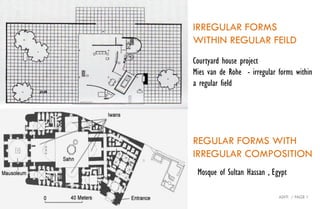
Courtyard house project
Mies van de Rohe - irregular forms within
a regular field
IRREGULAR FORMS
WITHIN REGULAR FEILD
Mosque of Sultan Hassan , Egypt
REGULAR FORMS WITH
IRREGULAR COMPOSITION
ADITI / PAGE 1
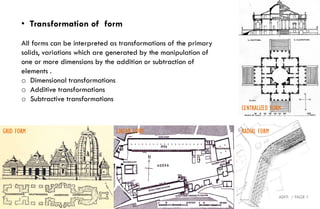
• Transformation of form
All forms can be interpreted as transformations of the primary
solids, variations which are generated by the manipulation of
one or more dimensions by the addition or subtraction of
elements .
o Dimensional transformations
o Additive transformations
o Subtractive transformations
CENTRALIZED FORM
GRID FORM LINEAR FORM RADIAL FORM
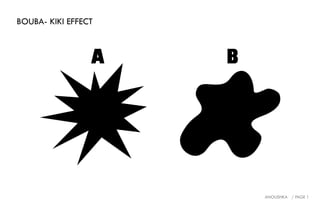
BOUBA- KIKI EFFECT
ANOUSHKA / PAGE 1
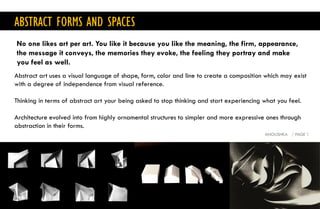
ABSTRACT FORMS AND SPACES
No one likes art per art. You like it because you like the meaning, the firm, appearance,
the message it conveys, the memories they evoke, the feeling they portray and make
you feel as well.
Abstract art uses a visual language of shape, form, color and line to create a composition which may exist
with a degree of independence from visual reference.
Thinking in terms of abstract art your being asked to stop thinking and start experiencing what you feel.
Architecture evolved into from highly ornamental structures to simpler and more expressive ones through
abstraction in their forms.
ANOUSHKA / PAGE 1
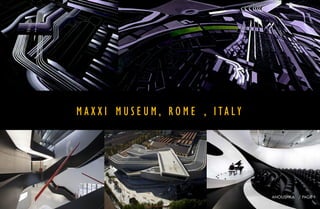
M A X X I M U S E U M , R O M E , I T A L Y
ANOUSHKA / PAGE 1
EFFECT OF SPACES ON HUMAN MIND
AASHI & ARCHANA / PAGE 1
Architecture can impact or affect human behavior in positive and negative ways, it can
affect the health and well-being of humans, as well as human performance.
Humans spend the majority of their lives in built environments and less of their lives in natural
environments; therefore, it is inevitable that architecture regardless of whether it is residential or
commercial architectural designs will indeed impact or affect human
The direct and indirect consequences of architectural designs can either be functionally
appropriate and aesthetically pleasing to humans; therefore, fostering positive behavior or
functionally inappropriate by imposing restrictions on behavior.
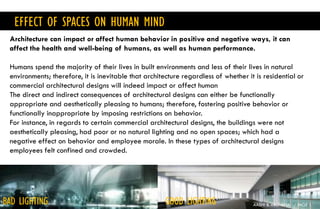
For instance, in regards to certain commercial architectural designs, the buildings were not
aesthetically pleasing, had poor or no natural lighting and no open spaces; which had a
negative effect on behavior and employee morale. In these types of architectural designs
employees felt confined and crowded.
BAD LIGHTING GOOD LIGHTING
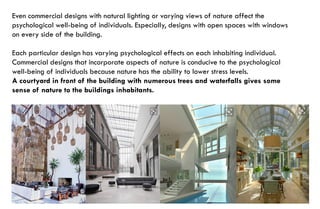
Even commercial designs with natural lighting or varying views of nature affect the
psychological well-being of individuals. Especially, designs with open spaces with windows
on every side of the building.
Each particular design has varying psychological effects on each inhabiting individual.
Commercial designs that incorporate aspects of nature is conducive to the psychological
well-being of individuals because nature has the ability to lower stress levels.
A courtyard in front of the building with numerous trees and waterfalls gives some
sense of nature to the buildings inhabitants.
• Building scale refers to building elements and details as they
proportionally relate to each other and to humans
• As we all know by know there two types of scales mainly
a. MONUMANTAL SCALE : Buildings, statues, and
memorials are constructed in a scale larger than life
as a social/cultural signal that the subject matter is
also larger than life.
b. HUMAN SCALE : is the set of physical qualities, and
quantities of information, characterizing
the human body, its motor, sensory, or mental
capabilities.
• Both monumental and human scales give us way different
feelings mentally, emotionally an even physically .
• For example in MANHATTAN of NY , one can find a large
number of huge tall buildings grouped together this might
make a person feel inferior .
CHARITHA / PAGE 1
EFFECT OF SCALE
REACTIONS TO SPACES
SIGHT
The man in course of his space travels, needs the body messages to ensure
the stability of their visual world. Not having this body information, the
human being looses the connection with the world.
HEARING
Sound is invisible but has the power to change the space characteristics
we occupy .
Building always have sound; we feel pleasure and protection when the
body discovers its resonance in it.
SMELL
The nostrils awaken a forgotten image and fall into a vivid dream. The
nose makes the eyes remember.
TOUCH
While tactile space separates the observer from objects, visual spaces
separates the object from each other. The perceptual world is guided by
the touch, being more immediate and welcoming than the world guided
by sight. HARSHITH / PAGE 1
• The word emotion is often applied to a wide variety of phenomena, such as passions ,
sentiments , temperament and moods.
• The impact a space has on a person's mood is huge: not how it looks, but how we feel it,
through the way it allows us to act, think, behave and reflect.
• A space elicits different emotions , like letting u feel small or big, or give us a safe feeling or
unsafe one.
• At times it also evokes a sense of spiritual mood. Someone may feel calm, other person may
feel uncomfortable.
EMOTIONS TOWARDS SPACES
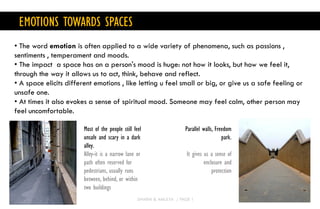
Most of the people still feel
unsafe and scary in a dark
alley.
Alley-it is a narrow lane or
path often reserved for
pedestrians, usually runs
between, behind, or within
two buildings
Parallel walls, Freedom
park.
It gives us a sense of
enclosure and
protection
DHARNI & AMULYA / PAGE 1
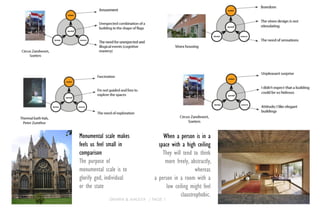
Monumental scale makes
feels us feel small in
comparison
The purpose of
monumental scale is to
glorify god, individual
or the state
When a person is in a
space with a high ceiling
They will tend to think
more freely, abstractly,
whereas
a person in a room with a
low ceiling might feel
claustrophobic.
DHARNI & AMULYA / PAGE 1
AUWAD / PAGE 1
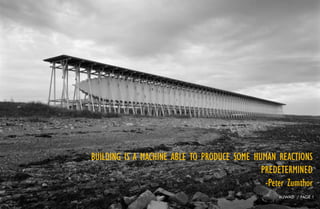
BUILDING IS A MACHINE ABLE TO PRODUCE SOME HUMAN REACTIONS
PREDETERMINED
-Peter Zumthor

Perception in architecture

  • 1.
  • 2.
    Different researches inthe fields of psychology, behavioral studies, E-B studies, architecture and other fields have tried to define and explain the emotional impacts space has over a person. Studies show that different spaces evoke different emotions, yet it is still hard to tell exactly how architecture induces them. Conclusions have been drawn from several different research fields in order to establish a methodology for exploring the connection between space and human feelings. This is to produce more scientific knowledge for the field in the future, using tools of computation and simulations. This study will enhance our capabilities to create more pleasant environments – a primary goal for designers, architects and urban planners. INTRODUCTION ALSON/ PAGE 1
  • 3.
    PHYSIOLOGICAL EFFECTS OFSPACES Space conveys both physiological and psychological effects. • Physiologically, it contributes to illusion s of size. Filled space seems larger than empty space. • Spatial distance through which lines travel, as well as their angles, contributes to inaccurate perceptions of their length. • Psychologically, large, unbroken spaces are serene, yet bold and dramatic. Small, broken spaces suggest delicacy and complexity. • Divisions into long narrow vertical spaces will heighten, lengthen the space. • Divisions into horizontal sections will shorten and widen the space. • It provides rest and relief in patter, a visual interval similar to rest in music and pause in speech. • Appears behind shape this pushes the shape forward. • Because it is less dense, more airy or hollow that the shape it surrounds and gives the shape buoyancy. • The cues that make enclose space appear solid are advancing curs. These cues expand, create depth, and increase apparent distance between foreground and background. HARSHITHA/ PAGE 1
  • 4.
    • Form isa term that is used to denote the formal structure of a work. • Form suggests reference to both internal structures and external outline and the principle that gives unity to the whole . • Forms are created through different shapes, it is the principle aspect by which we identify and categorize forms . • Forms also have relational properties that govern the pattern and composition of elements. • Surfaces : In the transition from shapes to planes to forms of volume is the realm of surfaces. • Regular forms and irregular forms : Regular forms refers to those whose parts are related to one another in a consistent and orderly manner. • Irregular forms are those whose parts are dissimilar in nature and are related in an inconsistent manner. FORM AND ORDER ADITI / PAGE 1 YA H A R A B O AT C L U B
  • 5.
    ADITI / PAGE1 Philharmonic hall , Berlin Coonley playhouse ,Illinois IRREGULAR FORMS REGULAR FORMS
  • 6.
    ADITI / PAGE1 Courtyard house project Mies van de Rohe - irregular forms within a regular field IRREGULAR FORMS WITHIN REGULAR FEILD Mosque of Sultan Hassan , Egypt REGULAR FORMS WITH IRREGULAR COMPOSITION
  • 7.
    ADITI / PAGE1 • Transformation of form All forms can be interpreted as transformations of the primary solids, variations which are generated by the manipulation of one or more dimensions by the addition or subtraction of elements . o Dimensional transformations o Additive transformations o Subtractive transformations CENTRALIZED FORM GRID FORM LINEAR FORM RADIAL FORM
  • 8.
  • 9.
    ABSTRACT FORMS ANDSPACES No one likes art per art. You like it because you like the meaning, the firm, appearance, the message it conveys, the memories they evoke, the feeling they portray and make you feel as well. Abstract art uses a visual language of shape, form, color and line to create a composition which may exist with a degree of independence from visual reference. Thinking in terms of abstract art your being asked to stop thinking and start experiencing what you feel. Architecture evolved into from highly ornamental structures to simpler and more expressive ones through abstraction in their forms. ANOUSHKA / PAGE 1
  • 10.
    M A XX I M U S E U M , R O M E , I T A L Y ANOUSHKA / PAGE 1
  • 11.
    EFFECT OF SPACESON HUMAN MIND AASHI & ARCHANA / PAGE 1 Architecture can impact or affect human behavior in positive and negative ways, it can affect the health and well-being of humans, as well as human performance. Humans spend the majority of their lives in built environments and less of their lives in natural environments; therefore, it is inevitable that architecture regardless of whether it is residential or commercial architectural designs will indeed impact or affect human The direct and indirect consequences of architectural designs can either be functionally appropriate and aesthetically pleasing to humans; therefore, fostering positive behavior or functionally inappropriate by imposing restrictions on behavior. For instance, in regards to certain commercial architectural designs, the buildings were not aesthetically pleasing, had poor or no natural lighting and no open spaces; which had a negative effect on behavior and employee morale. In these types of architectural designs employees felt confined and crowded. BAD LIGHTING GOOD LIGHTING
  • 12.
    Even commercial designswith natural lighting or varying views of nature affect the psychological well-being of individuals. Especially, designs with open spaces with windows on every side of the building. Each particular design has varying psychological effects on each inhabiting individual. Commercial designs that incorporate aspects of nature is conducive to the psychological well-being of individuals because nature has the ability to lower stress levels. A courtyard in front of the building with numerous trees and waterfalls gives some sense of nature to the buildings inhabitants.
  • 13.
    • Building scalerefers to building elements and details as they proportionally relate to each other and to humans • As we all know by know there two types of scales mainly a. MONUMANTAL SCALE : Buildings, statues, and memorials are constructed in a scale larger than life as a social/cultural signal that the subject matter is also larger than life. b. HUMAN SCALE : is the set of physical qualities, and quantities of information, characterizing the human body, its motor, sensory, or mental capabilities. • Both monumental and human scales give us way different feelings mentally, emotionally an even physically . • For example in MANHATTAN of NY , one can find a large number of huge tall buildings grouped together this might make a person feel inferior . CHARITHA / PAGE 1 EFFECT OF SCALE
  • 14.
    REACTIONS TO SPACES SIGHT Theman in course of his space travels, needs the body messages to ensure the stability of their visual world. Not having this body information, the human being looses the connection with the world. HEARING Sound is invisible but has the power to change the space characteristics we occupy . Building always have sound; we feel pleasure and protection when the body discovers its resonance in it. SMELL The nostrils awaken a forgotten image and fall into a vivid dream. The nose makes the eyes remember. TOUCH While tactile space separates the observer from objects, visual spaces separates the object from each other. The perceptual world is guided by the touch, being more immediate and welcoming than the world guided by sight. HARSHITH / PAGE 1
  • 15.
    • The wordemotion is often applied to a wide variety of phenomena, such as passions , sentiments , temperament and moods. • The impact a space has on a person's mood is huge: not how it looks, but how we feel it, through the way it allows us to act, think, behave and reflect. • A space elicits different emotions , like letting u feel small or big, or give us a safe feeling or unsafe one. • At times it also evokes a sense of spiritual mood. Someone may feel calm, other person may feel uncomfortable. EMOTIONS TOWARDS SPACES Most of the people still feel unsafe and scary in a dark alley. Alley-it is a narrow lane or path often reserved for pedestrians, usually runs between, behind, or within two buildings Parallel walls, Freedom park. It gives us a sense of enclosure and protection DHARNI & AMULYA / PAGE 1
  • 16.
    Monumental scale makes feelsus feel small in comparison The purpose of monumental scale is to glorify god, individual or the state When a person is in a space with a high ceiling They will tend to think more freely, abstractly, whereas a person in a room with a low ceiling might feel claustrophobic. DHARNI & AMULYA / PAGE 1
  • 17.
    AUWAD / PAGE1 BUILDING IS A MACHINE ABLE TO PRODUCE SOME HUMAN REACTIONS PREDETERMINED -Peter Zumthor