BASIC SITE
PLANNING
References: Kevin Lynch and Gary Hack
(1984)
Credits: Original slide by Dr. Omolo-Okalebo. Edited and presented by Dr. Apell.
Site selectionSite selection
• For every site there is an ideal use
• For every use there is an ideal site.
What are factors influencing siteWhat are factors influencing site
planning?planning?
1. Natural factors : Geology and soil, topography, habitat,
microclimate, Hydrology.
The categories of data and its interpretation is related to
the proposed project. The level of detail depends on the
nature of the program --how simple or complex and the
type of site --rural or urban
2. Man-made factors : existing uses, man-made
features, legal regulations and historical associations.
3. Aesthetic factors : visual qualities and relationship.
4. Metrological: Climate, Natural Disasters etc.
Stage 1: Site Analysis
• Consultation with client
• Simple site visit.
• This results in a drawing to provide a rough
sketch of locations and concept of plan.
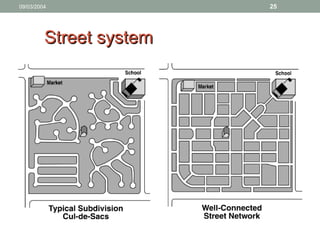
• Drawing and graphics are generally abstract.
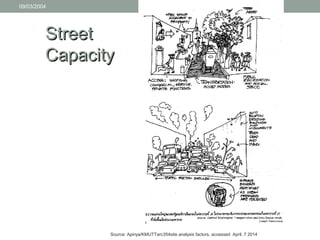
Source: http://www.ts-architects.co.uk: retrieved 11/19/15
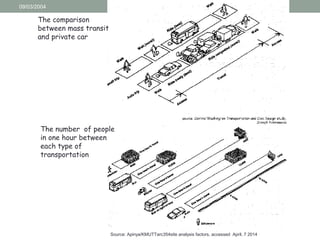
Collection & Analysis of existing
Site information
Locate and collect any information not found on existing plans
Natural factorsNatural factors
Slope and Topography
• Slope and topography describe the shape and
relief of land.
• Topography is a measurement of elevation and
relief of the Land. Topography is measured with
contours that connect points representing the
same elevation
• Slope is the difference in elevation from one point
to another divided by the lateral distance between
those points.
Why are slope and Topography important?
• Reduce construction costs
• Minimize risks from natural hazards such as flooding and
landslides,
• Minimize the impacts of proposed developments on
natural resources such as soils, vegetation and water
systems.
• Vreate a model of the land surface (digital elevation
model) or three dimensional physical models.
09/03/2004 10
Topographic mapTopographic map
•Locations
•Natural Features
•Man-made Features
•Elevation And Relief
•Vegetation
•Hydrographic, Water Body
•Roads, Buildings
Source: Discoverdesign.org. Retrieved: 11/19/15
i
09/03/2004 11
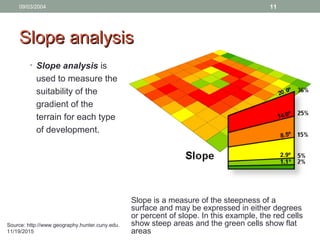
Slope analysisSlope analysis
• Slope analysis is
used to measure the
suitability of the
gradient of the
terrain for each type
of development.
Slope is a measure of the steepness of a
surface and may be expressed in either degrees
or percent of slope. In this example, the red cells
show steep areas and the green cells show flat
areas
Source: http://www.geography.hunter.cuny.edu.
11/19/2015
Typical questions:
1. Contour interval, pattern of landform
2. Natural drainage pattern
3. Unique features
4. Slope analysis and percent slope.
5. Site dangers: Land slide potential, sink holes,
Slope analysisSlope analysis
Source: Apinya/KMUTTarc354site analysis factors, accessed April, 7 2014
09/03/2004 13
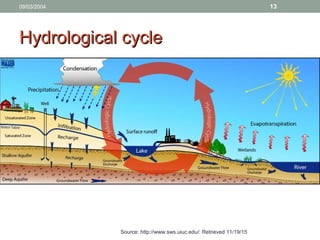
Hydrological cycleHydrological cycle
Source: http://www.sws.uiuc.edu/: Retrieved 11/19/15
09/03/2004 /Apinya/KMUTTarc354site analysis factors 14
• Soil classification ( Loam, Clay, Sand)
• Soil survey data
• Why is soil information important?
Natural factors: SoilNatural factors: Soil
09/03/2004 15
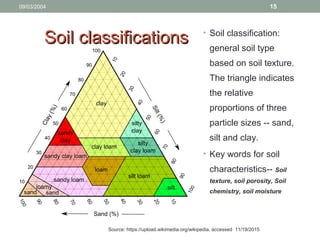
Soil classificationsSoil classifications • Soil classification:
general soil type
based on soil texture.
The triangle indicates
the relative
proportions of three
particle sizes -- sand,
silt and clay.
• Key words for soil
characteristics-- Soil
texture, soil porosity, Soil
chemistry, soil moisture
Source: https://upload.wikimedia.org/wikipedia, accessed 11/19/2015
Soil mapSoil map
Source:www.esri.com; 11/19/15 16
09/03/2004 17
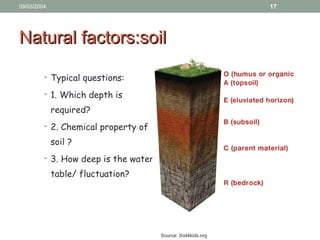
• Typical questions:
• 1. Which depth is
required?
• 2. Chemical property of
soil ?
• 3. How deep is the water
table/ fluctuation?
Natural factors:soilNatural factors:soil
Source: Soil4kids.org
09/03/2004 18
• Temperature
• Micro-climate
• WIND VELOCITY
• PRECIPITATION RATE
• TEMPERATURE
• HUMIDITY
Metrological FactorsMetrological Factors
Note Important Site Features:
• Sun orientation
• Airflow
• Water
• Wildlife
• Population Density
• existing uses of the site & its surroundings
• think of all the senses and record observations - sound /
sight / smell / touch / taste + spirit
09/03/2004 20
Land use/ DevelopmentsLand use/ Developments
• Existing land use on-site, off-site
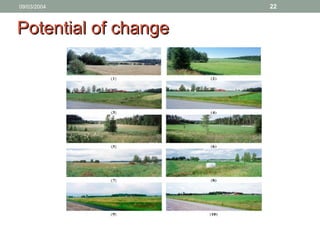
• the potential of change
• color symbol of land use
• facilities or site amenity
09/03/2004 21
Site surrounding: AerialSite surrounding: Aerial
PhotoPhoto
Source: Speke Resort Kampala
09/03/2004 22
Potential of changePotential of change
ExistingExisting
FacilitiesFacilities
Public school
Social service
Hospital
Fire station
Library, Post office
Source: Apinya/KMUTTarc354site analysis factors, accessed April, 7 2014
09/03/2004 24
• Linkage and movement pattern
• Connection to activity centers
• Circulation
• Accessibility
• Potential of change
CirculationCirculation
Source: Apinya/KMUTTarc354site analysis factors, accessed April, 7 2014
09/03/2004 25
Street systemStreet system
09/03/2004 /Apinya/KMUTTarc354site analysis factors 26
StreetStreet
CapacityCapacity
Source: Apinya/KMUTTarc354site analysis factors, accessed April, 7 2014
09/03/2004 /Apinya/KMUTTarc354site analysis factors 27
The comparison
between mass transit
and private car
The number of people
in one hour between
each type of
transportation
Source: Apinya/KMUTTarc354site analysis factors, accessed April, 7 2014
09/03/2004 /Apinya/KMUTTarc354site analysis factors 28
• Density : F.A.R
• Zoning district
• Set back, building and other regulation
Law and regulationLaw and regulation
09/03/2004 29
• FAR is one of the density
control device, FAR is a term
the zoning ordinance will use
to quantify and limit the
amount of square footage of
building area as a function of
the building site
F.A.R.=1/2
One-story bldg. Two-story bldg.
Law and regulationLaw and regulation
Site area
Floor area ratio(FAR)= building area
09/03/2004 /Apinya/KMUTTarc354site analysis factors 30
• Zoning setback and
height limits-- these
minimums and
maximums provide the
basis for the maximum
building envelope on
the site.
Laws, codesLaws, codes
& regulation& regulation
Aesthetic factorsAesthetic factors
09/03/2004 32
Visual qualityVisual quality
•Landscape special character
•Spatial pattern of the site
•Visual quality and character
•Visual disturbance
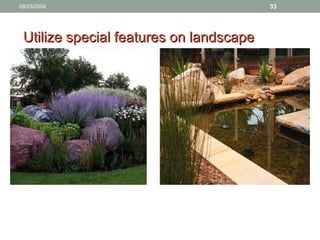
Utilize special features on landscapeUtilize special features on landscape
09/03/2004 33
Rocky outcrops
09/03/2004 34
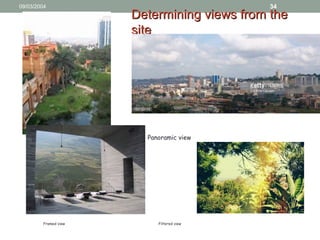
Determining views from theDetermining views from the
sitesite
Vista Panoramic view
Framed view Filtered view
Stage 2: The Concept Design
• This is typically the initial design response.
• There are no definite rules as to what must be
included in a concept plan.
• Typically, the main features of the landscape design
are shown - for instance the different garden areas
and their relationship to neighboring areas, main
features and main trees.
• Plans are often to scale and include a basic
indication of materials. The drawings are often
illustrative.
Measurements
• Measure enough existing features to verify the scale of
your drawings
• Overall length and height of building faces
• Location and width of paths
• Location & size (trunk, canopy and height) of trees &
shrubs
Conceptual Diagrams – from Landscape Graphics by Grant W. Reid
Stage 3: Preliminary Drawings
• Sometimes Preliminary Designs are produced if a
Concept needs further resolution but the client does
not want to progress to detailed designs or full
tender or construction documents.
• For the preliminary phase, the main goal is to map
out how the complex components will perform the
functions in a given site, and their defined interfaces
within the general environment.
• A presentation is made to the client and the client
assess how well the plan suits their needs and if any
changes need to be made.
Stage 4: Detailed Designs /Tender Issue
Plans
• The Tender Issue Plans are used to obtain quotes
from contractors.
• These drawings must communicate the fully
resolved design to the contractors, and include all
details the contractor will need to provide an
accurate quote.
• The drawings must give the contractor enough
information to determine the scope of works to be
done, all the required components, and the ability to
estimate labour requirements.
What is Landscape?
• “A portion of the earth’s surface that can be comprehended at a
glance.”
• Landscape may also be defined as natural scenery seen from
a single view point
• ‘Landscape is an attractive, important, and ambiguous term
[that] encompasses an ensemble of ordinary features which
constitute an extraordinarily rich exhibit of the course and
character of any society’ and that ‘Landscape is defined by our
vision and interpreted by our minds.
11/23/140

Site Planning

  • 1.
    BASIC SITE PLANNING References: KevinLynch and Gary Hack (1984) Credits: Original slide by Dr. Omolo-Okalebo. Edited and presented by Dr. Apell.
  • 2.
    Site selectionSite selection •For every site there is an ideal use • For every use there is an ideal site.
  • 3.
    What are factorsinfluencing siteWhat are factors influencing site planning?planning? 1. Natural factors : Geology and soil, topography, habitat, microclimate, Hydrology. The categories of data and its interpretation is related to the proposed project. The level of detail depends on the nature of the program --how simple or complex and the type of site --rural or urban 2. Man-made factors : existing uses, man-made features, legal regulations and historical associations. 3. Aesthetic factors : visual qualities and relationship. 4. Metrological: Climate, Natural Disasters etc.
  • 4.
    Stage 1: SiteAnalysis • Consultation with client • Simple site visit. • This results in a drawing to provide a rough sketch of locations and concept of plan. • Drawing and graphics are generally abstract.
  • 5.
  • 6.
    Collection & Analysisof existing Site information Locate and collect any information not found on existing plans
  • 7.
  • 8.
    Slope and Topography •Slope and topography describe the shape and relief of land. • Topography is a measurement of elevation and relief of the Land. Topography is measured with contours that connect points representing the same elevation • Slope is the difference in elevation from one point to another divided by the lateral distance between those points.
  • 9.
    Why are slopeand Topography important? • Reduce construction costs • Minimize risks from natural hazards such as flooding and landslides, • Minimize the impacts of proposed developments on natural resources such as soils, vegetation and water systems. • Vreate a model of the land surface (digital elevation model) or three dimensional physical models.
  • 10.
    09/03/2004 10 Topographic mapTopographicmap •Locations •Natural Features •Man-made Features •Elevation And Relief •Vegetation •Hydrographic, Water Body •Roads, Buildings Source: Discoverdesign.org. Retrieved: 11/19/15 i
  • 11.
    09/03/2004 11 Slope analysisSlopeanalysis • Slope analysis is used to measure the suitability of the gradient of the terrain for each type of development. Slope is a measure of the steepness of a surface and may be expressed in either degrees or percent of slope. In this example, the red cells show steep areas and the green cells show flat areas Source: http://www.geography.hunter.cuny.edu. 11/19/2015
  • 12.
    Typical questions: 1. Contourinterval, pattern of landform 2. Natural drainage pattern 3. Unique features 4. Slope analysis and percent slope. 5. Site dangers: Land slide potential, sink holes, Slope analysisSlope analysis Source: Apinya/KMUTTarc354site analysis factors, accessed April, 7 2014
  • 13.
    09/03/2004 13 Hydrological cycleHydrologicalcycle Source: http://www.sws.uiuc.edu/: Retrieved 11/19/15
  • 14.
    09/03/2004 /Apinya/KMUTTarc354site analysisfactors 14 • Soil classification ( Loam, Clay, Sand) • Soil survey data • Why is soil information important? Natural factors: SoilNatural factors: Soil
  • 15.
    09/03/2004 15 Soil classificationsSoilclassifications • Soil classification: general soil type based on soil texture. The triangle indicates the relative proportions of three particle sizes -- sand, silt and clay. • Key words for soil characteristics-- Soil texture, soil porosity, Soil chemistry, soil moisture Source: https://upload.wikimedia.org/wikipedia, accessed 11/19/2015
  • 16.
  • 17.
    09/03/2004 17 • Typicalquestions: • 1. Which depth is required? • 2. Chemical property of soil ? • 3. How deep is the water table/ fluctuation? Natural factors:soilNatural factors:soil Source: Soil4kids.org
  • 18.
    09/03/2004 18 • Temperature •Micro-climate • WIND VELOCITY • PRECIPITATION RATE • TEMPERATURE • HUMIDITY Metrological FactorsMetrological Factors
  • 19.
    Note Important SiteFeatures: • Sun orientation • Airflow • Water • Wildlife • Population Density • existing uses of the site & its surroundings • think of all the senses and record observations - sound / sight / smell / touch / taste + spirit
  • 20.
    09/03/2004 20 Land use/DevelopmentsLand use/ Developments • Existing land use on-site, off-site • the potential of change • color symbol of land use • facilities or site amenity
  • 21.
    09/03/2004 21 Site surrounding:AerialSite surrounding: Aerial PhotoPhoto Source: Speke Resort Kampala
  • 22.
    09/03/2004 22 Potential ofchangePotential of change
  • 23.
    ExistingExisting FacilitiesFacilities Public school Social service Hospital Firestation Library, Post office Source: Apinya/KMUTTarc354site analysis factors, accessed April, 7 2014
  • 24.
    09/03/2004 24 • Linkageand movement pattern • Connection to activity centers • Circulation • Accessibility • Potential of change CirculationCirculation Source: Apinya/KMUTTarc354site analysis factors, accessed April, 7 2014
  • 25.
  • 26.
    09/03/2004 /Apinya/KMUTTarc354site analysisfactors 26 StreetStreet CapacityCapacity Source: Apinya/KMUTTarc354site analysis factors, accessed April, 7 2014
  • 27.
    09/03/2004 /Apinya/KMUTTarc354site analysisfactors 27 The comparison between mass transit and private car The number of people in one hour between each type of transportation Source: Apinya/KMUTTarc354site analysis factors, accessed April, 7 2014
  • 28.
    09/03/2004 /Apinya/KMUTTarc354site analysisfactors 28 • Density : F.A.R • Zoning district • Set back, building and other regulation Law and regulationLaw and regulation
  • 29.
    09/03/2004 29 • FARis one of the density control device, FAR is a term the zoning ordinance will use to quantify and limit the amount of square footage of building area as a function of the building site F.A.R.=1/2 One-story bldg. Two-story bldg. Law and regulationLaw and regulation Site area Floor area ratio(FAR)= building area
  • 30.
    09/03/2004 /Apinya/KMUTTarc354site analysisfactors 30 • Zoning setback and height limits-- these minimums and maximums provide the basis for the maximum building envelope on the site. Laws, codesLaws, codes & regulation& regulation
  • 31.
  • 32.
    09/03/2004 32 Visual qualityVisualquality •Landscape special character •Spatial pattern of the site •Visual quality and character •Visual disturbance
  • 33.
    Utilize special featureson landscapeUtilize special features on landscape 09/03/2004 33 Rocky outcrops
  • 34.
    09/03/2004 34 Determining viewsfrom theDetermining views from the sitesite Vista Panoramic view Framed view Filtered view
  • 35.
    Stage 2: TheConcept Design • This is typically the initial design response. • There are no definite rules as to what must be included in a concept plan. • Typically, the main features of the landscape design are shown - for instance the different garden areas and their relationship to neighboring areas, main features and main trees. • Plans are often to scale and include a basic indication of materials. The drawings are often illustrative.
  • 36.
    Measurements • Measure enoughexisting features to verify the scale of your drawings • Overall length and height of building faces • Location and width of paths • Location & size (trunk, canopy and height) of trees & shrubs
  • 37.
    Conceptual Diagrams –from Landscape Graphics by Grant W. Reid
  • 38.
    Stage 3: PreliminaryDrawings • Sometimes Preliminary Designs are produced if a Concept needs further resolution but the client does not want to progress to detailed designs or full tender or construction documents. • For the preliminary phase, the main goal is to map out how the complex components will perform the functions in a given site, and their defined interfaces within the general environment. • A presentation is made to the client and the client assess how well the plan suits their needs and if any changes need to be made.
  • 39.
    Stage 4: DetailedDesigns /Tender Issue Plans • The Tender Issue Plans are used to obtain quotes from contractors. • These drawings must communicate the fully resolved design to the contractors, and include all details the contractor will need to provide an accurate quote. • The drawings must give the contractor enough information to determine the scope of works to be done, all the required components, and the ability to estimate labour requirements.
  • 40.
    What is Landscape? •“A portion of the earth’s surface that can be comprehended at a glance.” • Landscape may also be defined as natural scenery seen from a single view point • ‘Landscape is an attractive, important, and ambiguous term [that] encompasses an ensemble of ordinary features which constitute an extraordinarily rich exhibit of the course and character of any society’ and that ‘Landscape is defined by our vision and interpreted by our minds. 11/23/140

Editor's Notes

  • #12 To calculate percent slope, divide the elevation difference (known as the rise) between two points, by the distance between them (known as the run), and then multiply the result by 100.To calculate degree of slope, imagine rise and run as sides of a right triangle, then the degree of slope is the angle opposite the rise. Since degree of slope is equal to the tangent of the fraction rise/run, it can be calculated as the arctangent of rise/run. Measures of slope in degrees can approach 90 degrees and measures of slope in percent can approach infinity.
  • #17 Soil map if related to drainage , building foundations, suitability of locating uses ( Gardens, Parks , etc)