Landscpe Design
Site analysis
Ar.Shruti.H.Kapur
LANDFORMS-CLASSIFY FOUR TYPICAL BUILDING
SITES
Hilly site ---------------
•contours are major plan factors. The areas of relatively equal
elevation are narrow bands lying perpendicular to the
axis of the slope.
•sizable level areas are non existent.
•the essence of slope is rise and fall.
•the slope is a ramp.
•The slope grade is perhaps too steep for wheeled traffic.
•The pull of gravity is drawn the slope.
•The slope site has a dynamic landscape quality.
•The dramatic quality of a slope is its apparent chamgein
grade.
•A slope inherently emphasizes the meeting of earth and air.
•The top of the slope is most exposed to the elements.
•A sloping site affords interest in views.
•The slope is oriented outward.
•A sloping site has drainage problem.
•a slope brings out many of the desirable qualities of water.
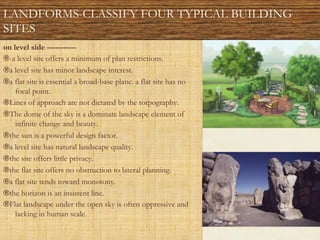
on level side -----------
®-a level site offers a minimum of plan restrictions.
®a level site has minor landscape interest.
®a flat site is essential a broad-base plane. a flat site has no
focal point.
®Lines of approach are not dictated by the totpography.
®The dome of the sky is a dominate landscape element of
infinite change and beauty.
®the sun is a powerful design factor.
®a level site has natural landscape quality.
®the site offers little privacy.
®the flat site offers no obstruction to lateral planning.
®a flat site tends toward monotony.
®the horizon is an insistent line.
®Flat landscape under the open sky is often oppressive and
lacking in human scale.
LANDFORMS-CLASSIFY FOUR TYPICAL BUILDING
SITES
City lot
®Area is a premium
®Space is limited
®The city environs impose a sense of confinement
and oppression
®Areas and spaces are minute in scale
®City streets and pedestrian walks are major lines of
approach.
®The city street is a source of noise ,fumes and
danger.
®The city is climatologically speaking ,a desert of
pavement and masonry.
®Natural features-trees, interesting ground forms,
rocks and water are scare and therefore have
increased have increased valve and meaning.
®City materials and forms are ,at their best ,
sophisticated.
LANDFORMS-CLASSIFY FOUR TYPICAL BUILDING
SITES
Rural site
®Land area is plentiful
®Freedom ,with open view of fields , woods, and sky.
®The choice of a rural site would indicate a desire to
be at one with nature.
®The major landscape features are established.
®The landscape is dominant(in character and mood).
®Earth and ground forms are strong visual elements.
®The pleasant landscape is one of agreeable
transitions.
®Structures become elements imposed on the
landscape.
®The rural landscape is a landscape of subtleties –of
foliage shadings, sky tints, and cloud shadows.
®Ina rural site ,one is more exposed to the elements
and the weather-rain, storms, sun ,wind,
snow,frost,wintercold and summer heat.
LANDFORMS-CLASSIFY FOUR TYPICAL BUILDING
SITES
•  Site analysis
•  •Site analysisis an inventory completed as a preparatory step to site planning, a form of
urban planningwhich involves research, analysis, and synthesis. It primarily deals with
basic data as it relates to a specific site. The topic itself branches into the boundaries of
architecture, landscape architecture, engineering, real estate development, economics, and
urban planning
•  •Site analysis is an element in site planning and design. Kevin A. Lynch, an urban
plannerdeveloped an eight cycle step process of site design, in which the second step is site
analysis, the focus of this section
SITE ANALYSIS
GOAL OF SITE ANALYSIS
®To achieve a successful design, site analysis is a
must & should be done carefully
®Site Analysis involves taking an inventory of site
elements and analyzing these factors relative to
the clients needs & aims
®Gather relevant information about the properties
of the site, from topography to climate to wind
pattern and vegetation
®Analyze these features and incorporate them into
the design
Process
•The site design process is divided up
into three sections; researchphase,
analysisphase, and synthesisphase.
These three phases are divided into
the eight chronological steps in the
design process.[
•Research phase: The first step is defining
the problem and its definition. This
is part of the research phase. The site
design and site planning process
begins with the initial problem to be
solved. This is started by a client
contractinga planner to work with a
particular site.
PROCESS OF SITE ANALYSIS
•Analysis phase: The next step involves
programming the site as well as site and user
analysis, which is focused on in-depth below.
There are numerous site elements related to
the analysis during this phase. This is part of
the analysis phase in site planning.
•Synthesis phase: From the analysis, a program is
developed, which is part of the synthesis phase.
The third step deals with schematic designof a
site planas well as a preliminary cost estimate
for the site. Step four involves more developed
designs and a detailed cost estimate. Step five is
the construction documentsfor the plan.
Bidding and contracting for the project follows
as step six. Construction then will take place as
step seven. The final step, step eight, in the site
design process is occupation and management
of the site
•  SITE ANALYSIS AND ASSESSMENT
•  •The process of calculating the degree of resource use and the degree of disturbance of
existing natural systems required to support a development begins with site selection
•  •The most environmentally sound development is one that disturbs as little of the
existing site as possible .
•  •Building projects also require connections to
•  1.mass transit,
•  2.vehicular infrastructure,
•  3.utility
•  4.telecommunication networks .
ACCESSMENT OF SITE ANALYSIS
•  collected and analyzed
•  •Site data on
•  1.climate,
•  2.topography,
•  3.soils,
•  4.water,
•  5.vegetation,
•  and other factors should be
collected and analyzed to assess a
site's compatibility with the
proposed program from an
energy and resource conservation
perspective .
ACCESSMENT OF SITE ANALYSIS
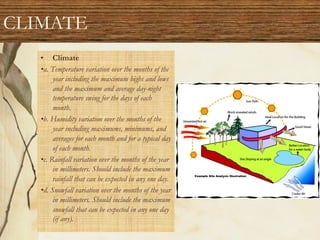
•  Climate
•a. Temperature variation over the months of the
year including the maximum highs and lows
and the maximum and average day-night
temperature swing for the days of each
month.
•b. Humidity variation over the months of the
year including maximums, minimums, and
averages for each month and for a typical day
of each month.
•c. Rainfall variation over the months of the year
in millimeters. Should include the maximum
rainfall that can be expected in any one day.
•d. Snowfall variation over the months of the year
in millimeters. Should include the maximum
snowfall that can be expected in any one day
(if any).
CLIMATE
Climate
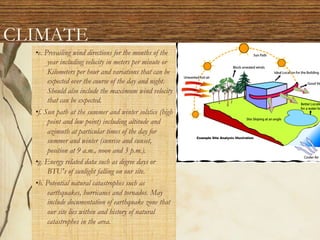
•e. Prevailing wind directions for the months of the
year including velocity in meters per minute or
Kilometers per hour and variations that can be
expected over the course of the day and night.
Should also include the maximum wind velocity
that can be expected.
•f. Sun path at the summer and winter solstice (high
point and low point) including altitude and
azimuth at particular times of the day for
summer and winter (sunrise and sunset,
position at 9 a.m., noon and 3 p.m.).
•g. Energy related data such as degree days or
BTU's of sunlight falling on our site.
•h. Potential natural catastrophes such as
earthquakes, hurricanes and tornados. May
include documentation of earthquake zone that
our site lies within and history of natural
catastrophes in the area.
CLIMATE
Topography
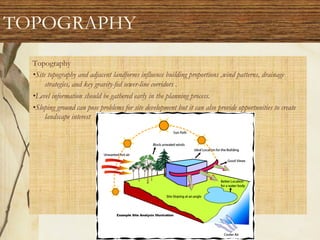
•Site topography and adjacent landforms influence building proportions ,wind patterns, drainage
strategies, and key gravity-fed sewer-line corridors .
•Level information should be gathered early in the planning process.
•Sloping ground can pose problems for site development but it can also provide opportunities to create
landscape interest
TOPOGRAPHY
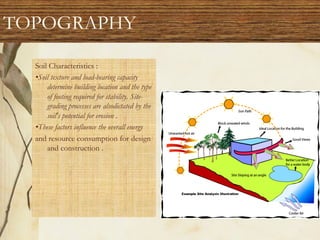
Soil Characteristics :
•Soil texture and load-bearing capacity
determine building location and the type
of footing required for stability. Site-
grading processes are alsodictated by the
soil's potential for erosion .
•These factors influence the overall energy
and resource consumption for design
and construction .
TOPOGRAPHY
Geographical latitude (solar altitude)
and solar access :
•Exposure to solar radiation determines
orientation of buildings for maximum
use of passive solar resources for
•heating,
•daylighting, and
•photovoltaics
GEOGRAPHICAL LATITUDE&
WIND PATTERN
Wind Patterns
•Air-movement, both annual and diurnal,
particularly influence sitingof multiple
structures, to avoid damming of cold
moisture-laden air, or blocking
favorable cooling breezes during
periods of overheating .
•Properly measured wind loads and pressure
differentials are essential for designing
interior air-handling systems or use of
passive solar cooling strategies .
Groundwater and surface runoff
characteristics: Surface drainage
•: Site drainage determines building
locations as well as natural channels for
diverting storm runoff and locations of
runoff detention ponds. Use of the
existing drainage system minimizes need
for additional infrastructure .
•The opportunity to incorporate sustainable
drainage measures should be explored
wherever possible to accommodate
surface water run off from buildings and
hard landscape areas
GROUND WATER &VEGETATION
Vegetation :
•Existing vegetation should
be inventoried to identify significant
plant communities . This may
influence building location,
surface runoff characteristics, and
solar access to the site .
•  Adjacent land uses :
•  •Neighboring developments and
proposed future developments may
influence site design or proposed uses .
•  •Neighboring uses should provide
support services that compliment the
proposed development in order to
minimize transportation needs of
residents and/or employees .
NEIGHBORING LAND
USES&LOCATION
•  Location
•  •a. Location of the city in the state
including relationship to roads, cities,
etc.
•  •b. Location of the site neighborhood in
the city.
•  •c. Location of the site in the
neighborhood.
•  •d. Distances and travel times between
the site and locations of other related
functions in the city.
Man-Made Features
•a. Size, shape, height and location of any
on site buildings. If these are to remain,
the exterior character and interior
layout should also be documented. If the
buildings are to be part of our project,
we must do a detailed building analysis
of each facility.
•b. Location and type of walls, retaining
walls, ramadasor fences.
•c. Location, size and character of exterior
play fields, courts, patios, plazas, drives,
walks or service areas.
•d. Where it may be important to our design
we should record the paving patterns of
man-made surfaces.
•e. Location and size of curb cuts, power
poles, fire hydrants or bus stop shelters.
•f. Off site man-made features may include any of
the on site items listed above and/or may
involve a detailed analysis of the existing
architectural character surrounding our site.
This is particularly important where the
architectural character will be a factor in the
design of our facility (historic district, etc.).
•Some factors to consider in analyzing
surrounding architectural character include
scale, proportion, roof forms, window and
door patterns, setbacks, materials, colors,
textures, open space versus built space, visual
axes, landscaping materials and patterns,
paving textures and patterns, porosity (extent
of openness) and assertiveness (ins and outs)
of wall forms, connections, details and
accessories, exterior lighting, outdoor furniture
and car storage methods.
MAN MADE FEATURES
•  The concept of relating temperature and humidity conditions to design for
human
•  comfort is referred to as bioclimatic design .
•  ®Bioclimatefundamentals can be used to develop a site plan and design that
meets
•  the needs of its occupants, while minimizing energy consumption
•  •Bioclimatic design creates site patterns and applies materials and structural forms which
are suitable for the region in general, and the site in particular.
•  •summarizes various techniques for each climatic region
TEMPRATURE
•  Characterized by dry, hot summer temperatures [>20°C (68°F)] and mild to
cool winters [>0°C (32°F)] .
•  ®Annual precipitation is low, however seasonalflash-floods may occur.
While freezing temperatures are uncommon, extreme diurnal temperature
fluctuations are typical .
•  ®Site planning and design should seek to balance daily temperature
extremes by storing energy, increasing humidity, and diverting desiccating
winds
TEMPRATURE
1 . Use moisture conserving plants.
®2 . Prevent heat build-up on structures (thick walled, in-ground architecture is
useful) .
®3 . Deflect hot winds with walls, screens,and earthwork .
®4 . Trap cool air for convection .
®6 . Use pergola and trellis structures on south and southwest walls.
®7 . Use large overhang calculated for winter sun .
®8 . Avoid large exposed glass .
®9 . Avoid heat absorbing materials .
®10 . Position structure to benefit from durnalair currents .
TEMPRATURE
•  HOT HUMID REGIONS :
•  ®Characterized byhot summer
temperatures [>20°C (68°F)] and
mild to cool winters [>0°C
(32'F)] .
•  ®Annual precipitation and
humidity are high, with frequent
rain showers . Freezing
temperatures are uncommon, and
relatively minor diurnal
temperature fluctuations are
typical .
•  ®Site planning and design should
seek to increase shade, cooling
from evaporation,andbreezes .
HOT HUMID REGIONS
•  HOT HUMID STRATIGIES:
•  ®1 . Maximize breezes and evaporation with
high canopy trees and loose open planting
patterns .
•  ®2 . Avoid tall solid walls that block winds.
•  ®3 . Seek high ground or rising slopes
facing prevailing winds .
•  ®4. Avoid topographical depressions .
•  ®5 . Use large overhangs calculated for
severe sun angles (east and west)
•  ®6 . Covered pergolas, or screened terraces
adjacent to structure will help draw air
currents .
•  ®7 . Avoid excessive earth mounding which
might trap moist, stagnant air.
•  ®8 . Use high ceilings, and vent all roof
systems .
TEMPRATURE
•  TEMPERATE REGIONS
•  ®Characterized byhot, often humid, summers [>20'C (68°F)] and cold winters
[<0°C (32'F)] . Annual precipitation is fairly high .
•  ®The region is subject to repetitive freezing/thawing action, and significant seasonal
temperature fluctuations are common.
•  ®Site planning and design should seek to promote shade and evaporative cooling in
warm periods, and block winds and promote heat gain in cool periods, without
disrupting favorable summer wind pattern
TEMPRATURE
•  COLD REGIONS:
•  ®Characterized by mild summer temperatures [>10°-20o C (50°-68o F)] and very cold winters
[<0°C (32°F)] . Annual precipitation is typically low.
•  ®Region is subject to extreme freezing/thawing action .
•  ®Site planning and design should seek to control winter winds, and promote solar gain and
storage .
COLD REGIONS:
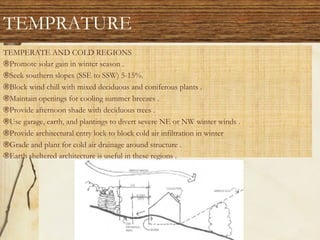
TEMPERATE AND COLD REGIONS
®Promote solar gain in winter season .
®Seek southern slopes (SSE to SSW) 5-15%.
®Block wind chill with mixed deciduous and coniferous plants .
®Maintain openings for cooling summer breezes .
®Provide afternoon shade with deciduous trees .
®Use garage, earth, and plantings to divert severe NE or NW winter winds .
®Provide architectural entry lock to block cold air infiltration in winter
®Grade and plant for cold air drainage around structure .
®Earth sheltered architecture is useful in these regions .
TEMPRATURE
•  ILLUSTRATES A TOPOGRAPHICSECTION SHOWING THE THEORETICAL
"MOSTFAVORABLE" MICROCLIMATE LOCATION FOR EACH CLIMATE REGION .
TEMPRATURE
THANK YOU

L-5 LANDSCAPE site analysis.pdf

  • 1.
  • 2.
    LANDFORMS-CLASSIFY FOUR TYPICALBUILDING SITES Hilly site --------------- •contours are major plan factors. The areas of relatively equal elevation are narrow bands lying perpendicular to the axis of the slope. •sizable level areas are non existent. •the essence of slope is rise and fall. •the slope is a ramp. •The slope grade is perhaps too steep for wheeled traffic. •The pull of gravity is drawn the slope. •The slope site has a dynamic landscape quality. •The dramatic quality of a slope is its apparent chamgein grade. •A slope inherently emphasizes the meeting of earth and air. •The top of the slope is most exposed to the elements. •A sloping site affords interest in views. •The slope is oriented outward. •A sloping site has drainage problem. •a slope brings out many of the desirable qualities of water.
  • 3.
    on level side----------- ®-a level site offers a minimum of plan restrictions. ®a level site has minor landscape interest. ®a flat site is essential a broad-base plane. a flat site has no focal point. ®Lines of approach are not dictated by the totpography. ®The dome of the sky is a dominate landscape element of infinite change and beauty. ®the sun is a powerful design factor. ®a level site has natural landscape quality. ®the site offers little privacy. ®the flat site offers no obstruction to lateral planning. ®a flat site tends toward monotony. ®the horizon is an insistent line. ®Flat landscape under the open sky is often oppressive and lacking in human scale. LANDFORMS-CLASSIFY FOUR TYPICAL BUILDING SITES
  • 4.
    City lot ®Area isa premium ®Space is limited ®The city environs impose a sense of confinement and oppression ®Areas and spaces are minute in scale ®City streets and pedestrian walks are major lines of approach. ®The city street is a source of noise ,fumes and danger. ®The city is climatologically speaking ,a desert of pavement and masonry. ®Natural features-trees, interesting ground forms, rocks and water are scare and therefore have increased have increased valve and meaning. ®City materials and forms are ,at their best , sophisticated. LANDFORMS-CLASSIFY FOUR TYPICAL BUILDING SITES
  • 5.
    Rural site ®Land areais plentiful ®Freedom ,with open view of fields , woods, and sky. ®The choice of a rural site would indicate a desire to be at one with nature. ®The major landscape features are established. ®The landscape is dominant(in character and mood). ®Earth and ground forms are strong visual elements. ®The pleasant landscape is one of agreeable transitions. ®Structures become elements imposed on the landscape. ®The rural landscape is a landscape of subtleties –of foliage shadings, sky tints, and cloud shadows. ®Ina rural site ,one is more exposed to the elements and the weather-rain, storms, sun ,wind, snow,frost,wintercold and summer heat. LANDFORMS-CLASSIFY FOUR TYPICAL BUILDING SITES
  • 6.
    •  Site analysis • •Site analysisis an inventory completed as a preparatory step to site planning, a form of urban planningwhich involves research, analysis, and synthesis. It primarily deals with basic data as it relates to a specific site. The topic itself branches into the boundaries of architecture, landscape architecture, engineering, real estate development, economics, and urban planning •  •Site analysis is an element in site planning and design. Kevin A. Lynch, an urban plannerdeveloped an eight cycle step process of site design, in which the second step is site analysis, the focus of this section SITE ANALYSIS
  • 7.
    GOAL OF SITEANALYSIS ®To achieve a successful design, site analysis is a must & should be done carefully ®Site Analysis involves taking an inventory of site elements and analyzing these factors relative to the clients needs & aims ®Gather relevant information about the properties of the site, from topography to climate to wind pattern and vegetation ®Analyze these features and incorporate them into the design
  • 8.
    Process •The site designprocess is divided up into three sections; researchphase, analysisphase, and synthesisphase. These three phases are divided into the eight chronological steps in the design process.[ •Research phase: The first step is defining the problem and its definition. This is part of the research phase. The site design and site planning process begins with the initial problem to be solved. This is started by a client contractinga planner to work with a particular site. PROCESS OF SITE ANALYSIS •Analysis phase: The next step involves programming the site as well as site and user analysis, which is focused on in-depth below. There are numerous site elements related to the analysis during this phase. This is part of the analysis phase in site planning. •Synthesis phase: From the analysis, a program is developed, which is part of the synthesis phase. The third step deals with schematic designof a site planas well as a preliminary cost estimate for the site. Step four involves more developed designs and a detailed cost estimate. Step five is the construction documentsfor the plan. Bidding and contracting for the project follows as step six. Construction then will take place as step seven. The final step, step eight, in the site design process is occupation and management of the site
  • 9.
    •  SITE ANALYSISAND ASSESSMENT •  •The process of calculating the degree of resource use and the degree of disturbance of existing natural systems required to support a development begins with site selection •  •The most environmentally sound development is one that disturbs as little of the existing site as possible . •  •Building projects also require connections to •  1.mass transit, •  2.vehicular infrastructure, •  3.utility •  4.telecommunication networks . ACCESSMENT OF SITE ANALYSIS
  • 10.
    •  collected andanalyzed •  •Site data on •  1.climate, •  2.topography, •  3.soils, •  4.water, •  5.vegetation, •  and other factors should be collected and analyzed to assess a site's compatibility with the proposed program from an energy and resource conservation perspective . ACCESSMENT OF SITE ANALYSIS
  • 11.
    •  Climate •a. Temperaturevariation over the months of the year including the maximum highs and lows and the maximum and average day-night temperature swing for the days of each month. •b. Humidity variation over the months of the year including maximums, minimums, and averages for each month and for a typical day of each month. •c. Rainfall variation over the months of the year in millimeters. Should include the maximum rainfall that can be expected in any one day. •d. Snowfall variation over the months of the year in millimeters. Should include the maximum snowfall that can be expected in any one day (if any). CLIMATE
  • 12.
    Climate •e. Prevailing winddirections for the months of the year including velocity in meters per minute or Kilometers per hour and variations that can be expected over the course of the day and night. Should also include the maximum wind velocity that can be expected. •f. Sun path at the summer and winter solstice (high point and low point) including altitude and azimuth at particular times of the day for summer and winter (sunrise and sunset, position at 9 a.m., noon and 3 p.m.). •g. Energy related data such as degree days or BTU's of sunlight falling on our site. •h. Potential natural catastrophes such as earthquakes, hurricanes and tornados. May include documentation of earthquake zone that our site lies within and history of natural catastrophes in the area. CLIMATE
  • 13.
    Topography •Site topography andadjacent landforms influence building proportions ,wind patterns, drainage strategies, and key gravity-fed sewer-line corridors . •Level information should be gathered early in the planning process. •Sloping ground can pose problems for site development but it can also provide opportunities to create landscape interest TOPOGRAPHY
  • 14.
    Soil Characteristics : •Soiltexture and load-bearing capacity determine building location and the type of footing required for stability. Site- grading processes are alsodictated by the soil's potential for erosion . •These factors influence the overall energy and resource consumption for design and construction . TOPOGRAPHY
  • 15.
    Geographical latitude (solaraltitude) and solar access : •Exposure to solar radiation determines orientation of buildings for maximum use of passive solar resources for •heating, •daylighting, and •photovoltaics GEOGRAPHICAL LATITUDE& WIND PATTERN Wind Patterns •Air-movement, both annual and diurnal, particularly influence sitingof multiple structures, to avoid damming of cold moisture-laden air, or blocking favorable cooling breezes during periods of overheating . •Properly measured wind loads and pressure differentials are essential for designing interior air-handling systems or use of passive solar cooling strategies .
  • 16.
    Groundwater and surfacerunoff characteristics: Surface drainage •: Site drainage determines building locations as well as natural channels for diverting storm runoff and locations of runoff detention ponds. Use of the existing drainage system minimizes need for additional infrastructure . •The opportunity to incorporate sustainable drainage measures should be explored wherever possible to accommodate surface water run off from buildings and hard landscape areas GROUND WATER &VEGETATION Vegetation : •Existing vegetation should be inventoried to identify significant plant communities . This may influence building location, surface runoff characteristics, and solar access to the site .
  • 17.
    •  Adjacent landuses : •  •Neighboring developments and proposed future developments may influence site design or proposed uses . •  •Neighboring uses should provide support services that compliment the proposed development in order to minimize transportation needs of residents and/or employees . NEIGHBORING LAND USES&LOCATION •  Location •  •a. Location of the city in the state including relationship to roads, cities, etc. •  •b. Location of the site neighborhood in the city. •  •c. Location of the site in the neighborhood. •  •d. Distances and travel times between the site and locations of other related functions in the city.
  • 18.
    Man-Made Features •a. Size,shape, height and location of any on site buildings. If these are to remain, the exterior character and interior layout should also be documented. If the buildings are to be part of our project, we must do a detailed building analysis of each facility. •b. Location and type of walls, retaining walls, ramadasor fences. •c. Location, size and character of exterior play fields, courts, patios, plazas, drives, walks or service areas. •d. Where it may be important to our design we should record the paving patterns of man-made surfaces. •e. Location and size of curb cuts, power poles, fire hydrants or bus stop shelters. •f. Off site man-made features may include any of the on site items listed above and/or may involve a detailed analysis of the existing architectural character surrounding our site. This is particularly important where the architectural character will be a factor in the design of our facility (historic district, etc.). •Some factors to consider in analyzing surrounding architectural character include scale, proportion, roof forms, window and door patterns, setbacks, materials, colors, textures, open space versus built space, visual axes, landscaping materials and patterns, paving textures and patterns, porosity (extent of openness) and assertiveness (ins and outs) of wall forms, connections, details and accessories, exterior lighting, outdoor furniture and car storage methods. MAN MADE FEATURES
  • 19.
    •  The conceptof relating temperature and humidity conditions to design for human •  comfort is referred to as bioclimatic design . •  ®Bioclimatefundamentals can be used to develop a site plan and design that meets •  the needs of its occupants, while minimizing energy consumption •  •Bioclimatic design creates site patterns and applies materials and structural forms which are suitable for the region in general, and the site in particular. •  •summarizes various techniques for each climatic region TEMPRATURE
  • 20.
    •  Characterized bydry, hot summer temperatures [>20°C (68°F)] and mild to cool winters [>0°C (32°F)] . •  ®Annual precipitation is low, however seasonalflash-floods may occur. While freezing temperatures are uncommon, extreme diurnal temperature fluctuations are typical . •  ®Site planning and design should seek to balance daily temperature extremes by storing energy, increasing humidity, and diverting desiccating winds TEMPRATURE
  • 21.
    1 . Usemoisture conserving plants. ®2 . Prevent heat build-up on structures (thick walled, in-ground architecture is useful) . ®3 . Deflect hot winds with walls, screens,and earthwork . ®4 . Trap cool air for convection . ®6 . Use pergola and trellis structures on south and southwest walls. ®7 . Use large overhang calculated for winter sun . ®8 . Avoid large exposed glass . ®9 . Avoid heat absorbing materials . ®10 . Position structure to benefit from durnalair currents . TEMPRATURE
  • 22.
    •  HOT HUMIDREGIONS : •  ®Characterized byhot summer temperatures [>20°C (68°F)] and mild to cool winters [>0°C (32'F)] . •  ®Annual precipitation and humidity are high, with frequent rain showers . Freezing temperatures are uncommon, and relatively minor diurnal temperature fluctuations are typical . •  ®Site planning and design should seek to increase shade, cooling from evaporation,andbreezes . HOT HUMID REGIONS
  • 23.
    •  HOT HUMIDSTRATIGIES: •  ®1 . Maximize breezes and evaporation with high canopy trees and loose open planting patterns . •  ®2 . Avoid tall solid walls that block winds. •  ®3 . Seek high ground or rising slopes facing prevailing winds . •  ®4. Avoid topographical depressions . •  ®5 . Use large overhangs calculated for severe sun angles (east and west) •  ®6 . Covered pergolas, or screened terraces adjacent to structure will help draw air currents . •  ®7 . Avoid excessive earth mounding which might trap moist, stagnant air. •  ®8 . Use high ceilings, and vent all roof systems . TEMPRATURE
  • 24.
    •  TEMPERATE REGIONS • ®Characterized byhot, often humid, summers [>20'C (68°F)] and cold winters [<0°C (32'F)] . Annual precipitation is fairly high . •  ®The region is subject to repetitive freezing/thawing action, and significant seasonal temperature fluctuations are common. •  ®Site planning and design should seek to promote shade and evaporative cooling in warm periods, and block winds and promote heat gain in cool periods, without disrupting favorable summer wind pattern TEMPRATURE
  • 25.
    •  COLD REGIONS: • ®Characterized by mild summer temperatures [>10°-20o C (50°-68o F)] and very cold winters [<0°C (32°F)] . Annual precipitation is typically low. •  ®Region is subject to extreme freezing/thawing action . •  ®Site planning and design should seek to control winter winds, and promote solar gain and storage . COLD REGIONS:
  • 26.
    TEMPERATE AND COLDREGIONS ®Promote solar gain in winter season . ®Seek southern slopes (SSE to SSW) 5-15%. ®Block wind chill with mixed deciduous and coniferous plants . ®Maintain openings for cooling summer breezes . ®Provide afternoon shade with deciduous trees . ®Use garage, earth, and plantings to divert severe NE or NW winter winds . ®Provide architectural entry lock to block cold air infiltration in winter ®Grade and plant for cold air drainage around structure . ®Earth sheltered architecture is useful in these regions . TEMPRATURE
  • 28.
    •  ILLUSTRATES ATOPOGRAPHICSECTION SHOWING THE THEORETICAL "MOSTFAVORABLE" MICROCLIMATE LOCATION FOR EACH CLIMATE REGION . TEMPRATURE
  • 29.