Nuclear Binding, Radioactivity Physics 102:  Lecture 28
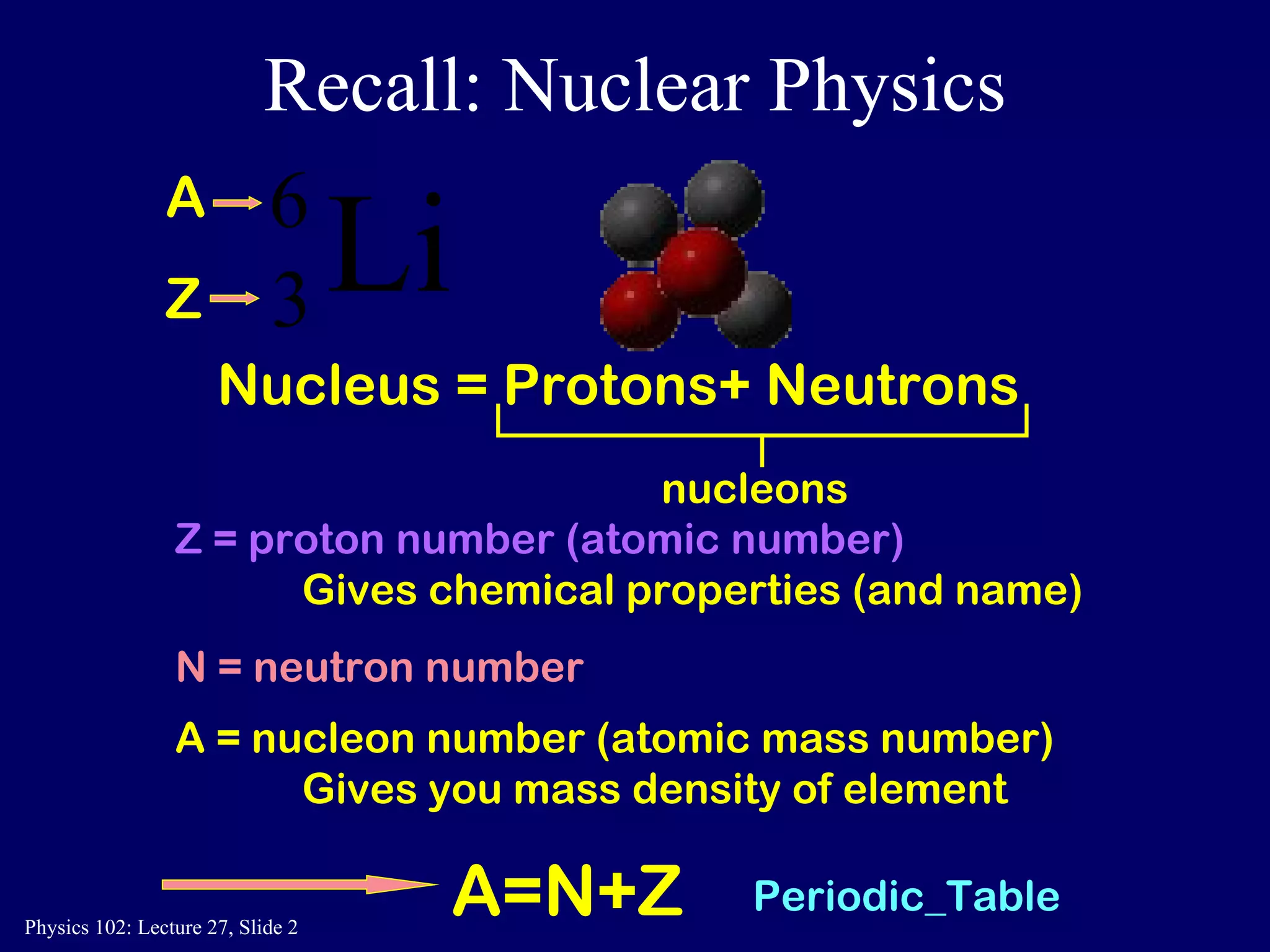
Recall: Nuclear Physics Nucleus = Protons+ Neutrons nucleons A = nucleon number (atomic mass number) Gives you mass density of element Z = proton number (atomic number)   Gives chemical properties (and name) N = neutron number A=N+Z A Z Periodic_Table
Preflight 27.1 A material is known to be an isotope of lead Based on this information which of the following can you specify? 1) The atomic mass number 2) The neutron number 3) The number of protons
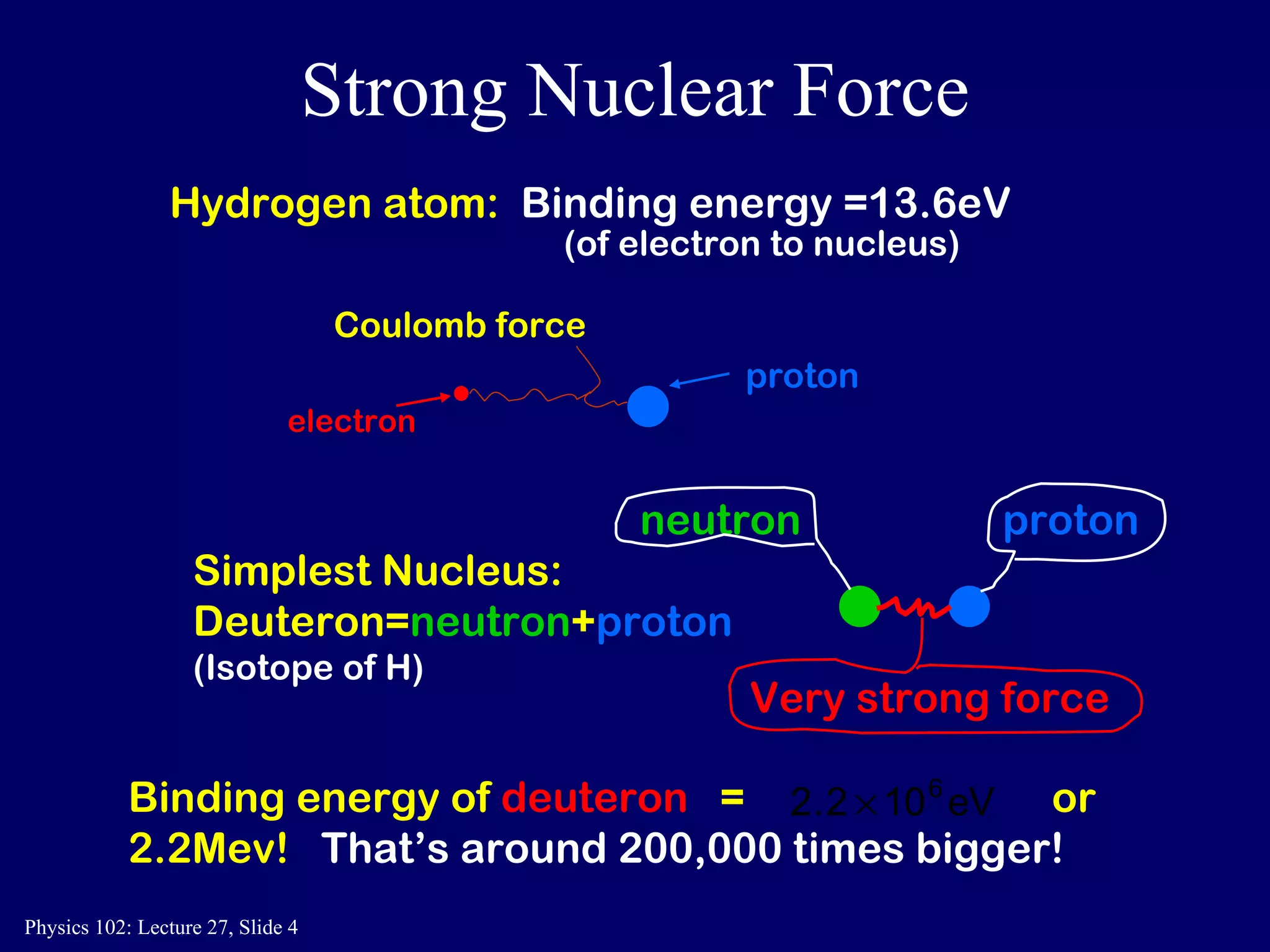
Strong Nuclear Force Hydrogen atom:   Binding energy   =13.6eV Simplest Nucleus:  Deuteron= neutron + proton (Isotope of H) (of electron to nucleus) Binding energy of   deuteron   =   or 2.2Mev!   That’s around 200,000 times bigger! neutron proton Very strong force Coulomb force electron proton
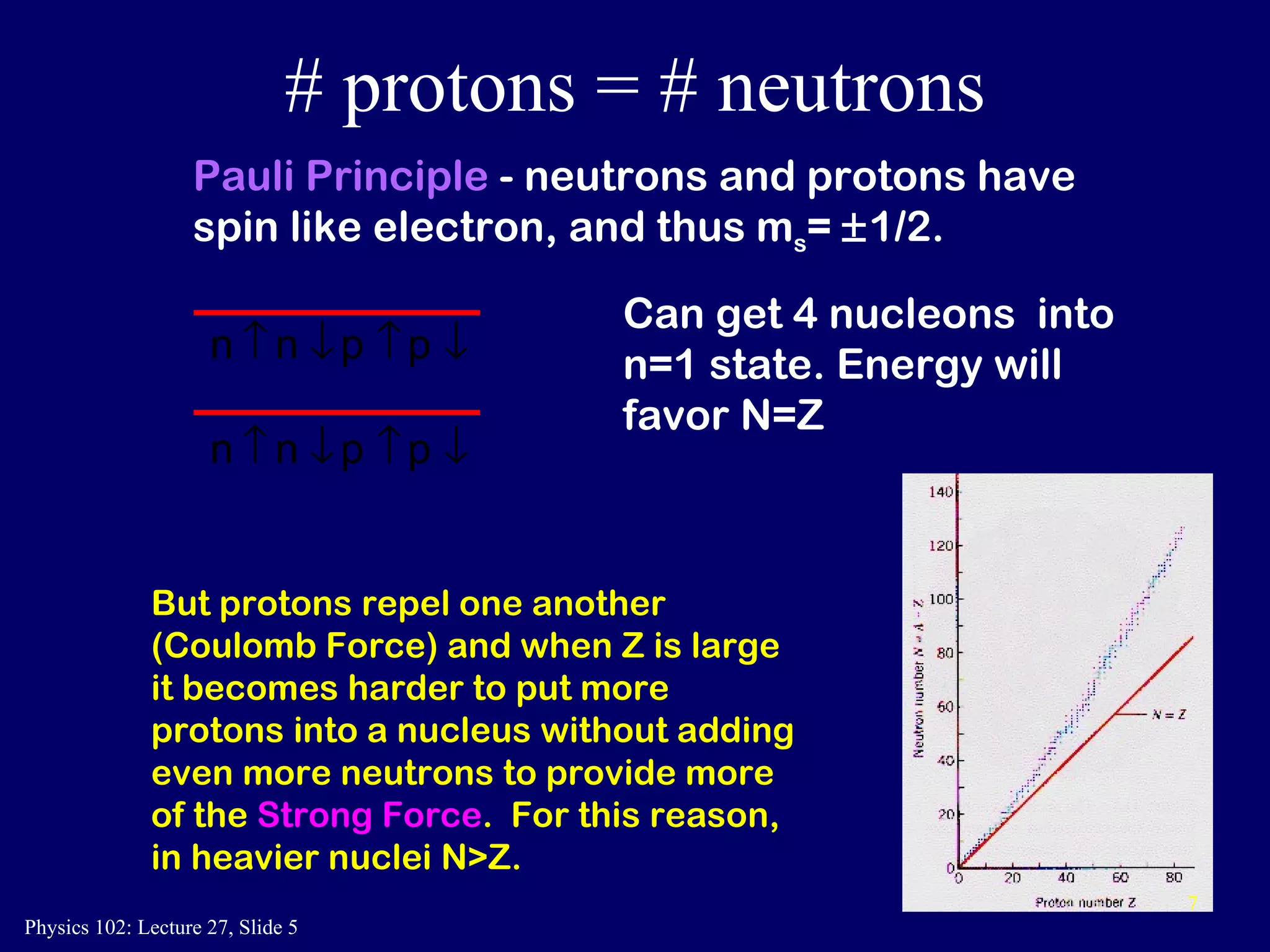
# protons = # neutrons Pauli Principle  - neutrons and protons have spin like electron, and thus m s =   1/2. But protons repel one another (Coulomb Force) and when Z is large it becomes harder to put more protons into a nucleus without adding even more neutrons to provide more of the  Strong Force .  For this reason, in heavier nuclei N>Z. 7 Can get 4 nucleons  into n=1 state. Energy will favor N=Z
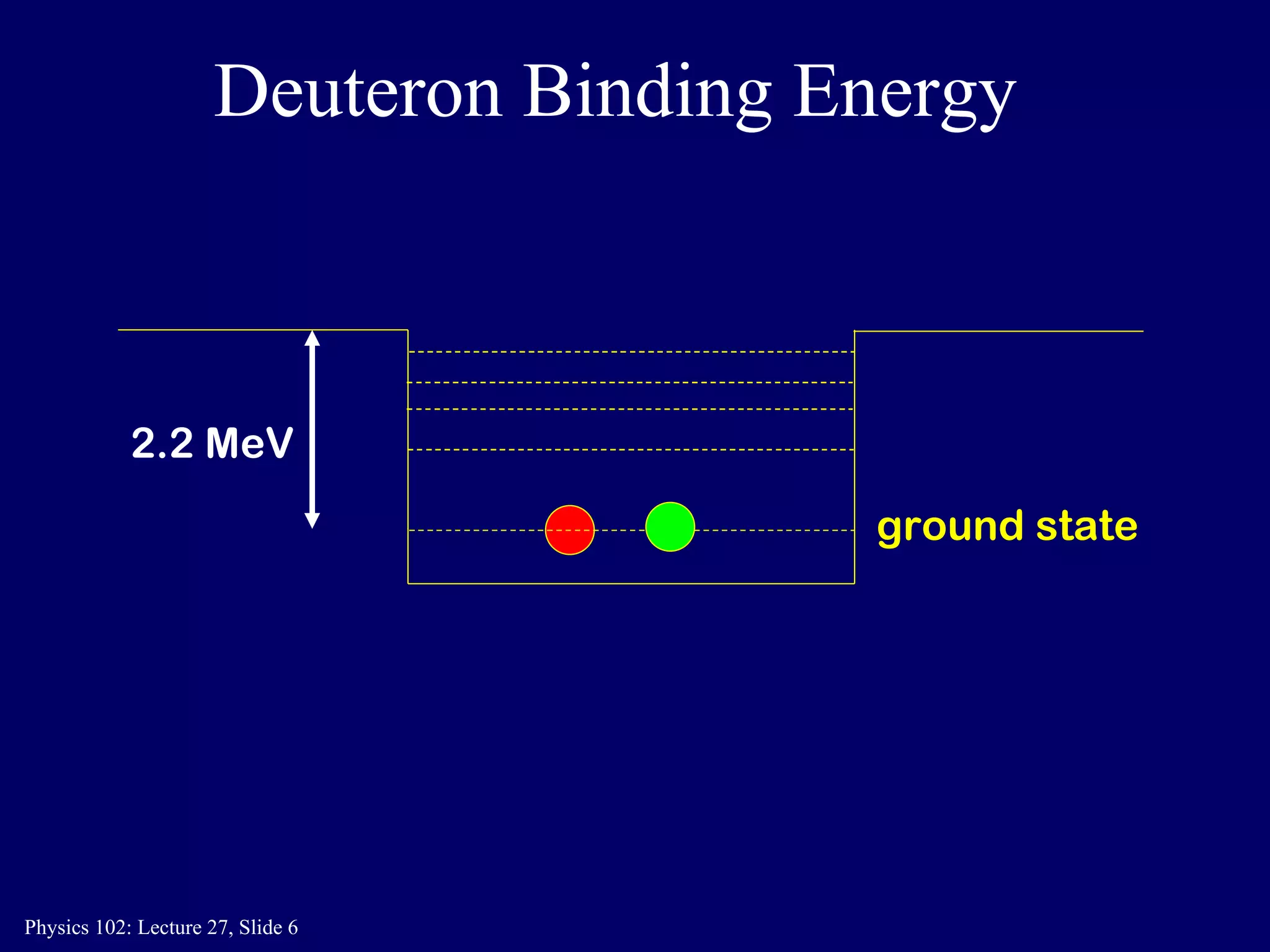
ground state 2.2 MeV Deuteron Binding Energy
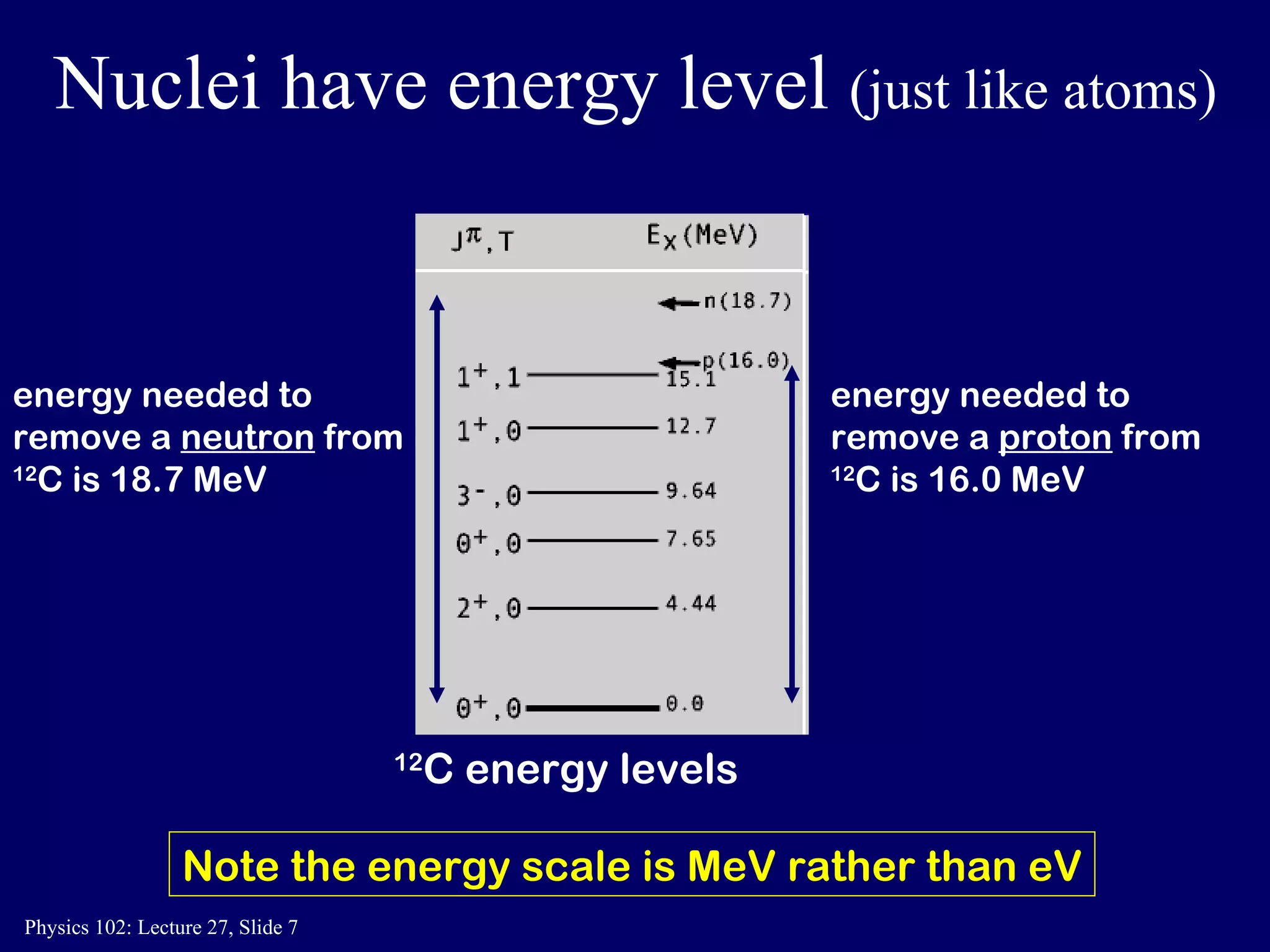
Nuclei have energy level  (just like atoms) 12 C energy levels Note the energy scale is MeV rather than eV energy needed to remove a  proton  from  12 C is 16.0 MeV energy needed to remove a  neutron  from  12 C is 18.7 MeV
Preflight 27.2 Where does the energy released in the nuclear reactions of the sun come from? covalent bonds between atoms binding energy of electrons to the nucleus (3) binding energy of nucleons
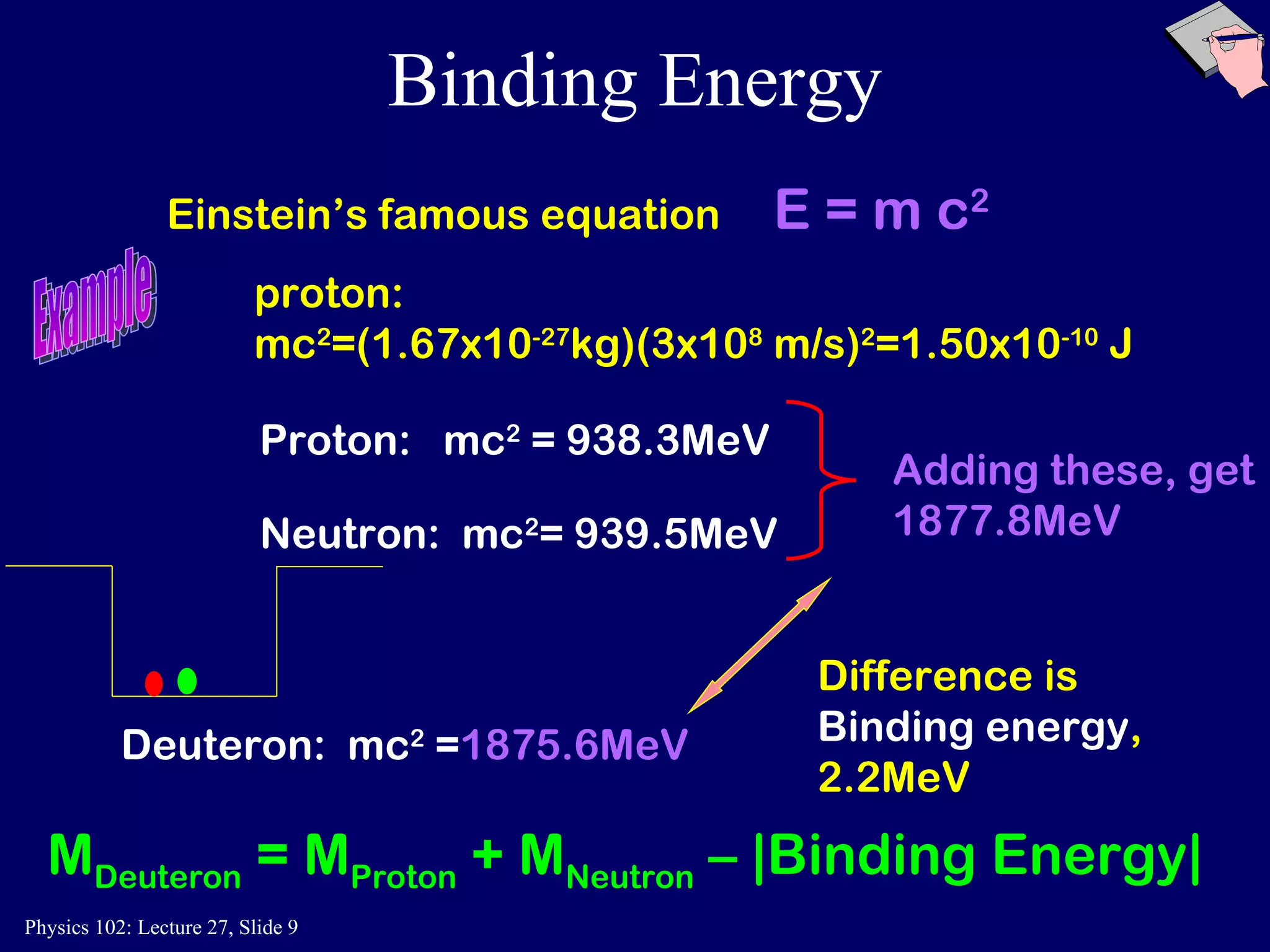
Binding Energy Einstein’s famous equation  E = m c 2 Deuteron:  mc 2  = 1875.6MeV Difference is  Binding energy ,   2.2MeV M Deuteron  = M Proton  + M Neutron  – |Binding Energy| Example proton: mc 2 =(1.67x10 -27 kg)(3x10 8  m/s) 2 =1.50x10 -10  J Proton:  mc 2  = 938.3MeV Neutron:   mc 2 = 939.5MeV Adding these, get 1877.8MeV
ACT: Binding Energy Which system “weighs” more? Two balls attached by a relaxed spring. Two balls attached by a stretched spring. They have the same weight.
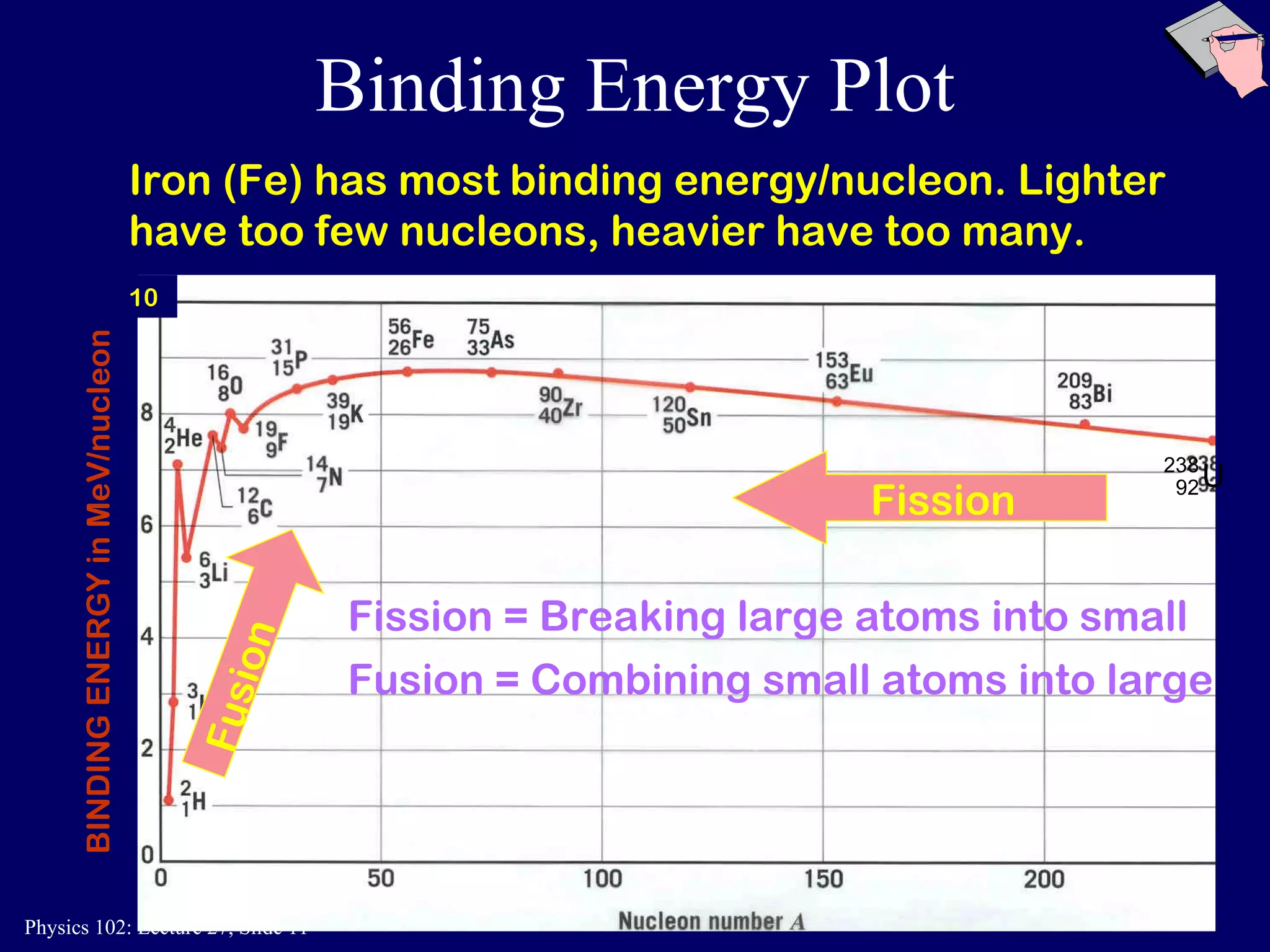
Binding Energy Plot Iron (Fe) has most binding energy/nucleon. Lighter have too few nucleons, heavier have too many. BINDING ENERGY in MeV/nucleon 10 Fission Fusion = Combining small atoms into large Fission = Breaking large atoms into small Fusion
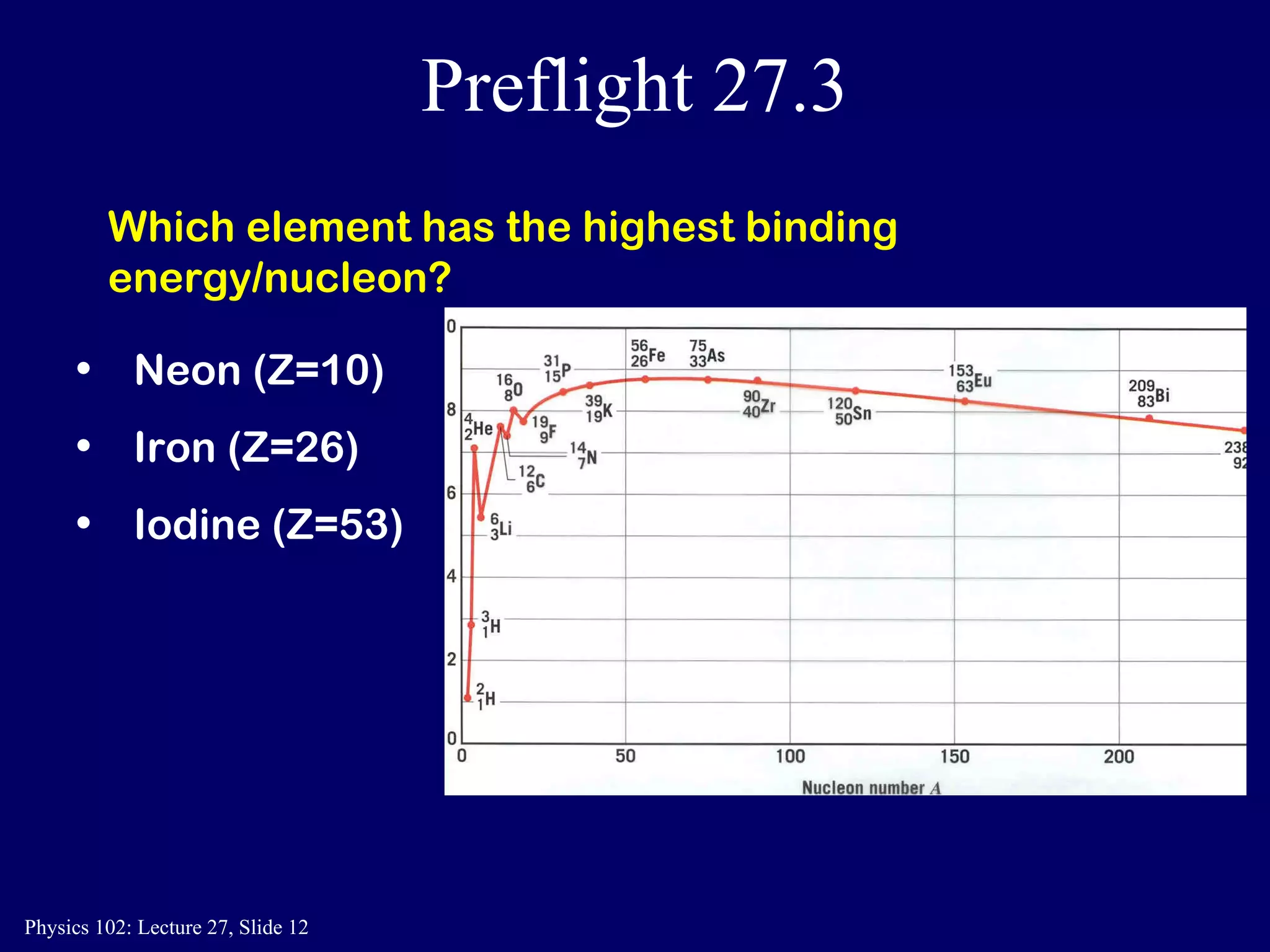
Preflight 27.3 Neon (Z=10)  Iron (Z=26) Iodine (Z=53) Which element has the highest binding energy/nucleon?
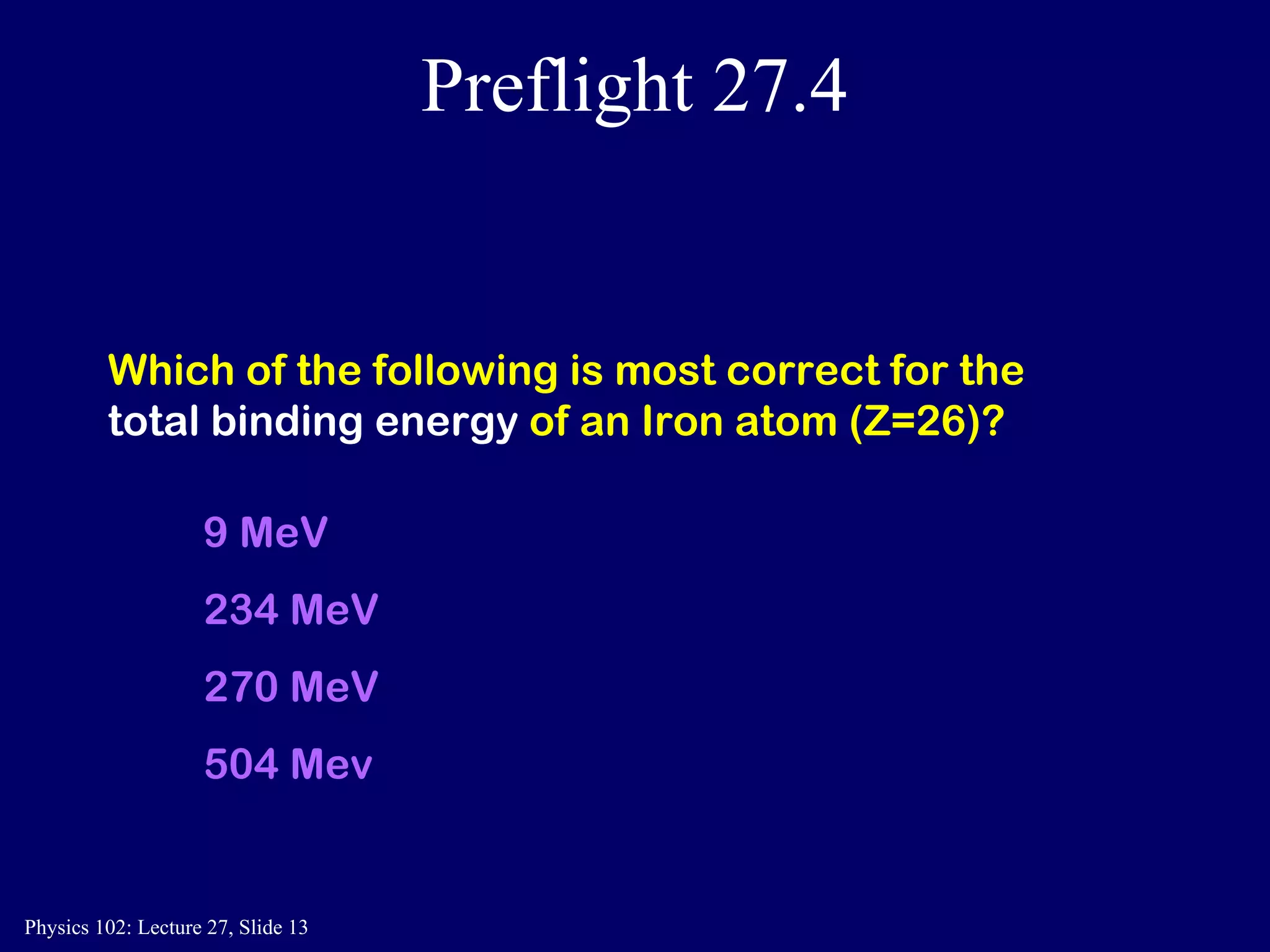
Preflight 27.4 Which of the following is most correct for the  total binding energy  of an Iron atom (Z=26)? 9 MeV 234 MeV 270 MeV 504 Mev
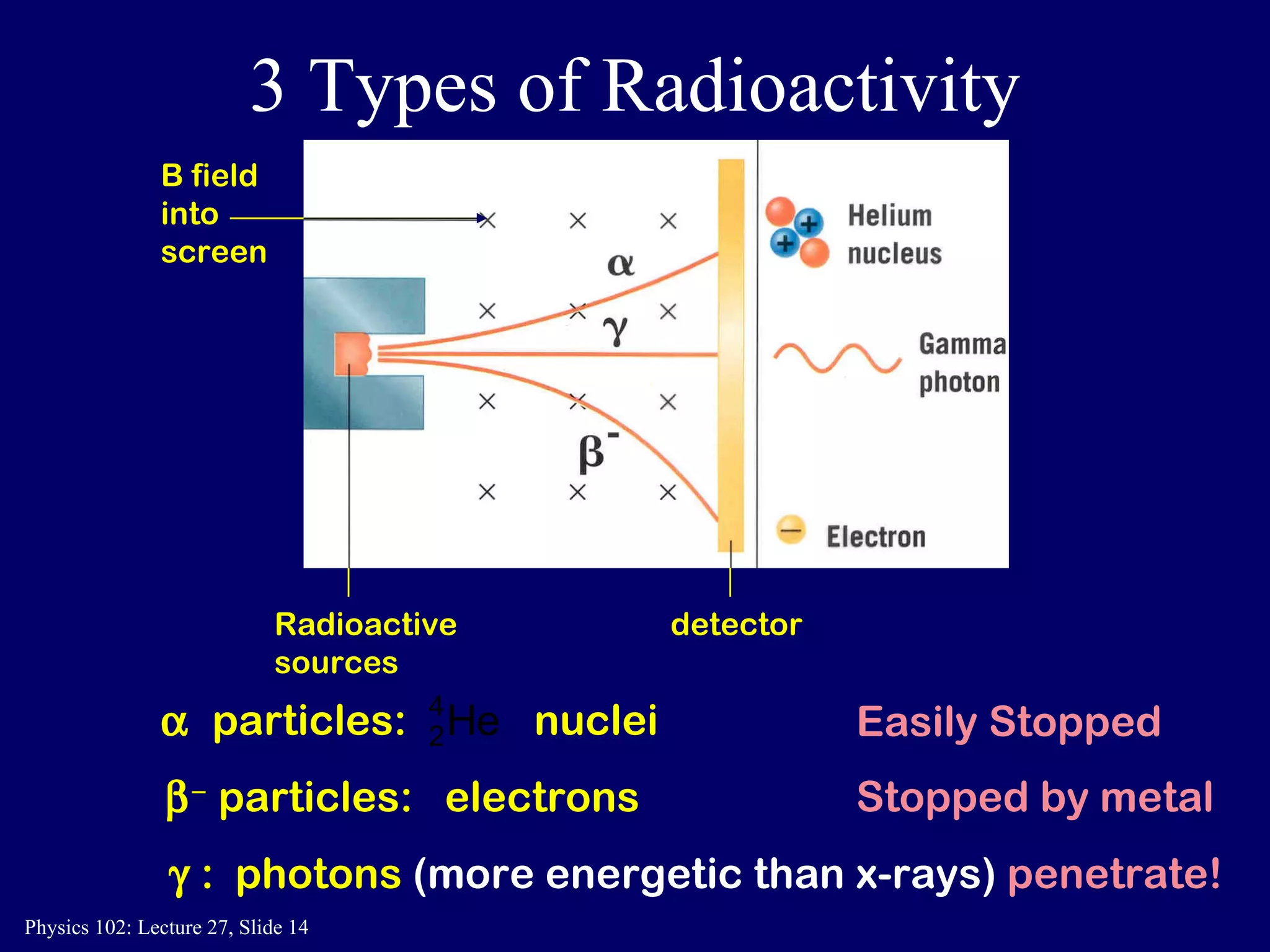
3 Types of Radioactivity      particles:  electrons    :  photons  (more energetic than x-rays)   penetrate! Easily Stopped Stopped by metal    particles:  nuclei Radioactive sources B field into screen detector
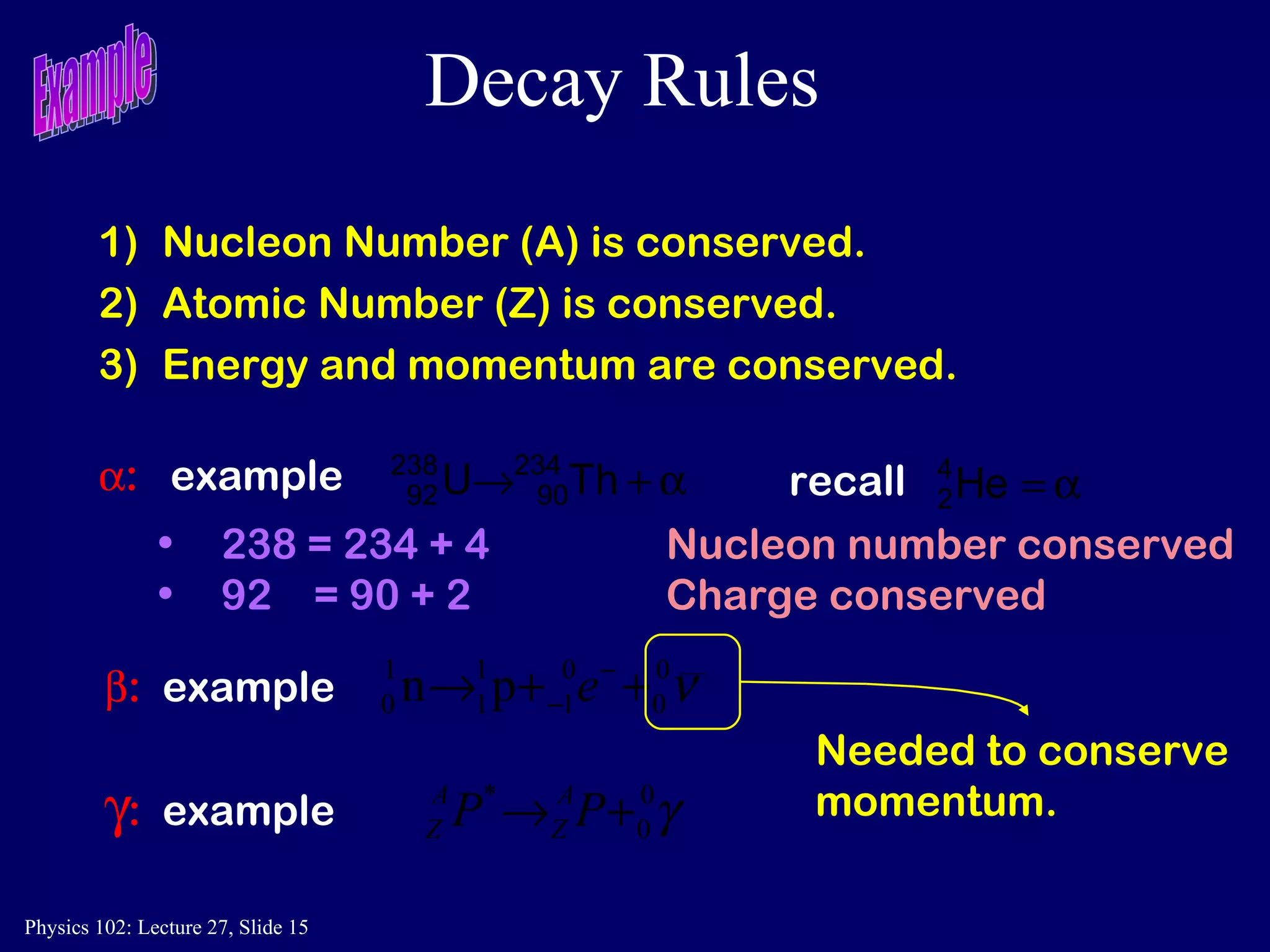
Decay Rules  :   example   recall  :   example   Nucleon Number (A) is conserved. Atomic Number (Z) is conserved. Energy and momentum are conserved.  :   example   238 = 234 + 4 Nucleon number conserved 92  = 90 + 2 Charge conserved Needed to conserve momentum. Example
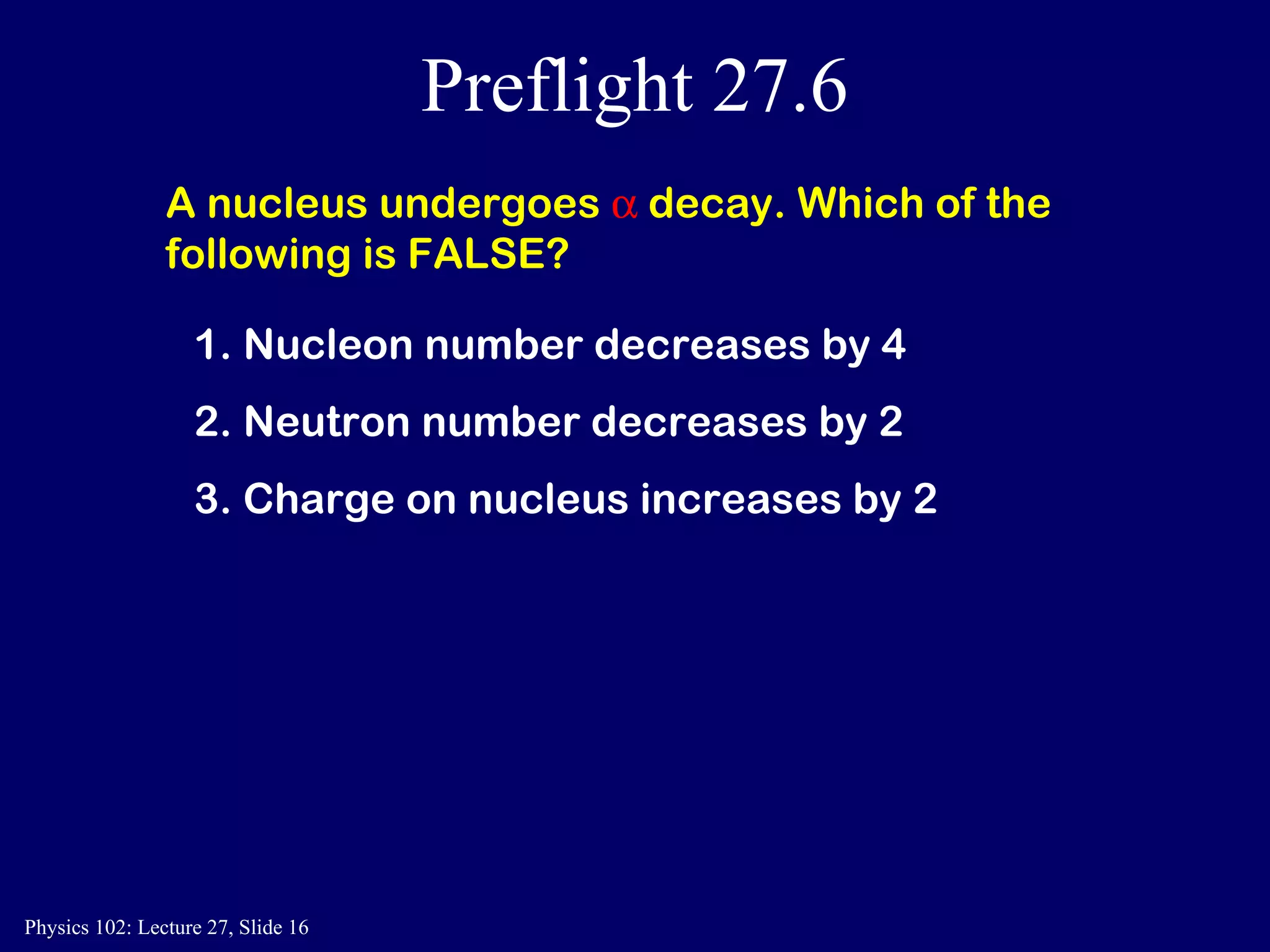
Preflight 27.6 A nucleus undergoes    decay. Which of the following is FALSE? 1. Nucleon number decreases by 4  2. Neutron number decreases by 2  3. Charge on nucleus increases by 2
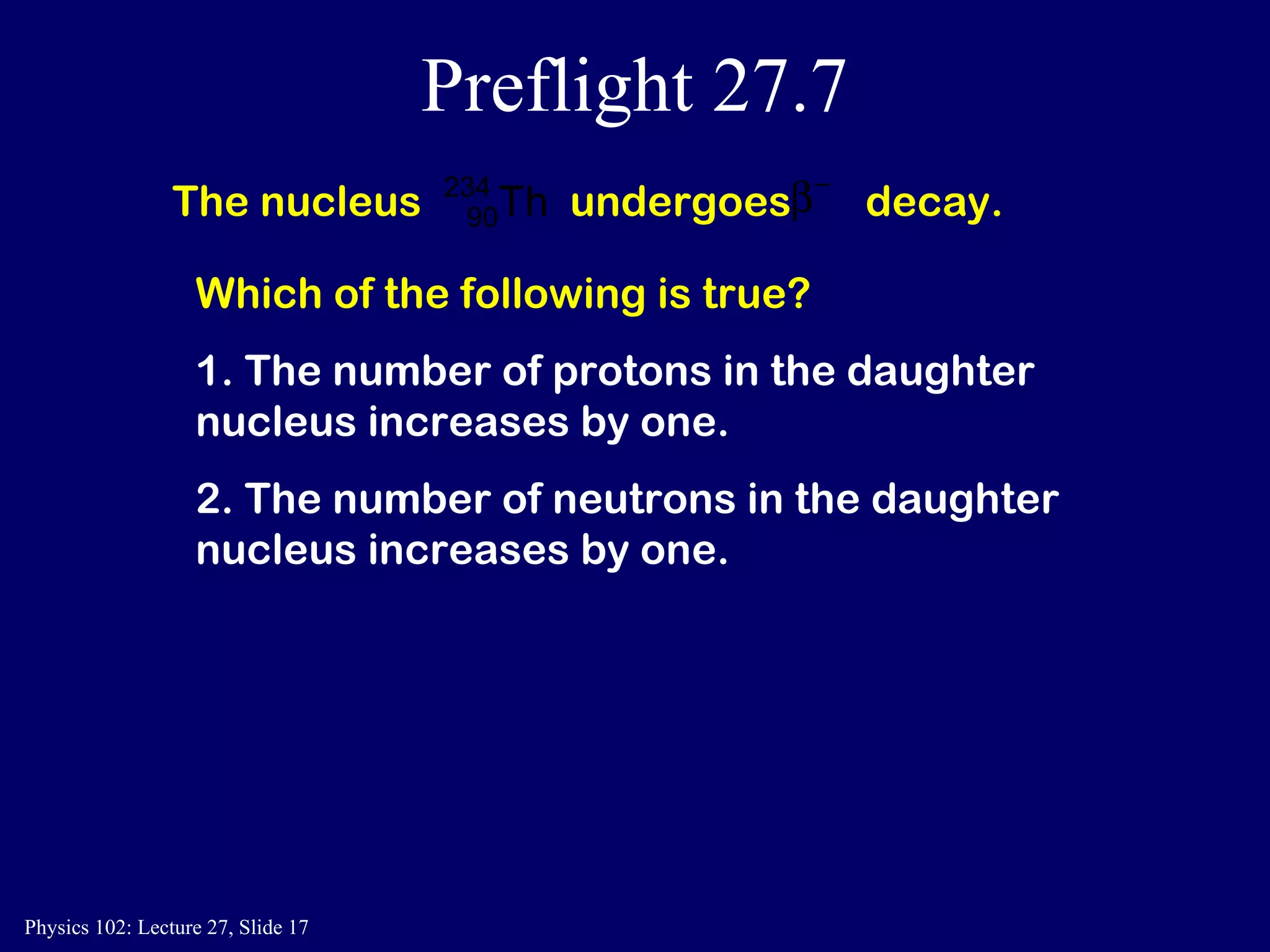
Preflight 27.7 The nucleus  undergoes  decay.  Which of the following is true? 1. The number of protons in the daughter nucleus increases by one.  2. The number of neutrons in the daughter nucleus increases by one.
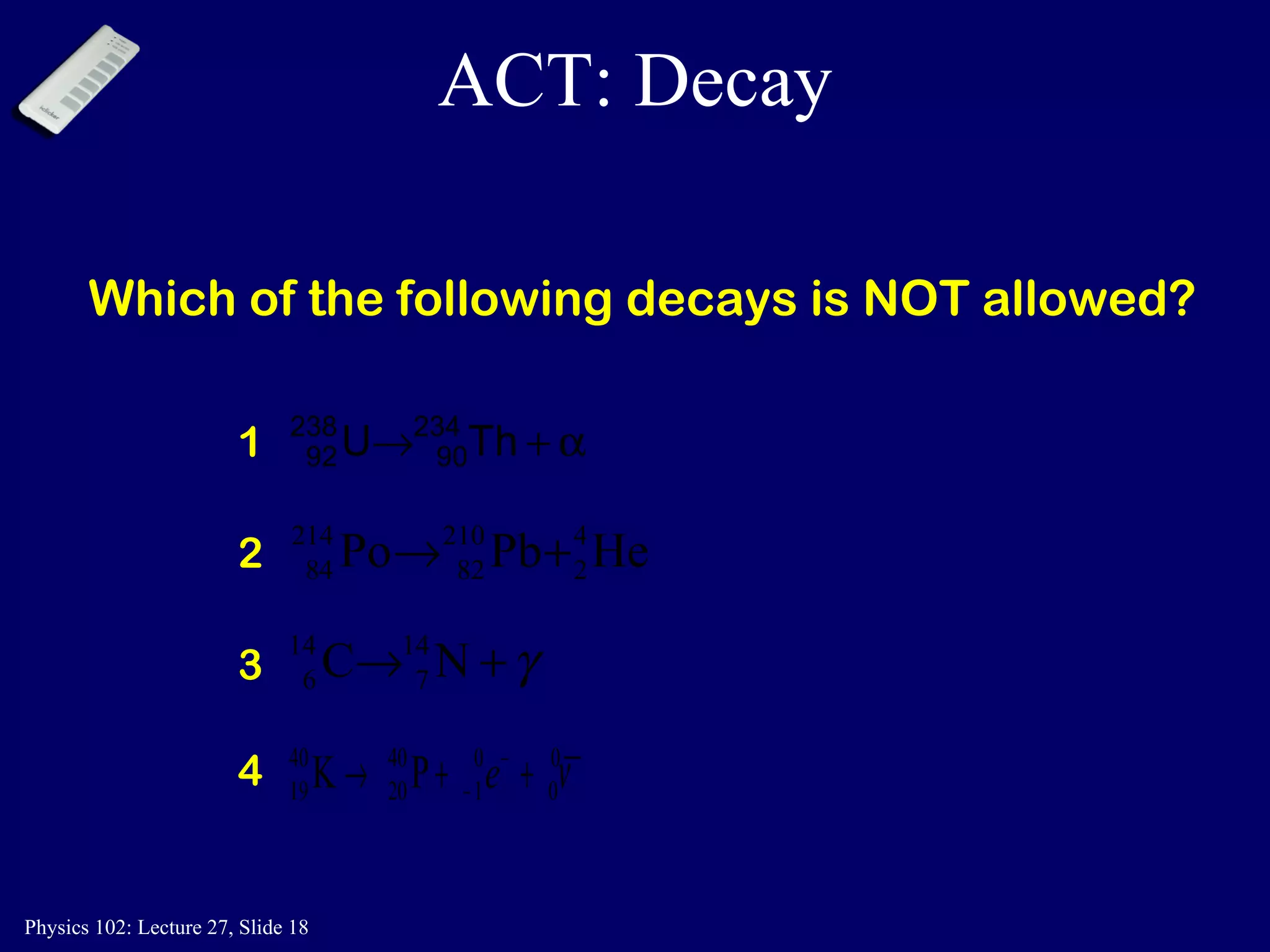
ACT: Decay Which of the following decays is NOT allowed? 1 2 3 4
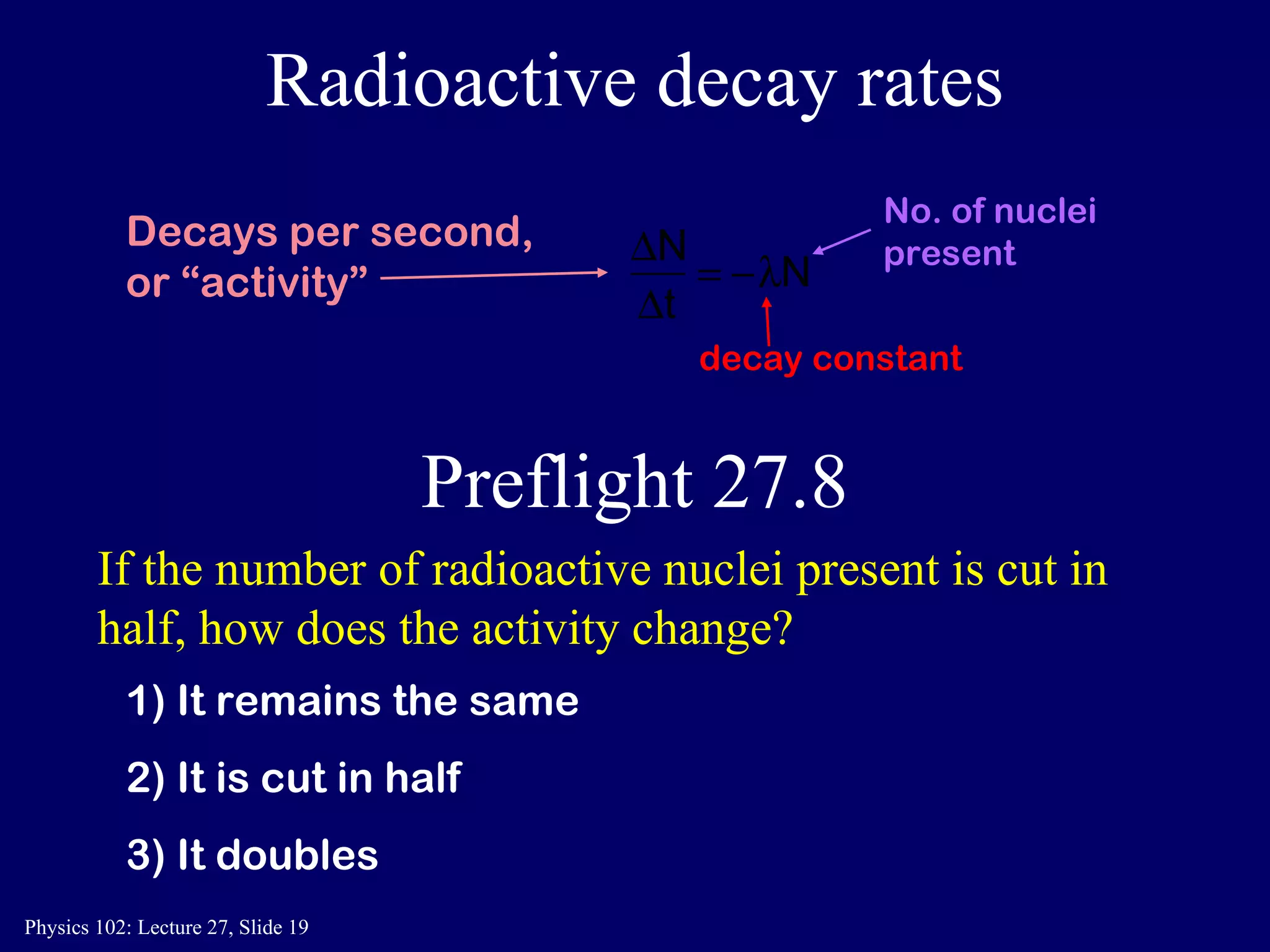
Radioactive decay rates If the number of radioactive nuclei present is cut in half, how does the activity change? 1) It remains the same 2) It is cut in half 3) It doubles Preflight 27.8 No. of nuclei present decay constant Decays per second,  or “activity”
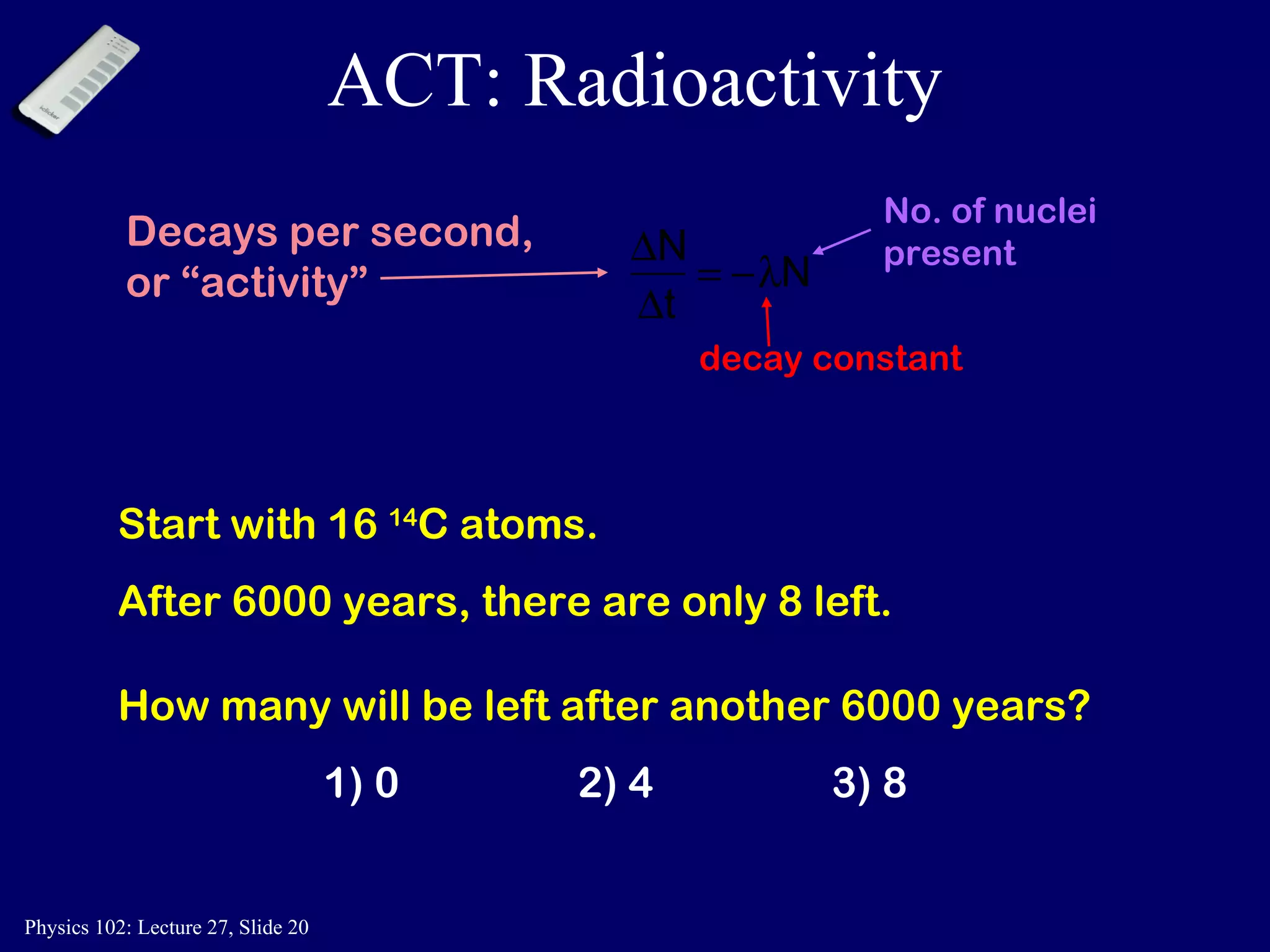
ACT: Radioactivity Start with 16  14 C atoms. After 6000 years, there are only 8 left. How many will be left after another 6000 years? 1) 0 2) 4 3) 8 No. of nuclei present decay constant Decays per second,  or “activity”
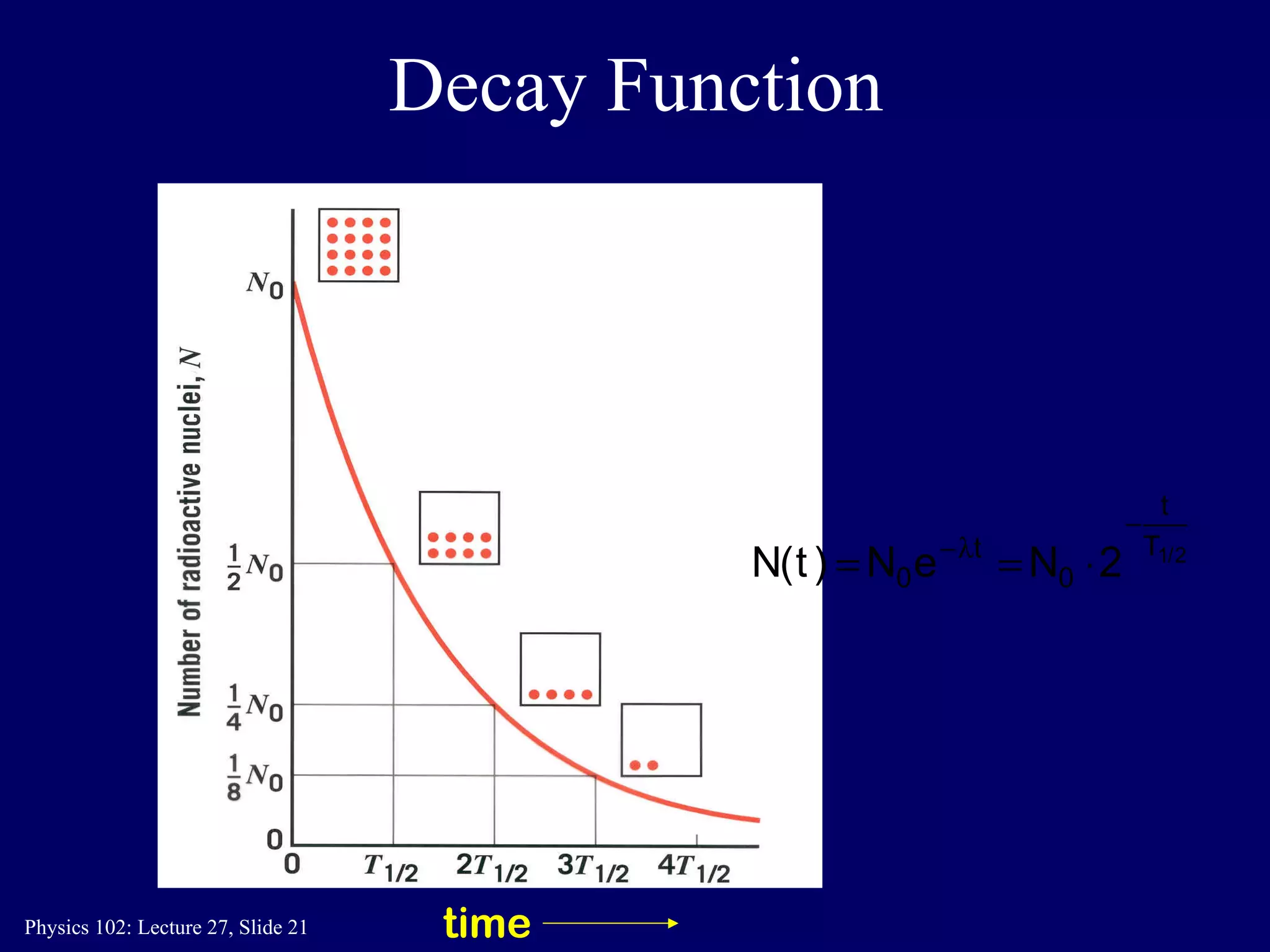
Decay Function time
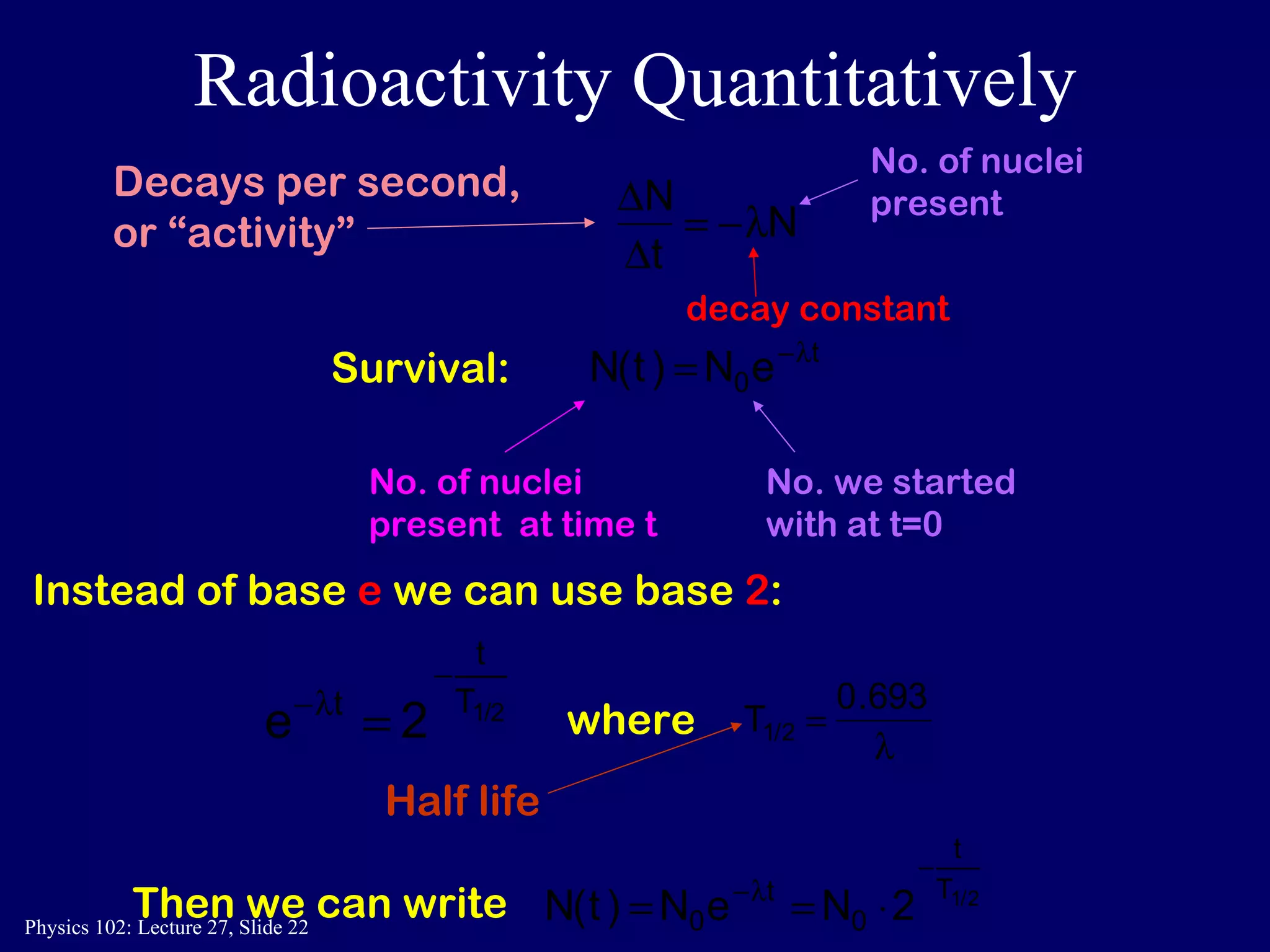
Radioactivity Quantitatively Instead of base   e   we can use base   2 : Survival: No. of nuclei present  at time t No. we started with at t=0 where Then we can write Half life No. of nuclei present decay constant Decays per second,  or “activity”
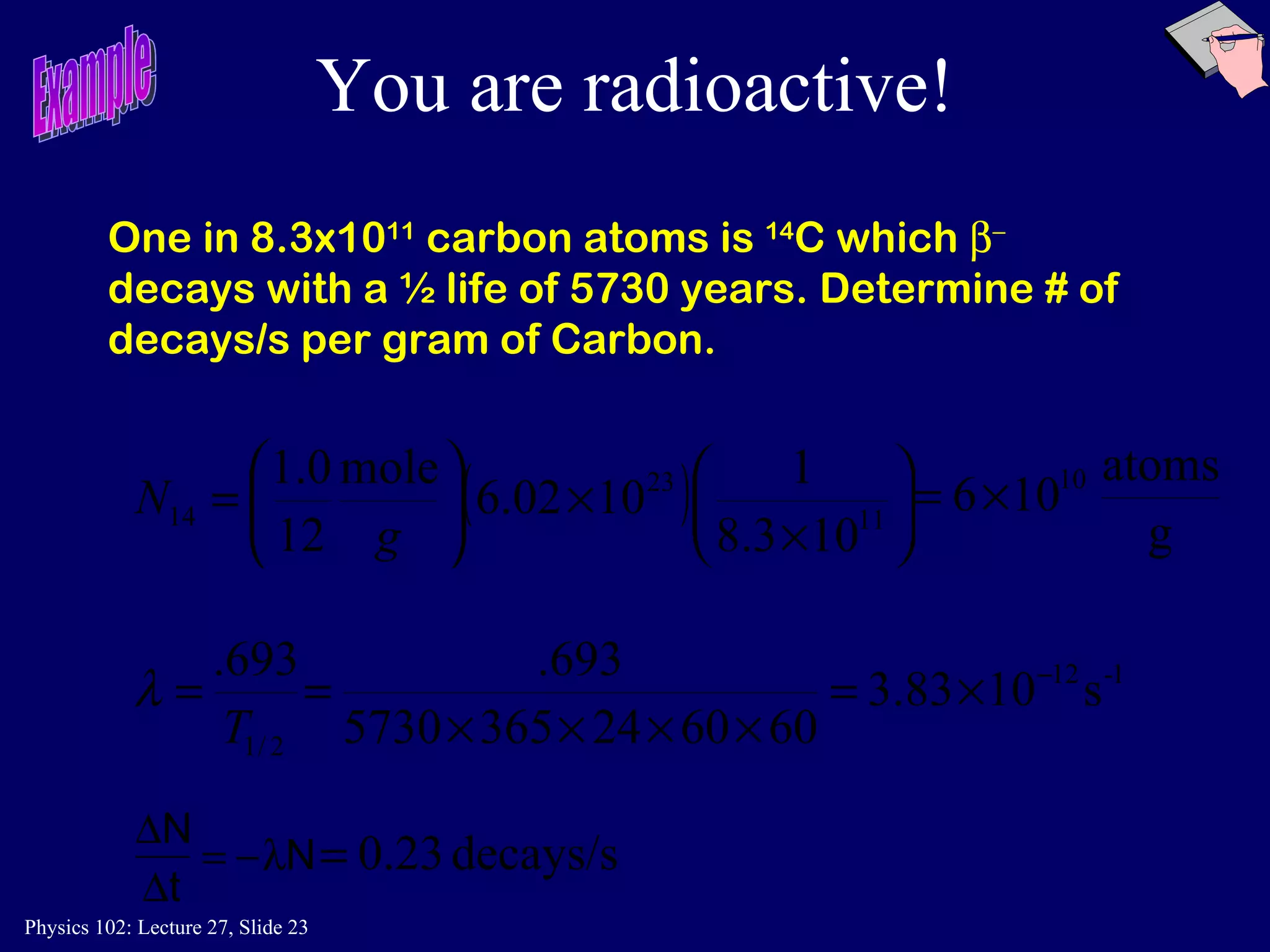
You are radioactive! One in 8.3x10 11  carbon atoms is  14 C which     decays with a ½ life of 5730 years. Determine # of decays/s per gram of Carbon. Example
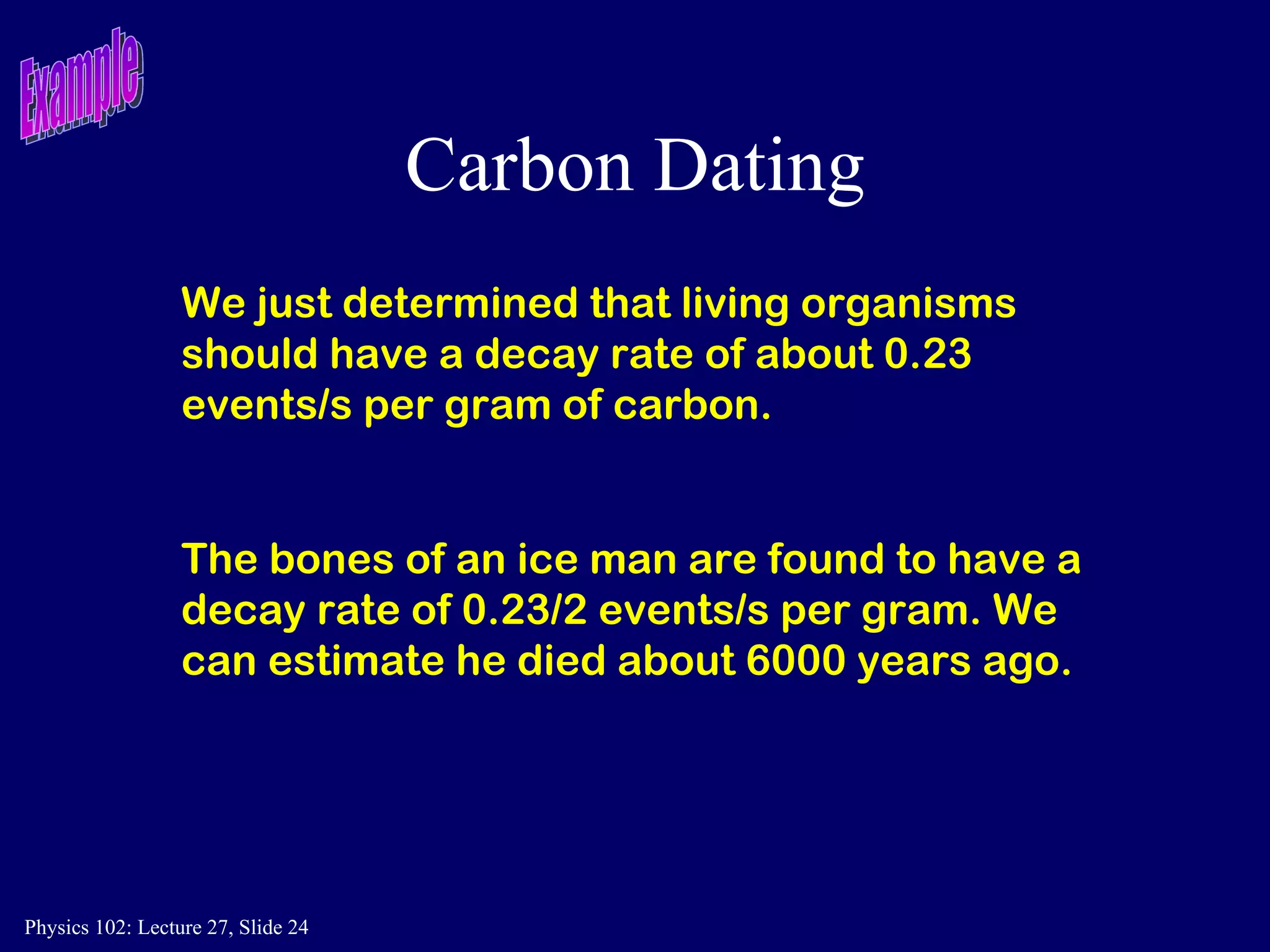
Carbon Dating We just determined that living organisms should have a decay rate of about 0.23 events/s per gram of carbon.  The bones of an ice man are found to have a decay rate of 0.23/2 events/s per gram. We can estimate he died about 6000 years ago. Example
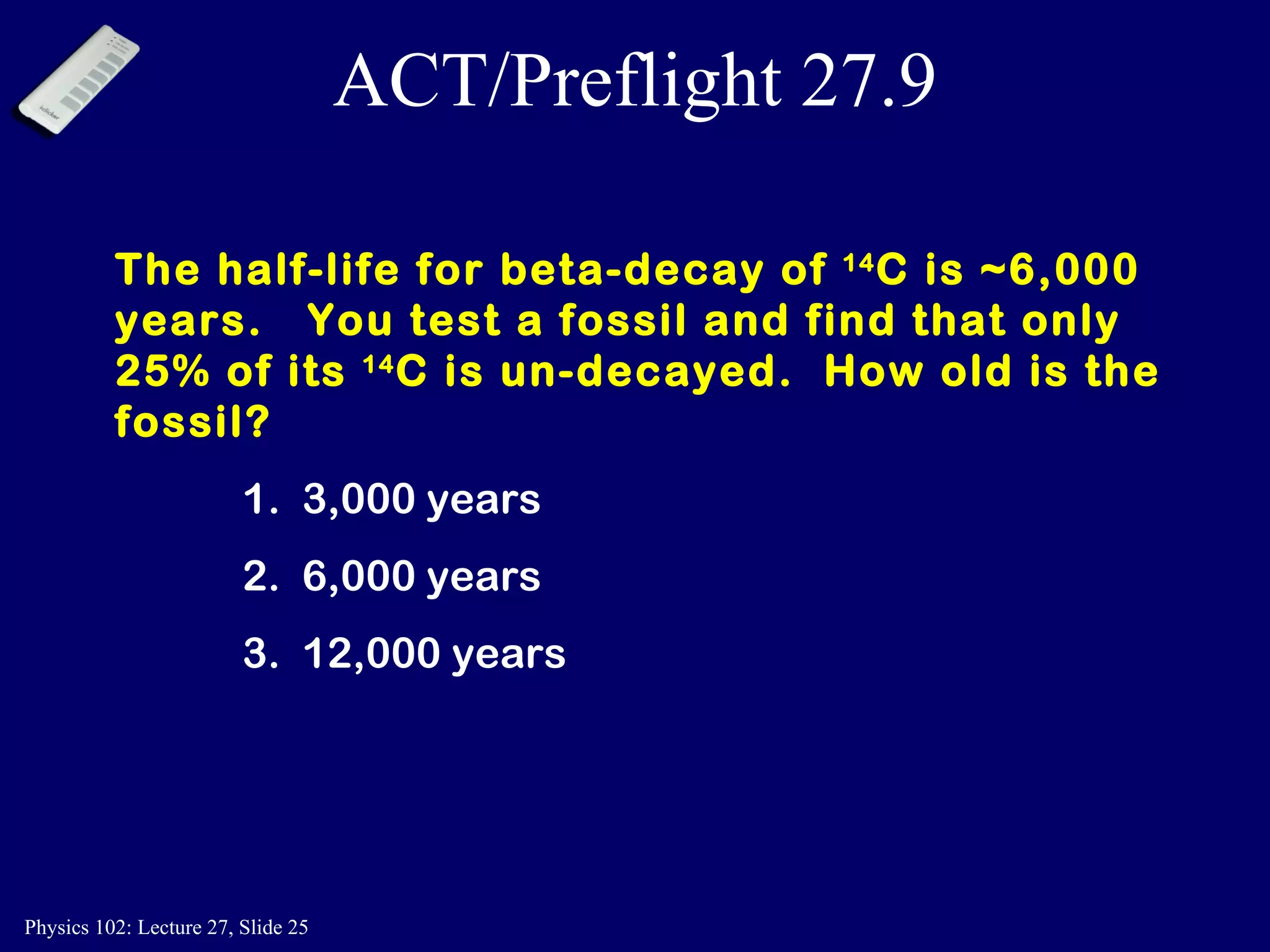
ACT/Preflight 27.9 The half-life for beta-decay of  14 C is ~6,000 years.  You test a fossil and find that only 25% of its  14 C is un-decayed.  How old is the fossil? 1.  3,000 years 2.  6,000 years 3.  12,000 years
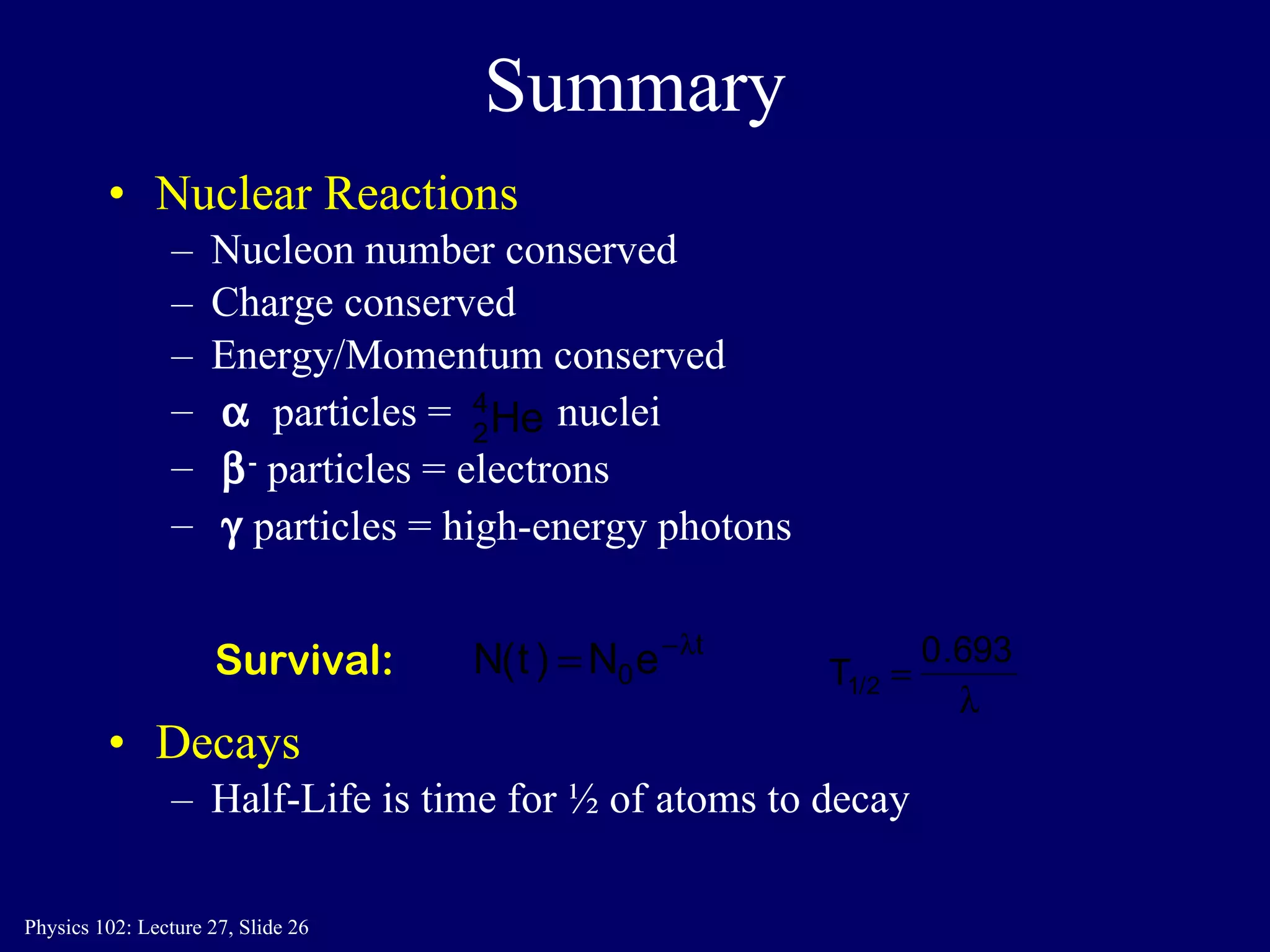
Summary Nuclear Reactions Nucleon number conserved Charge conserved Energy/Momentum conserved    particles  =  nuclei  -   particles = electrons    particles = high-energy photons Decays Half-Life is time for ½ of atoms to decay Survival:

Lect27 handout

  • 1.
    Nuclear Binding, RadioactivityPhysics 102: Lecture 28
  • 2.
    Recall: Nuclear PhysicsNucleus = Protons+ Neutrons nucleons A = nucleon number (atomic mass number) Gives you mass density of element Z = proton number (atomic number) Gives chemical properties (and name) N = neutron number A=N+Z A Z Periodic_Table
  • 3.
    Preflight 27.1 Amaterial is known to be an isotope of lead Based on this information which of the following can you specify? 1) The atomic mass number 2) The neutron number 3) The number of protons
  • 4.
    Strong Nuclear ForceHydrogen atom: Binding energy =13.6eV Simplest Nucleus: Deuteron= neutron + proton (Isotope of H) (of electron to nucleus) Binding energy of deuteron = or 2.2Mev! That’s around 200,000 times bigger! neutron proton Very strong force Coulomb force electron proton
  • 5.
    # protons =# neutrons Pauli Principle - neutrons and protons have spin like electron, and thus m s =  1/2. But protons repel one another (Coulomb Force) and when Z is large it becomes harder to put more protons into a nucleus without adding even more neutrons to provide more of the Strong Force . For this reason, in heavier nuclei N>Z. 7 Can get 4 nucleons into n=1 state. Energy will favor N=Z
  • 6.
    ground state 2.2MeV Deuteron Binding Energy
  • 7.
    Nuclei have energylevel (just like atoms) 12 C energy levels Note the energy scale is MeV rather than eV energy needed to remove a proton from 12 C is 16.0 MeV energy needed to remove a neutron from 12 C is 18.7 MeV
  • 8.
    Preflight 27.2 Wheredoes the energy released in the nuclear reactions of the sun come from? covalent bonds between atoms binding energy of electrons to the nucleus (3) binding energy of nucleons
  • 9.
    Binding Energy Einstein’sfamous equation E = m c 2 Deuteron: mc 2 = 1875.6MeV Difference is Binding energy , 2.2MeV M Deuteron = M Proton + M Neutron – |Binding Energy| Example proton: mc 2 =(1.67x10 -27 kg)(3x10 8 m/s) 2 =1.50x10 -10 J Proton: mc 2 = 938.3MeV Neutron: mc 2 = 939.5MeV Adding these, get 1877.8MeV
  • 10.
    ACT: Binding EnergyWhich system “weighs” more? Two balls attached by a relaxed spring. Two balls attached by a stretched spring. They have the same weight.
  • 11.
    Binding Energy PlotIron (Fe) has most binding energy/nucleon. Lighter have too few nucleons, heavier have too many. BINDING ENERGY in MeV/nucleon 10 Fission Fusion = Combining small atoms into large Fission = Breaking large atoms into small Fusion
  • 12.
    Preflight 27.3 Neon(Z=10) Iron (Z=26) Iodine (Z=53) Which element has the highest binding energy/nucleon?
  • 13.
    Preflight 27.4 Whichof the following is most correct for the total binding energy of an Iron atom (Z=26)? 9 MeV 234 MeV 270 MeV 504 Mev
  • 14.
    3 Types ofRadioactivity    particles: electrons  : photons (more energetic than x-rays) penetrate! Easily Stopped Stopped by metal  particles: nuclei Radioactive sources B field into screen detector
  • 15.
    Decay Rules : example recall  : example Nucleon Number (A) is conserved. Atomic Number (Z) is conserved. Energy and momentum are conserved.  : example 238 = 234 + 4 Nucleon number conserved 92 = 90 + 2 Charge conserved Needed to conserve momentum. Example
  • 16.
    Preflight 27.6 Anucleus undergoes  decay. Which of the following is FALSE? 1. Nucleon number decreases by 4 2. Neutron number decreases by 2 3. Charge on nucleus increases by 2
  • 17.
    Preflight 27.7 Thenucleus undergoes decay. Which of the following is true? 1. The number of protons in the daughter nucleus increases by one. 2. The number of neutrons in the daughter nucleus increases by one.
  • 18.
    ACT: Decay Whichof the following decays is NOT allowed? 1 2 3 4
  • 19.
    Radioactive decay ratesIf the number of radioactive nuclei present is cut in half, how does the activity change? 1) It remains the same 2) It is cut in half 3) It doubles Preflight 27.8 No. of nuclei present decay constant Decays per second, or “activity”
  • 20.
    ACT: Radioactivity Startwith 16 14 C atoms. After 6000 years, there are only 8 left. How many will be left after another 6000 years? 1) 0 2) 4 3) 8 No. of nuclei present decay constant Decays per second, or “activity”
  • 21.
  • 22.
    Radioactivity Quantitatively Insteadof base e we can use base 2 : Survival: No. of nuclei present at time t No. we started with at t=0 where Then we can write Half life No. of nuclei present decay constant Decays per second, or “activity”
  • 23.
    You are radioactive!One in 8.3x10 11 carbon atoms is 14 C which   decays with a ½ life of 5730 years. Determine # of decays/s per gram of Carbon. Example
  • 24.
    Carbon Dating Wejust determined that living organisms should have a decay rate of about 0.23 events/s per gram of carbon. The bones of an ice man are found to have a decay rate of 0.23/2 events/s per gram. We can estimate he died about 6000 years ago. Example
  • 25.
    ACT/Preflight 27.9 Thehalf-life for beta-decay of 14 C is ~6,000 years. You test a fossil and find that only 25% of its 14 C is un-decayed. How old is the fossil? 1. 3,000 years 2. 6,000 years 3. 12,000 years
  • 26.
    Summary Nuclear ReactionsNucleon number conserved Charge conserved Energy/Momentum conserved  particles = nuclei  - particles = electrons  particles = high-energy photons Decays Half-Life is time for ½ of atoms to decay Survival:

Editor's Notes

  • #2 1
  • #16 Comment on preflight only 30% got correct that alpha decay does NOT have charge increase by 2.