Physics 102:  Lecture 20 Interference
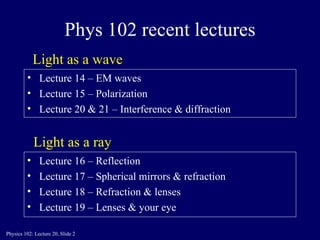
Phys 102 recent lectures Lecture 14 – EM waves Lecture 15 – Polarization Lecture 20 & 21 – Interference & diffraction Lecture 16 – Reflection Lecture 17 – Spherical mirrors & refraction Lecture 18 – Refraction & lenses Lecture 19 – Lenses & your eye Light as a wave Light as a ray
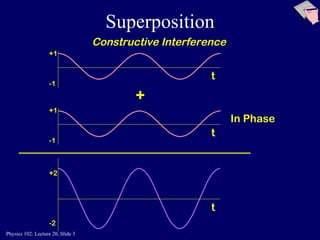
Superposition + Constructive   Interference In Phase t +1 -1 t +1 -1 t +2 -2
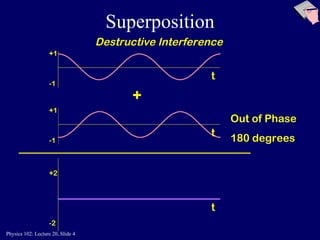
Superposition t +1 -1 t +1 -1 + Destructive Interference Out of Phase 180 degrees t +2 -2
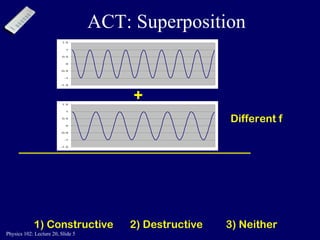
ACT: Superposition + Different f 1) Constructive 2) Destructive 3) Neither
Interference Requirements Need two (or more) waves Must have same frequency Must be coherent  (i.e. waves must have definite phase relation)
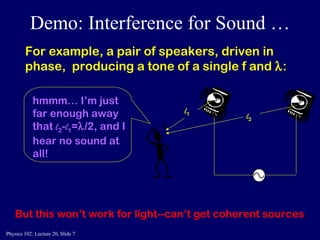
Demo: Interference for Sound … For example, a pair of speakers, driven in phase,  producing a tone of a single f and   : But this won’t work for light--can’t get coherent sources l 1 l 2 hmmm… I’m just far enough away that  l 2 - l 1 =  /2, and I hear no sound at all!
Interference for Light … Can’t produce coherent light from separate sources.  (f    10 14  Hz) Need two waves from  single source  taking  two different paths Two slits Reflection (thin films) Diffraction * Next lecture Today’s lecture
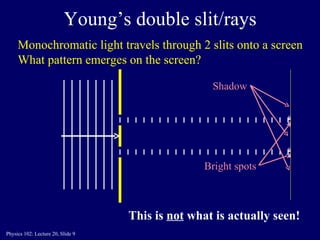
Young’s double slit/rays This is  not  what is actually seen! Monochromatic light travels through 2 slits onto a screen What pattern emerges on the screen? Bright spots Shadow
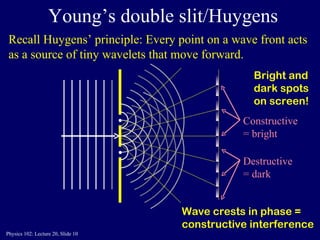
Young’s double slit/Huygens Recall Huygens’ principle: Every point on a wave front acts as a source of tiny wavelets that move forward. Wave crests in phase = constructive interference Bright and dark spots on screen! • • Constructive = bright Destructive = dark
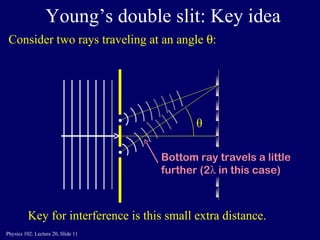
Young’s double slit: Key idea Key for interference is this small extra distance. Consider two rays traveling at an angle   : θ • • Bottom ray travels a little further (2   in this case)
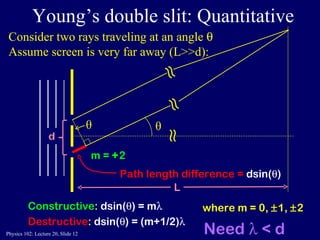
Young’s double slit: Quantitative Constructive :  dsin(  ) = m  Destructive :  dsin(  ) = (m+1/2)  Consider two rays traveling at an angle   Assume screen is very far away (L>>d): θ ≈ ≈ ≈ L where m = 0,   1,   2  m =  + 2  Need   < d Path length difference =  dsin(  ) θ
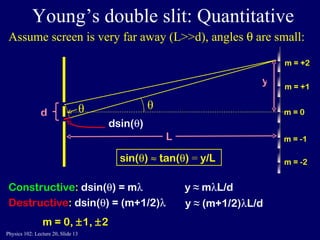
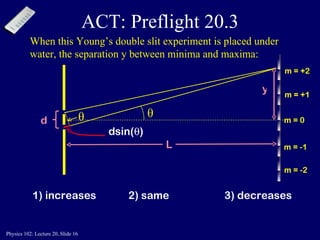
Young’s double slit: Quantitative Constructive :  dsin(  ) = m  Destructive :  dsin(  ) = (m+1/2)  Assume screen is very far away (L>>d), angles    are small: θ L m = 0,   1,   2  sin(  )    tan(  )  =  y/L y  ≈  m  L/d y  ≈  (m+1/2)  L/d dsin(  ) θ m = 0 m = +1 m = -1 m = -2 m = +2 y
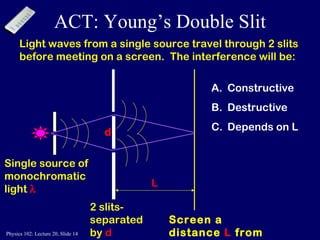
ACT: Young’s Double Slit Screen a distance  L  from slits Single source of monochromatic light   d 2 slits-separated by  d Constructive Destructive Depends on L L Light waves from a single source travel through 2 slits before meeting on a screen.  The interference will be:
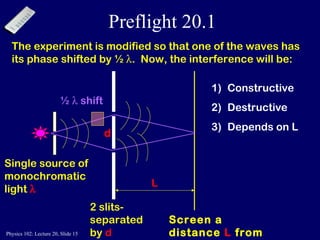
Preflight 20.1 Screen a distance  L  from slits Single source of monochromatic light   d 2 slits-separated by  d Constructive Destructive Depends on L L The experiment is modified so that one of the waves has its phase shifted by ½   .  Now, the interference will be: ½    shift
ACT: Preflight 20.3 1) increases   2) same 3) decreases θ L When this Young’s double slit experiment is placed under water, the separation y between minima and maxima: dsin(  ) θ m = 0 m = +1 m = -1 m = -2 m = +2 y
Preflight 20.2 In the Young double slit experiment, is it possible to see interference maxima when the distance between slits is smaller than the wavelength of light? 1) Yes 2) No
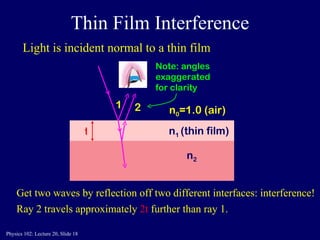
Thin Film Interference n 1  (thin film)   n 2 n 0 =1.0 (air) t Get two waves by reflection off two different interfaces: interference!  Ray 2 travels approximately  2t  further than ray 1. Light is incident normal to a thin film 1 2 Note: angles exaggerated for clarity
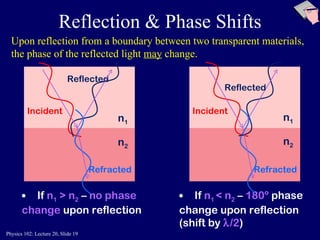
Reflection & Phase Shifts n 1 n 2 Upon reflection from a boundary between two transparent materials, the phase of the reflected light  may  change. If  n 1  > n 2  –  no phase change  upon reflection If  n 1  < n 2  –  180º  phase change upon reflection (shift by   /2 ) Incident Reflected n 1 n 2 Refracted Incident Reflected Refracted
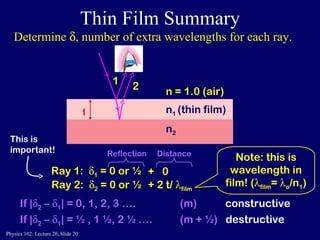
Thin Film Summary n 1  (thin film)   n 2 n = 1.0 (air) t 1 2 Ray 1:   1  = 0 or ½  Determine   , number of extra wavelengths for each ray. If |  2  –   1 | = ½ , 1 ½, 2 ½ ….  (m + ½)  destructive If |  2  –   1 | = 0, 1, 2, 3 ….  (m)    constructive Note: this is wavelength in film! (  film =   o /n 1 ) + 2 t/   film Ray 2:   2  = 0 or ½ +  0 Reflection Distance This is important!
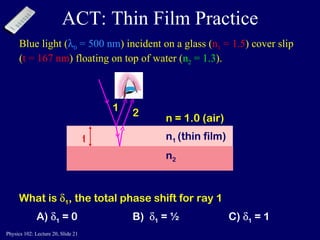
ACT: Thin Film Practice n 1  (thin film)   n 2 n = 1.0 (air) t 1 2 Blue light (  0  = 500 nm ) incident on a glass ( n 1  = 1.5 ) cover slip ( t = 167 nm ) floating on top of water ( n 2  = 1.3 ).  A)   1  = 0 B)   1  = ½ C)   1  = 1 What is   1 , the total phase shift for ray 1
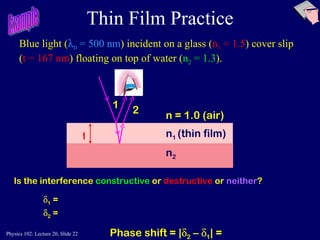
Thin Film Practice Is the interference  constructive   or  destructive  or  neither ? n 1  (thin film)   n 2 n = 1.0 (air) t 1 2 Blue light (  0  = 500 nm ) incident on a glass ( n 1  = 1.5 ) cover slip ( t = 167 nm ) floating on top of water ( n 2  = 1.3 ).  Example  1  =  2  = Phase shift = |  2  –   1 | =
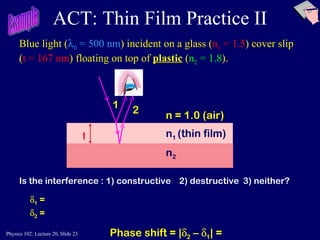
ACT: Thin Film Practice II n 1  (thin film)   n 2 n = 1.0 (air) t 1 2 Blue light (  0  = 500 nm ) incident on a glass ( n 1  = 1.5 ) cover slip ( t = 167 nm ) floating on top of  plastic  ( n 2  = 1.8 ).  Example  1  =  2  = Phase shift = |  2  –   1 | = Is the interference : 1) constructive  2) destructive  3) neither?

Lect20 handout

  • 1.
    Physics 102: Lecture 20 Interference
  • 2.
    Phys 102 recentlectures Lecture 14 – EM waves Lecture 15 – Polarization Lecture 20 & 21 – Interference & diffraction Lecture 16 – Reflection Lecture 17 – Spherical mirrors & refraction Lecture 18 – Refraction & lenses Lecture 19 – Lenses & your eye Light as a wave Light as a ray
  • 3.
    Superposition + Constructive Interference In Phase t +1 -1 t +1 -1 t +2 -2
  • 4.
    Superposition t +1-1 t +1 -1 + Destructive Interference Out of Phase 180 degrees t +2 -2
  • 5.
    ACT: Superposition +Different f 1) Constructive 2) Destructive 3) Neither
  • 6.
    Interference Requirements Needtwo (or more) waves Must have same frequency Must be coherent (i.e. waves must have definite phase relation)
  • 7.
    Demo: Interference forSound … For example, a pair of speakers, driven in phase, producing a tone of a single f and  : But this won’t work for light--can’t get coherent sources l 1 l 2 hmmm… I’m just far enough away that l 2 - l 1 =  /2, and I hear no sound at all!
  • 8.
    Interference for Light… Can’t produce coherent light from separate sources. (f  10 14 Hz) Need two waves from single source taking two different paths Two slits Reflection (thin films) Diffraction * Next lecture Today’s lecture
  • 9.
    Young’s double slit/raysThis is not what is actually seen! Monochromatic light travels through 2 slits onto a screen What pattern emerges on the screen? Bright spots Shadow
  • 10.
    Young’s double slit/HuygensRecall Huygens’ principle: Every point on a wave front acts as a source of tiny wavelets that move forward. Wave crests in phase = constructive interference Bright and dark spots on screen! • • Constructive = bright Destructive = dark
  • 11.
    Young’s double slit:Key idea Key for interference is this small extra distance. Consider two rays traveling at an angle  : θ • • Bottom ray travels a little further (2  in this case)
  • 12.
    Young’s double slit:Quantitative Constructive : dsin(  ) = m  Destructive : dsin(  ) = (m+1/2)  Consider two rays traveling at an angle  Assume screen is very far away (L>>d): θ ≈ ≈ ≈ L where m = 0,  1,  2 m = + 2 Need  < d Path length difference = dsin(  ) θ
  • 13.
    Young’s double slit:Quantitative Constructive : dsin(  ) = m  Destructive : dsin(  ) = (m+1/2)  Assume screen is very far away (L>>d), angles  are small: θ L m = 0,  1,  2 sin(  )  tan(  ) = y/L y ≈ m  L/d y ≈ (m+1/2)  L/d dsin(  ) θ m = 0 m = +1 m = -1 m = -2 m = +2 y
  • 14.
    ACT: Young’s DoubleSlit Screen a distance L from slits Single source of monochromatic light  d 2 slits-separated by d Constructive Destructive Depends on L L Light waves from a single source travel through 2 slits before meeting on a screen. The interference will be:
  • 15.
    Preflight 20.1 Screena distance L from slits Single source of monochromatic light  d 2 slits-separated by d Constructive Destructive Depends on L L The experiment is modified so that one of the waves has its phase shifted by ½  . Now, the interference will be: ½  shift
  • 16.
    ACT: Preflight 20.31) increases 2) same 3) decreases θ L When this Young’s double slit experiment is placed under water, the separation y between minima and maxima: dsin(  ) θ m = 0 m = +1 m = -1 m = -2 m = +2 y
  • 17.
    Preflight 20.2 Inthe Young double slit experiment, is it possible to see interference maxima when the distance between slits is smaller than the wavelength of light? 1) Yes 2) No
  • 18.
    Thin Film Interferencen 1 (thin film) n 2 n 0 =1.0 (air) t Get two waves by reflection off two different interfaces: interference! Ray 2 travels approximately 2t further than ray 1. Light is incident normal to a thin film 1 2 Note: angles exaggerated for clarity
  • 19.
    Reflection & PhaseShifts n 1 n 2 Upon reflection from a boundary between two transparent materials, the phase of the reflected light may change. If n 1 > n 2 – no phase change upon reflection If n 1 < n 2 – 180º phase change upon reflection (shift by  /2 ) Incident Reflected n 1 n 2 Refracted Incident Reflected Refracted
  • 20.
    Thin Film Summaryn 1 (thin film) n 2 n = 1.0 (air) t 1 2 Ray 1:  1 = 0 or ½ Determine  , number of extra wavelengths for each ray. If |  2 –  1 | = ½ , 1 ½, 2 ½ …. (m + ½) destructive If |  2 –  1 | = 0, 1, 2, 3 …. (m) constructive Note: this is wavelength in film! (  film =  o /n 1 ) + 2 t/  film Ray 2:  2 = 0 or ½ + 0 Reflection Distance This is important!
  • 21.
    ACT: Thin FilmPractice n 1 (thin film) n 2 n = 1.0 (air) t 1 2 Blue light (  0 = 500 nm ) incident on a glass ( n 1 = 1.5 ) cover slip ( t = 167 nm ) floating on top of water ( n 2 = 1.3 ). A)  1 = 0 B)  1 = ½ C)  1 = 1 What is  1 , the total phase shift for ray 1
  • 22.
    Thin Film PracticeIs the interference constructive or destructive or neither ? n 1 (thin film) n 2 n = 1.0 (air) t 1 2 Blue light (  0 = 500 nm ) incident on a glass ( n 1 = 1.5 ) cover slip ( t = 167 nm ) floating on top of water ( n 2 = 1.3 ). Example  1 =  2 = Phase shift = |  2 –  1 | =
  • 23.
    ACT: Thin FilmPractice II n 1 (thin film) n 2 n = 1.0 (air) t 1 2 Blue light (  0 = 500 nm ) incident on a glass ( n 1 = 1.5 ) cover slip ( t = 167 nm ) floating on top of plastic ( n 2 = 1.8 ). Example  1 =  2 = Phase shift = |  2 –  1 | = Is the interference : 1) constructive 2) destructive 3) neither?

Editor's Notes