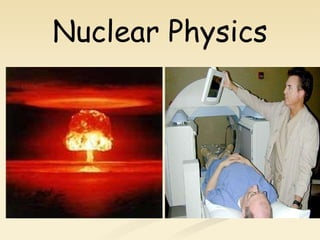
Nuclear Physics
Shortcut to  AtomicBombTest
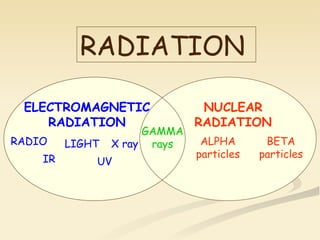
RADIATION ELECTROMAGNETIC RADIATION NUCLEAR RADIATION RADIO LIGHT IR UV X ray ALPHA particles BETA particles GAMMA rays
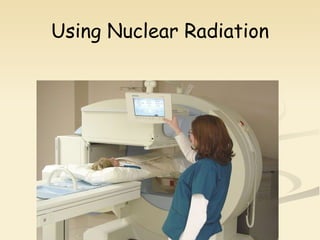
Using Nuclear Radiation
Cancer Therapy
Electricity Production
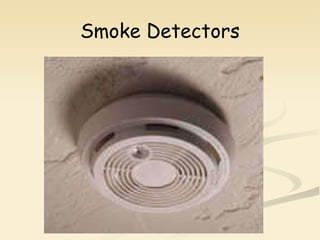
Smoke Detectors
Sterilisation
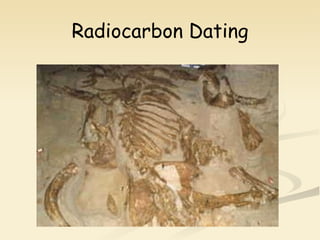
Radiocarbon Dating
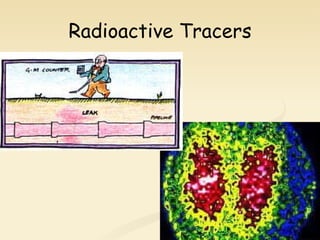
Radioactive Tracers
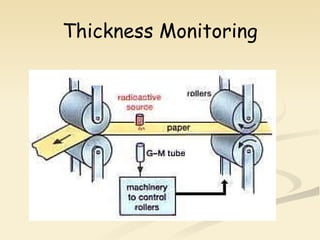
Thickness Monitoring
Understanding Atoms Our understanding of what’s inside atoms has developed in the last 200 years……..
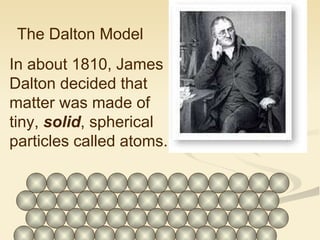
The Dalton Model In about 1810, James Dalton decided that matter was made of tiny,  solid , spherical particles called atoms.
He introduced the idea of atoms as  elementary particles.
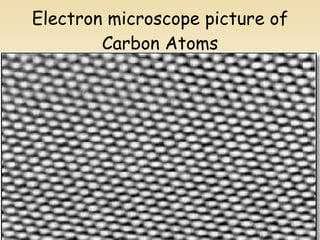
Electron microscope picture of Carbon Atoms
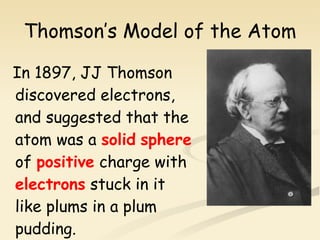
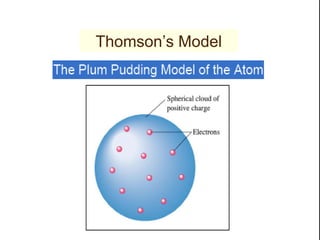
Thomson’s Model of the Atom In 1897, JJ Thomson discovered electrons, and suggested that the atom was a  solid   sphere  of  positive  charge with  electrons  stuck in it like plums in a plum pudding.
Copyright © Houghton Mifflin Company. All rights reserved. 2–19  Rutherford's Experiment On α-Particle Bombardment of Metal Foil Copyright © Houghton Mifflin Company. All rights reserved. 2–19  Rutherford's Experiment On α-Particle Bombardment of Metal Foil Thomson’s Model
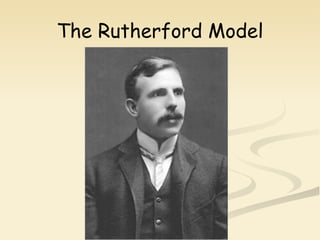
The Rutherford Model
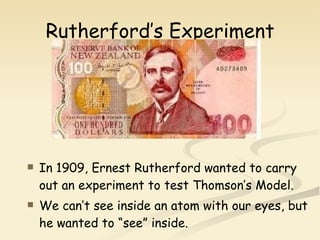
Rutherford’s Experiment In 1909, Ernest Rutherford wanted to carry out an experiment to test Thomson’s Model. We can’t see inside an atom with our eyes, but he wanted to “see” inside.
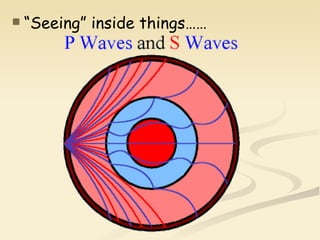
“ Seeing” inside things……
 
“ Seeing” inside things……
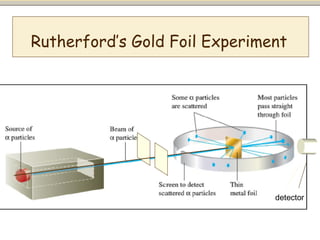
He managed to “look inside” the atom by firing tiny particles called  alpha particles  at a thin gold foil to see how the alpha particles were deflected by the atoms of gold. Alpha particles are the same as Helium nucleii, they are emitted from some radioactive atoms.
detector Rutherford’s Gold Foil Experiment
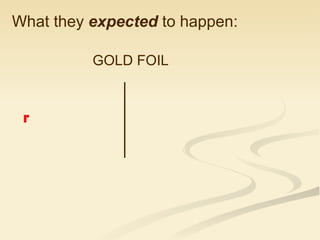
What they  expected  to happen: GOLD FOIL
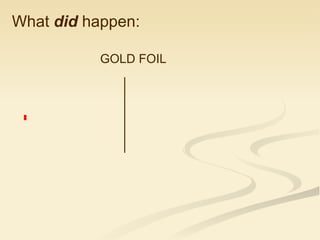
What  did  happen: GOLD FOIL
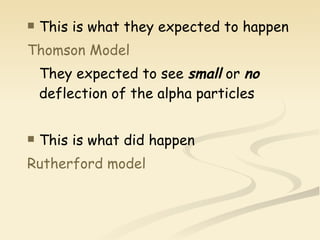
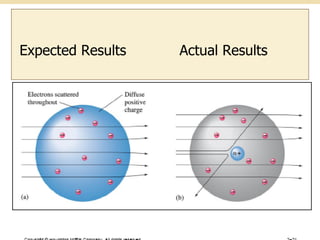
This is what they expected to happen Thomson Model They expected to see  small  or  no  deflection of the alpha particles This is what did happen Rutherford model
Expected Results Actual Results
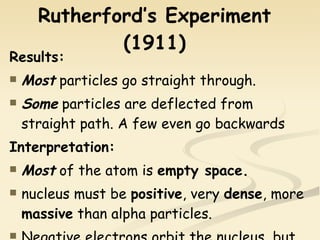
Rutherford’s Experiment (1911) Results: Most  particles go straight through. Some  particles are deflected from straight path. A few even go backwards Interpretation: Most  of the atom is  empty space. nucleus must be  positive , very  dense , more  massive  than alpha particles. Negative electrons orbit the nucleus, but are  much  lighter
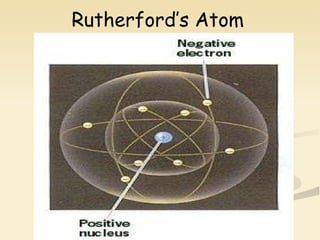
Rutherford’s Atom
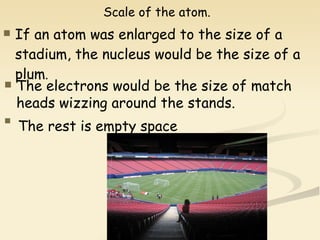
Scale of the atom. If an atom was enlarged to the size of a stadium, the nucleus would be the size of a plum . The electrons would be the size of match heads wizzing around the stands. The rest is empty space
Size of the Atom An atom is roughly 10 -10  m in diameter This means a full stop is roughly  ten million  atoms across. A small nucleus is roughly 10 -15  m in diameter This is 1/100,000 ths   the diameter of the atom
Fundamental Forces What are the only two  Fundamental Forces  you are familiar with? Gravity Electric
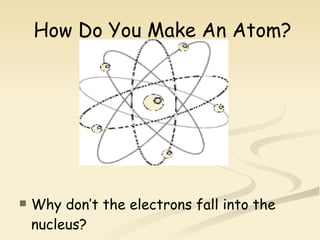
How Do You Make An Atom? Why don’t the electrons fall into the nucleus?
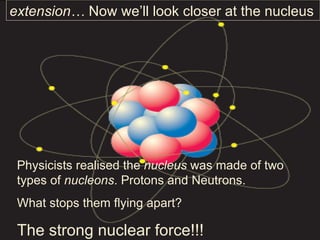
Physicists realised the  nucleus  was made of two types of  nucleons . Protons and Neutrons. What stops them flying apart? The strong nuclear force!!! extension…  Now we’ll look closer at the nucleus
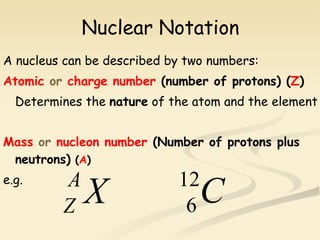
Nuclear Notation A nucleus can be described by two numbers: Atomic  or  charge number  (number of protons) ( Z )  Determines the  nature  of the atom and the element Mass  or  nucleon number  (Number of protons plus neutrons)  ( A )  e.g.
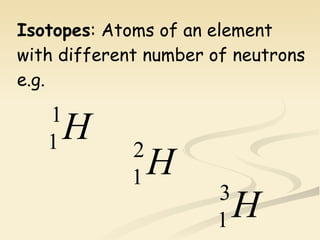
Isotopes : Atoms of an element with different number of neutrons e.g.
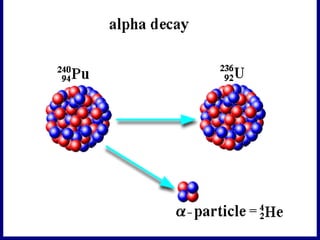
Radioactive Decay Nuclei that have too much energy are unstable. They become more stable by firing out some nuclear radiation There are three types of radioactive decay……
 
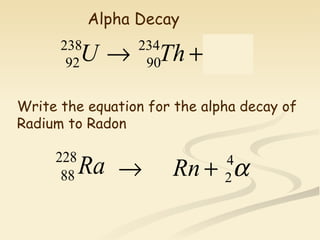
Write the equation for the alpha decay of Radium to Radon Alpha Decay
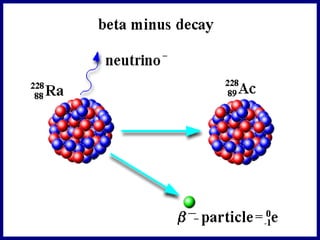
Beta Decay
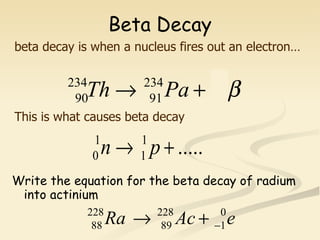
Beta Decay Write the equation for the beta decay of radium into actinium This is what causes beta decay beta decay is when a nucleus fires out an electron…
 
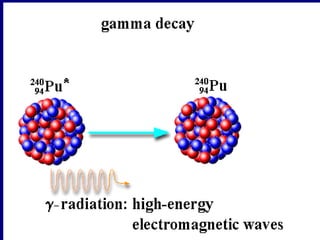
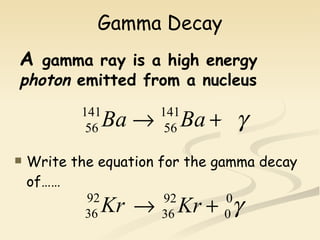
Gamma Decay Write the equation for the gamma decay of……  A  gamma ray is a high energy  photon  emitted from a nucleus
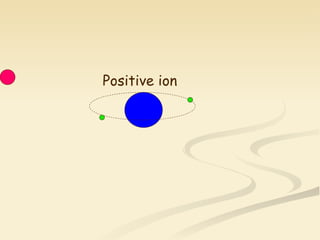
Ionisation When alpha particles collide with atoms, they can knock electrons off. This will produce a positive ion and a free electron.
Positive ion
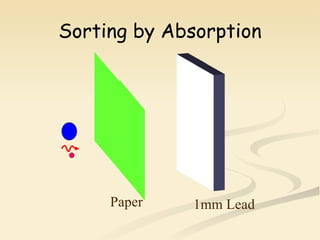
Sorting by Absorption Paper 1mm Lead
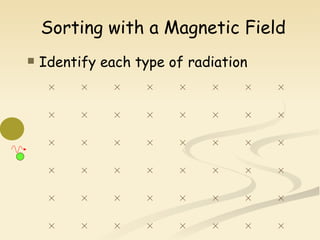
Sorting with a Magnetic Field Identify each type of radiation
Half Life The half life of an isotope is the time taken for  half  of a sample to decay into another isotope. OR, the time taken for the activity of a sample to halve. The shorter the half life, the less stable it is. e.g. Uranium 238: 4,500 MY Radon 218 0.04 s link to half life 1
Radioactivity and Probability Radioactivity is all about chance. You can’t say when a certain nucleus will decay, but it might have a 1 in 10 chance of decaying in the next 5 seconds. For the example above: 1000 nuclei  100 decays in 5s 100 nuclei  10 decays in 5s
This means there are more decays when there are more nuclei. A shorter half life means a greater probability of a decay occurring
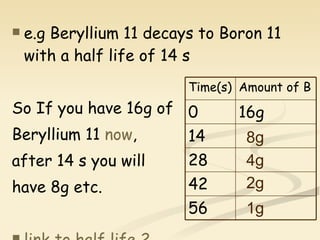
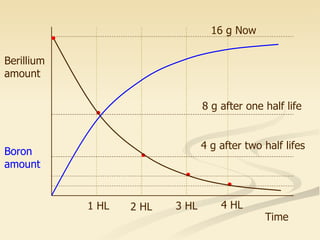
e.g Beryllium 11 decays to Boron 11 with a half life of 14 s So If you have 16g of  Beryllium 11  now , after 14 s you will have 8g etc. link to half life 2 8g 4g 2g 1g 56 42 28 14 16g 0 Amount of B Time(s)
Berillium amount Time 16 g Now 8 g after one half life 4 g after two half lifes 1 HL 2 HL 3 HL 4 HL Boron amount
Note that the  total mass  of the sample is   about the same , because as the Beryllium  decays, it doesn’t disappear, it changes into Boron. The Boron is still there.
Sample Question. A radioactive isotope has a half life of 3 years. A 5 g sample of the isotope produces 30 decays per sec. What will the decay rate of a 1 g sample be in 9 years time?
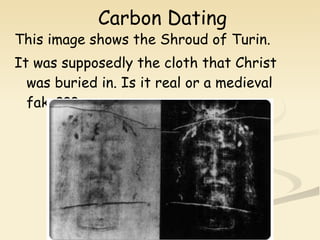
Carbon Dating This image shows the Shroud of Turin. It was supposedly the cloth that Christ was buried in. Is it real or a medieval fake???
In the Atmosphere, cosmic rays hit Nitrogen 14 changing it to Carbon 14. The Carbon 14 decays with a half life of 6300 years. So a small fraction of CO 2  molecules contain Carbon 14. This is taken in by plants, and hence animals. When the organism dies, The Carbon 12 stays the same, the Carbon 14 decays. By measuring the ratio of C14 to C12, the time since it was alive can be calculated
Back to the shroud. The ratio of C14 to C12 showed it was about 800 years old!!! Final question. A wooden axe handle has a ratio of C14 to C12 that is 1/8 times the ratio for new wood. How old is it?
NCEA type question  Describe the Dalton model of the atom Explain the evidence for the Thomson model  Explain the evidence for the Rutherford model
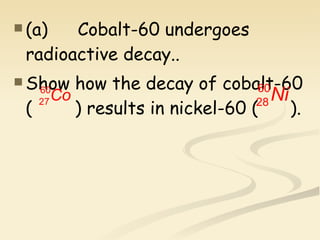
(a) Cobalt-60 undergoes radioactive decay..  Show how the decay of cobalt-60 (  ) results in nickel-60 (  ).
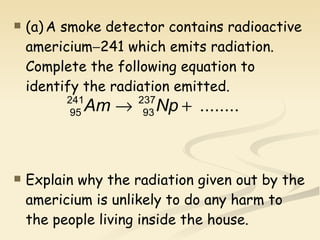
(a) A smoke detector contains radioactive americium  241 which emits radiation. Complete the following equation to identify the radiation emitted. Explain why the radiation given out by the americium is unlikely to do any harm to the people living inside the house.
The alpha particles ionise atoms in the air. Explain what this means.
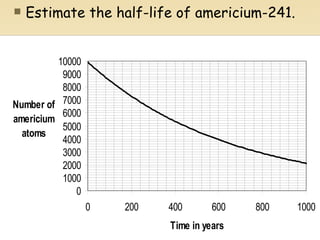
Estimate the half-life of americium-241.
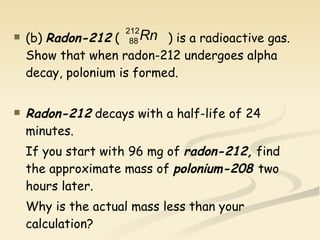
(b) Radon-212  (  ) is a radioactive gas. Show that when radon-212 undergoes alpha decay, polonium is formed.  Radon-212  decays with a half-life of 24 minutes. If you start with 96 mg of  radon-212,  find the approximate mass of  polonium-208  two hours later. Why is the actual mass less than your calculation?
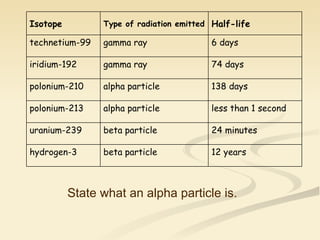
State what an alpha particle is.   12 years beta particle hydrogen-3 24 minutes beta particle uranium-239 less than 1 second alpha particle polonium-213 138 days alpha particle polonium-210 74 days gamma ray iridium-192 6 days gamma ray technetium-99 Half-life Type of radiation emitted Isotope
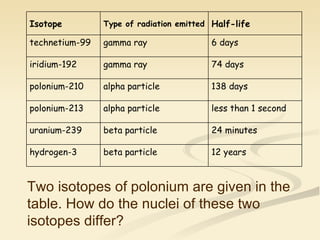
Two isotopes of polonium are given in the table. How do the nuclei of these two isotopes differ?   12 years beta particle hydrogen-3 24 minutes beta particle uranium-239 less than 1 second alpha particle polonium-213 138 days alpha particle polonium-210 74 days gamma ray iridium-192 6 days gamma ray technetium-99 Half-life Type of radiation emitted Isotope
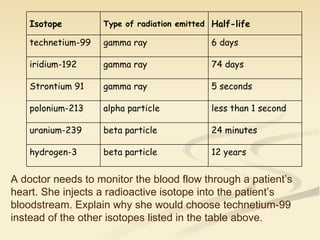
A doctor needs to monitor the blood flow through a patient’s heart. She injects a radioactive isotope into the patient’s bloodstream. Explain why she would choose technetium-99 instead of the other isotopes listed in the table above.   12 years beta particle hydrogen-3 24 minutes beta particle uranium-239 less than 1 second alpha particle polonium-213 5 seconds gamma ray Strontium 91 74 days gamma ray iridium-192 6 days gamma ray technetium-99 Half-life Type of radiation emitted Isotope

Nuclear and Atomic Physics

  • 1.
  • 2.
    Shortcut to AtomicBombTest
  • 3.
    RADIATION ELECTROMAGNETIC RADIATIONNUCLEAR RADIATION RADIO LIGHT IR UV X ray ALPHA particles BETA particles GAMMA rays
  • 4.
  • 5.
  • 6.
  • 7.
  • 8.
  • 9.
  • 10.
  • 11.
  • 12.
    Understanding Atoms Ourunderstanding of what’s inside atoms has developed in the last 200 years……..
  • 13.
    The Dalton ModelIn about 1810, James Dalton decided that matter was made of tiny, solid , spherical particles called atoms.
  • 14.
    He introduced theidea of atoms as elementary particles.
  • 15.
  • 16.
    Thomson’s Model ofthe Atom In 1897, JJ Thomson discovered electrons, and suggested that the atom was a solid sphere of positive charge with electrons stuck in it like plums in a plum pudding.
  • 17.
    Copyright © HoughtonMifflin Company. All rights reserved. 2–19 Rutherford's Experiment On α-Particle Bombardment of Metal Foil Copyright © Houghton Mifflin Company. All rights reserved. 2–19 Rutherford's Experiment On α-Particle Bombardment of Metal Foil Thomson’s Model
  • 18.
  • 19.
    Rutherford’s Experiment In1909, Ernest Rutherford wanted to carry out an experiment to test Thomson’s Model. We can’t see inside an atom with our eyes, but he wanted to “see” inside.
  • 20.
  • 21.
  • 22.
  • 23.
  • 24.
    He managed to“look inside” the atom by firing tiny particles called alpha particles at a thin gold foil to see how the alpha particles were deflected by the atoms of gold. Alpha particles are the same as Helium nucleii, they are emitted from some radioactive atoms.
  • 25.
  • 26.
    What they expected to happen: GOLD FOIL
  • 27.
    What did happen: GOLD FOIL
  • 28.
    This is whatthey expected to happen Thomson Model They expected to see small or no deflection of the alpha particles This is what did happen Rutherford model
  • 29.
  • 30.
    Rutherford’s Experiment (1911)Results: Most particles go straight through. Some particles are deflected from straight path. A few even go backwards Interpretation: Most of the atom is empty space. nucleus must be positive , very dense , more massive than alpha particles. Negative electrons orbit the nucleus, but are much lighter
  • 31.
  • 32.
    Scale of theatom. If an atom was enlarged to the size of a stadium, the nucleus would be the size of a plum . The electrons would be the size of match heads wizzing around the stands. The rest is empty space
  • 33.
    Size of theAtom An atom is roughly 10 -10 m in diameter This means a full stop is roughly ten million atoms across. A small nucleus is roughly 10 -15 m in diameter This is 1/100,000 ths the diameter of the atom
  • 34.
    Fundamental Forces Whatare the only two Fundamental Forces you are familiar with? Gravity Electric
  • 35.
    How Do YouMake An Atom? Why don’t the electrons fall into the nucleus?
  • 36.
    Physicists realised the nucleus was made of two types of nucleons . Protons and Neutrons. What stops them flying apart? The strong nuclear force!!! extension… Now we’ll look closer at the nucleus
  • 37.
    Nuclear Notation Anucleus can be described by two numbers: Atomic or charge number (number of protons) ( Z ) Determines the nature of the atom and the element Mass or nucleon number (Number of protons plus neutrons) ( A ) e.g.
  • 38.
    Isotopes : Atomsof an element with different number of neutrons e.g.
  • 39.
    Radioactive Decay Nucleithat have too much energy are unstable. They become more stable by firing out some nuclear radiation There are three types of radioactive decay……
  • 40.
  • 41.
    Write the equationfor the alpha decay of Radium to Radon Alpha Decay
  • 42.
  • 43.
    Beta Decay Writethe equation for the beta decay of radium into actinium This is what causes beta decay beta decay is when a nucleus fires out an electron…
  • 44.
  • 45.
    Gamma Decay Writethe equation for the gamma decay of…… A gamma ray is a high energy photon emitted from a nucleus
  • 46.
    Ionisation When alphaparticles collide with atoms, they can knock electrons off. This will produce a positive ion and a free electron.
  • 47.
  • 48.
    Sorting by AbsorptionPaper 1mm Lead
  • 49.
    Sorting with aMagnetic Field Identify each type of radiation
  • 50.
    Half Life Thehalf life of an isotope is the time taken for half of a sample to decay into another isotope. OR, the time taken for the activity of a sample to halve. The shorter the half life, the less stable it is. e.g. Uranium 238: 4,500 MY Radon 218 0.04 s link to half life 1
  • 51.
    Radioactivity and ProbabilityRadioactivity is all about chance. You can’t say when a certain nucleus will decay, but it might have a 1 in 10 chance of decaying in the next 5 seconds. For the example above: 1000 nuclei  100 decays in 5s 100 nuclei  10 decays in 5s
  • 52.
    This means thereare more decays when there are more nuclei. A shorter half life means a greater probability of a decay occurring
  • 53.
    e.g Beryllium 11decays to Boron 11 with a half life of 14 s So If you have 16g of Beryllium 11 now , after 14 s you will have 8g etc. link to half life 2 8g 4g 2g 1g 56 42 28 14 16g 0 Amount of B Time(s)
  • 54.
    Berillium amount Time16 g Now 8 g after one half life 4 g after two half lifes 1 HL 2 HL 3 HL 4 HL Boron amount
  • 55.
    Note that the total mass of the sample is about the same , because as the Beryllium decays, it doesn’t disappear, it changes into Boron. The Boron is still there.
  • 56.
    Sample Question. Aradioactive isotope has a half life of 3 years. A 5 g sample of the isotope produces 30 decays per sec. What will the decay rate of a 1 g sample be in 9 years time?
  • 57.
    Carbon Dating Thisimage shows the Shroud of Turin. It was supposedly the cloth that Christ was buried in. Is it real or a medieval fake???
  • 58.
    In the Atmosphere,cosmic rays hit Nitrogen 14 changing it to Carbon 14. The Carbon 14 decays with a half life of 6300 years. So a small fraction of CO 2 molecules contain Carbon 14. This is taken in by plants, and hence animals. When the organism dies, The Carbon 12 stays the same, the Carbon 14 decays. By measuring the ratio of C14 to C12, the time since it was alive can be calculated
  • 59.
    Back to theshroud. The ratio of C14 to C12 showed it was about 800 years old!!! Final question. A wooden axe handle has a ratio of C14 to C12 that is 1/8 times the ratio for new wood. How old is it?
  • 60.
    NCEA type question Describe the Dalton model of the atom Explain the evidence for the Thomson model Explain the evidence for the Rutherford model
  • 61.
    (a) Cobalt-60 undergoesradioactive decay.. Show how the decay of cobalt-60 ( ) results in nickel-60 ( ).
  • 62.
    (a) A smokedetector contains radioactive americium  241 which emits radiation. Complete the following equation to identify the radiation emitted. Explain why the radiation given out by the americium is unlikely to do any harm to the people living inside the house.
  • 63.
    The alpha particlesionise atoms in the air. Explain what this means.
  • 64.
    Estimate the half-lifeof americium-241.
  • 65.
    (b) Radon-212 ( ) is a radioactive gas. Show that when radon-212 undergoes alpha decay, polonium is formed. Radon-212 decays with a half-life of 24 minutes. If you start with 96 mg of radon-212, find the approximate mass of polonium-208 two hours later. Why is the actual mass less than your calculation?
  • 66.
    State what analpha particle is. 12 years beta particle hydrogen-3 24 minutes beta particle uranium-239 less than 1 second alpha particle polonium-213 138 days alpha particle polonium-210 74 days gamma ray iridium-192 6 days gamma ray technetium-99 Half-life Type of radiation emitted Isotope
  • 67.
    Two isotopes ofpolonium are given in the table. How do the nuclei of these two isotopes differ? 12 years beta particle hydrogen-3 24 minutes beta particle uranium-239 less than 1 second alpha particle polonium-213 138 days alpha particle polonium-210 74 days gamma ray iridium-192 6 days gamma ray technetium-99 Half-life Type of radiation emitted Isotope
  • 68.
    A doctor needsto monitor the blood flow through a patient’s heart. She injects a radioactive isotope into the patient’s bloodstream. Explain why she would choose technetium-99 instead of the other isotopes listed in the table above. 12 years beta particle hydrogen-3 24 minutes beta particle uranium-239 less than 1 second alpha particle polonium-213 5 seconds gamma ray Strontium 91 74 days gamma ray iridium-192 6 days gamma ray technetium-99 Half-life Type of radiation emitted Isotope