Nuclei
Nuclear Forces
Short Ranged Force ( ~ femtometers 10-15)
In short range , they are very strong(even stronger than Coulomb and Gravitation) .
Other than this they are very weak.
Nuclear force does not depend on charge , Hence it is same for neutron-neutron ,
proton-proton and neutron-proton
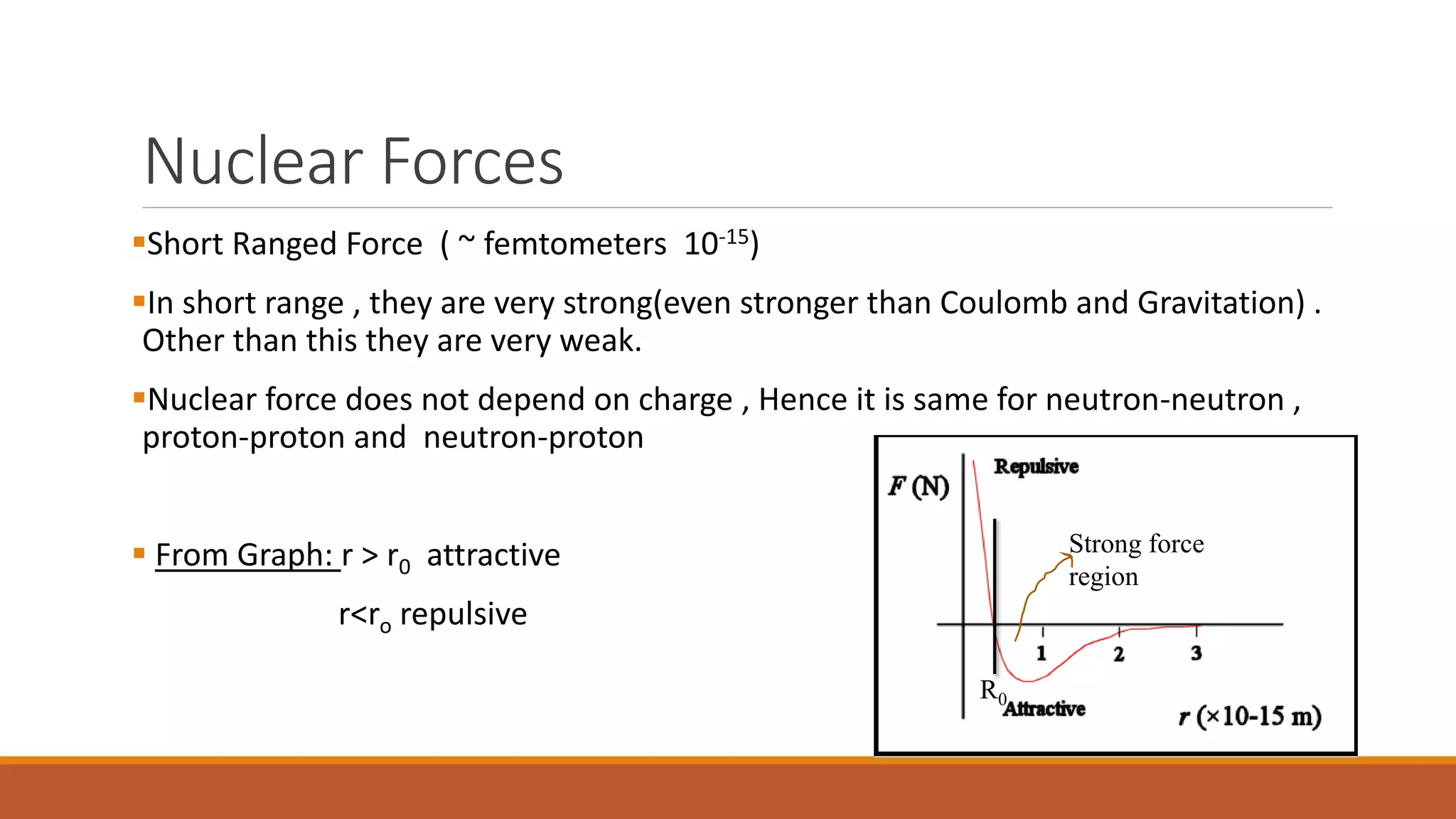
 From Graph: r > r0 attractive
r<ro repulsive
R0
Strong force
region
Basic Facts
 A = Mass number = No of protons + Number of electrons
Z = Atomic Number = No of protons
Radius of Nucleus ∝ A1/3
Volume = (4/3) π R3 ∝ A
Density = Mass / Volume = Mass number /Volume = Constant
So Density of nucleus is independent of Mass number .
Density of nucleus is very high . As it was concluded in Rutherford’s Experiment
Mass Energy Equivalence
Mass is condensed form of Energy
Energy Equivalent for Mass : E = mc2
Energy Equivalent of 1 amu = 931 MeV. ~930
So , If mass is known in amu just multiply it by 931 to get energy equivalent .
Energy Concepts
To break things we need energy . Example to break a chemical bond energy is
required , To break an ice cube ,energy is required .
When things are formed on their own , energy is released .
Binding Energy
Since we are breaking , Energy should be added . Energy Equal to Binding Energy is
required to break nucleus . So Binding Energy Stability
Applying Energy Conservation
Energy of Nucleus + Binding Energy = Energy of nucleons
Mnucleusc2 + Binding Energy = Mnucleons c2
Mnucleons > Mnucleus .. This is called mass defect (खुल्ले का mass ज्यादा होता है)
So Binding Energy = (Mass Defect) c2 = (Mnucleons-Mnucleus) c2
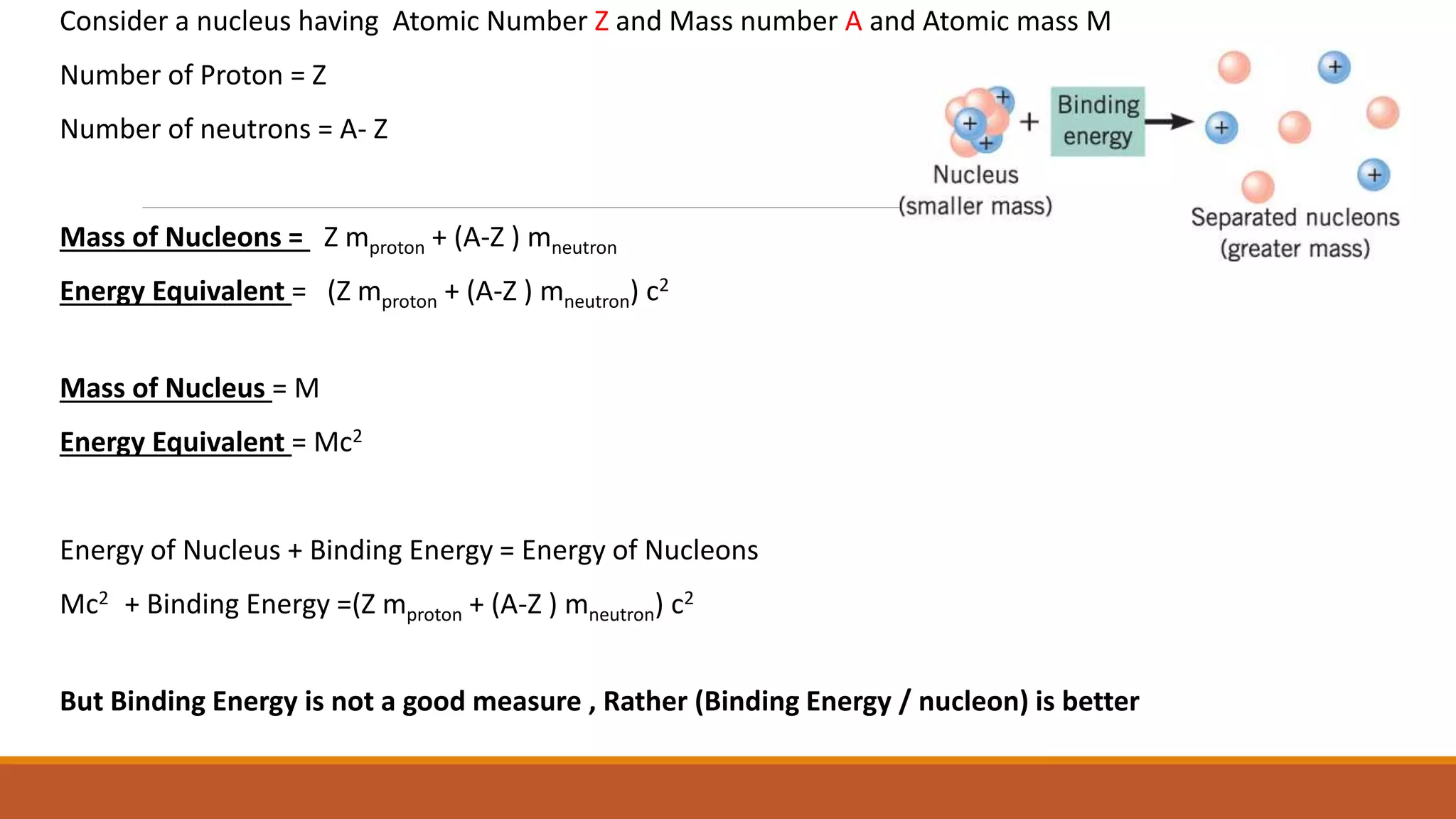
Consider a nucleus having Atomic Number Z and Mass number A and Atomic mass M
Number of Proton = Z
Number of neutrons = A- Z
Mass of Nucleons = Z mproton + (A-Z ) mneutron
Energy Equivalent = (Z mproton + (A-Z ) mneutron) c2
Mass of Nucleus = M
Energy Equivalent = Mc2
Energy of Nucleus + Binding Energy = Energy of Nucleons
Mc2 + Binding Energy =(Z mproton + (A-Z ) mneutron) c2
But Binding Energy is not a good measure , Rather (Binding Energy / nucleon) is better
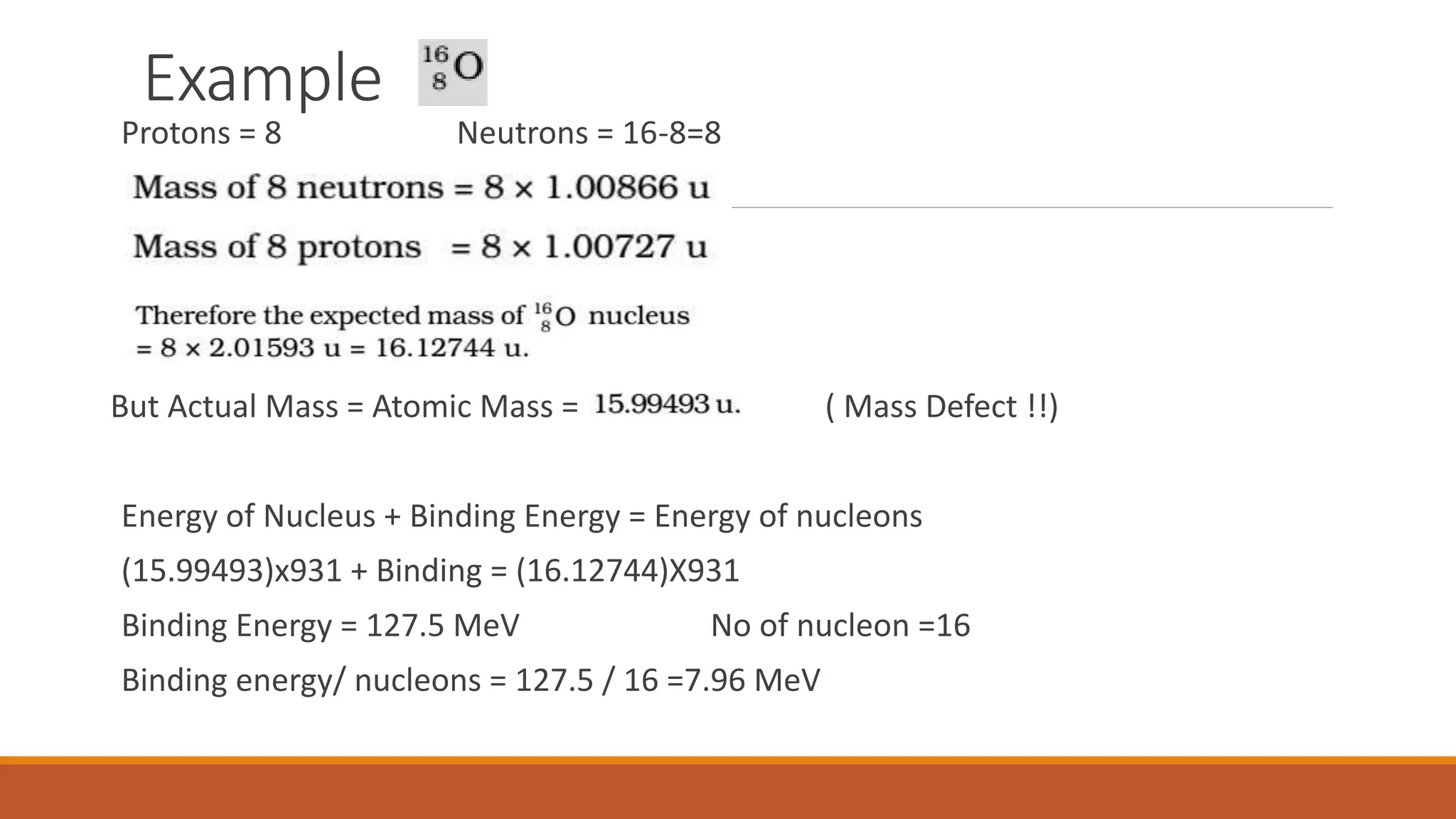
Example
Protons = 8 Neutrons = 16-8=8
But Actual Mass = Atomic Mass = ( Mass Defect !!)
Energy of Nucleus + Binding Energy = Energy of nucleons
(15.99493)x931 + Binding = (16.12744)X931
Binding Energy = 127.5 MeV No of nucleon =16
Binding energy/ nucleons = 127.5 / 16 =7.96 MeV
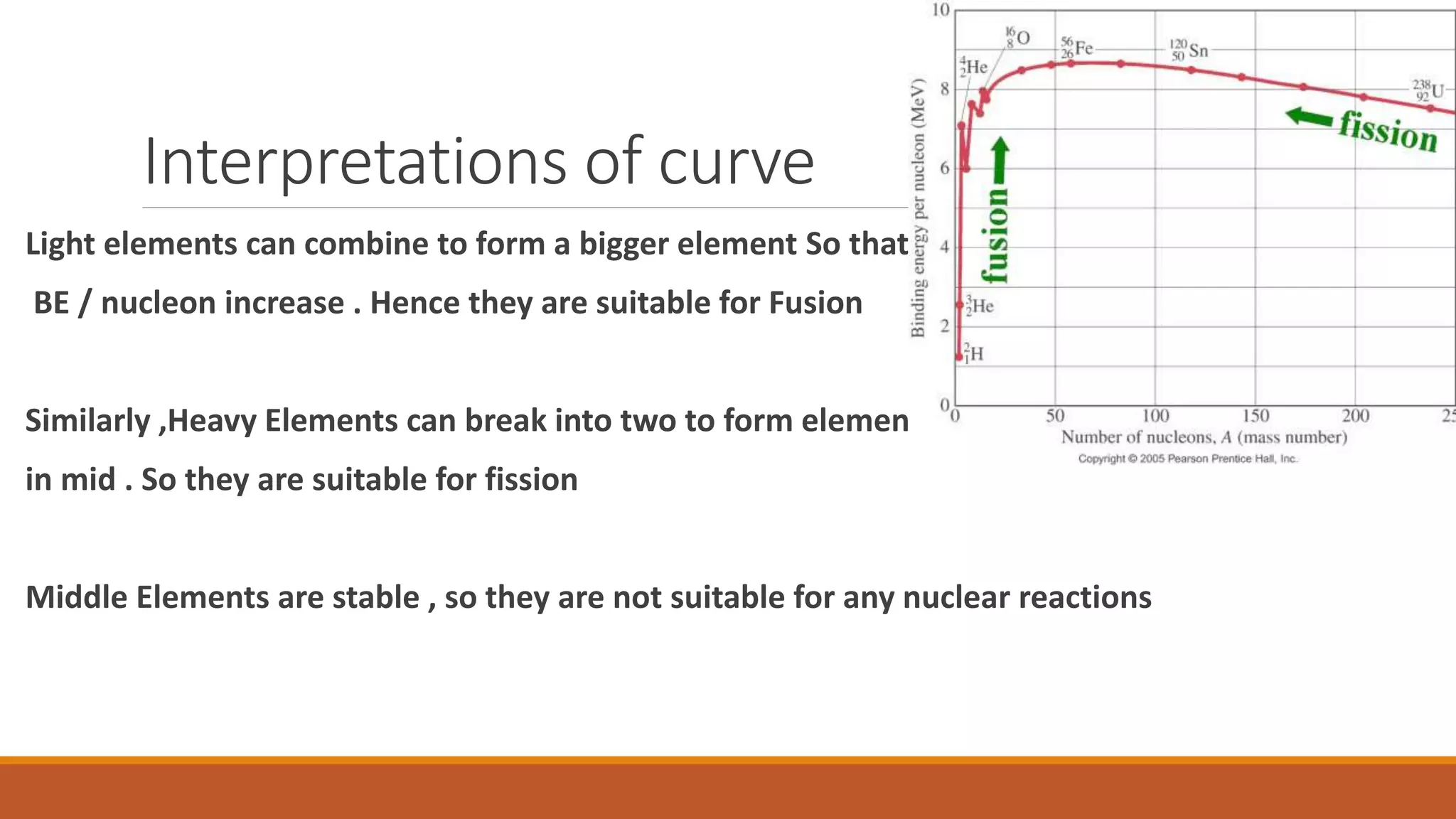
Binding Energy Curve
Curve is on Binding Energy /Nucleon
Most stable : Iron Group
30< A<70 almost constant , because nuclear force is
short ranged .
Binding Energy / nucleon is low for light as well as heavy elements
Interpretations of curve
Light elements can combine to form a bigger element So that
BE / nucleon increase . Hence they are suitable for Fusion
Similarly ,Heavy Elements can break into two to form elements
in mid . So they are suitable for fission
Middle Elements are stable , so they are not suitable for any nuclear reactions
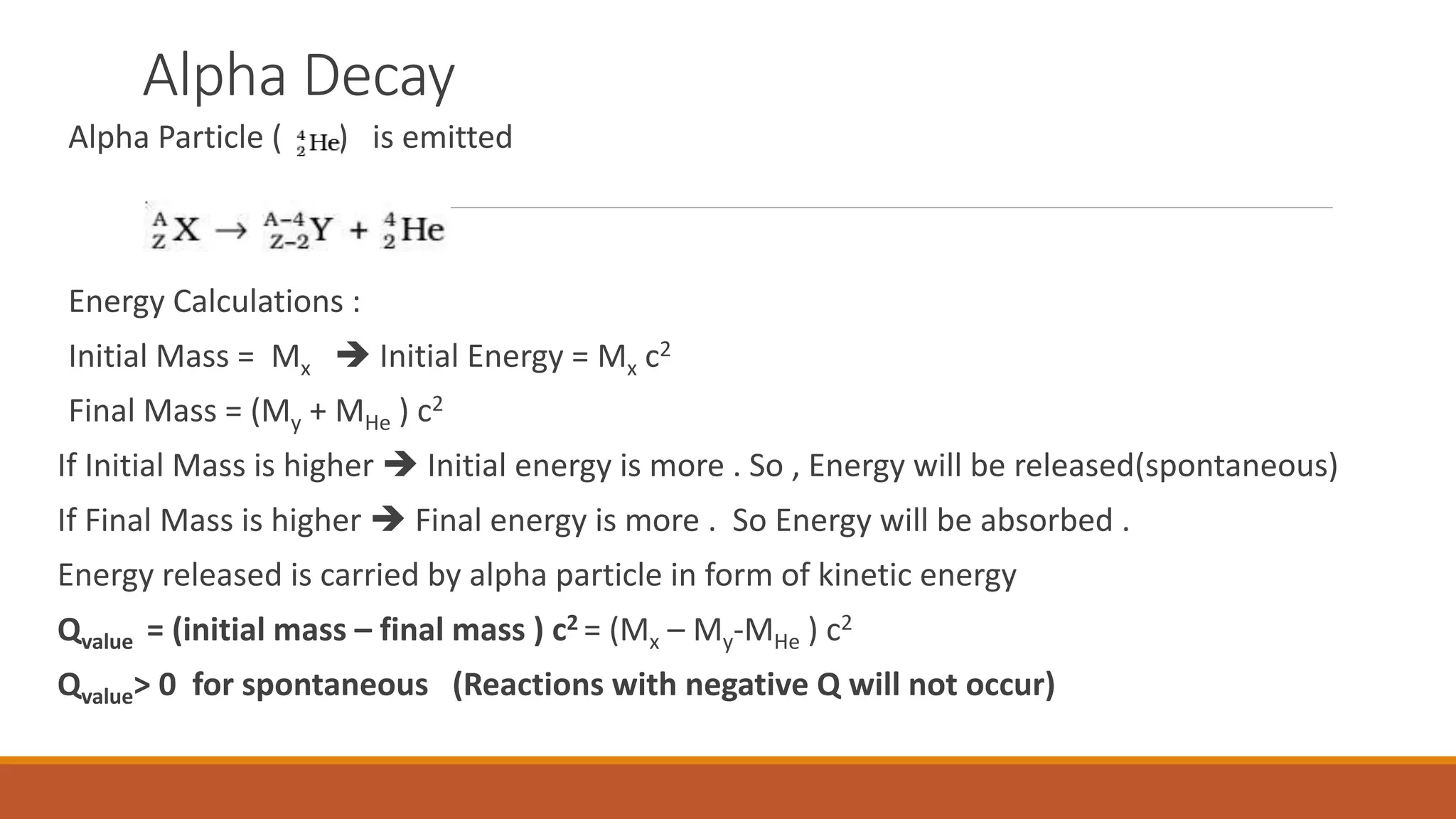
Alpha Decay
Alpha Particle ( ) is emitted
Energy Calculations :
Initial Mass = Mx  Initial Energy = Mx c2
Final Mass = (My + MHe ) c2
If Initial Mass is higher  Initial energy is more . So , Energy will be released(spontaneous)
If Final Mass is higher  Final energy is more . So Energy will be absorbed .
Energy released is carried by alpha particle in form of kinetic energy
Qvalue = (initial mass – final mass ) c2 = (Mx – My-MHe ) c2
Qvalue> 0 for spontaneous (Reactions with negative Q will not occur)
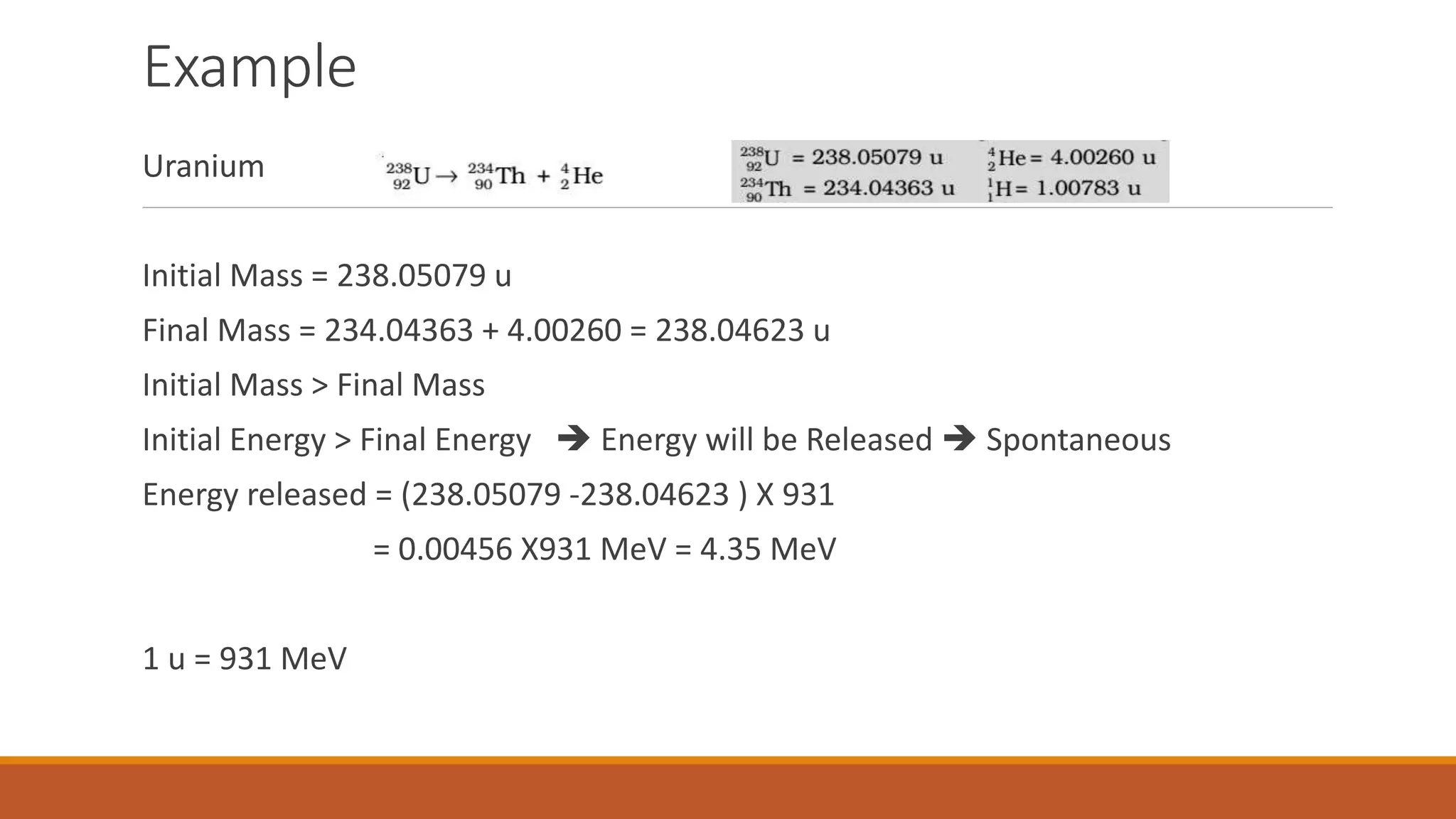
Example
Uranium
Initial Mass = 238.05079 u
Final Mass = 234.04363 + 4.00260 = 238.04623 u
Initial Mass > Final Mass
Initial Energy > Final Energy  Energy will be Released  Spontaneous
Energy released = (238.05079 -238.04623 ) X 931
= 0.00456 X931 MeV = 4.35 MeV
1 u = 931 MeV
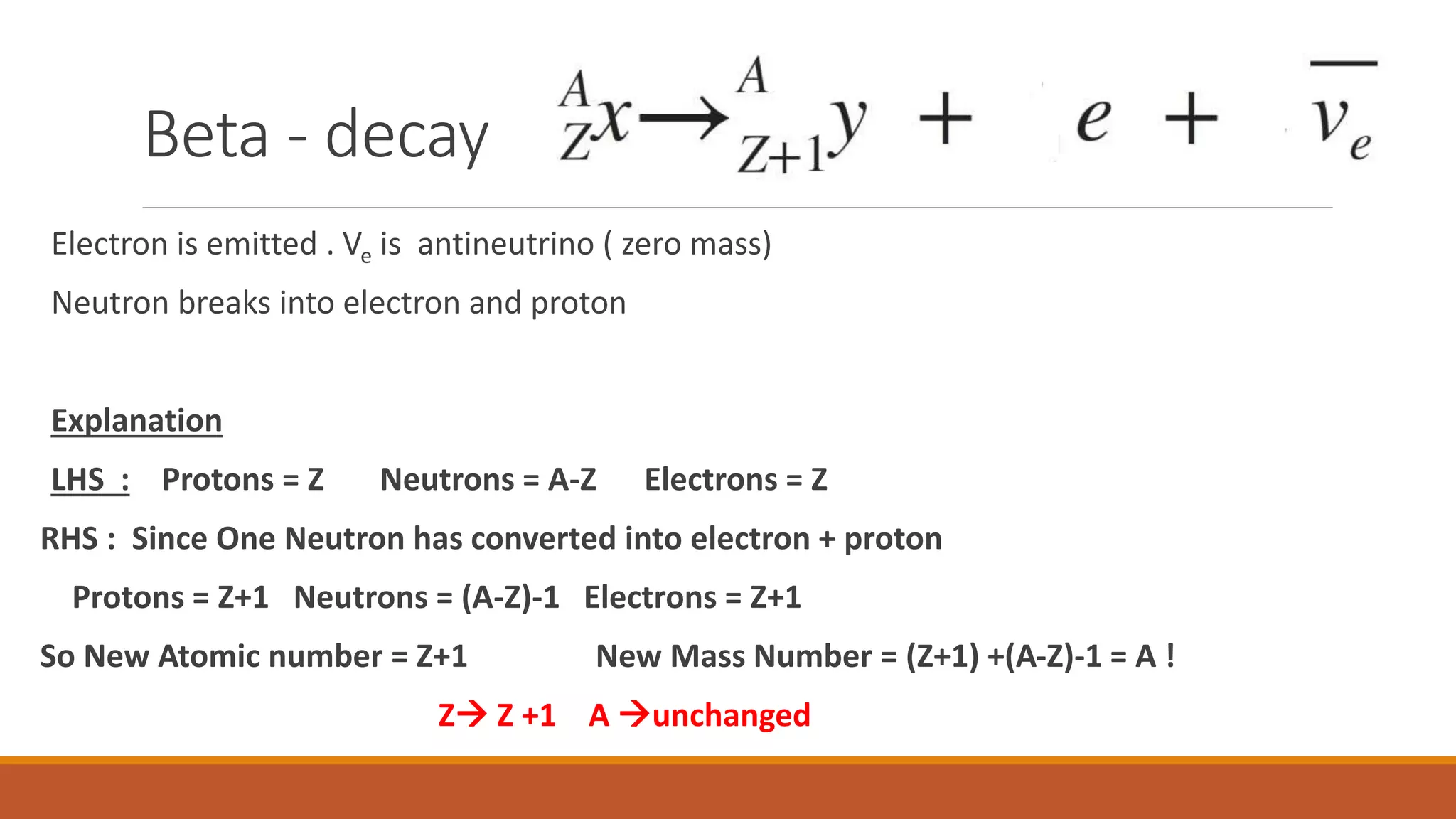
Beta - decay
Electron is emitted . Ve is antineutrino ( zero mass)
Neutron breaks into electron and proton
Explanation
LHS : Protons = Z Neutrons = A-Z Electrons = Z
RHS : Since One Neutron has converted into electron + proton
Protons = Z+1 Neutrons = (A-Z)-1 Electrons = Z+1
So New Atomic number = Z+1 New Mass Number = (Z+1) +(A-Z)-1 = A !
Z Z +1 A unchanged
Energy Calculations
Initial Mass = Mx
Initial Energy = Mxc2
Final Mass = (My + Me)
Final Energy = (My + Me)c2
Qvalue = ( Initial Mass – Final Mass ) c2 = (Mx- My -Me)c2
Qvalue > 0  Spontaneous
This energy ( Q) is carried away as kinetic energy by the electron and
antineutrino.
Beta plus decay
Proton breaks into Neutron and positive electron
Explanation :
LHS : Protons : Z Neutrons : A-Z
Now one proton converts into positive electron and neutron
RHS : Proton : Z-1 Neutron : (A-Z+1)
New Atomic number : Z-1 New Mass Number = (Z-1) + (A-Z+1 ) = A !
Z  Z-1 A  Unchanged
Energy Calculations
Initial Mass = Mx
Initial Energy = Mxc2
Final Mass = (My + Me)
Final Energy = (My + Me)c2
Qvalue = ( Initial Mass – Final Mass ) c2 = (Mx- My -Me)c2
Qvalue > 0  Spontaneous
This energy(Q) is carried away as kinetic energy by the electron and neutrino.
Gamma Decay
Like electrons , nuclei also have energy states .
But energy gap is very high in case of nucleus . In case of electrons it is relatively small ( 13.6 eV,
10.2eV etc)
But in case of nucleus it is of the order of MeV ( Mega = 10 6 , as in megabytes)
When nucleus , jumps down from excited state to lower state energy is released in the form of
photons . Efinal- Einitial = h v
Example
Fact : Beta / alpha decay are generally accompanied by gamma decay
In this example , Cobalt first goes beta minus decay , In beta
Minus decay Z increases by 1 ( 2728)
Then it undergoes two gamma decays
First gamma : 1.17 Mev 1.17X106 = 1240/ λ λ =10-3 nm
Second gamma : 1.33 MeV
Radioactivity
First Order Reaction
N = Number of nuclei present
N0 initial number of nuclei
So number of nuclei will decrease with time .
Decay rate :
So ,
Putting value of N in above equation
R is also called activity of sample
Half life : Time at which number of nuclei present become half of initial nuclei
T1/2 depends only on decay constant .not on N
Average life : Life a nuclei is expected to live .
Like some humans die at early age , some at high age . The average comes in
middle which is called life expectancy .
Moderator – For slowing down Neutrons
Safety rods – to absorb neutrons

Nuclei

  • 1.
  • 2.
    Nuclear Forces Short RangedForce ( ~ femtometers 10-15) In short range , they are very strong(even stronger than Coulomb and Gravitation) . Other than this they are very weak. Nuclear force does not depend on charge , Hence it is same for neutron-neutron , proton-proton and neutron-proton  From Graph: r > r0 attractive r<ro repulsive R0 Strong force region
  • 3.
    Basic Facts  A= Mass number = No of protons + Number of electrons Z = Atomic Number = No of protons Radius of Nucleus ∝ A1/3 Volume = (4/3) π R3 ∝ A Density = Mass / Volume = Mass number /Volume = Constant So Density of nucleus is independent of Mass number . Density of nucleus is very high . As it was concluded in Rutherford’s Experiment
  • 4.
    Mass Energy Equivalence Massis condensed form of Energy Energy Equivalent for Mass : E = mc2 Energy Equivalent of 1 amu = 931 MeV. ~930 So , If mass is known in amu just multiply it by 931 to get energy equivalent .
  • 5.
    Energy Concepts To breakthings we need energy . Example to break a chemical bond energy is required , To break an ice cube ,energy is required . When things are formed on their own , energy is released .
  • 6.
    Binding Energy Since weare breaking , Energy should be added . Energy Equal to Binding Energy is required to break nucleus . So Binding Energy Stability Applying Energy Conservation Energy of Nucleus + Binding Energy = Energy of nucleons Mnucleusc2 + Binding Energy = Mnucleons c2 Mnucleons > Mnucleus .. This is called mass defect (खुल्ले का mass ज्यादा होता है) So Binding Energy = (Mass Defect) c2 = (Mnucleons-Mnucleus) c2
  • 7.
    Consider a nucleushaving Atomic Number Z and Mass number A and Atomic mass M Number of Proton = Z Number of neutrons = A- Z Mass of Nucleons = Z mproton + (A-Z ) mneutron Energy Equivalent = (Z mproton + (A-Z ) mneutron) c2 Mass of Nucleus = M Energy Equivalent = Mc2 Energy of Nucleus + Binding Energy = Energy of Nucleons Mc2 + Binding Energy =(Z mproton + (A-Z ) mneutron) c2 But Binding Energy is not a good measure , Rather (Binding Energy / nucleon) is better
  • 8.
    Example Protons = 8Neutrons = 16-8=8 But Actual Mass = Atomic Mass = ( Mass Defect !!) Energy of Nucleus + Binding Energy = Energy of nucleons (15.99493)x931 + Binding = (16.12744)X931 Binding Energy = 127.5 MeV No of nucleon =16 Binding energy/ nucleons = 127.5 / 16 =7.96 MeV
  • 9.
    Binding Energy Curve Curveis on Binding Energy /Nucleon Most stable : Iron Group 30< A<70 almost constant , because nuclear force is short ranged . Binding Energy / nucleon is low for light as well as heavy elements
  • 10.
    Interpretations of curve Lightelements can combine to form a bigger element So that BE / nucleon increase . Hence they are suitable for Fusion Similarly ,Heavy Elements can break into two to form elements in mid . So they are suitable for fission Middle Elements are stable , so they are not suitable for any nuclear reactions
  • 11.
    Alpha Decay Alpha Particle( ) is emitted Energy Calculations : Initial Mass = Mx  Initial Energy = Mx c2 Final Mass = (My + MHe ) c2 If Initial Mass is higher  Initial energy is more . So , Energy will be released(spontaneous) If Final Mass is higher  Final energy is more . So Energy will be absorbed . Energy released is carried by alpha particle in form of kinetic energy Qvalue = (initial mass – final mass ) c2 = (Mx – My-MHe ) c2 Qvalue> 0 for spontaneous (Reactions with negative Q will not occur)
  • 12.
    Example Uranium Initial Mass =238.05079 u Final Mass = 234.04363 + 4.00260 = 238.04623 u Initial Mass > Final Mass Initial Energy > Final Energy  Energy will be Released  Spontaneous Energy released = (238.05079 -238.04623 ) X 931 = 0.00456 X931 MeV = 4.35 MeV 1 u = 931 MeV
  • 13.
    Beta - decay Electronis emitted . Ve is antineutrino ( zero mass) Neutron breaks into electron and proton Explanation LHS : Protons = Z Neutrons = A-Z Electrons = Z RHS : Since One Neutron has converted into electron + proton Protons = Z+1 Neutrons = (A-Z)-1 Electrons = Z+1 So New Atomic number = Z+1 New Mass Number = (Z+1) +(A-Z)-1 = A ! Z Z +1 A unchanged
  • 14.
    Energy Calculations Initial Mass= Mx Initial Energy = Mxc2 Final Mass = (My + Me) Final Energy = (My + Me)c2 Qvalue = ( Initial Mass – Final Mass ) c2 = (Mx- My -Me)c2 Qvalue > 0  Spontaneous This energy ( Q) is carried away as kinetic energy by the electron and antineutrino.
  • 15.
    Beta plus decay Protonbreaks into Neutron and positive electron Explanation : LHS : Protons : Z Neutrons : A-Z Now one proton converts into positive electron and neutron RHS : Proton : Z-1 Neutron : (A-Z+1) New Atomic number : Z-1 New Mass Number = (Z-1) + (A-Z+1 ) = A ! Z  Z-1 A  Unchanged
  • 16.
    Energy Calculations Initial Mass= Mx Initial Energy = Mxc2 Final Mass = (My + Me) Final Energy = (My + Me)c2 Qvalue = ( Initial Mass – Final Mass ) c2 = (Mx- My -Me)c2 Qvalue > 0  Spontaneous This energy(Q) is carried away as kinetic energy by the electron and neutrino.
  • 17.
    Gamma Decay Like electrons, nuclei also have energy states . But energy gap is very high in case of nucleus . In case of electrons it is relatively small ( 13.6 eV, 10.2eV etc) But in case of nucleus it is of the order of MeV ( Mega = 10 6 , as in megabytes) When nucleus , jumps down from excited state to lower state energy is released in the form of photons . Efinal- Einitial = h v
  • 18.
    Example Fact : Beta/ alpha decay are generally accompanied by gamma decay In this example , Cobalt first goes beta minus decay , In beta Minus decay Z increases by 1 ( 2728) Then it undergoes two gamma decays First gamma : 1.17 Mev 1.17X106 = 1240/ λ λ =10-3 nm Second gamma : 1.33 MeV
  • 19.
    Radioactivity First Order Reaction N= Number of nuclei present N0 initial number of nuclei So number of nuclei will decrease with time .
  • 20.
    Decay rate : So, Putting value of N in above equation R is also called activity of sample
  • 21.
    Half life :Time at which number of nuclei present become half of initial nuclei T1/2 depends only on decay constant .not on N Average life : Life a nuclei is expected to live . Like some humans die at early age , some at high age . The average comes in middle which is called life expectancy .
  • 22.
    Moderator – Forslowing down Neutrons Safety rods – to absorb neutrons