Snell’s Law, Total Internal Reflection, Brewster’s Angle, Dispersion, Lenses   Physics 102:   Lecture 18
Summary of today’s lecture Examples of refraction 1) Total internal reflection 2) Brewster’s angle 3) Dispersion (rainbows) 4) Lenses
Demo: Snell’s Law n 2 n 1   > n 2   When light travels from one medium to another the speed changes  v=c/n, but the frequency is constant.  So the light bends: n 1  sin(  1 )= n 2  sin(  2 )   n 1  > n 2       2  >   1   Light bent  away  from normal as it goes in medium with  lower  n  1  2  r incident reflected refracted
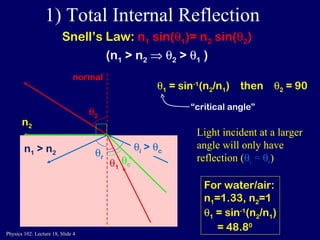
1) Total Internal Reflection normal n 2 n 1  > n 2 Snell’s Law:  n 1  sin(  1 )= n 2  sin(  2 ) (n 1  > n 2       2  >   1  )  1  = sin -1 (n 2 /n 1 )  then   2  = 90 Light incident at a larger angle will only have reflection (  i  =   r ) For water/air: n 1 =1.33, n 2 =1  1  = sin -1 (n 2 /n 1 ) = 48.8 0 “ critical angle”  1  2  i  >   c  r  c
Fiber Optics Telecommunications Arthoscopy Laser surgery Total Internal Reflection only works if n outside  < n inside   At each contact w/ the glass air interface, if the light hits at greater than the critical angle, it undergoes total internal reflection and stays in the fiber. n inside n outside
Can the person standing on the edge of the pool be prevented from seeing the light by  total internal reflection ? 1)  Yes 2) No Preflight 18.1
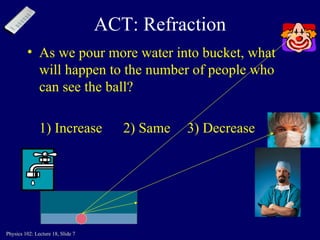
ACT: Refraction As we pour more water into bucket, what will happen to the number of people who can see the ball? 1) Increase 2) Same 3) Decrease
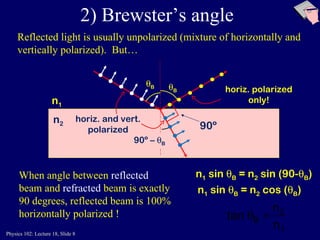
2) Brewster’s angle When angle between  reflected  beam and  refracted  beam is exactly 90 degrees, reflected beam is 100% horizontally polarized ! Reflected light is usually unpolarized (mixture of horizontally and vertically polarized).  But… n 1  sin   B  = n 2  sin (90-  B )  n 1  sin   B  = n 2  cos (  B )  horiz. and vert. polarized  B  B 90º –   B 90º horiz. polarized only! n 1 n 2
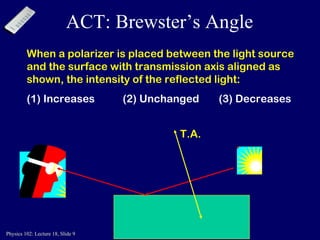
ACT: Brewster’s Angle When a polarizer is placed between the light source and the surface with transmission axis aligned as shown, the intensity of the reflected light: (1) Increases (2) Unchanged (3) Decreases T.A.
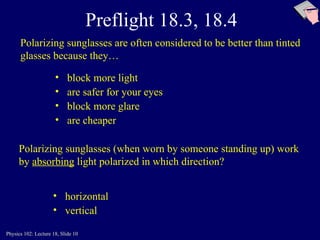
Preflight 18.3, 18.4 block more light are safer for your eyes block more glare are cheaper Polarizing sunglasses are often considered to be better than tinted glasses because they… Polarizing sunglasses (when worn by someone standing up) work by  absorbing  light polarized in which direction? horizontal vertical
3) Dispersion Prism Blue light gets deflected more n blue  >  n red The index of refraction  n  depends on color! In glass:  n blue  = 1.53 n red  = 1.52 White light  blue  <   red  red  i  blue
Skier sees  blue coming up from the bottom (1) , and  red coming down from the top (2)  of the rainbow. Rainbow:  Preflight 18.5 Wow look at the variation in index of refraction! Which is  red ? Which is  blue ? Blue light is deflected more!
LIKE SO! In second rainbow pattern is reversed
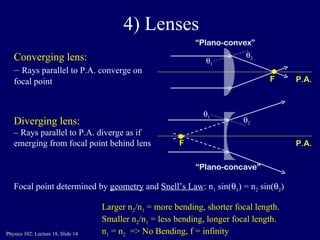
4) Lenses Focal point determined by  geometry  and  Snell’s Law : n 1  sin(  1 ) = n 2  sin(  2 ) Converging lens: –  Rays parallel to P.A. converge on focal point  Diverging lens: –  Rays parallel to P.A. diverge as if emerging from focal point behind lens Larger n 2 /n 1  = more bending, shorter focal length. Smaller n 2 /n 1  = less bending, longer focal length. n 1  = n 2   => No Bending, f = infinity F         “ Plano-convex” “ Plano-concave” P.A. F P.A.
Converging & Diverging Lenses Converging lens: –  Rays parallel to P.A. converge on focal point  Diverging lens: –  Rays parallel to P.A. diverge as if emerging from focal point behind lens “ Plano-convex” “ Plano-concave” Converging = fat in the middle Diverging = thin in the middle “ Double concave” “ Double convex” = = = = “ Convex-concave” “ Concave-convex”
1)  Rays  parallel  to principal axis pass through focal point. 2)  Rays through  center  of lens are not refracted. 3)  Rays  through F  emerge parallel to principal axis. Converging Lens Principal Rays F F Object P.A. Image is:  real, inverted  and  enlarged  (in this case). Example Image Key assumptions:   •  monochromatic light incident on a  thin  lens. •  rays are all “near” the principal axis.
Converging Lens All rays parallel to principal axis pass through focal point F. Double Convex P.A. n lens  > n outside F At F Inside F Outside F P.A. F Preflight 18.6 A beacon in a lighthouse produces a parallel beam of light.  The beacon consists of a bulb and a converging lens.  Where should the bulb be placed?
3 Cases for Converging Lenses This could be used in a camera.  Big object on small film Inverted Reduced Real Past 2F This could be used as a projector. Small slide on big screen Inverted Enlarged Real Between F & 2F This is a magnifying glass Upright Enlarged Virtual Inside F Object Image Image Object Image Object
ACT: Converging Lens Which way should you move object so image is real and diminished? (1) Closer to lens (2) Further from lens (3) Converging lens can’t create real diminished image. F F Object P.A.
1)  Rays  parallel  to principal axis pass through focal point. 2)  Rays through  center  of lens are not refracted. 3)  Rays  toward F  emerge parallel to principal axis. Diverging Lens Principal Rays F F Object P.A. Only 1 case for diverging lens : Image is always  virtual, upright, and reduced . Example Image
Which way should you move object so image is real? Closer to lens Further from lens Diverging lens can’t create real image. ACT: Diverging Lenses Demo F F Object P.A.

Lect18 handout

  • 1.
    Snell’s Law, TotalInternal Reflection, Brewster’s Angle, Dispersion, Lenses Physics 102: Lecture 18
  • 2.
    Summary of today’slecture Examples of refraction 1) Total internal reflection 2) Brewster’s angle 3) Dispersion (rainbows) 4) Lenses
  • 3.
    Demo: Snell’s Lawn 2 n 1 > n 2 When light travels from one medium to another the speed changes v=c/n, but the frequency is constant. So the light bends: n 1 sin(  1 )= n 2 sin(  2 ) n 1 > n 2   2 >  1 Light bent away from normal as it goes in medium with lower n  1  2  r incident reflected refracted
  • 4.
    1) Total InternalReflection normal n 2 n 1 > n 2 Snell’s Law: n 1 sin(  1 )= n 2 sin(  2 ) (n 1 > n 2   2 >  1 )  1 = sin -1 (n 2 /n 1 ) then  2 = 90 Light incident at a larger angle will only have reflection (  i =  r ) For water/air: n 1 =1.33, n 2 =1  1 = sin -1 (n 2 /n 1 ) = 48.8 0 “ critical angle”  1  2  i >  c  r  c
  • 5.
    Fiber Optics TelecommunicationsArthoscopy Laser surgery Total Internal Reflection only works if n outside < n inside At each contact w/ the glass air interface, if the light hits at greater than the critical angle, it undergoes total internal reflection and stays in the fiber. n inside n outside
  • 6.
    Can the personstanding on the edge of the pool be prevented from seeing the light by total internal reflection ? 1) Yes 2) No Preflight 18.1
  • 7.
    ACT: Refraction Aswe pour more water into bucket, what will happen to the number of people who can see the ball? 1) Increase 2) Same 3) Decrease
  • 8.
    2) Brewster’s angleWhen angle between reflected beam and refracted beam is exactly 90 degrees, reflected beam is 100% horizontally polarized ! Reflected light is usually unpolarized (mixture of horizontally and vertically polarized). But… n 1 sin  B = n 2 sin (90-  B ) n 1 sin  B = n 2 cos (  B ) horiz. and vert. polarized  B  B 90º –  B 90º horiz. polarized only! n 1 n 2
  • 9.
    ACT: Brewster’s AngleWhen a polarizer is placed between the light source and the surface with transmission axis aligned as shown, the intensity of the reflected light: (1) Increases (2) Unchanged (3) Decreases T.A.
  • 10.
    Preflight 18.3, 18.4block more light are safer for your eyes block more glare are cheaper Polarizing sunglasses are often considered to be better than tinted glasses because they… Polarizing sunglasses (when worn by someone standing up) work by absorbing light polarized in which direction? horizontal vertical
  • 11.
    3) Dispersion PrismBlue light gets deflected more n blue > n red The index of refraction n depends on color! In glass: n blue = 1.53 n red = 1.52 White light  blue <  red  red  i  blue
  • 12.
    Skier sees blue coming up from the bottom (1) , and red coming down from the top (2) of the rainbow. Rainbow: Preflight 18.5 Wow look at the variation in index of refraction! Which is red ? Which is blue ? Blue light is deflected more!
  • 13.
    LIKE SO! Insecond rainbow pattern is reversed
  • 14.
    4) Lenses Focalpoint determined by geometry and Snell’s Law : n 1 sin(  1 ) = n 2 sin(  2 ) Converging lens: – Rays parallel to P.A. converge on focal point Diverging lens: – Rays parallel to P.A. diverge as if emerging from focal point behind lens Larger n 2 /n 1 = more bending, shorter focal length. Smaller n 2 /n 1 = less bending, longer focal length. n 1 = n 2 => No Bending, f = infinity F         “ Plano-convex” “ Plano-concave” P.A. F P.A.
  • 15.
    Converging & DivergingLenses Converging lens: – Rays parallel to P.A. converge on focal point Diverging lens: – Rays parallel to P.A. diverge as if emerging from focal point behind lens “ Plano-convex” “ Plano-concave” Converging = fat in the middle Diverging = thin in the middle “ Double concave” “ Double convex” = = = = “ Convex-concave” “ Concave-convex”
  • 16.
    1) Rays parallel to principal axis pass through focal point. 2) Rays through center of lens are not refracted. 3) Rays through F emerge parallel to principal axis. Converging Lens Principal Rays F F Object P.A. Image is: real, inverted and enlarged (in this case). Example Image Key assumptions: • monochromatic light incident on a thin lens. • rays are all “near” the principal axis.
  • 17.
    Converging Lens Allrays parallel to principal axis pass through focal point F. Double Convex P.A. n lens > n outside F At F Inside F Outside F P.A. F Preflight 18.6 A beacon in a lighthouse produces a parallel beam of light. The beacon consists of a bulb and a converging lens. Where should the bulb be placed?
  • 18.
    3 Cases forConverging Lenses This could be used in a camera. Big object on small film Inverted Reduced Real Past 2F This could be used as a projector. Small slide on big screen Inverted Enlarged Real Between F & 2F This is a magnifying glass Upright Enlarged Virtual Inside F Object Image Image Object Image Object
  • 19.
    ACT: Converging LensWhich way should you move object so image is real and diminished? (1) Closer to lens (2) Further from lens (3) Converging lens can’t create real diminished image. F F Object P.A.
  • 20.
    1) Rays parallel to principal axis pass through focal point. 2) Rays through center of lens are not refracted. 3) Rays toward F emerge parallel to principal axis. Diverging Lens Principal Rays F F Object P.A. Only 1 case for diverging lens : Image is always virtual, upright, and reduced . Example Image
  • 21.
    Which way shouldyou move object so image is real? Closer to lens Further from lens Diverging lens can’t create real image. ACT: Diverging Lenses Demo F F Object P.A.

Editor's Notes

  • #2 1
  • #4 Demo 281: Snell’s Law
  • #5 Demo 281: Snell’s Law Only possible if n1&gt;n2
  • #8 ACT, then demo 1129 (ball in tub of water)
  • #10 ACT, then demo 664
  • #13 refraction, reflection, refraction
  • #15 Start this by :35 Lens in water has larger focal length since n 2 /n 1 is smaller!
  • #16 Start this by :35 Lens in water has larger focal length since n 2 /n 1 is smaller!
  • #19 Demo 71
  • #20 Demo 71