Basic Nuclear Physics

      Roppon Picha


  created: November 2005
   updated: April 8, 2010
Dalton’s atoms (1808)
J.J. Thomson’s Experiment


          cathode rays = electrons (1897)
Rutherford, Geiger, Marsden


            226         222                218
            88 Ra   →   86 Rn   +α → α +   84 Po
rate of alpha scattering at angle θ from nucleus of charge
Z:

                                 2
                         Ze2             1
               R(θ) ∝        2         4
                         mα vα       sin (θ/2)
Electron configuration
  Rutherford model (1911): Electrons orbit the nucleus like
  planets orbit the Sun.
  Bohr model of the atom (1913): Electrons stay in the
  atom on special orbits (orbitals).


  Experimentally verified by James Franck and Gustav
  Ludwig Hertz in 1914. Atoms only absorb certain
  “chunks” of energy.
Electron configuration


  principal quantum number: n = 1, 2, 3, . . .


  e− most strongly bound at n = 1.


  example: sodium (Na) has 11 electrons. In ground state,
  2 electrons are in n = 1 level, 8 in n = 2, and 1 in n = 3.
Hydrogen

                                       e2 1
                         V (r ) = −
                                      4π 0 r


                                  13.6
                         En = −        eV
                                   n2
  (Bohr formula, 1913)

  hydrogenic (1 electron, Ze nuclear charge):

                                  13.6Z 2
                         En = −
                                    n2
Sub configurations


  Besides n, we have orbital angular momentum
  quantum number l.


  l = 0, 1, 2, . . . , n − 1
  letters: s, p, d, f, g, h, . . .


  Then, there is spin quantum number s.
Quantum angular momentum


  total angular momentum quantum number j:

                           j=s+l


  values jump in integer steps:

                      |l − s| ≤ j ≤ l + s
Quantum angular momentum


  example:
  for the electron, s = 1/2. if l = 1, what are possible values
  of j?


  s = 1/2 and l = 3?


  What are all possible j values for electron in n = 4 level?
Proton (1919) was discovered by Rutherford.


                    α+N→H+O


Protos = first
Chadwick’s Neutron Discovery


    • Existence suggested since 1920 by Rutherford.
    • Finally found via experiments in 1932.

               9
               4 Be5   +4 He2+
                        2   2    −→   12
                                      6 C   +1 n1
                                             0

  or (α, n) reaction


  mass: neutron 939.6 MeV/c2 ≈ proton 938.3 MeV/c2
Neutron energy

  Fast neutrons = high-energy neutrons. E > 1 eV.


  Thermal neutrons = those with average thermal energy
  corresponding to room temperature (T = 300 K).


                           3        1
                   Eth =     kB T ≈    eV
                           2        40

  where kB = 1.38 × 10⁻²³ J/K.
Energy and Velocity

  For a nucleon of kinetic energy 15 MeV, the velocity can
  be calculated via

                  1
               T =  mv 2
                  2
                    2T          2 · 15
               v=        ≈c            ≈ 0.18c
                     m           938


  de Broglie wavelength of this nucleon is

                h   4.1 × 10⁻²¹ MeV s
          λ=      =                    ≈ 7.3 fm
               mv   938MeV c−2 · 0.18c
Accelerated Charge
EM radiation

  Electric field far away does not know of particle’s
  movement.


  The electric field form a wavefront consisting radial
  (Coulomb) and transverse components.


                             q 2 a2
    radiated power = P =                Larmor’s equation
                            6π 0 c 3
Electromagnetic Spectrum
p++
Region of Stability
Binding Energy per Nucleon
Binding energy


  binding energy of most nuclei ∼ 8 MeV/nucleon


  electrons are bound at ∼ 10 eV to atoms.
Separation Energy

  removing a proton:
                       A           A−1
                       Z XN   −→   Z −1 YN


  removing a neutron:
                   A               A−1
                   Z XN       −→   Z   YN−1


  Separation energy (S) is the difference between binding
  energies (B) of initial nucleus and final nucleus.
Separation Energy


  S > 0 when we change a stable nucleus (high B) into a
  less stable nucleus (low B).


              B = (      mconstituents − matom )c 2
              S ≡ Bi − Bf
             Sp = B(A XN ) − B(A−1 YN )
                     Z         Z −1
             Sn = B(A XN ) − B(A−1 YN−1 )
                    Z          Z
Ionization vs. Separation
Quantum behaviors


  Subatomic particles can be described by quantum
  mechanics.


  States are represented by wave function ψ(x, t).


  Particles = Wave packets = superpositions of waves.
Wave functions

  Wave = non-localized state.


                         ∆x · ∆p >
  (Heisenberg uncertainty relation)

  To get the wave function and its evolution, solve
  Schrodinger’s equation:


                                   2
                       ∂ψ
                   i      =   −        +V   ψ
                       ∂t         2m
Wave function
  Normalization:
                        ∞
                             |ψ(x, t)|2 dx = 1
                        −∞


  At any given time, the particle has to be somewhere.

  expectation values:


                        x =       ψ ∗ (x)ψ dx

                        p =       ψ ∗ (p)ψ dx
Wave properties


  de Broglie wavelength of a (non-zero mass) particle of
  momentum p


                                h
                           λ=
                                p


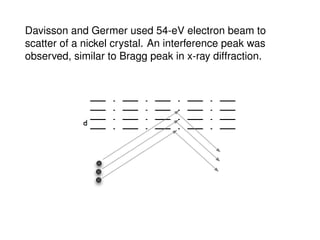
  Experimental verification: Davisson and Germer (1954).
Davisson and Germer used 54-eV electron beam to
scatter of a nickel crystal. An interference peak was
observed, similar to Bragg peak in x-ray diffraction.
Photons


  ∼ 1900: Blackbody radiation study led Planck to think
  about nature of electromagnetic energy.


  1905: Einstein proposed that light consists of photons,
  each possessing a certain lump of energy.


  Total energy = multiples of this number.
Energy


  Planck-Einstein relation gives energy of a photon:

                                     hc
                     E = hν = ω =
                                     λ


  ν and ω are frequency and angular frequency,
  respectively.
Energy

  h = 6.63 × 10⁻³⁴ J s = 4.14 eV s


  for λ given in angstrom:
                             12.4
                        E=        keV
                              λ


  Characteristic radiation of atoms which has only certain
  values are due to the fact that the atoms only exist in
  certain stable states of discrete energies.
Photon interactions


  excitation (and de-excitation)

                        hν + Am ↔ An


  ionization (and recombination)

                      hν + A ↔ A+ + e−
Fermions and Bosons

  Protons, neutrons, and electrons belong to the fermion
  family.


  Quarks and leptons are also fermions.


  They have odd half-integer spins: s = 1/2, 3/2, 5/2, . . ..


  Bosons have integer spin: s = 0, 1, 2, . . ..
  examples: photons (s = ±1) and 4 He atoms (s = 0)
Periodic table

  Electrons are identical fermions. At a given orbital
  (n, l, m), only two electrons can occupy the same state
  (one spin-up, one spin-down)


  For each l, there are 2l + 1 values of ml . For each (l, ml ,
  there is two spin states (ms = ± 1 ).
                                   2


  Exercise: What are maximum number of electrons for
  l = 0, 1, 2, 3?
Periodic table shows an integer increase of protons and
electrons. Shells are filled, from low to high energies.


Ground-state configs:


  • H: (1s 1 )
  • He: (1s 2 )
  • Li: (He)(2s 1 )
  • Be: (He)(2s 2 )
  • B: (He)(2s 2 )(2p 1 )
  • ...
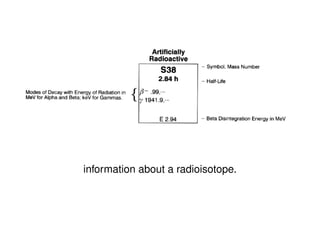
information about a radioisotope.
Decay Law

                    dN(t)
                          = −λN(t)
                     dt
  t is time. N(t) is number of nuclei. λ is decay constant.
  solution:


                      N(t) = N0e−λt
  N0 = number of nuclei at the starting time.
  decay constant is inversely proportional to the half-life:

                                 ln 2
                            λ=
                                 t1/2
A parent nuclide decays and yields a daughter nuclide.


increase in number of daughter (D) = decrease in number
of parents (P)


                    Df − Di = Pi − Pf
Decay constant
  Decays aren’t always 1-to-1:


                  A → B (55% of the time)
                    → C (40%)
                    → D (5%)


  For branched decays, the total decay constant is just the
  sum of each mode constant:

                   λtot = λ1 + λ2 + λ3 + . . .
Lifetime

  For a given decay constant λ, the lifetime of the state is
                                  1
                             τ=
                                  λ


  It is the time taken the state to drop from N0 to
  N0 /e ≈ 0.37N0 .

  branched decays:
                                  1
                       τ=
                            λ1 + λ2 + . . .
Activity


                   dN
            A≡−       = λN = −λN0 e−λt = A0 e−λt
                   dt


  A is also called “decay rate” or “disintegration rate.”


  units: becquerel (1 s−1 ) or curie (3.7 × 10¹⁰ s−1 )
Mysterious rays

  Henri becquerel discovered radioactivity from uranium ore
  in 1896.


  At Cambridge, Rutherford studied these unknown rays
  and published results in 1899.


  Those that got absorbed by a sheet of paper or a few cm
  of air was named alpha rays.


  The more penetrating ones were called beta rays.
Alpha Decay


  Alpha (α) = 2p&2n bound state


  Process:
               A           A−4
               Z XN   −→   Z −2 YN−2   + 4 He2
                                         2
Examples:
                226            222
                88 Ra138   →   86 Rn136 + α
                 238           234
                 92 U146   →   90 Th144 + α


      mX c 2 = (mY c 2 + TY ) + (mα c 2 + Tα )
            Q ≡ (mi − mf )c 2 = (mX − mY − mα )c 2
Alpha emitters with large Q tend to have short half-lives.


                                     Z
                    ln λ(E) = a − b √
                                      E
Geiger-Nuttall law. λ is the decay constant; a and b are
constants; Z is the atomic number; E is the decay energy.
Beta Decay


  W. Pauli: There must be a neutrino. (1930)
  Cowan and Reines observed it. (1956)
Beta Decay

  Processes:

             n → p + e− + νe
                          ¯           β − decay
             p → n + e+ + νe          β + decay (rare)
        p + e− → n + νe               e capture (ε)


  Examples:
                234            234         −
                90 Th144   →   91 Pa143 + e +   νe
                                                ¯
                  53m          53        +
                  27 Co    →   26 Fe + e + νe
               15      −       15
                O+e        →      N + νe
X-ray

  Charged particles that decelerate create electromagnetic
  radiation. This process is known as bremsstrahlung.

  Photons can excite or ionize atoms.

  Subsequent atomic transitions can produce additional
  X-ray photons. This process is called X-ray
  fluorescence.

  If an atomic electron absorbs such X-ray photon, it can be
  ejected. These electrons are called Auger (oh-zhay)
  electrons.
Gamma Decay

 A year after Rutherford discovered α and β rays, Paul
 Villard discovered a more penetrating radiation from
 radium. This is the gamma (γ) ray.

 Excited nuclear states can decay via γ emission. Typical
 energies ∼ 0.1 − 10 MeV.

 Examples:
   99m           99
   43 Tc     →   43 Tc + γ                isomeric transition
                           −
    60
    27 Co    →   60
                 28 Ni + e     + νe + γ
                                 ¯        with β −
Internal conversion


  An excited nucleus can interact with an orbital electron,
  transferring energy Eex .


  The electron gets ejected with energy

                        Ee = Eex − Eb
  where Eb is the binding energy of the electron.
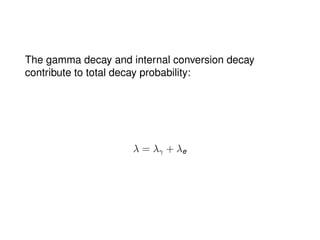
The gamma decay and internal conversion decay
contribute to total decay probability:


                     λ = λγ + λe
Radiation Units


   quantity               description       units

   activity (A)           decay rate        curie (Ci), becquerel (Bq)
   exposure (X )          air ionization    roentgen (R), coulomb/kg
   absorbed dose (D)      absorbed energy   rad, gray (Gy)
   dose equivalent (DE)   bio. effects      rem, sievert (Sv)
Quiz


   1. What kind of radiation does not come from a
      nucleus? [choices: α, β, x-ray, γ]
   2. Be-7 decays by capturing an electron. What is the
      resulting nuclide?
   3. 15.1% of natural samarium is 147 Sm, which decays by
      emitting α. 10 grams of natural samarium gives 120 α
      per second. Calculate activity per gram of 147 Sm.
Reaction Cross Section


  for reaction
                        a + X −→ Y + b

                         reaction rate
                 σ=
                    fluxincident · densitytarget
                          rate of detecting b
                  =
                    (flux of a) · (X areal density)
Nuclear Reactions: First reaction in lab
Creating new nuclides

  making light radionuclides:
                        14
                             N + n →14 C +1 H
                   55
                        Mn +2 H →55 Fe + 2n
                    59
                         Co + n →60 Co + γ


  making Np-239 (transuranic)
                             238
                                   U + n →239 U
                   239
                         U →239 Np + e− + νe
                                          ¯
Balancing nuclear equations

  What is x in each of these nuclear reactions?


            197       12
            79 Au +6 C         → 206At + x
                                 85
              32     4
              16 S + He        → x +γ
                 27
                 13 Al + p     → x +n
              4
                He +17 N
                      7        → x +1 H
EM interactions

  Main processes:


  Photoelectric absorption


  Compton scattering


  Pair production
Intensity attenuation:

                         I(x) = I(0)e−µx


half-value layer = thickness that reduces intensity by 50%.
Producing radionuclides


  Ways to do it:
    • Reactors
    • Accelerators
    • Generators
Reactors


             A
                 X +n →             →


  Longer irradiation time → higher specific activity.
Examples:


          130
          51 Te   +n →              →


                      6
                      3 Li   +n →α+t


as fission products:

              85     133    90     99     137
              36 Kr, 54 Xe, 38 Sr, 42 Mo, 55 Cs
Accelerators


  Usual projectiles: p, d, α


  Examples:
                         20           18
                         10 Ne(d, α) 9 F
                        76           76
                        34 Se(p, n) 35 Br
                          35          38
                          17 Cl(α, n) 19 K
Generators

  Suppose you want to use a short-lived nuclide produced
  from a reactor. But you are far away from the reactor.
  What can you do?


  Prepare the parent nuclide which has longer half-life, in a
  device that can separate the daughter from the parent.


  Examples:
  44                    44
  22 Ti (t1/2 = 6 y) ⇒ 21 Sc (t1/2 = 3.9 h)
  83                83m
  37 Rb (86 d) ⇒ 36 Kr (1.8 h)
  99                99m
  42 Mo (66 h) ⇒ 43 Tc (6 h)
the End

Nuclear Basics Summer 2010

  • 1.
    Basic Nuclear Physics Roppon Picha created: November 2005 updated: April 8, 2010
  • 2.
  • 3.
    J.J. Thomson’s Experiment cathode rays = electrons (1897)
  • 4.
    Rutherford, Geiger, Marsden 226 222 218 88 Ra → 86 Rn +α → α + 84 Po
  • 5.
    rate of alphascattering at angle θ from nucleus of charge Z: 2 Ze2 1 R(θ) ∝ 2 4 mα vα sin (θ/2)
  • 6.
    Electron configuration Rutherford model (1911): Electrons orbit the nucleus like planets orbit the Sun. Bohr model of the atom (1913): Electrons stay in the atom on special orbits (orbitals). Experimentally verified by James Franck and Gustav Ludwig Hertz in 1914. Atoms only absorb certain “chunks” of energy.
  • 7.
    Electron configuration principal quantum number: n = 1, 2, 3, . . . e− most strongly bound at n = 1. example: sodium (Na) has 11 electrons. In ground state, 2 electrons are in n = 1 level, 8 in n = 2, and 1 in n = 3.
  • 8.
    Hydrogen e2 1 V (r ) = − 4π 0 r 13.6 En = − eV n2 (Bohr formula, 1913) hydrogenic (1 electron, Ze nuclear charge): 13.6Z 2 En = − n2
  • 9.
    Sub configurations Besides n, we have orbital angular momentum quantum number l. l = 0, 1, 2, . . . , n − 1 letters: s, p, d, f, g, h, . . . Then, there is spin quantum number s.
  • 10.
    Quantum angular momentum total angular momentum quantum number j: j=s+l values jump in integer steps: |l − s| ≤ j ≤ l + s
  • 11.
    Quantum angular momentum example: for the electron, s = 1/2. if l = 1, what are possible values of j? s = 1/2 and l = 3? What are all possible j values for electron in n = 4 level?
  • 12.
    Proton (1919) wasdiscovered by Rutherford. α+N→H+O Protos = first
  • 13.
    Chadwick’s Neutron Discovery • Existence suggested since 1920 by Rutherford. • Finally found via experiments in 1932. 9 4 Be5 +4 He2+ 2 2 −→ 12 6 C +1 n1 0 or (α, n) reaction mass: neutron 939.6 MeV/c2 ≈ proton 938.3 MeV/c2
  • 14.
    Neutron energy Fast neutrons = high-energy neutrons. E > 1 eV. Thermal neutrons = those with average thermal energy corresponding to room temperature (T = 300 K). 3 1 Eth = kB T ≈ eV 2 40 where kB = 1.38 × 10⁻²³ J/K.
  • 15.
    Energy and Velocity For a nucleon of kinetic energy 15 MeV, the velocity can be calculated via 1 T = mv 2 2 2T 2 · 15 v= ≈c ≈ 0.18c m 938 de Broglie wavelength of this nucleon is h 4.1 × 10⁻²¹ MeV s λ= = ≈ 7.3 fm mv 938MeV c−2 · 0.18c
  • 16.
  • 17.
    EM radiation Electric field far away does not know of particle’s movement. The electric field form a wavefront consisting radial (Coulomb) and transverse components. q 2 a2 radiated power = P = Larmor’s equation 6π 0 c 3
  • 18.
  • 19.
  • 20.
  • 21.
  • 22.
    Binding energy binding energy of most nuclei ∼ 8 MeV/nucleon electrons are bound at ∼ 10 eV to atoms.
  • 23.
    Separation Energy removing a proton: A A−1 Z XN −→ Z −1 YN removing a neutron: A A−1 Z XN −→ Z YN−1 Separation energy (S) is the difference between binding energies (B) of initial nucleus and final nucleus.
  • 24.
    Separation Energy S > 0 when we change a stable nucleus (high B) into a less stable nucleus (low B). B = ( mconstituents − matom )c 2 S ≡ Bi − Bf Sp = B(A XN ) − B(A−1 YN ) Z Z −1 Sn = B(A XN ) − B(A−1 YN−1 ) Z Z
  • 25.
  • 26.
    Quantum behaviors Subatomic particles can be described by quantum mechanics. States are represented by wave function ψ(x, t). Particles = Wave packets = superpositions of waves.
  • 27.
    Wave functions Wave = non-localized state. ∆x · ∆p > (Heisenberg uncertainty relation) To get the wave function and its evolution, solve Schrodinger’s equation: 2 ∂ψ i = − +V ψ ∂t 2m
  • 28.
    Wave function Normalization: ∞ |ψ(x, t)|2 dx = 1 −∞ At any given time, the particle has to be somewhere. expectation values: x = ψ ∗ (x)ψ dx p = ψ ∗ (p)ψ dx
  • 29.
    Wave properties de Broglie wavelength of a (non-zero mass) particle of momentum p h λ= p Experimental verification: Davisson and Germer (1954).
  • 30.
    Davisson and Germerused 54-eV electron beam to scatter of a nickel crystal. An interference peak was observed, similar to Bragg peak in x-ray diffraction.
  • 32.
    Photons ∼1900: Blackbody radiation study led Planck to think about nature of electromagnetic energy. 1905: Einstein proposed that light consists of photons, each possessing a certain lump of energy. Total energy = multiples of this number.
  • 33.
    Energy Planck-Einsteinrelation gives energy of a photon: hc E = hν = ω = λ ν and ω are frequency and angular frequency, respectively.
  • 34.
    Energy h= 6.63 × 10⁻³⁴ J s = 4.14 eV s for λ given in angstrom: 12.4 E= keV λ Characteristic radiation of atoms which has only certain values are due to the fact that the atoms only exist in certain stable states of discrete energies.
  • 35.
    Photon interactions excitation (and de-excitation) hν + Am ↔ An ionization (and recombination) hν + A ↔ A+ + e−
  • 36.
    Fermions and Bosons Protons, neutrons, and electrons belong to the fermion family. Quarks and leptons are also fermions. They have odd half-integer spins: s = 1/2, 3/2, 5/2, . . .. Bosons have integer spin: s = 0, 1, 2, . . .. examples: photons (s = ±1) and 4 He atoms (s = 0)
  • 37.
    Periodic table Electrons are identical fermions. At a given orbital (n, l, m), only two electrons can occupy the same state (one spin-up, one spin-down) For each l, there are 2l + 1 values of ml . For each (l, ml , there is two spin states (ms = ± 1 ). 2 Exercise: What are maximum number of electrons for l = 0, 1, 2, 3?
  • 38.
    Periodic table showsan integer increase of protons and electrons. Shells are filled, from low to high energies. Ground-state configs: • H: (1s 1 ) • He: (1s 2 ) • Li: (He)(2s 1 ) • Be: (He)(2s 2 ) • B: (He)(2s 2 )(2p 1 ) • ...
  • 39.
    information about aradioisotope.
  • 42.
    Decay Law dN(t) = −λN(t) dt t is time. N(t) is number of nuclei. λ is decay constant. solution: N(t) = N0e−λt N0 = number of nuclei at the starting time. decay constant is inversely proportional to the half-life: ln 2 λ= t1/2
  • 43.
    A parent nuclidedecays and yields a daughter nuclide. increase in number of daughter (D) = decrease in number of parents (P) Df − Di = Pi − Pf
  • 44.
    Decay constant Decays aren’t always 1-to-1: A → B (55% of the time) → C (40%) → D (5%) For branched decays, the total decay constant is just the sum of each mode constant: λtot = λ1 + λ2 + λ3 + . . .
  • 45.
    Lifetime Fora given decay constant λ, the lifetime of the state is 1 τ= λ It is the time taken the state to drop from N0 to N0 /e ≈ 0.37N0 . branched decays: 1 τ= λ1 + λ2 + . . .
  • 46.
    Activity dN A≡− = λN = −λN0 e−λt = A0 e−λt dt A is also called “decay rate” or “disintegration rate.” units: becquerel (1 s−1 ) or curie (3.7 × 10¹⁰ s−1 )
  • 47.
    Mysterious rays Henri becquerel discovered radioactivity from uranium ore in 1896. At Cambridge, Rutherford studied these unknown rays and published results in 1899. Those that got absorbed by a sheet of paper or a few cm of air was named alpha rays. The more penetrating ones were called beta rays.
  • 48.
    Alpha Decay Alpha (α) = 2p&2n bound state Process: A A−4 Z XN −→ Z −2 YN−2 + 4 He2 2
  • 49.
    Examples: 226 222 88 Ra138 → 86 Rn136 + α 238 234 92 U146 → 90 Th144 + α mX c 2 = (mY c 2 + TY ) + (mα c 2 + Tα ) Q ≡ (mi − mf )c 2 = (mX − mY − mα )c 2
  • 50.
    Alpha emitters withlarge Q tend to have short half-lives. Z ln λ(E) = a − b √ E Geiger-Nuttall law. λ is the decay constant; a and b are constants; Z is the atomic number; E is the decay energy.
  • 51.
    Beta Decay W. Pauli: There must be a neutrino. (1930) Cowan and Reines observed it. (1956)
  • 52.
    Beta Decay Processes: n → p + e− + νe ¯ β − decay p → n + e+ + νe β + decay (rare) p + e− → n + νe e capture (ε) Examples: 234 234 − 90 Th144 → 91 Pa143 + e + νe ¯ 53m 53 + 27 Co → 26 Fe + e + νe 15 − 15 O+e → N + νe
  • 53.
    X-ray Chargedparticles that decelerate create electromagnetic radiation. This process is known as bremsstrahlung. Photons can excite or ionize atoms. Subsequent atomic transitions can produce additional X-ray photons. This process is called X-ray fluorescence. If an atomic electron absorbs such X-ray photon, it can be ejected. These electrons are called Auger (oh-zhay) electrons.
  • 55.
    Gamma Decay Ayear after Rutherford discovered α and β rays, Paul Villard discovered a more penetrating radiation from radium. This is the gamma (γ) ray. Excited nuclear states can decay via γ emission. Typical energies ∼ 0.1 − 10 MeV. Examples: 99m 99 43 Tc → 43 Tc + γ isomeric transition − 60 27 Co → 60 28 Ni + e + νe + γ ¯ with β −
  • 56.
    Internal conversion An excited nucleus can interact with an orbital electron, transferring energy Eex . The electron gets ejected with energy Ee = Eex − Eb where Eb is the binding energy of the electron.
  • 58.
    The gamma decayand internal conversion decay contribute to total decay probability: λ = λγ + λe
  • 59.
    Radiation Units quantity description units activity (A) decay rate curie (Ci), becquerel (Bq) exposure (X ) air ionization roentgen (R), coulomb/kg absorbed dose (D) absorbed energy rad, gray (Gy) dose equivalent (DE) bio. effects rem, sievert (Sv)
  • 60.
    Quiz 1. What kind of radiation does not come from a nucleus? [choices: α, β, x-ray, γ] 2. Be-7 decays by capturing an electron. What is the resulting nuclide? 3. 15.1% of natural samarium is 147 Sm, which decays by emitting α. 10 grams of natural samarium gives 120 α per second. Calculate activity per gram of 147 Sm.
  • 61.
    Reaction Cross Section for reaction a + X −→ Y + b reaction rate σ= fluxincident · densitytarget rate of detecting b = (flux of a) · (X areal density)
  • 62.
    Nuclear Reactions: Firstreaction in lab
  • 63.
    Creating new nuclides making light radionuclides: 14 N + n →14 C +1 H 55 Mn +2 H →55 Fe + 2n 59 Co + n →60 Co + γ making Np-239 (transuranic) 238 U + n →239 U 239 U →239 Np + e− + νe ¯
  • 64.
    Balancing nuclear equations What is x in each of these nuclear reactions? 197 12 79 Au +6 C → 206At + x 85 32 4 16 S + He → x +γ 27 13 Al + p → x +n 4 He +17 N 7 → x +1 H
  • 65.
    EM interactions Main processes: Photoelectric absorption Compton scattering Pair production
  • 66.
    Intensity attenuation: I(x) = I(0)e−µx half-value layer = thickness that reduces intensity by 50%.
  • 67.
    Producing radionuclides Ways to do it: • Reactors • Accelerators • Generators
  • 68.
    Reactors A X +n → → Longer irradiation time → higher specific activity.
  • 69.
    Examples: 130 51 Te +n → → 6 3 Li +n →α+t as fission products: 85 133 90 99 137 36 Kr, 54 Xe, 38 Sr, 42 Mo, 55 Cs
  • 70.
    Accelerators Usualprojectiles: p, d, α Examples: 20 18 10 Ne(d, α) 9 F 76 76 34 Se(p, n) 35 Br 35 38 17 Cl(α, n) 19 K
  • 71.
    Generators Supposeyou want to use a short-lived nuclide produced from a reactor. But you are far away from the reactor. What can you do? Prepare the parent nuclide which has longer half-life, in a device that can separate the daughter from the parent. Examples: 44 44 22 Ti (t1/2 = 6 y) ⇒ 21 Sc (t1/2 = 3.9 h) 83 83m 37 Rb (86 d) ⇒ 36 Kr (1.8 h) 99 99m 42 Mo (66 h) ⇒ 43 Tc (6 h)
  • 72.