Download to read offline

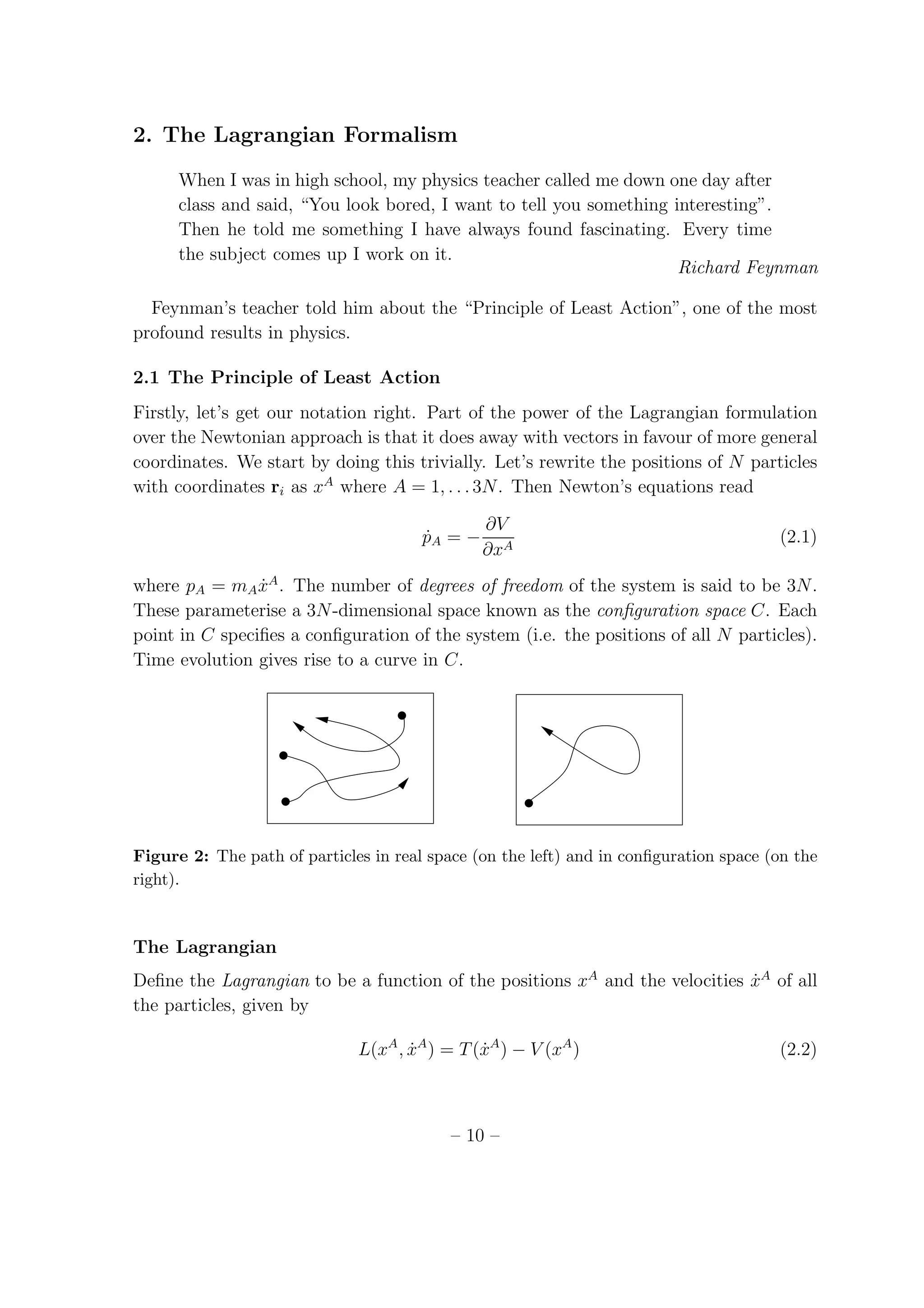
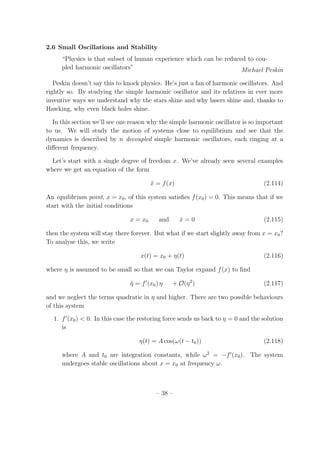
![where T = 1
2 A mA( ˙xA
)2
is the kinetic energy, and V (xA
) is the potential energy.
Note the minus sign between T and V ! To describe the principle of least action, we
consider all smooth paths xA
(t) in C with fixed end points so that
xA
(ti) = xA
initial and xA
(tf ) = xA
final (2.3)
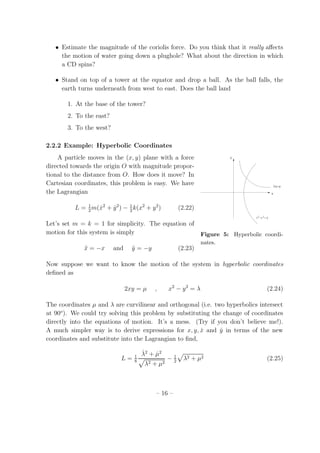
Of all these possible paths, only one is the true path t
x
x
xinitial
final
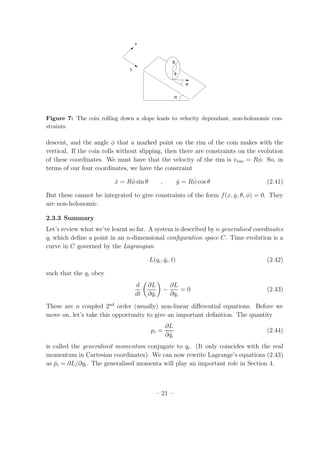
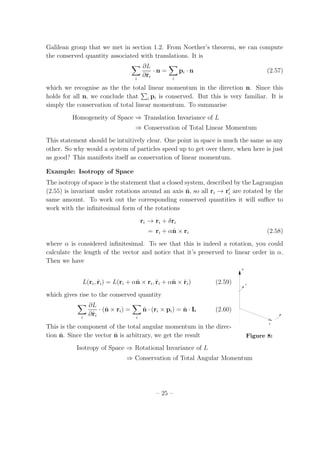
Figure 3:
taken by the system. Which one? To each path, let us
assign a number called the action S defined as
S[xA
(t)] =
tf
ti
L(xA
(t), ˙xA
(t)) dt (2.4)
The action is a functional (i.e. a function of the path which
is itself a function). The principle of least action is the fol-
lowing result:
Theorem (Principle of Least Action): The actual path taken by the system is an
extremum of S.
Proof: Consider varying a given path slightly, so
xA
(t) → xA
(t) + δxA
(t) (2.5)
where we fix the end points of the path by demanding δxA
(ti) = δxA
(tf ) = 0. Then
the change in the action is
δS = δ
tf
ti
L dt
=
tf
ti
δL dt
=
tf
ti
∂L
∂xA
δxA
+
∂L
∂ ˙xA
δ ˙xA
dt (2.6)
At this point we integrate the second term by parts to get
δS =
tf
ti
∂L
∂xA
−
d
dt
∂L
∂ ˙xA
δxA
dt +
∂L
∂ ˙xA
δxA
tf
ti
(2.7)
But the final term vanishes since we have fixed the end points of the path so δxA
(ti) =
δxA
(tf ) = 0. The requirement that the action is an extremum says that δS = 0 for all
changes in the path δxA
(t). We see that this holds if and only if
∂L
∂xA
−
d
dt
∂L
∂ ˙xA
= 0 for each A = 1, . . . 3N (2.8)
– 11 –](https://image.slidesharecdn.com/two-170429162244/85/Two-2-320.jpg)
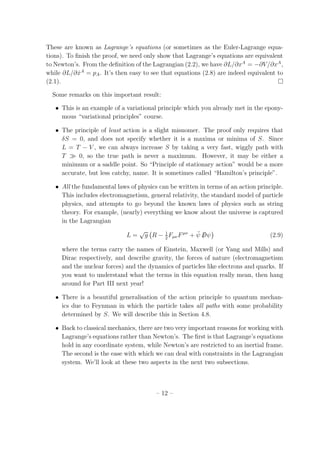
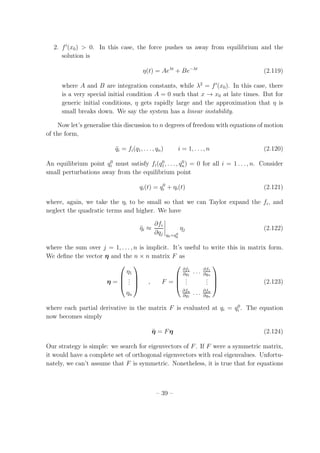
![Equation (2.16) is our final result. We see that if Lagrange’s equation is solved in the
xA
coordinate system (so that [. . .] on the RHS vanishes) then it is also solved in the
qa coordinate system. (Conversely, if it is satisfied in the qa coordinate system, so the
LHS vanishes, then it is also satisfied in the xA
coordinate system as long as our choice
of coordinates is invertible: i.e det(∂xA
/∂qa) = 0).
So the form of Lagrange’s equations holds in any coordinate system. This is in
contrast to Newton’s equations which are only valid in an inertial frame. Let’s illustrate
the power of this fact with a couple of simple examples
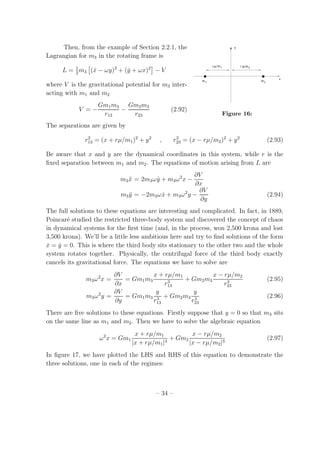
2.2.1 Example: Rotating Coordinate Systems
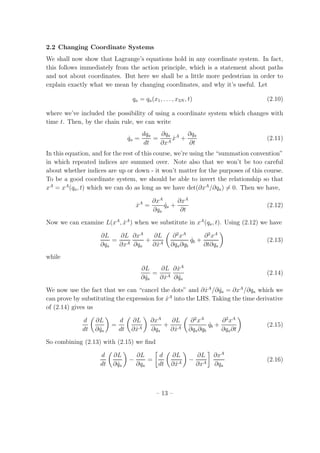
Consider a free particle with Lagrangian given by
L = 1
2
m˙r2
(2.17)
with r = (x, y, z). Now measure the motion of the particle with respect to a coordinate
system which is rotating with angular velocity ω = (0, 0, ω) about the z axis. If
r′
= (x′
, y′
, z′
) are the coordinates in the rotating system, we have the relationship
x′
= x cos ωt + y sin ωt
y′
= y cos ωt − x sin ωt
z′
= z (2.18)
Then we can substitute these expressions into the Lagrangian to find L in terms of the
rotating coordinates,
L = 1
2
m[( ˙x′
− ωy′
)2
+ ( ˙y′
+ ωx′
)2
+ ˙z2
] = 1
2
m(˙r′
+ ω × r′
)2
(2.19)
In this rotating frame, we can use Lagrange’s equations to derive the equations of
motion. Taking derivatives, we have
∂L
∂r′
= m(˙r′
× ω − ω × (ω × r′
))
d
dt
∂L
∂˙r′
= m(¨r′
+ ω × ˙r′
) (2.20)
so Lagrange’s equation reads
d
dt
∂L
∂˙r′
−
∂L
∂r′
= m(¨r′
+ ω × (ω × r′
) + 2ω × ˙r′
) = 0 (2.21)
The second and third terms in this expression are the centrifugal and coriolis forces
respectively. These are examples of the “fictitious forces” that you were warned about in
– 14 –](https://image.slidesharecdn.com/two-170429162244/85/Two-5-320.jpg)
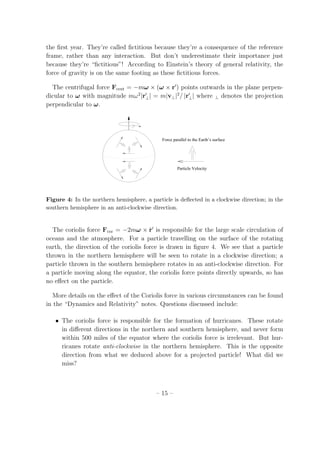
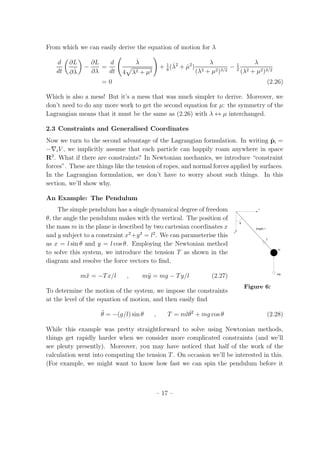
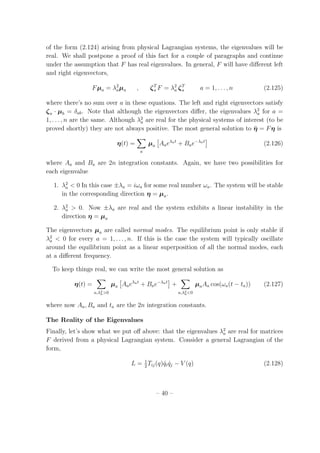
![The Pendulum Example Again
The Lagrangian for the pendulum is given by that for a free particle moving in the
plane, augmented by the Lagrange multiplier term for the constraints. It is
L′
= 1
2
m( ˙x2
+ ˙y2
) + mgy + 1
2
λ(x2
+ y2
− l2
) (2.34)
From which we can calculate the two equations of motion for x and y,
m¨x = λx and ¨y = mg + λy (2.35)
while the equation of motion for λ reproduces the constraint x2
+y2
−l2
= 0. Comparing
with the Newtonian approach (2.27), we again see that the Lagrange multiplier λ is
proportional to the tension: λ = −T/l.
So we see that we can easily incorporate constraint forces into the Lagrangian setup
using Lagrange multipliers. But the big news is that we don’t have to! Often we don’t
care about the tension T or other constraint forces, but only want to know what the
generalised coordinates qi are doing. In this case we have the following useful theorem
Theorem: For constrained systems, we may derive the equations of motion directly
in generalised coordinates qi
L[qi, ˙qi, t] = L[xA
(qi, t), ˙xA
(qi, ˙qi, t)] (2.36)
Proof: Let’s work with L′
= L + λαfα and change coordinates to
xA →
qi i = 1, . . . , n
fα α = 1, . . . 3N − n
(2.37)
We know that Lagrange’s equations take the same form in these new coordinates. In
particular, we may look at the equations for qi,
d
dt
∂L
∂ ˙qi
−
∂L
∂qi
= λα
∂fα
∂qi
(2.38)
But, by definition, ∂fα/∂qi = 0. So we are left with Lagrange’s equations purely in
terms of qi, with no sign of the constraint forces. If we are only interested in the
dynamics of the generalised coordinates qi, we may ignore the Lagrange multipliers
and work entirely with the unconstrained Lagrangian L(qi, ˙qi, t) defined in (2.36) where
we just substitute in xA = xA(qi, t).
– 19 –](https://image.slidesharecdn.com/two-170429162244/85/Two-10-320.jpg)
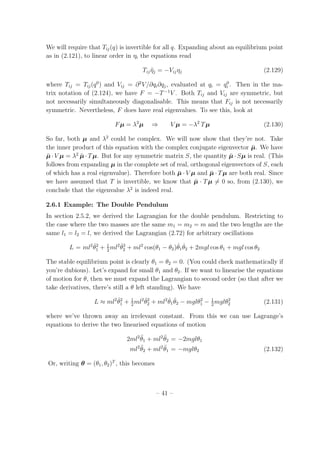
![Example: Homogeneity of Time
What about homogeneity of time? In mathematical language, this means L is invariant
under t → t+s or, in other words, ∂L/∂t = 0. But we already saw earlier in this section
that this implies H = i ˙qi(∂L/∂ ˙qi)−L is conserved. In the systems we’re considering,
this is simply the total energy. We see that the existence of a conserved quantity which
we call energy can be traced to the homogeneous passage of time. Or
Time is to Energy as Space is to Momentum
Recall from your course on special relativity that energy and 3-momentum fit together
to form a 4-vector which rotates under spacetime transformations. Here we see that
the link between energy-momentum and time-space exists even in the non-relativistic
framework of Newtonian physics. You don’t have to be Einstein to see it. You just
have to be Emmy Noether.
Remarks: It turns out that all conservation laws in nature are related to symmetries
through Noether’s theorem. This includes the conservation of electric charge and the
conservation of particles such as protons and neutrons (known as baryons).
There are also discrete symmetries in Nature which don’t depend on a continuous
parameter. For example, many theories are invariant under reflection (known as parity)
in which ri → −ri. These types of symmetries do not give rise to conservation laws in
classical physics (although they do in quantum physics).
2.5 Applications
Having developed all of these tools, let’s now apply them to a few examples.
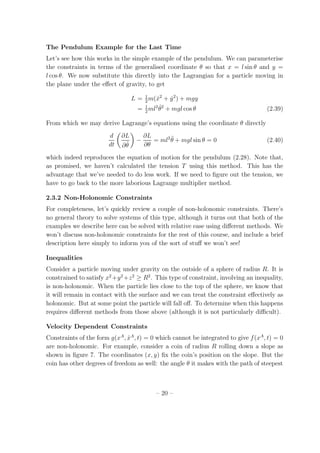
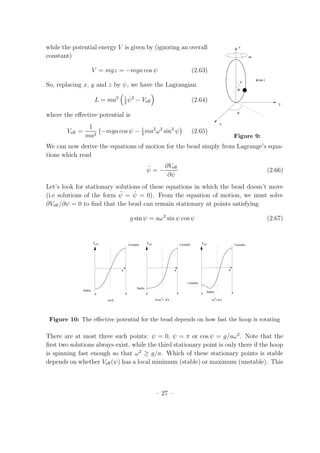
2.5.1 Bead on a Rotating Hoop
This is an example of a system with a time dependent holonomic constraint. The hoop
is of radius a and rotates with frequency ω as shown in figure 9. The bead, of mass m,
is threaded on the hoop and moves without friction. We want to determine its motion.
There is a single degree of freedom ψ, the angle the bead makes with the vertical. In
terms of Cartesian coordinates (x, y, z) the position of the bead is
x = a sin ψ cos ωt , y = a sin ψ sin ωt , z = a − a cos ψ (2.61)
To determine the Lagrangian in terms of the generalised coordinate ψ we must substi-
tute these expressions into the Lagrangian for the free particle. For the kinetic energy
T we have
T = 1
2
m( ˙x2
+ ˙y2
+ ˙z2
) = 1
2
ma2
[ ˙ψ2
+ ω2
sin2
ψ] (2.62)
– 26 –](https://image.slidesharecdn.com/two-170429162244/85/Two-17-320.jpg)

Richard Feynman's high school physics teacher introduced him to the principle of least action, one of the most profound concepts in physics. The principle states that among all possible paths a physical system can take between two configurations, the actual path taken will be the one that minimizes the action. The action is defined as the time integral of the Lagrangian over the path, where the Lagrangian is the difference between the system's kinetic and potential energies. This principle allows physics to be formulated in terms of variational calculus and is the foundation for classical mechanics, electromagnetism, general relativity, and other physical theories.


