Image Analysis & Retrieval
CS/EE 5590 Special Topics (Class Ids: 44873, 44874)
Fall 2016, M/W 4-5:15pm@Bloch 0012
Lec 14
Eigenface and Fisherface
Zhu Li
Dept of CSEE, UMKC
Office: FH560E, Email: lizhu@umkc.edu, Ph: x 2346.
http://l.web.umkc.edu/lizhu
Z. Li, Image Analysis & Retrv. 2016 p.1
Outline
 Recap:
 SVD
 PCA
 Face Recognition – direct learning from pixels
 Eigenface
 Fisherface
 Summary
Z. Li, Image Analysis & Retrv. 2016 p.2
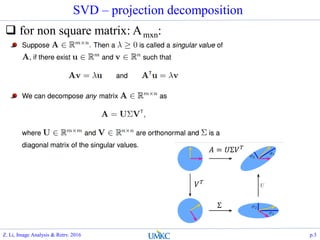
SVD – projection decomposition
 for non square matrix: Amxn:
𝐴 = 𝑈Σ𝑉 𝑇
𝑉 𝑇
Σ
Z. Li, Image Analysis & Retrv. 2016 p.3
SVD as Signal Decomposition
The Singular Value Decomposition (SVD) of an nxm matrix A,
is,
 Where the diagonal of S are the eigen values of AAT,
[𝜎1, 𝜎2, … , 𝜎 𝑛], called “singular values”
 U are eigenvectors of AAT, and V are eigen vectors of ATA,
the outer product of uivi
T, are basis of A in reconstruction:
𝐴 = 𝑈𝑆𝑉 𝑇 =
𝑖
𝜎𝑖 𝑢𝑖 𝑣𝑖
𝑡
A(mxn) = U(mxm) S(mxn)
V(nxn)
The 1st order SVD approx. of A is:
𝜎1 ∗ 𝑈 : , 1 ∗ 𝑉 : , 1 𝑇
Z. Li, Image Analysis & Retrv. 2016 p.4
SVD approximation of an image
 Very easy…
function [x]=svd_approx(x0, k)
dbg=0;
if dbg
x0= fix(100*randn(4,6));
k=2;
end
[u, s, v]=svd(x0);
[m, n]=size(s);
x = zeros(m, n);
sgm = diag(s);
for j=1:k
x = x + sgm(j)*u(:,j)*v(:,j)';
end
Z. Li, Image Analysis & Retrv. 2016 p.5
PCA- Principal Component Analysis
 Formulation:
 Find projections, that the information/energy of the data are
maximally preserved
 Matlab: [A, s, eigv]=princomp(X);
max
𝑊
𝐸 𝑥 𝑇 𝑊 𝑇 𝑊𝑥 , 𝑠. 𝑡. , 𝑊 𝑇 𝑊 = 𝐼
Z. Li, Image Analysis & Retrv. 2016 p.6
PCAAlgorithm
 Center the data:
 X = X – repmat(mean(x), [n,
1]);
Principal component #1
points in the direction of the
largest variance
Each subsequent principal
component…
 is orthogonal to the previous
ones, and
 points in the directions of the
largest variance of the residual
subspace
 Solved by finding Eigen
Vectors of the
Scatter/Covarinace matrix of
data:
 S = cov(X); [A, eigv]=Eig(S)
Z. Li, Image Analysis & Retrv. 2016 p.7
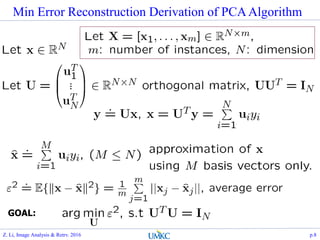
Min Error Reconstruction Derivation of PCAAlgorithm
GOAL:
Z. Li, Image Analysis & Retrv. 2016 p.8
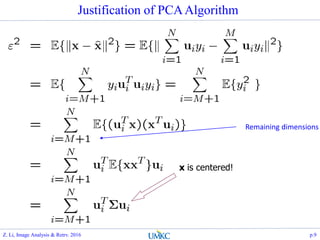
Justification of PCAAlgorithm
x is centered!
Remaining dimensions
Z. Li, Image Analysis & Retrv. 2016 p.9
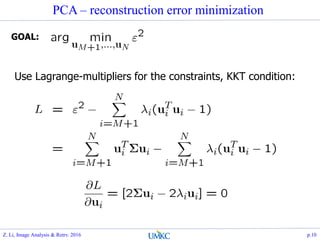
PCA – reconstruction error minimization
GOAL:
Use Lagrange-multipliers for the constraints, KKT condition:
Z. Li, Image Analysis & Retrv. 2016 p.10
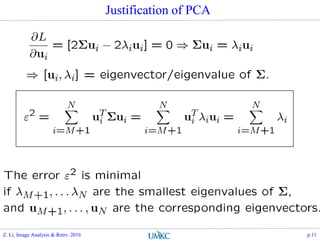
Justification of PCA
Z. Li, Image Analysis & Retrv. 2016 p.11
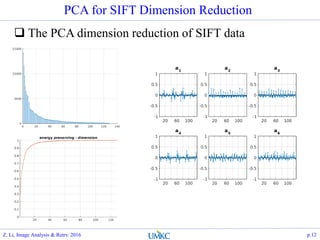
PCA for SIFT Dimension Reduction
 The PCA dimension reduction of SIFT data
Z. Li, Image Analysis & Retrv. 2016 p.12
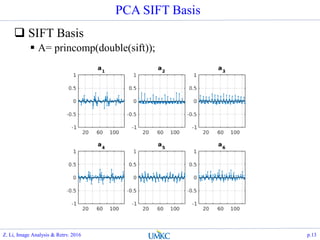
PCA SIFT Basis
 SIFT Basis
 A= princomp(double(sift));
Z. Li, Image Analysis & Retrv. 2016 p.13
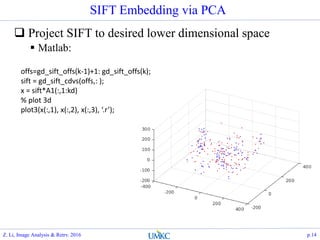
SIFT Embedding via PCA
 Project SIFT to desired lower dimensional space
 Matlab:
offs=gd_sift_offs(k-1)+1: gd_sift_offs(k);
sift = gd_sift_cdvs(offs,: );
x = sift*A1(:,1:kd)
% plot 3d
plot3(x(:,1), x(:,2), x(:,3), ‘.r’);
Z. Li, Image Analysis & Retrv. 2016 p.14
Outline
 Recap:
 SVD
 PCA
 Face Recognition – direct learning from pixels
 Eigenface
 Fisherface
 Summary
Z. Li, Image Analysis & Retrv. 2016 p.15
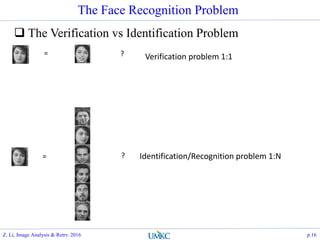
The Face Recognition Problem
 The Verification vs Identification Problem
= ?
= ?
Verification problem 1:1
Identification/Recognition problem 1:N
Z. Li, Image Analysis & Retrv. 2016 p.16
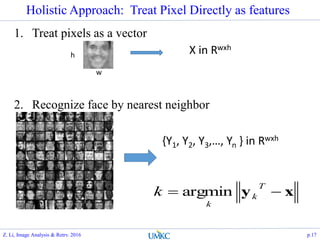
Holistic Approach: Treat Pixel Directly as features
1. Treat pixels as a vector
2. Recognize face by nearest neighbor
xy 
T
k
k
k argmin
h
w
X in Rwxh
{Y1, Y2, Y3,…, Yn } in Rwxh
Z. Li, Image Analysis & Retrv. 2016 p.17
The space of all face images
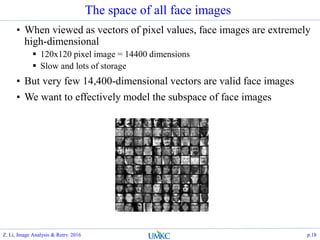
• When viewed as vectors of pixel values, face images are extremely
high-dimensional
 120x120 pixel image = 14400 dimensions
 Slow and lots of storage
• But very few 14,400-dimensional vectors are valid face images
• We want to effectively model the subspace of face images
Z. Li, Image Analysis & Retrv. 2016 p.18
The space of all face images
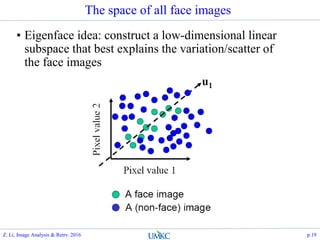
• Eigenface idea: construct a low-dimensional linear
subspace that best explains the variation/scatter of
the face images
Z. Li, Image Analysis & Retrv. 2016 p.19
Principal Component Analysis (PCA)
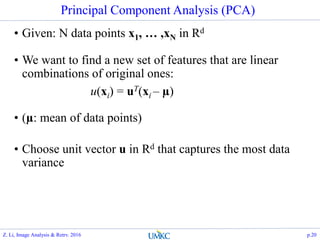
• Given: N data points x1, … ,xN in Rd
• We want to find a new set of features that are linear
combinations of original ones:
u(xi) = uT(xi – µ)
• (µ: mean of data points)
• Choose unit vector u in Rd that captures the most data
variance
Z. Li, Image Analysis & Retrv. 2016 p.20
Principal Component Analysis
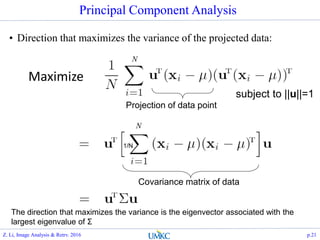
• Direction that maximizes the variance of the projected data:
Projection of data point
Covariance matrix of data
The direction that maximizes the variance is the eigenvector associated with the
largest eigenvalue of Σ
N
N
1/N
Maximize
subject to ||u||=1
Z. Li, Image Analysis & Retrv. 2016 p.21
Eigenfaces (PCA on face images)
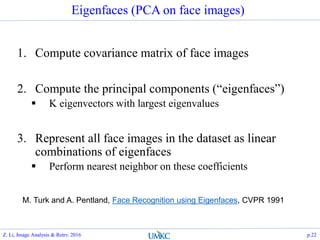
1. Compute covariance matrix of face images
2. Compute the principal components (“eigenfaces”)
 K eigenvectors with largest eigenvalues
3. Represent all face images in the dataset as linear
combinations of eigenfaces
 Perform nearest neighbor on these coefficients
M. Turk and A. Pentland, Face Recognition using Eigenfaces, CVPR 1991
Z. Li, Image Analysis & Retrv. 2016 p.22
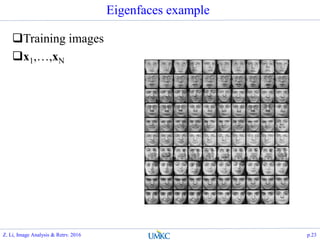
Eigenfaces example
Training images
x1,…,xN
Z. Li, Image Analysis & Retrv. 2016 p.23
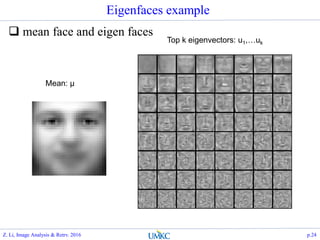
Eigenfaces example
 mean face and eigen faces
Top k eigenvectors: u1,…uk
Mean: μ
Z. Li, Image Analysis & Retrv. 2016 p.24
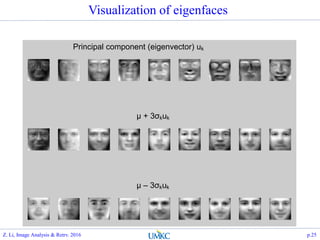
Visualization of eigenfaces
Principal component (eigenvector) uk
μ + 3σkuk
μ – 3σkuk
Z. Li, Image Analysis & Retrv. 2016 p.25
Representation and reconstruction
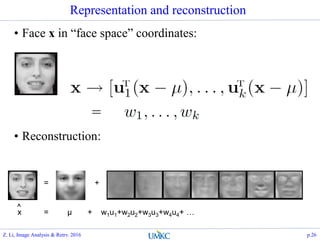
• Face x in “face space” coordinates:
• Reconstruction:
= +
µ + w1u1+w2u2+w3u3+w4u4+ …
=
^
x =
Z. Li, Image Analysis & Retrv. 2016 p.26
Matlab Implementation
 Scaling the face image to thumbnail size
 Justification: as long as human eye can recognize, that
contains sufficient info
 Scale space characteristic response for face recognition
 Compute the PCA over the vectorized face data
load faces-ids-n6680-m417-20x20.mat;
[A, s, lat]=princomp(faces);
h=20; w=20;
figure(30);
subplot(1,2,1); grid on; hold on; stem(lat, '.');
f_eng=lat.*lat;
subplot(1,2,2); grid on; hold on; plot(cumsum(f_eng)/sum(f_eng),
'.-');
Z. Li, Image Analysis & Retrv. 2016 p.27
Eigenface
Holistic approach: treat an hxw image as a point in Rhxw:
 Face data set: 20x20 face icon images, 417 subjects, 6680 face images
 Notice that all the face images are not filling up the R20x20 space:
 Eigenface basis: imagesc(reshape(A1(:,1), [h, w]));
kd kd
eigval
Infopreservingratio
Z. Li, Image Analysis & Retrv. 2016 p.28
Eigenface Projections
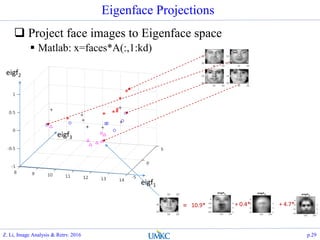
 Project face images to Eigenface space
 Matlab: x=faces*A(:,1:kd)
eigf1
eigf2
eigf3
= 10.9* + 0.4* + 4.7*
Z. Li, Image Analysis & Retrv. 2016 p.29
Verification Performance
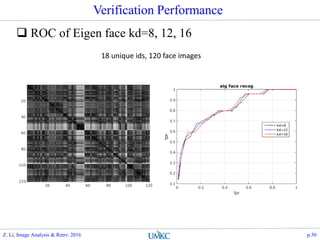
 ROC of Eigen face kd=8, 12, 16
18 unique ids, 120 face images
Z. Li, Image Analysis & Retrv. 2016 p.30
Eigenface Matlab
 Matlab code
% PCA:
[A, s, eigv]=princomp(faces);
kd=16; nface=120;
% eigenface projectio
x=faces*A(:, 1:kd);
f_dist = pdist2(x(1:nface,:), x(1:nface,:));
figure(32);
imagesc(f_dist); colormap('gray');
figure(33); hold on; grid on;
d0 = f_dist(1:7,1:7); d1=f_dist(8:end, 8:end);
[tp, fp, tn, fn]= getPrecisionRecall(d0(:), d1(:), 40);
plot(fp./(tn+fp), tp./(tp+fn), '.-r', 'DisplayName', 'tpr-fpr
color, data set 1');
xlabel('fpr'); ylabel('tpr'); title('eig face recog');
legend('kd=8', 'kd=12', 'kd=16', 0);
Z. Li, Image Analysis & Retrv. 2016 p.31
Limitation of PCA
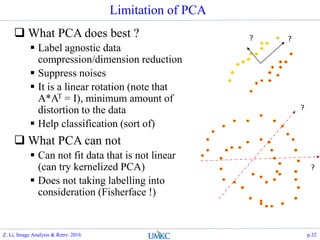
 What PCA does best ?
 Label agnostic data
compression/dimension reduction
 Suppress noises
 It is a linear rotation (note that
A*AT = I), minimum amount of
distortion to the data
 Help classification (sort of)
 What PCA can not
 Can not fit data that is not linear
(can try kernelized PCA)
 Does not taking labelling into
consideration (Fisherface !)
?
?
??
Z. Li, Image Analysis & Retrv. 2016 p.32
Outline
 Recap:
 SVD
 PCA
 Face Recognition – direct learning from pixels
 Eigenface
 Fisherface
 Summary
Z. Li, Image Analysis & Retrv. 2016 p.33
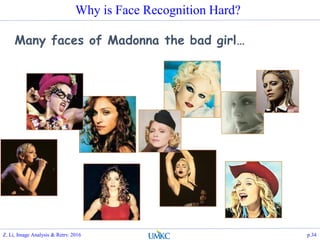
Why is Face Recognition Hard?
Many faces of Madonna the bad girl…
Z. Li, Image Analysis & Retrv. 2016 p.34
• Identify similar faces (inter-class similarity)
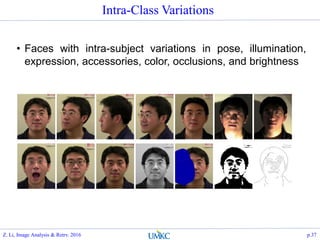
• Accommodate intra-class variability due to:
• head pose
• illumination conditions
• expressions
• facial accessories
• aging effects
• Cartoon/sketch
Face Recognition Challenges
Z. Li, Image Analysis & Retrv. 2016 p.35
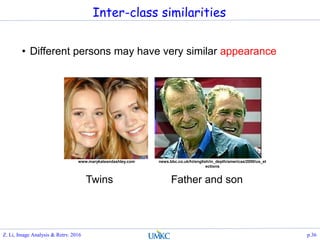
• Different persons may have very similar appearance
Twins Father and son
www.marykateandashley.com news.bbc.co.uk/hi/english/in_depth/americas/2000/us_el
ections
Inter-class similarities
Z. Li, Image Analysis & Retrv. 2016 p.36
• Faces with intra-subject variations in pose, illumination,
expression, accessories, color, occlusions, and brightness
Intra-Class Variations
Z. Li, Image Analysis & Retrv. 2016 p.37
P. Belhumeur, J. Hespanha, D. Kriegman, Eigenfaces vs. Fisherfaces: Recognition
Using Class Specific Linear Projection, PAMI, July 1997, pp. 711--720.
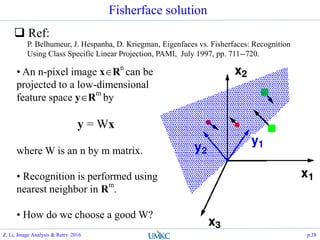
• An n-pixel image xRn
can be
projected to a low-dimensional
feature space yR
m
by
y = Wx
where W is an n by m matrix.
• Recognition is performed using
nearest neighbor in R
m
.
• How do we choose a good W?
Fisherface solution
 Ref:
Z. Li, Image Analysis & Retrv. 2016 p.38
PCA & Fisher’s Linear Discriminant
• Between-class scatter
• Within-class scatter
• Total scatter
• Where
– c is the number of classes
– i is the mean of class i
– | i | is number of samples of i..
T
ii
c
i
iBS ))((
1
  
  

c
i x
T
ikikW
ik
xS
1
))((


WB
c
i x
T
kkT SSxS
ik
   1
))((


1
2

1
2
Z. Li, Image Analysis & Retrv. 2016 p.39
Eigen vs Fisher Projection
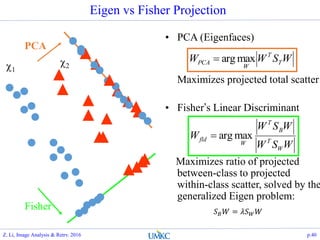
• PCA (Eigenfaces)
Maximizes projected total scatter
• Fisher’s Linear Discriminant
Maximizes ratio of projected
between-class to projected
within-class scatter, solved by the
generalized Eigen problem:
WSWW T
T
W
PCA maxarg
WSW
WSW
W
W
T
B
T
W
fld maxarg
1
2
PCA
Fisher 𝑆 𝐵 𝑊 = 𝜆𝑆 𝑊 𝑊
Z. Li, Image Analysis & Retrv. 2016 p.40
A problem…
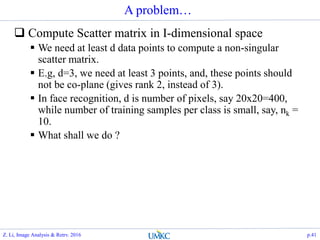
 Compute Scatter matrix in I-dimensional space
 We need at least d data points to compute a non-singular
scatter matrix.
 E.g, d=3, we need at least 3 points, and, these points should
not be co-plane (gives rank 2, instead of 3).
 In face recognition, d is number of pixels, say 20x20=400,
while number of training samples per class is small, say, nk =
10.
 What shall we do ?
Z. Li, Image Analysis & Retrv. 2016 p.41
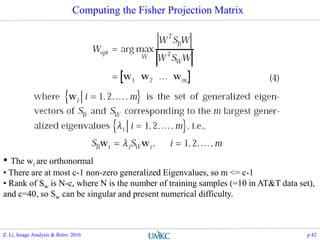
Computing the Fisher Projection Matrix
• The wi are orthonormal
• There are at most c-1 non-zero generalized Eigenvalues, so m <= c-1
• Rank of Sw is N-c, where N is the number of training samples (=10 in AT&T data set),
and c=40, so Sw can be singular and present numerical difficulty.
Z. Li, Image Analysis & Retrv. 2016 p.42
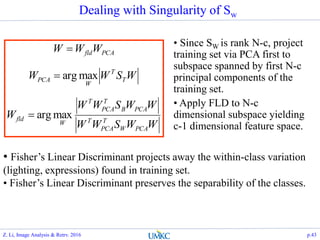
Dealing with Singularity of Sw
WWSWW
WWSWW
W
WSWW
WWW
PCAW
T
PCA
T
PCAB
T
PCA
T
W
fld
T
T
W
PCA
PCAfld
maxarg
maxarg



• Since SW is rank N-c, project
training set via PCA first to
subspace spanned by first N-c
principal components of the
training set.
• Apply FLD to N-c
dimensional subspace yielding
c-1 dimensional feature space.
• Fisher’s Linear Discriminant projects away the within-class variation
(lighting, expressions) found in training set.
• Fisher’s Linear Discriminant preserves the separability of the classes.
Z. Li, Image Analysis & Retrv. 2016 p.43
Experiment results on 417-6680 data set
 Compute Eigenface model and Fisherface model
% Eigenface: A1
load faces-ids-n6680-m417-20x20.mat;
[A1, s, lat]=princomp(faces);
% Fisherface: A2
n_face = 600; n_subj = length(unique(ids(1:n_face)));
%eigenface kd
kd = 32; opt.Fisherface = 1;
[A2, lat]=LDA(ids(1:n_face), opt,
faces(1:n_face,:)*A1(:,1:kd));
% eigenface
x1 = faces*A1(:,1:kd);
f_dist1 = pdist2(x1, x1);
% fisherface
x2 = faces*A1(:,1:kd)*A2;
f_dist2 = pdist2(x2, x2);
Z. Li, Image Analysis & Retrv. 2016 p.44
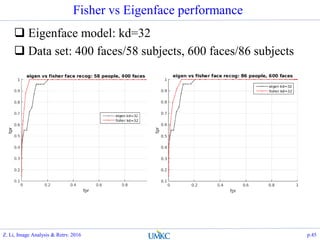
Fisher vs Eigenface performance
 Eigenface model: kd=32
 Data set: 400 faces/58 subjects, 600 faces/86 subjects
Z. Li, Image Analysis & Retrv. 2016 p.45
Summary
 PCA approach
 Try to find an orthogonal rotation
s.t. the first k-dimensions of the
new subspace, captures most of
the info of the data
 Agnostic to the label info
 Matlab: [A, s,
eigv]=princomp(data);
 LDA approach
 Try to find projection that
maximizes the ratio of between
class scatter vs within class
scatter
 Typically solved by apply PCA
first to avoid within class scatter
singularity
 Utilizes label info
 Matlab: [A, eigv]=LDA(label,
opt, data);
1
2
PCA
Fisher
Z. Li, Image Analysis & Retrv. 2016 p.46

Lec14 eigenface and fisherface

  • 1.
    Image Analysis &Retrieval CS/EE 5590 Special Topics (Class Ids: 44873, 44874) Fall 2016, M/W 4-5:15pm@Bloch 0012 Lec 14 Eigenface and Fisherface Zhu Li Dept of CSEE, UMKC Office: FH560E, Email: lizhu@umkc.edu, Ph: x 2346. http://l.web.umkc.edu/lizhu Z. Li, Image Analysis & Retrv. 2016 p.1
  • 2.
    Outline  Recap:  SVD PCA  Face Recognition – direct learning from pixels  Eigenface  Fisherface  Summary Z. Li, Image Analysis & Retrv. 2016 p.2
  • 3.
    SVD – projectiondecomposition  for non square matrix: Amxn: 𝐴 = 𝑈Σ𝑉 𝑇 𝑉 𝑇 Σ Z. Li, Image Analysis & Retrv. 2016 p.3
  • 4.
    SVD as SignalDecomposition The Singular Value Decomposition (SVD) of an nxm matrix A, is,  Where the diagonal of S are the eigen values of AAT, [𝜎1, 𝜎2, … , 𝜎 𝑛], called “singular values”  U are eigenvectors of AAT, and V are eigen vectors of ATA, the outer product of uivi T, are basis of A in reconstruction: 𝐴 = 𝑈𝑆𝑉 𝑇 = 𝑖 𝜎𝑖 𝑢𝑖 𝑣𝑖 𝑡 A(mxn) = U(mxm) S(mxn) V(nxn) The 1st order SVD approx. of A is: 𝜎1 ∗ 𝑈 : , 1 ∗ 𝑉 : , 1 𝑇 Z. Li, Image Analysis & Retrv. 2016 p.4
  • 5.
    SVD approximation ofan image  Very easy… function [x]=svd_approx(x0, k) dbg=0; if dbg x0= fix(100*randn(4,6)); k=2; end [u, s, v]=svd(x0); [m, n]=size(s); x = zeros(m, n); sgm = diag(s); for j=1:k x = x + sgm(j)*u(:,j)*v(:,j)'; end Z. Li, Image Analysis & Retrv. 2016 p.5
  • 6.
    PCA- Principal ComponentAnalysis  Formulation:  Find projections, that the information/energy of the data are maximally preserved  Matlab: [A, s, eigv]=princomp(X); max 𝑊 𝐸 𝑥 𝑇 𝑊 𝑇 𝑊𝑥 , 𝑠. 𝑡. , 𝑊 𝑇 𝑊 = 𝐼 Z. Li, Image Analysis & Retrv. 2016 p.6
  • 7.
    PCAAlgorithm  Center thedata:  X = X – repmat(mean(x), [n, 1]); Principal component #1 points in the direction of the largest variance Each subsequent principal component…  is orthogonal to the previous ones, and  points in the directions of the largest variance of the residual subspace  Solved by finding Eigen Vectors of the Scatter/Covarinace matrix of data:  S = cov(X); [A, eigv]=Eig(S) Z. Li, Image Analysis & Retrv. 2016 p.7
  • 8.
    Min Error ReconstructionDerivation of PCAAlgorithm GOAL: Z. Li, Image Analysis & Retrv. 2016 p.8
  • 9.
    Justification of PCAAlgorithm xis centered! Remaining dimensions Z. Li, Image Analysis & Retrv. 2016 p.9
  • 10.
    PCA – reconstructionerror minimization GOAL: Use Lagrange-multipliers for the constraints, KKT condition: Z. Li, Image Analysis & Retrv. 2016 p.10
  • 11.
    Justification of PCA Z.Li, Image Analysis & Retrv. 2016 p.11
  • 12.
    PCA for SIFTDimension Reduction  The PCA dimension reduction of SIFT data Z. Li, Image Analysis & Retrv. 2016 p.12
  • 13.
    PCA SIFT Basis SIFT Basis  A= princomp(double(sift)); Z. Li, Image Analysis & Retrv. 2016 p.13
  • 14.
    SIFT Embedding viaPCA  Project SIFT to desired lower dimensional space  Matlab: offs=gd_sift_offs(k-1)+1: gd_sift_offs(k); sift = gd_sift_cdvs(offs,: ); x = sift*A1(:,1:kd) % plot 3d plot3(x(:,1), x(:,2), x(:,3), ‘.r’); Z. Li, Image Analysis & Retrv. 2016 p.14
  • 15.
    Outline  Recap:  SVD PCA  Face Recognition – direct learning from pixels  Eigenface  Fisherface  Summary Z. Li, Image Analysis & Retrv. 2016 p.15
  • 16.
    The Face RecognitionProblem  The Verification vs Identification Problem = ? = ? Verification problem 1:1 Identification/Recognition problem 1:N Z. Li, Image Analysis & Retrv. 2016 p.16
  • 17.
    Holistic Approach: TreatPixel Directly as features 1. Treat pixels as a vector 2. Recognize face by nearest neighbor xy  T k k k argmin h w X in Rwxh {Y1, Y2, Y3,…, Yn } in Rwxh Z. Li, Image Analysis & Retrv. 2016 p.17
  • 18.
    The space ofall face images • When viewed as vectors of pixel values, face images are extremely high-dimensional  120x120 pixel image = 14400 dimensions  Slow and lots of storage • But very few 14,400-dimensional vectors are valid face images • We want to effectively model the subspace of face images Z. Li, Image Analysis & Retrv. 2016 p.18
  • 19.
    The space ofall face images • Eigenface idea: construct a low-dimensional linear subspace that best explains the variation/scatter of the face images Z. Li, Image Analysis & Retrv. 2016 p.19
  • 20.
    Principal Component Analysis(PCA) • Given: N data points x1, … ,xN in Rd • We want to find a new set of features that are linear combinations of original ones: u(xi) = uT(xi – µ) • (µ: mean of data points) • Choose unit vector u in Rd that captures the most data variance Z. Li, Image Analysis & Retrv. 2016 p.20
  • 21.
    Principal Component Analysis •Direction that maximizes the variance of the projected data: Projection of data point Covariance matrix of data The direction that maximizes the variance is the eigenvector associated with the largest eigenvalue of Σ N N 1/N Maximize subject to ||u||=1 Z. Li, Image Analysis & Retrv. 2016 p.21
  • 22.
    Eigenfaces (PCA onface images) 1. Compute covariance matrix of face images 2. Compute the principal components (“eigenfaces”)  K eigenvectors with largest eigenvalues 3. Represent all face images in the dataset as linear combinations of eigenfaces  Perform nearest neighbor on these coefficients M. Turk and A. Pentland, Face Recognition using Eigenfaces, CVPR 1991 Z. Li, Image Analysis & Retrv. 2016 p.22
  • 23.
    Eigenfaces example Training images x1,…,xN Z.Li, Image Analysis & Retrv. 2016 p.23
  • 24.
    Eigenfaces example  meanface and eigen faces Top k eigenvectors: u1,…uk Mean: μ Z. Li, Image Analysis & Retrv. 2016 p.24
  • 25.
    Visualization of eigenfaces Principalcomponent (eigenvector) uk μ + 3σkuk μ – 3σkuk Z. Li, Image Analysis & Retrv. 2016 p.25
  • 26.
    Representation and reconstruction •Face x in “face space” coordinates: • Reconstruction: = + µ + w1u1+w2u2+w3u3+w4u4+ … = ^ x = Z. Li, Image Analysis & Retrv. 2016 p.26
  • 27.
    Matlab Implementation  Scalingthe face image to thumbnail size  Justification: as long as human eye can recognize, that contains sufficient info  Scale space characteristic response for face recognition  Compute the PCA over the vectorized face data load faces-ids-n6680-m417-20x20.mat; [A, s, lat]=princomp(faces); h=20; w=20; figure(30); subplot(1,2,1); grid on; hold on; stem(lat, '.'); f_eng=lat.*lat; subplot(1,2,2); grid on; hold on; plot(cumsum(f_eng)/sum(f_eng), '.-'); Z. Li, Image Analysis & Retrv. 2016 p.27
  • 28.
    Eigenface Holistic approach: treatan hxw image as a point in Rhxw:  Face data set: 20x20 face icon images, 417 subjects, 6680 face images  Notice that all the face images are not filling up the R20x20 space:  Eigenface basis: imagesc(reshape(A1(:,1), [h, w])); kd kd eigval Infopreservingratio Z. Li, Image Analysis & Retrv. 2016 p.28
  • 29.
    Eigenface Projections  Projectface images to Eigenface space  Matlab: x=faces*A(:,1:kd) eigf1 eigf2 eigf3 = 10.9* + 0.4* + 4.7* Z. Li, Image Analysis & Retrv. 2016 p.29
  • 30.
    Verification Performance  ROCof Eigen face kd=8, 12, 16 18 unique ids, 120 face images Z. Li, Image Analysis & Retrv. 2016 p.30
  • 31.
    Eigenface Matlab  Matlabcode % PCA: [A, s, eigv]=princomp(faces); kd=16; nface=120; % eigenface projectio x=faces*A(:, 1:kd); f_dist = pdist2(x(1:nface,:), x(1:nface,:)); figure(32); imagesc(f_dist); colormap('gray'); figure(33); hold on; grid on; d0 = f_dist(1:7,1:7); d1=f_dist(8:end, 8:end); [tp, fp, tn, fn]= getPrecisionRecall(d0(:), d1(:), 40); plot(fp./(tn+fp), tp./(tp+fn), '.-r', 'DisplayName', 'tpr-fpr color, data set 1'); xlabel('fpr'); ylabel('tpr'); title('eig face recog'); legend('kd=8', 'kd=12', 'kd=16', 0); Z. Li, Image Analysis & Retrv. 2016 p.31
  • 32.
    Limitation of PCA What PCA does best ?  Label agnostic data compression/dimension reduction  Suppress noises  It is a linear rotation (note that A*AT = I), minimum amount of distortion to the data  Help classification (sort of)  What PCA can not  Can not fit data that is not linear (can try kernelized PCA)  Does not taking labelling into consideration (Fisherface !) ? ? ?? Z. Li, Image Analysis & Retrv. 2016 p.32
  • 33.
    Outline  Recap:  SVD PCA  Face Recognition – direct learning from pixels  Eigenface  Fisherface  Summary Z. Li, Image Analysis & Retrv. 2016 p.33
  • 34.
    Why is FaceRecognition Hard? Many faces of Madonna the bad girl… Z. Li, Image Analysis & Retrv. 2016 p.34
  • 35.
    • Identify similarfaces (inter-class similarity) • Accommodate intra-class variability due to: • head pose • illumination conditions • expressions • facial accessories • aging effects • Cartoon/sketch Face Recognition Challenges Z. Li, Image Analysis & Retrv. 2016 p.35
  • 36.
    • Different personsmay have very similar appearance Twins Father and son www.marykateandashley.com news.bbc.co.uk/hi/english/in_depth/americas/2000/us_el ections Inter-class similarities Z. Li, Image Analysis & Retrv. 2016 p.36
  • 37.
    • Faces withintra-subject variations in pose, illumination, expression, accessories, color, occlusions, and brightness Intra-Class Variations Z. Li, Image Analysis & Retrv. 2016 p.37
  • 38.
    P. Belhumeur, J.Hespanha, D. Kriegman, Eigenfaces vs. Fisherfaces: Recognition Using Class Specific Linear Projection, PAMI, July 1997, pp. 711--720. • An n-pixel image xRn can be projected to a low-dimensional feature space yR m by y = Wx where W is an n by m matrix. • Recognition is performed using nearest neighbor in R m . • How do we choose a good W? Fisherface solution  Ref: Z. Li, Image Analysis & Retrv. 2016 p.38
  • 39.
    PCA & Fisher’sLinear Discriminant • Between-class scatter • Within-class scatter • Total scatter • Where – c is the number of classes – i is the mean of class i – | i | is number of samples of i.. T ii c i iBS ))(( 1        c i x T ikikW ik xS 1 ))((   WB c i x T kkT SSxS ik    1 ))((   1 2  1 2 Z. Li, Image Analysis & Retrv. 2016 p.39
  • 40.
    Eigen vs FisherProjection • PCA (Eigenfaces) Maximizes projected total scatter • Fisher’s Linear Discriminant Maximizes ratio of projected between-class to projected within-class scatter, solved by the generalized Eigen problem: WSWW T T W PCA maxarg WSW WSW W W T B T W fld maxarg 1 2 PCA Fisher 𝑆 𝐵 𝑊 = 𝜆𝑆 𝑊 𝑊 Z. Li, Image Analysis & Retrv. 2016 p.40
  • 41.
    A problem…  ComputeScatter matrix in I-dimensional space  We need at least d data points to compute a non-singular scatter matrix.  E.g, d=3, we need at least 3 points, and, these points should not be co-plane (gives rank 2, instead of 3).  In face recognition, d is number of pixels, say 20x20=400, while number of training samples per class is small, say, nk = 10.  What shall we do ? Z. Li, Image Analysis & Retrv. 2016 p.41
  • 42.
    Computing the FisherProjection Matrix • The wi are orthonormal • There are at most c-1 non-zero generalized Eigenvalues, so m <= c-1 • Rank of Sw is N-c, where N is the number of training samples (=10 in AT&T data set), and c=40, so Sw can be singular and present numerical difficulty. Z. Li, Image Analysis & Retrv. 2016 p.42
  • 43.
    Dealing with Singularityof Sw WWSWW WWSWW W WSWW WWW PCAW T PCA T PCAB T PCA T W fld T T W PCA PCAfld maxarg maxarg    • Since SW is rank N-c, project training set via PCA first to subspace spanned by first N-c principal components of the training set. • Apply FLD to N-c dimensional subspace yielding c-1 dimensional feature space. • Fisher’s Linear Discriminant projects away the within-class variation (lighting, expressions) found in training set. • Fisher’s Linear Discriminant preserves the separability of the classes. Z. Li, Image Analysis & Retrv. 2016 p.43
  • 44.
    Experiment results on417-6680 data set  Compute Eigenface model and Fisherface model % Eigenface: A1 load faces-ids-n6680-m417-20x20.mat; [A1, s, lat]=princomp(faces); % Fisherface: A2 n_face = 600; n_subj = length(unique(ids(1:n_face))); %eigenface kd kd = 32; opt.Fisherface = 1; [A2, lat]=LDA(ids(1:n_face), opt, faces(1:n_face,:)*A1(:,1:kd)); % eigenface x1 = faces*A1(:,1:kd); f_dist1 = pdist2(x1, x1); % fisherface x2 = faces*A1(:,1:kd)*A2; f_dist2 = pdist2(x2, x2); Z. Li, Image Analysis & Retrv. 2016 p.44
  • 45.
    Fisher vs Eigenfaceperformance  Eigenface model: kd=32  Data set: 400 faces/58 subjects, 600 faces/86 subjects Z. Li, Image Analysis & Retrv. 2016 p.45
  • 46.
    Summary  PCA approach Try to find an orthogonal rotation s.t. the first k-dimensions of the new subspace, captures most of the info of the data  Agnostic to the label info  Matlab: [A, s, eigv]=princomp(data);  LDA approach  Try to find projection that maximizes the ratio of between class scatter vs within class scatter  Typically solved by apply PCA first to avoid within class scatter singularity  Utilizes label info  Matlab: [A, eigv]=LDA(label, opt, data); 1 2 PCA Fisher Z. Li, Image Analysis & Retrv. 2016 p.46