CS/EE 5590 / ENG 401 Special Topics
(Class Ids: 17804, 17815, 17803)
Lec 03
Entropy and Coding II
Hoffman and Golomb Coding
Zhu Li
Z. Li Multimedia Communciation, 2016 Spring p.1
Outline
 Lecture 02 ReCap
 Hoffman Coding
 Golomb Coding and JPEG 2000 Lossless Coding
Z. Li Multimedia Communciation, 2016 Spring p.2
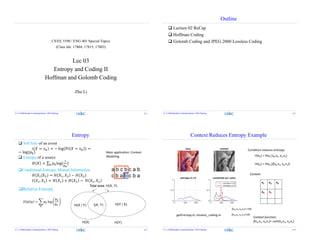
Entropy
 Self Info of an event
= = − log Pr = =
− log	( )
 Entropy of a source
= ∑ log	( )
Conditional Entropy, Mutual Information
= , − ( )
, = + − 	 ,
Z. Li Multimedia Communciation, 2016 Spring p.3
H(X) H(Y)
I(X; Y)H(X | Y) H(Y | X)
Total area: H(X, Y)
a b c b c a b
c b a b c b a
Main application: Context
Modeling
Relative Entropy
( | = log
	
Context Reduces Entropy Example
Z. Li Multimedia Communciation, 2016 Spring p.4
x1 x2 x3
x4 x5
H(x5) > H(x5|x4,x3, x2,x1)
H(x5) > H(x5|f(x4,x3, x2,x1))
Condition reduces entropy:
Context function:
f(x4,x3, x2,x1)= sum(x4,x3, x2,x1)
getEntropy.m, lossless_coding.m
f(x4,x3, x2,x1)==100
f(x4,x3, x2,x1)<100
Context:
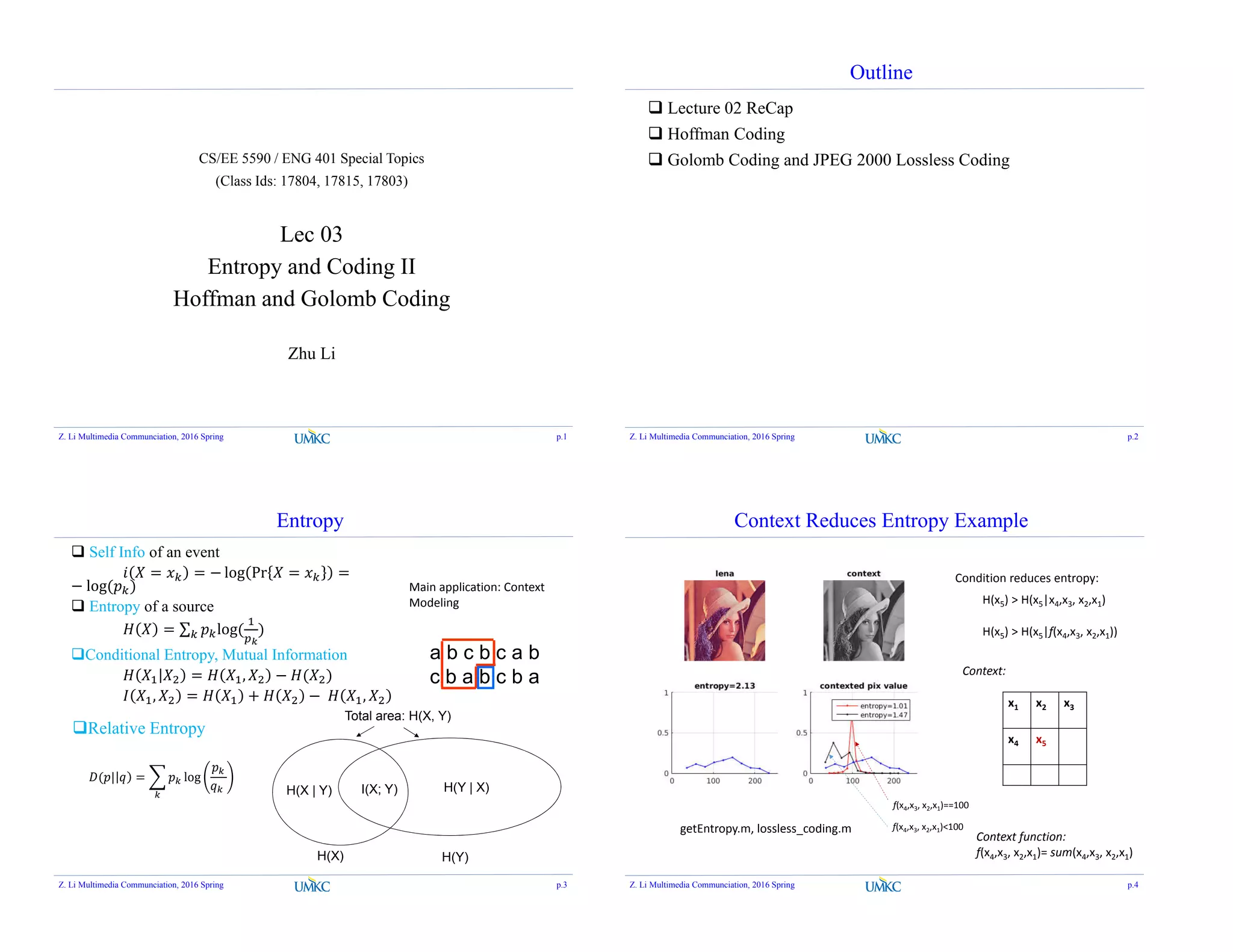
Lossless Coding
 Prefix Coding
 Codes on leaves
 No code is prefix of other codes
 Simple encoding/decoding
Kraft- McMillan Inequality:
 For a coding scheme with code length: l1, l2, …ln,
 Given a set of integer length {l1, l2, …ln} that satisfy above inequality,
we can always find a prefix code with code length l1, l2, …ln
Z. Li Multimedia Communciation, 2016 Spring p.5
0 1
0 1
0 1
0
10
110 111
Root node
leaf node
Internal node
2 ≤ 1
Outline
 Lecture 02 ReCap
 Hoffman Coding
 Golomb Coding and JPEG 2000 Lossless
Z. Li Multimedia Communciation, 2016 Spring p.6
Huffman Coding
A procedure to construct optimal prefix code
Result of David Huffman’s term paper in 1952 when he was a
PhD student at MIT
 Shannon  Fano  Huffman (1925-1999)
Z. Li Multimedia Communciation, 2016 Spring p.7
Huffman Code Design
 Requirement:
 The source probability distribution.
(But not available in many cases)
 Procedure:
1. Sort the probability of all source symbols in a descending order.
2. Merge the last two into a new symbol, add their probabilities.
3. Repeat Step 1, 2 until only one symbol (the root) is left.
4. Code assignment:
Traverse the tree from the root to each leaf node,
assign 0 to the top branch and 1 to the bottom branch.
Z. Li Multimedia Communciation, 2016 Spring p.8
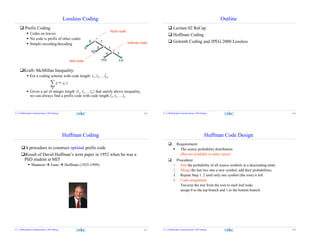
Example
Source alphabet A = {a1, a2, a3, a4, a5}
Probability distribution: {0.2, 0.4, 0.2, 0.1, 0.1}
a2 (0.4)
a1(0.2)
a3(0.2)
a4(0.1)
a5(0.1)
Sort
0.2
merge Sort
0.4
0.2
0.2
0.2
0.4
merge Sort
0.4
0.2
0.4
0.6
merge
0.6
0.4
Sort
1
merge
Assign code
0
1
1
00
01
1
000
001
01
1
000
01
0010
0011
1
000
01
0010
0011
Z. Li Multimedia Communciation, 2016 Spring p.9
Huffman code is prefix-free
01 (a1)
000 (a3)
0010 (a4) 0011(a5)
1
000
01
0010
0011
1 (a2)
All codewords are leaf nodes
 No code is a prefix of any other code.
(Prefix free)
Z. Li Multimedia Communciation, 2016 Spring p.10
Average Codeword Length vs Entropy
 Source alphabet A = {a, b, c, d, e}
 Probability distribution: {0.2, 0.4, 0.2, 0.1, 0.1}
 Code: {01, 1, 000, 0010, 0011}
 Entropy:
H(S) = - (0.2*log2(0.2)*2 + 0.4*log2(0.4)+0.1*log2(0.1)*2)
= 2.122 bits / symbol
 Average Huffman codeword length:
L = 0.2*2+0.4*1+0.2*3+0.1*4+0.1*4 = 2.2 bits / symbol
 This verifies H(S) ≤ L < H(S) + 1.
Z. Li Multimedia Communciation, 2016 Spring p.11
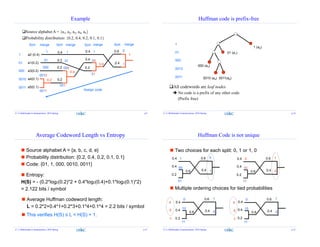
Huffman Code is not unique
0.4
0.2
0.4
0.6
0.6
0.4
0
1
1
00
01
 Multiple ordering choices for tied probabilities
 Two choices for each split: 0, 1 or 1, 0
0.4
0.2
0.4
0.6
0.6
0.4
1
0
0
10
11
a
b
c
0.4
0.2
0.4
0.6
0.6
0.4
1
0
0
10
11
b
a
c
0.4
0.2
0.4
0.6
0.6
0.4
1
0
0
10
11
Z. Li Multimedia Communciation, 2016 Spring p.12
Huffman Coding is Optimal
Assume the probabilities are ordered:
 p1 ≥ p2 ≥ …… pm.
Lemma: For any distribution, there exists an optimal
prefix code that satisfies:
 If pj ≥ pk, then lj ≤ lk: otherwise can swap codewords to reduce
the average length.
The two least probable letters have the same length:
otherwise we can truncate the longer one without violating
prefix-free condition.
The two longest codewords differ only in the last bit and
correspond to the two least probable symbols. Otherwise we
can rearrange to achieve this.
 Proof skipped.
Z. Li Multimedia Communciation, 2016 Spring p.13
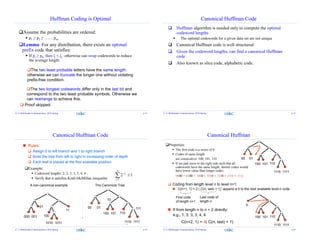
Canonical Huffman Code
 Huffman algorithm is needed only to compute the optimal
codeword lengths
 The optimal codewords for a given data set are not unique
 Canonical Huffman code is well structured
 Given the codeword lengths, can find a canonical Huffman
code
 Also known as slice code, alphabetic code.
Z. Li Multimedia Communciation, 2016 Spring p.14
Canonical Huffman Code
Example:
 Codeword lengths: 2, 2, 3, 3, 3, 4, 4
 Verify that it satisfies Kraft-McMillan inequality
01
100
11
000 001
1010 1011
A non-canonical example
00 01
The Canonical Tree
 Rules:
 Assign 0 to left branch and 1 to right branch
 Build the tree from left to right in increasing order of depth
 Each leaf is placed at the first available position
110100 101
10
1110 1111
111
12
1


N
i
li
Z. Li Multimedia Communciation, 2016 Spring p.15
Canonical Huffman
Properties:
 The first code is a series of 0
 Codes of same length
are consecutive: 100, 101, 110
 If we pad zeros to the right side such that all
codewords have the same length, shorter codes would
have lower value than longer codes:
0000 < 0100 < 1000 < 1010 < 1100 < 1110 < 1111
00 01
110100 101
1110 1111
 If from length n to n + 2 directly:
e.g., 1, 3, 3, 3, 4, 4
C(n+2, 1) = 4( C(n, last) + 1)
0
110100 101
1110 1111
First code
of length n+1
Last code of
length n
 Coding from length level n to level n+1:
 C(n+1, 1) = 2 ( C(n, last) + 1): append a 0 to the next available level-n code
Z. Li Multimedia Communciation, 2016 Spring p.16
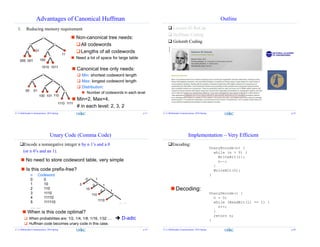
Advantages of Canonical Huffman
1. Reducing memory requirement
 Non-canonical tree needs:
All codewords
Lengths of all codewords
 Need a lot of space for large table
01
100
11
000 001
1010 1011
00 01
110100 101
1110 1111
 Canonical tree only needs:
 Min: shortest codeword length
 Max: longest codeword length
 Distribution:
 Number of codewords in each level
 Min=2, Max=4,
# in each level: 2, 3, 2
Z. Li Multimedia Communciation, 2016 Spring p.17
Outline
 Lecture 02 ReCap
 Hoffman Coding
 Golomb Coding
Z. Li Multimedia Communciation, 2016 Spring p.18
Unary Code (Comma Code)
Encode a nonnegative integer n by n 1’s and a 0
(or n 0’s and an 1).
n Codeword
0 0
1 10
2 110
3 1110
4 11110
5 111110
… …
 Is this code prefix-free?
0 1
0 1
0 1
0
10
110
1110
… …
 When is this code optimal?
 When probabilities are: 1/2, 1/4, 1/8, 1/16, 1/32 …  D-adic
 Huffman code becomes unary code in this case.
 No need to store codeword table, very simple
Z. Li Multimedia Communciation, 2016 Spring p.19
Implementation – Very Efficient
Encoding:
UnaryEncode(n) {
while (n > 0) {
WriteBit(1);
n--;
}
WriteBit(0);
}
 Decoding:
UnaryDecode() {
n = 0;
while (ReadBit(1) == 1) {
n++;
}
return n;
}
Z. Li Multimedia Communciation, 2016 Spring p.20
Golomb Code [Golomb, 1966]
A multi-resolutional approach:
 Divide all numbers into groups of equal size m
o Denote as Golomb(m) or Golomb-m
 Groups with smaller symbol values have shorter codes
 Symbols in the same group has codewords of similar lengths
o The codeword length grows much slower than in unary code
0 max
m m m m
 Codeword :
 (Unary, fixed-length)
Group ID:
Unary code
Index within each group:
Z. Li Multimedia Communciation, 2016 Spring p.21
Golomb Code
rm
m
n
rqmn 




 q: Quotient,
used unary code
q Codeword
0 0
1 10
2 110
3 1110
4 11110
5 111110
6 1111110
… …
 r: remainder, “fixed-length” code
 K bits if m = 2^k
 m=8: 000, 001, ……, 111
 If m ≠ 2^k: (not desired)
bits for smaller r
bits for larger r
 m2log
 m2log
m = 5: 00, 01, 10, 110, 111
Z. Li Multimedia Communciation, 2016 Spring p.22
Golomb Code with m = 5 (Golomb-5)
n q r code
0 0 0 000
1 0 1 001
2 0 2 010
3 0 3 0110
4 0 4 0111
n q r code
5 1 0 1000
6 1 1 1001
7 1 2 1010
8 1 3 10110
9 1 4 10111
n q r code
10 2 0 11000
11 2 1 11001
12 2 2 11010
13 2 3 110110
14 2 4 110111
Z. Li Multimedia Communciation, 2016 Spring p.23
Golomb vs Canonical Huffman
Golomb code is a canonical Huffman
 With more properties
 Codewords: 000, 001, 010, 0110, 0111,
1000, 1001, 1010, 10110, 10111
 Canonical form:
From left to right
From short to long
Take first valid spot
Z. Li Multimedia Communciation, 2016 Spring p.24
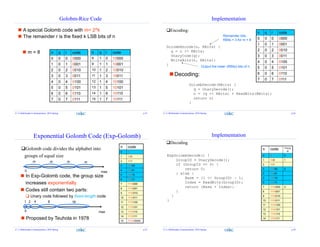
 A special Golomb code with m= 2^k
 The remainder r is the fixed k LSB bits of n
n q r code
0 0 0 0000
1 0 1 0001
2 0 2 0010
3 0 3 0011
4 0 4 0100
5 0 5 0101
6 0 6 0110
7 0 7 0111
n q r code
8 1 0 10000
9 1 1 10001
10 1 2 10010
11 1 3 10011
12 1 4 10100
13 1 5 10101
14 1 6 10110
15 1 7 10111
 m = 8
Golobm-Rice Code
Z. Li Multimedia Communciation, 2016 Spring p.25
Implementation
Encoding:
GolombEncode(n, RBits) {
q = n >> RBits;
UnaryCode(q);
WriteBits(n, RBits);
}
 Decoding:
GolombDecode(RBits) {
q = UnaryDecode();
n = (q << RBits) + ReadBits(RBits);
return n;
}
Remainder bits:
RBits = 3 for m = 8
Output the lower (RBits) bits of n.
n q r code
0 0 0 0000
1 0 1 0001
2 0 2 0010
3 0 3 0011
4 0 4 0100
5 0 5 0101
6 0 6 0110
7 0 7 0111
Z. Li Multimedia Communciation, 2016 Spring p.26
Exponential Golomb Code (Exp-Golomb)
Golomb code divides the alphabet into
groups of equal size
0 max
m m m m
 In Exp-Golomb code, the group size
increases exponentially
 Codes still contain two parts:
 Unary code followed by fixed-length code
0 max
4 8 161 2
n code
0 0
1 100
2 101
3 11000
4 11001
5 11010
6 11011
7 1110000
8 1110001
9 1110010
10 1110011
11 1110100
12 1110101
13 1110110
14 1110111
15 111100000
 Proposed by Teuhola in 1978
Z. Li Multimedia Communciation, 2016 Spring p.27
Implementation
Decoding
ExpGolombDecode() {
GroupID = UnaryDecode();
if (GroupID == 0) {
return 0;
} else {
Base = (1 << GroupID) - 1;
Index = ReadBits(GroupID);
return (Base + Index);
}
}
}
n code Group
ID
0 0 0
1 100 1
2 101
3 11000 2
4 11001
5 11010
6 11011
7 1110000 3
8 1110001
9 1110010
10 1110011
11 1110100
12 1110101
13 1110110
14 1110111
Z. Li Multimedia Communciation, 2016 Spring p.28
Outline
Golomb Code Family:
 Unary Code
 Golomb Code
 Golomb-Rice Code
 Exponential Golomb Code
Why Golomb code?
Z. Li Multimedia Communciation, 2016 Spring p.29
Geometric Distribution (GD)
 Geometric distribution with parameter ρ:
 P(x) = ρx (1 - ρ), x ≥ 0, integer.
 Prob of the number of failures before the first success in a series of
independent Yes/No experiments (Bernoulli trials).
 Unary code is the optimal prefix code for geometric distribution
with ρ ≤ 1/2:
 ρ = 1/4: P(x): 0.75, 0.19, 0.05, 0.01, 0.003, …
 Huffman coding never needs to re-order  equivalent to unary code.
 Unary code is the optimal prefix code, but not efficient
( avg length >> entropy)
 ρ = 3/4: P(x): 0.25, 0.19, 0.14, 0.11, 0.08, …
 Reordering is needed for Huffman code, unary code not optimal prefix code.
 ρ = 1/2: Expected length = entropy.
 Unary code is not only the optimal prefix code, but also optimal among all
entropy coding (including arithmetic coding).
Z. Li Multimedia Communciation, 2016 Spring p.30
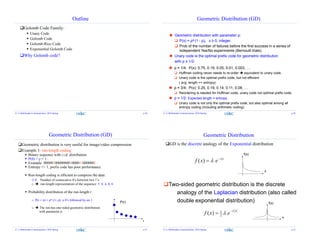
Geometric Distribution (GD)
Geometric distribution is very useful for image/video compression
Example 1: run-length coding
 Binary sequence with i.i.d. distribution
 P(0) = ρ ≈ 1:
 Example: 0000010000000010000110000001
 Entropy << 1, prefix code has poor performance.
 Run-length coding is efficient to compress the data:
or: Number of consecutive 0’s between two 1’s
o  run-length representation of the sequence: 5, 8, 4, 0, 6
 Probability distribution of the run-length r:
o P(r = n) = ρn (1- ρ): n 0’s followed by an 1.
o  The run has one-sided geometric distribution
with parameter ρ.
r
P(r)
Z. Li Multimedia Communciation, 2016 Spring p.31
Geometric Distribution
GD is the discrete analogy of the Exponential distribution
x
exf

 
)( 2
1
Two-sided geometric distribution is the discrete
analogy of the Laplacian distribution (also called
double exponential distribution)
( ) x
f x e 
 

x
f(x)
x
f(x)
Z. Li Multimedia Communciation, 2016 Spring p.32
Why Golomb Code?
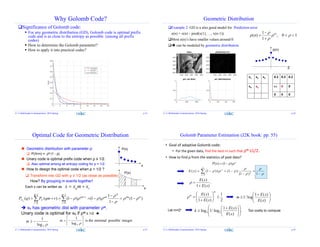
Significance of Golomb code:
 For any geometric distribution (GD), Golomb code is optimal prefix
code and is as close to the entropy as possible (among all prefix
codes)
 How to determine the Golomb parameter?
 How to apply it into practical codec?
Z. Li Multimedia Communciation, 2016 Spring p.33
Geometric Distribution
Example 2: GD is a also good model for Prediction error
e(n) = x(n) – pred(x(1), …, x(n-1)).
Most e(n)’s have smaller values around 0:
 can be modeled by geometric distribution.
n
p(n)
10,
1
1
)( ||



 

 n
np
Z. Li Multimedia Communciation, 2016 Spring p.34
x1 x2 x3
x4 x5
0.2 0.3 0.2
0.2 0 0
0 0 0
Optimal Code for Geometric Distribution
 Geometric distribution with parameter ρ:
 P(X=n) = ρn (1 - ρ)
 Unary code is optimal prefix code when ρ ≤ 1/2.
 Also optimal among all entropy coding for ρ = 1/2.
 How to design the optimal code when ρ > 1/2 ?
x
P(x)
1 1
0 0
1
( ) ( ) (1 ) (1 ) (1 )
1q
mm m
qm r qm mq m
X X
r r
P q P qm r

     

 

 

       

 
 xq has geometric dist with parameter ρm.
Unary code is optimal for xq if ρm ≤ 1/2 
2log
1
m integer.possibleminimaltheis
log
1
2








m
rq xmxx 
 Transform into GD with ρ ≤ 1/2 (as close as possible)
How? By grouping m events together!
Each x can be written as
x
P(x)
Z. Li Multimedia Communciation, 2016 Spring p.35
Golomb Parameter Estimation (J2K book: pp. 55)
x
xP )1()( 
• Goal of adaptive Golomb code:
• For the given data, find the best m such that ρm ≤1/2.
• How to find ρ from the statistics of past data?








 

 1)1(
)1()1()( 2
0x
x
xxE
.
)(1
)(
xE
xE


2
1
)(1
)(








m
m
xE
xE
 




 

)(
)(1
log/1
xE
xE
m
Let m=2k
.
)(
)(1
log/1log 22 












 

xE
xE
k Too costly to compute
Z. Li Multimedia Communciation, 2016 Spring p.36
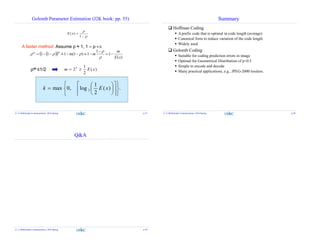
Golomb Parameter Estimation (J2K book: pp. 55)
( )
1
E x




A faster method: Assume ρ ≈ 1, 1 – ρ ≈ 0.
  
)(
1
1
1)1(111
xE
m
mm
mm






ρm ≤1/2 )(
2
1
2 xEm k

.)(
2
1
log,0max 2


















 xEk
Z. Li Multimedia Communciation, 2016 Spring p.37
Summary
 Hoffman Coding
 A prefix code that is optimal in code length (average)
 Canonical form to reduce variation of the code length
 Widely used
 Golomb Coding
 Suitable for coding prediction errors in image
 Optimal for Geometrical Distribution of p=0.5
 Simple to encode and decode
 Many practical applications, e.g., JPEG-2000 lossless.
Z. Li Multimedia Communciation, 2016 Spring p.38
Q&A
Z. Li Multimedia Communciation, 2016 Spring p.39

Lec-03 Entropy Coding I: Hoffmann & Golomb Codes

  • 1.
    CS/EE 5590 /ENG 401 Special Topics (Class Ids: 17804, 17815, 17803) Lec 03 Entropy and Coding II Hoffman and Golomb Coding Zhu Li Z. Li Multimedia Communciation, 2016 Spring p.1 Outline  Lecture 02 ReCap  Hoffman Coding  Golomb Coding and JPEG 2000 Lossless Coding Z. Li Multimedia Communciation, 2016 Spring p.2 Entropy  Self Info of an event = = − log Pr = = − log ( )  Entropy of a source = ∑ log ( ) Conditional Entropy, Mutual Information = , − ( ) , = + − , Z. Li Multimedia Communciation, 2016 Spring p.3 H(X) H(Y) I(X; Y)H(X | Y) H(Y | X) Total area: H(X, Y) a b c b c a b c b a b c b a Main application: Context Modeling Relative Entropy ( | = log Context Reduces Entropy Example Z. Li Multimedia Communciation, 2016 Spring p.4 x1 x2 x3 x4 x5 H(x5) > H(x5|x4,x3, x2,x1) H(x5) > H(x5|f(x4,x3, x2,x1)) Condition reduces entropy: Context function: f(x4,x3, x2,x1)= sum(x4,x3, x2,x1) getEntropy.m, lossless_coding.m f(x4,x3, x2,x1)==100 f(x4,x3, x2,x1)<100 Context:
  • 2.
    Lossless Coding  PrefixCoding  Codes on leaves  No code is prefix of other codes  Simple encoding/decoding Kraft- McMillan Inequality:  For a coding scheme with code length: l1, l2, …ln,  Given a set of integer length {l1, l2, …ln} that satisfy above inequality, we can always find a prefix code with code length l1, l2, …ln Z. Li Multimedia Communciation, 2016 Spring p.5 0 1 0 1 0 1 0 10 110 111 Root node leaf node Internal node 2 ≤ 1 Outline  Lecture 02 ReCap  Hoffman Coding  Golomb Coding and JPEG 2000 Lossless Z. Li Multimedia Communciation, 2016 Spring p.6 Huffman Coding A procedure to construct optimal prefix code Result of David Huffman’s term paper in 1952 when he was a PhD student at MIT  Shannon  Fano  Huffman (1925-1999) Z. Li Multimedia Communciation, 2016 Spring p.7 Huffman Code Design  Requirement:  The source probability distribution. (But not available in many cases)  Procedure: 1. Sort the probability of all source symbols in a descending order. 2. Merge the last two into a new symbol, add their probabilities. 3. Repeat Step 1, 2 until only one symbol (the root) is left. 4. Code assignment: Traverse the tree from the root to each leaf node, assign 0 to the top branch and 1 to the bottom branch. Z. Li Multimedia Communciation, 2016 Spring p.8
  • 3.
    Example Source alphabet A= {a1, a2, a3, a4, a5} Probability distribution: {0.2, 0.4, 0.2, 0.1, 0.1} a2 (0.4) a1(0.2) a3(0.2) a4(0.1) a5(0.1) Sort 0.2 merge Sort 0.4 0.2 0.2 0.2 0.4 merge Sort 0.4 0.2 0.4 0.6 merge 0.6 0.4 Sort 1 merge Assign code 0 1 1 00 01 1 000 001 01 1 000 01 0010 0011 1 000 01 0010 0011 Z. Li Multimedia Communciation, 2016 Spring p.9 Huffman code is prefix-free 01 (a1) 000 (a3) 0010 (a4) 0011(a5) 1 000 01 0010 0011 1 (a2) All codewords are leaf nodes  No code is a prefix of any other code. (Prefix free) Z. Li Multimedia Communciation, 2016 Spring p.10 Average Codeword Length vs Entropy  Source alphabet A = {a, b, c, d, e}  Probability distribution: {0.2, 0.4, 0.2, 0.1, 0.1}  Code: {01, 1, 000, 0010, 0011}  Entropy: H(S) = - (0.2*log2(0.2)*2 + 0.4*log2(0.4)+0.1*log2(0.1)*2) = 2.122 bits / symbol  Average Huffman codeword length: L = 0.2*2+0.4*1+0.2*3+0.1*4+0.1*4 = 2.2 bits / symbol  This verifies H(S) ≤ L < H(S) + 1. Z. Li Multimedia Communciation, 2016 Spring p.11 Huffman Code is not unique 0.4 0.2 0.4 0.6 0.6 0.4 0 1 1 00 01  Multiple ordering choices for tied probabilities  Two choices for each split: 0, 1 or 1, 0 0.4 0.2 0.4 0.6 0.6 0.4 1 0 0 10 11 a b c 0.4 0.2 0.4 0.6 0.6 0.4 1 0 0 10 11 b a c 0.4 0.2 0.4 0.6 0.6 0.4 1 0 0 10 11 Z. Li Multimedia Communciation, 2016 Spring p.12
  • 4.
    Huffman Coding isOptimal Assume the probabilities are ordered:  p1 ≥ p2 ≥ …… pm. Lemma: For any distribution, there exists an optimal prefix code that satisfies:  If pj ≥ pk, then lj ≤ lk: otherwise can swap codewords to reduce the average length. The two least probable letters have the same length: otherwise we can truncate the longer one without violating prefix-free condition. The two longest codewords differ only in the last bit and correspond to the two least probable symbols. Otherwise we can rearrange to achieve this.  Proof skipped. Z. Li Multimedia Communciation, 2016 Spring p.13 Canonical Huffman Code  Huffman algorithm is needed only to compute the optimal codeword lengths  The optimal codewords for a given data set are not unique  Canonical Huffman code is well structured  Given the codeword lengths, can find a canonical Huffman code  Also known as slice code, alphabetic code. Z. Li Multimedia Communciation, 2016 Spring p.14 Canonical Huffman Code Example:  Codeword lengths: 2, 2, 3, 3, 3, 4, 4  Verify that it satisfies Kraft-McMillan inequality 01 100 11 000 001 1010 1011 A non-canonical example 00 01 The Canonical Tree  Rules:  Assign 0 to left branch and 1 to right branch  Build the tree from left to right in increasing order of depth  Each leaf is placed at the first available position 110100 101 10 1110 1111 111 12 1   N i li Z. Li Multimedia Communciation, 2016 Spring p.15 Canonical Huffman Properties:  The first code is a series of 0  Codes of same length are consecutive: 100, 101, 110  If we pad zeros to the right side such that all codewords have the same length, shorter codes would have lower value than longer codes: 0000 < 0100 < 1000 < 1010 < 1100 < 1110 < 1111 00 01 110100 101 1110 1111  If from length n to n + 2 directly: e.g., 1, 3, 3, 3, 4, 4 C(n+2, 1) = 4( C(n, last) + 1) 0 110100 101 1110 1111 First code of length n+1 Last code of length n  Coding from length level n to level n+1:  C(n+1, 1) = 2 ( C(n, last) + 1): append a 0 to the next available level-n code Z. Li Multimedia Communciation, 2016 Spring p.16
  • 5.
    Advantages of CanonicalHuffman 1. Reducing memory requirement  Non-canonical tree needs: All codewords Lengths of all codewords  Need a lot of space for large table 01 100 11 000 001 1010 1011 00 01 110100 101 1110 1111  Canonical tree only needs:  Min: shortest codeword length  Max: longest codeword length  Distribution:  Number of codewords in each level  Min=2, Max=4, # in each level: 2, 3, 2 Z. Li Multimedia Communciation, 2016 Spring p.17 Outline  Lecture 02 ReCap  Hoffman Coding  Golomb Coding Z. Li Multimedia Communciation, 2016 Spring p.18 Unary Code (Comma Code) Encode a nonnegative integer n by n 1’s and a 0 (or n 0’s and an 1). n Codeword 0 0 1 10 2 110 3 1110 4 11110 5 111110 … …  Is this code prefix-free? 0 1 0 1 0 1 0 10 110 1110 … …  When is this code optimal?  When probabilities are: 1/2, 1/4, 1/8, 1/16, 1/32 …  D-adic  Huffman code becomes unary code in this case.  No need to store codeword table, very simple Z. Li Multimedia Communciation, 2016 Spring p.19 Implementation – Very Efficient Encoding: UnaryEncode(n) { while (n > 0) { WriteBit(1); n--; } WriteBit(0); }  Decoding: UnaryDecode() { n = 0; while (ReadBit(1) == 1) { n++; } return n; } Z. Li Multimedia Communciation, 2016 Spring p.20
  • 6.
    Golomb Code [Golomb,1966] A multi-resolutional approach:  Divide all numbers into groups of equal size m o Denote as Golomb(m) or Golomb-m  Groups with smaller symbol values have shorter codes  Symbols in the same group has codewords of similar lengths o The codeword length grows much slower than in unary code 0 max m m m m  Codeword :  (Unary, fixed-length) Group ID: Unary code Index within each group: Z. Li Multimedia Communciation, 2016 Spring p.21 Golomb Code rm m n rqmn       q: Quotient, used unary code q Codeword 0 0 1 10 2 110 3 1110 4 11110 5 111110 6 1111110 … …  r: remainder, “fixed-length” code  K bits if m = 2^k  m=8: 000, 001, ……, 111  If m ≠ 2^k: (not desired) bits for smaller r bits for larger r  m2log  m2log m = 5: 00, 01, 10, 110, 111 Z. Li Multimedia Communciation, 2016 Spring p.22 Golomb Code with m = 5 (Golomb-5) n q r code 0 0 0 000 1 0 1 001 2 0 2 010 3 0 3 0110 4 0 4 0111 n q r code 5 1 0 1000 6 1 1 1001 7 1 2 1010 8 1 3 10110 9 1 4 10111 n q r code 10 2 0 11000 11 2 1 11001 12 2 2 11010 13 2 3 110110 14 2 4 110111 Z. Li Multimedia Communciation, 2016 Spring p.23 Golomb vs Canonical Huffman Golomb code is a canonical Huffman  With more properties  Codewords: 000, 001, 010, 0110, 0111, 1000, 1001, 1010, 10110, 10111  Canonical form: From left to right From short to long Take first valid spot Z. Li Multimedia Communciation, 2016 Spring p.24
  • 7.
     A specialGolomb code with m= 2^k  The remainder r is the fixed k LSB bits of n n q r code 0 0 0 0000 1 0 1 0001 2 0 2 0010 3 0 3 0011 4 0 4 0100 5 0 5 0101 6 0 6 0110 7 0 7 0111 n q r code 8 1 0 10000 9 1 1 10001 10 1 2 10010 11 1 3 10011 12 1 4 10100 13 1 5 10101 14 1 6 10110 15 1 7 10111  m = 8 Golobm-Rice Code Z. Li Multimedia Communciation, 2016 Spring p.25 Implementation Encoding: GolombEncode(n, RBits) { q = n >> RBits; UnaryCode(q); WriteBits(n, RBits); }  Decoding: GolombDecode(RBits) { q = UnaryDecode(); n = (q << RBits) + ReadBits(RBits); return n; } Remainder bits: RBits = 3 for m = 8 Output the lower (RBits) bits of n. n q r code 0 0 0 0000 1 0 1 0001 2 0 2 0010 3 0 3 0011 4 0 4 0100 5 0 5 0101 6 0 6 0110 7 0 7 0111 Z. Li Multimedia Communciation, 2016 Spring p.26 Exponential Golomb Code (Exp-Golomb) Golomb code divides the alphabet into groups of equal size 0 max m m m m  In Exp-Golomb code, the group size increases exponentially  Codes still contain two parts:  Unary code followed by fixed-length code 0 max 4 8 161 2 n code 0 0 1 100 2 101 3 11000 4 11001 5 11010 6 11011 7 1110000 8 1110001 9 1110010 10 1110011 11 1110100 12 1110101 13 1110110 14 1110111 15 111100000  Proposed by Teuhola in 1978 Z. Li Multimedia Communciation, 2016 Spring p.27 Implementation Decoding ExpGolombDecode() { GroupID = UnaryDecode(); if (GroupID == 0) { return 0; } else { Base = (1 << GroupID) - 1; Index = ReadBits(GroupID); return (Base + Index); } } } n code Group ID 0 0 0 1 100 1 2 101 3 11000 2 4 11001 5 11010 6 11011 7 1110000 3 8 1110001 9 1110010 10 1110011 11 1110100 12 1110101 13 1110110 14 1110111 Z. Li Multimedia Communciation, 2016 Spring p.28
  • 8.
    Outline Golomb Code Family: Unary Code  Golomb Code  Golomb-Rice Code  Exponential Golomb Code Why Golomb code? Z. Li Multimedia Communciation, 2016 Spring p.29 Geometric Distribution (GD)  Geometric distribution with parameter ρ:  P(x) = ρx (1 - ρ), x ≥ 0, integer.  Prob of the number of failures before the first success in a series of independent Yes/No experiments (Bernoulli trials).  Unary code is the optimal prefix code for geometric distribution with ρ ≤ 1/2:  ρ = 1/4: P(x): 0.75, 0.19, 0.05, 0.01, 0.003, …  Huffman coding never needs to re-order  equivalent to unary code.  Unary code is the optimal prefix code, but not efficient ( avg length >> entropy)  ρ = 3/4: P(x): 0.25, 0.19, 0.14, 0.11, 0.08, …  Reordering is needed for Huffman code, unary code not optimal prefix code.  ρ = 1/2: Expected length = entropy.  Unary code is not only the optimal prefix code, but also optimal among all entropy coding (including arithmetic coding). Z. Li Multimedia Communciation, 2016 Spring p.30 Geometric Distribution (GD) Geometric distribution is very useful for image/video compression Example 1: run-length coding  Binary sequence with i.i.d. distribution  P(0) = ρ ≈ 1:  Example: 0000010000000010000110000001  Entropy << 1, prefix code has poor performance.  Run-length coding is efficient to compress the data: or: Number of consecutive 0’s between two 1’s o  run-length representation of the sequence: 5, 8, 4, 0, 6  Probability distribution of the run-length r: o P(r = n) = ρn (1- ρ): n 0’s followed by an 1. o  The run has one-sided geometric distribution with parameter ρ. r P(r) Z. Li Multimedia Communciation, 2016 Spring p.31 Geometric Distribution GD is the discrete analogy of the Exponential distribution x exf    )( 2 1 Two-sided geometric distribution is the discrete analogy of the Laplacian distribution (also called double exponential distribution) ( ) x f x e     x f(x) x f(x) Z. Li Multimedia Communciation, 2016 Spring p.32
  • 9.
    Why Golomb Code? Significanceof Golomb code:  For any geometric distribution (GD), Golomb code is optimal prefix code and is as close to the entropy as possible (among all prefix codes)  How to determine the Golomb parameter?  How to apply it into practical codec? Z. Li Multimedia Communciation, 2016 Spring p.33 Geometric Distribution Example 2: GD is a also good model for Prediction error e(n) = x(n) – pred(x(1), …, x(n-1)). Most e(n)’s have smaller values around 0:  can be modeled by geometric distribution. n p(n) 10, 1 1 )( ||        n np Z. Li Multimedia Communciation, 2016 Spring p.34 x1 x2 x3 x4 x5 0.2 0.3 0.2 0.2 0 0 0 0 0 Optimal Code for Geometric Distribution  Geometric distribution with parameter ρ:  P(X=n) = ρn (1 - ρ)  Unary code is optimal prefix code when ρ ≤ 1/2.  Also optimal among all entropy coding for ρ = 1/2.  How to design the optimal code when ρ > 1/2 ? x P(x) 1 1 0 0 1 ( ) ( ) (1 ) (1 ) (1 ) 1q mm m qm r qm mq m X X r r P q P qm r                           xq has geometric dist with parameter ρm. Unary code is optimal for xq if ρm ≤ 1/2  2log 1 m integer.possibleminimaltheis log 1 2         m rq xmxx   Transform into GD with ρ ≤ 1/2 (as close as possible) How? By grouping m events together! Each x can be written as x P(x) Z. Li Multimedia Communciation, 2016 Spring p.35 Golomb Parameter Estimation (J2K book: pp. 55) x xP )1()(  • Goal of adaptive Golomb code: • For the given data, find the best m such that ρm ≤1/2. • How to find ρ from the statistics of past data?             1)1( )1()1()( 2 0x x xxE . )(1 )( xE xE   2 1 )(1 )(         m m xE xE          )( )(1 log/1 xE xE m Let m=2k . )( )(1 log/1log 22                 xE xE k Too costly to compute Z. Li Multimedia Communciation, 2016 Spring p.36
  • 10.
    Golomb Parameter Estimation(J2K book: pp. 55) ( ) 1 E x     A faster method: Assume ρ ≈ 1, 1 – ρ ≈ 0.    )( 1 1 1)1(111 xE m mm mm       ρm ≤1/2 )( 2 1 2 xEm k  .)( 2 1 log,0max 2                    xEk Z. Li Multimedia Communciation, 2016 Spring p.37 Summary  Hoffman Coding  A prefix code that is optimal in code length (average)  Canonical form to reduce variation of the code length  Widely used  Golomb Coding  Suitable for coding prediction errors in image  Optimal for Geometrical Distribution of p=0.5  Simple to encode and decode  Many practical applications, e.g., JPEG-2000 lossless. Z. Li Multimedia Communciation, 2016 Spring p.38 Q&A Z. Li Multimedia Communciation, 2016 Spring p.39