Image Analysis & Retrieval
CS/EE 5590 Special Topics (Class Ids: 44873, 44874)
Fall 2016, M/W 4-5:15pm@Bloch 0012
Lec 16
Subspace/Transform Optimization
Zhu Li
Dept of CSEE, UMKC
Office: FH560E, Email: lizhu@umkc.edu, Ph: x 2346.
http://l.web.umkc.edu/lizhu
p.1Z. Li, Image Analysis & Retrv, 2016 Fall
Outline
 Recap:
 Laplacianface
 Graph Fourier Transform
 Data Partition and Subspace Optimization
 Query Driven Solution
 Subspace Indexing on Grassmann Manifold
 Optimization of Subspace on Grassmann Manifold
Summary
p.2Z. Li, Image Analysis & Retrv, 2016 Fall
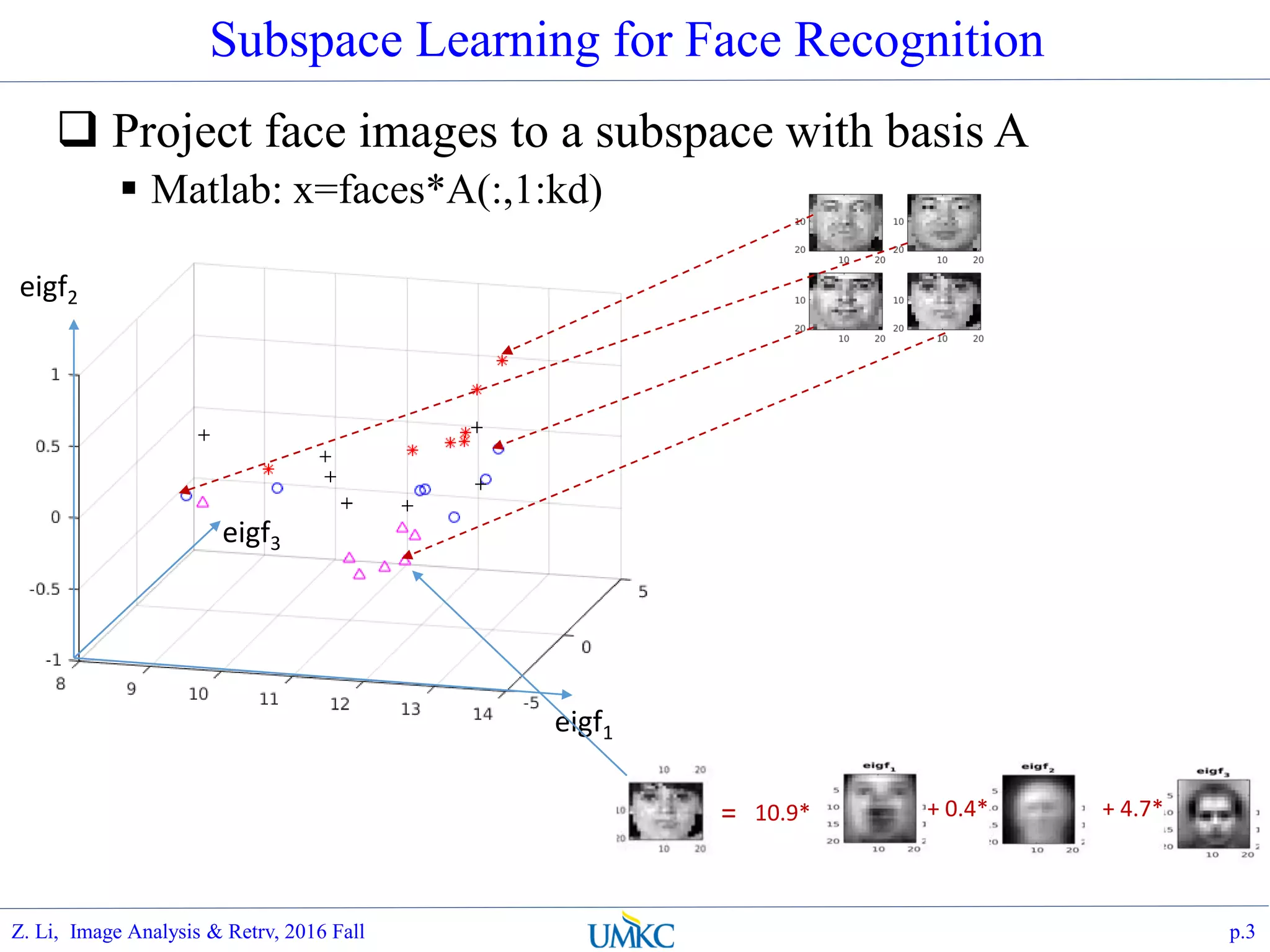
Subspace Learning for Face Recognition
 Project face images to a subspace with basis A
 Matlab: x=faces*A(:,1:kd)
eigf1
eigf2
eigf3
= 10.9* + 0.4* + 4.7*
p.3Z. Li, Image Analysis & Retrv, 2016 Fall
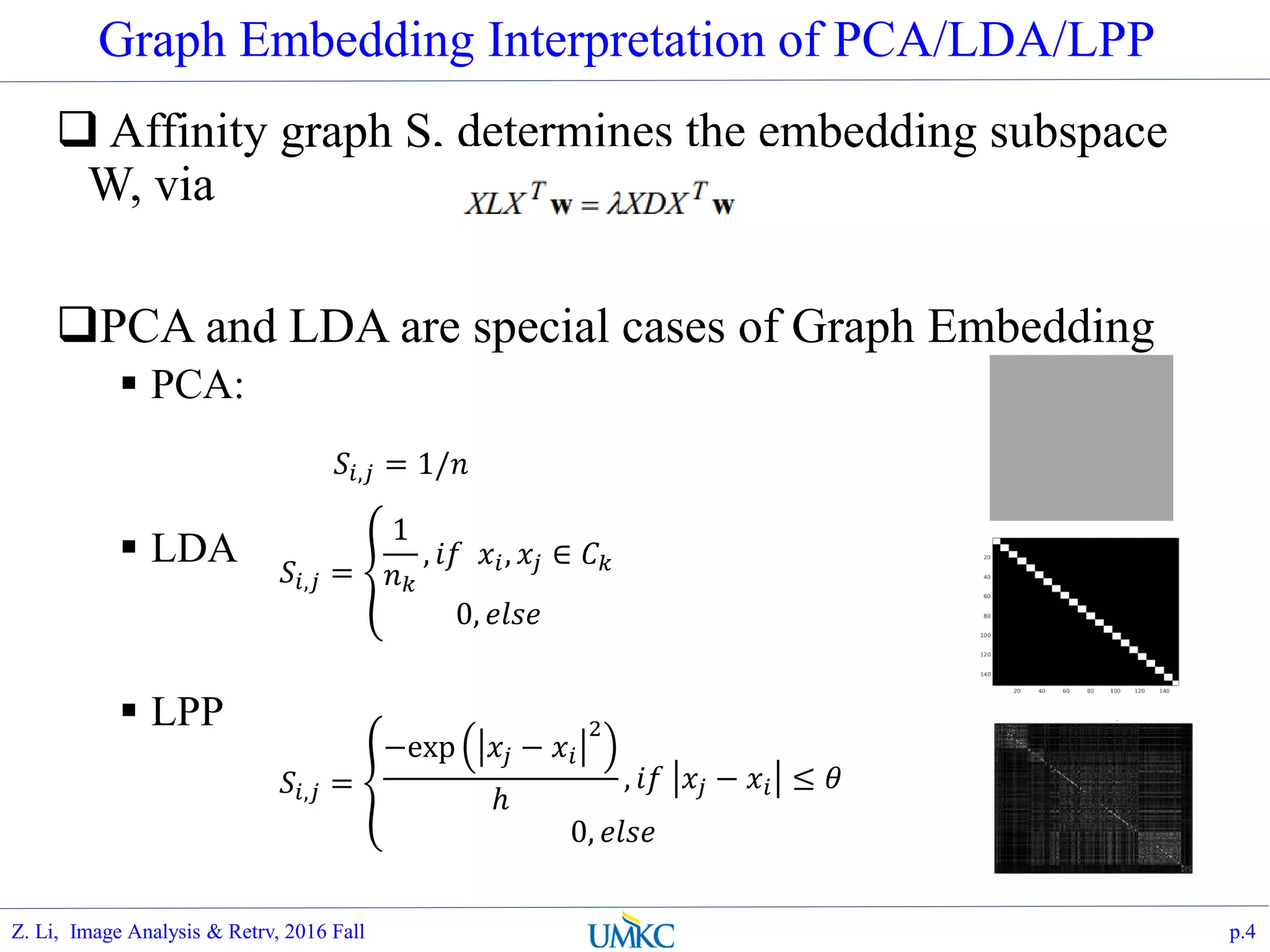
Graph Embedding Interpretation of PCA/LDA/LPP
 Affinity graph S, determines the embedding subspace
W, via
PCA and LDA are special cases of Graph Embedding
 PCA:
 LDA
 LPP
p.4
𝑆𝑖,𝑗 =
−exp 𝑥𝑗 − 𝑥𝑖
2
ℎ
, 𝑖𝑓 𝑥𝑗 − 𝑥𝑖 ≤ 𝜃
0, 𝑒𝑙𝑠𝑒
𝑆𝑖,𝑗 =
1
𝑛 𝑘
, 𝑖𝑓 𝑥𝑖, 𝑥𝑗 ∈ 𝐶 𝑘
0, 𝑒𝑙𝑠𝑒
𝑆𝑖,𝑗 = 1/𝑛
Z. Li, Image Analysis & Retrv, 2016 Fall
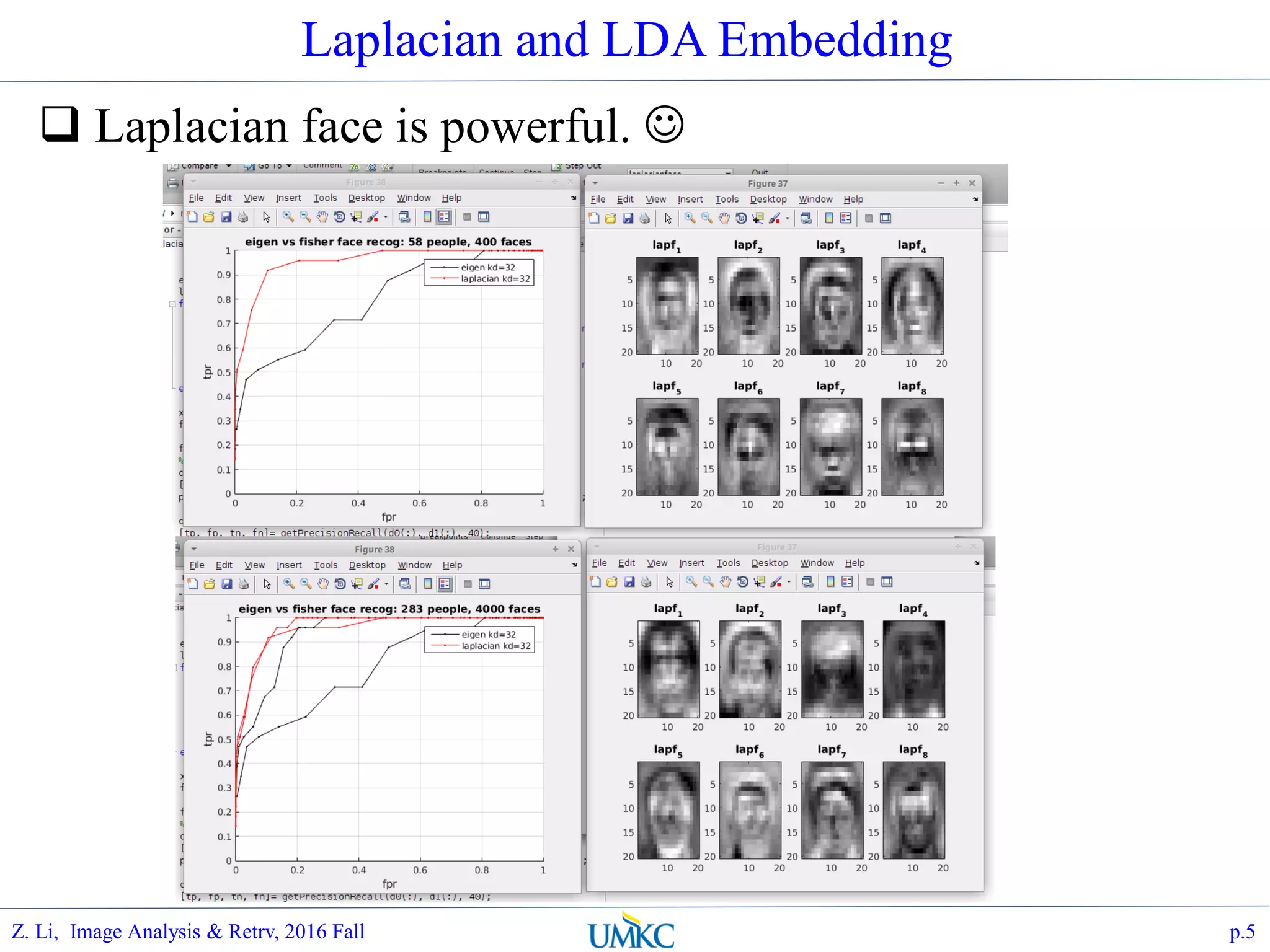
Laplacian and LDA Embedding
 Laplacian face is powerful. 
p.5Z. Li, Image Analysis & Retrv, 2016 Fall
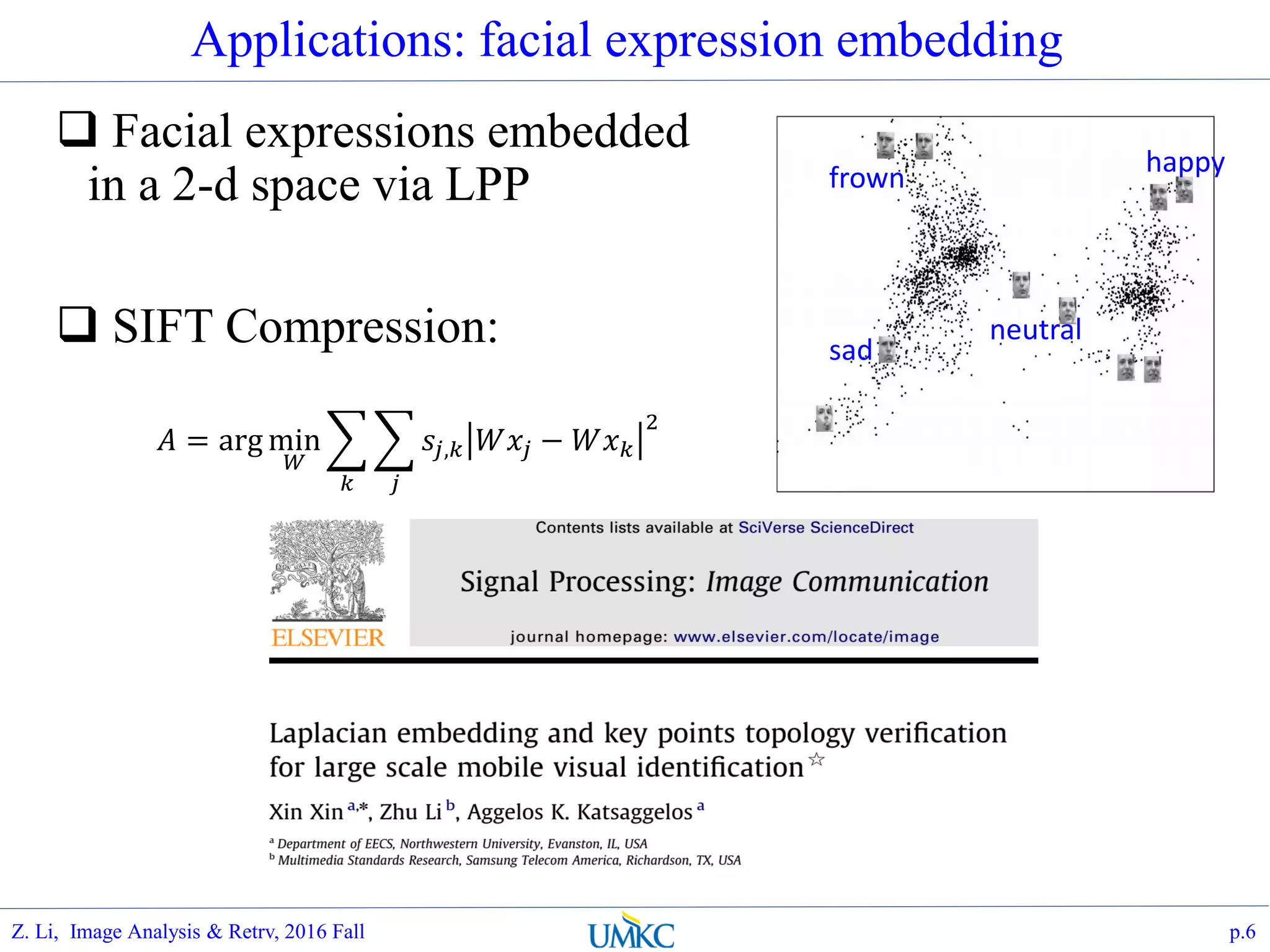
Applications: facial expression embedding
 Facial expressions embedded
in a 2-d space via LPP
 SIFT Compression:
p.6
frown
sad
happy
neutral
𝐴 = arg min
𝑊
𝑘 𝑗
𝑠𝑗,𝑘 𝑊𝑥𝑗 − 𝑊𝑥 𝑘
2
Z. Li, Image Analysis & Retrv, 2016 Fall
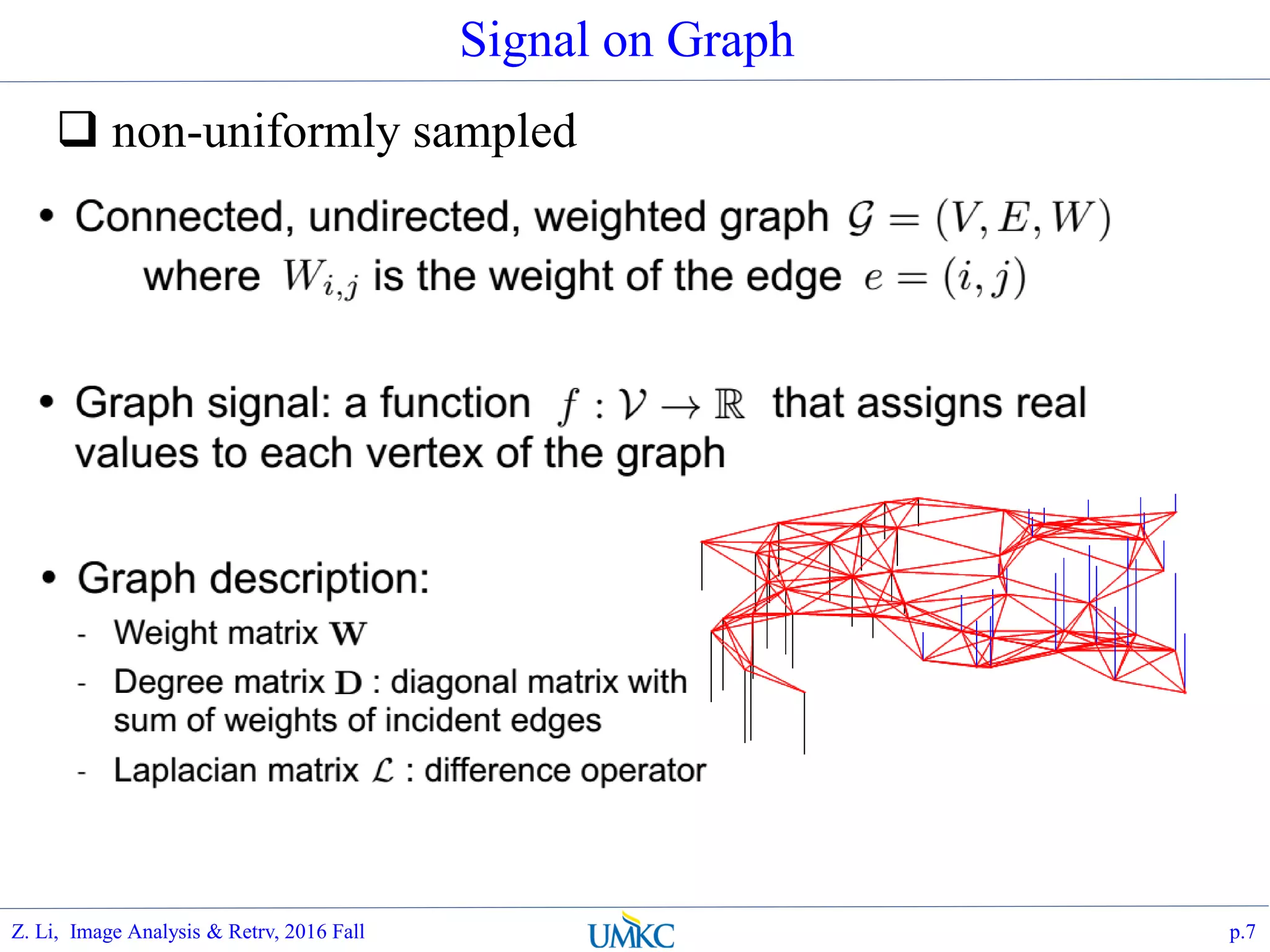
Signal on Graph
 non-uniformly sampled
p.7Z. Li, Image Analysis & Retrv, 2016 Fall
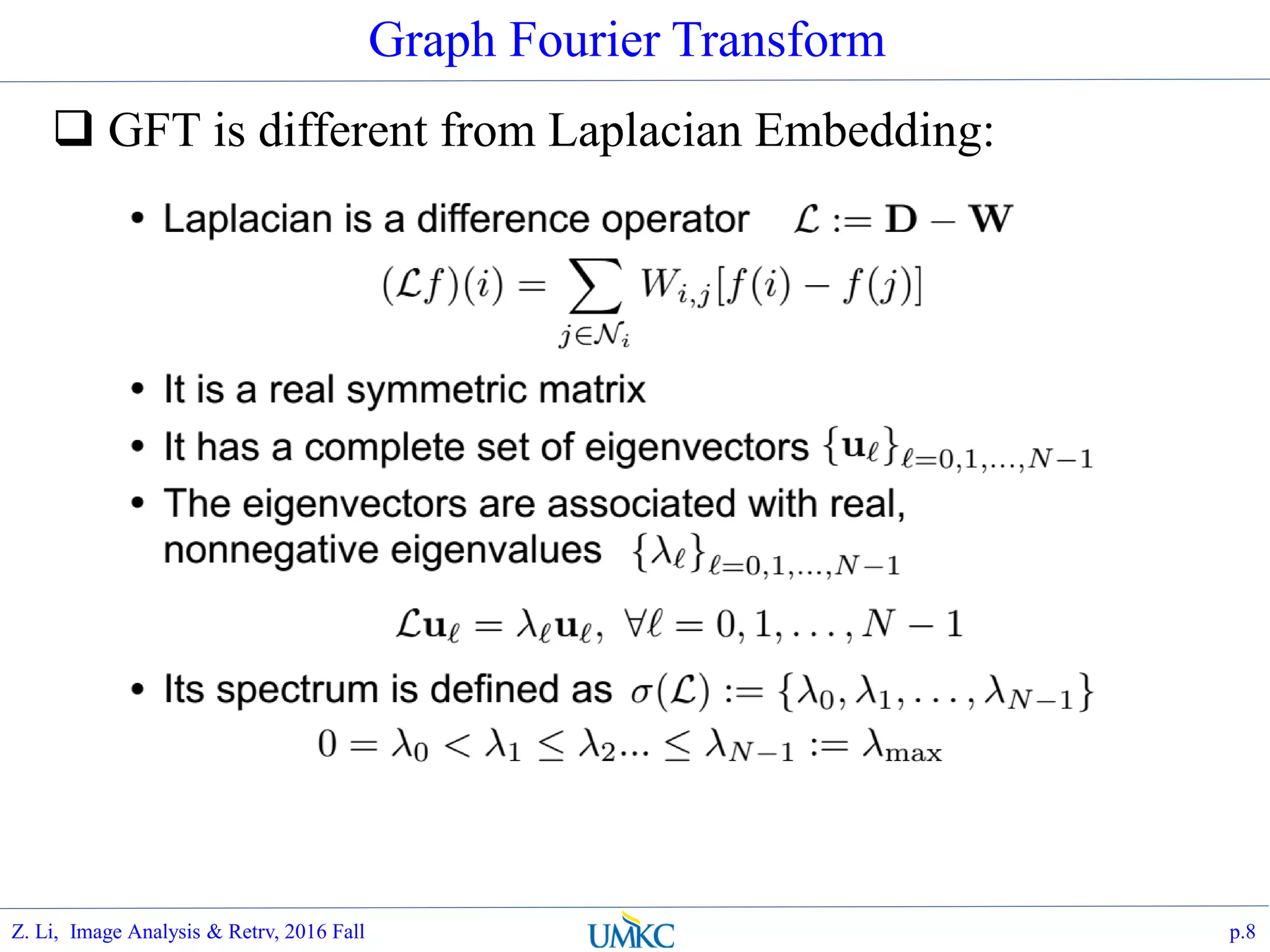
Graph Fourier Transform
 GFT is different from Laplacian Embedding:
p.8Z. Li, Image Analysis & Retrv, 2016 Fall
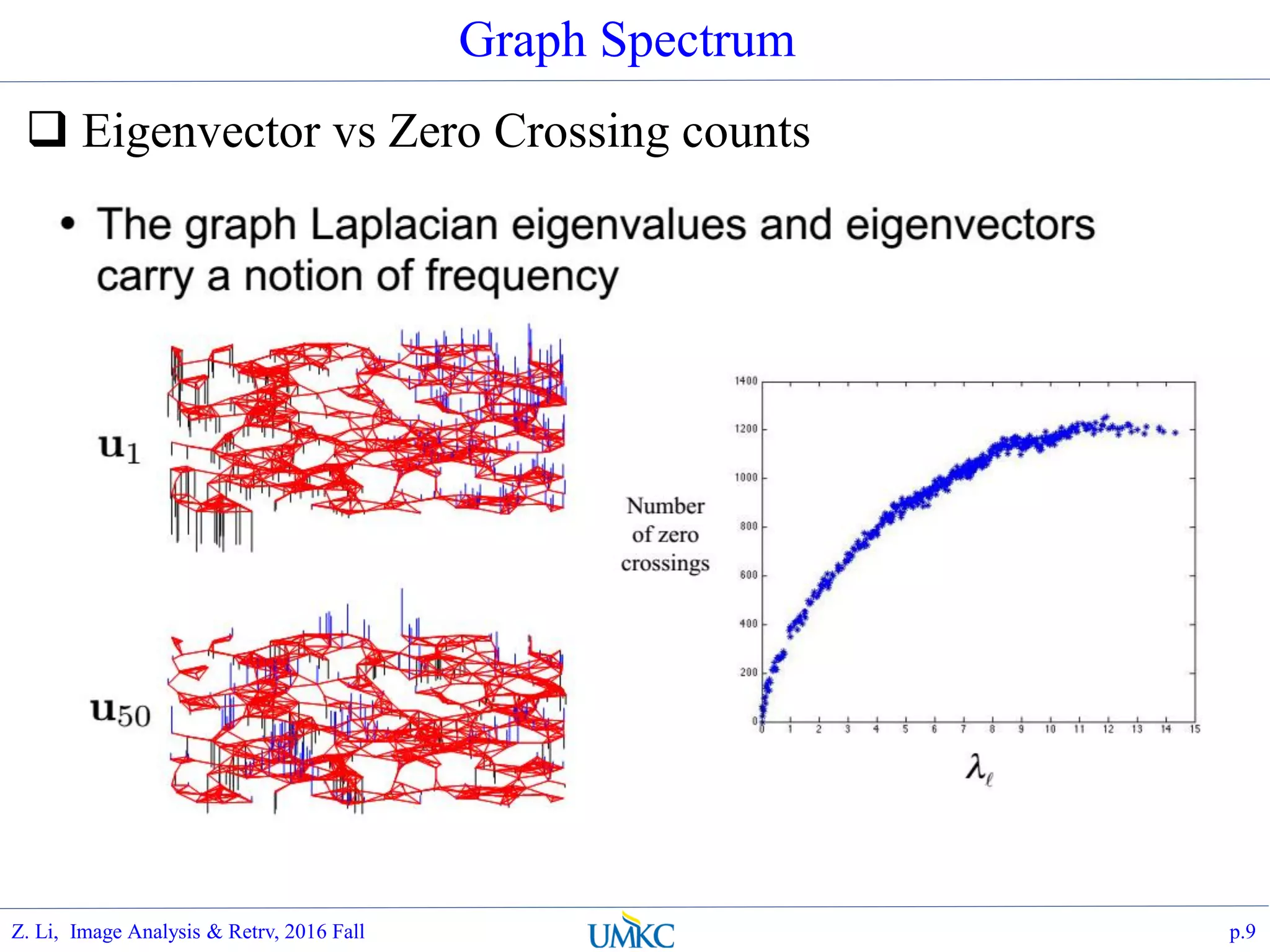
Graph Spectrum
 Eigenvector vs Zero Crossing counts
p.9Z. Li, Image Analysis & Retrv, 2016 Fall
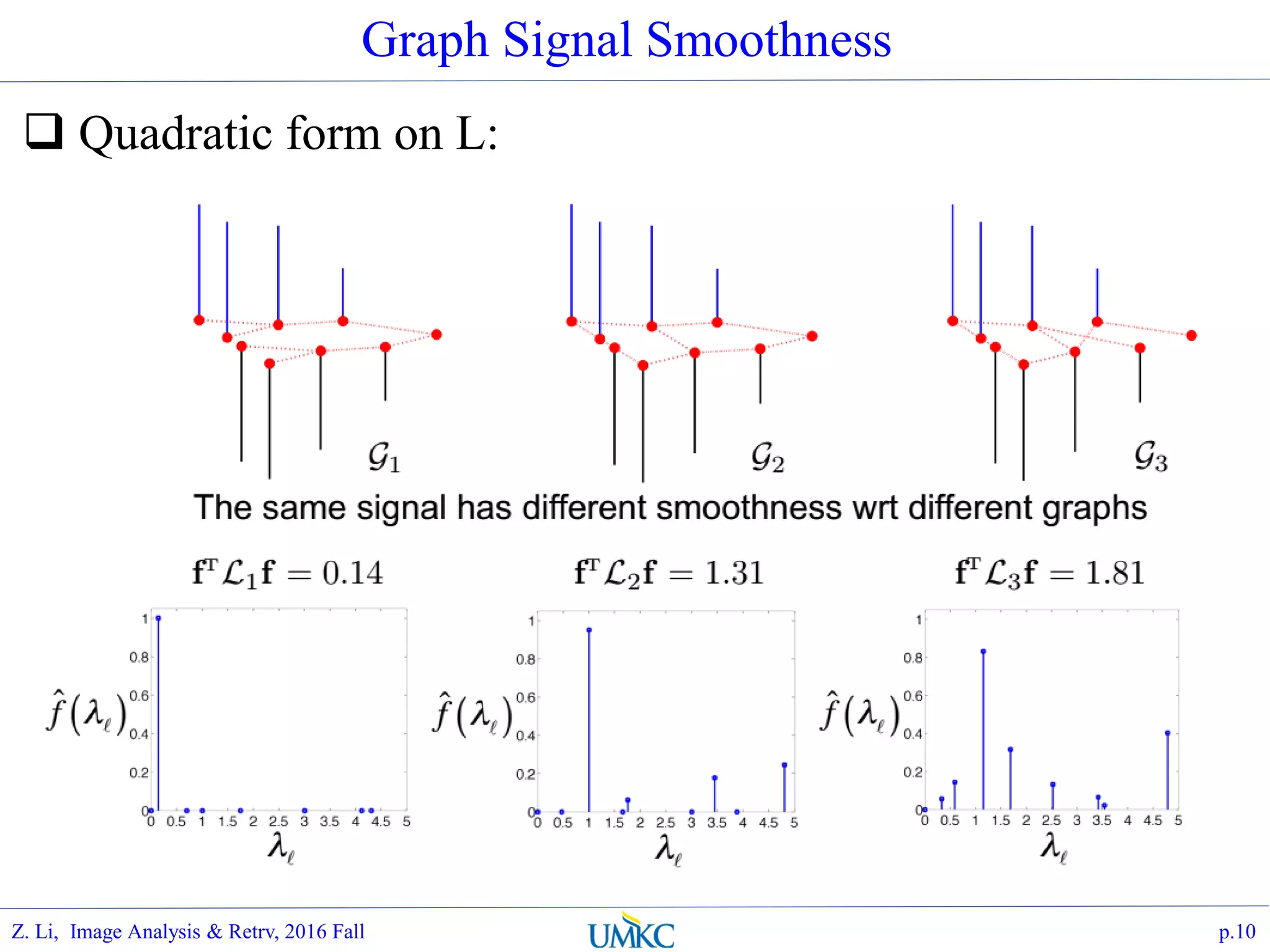
Graph Signal Smoothness
 Quadratic form on L:
p.10Z. Li, Image Analysis & Retrv, 2016 Fall
Outline
 Recap:
 Laplacianface
 Graph Fourier Transform
 Data Partition and Subspace Optimization
 Query Driven Solution
 Subspace Indexing on Grassmann Manifold
 Optimization of Subspace on Grassmann Manifold
Summary
p.11Z. Li, Image Analysis & Retrv, 2016 Fall
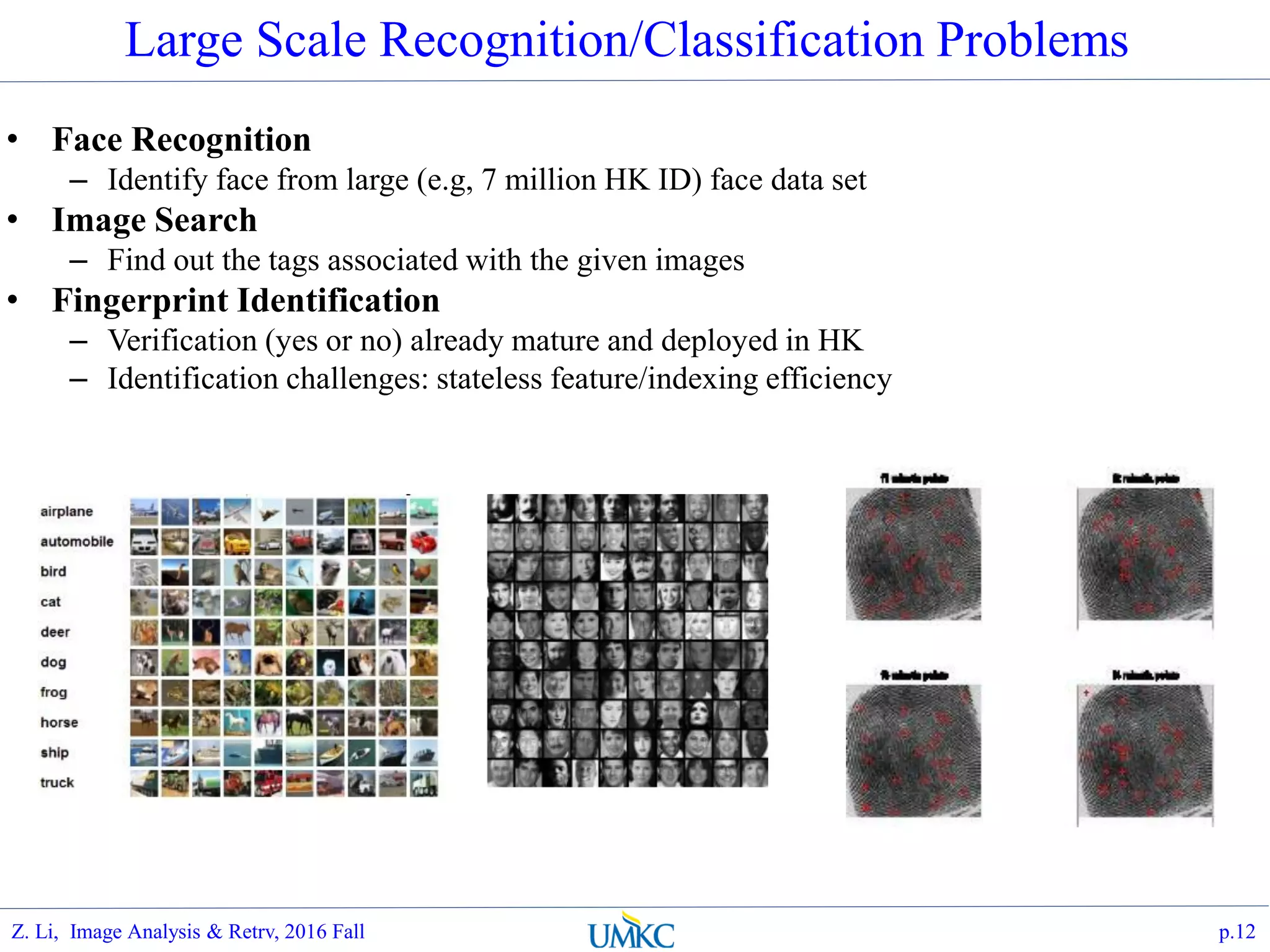
• Face Recognition
– Identify face from large (e.g, 7 million HK ID) face data set
• Image Search
– Find out the tags associated with the given images
• Fingerprint Identification
– Verification (yes or no) already mature and deployed in HK
– Identification challenges: stateless feature/indexing efficiency
Large Scale Recognition/Classification Problems
p.12Z. Li, Image Analysis & Retrv, 2016 Fall
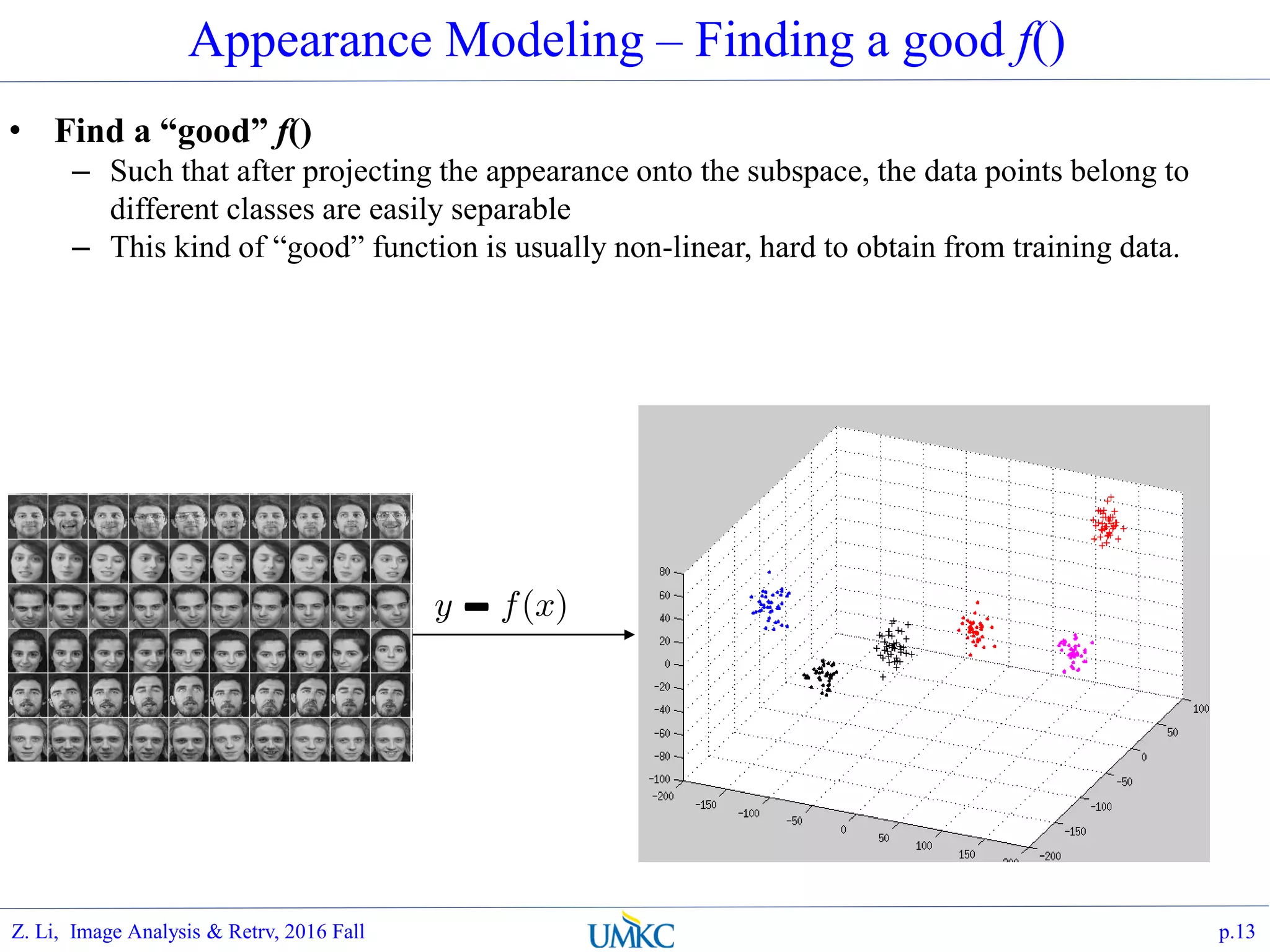
• Find a “good” f()
– Such that after projecting the appearance onto the subspace, the data points belong to
different classes are easily separable
– This kind of “good” function is usually non-linear, hard to obtain from training data.
Appearance Modeling – Finding a good f()
p.13Z. Li, Image Analysis & Retrv, 2016 Fall
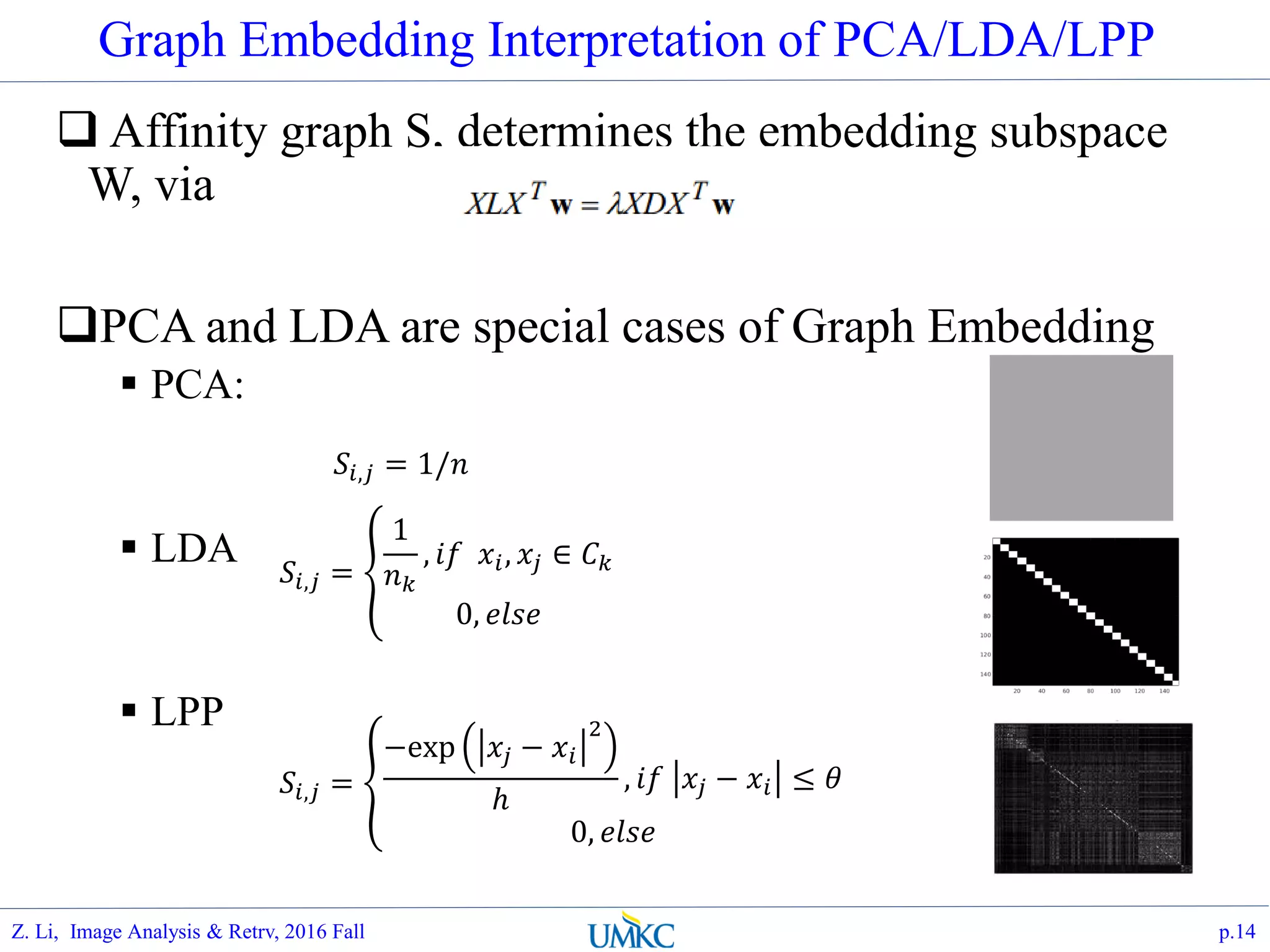
Graph Embedding Interpretation of PCA/LDA/LPP
 Affinity graph S, determines the embedding subspace
W, via
PCA and LDA are special cases of Graph Embedding
 PCA:
 LDA
 LPP
p.14
𝑆𝑖,𝑗 =
−exp 𝑥𝑗 − 𝑥𝑖
2
ℎ
, 𝑖𝑓 𝑥𝑗 − 𝑥𝑖 ≤ 𝜃
0, 𝑒𝑙𝑠𝑒
𝑆𝑖,𝑗 =
1
𝑛 𝑘
, 𝑖𝑓 𝑥𝑖, 𝑥𝑗 ∈ 𝐶 𝑘
0, 𝑒𝑙𝑠𝑒
𝑆𝑖,𝑗 = 1/𝑛
Z. Li, Image Analysis & Retrv, 2016 Fall
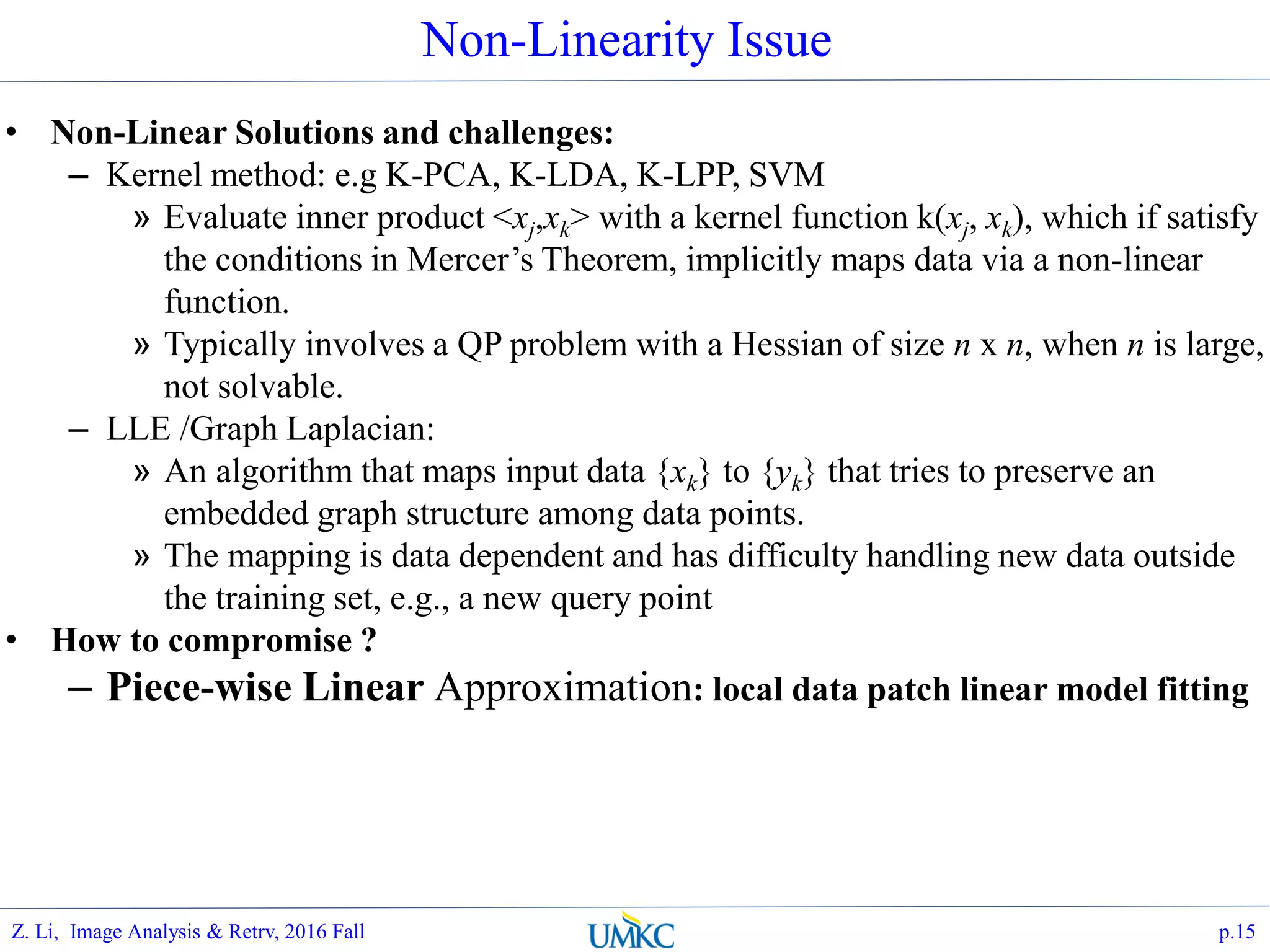
• Non-Linear Solutions and challenges:
– Kernel method: e.g K-PCA, K-LDA, K-LPP, SVM
» Evaluate inner product <xj,xk> with a kernel function k(xj, xk), which if satisfy
the conditions in Mercer’s Theorem, implicitly maps data via a non-linear
function.
» Typically involves a QP problem with a Hessian of size n x n, when n is large,
not solvable.
– LLE /Graph Laplacian:
» An algorithm that maps input data {xk} to {yk} that tries to preserve an
embedded graph structure among data points.
» The mapping is data dependent and has difficulty handling new data outside
the training set, e.g., a new query point
• How to compromise ?
– Piece-wise Linear Approximation: local data patch linear model fitting
Non-Linearity Issue
p.15Z. Li, Image Analysis & Retrv, 2016 Fall
Piece-wise Linear : Query Driven
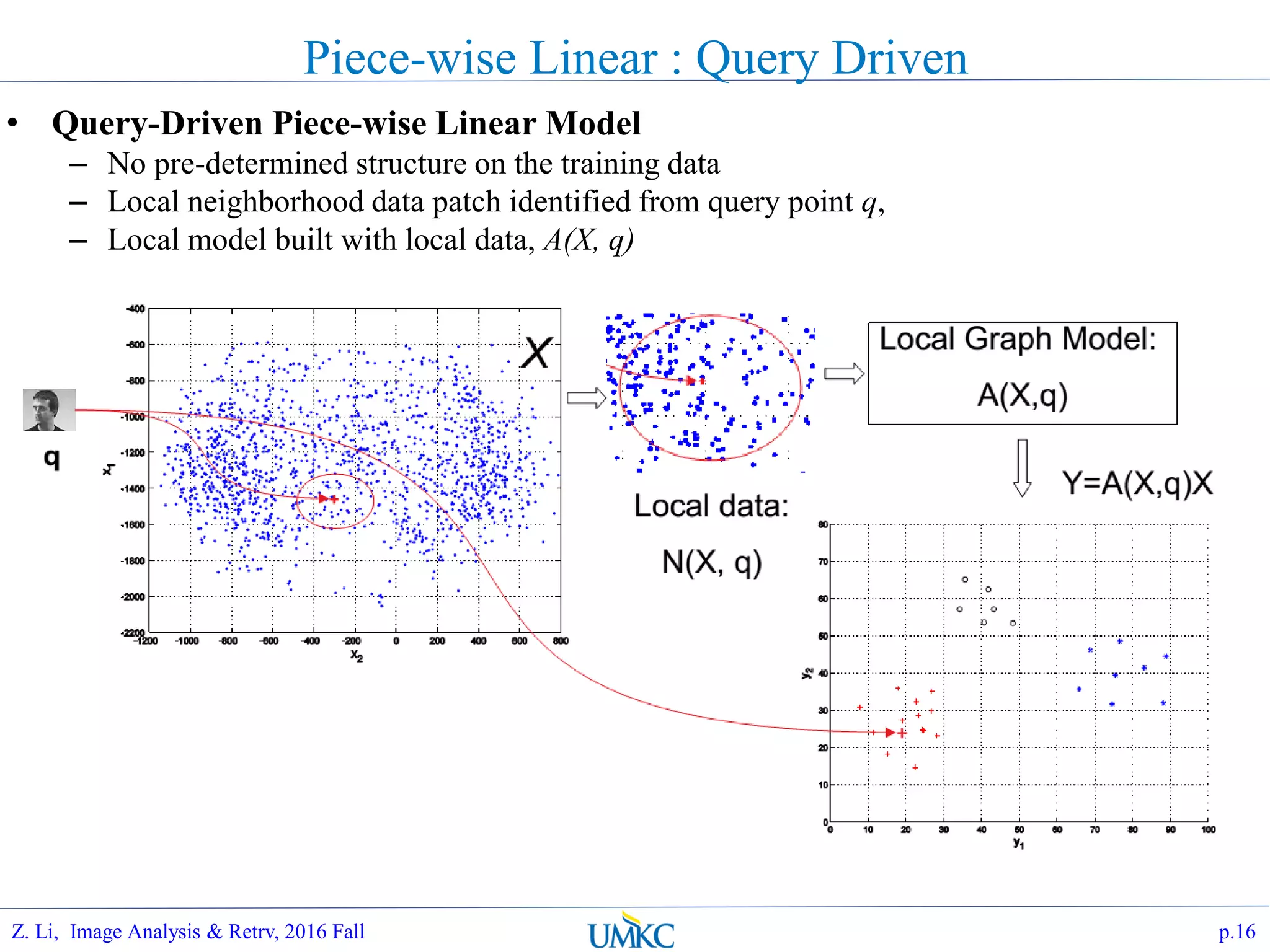
• Query-Driven Piece-wise Linear Model
– No pre-determined structure on the training data
– Local neighborhood data patch identified from query point q,
– Local model built with local data, A(X, q)
p.16Z. Li, Image Analysis & Retrv, 2016 Fall
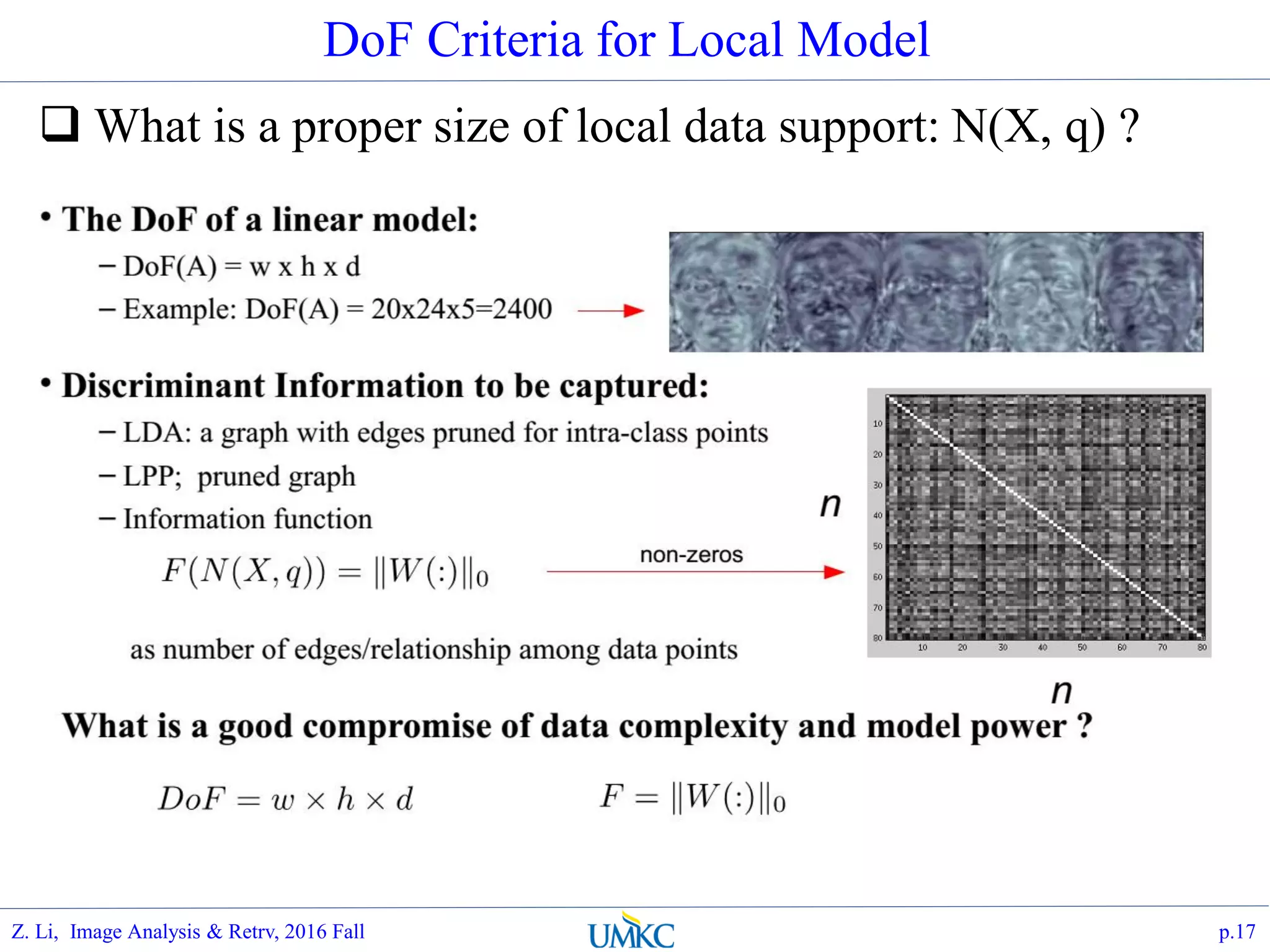
DoF Criteria for Local Model
 What is a proper size of local data support: N(X, q) ?
p.17Z. Li, Image Analysis & Retrv, 2016 Fall
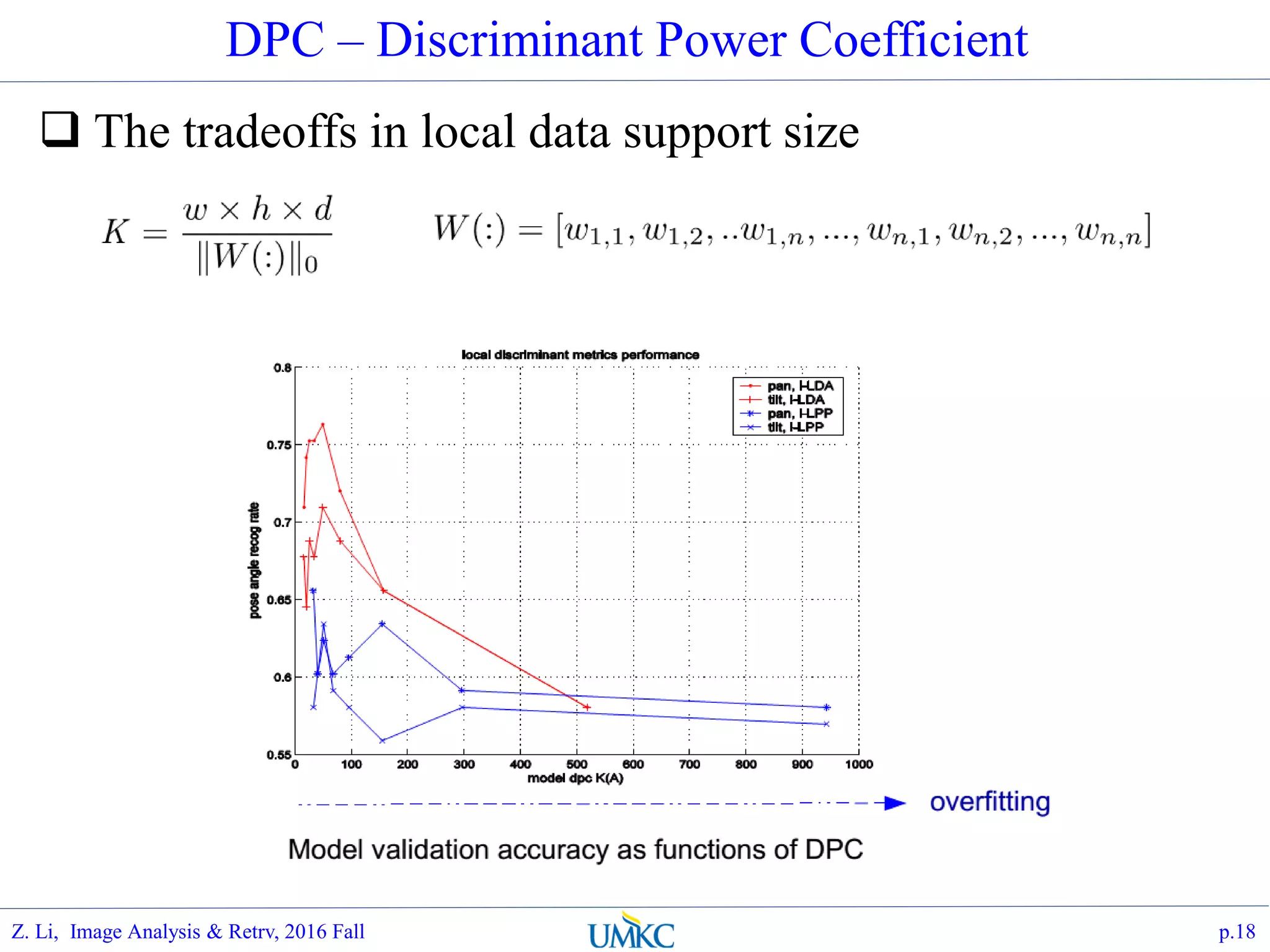
DPC – Discriminant Power Coefficient
 The tradeoffs in local data support size
p.18Z. Li, Image Analysis & Retrv, 2016 Fall
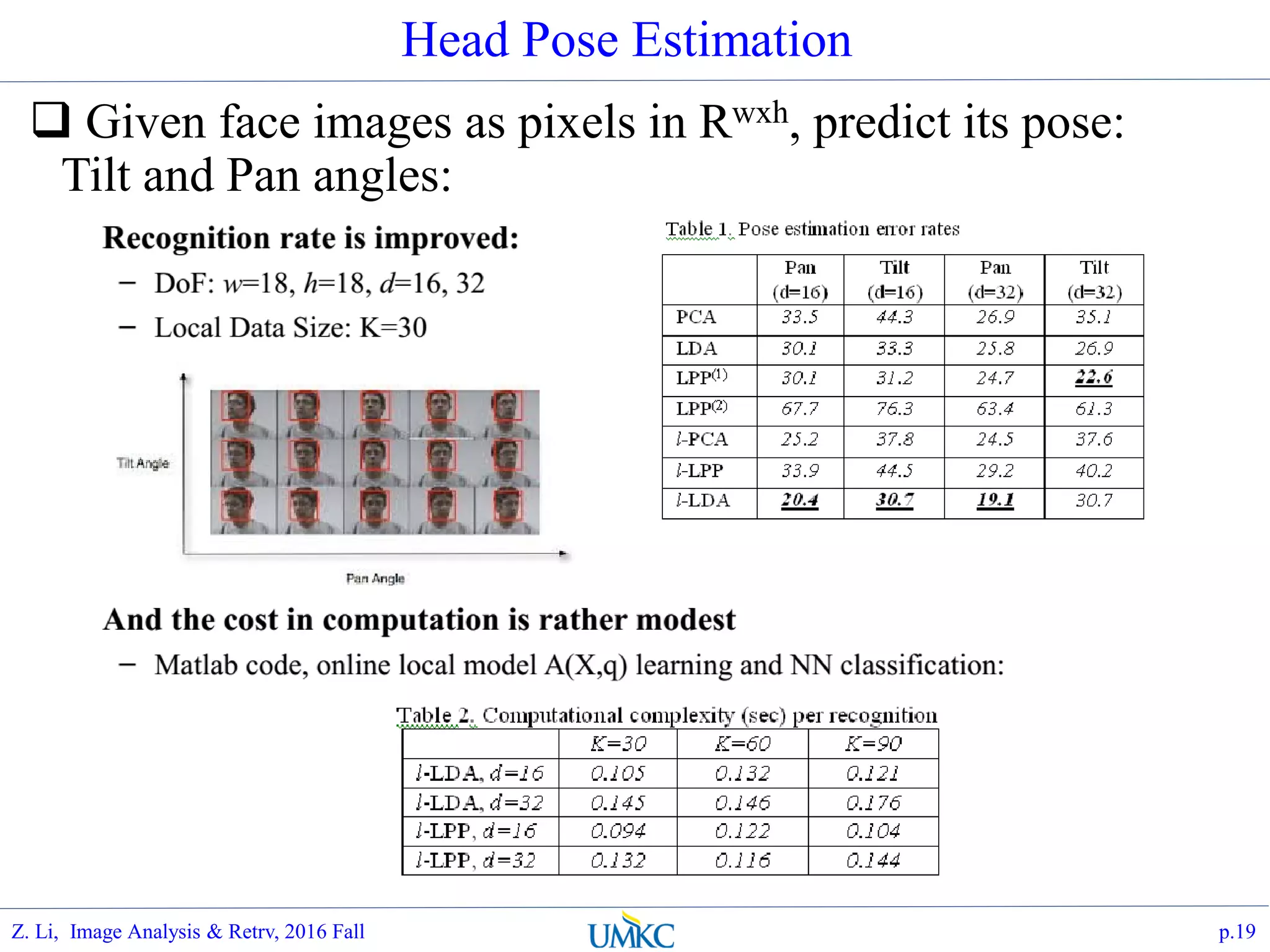
Head Pose Estimation
 Given face images as pixels in Rwxh, predict its pose:
Tilt and Pan angles:
p.19Z. Li, Image Analysis & Retrv, 2016 Fall
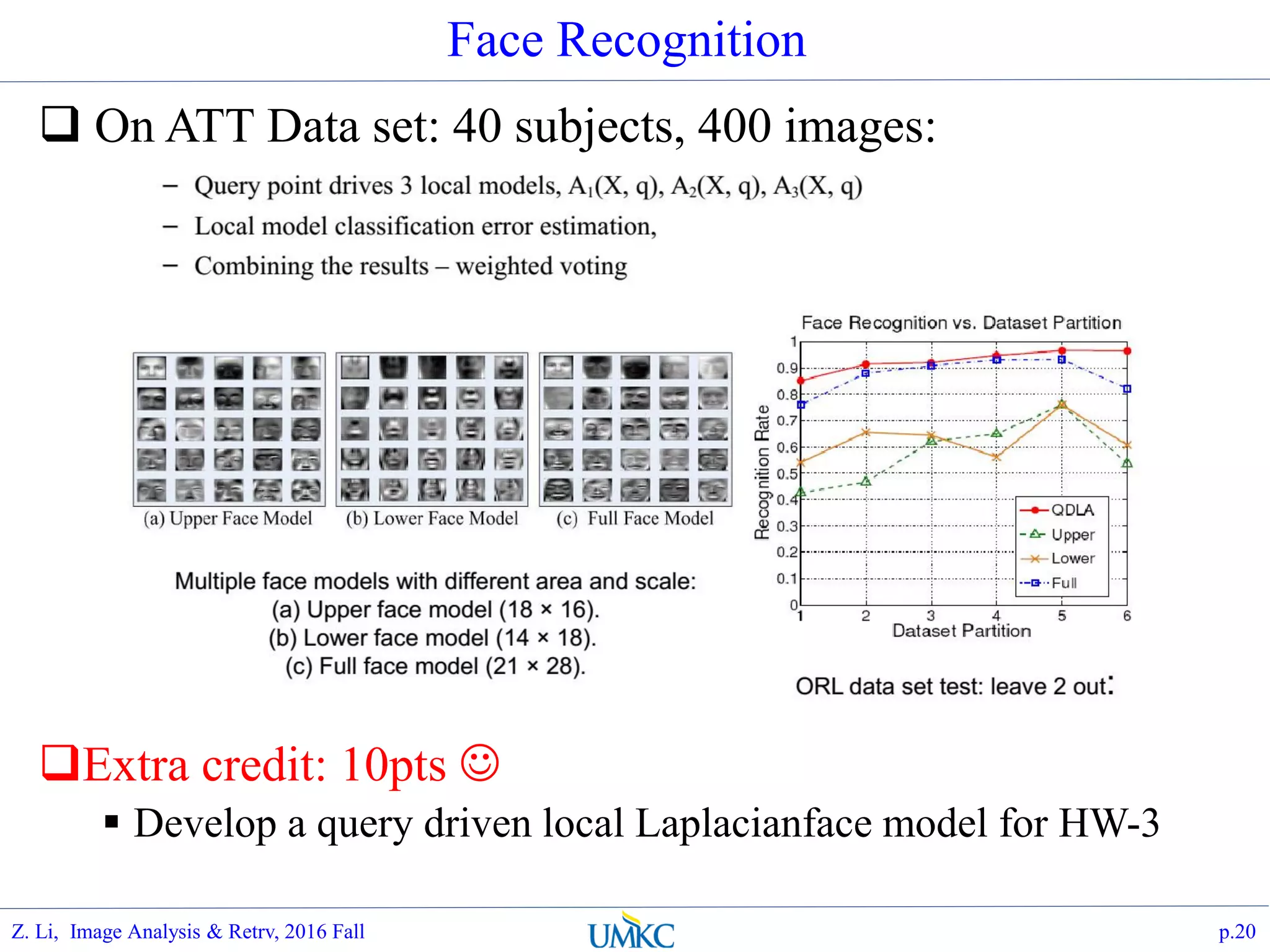
Face Recognition
 On ATT Data set: 40 subjects, 400 images:
Extra credit: 10pts 
 Develop a query driven local Laplacianface model for HW-3
p.20Z. Li, Image Analysis & Retrv, 2016 Fall
Summary of Query Driven Local Models
The Good:
 Allows for local data adaptation, solid gains in classification
 Problem size is d x d, (vs kernel method, which is n x n, not scaling
well )
 The Bad:
 Data driven: need to compute a run-time model that adds
computational complexity
 The Ugly:
 Storage Penalty: need extra storage to store all training data,
because the local NN data, patch is generated at run time, as
function of the query point
 Indexing challenge: for very large scale problem, not practical to
store all training data, and effective indexing needed to support
efficient access of query induced local training
data.
 Question:
 Can we do better ?
p.21Z. Li, Image Analysis & Retrv, 2016 Fall
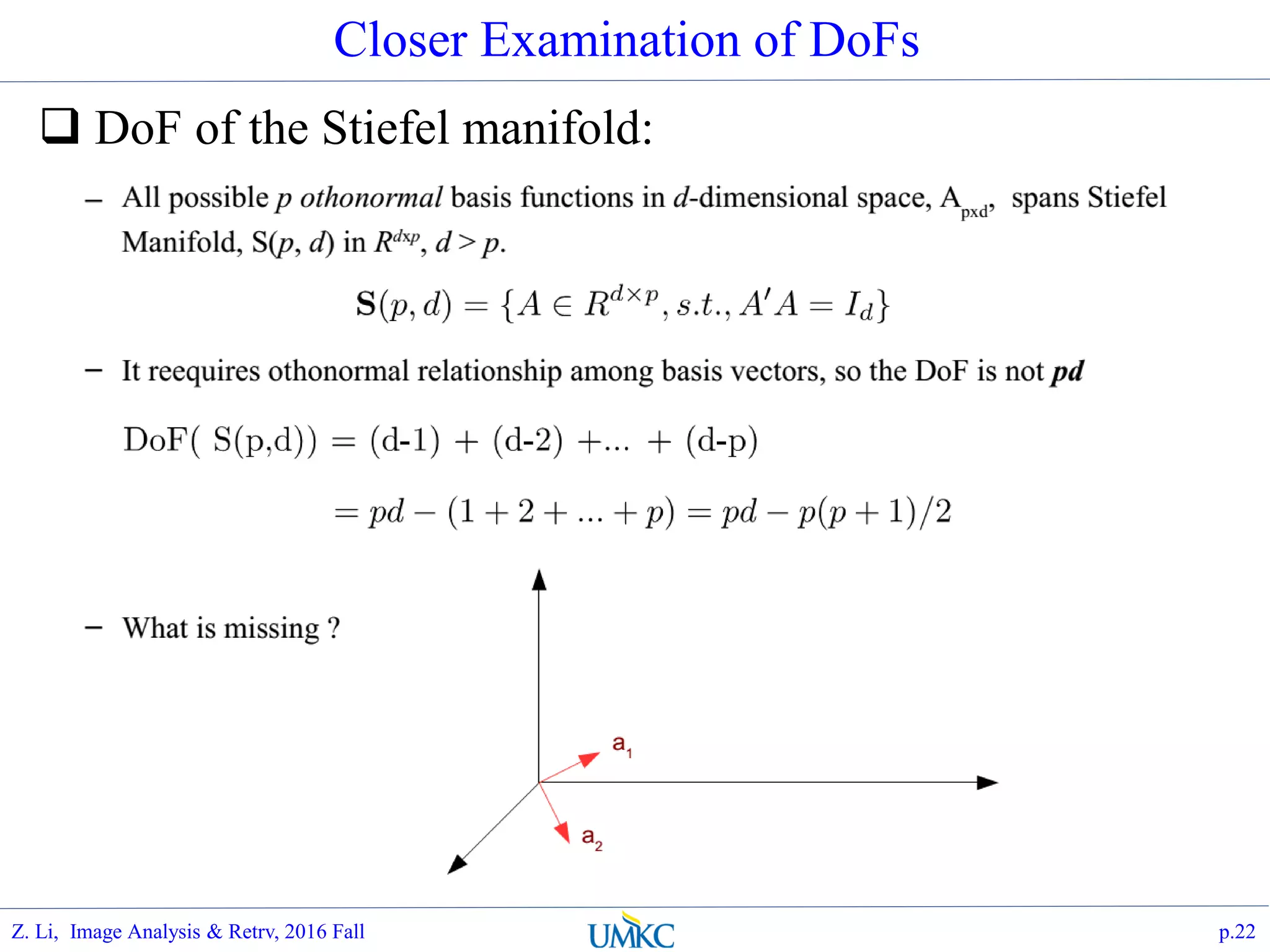
Closer Examination of DoFs
 DoF of the Stiefel manifold:
p.22Z. Li, Image Analysis & Retrv, 2016 Fall
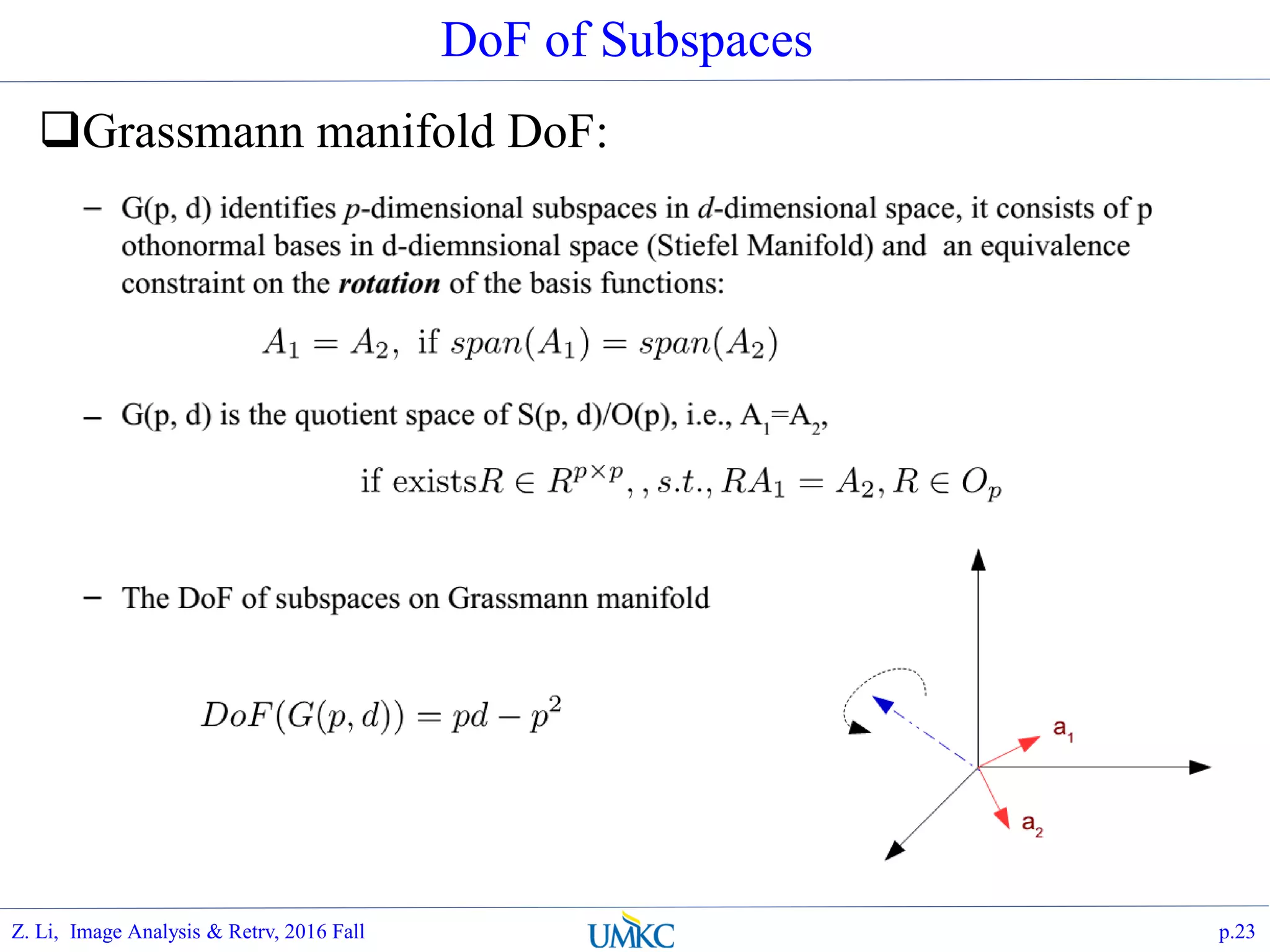
DoF of Subspaces
Grassmann manifold DoF:
p.23Z. Li, Image Analysis & Retrv, 2016 Fall
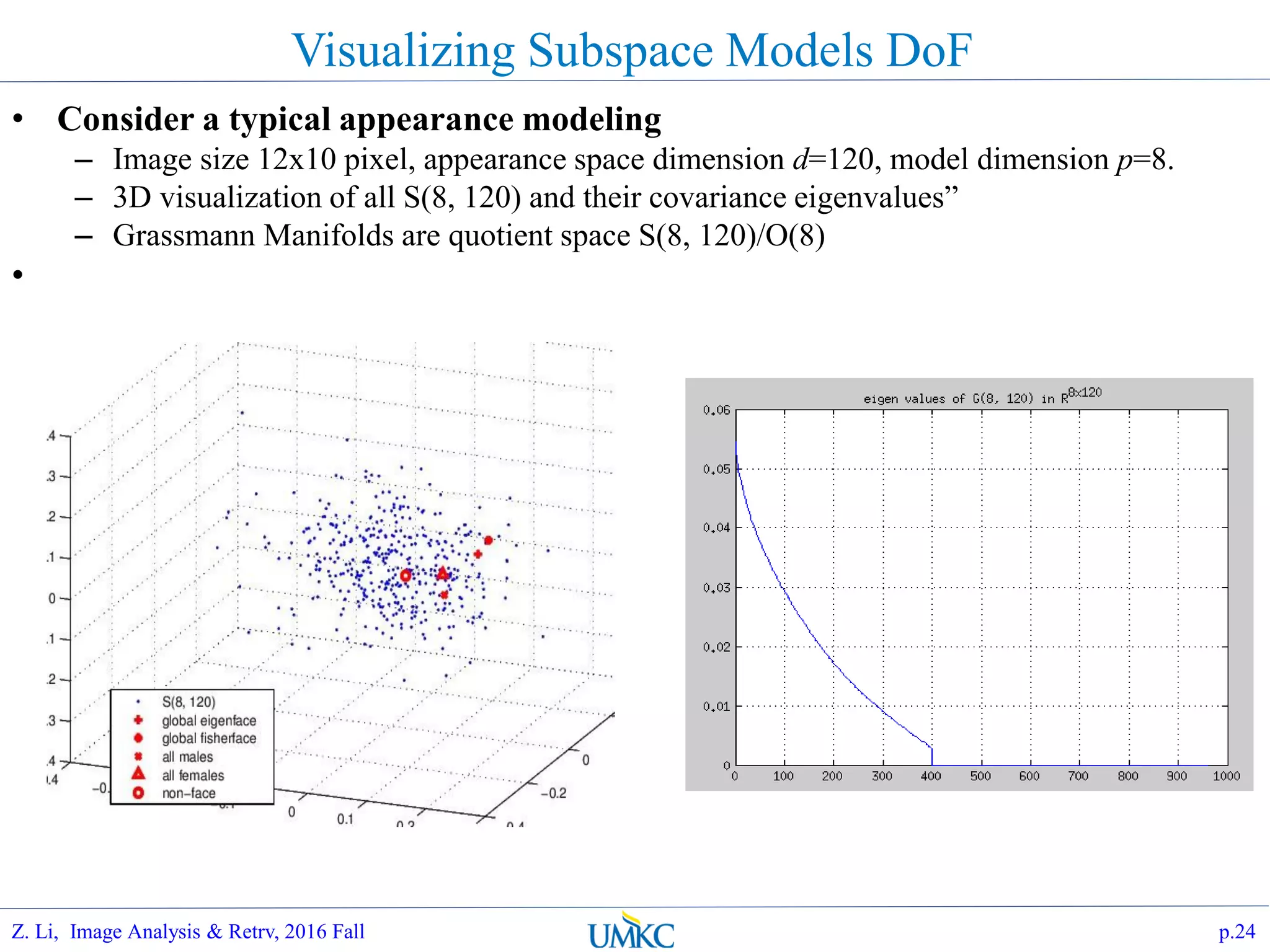
Visualizing Subspace Models DoF
• Consider a typical appearance modeling
– Image size 12x10 pixel, appearance space dimension d=120, model dimension p=8.
– 3D visualization of all S(8, 120) and their covariance eigenvalues”
– Grassmann Manifolds are quotient space S(8, 120)/O(8)
•
p.24Z. Li, Image Analysis & Retrv, 2016 Fall
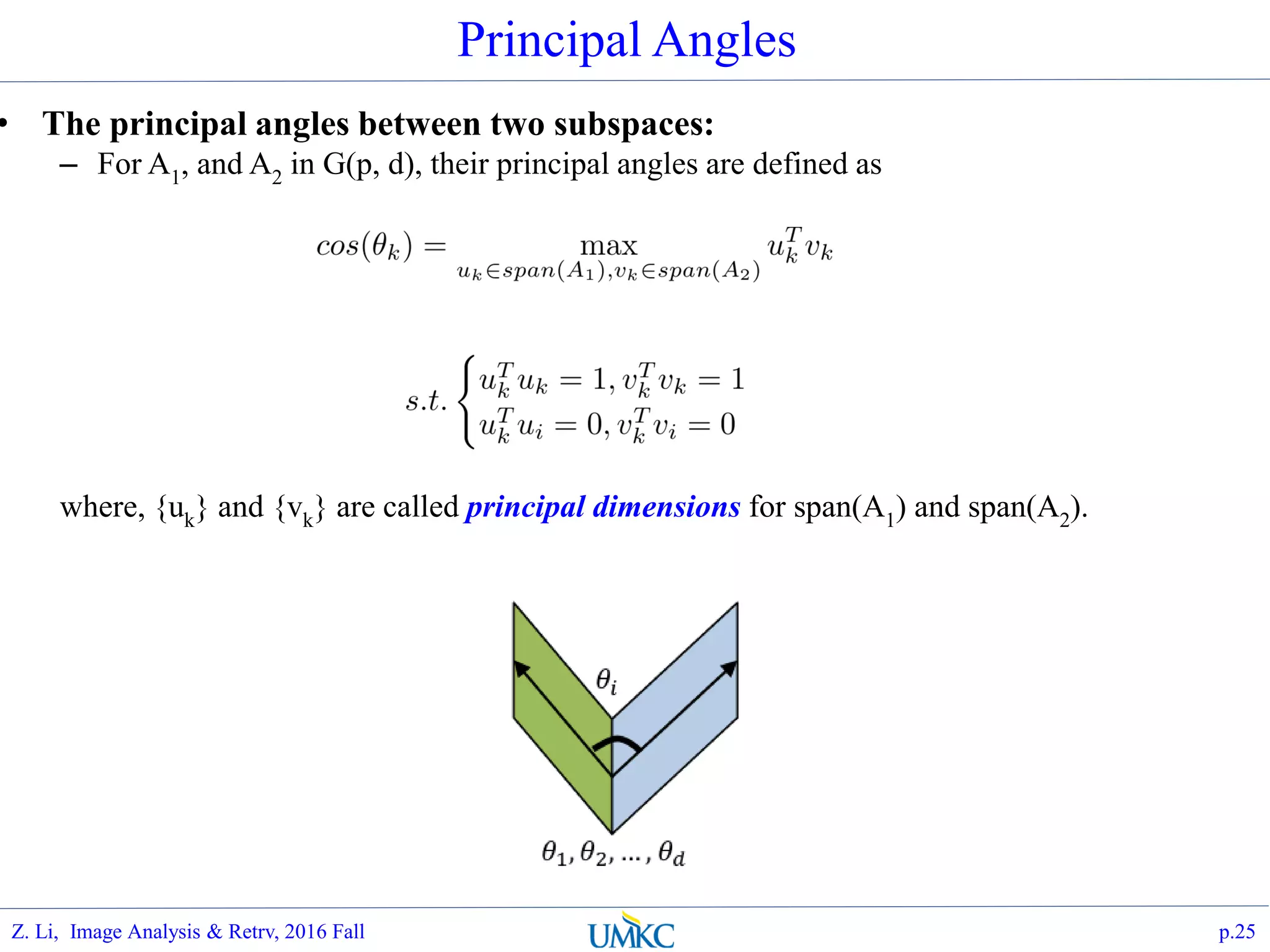
• The principal angles between two subspaces:
– For A1, and A2 in G(p, d), their principal angles are defined as
where, {uk} and {vk} are called principal dimensions for span(A1) and span(A2).
Principal Angles
p.25Z. Li, Image Analysis & Retrv, 2016 Fall
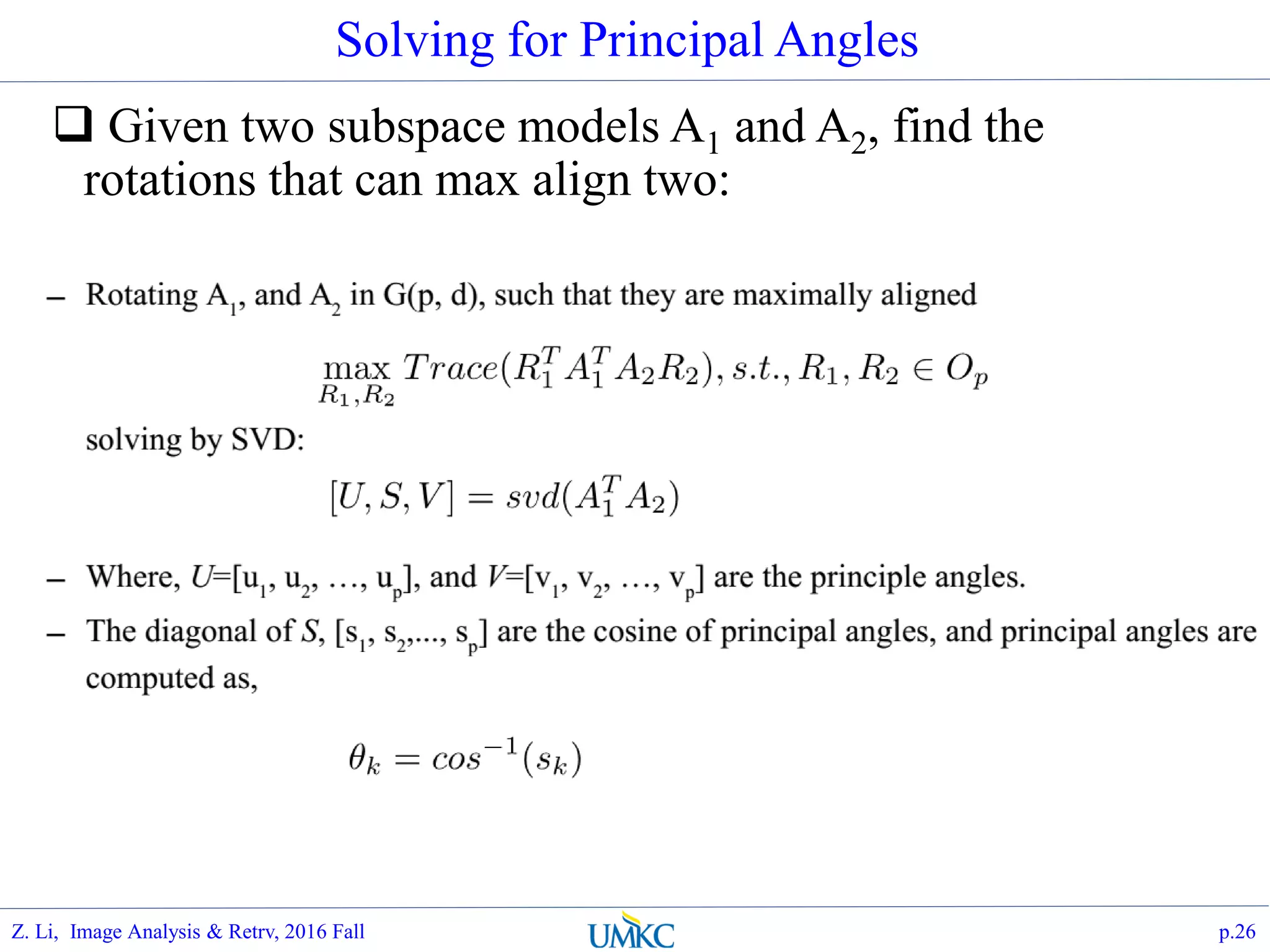
Solving for Principal Angles
 Given two subspace models A1 and A2, find the
rotations that can max align two:
p.26Z. Li, Image Analysis & Retrv, 2016 Fall
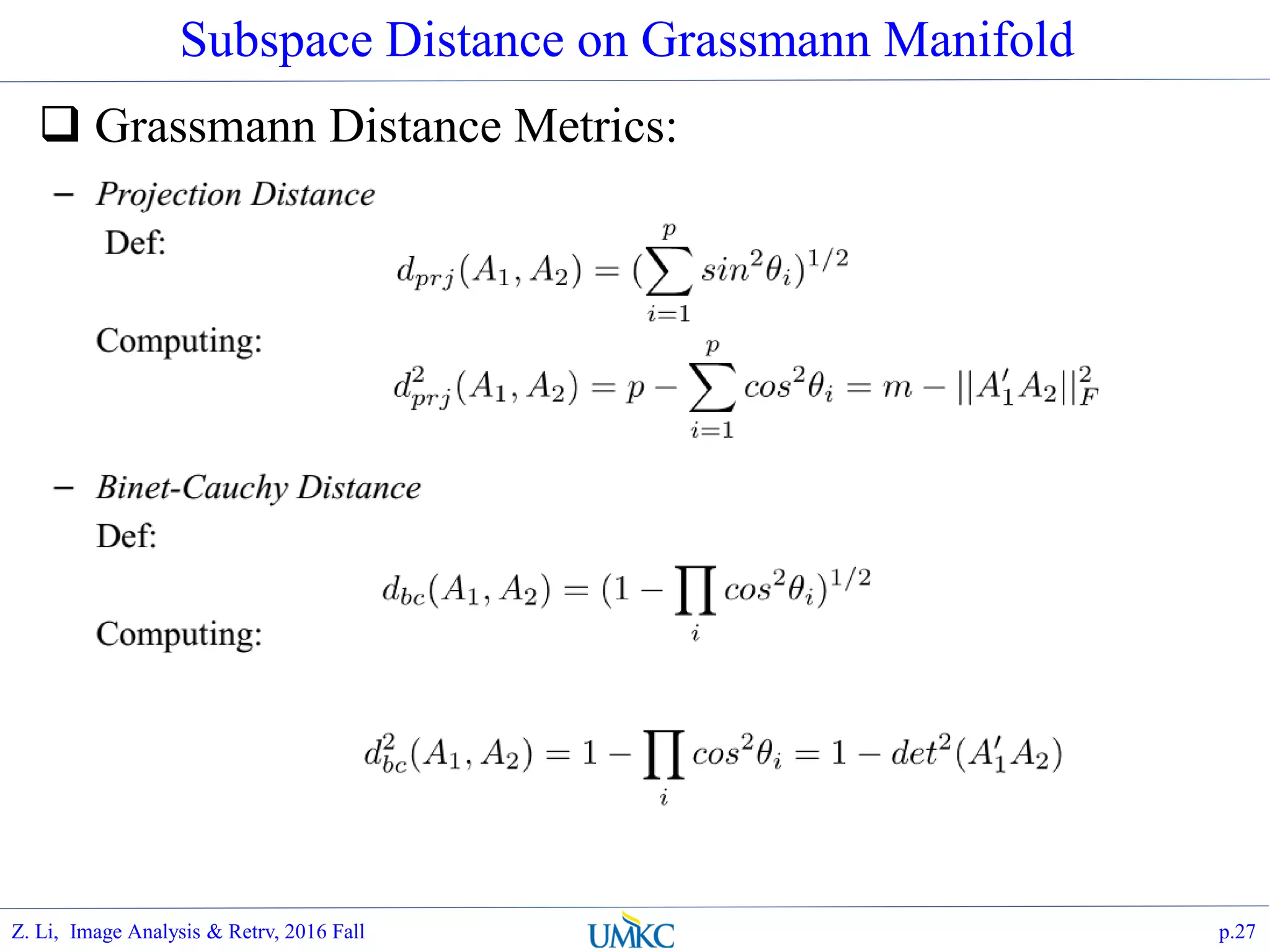
Subspace Distance on Grassmann Manifold
 Grassmann Distance Metrics:
p.27Z. Li, Image Analysis & Retrv, 2016 Fall
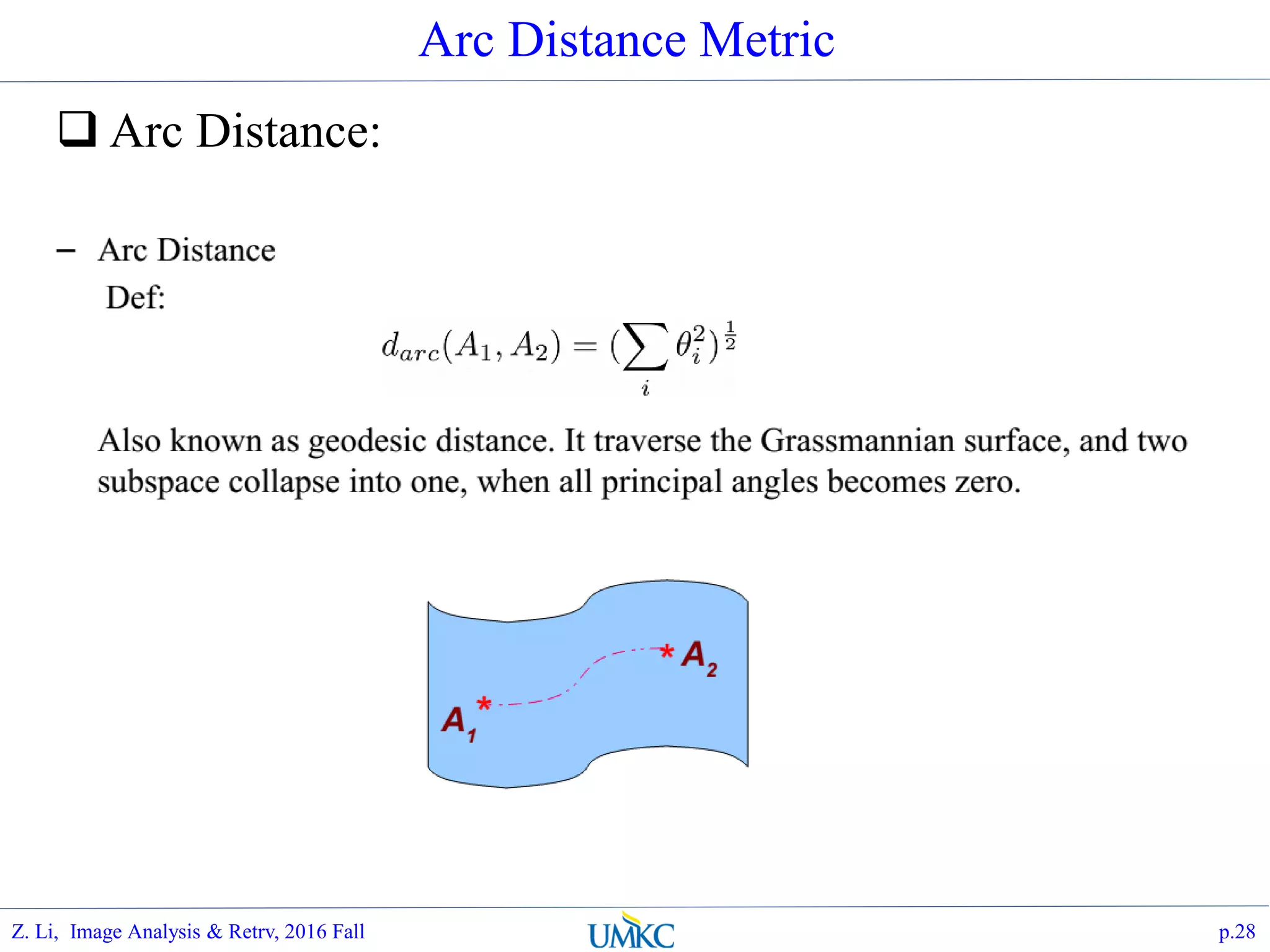
Arc Distance Metric
 Arc Distance:
p.28Z. Li, Image Analysis & Retrv, 2016 Fall
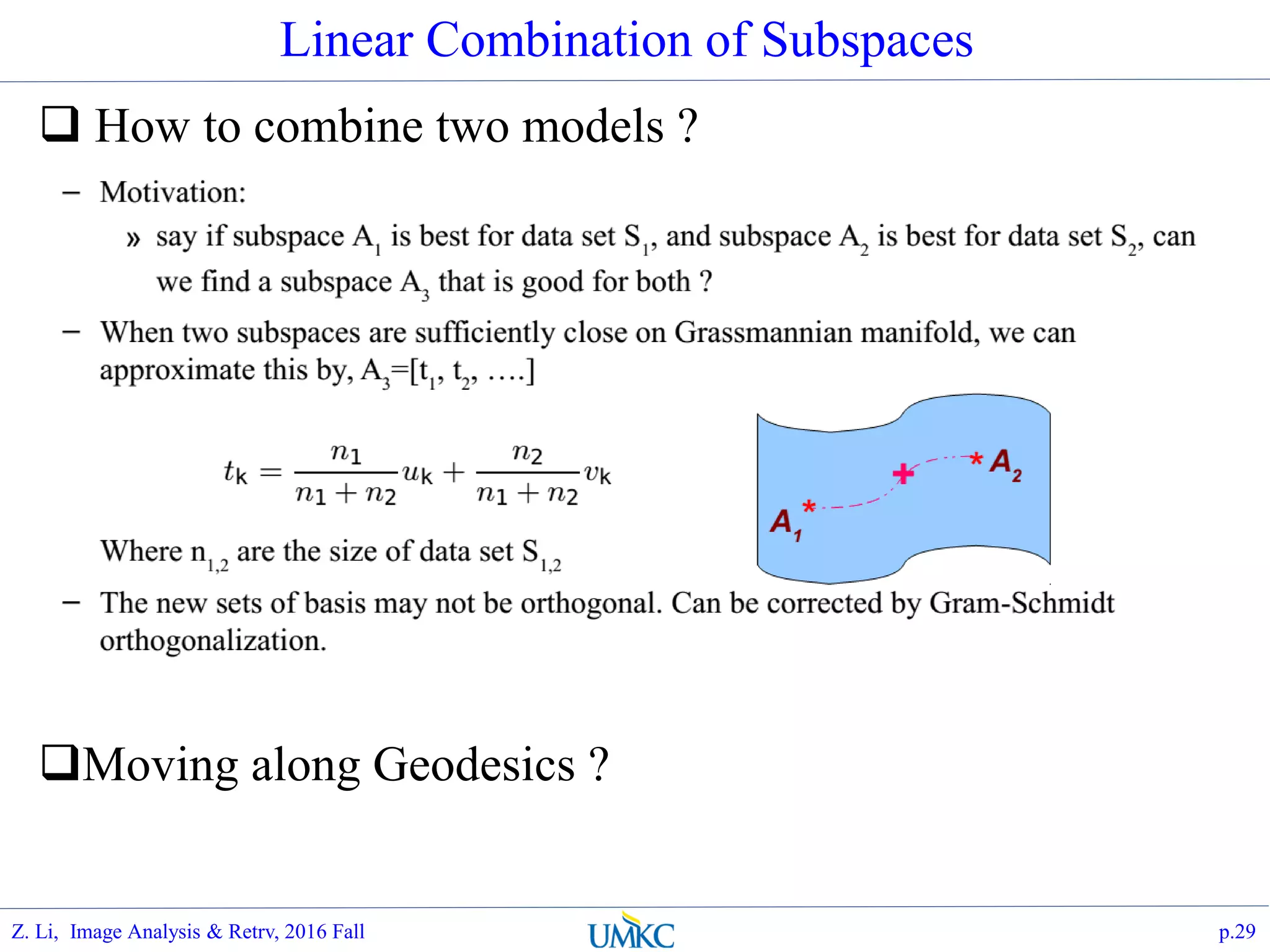
Linear Combination of Subspaces
 How to combine two models ?
Moving along Geodesics ?
p.29Z. Li, Image Analysis & Retrv, 2016 Fall
Training Data Set Partition
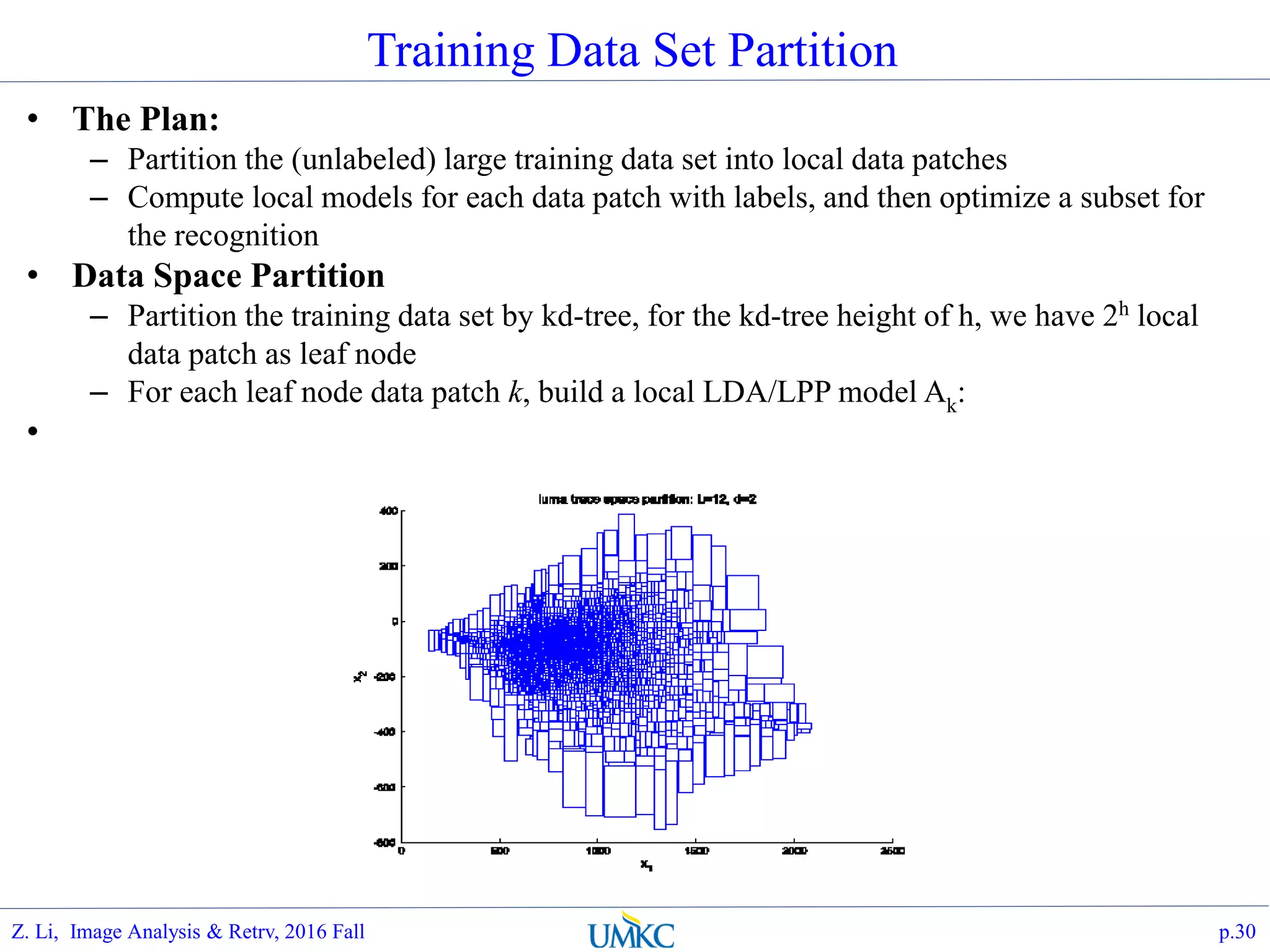
• The Plan:
– Partition the (unlabeled) large training data set into local data patches
– Compute local models for each data patch with labels, and then optimize a subset for
the recognition
• Data Space Partition
– Partition the training data set by kd-tree, for the kd-tree height of h, we have 2h
local
data patch as leaf node
– For each leaf node data patch k, build a local LDA/LPP model Ak:
•
p.30Z. Li, Image Analysis & Retrv, 2016 Fall
Subspace Indexing
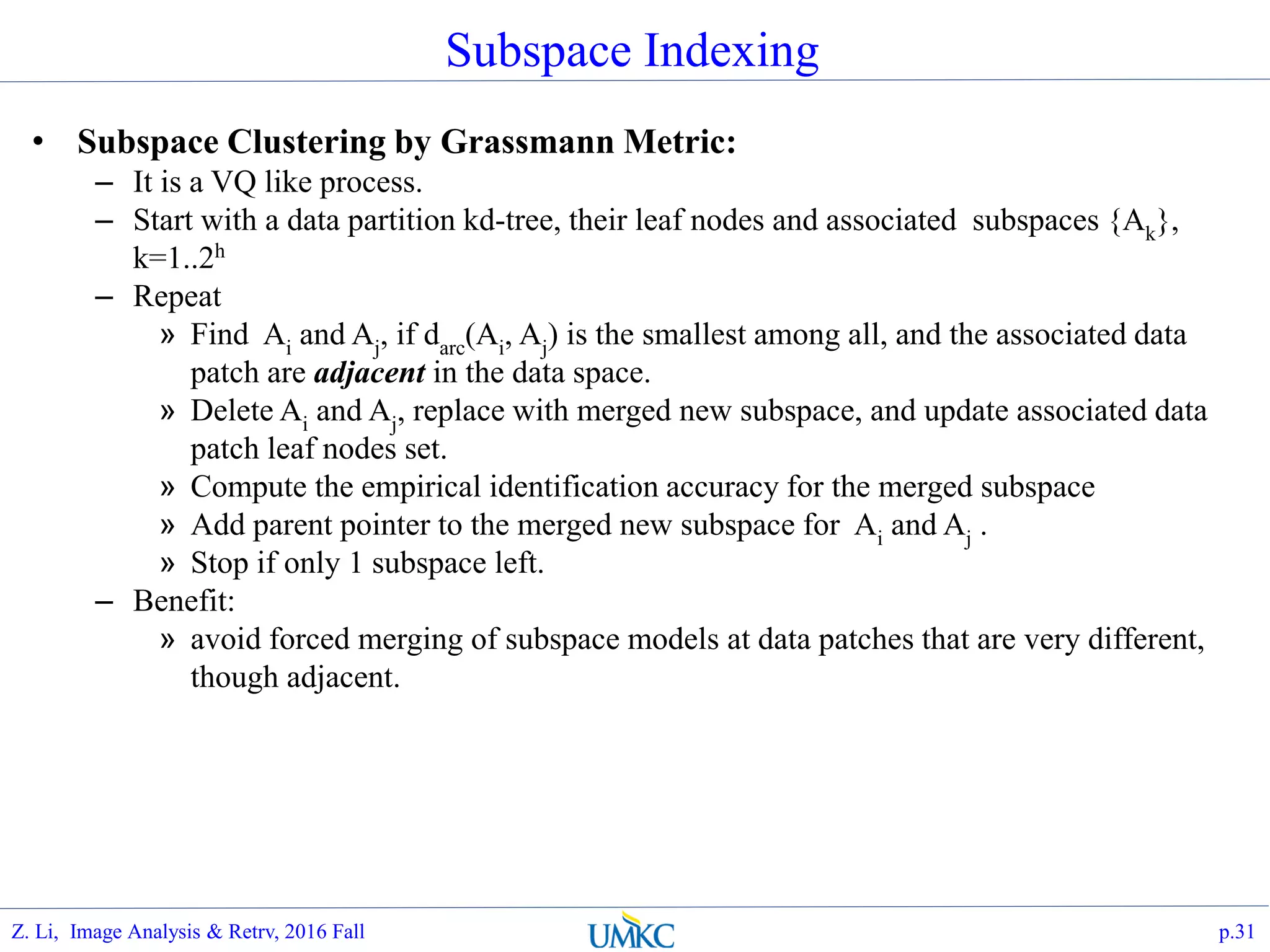
• Subspace Clustering by Grassmann Metric:
– It is a VQ like process.
– Start with a data partition kd-tree, their leaf nodes and associated subspaces {Ak},
k=1..2h
– Repeat
» Find Ai and Aj, if darc(Ai, Aj) is the smallest among all, and the associated data
patch are adjacent in the data space.
» Delete Ai and Aj, replace with merged new subspace, and update associated data
patch leaf nodes set.
» Compute the empirical identification accuracy for the merged subspace
» Add parent pointer to the merged new subspace for Ai and Aj .
» Stop if only 1 subspace left.
– Benefit:
» avoid forced merging of subspace models at data patches that are very different,
though adjacent.
p.31Z. Li, Image Analysis & Retrv, 2016 Fall
MHT Based Identification
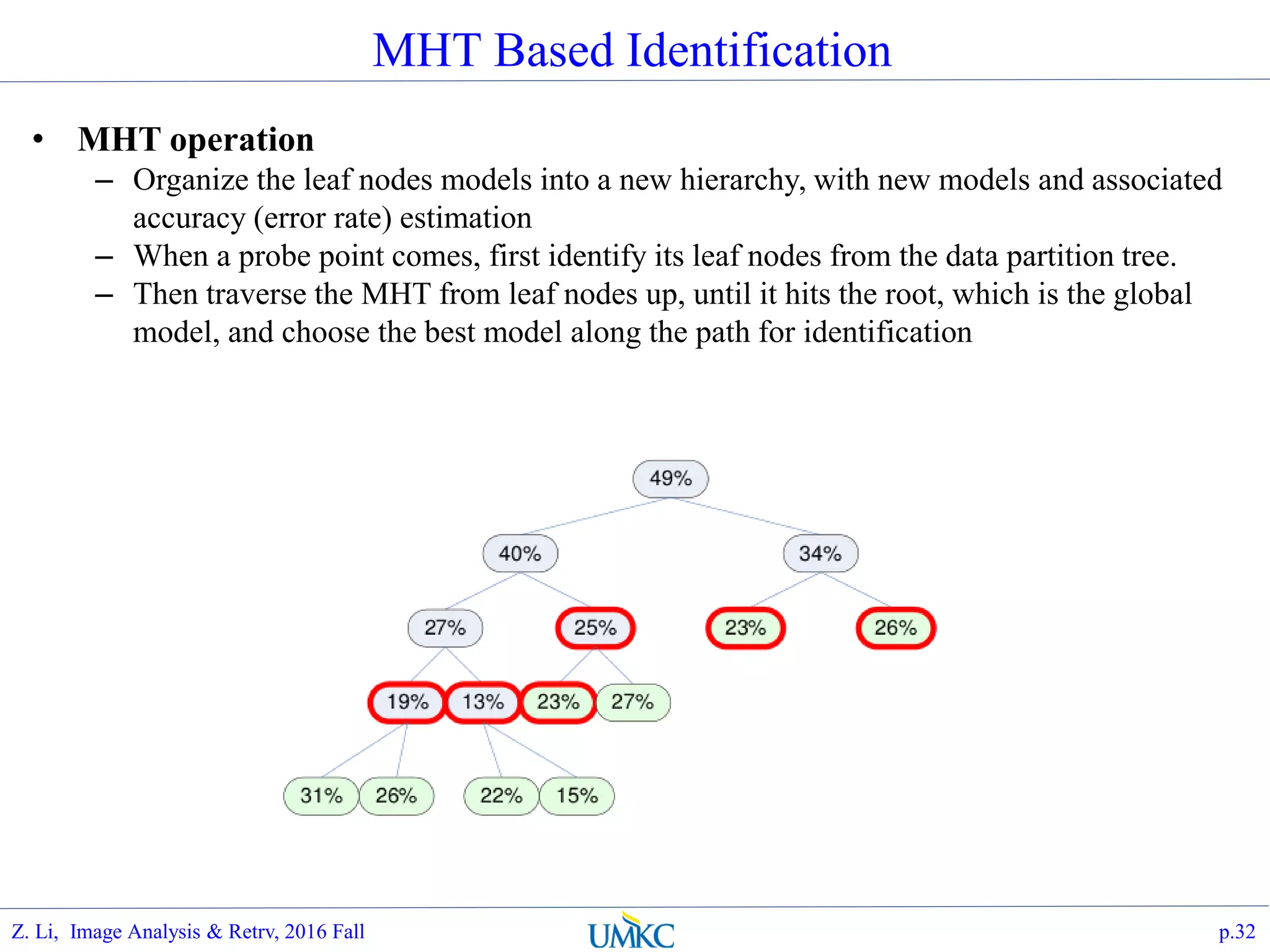
• MHT operation
– Organize the leaf nodes models into a new hierarchy, with new models and associated
accuracy (error rate) estimation
– When a probe point comes, first identify its leaf nodes from the data partition tree.
– Then traverse the MHT from leaf nodes up, until it hits the root, which is the global
model, and choose the best model along the path for identification
p.32Z. Li, Image Analysis & Retrv, 2016 Fall
Simulation
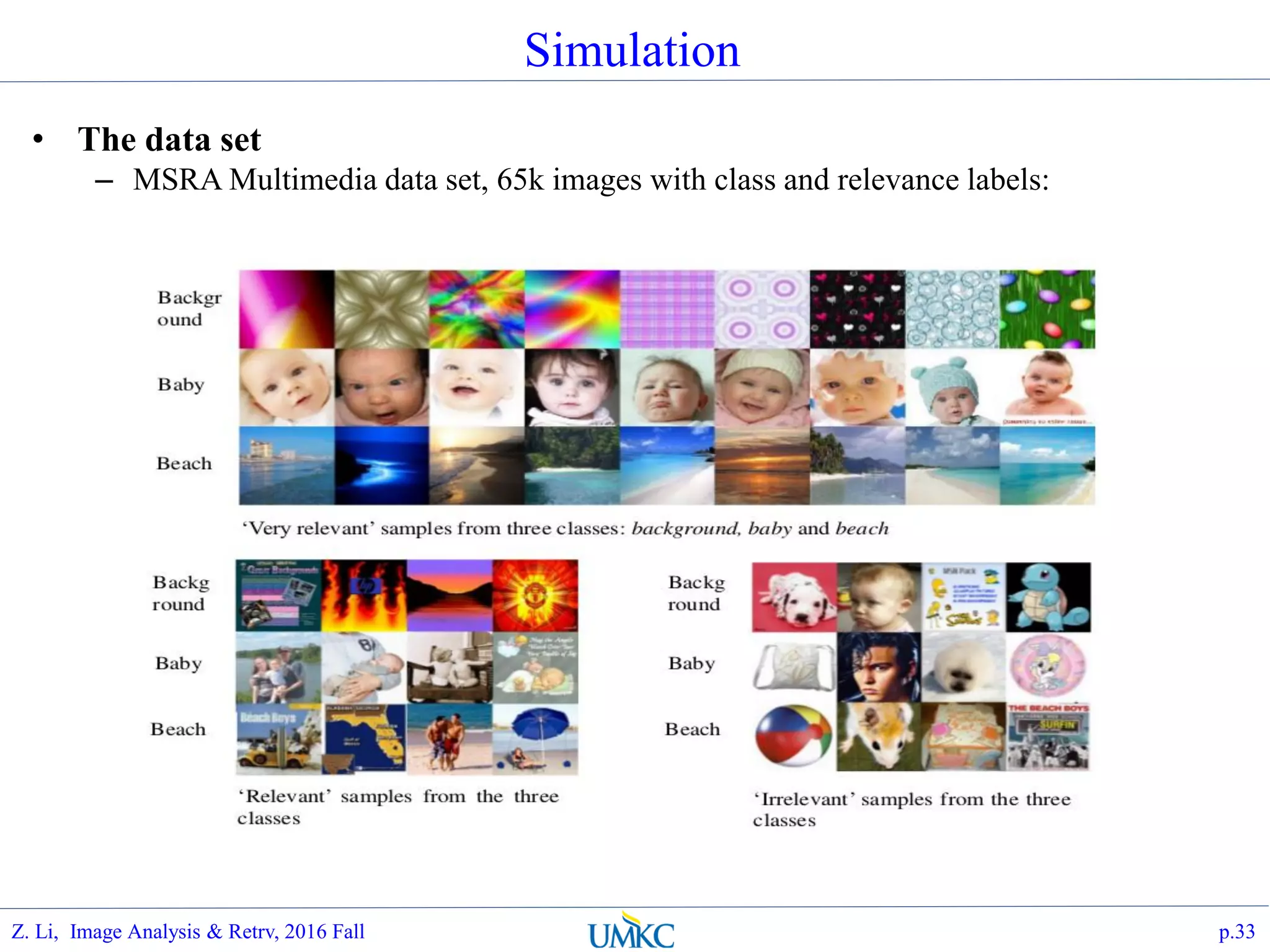
• The data set
– MSRA Multimedia data set, 65k images with class and relevance labels:
p.33Z. Li, Image Analysis & Retrv, 2016 Fall
Simulation
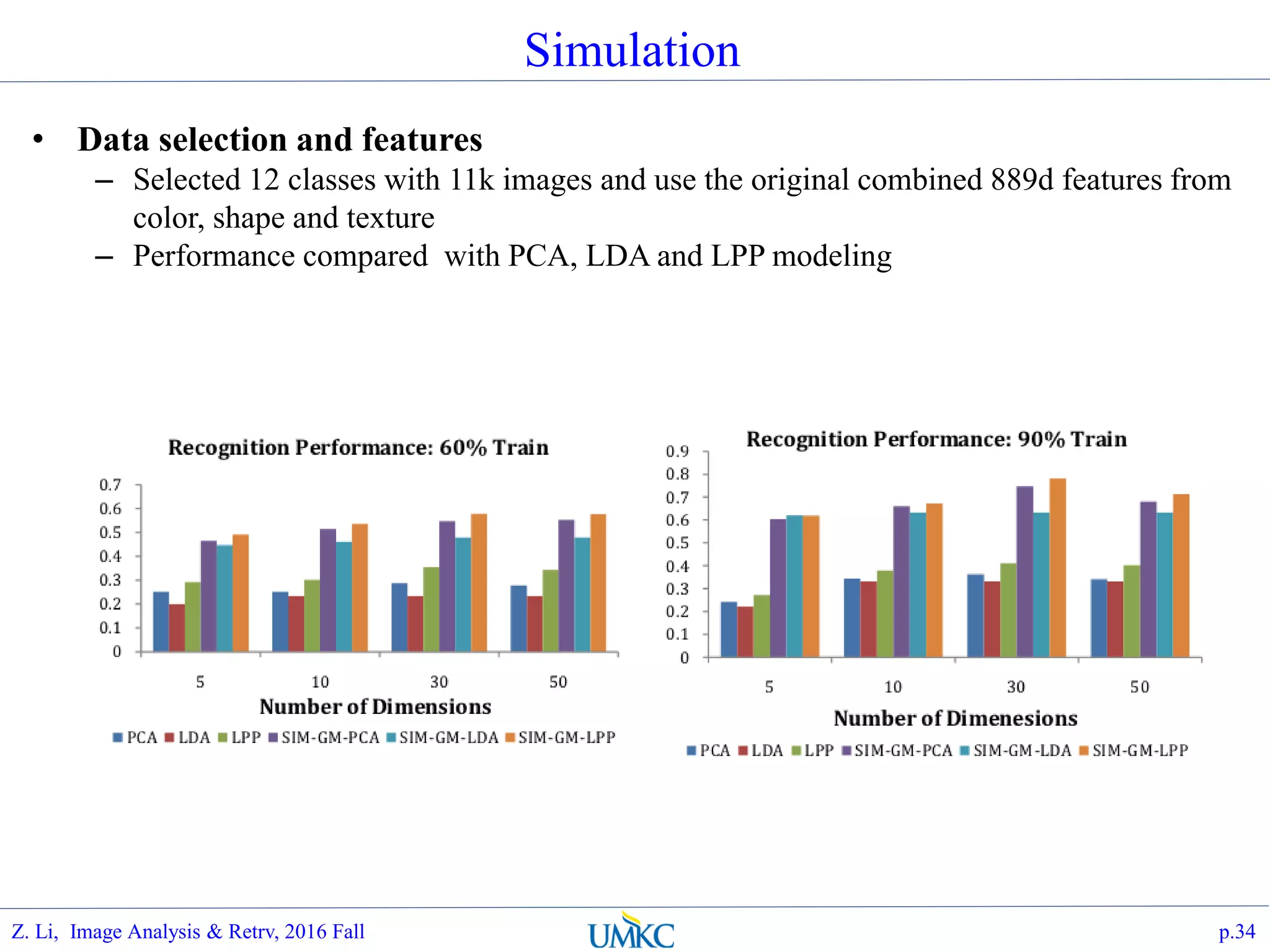
• Data selection and features
– Selected 12 classes with 11k images and use the original combined 889d features from
color, shape and texture
– Performance compared with PCA, LDA and LPP modeling
p.34Z. Li, Image Analysis & Retrv, 2016 Fall
Simulation
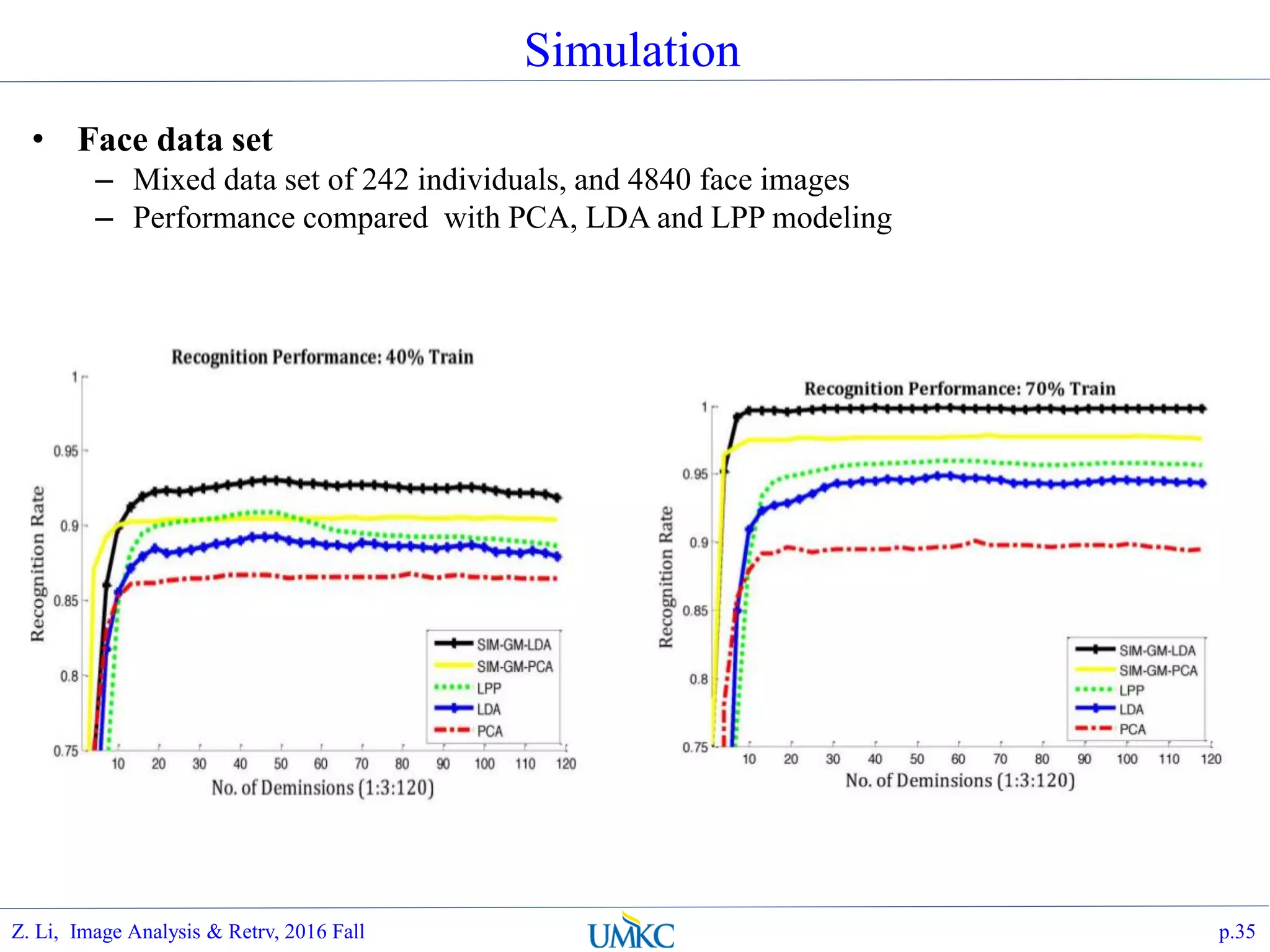
• Face data set
– Mixed data set of 242 individuals, and 4840 face images
– Performance compared with PCA, LDA and LPP modeling
p.35Z. Li, Image Analysis & Retrv, 2016 Fall
Grassmann Indexing Summary
• Contributions
– Address the DoF issues of the BIGDATA recognition problem.
– Piece-wise linear approach is effective in modeling non-linearity in visual manifolds for a
variety of recognition problem.
– Subspace indexing on Grassmann manifold offers a systemic approach in optimizing the
linear models for the localized problem.
– Solid performance gains over the state of art global linear models and their kernelized non-
linear models.
•
p.36Z. Li, Image Analysis & Retrv, 2016 Fall
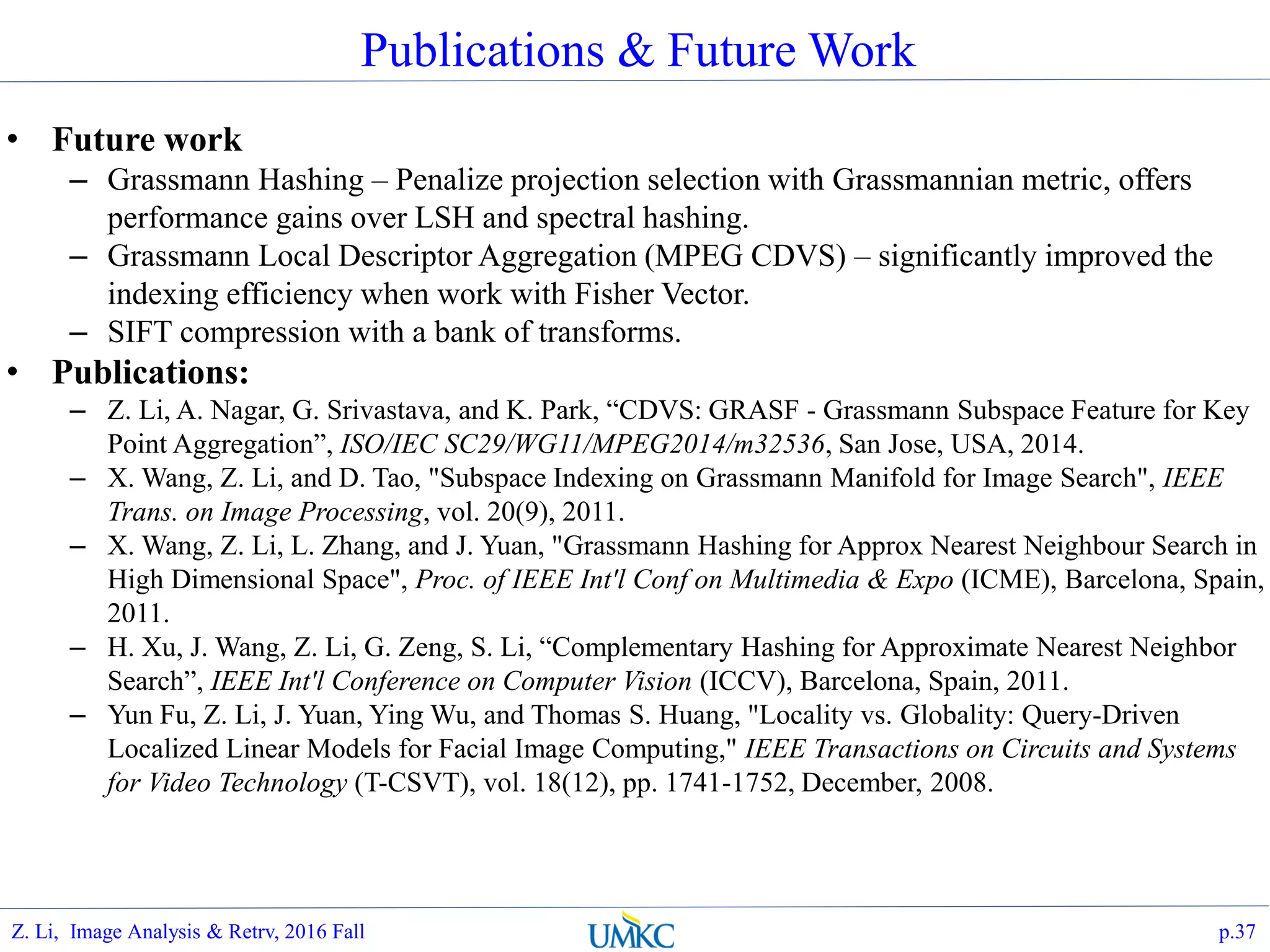
Publications & Future Work
• Future work
– Grassmann Hashing – Penalize projection selection with Grassmannian metric, offers
performance gains over LSH and spectral hashing.
– Grassmann Local Descriptor Aggregation (MPEG CDVS) – significantly improved the
indexing efficiency when work with Fisher Vector.
– SIFT compression with a bank of transforms.
• Publications:
– Z. Li, A. Nagar, G. Srivastava, and K. Park, “CDVS: GRASF - Grassmann Subspace Feature for Key
Point Aggregation”, ISO/IEC SC29/WG11/MPEG2014/m32536, San Jose, USA, 2014.
– X. Wang, Z. Li, and D. Tao, "Subspace Indexing on Grassmann Manifold for Image Search", IEEE
Trans. on Image Processing, vol. 20(9), 2011.
– X. Wang, Z. Li, L. Zhang, and J. Yuan, "Grassmann Hashing for Approx Nearest Neighbour Search in
High Dimensional Space", Proc. of IEEE Int'l Conf on Multimedia & Expo (ICME), Barcelona, Spain,
2011.
– H. Xu, J. Wang, Z. Li, G. Zeng, S. Li, “Complementary Hashing for Approximate Nearest Neighbor
Search”, IEEE Int'l Conference on Computer Vision (ICCV), Barcelona, Spain, 2011.
– Yun Fu, Z. Li, J. Yuan, Ying Wu, and Thomas S. Huang, "Locality vs. Globality: Query-Driven
Localized Linear Models for Facial Image Computing," IEEE Transactions on Circuits and Systems
for Video Technology (T-CSVT), vol. 18(12), pp. 1741-1752, December, 2008.
p.37Z. Li, Image Analysis & Retrv, 2016 Fall
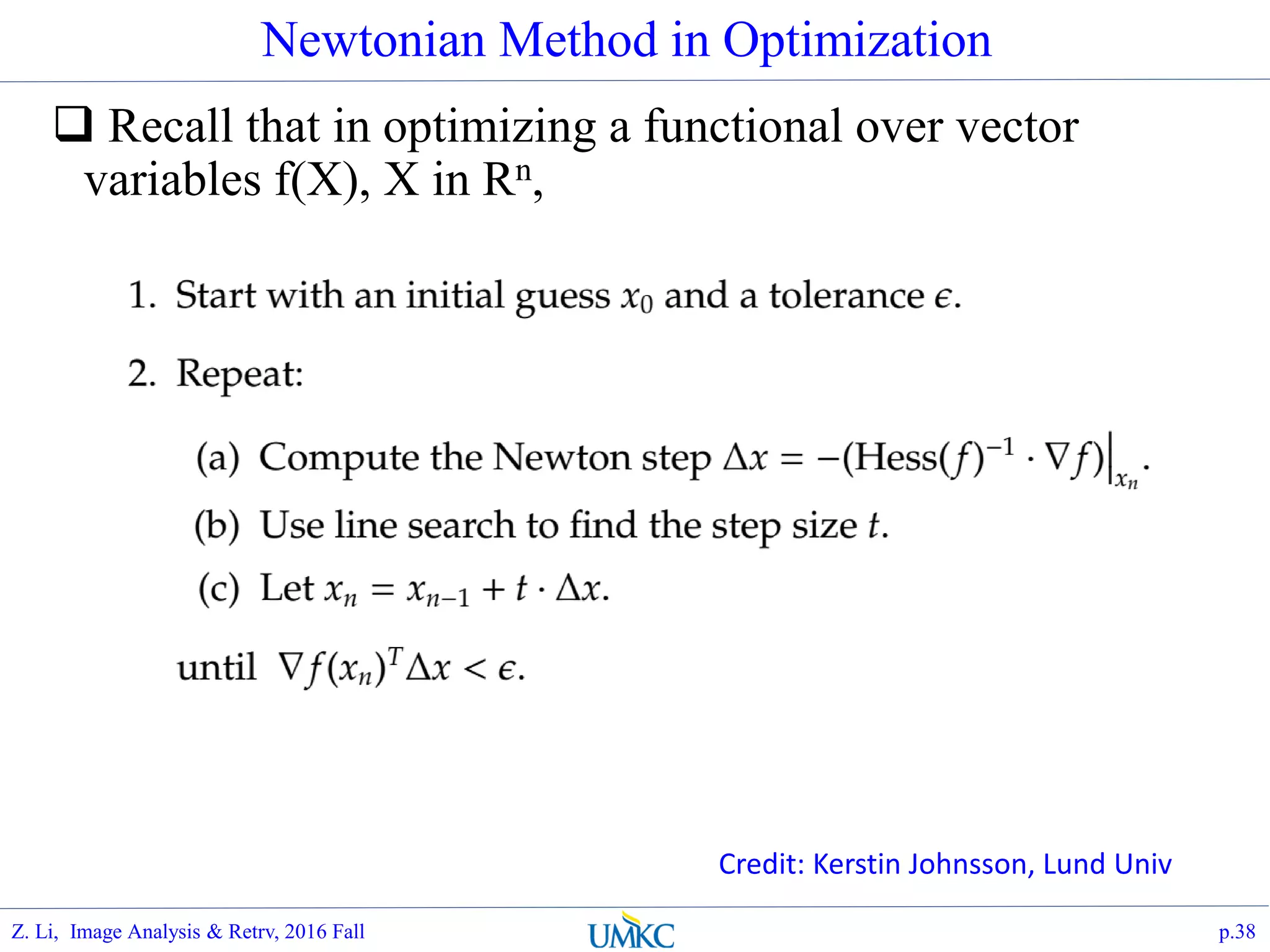
Newtonian Method in Optimization
 Recall that in optimizing a functional over vector
variables f(X), X in Rn,
p.38
Credit: Kerstin Johnsson, Lund Univ
Z. Li, Image Analysis & Retrv, 2016 Fall
Gradient & Hessian on Grassmann Manifold
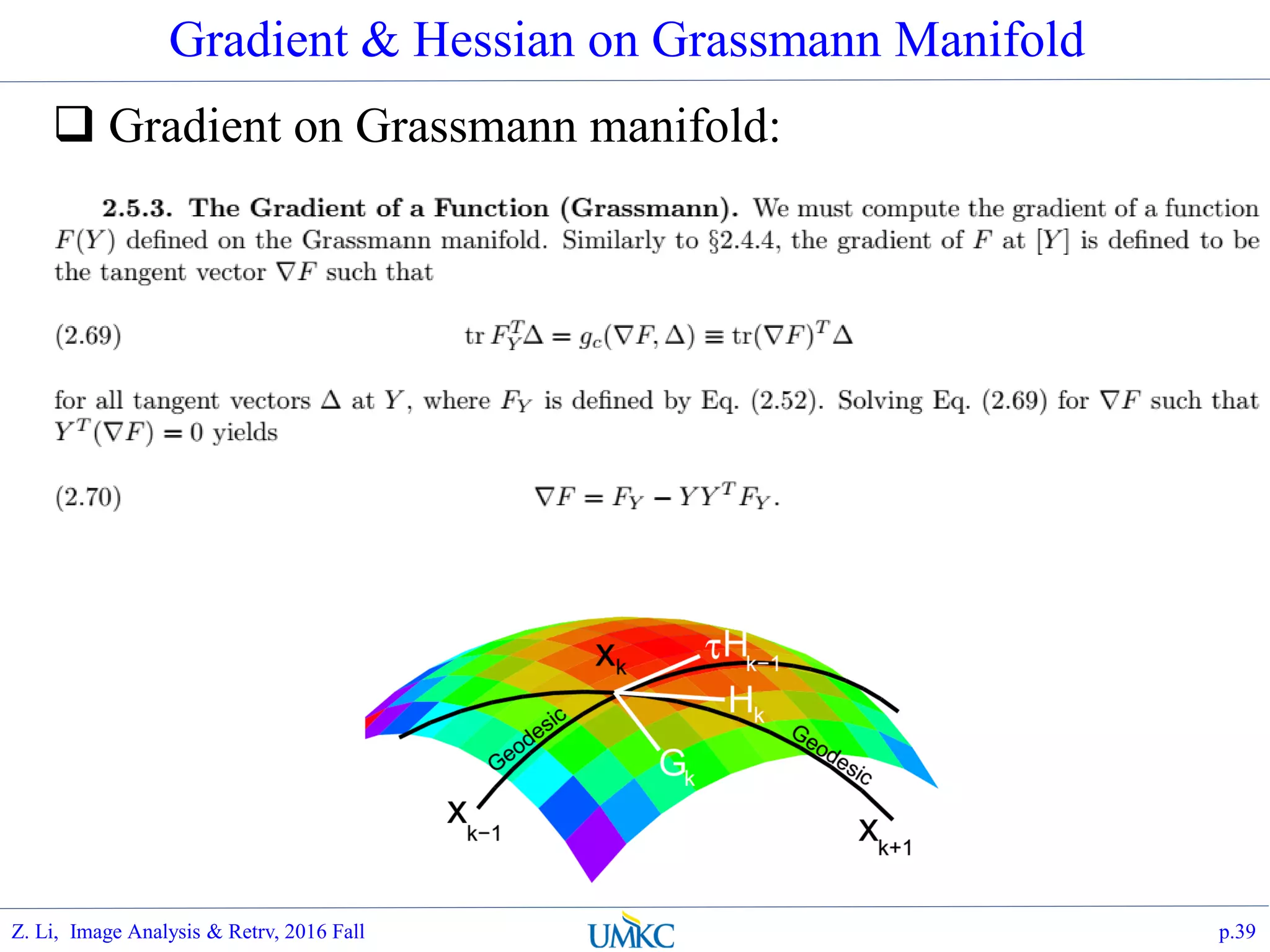
 Gradient on Grassmann manifold:
p.39Z. Li, Image Analysis & Retrv, 2016 Fall
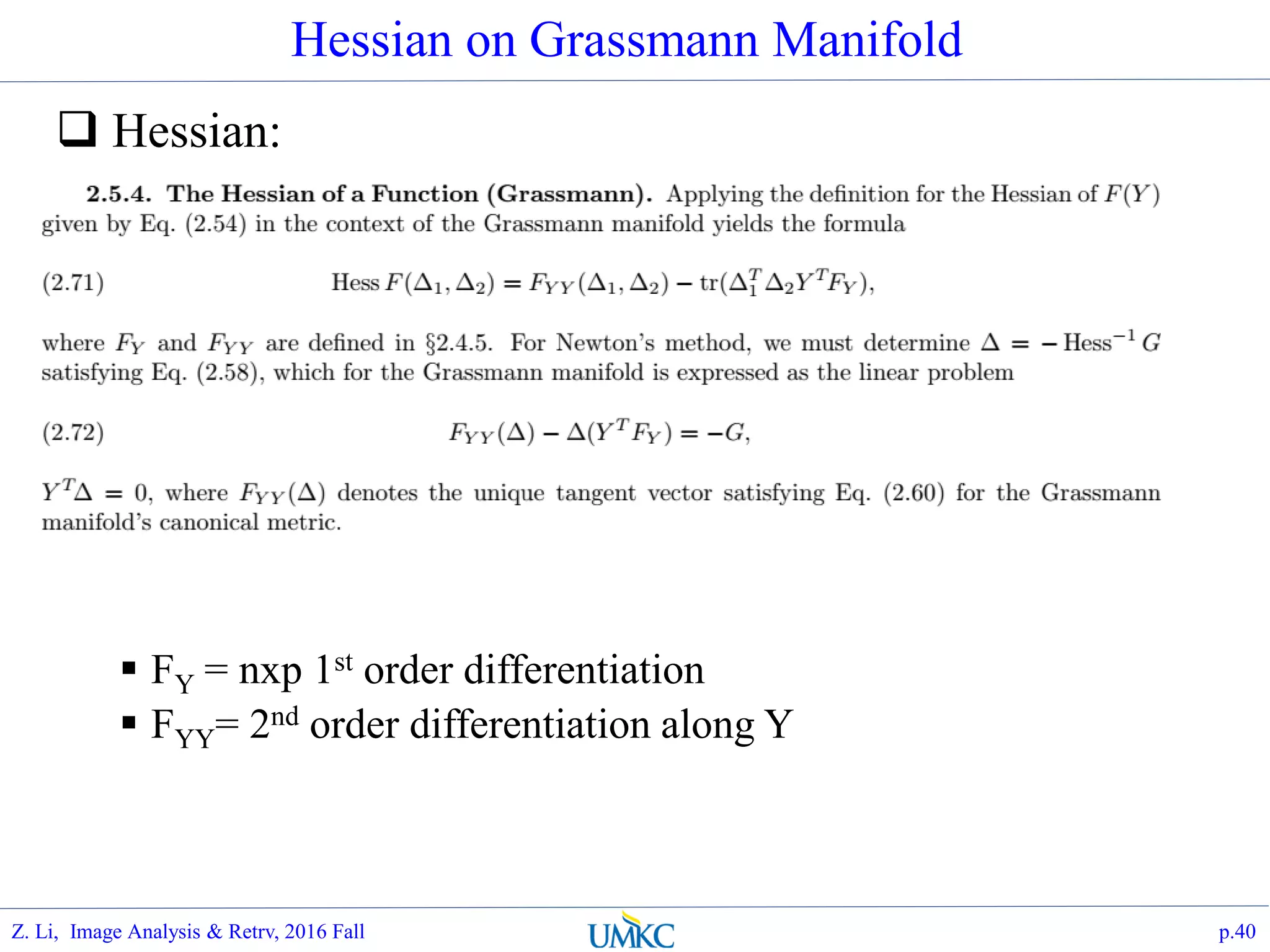
Hessian on Grassmann Manifold
 Hessian:
 FY = nxp 1st order differentiation
 FYY= 2nd order differentiation along Y
p.40Z. Li, Image Analysis & Retrv, 2016 Fall
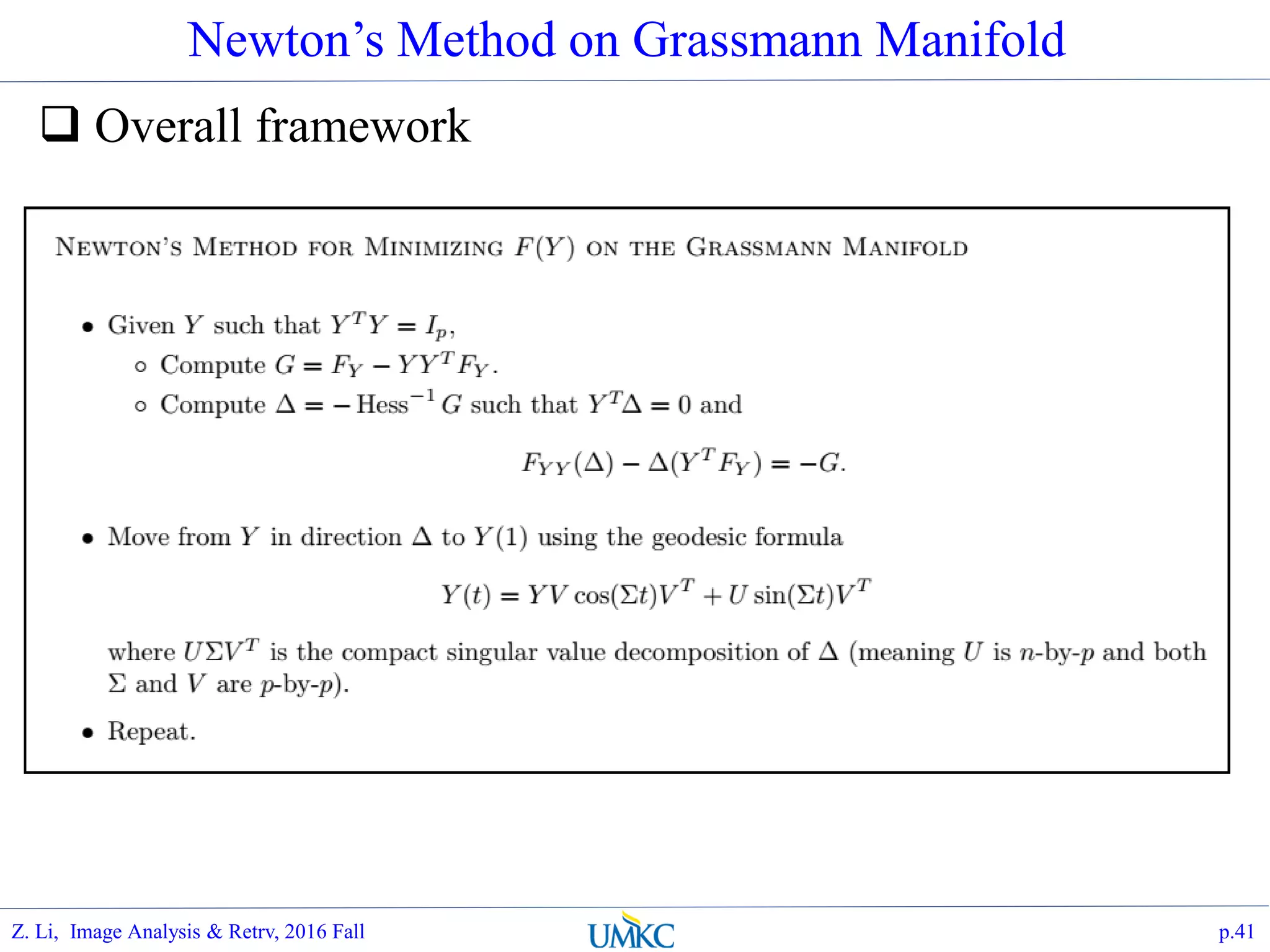
Newton’s Method on Grassmann Manifold
 Overall framework
p.41Z. Li, Image Analysis & Retrv, 2016 Fall
Matlab Implementation
 Prof. A. Edelman’s matlab package:
 https://umkc.box.com/s/g2oyqvsb2lx2v9wzf0ju60wnspts4t9g
 Potential project for the class:
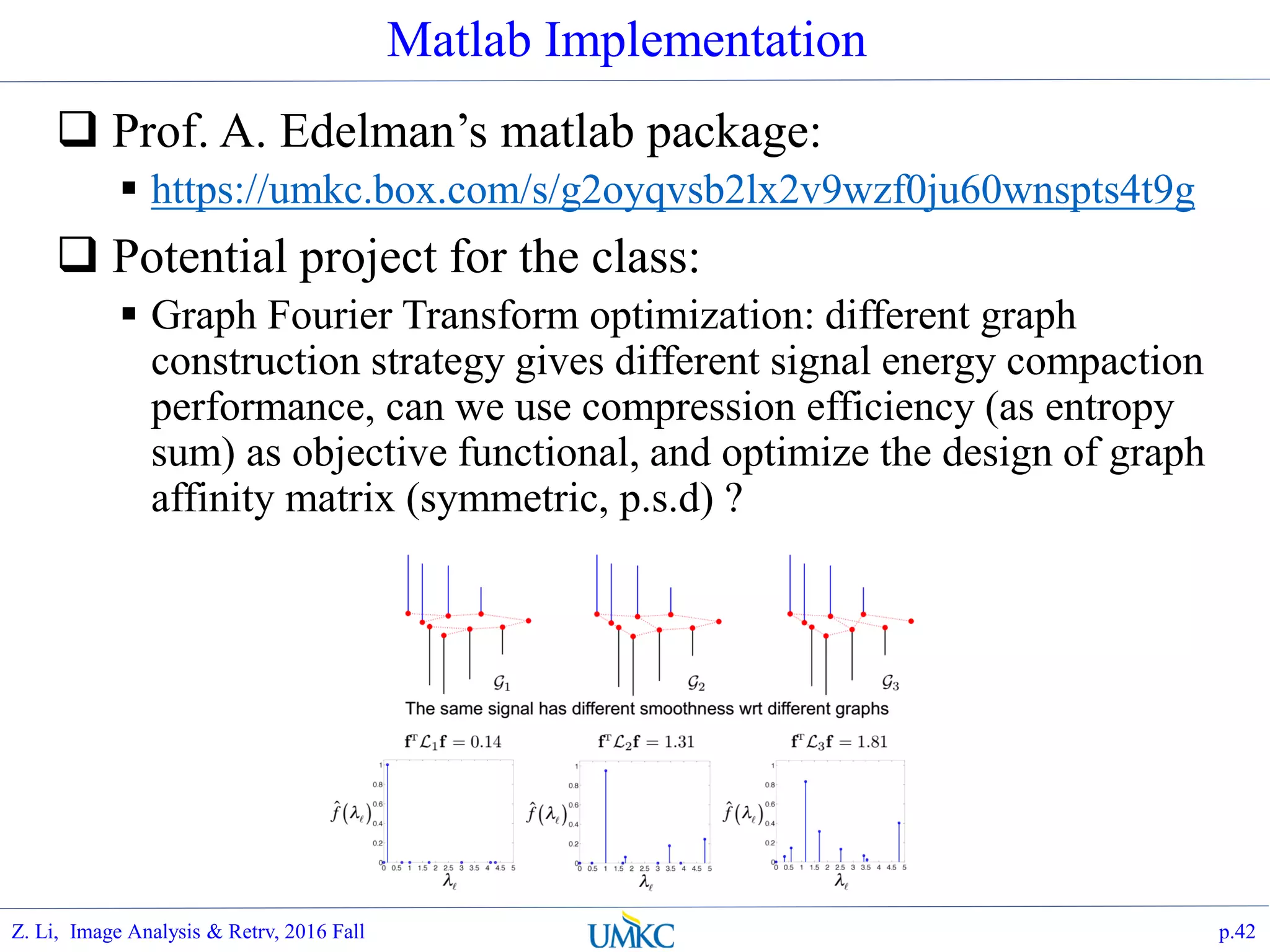
 Graph Fourier Transform optimization: different graph
construction strategy gives different signal energy compaction
performance, can we use compression efficiency (as entropy
sum) as objective functional, and optimize the design of graph
affinity matrix (symmetric, p.s.d) ?
p.42Z. Li, Image Analysis & Retrv, 2016 Fall
Summary
 Graph Laplacian Embedding is an unifying theory for
feature space dimension reduction
 PCA is a special case of graph embedding
o Fully connected affinity map, equal importance
 LDA is a special case of graph embedding
o Fully connected intra class
o Zero affinity inter class
 LPP: preserves pair wise affinity.
 GFT: Eigen vectors of graph Laplacian, has Fourier
Transform like characteristics.
 Many applications in
 Face recognition
 Pose estimation
 Facial expression modeling
 Compression of Graph signals.
p.43Z. Li, Image Analysis & Retrv, 2016 Fall

Lec16 subspace optimization

  • 1.
    Image Analysis &Retrieval CS/EE 5590 Special Topics (Class Ids: 44873, 44874) Fall 2016, M/W 4-5:15pm@Bloch 0012 Lec 16 Subspace/Transform Optimization Zhu Li Dept of CSEE, UMKC Office: FH560E, Email: lizhu@umkc.edu, Ph: x 2346. http://l.web.umkc.edu/lizhu p.1Z. Li, Image Analysis & Retrv, 2016 Fall
  • 2.
    Outline  Recap:  Laplacianface Graph Fourier Transform  Data Partition and Subspace Optimization  Query Driven Solution  Subspace Indexing on Grassmann Manifold  Optimization of Subspace on Grassmann Manifold Summary p.2Z. Li, Image Analysis & Retrv, 2016 Fall
  • 3.
    Subspace Learning forFace Recognition  Project face images to a subspace with basis A  Matlab: x=faces*A(:,1:kd) eigf1 eigf2 eigf3 = 10.9* + 0.4* + 4.7* p.3Z. Li, Image Analysis & Retrv, 2016 Fall
  • 4.
    Graph Embedding Interpretationof PCA/LDA/LPP  Affinity graph S, determines the embedding subspace W, via PCA and LDA are special cases of Graph Embedding  PCA:  LDA  LPP p.4 𝑆𝑖,𝑗 = −exp 𝑥𝑗 − 𝑥𝑖 2 ℎ , 𝑖𝑓 𝑥𝑗 − 𝑥𝑖 ≤ 𝜃 0, 𝑒𝑙𝑠𝑒 𝑆𝑖,𝑗 = 1 𝑛 𝑘 , 𝑖𝑓 𝑥𝑖, 𝑥𝑗 ∈ 𝐶 𝑘 0, 𝑒𝑙𝑠𝑒 𝑆𝑖,𝑗 = 1/𝑛 Z. Li, Image Analysis & Retrv, 2016 Fall
  • 5.
    Laplacian and LDAEmbedding  Laplacian face is powerful.  p.5Z. Li, Image Analysis & Retrv, 2016 Fall
  • 6.
    Applications: facial expressionembedding  Facial expressions embedded in a 2-d space via LPP  SIFT Compression: p.6 frown sad happy neutral 𝐴 = arg min 𝑊 𝑘 𝑗 𝑠𝑗,𝑘 𝑊𝑥𝑗 − 𝑊𝑥 𝑘 2 Z. Li, Image Analysis & Retrv, 2016 Fall
  • 7.
    Signal on Graph non-uniformly sampled p.7Z. Li, Image Analysis & Retrv, 2016 Fall
  • 8.
    Graph Fourier Transform GFT is different from Laplacian Embedding: p.8Z. Li, Image Analysis & Retrv, 2016 Fall
  • 9.
    Graph Spectrum  Eigenvectorvs Zero Crossing counts p.9Z. Li, Image Analysis & Retrv, 2016 Fall
  • 10.
    Graph Signal Smoothness Quadratic form on L: p.10Z. Li, Image Analysis & Retrv, 2016 Fall
  • 11.
    Outline  Recap:  Laplacianface Graph Fourier Transform  Data Partition and Subspace Optimization  Query Driven Solution  Subspace Indexing on Grassmann Manifold  Optimization of Subspace on Grassmann Manifold Summary p.11Z. Li, Image Analysis & Retrv, 2016 Fall
  • 12.
    • Face Recognition –Identify face from large (e.g, 7 million HK ID) face data set • Image Search – Find out the tags associated with the given images • Fingerprint Identification – Verification (yes or no) already mature and deployed in HK – Identification challenges: stateless feature/indexing efficiency Large Scale Recognition/Classification Problems p.12Z. Li, Image Analysis & Retrv, 2016 Fall
  • 13.
    • Find a“good” f() – Such that after projecting the appearance onto the subspace, the data points belong to different classes are easily separable – This kind of “good” function is usually non-linear, hard to obtain from training data. Appearance Modeling – Finding a good f() p.13Z. Li, Image Analysis & Retrv, 2016 Fall
  • 14.
    Graph Embedding Interpretationof PCA/LDA/LPP  Affinity graph S, determines the embedding subspace W, via PCA and LDA are special cases of Graph Embedding  PCA:  LDA  LPP p.14 𝑆𝑖,𝑗 = −exp 𝑥𝑗 − 𝑥𝑖 2 ℎ , 𝑖𝑓 𝑥𝑗 − 𝑥𝑖 ≤ 𝜃 0, 𝑒𝑙𝑠𝑒 𝑆𝑖,𝑗 = 1 𝑛 𝑘 , 𝑖𝑓 𝑥𝑖, 𝑥𝑗 ∈ 𝐶 𝑘 0, 𝑒𝑙𝑠𝑒 𝑆𝑖,𝑗 = 1/𝑛 Z. Li, Image Analysis & Retrv, 2016 Fall
  • 15.
    • Non-Linear Solutionsand challenges: – Kernel method: e.g K-PCA, K-LDA, K-LPP, SVM » Evaluate inner product <xj,xk> with a kernel function k(xj, xk), which if satisfy the conditions in Mercer’s Theorem, implicitly maps data via a non-linear function. » Typically involves a QP problem with a Hessian of size n x n, when n is large, not solvable. – LLE /Graph Laplacian: » An algorithm that maps input data {xk} to {yk} that tries to preserve an embedded graph structure among data points. » The mapping is data dependent and has difficulty handling new data outside the training set, e.g., a new query point • How to compromise ? – Piece-wise Linear Approximation: local data patch linear model fitting Non-Linearity Issue p.15Z. Li, Image Analysis & Retrv, 2016 Fall
  • 16.
    Piece-wise Linear :Query Driven • Query-Driven Piece-wise Linear Model – No pre-determined structure on the training data – Local neighborhood data patch identified from query point q, – Local model built with local data, A(X, q) p.16Z. Li, Image Analysis & Retrv, 2016 Fall
  • 17.
    DoF Criteria forLocal Model  What is a proper size of local data support: N(X, q) ? p.17Z. Li, Image Analysis & Retrv, 2016 Fall
  • 18.
    DPC – DiscriminantPower Coefficient  The tradeoffs in local data support size p.18Z. Li, Image Analysis & Retrv, 2016 Fall
  • 19.
    Head Pose Estimation Given face images as pixels in Rwxh, predict its pose: Tilt and Pan angles: p.19Z. Li, Image Analysis & Retrv, 2016 Fall
  • 20.
    Face Recognition  OnATT Data set: 40 subjects, 400 images: Extra credit: 10pts   Develop a query driven local Laplacianface model for HW-3 p.20Z. Li, Image Analysis & Retrv, 2016 Fall
  • 21.
    Summary of QueryDriven Local Models The Good:  Allows for local data adaptation, solid gains in classification  Problem size is d x d, (vs kernel method, which is n x n, not scaling well )  The Bad:  Data driven: need to compute a run-time model that adds computational complexity  The Ugly:  Storage Penalty: need extra storage to store all training data, because the local NN data, patch is generated at run time, as function of the query point  Indexing challenge: for very large scale problem, not practical to store all training data, and effective indexing needed to support efficient access of query induced local training data.  Question:  Can we do better ? p.21Z. Li, Image Analysis & Retrv, 2016 Fall
  • 22.
    Closer Examination ofDoFs  DoF of the Stiefel manifold: p.22Z. Li, Image Analysis & Retrv, 2016 Fall
  • 23.
    DoF of Subspaces Grassmannmanifold DoF: p.23Z. Li, Image Analysis & Retrv, 2016 Fall
  • 24.
    Visualizing Subspace ModelsDoF • Consider a typical appearance modeling – Image size 12x10 pixel, appearance space dimension d=120, model dimension p=8. – 3D visualization of all S(8, 120) and their covariance eigenvalues” – Grassmann Manifolds are quotient space S(8, 120)/O(8) • p.24Z. Li, Image Analysis & Retrv, 2016 Fall
  • 25.
    • The principalangles between two subspaces: – For A1, and A2 in G(p, d), their principal angles are defined as where, {uk} and {vk} are called principal dimensions for span(A1) and span(A2). Principal Angles p.25Z. Li, Image Analysis & Retrv, 2016 Fall
  • 26.
    Solving for PrincipalAngles  Given two subspace models A1 and A2, find the rotations that can max align two: p.26Z. Li, Image Analysis & Retrv, 2016 Fall
  • 27.
    Subspace Distance onGrassmann Manifold  Grassmann Distance Metrics: p.27Z. Li, Image Analysis & Retrv, 2016 Fall
  • 28.
    Arc Distance Metric Arc Distance: p.28Z. Li, Image Analysis & Retrv, 2016 Fall
  • 29.
    Linear Combination ofSubspaces  How to combine two models ? Moving along Geodesics ? p.29Z. Li, Image Analysis & Retrv, 2016 Fall
  • 30.
    Training Data SetPartition • The Plan: – Partition the (unlabeled) large training data set into local data patches – Compute local models for each data patch with labels, and then optimize a subset for the recognition • Data Space Partition – Partition the training data set by kd-tree, for the kd-tree height of h, we have 2h local data patch as leaf node – For each leaf node data patch k, build a local LDA/LPP model Ak: • p.30Z. Li, Image Analysis & Retrv, 2016 Fall
  • 31.
    Subspace Indexing • SubspaceClustering by Grassmann Metric: – It is a VQ like process. – Start with a data partition kd-tree, their leaf nodes and associated subspaces {Ak}, k=1..2h – Repeat » Find Ai and Aj, if darc(Ai, Aj) is the smallest among all, and the associated data patch are adjacent in the data space. » Delete Ai and Aj, replace with merged new subspace, and update associated data patch leaf nodes set. » Compute the empirical identification accuracy for the merged subspace » Add parent pointer to the merged new subspace for Ai and Aj . » Stop if only 1 subspace left. – Benefit: » avoid forced merging of subspace models at data patches that are very different, though adjacent. p.31Z. Li, Image Analysis & Retrv, 2016 Fall
  • 32.
    MHT Based Identification •MHT operation – Organize the leaf nodes models into a new hierarchy, with new models and associated accuracy (error rate) estimation – When a probe point comes, first identify its leaf nodes from the data partition tree. – Then traverse the MHT from leaf nodes up, until it hits the root, which is the global model, and choose the best model along the path for identification p.32Z. Li, Image Analysis & Retrv, 2016 Fall
  • 33.
    Simulation • The dataset – MSRA Multimedia data set, 65k images with class and relevance labels: p.33Z. Li, Image Analysis & Retrv, 2016 Fall
  • 34.
    Simulation • Data selectionand features – Selected 12 classes with 11k images and use the original combined 889d features from color, shape and texture – Performance compared with PCA, LDA and LPP modeling p.34Z. Li, Image Analysis & Retrv, 2016 Fall
  • 35.
    Simulation • Face dataset – Mixed data set of 242 individuals, and 4840 face images – Performance compared with PCA, LDA and LPP modeling p.35Z. Li, Image Analysis & Retrv, 2016 Fall
  • 36.
    Grassmann Indexing Summary •Contributions – Address the DoF issues of the BIGDATA recognition problem. – Piece-wise linear approach is effective in modeling non-linearity in visual manifolds for a variety of recognition problem. – Subspace indexing on Grassmann manifold offers a systemic approach in optimizing the linear models for the localized problem. – Solid performance gains over the state of art global linear models and their kernelized non- linear models. • p.36Z. Li, Image Analysis & Retrv, 2016 Fall
  • 37.
    Publications & FutureWork • Future work – Grassmann Hashing – Penalize projection selection with Grassmannian metric, offers performance gains over LSH and spectral hashing. – Grassmann Local Descriptor Aggregation (MPEG CDVS) – significantly improved the indexing efficiency when work with Fisher Vector. – SIFT compression with a bank of transforms. • Publications: – Z. Li, A. Nagar, G. Srivastava, and K. Park, “CDVS: GRASF - Grassmann Subspace Feature for Key Point Aggregation”, ISO/IEC SC29/WG11/MPEG2014/m32536, San Jose, USA, 2014. – X. Wang, Z. Li, and D. Tao, "Subspace Indexing on Grassmann Manifold for Image Search", IEEE Trans. on Image Processing, vol. 20(9), 2011. – X. Wang, Z. Li, L. Zhang, and J. Yuan, "Grassmann Hashing for Approx Nearest Neighbour Search in High Dimensional Space", Proc. of IEEE Int'l Conf on Multimedia & Expo (ICME), Barcelona, Spain, 2011. – H. Xu, J. Wang, Z. Li, G. Zeng, S. Li, “Complementary Hashing for Approximate Nearest Neighbor Search”, IEEE Int'l Conference on Computer Vision (ICCV), Barcelona, Spain, 2011. – Yun Fu, Z. Li, J. Yuan, Ying Wu, and Thomas S. Huang, "Locality vs. Globality: Query-Driven Localized Linear Models for Facial Image Computing," IEEE Transactions on Circuits and Systems for Video Technology (T-CSVT), vol. 18(12), pp. 1741-1752, December, 2008. p.37Z. Li, Image Analysis & Retrv, 2016 Fall
  • 38.
    Newtonian Method inOptimization  Recall that in optimizing a functional over vector variables f(X), X in Rn, p.38 Credit: Kerstin Johnsson, Lund Univ Z. Li, Image Analysis & Retrv, 2016 Fall
  • 39.
    Gradient & Hessianon Grassmann Manifold  Gradient on Grassmann manifold: p.39Z. Li, Image Analysis & Retrv, 2016 Fall
  • 40.
    Hessian on GrassmannManifold  Hessian:  FY = nxp 1st order differentiation  FYY= 2nd order differentiation along Y p.40Z. Li, Image Analysis & Retrv, 2016 Fall
  • 41.
    Newton’s Method onGrassmann Manifold  Overall framework p.41Z. Li, Image Analysis & Retrv, 2016 Fall
  • 42.
    Matlab Implementation  Prof.A. Edelman’s matlab package:  https://umkc.box.com/s/g2oyqvsb2lx2v9wzf0ju60wnspts4t9g  Potential project for the class:  Graph Fourier Transform optimization: different graph construction strategy gives different signal energy compaction performance, can we use compression efficiency (as entropy sum) as objective functional, and optimize the design of graph affinity matrix (symmetric, p.s.d) ? p.42Z. Li, Image Analysis & Retrv, 2016 Fall
  • 43.
    Summary  Graph LaplacianEmbedding is an unifying theory for feature space dimension reduction  PCA is a special case of graph embedding o Fully connected affinity map, equal importance  LDA is a special case of graph embedding o Fully connected intra class o Zero affinity inter class  LPP: preserves pair wise affinity.  GFT: Eigen vectors of graph Laplacian, has Fourier Transform like characteristics.  Many applications in  Face recognition  Pose estimation  Facial expression modeling  Compression of Graph signals. p.43Z. Li, Image Analysis & Retrv, 2016 Fall