Download to read offline
![International Journal of Computer Applications Technology and Research
Volume 4– Issue 4, 296 - 299, 2015, ISSN:- 2319–8656
www.ijcat.com 296
Identity Recognition Using Edge Suppression Method
R.Ram kumar
Bharath University
Chennai, India
V.Sanjeevi
Bharath University
Chennai, India
K.Sivaraman
Bharath University
Chennai, India
Abstract: There are multiple crimes happening even in the presence of cctv cameras still we couldn’t able to find the identity due to
shadows in the image. In this work, we have used edge suppression method and affine transformation to recognize identity even under
severe shadow. We also used gradient field to calculate the position of light sources in the place. For classification of identity from the
databases we use k-nearest neighbor rule. Additionally we also were using this principal component analysis for feature extraction.
Classification can be done in real time environments by accessing authorized databases or also by standard databases.
Keywords: K-NN Classifier, Tensors, flash image, shadow removing, Feature extraction
1. INTRODUCTION
Face recognition is one of the applications for automatically
identifying and recognizing the face of an human by an
computer. This kind of image processing applications are used
in many ways, in this work face recognition system is used
not only recognizing face also taken upto his chest which
increases multiple reference points such as neck, shoulder and
more. The another important issue is shadow presence in the
image due to this there is a chance of error occurrence in
finding the correct person. So, to reduce the impact of shadow
on the image diagonally projecting sensors[2] are used this
suppresses the edges of the image. Here we also were
accounting the chromaticity[8] of the environment lighting.
Ramesh Raskar[1] had mentioned that the chromaticity of the
environment lightning will be approximately as same as the
chromaticity of the diffused light. And it is found that for
different magnitude in the chromaticity of differently exposed
regions has different rgb, hue and hsv color values[5].We
proposing that along with face recognition recognizing of
other identities also important because the identity database
like aadhar card are capturing images up to chest level not
only up to face. So it will be useful when using it with real
databases. As compared with thresholding we clear the
textures in the scene by approaching principled way. Here we
are not accounting any assumptions on the environment
lightning, mapping of exposure or reflection. The diagonally
projecting tensors helps us to remove those shadows by using
an highly exposed image as an reference called as flash
image.
2. EXISTING METHODOLOGY:
All images are a combination of primary colors like red, blue,
green. All the image processing process uses RGB images
which has more number of color components and it makes the
processing slower. In recovering the
illumination map, we make the usual assumption that the
scene texture edges do not coincide with the illumination
edges. But the foreground layer, edges of the foreground
object which exactly align with the background edges cannot
be recovered. And the existing systems has face recognition
only, which may fail in case of twins and people having
similar faces and also in usage of mask.
.
3. PROPOSED METHODOLOGY:
To predict the presence of light source the two pictures are
converted into YUV format which reduces the color
components for processing it into a gradient pictures with x
and y-axis components. That helps in finding the position of
light sources which in turn helps in removing shadows. Then
those diagonally projecting tensors are applied on the pictures
to analyze the vector and scalar values of two pictures(real
image and flash image) then affine transformation uses those
values to correct the pictures like rotating and aligning. Thus a
shadow free image is obtained as a result. This resulted
picture is used to search in databases. Here we are proposing a
id recognition instead of regular face recognition which uses
the principal component analysis to feature extract the face,
neck, shoulders from the images. By using the calculated
eigen vectors and values KNN classifier produce the result by
comparison.
Fig.1 Block diagram
4. GRADIENT COMPUTATIONS:
This computations are existing mathematical functions only.
This is used to obtain the gradient value in the image
environment. The gradient magnitude and direction are
encoded by computing. By [9]adding partial derivatives of X
and Y directions gradient vector is formed.
ΔI= (∂I/∂x, ∂I/∂y) …(1)
we could write this continuous function, I(x, y) as:](https://image.slidesharecdn.com/ijcatr04041016-150429041311-conversion-gate01/85/Ijcatr04041016-1-320.jpg)
![International Journal of Computer Applications Technology and Research
Volume 4– Issue 4, 296 - 299, 2015, ISSN:- 2319–8656
www.ijcat.com 296
Identity Recognition Using Edge Suppression Method
R.Ram kumar
Bharath University
Chennai, India
V.Sanjeevi
Bharath University
Chennai, India
K.Sivaraman
Bharath University
Chennai, India
Abstract: There are multiple crimes happening even in the presence of cctv cameras still we couldn’t able to find the identity due to
shadows in the image. In this work, we have used edge suppression method and affine transformation to recognize identity even under
severe shadow. We also used gradient field to calculate the position of light sources in the place. For classification of identity from the
databases we use k-nearest neighbor rule. Additionally we also were using this principal component analysis for feature extraction.
Classification can be done in real time environments by accessing authorized databases or also by standard databases.
Keywords: K-NN Classifier, Tensors, flash image, shadow removing, Feature extraction
1. INTRODUCTION
Face recognition is one of the applications for automatically
identifying and recognizing the face of an human by an
computer. This kind of image processing applications are used
in many ways, in this work face recognition system is used
not only recognizing face also taken upto his chest which
increases multiple reference points such as neck, shoulder and
more. The another important issue is shadow presence in the
image due to this there is a chance of error occurrence in
finding the correct person. So, to reduce the impact of shadow
on the image diagonally projecting sensors[2] are used this
suppresses the edges of the image. Here we also were
accounting the chromaticity[8] of the environment lighting.
Ramesh Raskar[1] had mentioned that the chromaticity of the
environment lightning will be approximately as same as the
chromaticity of the diffused light. And it is found that for
different magnitude in the chromaticity of differently exposed
regions has different rgb, hue and hsv color values[5].We
proposing that along with face recognition recognizing of
other identities also important because the identity database
like aadhar card are capturing images up to chest level not
only up to face. So it will be useful when using it with real
databases. As compared with thresholding we clear the
textures in the scene by approaching principled way. Here we
are not accounting any assumptions on the environment
lightning, mapping of exposure or reflection. The diagonally
projecting tensors helps us to remove those shadows by using
an highly exposed image as an reference called as flash
image.
2. EXISTING METHODOLOGY:
All images are a combination of primary colors like red, blue,
green. All the image processing process uses RGB images
which has more number of color components and it makes the
processing slower. In recovering the
illumination map, we make the usual assumption that the
scene texture edges do not coincide with the illumination
edges. But the foreground layer, edges of the foreground
object which exactly align with the background edges cannot
be recovered. And the existing systems has face recognition
only, which may fail in case of twins and people having
similar faces and also in usage of mask.
.
3. PROPOSED METHODOLOGY:
To predict the presence of light source the two pictures are
converted into YUV format which reduces the color
components for processing it into a gradient pictures with x
and y-axis components. That helps in finding the position of
light sources which in turn helps in removing shadows. Then
those diagonally projecting tensors are applied on the pictures
to analyze the vector and scalar values of two pictures(real
image and flash image) then affine transformation uses those
values to correct the pictures like rotating and aligning. Thus a
shadow free image is obtained as a result. This resulted
picture is used to search in databases. Here we are proposing a
id recognition instead of regular face recognition which uses
the principal component analysis to feature extract the face,
neck, shoulders from the images. By using the calculated
eigen vectors and values KNN classifier produce the result by
comparison.
Fig.1 Block diagram
4. GRADIENT COMPUTATIONS:
This computations are existing mathematical functions only.
This is used to obtain the gradient value in the image
environment. The gradient magnitude and direction are
encoded by computing. By [9]adding partial derivatives of X
and Y directions gradient vector is formed.
ΔI= (∂I/∂x, ∂I/∂y) …(1)
we could write this continuous function, I(x, y) as:](https://image.slidesharecdn.com/ijcatr04041016-150429041311-conversion-gate01/75/Ijcatr04041016-1-2048.jpg)
![International Journal of Computer Applications Technology and Research
Volume 4– Issue 4, 296 - 299, 2015, ISSN:- 2319–8656
www.ijcat.com 297
(∂I(x,y)/∂x) = limΔx→0 (I(x+Δx,y)-I(x,y))/Δx …(2)
While if it is an discrete case, only one pixel intervals can
be taken. Hence we can take the difference between pixel
before or one pixel after the I(x,y).By the usage of
correlation we can define the pixels after and before I(x,y)
symmetrically, and compute:
(∂I(x,y) /∂x) = ( I(x+1,y) - I(x-1,y)) /2 ...(3)
5. ARCHITECTURE DIAGRAM:
Fig.2 Architecture Diagram
6. AFFINE TRANSFORMATION ON
GRADIENT:
Let intensity image and denote each pixels
gradient vector at I. The Gσ smoothed structure tensor is
defined as
where ∗ denotes convolution and Kσ is a normalized 2D
Gaussian kernel of variance σ. The matrix Gσ can be
de-composed as
here the eigen-vectors v1,v2 are corresponding to the Eigen-
values λ1, λ2 respectively and λ2 ≤ λ1. The eigen-values and
eigen-vectors of Gσ give information about the local intensity
structures in the image[8]. For homogeneous regions, λ1 =
λ2= 0. If λ2= 0 and λ1 > 0, it signifies the presence of an
intensity edge. The eigen-vector v1 (corresponding to the
higher eigen-value λ1) corresponds to the direction of the
edge.
7. TENSORS:
Here we have used tensors to find out the difference between
the scalars and vectors of real image and flash image. These
tensors are idely used mathematical component to derivethe
scalar and vectors, actually it’san generalization of scalars
and vectors; a zero rank tensor is a scalar,and a first
ranktensor is a vector and a tensor also include linear map,
dotproduct and cross product.
Fig.3 (i) Obtained image (ii) Shadow free image
8. SELF PROJECTION TENSORS:
We removed edges from a single image by using this already
proven diagonally projecting tensors from the image itself.
The idea is to project the image gradient vector onto its own
orthogonal direction and hence the name self-projection
tensors. This analysis will lead us to our main idea of cross
projection tensors is to estimate these tensors from a second
image and apply them to suppress edges in the given image.
As Amit Agarwal [7] proposed the technique of gradient
projection to remove artifacts from flash image using a non-
flash real image. They project the flash image gradient onto
the direction of the ambient image gradient to remove
spurious edges from flash image due to glass reflections. They
use the idea that the direction of the image gradient remains
stable under illumination changes. We first show that taking a
projection can also be defined by an affine transformation of
the gradient field. The Eigen-vector v1 of the structure tensor
matrix G correspond to the Direction of the edge. Suppose by
an affine transformation of the gradient field. The Eigen
Vector v1 of the structure tensor matrix G correspond to the
direction of the edge. Suppose we define the self-projection
tensor D
self
as u1=v1 u 2=v2 ,µ1=0 µ2=1. It is
easy to see that an affine transformation of the image gradient
using D
self
will remove the local edge](https://image.slidesharecdn.com/ijcatr04041016-150429041311-conversion-gate01/85/Ijcatr04041016-2-320.jpg)
![International Journal of Computer Applications Technology and Research
Volume 4– Issue 4, 296 - 299, 2015, ISSN:- 2319–8656
www.ijcat.com 299
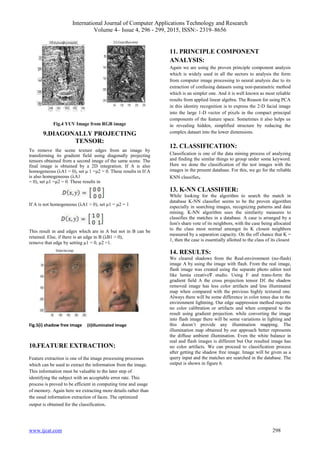
Fig.6 Output
15. CONCLUSION:
To remove shadow in a image, a tensor-based identity
recognition method is proposed the illuminations is
effectively reduced by edge suppression method. We
presented an approach for edge-suppressing operations on an
image. The light sources are found by applying the gradient
field effect. In the recognition phase, Principal component
analysis is used for feature extraction. The K-nearest-neighbor
rule is applied for classification. Experiments are carried out
upon standard databases and if access available can be done in
real-time too. The results reveal that the proposed method
achieves satisfactory recognition rates under varying
illumination conditions. We hope that it can be able to use in
verification and identity authentication processes etc because
of its easy handling.
16. REFERENCE:
[1] Ramesh Raskar, S.Nayar and Y. Li. Removing
photography artifacts using gradient projection and
flashexposure sampling. ACM Trans. Graph., 24(3):828–
835, 2005.
[2] Face Recognition under Severe Shadow Effects Using
Gradient Field Transformation Parisa Beham M *, Bala
Bhattachariar J.U, ISSN 2250-3153. International Journal of
Multimedia and Ubiquitous Engineering
[3] ClopiNet, 955 Creston Rd., Berkeley, CA 94708, USA.
isabelle@clopinet.com 2 IBM Research GmbH, Zurich
Research Laboratory, Saumerstrasse 4, CH-8803 Ruschlikon,
Switzerland. ¨ ael@zurich.ibm.com
[4]H. Barrow and J. Tenenbaum. Recovering intrinsic scene
characteristics from images. In Computer Vision Systems,
pages 3–26, 1978
[5] H.Chen, P.Belhumeur, and D. Jacobs. In search of
illumination invariants. In Proc. Conf. Computer Vision and
Pattern Recognition, pages 254–261, 2000.
[6] A.Elgammal, D.Harwood, and L. Davis. Non-parametric
model for background subtraction. In Proc. European Conf.
Computer Vision, pages 751–767, 2000.
[7] Edge Suppression by Gradient Field Transformation using
Cross-Projection Tensors by Amit Agrawal, Ramesh Raskar
and Rama Chellappa, 2008.
[8] Commentary paper on shadow removal in indoor scene by
Sofke.M, 2008
[9] G.Aubert and P. Kornprobst. Mathematical Problems in
Image Processing: Partial Differential Equations and the
Calculus of Variations, volume 147 of Applied Mathematical
Sciences. SpringerVerlag, 2002](https://image.slidesharecdn.com/ijcatr04041016-150429041311-conversion-gate01/85/Ijcatr04041016-4-320.jpg)

This document presents a method for identity recognition using edge suppression. It aims to recognize identity even under severe shadows. The method uses edge suppression through affine transformation and gradient field calculation to determine light source positions. K-nearest neighbor classification is used for matching identities in databases, along with principal component analysis for feature extraction. Diagonally projecting tensors are applied to suppress edges and remove shadows from images. The method is evaluated on standard databases and is proposed to work for real-time identity recognition applications.


