CS/EE 5590 / ENG 401 Special Topics (17804, 17815, 17803)
Lec 11
Rate-Distortion Optimization (RDO) in Video
Coding-I
Zhu Li
Course Web:
http://l.web.umkc.edu/lizhu/teaching/2016sp.video-communication/main.html
Z. Li Multimedia Communciation, 2016 Spring p.1
Outline
 Lecture 10 ReCap
 Course Projects Sign Up
 Video Coding Standard and Systems
 HEVC History
 HEVC Performance
 HEVC Key Coding Features
Z. Li Multimedia Communciation, 2016 Spring p.2
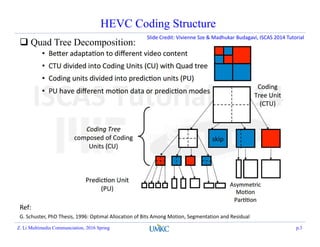
HEVC Coding Structure
 Quad Tree Decomposition:
Z. Li Multimedia Communciation, 2016 Spring p.3
Slide Credit: Vivienne Sze & Madhukar Budagavi, ISCAS 2014 Tutorial
Ref:
G. Schuster, PhD Thesis, 1996: Optimal Allocation of Bits Among Motion, Segmentation and Residual
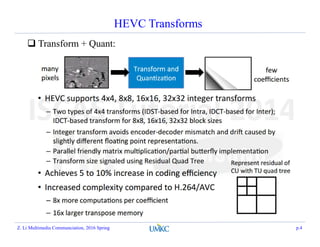
HEVC Transforms
 Transform + Quant:
Z. Li Multimedia Communciation, 2016 Spring p.4
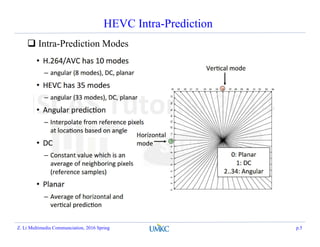
HEVC Intra-Prediction
 Intra-Prediction Modes
Z. Li Multimedia Communciation, 2016 Spring p.5
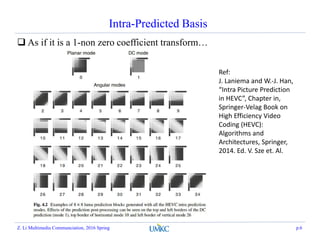
Intra-Predicted Basis
 As if it is a 1-non zero coefficient transform…
Z. Li Multimedia Communciation, 2016 Spring p.6
Ref:
J. Laniema and W.-J. Han,
“Intra Picture Prediction
in HEVC”, Chapter in,
Springer-Velag Book on
High Efficiency Video
Coding (HEVC):
Algorithms and
Architectures, Springer,
2014. Ed. V. Sze et. Al.
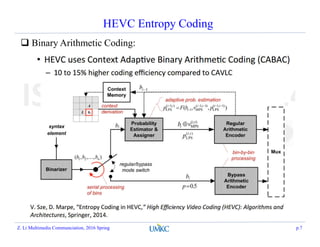
HEVC Entropy Coding
 Binary Arithmetic Coding:
Z. Li Multimedia Communciation, 2016 Spring p.7
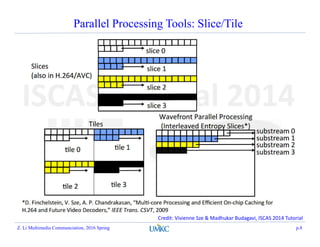
Parallel Processing Tools: Slice/Tile
Z. Li Multimedia Communciation, 2016 Spring p.8
Credit: Vivienne Sze & Madhukar Budagavi, ISCAS 2014 Tutorial
HEVC Resources
 Main Spec:
 http://www.itu.int/ITU-T/recommendaBons/rec.aspx?rec=11885
 T-CSVT Special Issue:
 2012: Combined Issue on HEVC Standard and Research:
http://ieeexplore.ieee.org/xpl/tocresult.jsp?isnumber=6403920
 2016: Special Issue on HEVC Extensions and Efficient HEVC
Implementations:
http://ieeexplore.ieee.org/xpl/tocresult.jsp?isnumber=7372356
 Springer Book:
 V. Sze, M. Budagavi, G. J. Sullivan (Editors), “High
Efficiency Video Coding (HEVC): Algorithms and
Architectures,” Springer, 2014,
http://www.springer.com/engineering/signals/book/
978-3-319-06894-7
 HM (open source software):
 https://hevc.hhi.fraunhofer.de/svn/svn_HEVCSovware/
Z. Li Multimedia Communciation, 2016 Spring p.9
HARP
 HARP: http://www.lms.lnt.de/HARP/
Visualizing the mode decision and coding results
Z. Li Multimedia Communciation, 2016 Spring p.10
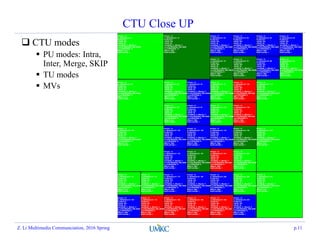
CTU Close UP
 CTU modes
 PU modes: Intra,
Inter, Merge, SKIP
 TU modes
 MVs
Z. Li Multimedia Communciation, 2016 Spring p.11
Course Project Proposal Due 03/14
 Course Project (40%, +10% extra bonus for original research)
 Candidate Topics
 Genome Compression:
 Light Field Compression:
 Point Cloud Compression:
 Screen Content Coding
 RD-Optimized Video Streaming over WebSocket/QUIC/WebRTC:
 Video Storage/Broadcasting:
 Other Video Coding/Communication Topics
 Proposal:
 One page (10pt, single space, excluding references) write up of your
problem formulation and planned work.
 Due 03/14 for video coding related topics, and 03/21 for video
communication related
Z. Li Multimedia Communciation, 2016 Spring p.12
R-D Optimization in Video Coding
An image/video coding system needs to decide many different
parameters for each frame and each MB:
 Intra/Inter Prediction modes
 CTU/MB segmentation
 Quantization step sizes
 …
How to achieve the optimal decision?
The answer depends on the objective.
 Minimizing Distortion ?
 Minimizing Delay ?
 Minimizing Storage ?
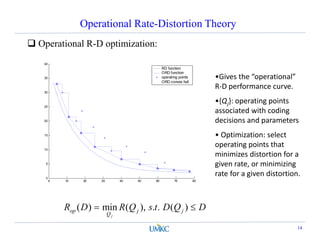
Operational Rate-Distortion Theory
 Operational R-D optimization:
14
•Gives the “operational”
R-D performance curve.
•{Qj}: operating points
associated with coding
decisions and parameters
• Optimization: select
operating points that
minimizes distortion for a
given rate, or minimizing
rate for a given distortion.
0 10 20 30 40 50 60 70 80
0
5
10
15
20
25
30
35
40
RD function
ORD function
operating points
ORD convex hull
DQDtsQRDR jj
Q
op
j
 )(..),(min)(
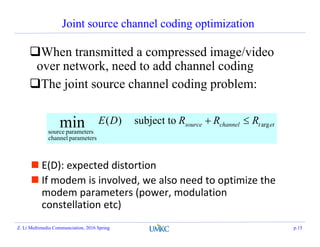
Joint source channel coding optimization
When transmitted a compressed image/video
over network, need to add channel coding
The joint source channel coding problem:
ettchannelsource RRRDE arg
parameterschannel
parameterssource
subject to)(min 
 E(D): expected distortion
 If modem is involved, we also need to optimize the
modem parameters (power, modulation
constellation etc)
Z. Li Multimedia Communciation, 2016 Spring p.15
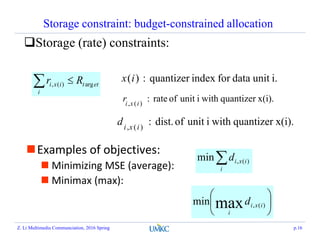
Storage constraint: budget-constrained allocation
Storage (rate) constraints:
ett
i
ixi Rr arg)(,  i.unitdataforindexquantizer:)(ix
Examples of objectives:
 Minimizing MSE (average):
 Minimax (max):
i
ixid )(,min






)(,maxmin ixi
i
d
x(i).quantizerwithiunitofdist.:)(, ixi
d
x(i).quantizerwithiunitofrate:)(, ixi
r
Z. Li Multimedia Communciation, 2016 Spring p.16
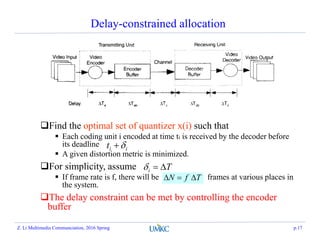
Delay-constrained allocation
Find the optimal set of quantizer x(i) such that
 Each coding unit i encoded at time ti is received by the decoder before
its deadline
 A given distortion metric is minimized.
For simplicity, assume
 If frame rate is f, there will be frames at various places in
the system.
The delay constraint can be met by controlling the encoder
buffer
iit 
Ti 
TfN 
Z. Li Multimedia Communciation, 2016 Spring p.17
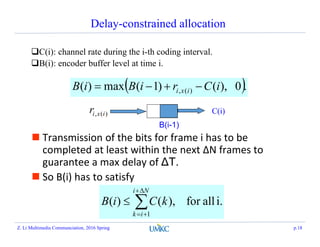
Delay-constrained allocation
C(i): channel rate during the i-th coding interval.
B(i): encoder buffer level at time i.
 .0),()1(max)( )(, iCriBiB ixi 
B(i-1)
C(i))(, ixir
 Transmission of the bits for frame i has to be
completed at least within the next ΔN frames to
guarantee a max delay of ΔT.
 So B(i) has to satisfy
i.allfor),()(
1




Ni
ik
kCiB
Z. Li Multimedia Communciation, 2016 Spring p.18
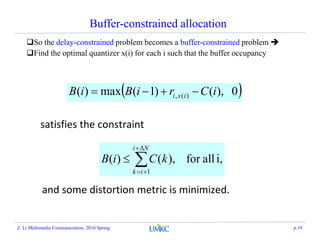
Buffer-constrained allocation
So the delay-constrained problem becomes a buffer-constrained problem 
Find the optimal quantizer x(i) for each i such that the buffer occupancy
 0),()1(max)( )(, iCriBiB ixi 
i,allfor),()(
1




Ni
ik
kCiB
satisfies the constraint
and some distortion metric is minimized.
Z. Li Multimedia Communciation, 2016 Spring p.19
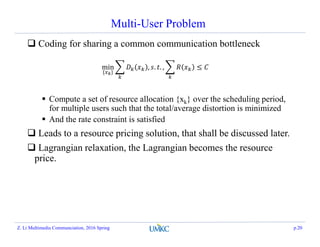
Multi-User Problem
 Coding for sharing a common communication bottleneck
 Compute a set of resource allocation {xk} over the scheduling period,
for multiple users such that the total/average distortion is minimized
 And the rate constraint is satisfied
 Leads to a resource pricing solution, that shall be discussed later.
 Lagrangian relaxation, the Lagrangian becomes the resource
price.
Z. Li Multimedia Communciation, 2016 Spring p.20
min
{ }
, . . , ≤
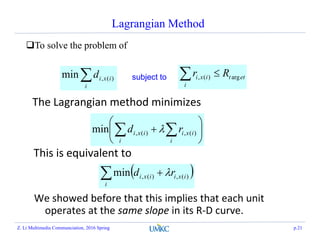
Lagrangian Method
To solve the problem of
ett
i
ixi Rr arg)(, i
ixid )(,min subject to
The Lagrangian method minimizes






  i
ixi
i
ixi rd )(,)(,min 
This is equivalent to
  
i
ixiixi rd )(,)(,min 
We showed before that this implies that each unit
operates at the same slope in its R-D curve.
Z. Li Multimedia Communciation, 2016 Spring p.21
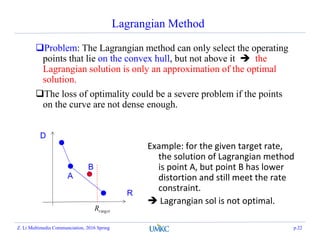
Lagrangian Method
Problem: The Lagrangian method can only select the operating
points that lie on the convex hull, but not above it  the
Lagrangian solution is only an approximation of the optimal
solution.
The loss of optimality could be a severe problem if the points
on the curve are not dense enough.
D
R
ettR arg
A
B
Example: for the given target rate,
the solution of Lagrangian method
is point A, but point B has lower
distortion and still meet the rate
constraint.
 Lagrangian sol is not optimal.
Z. Li Multimedia Communciation, 2016 Spring p.22
Convex Optimization
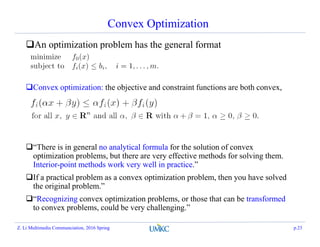
An optimization problem has the general format
Convex optimization: the objective and constraint functions are both convex,
ie,
“There is in general no analytical formula for the solution of convex
optimization problems, but there are very effective methods for solving them.
Interior-point methods work very well in practice.”
If a practical problem as a convex optimization problem, then you have solved
the original problem.”
“Recognizing convex optimization problems, or those that can be transformed
to convex problems, could be very challenging.”
Z. Li Multimedia Communciation, 2016 Spring p.23
Convex Optimization Course Work
 Very good online course coverage on this topic:
 Course video by Prof. Stephen Boyd:
http://web.stanford.edu/class/ee364a/videos.html
Ref:
 Slides: http://stanford.edu/~boyd/cvxbook/bv_cvxslides.pdf
 The book: Stephen Boyd, Convex Optimization, Chapter 5,
http://stanford.edu/~boyd/cvxbook/
Z. Li Multimedia Communciation, 2016 Spring p.24
Convex Optimization
Convex optimization also plays an important role in nonconvex
problems.
Initialization for local optimization:
 Approximate the problem by a convex problem
 Use the solution of convex approximation as the starting point for a local
optimization method
Convex heuristics for nonconvex optimization
 Example: finding a sparse vector that satisfies some constraints
 This is the case in compressed sensing
Bounds for nonconvex global optimization
 Relaxation: each nonconvex constraint is replaced with a looser, but
convex, constraint.
 Lagrangian relaxation: the Lagrangian dual problem is solved, which is
convex, and provides a lower bound on the optimal value of the
nonconvex problem.
Z. Li Multimedia Communciation, 2016 Spring p.25
Affine set and convex set
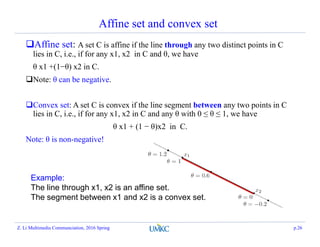
Affine set: A set C is affine if the line through any two distinct points in C
lies in C, i.e., if for any x1, x2 in C and θ, we have
θ x1 +(1−θ) x2 in C.
Note: θ can be negative.
Convex set: A set C is convex if the line segment between any two points in C
lies in C, i.e., if for any x1, x2 in C and any θ with 0 ≤ θ ≤ 1, we have
θ x1 + (1 − θ)x2 in C.
Note: θ is non-negative!
Example:
The line through x1, x2 is an affine set.
The segment between x1 and x2 is a convex set.
Z. Li Multimedia Communciation, 2016 Spring p.26
Operations that preserve convexity
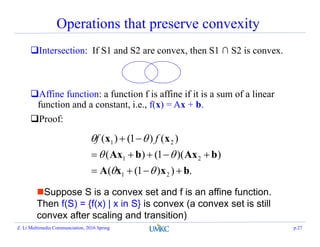
Intersection: If S1 and S2 are convex, then S1 ∩ S2 is convex.
Affine function: a function f is affine if it is a sum of a linear
function and a constant, i.e., f(x) = Ax + b.
Proof:
Suppose S is a convex set and f is an affine function.
Then f(S) = {f(x) | x in S} is convex (a convex set is still
convex after scaling and transition)
.))1((
))(1()(
)()1()(
21
21
21
bxxA
bAxbAx
xx





 ff
Z. Li Multimedia Communciation, 2016 Spring p.27
Operations that preserve convexity
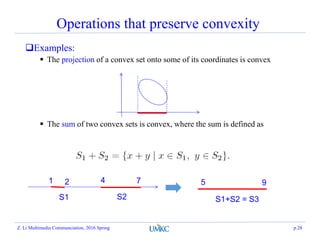
Examples:
 The projection of a convex set onto some of its coordinates is convex
 The sum of two convex sets is convex, where the sum is defined as
1 2 4 7
S1 S2
5 9
S1+S2 = S3
Z. Li Multimedia Communciation, 2016 Spring p.28
Lagrangian
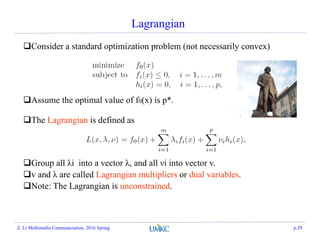
Consider a standard optimization problem (not necessarily convex)
Assume the optimal value of f0(x) is p*.
The Lagrangian is defined as
Group all λi into a vector λ, and all νi into vector v.
v and λ are called Lagrangian multipliers or dual variables.
Note: The Lagrangian is unconstrained.
Z. Li Multimedia Communciation, 2016 Spring p.29
The Lagrangian dual function
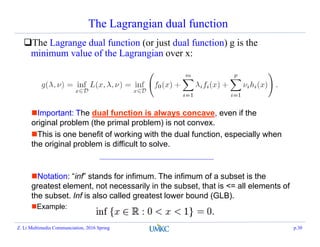
The Lagrange dual function (or just dual function) g is the
minimum value of the Lagrangian over x:
Important: The dual function is always concave, even if the
original problem (the primal problem) is not convex.
This is one benefit of working with the dual function, especially when
the original problem is difficult to solve.
Notation: “inf” stands for infimum. The infimum of a subset is the
greatest element, not necessarily in the subset, that is <= all elements of
the subset. Inf is also called greatest lower bound (GLB).
Example:
Z. Li Multimedia Communciation, 2016 Spring p.30
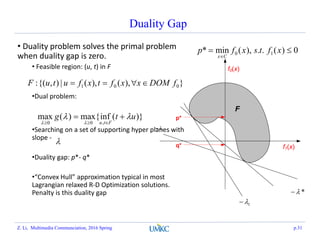
Duality Gap
2
• Duality problem solves the primal problem
when duality gap is zero.
• Feasible region: (u, t) in F
•Dual problem:
•Searching on a set of supporting hyper planes with
slope -
•Duality gap: p*- q*
•“Convex Hull” approximation typical in most
Lagrangian relaxed R-D Optimization solutions.
Penalty is this duality gap *
1
}),(),(|),{(: 001 fDOMxxftxfutuF 
)}(inf{max)(max
,00
utg
Ftu





0)(..),(min* 10 

xftsxfp
Cx
p*
q* f1(x)
f0(x)
F
Z. Li, Multimedia Communciation, 2016 Spring p.31
Lower bound on optimal value
Solid line: f0(x)
Dashed line: f1(x)
Feasible set: [-0.46, 0.46] (f1(x) <=0)
Optimal solution: x* = -0.46, p* = 1.54
Dotted line: L(x, λ) for λ = 0.1, 0.2, …, 1.0.
The minimum of each dotted line is <= p*.
Dual function g(λ)= inf L(x, λ).
(Note that fi(x) is not convex,
But g(λ) is concave!)
Dashed line: p*.
.0)(..),(min 10 xftsxf
)(0 xf
)(1 xf
),( xL
Z. Li, Multimedia Communciation, 2016 Spring p.32
Example
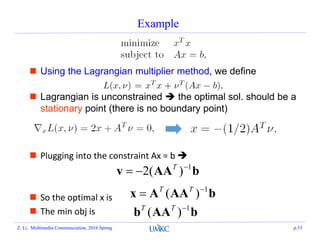
 Using the Lagrangian multiplier method, we define
 Lagrangian is unconstrained  the optimal sol. should be a
stationary point (there is no boundary point)
 Plugging into the constraint Ax = b 
 So the optimal x is
 The min obj is
bAAv 1
)(2 
 T
bAAAx 1
)( 
 TT
bAAb 1
)( TT
Z. Li, Multimedia Communciation, 2016 Spring p.33
Lagrangian dual problem
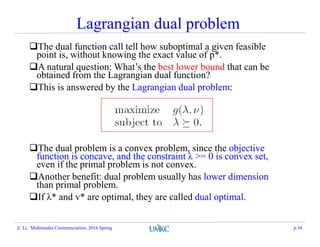
The dual function call tell how suboptimal a given feasible
point is, without knowing the exact value of p*.
A natural question: What’s the best lower bound that can be
obtained from the Lagrangian dual function?
This is answered by the Lagrangian dual problem:
The dual problem is a convex problem, since the objective
function is concave, and the constraint λ >= 0 is convex set,
even if the primal problem is not convex.
Another benefit: dual problem usually has lower dimension
than primal problem.
If λ* and v* are optimal, they are called dual optimal.
Z. Li, Multimedia Communciation, 2016 Spring p.34
Lagrangian dual problem
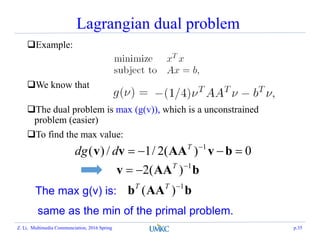
Example:
We know that
The dual problem is max (g(v)), which is a unconstrained
problem (easier)
To find the max value:
0)(2/1/)( 1
 
bvAAvv T
ddg
bAAv 1
)(2 
 T
bAAb 1
)( TT
The max g(v) is:
same as the min of the primal problem.
Z. Li, Multimedia Communciation, 2016 Spring p.35
Weak Duality
Let the optimal value of the Lagrange dual problem be
d*.
This is the best lower bound on p*.
By definition of dual function, we have
d* ≤ p*.
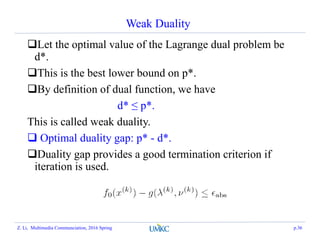
This is called weak duality.
 Optimal duality gap: p* - d*.
Duality gap provides a good termination criterion if
iteration is used.
Z. Li, Multimedia Communciation, 2016 Spring p.36
Strong Duality
If d* = p*, then we say that strong duality holds.
This is usually (not always) true if the primal problem is convex.
In this case, the dual problem yields the same solution as primal
problem, but is usually easier to solve.
This is the case in the previous example:
Z. Li, Multimedia Communciation, 2016 Spring p.37
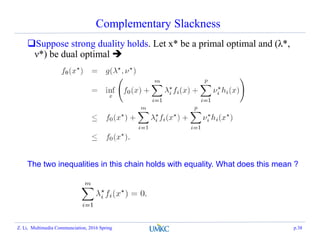
Complementary Slackness
Suppose strong duality holds. Let x* be a primal optimal and (λ*,
ν*) be dual optimal 
The two inequalities in this chain holds with equality. What does this mean ?
Z. Li, Multimedia Communciation, 2016 Spring p.38
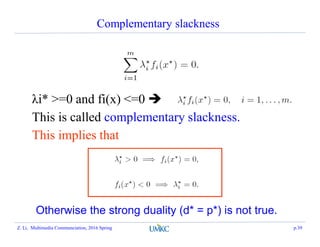
Complementary slackness
λi* >=0 and fi(x) <=0 
This is called complementary slackness.
This implies that
Otherwise the strong duality (d* = p*) is not true.
Z. Li, Multimedia Communciation, 2016 Spring p.39
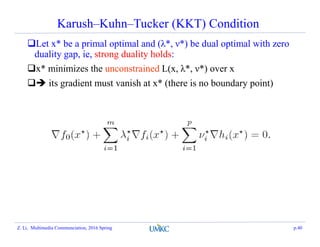
Karush–Kuhn–Tucker (KKT) Condition
Let x* be a primal optimal and (λ*, ν*) be dual optimal with zero
duality gap, ie, strong duality holds:
x* minimizes the unconstrained L(x, λ*, ν*) over x
 its gradient must vanish at x* (there is no boundary point)
Z. Li, Multimedia Communciation, 2016 Spring p.40
KKT Condition
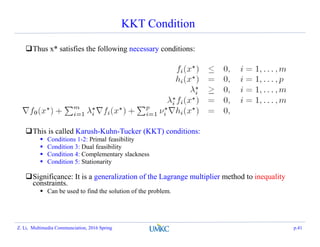
Thus x* satisfies the following necessary conditions:
This is called Karush-Kuhn-Tucker (KKT) conditions:
 Conditions 1-2: Primal feasibility
 Condition 3: Dual feasibility
 Condition 4: Complementary slackness
 Condition 5: Stationarity
Significance: It is a generalization of the Lagrange multiplier method to inequality
constraints.
 Can be used to find the solution of the problem.
Z. Li, Multimedia Communciation, 2016 Spring p.41
KKT Condition
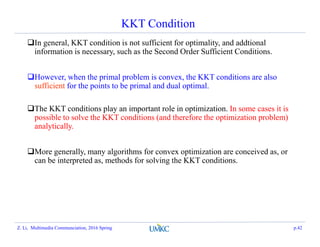
In general, KKT condition is not sufficient for optimality, and addtional
information is necessary, such as the Second Order Sufficient Conditions.
However, when the primal problem is convex, the KKT conditions are also
sufficient for the points to be primal and dual optimal.
The KKT conditions play an important role in optimization. In some cases it is
possible to solve the KKT conditions (and therefore the optimization problem)
analytically.
More generally, many algorithms for convex optimization are conceived as, or
can be interpreted as, methods for solving the KKT conditions.
Z. Li, Multimedia Communciation, 2016 Spring p.42
KKT Condition
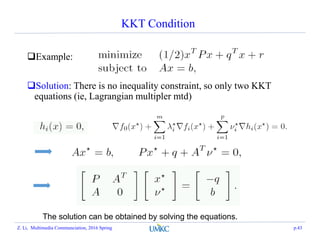
Example:
Solution: There is no inequality constraint, so only two KKT
equations (ie, Lagrangian multipler mtd)
The solution can be obtained by solving the equations.
Z. Li, Multimedia Communciation, 2016 Spring p.43
Summary
 Course Project Signup
 Start early to avoid last minute hear burns.
 Accounts for 40~50 % of course credit, can leads to MS Thesis
 Start reading, deep diving o topics of your choice.
 Will set up task forces so people can collaborate
 RD Optimization
 Lagrangian Operational RD Optimization: can only trace out the convex hull
of the R-D plane.
 Convert the original constrained problem into un-constrained Dual problem,
searching the Lagrangian for convex-hull optimal solution
 Next Class:
 Will cover DP, and show a practical problem solved by Lagrangian Relaxation
as outer loop of control, and DP as inner loop of control.
Z. Li Multimedia Communciation, 2016 Spring p.44

Lec11 rate distortion optimization

  • 1.
    CS/EE 5590 /ENG 401 Special Topics (17804, 17815, 17803) Lec 11 Rate-Distortion Optimization (RDO) in Video Coding-I Zhu Li Course Web: http://l.web.umkc.edu/lizhu/teaching/2016sp.video-communication/main.html Z. Li Multimedia Communciation, 2016 Spring p.1
  • 2.
    Outline  Lecture 10ReCap  Course Projects Sign Up  Video Coding Standard and Systems  HEVC History  HEVC Performance  HEVC Key Coding Features Z. Li Multimedia Communciation, 2016 Spring p.2
  • 3.
    HEVC Coding Structure Quad Tree Decomposition: Z. Li Multimedia Communciation, 2016 Spring p.3 Slide Credit: Vivienne Sze & Madhukar Budagavi, ISCAS 2014 Tutorial Ref: G. Schuster, PhD Thesis, 1996: Optimal Allocation of Bits Among Motion, Segmentation and Residual
  • 4.
    HEVC Transforms  Transform+ Quant: Z. Li Multimedia Communciation, 2016 Spring p.4
  • 5.
    HEVC Intra-Prediction  Intra-PredictionModes Z. Li Multimedia Communciation, 2016 Spring p.5
  • 6.
    Intra-Predicted Basis  Asif it is a 1-non zero coefficient transform… Z. Li Multimedia Communciation, 2016 Spring p.6 Ref: J. Laniema and W.-J. Han, “Intra Picture Prediction in HEVC”, Chapter in, Springer-Velag Book on High Efficiency Video Coding (HEVC): Algorithms and Architectures, Springer, 2014. Ed. V. Sze et. Al.
  • 7.
    HEVC Entropy Coding Binary Arithmetic Coding: Z. Li Multimedia Communciation, 2016 Spring p.7
  • 8.
    Parallel Processing Tools:Slice/Tile Z. Li Multimedia Communciation, 2016 Spring p.8 Credit: Vivienne Sze & Madhukar Budagavi, ISCAS 2014 Tutorial
  • 9.
    HEVC Resources  MainSpec:  http://www.itu.int/ITU-T/recommendaBons/rec.aspx?rec=11885  T-CSVT Special Issue:  2012: Combined Issue on HEVC Standard and Research: http://ieeexplore.ieee.org/xpl/tocresult.jsp?isnumber=6403920  2016: Special Issue on HEVC Extensions and Efficient HEVC Implementations: http://ieeexplore.ieee.org/xpl/tocresult.jsp?isnumber=7372356  Springer Book:  V. Sze, M. Budagavi, G. J. Sullivan (Editors), “High Efficiency Video Coding (HEVC): Algorithms and Architectures,” Springer, 2014, http://www.springer.com/engineering/signals/book/ 978-3-319-06894-7  HM (open source software):  https://hevc.hhi.fraunhofer.de/svn/svn_HEVCSovware/ Z. Li Multimedia Communciation, 2016 Spring p.9
  • 10.
    HARP  HARP: http://www.lms.lnt.de/HARP/ Visualizingthe mode decision and coding results Z. Li Multimedia Communciation, 2016 Spring p.10
  • 11.
    CTU Close UP CTU modes  PU modes: Intra, Inter, Merge, SKIP  TU modes  MVs Z. Li Multimedia Communciation, 2016 Spring p.11
  • 12.
    Course Project ProposalDue 03/14  Course Project (40%, +10% extra bonus for original research)  Candidate Topics  Genome Compression:  Light Field Compression:  Point Cloud Compression:  Screen Content Coding  RD-Optimized Video Streaming over WebSocket/QUIC/WebRTC:  Video Storage/Broadcasting:  Other Video Coding/Communication Topics  Proposal:  One page (10pt, single space, excluding references) write up of your problem formulation and planned work.  Due 03/14 for video coding related topics, and 03/21 for video communication related Z. Li Multimedia Communciation, 2016 Spring p.12
  • 13.
    R-D Optimization inVideo Coding An image/video coding system needs to decide many different parameters for each frame and each MB:  Intra/Inter Prediction modes  CTU/MB segmentation  Quantization step sizes  … How to achieve the optimal decision? The answer depends on the objective.  Minimizing Distortion ?  Minimizing Delay ?  Minimizing Storage ?
  • 14.
    Operational Rate-Distortion Theory Operational R-D optimization: 14 •Gives the “operational” R-D performance curve. •{Qj}: operating points associated with coding decisions and parameters • Optimization: select operating points that minimizes distortion for a given rate, or minimizing rate for a given distortion. 0 10 20 30 40 50 60 70 80 0 5 10 15 20 25 30 35 40 RD function ORD function operating points ORD convex hull DQDtsQRDR jj Q op j  )(..),(min)(
  • 15.
    Joint source channelcoding optimization When transmitted a compressed image/video over network, need to add channel coding The joint source channel coding problem: ettchannelsource RRRDE arg parameterschannel parameterssource subject to)(min   E(D): expected distortion  If modem is involved, we also need to optimize the modem parameters (power, modulation constellation etc) Z. Li Multimedia Communciation, 2016 Spring p.15
  • 16.
    Storage constraint: budget-constrainedallocation Storage (rate) constraints: ett i ixi Rr arg)(,  i.unitdataforindexquantizer:)(ix Examples of objectives:  Minimizing MSE (average):  Minimax (max): i ixid )(,min       )(,maxmin ixi i d x(i).quantizerwithiunitofdist.:)(, ixi d x(i).quantizerwithiunitofrate:)(, ixi r Z. Li Multimedia Communciation, 2016 Spring p.16
  • 17.
    Delay-constrained allocation Find theoptimal set of quantizer x(i) such that  Each coding unit i encoded at time ti is received by the decoder before its deadline  A given distortion metric is minimized. For simplicity, assume  If frame rate is f, there will be frames at various places in the system. The delay constraint can be met by controlling the encoder buffer iit  Ti  TfN  Z. Li Multimedia Communciation, 2016 Spring p.17
  • 18.
    Delay-constrained allocation C(i): channelrate during the i-th coding interval. B(i): encoder buffer level at time i.  .0),()1(max)( )(, iCriBiB ixi  B(i-1) C(i))(, ixir  Transmission of the bits for frame i has to be completed at least within the next ΔN frames to guarantee a max delay of ΔT.  So B(i) has to satisfy i.allfor),()( 1     Ni ik kCiB Z. Li Multimedia Communciation, 2016 Spring p.18
  • 19.
    Buffer-constrained allocation So thedelay-constrained problem becomes a buffer-constrained problem  Find the optimal quantizer x(i) for each i such that the buffer occupancy  0),()1(max)( )(, iCriBiB ixi  i,allfor),()( 1     Ni ik kCiB satisfies the constraint and some distortion metric is minimized. Z. Li Multimedia Communciation, 2016 Spring p.19
  • 20.
    Multi-User Problem  Codingfor sharing a common communication bottleneck  Compute a set of resource allocation {xk} over the scheduling period, for multiple users such that the total/average distortion is minimized  And the rate constraint is satisfied  Leads to a resource pricing solution, that shall be discussed later.  Lagrangian relaxation, the Lagrangian becomes the resource price. Z. Li Multimedia Communciation, 2016 Spring p.20 min { } , . . , ≤
  • 21.
    Lagrangian Method To solvethe problem of ett i ixi Rr arg)(, i ixid )(,min subject to The Lagrangian method minimizes         i ixi i ixi rd )(,)(,min  This is equivalent to    i ixiixi rd )(,)(,min  We showed before that this implies that each unit operates at the same slope in its R-D curve. Z. Li Multimedia Communciation, 2016 Spring p.21
  • 22.
    Lagrangian Method Problem: TheLagrangian method can only select the operating points that lie on the convex hull, but not above it  the Lagrangian solution is only an approximation of the optimal solution. The loss of optimality could be a severe problem if the points on the curve are not dense enough. D R ettR arg A B Example: for the given target rate, the solution of Lagrangian method is point A, but point B has lower distortion and still meet the rate constraint.  Lagrangian sol is not optimal. Z. Li Multimedia Communciation, 2016 Spring p.22
  • 23.
    Convex Optimization An optimizationproblem has the general format Convex optimization: the objective and constraint functions are both convex, ie, “There is in general no analytical formula for the solution of convex optimization problems, but there are very effective methods for solving them. Interior-point methods work very well in practice.” If a practical problem as a convex optimization problem, then you have solved the original problem.” “Recognizing convex optimization problems, or those that can be transformed to convex problems, could be very challenging.” Z. Li Multimedia Communciation, 2016 Spring p.23
  • 24.
    Convex Optimization CourseWork  Very good online course coverage on this topic:  Course video by Prof. Stephen Boyd: http://web.stanford.edu/class/ee364a/videos.html Ref:  Slides: http://stanford.edu/~boyd/cvxbook/bv_cvxslides.pdf  The book: Stephen Boyd, Convex Optimization, Chapter 5, http://stanford.edu/~boyd/cvxbook/ Z. Li Multimedia Communciation, 2016 Spring p.24
  • 25.
    Convex Optimization Convex optimizationalso plays an important role in nonconvex problems. Initialization for local optimization:  Approximate the problem by a convex problem  Use the solution of convex approximation as the starting point for a local optimization method Convex heuristics for nonconvex optimization  Example: finding a sparse vector that satisfies some constraints  This is the case in compressed sensing Bounds for nonconvex global optimization  Relaxation: each nonconvex constraint is replaced with a looser, but convex, constraint.  Lagrangian relaxation: the Lagrangian dual problem is solved, which is convex, and provides a lower bound on the optimal value of the nonconvex problem. Z. Li Multimedia Communciation, 2016 Spring p.25
  • 26.
    Affine set andconvex set Affine set: A set C is affine if the line through any two distinct points in C lies in C, i.e., if for any x1, x2 in C and θ, we have θ x1 +(1−θ) x2 in C. Note: θ can be negative. Convex set: A set C is convex if the line segment between any two points in C lies in C, i.e., if for any x1, x2 in C and any θ with 0 ≤ θ ≤ 1, we have θ x1 + (1 − θ)x2 in C. Note: θ is non-negative! Example: The line through x1, x2 is an affine set. The segment between x1 and x2 is a convex set. Z. Li Multimedia Communciation, 2016 Spring p.26
  • 27.
    Operations that preserveconvexity Intersection: If S1 and S2 are convex, then S1 ∩ S2 is convex. Affine function: a function f is affine if it is a sum of a linear function and a constant, i.e., f(x) = Ax + b. Proof: Suppose S is a convex set and f is an affine function. Then f(S) = {f(x) | x in S} is convex (a convex set is still convex after scaling and transition) .))1(( ))(1()( )()1()( 21 21 21 bxxA bAxbAx xx       ff Z. Li Multimedia Communciation, 2016 Spring p.27
  • 28.
    Operations that preserveconvexity Examples:  The projection of a convex set onto some of its coordinates is convex  The sum of two convex sets is convex, where the sum is defined as 1 2 4 7 S1 S2 5 9 S1+S2 = S3 Z. Li Multimedia Communciation, 2016 Spring p.28
  • 29.
    Lagrangian Consider a standardoptimization problem (not necessarily convex) Assume the optimal value of f0(x) is p*. The Lagrangian is defined as Group all λi into a vector λ, and all νi into vector v. v and λ are called Lagrangian multipliers or dual variables. Note: The Lagrangian is unconstrained. Z. Li Multimedia Communciation, 2016 Spring p.29
  • 30.
    The Lagrangian dualfunction The Lagrange dual function (or just dual function) g is the minimum value of the Lagrangian over x: Important: The dual function is always concave, even if the original problem (the primal problem) is not convex. This is one benefit of working with the dual function, especially when the original problem is difficult to solve. Notation: “inf” stands for infimum. The infimum of a subset is the greatest element, not necessarily in the subset, that is <= all elements of the subset. Inf is also called greatest lower bound (GLB). Example: Z. Li Multimedia Communciation, 2016 Spring p.30
  • 31.
    Duality Gap 2 • Dualityproblem solves the primal problem when duality gap is zero. • Feasible region: (u, t) in F •Dual problem: •Searching on a set of supporting hyper planes with slope - •Duality gap: p*- q* •“Convex Hull” approximation typical in most Lagrangian relaxed R-D Optimization solutions. Penalty is this duality gap * 1 }),(),(|),{(: 001 fDOMxxftxfutuF  )}(inf{max)(max ,00 utg Ftu      0)(..),(min* 10   xftsxfp Cx p* q* f1(x) f0(x) F Z. Li, Multimedia Communciation, 2016 Spring p.31
  • 32.
    Lower bound onoptimal value Solid line: f0(x) Dashed line: f1(x) Feasible set: [-0.46, 0.46] (f1(x) <=0) Optimal solution: x* = -0.46, p* = 1.54 Dotted line: L(x, λ) for λ = 0.1, 0.2, …, 1.0. The minimum of each dotted line is <= p*. Dual function g(λ)= inf L(x, λ). (Note that fi(x) is not convex, But g(λ) is concave!) Dashed line: p*. .0)(..),(min 10 xftsxf )(0 xf )(1 xf ),( xL Z. Li, Multimedia Communciation, 2016 Spring p.32
  • 33.
    Example  Using theLagrangian multiplier method, we define  Lagrangian is unconstrained  the optimal sol. should be a stationary point (there is no boundary point)  Plugging into the constraint Ax = b   So the optimal x is  The min obj is bAAv 1 )(2   T bAAAx 1 )(   TT bAAb 1 )( TT Z. Li, Multimedia Communciation, 2016 Spring p.33
  • 34.
    Lagrangian dual problem Thedual function call tell how suboptimal a given feasible point is, without knowing the exact value of p*. A natural question: What’s the best lower bound that can be obtained from the Lagrangian dual function? This is answered by the Lagrangian dual problem: The dual problem is a convex problem, since the objective function is concave, and the constraint λ >= 0 is convex set, even if the primal problem is not convex. Another benefit: dual problem usually has lower dimension than primal problem. If λ* and v* are optimal, they are called dual optimal. Z. Li, Multimedia Communciation, 2016 Spring p.34
  • 35.
    Lagrangian dual problem Example: Weknow that The dual problem is max (g(v)), which is a unconstrained problem (easier) To find the max value: 0)(2/1/)( 1   bvAAvv T ddg bAAv 1 )(2   T bAAb 1 )( TT The max g(v) is: same as the min of the primal problem. Z. Li, Multimedia Communciation, 2016 Spring p.35
  • 36.
    Weak Duality Let theoptimal value of the Lagrange dual problem be d*. This is the best lower bound on p*. By definition of dual function, we have d* ≤ p*. This is called weak duality.  Optimal duality gap: p* - d*. Duality gap provides a good termination criterion if iteration is used. Z. Li, Multimedia Communciation, 2016 Spring p.36
  • 37.
    Strong Duality If d*= p*, then we say that strong duality holds. This is usually (not always) true if the primal problem is convex. In this case, the dual problem yields the same solution as primal problem, but is usually easier to solve. This is the case in the previous example: Z. Li, Multimedia Communciation, 2016 Spring p.37
  • 38.
    Complementary Slackness Suppose strongduality holds. Let x* be a primal optimal and (λ*, ν*) be dual optimal  The two inequalities in this chain holds with equality. What does this mean ? Z. Li, Multimedia Communciation, 2016 Spring p.38
  • 39.
    Complementary slackness λi* >=0and fi(x) <=0  This is called complementary slackness. This implies that Otherwise the strong duality (d* = p*) is not true. Z. Li, Multimedia Communciation, 2016 Spring p.39
  • 40.
    Karush–Kuhn–Tucker (KKT) Condition Letx* be a primal optimal and (λ*, ν*) be dual optimal with zero duality gap, ie, strong duality holds: x* minimizes the unconstrained L(x, λ*, ν*) over x  its gradient must vanish at x* (there is no boundary point) Z. Li, Multimedia Communciation, 2016 Spring p.40
  • 41.
    KKT Condition Thus x*satisfies the following necessary conditions: This is called Karush-Kuhn-Tucker (KKT) conditions:  Conditions 1-2: Primal feasibility  Condition 3: Dual feasibility  Condition 4: Complementary slackness  Condition 5: Stationarity Significance: It is a generalization of the Lagrange multiplier method to inequality constraints.  Can be used to find the solution of the problem. Z. Li, Multimedia Communciation, 2016 Spring p.41
  • 42.
    KKT Condition In general,KKT condition is not sufficient for optimality, and addtional information is necessary, such as the Second Order Sufficient Conditions. However, when the primal problem is convex, the KKT conditions are also sufficient for the points to be primal and dual optimal. The KKT conditions play an important role in optimization. In some cases it is possible to solve the KKT conditions (and therefore the optimization problem) analytically. More generally, many algorithms for convex optimization are conceived as, or can be interpreted as, methods for solving the KKT conditions. Z. Li, Multimedia Communciation, 2016 Spring p.42
  • 43.
    KKT Condition Example: Solution: Thereis no inequality constraint, so only two KKT equations (ie, Lagrangian multipler mtd) The solution can be obtained by solving the equations. Z. Li, Multimedia Communciation, 2016 Spring p.43
  • 44.
    Summary  Course ProjectSignup  Start early to avoid last minute hear burns.  Accounts for 40~50 % of course credit, can leads to MS Thesis  Start reading, deep diving o topics of your choice.  Will set up task forces so people can collaborate  RD Optimization  Lagrangian Operational RD Optimization: can only trace out the convex hull of the R-D plane.  Convert the original constrained problem into un-constrained Dual problem, searching the Lagrangian for convex-hull optimal solution  Next Class:  Will cover DP, and show a practical problem solved by Lagrangian Relaxation as outer loop of control, and DP as inner loop of control. Z. Li Multimedia Communciation, 2016 Spring p.44