This presentation by Shweta Kanhere-Banait discusses object tracking in computer vision, including its definition, classifications, algorithms, challenges, applications, and future work. Object tracking is important in various fields such as security and human-computer interaction, while highlighting the roles of different tracking algorithms and their challenges, including appearance changes and occlusions. Future improvements in automatic feature selection and contextual information usage are suggested to enhance tracking accuracy.

Introduction to Objecttracking
• Computer vision has received great attention over the last two decades.
• This research field is important not only in security related software, but also
in advanced interface between people and computers, advanced control
methods and many other areas.
• Object tracking play a key role .
4.
Definition
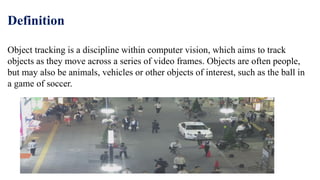
Object tracking isa discipline within computer vision, which aims to track
objects as they move across a series of video frames. Objects are often people,
but may also be animals, vehicles or other objects of interest, such as the ball in
a game of soccer.
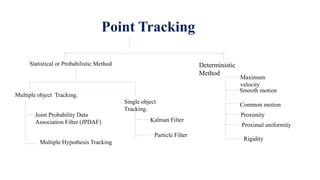
Point Tracking
Deterministic
Method
Maximum
velocity
Smooth motion
Proximaluniformity
Common motion
Proximity
Rigidity
Statistical or Probabilistic Method
Multiple object Tracking.
Single object
Tracking.
Kalman Filter
Particle Filter
Joint Probability Data
Association Filter (JPDAF)
Multiple Hypothesis Tracking
Silhouette-Based Object Tracking
•When object is represented by the outlines with only single solid color
in between the outlines made up of edges is known as silhouette.
• It is used where object cannot be represented by the simple geometric
shapes or by set of points.
• Silhouette is feature-less, therefore object model is created with help
of contour, edge information, color histogram etc.
10.
Object Tracking Algorithms
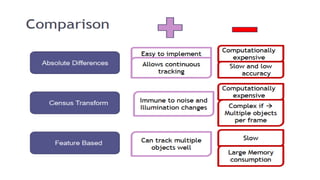
1. Absolute Differences 2. Census Method 3. Feature Based Method
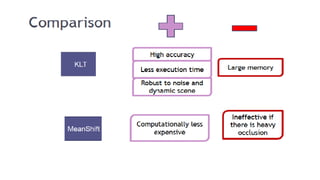
• Mean-shift
• KLTP
• Condensation
• Tracking-Learning-Detection (TLD)
• Tracking Based on Boundary of the Object
Popular object tracking algorithms that use deep learning methods:
• SORT
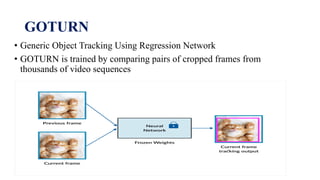
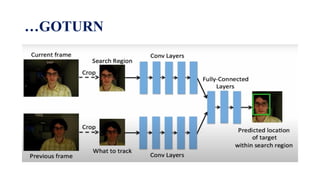
• GOTURN
• MDNet
11.
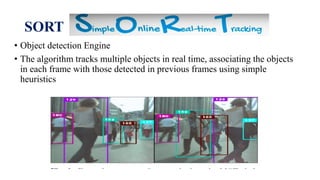
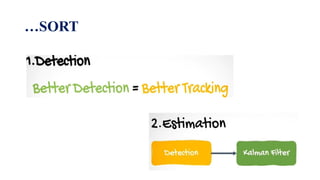
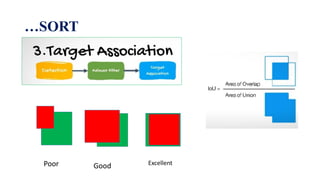
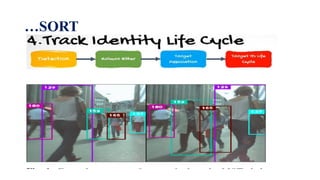
SORT
• Object detectionEngine
• The algorithm tracks multiple objects in real time, associating the objects
in each frame with those detected in previous frames using simple
heuristics
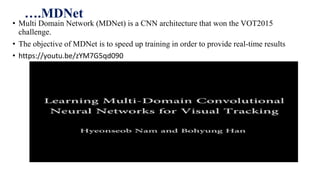
….MDNet
• Multi DomainNetwork (MDNet) is a CNN architecture that won the VOT2015
challenge.
• The objective of MDNet is to speed up training in order to provide real-time results
• https://youtu.be/zYM7G5qd090
21.
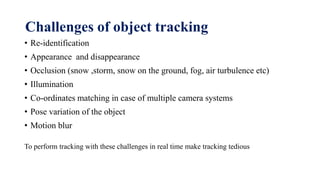
Challenges of objecttracking
• Re-identification
• Appearance and disappearance
• Occlusion (snow ,storm, snow on the ground, fog, air turbulence etc)
• Illumination
• Co-ordinates matching in case of multiple camera systems
• Pose variation of the object
• Motion blur
To perform tracking with these challenges in real time make tracking tedious
22.
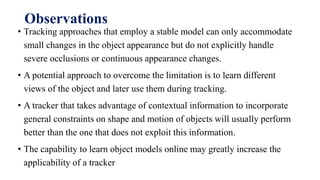
Observations
• Tracking approachesthat employ a stable model can only accommodate
small changes in the object appearance but do not explicitly handle
severe occlusions or continuous appearance changes.
• A potential approach to overcome the limitation is to learn different
views of the object and later use them during tracking.
• A tracker that takes advantage of contextual information to incorporate
general constraints on shape and motion of objects will usually perform
better than the one that does not exploit this information.
• The capability to learn object models online may greatly increase the
applicability of a tracker
Future work
• Theaccuracy of object tracking could potentially increase by developing
methods for a more automatic selection process of features.
• We know from experience that a human tends do make more mistake than a
computer program optimized for a certain purpose.
• Automatic feature selection has received attention in the area of pattern
recognition, where methods for this purpose are divided into filter methods
and wrapper methods.
• However, these have not gotten the same attention in the area of object
tracking, where feature selection still is mostly done manually.
• There could be room for improvement in object tracking by developing fast
and accurate methods for automatic feature selection.
25.
References:
• Z. Kalal,K. Mikolajczyk, and J. Matas, “Tracking-Learning-Detection,” Pattern Analysis and Machine Intelligence, 2011.
• Moving Object Detection Approaches, Challenges and Object Tracking
• https://missinglink.ai/guides/computer-vision/object-tracking-deep-learning/
• Li, F. Li, and M. Zhang, “A Real-time Detecting and Tracking Method for Moving Objects Basedon Color Video,” in 2009 Sixth
International Conference on Computer Graphics, Imaging andVisualization. IEEE, 2009, pp. 317–322.
• Object Detection and Tracking, Fatih Porikli and Alper Yilmaz
• Abdurrahman, "Smart video-based surveillance: Opportunities and challenges from image processing perspectives," 2016 3rd
International Conference on Information Technology, Computer, and Electrical Engineering (ICITACEE), Semarang, 2016, pp.
10-10
• W. Kim and C. Jung, "Illumination-Invariant Background Subtraction: Comparative Review, Models, and Prospects," in IEEE
Access, vol. 5, pp. 8369-8384, 2017.
• Aseema Mohanty and Sanjivani Shantaiya. Article: A Survey on Moving Object Detection using Background Subtraction Methods
in Video. IJCA Proceedings on National Conference on Knowledge , Innovation in Technology and Engineering
(NCKITE 2015)NCKITE, 2015(2):5-10, July 2015
• M. Zhu and H. Wang, "Fast detection of moving object based on improved frame-difference method," 2017 6th International
Conference on Computer Science and Network Technology (ICCSNT), Dalian, 2017, pp. 299-303.
• Nesne Takibinde Uyarlanabilir Arama Alanı Adaptive Search Area in the Object Tracking , Kazım HANBAY , Bingöl
Üniversitesi, Bilgisayar Mühendisliği Bölümü, Bingöl, Türkiye , Bingöl, Türkiye