Face recognition using PCA
R.SINDHI MADHURI
A.ANURAG REDDY
G.USHASWI
ROHIT UPADHYAY
•
•
•
•
•

IDEA
OPERATIONS

MERITS
DEMERITS
APPLICATIONS
PCA
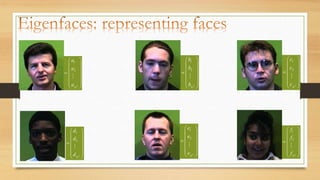
Eigenfaces: the idea
Eigenvectors and Eigenvalues
Learning Eigenfaces from training sets of faces
Co-variance

Recognition and reconstruction
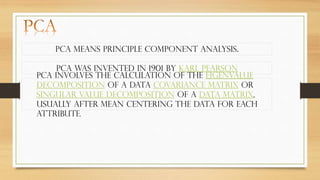
PCA means Principle Component Analysis.

PCA was invented in 1901 by Karl Pearson
PCA involves the calculation of the eigenvalue
decomposition of a data covariance matrix or
singular value decomposition of a data matrix,
usually after mean centering the data for each
attribute.
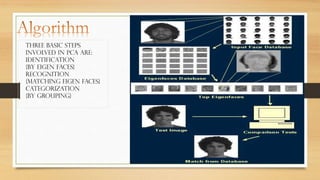
Three basic steps
involved in PCA are:
Identification
{by eigen faces}
Recognition
{matching eigen faces}
Categorization
{by grouping}
In Digital Image Processing, we convert 2-D images into matrix form for clear analysis.
Every matrix can be represented with the help of its eigen vectors.
An eigenvector is a vector that obeys the following rule:

Av   v

Where A is a matrix , is a scalar (called the eigenvalue)
e.g. A   2

3 one eigenvector of is
 3  since
  
 2 1


2
 2 3  3 12
3
 2 1  2    8   4   2 

   
 

so for this eigenvector of this matrix the eigenvalue is 4
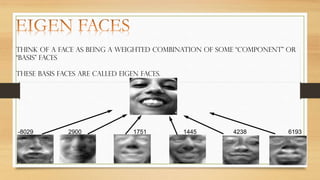
Think of a face as being a weighted combination of some “component” or
“basis” faces
These basis faces are called eigen faces.

-8029

2900

1751

1445

4238

6193
 a1 


a2 




a 2 

 N 

 d1 


 d2 




d 2 

 N 

 b1 


b2 




b 2 

 N 

 c1 


c2 




c 2 

 N 

 e1 


e2 




e 2 

 N 

 f1 


 f2 




f 2

 N 
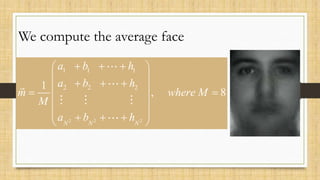
We compute the average face
 a1  b1 

1  a2  b2 
m
M

a 2 b 2 
N
 N

 h1 

 h2 
,


 hN 2 


where M  8
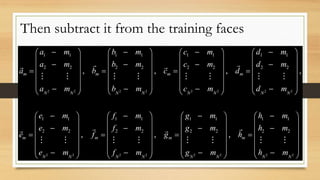
Then subtract it from the training faces
 a1  m1 
 b1  m1 
 c1  m1 
 d1  m1 








 a2  m2  , b   b2  m2  , c   c2  m2  , d   d 2  m2  ,
am 
m
m
m












a 2  m 2 

b 2  m 2 

c 2  m 2 

d 2  m 2 

N 
N 
N 
N 
 N
 N
 N
 N
 e1  m1 


e2  m2 
em  
,



e 2  m 2 

N 
 N

 f1  m1 
 g1  m1 
 h1  m1 






f 2  m2 
g 2  m2 
h2  m2 
fm  
, gm  
, hm  









f 2 m 2

g 2  m 2 

h 2  m 2 

N 
N 
N 
 N
 N
 N
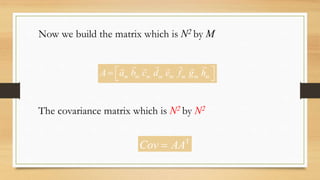
Now we build the matrix which is N2 by M
A   am bm cm d m em f m g m hm 



The covariance matrix which is N2 by N2


Cov  AA
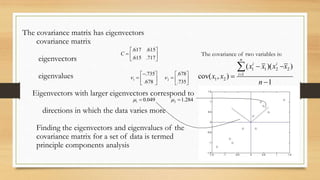
The covariance matrix has eigenvectors
covariance matrix
eigenvectors
eigenvalues

.617 .615 
C

.615 .717 
 .735

 .678 

1  

The covariance of two variables is:
n

.678

2  
.735




Eigenvectors with larger eigenvectors correspond to
1  0.049

2  1.284

directions in which the data varies more
Finding the eigenvectors and eigenvalues of the
covariance matrix for a set of data is termed
principle components analysis

cov( x1 , x2 ) 

i
( x1i  x1 )( x2 x2 )

i 1

n 1
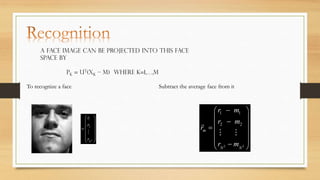
A face image can be projected into this face
space by
pk = UT(xk – m) where k=1,…,m
To recognize a face

Subtract the average face from it

 r1 
 
r2
 
 
 
r 2 
 N 

 r1  m1 


r2  m2 
rm  



r 2  m 2 

N 
 N
Compute its projection onto the face space U

 U

Compute the distance in the face  2
i
space between the face and all
known faces

Compute the threshold





 rm 

   i

1
  max i   j
2

2

for i  1.. M

 for i, j  1.. M
Distinguish between
• If    then it’s not a face; the distance between
the face and its reconstruction is larger than
threshold
• If    and min  i    then it’s a new face
• If    and  i   , (i  1.. M ) then it’s a known
face because the distance in the face space
between the face and all known faces is larger than
threshold
Image is reconstructed in the 3rd case, if
   and 

i

  , (i  1.. M )

Using the MATLAB code, original image and reconstructed image are shown.
Ex:
Relatively simple
Fast
Robust
Expression
- Change in feature
location and shape.
Variations in lighting
conditions
Different lighting conditions
for enrolment and query.
Bright light causing image
saturation.
Various potential
applications, such as
•
•

Person identification.
Human-computer
interaction.
• Security systems.
Face Recognition using PCA-Principal Component Analysis using MATLAB

Face Recognition using PCA-Principal Component Analysis using MATLAB

  • 1.
    Face recognition usingPCA R.SINDHI MADHURI A.ANURAG REDDY G.USHASWI ROHIT UPADHYAY
  • 2.
  • 3.
    PCA Eigenfaces: the idea Eigenvectorsand Eigenvalues Learning Eigenfaces from training sets of faces Co-variance Recognition and reconstruction
  • 4.
    PCA means PrincipleComponent Analysis. PCA was invented in 1901 by Karl Pearson PCA involves the calculation of the eigenvalue decomposition of a data covariance matrix or singular value decomposition of a data matrix, usually after mean centering the data for each attribute.
  • 5.
    Three basic steps involvedin PCA are: Identification {by eigen faces} Recognition {matching eigen faces} Categorization {by grouping}
  • 6.
    In Digital ImageProcessing, we convert 2-D images into matrix form for clear analysis. Every matrix can be represented with the help of its eigen vectors. An eigenvector is a vector that obeys the following rule: Av   v Where A is a matrix , is a scalar (called the eigenvalue) e.g. A   2 3 one eigenvector of is  3  since     2 1   2  2 3  3 12 3  2 1  2    8   4   2         so for this eigenvector of this matrix the eigenvalue is 4
  • 7.
    Think of aface as being a weighted combination of some “component” or “basis” faces These basis faces are called eigen faces. -8029 2900 1751 1445 4238 6193
  • 8.
     a1    a2     a 2    N   d1     d2      d 2    N   b1    b2      b 2    N   c1    c2      c 2    N   e1    e2      e 2    N   f1     f2      f 2   N 
  • 9.
    We compute theaverage face  a1  b1   1  a2  b2  m M  a 2 b 2  N  N  h1    h2  ,    hN 2   where M  8
  • 10.
    Then subtract itfrom the training faces  a1  m1   b1  m1   c1  m1   d1  m1           a2  m2  , b   b2  m2  , c   c2  m2  , d   d 2  m2  , am  m m m             a 2  m 2   b 2  m 2   c 2  m 2   d 2  m 2   N  N  N  N   N  N  N  N  e1  m1    e2  m2  em   ,    e 2  m 2   N   N  f1  m1   g1  m1   h1  m1        f 2  m2  g 2  m2  h2  m2  fm   , gm   , hm            f 2 m 2  g 2  m 2   h 2  m 2   N  N  N   N  N  N
  • 11.
    Now we buildthe matrix which is N2 by M A   am bm cm d m em f m g m hm    The covariance matrix which is N2 by N2  Cov  AA
  • 12.
    The covariance matrixhas eigenvectors covariance matrix eigenvectors eigenvalues .617 .615  C  .615 .717   .735   .678  1   The covariance of two variables is: n .678 2   .735   Eigenvectors with larger eigenvectors correspond to 1  0.049 2  1.284 directions in which the data varies more Finding the eigenvectors and eigenvalues of the covariance matrix for a set of data is termed principle components analysis cov( x1 , x2 )  i ( x1i  x1 )( x2 x2 )  i 1 n 1
  • 13.
    A face imagecan be projected into this face space by pk = UT(xk – m) where k=1,…,m To recognize a face Subtract the average face from it  r1    r2       r 2   N   r1  m1    r2  m2  rm      r 2  m 2   N   N
  • 14.
    Compute its projectiononto the face space U  U Compute the distance in the face  2 i space between the face and all known faces Compute the threshold    rm     i 1   max i   j 2 2 for i  1.. M  for i, j  1.. M
  • 15.
    Distinguish between • If   then it’s not a face; the distance between the face and its reconstruction is larger than threshold • If    and min  i    then it’s a new face • If    and  i   , (i  1.. M ) then it’s a known face because the distance in the face space between the face and all known faces is larger than threshold
  • 16.
    Image is reconstructedin the 3rd case, if    and  i   , (i  1.. M ) Using the MATLAB code, original image and reconstructed image are shown. Ex:
  • 17.
  • 18.
    Variations in lighting conditions Differentlighting conditions for enrolment and query. Bright light causing image saturation.
  • 19.
    Various potential applications, suchas • • Person identification. Human-computer interaction. • Security systems.