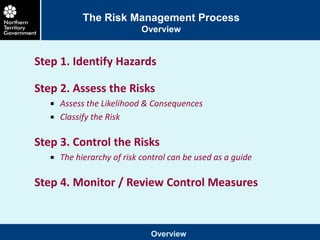
Step 1. Identify Hazards
Step 2. Assess the Risks
 Assess the Likelihood & Consequences
 Classify the Risk
Step 3. Control the Risks
 The hierarchy of risk control can be used as a guide
Step 4. Monitor / Review Control Measures
Overview
The Risk Management Process
Overview
What is a hazard?
Something that has the potential to cause harm to people,
property or the environment.
What is a risk?
A ‘risk’ is the chance or probability of that hazard causing harm
or damage to people, property or the environment.
What is a control?
A control is a mechanism or process that minimises the risk of
the hazard becoming actual so protects people, property or
the environment from the identified hazard.
Definitions
The Risk Management Process
Definitions
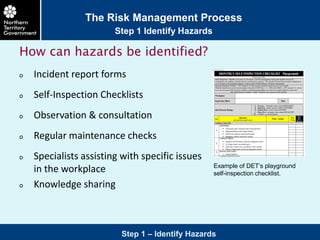
How can hazards be identified?
o Incident report forms
o Self-Inspection Checklists
o Observation & consultation
o Regular maintenance checks
o Specialists assisting with specific issues
in the workplace
o Knowledge sharing
Step 1 – Identify Hazards
The Risk Management Process
Step 1 Identify Hazards
Example of DET’s playground
self-inspection checklist.
1. Assessing likelihood
“How likely is it that someone will be exposed to the
hazard?”
The likelihood will depend on probability and frequency of
exposure to a hazard
Step 2 – Assess Risks
The Risk Management Process
Step 2 Assess Risks
A hazard has been identified – how can the risk the
hazard poses be assessed?
2. Assessing consequences
“Realistically, what is the likely outcome?”
The severity or range of the potential consequences
resulting from the hazard.
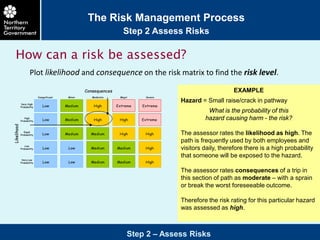
Plot likelihood and consequence on the risk matrix to find the risk level.
Step 2 – Assess Risks
Likelihood
Consequences
Very Low
Probability
Very High
Probability
Low
Probability
Equal
Probability
High
Probability
Insignificant Minor Moderate Major Severe
Low
Extreme
High
Medium
Extreme
Extreme
High
High
High High
High
High
Medium
Medium
Medium
Medium
Medium
Medium
MediumLow
LowLow
Low
Low
Low
Likelihood
Consequences
Very Low
Probability
Very High
Probability
Low
Probability
Equal
Probability
High
Probability
Insignificant Minor Moderate Major Severe
Low
Extreme
High
Medium
Extreme
Extreme
High
High
High High
High
High
Medium
Medium
Medium
Medium
Medium
Medium
MediumLow
LowLow
Low
Low
Low
EXAMPLE
Hazard = Small raise/crack in pathway
What is the probability of this
hazard causing harm - the risk?
The assessor rates the likelihood as high. The
path is frequently used by both employees and
visitors daily, therefore there is a high probability
that someone will be exposed to the hazard.
The assessor rates consequences of a trip in
this section of path as moderate – with a sprain
or break the worst foreseeable outcome.
Therefore the risk rating for this particular hazard
was assessed as high.
The Risk Management Process
Step 2 Assess Risks
How can a risk be assessed?
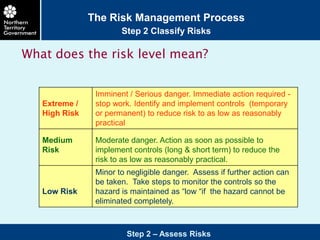
What does the risk level mean?
Extreme /
High Risk
Imminent / Serious danger. Immediate action required -
stop work. Identify and implement controls (temporary
or permanent) to reduce risk to as low as reasonably
practical
Medium
Risk
Moderate danger. Action as soon as possible to
implement controls (long & short term) to reduce the
risk to as low as reasonably practical.
Low Risk
Minor to negligible danger. Assess if further action can
be taken. Take steps to monitor the controls so the
hazard is maintained as “low “if the hazard cannot be
eliminated completely.
The Risk Management Process
Step 2 Classify Risks
Step 2 – Assess Risks
Step 3 – Control Risks
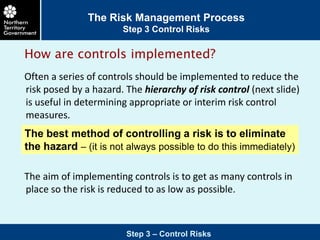
How are controls implemented?
Often a series of controls should be implemented to reduce the
risk posed by a hazard. The hierarchy of risk control (next slide)
is useful in determining appropriate or interim risk control
measures.
The aim of implementing controls is to get as many controls in
place so the risk is reduced to as low as possible.
The Risk Management Process
Step 3 Control Risks
The best method of controlling a risk is to eliminate
the hazard – (it is not always possible to do this immediately)
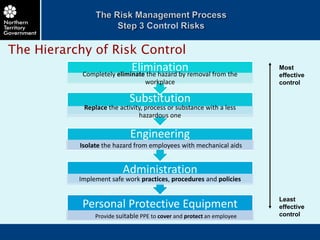
Personal Protective Equipment
Administration
Engineering
Implement safe work practices, procedures and policies
Substitution
Replace the activity, process or substance with a less
hazardous one
EliminationCompletely eliminate the hazard by removal from the
workplace
Isolate the hazard from employees with mechanical aids
Provide suitable PPE to cover and protect an employee
The Hierarchy of Risk Control
Most
effective
control
Least
effective
control
The Risk Management Process
Step 3 Control Risks
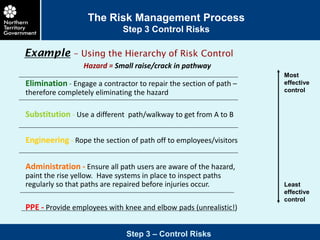
Elimination - Engage a contractor to repair the section of path –
therefore completely eliminating the hazard
Substitution - Use a different path/walkway to get from A to B
Engineering - Rope the section of path off to employees/visitors
Administration - Ensure all path users are aware of the hazard,
paint the rise yellow. Have systems in place to inspect paths
regularly so that paths are repaired before injuries occur.
PPE - Provide employees with knee and elbow pads (unrealistic!)
Most
effective
control
Least
effective
control
Step 3 – Control Risks
Example – Using the Hierarchy of Risk Control
Hazard = Small raise/crack in pathway
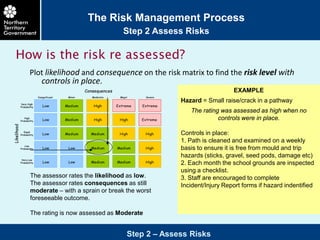
Plot likelihood and consequence on the risk matrix to find the risk level with
controls in place.
Step 2 – Assess Risks
Likelihood
Consequences
Very Low
Probability
Very High
Probability
Low
Probability
Equal
Probability
High
Probability
Insignificant Minor Moderate Major Severe
Low
Extreme
High
Medium
Extreme
Extreme
High
High
High High
High
High
Medium
Medium
Medium
Medium
Medium
Medium
MediumLow
LowLow
Low
Low
Low
Likelihood
Consequences
Very Low
Probability
Very High
Probability
Low
Probability
Equal
Probability
High
Probability
Insignificant Minor Moderate Major Severe
Low
Extreme
High
Medium
Extreme
Extreme
High
High
High High
High
High
Medium
Medium
Medium
Medium
Medium
Medium
MediumLow
LowLow
Low
Low
Low
EXAMPLE
Hazard = Small raise/crack in a pathway
The rating was assessed as high when no
controls were in place.
Controls in place:
1. Path is cleaned and examined on a weekly
basis to ensure it is free from mould and trip
hazards (sticks, gravel, seed pods, damage etc)
2. Each month the school grounds are inspected
using a checklist.
3. Staff are encouraged to complete
Incident/Injury Report forms if hazard indentified
The Risk Management Process
Step 2 Assess Risks
How is the risk re assessed?
The assessor rates the likelihood as low.
The assessor rates consequences as still
moderate – with a sprain or break the worst
foreseeable outcome.
The rating is now assessed as Moderate
Step 4 – Monitor & Review Controls
All indentified hazards and their controls should be documented
– usually referred to as a Hazard Register.
Hazards and controls need to be reviewed regularly but at least
every 5 years or when:
 New plant or substances are introduced to the workplace
 Before work of a type not previously performed at the workplace is
commenced
 When there is a change in the type of work, work practices or plant that
may result in an increased risk to workers or others
 When information becomes available concerning work, work practices,
plant or substances that may impact of workers or others
The Risk Management Process
Step 4 Monitor / Review Controls
Do I have to document any identified hazards and controls?
How are controls monitored?
• Ensure audits and workplace inspections are
conducted; and
• Ensure listed control measures are in use and
maintained.
• Risk Register reviewed on regular basis
It is an ongoing process and should be integrated into all
workplace activities.
Hazard Management is the responsibility of both employees
and management.
DET OHS Webpage
http://staff.det.nt.gov.au/quickfind/hr/ohs/index.shtml
DET OHS email - ohs.det@nt.gov.au
DET OHS Phone - 8901 4985
DBE OHS Information
http://uluru.nt.gov.au/dbe/hr/forms_procedures.shtml#ohs
Further Information

Risk Management Process

  • 1.
    Step 1. IdentifyHazards Step 2. Assess the Risks  Assess the Likelihood & Consequences  Classify the Risk Step 3. Control the Risks  The hierarchy of risk control can be used as a guide Step 4. Monitor / Review Control Measures Overview The Risk Management Process Overview
  • 2.
    What is ahazard? Something that has the potential to cause harm to people, property or the environment. What is a risk? A ‘risk’ is the chance or probability of that hazard causing harm or damage to people, property or the environment. What is a control? A control is a mechanism or process that minimises the risk of the hazard becoming actual so protects people, property or the environment from the identified hazard. Definitions The Risk Management Process Definitions
  • 3.
    How can hazardsbe identified? o Incident report forms o Self-Inspection Checklists o Observation & consultation o Regular maintenance checks o Specialists assisting with specific issues in the workplace o Knowledge sharing Step 1 – Identify Hazards The Risk Management Process Step 1 Identify Hazards Example of DET’s playground self-inspection checklist.
  • 4.
    1. Assessing likelihood “Howlikely is it that someone will be exposed to the hazard?” The likelihood will depend on probability and frequency of exposure to a hazard Step 2 – Assess Risks The Risk Management Process Step 2 Assess Risks A hazard has been identified – how can the risk the hazard poses be assessed? 2. Assessing consequences “Realistically, what is the likely outcome?” The severity or range of the potential consequences resulting from the hazard.
  • 5.
    Plot likelihood andconsequence on the risk matrix to find the risk level. Step 2 – Assess Risks Likelihood Consequences Very Low Probability Very High Probability Low Probability Equal Probability High Probability Insignificant Minor Moderate Major Severe Low Extreme High Medium Extreme Extreme High High High High High High Medium Medium Medium Medium Medium Medium MediumLow LowLow Low Low Low Likelihood Consequences Very Low Probability Very High Probability Low Probability Equal Probability High Probability Insignificant Minor Moderate Major Severe Low Extreme High Medium Extreme Extreme High High High High High High Medium Medium Medium Medium Medium Medium MediumLow LowLow Low Low Low EXAMPLE Hazard = Small raise/crack in pathway What is the probability of this hazard causing harm - the risk? The assessor rates the likelihood as high. The path is frequently used by both employees and visitors daily, therefore there is a high probability that someone will be exposed to the hazard. The assessor rates consequences of a trip in this section of path as moderate – with a sprain or break the worst foreseeable outcome. Therefore the risk rating for this particular hazard was assessed as high. The Risk Management Process Step 2 Assess Risks How can a risk be assessed?
  • 6.
    What does therisk level mean? Extreme / High Risk Imminent / Serious danger. Immediate action required - stop work. Identify and implement controls (temporary or permanent) to reduce risk to as low as reasonably practical Medium Risk Moderate danger. Action as soon as possible to implement controls (long & short term) to reduce the risk to as low as reasonably practical. Low Risk Minor to negligible danger. Assess if further action can be taken. Take steps to monitor the controls so the hazard is maintained as “low “if the hazard cannot be eliminated completely. The Risk Management Process Step 2 Classify Risks Step 2 – Assess Risks
  • 7.
    Step 3 –Control Risks How are controls implemented? Often a series of controls should be implemented to reduce the risk posed by a hazard. The hierarchy of risk control (next slide) is useful in determining appropriate or interim risk control measures. The aim of implementing controls is to get as many controls in place so the risk is reduced to as low as possible. The Risk Management Process Step 3 Control Risks The best method of controlling a risk is to eliminate the hazard – (it is not always possible to do this immediately)
  • 8.
    Personal Protective Equipment Administration Engineering Implementsafe work practices, procedures and policies Substitution Replace the activity, process or substance with a less hazardous one EliminationCompletely eliminate the hazard by removal from the workplace Isolate the hazard from employees with mechanical aids Provide suitable PPE to cover and protect an employee The Hierarchy of Risk Control Most effective control Least effective control
  • 9.
    The Risk ManagementProcess Step 3 Control Risks Elimination - Engage a contractor to repair the section of path – therefore completely eliminating the hazard Substitution - Use a different path/walkway to get from A to B Engineering - Rope the section of path off to employees/visitors Administration - Ensure all path users are aware of the hazard, paint the rise yellow. Have systems in place to inspect paths regularly so that paths are repaired before injuries occur. PPE - Provide employees with knee and elbow pads (unrealistic!) Most effective control Least effective control Step 3 – Control Risks Example – Using the Hierarchy of Risk Control Hazard = Small raise/crack in pathway
  • 10.
    Plot likelihood andconsequence on the risk matrix to find the risk level with controls in place. Step 2 – Assess Risks Likelihood Consequences Very Low Probability Very High Probability Low Probability Equal Probability High Probability Insignificant Minor Moderate Major Severe Low Extreme High Medium Extreme Extreme High High High High High High Medium Medium Medium Medium Medium Medium MediumLow LowLow Low Low Low Likelihood Consequences Very Low Probability Very High Probability Low Probability Equal Probability High Probability Insignificant Minor Moderate Major Severe Low Extreme High Medium Extreme Extreme High High High High High High Medium Medium Medium Medium Medium Medium MediumLow LowLow Low Low Low EXAMPLE Hazard = Small raise/crack in a pathway The rating was assessed as high when no controls were in place. Controls in place: 1. Path is cleaned and examined on a weekly basis to ensure it is free from mould and trip hazards (sticks, gravel, seed pods, damage etc) 2. Each month the school grounds are inspected using a checklist. 3. Staff are encouraged to complete Incident/Injury Report forms if hazard indentified The Risk Management Process Step 2 Assess Risks How is the risk re assessed? The assessor rates the likelihood as low. The assessor rates consequences as still moderate – with a sprain or break the worst foreseeable outcome. The rating is now assessed as Moderate
  • 11.
    Step 4 –Monitor & Review Controls All indentified hazards and their controls should be documented – usually referred to as a Hazard Register. Hazards and controls need to be reviewed regularly but at least every 5 years or when:  New plant or substances are introduced to the workplace  Before work of a type not previously performed at the workplace is commenced  When there is a change in the type of work, work practices or plant that may result in an increased risk to workers or others  When information becomes available concerning work, work practices, plant or substances that may impact of workers or others The Risk Management Process Step 4 Monitor / Review Controls Do I have to document any identified hazards and controls?
  • 12.
    How are controlsmonitored? • Ensure audits and workplace inspections are conducted; and • Ensure listed control measures are in use and maintained. • Risk Register reviewed on regular basis It is an ongoing process and should be integrated into all workplace activities. Hazard Management is the responsibility of both employees and management.
  • 13.
    DET OHS Webpage http://staff.det.nt.gov.au/quickfind/hr/ohs/index.shtml DETOHS email - ohs.det@nt.gov.au DET OHS Phone - 8901 4985 DBE OHS Information http://uluru.nt.gov.au/dbe/hr/forms_procedures.shtml#ohs Further Information