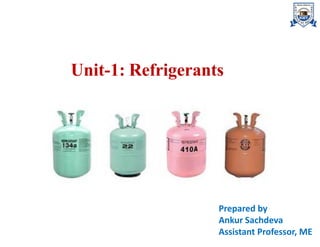
Unit-1: Refrigerants
Prepared by
Ankur Sachdeva
Assistant Professor, ME
What is a Refrigerant ?
• The working substance that flows through a
refrigerator and is capable of absorbing heat
from the source (which is at a lower
temperature) and dissipate the same to the
sink (which is a higher temperature than the
source) either in the form of sensible heat (as
in case of air refrigeration) or in the form of
latent heat (as in the case of vapor
Refrigeration) is called a refrigerant.
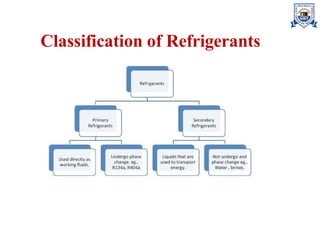
Classification of Refrigerants
Primary Refrigerants
• These are the refrigerants which
cool the substance or space
directly by absorbing heat.
• It absorbs heat during
evaporation in the evaporator
and releases heat energy during
condensation in condenser.
• It is also known as direct
expansion system
• Ex.: Ammonia, Freon, SO2, CO2
etc.
• These fluids provide refrigeration
by undergoing a phase change
process in the evaporator.
Components of Primary Refrigerants
Types of Primary Refrigerants
• Halo-carbon Refrigerant
• Azeotrope Refrigerant
• Inorganic Refrigerant
• Hydro-carbon Refrigerant
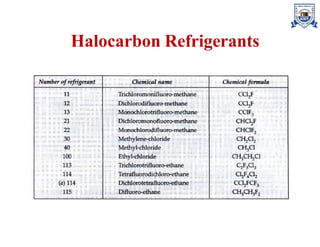
Halocarbon Refrigerants
• Halocarbon Refrigerant are all synthetically produced and were developed
as the Freon family of refrigerants.
• They are fluorocarbons of methane and ethane series.
• They contain 1 or more of these halogens (chlorine, bromine, fluorine)
• Non toxic, non-flammable, non-explosive, non- corrosive, non-irritant to
human body and eyes.
• Odourless, colourless.
• Will not react with food product stored in the refrigerated space.
• Will not react with lubricating oil.
• Has excellent thermodynamic properties
• Only disadvantage is ozone layer is damaged.
• Examples :
• CFC’s : R11, R12, R113, R114, R115
• HCFC’s : R22, R123
• HFC’s : R134a, R404a, R407C, R410a
Halocarbon Refrigerants
Inorganic Refrigerants
• Inorganic refrigerant were exclusively used before
the introduction of halocarbon.
• These refrigerant are still in use due to there
inherent thermodynamic and physical properties.
•Carbon Dioxide
•Water
•Ammonia
•Air
•Sulphur dioxide
Azeotropic Refrigerants
• This group of refrigerants consist of mixture of
different refrigerants which can not separated under
pressure and temperature and have fixed
thermodynamic properties.
• A stable mixture of two or several refrigerants whose
vapour and liquid phases retain identical compositions
over a wide range of temperatures.
• Azeotropic mixtures are designated by 500 series.
Examples :
• R-500 :( 73.8% R12 and 26.2% R152)
• R-502 : (8.8% R22 and 51.2% R115)
• R-503 : (40.1% R23 and 59.9% R13)
Zeotropic Refrigerants
• A zeotropic mixture is one whose composition in the
liquid phase differs from that in vapour phase.
• Zeotropic refrigerants therefore, do not boil at constant
temperatures, unlike azeotropic refrigerants.
• Zeotropic refrigerants (e.g. non-azeotropic mixtures)
are designated by 400 series.
Examples :
• R404a : R125 /R143a /R134a (44%,52%,4%)
• R407c : R32/R125/R134a (23%, 25%, 52%)
• R410a : R32/R125 (50%, 50%)
• R413a : R600a/ R218/R134a (3%, 9%, 88%)
Hydrocarbon Refrigerants
• Most of the hydrocarbon refrigerant are successfully
used in industrial and commercial installation.
• They possess satisfactory thermodynamic properties
but are highly flammable and explosive.
• Growing use in very small commercial systems like car
air-conditioning system
Examples:
• R170, Ethane, C2H6
• R290 , Propane C3H8
• R600, Butane, C4H10
• R600a, Isobutane, C4H10
• Blends of the above Gases
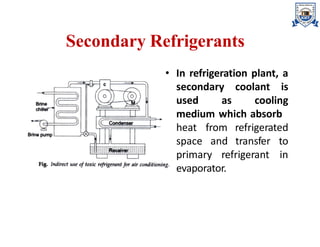
Secondary Refrigerants
• In refrigeration plant, a
secondary coolant is
used as cooling
medium which absorb
heat
space
from refrigerated
and transfer to
in
primary refrigerant
evaporator.
Secondary Refrigerants
• The refrigerants are brine which is used as intermediate fluid between
evaporator and the substance or space to be cooled. They cool the
substance and the space by absorbing their sensible heat.
• Also called indirect expansion system.
• Eg. Brine solution made of calcium chloride or sodium chloride
• Water cannot be used as secondary refrigerant because at 0°C itself it
will become ice and circulation is not possible.
• In brine solution CaCl2 is much preferred, it is very costly
• Substances that take away heat from the medium to be cooled and
give it to the boiling refrigerant are called secondary refrigerants
– They do not change their physical condition
– Cheap and harmless, chemically neutral to metals and packing
material
– Should have a low freezing point and large heat capacity
– Choice of brine depends on temperature to which a material is to be
cooled and industrial process in which it is to be used
Secondary Refrigerants
• The calcium chloride brine has eutectic temperature
of -55℃ at salt concentration of 30% by mass.
• The sodium chloride brine has eutectic temperature
of -21.1℃ at salt concentration of 23% by mass.
• NaCl is used when it is desired to have direct contact
between brine and product.
• Freezing point of brine depends on its concentration
• Cheapest secondary refrigerants are water and air but
their application is limited, since, water has a high
freezing point (0°C) and air has a low heat capacity
Advantages of Secondary Refrigerant
• When the temperature requirements of the different parts in a
large building are varied, then these different temperatures
can be easily maintained by controlling the amount of brine
flowing to the part.
• Easy to handle and easy to control compared with primary
refrigerant.
• The use of brines is advisable in order to keep coils and
pipes containing a toxic refrigerant away from the load
places.
• The secondary refrigerant also eliminates long refrigerant
lines in a system using a non-toxic refrigerant.
• The secondary refrigerant also eliminates possibilities of
leakage.
Antifreeze Solutions
• Antifreeze, a secondary refrigerant, is a solution of glycol-based
chemicals in water and can withstand temperatures below 0
degrees Celsius.
• Antifreeze is used to cool the engine block in combustion
engines. It is circulated into a cooling chamber where it makes
contact with and cools the engine block.
• A thermostat, thermally actuated valve, opens when the
temperature of the antifreeze exceeds the threshold temperature
where it is fed into a radiator coil.
• The radiator cools the fluid before it is pumped back through the
system.
Phase Changing Materials
• A phase change material (PCM) is a substance with a high heat
of fusion which, melting and solidifying at a certain temperature,
is capable of storing and releasing large amounts of energy.
• Heat is absorbed or released when the material changes from
solid to liquid and vice versa; thus, PCMs are classified as latent
heat storage (LHS) units.
• The main categorization of PCMs is the differentiation between
inorganic PCMs and organic PCMS.
• The commonly used phase change materials for technical
applications are: paraffin’s (organic), salt hydrates (inorganic)
and fatty acids (organic) (IEA, 2005).
Desirable Properties of Refrigerants
1. Thermodynamic and thermo-physical properties
(i) High Suction Pressure
(ii) Low Discharge Pressure
(iii) Low Pressure Ratio
(iv) High Latent Heat of Vaporization
(v) Low specific heat of liquid
(vi) High specific of vapour
(vii) High thermal conductivity
(viii) Low viscosity
(ix) Low freezing point
(x) Low boiling point
Desirable Properties of Refrigerants
2. Environmental, Safety and Economic Considerations
(i) Low ODP
(ii) Low GWP
(iii) Low TEWI
(iv) Non-toxic
(v) Non-flammable
(vi) High chemical stability
(vii) Ease of leak detection
(viii) Miscible with oil
(ix) Cheap and easily available
Classification of Refrigerants based on Safety
ASHRAE Standard 34 defines two safety classifications for
toxicity.
Class A denotes refrigerants of lower toxicity, and
Class B denotes refrigerants of higher toxicity.
For flammability, there are three classifications and one subclass.
The three main flammability classifications are
Class 1: Refrigerants that do not propagate a flame when tested
as per the standard;
Class 2: Refrigerants of lower flammability; and
Class 3: Highly flammable refrigerants such as the hydrocarbons.
Classification of Refrigerants based on Safety
Designation of Refrigerants
• Since a large number of refrigerants have been
developed over the years for a wide variety of
applications, a numbering system has been
adopted to designate various refrigerants.
• From the number, one can get some useful
information about the type of refrigerant, its
chemical composition, molecular weight etc. All
the refrigerants are designated by R followed by a
unique number.
Designation of Halogenated Refrigerants
• These refrigerants are derivatives of alkanes (CnH2n+2) such as methane (CH4),
ethane (C2H6). The chemical formula for the refrigerant is given as CmHnClpFq
• The refrigerant number is given by R (m-1)(n+1)q , where:
• m indicates the number of Carbon (C) atoms
• n indicates number of Hydrogen (H) atoms
• p indicates number of Chlorine (Cl) atoms
• q indicates number of Fluorine (F) atoms
• The value of p can be calculated using the expression
n+p+q = 2(m+1)…….(1)
• Ex: R 22
• m-1= 0, No. of Carbon atoms = 0+1 = 1 derivative ⇒ ⇒ of methane (CH4)
• n+1 = 2 ⇒ No. of Hydrogen atoms = 2-1 = 1
• q = 2 ⇒ No. of Fluorine atoms = 2
•Value of p can be found using equation-1
1+p+2 = 2(1+1) ⇒ p= 1
∴The chemical formula of R-22 = C1H1Cl1F2 or CHClF2 and chemical name
is monochloro-difluoro-methane
Designation of Inorganic Refrigerants
• These are designated by number 7 followed by
the molecular weight of the refrigerant (rounded-
off).
• Ex.: Ammonia: Molecular weight is 17,
∴ the designation is R 717
• Carbon dioxide: Molecular weight is 44,
∴ the designation is R 744
• Water: Molecular weight is 18,
∴ the designation is R 718
Refrigerant Oils
• Refrigeration oils are necessary to ensure the flawless
operation of the compressor.
The purposes of oil:
• reducing friction
• reducing the noise made by moving parts
• reducing internal refrigerant leaks
• compressor cooling
• carrying the leak detection agent
Oils Suitable for Various Refrigerants
Oils suitable for CFC and HCFC refrigerants
• Mineral oils
• Synthetic oils
• Semi-synthetic oils
Oils suitable for HFC refrigerants
• Polyolester oils or POE oils or colloquially “ester oils”
• PAG oils for car air conditioning system
Oils suitable for ammonia
• Mineral oils
• Synthetic P-type oils
Mineral Oils
Mineral oils used to be the most common oil type used in conjunction with
old CFC and HCFC refrigerants.
The oil is manufactured from raw oil by means of vacuum distillation and
purification.
It is also affordable due to the low degree of processing.
The lubrication qualities are limited in extreme conditions, however.
The viscosity of mineral oil changes dramatically as a function of
temperature, which is why the oil’s optimal operating range is rather
narrow.
The viscosity of mineral oils drops at high temperatures, which
deteriorates the lubricating properties.
At low temperatures, there may also be some oil return issues due to the
decreased dissolving of the lubricant and refrigerant.
Synthetic Oils
Synthetic oils are made from natural gas by
polymerizing ethene gas or through the refinement and
conversion process.
This enables the molecular chains of the synthetic to be
more homogenous than in mineral oils that are
manufactured directly from raw oil.
Synthetic oil is better at withstanding demanding
conditions, such as high final compression temperatures
and low evaporation temperatures.
Semi-Synthetic Oils
• The mixture of a mineral oil and synthetic oil is called a semi-
synthetic or part synthetic oil.
• These cannot be used with current HFC refrigerants.
• Mineral oils dissolve fully with old R11 and R12 refrigerants and
they are efficiently returned to the compressor.
• In the context of other CFC and HCFC refrigerants, the
dissolution is only partial.
• This means that the return of the oil must be ensured in
refrigeration plants.
• Semi-synthetic oil can be regarded as a compromise in terms of
price and properties.
Freon-12
• Mostly used in domestic and commercial refrigerants (in ice cream
cabinets, display cabinets, deep freezer)
• It is very widely used, colourless gas with mild odour.
• Heavier than air
• Does not dissolve in water, moisture content should not exceed
0.0025% by weight.
• Refrigerating effect per unit volume of ammonia is about 1.5 times
that of Freon-12
• It does not react with ferrous metals, aluminium, phosphor bronze
• It attacks copper, copper alloys, zinc and bronze and dissolves in
water
• It does not react with lubricating oils in the absence of moisture,
but oxidizes them in the presence of water vapour
Freon Family of Refrigerants
Refrigerants Applications ODP
Value
CFC 11(R11) Air-conditioning Systems ranging from 200 to 2000 tons in capacity. It is used
where low freezing point and noncorrosive properties are important.
1.0
CFC 12 (R 12) It is used for most of the applications. Air-conditioning plants, refrigerators,
freezers, ice-cream cabinets, water coolers, window air-conditioners,
automobile air conditioners.
1.0
CFC 13 (R 13) For low temp refrigeration up to – 90 °C in cascade system 1.0
CFC113 (R113) Small to medium air-conditioning system and industrial cooling 1.07
CFC114 (R114) In household refrigerators and in large industrial cooling 0.8
Blend of R22 and
R115 (R502)
Frozen food ice-cream display cases and warehouses and food freezing plants.
An excellent general low temp refrigerant
0.34
Ammonia (R717)
• Used for commercial purposes. Mainly in cold storage and
ice plants.
• The boiling temperature of NH3 at atmospheric pressure is -
33°C and melting point from solid is -78°C. The low boiling
points makes it possible to have refrigeration considerably
below 0°C without using pressure below atmospheric in the
evaporator.
• Its latent heat of vaporization at -15°C is 1315 kJ/kg
• It is colorless gas with a sharp pungent smell.
• Has good thermodynamic properties.
• It is neutral to all metals, highly soluble in oil.
• Volatile and non toxic but in higher concentration.
Sulphur-Dioxide (SO2)
• Previously used in household refrigerators
• Toxic, non-explosive and non-flammable, non-
corrosive
• Irritant to human body
• Non mixable with oil
• Has pungent odour and low latent heat value
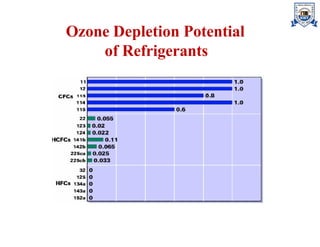
Ozone Depletion Potential (ODP)
• Ozone depletion potential is measured
relative to CFC-11 and it represents the
amount of ozone destroyed by emission of a
vapor over its entire atmospheric
lifetime relative to that caused by the
emission of the same mass of CFC-11.
Causes of Ozone Layer Depletion
Ozone Depletion Potential
of Refrigerants
Effects of Ozone Layer Depletion
• Ozone layer depletion causes increased UV radiation
levels at the Earth's surface, which is damaging to
human health.
• Negative effects include increases in certain types of
skin cancers, eye cataracts and immune deficiency
disorders.
• UV radiation also affects terrestrial and aquatic
ecosystems, altering growth, food chains and
biochemical cycles.
• Aquatic life just below the water’s surface, the basis of
the food chain, is particularly adversely affected by
high UV levels.
• UV rays also affect plant growth, reducing agricultural
productivity.
Global Warming Potential (GWP)
• GWP of a gas refers to the total contribution to
global warming resulting from the emission of
one unit of that gas relative to one unit of the
reference gas, CO2, which is assigned a value of 1.
• GWPs can also be used to define the impact
warming over different time periods or
greenhouse gases will have on global
time
horizons. These are usually 20 years, 100 years,
and 500 years. A time horizon of 100 years is
used by regulators
HYDROFLUORO-OLEFINS (HFOs)
• HFOs (hydrofluoro-olefins) are the fourth generation of fluorine-
based gases.
• HFC refrigerants are composed of hydrogen, fluorine, and carbon
atoms connected by single bonds between the atoms.
• HFO refrigerants are composed of hydrogen, fluorine, and carbon
atoms but contain at least one double bond between the carbon atoms.
• The first HFO, jointly developed by DuPont and Honeywell, is HFO
1234yf.
• HFO refrigerants are categorized as having zero ODP (Ozone
Depletion Potential) and low GWP and so offer a more
environmentally friendly alternative to CFCs, HCFCs, and HFCs

Refrigerants.pdf

  • 1.
    Unit-1: Refrigerants Prepared by AnkurSachdeva Assistant Professor, ME
  • 2.
    What is aRefrigerant ? • The working substance that flows through a refrigerator and is capable of absorbing heat from the source (which is at a lower temperature) and dissipate the same to the sink (which is a higher temperature than the source) either in the form of sensible heat (as in case of air refrigeration) or in the form of latent heat (as in the case of vapor Refrigeration) is called a refrigerant.
  • 3.
  • 4.
    Primary Refrigerants • Theseare the refrigerants which cool the substance or space directly by absorbing heat. • It absorbs heat during evaporation in the evaporator and releases heat energy during condensation in condenser. • It is also known as direct expansion system • Ex.: Ammonia, Freon, SO2, CO2 etc. • These fluids provide refrigeration by undergoing a phase change process in the evaporator.
  • 5.
  • 6.
    Types of PrimaryRefrigerants • Halo-carbon Refrigerant • Azeotrope Refrigerant • Inorganic Refrigerant • Hydro-carbon Refrigerant
  • 7.
    Halocarbon Refrigerants • HalocarbonRefrigerant are all synthetically produced and were developed as the Freon family of refrigerants. • They are fluorocarbons of methane and ethane series. • They contain 1 or more of these halogens (chlorine, bromine, fluorine) • Non toxic, non-flammable, non-explosive, non- corrosive, non-irritant to human body and eyes. • Odourless, colourless. • Will not react with food product stored in the refrigerated space. • Will not react with lubricating oil. • Has excellent thermodynamic properties • Only disadvantage is ozone layer is damaged. • Examples : • CFC’s : R11, R12, R113, R114, R115 • HCFC’s : R22, R123 • HFC’s : R134a, R404a, R407C, R410a
  • 8.
  • 9.
    Inorganic Refrigerants • Inorganicrefrigerant were exclusively used before the introduction of halocarbon. • These refrigerant are still in use due to there inherent thermodynamic and physical properties. •Carbon Dioxide •Water •Ammonia •Air •Sulphur dioxide
  • 10.
    Azeotropic Refrigerants • Thisgroup of refrigerants consist of mixture of different refrigerants which can not separated under pressure and temperature and have fixed thermodynamic properties. • A stable mixture of two or several refrigerants whose vapour and liquid phases retain identical compositions over a wide range of temperatures. • Azeotropic mixtures are designated by 500 series. Examples : • R-500 :( 73.8% R12 and 26.2% R152) • R-502 : (8.8% R22 and 51.2% R115) • R-503 : (40.1% R23 and 59.9% R13)
  • 11.
    Zeotropic Refrigerants • Azeotropic mixture is one whose composition in the liquid phase differs from that in vapour phase. • Zeotropic refrigerants therefore, do not boil at constant temperatures, unlike azeotropic refrigerants. • Zeotropic refrigerants (e.g. non-azeotropic mixtures) are designated by 400 series. Examples : • R404a : R125 /R143a /R134a (44%,52%,4%) • R407c : R32/R125/R134a (23%, 25%, 52%) • R410a : R32/R125 (50%, 50%) • R413a : R600a/ R218/R134a (3%, 9%, 88%)
  • 12.
    Hydrocarbon Refrigerants • Mostof the hydrocarbon refrigerant are successfully used in industrial and commercial installation. • They possess satisfactory thermodynamic properties but are highly flammable and explosive. • Growing use in very small commercial systems like car air-conditioning system Examples: • R170, Ethane, C2H6 • R290 , Propane C3H8 • R600, Butane, C4H10 • R600a, Isobutane, C4H10 • Blends of the above Gases
  • 13.
    Secondary Refrigerants • Inrefrigeration plant, a secondary coolant is used as cooling medium which absorb heat space from refrigerated and transfer to in primary refrigerant evaporator.
  • 14.
    Secondary Refrigerants • Therefrigerants are brine which is used as intermediate fluid between evaporator and the substance or space to be cooled. They cool the substance and the space by absorbing their sensible heat. • Also called indirect expansion system. • Eg. Brine solution made of calcium chloride or sodium chloride • Water cannot be used as secondary refrigerant because at 0°C itself it will become ice and circulation is not possible. • In brine solution CaCl2 is much preferred, it is very costly • Substances that take away heat from the medium to be cooled and give it to the boiling refrigerant are called secondary refrigerants – They do not change their physical condition – Cheap and harmless, chemically neutral to metals and packing material – Should have a low freezing point and large heat capacity – Choice of brine depends on temperature to which a material is to be cooled and industrial process in which it is to be used
  • 15.
    Secondary Refrigerants • Thecalcium chloride brine has eutectic temperature of -55℃ at salt concentration of 30% by mass. • The sodium chloride brine has eutectic temperature of -21.1℃ at salt concentration of 23% by mass. • NaCl is used when it is desired to have direct contact between brine and product. • Freezing point of brine depends on its concentration • Cheapest secondary refrigerants are water and air but their application is limited, since, water has a high freezing point (0°C) and air has a low heat capacity
  • 16.
    Advantages of SecondaryRefrigerant • When the temperature requirements of the different parts in a large building are varied, then these different temperatures can be easily maintained by controlling the amount of brine flowing to the part. • Easy to handle and easy to control compared with primary refrigerant. • The use of brines is advisable in order to keep coils and pipes containing a toxic refrigerant away from the load places. • The secondary refrigerant also eliminates long refrigerant lines in a system using a non-toxic refrigerant. • The secondary refrigerant also eliminates possibilities of leakage.
  • 17.
    Antifreeze Solutions • Antifreeze,a secondary refrigerant, is a solution of glycol-based chemicals in water and can withstand temperatures below 0 degrees Celsius. • Antifreeze is used to cool the engine block in combustion engines. It is circulated into a cooling chamber where it makes contact with and cools the engine block. • A thermostat, thermally actuated valve, opens when the temperature of the antifreeze exceeds the threshold temperature where it is fed into a radiator coil. • The radiator cools the fluid before it is pumped back through the system.
  • 18.
    Phase Changing Materials •A phase change material (PCM) is a substance with a high heat of fusion which, melting and solidifying at a certain temperature, is capable of storing and releasing large amounts of energy. • Heat is absorbed or released when the material changes from solid to liquid and vice versa; thus, PCMs are classified as latent heat storage (LHS) units. • The main categorization of PCMs is the differentiation between inorganic PCMs and organic PCMS. • The commonly used phase change materials for technical applications are: paraffin’s (organic), salt hydrates (inorganic) and fatty acids (organic) (IEA, 2005).
  • 19.
    Desirable Properties ofRefrigerants 1. Thermodynamic and thermo-physical properties (i) High Suction Pressure (ii) Low Discharge Pressure (iii) Low Pressure Ratio (iv) High Latent Heat of Vaporization (v) Low specific heat of liquid (vi) High specific of vapour (vii) High thermal conductivity (viii) Low viscosity (ix) Low freezing point (x) Low boiling point
  • 20.
    Desirable Properties ofRefrigerants 2. Environmental, Safety and Economic Considerations (i) Low ODP (ii) Low GWP (iii) Low TEWI (iv) Non-toxic (v) Non-flammable (vi) High chemical stability (vii) Ease of leak detection (viii) Miscible with oil (ix) Cheap and easily available
  • 21.
    Classification of Refrigerantsbased on Safety ASHRAE Standard 34 defines two safety classifications for toxicity. Class A denotes refrigerants of lower toxicity, and Class B denotes refrigerants of higher toxicity. For flammability, there are three classifications and one subclass. The three main flammability classifications are Class 1: Refrigerants that do not propagate a flame when tested as per the standard; Class 2: Refrigerants of lower flammability; and Class 3: Highly flammable refrigerants such as the hydrocarbons.
  • 22.
  • 23.
    Designation of Refrigerants •Since a large number of refrigerants have been developed over the years for a wide variety of applications, a numbering system has been adopted to designate various refrigerants. • From the number, one can get some useful information about the type of refrigerant, its chemical composition, molecular weight etc. All the refrigerants are designated by R followed by a unique number.
  • 24.
    Designation of HalogenatedRefrigerants • These refrigerants are derivatives of alkanes (CnH2n+2) such as methane (CH4), ethane (C2H6). The chemical formula for the refrigerant is given as CmHnClpFq • The refrigerant number is given by R (m-1)(n+1)q , where: • m indicates the number of Carbon (C) atoms • n indicates number of Hydrogen (H) atoms • p indicates number of Chlorine (Cl) atoms • q indicates number of Fluorine (F) atoms • The value of p can be calculated using the expression n+p+q = 2(m+1)…….(1) • Ex: R 22 • m-1= 0, No. of Carbon atoms = 0+1 = 1 derivative ⇒ ⇒ of methane (CH4) • n+1 = 2 ⇒ No. of Hydrogen atoms = 2-1 = 1 • q = 2 ⇒ No. of Fluorine atoms = 2 •Value of p can be found using equation-1 1+p+2 = 2(1+1) ⇒ p= 1 ∴The chemical formula of R-22 = C1H1Cl1F2 or CHClF2 and chemical name is monochloro-difluoro-methane
  • 25.
    Designation of InorganicRefrigerants • These are designated by number 7 followed by the molecular weight of the refrigerant (rounded- off). • Ex.: Ammonia: Molecular weight is 17, ∴ the designation is R 717 • Carbon dioxide: Molecular weight is 44, ∴ the designation is R 744 • Water: Molecular weight is 18, ∴ the designation is R 718
  • 26.
    Refrigerant Oils • Refrigerationoils are necessary to ensure the flawless operation of the compressor. The purposes of oil: • reducing friction • reducing the noise made by moving parts • reducing internal refrigerant leaks • compressor cooling • carrying the leak detection agent
  • 27.
    Oils Suitable forVarious Refrigerants Oils suitable for CFC and HCFC refrigerants • Mineral oils • Synthetic oils • Semi-synthetic oils Oils suitable for HFC refrigerants • Polyolester oils or POE oils or colloquially “ester oils” • PAG oils for car air conditioning system Oils suitable for ammonia • Mineral oils • Synthetic P-type oils
  • 28.
    Mineral Oils Mineral oilsused to be the most common oil type used in conjunction with old CFC and HCFC refrigerants. The oil is manufactured from raw oil by means of vacuum distillation and purification. It is also affordable due to the low degree of processing. The lubrication qualities are limited in extreme conditions, however. The viscosity of mineral oil changes dramatically as a function of temperature, which is why the oil’s optimal operating range is rather narrow. The viscosity of mineral oils drops at high temperatures, which deteriorates the lubricating properties. At low temperatures, there may also be some oil return issues due to the decreased dissolving of the lubricant and refrigerant.
  • 29.
    Synthetic Oils Synthetic oilsare made from natural gas by polymerizing ethene gas or through the refinement and conversion process. This enables the molecular chains of the synthetic to be more homogenous than in mineral oils that are manufactured directly from raw oil. Synthetic oil is better at withstanding demanding conditions, such as high final compression temperatures and low evaporation temperatures.
  • 30.
    Semi-Synthetic Oils • Themixture of a mineral oil and synthetic oil is called a semi- synthetic or part synthetic oil. • These cannot be used with current HFC refrigerants. • Mineral oils dissolve fully with old R11 and R12 refrigerants and they are efficiently returned to the compressor. • In the context of other CFC and HCFC refrigerants, the dissolution is only partial. • This means that the return of the oil must be ensured in refrigeration plants. • Semi-synthetic oil can be regarded as a compromise in terms of price and properties.
  • 32.
    Freon-12 • Mostly usedin domestic and commercial refrigerants (in ice cream cabinets, display cabinets, deep freezer) • It is very widely used, colourless gas with mild odour. • Heavier than air • Does not dissolve in water, moisture content should not exceed 0.0025% by weight. • Refrigerating effect per unit volume of ammonia is about 1.5 times that of Freon-12 • It does not react with ferrous metals, aluminium, phosphor bronze • It attacks copper, copper alloys, zinc and bronze and dissolves in water • It does not react with lubricating oils in the absence of moisture, but oxidizes them in the presence of water vapour
  • 33.
    Freon Family ofRefrigerants Refrigerants Applications ODP Value CFC 11(R11) Air-conditioning Systems ranging from 200 to 2000 tons in capacity. It is used where low freezing point and noncorrosive properties are important. 1.0 CFC 12 (R 12) It is used for most of the applications. Air-conditioning plants, refrigerators, freezers, ice-cream cabinets, water coolers, window air-conditioners, automobile air conditioners. 1.0 CFC 13 (R 13) For low temp refrigeration up to – 90 °C in cascade system 1.0 CFC113 (R113) Small to medium air-conditioning system and industrial cooling 1.07 CFC114 (R114) In household refrigerators and in large industrial cooling 0.8 Blend of R22 and R115 (R502) Frozen food ice-cream display cases and warehouses and food freezing plants. An excellent general low temp refrigerant 0.34
  • 34.
    Ammonia (R717) • Usedfor commercial purposes. Mainly in cold storage and ice plants. • The boiling temperature of NH3 at atmospheric pressure is - 33°C and melting point from solid is -78°C. The low boiling points makes it possible to have refrigeration considerably below 0°C without using pressure below atmospheric in the evaporator. • Its latent heat of vaporization at -15°C is 1315 kJ/kg • It is colorless gas with a sharp pungent smell. • Has good thermodynamic properties. • It is neutral to all metals, highly soluble in oil. • Volatile and non toxic but in higher concentration.
  • 35.
    Sulphur-Dioxide (SO2) • Previouslyused in household refrigerators • Toxic, non-explosive and non-flammable, non- corrosive • Irritant to human body • Non mixable with oil • Has pungent odour and low latent heat value
  • 36.
    Ozone Depletion Potential(ODP) • Ozone depletion potential is measured relative to CFC-11 and it represents the amount of ozone destroyed by emission of a vapor over its entire atmospheric lifetime relative to that caused by the emission of the same mass of CFC-11.
  • 37.
    Causes of OzoneLayer Depletion
  • 38.
  • 39.
    Effects of OzoneLayer Depletion • Ozone layer depletion causes increased UV radiation levels at the Earth's surface, which is damaging to human health. • Negative effects include increases in certain types of skin cancers, eye cataracts and immune deficiency disorders. • UV radiation also affects terrestrial and aquatic ecosystems, altering growth, food chains and biochemical cycles. • Aquatic life just below the water’s surface, the basis of the food chain, is particularly adversely affected by high UV levels. • UV rays also affect plant growth, reducing agricultural productivity.
  • 40.
    Global Warming Potential(GWP) • GWP of a gas refers to the total contribution to global warming resulting from the emission of one unit of that gas relative to one unit of the reference gas, CO2, which is assigned a value of 1. • GWPs can also be used to define the impact warming over different time periods or greenhouse gases will have on global time horizons. These are usually 20 years, 100 years, and 500 years. A time horizon of 100 years is used by regulators
  • 42.
    HYDROFLUORO-OLEFINS (HFOs) • HFOs(hydrofluoro-olefins) are the fourth generation of fluorine- based gases. • HFC refrigerants are composed of hydrogen, fluorine, and carbon atoms connected by single bonds between the atoms. • HFO refrigerants are composed of hydrogen, fluorine, and carbon atoms but contain at least one double bond between the carbon atoms. • The first HFO, jointly developed by DuPont and Honeywell, is HFO 1234yf. • HFO refrigerants are categorized as having zero ODP (Ozone Depletion Potential) and low GWP and so offer a more environmentally friendly alternative to CFCs, HCFCs, and HFCs