NaSc1 
1
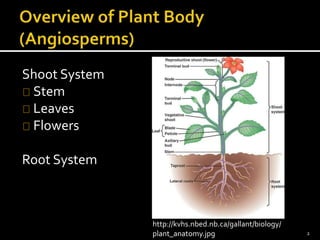
Shoot System 
Stem 
Leaves 
Flowers 
Root System 
http://kvhs.nbed.nb.ca/gallant/biology/ 
plant_anatomy.jpg 2
3
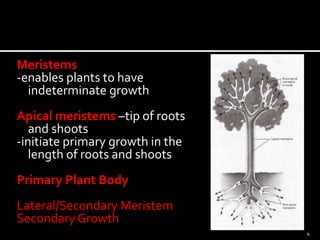
Meristems 
-enables plants to have 
indeterminate growth 
Apical meristems –tip of roots 
and shoots 
-initiate primary growth in the 
length of roots and shoots 
Primary Plant Body 
Lateral/Secondary Meristem 
Secondary Growth 
4
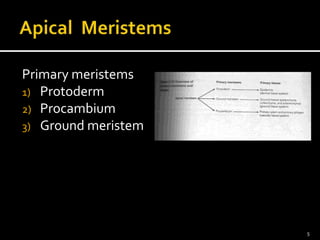
Primary meristems 
1) Protoderm 
2) Procambium 
3) Ground meristem 
5
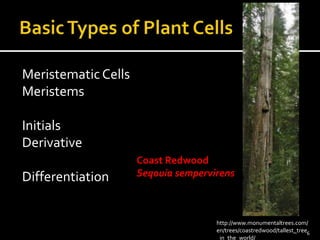
Meristematic Cells 
Meristems 
Initials 
Derivative 
Differentiation 
Coast Redwood 
Seqouia sempervirens 
http://www.monumentaltrees.com/ 
en/trees/coastredwood/tallest_tree 
_in_the_world/ 
6
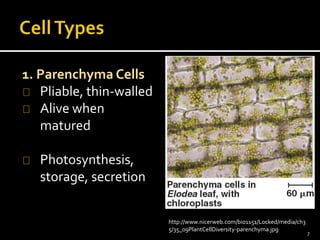
1. Parenchyma Cells 
Pliable, thin-walled 
Alive when 
matured 
Photosynthesis, 
storage, secretion 
http://www.nicerweb.com/bio1151/Locked/media/ch3 
5/35_09PlantCellDiversity-parenchyma.jpg 
7
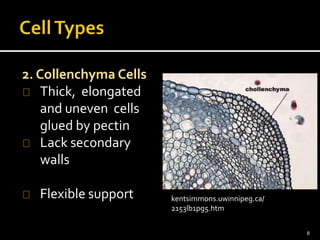
2. Collenchyma Cells 
Thick, elongated 
and uneven cells 
glued by pectin 
Lack secondary 
walls 
Flexible support kentsimmons.uwinnipeg.ca/ 
2153lb1pg5.htm 
8
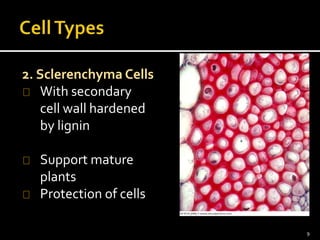
2. Sclerenchyma Cells 
With secondary 
cell wall hardened 
by lignin 
Support mature 
plants 
Protection of cells 
9
Vascular Plants 
Types of Plant Tissue 
Simple tissue 
Complex tissue 
Tissue system 
1) Dermal 
2) Vascular 
3) Ground 
10
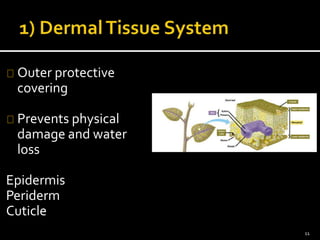
Outer protective 
covering 
Prevents physical 
damage and water 
loss 
Epidermis 
Periderm 
Cuticle 
11
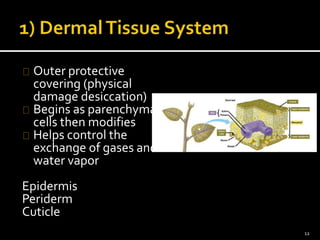
Outer protective 
covering (physical 
damage desiccation) 
Begins as parenchyma 
cells then modifies 
Helps control the 
exchange of gases and 
water vapor 
Epidermis 
Periderm 
Cuticle 
12
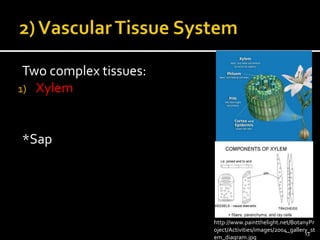
Two complex tissues: 
1) Xylem 
*Sap 
http://www.paintthelight.net/BotanyPr 
oject/Activities/images/2004_gallery_st 
13 
em_diagram.jpg
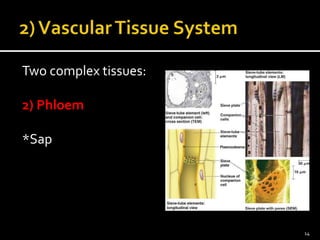
Two complex tissues: 
2) Phloem 
*Sap 
14
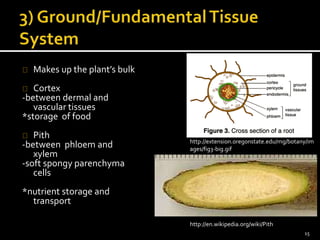
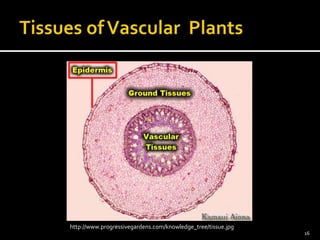
Makes up the plant’s bulk 
Cortex 
-between dermal and 
vascular tissues 
*storage of food 
Pith 
-between phloem and 
xylem 
-soft spongy parenchyma 
cells 
*nutrient storage and 
transport 
http://extension.oregonstate.edu/mg/botany/im 
ages/fig3-big.gif 
http://en.wikipedia.org/wiki/Pith 
15
http://www.progressivegardens.com/knowledge_tree/tissue.jpg 
16
Raven, P.H. , Evert, R.F. and Eichhorn, S.E. 1999. 
Biology of Plants 6th Ed. W.H. Freeman and Co. 
Worth Publishers, USA. 944 pp. 
Nabors, M.W. 2004. Botany an Introductory 
Approach. Pearson Education South Asia Pte. 
Ltd. 626pp. 
Diola, A., Dy., D., Ilano, A., Inoc, D.C., Oquinena, 
K., Parilla, R., Tambuli, A. and Yee, J. 2010. 
Natural Science 1 (Biological Sciences) Lecture 
Notes. University of San carlos, 126 pp. 
Starr, C. 2003. Biology: Concepts and 
Applications, 5th ed. Brooks/Cole, USA. 799 pp. 
17

Plant form & function part 1

  • 1.
  • 2.
    Shoot System Stem Leaves Flowers Root System http://kvhs.nbed.nb.ca/gallant/biology/ plant_anatomy.jpg 2
  • 3.
  • 4.
    Meristems -enables plantsto have indeterminate growth Apical meristems –tip of roots and shoots -initiate primary growth in the length of roots and shoots Primary Plant Body Lateral/Secondary Meristem Secondary Growth 4
  • 5.
    Primary meristems 1)Protoderm 2) Procambium 3) Ground meristem 5
  • 6.
    Meristematic Cells Meristems Initials Derivative Differentiation Coast Redwood Seqouia sempervirens http://www.monumentaltrees.com/ en/trees/coastredwood/tallest_tree _in_the_world/ 6
  • 7.
    1. Parenchyma Cells Pliable, thin-walled Alive when matured Photosynthesis, storage, secretion http://www.nicerweb.com/bio1151/Locked/media/ch3 5/35_09PlantCellDiversity-parenchyma.jpg 7
  • 8.
    2. Collenchyma Cells Thick, elongated and uneven cells glued by pectin Lack secondary walls Flexible support kentsimmons.uwinnipeg.ca/ 2153lb1pg5.htm 8
  • 9.
    2. Sclerenchyma Cells With secondary cell wall hardened by lignin Support mature plants Protection of cells 9
  • 10.
    Vascular Plants Typesof Plant Tissue Simple tissue Complex tissue Tissue system 1) Dermal 2) Vascular 3) Ground 10
  • 11.
    Outer protective covering Prevents physical damage and water loss Epidermis Periderm Cuticle 11
  • 12.
    Outer protective covering(physical damage desiccation) Begins as parenchyma cells then modifies Helps control the exchange of gases and water vapor Epidermis Periderm Cuticle 12
  • 13.
    Two complex tissues: 1) Xylem *Sap http://www.paintthelight.net/BotanyPr oject/Activities/images/2004_gallery_st 13 em_diagram.jpg
  • 14.
    Two complex tissues: 2) Phloem *Sap 14
  • 15.
    Makes up theplant’s bulk Cortex -between dermal and vascular tissues *storage of food Pith -between phloem and xylem -soft spongy parenchyma cells *nutrient storage and transport http://extension.oregonstate.edu/mg/botany/im ages/fig3-big.gif http://en.wikipedia.org/wiki/Pith 15
  • 16.
  • 17.
    Raven, P.H. ,Evert, R.F. and Eichhorn, S.E. 1999. Biology of Plants 6th Ed. W.H. Freeman and Co. Worth Publishers, USA. 944 pp. Nabors, M.W. 2004. Botany an Introductory Approach. Pearson Education South Asia Pte. Ltd. 626pp. Diola, A., Dy., D., Ilano, A., Inoc, D.C., Oquinena, K., Parilla, R., Tambuli, A. and Yee, J. 2010. Natural Science 1 (Biological Sciences) Lecture Notes. University of San carlos, 126 pp. Starr, C. 2003. Biology: Concepts and Applications, 5th ed. Brooks/Cole, USA. 799 pp. 17

Editor's Notes

  • #3 Shoot System – upper part Stem- supports upright growth; conduction of substances Leaves –photosynthesis Flowers –reproductive structure that attracts pollinators Root System – specialized; penetrates soil (except for few); spread downward and sideward Function: absorb water and dissolved nutriets; anchorage; stores food
  • #5 Primary plant body –produced by shoot and root apical meristem
  • #6  Primary meristems –regions of cell growth Protoderm –produces the primary dermal tissue system or epidermis Procambium –produces the primary vascular system (phloem, xylem) Ground system –produces the ground or fundamental tissue system (neither conducting and dermal tissues) Lateral meristem –makes plants woody; causes thickening of stems and roots Secondary growth –growth in thickness produced by lateral meristems
  • #7 Meristematic Cells –unspecialized cells that can divide indefinitely to produce new cells Meristems –regions that produce new growth Initials –meristematic cells that remain within meristems as sources of new growth; one of the daughter cells Derivative –other daughter cell that is pushed out of the meristem divides or begins elongation and differentiation Differentiation –process where an unspecialized cell becomes a specialized cell
  • #10 with secondary walls hardened by lignin -more expensive to produce (cellulose making up the secondary walls) -less common in smaller plants -typically dead in maturity *provides rigid support Types: Fibers Sclereids (stone cells) –rockhard and inflexible (nutshell and fruit pits); gritty sand-like structures (pears
  • #11 Vascular plants –with highly organized and efficient vascular tissues consist of cells joined into tubes that transport water and nutrients throughout the plant’s body; majority of plants; evolved from algae-like ancestors
  • #12 Epidermis –one layer of dismal tissue (first year of growth) Periderm –replaces epidermis of stems and roots for plants that live more than one growing season Trichome –hair like extensions, dermal cells that modify Cuticle –layer of wax and fatty acids (cutin) found outside the cell wall helps to limit water loss
  • #13 Epidermis –one layer of dismal tissue (first year of growth) Periderm –replaces epidermis of stems and roots for plants that live more than one growing season Trichome –hair like extensions, dermal cells that modify Cuticle –layer of wax and fatty acids (cutin) found outside the cell wall helps to limit water loss
  • #14 Vascular tissue system –continuous system of tissues that conduct water minerals and food Xylem –brings water and nutrients from the roots to the other parts Phloem –moves sugars and other organic nutrients from leaves to the other parts Sap –contents transported by xylem and phloem Tracheids –long cells with tapered ends; first water conducting cells to evolve in vascular plants align with each other to form continuous water conducting system Pits –thin regions n primary walls of tracheids; aligns with pits of adjacent tracheids Vessel elements –water conducting cells that transport water and minerals more rapidly; dead at maturity Sieve Tube Members /Elements –alive and active at maturity; brings organic nutrients from the leaves to other parts; believed to be arising from the meristem others think they are highly defirrentiated form of parenchyma
  • #15 Sap –contents transported by xylem and phloem Vessel elements –water conducting cells that transport water and minerals more rapidly; dead at maturity Sieve Tube Members /Elements –alive and active at maturity; brings organic nutrients from the leaves to other parts; believed to be arising from the meristem others think they are highly defirrentiated form of parenchyma Sieve plates-cell walls with membrane-lined pores that allow materials from cell to cell Companion cell –cell that shares its nucleus to the siee tube members which do not have nucleus at maturity Callose –carbohydrate molecule formed by sieve tube members when damaged; around the components of cell wall in its sieve plates Sieve cell –primitive type of water conducting cell in non-flowering plants
  • #16 In most dicots: Cortex- region between the vascular bundles and the epidermis Pith – center of the stem; inside the ring of vascular bundle