PREPARED BY:- KHUSHBU TEKWANI
CONTENTS
 Introduction
 Intersections
 Traffic Islands
 Conflicts at Intersection
 Visibility at Intersection
 Widths of carriageway at Intersection
 Median Openings
 T- Intersection
 Y- Intersection
 Cross roads and Staggered Intersection
Rotary Intersection
 Rotary design elements
Grade Separated Intersections
Terminal Facilities
INTRODUCTION
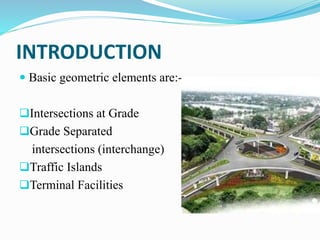
 Basic geometric elements are:-
Intersections at Grade
Grade Separated
intersections (interchange)
Traffic Islands
Terminal Facilities
INTERSECTIONS
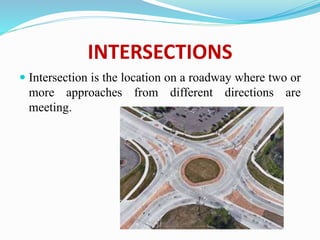
 Intersection is the location on a roadway where two or
more approaches from different directions are
meeting.
INTERSECTION
 Road intersections can be divided in two groups:-
A. Intersection at Grade
B. Grade separated Intersection
A) INTERSECTION AT GRADE
 All roads meet at more or less the same level involved in
the intersection at grade.
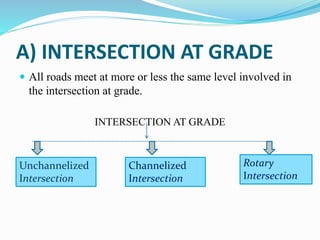
INTERSECTION AT GRADE
Unchannelized
Intersection
Channelized
Intersection
Rotary
Intersection
Classification of Intersection at Grade
A) According to Shape:-
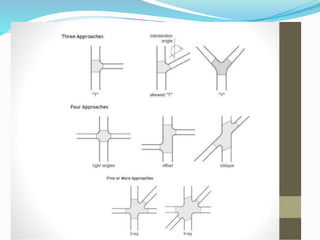
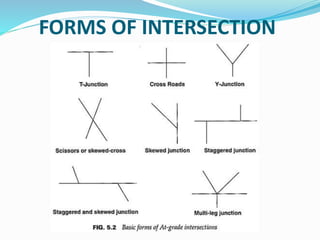
 Three legged intersection (T, Y and skewed)
 Four legged intersection (Right angled, skewed, offset)
 Rotary intersection
B) According to Geometric design features:-
 Unchannalized intersection
 Channelized intersection
C) According to traffic control:-
 Uncontrolled intersection
 Controlled Intersection
 Signalized intersection
D) According to levels of crossing:-
 At grade intersections
 Grade separated intersections
FORMS OF INTERSECTION
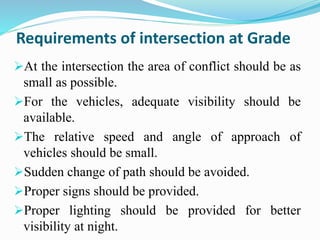
Requirements of intersection at Grade
At the intersection the area of conflict should be as
small as possible.
For the vehicles, adequate visibility should be
available.
The relative speed and angle of approach of
vehicles should be small.
Sudden change of path should be avoided.
Proper signs should be provided.
Proper lighting should be provided for better
visibility at night.
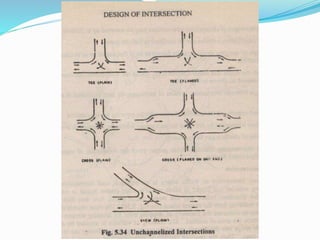
Unchannelized Intersections
 The intersection area is paved and there is absolutely
no restriction to vehicle to use any part of intersection
area.
 Lowest class of intersection
 Easy to design but most complex in traffic operations
resulting in maximum conflict area and more no of
accidents.
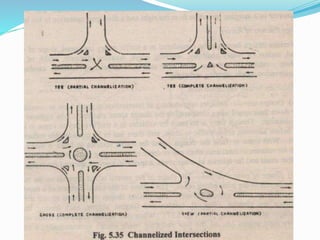
Channelized Intersections
 Channelized Intersections is achieved by introducing
islands into the intersectional area, thus reducing total
conflict area available.
 These are help to channelize turning traffic, to control
their speed and to decrease conflict area.
Advantages of Channelized
Intersections
By channelization, vehicles confined to definite path.
Conflict areas can be decreased.
Angle of merging streams can be forced to be flat
angles so as to cause minimum disruption.
Speed of vehicle can be controlled.
Refuse islands can be provided for pedestrians.
Points of conflicts can be separated.
Signs & traffic devices can be installed.
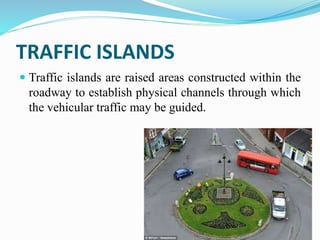
TRAFFIC ISLANDS
 Traffic islands are raised areas constructed within the
roadway to establish physical channels through which
the vehicular traffic may be guided.
FUNCTIONS OF TRAFFIC ISLANDS
Functions of Traffic Islands:-
To segregate the pedestrians and vehicles.
To separate traffic into specified paths.
To reduce conflict areas.
To increase safety
To divert traffic from obstacles.
ADVANTAGES OF TRAFFIC
ISLANDS
It provides smooth and controlled traffic flow.
It reduces the accident and increase safety
It gives uniform speed of traffic.
No need of police control.
DISADVANTAGES OF TRAFFIC
ISLANDS
 It consumes useful traffic area.
 It increases travel distance.
 Width of traffic lane decreases.
TYPES OF TRAFFIC ISLANDS
1. Divisional islands
2. Channelizing islands
3. Pedestrian loading islands
4. Rotary islands
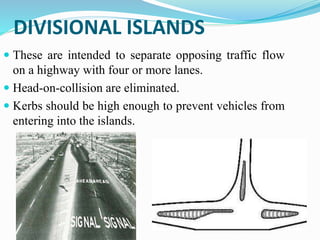
DIVISIONAL ISLANDS
 These are intended to separate opposing traffic flow
on a highway with four or more lanes.
 Head-on-collision are eliminated.
 Kerbs should be high enough to prevent vehicles from
entering into the islands.
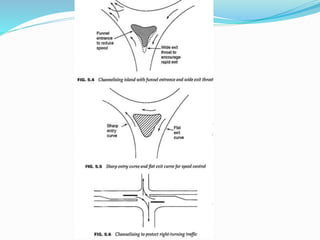
CHANNELIZED ISLANDS
 These are used to guide traffic into proper channel
through the intersection area.
 Very useful as traffic control devices for intersection
at grade.
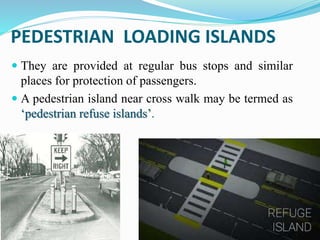
PEDESTRIAN LOADING ISLANDS
 They are provided at regular bus stops and similar
places for protection of passengers.
 A pedestrian island near cross walk may be termed as
‘pedestrian refuse islands’.
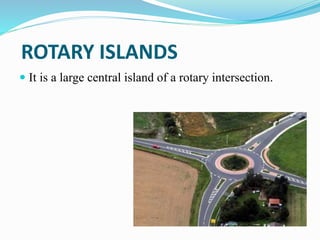
ROTARY ISLANDS
 It is a large central island of a rotary intersection.
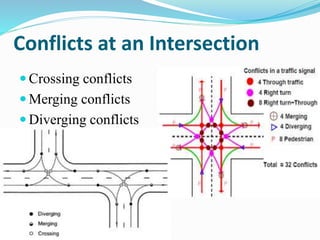
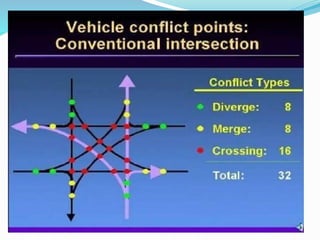
Conflicts at an Intersection
 Crossing conflicts
 Merging conflicts
 Diverging conflicts
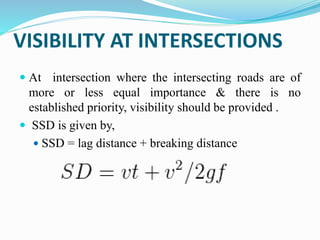
VISIBILITY AT INTERSECTIONS
 At intersection where the intersecting roads are of
more or less equal importance & there is no
established priority, visibility should be provided .
 SSD is given by,
 SSD = lag distance + breaking distance
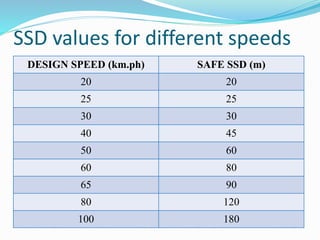
SSD values for different speeds
DESIGN SPEED (km.ph) SAFE SSD (m)
20 20
25 25
30 30
40 45
50 60
60 80
65 90
80 120
100 180
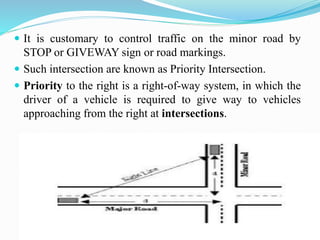
 It is customary to control traffic on the minor road by
STOP or GIVEWAY sign or road markings.
 Such intersection are known as Priority Intersection.
 Priority to the right is a right-of-way system, in which the
driver of a vehicle is required to give way to vehicles
approaching from the right at intersections.
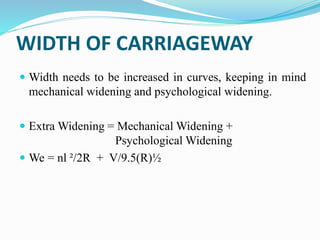
WIDTH OF CARRIAGEWAY
 Width needs to be increased in curves, keeping in mind
mechanical widening and psychological widening.
 Extra Widening = Mechanical Widening +
Psychological Widening
 We = nl ²/2R + V/9.5(R)½
MEDIAN OPENINGS
 At Intersections, where nearly all the traffic travels on the
divided highway and volume is below capacity, the
occasional vehicles may use the median opening either to
come to the through road from the cross road or reverse.
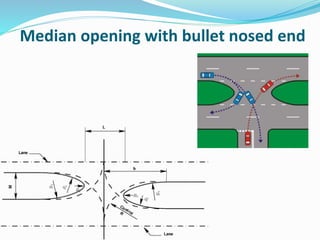
 A bullet nosed median opening designed for the minimum
turning path will meet the requirements.
 A bullet nosed median end is preferable.
 The length of opening depends on the width of median.
Median opening with bullet nosed end
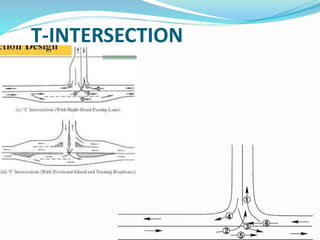
T-INTERSECTION
 It is normally provided for very light traffic and for minor
and local roads.
 For locations where speeds are high and turning
movements are large, it is hazardous.
T-INTERSECTION
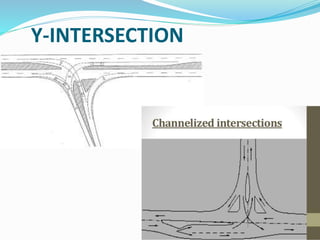
Y-INTERSECTION
 Mostly design features are similar to that of T-
Intersections, except where the intersection angle is very
acute.
Y-INTERSECTION
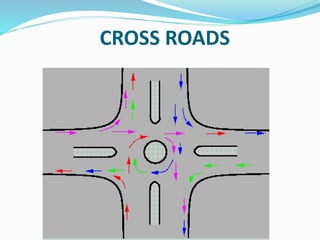
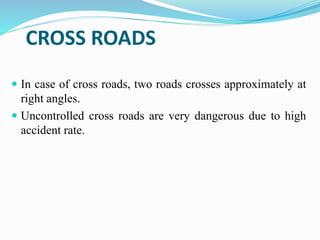
CROSS ROADS
 In case of cross roads, two roads crosses approximately at
right angles.
 Uncontrolled cross roads are very dangerous due to high
accident rate.
CROSS ROADS
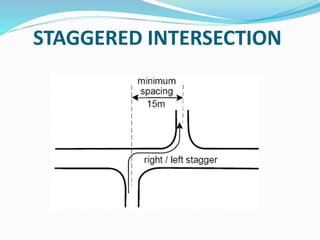
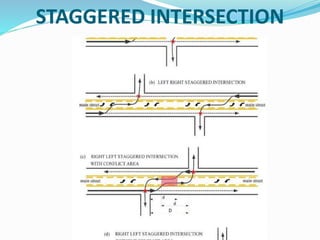
STAGGERED INTERSECTION
 The safety at the cross roads can be significantly enhanced
by converting it into a staggered intersection.
 A minimum distance of 35 m is necessary between the
staggered roads.
 A right/left staggered is preferred to left/right stagger
where there are no separate right turning lanes.
STAGGERED INTERSECTION
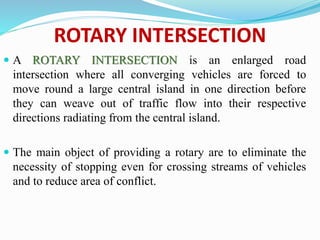
ROTARY INTERSECTION
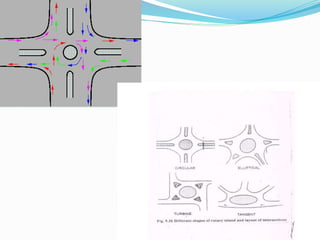
 A ROTARY INTERSECTION is an enlarged road
intersection where all converging vehicles are forced to
move round a large central island in one direction before
they can weave out of traffic flow into their respective
directions radiating from the central island.
 The main object of providing a rotary are to eliminate the
necessity of stopping even for crossing streams of vehicles
and to reduce area of conflict.
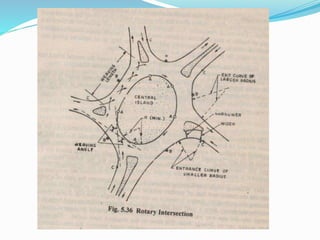
ROTARY DESIGN ELEMENTS
Design Speed
Shape of central island
Radius of entry
Radius at exit
Radius of central island
Weaving length
Width of carriage way at entry and exit
Width of rotary carriageway
Entry and exit angles
Camber and super elevation
Capacity
GRADE SEPARATED INTERSECTIONS
 In a grade separated intersection, the intersecting roadways
are placed at different elevations to allow uninterrupted
traffic movement.
 The grade separated intersections are classified as
OVERPASS and UNDERPASS.
 When the major highway is taken over the road of lesser
importance, it is called as OVERPASS.
 If the major highway is taken by depressing it below the
ground level to cross another road of less importance by
means of under bridge, it is known as UNDERPASS.
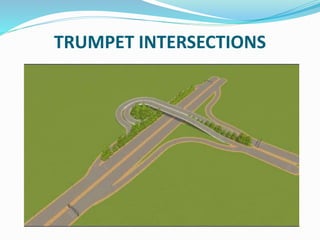
TRUMPET INTERSECTIONS
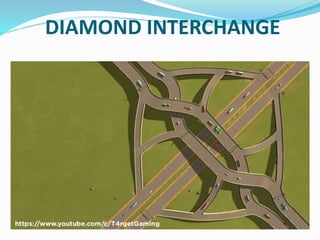
DIAMOND INTERCHANGE
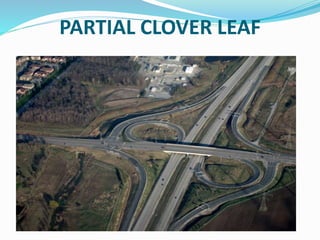
PARTIAL CLOVER LEAF
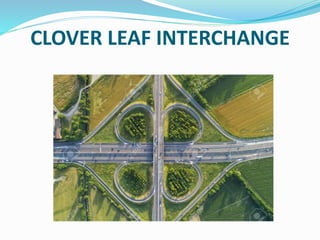
CLOVER LEAF INTERCHANGE
ADVANTAGES OF GRADE
SEPARATION
It avoids necessity of stopping.
Avoids accidents at intersection.
There is increased safety or turning traffic.
There is overall increase in comfort and convenience to the
motorists and saving in travel time.
It is very useful for expressways.
DISADVANTAGES OF GRADE
SEPARATION
It is very costly.
Where there is limited right of way like built up or urban area
or where topography is not favourable, construction of grade
separation is costly, difficult and undesirable.
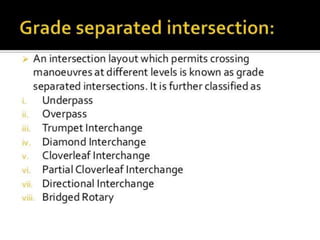
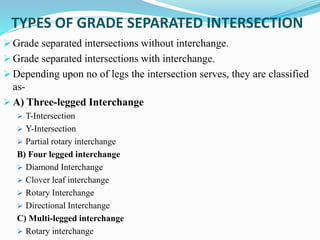
TYPES OF GRADE SEPARATED INTERSECTION
 Grade separated intersections without interchange.
 Grade separated intersections with interchange.
 Depending upon no of legs the intersection serves, they are classified
as-
 A) Three-legged Interchange
 T-Intersection
 Y-Intersection
 Partial rotary interchange
B) Four legged interchange
 Diamond Interchange
 Clover leaf interchange
 Rotary Interchange
 Directional Interchange
C) Multi-legged interchange
 Rotary interchange
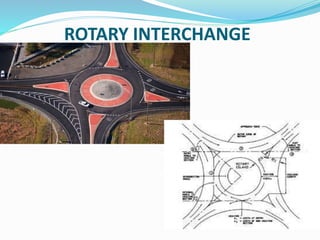
ROTARY INTERCHANGE
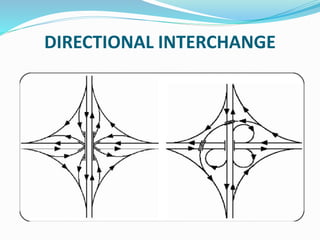
DIRECTIONAL INTERCHANGE
TERMINAL FACILITIES
 Along the highway the terminal facilities required are:-
Bus stops
Bus bays
Drive ways
Footways
Traffic geometrics

Traffic geometrics

  • 1.
  • 2.
    CONTENTS  Introduction  Intersections Traffic Islands  Conflicts at Intersection  Visibility at Intersection  Widths of carriageway at Intersection  Median Openings  T- Intersection  Y- Intersection  Cross roads and Staggered Intersection Rotary Intersection  Rotary design elements Grade Separated Intersections Terminal Facilities
  • 3.
    INTRODUCTION  Basic geometricelements are:- Intersections at Grade Grade Separated intersections (interchange) Traffic Islands Terminal Facilities
  • 4.
    INTERSECTIONS  Intersection isthe location on a roadway where two or more approaches from different directions are meeting.
  • 5.
    INTERSECTION  Road intersectionscan be divided in two groups:- A. Intersection at Grade B. Grade separated Intersection
  • 6.
    A) INTERSECTION ATGRADE  All roads meet at more or less the same level involved in the intersection at grade. INTERSECTION AT GRADE Unchannelized Intersection Channelized Intersection Rotary Intersection
  • 7.
    Classification of Intersectionat Grade A) According to Shape:-  Three legged intersection (T, Y and skewed)  Four legged intersection (Right angled, skewed, offset)  Rotary intersection B) According to Geometric design features:-  Unchannalized intersection  Channelized intersection C) According to traffic control:-  Uncontrolled intersection  Controlled Intersection  Signalized intersection D) According to levels of crossing:-  At grade intersections  Grade separated intersections
  • 9.
  • 10.
    Requirements of intersectionat Grade At the intersection the area of conflict should be as small as possible. For the vehicles, adequate visibility should be available. The relative speed and angle of approach of vehicles should be small. Sudden change of path should be avoided. Proper signs should be provided. Proper lighting should be provided for better visibility at night.
  • 11.
    Unchannelized Intersections  Theintersection area is paved and there is absolutely no restriction to vehicle to use any part of intersection area.  Lowest class of intersection  Easy to design but most complex in traffic operations resulting in maximum conflict area and more no of accidents.
  • 13.
    Channelized Intersections  ChannelizedIntersections is achieved by introducing islands into the intersectional area, thus reducing total conflict area available.  These are help to channelize turning traffic, to control their speed and to decrease conflict area.
  • 15.
    Advantages of Channelized Intersections Bychannelization, vehicles confined to definite path. Conflict areas can be decreased. Angle of merging streams can be forced to be flat angles so as to cause minimum disruption. Speed of vehicle can be controlled. Refuse islands can be provided for pedestrians. Points of conflicts can be separated. Signs & traffic devices can be installed.
  • 16.
    TRAFFIC ISLANDS  Trafficislands are raised areas constructed within the roadway to establish physical channels through which the vehicular traffic may be guided.
  • 17.
    FUNCTIONS OF TRAFFICISLANDS Functions of Traffic Islands:- To segregate the pedestrians and vehicles. To separate traffic into specified paths. To reduce conflict areas. To increase safety To divert traffic from obstacles.
  • 18.
    ADVANTAGES OF TRAFFIC ISLANDS Itprovides smooth and controlled traffic flow. It reduces the accident and increase safety It gives uniform speed of traffic. No need of police control.
  • 19.
    DISADVANTAGES OF TRAFFIC ISLANDS It consumes useful traffic area.  It increases travel distance.  Width of traffic lane decreases.
  • 20.
    TYPES OF TRAFFICISLANDS 1. Divisional islands 2. Channelizing islands 3. Pedestrian loading islands 4. Rotary islands
  • 21.
    DIVISIONAL ISLANDS  Theseare intended to separate opposing traffic flow on a highway with four or more lanes.  Head-on-collision are eliminated.  Kerbs should be high enough to prevent vehicles from entering into the islands.
  • 22.
    CHANNELIZED ISLANDS  Theseare used to guide traffic into proper channel through the intersection area.  Very useful as traffic control devices for intersection at grade.
  • 24.
    PEDESTRIAN LOADING ISLANDS They are provided at regular bus stops and similar places for protection of passengers.  A pedestrian island near cross walk may be termed as ‘pedestrian refuse islands’.
  • 25.
    ROTARY ISLANDS  Itis a large central island of a rotary intersection.
  • 26.
    Conflicts at anIntersection  Crossing conflicts  Merging conflicts  Diverging conflicts
  • 28.
    VISIBILITY AT INTERSECTIONS At intersection where the intersecting roads are of more or less equal importance & there is no established priority, visibility should be provided .  SSD is given by,  SSD = lag distance + breaking distance
  • 29.
    SSD values fordifferent speeds DESIGN SPEED (km.ph) SAFE SSD (m) 20 20 25 25 30 30 40 45 50 60 60 80 65 90 80 120 100 180
  • 30.
     It iscustomary to control traffic on the minor road by STOP or GIVEWAY sign or road markings.  Such intersection are known as Priority Intersection.  Priority to the right is a right-of-way system, in which the driver of a vehicle is required to give way to vehicles approaching from the right at intersections.
  • 31.
    WIDTH OF CARRIAGEWAY Width needs to be increased in curves, keeping in mind mechanical widening and psychological widening.  Extra Widening = Mechanical Widening + Psychological Widening  We = nl ²/2R + V/9.5(R)½
  • 32.
    MEDIAN OPENINGS  AtIntersections, where nearly all the traffic travels on the divided highway and volume is below capacity, the occasional vehicles may use the median opening either to come to the through road from the cross road or reverse.  A bullet nosed median opening designed for the minimum turning path will meet the requirements.  A bullet nosed median end is preferable.  The length of opening depends on the width of median.
  • 33.
    Median opening withbullet nosed end
  • 34.
    T-INTERSECTION  It isnormally provided for very light traffic and for minor and local roads.  For locations where speeds are high and turning movements are large, it is hazardous.
  • 35.
  • 36.
    Y-INTERSECTION  Mostly designfeatures are similar to that of T- Intersections, except where the intersection angle is very acute.
  • 37.
  • 38.
    CROSS ROADS  Incase of cross roads, two roads crosses approximately at right angles.  Uncontrolled cross roads are very dangerous due to high accident rate.
  • 39.
  • 40.
    STAGGERED INTERSECTION  Thesafety at the cross roads can be significantly enhanced by converting it into a staggered intersection.  A minimum distance of 35 m is necessary between the staggered roads.  A right/left staggered is preferred to left/right stagger where there are no separate right turning lanes.
  • 41.
  • 42.
  • 43.
    ROTARY INTERSECTION  AROTARY INTERSECTION is an enlarged road intersection where all converging vehicles are forced to move round a large central island in one direction before they can weave out of traffic flow into their respective directions radiating from the central island.  The main object of providing a rotary are to eliminate the necessity of stopping even for crossing streams of vehicles and to reduce area of conflict.
  • 46.
    ROTARY DESIGN ELEMENTS DesignSpeed Shape of central island Radius of entry Radius at exit Radius of central island Weaving length Width of carriage way at entry and exit Width of rotary carriageway Entry and exit angles Camber and super elevation Capacity
  • 47.
    GRADE SEPARATED INTERSECTIONS In a grade separated intersection, the intersecting roadways are placed at different elevations to allow uninterrupted traffic movement.  The grade separated intersections are classified as OVERPASS and UNDERPASS.  When the major highway is taken over the road of lesser importance, it is called as OVERPASS.  If the major highway is taken by depressing it below the ground level to cross another road of less importance by means of under bridge, it is known as UNDERPASS.
  • 49.
  • 50.
  • 51.
  • 52.
  • 53.
    ADVANTAGES OF GRADE SEPARATION Itavoids necessity of stopping. Avoids accidents at intersection. There is increased safety or turning traffic. There is overall increase in comfort and convenience to the motorists and saving in travel time. It is very useful for expressways.
  • 54.
    DISADVANTAGES OF GRADE SEPARATION Itis very costly. Where there is limited right of way like built up or urban area or where topography is not favourable, construction of grade separation is costly, difficult and undesirable.
  • 55.
    TYPES OF GRADESEPARATED INTERSECTION  Grade separated intersections without interchange.  Grade separated intersections with interchange.  Depending upon no of legs the intersection serves, they are classified as-  A) Three-legged Interchange  T-Intersection  Y-Intersection  Partial rotary interchange B) Four legged interchange  Diamond Interchange  Clover leaf interchange  Rotary Interchange  Directional Interchange C) Multi-legged interchange  Rotary interchange
  • 56.
  • 57.
  • 58.
    TERMINAL FACILITIES  Alongthe highway the terminal facilities required are:- Bus stops Bus bays Drive ways Footways