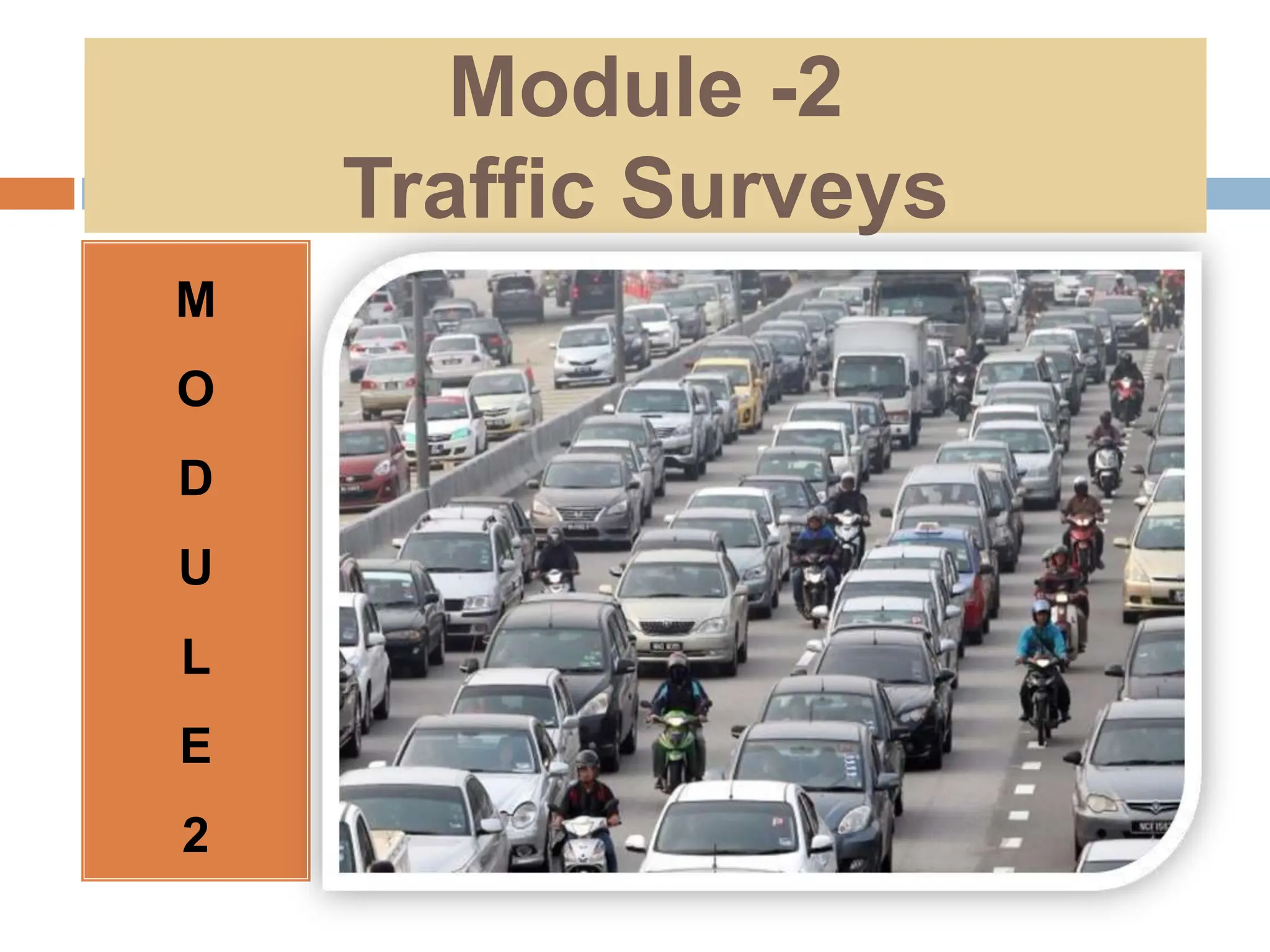
Module -2
Traffic Surveys
M
O
D
U
L
E
2
Traffic Surveys
 Speed, journey time and delay surveys,
 Vehicles Volume Survey including non-motorized
transports,
 Methods and interpretation,
 Origin Destination Survey,
 Methods and presentation,
 Parking Survey,
 Accident analysis-Methods, interpretation and
presentation,
 Statistical applications in traffic studies and traffic
forecasting,
 Level of service- Concept, applications and
significance.
Traffic Surveys
The various traffic engineering surveys
are:
Traffic volume study
Origin and Destination (O and D) study
Parking study
Accident studies or traffic flop
Speed studies
Spot speed study
Speed and delay study
Traffic flow characteristics
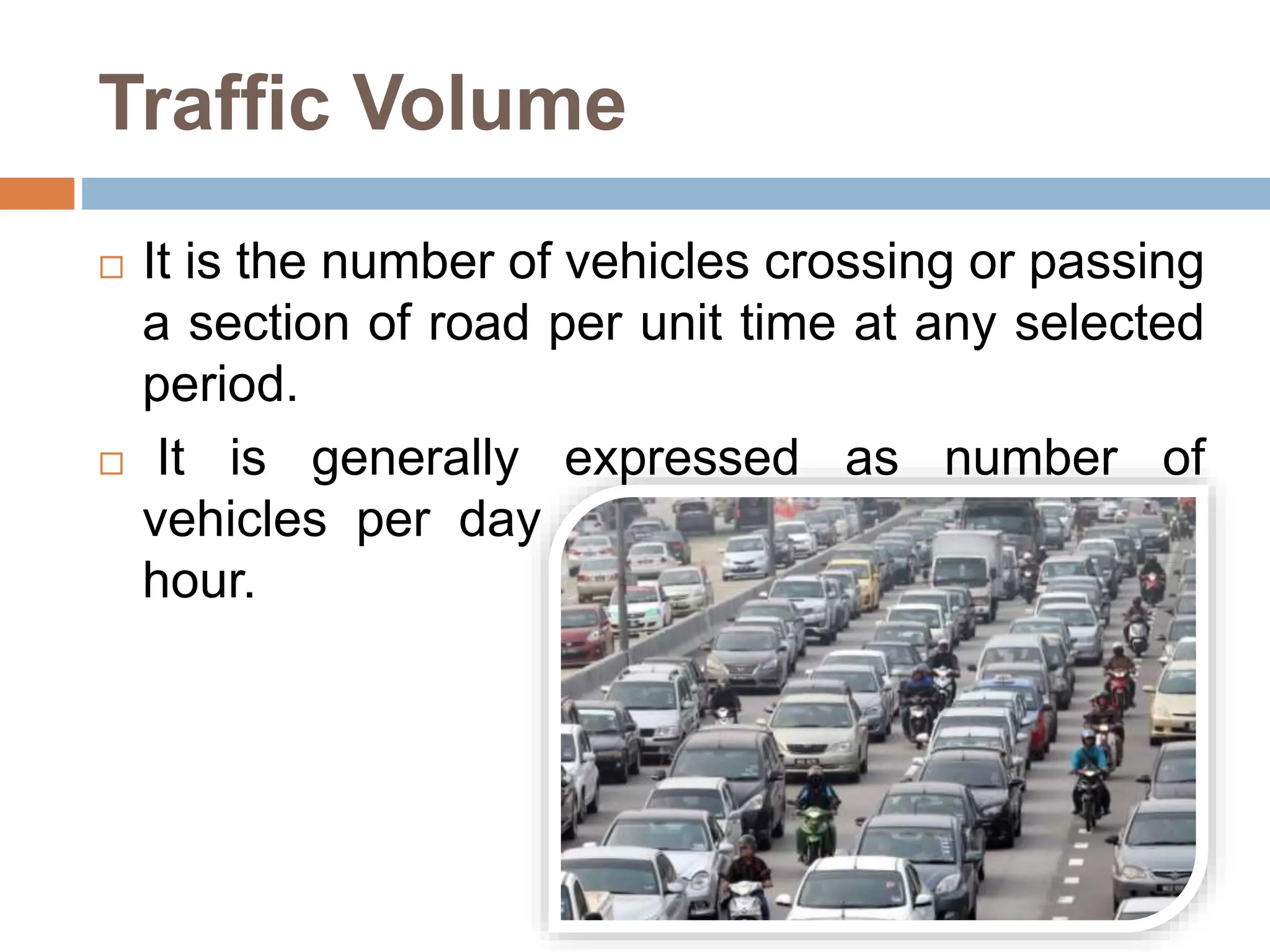
Traffic Volume
 It is the number of vehicles crossing or passing
a section of road per unit time at any selected
period.
 It is generally expressed as number of
vehicles per day or number of vehicles per
hour.
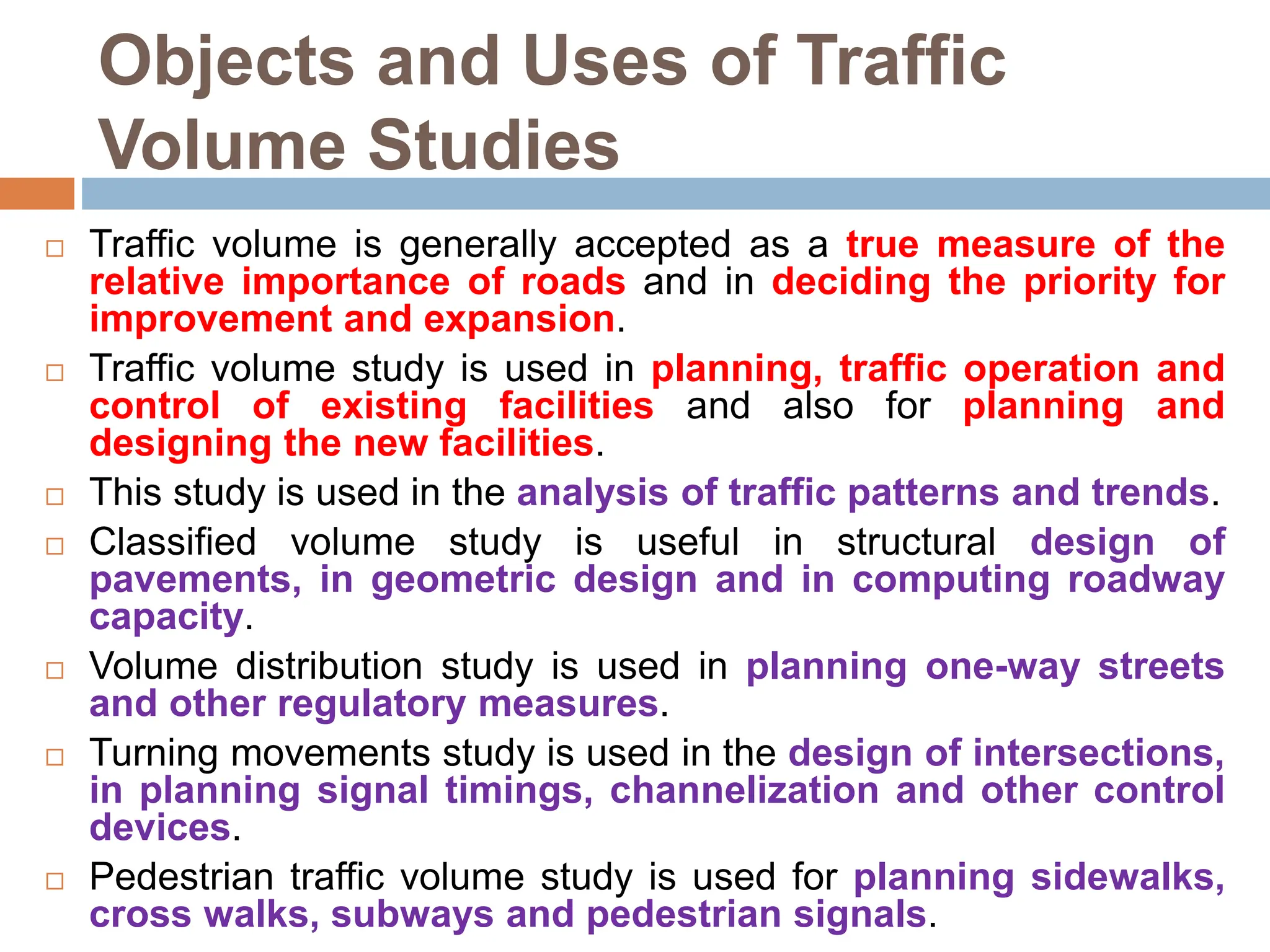
Objects and Uses of Traffic
Volume Studies
 Traffic volume is generally accepted as a true measure of the
relative importance of roads and in deciding the priority for
improvement and expansion.
 Traffic volume study is used in planning, traffic operation and
control of existing facilities and also for planning and
designing the new facilities.
 This study is used in the analysis of traffic patterns and trends.
 Classified volume study is useful in structural design of
pavements, in geometric design and in computing roadway
capacity.
 Volume distribution study is used in planning one-way streets
and other regulatory measures.
 Turning movements study is used in the design of intersections,
in planning signal timings, channelization and other control
devices.
 Pedestrian traffic volume study is used for planning sidewalks,
cross walks, subways and pedestrian signals.
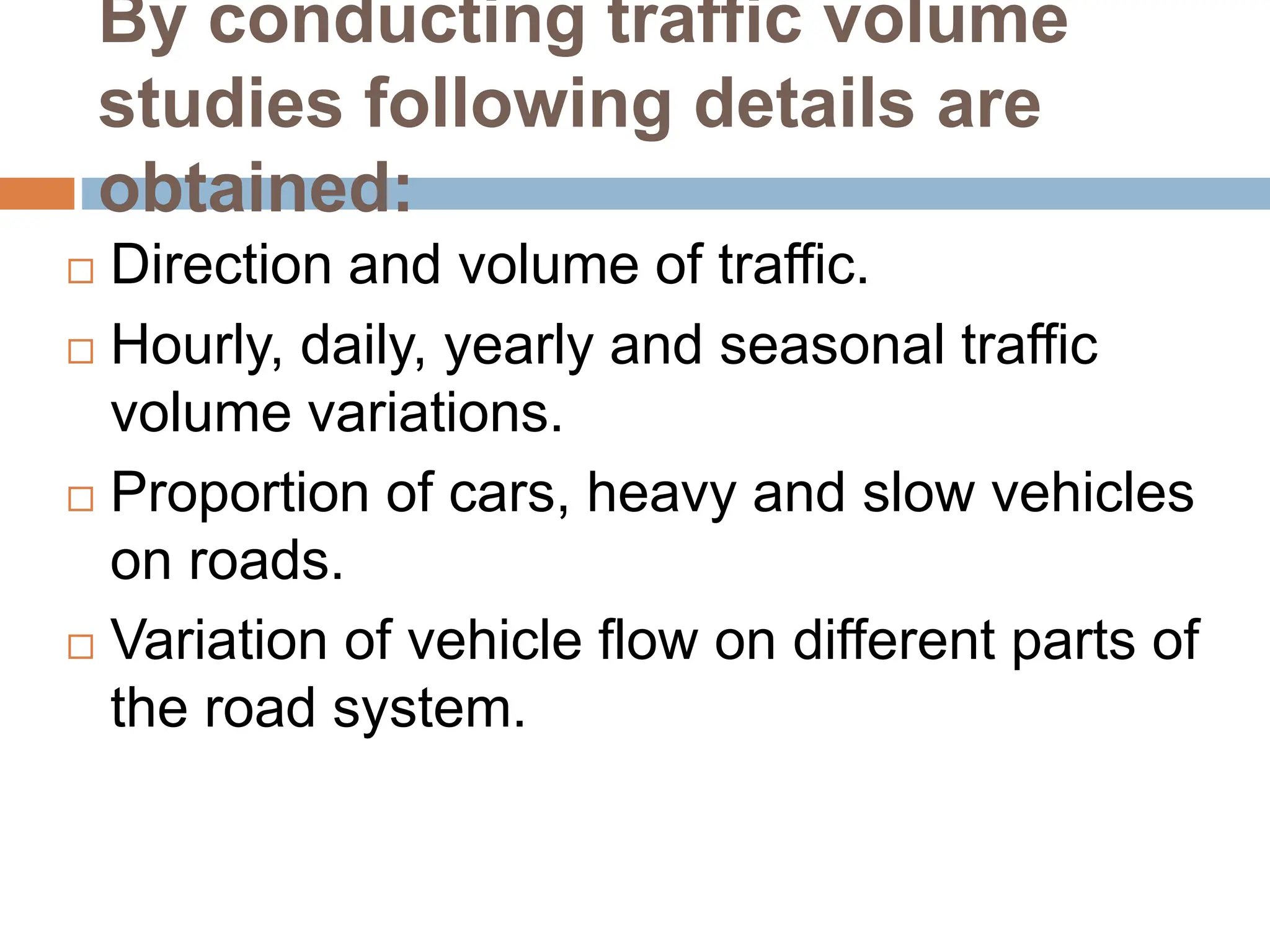
By conducting traffic volume
studies following details are
obtained:
 Direction and volume of traffic.
 Hourly, daily, yearly and seasonal traffic
volume variations.
 Proportion of cars, heavy and slow vehicles
on roads.
 Variation of vehicle flow on different parts of
the road system.
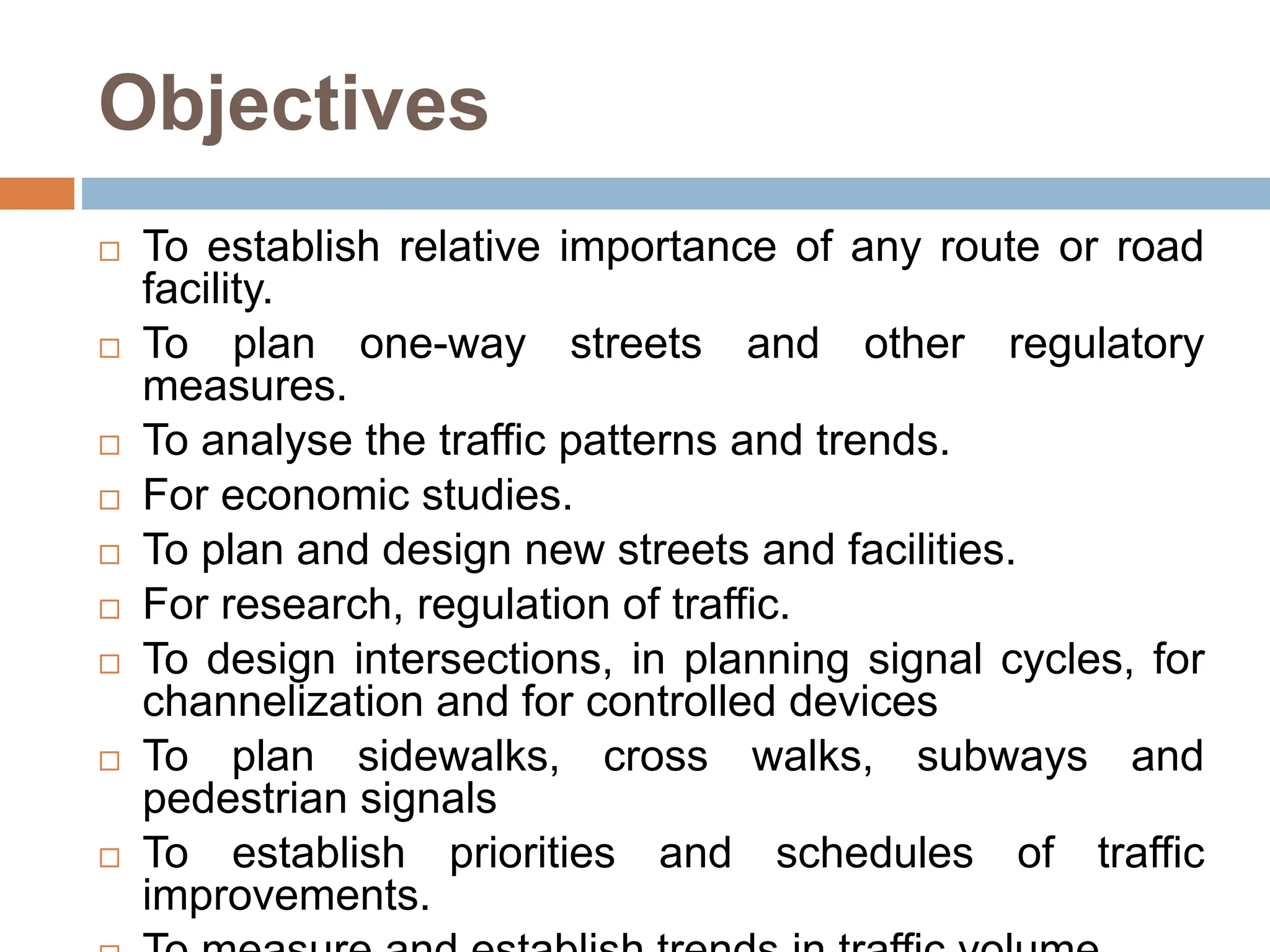
Objectives
 To establish relative importance of any route or road
facility.
 To plan one-way streets and other regulatory
measures.
 To analyse the traffic patterns and trends.
 For economic studies.
 To plan and design new streets and facilities.
 For research, regulation of traffic.
 To design intersections, in planning signal cycles, for
channelization and for controlled devices
 To plan sidewalks, cross walks, subways and
pedestrian signals
 To establish priorities and schedules of traffic
improvements.
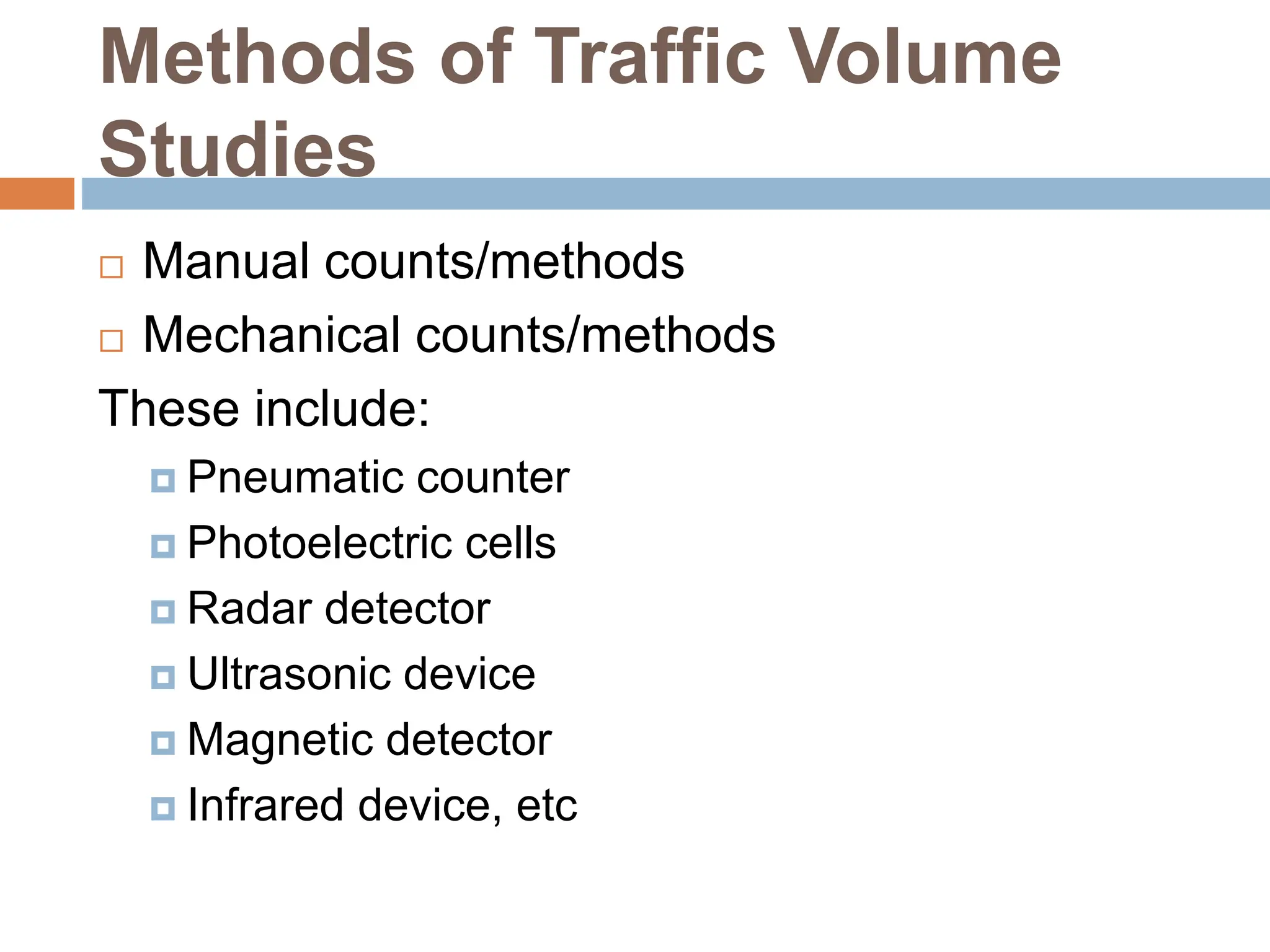
Methods of Traffic Volume
Studies
 Manual counts/methods
 Mechanical counts/methods
These include:
 Pneumatic counter
 Photoelectric cells
 Radar detector
 Ultrasonic device
 Magnetic detector
 Infrared device, etc
Manual Counts
Manual Counts
 This method employs a field team to record
traffic volume on the prescribed record sheets.
 By this method it is possible to obtain data
which can not be collected by mechanical
counters, such as vehicle classification,
turning movements and counts where the
loading conditions or number of occupants are
required.
Advantages of Manual
Methods
 These are simple and quick
 These are flexible and no requirement of setting up of
instruments at field or special skills
 Turning movements and direction of movements are
recorded
 Traffic classification is cheaper for specific purpose
and for short counts
 These are mainly suitable for short term and non-
continuous counts.
 Data collected gives information about break-down of
traffic in each direction
 In rural areas, this is more suitable due to vandalism
 In developing and under developed countries
sophisticated automatic devices are not available.
Disadvantages of Manual
Methods
 For longer counts these are expensive.
 It is unsuitable in bad weather condition
 Mainly depends on accuracy and efficiency of
the observer
 It is very difficult to conduct manual counts for
24hours in a day for all 365 days
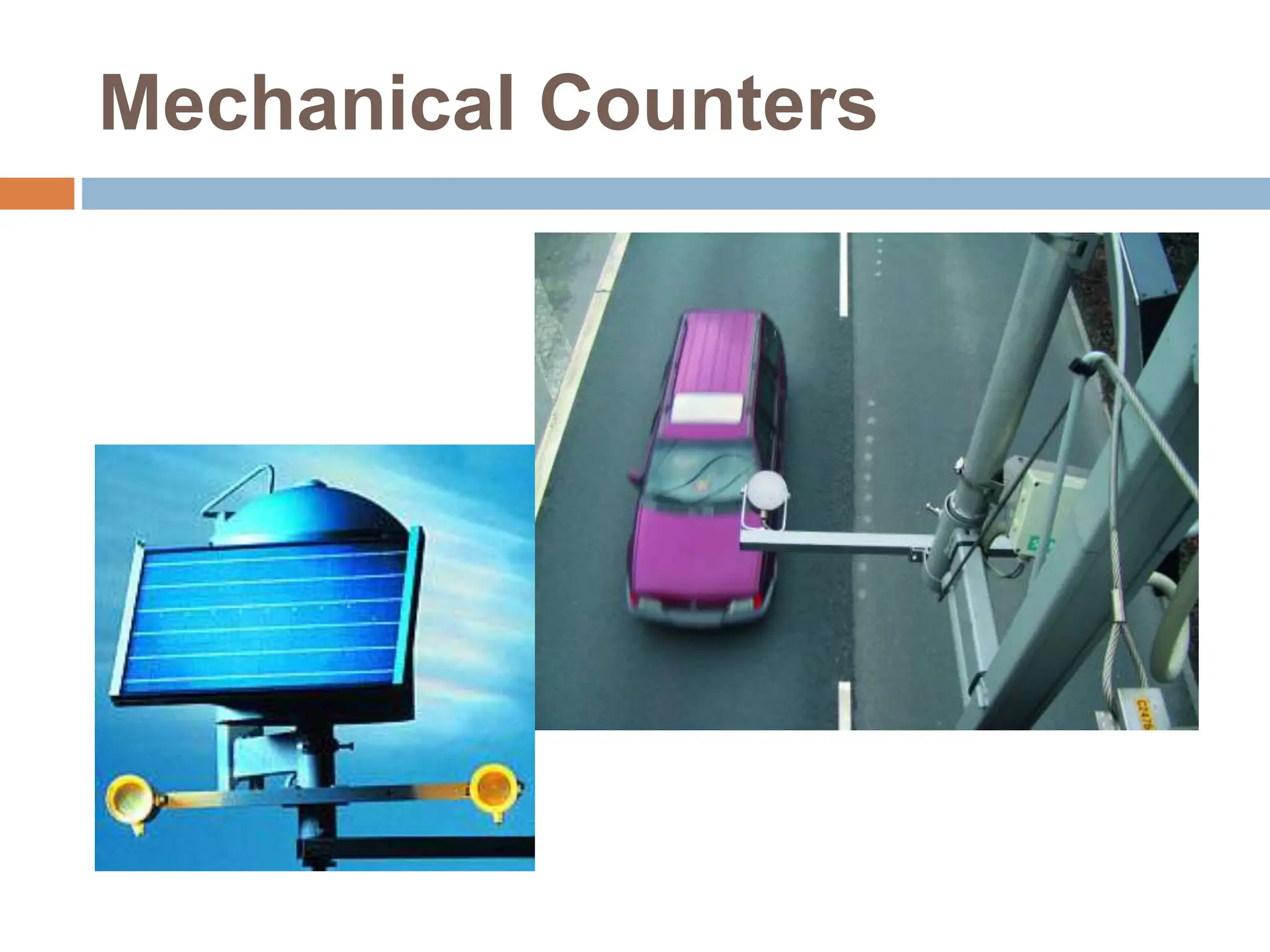
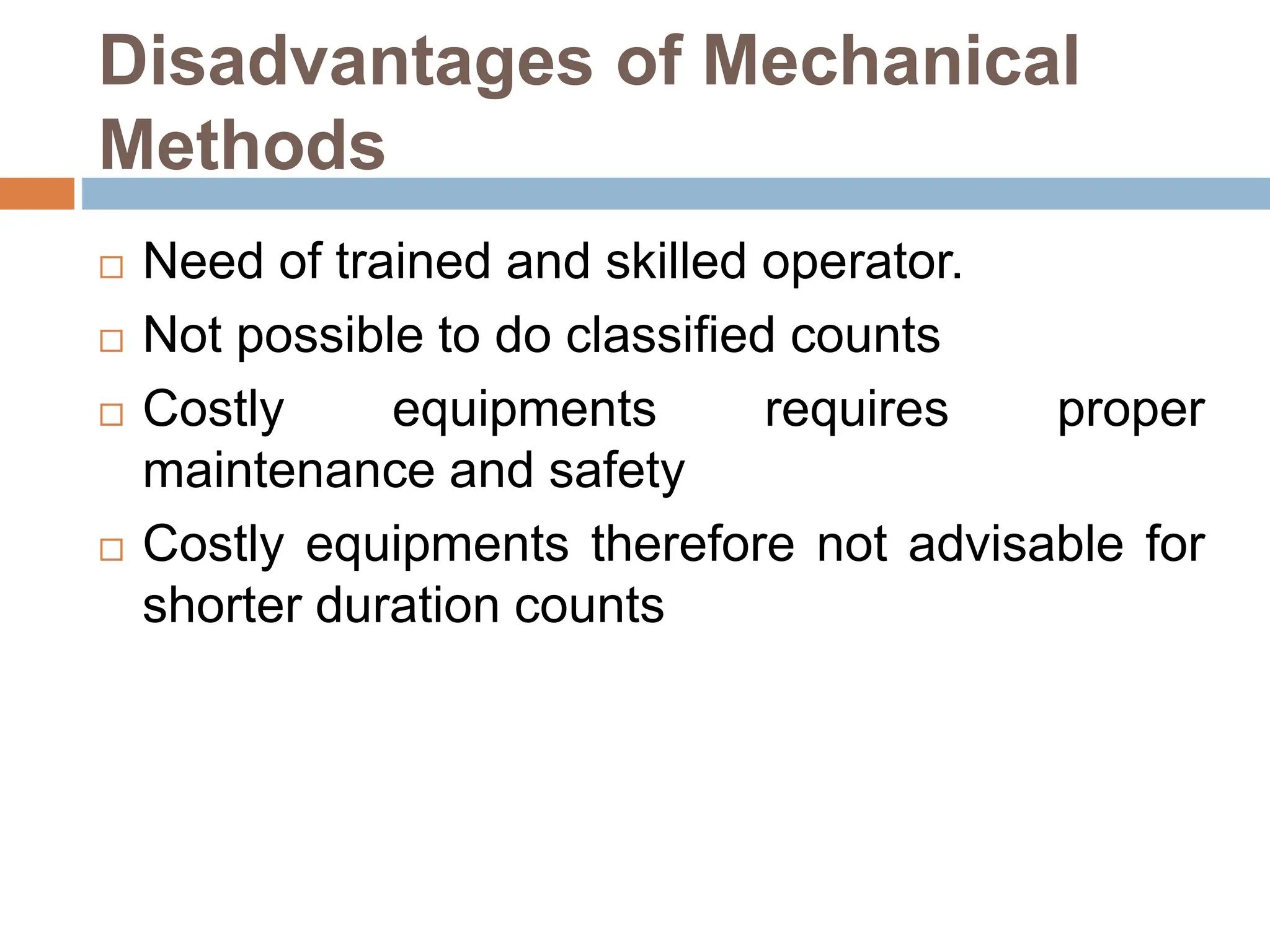
Mechanical Counters
Mechanical Counters
 These may be either fixed (permanent) type or
portable type.
 The mechanical counter can automatically record the
total number of vehicles crossing a section of the road
in a desired period.
 The working may be by the effect of impulses or
stimuli caused by traffic movements on a pneumatic
hose placed across the roadway or by using any other
type of sensor.
 Traffic count is recorded by electrically operated
counters and recorders capable of recording the
impulses.
 The impulses caused by vehicles of light weight may
not be enough in some cases to actuate the counter.
 Also it is not possible to easily record pedestrian traffic
Advantages of Mechanical
Methods
 This can be used in all weather conditions and
at all times
 If maintained properly these gives accurate
information
 It gives punched data which is easy to analyse
by computers
 For long duration counts these are cheaper
 Where continuous and regular flow of traffic is
these are widely used, in developed countries
and in remote areas
Disadvantages of Mechanical
Methods
 Need of trained and skilled operator.
 Not possible to do classified counts
 Costly equipments requires proper
maintenance and safety
 Costly equipments therefore not advisable for
shorter duration counts
PEDESTRIAN VOLUME
STUDIES
 Objects
 To minimise the vehicular delay
 To plan and design traffic control devices
 To increase safety of pedestrians
 To provide a design which minimises pedestrian-
vehicle conflicts
 To find the utility of sidewalks.
 To properly design signal timings at intersections
Interpretation/Presentation of
Traffic Volume Data Collected
 Annual Average Daily Traffic (AADT or
ADT)
 Traffic Flow Maps
 Trends Charts
 Variation Charts
 Volume Flow Diagram
 Thirtieth Highest Hourly Volume/ Design
Volume Flow Diagram
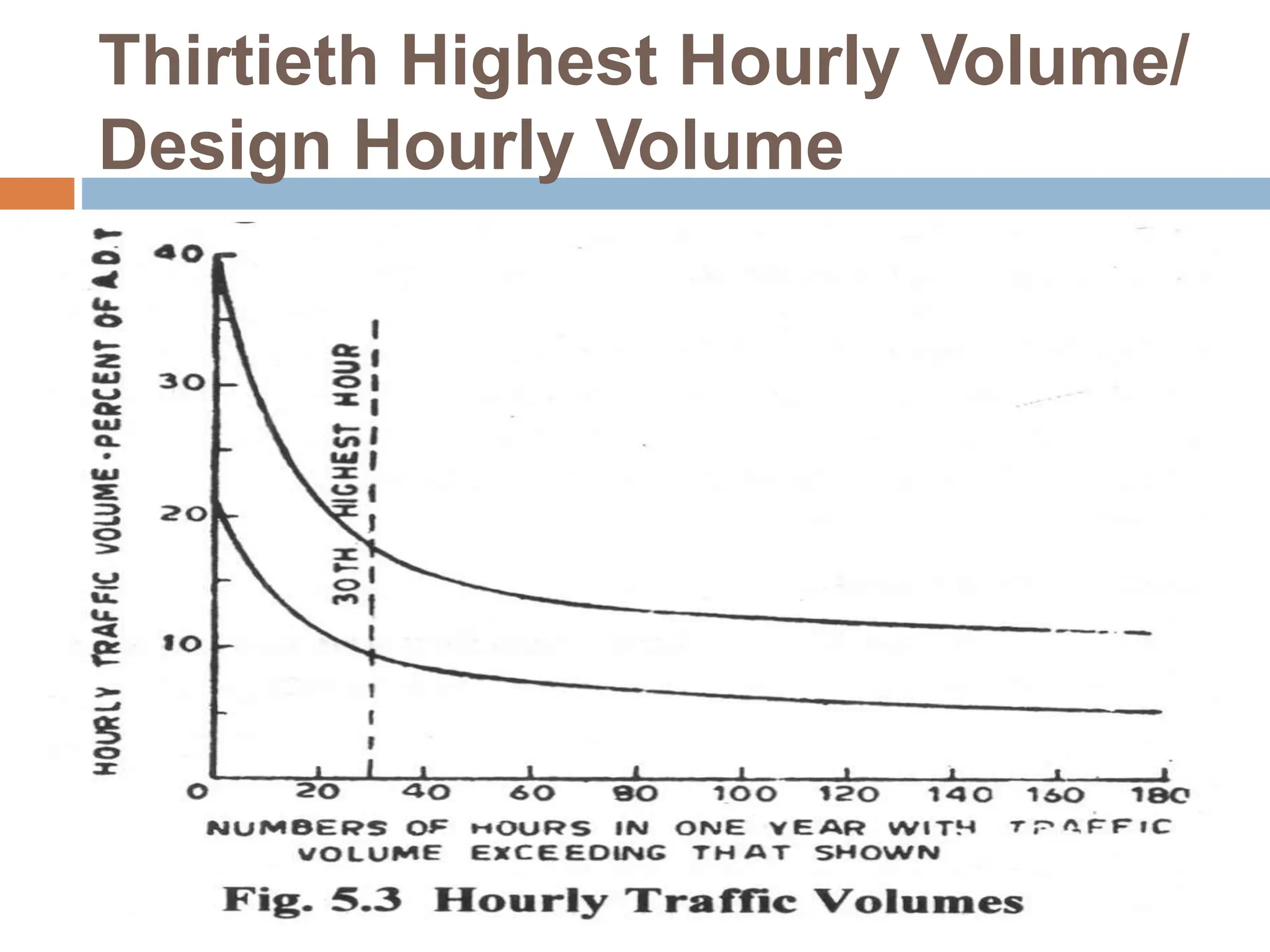
Thirtieth Highest Hourly Volume/
Design Hourly Volume
Passenger Car Unit (PCU)
The PCU of vehicle type
depends upon:
 Size and speed of the
vehicle
 Type and kind of road
environment [Ex: rural
road, urban street, traffic
signal]
It is generally not
dependent on:
 Flow
 Road width
The factors controlling PCU
are:
 Speed, acceleration,
braking characteristics
 Spacing of vehicles,
clearness
 Composition of traffic
stream
 Road geometrics
 Traffic regulations
 Environmental conditions
PCU Equivalents as per Indian
Practice
Sl.
No.
Vehicle Type
PCU Equivalency
Factor
1 Motor cycle or scooter 0.50
2 Passenger car, van, auto-rickshaw 1.00
3 Agricultural tractor, LCV 1.50
4 Truck or bus 3.00
5
Truck trailer, agricultural tractor-
trailer
4.50
6 Cycle 0.50
7 Cycle rickshaw 2.00
8 Hand cart 3.00
9 Horse-drawn vehicle 4.00
10 Bullock cart 8.00*
*For smaller bullock carts, a value of 6 will be appropriate

TRAFFIC SURVEYS- TRANSPORTATION ENGINEERING

  • 1.
  • 2.
    Traffic Surveys  Speed,journey time and delay surveys,  Vehicles Volume Survey including non-motorized transports,  Methods and interpretation,  Origin Destination Survey,  Methods and presentation,  Parking Survey,  Accident analysis-Methods, interpretation and presentation,  Statistical applications in traffic studies and traffic forecasting,  Level of service- Concept, applications and significance.
  • 3.
    Traffic Surveys The varioustraffic engineering surveys are: Traffic volume study Origin and Destination (O and D) study Parking study Accident studies or traffic flop Speed studies Spot speed study Speed and delay study Traffic flow characteristics
  • 4.
    Traffic Volume  Itis the number of vehicles crossing or passing a section of road per unit time at any selected period.  It is generally expressed as number of vehicles per day or number of vehicles per hour.
  • 5.
    Objects and Usesof Traffic Volume Studies  Traffic volume is generally accepted as a true measure of the relative importance of roads and in deciding the priority for improvement and expansion.  Traffic volume study is used in planning, traffic operation and control of existing facilities and also for planning and designing the new facilities.  This study is used in the analysis of traffic patterns and trends.  Classified volume study is useful in structural design of pavements, in geometric design and in computing roadway capacity.  Volume distribution study is used in planning one-way streets and other regulatory measures.  Turning movements study is used in the design of intersections, in planning signal timings, channelization and other control devices.  Pedestrian traffic volume study is used for planning sidewalks, cross walks, subways and pedestrian signals.
  • 6.
    By conducting trafficvolume studies following details are obtained:  Direction and volume of traffic.  Hourly, daily, yearly and seasonal traffic volume variations.  Proportion of cars, heavy and slow vehicles on roads.  Variation of vehicle flow on different parts of the road system.
  • 7.
    Objectives  To establishrelative importance of any route or road facility.  To plan one-way streets and other regulatory measures.  To analyse the traffic patterns and trends.  For economic studies.  To plan and design new streets and facilities.  For research, regulation of traffic.  To design intersections, in planning signal cycles, for channelization and for controlled devices  To plan sidewalks, cross walks, subways and pedestrian signals  To establish priorities and schedules of traffic improvements.
  • 8.
    Methods of TrafficVolume Studies  Manual counts/methods  Mechanical counts/methods These include:  Pneumatic counter  Photoelectric cells  Radar detector  Ultrasonic device  Magnetic detector  Infrared device, etc
  • 9.
  • 10.
    Manual Counts  Thismethod employs a field team to record traffic volume on the prescribed record sheets.  By this method it is possible to obtain data which can not be collected by mechanical counters, such as vehicle classification, turning movements and counts where the loading conditions or number of occupants are required.
  • 11.
    Advantages of Manual Methods These are simple and quick  These are flexible and no requirement of setting up of instruments at field or special skills  Turning movements and direction of movements are recorded  Traffic classification is cheaper for specific purpose and for short counts  These are mainly suitable for short term and non- continuous counts.  Data collected gives information about break-down of traffic in each direction  In rural areas, this is more suitable due to vandalism  In developing and under developed countries sophisticated automatic devices are not available.
  • 12.
    Disadvantages of Manual Methods For longer counts these are expensive.  It is unsuitable in bad weather condition  Mainly depends on accuracy and efficiency of the observer  It is very difficult to conduct manual counts for 24hours in a day for all 365 days
  • 13.
  • 14.
    Mechanical Counters  Thesemay be either fixed (permanent) type or portable type.  The mechanical counter can automatically record the total number of vehicles crossing a section of the road in a desired period.  The working may be by the effect of impulses or stimuli caused by traffic movements on a pneumatic hose placed across the roadway or by using any other type of sensor.  Traffic count is recorded by electrically operated counters and recorders capable of recording the impulses.  The impulses caused by vehicles of light weight may not be enough in some cases to actuate the counter.  Also it is not possible to easily record pedestrian traffic
  • 15.
    Advantages of Mechanical Methods This can be used in all weather conditions and at all times  If maintained properly these gives accurate information  It gives punched data which is easy to analyse by computers  For long duration counts these are cheaper  Where continuous and regular flow of traffic is these are widely used, in developed countries and in remote areas
  • 16.
    Disadvantages of Mechanical Methods Need of trained and skilled operator.  Not possible to do classified counts  Costly equipments requires proper maintenance and safety  Costly equipments therefore not advisable for shorter duration counts
  • 17.
    PEDESTRIAN VOLUME STUDIES  Objects To minimise the vehicular delay  To plan and design traffic control devices  To increase safety of pedestrians  To provide a design which minimises pedestrian- vehicle conflicts  To find the utility of sidewalks.  To properly design signal timings at intersections
  • 18.
    Interpretation/Presentation of Traffic VolumeData Collected  Annual Average Daily Traffic (AADT or ADT)  Traffic Flow Maps  Trends Charts  Variation Charts  Volume Flow Diagram  Thirtieth Highest Hourly Volume/ Design
  • 19.
  • 20.
    Thirtieth Highest HourlyVolume/ Design Hourly Volume
  • 21.
    Passenger Car Unit(PCU) The PCU of vehicle type depends upon:  Size and speed of the vehicle  Type and kind of road environment [Ex: rural road, urban street, traffic signal] It is generally not dependent on:  Flow  Road width
  • 22.
    The factors controllingPCU are:  Speed, acceleration, braking characteristics  Spacing of vehicles, clearness  Composition of traffic stream  Road geometrics  Traffic regulations  Environmental conditions
  • 23.
    PCU Equivalents asper Indian Practice Sl. No. Vehicle Type PCU Equivalency Factor 1 Motor cycle or scooter 0.50 2 Passenger car, van, auto-rickshaw 1.00 3 Agricultural tractor, LCV 1.50 4 Truck or bus 3.00 5 Truck trailer, agricultural tractor- trailer 4.50 6 Cycle 0.50 7 Cycle rickshaw 2.00 8 Hand cart 3.00 9 Horse-drawn vehicle 4.00 10 Bullock cart 8.00* *For smaller bullock carts, a value of 6 will be appropriate