Traffic Engineering
Mr. Brijesh Raychanda
M.Tech (Structure Design)
 What isTraffic Engineering ?
 Scope of traffic Engineering
 Traffic SystemComponents
 TrafficCharacteristics – Road UserCharacteristics
Vehicular Characteristics
RoadCharacteristics
 TrafficCharacteristics
 Traffic studies & analysis
 Traffic operation – control
 Planning &Analysis
 Geometric Design
 Administration & Management
What is
TRANSPORTATION
?
2
Transportation System
Definition of Transportation Modes
 A transportation system is an infrastructure that serves to
move people and goods efficiently.
 Efficient = safe, rapid, comfortable, convenient, economical,
environmentally compatible.
3
Transportation System
Major transportation subsystems
 Land transportation: highway, rail
 Air transportation: domestic, international
 Water transportation: inland, coastal, ocean
 Pipelines: oil, gas, other
4
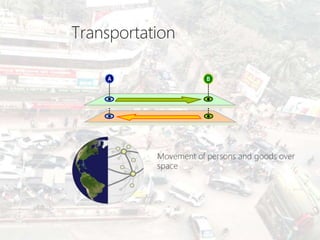
Transportation
Movement of persons and goods over
space
A B
5
Study of Traffic Engineering
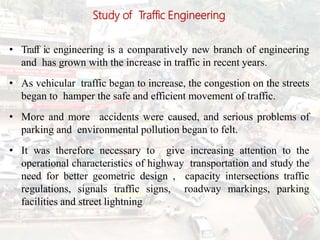
• Traff6ic engineering is a comparatively new branch of engineering
and has grown with the increase in traffic in recent years.
• As vehicular traffic began to increase, the congestion on the streets
began to hamper the safe and efficient movement of traffic.
• More and more accidents were caused, and serious problems of
parking and environmental pollution began to felt.
• It was therefore necessary to give increasing attention to the
operational characteristics of highway transportation and study the
need for better geometric design , capacity intersections traffic
regulations, signals traffic signs, roadway markings, parking
facilities and street lightning.
Introduction to Traffic Engineering
Traff7ic Engineering
Traffic engineering is that branch of engineering which deals with
planning and geometric design of streets, highway, and operating
traffic systems to achieve safe, economical, convenient and efficient
movement of persons and goods.
Object of Traffic Engineering:
The basic object of traffic engineering is to achieve efficient, free and
rapid flow of traffic with least number of traffic accident.
Factors affecting Traffic:
The Road user
The Vehicle
The Roadway
The environment
Drivers of various types of vehicles and pedestrians are
known as road user.
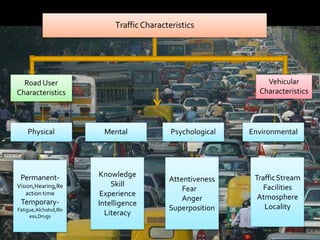
TrafficCharacteristics
Road User
Characteristics
Vehicular
Characteristics
Permanent-
Vision,Hearing,Re
action time
Temporary-
Fatigue,Alchohol,Illn
ess,Drugs
TrafficStream
Facilities
Atmosphere
Locality
Physical Mental Psychological Environmental
Attentiveness
Fear
Anger
Superposition
Knowledge
Skill
Experience
Intelligence
Literacy
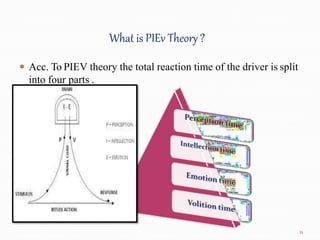
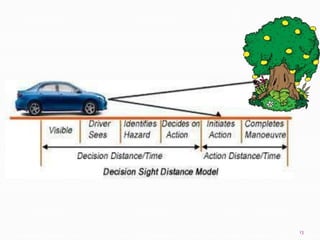
What is PIEv Theory?
 Acc. To PIEV theory the total reaction time of the driver is split
into four parts .
11
1) Perception time :
It is the time required for the sensations received by the
eyes or ears to be transmitted to the brain through the
nervous system .
2) Intellection time :
 It is the time required for understanding the situation.
12
13
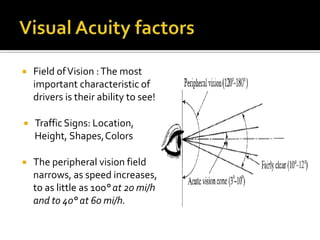
 Field ofVision :The most
important characteristic of
drivers is their ability to see!
 Traffic Signs: Location,
Height, Shapes,Colors
 The peripheral vision field
narrows, as speed increases,
to as little as 100° at 20 mi/h
and to 40° at 60 mi/h.
3) Emotion time :
 it is time elapsed during emotional sensations & Disturbance
such as fear , anger ,etc. with reference to the situation .
4) Volition time :
 volition time is the time taken for the final action.
 Total reaction timeof driver may bevary from 0.5 sec to 4
BITS Edu Campus Prof. Ankitpatel 15
sec
Where,
Lag distance = v * t
v = speed of vehicle in m/s
t = total reaction time (s) [ as per IRC t = 2.5 s ]
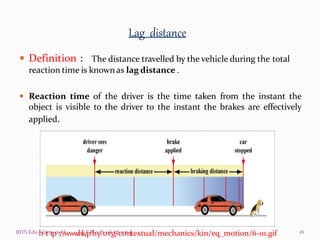
Lag distance
 Definition : The distance travelled by the vehicle during the total
reaction time is known as lag distance .
 Reaction time of the driver is the time taken from the instant the
object is visible to the driver to the instant the brakes are effectively
applied.
16BITS Edu hCatmtppu:/s/www.hk/pPrhoyf..Aonrkgit/pcaotenltextual/mechanics/kin/eq_motion/6-01.gif
 Perception-ReactionTime :The second critical driver characteristic is
perception-reaction time (PRT).
 Detection. In this phase, an object or condition of concern enters the
driver’s field of vision, and the driver becomes consciously aware that
something requiring a response is present.(Perception=VisionAwareness)
 Identification. In this phase, the driver acquires sufficient information
concerning the object or condition to allow the consideration of an
appropriate response.(Intellection- Interpretation)
 Decision.Once identification of the object or condition is sufficiently
completed, the driver must analyze the information and make a decision
about how to respond.
 Response. After a decision has been reached, the response isnow
physically implemented by the driver.(Volition= physical response)
 d = 0.278S.t
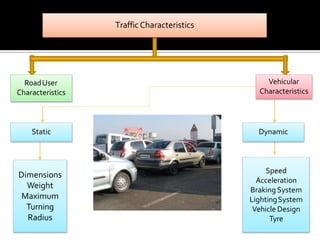
TrafficCharacteristics
RoadUser
Characteristics
Vehicular
Characteristics
Dimensions
Weight
Maximum
Turning
Radius
Speed
Acceleration
BrakingSystem
LightingSystem
Vehicle Design
Tyre
Static Dynamic
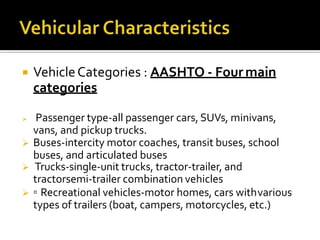
 VehicleCategories : AASHTO - Fourmain
categories
 Passenger type-all passenger cars, SUVs, minivans,
vans, and pickup trucks.
 Buses-intercity motor coaches, transit buses, school
buses, and articulated buses
 Trucks-single-unit trucks, tractor-trailer, and
tractorsemi-trailer combination vehicles
 ▫ Recreational vehicles-motor homes, cars withvarious
types of trailers (boat, campers, motorcycles, etc.)
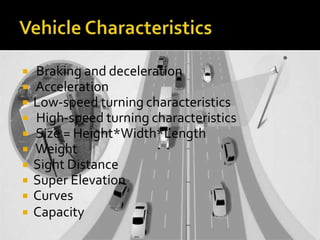
 Braking and deceleration
 Acceleration
 Low-speed turning characteristics
 High-speed turning characteristics
 Size = Height*Width*Length
 Weight
 Sight Distance
 Super Elevation
 Curves
 Capacity
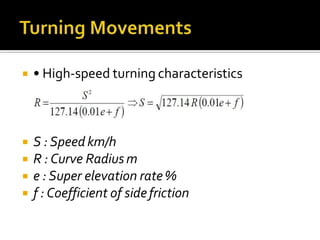
 • High-speed turning characteristics
 S : Speed km/h
 R : Curve Radiusm
 e : Super elevation rate%
 f : Coefficient of sidefriction
 Braking and deceleration
 Acceleration
 Low-speed turning characteristics
 High-speed turning characteristics
 Size = Height*Width*Length
 Weight
 Sight Distance
 Super Elevation
 Curves
 Capacity
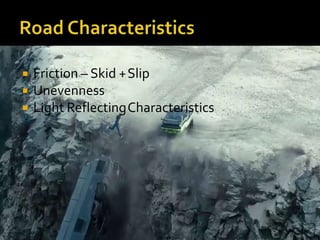
 Friction – Skid +Slip
 Unevenness
 Light ReflectingCharacteristics
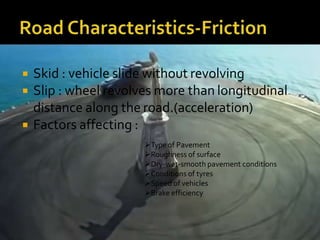
 Skid : vehicle slide without revolving
 Slip : wheel revolves more than longitudinal
distance along the road.(acceleration)
 Factors affecting :
Type of Pavement
Roughness of surface
Dry-wet-smooth pavement conditions
Conditions of tyres
Speed of vehicles
Brake efficiency
Chapter 1 traffic characteristics

Chapter 1 traffic characteristics

  • 1.
    Traffic Engineering Mr. BrijeshRaychanda M.Tech (Structure Design)
  • 2.
     What isTrafficEngineering ?  Scope of traffic Engineering  Traffic SystemComponents  TrafficCharacteristics – Road UserCharacteristics Vehicular Characteristics RoadCharacteristics
  • 3.
     TrafficCharacteristics  Trafficstudies & analysis  Traffic operation – control  Planning &Analysis  Geometric Design  Administration & Management
  • 4.
  • 5.
    Transportation System Definition ofTransportation Modes  A transportation system is an infrastructure that serves to move people and goods efficiently.  Efficient = safe, rapid, comfortable, convenient, economical, environmentally compatible. 3
  • 6.
    Transportation System Major transportationsubsystems  Land transportation: highway, rail  Air transportation: domestic, international  Water transportation: inland, coastal, ocean  Pipelines: oil, gas, other 4
  • 7.
    Transportation Movement of personsand goods over space A B 5
  • 8.
    Study of TrafficEngineering • Traff6ic engineering is a comparatively new branch of engineering and has grown with the increase in traffic in recent years. • As vehicular traffic began to increase, the congestion on the streets began to hamper the safe and efficient movement of traffic. • More and more accidents were caused, and serious problems of parking and environmental pollution began to felt. • It was therefore necessary to give increasing attention to the operational characteristics of highway transportation and study the need for better geometric design , capacity intersections traffic regulations, signals traffic signs, roadway markings, parking facilities and street lightning.
  • 9.
    Introduction to TrafficEngineering Traff7ic Engineering Traffic engineering is that branch of engineering which deals with planning and geometric design of streets, highway, and operating traffic systems to achieve safe, economical, convenient and efficient movement of persons and goods. Object of Traffic Engineering: The basic object of traffic engineering is to achieve efficient, free and rapid flow of traffic with least number of traffic accident. Factors affecting Traffic: The Road user The Vehicle The Roadway The environment Drivers of various types of vehicles and pedestrians are known as road user.
  • 10.
  • 11.
    What is PIEvTheory?  Acc. To PIEV theory the total reaction time of the driver is split into four parts . 11
  • 12.
    1) Perception time: It is the time required for the sensations received by the eyes or ears to be transmitted to the brain through the nervous system . 2) Intellection time :  It is the time required for understanding the situation. 12
  • 13.
  • 14.
     Field ofVision:The most important characteristic of drivers is their ability to see!  Traffic Signs: Location, Height, Shapes,Colors  The peripheral vision field narrows, as speed increases, to as little as 100° at 20 mi/h and to 40° at 60 mi/h.
  • 15.
    3) Emotion time:  it is time elapsed during emotional sensations & Disturbance such as fear , anger ,etc. with reference to the situation . 4) Volition time :  volition time is the time taken for the final action.  Total reaction timeof driver may bevary from 0.5 sec to 4 BITS Edu Campus Prof. Ankitpatel 15 sec Where, Lag distance = v * t v = speed of vehicle in m/s t = total reaction time (s) [ as per IRC t = 2.5 s ]
  • 16.
    Lag distance  Definition: The distance travelled by the vehicle during the total reaction time is known as lag distance .  Reaction time of the driver is the time taken from the instant the object is visible to the driver to the instant the brakes are effectively applied. 16BITS Edu hCatmtppu:/s/www.hk/pPrhoyf..Aonrkgit/pcaotenltextual/mechanics/kin/eq_motion/6-01.gif
  • 17.
     Perception-ReactionTime :Thesecond critical driver characteristic is perception-reaction time (PRT).  Detection. In this phase, an object or condition of concern enters the driver’s field of vision, and the driver becomes consciously aware that something requiring a response is present.(Perception=VisionAwareness)  Identification. In this phase, the driver acquires sufficient information concerning the object or condition to allow the consideration of an appropriate response.(Intellection- Interpretation)  Decision.Once identification of the object or condition is sufficiently completed, the driver must analyze the information and make a decision about how to respond.  Response. After a decision has been reached, the response isnow physically implemented by the driver.(Volition= physical response)  d = 0.278S.t
  • 18.
  • 19.
     VehicleCategories :AASHTO - Fourmain categories  Passenger type-all passenger cars, SUVs, minivans, vans, and pickup trucks.  Buses-intercity motor coaches, transit buses, school buses, and articulated buses  Trucks-single-unit trucks, tractor-trailer, and tractorsemi-trailer combination vehicles  ▫ Recreational vehicles-motor homes, cars withvarious types of trailers (boat, campers, motorcycles, etc.)
  • 20.
     Braking anddeceleration  Acceleration  Low-speed turning characteristics  High-speed turning characteristics  Size = Height*Width*Length  Weight  Sight Distance  Super Elevation  Curves  Capacity
  • 21.
     • High-speedturning characteristics  S : Speed km/h  R : Curve Radiusm  e : Super elevation rate%  f : Coefficient of sidefriction
  • 22.
     Braking anddeceleration  Acceleration  Low-speed turning characteristics  High-speed turning characteristics  Size = Height*Width*Length  Weight  Sight Distance  Super Elevation  Curves  Capacity
  • 23.
     Friction –Skid +Slip  Unevenness  Light ReflectingCharacteristics
  • 24.
     Skid :vehicle slide without revolving  Slip : wheel revolves more than longitudinal distance along the road.(acceleration)  Factors affecting : Type of Pavement Roughness of surface Dry-wet-smooth pavement conditions Conditions of tyres Speed of vehicles Brake efficiency