10/23/2012
1
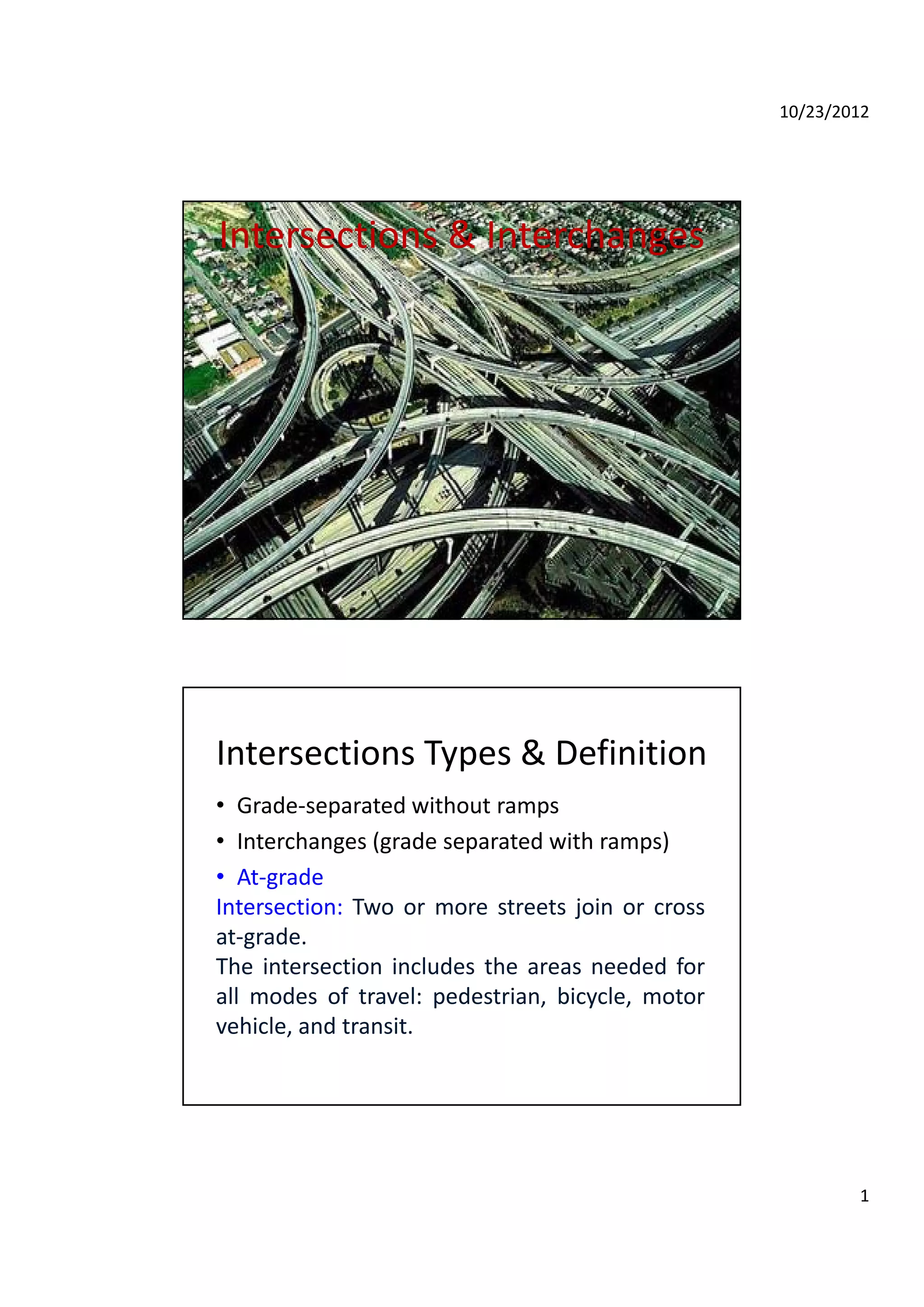
Intersections & Interchanges
Intersections Types & Definition
• Grade‐separated without ramps
• Interchanges (grade separated with ramps)
• At‐grade
Intersection: Two or more streets join or cross
at‐grade.
The intersection includes the areas needed forThe intersection includes the areas needed for
all modes of travel: pedestrian, bicycle, motor
vehicle, and transit.
10/23/2012
2
At‐grade intersections
• All highways have intersections at grade 
except freeways so that the intersection areaexcept freeways, so that the intersection area 
is a part of every connecting road or street.
• In this area, crossing and turning movements 
occur.
• Some intersection are channelized 
– minimize traffic accidents, speed control, 
prevention of prohibited turns, refuge may be 
provided for pedestrians.
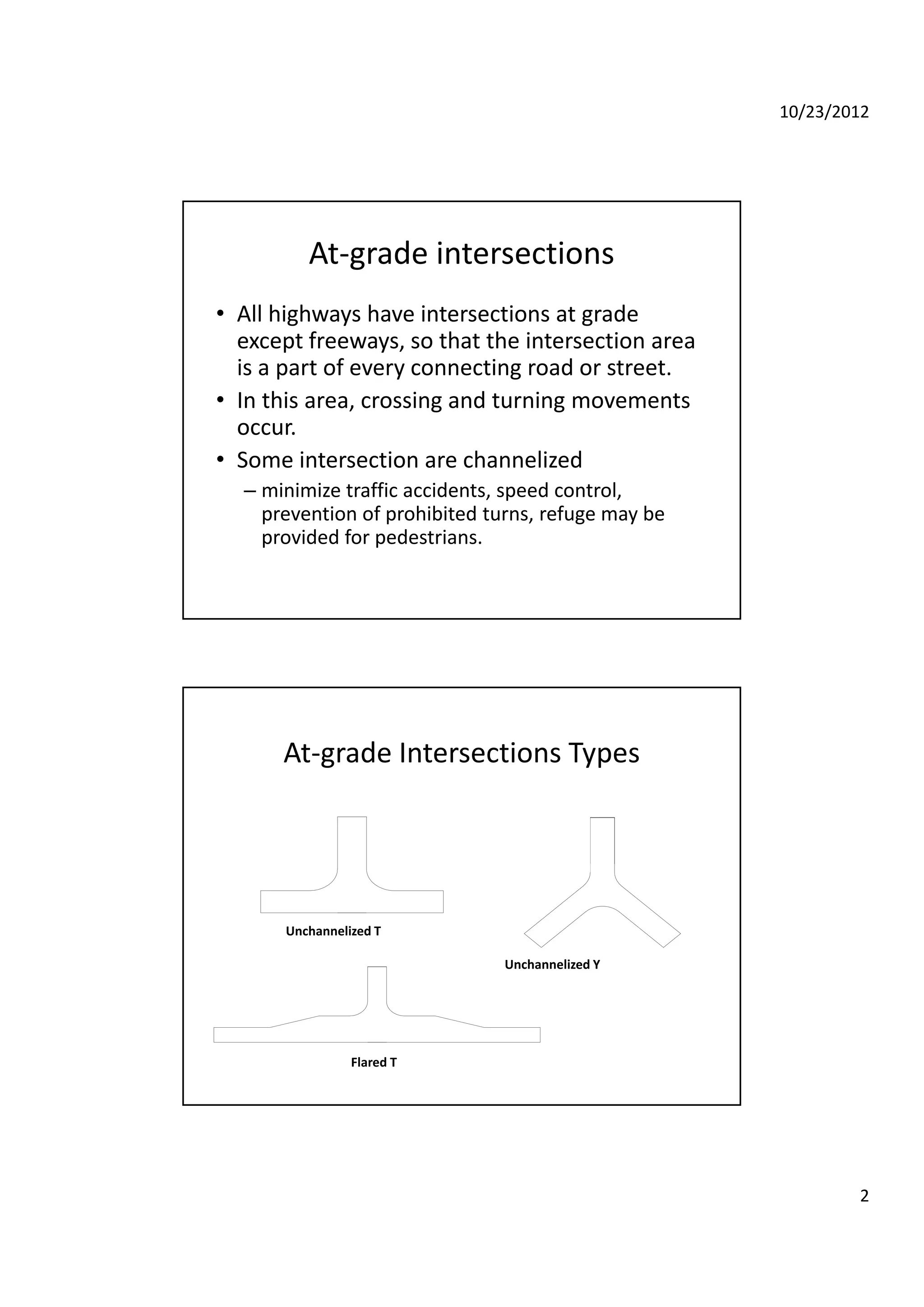
At‐grade Intersections Types
Unchannelized T
Unchannelized YUnchannelized Y
Flared T
10/23/2012
3
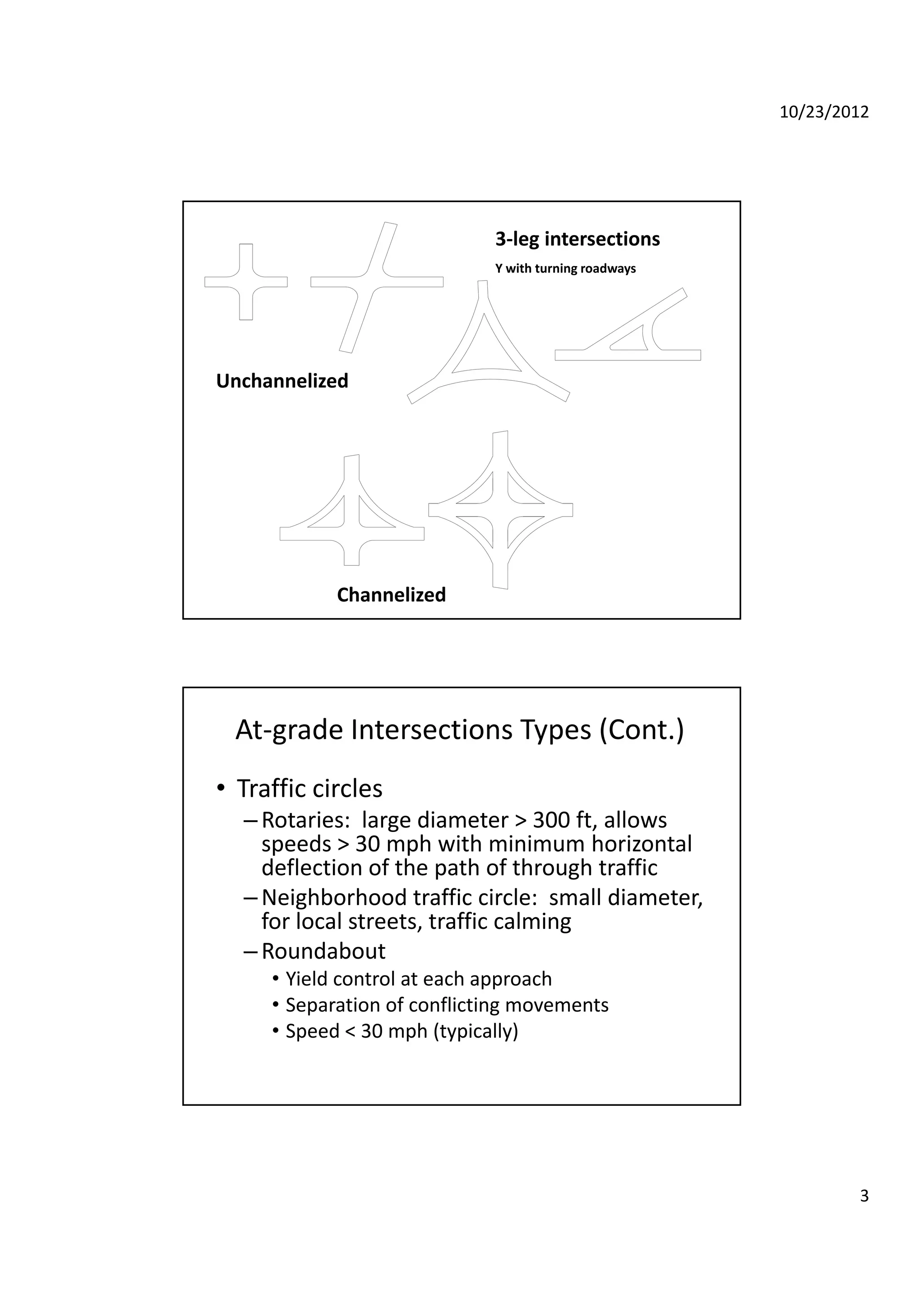
3‐leg intersections
Y with turning roadways
Unchannelized
Channelized
• Traffic circles
–Rotaries: large diameter > 300 ft, allows
At‐grade Intersections Types (Cont.)
Rotaries:  large diameter   300 ft, allows 
speeds > 30 mph with minimum horizontal 
deflection of the path of through traffic
–Neighborhood traffic circle:  small diameter, 
for local streets, traffic calming
–Roundabout
• Yield control at each approach
• Separation of conflicting movements
• Speed < 30 mph (typically)
10/23/2012
4
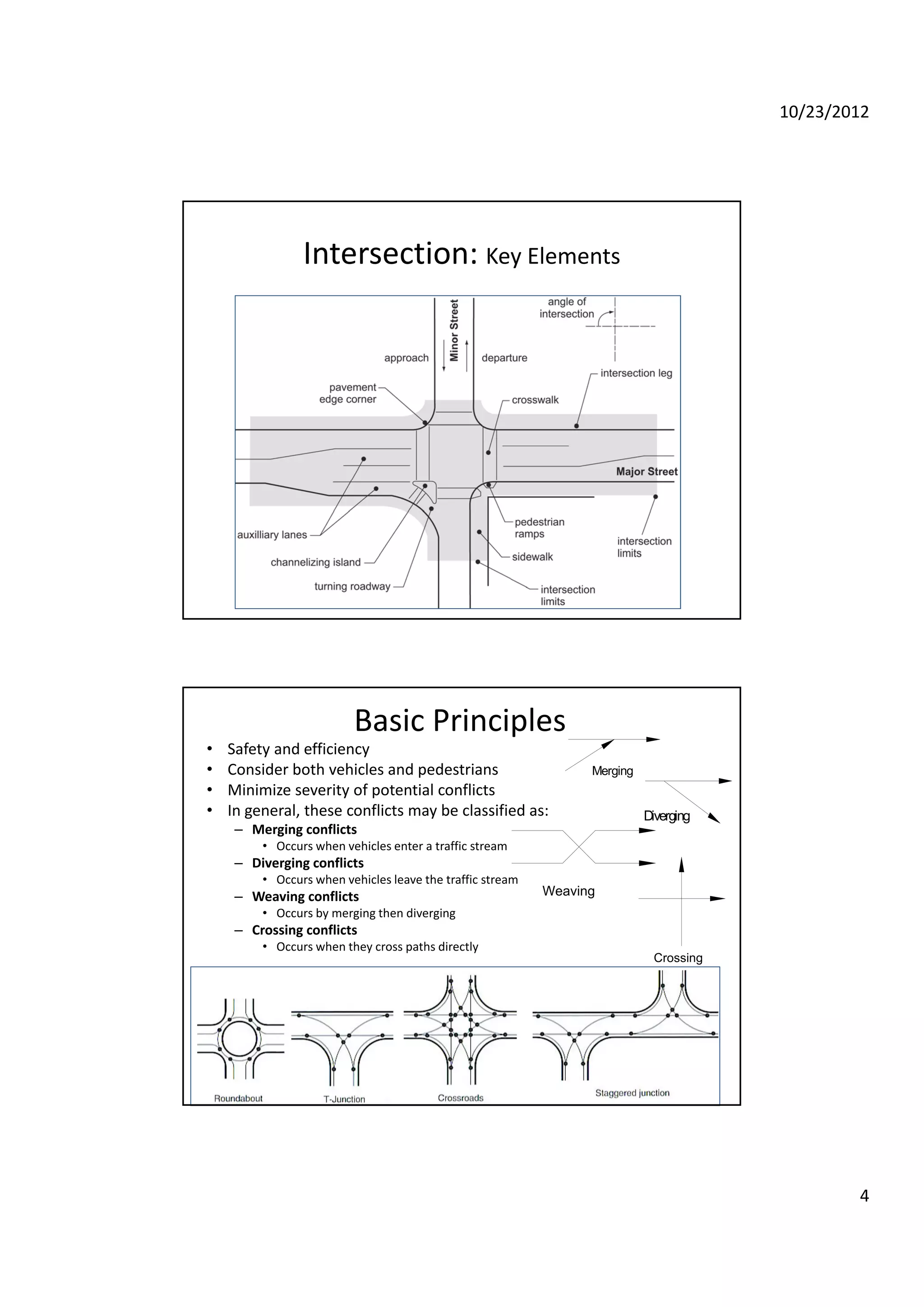
Intersection: Key Elements
• Safety and efficiency
• Consider both vehicles and pedestrians
• Minimize severity of potential conflicts
• In general, these conflicts may be classified as:
M i fli t
Merging
Diverging
Basic Principles
– Merging conflicts
• Occurs when vehicles enter a traffic stream
– Diverging conflicts
• Occurs when vehicles leave the traffic stream
– Weaving conflicts
• Occurs by merging then diverging
– Crossing conflicts
• Occurs when they cross paths directly
Weaving
Crossing
10/23/2012
5
Crossing Conflicts Solutions
• Time‐sharing
• Space‐sharing
• Grade separation (Interchanges)
INTERCHANGES
• Are classified according to the way they  
h dl l ft t i t ffihandle left‐turning traffic.
INTERCHANGE CONFIGURATION
‐ are selected on the basis of structural cost, 
right of way costs and ability to serve trafficright‐of‐way costs, and ability to serve traffic.
10/23/2012
6
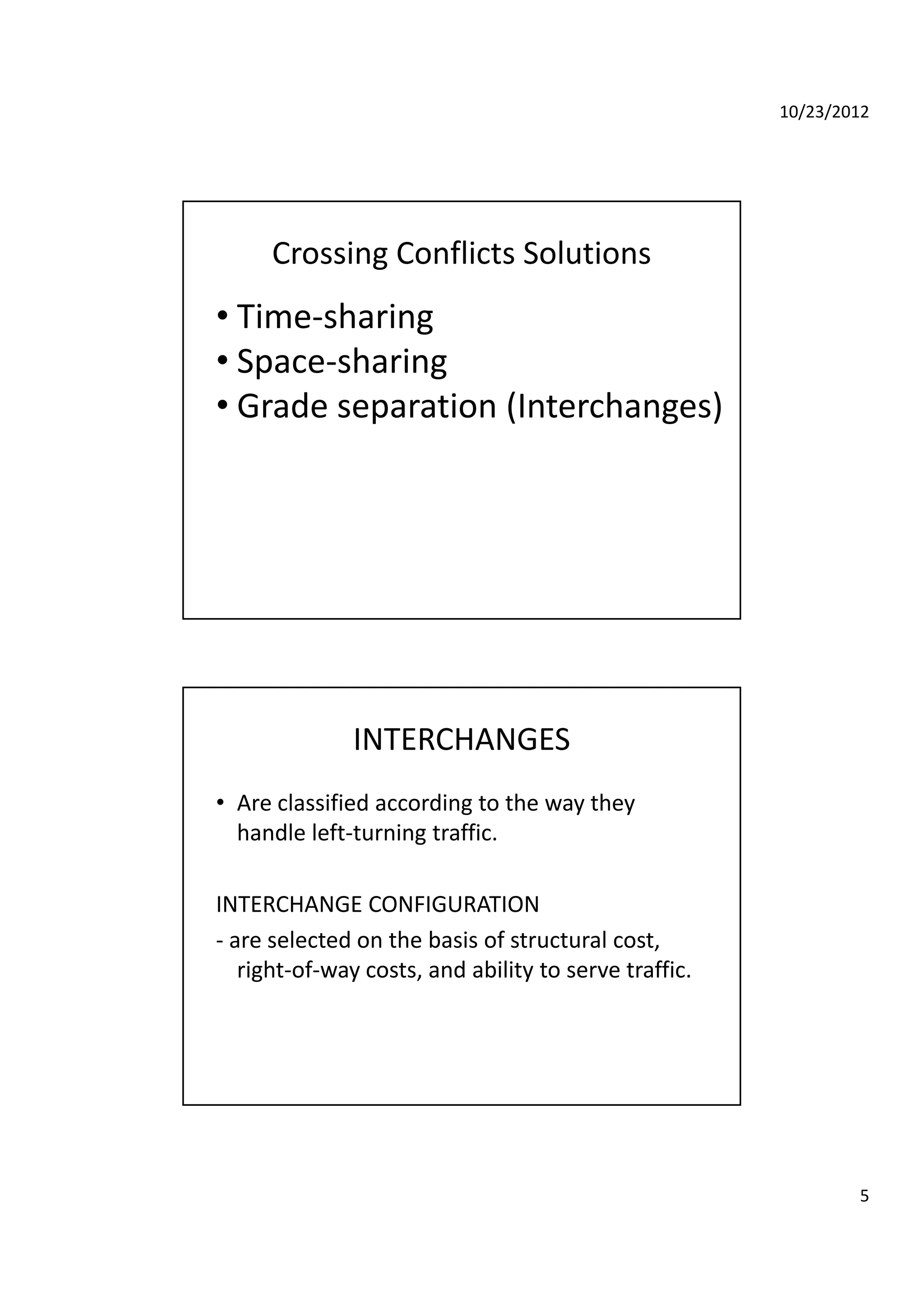
Diamond Interchange
Diamond Interchange
• Diamond Interchangeg
– Employ diamond ramps 
which connect to the cross 
road by means of an at 
grade intersection.
– Left turns are accomplished 
by having vehicles turn left 
across traffic on the cross 
road.road.
10/23/2012
7
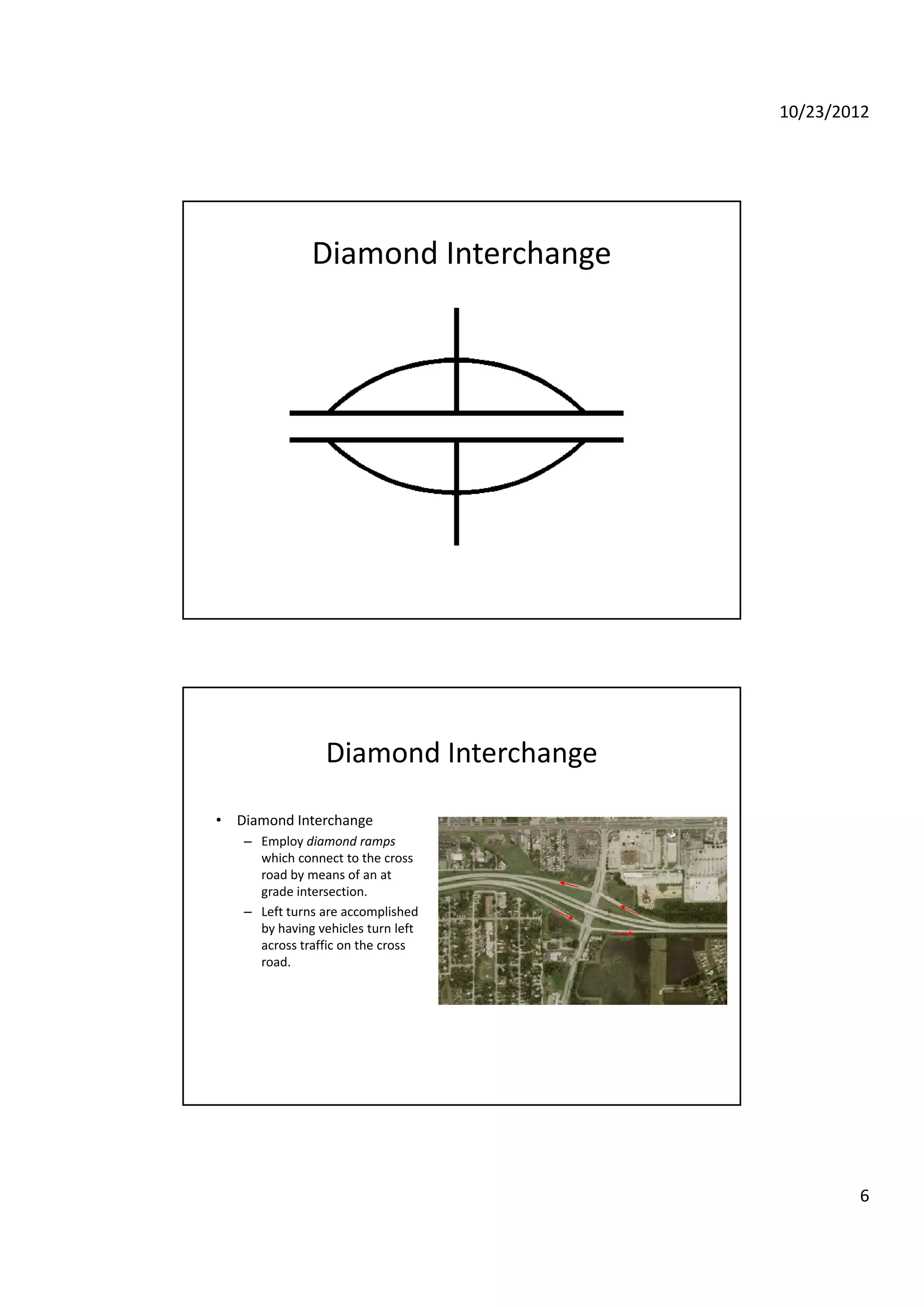
Cloverleaf Interchange
 Cloverleaf InterchangeCloverleaf Interchange Cloverleaf InterchangeCloverleaf Interchange
 Employ Employ loop rampsloop ramps, in , in 
which vehicles turn left which vehicles turn left 
by turning 270 degrees by turning 270 degrees 
to the right.to the right.
10/23/2012
8
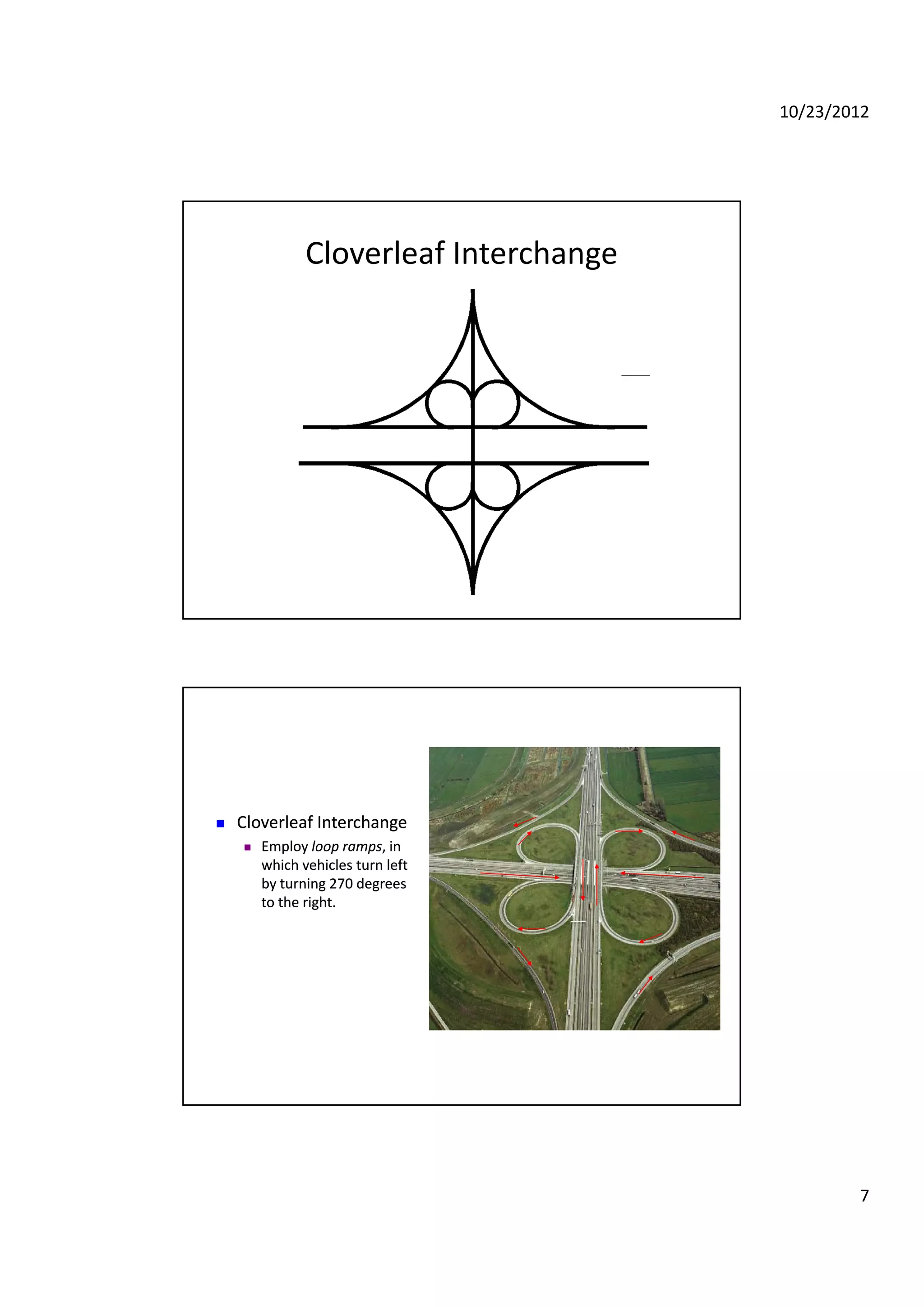
Partial cloverleaf
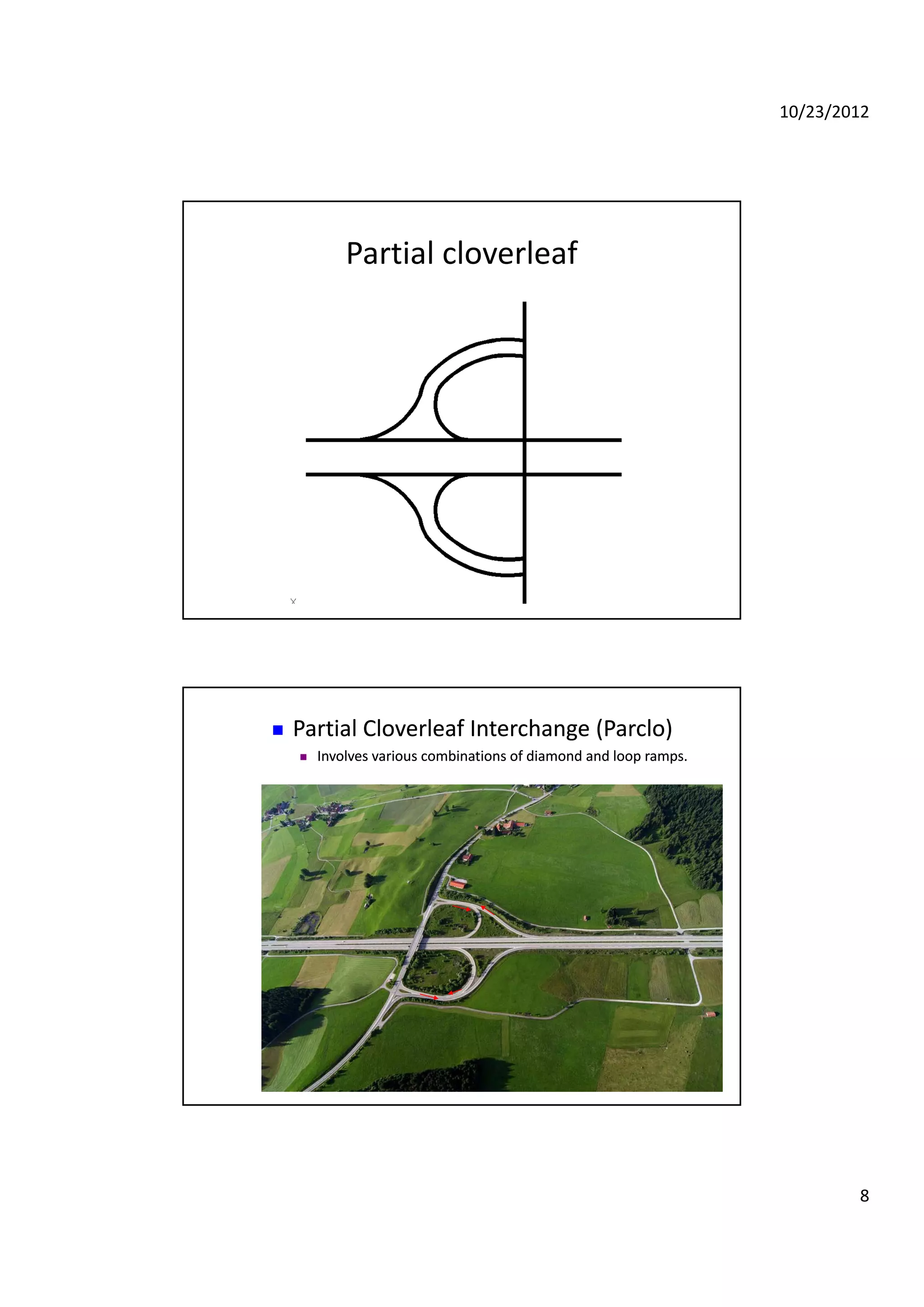
 Partial Cloverleaf Interchange (Partial Cloverleaf Interchange (ParcloParclo))
 Involves various combinations of diamond and loop ramps.Involves various combinations of diamond and loop ramps.
10/23/2012
9
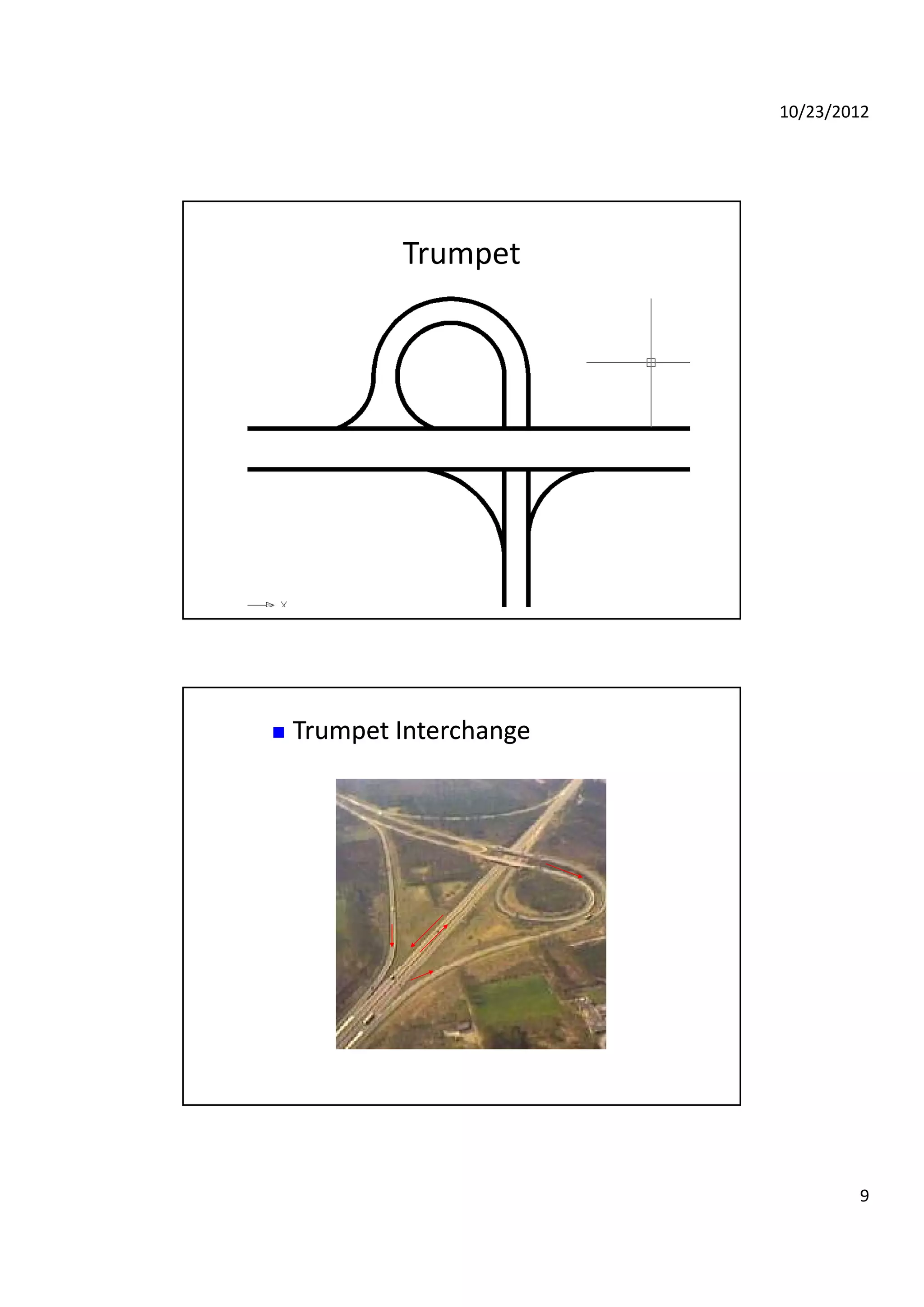
Trumpet
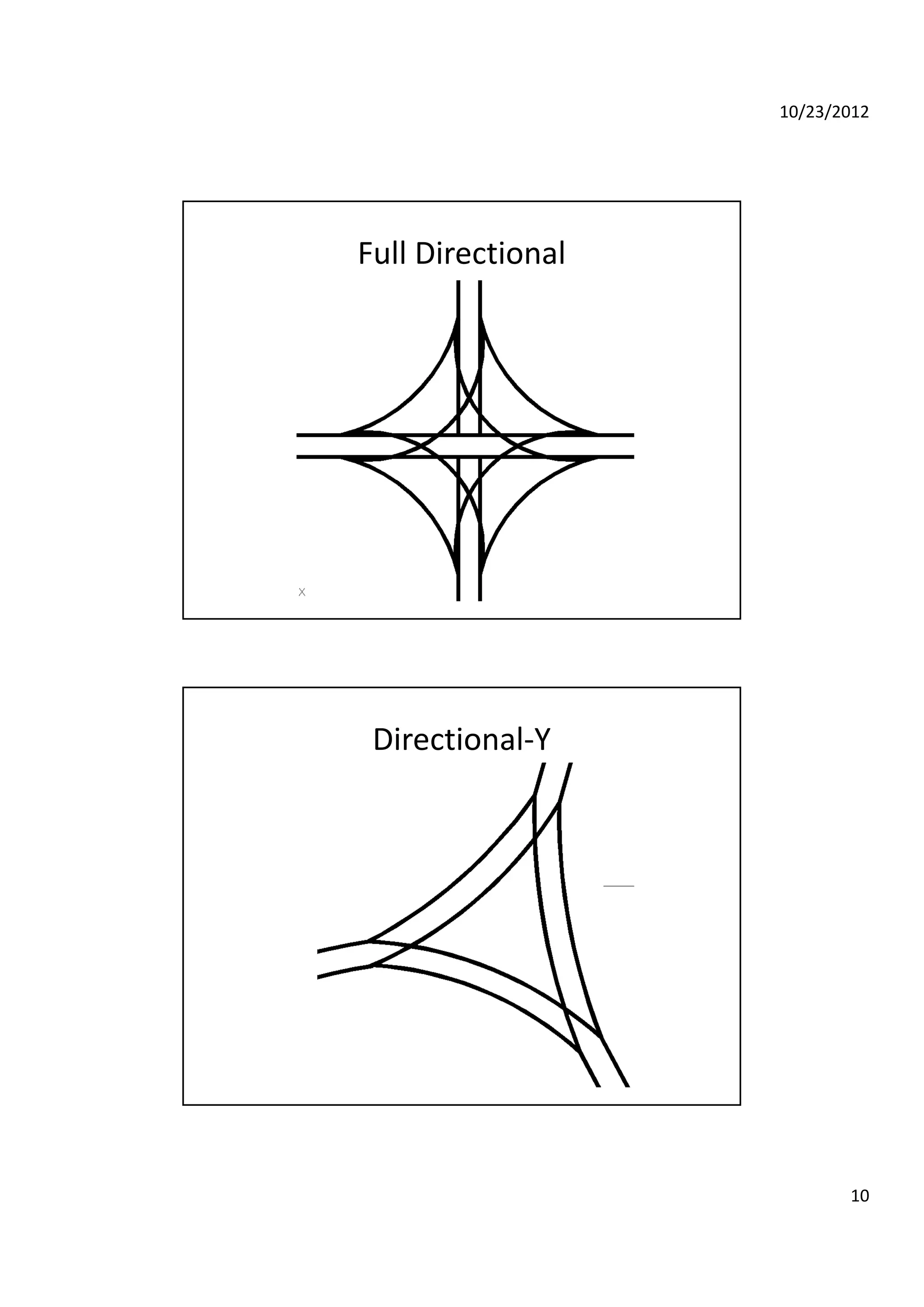
 Trumpet Interchange Trumpet Interchange 
10/23/2012
10
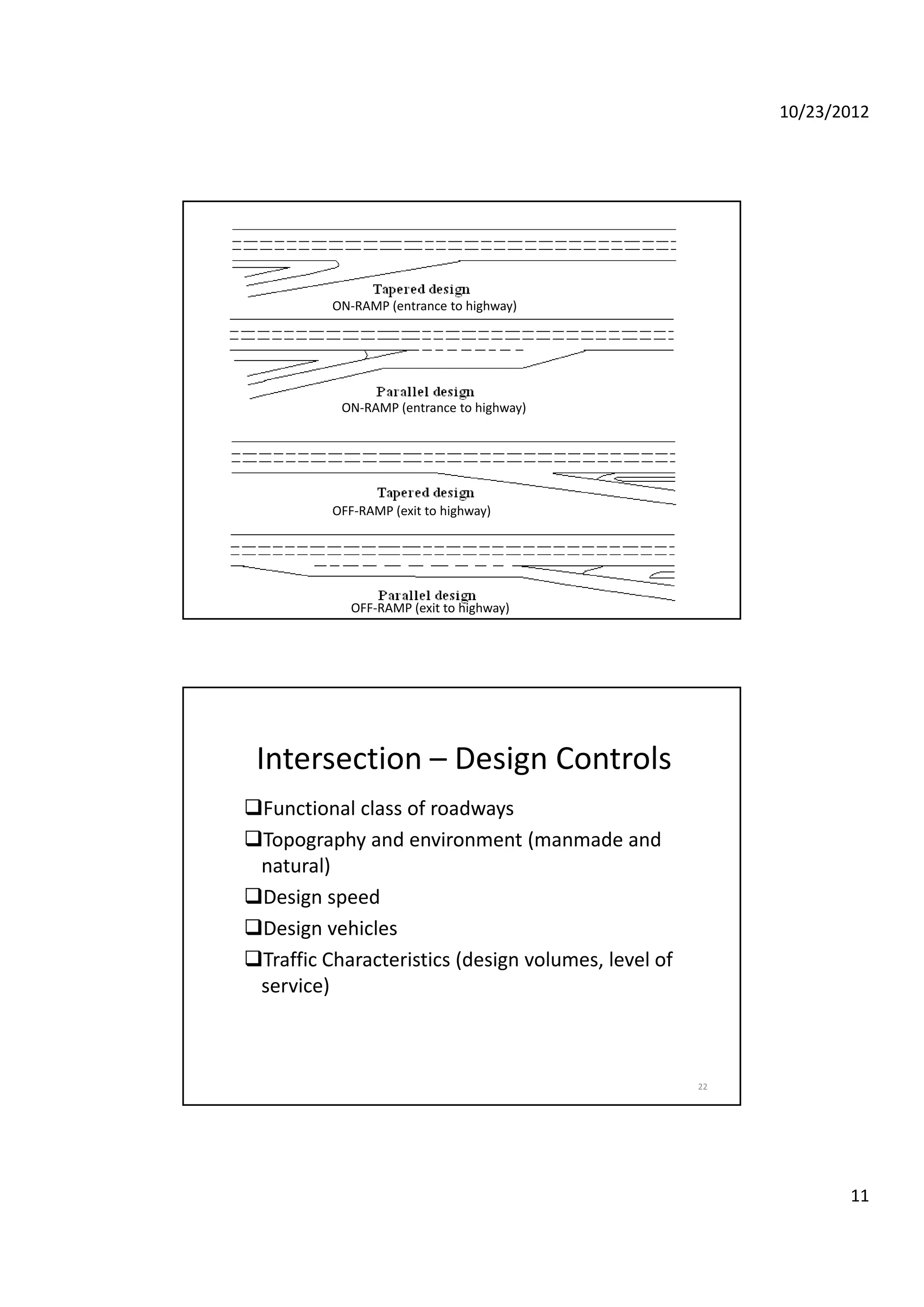
Full Directional
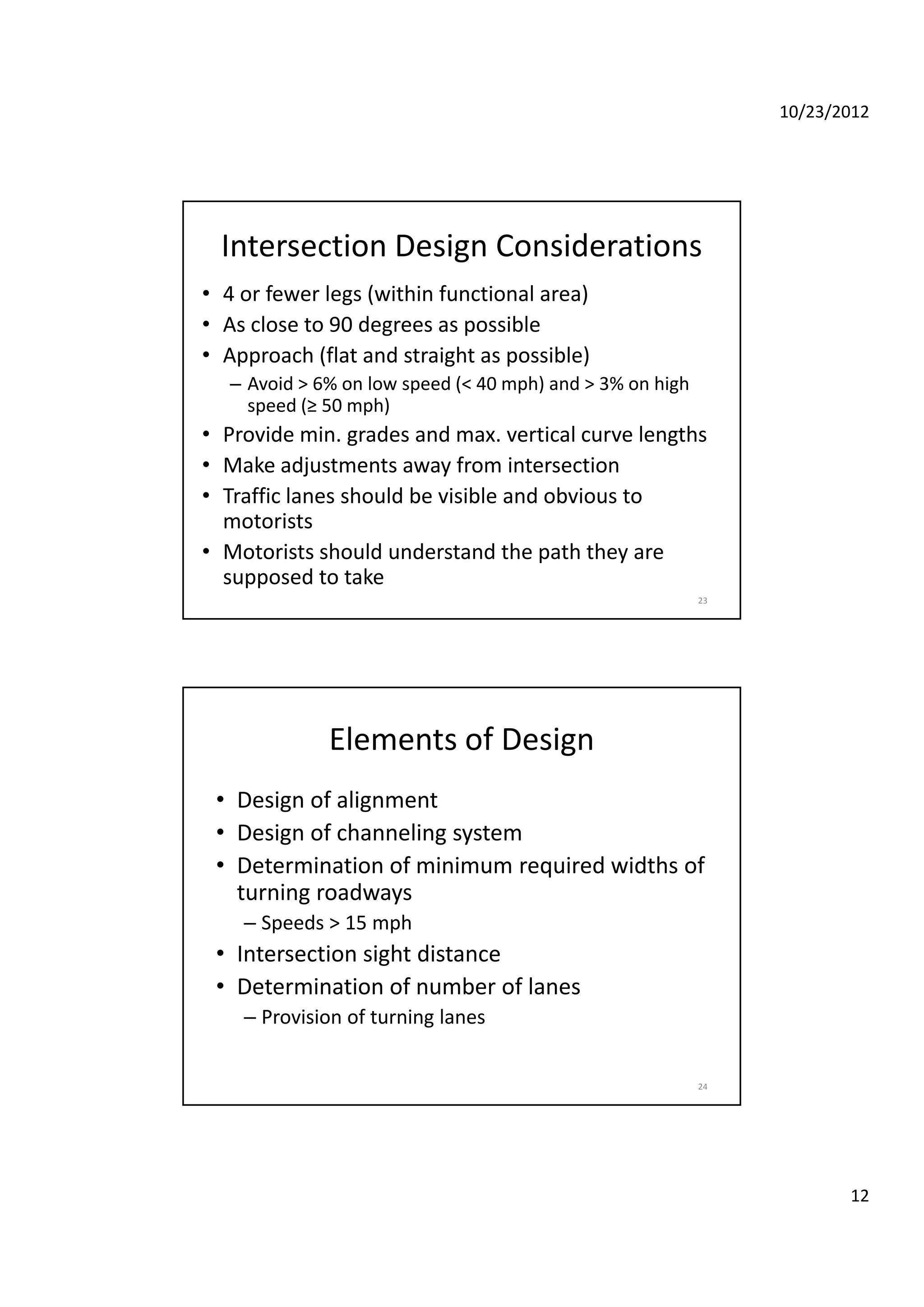
Directional‐Y
10/23/2012
11
ON‐RAMP (entrance to highway)
OFF‐RAMP (exit to highway)
Intersection – Design Controls
Functional class of roadways
Topography and environment (manmade and 
natural)
Design speed
Design vehicles
Traffic Characteristics (design volumes, level of
22
Traffic Characteristics (design volumes, level of 
service) 
10/23/2012
12
Intersection Design Considerations 
• 4 or fewer legs (within functional area)
• As close to 90 degrees as possible
• Approach (flat and straight as possible)
– Avoid > 6% on low speed (< 40 mph) and > 3% on high 
speed (≥ 50 mph)
• Provide min. grades and max. vertical curve lengths
• Make adjustments away from intersection
23
• Traffic lanes should be visible and obvious to 
motorists
• Motorists should understand the path they are 
supposed to take 
Elements of Design 
• Design of alignment
D i f h li t• Design of channeling system
• Determination of minimum required widths of 
turning roadways 
– Speeds > 15 mph
• Intersection sight distance
24
• Determination of number of lanes 
– Provision of turning lanes
10/23/2012
13
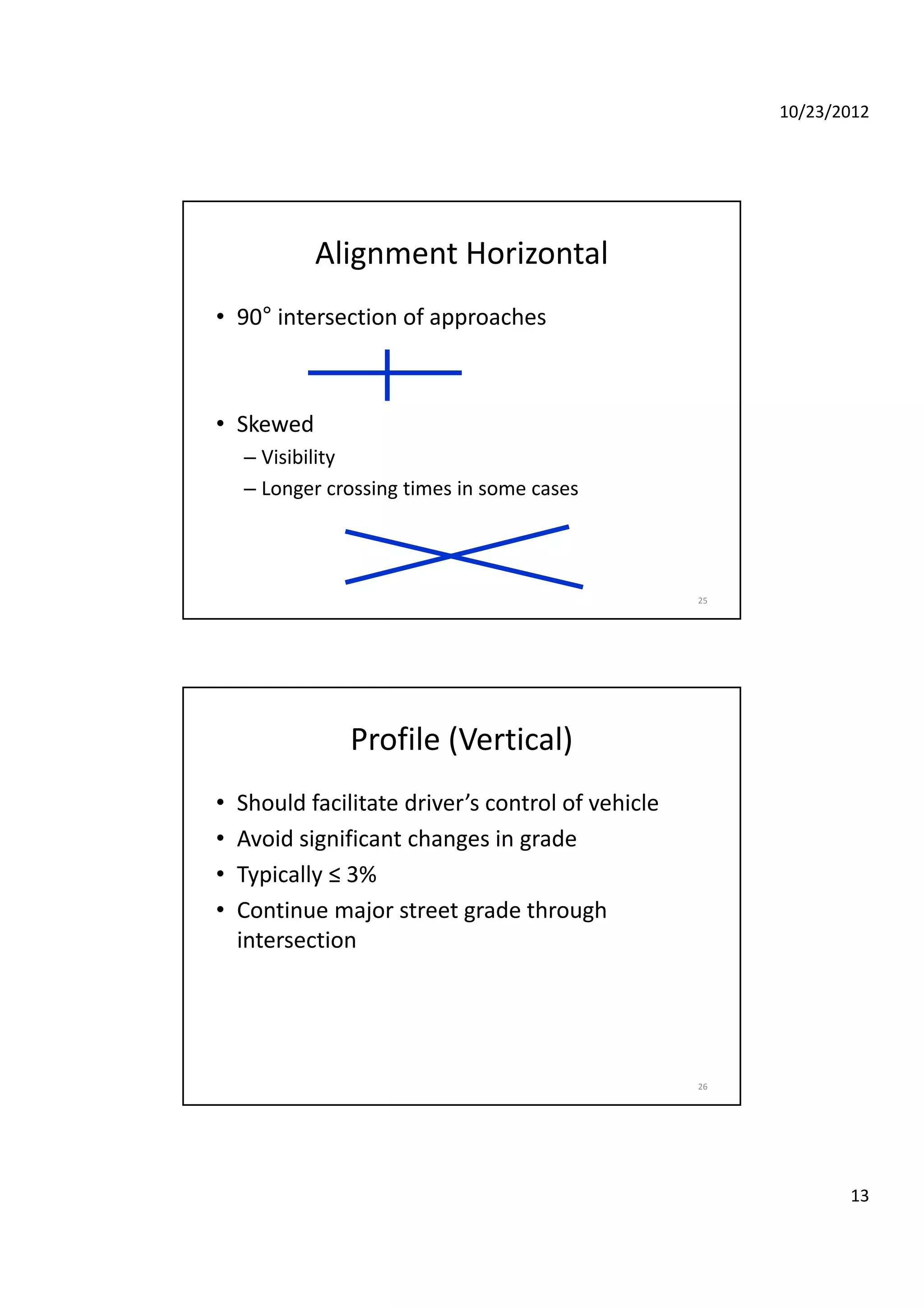
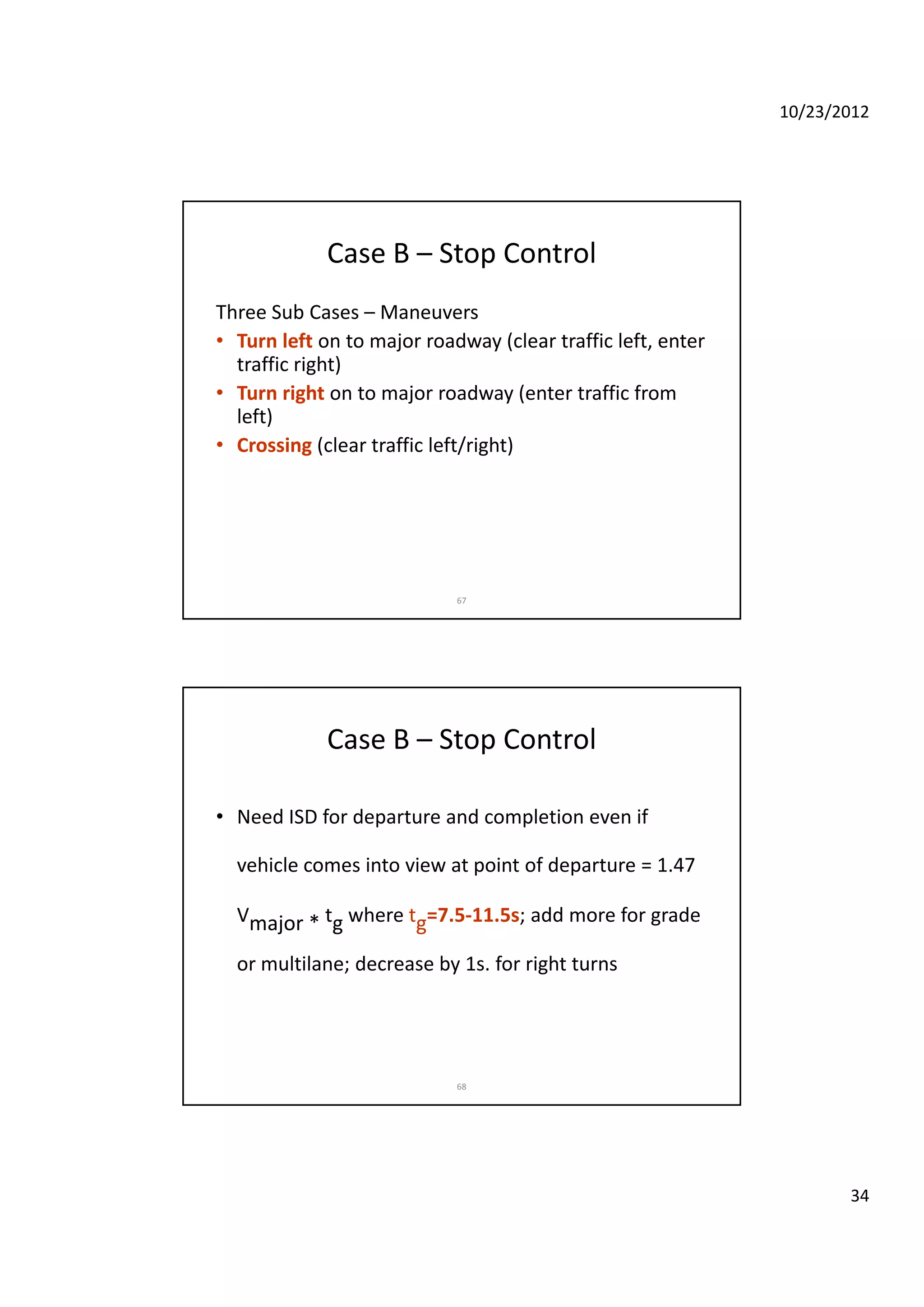
Alignment Horizontal
• 90° intersection of approaches
• Skewed
– Visibility
25
– Longer crossing times in some cases
Profile (Vertical)
• Should facilitate driver’s control of vehicle
• Avoid significant changes in grade
• Typically ≤ 3%
• Continue major street grade through 
intersection
26
10/23/2012
14
Curb Radius Design
• Factors:
– Design vehicle
– Intersection angle
– Approach width and parking
– Channelization
27
– Pedestrians
– Allowable speed reduction
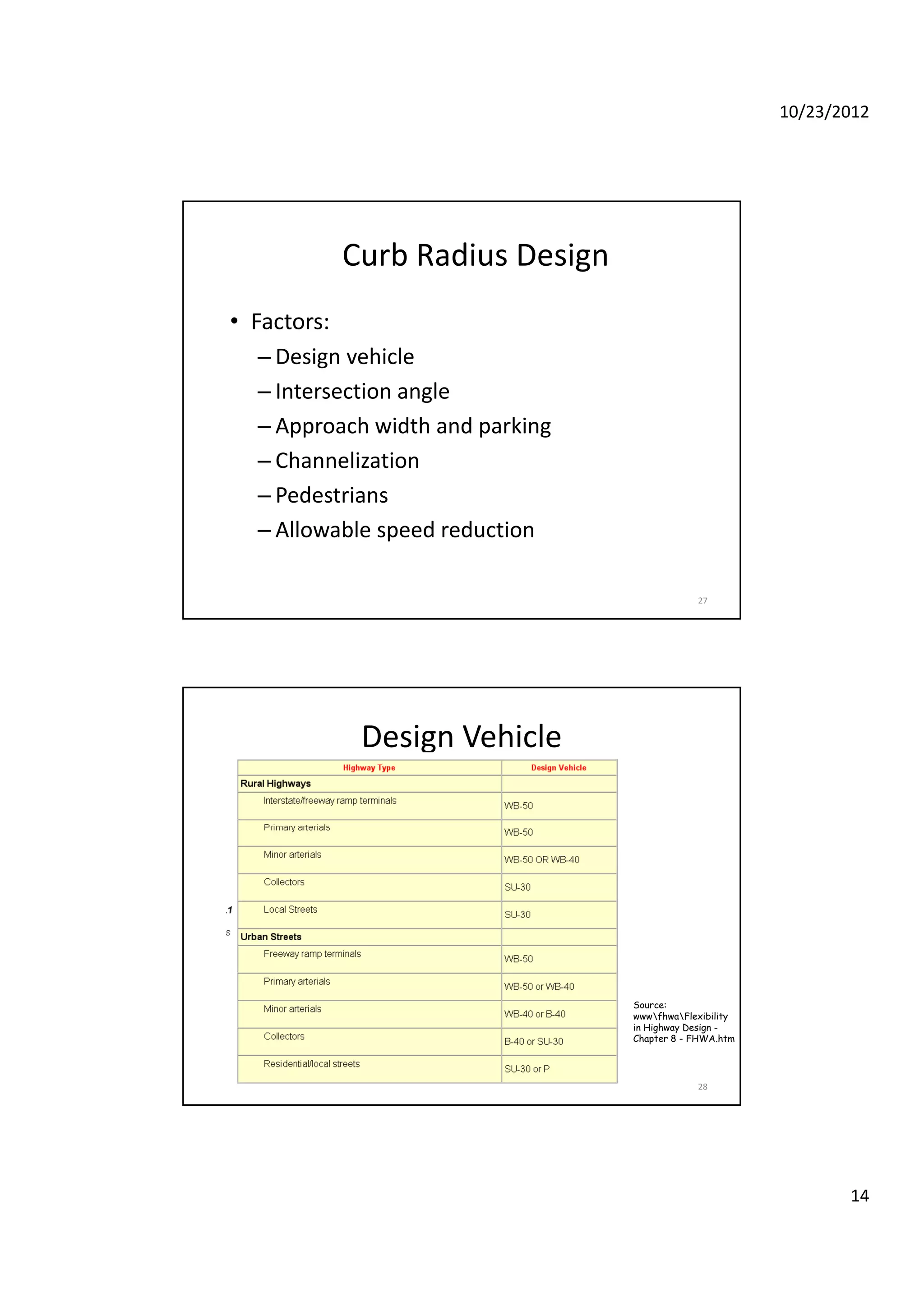
Design Vehicle
28
Source:
wwwfhwaFlexibility
in Highway Design -
Chapter 8 - FHWA.htm
10/23/2012
15
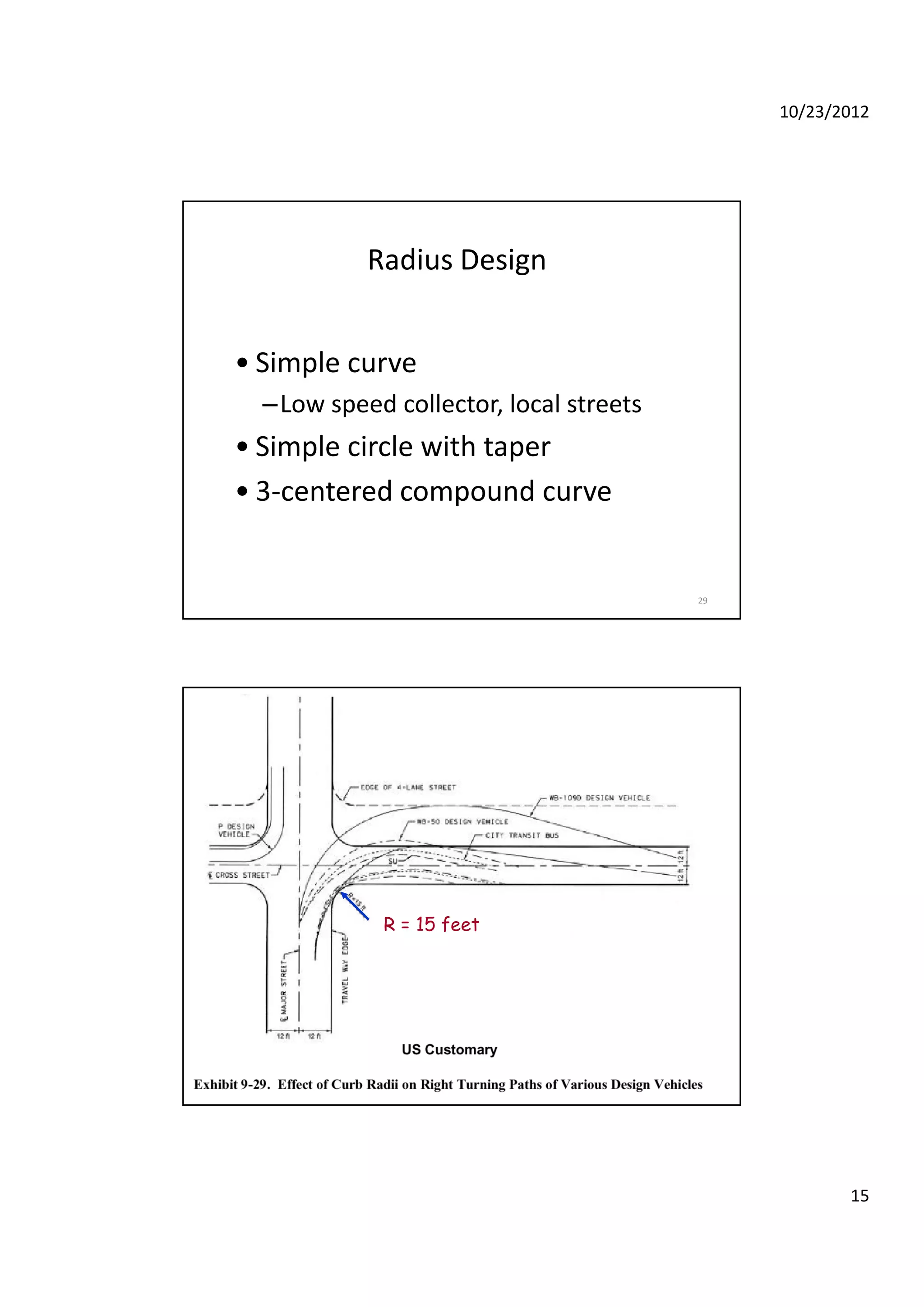
Radius Design
• Simple curve
–Low speed collector, local streets
• Simple circle with taper
d d
29
• 3‐centered compound curve
Minimize lane encroachment
R = 15 feet
30
10/23/2012
16
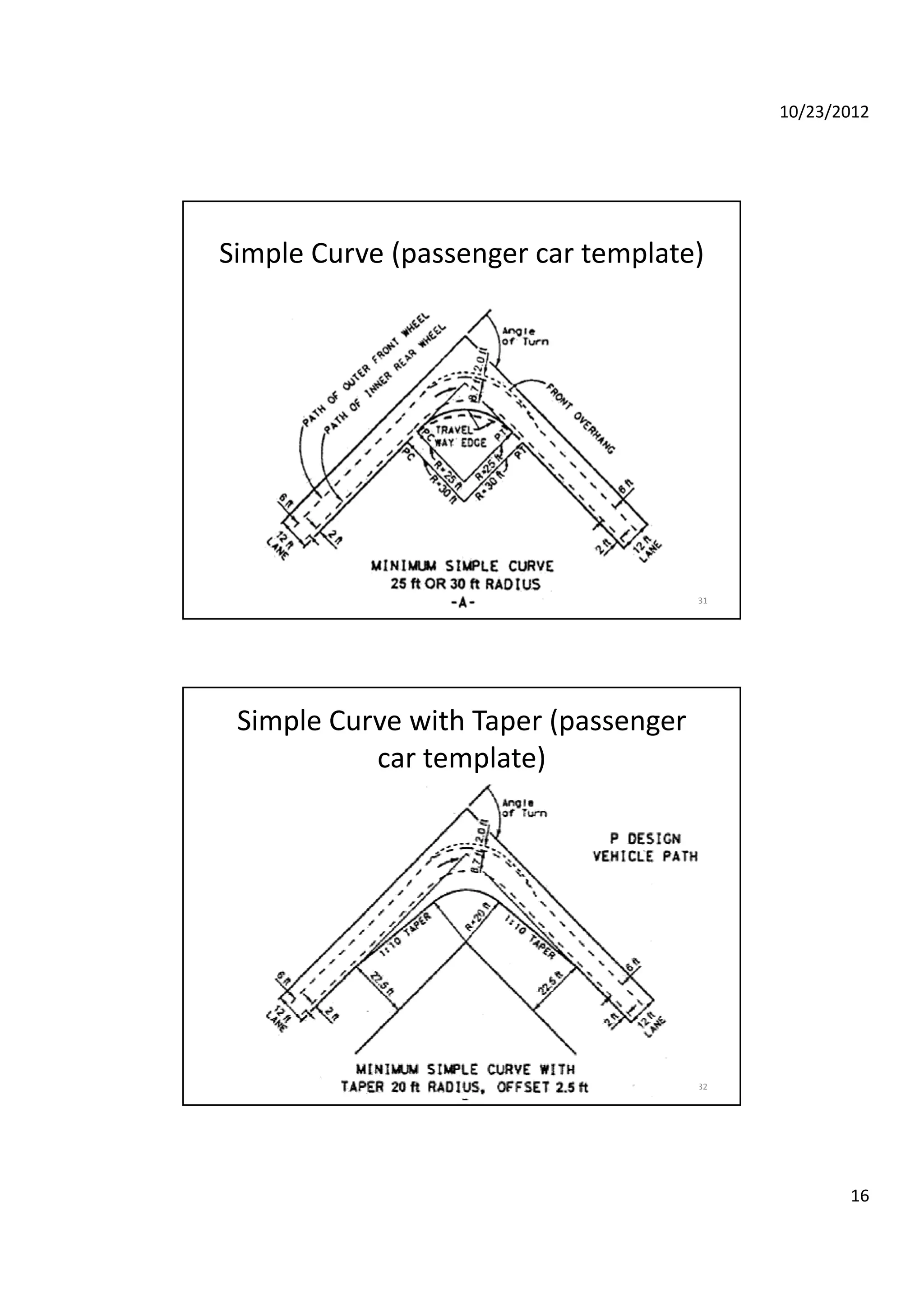
Simple Curve (passenger car template)
31
Simple Curve with Taper (passenger 
car template)
32
10/23/2012
17
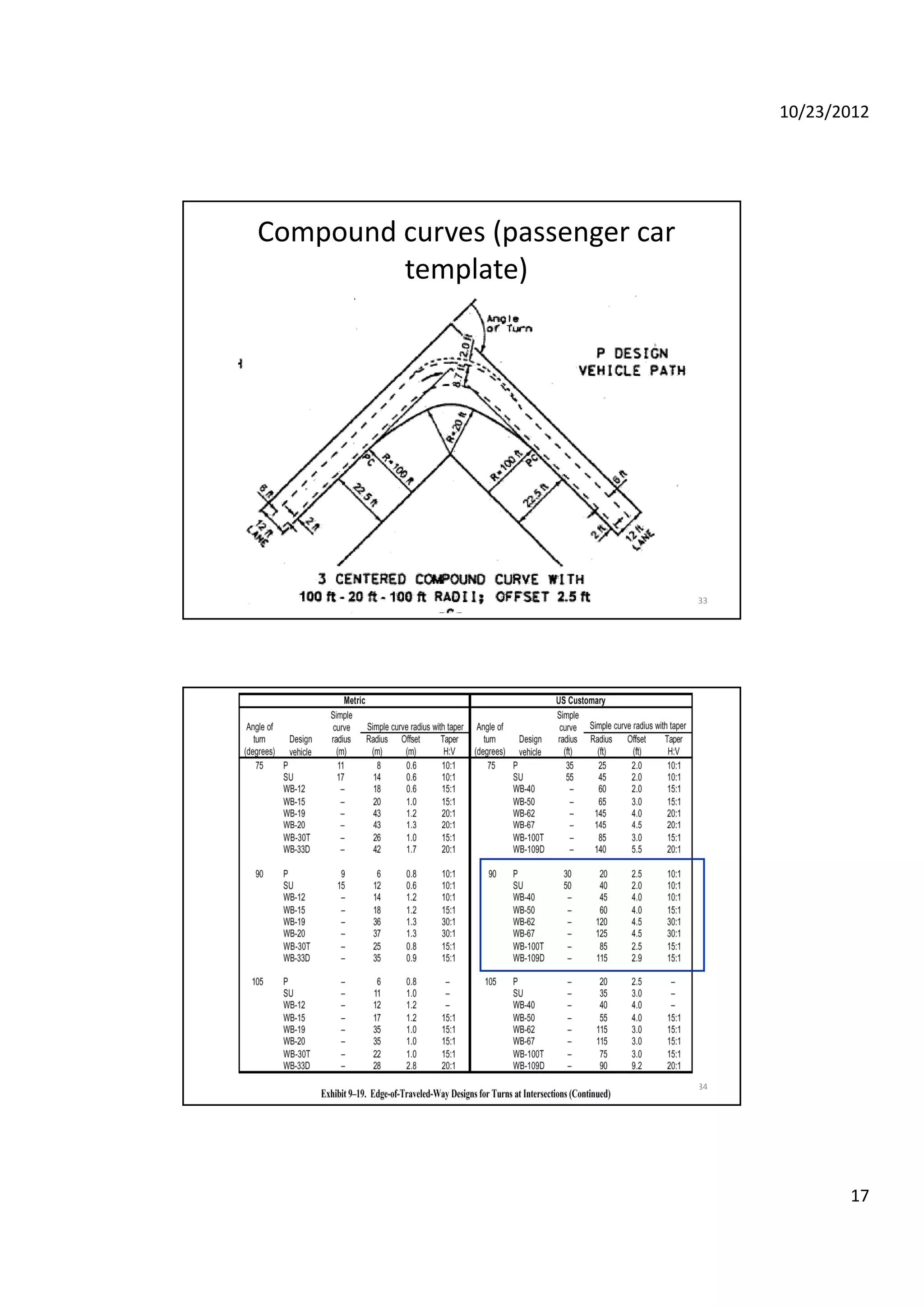
Compound curves (passenger car 
template)
33
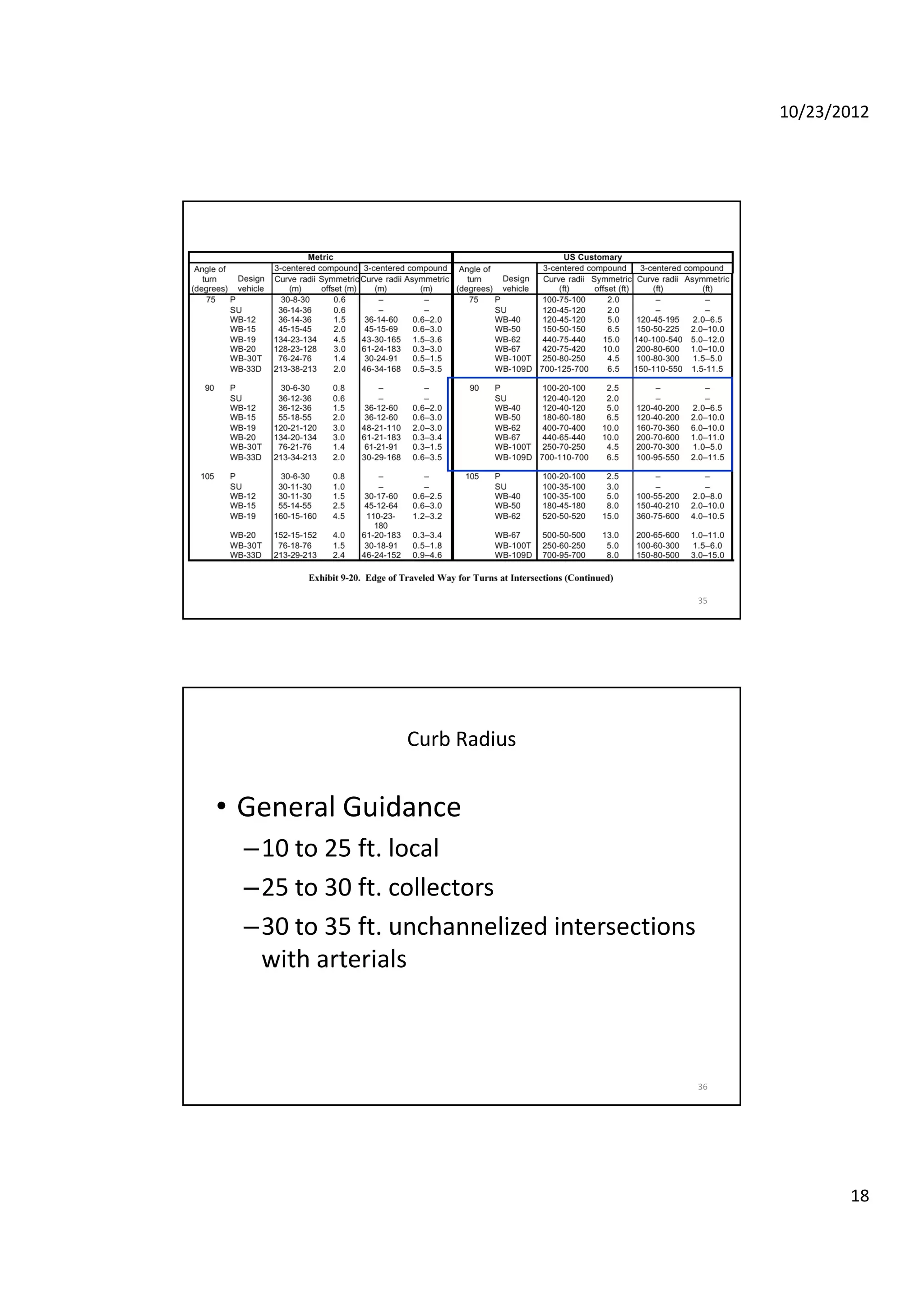
34
10/23/2012
18
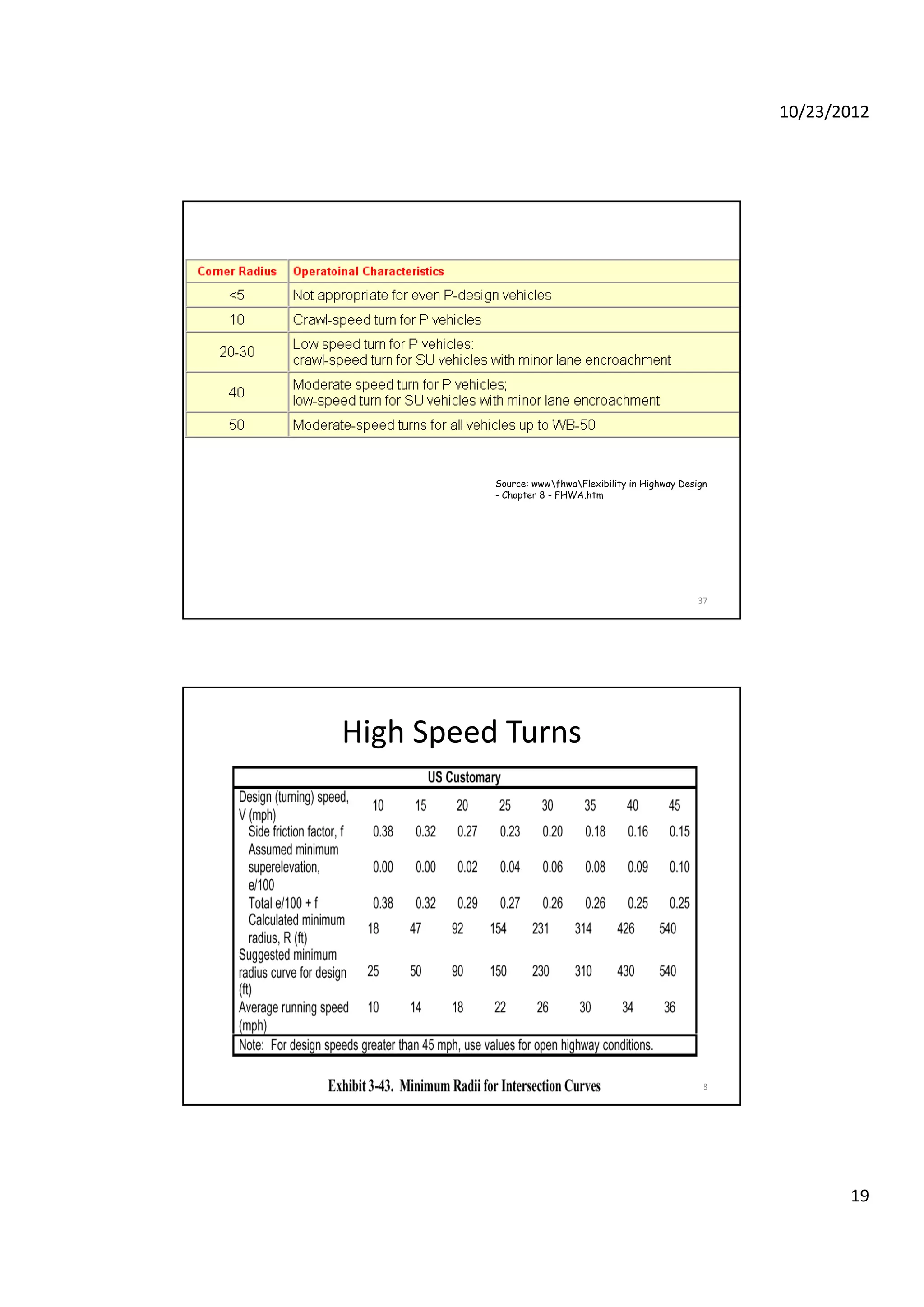
35
Curb Radius
• General Guidance
–10 to 25 ft. local
–25 to 30 ft. collectors
–30 to 35 ft. unchannelized intersections 
with arterials
36
with arterials
10/23/2012
19
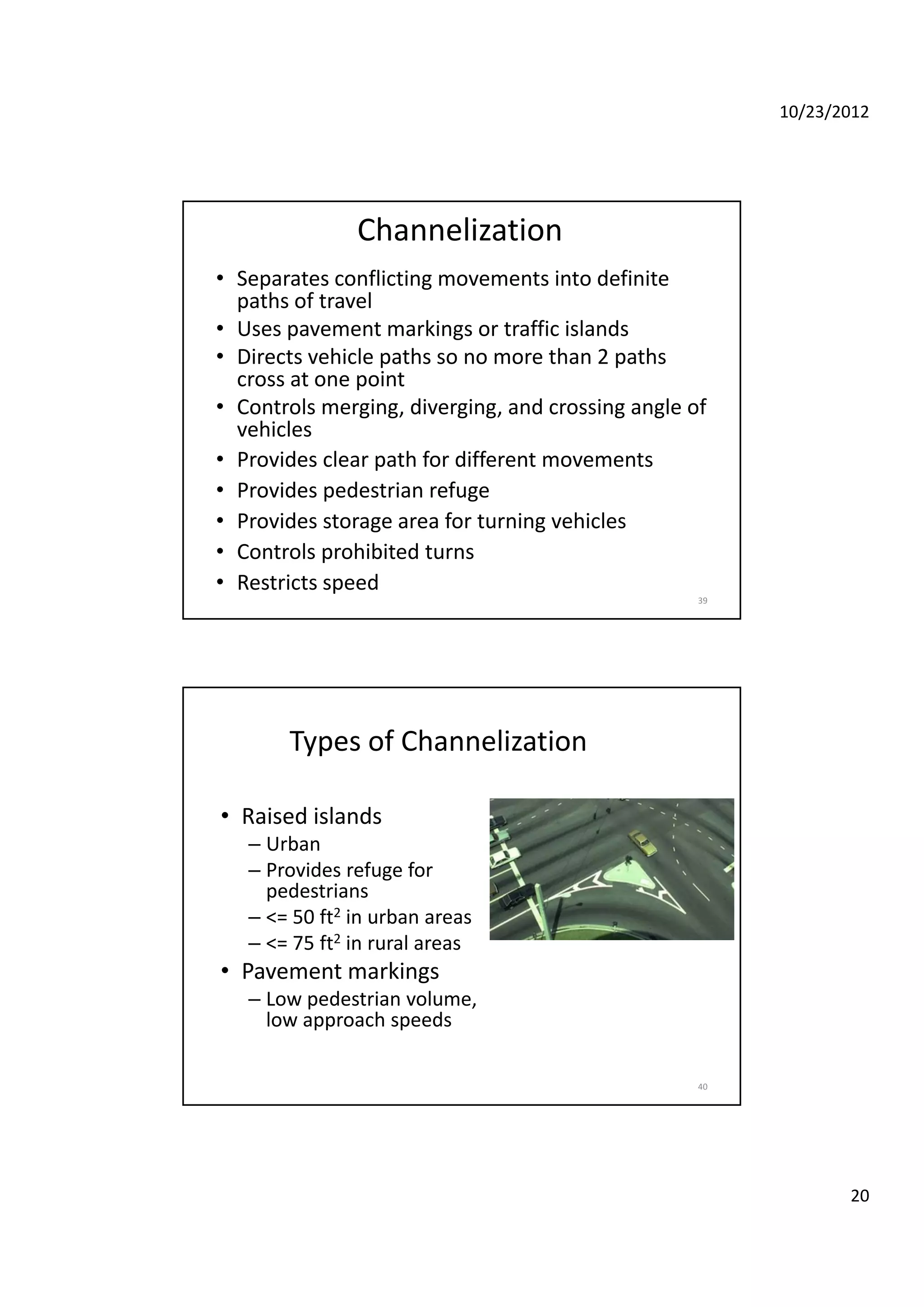
fh Fl b l H h D
37
Source: wwwfhwaFlexibility in Highway Design
- Chapter 8 - FHWA.htm
High Speed Turns
38
10/23/2012
20
Channelization
• Separates conflicting movements into definite 
paths of travel
• Uses pavement markings or traffic islands
• Directs vehicle paths so no more than 2 paths 
cross at one point
• Controls merging, diverging, and crossing angle of 
vehicles
• Provides clear path for different movements
39
• Provides pedestrian refuge
• Provides storage area for turning vehicles
• Controls prohibited turns
• Restricts speed
Types of Channelization
• Raised islands
– Urban
– Provides refuge for 
pedestrians
– <= 50 ft2 in urban areas
– <= 75 ft2 in rural areas
P t ki
40
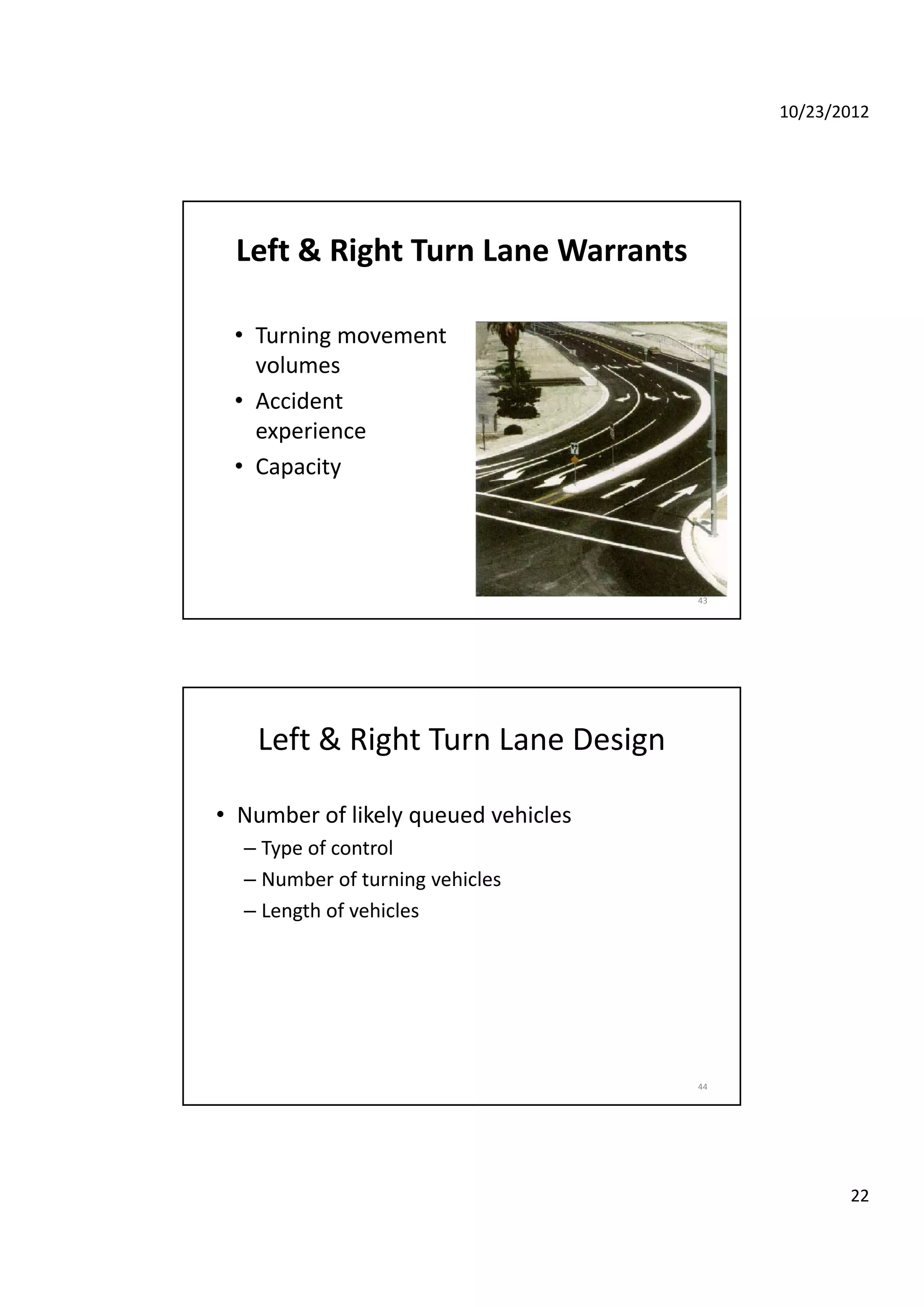
• Pavement markings
– Low pedestrian volume, 
low approach speeds
10/23/2012
21
Types of Channelization (Cont.)
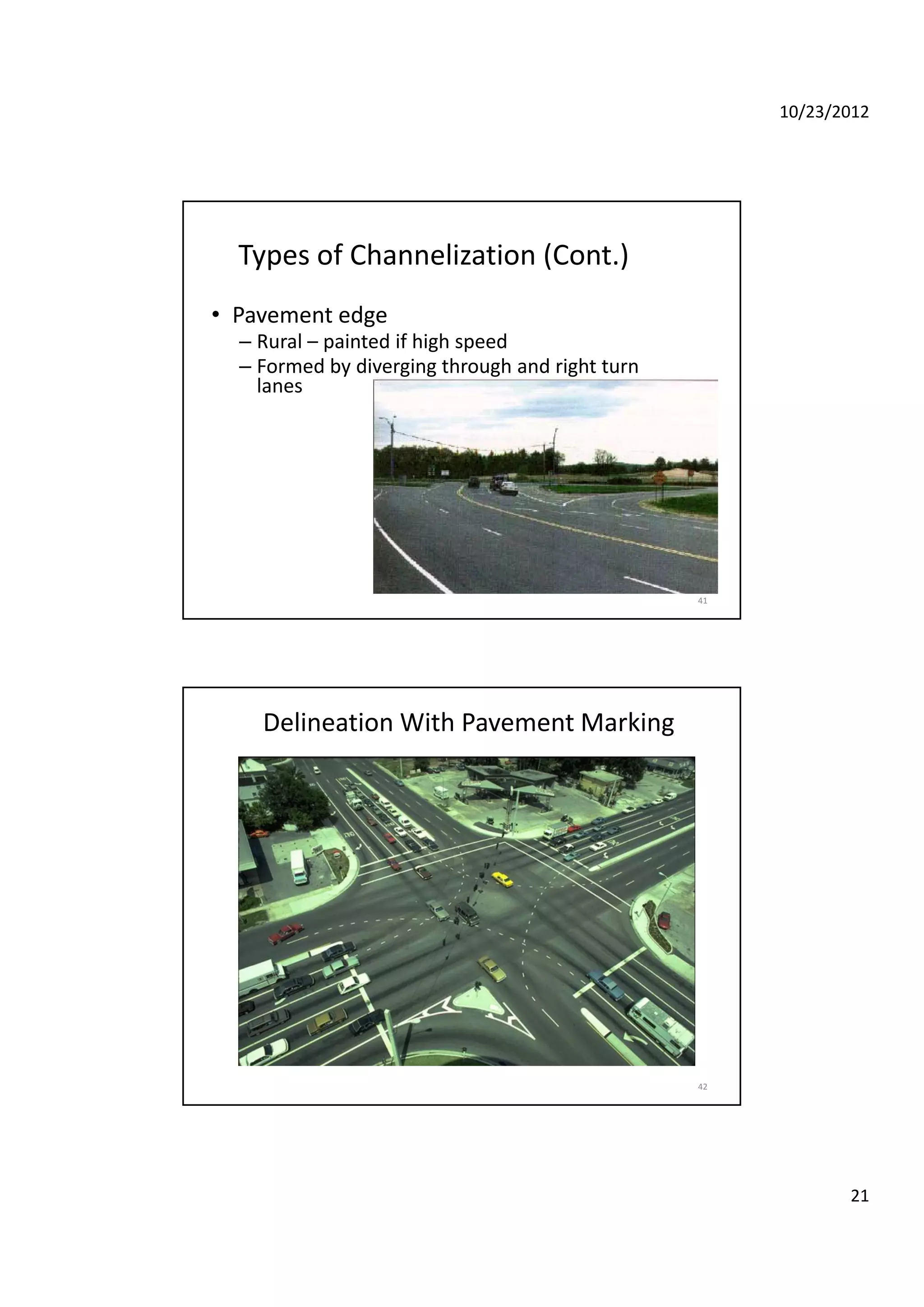
• Pavement edge
Rural painted if high speed– Rural – painted if high speed
– Formed by diverging through and right turn 
lanes
41
Delineation With Pavement Marking
42
10/23/2012
22
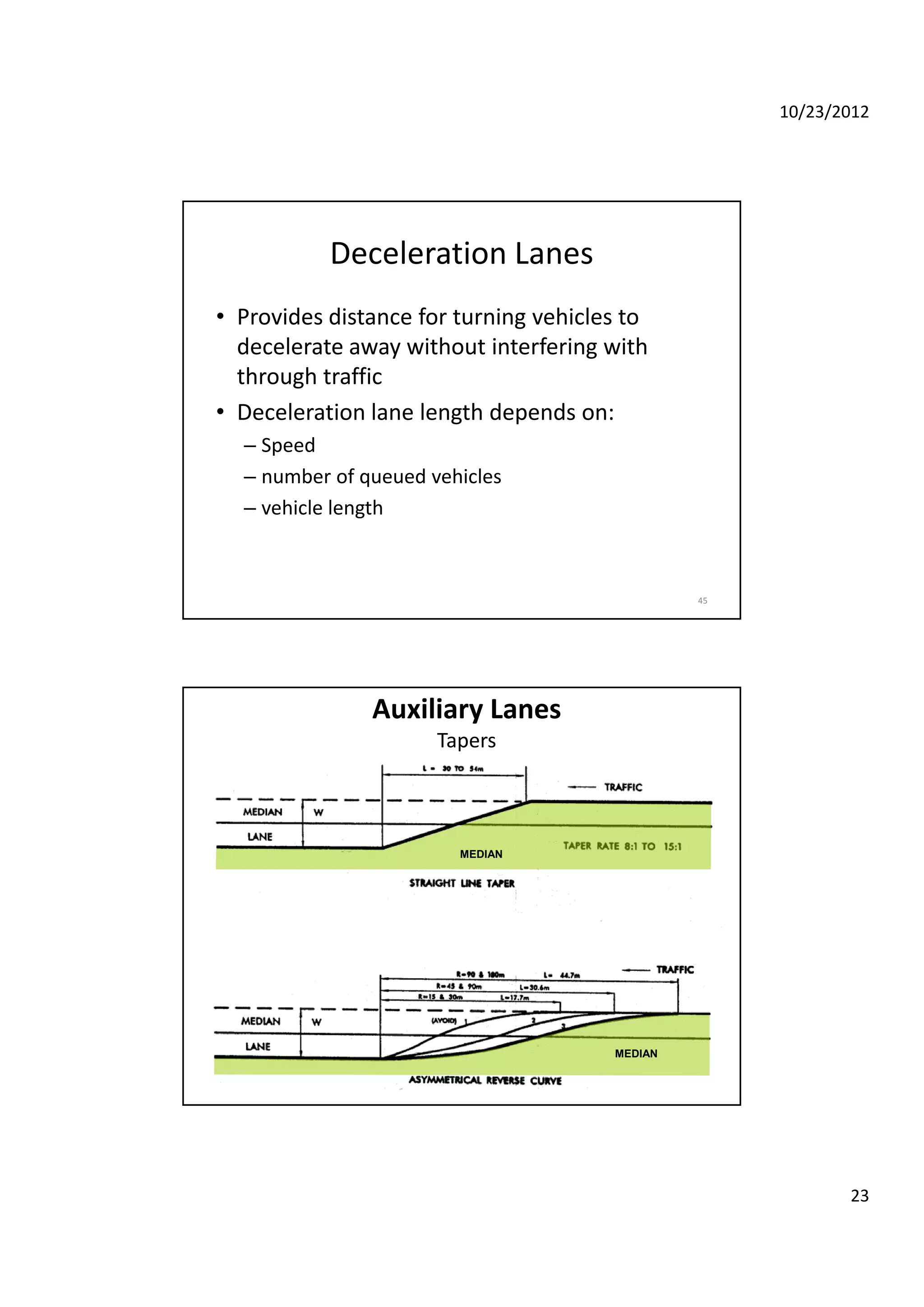
Left & Right Turn Lane Warrants
• Turning movementTurning movement 
volumes
• Accident 
experience
• Capacity
43
Left & Right Turn Lane Design
• Number of likely queued vehiclesy q
– Type of control
– Number of turning vehicles
– Length of vehicles
44
10/23/2012
23
Deceleration Lanes
• Provides distance for turning vehicles to 
d l t ith t i t f i ithdecelerate away without interfering with 
through traffic
• Deceleration lane length depends on:
– Speed
– number of queued vehicles
45
number of queued vehicles
– vehicle length 
Auxiliary Lanes
Tapers
MEDIAN
MEDIAN
10/23/2012
24
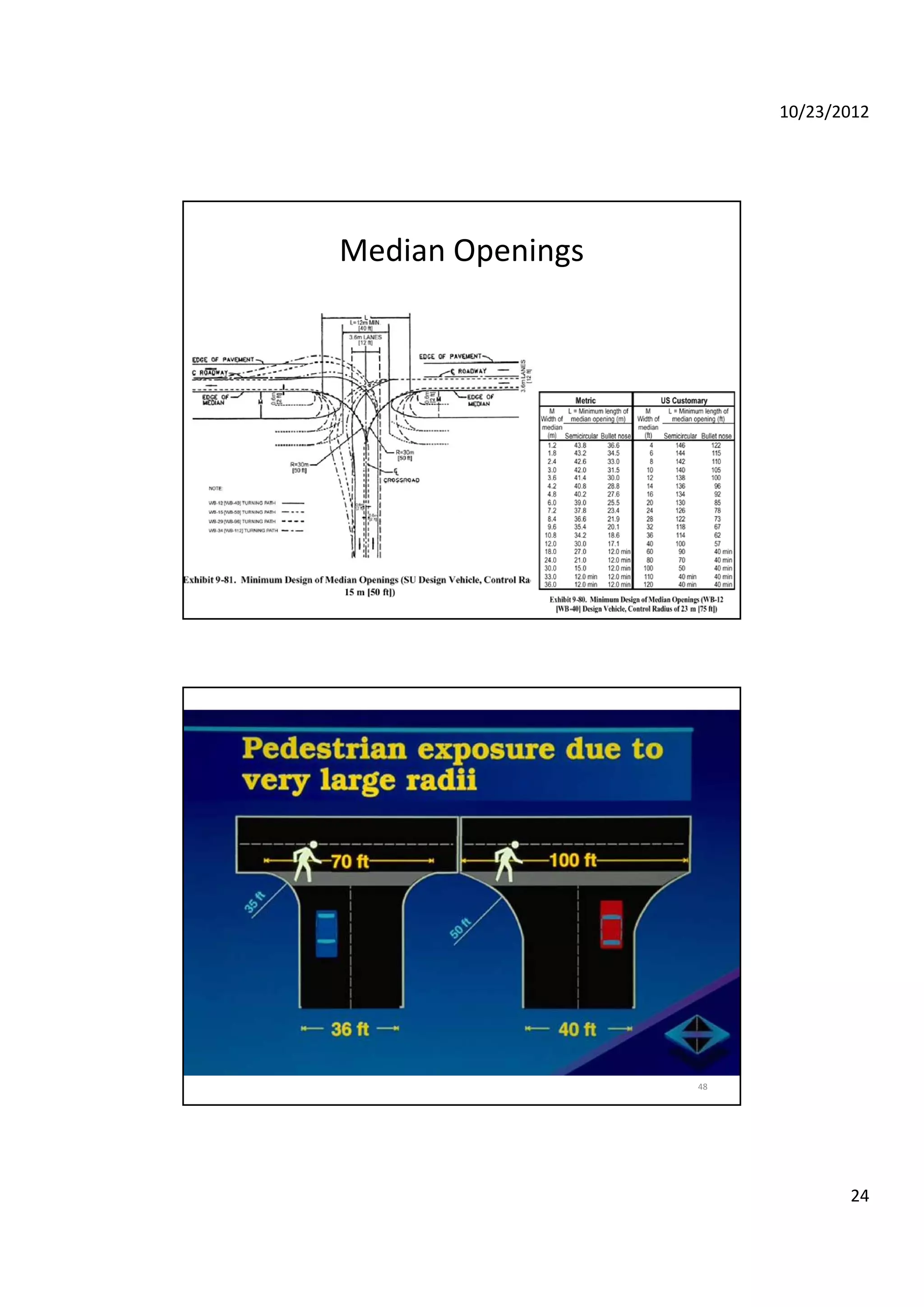
Median Openings
47
48
10/23/2012
25
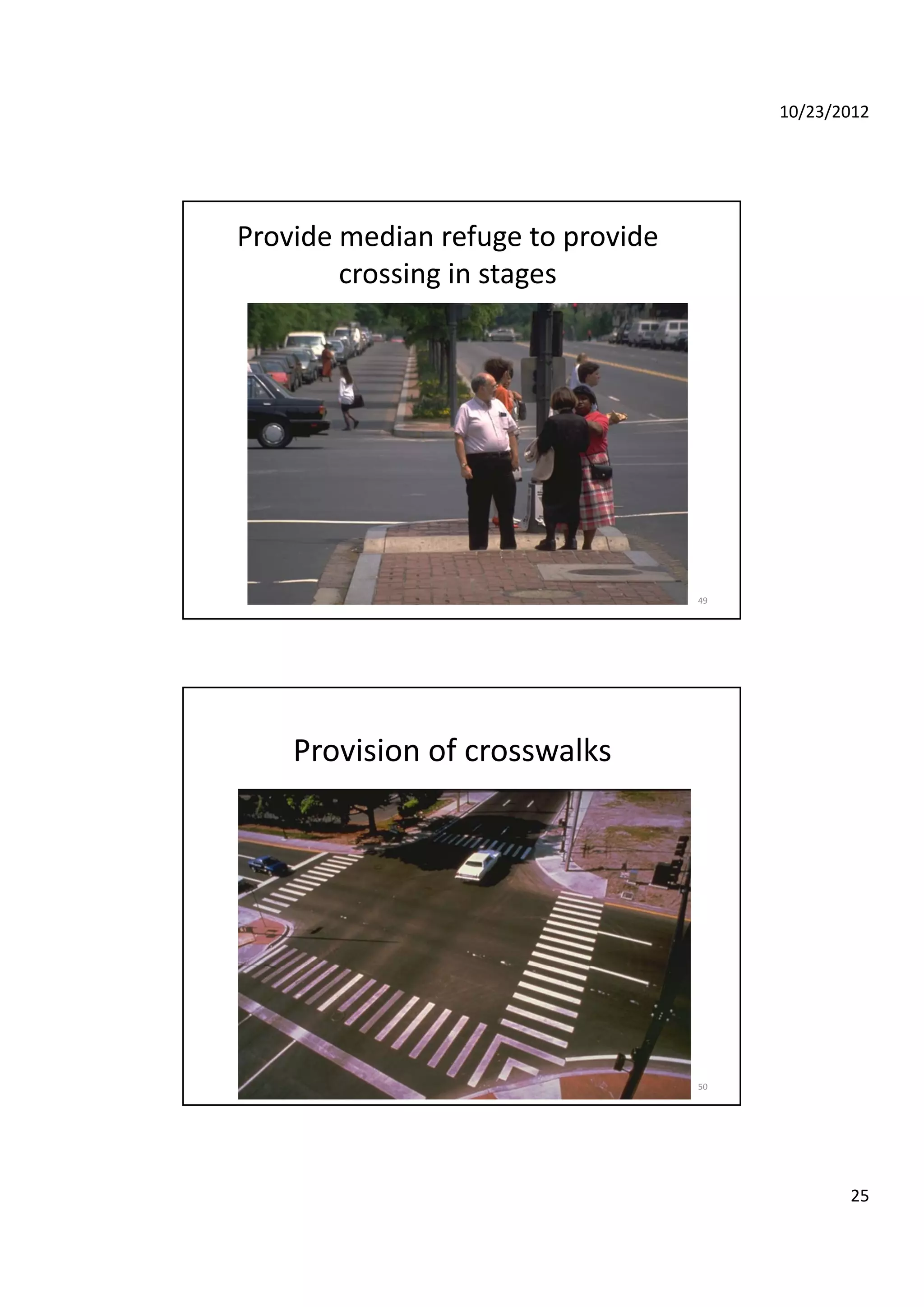
Provide median refuge to provide 
crossing in stages
49
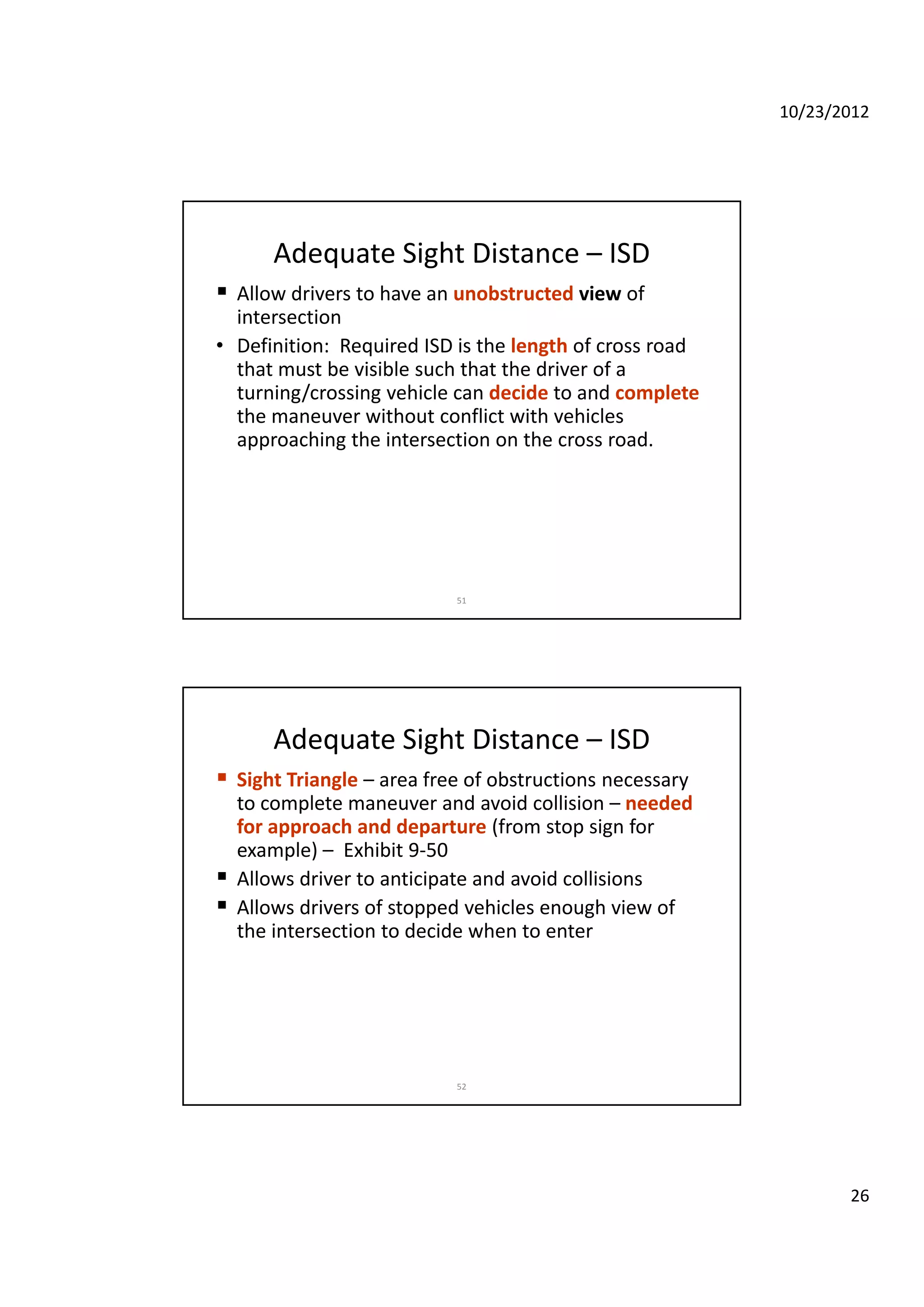
Provision of crosswalks
50
10/23/2012
26
Adequate Sight Distance – ISD
 Allow drivers to have an unobstructed view of 
intersection
D fi iti R i d ISD i th l th f d• Definition:  Required ISD is the length of cross road 
that must be visible such that the driver of a 
turning/crossing vehicle can decide to and complete
the maneuver without conflict with vehicles 
approaching the intersection on the cross road.
51
Adequate Sight Distance – ISD
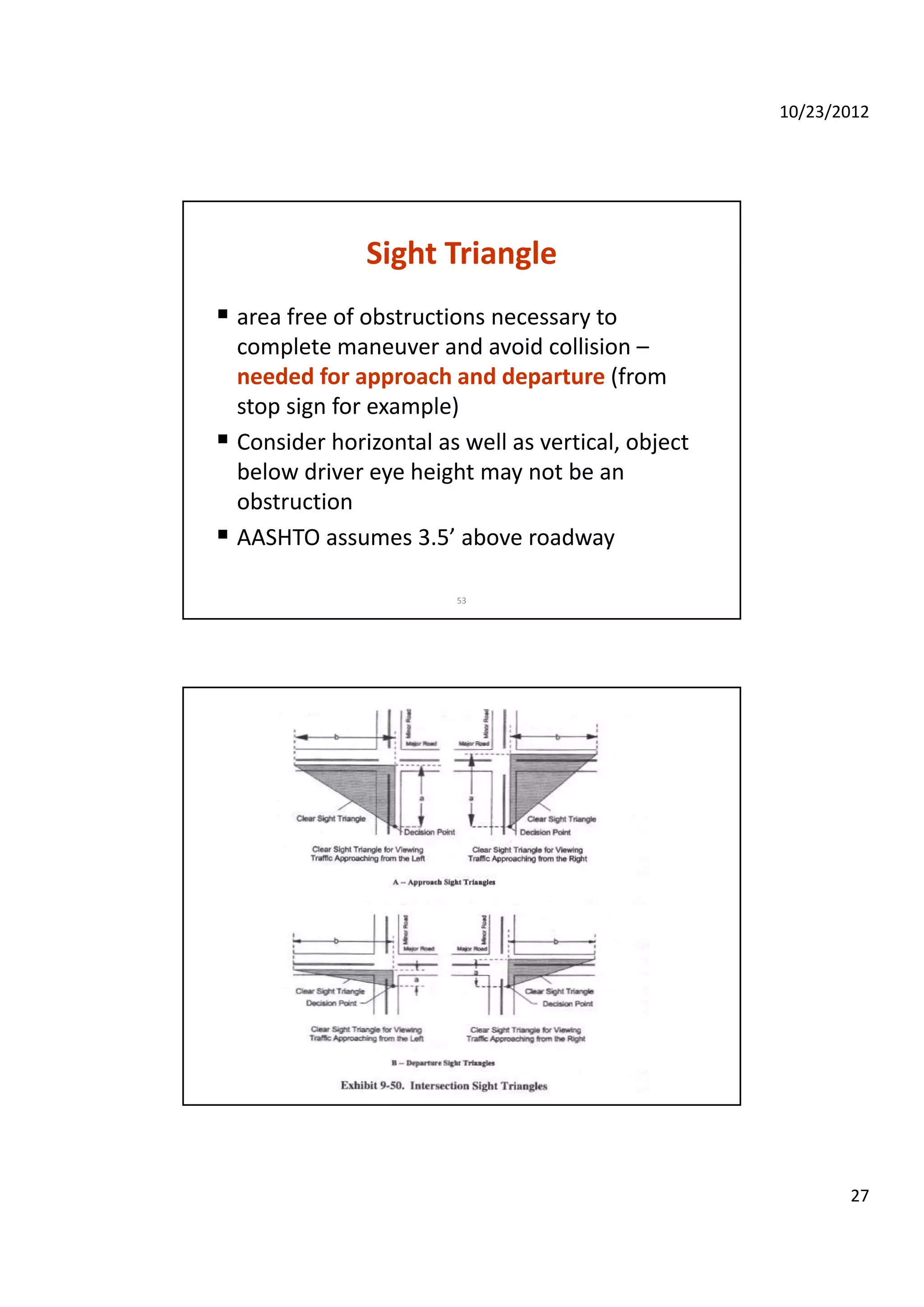
 Sight Triangle – area free of obstructions necessary 
to complete maneuver and avoid collision – needed 
for approach and departure (from stop sign forfor approach and departure (from stop sign for 
example) – Exhibit 9‐50 
 Allows driver to anticipate and avoid collisions 
 Allows drivers of stopped vehicles enough view of 
the intersection to decide when to enter
52
10/23/2012
27
Sight Triangle
 area free of obstructions necessary to 
l t d id lli icomplete maneuver and avoid collision –
needed for approach and departure (from 
stop sign for example)
 Consider horizontal as well as vertical, object 
below driver eye height may not be an 
53
y g y
obstruction
 AASHTO assumes 3.5’ above roadway
54
10/23/2012
28
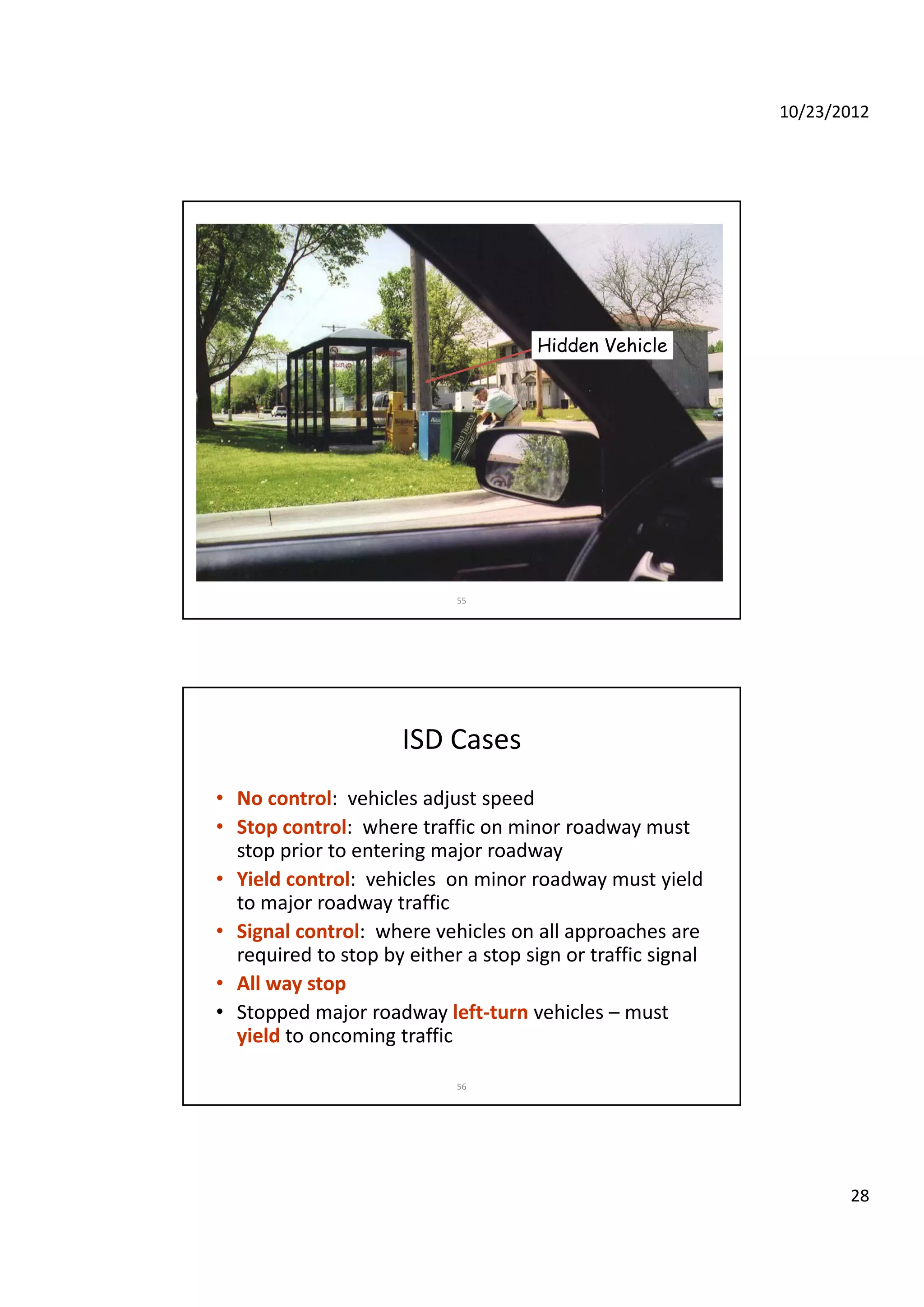
Sight Distance Obstruction
Hidd V hi lHidden Vehicle
55
ISD Cases
• No control:  vehicles adjust speed
• Stop control: where traffic on minor roadway must• Stop control:  where traffic on minor roadway must 
stop prior to entering major roadway
• Yield control:  vehicles  on minor roadway must yield 
to major roadway traffic
• Signal control:  where vehicles on all approaches are 
required to stop by either a stop sign or traffic signal
56
• All way stop
• Stopped major roadway left‐turn vehicles – must 
yield to oncoming traffic 
10/23/2012
29
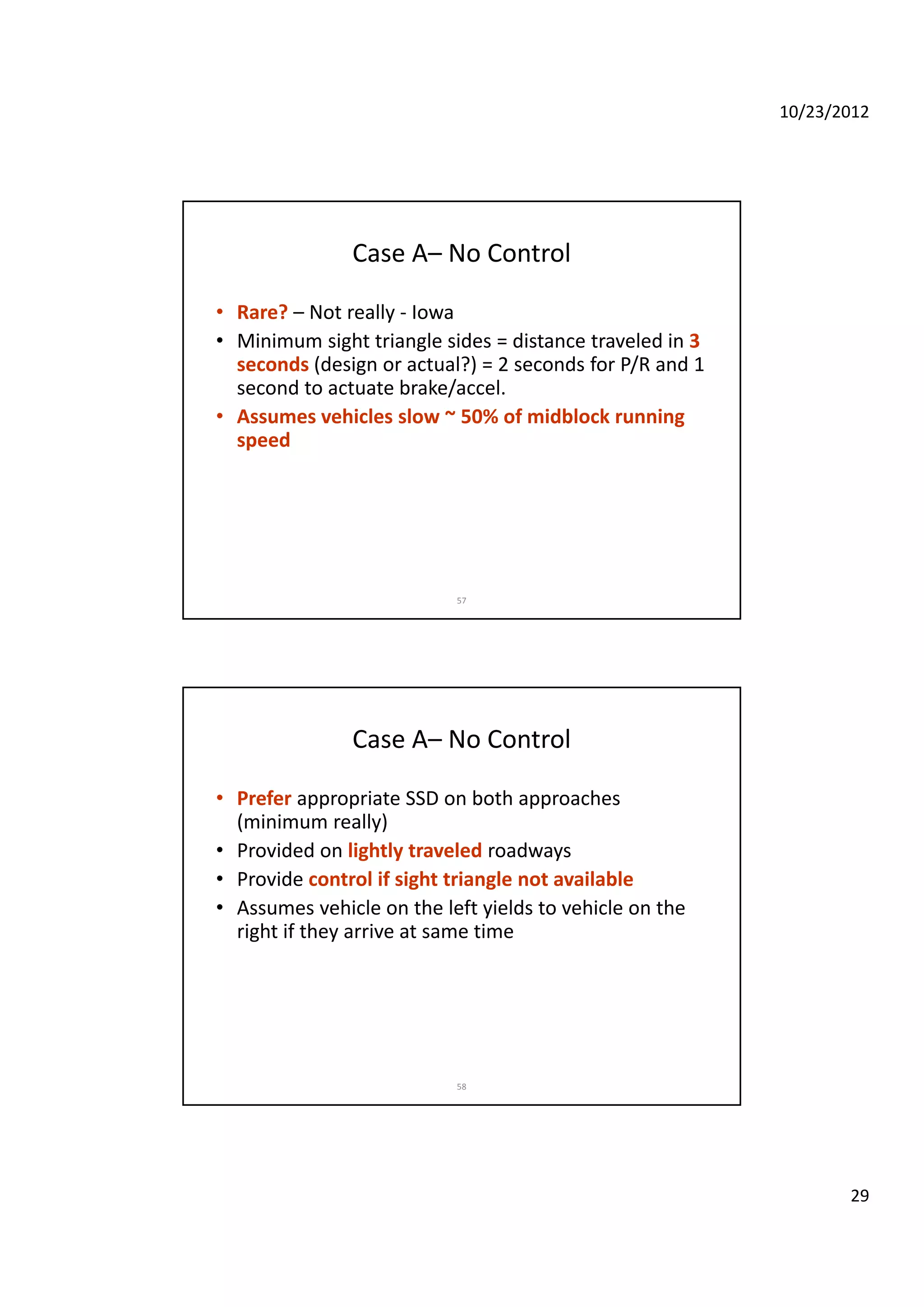
Case A– No Control
• Rare? – Not really ‐ Iowa
• Minimum sight triangle sides = distance traveled in 3• Minimum sight triangle sides = distance traveled in 3 
seconds (design or actual?) = 2 seconds for P/R and 1 
second to actuate brake/accel.
• Assumes vehicles slow ~ 50% of midblock running 
speed
57
Case A– No Control
• Prefer appropriate SSD on both approaches 
(minimum really)(minimum really)
• Provided on lightly traveled roadways
• Provide control if sight triangle not available
• Assumes vehicle on the left yields to vehicle on the 
right if they arrive at same time
58
10/23/2012
30
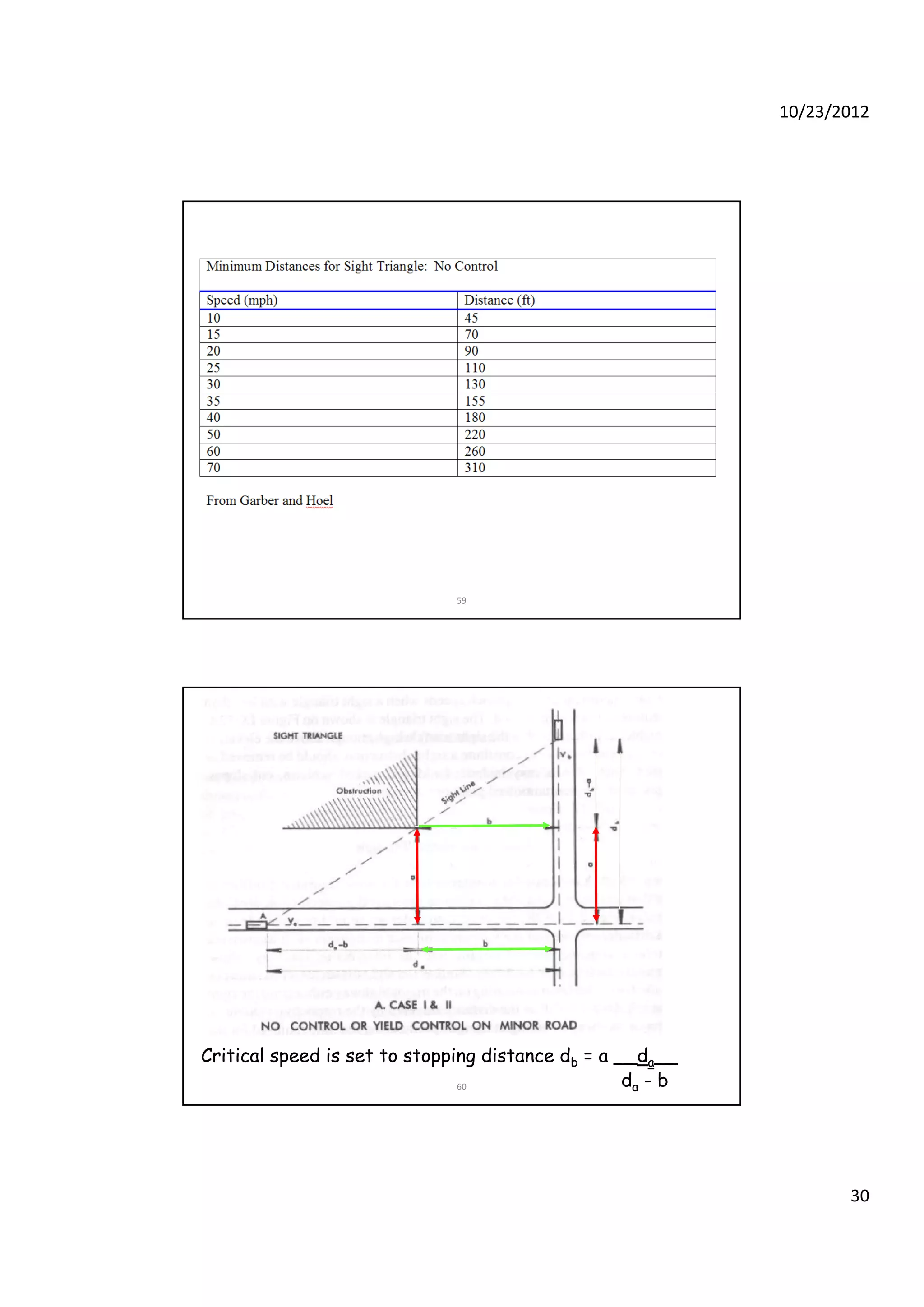
59
60
Critical speed is set to stopping distance dCritical speed is set to stopping distance dbb = a __= a __ddaa____
ddaa -- bb
10/23/2012
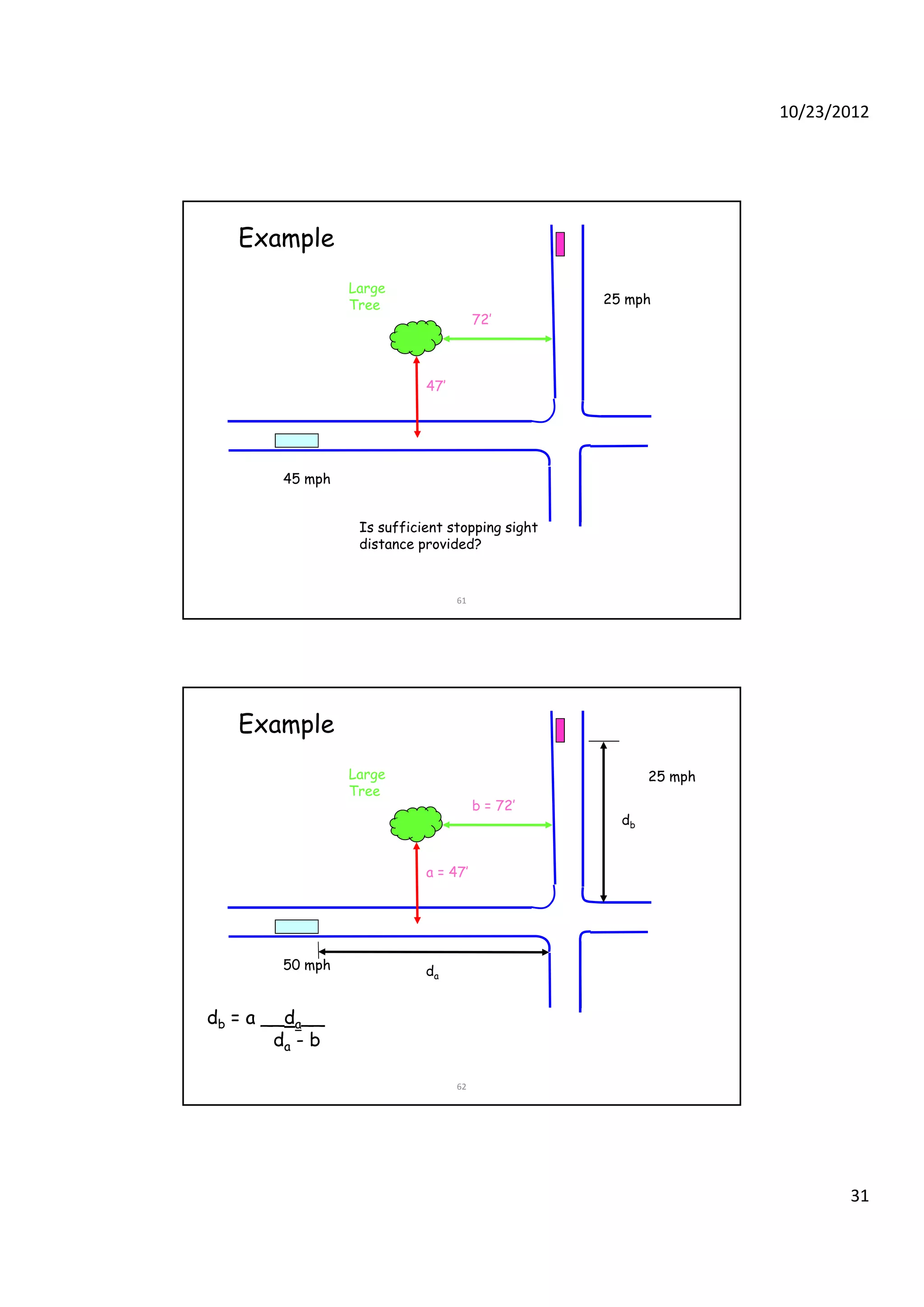
31
Large
Tree
72’
Example
25 mph
47’
45 mph
61
45 mph
Is sufficient stopping sight
distance provided?
Large
Tree
b = 72’
Example
25 mph
db
a = 47’
50 mph
b
d
62
50 mph
ddbb = a __= a __ddaa____
ddaa -- bb
da
10/23/2012
32
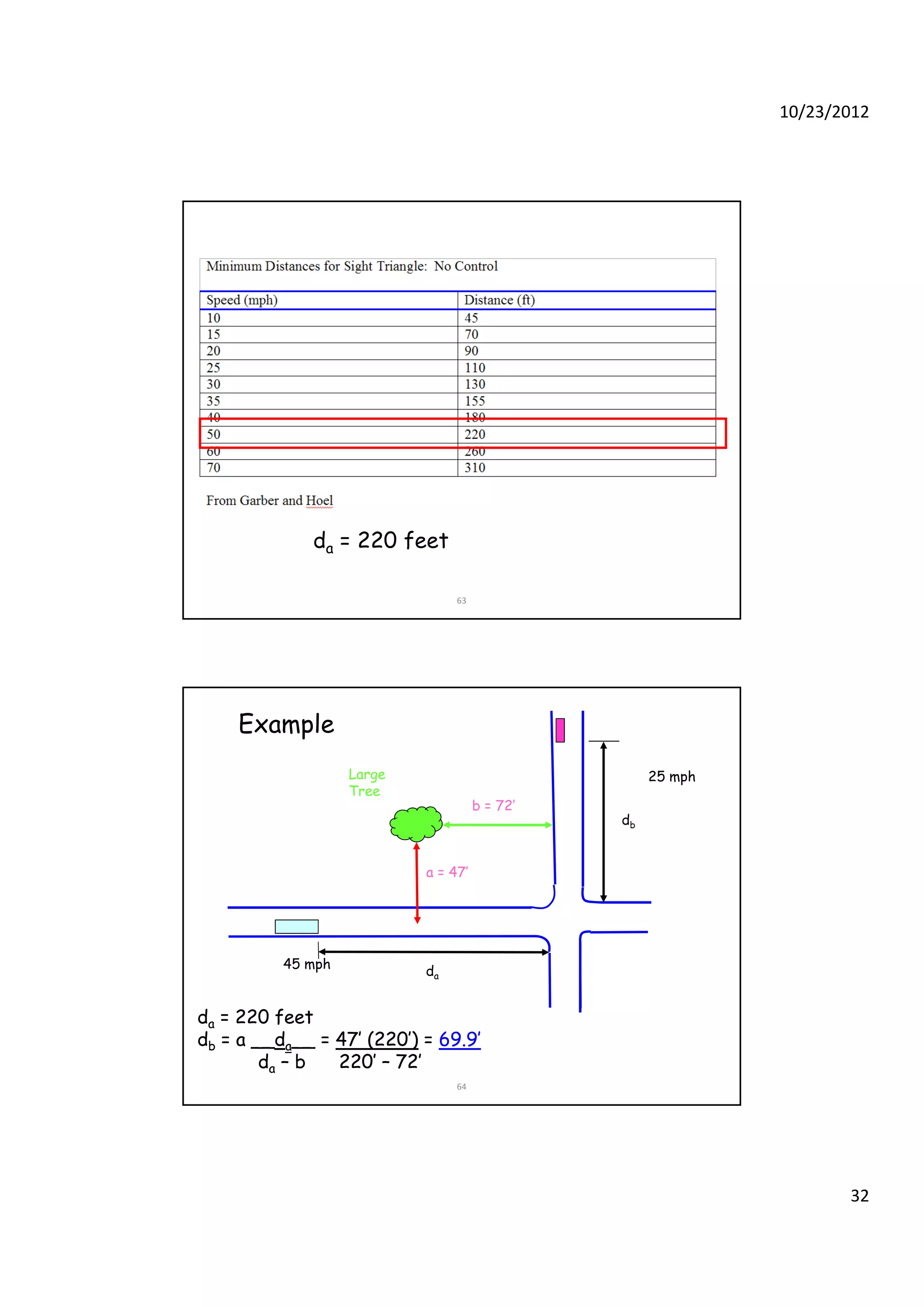
63
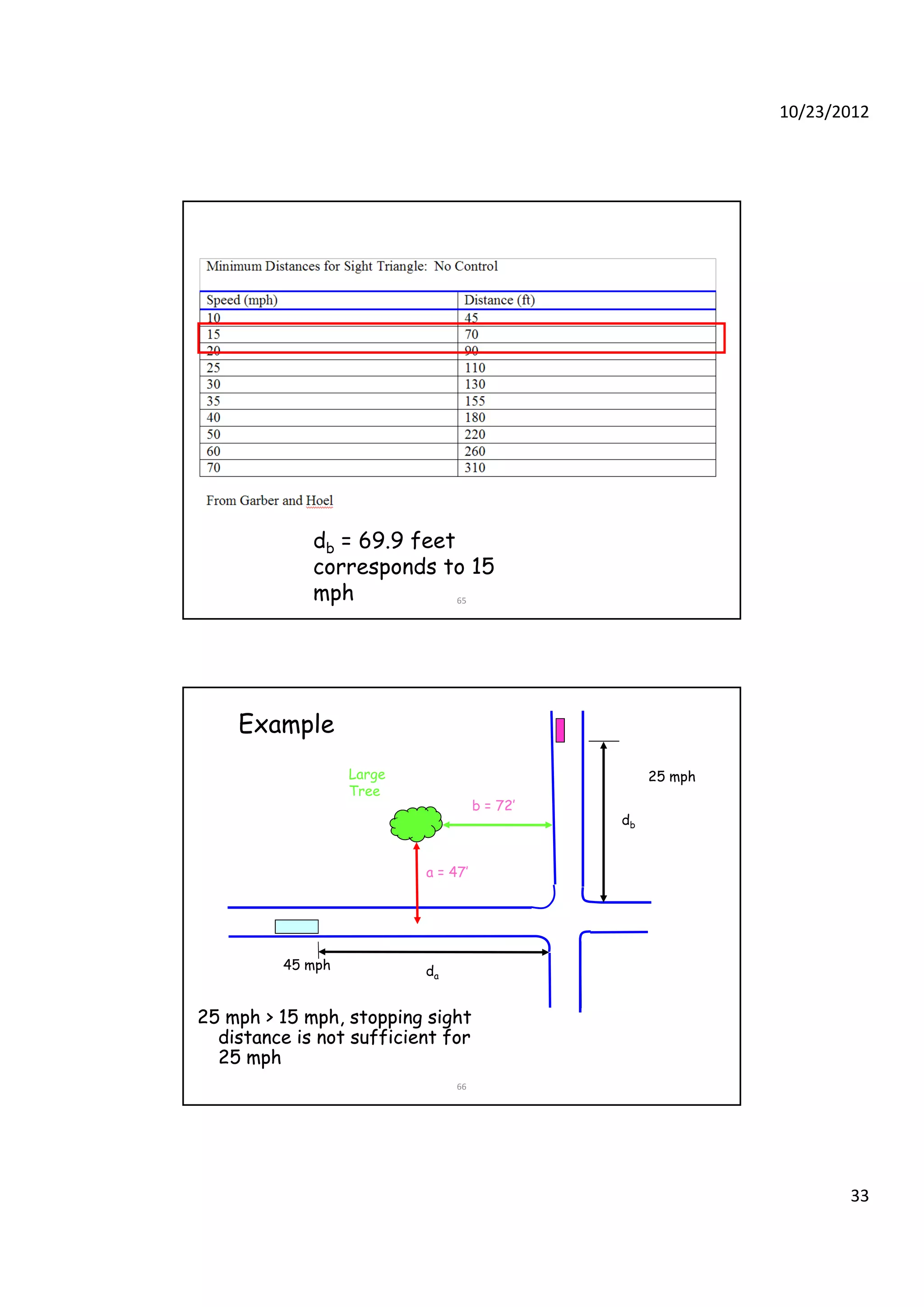
da = 220 feet
Large
Tree
b = 72’
Example
25 mph
db
a = 47’
45 mph
b
d
64
45 mph
ddaa = 220 feet= 220 feet
ddbb = a __= a __ddaa__ =__ = 47’ (220’)47’ (220’) == 69.9’69.9’
ddaa –– b 220’b 220’ –– 72’72’
da
10/23/2012
33
65
db = 69.9 feet
corresponds to 15
mph
Large
Tree
b = 72’
Example
25 mph
db
a = 47’
45 mph
b
d
66
45 mph
25 mph > 15 mph, stopping sight25 mph > 15 mph, stopping sight
distance is not sufficient fordistance is not sufficient for
25 mph25 mph
da
10/23/2012
34
Case B – Stop Control
Three Sub Cases – Maneuvers
• Turn left on to major roadway (clear traffic left enter• Turn left on to major roadway (clear traffic left, enter 
traffic right)
• Turn right on to major roadway (enter traffic from 
left)
• Crossing (clear traffic left/right)
67
Case B – Stop Control
• Need ISD for departure and completion even if p p
vehicle comes into view at point of departure = 1.47 
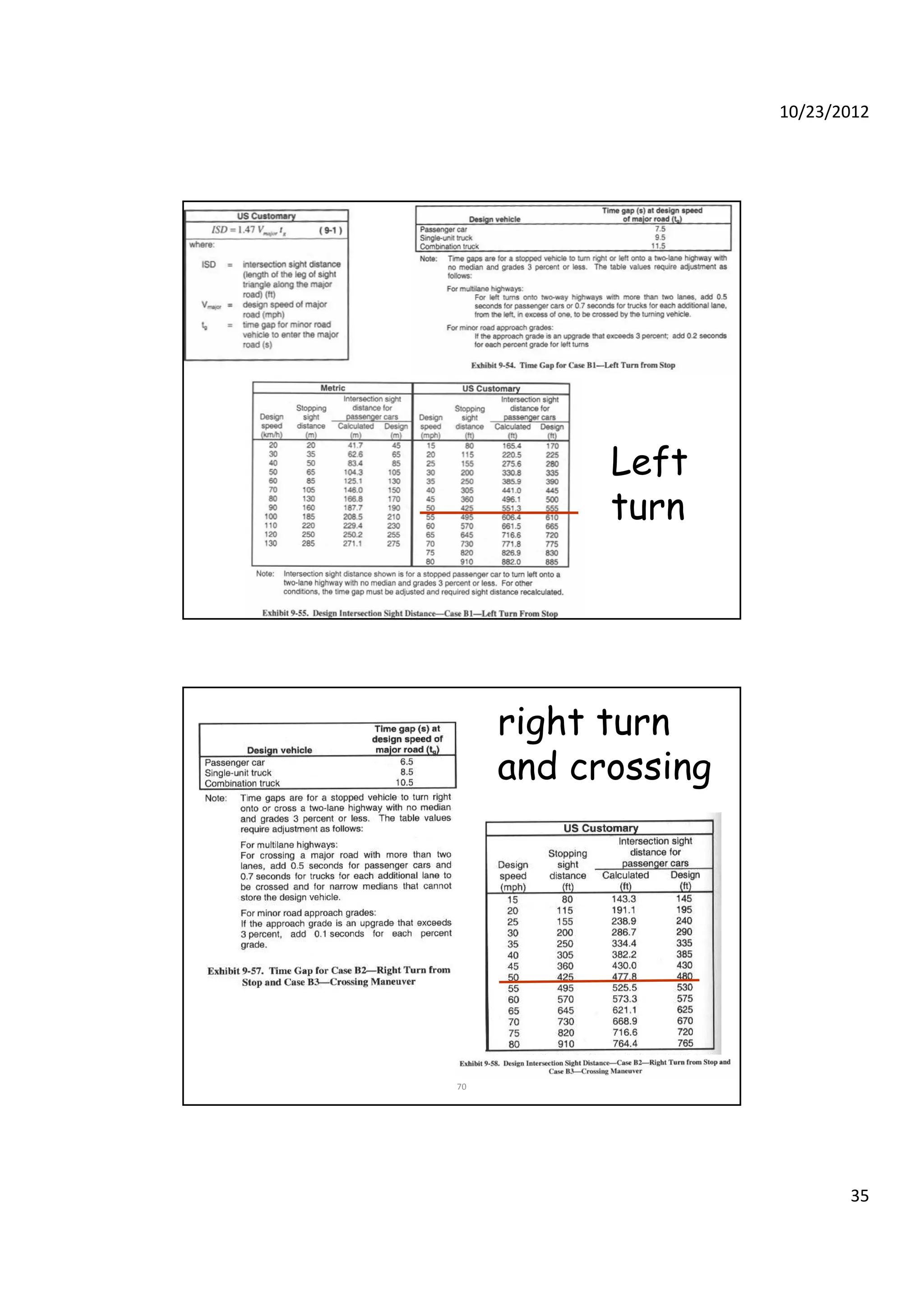
Vmajor * tg where tg=7.5‐11.5s; add more for grade 
or multilane; decrease by 1s for right turns
68
or multilane; decrease by 1s. for right turns 
10/23/2012
35
Left
69
turn
right turn
and crossing
70
10/23/2012
36
Case C  ‐ Yield Control
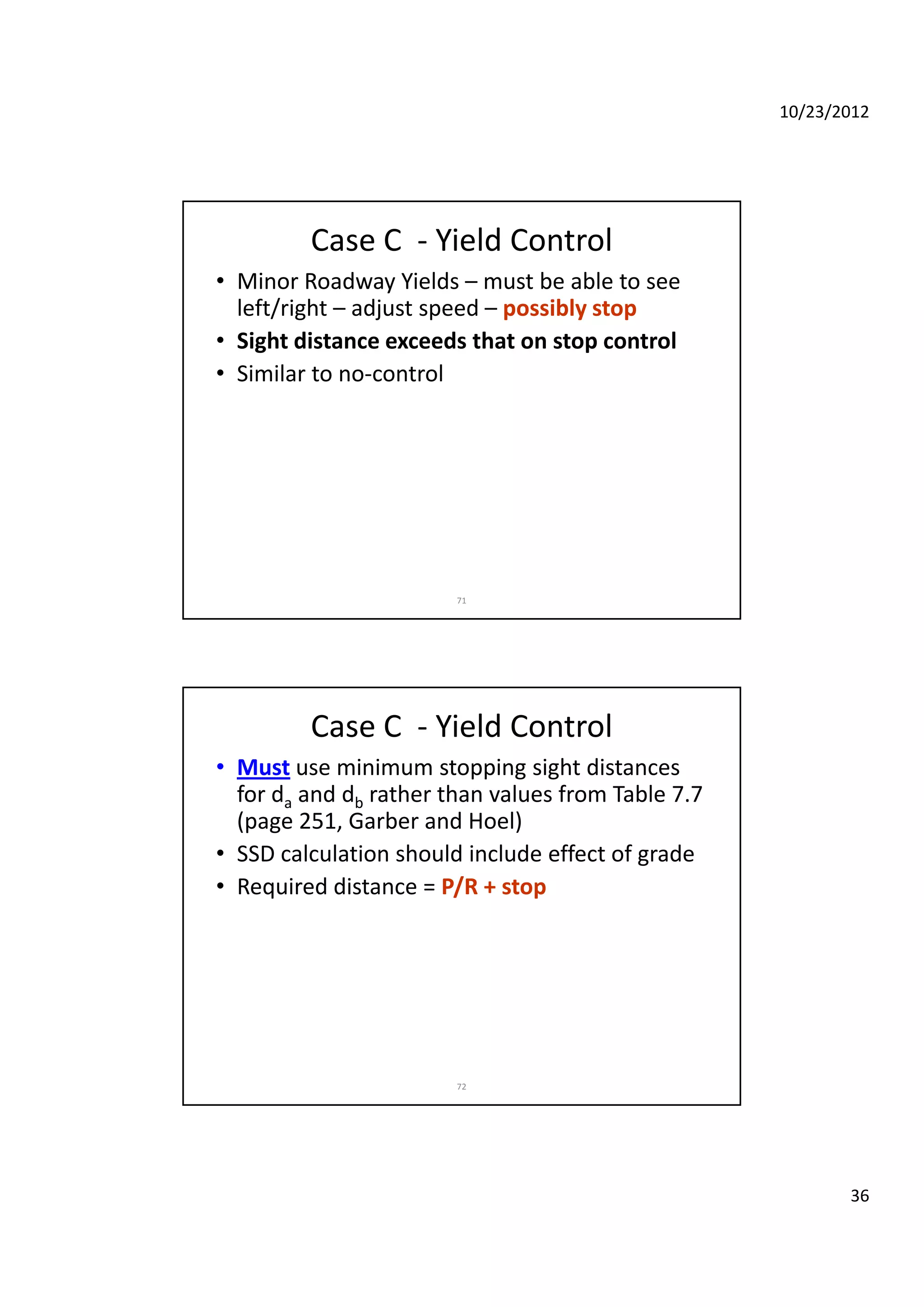
• Minor Roadway Yields – must be able to see 
left/right – adjust speed – possibly stop
• Sight distance exceeds that on stop control• Sight distance exceeds that on stop control
• Similar to no‐control 
71
Case C  ‐ Yield Control
• Must use minimum stopping sight distances 
for da and db rather than values from Table 7.7 
(page 251, Garber and Hoel)(page 251, Garber and Hoel)
• SSD calculation should include effect of grade
• Required distance = P/R + stop
72
10/23/2012
37
Case C  ‐ Yield Control
• Typically Known – a, b
• Typically Assume Va or Vb
73
Case C  ‐ Yield Control
• Typically Known – a, b
• Typically Assume Va or Vb
• Similar triangle can be used to calculate safeSimilar triangle can be used to calculate safe 
approach speeds (given one approach speed) or 
allowable a and b.
• da/db = (da – b)/a
• db = (da *a)/ (da – b) 
74
10/23/2012
38
db
75
Critical speed is set to stopping distance dCritical speed is set to stopping distance dbb = (d= (daa *a)/ (d*a)/ (daa –– b)b)
da
Yield Control
• Case C I:  Crossing maneuver from minor road
• Assumes that minor road vehicles that do not stop 
decelerate to 60% of minor road speed
• Vehicle should be able to:
• Travel from decision point to intersection decelerating 
to 60% of design speed
C d l th i t ti t th d
76
• Cross and clear the intersection at the same speed
10/23/2012
39
tgg
77
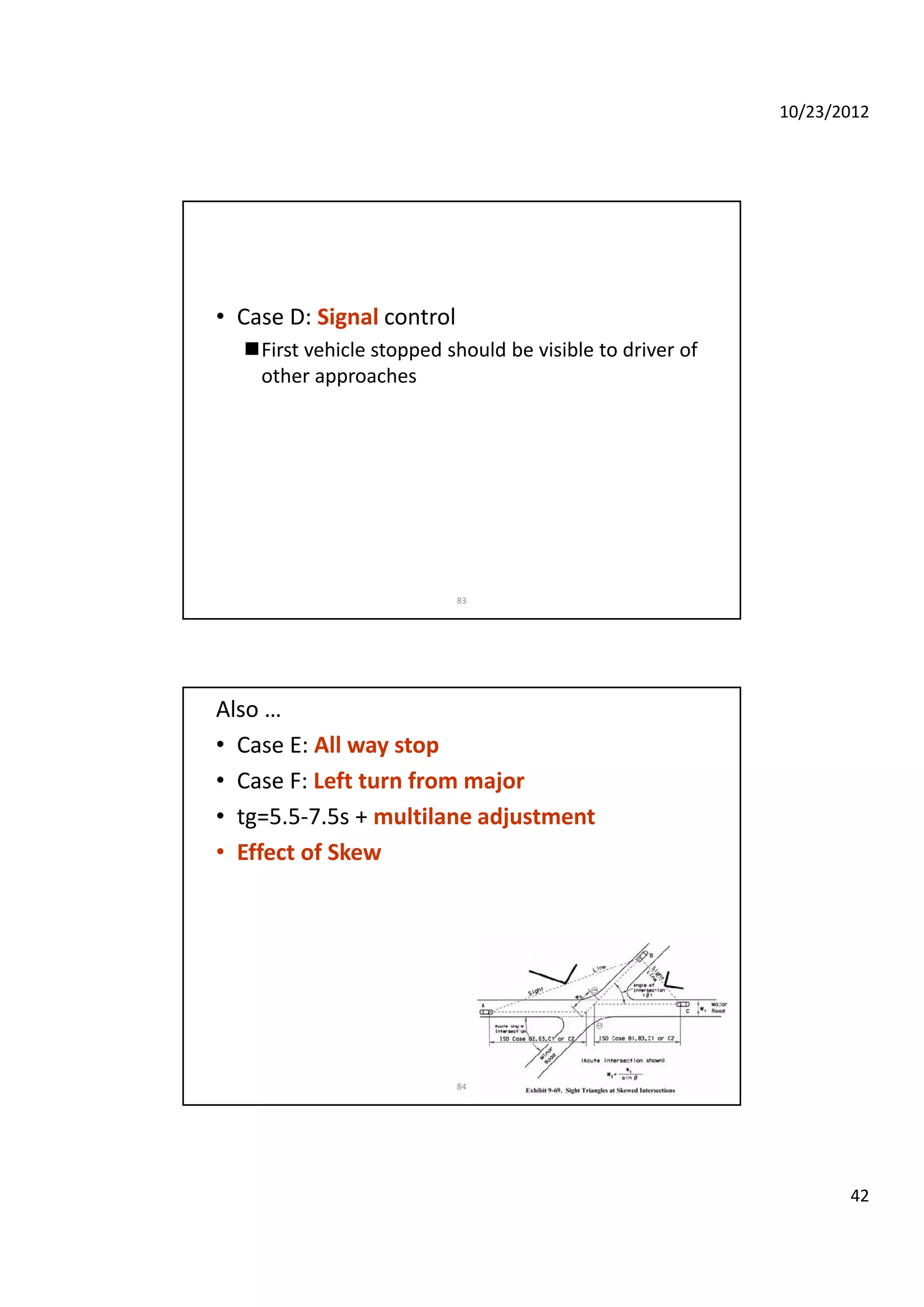
78Need tg
10/23/2012
40
79
Yield Control
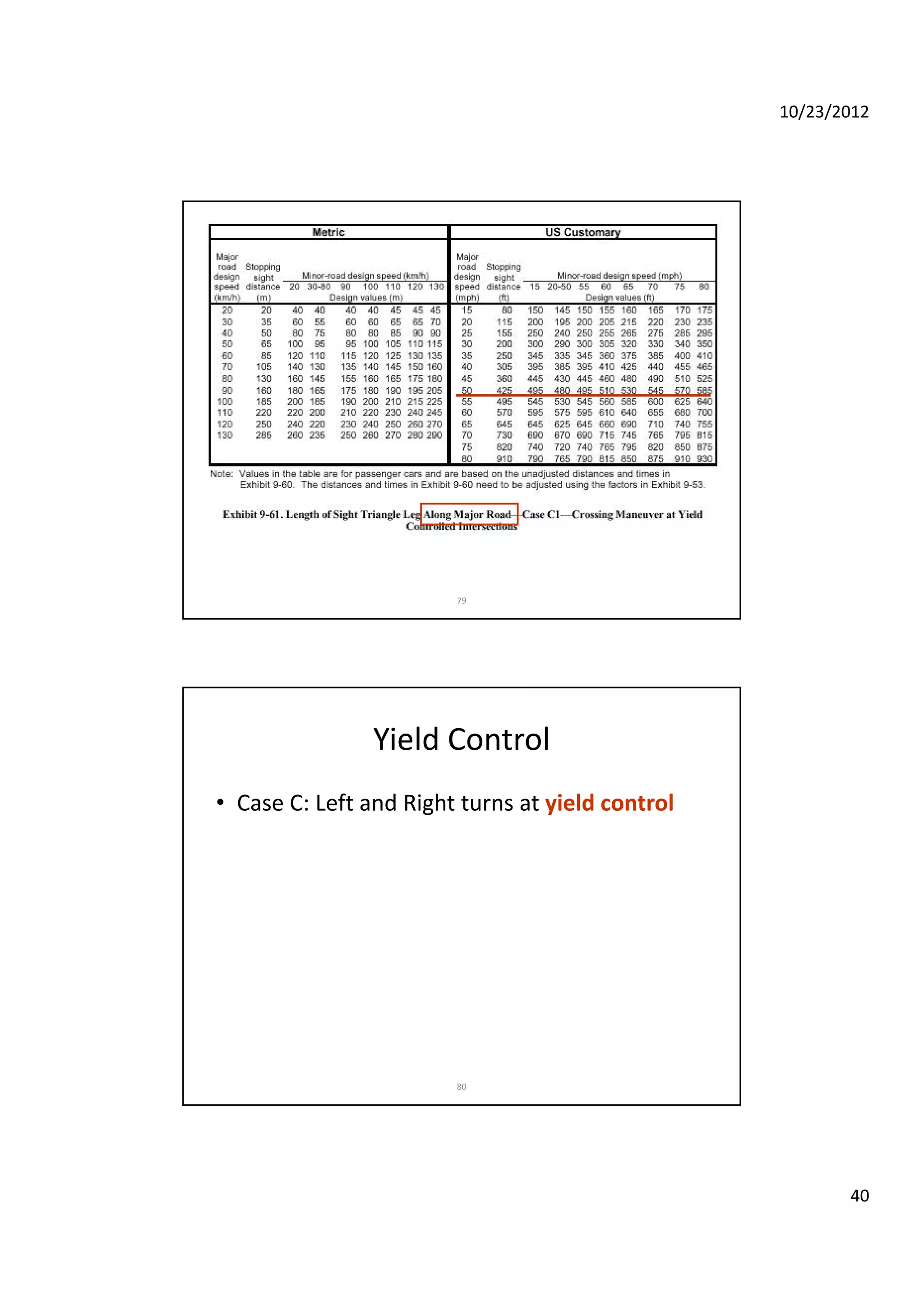
• Case C: Left and Right turns at yield control
80
10/23/2012
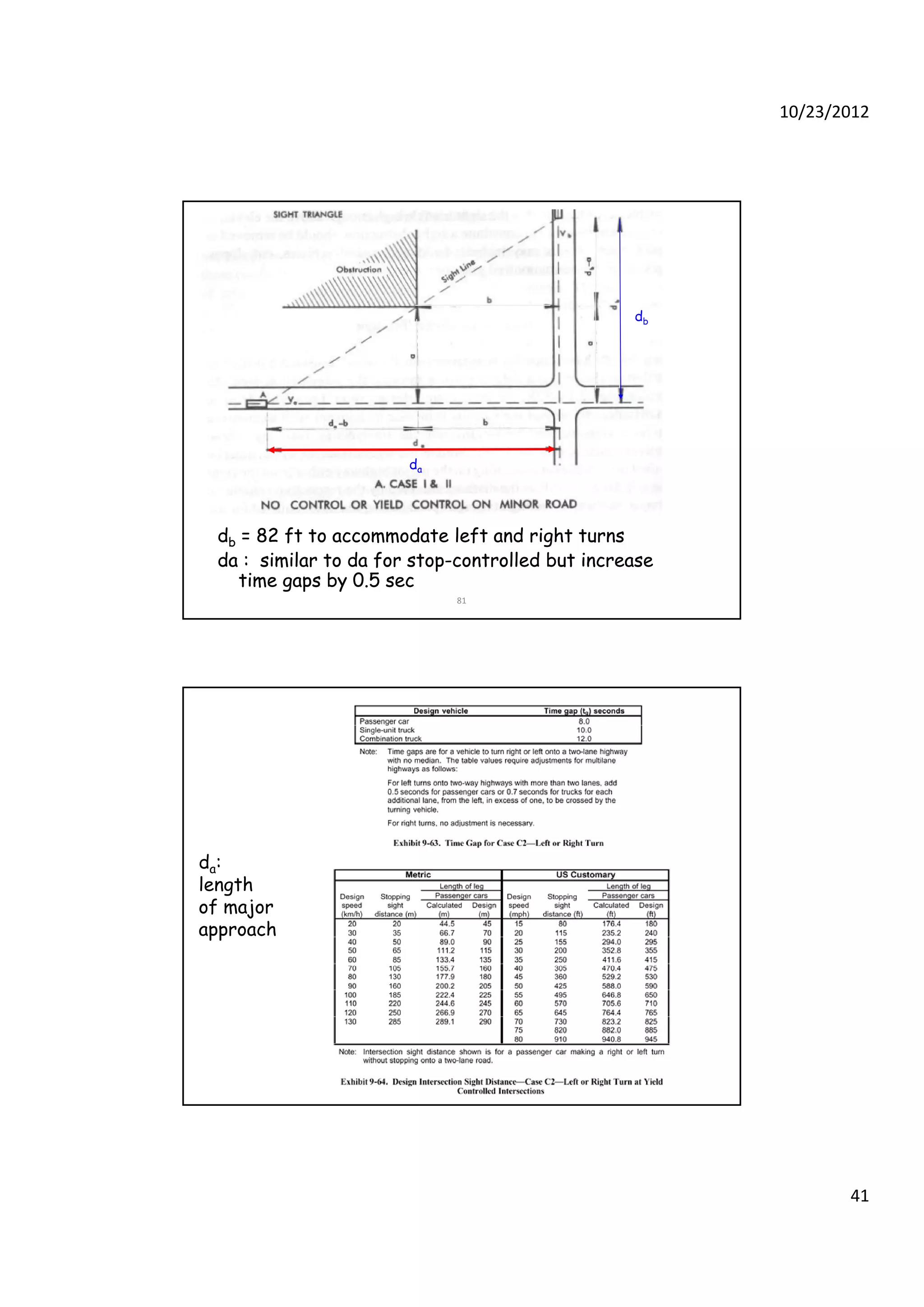
41
db
da
81
ddbb = 82 ft to accommodate left and right turns= 82 ft to accommodate left and right turns
da : similar to da for stopda : similar to da for stop--controlled but increasecontrolled but increase
time gaps by 0.5 sectime gaps by 0.5 sec
da:
length
of major
approach
82
10/23/2012
42
• Case D: Signal control
First vehicle stopped should be visible to driver of 
other approaches
83
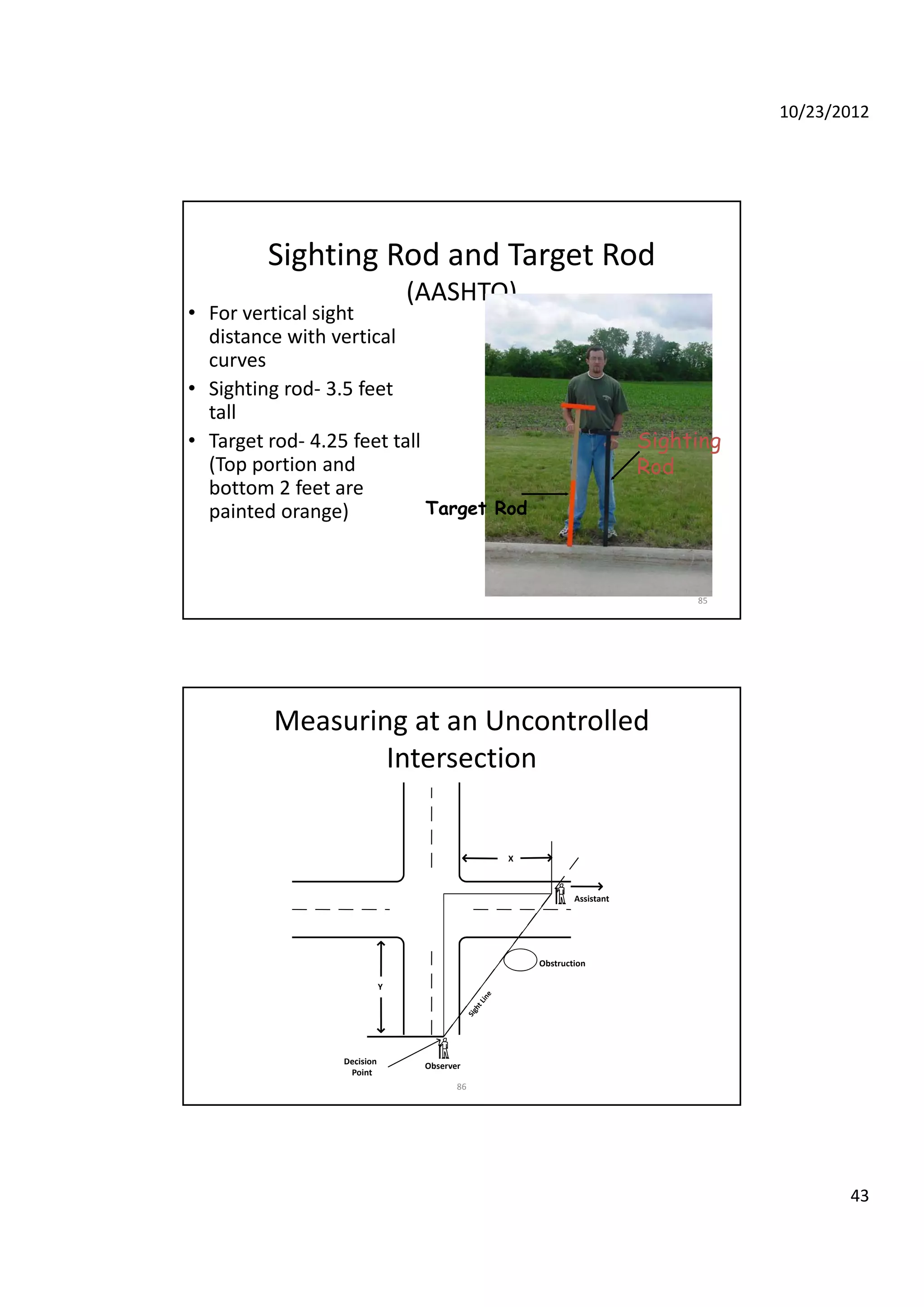
Also …
• Case E: All way stop
• Case F: Left turn from major
• tg=5.5‐7.5s + multilane adjustmentg j
• Effect of Skew
84
10/23/2012
43
Sighting Rod and Target Rod
(AASHTO)
• For vertical sight 
distance with verticaldistance with vertical 
curves
• Sighting rod‐ 3.5 feet 
tall
• Target rod‐ 4.25 feet tall 
(Top portion and 
b f
Sighting
Rod
85
bottom 2 feet are 
painted orange) Target Rod
Measuring at an Uncontrolled 
Intersection
Assistant
Obstruction
X
86
Observer
Decision
Point
Obstruction
Y

Intersections & Interchanges ( Highway Engineering Dr. Sherif El-Badawy )