Learning Sparse
Representations

Gabriel Peyré


    www.numerical-tours.com
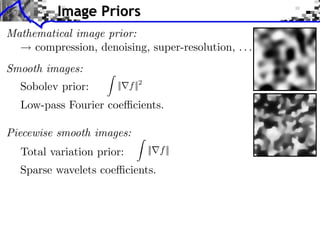
Image Priors
Mathematical image prior:
     compression, denoising, super-resolution, . . .
Image Priors
Mathematical image prior:
     compression, denoising, super-resolution, . . .
Smooth images:
  Sobolev prior:       || f ||2

   Low-pass Fourier coe cients.
Image Priors
Mathematical image prior:
     compression, denoising, super-resolution, . . .
Smooth images:
  Sobolev prior:       || f ||2

   Low-pass Fourier coe cients.

Piecewise smooth images:
   Total variation prior:         || f ||

  Sparse wavelets coe cients.
Image Priors
Mathematical image prior:
     compression, denoising, super-resolution, . . .
Smooth images:
  Sobolev prior:       || f ||2

   Low-pass Fourier coe cients.

Piecewise smooth images:
   Total variation prior:         || f ||

  Sparse wavelets coe cients.


     Learning the prior from exemplars?
Overview

•Sparsity and Redundancy

•Dictionary Learning

•Extensions

•Task-driven Learning

•Texture Synthesis
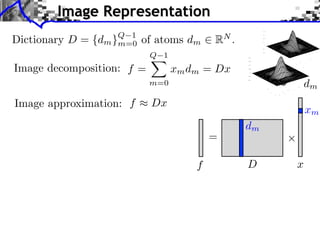
Image Representation
                      Q 1
Dictionary D =   {dm }m=0   of atoms dm    RN .
                             Q 1
Image decomposition: f =           xm dm = Dx
                             m=0                           dm

                                                           xm
                                                  dm
                                           =

                                       f          D    x
Image Representation
                      Q 1
Dictionary D =   {dm }m=0   of atoms dm    RN .
                             Q 1
Image decomposition: f =           xm dm = Dx
                             m=0                           dm
Image approximation: f       Dx
                                                           xm
                                                  dm
                                           =

                                       f          D    x
Image Representation
                      Q 1
Dictionary D =   {dm }m=0   of atoms dm    RN .
                             Q 1
Image decomposition: f =           xm dm = Dx
                             m=0                           dm
Image approximation: f       Dx
                                                           xm
                                                  dm
Orthogonal dictionary: N = Q               =
   xm = f, dm
                                       f          D    x
Image Representation
                      Q 1
Dictionary D =   {dm }m=0   of atoms dm      RN .
                             Q 1
Image decomposition: f =           xm dm = Dx
                             m=0                             dm
Image approximation: f       Dx
                                                             xm
                                                    dm
Orthogonal dictionary: N = Q               =
   xm = f, dm
                                       f            D    x
Redundant dictionary: N       Q
   Examples: TI wavelets, curvelets, . . .
     x is not unique.
Sparsity
                      Q 1
Decomposition:   f=         xm dm = Dx
                      m=0


Sparsity: most xm are small.
     Example: wavelet transform.
                                           Image f


                                         Coe cients x
Sparsity
                       Q 1
Decomposition:    f=         xm dm = Dx
                       m=0


Sparsity: most xm are small.
     Example: wavelet transform.
                                            Image f
Ideal sparsity: most xm are zero.
    J0 (x) = | {m  xm = 0} |


                                          Coe cients x
Sparsity
                        Q 1
Decomposition:     f=         xm dm = Dx
                        m=0


Sparsity: most xm are small.
     Example: wavelet transform.
                                             Image f
Ideal sparsity: most xm are zero.
    J0 (x) = | {m  xm = 0} |

Approximate sparsity: compressibility
    ||f   Dx|| is small with J0 (x)   M.
                                           Coe cients x
Sparse Coding
                                Q 1
Redundant dictionary D =   {dm }m=0 ,   Q   N.
        non-unique representation f = Dx.
Sparsest decomposition:      min J0 (x)
                            f =Dx
Sparse Coding
                                Q 1
Redundant dictionary D =   {dm }m=0 ,      Q      N.
        non-unique representation f = Dx.
Sparsest decomposition:      min J0 (x)
                            f =Dx
                                      1
Sparsest approximation:            min ||f        Dx|| + J0 (x)
                                                        2
                                    x 2

       Equivalence                 min     ||f     Dx||
           M     ⇥           J0 (x) M
                                   min         J0 (x)
                             ||f    Dx||
Sparse Coding
                                Q 1
Redundant dictionary D =   {dm }m=0 ,        Q      N.
        non-unique representation f = Dx.
Sparsest decomposition:       min J0 (x)
                              f =Dx
                                        1
Sparsest approximation:              min ||f        Dx|| + J0 (x)
                                                          2
                                      x 2

       Equivalence                   min     ||f     Dx||
           M     ⇥             J0 (x) M
                                     min         J0 (x)
                               ||f    Dx||
Ortho-basis D:
                                ⇤                  Pick the M largest
           f, dm ⇥ if |xm |          2                 coe cients
 xm =
          0 otherwise.                                in { f, dm ⇥}m
Sparse Coding
                                Q 1
Redundant dictionary D =   {dm }m=0 ,        Q      N.
        non-unique representation f = Dx.
Sparsest decomposition:       min J0 (x)
                              f =Dx
                                        1
Sparsest approximation:              min ||f        Dx|| + J0 (x)
                                                          2
                                      x 2

       Equivalence                   min     ||f     Dx||
           M     ⇥             J0 (x) M
                                     min         J0 (x)
                               ||f    Dx||
Ortho-basis D:
                                ⇤                  Pick the M largest
           f, dm ⇥ if |xm |          2                 coe cients
 xm =
          0 otherwise.                                in { f, dm ⇥}m

General redundant dictionary: NP-hard.
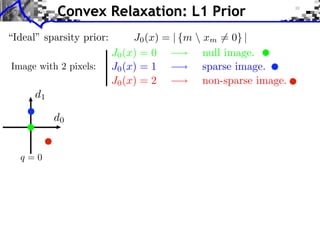
Convex Relaxation: L1 Prior
                            J0 (x) = | {m  xm = 0} |
                       J0 (x) = 0           null image.
Image with 2 pixels:   J0 (x) = 1           sparse image.
                       J0 (x) = 2           non-sparse image.
     d1

          d0


  q=0
Convex Relaxation: L1 Prior
                              J0 (x) = | {m  xm = 0} |
                         J0 (x) = 0           null image.
Image with 2 pixels:     J0 (x) = 1           sparse image.
                         J0 (x) = 2           non-sparse image.
       d1

               d0


     q=0            q = 1/2          q=1      q = 3/2        q=2
 q
     priors:         Jq (x) =       |xm |q        (convex for q    1)
                                m
Convex Relaxation: L1 Prior
                                   J0 (x) = | {m  xm = 0} |
                              J0 (x) = 0           null image.
Image with 2 pixels:          J0 (x) = 1           sparse image.
                              J0 (x) = 2           non-sparse image.
       d1

                d0


     q=0                 q = 1/2          q=1             q = 3/2        q=2
 q
     priors:              Jq (x) =       |xm |q               (convex for q    1)
                                     m


Sparse      1
                prior:     J1 (x) = ||x||1 =          |xm |
                                                  m
Inverse Problems


Denoising/approximation:   = Id.
Inverse Problems


Denoising/approximation:      = Id.
Examples: Inpainting, super-resolution, compressed-sensing
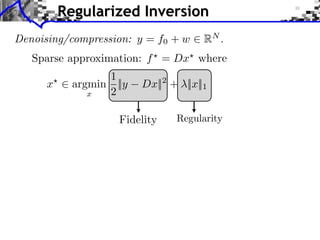
Regularized Inversion
Denoising/compression: y = f0 + w   RN .
   Sparse approximation: f = Dx where
                1
      x ⇥ argmin ||y   Dx||2 + ||x||1
             x  2

                   Fidelity
Regularized Inversion
Denoising/compression: y = f0 + w    RN .
   Sparse approximation: f = Dx where
                1
      x ⇥ argmin ||y    Dx||2 + ||x||1
             x  2

                    Fidelity                Replace
                                            D by D
Inverse problems y = f0 + w RP .
                   1
      x ⇥ argmin ||y     Dx|| + ||x||1
                             2
              x    2
Regularized Inversion
Denoising/compression: y = f0 + w     RN .
   Sparse approximation: f = Dx where
                1
      x ⇥ argmin ||y     Dx||2 + ||x||1
             x  2

                     Fidelity                    Replace
                                                 D by D
Inverse problems y = f0 + w RP .
                   1
      x ⇥ argmin ||y     Dx|| + ||x||1
                             2
              x    2

Numerical solvers: proximal splitting schemes.
             www.numerical-tours.com
Inpainting Results
Overview

•Sparsity and Redundancy

•Dictionary Learning

•Extensions

•Task-driven Learning

•Texture Synthesis
Dictionary Learning: MAP Energy
Set of (noisy) exemplars {yk }k .
                                    1
Sparse approximation:         min     ||yk   Dxk || + ||xk ||1
                                                  2
                               xk   2
Dictionary Learning: MAP Energy
Set of (noisy) exemplars {yk }k .
                                         1
Sparse approximation: min min              ||yk   Dxk || + ||xk ||1
                                                       2
                         D C   xk
                                     k
                                         2

                          Dictionary learning
Dictionary Learning: MAP Energy
Set of (noisy) exemplars {yk }k .
                                        1
Sparse approximation: min min             ||yk   Dxk || + ||xk ||1
                                                      2
                         D C   xk
                                    k
                                        2

                       Dictionary learning
 Constraint:   C = {D = (dm )m  m, ||dm ||      1}
       Otherwise: D       + , X     0
Dictionary Learning: MAP Energy
Set of (noisy) exemplars {yk }k .
                                          1
Sparse approximation: min min               ||yk   Dxk || + ||xk ||1
                                                        2
                          D C   xk
                                     k
                                          2

                        Dictionary learning
 Constraint:    C = {D = (dm )m  m, ||dm ||       1}
       Otherwise: D       + , X      0
Matrix formulation:
                          1
            min f (X, D) = ||Y           DX|| + ||X||1
                                             2

          X⇥R  Q K        2
          D⇥C    RN   Q
Dictionary Learning: MAP Energy
Set of (noisy) exemplars {yk }k .
                                           1
Sparse approximation: min min                ||yk     Dxk || + ||xk ||1
                                                           2
                           D C   xk
                                      k
                                           2

                        Dictionary learning
 Constraint:    C = {D = (dm )m  m, ||dm ||         1}
       Otherwise: D        + , X      0
Matrix formulation:
                          1
            min f (X, D) = ||Y            DX|| + ||X||1
                                                 2

          X⇥R  Q K        2
                                            min f (X, D)
          D⇥C    R   N Q
                                             X

    Convex with respect to X.
    Convex with respect to D.                                        D
    Non-onvex with respect to (X, D).                Local minima
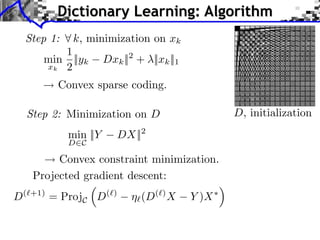
Dictionary Learning: Algorithm
Step 1:   k, minimization on xk
      1
   min ||yk    Dxk || + ||xk ||1
                    2
   xk 2

      Convex sparse coding.

                                   D, initialization
Dictionary Learning: Algorithm
Step 1:    k, minimization on xk
      1
   min ||yk         Dxk || + ||xk ||1
                         2
   xk 2

      Convex sparse coding.

Step 2: Minimization on D               D, initialization
          min ||Y      DX||  2
          D C

      Convex constraint minimization.
Dictionary Learning: Algorithm
    Step 1:     k, minimization on xk
           1
        min ||yk         Dxk || + ||xk ||1
                               2
        xk 2

             Convex sparse coding.

    Step 2: Minimization on D                            D, initialization
               min ||Y      DX||   2
               D C

           Convex constraint minimization.
      Projected gradient descent:
D   ( +1)
            = ProjC D    ( )
                                   (D   ( )
                                              X   Y )X
Dictionary Learning: Algorithm
    Step 1:     k, minimization on xk
           1
        min ||yk         Dxk || + ||xk ||1
                               2
        xk 2

             Convex sparse coding.

    Step 2: Minimization on D                            D, initialization
               min ||Y      DX||   2
               D C

           Convex constraint minimization.
      Projected gradient descent:
D   ( +1)
            = ProjC D    ( )
                                   (D   ( )
                                              X   Y )X
Convergence: toward a stationary point
             of f (X, D).                                D, convergence
Patch-based Learning

                      Learning D


Exemplar patches yk                      Dictionary D
                                     [Olshausen, Fields 1997]
 State of the art denoising [Elad et al. 2006]
Patch-based Learning

                       Learning D


Exemplar patches yk                      Dictionary D
                                     [Olshausen, Fields 1997]
 State of the art denoising [Elad et al. 2006]


                      Learning D


  Sparse texture synthesis, inpainting [Peyr´ 2008]
                                            e
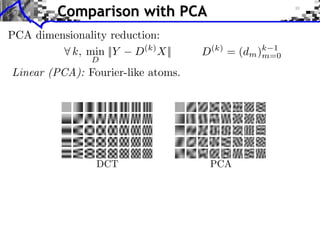
Comparison with PCA
PCA dimensionality reduction:
         ⇥ k, min ||Y D(k) X||                           D   (k)
                                                                   =   (dm )m=0
                                                                            k 1
                   D
Linear (PCA): Fourier-like atoms.
         RUBINSTEIN et al.: al.: DICTIONARIES FOR SPARSE REPRESENTATION
           RUBINSTEIN et DICTIONARIES FOR SPARSE REPRESENTATION


                                                                                1980 by by Bast
                                                                                   1980 Bastiaa
                                                                                fundamental prop
                                                                                   fundamental p
                                                                                   A basic 1-D G
                                                                                      A basic 1-D
                                                                                forms
                                                                                   forms
                                                                                             © ©
                                                                                        G = = n,
                                                                                          G ⇤ ⇤

                     DCT                                    PCA                    where w(·) is is
                                                                                      where w(·) a
         Fig. 1. 1.Left: A fewfew £ 12 12 DCT atoms. Right: The first 40 KLT atoms, (typically a Gau
             Fig.      Left: A 12 12 £ DCT atoms. Right: The first 40 KLT atoms,       (typically a G
         trained using 12 £ 12 12 image patches from Lena.
             trained using 12 £ image patches from Lena.
                                                                                   frequency resolu
                                                                                      frequency reso
                                                                                   matical foundatio
                                                                                      matical founda
                                                                                   late 1980’s by by
                                                                                      late 1980’s D
         B. B. Non-Linear Revolution and Elements Modern Dictionary
              Non-Linear Revolution and Elements of of Modern Dictionary
                                                                                   who studied thet
                                                                                      who studied
         Design
             Design
                                                                                   and by by Feichti
                                                                                      and Feichting
             In In statistics research, the 1980’s saw the rise of new generalized group
                  statistics research, the 1980’s saw the rise of a a new generalized gro
         powerful approach known as as robust statistics. Robust statistics
             powerful approach known robust statistics. Robust statistics
Comparison with PCA
PCA dimensionality reduction:
         ⇥ k, min ||Y D(k) X||                                  D   (k)
                                                                          =   (dm )m=0
                                                                                   k 1
                          D
Linear (PCA): Fourier-like atoms.
           RUBINSTEIN et al.: al.: DICTIONARIES FOR SPARSE REPRESENTATION
             RUBINSTEIN et DICTIONARIES FOR SPARSE REPRESENTATION
Sparse (learning): Gabor-like atoms.
                                                                                       1980 by by Bast
                                                                                          1980 Bastiaa
                                                                                       fundamental prop
                                                                                          fundamental p
                                                                                          A basic 1-D G
                                                                                             A basic 1-D
                                                                                       forms
                                                                                          forms
                                                                                                    © ©
                4
                                                                                               G = = n,
                                                                                                 G ⇤ ⇤
                    4

                            DCT                                    PCA                    where w(·) is is
                                                                                             where w(·) a
                Fig. 1. 1.Left: A fewfew £ 12 12 DCT atoms. Right: The first 40 KLT atoms, (typically a Gau
                    Fig.      Left: A 12 12 £ DCT atoms. Right: The first 40 KLT atoms,  0.15
                                                                                             (typically a G
                                                                                                0.15

                trained using 12 £ 12 12 image patches from Lena.
                    trained using 12 £ image patches from Lena.
                                                                                          frequency resolu
                                                                                         0.1
                                                                                             frequency reso
                                                                                                 0.1


                                                                                          matical foundatio
                                                                                             matical founda
                                                                                        0.05    0.05


                                                                                           0       0

                                                                                          late 1980’s by by
                                                                                             late 1980’s D
                B. B. Non-Linear Revolution and Elements Modern Dictionary
                     Non-Linear Revolution and Elements of of Modern Dictionary        -0.05   -0.05


                                                                                          who studied thet
                                                                                             who studied
                Design
                    Design
                                                                                        -0.1    -0.1


                                                                                          and by by Feichti
                                                                                       -0.15
                                                                                             and Feichting
                                                                                               -0.15


                    In In statistics research, the 1980’s saw the rise of new generalized group
                         statistics research, the 1980’s saw the rise of a a new generalized gro
                                                                                        -0.2    -0.2


                              Gabor                                   Learned
                powerful approach known as as robust statistics. Robust statistics
                    powerful approach known robust statistics. Robust statistics
Patch-based Denoising
Noisy image: f = f0 + w.
Step 1: Extract patches.   yk (·) = f (zk + ·)


    yk


[Aharon & Elad 2006]
Patch-based Denoising
Noisy image: f = f0 + w.
Step 1: Extract patches. yk (·) = f (zk + ·)
Step 2: Dictionary learning.
                 1
       min         ||yk Dxk || + ||xk ||1
                              2
      D,(xk )k   2
              k


    yk


[Aharon & Elad 2006]
Patch-based Denoising
Noisy image: f = f0 + w.
Step 1: Extract patches. yk (·) = f (zk + ·)
Step 2: Dictionary learning.
                   1
       min           ||yk Dxk || + ||xk ||1
                                 2
      D,(xk )k     2
                 k
Step 3: Patch averaging.         yk = Dxk
                                  ˜
            ˜
           f (·) ⇥      yk (· zk )
                        ˜
                  k


    yk                             ˜
                                   yk


[Aharon & Elad 2006]
Learning with Missing Data
Inverse problem: y = f0 + w                                           LEARNING MULTISCALE AND S


         1            1
 min ||y       f || +
                   2
                        ||pk (f )          Dxk || + ⇥||xk ||1
                                                    2
f,(xk )k 2            2
                       k
D   C
                                                                                      f0
Patch extractor:   pk (f ) = f (zk + ·)
                                                                      pk
                                   LEARNING MULTISCALE AND SPARSE REPRESENTATIONS       237


                                                                       (a) Original

                                                                                      y


                                    (a) Original                       (b) Damaged
Learning with Missing Data
Inverse problem: y = f0 + w                                              LEARNING MULTISCALE AND S


         1            1
 min ||y       f || +
                   2
                        ||pk (f )             Dxk || + ⇥||xk ||1
                                                       2
f,(xk )k 2            2
                          k
D   C
                                                                                         f0
Patch extractor:      pk (f ) = f (zk + ·)
                                                                         pk
    Step 1:    k, minimization on xk  LEARNING MULTISCALE AND SPARSE REPRESENTATIONS       237


              Convex sparse coding.
                                                                          (a) Original

                                                                                         y


                                       (a) Original                       (b) Damaged
Learning with Missing Data
Inverse problem: y = f0 + w                                               LEARNING MULTISCALE AND S


         1            1
 min ||y       f || +
                   2
                        ||pk (f )              Dxk || + ⇥||xk ||1
                                                        2
f,(xk )k 2            2
                          k
D   C
                                                                                          f0
Patch extractor:      pk (f ) = f (zk + ·)
                                                                          pk
    Step 1:    k, minimization on xk   LEARNING MULTISCALE AND SPARSE REPRESENTATIONS       237


              Convex sparse coding.

    Step 2: Minimization on D
                                                                           (a) Original

                                                                                          y
              Quadratic constrained.


                                        (a) Original                       (b) Damaged
Learning with Missing Data
Inverse problem: y = f0 + w                                               LEARNING MULTISCALE AND S


         1            1
 min ||y       f || +
                   2
                        ||pk (f )              Dxk || + ⇥||xk ||1
                                                        2
f,(xk )k 2            2
                           k
D   C
                                                                                          f0
Patch extractor:      pk (f ) = f (zk + ·)
                                                                          pk
    Step 1:    k, minimization on xk   LEARNING MULTISCALE AND SPARSE REPRESENTATIONS       237


              Convex sparse coding.

    Step 2: Minimization on D
                                                                           (a) Original

                                                                                          y
              Quadratic constrained.

    Step 3: Minimization on f
              Quadratic.
                                        (a) Original                       (b) Damaged
Inpainting Example
    LEARNING MULTISCALE AND SPARSE REPRESENTATIONS
      LEARNING MULTISCALE AND SPARSE REPRESENTATIONS                   237
                                                                         237


                                           (a) Original                                       (b) Damaged


    Image f0
     (a) Original
        (a) Original
                                    Observations
                                       (c) Restored, N = 1
                                             (b) Damaged
                                               (b) Damaged
                                                                                 Regularized f
                                                                                      (d) Restored, N = 2

                                    y = using + w
                              Fig. 14. Inpainting f0 N = 2 and n = 16 × 16 (bottom-right image), or N = 1 and n = 8 × 8
                          (bottom-left). J = 100 iterations were performed, producing an adaptive dictionary. During the
                          learning, 50% of the patches were used. A sparsity factor L = 10 has been used during the learning
                          process and L = 25 for the final reconstruction. The damaged image was created by removing 75% of
                          the data from the original image. The initial PSNR is 6.13dB. The resulting PSNR for N = 2 is

[Mairal et al. 2008]
                          33.97dB and 31.75dB for N = 1.
Adaptive Inpainting and Separation


      Wavelets       Local DCT


      Wavelets        Local DCT      Learned


      [Peyr´, Fadili, Starck 2010]
           e
Overview

•Sparsity and Redundancy

•Dictionary Learning

•Extensions

•Task-driven Learning

•Texture Synthesis
OISING ALGORITHM WITH 256 ATOMS OF SIZE 7 7 3 FOR
        TS ARE THOSE GIVEN BY MCAULEY AND AL [28] WITH THEIR “3
         D DICTIONARY. THE BOTTOM-RIGHT ARE THE IMPROVEMENTS OBTAINED WITH THE ADAPTIVE APPRO


                                                                                                                                                                             SENTATION FOR COLOR IMAGE RESTORATION
         EST RESULTS FOR EACH GROUP. AS CAN BE SEEN, OUR PROPOSED TECHNIQUE CONSISTENTLY PRODUC

         K-SVD ALGORITHM [2] ON EACH CHANNEL SEPARATELY WITH 8 8 ATOMS. THE BOTTOM-LEFT AR
 s are reduced with our proposed technique (
                                                                                                              Higher Dimensional Learning
mples of color artifacts while reconstructing a damaged version of the image (a) without the improvement here proposed (             in the new metric).
                                                         in our proposed new metric). Both images have been denoised with the same global dictionary.
bserves a bias effect in the color from the castle and in some part of the water. What is more, the color of the sky is piecewise constant when MAIRAL
 rs), which is another artifact our approach corrected. (a) Original. (b) Original algorithm,
                  dB.
                                                                                                                            dB. (c) Proposed algorithm,
                                                                                                                                                                                                                     et al.: SPARSE REPRESENTATION FOR COLOR IMAGE RESTORATION

naries with 256 atoms learned on a generic database of natural images, with two different sizes of patches. Note the large number of color-less atoms.
 can have negative values, the vectors are presented scaled and shifted to the [0,255] range per channel: (a) 5 5 3 patches; (b) 8 8 3 patches.


OLOR IMAGE RESTORATION                                                                                                                                                                                                                                                      61


                                                                                                              Fig. 7. Data set used for evaluating denoising experiments.
                                                                                                                                                                            Learning D

 (a) Training Image; (b) resulting dictionary; (b) is the dictionary learned in the image in (a). The dictionary is more colored than the global one.
                                                                                                    TABLE I


    Fig. 7. Data set used for evaluating denoising experiments.


 les of color artifacts while reconstructing a damaged version of the image (a) without the improvement here proposedatoms learned on new metric).
                                                                                             Fig. 2. Dictionaries with 256 (       in the a generic database of natural images, with two d
are reduced with our proposed technique ( TABLE I our proposed new metric). Both images have been denoised negative values, the vectors are presented scaled and shifted to the [0,2
                                                     in
                                                                                             Since the atoms can have
                                                                                                                      with the same global dictionary.
ervesITH 256 ATOMS OF SIZE castle and in3 FOR of the water. What is more, the color of the sky is . EACH constant IS DIVIDED IN FOUR
  W a bias effect in the color from the 7 7 some part                      AND 6        6 3 FOR                       piecewise CASE when
EN BY is another artifact our approach corrected. (a)HEIR “3(b) Original algorithm, HE TOP-RIGHT RESULTS ARE THOSE OBTAINED BY
), which
          MCAULEY AND AL [28] WITH T Original.                          3 MODEL.” T                                       dB. (c) Proposed algorithm,
                                                                   3 MODEL.” THE TOP-RIGHT RESUL


                 dB.
                                                                     AND 6


M [2] ON EACH CHANNEL SEPARATELY WITH 8    8 ATOMS. THE BOTTOM-LEFT ARE OUR RESULTS OBTAINED
E BOTTOM-RIGHT ARE THE IMPROVEMENTS OBTAINED WITH THE ADAPTIVE APPROACH WITH 20 ITERATIONS.
EACH GROUP. AS CAN BE SEEN, OUR PROPOSED TECHNIQUE CONSISTENTLY PRODUCES THE BEST RESULTS
                                                                            6 3 FOR         . EAC
OISING ALGORITHM WITH 256 ATOMS OF SIZE 7 7 3 FOR
        TS ARE THOSE GIVEN BY MCAULEY AND AL [28] WITH THEIR “3
         D DICTIONARY. THE BOTTOM-RIGHT ARE THE IMPROVEMENTS OBTAINED WITH THE ADAPTIVE APPRO


                                                                                                                                                                             SENTATION FOR COLOR IMAGE RESTORATION
         EST RESULTS FOR EACH GROUP. AS CAN BE SEEN, OUR PROPOSED TECHNIQUE CONSISTENTLY PRODUC

         K-SVD ALGORITHM [2] ON EACH CHANNEL SEPARATELY WITH 8 8 ATOMS. THE BOTTOM-LEFT AR
                                                                                                              Higher Dimensional Learning
                                                                                               O NLINE L EARNING FOR M ATRIX FACTORIZATION AND FACTORIZATION AND S PARSE C ODING
                                                                                                                  O NLINE L EARNING FOR M ATRIX S PARSE C ODING
mples of color artifacts while reconstructing a damaged version of the image (a) without the improvement here proposed (
 s are reduced with our proposed technique (
                                                                                                                                     in the new metric).
                                                         in our proposed new metric). Both images have been denoised with the same global dictionary.
bserves a bias effect in the color from the castle and in some part of the water. What is more, the color of the sky is piecewise constant when MAIRAL
 rs), which is another artifact our approach corrected. (a) Original. (b) Original algorithm,
                  dB.
                                                                                                                            dB. (c) Proposed algorithm,
                                                                                                                                                                                                                     et al.: SPARSE REPRESENTATION FOR COLOR IMAGE RESTORATION

naries with 256 atoms learned on a generic database of natural images, with two different sizes of patches. Note the large number of color-less atoms.
 can have negative values, the vectors are presented scaled and shifted to the [0,255] range per channel: (a) 5 5 3 patches; (b) 8 8 3 patches.


OLOR IMAGE RESTORATION                                                                                                                                                                                                                                                      61


                                                                                                              Fig. 7. Data set used for evaluating denoising experiments.
                                                                                                                                                                            Learning D

 (a) Training Image; (b) resulting dictionary; (b) is the dictionary learned in the image in (a). The dictionary is more colored than the global one.
                                                                                                    TABLE I


    Fig. 7. Data set used for evaluating denoising experiments.


 les of color artifacts while reconstructing a damaged version of the image (a) without the improvement here proposedatoms learned on new metric).
                                                                                             Fig. 2. Dictionaries with 256 (       in the a generic database of natural images, with two d
are reduced with our proposed technique ( TABLE I our proposed new metric). Both images have been denoised negative values, the vectors are presented scaled and shifted to the [0,2
                                                     in
                                                                                             Since the atoms can have
                                                                                                                      with the same global dictionary.
ervesITH 256 ATOMS OF SIZE castle and in3 FOR of the water. What is more, the color of the sky is . EACH constant IS DIVIDED IN FOUR
  W a bias effect in the color from the 7 7 some part                      AND 6        6 3 FOR                       piecewise CASE when
EN BY is another artifact our approach corrected. (a)HEIR “3(b) Original algorithm, HE TOP-RIGHT RESULTS ARE THOSE OBTAINED BY
), which
          MCAULEY AND AL [28] WITH T Original.                          3 MODEL.” T                                       dB. (c) Proposed algorithm,
                                                                   3 MODEL.” THE TOP-RIGHT RESUL


                 dB.
                                                                     AND 6


M [2] ON EACH CHANNEL SEPARATELY WITH 8    8 ATOMS. THE BOTTOM-LEFT ARE OUR RESULTS OBTAINED
E BOTTOM-RIGHT ARE THE IMPROVEMENTS OBTAINED WITH THE ADAPTIVE APPROACH WITH 20 ITERATIONS.                                                                                          Inpainting
EACH GROUP. AS CAN BE SEEN, OUR PROPOSED TECHNIQUE CONSISTENTLY PRODUCES THE BEST RESULTS
                                                                            6 3 FOR         . EAC
Movie Inpainting
Facial Image Compression                        O. Bryt, M. Elad / J. Vis. Commun. Image R. 19 (2008) 270–282                                                271


          [Elad et al. 2009]
           show recognizable faces. We use a database containing around 6000
           such facial images, some of which are used for training and tuning
           the algorithm, and the others for testing it, similar to the approach

Image registration.
           taken in [17].
               In our work we propose a novel compression algorithm, related
           to the one presented in [17], improving over it.
               Our algorithm relies strongly on recent advancements made in
           using sparse and redundant representation of signals [18–26], and
           learning their sparsifying dictionaries [27–29]. We use the K-SVD
           algorithm for learning the dictionaries for representing small
           image patches in a locally adaptive way, and use these to sparse-
           code the patches’ content. This is a relatively simple and
           straight-forward algorithm with hardly any entropy coding stage.
           Yet, it is shown to be superior to several competing algorithms:
           (i) the JPEG2000, (ii) the VQ-based algorithm presented in [17],
           and (iii) A Principal Component Analysis (PCA) approach.2                       Fig. 1. (Left) Piece-wise affine warping of the image by triangulation. (Right) A
               In the next section we provide some background material for                 uniform slicing to disjoint square patches for coding purposes.
           this work: we start by presenting the details of the compression
           algorithm developed in [17], as their scheme is the one we embark               K-Means) per each patch separately, using patches taken from the
           from in the development of ours. We also describe the topic of                  same location from 5000 training images. This way, each VQ is
           sparse and redundant representations and the K-SVD, that are                    adapted to the expected local content, and thus the high perfor-
           the foundations for our algorithm. In Section 3 we turn to present              mance presented by this algorithm. The number of code-words
           the proposed algorithm in details, showing its various steps, and               in the VQ is a function of the bit-allocation for the patches. As
           discussing its computational/memory complexities. Section 4                     we argue in the next section, VQ coding is limited by the available
           presents results of our method, demonstrating the claimed                       number of examples and the desired rate, forcing relatively small
           superiority. We conclude in Section 5 with a list of future activities          patch sizes. This, in turn, leads to a loss of some redundancy be-
           that can further improve over the proposed scheme.                              tween adjacent patches, and thus loss of potential compression.
                                                                                               Another ingredient in this algorithm that partly compensates
           2. Background material                                                          for the above-described shortcoming is a multi-scale coding
                                                                                           scheme. The image is scaled down and VQ-coded using patches
           2.1. VQ-based image compression                                                 of size 8 Â 8. Then it is interpolated back to the original resolution,
                                                                                           and the residual is coded using VQ on 8 Â 8 pixel patches once
               Among the thousands of papers that study still image                        again. This method can be applied on a Laplacian pyramid of the
           compression algorithms, there are relatively few that consider                  original (warped) image with several scales [33].
           the treatment of facial images [2–17]. Among those, the most                        As already mentioned above, the results shown in [17] surpass
           recent and the best performing algorithm is the one reported in                 those obtained by JPEG2000, both visually and in Peak-Signal-to-
           [17]. That paper also provides a thorough literature survey that                Noise Ratio (PSNR) quantitative comparisons. In our work we pro-
           compares the various methods and discusses similarities and                     pose to replace the coding stage from VQ to sparse and redundant
           differences between them. Therefore, rather than repeating such                 representations—this leads us to the next subsection, were we de-
           a survey here, we refer the interested reader to [17]. In this                  scribe the principles behind this coding strategy.
           sub-section we concentrate on the description of the algorithm
           in [17] as our method resembles it to some extent.                              2.2. Sparse and redundant representations
Facial Image Compression                         O.O. Bryt, M. EladJ. J. Vis. Commun. Image R. 19 (2008) 270–282
                                                              Bryt, M. Elad / / Vis. Commun. Image R. 19 (2008) 270–282                                                 271
                                                                                                                                                                         271


          [Elad et al. 2009]
            show recognizable faces. We use a a database containing around 6000
              show recognizable faces. We use database containing around 6000
            such facial images, some of which are used for training and tuning
              such facial images, some of which are used for training and tuning
            the algorithm, and the others for testing it, similar to the approach
              the algorithm, and the others for testing it, similar to the approach

Image registration.
            taken in [17].
              taken in [17].
                In our work we propose a a novel compression algorithm, related
                  In our work we propose novel compression algorithm, related
            to the one presented in [17], improving over it.
              to the one presented in [17], improving over it.
                Our algorithm relies strongly on recent advancements made in
                  Our algorithm relies strongly on recent advancements made in

Non-overlapping patches (fk )k .
            using sparse and redundant representation of signals [18–26], and
              using sparse and redundant representation of signals [18–26], and                                                                                  fk
            learning their sparsifying dictionaries [27–29]. We use the K-SVD
              learning their sparsifying dictionaries [27–29]. We use the K-SVD
            algorithm for learning the dictionaries for representing small
              algorithm for learning the dictionaries for representing small
            image patches in a a locally adaptive way, and use these to sparse-
              image patches in locally adaptive way, and use these to sparse-
            code the patches’ content. This isis a a relatively simple and
              code the patches’ content. This               relatively simple and
            straight-forward algorithm with hardly any entropy coding stage.
              straight-forward algorithm with hardly any entropy coding stage.
            Yet, itit is shown to be superior to several competing algorithms:
              Yet, is shown to be superior to several competing algorithms:
            (i) the JPEG2000, (ii) the VQ-based algorithm presented in [17],
              (i) the JPEG2000, (ii) the VQ-based algorithm presented in [17],
                                                                          2
            and (iii) AA Principal Component Analysis (PCA) approach.2
              and (iii) Principal Component Analysis (PCA) approach.                        Fig. 1.1. (Left) Piece-wise affine warping of the image by triangulation. (Right) A
                                                                                              Fig. (Left) Piece-wise affine warping of the image by triangulation. (Right) A
                In the next section we provide some background material for
                  In the next section we provide some background material for               uniform slicing toto disjoint square patches for coding purposes.
                                                                                              uniform slicing disjoint square patches for coding purposes.
            this work: we start by presenting the details of the compression
              this work: we start by presenting the details of the compression
            algorithm developed in [17], as their scheme isis the one we embark
              algorithm developed in [17], as their scheme the one we embark                K-Means) per each patch separately, using patches taken from the
                                                                                              K-Means) per each patch separately, using patches taken from the
            from in the development of ours. We also describe the topic of
              from in the development of ours. We also describe the topic of                same location from 5000 training images. This way, each VQ isis
                                                                                              same location from 5000 training images. This way, each VQ
            sparse and redundant representations and the K-SVD, that are
              sparse and redundant representations and the K-SVD, that are                  adapted to the expected local content, and thus the high perfor-
                                                                                              adapted to the expected local content, and thus the high perfor-
            the foundations for our algorithm. In Section 3 3 we turn to present
              the foundations for our algorithm. In Section we turn to present              mance presented by this algorithm. The number of code-words
                                                                                              mance presented by this algorithm. The number of code-words
            the proposed algorithm in details, showing its various steps, and
              the proposed algorithm in details, showing its various steps, and             in the VQ isisa afunction of the bit-allocation for the patches. As
                                                                                              in the VQ        function of the bit-allocation for the patches. As
            discussing its computational/memory complexities. Section 4 4
              discussing its computational/memory complexities. Section                     we argue in the next section, VQ coding isis limited by the available
                                                                                              we argue in the next section, VQ coding limited by the available
            presents results of our method, demonstrating the claimed
              presents results of our method, demonstrating the claimed                     number of examples and the desired rate, forcing relatively small
                                                                                              number of examples and the desired rate, forcing relatively small
            superiority. We conclude in Section 5 5 with a list of future activities
              superiority. We conclude in Section with a list of future activities          patch sizes. This, in turn, leads to a a loss of some redundancy be-
                                                                                              patch sizes. This, in turn, leads to loss of some redundancy be-
            that can further improve over the proposed scheme.
              that can further improve over the proposed scheme.                            tween adjacent patches, and thus loss of potential compression.
                                                                                              tween adjacent patches, and thus loss of potential compression.
                                                                                                Another ingredient in this algorithm that partly compensates
                                                                                                  Another ingredient in this algorithm that partly compensates
            2. Background material
             2. Background material                                                         for the above-described shortcoming isis a a multi-scale coding
                                                                                              for the above-described shortcoming               multi-scale coding
                                                                                            scheme. The image isisscaled down and VQ-coded using patches
                                                                                              scheme. The image         scaled down and VQ-coded using patches
            2.1. VQ-based image compression
             2.1. VQ-based image compression                                                of size 8 8 Â 8. Then it is interpolated back to the original resolution,
                                                                                              of size  8. Then it is interpolated back to the original resolution,
                                                                                            and the residual isiscoded using VQ on 8 8 Â 8pixel patches once
                                                                                              and the residual      coded using VQ on  8 pixel patches once
                Among the thousands of papers that study still image
                  Among the thousands of papers that study still image                      again. This method can be applied on a a Laplacian pyramid of the
                                                                                              again. This method can be applied on Laplacian pyramid of the
            compression algorithms, there are relatively few that consider
              compression algorithms, there are relatively few that consider                original (warped) image with several scales [33].
                                                                                              original (warped) image with several scales [33].
            the treatment of facial images [2–17]. Among those, the most
              the treatment of facial images [2–17]. Among those, the most                      As already mentioned above, the results shown in [17] surpass
                                                                                                  As already mentioned above, the results shown in [17] surpass
            recent and the best performing algorithm isis the one reported in
              recent and the best performing algorithm the one reported in                  those obtained by JPEG2000, both visually and in Peak-Signal-to-
                                                                                              those obtained by JPEG2000, both visually and in Peak-Signal-to-
            [17]. That paper also provides a athorough literature survey that
              [17]. That paper also provides thorough literature survey that                Noise Ratio (PSNR) quantitative comparisons. In our work we pro-
                                                                                              Noise Ratio (PSNR) quantitative comparisons. In our work we pro-
            compares the various methods and discusses similarities and
              compares the various methods and discusses similarities and                   pose to replace the coding stage from VQ to sparse and redundant
                                                                                              pose to replace the coding stage from VQ to sparse and redundant
            differences between them. Therefore, rather than repeating such
              differences between them. Therefore, rather than repeating such               representations—this leads us to the next subsection, were we de-
                                                                                              representations—this leads us to the next subsection, were we de-
            a asurvey here, we refer the interested reader to [17]. In this
                 survey here, we refer the interested reader to [17]. In this               scribe the principles behind this coding strategy.
                                                                                              scribe the principles behind this coding strategy.
            sub-section we concentrate on the description of the algorithm
              sub-section we concentrate on the description of the algorithm
            in [17] as our method resembles itit to some extent.
              in [17] as our method resembles to some extent.                               2.2. Sparse and redundant representations
                                                                                             2.2. Sparse and redundant representations
Facial Image Compression                                                                                                 O. Bryt, M. Elad / J. Vis. Commun. Image R. 19 (2008) 270–282


                                                                                           Before turning to preset the results we should add the follow-
                                                                   O.O. Bryt, M. EladJ. J. ing: while all theImage R. 19 (2008) 270–282 specific database
                                                                      Bryt, M. Elad / / Vis. Commun. Image R. shown here 270–282
                                                                                            Vis. Commun. results 19 (2008) refer to the
                                                                                                                                                                    was trained for patch number 80 (The left
                                                                                                                                                                                                           271
                                                                                                                                                                    coding atoms, and similarly, in Fig. 7 we271
                                                                                                                                                                                                              can
                                                                             we operate on, the overall scheme proposed is general and should                       was trained for patch number 87 (The right
                                                                             apply to other face images databases just as well. Naturally, some                     sparse coding atoms. It can be seen that bot


          [Elad et al. 2009]
            show recognizable faces. We use a a database containing around 6000 the parameters might be necessary, and among those,
              show recognizable faces. We use database containing around 6000 in
                                                                             changes                                                                                images similar in nature to the image patch
            such facial images, some of which are used for training and tuning size is the most important to consider. We also note that
              such facial images, some of which are used for training andthe patch
                                                                               tuning                                                                               trained for. A similar behavior was observed

            the algorithm, and the others for testing it, similar to the approach from one source of images to another, this relative size
                                                                             as one shifts
              the algorithm, and the others for testing it, similar to the approach
                                                                             of the background in the photos may vary, and
                                                                                                                                the
                                                                                                                                     necessarily                    4.2. Reconstructed images


Image registration.
            taken in [17].
              taken in [17].                                                 leads to changes in performance. More specifically, when the back-
                In our work we propose a a novel compression algorithm, ground small such larger (e.g., the images we useperformance is
                  In our work we propose novel compression algorithm, related related
                                                                             tively
                                                                                     regions are
                                                                                                  regions),
                                                                                                            the
                                                                                                                compression
                                                                                                                                 here have rela-                        Our coding strategy allows us to learn w
                                                                                                                                                                    age are more difficult than others to co
            to the one presented in [17], improving over it.
              to the one presented in [17], improving over it.               expected to improve.                                                                   assigning the same representation error th
                Our algorithm relies strongly on recent advancements made in
                  Our algorithm relies strongly on recent advancements made in dictionaries

Non-overlapping patches (fk )k .
                                                                            4.1. K-SVD
            using sparse and redundant representation of signals [18–26], and
              using sparse and redundant representation of signals [18–26], and                                                                                                                    fk
                                                                                                                                                                    patches, and observing how many atoms
                                                                                                                                                                    representation of each patch on average.
                                                                                                                                                                    a small number of allocated atoms are simp
            learning their sparsifying dictionaries [27–29]. We use the K-SVD
              learning their sparsifying dictionaries [27–29]. We use the K-SVDThe primary stopping condition for the training process was set                      others. We would expect that the represent
                                                                            to be a limitation on the maximal number of K-SVD iterations                            of the image such as the background, p
            algorithm for learning the dictionaries for representing (being 100). A secondary stopping condition was a limitation on
              algorithm for learning the dictionaries for representingsmall    small                                                                                maybe parts of the clothes will be simpler
            image patches in a a locally adaptive way, and use these to sparse-
              image patches in locally adaptive way, and use these to sparse-
                                                                            the minimal representation error. In the image compression stage                        tion of areas containing high frequency e


Dictionary learning (Dk )k .
                                                                            we added a limitation on the maximal number of atoms per patch.                         hair or the eyes. Fig. 8 shows maps of atom
            code the patches’ content. This isis a a relatively simple and
              code the patches’ content. This             relatively simple and
                                                                            These conditions were used to allow us to better control the rates                      and representation error (RMSE—squared
            straight-forward algorithm with hardly any entropy coding of stage.
                                                                            stage.
              straight-forward algorithm with hardly any entropy coding the resulting images and the overall simulation time.                                       squared error) per patch for the images in
                                                                               Every obtained dictionary contains 512 patches of size                               different bit-rates. It can be seen that more
            Yet, itit is shown to be superior to several competing algorithms: as atoms. In Fig. 6 we can see the dictionary that
              Yet, is shown to be superior to several competing algorithms:pixels
                                                                            15 Â 15                                                                                 to patches containing the facial details (h
            (i) the JPEG2000, (ii) the VQ-based algorithm presented in [17],
              (i) the JPEG2000, (ii) the VQ-based algorithm presented in [17],
                                                                        2
            and (iii) AA Principal Component Analysis (PCA) approach.2
              and (iii) Principal Component Analysis (PCA) approach.                       Fig. 1.1. (Left) Piece-wise affine warping of the image by triangulation. (Right) A
                                                                                             Fig. (Left) Piece-wise affine warping of the image by triangulation. (Right) A
                In the next section we provide some background material for
                  In the next section we provide some background material for              uniform slicing toto disjoint square patches for coding purposes.
                                                                                             uniform slicing disjoint square patches for coding purposes.
            this work: we start by presenting the details of the compression
              this work: we start by presenting the details of the compression
            algorithm developed in [17], as their scheme isis the one we embark
              algorithm developed in [17], as their scheme the one we embark               K-Means) per each patch separately, using patches taken from the
                                                                                             K-Means) per each patch separately, using patches taken from the
            from in the development of ours. We also describe the topic of
              from in the development of ours. We also describe the topic of               same location from 5000 training images. This way, each VQ isis
                                                                                             same location from 5000 training images. This way, each VQ
            sparse and redundant representations and the K-SVD, that are
              sparse and redundant representations and the K-SVD, that are                 adapted to the expected local content, and thus the high perfor-
                                                                                             adapted to the expected local content, and thus the high perfor-
            the foundations for our algorithm. In Section 3 3 we turn to present
              the foundations for our algorithm. In Section we turn to present             mance presented by this algorithm. The number of code-words
                                                                                             mance presented by this algorithm. The number of code-words
            the proposed algorithm in details, showing its various steps, and
              the proposed algorithm in details, showing its various steps, and            in the VQ isisa afunction of the bit-allocation for the patches. As
                                                                                             in the VQ               function of the bit-allocation for the patches. As
            discussing its computational/memory complexities. Section 4 4
              discussing its computational/memory complexities. Section                    we argue in the next section, VQ coding isis limited by the available
                                                                                             we argue in the next section, VQ coding limited by the available
            presents results of our method, demonstrating the claimed
              presents results of our method, demonstrating the claimed                    number of examples and the desired rate, forcing relatively small
                                                                                             number of examples and the desired rate, forcing relatively small
            superiority. We conclude in Section 5 5 with a list of future activities
              superiority. We conclude in Section with a list of future activities         patch sizes. This, in turn, leads to a a loss of some redundancy be-
                                                                                             patch sizes. This, in turn, leads to loss of some redundancy be-
            that can further improve over the proposed scheme.
              that can further improve over the proposed scheme.                           tween adjacent patches, and thus loss of potential compression.
                                                                                             tween adjacent patches, and thus loss of potential compression.

            2. Background material
             2. Background material
                                                                                                           AnotherThe Dictionary obtained by K-SVD for Patch No. 80 (the that partlyOMPcompensates
                                                                                                             Another ingredient in this algorithmleft eye) using the compensates
                                                                                                               Fig. 6. ingredient in this algorithm that partly method with L ¼ 4.
                                                                                                       for the above-described shortcoming isis a a multi-scale coding
                                                                                                         for the above-described shortcoming                                   multi-scale coding
                                                                                                                                                                                                   Dk
                                                                                                       scheme. The image isisscaled down and VQ-coded using patches
                                                                                                         scheme. The image                scaled down and VQ-coded using patches
            2.1. VQ-based image compression
             2.1. VQ-based image compression                                                           of size 8 8 Â 8. Then it is interpolated back to the original resolution,
                                                                                                         of size   Â 8. Then it is interpolated back to the original resolution,
                                                                                                       and the residual isiscoded using VQ on 8 8 Â 8pixel patches once
                                                                                                         and the residual             coded using VQ on  8 pixel patches once
                Among the thousands of papers that study still image
                  Among the thousands of papers that study still image                                 again. This method can be applied on a a Laplacian pyramid of the
                                                                                                         again. This method can be applied on Laplacian pyramid of the
            compression algorithms, there are relatively few that consider
              compression algorithms, there are relatively few that consider                           original (warped) image with several scales [33].
                                                                                                         original (warped) image with several scales [33].
            the treatment of facial images [2–17]. Among those, the most
              the treatment of facial images [2–17]. Among those, the most                                 As already mentioned above, the results shown in [17] surpass
                                                                                                             As already mentioned above, the results shown in [17] surpass
            recent and the best performing algorithm isis the one reported in
              recent and the best performing algorithm the one reported in                             those obtained by JPEG2000, both visually and in Peak-Signal-to-
                                                                                                         those obtained by JPEG2000, both visually and in Peak-Signal-to-
            [17]. That paper also provides a athorough literature survey that
              [17]. That paper also provides thorough literature survey that                           Noise Ratio (PSNR) quantitative comparisons. In our work we pro-
                                                                                                         Noise Ratio (PSNR) quantitative comparisons. In our work we pro-
            compares the various methods and discusses similarities and
              compares the various methods and discusses similarities and                              pose to replace the coding stage from VQ to sparse and redundant
                                                                                                         pose to replace the coding stage from VQ to sparse and redundant
            differences between them. Therefore, rather than repeating such
              differences between them. Therefore, rather than repeating such                          representations—this leads us to the next subsection, were we de-
                                                                                                         representations—this leads us to the next subsection, were we de-
            a asurvey here, we refer the interested reader to [17]. In this
                 survey here, we refer the interested reader to [17]. In this                          scribe the principles behind this coding strategy.
                                                                                                         scribe the principles behind this coding strategy.
            sub-section we concentrate on the description of the algorithm
              sub-section we concentrate on the description of the algorithm
            in [17] as our method resembles itit to some extent.
              in [17] as our method resembles to some extent.                                          2.2. Sparse and redundant representations
                                                                                                        2.2. Sparse and redundant representations
Facial Image Compression                                                                                                   O. Bryt, M. Elad / J. Vis. Commun. Image R. 19 (2008) 270–282


                                                                                                     Before turning to preset the results we should add the follow-
                                                                             O.O. Bryt, M. EladJ. J. ing: while all theImage R. 19 (2008) 270–282 specific database
                                                                                Bryt, M. Elad / / Vis. Commun. Image R. shown here 270–282
                                                                                                      Vis. Commun. results 19 (2008) refer to the
                                                                                                                                                                              was trained for patch number 80 (The left
                                                                                                                                                                                                                     271
                                                                                                                                                                              coding atoms, and similarly, in Fig. 7 we271
                                                                                                                                                                                                                        can
                                                                                       we operate on, the overall scheme proposed is general and should                       was trained for patch number 87 (The right
                                                                                       apply to other face images databases just as well. Naturally, some                     sparse coding atoms. It can be seen that bot


                [Elad et al. 2009]
                      show recognizable faces. We use a a database containing around 6000 the parameters might be necessary, and among those,
                        show recognizable faces. We use database containing around 6000 in
                                                                                       changes                                                                                images similar in nature to the image patch
                      such facial images, some of which are used for training and tuning size is the most important to consider. We also note that
                        such facial images, some of which are used for training andthe patch
                                                                                         tuning                                                                               trained for. A similar behavior was observed

                      the algorithm, and the others for testing it, similar to the approach from one source of images to another, this relative size
                                                                                       as one shifts
                        the algorithm, and the others for testing it, similar to the approach
                                                                                       of the background in the photos may vary, and
                                                                                                                                          the
                                                                                                                                               necessarily                    4.2. Reconstructed images


      Image registration.
                      taken in [17].
                        taken in [17].                                                 leads to changes in performance. More specifically, when the back-
                          In our work we propose a a novel compression algorithm, ground small such larger (e.g., the images we useperformance is
                            In our work we propose novel compression algorithm, related related
                                                                                       tively
                                                                                               regions are
                                                                                                            regions),
                                                                                                                      the
                                                                                                                          compression
                                                                                                                                           here have rela-                        Our coding strategy allows us to learn w
                                                                                                                                                                              age are more difficult than others to co
                      to the one presented in [17], improving over it.
                        to the one presented in [17], improving over it.               expected to improve.                                                                   assigning the same representation error th
                          Our algorithm relies strongly on recent advancements made in
                            Our algorithm relies strongly on recent advancements made in dictionaries

      Non-overlapping patches (fk )k .
                                                                                      4.1. K-SVD
                      using sparse and redundant representation of signals [18–26], and
                        using sparse and redundant representation of signals [18–26], and                                                                                                                    fk
                                                                                                                                                                              patches, and observing how many atoms
                                                                                                                                                                              representation of each patch on average.
                                                                                                                                                                              a small number of allocated atoms are simp
                      learning their sparsifying dictionaries [27–29]. We use the K-SVD
                        learning their sparsifying dictionaries [27–29]. We use the K-SVDThe primary stopping condition for the training process was set                      others. We would expect that the represent
                                                                                      to be a limitation on the maximal number of K-SVD iterations                            of the image such as the background, p
                      algorithm for learning the dictionaries for representing (being 100). A secondary stopping condition was a limitation on
                        algorithm for learning the dictionaries for representingsmall    small                                                                                maybe parts of the clothes will be simpler
                      image patches in a a locally adaptive way, and use these to sparse-
                        image patches in locally adaptive way, and use these to sparse-
                                                                                      the minimal representation error. In the image compression stage                        tion of areas containing high frequency e


      Dictionary learning (Dk )k .
                                                                                      we added a limitation on the maximal number of atoms per patch.                         hair or the eyes. Fig. 8 shows maps of atom
                      code the patches’ content. This isis a a relatively simple and
                        code the patches’ content. This             relatively simple and
                                                                                      These conditions were used to allow us to better control the rates                      and representation error (RMSE—squared
                      straight-forward algorithm with hardly any entropy coding of stage.
                                                                                      stage.
                        straight-forward algorithm with hardly any entropy coding the resulting images and the overall simulation time.                                       squared error) per patch for the images in
                                                                                         Every obtained dictionary contains 512 patches of size                               different bit-rates. It can be seen that more
                      Yet, itit is shown to be superior to several competing algorithms: as atoms. In Fig. 6 we can see the dictionary that
                        Yet, is shown to be superior to several competing algorithms:pixels
                                                                                      15 Â 15                                                                                 to patches containing the facial details (h
                      (i) the JPEG2000, (ii) the VQ-based algorithm presented in [17],
                        (i) the JPEG2000, (ii) the VQ-based algorithm presented in [17],
      Sparse approximation:
                      and (iii) AA Principal Component Analysis (PCA) approach.2
                        and (iii) Principal Component Analysis (PCA) approach.
                                                                                  2

                          In the next section we provide some background material for
                            In the next section we provide some background material for
                                                                                                     Fig. 1.1. (Left) Piece-wise affine warping of the image by triangulation. (Right) A
                                                                                                       Fig. (Left) Piece-wise affine warping of the image by triangulation. (Right) A
                                                                                                     uniform slicing toto disjoint square patches for coding purposes.
                                                                                                       uniform slicing disjoint square patches for coding purposes.
                      this work: we start by presenting the details of the compression
                        this work: we start by presenting the details of the compression
               fk Dk xk
                      algorithm developed in [17], as their scheme isis the one we embark
                        algorithm developed in [17], as their scheme the one we embark
                      from in the development of ours. We also describe the topic of
                        from in the development of ours. We also describe the topic of
                                                                                                     K-Means) per each patch separately, using patches taken from the
                                                                                                       K-Means) per each patch separately, using patches taken from the
                                                                                                     same location from 5000 training images. This way, each VQ isis
                                                                                                       same location from 5000 training images. This way, each VQ
                      sparse and redundant representations and the K-SVD, that are
                        sparse and redundant representations and the K-SVD, that are                 adapted to the expected local content, and thus the high perfor-
                                                                                                       adapted to the expected local content, and thus the high perfor-

      Entropic coding: xk                                    file.
                      the foundations for our algorithm. In Section 3 3 we turn to present
                        the foundations for our algorithm. In Section we turn to present
                      the proposed algorithm in details, showing its various steps, and
                        the proposed algorithm in details, showing its various steps, and
                      discussing its computational/memory complexities. Section 4 4
                        discussing its computational/memory complexities. Section
                                                                                                     mance presented by this algorithm. The number of code-words
                                                                                                       mance presented by this algorithm. The number of code-words
                                                                                                     in the VQ isisa afunction of the bit-allocation for the patches. As
                                                                                                       in the VQ               function of the bit-allocation for the patches. As
                                                                                                     we argue in the next section, VQ coding isis limited by the available
                                                                                                       we argue in the next section, VQ coding limited by the available
                      presents results of our method, demonstrating the claimed
                        presents results of our method, demonstrating the claimed                    number of examples and the desired rate, forcing relatively small
                                                                                                       number of examples and the desired rate, forcing relatively small
                      superiority. We conclude in Section 5 5 with a list of future activities
                        superiority. We conclude in Section with a list of future activities         patch sizes. This, in turn, leads to a a loss of some redundancy be-
                                                                                                       patch sizes. This, in turn, leads to loss of some redundancy be-
                      that can further improve over the proposed scheme.
                        that can further improve over the proposed scheme.                           tween adjacent patches, and thus loss of potential compression.
                                                                                                       tween adjacent patches, and thus loss of potential compression.
400 bytes


                      2. Background material
                       2. Background material
                                                                                                                     AnotherThe Dictionary obtained by K-SVD for Patch No. 80 (the that partlyOMPcompensates
                                                                                                                       Another ingredient in this algorithmleft eye) using the compensates
                                                                                                                         Fig. 6. ingredient in this algorithm that partly method with L ¼ 4.
                                                                                                                 for the above-described shortcoming isis a a multi-scale coding
                                                                                                                   for the above-described shortcoming                                   multi-scale coding
                                                                                                                                                                                                             Dk
                                                                                                                 scheme. The image isisscaled down and VQ-coded using patches
                                                                                                                   scheme. The image                scaled down and VQ-coded using patches
                      2.1. VQ-based image compression
                       2.1. VQ-based image compression                                                           of size 8 8 Â 8. Then it is interpolated back to the original resolution,
                                                                                                                   of size   Â 8. Then it is interpolated back to the original resolution,
                                                                                                                 and the residual isiscoded using VQ on 8 8 Â 8pixel patches once
                                                                                                                   and the residual             coded using VQ on  8 pixel patches once
                          Among the thousands of papers that study still image
                            Among the thousands of papers that study still image                                 again. This method can be applied on a a Laplacian pyramid of the
                                                                                                                   again. This method can be applied on Laplacian pyramid of the
                      compression algorithms, there are relatively few that consider
                        compression algorithms, there are relatively few that consider                           original (warped) image with several scales [33].
                                                                                                                   original (warped) image with several scales [33].
                      the treatment of facial images [2–17]. Among those, the most
                        the treatment of facial images [2–17]. Among those, the most                                 As already mentioned above, the results shown in [17] surpass
                                                                                                                       As already mentioned above, the results shown in [17] surpass
                      recent and the best performing algorithm isis the one reported in
                        recent and the best performing algorithm the one reported in                             those obtained by JPEG2000, both visually and in Peak-Signal-to-
                                                                                                                   those obtained by JPEG2000, both visually and in Peak-Signal-to-
                      [17]. That paper also provides a athorough literature survey that
                        [17]. That paper also provides thorough literature survey that                           Noise Ratio (PSNR) quantitative comparisons. In our work we pro-
                                                                                                                   Noise Ratio (PSNR) quantitative comparisons. In our work we pro-
                      compares the various methods and discusses similarities and
                        compares the various methods and discusses similarities and                              pose to replace the coding stage from VQ to sparse and redundant
                                                                                                                   pose to replace the coding stage from VQ to sparse and redundant
                      differences between them. Therefore, rather than repeating such
                        differences between them. Therefore, rather than repeating such                          representations—this leads us to the next subsection, were we de-
                                                                                                                   representations—this leads us to the next subsection, were we de-
                      a asurvey here, we refer the interested reader to [17]. In this
                                                                             Learning
                           survey here, we refer the interested reader to [17]. In this
            JPEG-2k
                                                                                                                 scribe the principles behind this coding strategy.
                                       PCA
                                                                                                                   scribe the principles behind this coding strategy.
                      sub-section we concentrate on the description of the algorithm
                        sub-section we concentrate on the description of the algorithm
                      in [17] as our method resembles itit to some extent.
                        in [17] as our method resembles to some extent.                                          2.2. Sparse and redundant representations
                                                                                                                  2.2. Sparse and redundant representations
Constraints on the Learning
                                                                         1
Dictionary learning:                                                 min ||Y              DX|| + ||X||1
                                                                                               2

  C = {D  ||dm || 1}                                             X, D C 2
                                                (a) PCA              (b) SPCA, τ = 70%


O NLINE L EARNING FOR M ATRIX FACTORIZATION AND S PARSE C ODING


                                               (c) NMF               (d) SPCA, τ = 30%
                                                                                         Exemplars Y


     PCA  (a) PCA
                                      Learning
                                         (e) Dictionary= 70%
                                           (b) SPCA, τ Learning      (f) SPCA, τ = 10%
Constraints on the Learning
                                                                         1
Dictionary learning:                                                 min ||Y                      DX|| + ||X||1
                                                                                                             2
                                                                  X, D C 2
                                                                  O NLINE L EARNING FOR M ATRIX FACTORIZATION AND S PARSE C ODING

  C = {D  ||dm || 1}                           (a) PCA                (b) SPCA, τ = 70%


Non-negative matrix factorization:
  C = {D  ||dm || 1, D 0}


O NLINE L EARNING FOR M ATRIX FACTORIZATION AND S PARSE C ODING


                                               (c) NMF                       (a) PCA
                                                                       (d) SPCA, τ = 30%
                                                                                             Exemplars Y    (b) SPCA, τ = 70%


     PCA  (a) PCA
                                      Learning
                                         (e) Dictionary= 70%
                                           (b) SPCA, τ Learning
                                                                       NMF  (c) NMF
                                                                       (f) SPCA, τ = 10%                    (d) SPCA, τ = 30%
Constraints on the Learning
                                                                         1
Dictionary learning:                                                 min ||Y                         DX|| + ||X||1
                                                                                                                 2
                                                                  X, D C 2
                                                                      O NLINE L EARNING FOR M ATRIX FACTORIZATION AND S PARSE C ODING
                                                                      O NLINE L EARNING FOR M ATRIX FACTORIZATION AND S PARSE C ODING

  C = {D  ||dm || 1}                           (a) PCA                    (b) SPCA, τ = 70%


Non-negative matrix factorization:
  C = {D  ||dm || 1, D 0}

Sparse-PCA:
  C = D  ||dm ||2 + ||dm ||1
O NLINE L EARNING FOR M ATRIX FACTORIZATION AND S PARSE C ODING
                                                                  1
                                               (c) NMF                           (a) PCA
                                                                           (d) SPCA,PCA 30%
                                                                                  (a) τ =
                                                                                                 Exemplars Y    (b) SPCA, ττ= 70%
                                                                                                                 (b) SPCA, = 70%


     PCA  (a) PCA
                                      Learning
                                         (e) Dictionary= 70%
                                           (b) SPCA, τ Learning
                                                                           NMF  (c) NMF
                                                                           (f) SPCA,NMF10%
                                                                                 (c) τ =
                                                                                                           Sparse PCA
                                                                                                                (d) SPCA, ττ= 30%
                                                                                                                 (d) SPCA, = 30%
Dictionary Signature / Epitome
                          5.2. Influence of the Size of the Patches
  Translation invariance + patches:          [Aharon & Elad 2008]
                            The size of the patches seem to play an im
                                             [Jojic et al. 2003]
                         the visual aspect of the epitome. We illustra
  Low dimensional dictionary parameterization. of epitome of siz
                         an experiment where pairs
        D = (dm )m       learned withd(zm + t)
                            dm (t) = different sizes of patches.


                            Dictionary D

       Image f
Lena, Boat and Barbara
                                                        Signature d

                          Figure 6. Pairs of epitomes of width 46 obtained
ative and quantitative    width 6, 8, 9, 10 and 12. All other parameters are
Dictionary Signature / Epitome
                             5.2. Influence of the Size of the Patches
  Translation invariance + patches:          [Aharon & Elad 2008]
                            The size of the patches seem to play an im
                                             [Jojic et al. 2003]
                         the visual aspect of the epitome. We illustra
  Low dimensional dictionary parameterization. of epitome of siz
                         an experiment where pairs
        D = (dm )m       learned withd(zm + t)
                            dm (t) = different sizes of patches.


                               Dictionary D

        Image Barbara
Lena, Boat and f                                           Signature d
          Faster learning.
                           Figure 6. Pairs of epitomes of width 46 obtained
          Make use of atoms spacial location xm .
ative and quantitative     width 6, 8, 9, 10 and 12. All other parameters are
Overview

•Sparsity and Redundancy

•Dictionary Learning

•Extensions

•Task-driven Learning

•Texture Synthesis
Task Driven Learning
Ground trust: yk = fk +   k


                              Exemplar fk   Observation yk
Task Driven Learning
Ground trust: yk = fk +          k

        Estimator
   yk               f (D, yk )
                                                   f (D, ·)
Example:    1
                regularization.
                                     Exemplar fk              Observation yk
Task Driven Learning
Ground trust: yk = fk +           k

         Estimator
   yk                f (D, yk )
                                                     f (D, ·)
Example:     1
                 regularization.
                                       Exemplar fk              Observation yk

Task driven learning:                           [Mairal et al. 2010]
    min E(D) =           ||fk   f (D, yk )||
                                           2
                                                [Peyr´ & Fadili 2010]
                                                     e
     D
                     k
Task Driven Learning
Ground trust: yk = fk +             k

         Estimator
   yk                f (D, yk )
                                                      f (D, ·)
Example:     1
                 regularization.
                                        Exemplar fk              Observation yk

Task driven learning:                              [Mairal et al. 2010]
    min E(D) =           ||fk   f (D, yk )|| 2
                                                   [Peyr´ & Fadili 2010]
                                                        e
     D
                     k


Gradient descent: D             D            ⇥f (D, yk ) [f (D, yk )      fk ]
                                         k
Task Driven Learning
Ground trust: yk = fk +             k

         Estimator
   yk                f (D, yk )
                                                      f (D, ·)
Example:     1
                 regularization.
                                        Exemplar fk              Observation yk

Task driven learning:                              [Mairal et al. 2010]
    min E(D) =           ||fk   f (D, yk )|| 2
                                                   [Peyr´ & Fadili 2010]
                                                        e
     D
                     k


Gradient descent: D             D            ⇥f (D, yk ) [f (D, yk )      fk ]
                                         k
                                                           Compute the
                                                           derivative f
                                                            w.r.t. D ?
Dictionary Sensitivity
Sparse estimator:  f (D, y) = Dx(D, y)
                          1
       x(D, y) = argmin ||y      Dx||2 + ||x||1
                  x RP 2
 =     D    ( Dx y) + s = 0          “s = sign(x)”
Dictionary Sensitivity
Sparse estimator:  f (D, y) = Dx(D, y)
                          1
       x(D, y) = argmin ||y      Dx||2 + ||x||1
                  x RP 2
 =     D    ( Dx y) + s = 0          “s = sign(x)”

Local expression of x(D, y) around (D, y):
 Support:     I = {m  xm = 0}           DI = (dm )m   I

 =      xI = (DI      DI )   1
                                 (DI y   sI )
                                                           D
                                                               x
                                                       I
Dictionary Sensitivity
Sparse estimator:  f (D, y) = Dx(D, y)
                          1
       x(D, y) = argmin ||y      Dx||2 + ||x||1
                  x RP 2
 =     D    ( Dx y) + s = 0          “s = sign(x)”

Local expression of x(D, y) around (D, y):
 Support:       I = {m  xm = 0}            DI = (dm )m   I

 =         xI = (DI     DI )   1
                                   (DI y    sI )
                                                              D
Locally:       sI is constant.                                    x
                                                          I
               The map y       x(D, y) is a ne.
               The map D        x(D, y) is a rational function.
Compute the derivative of D          x(D, y).
Blind Sparse Restoration
Unknown degradation operator: yk =     0 (fk )   + wk
Sparse recovery with linearized model :
                             1
     f (D, , y) = D argmin ||y      Dx|| + ||x||1
                                        2
                      x RP 2


   fk                   yk
Blind Sparse Restoration
Unknown degradation operator: yk =         0 (fk )   + wk
Sparse recovery with linearized model :
                             1
     f (D, , y) = D argmin ||y      Dx|| + ||x||1
                                        2
                      x RP 2
Task driven learning of D and :
           min      ||fk f (D, , yk )||2
            D,
                  k


    fk                    yk                         f (D, , yk )
Overview

•Sparsity and Redundancy

•Dictionary Learning

•Extensions

•Task-driven Learning

•Texture Synthesis
Texture Synthesis
Generate f perceptually similar to some input f0
               f                         f
f0


                f                        f
Texture Synthesis
Generate f perceptually similar to some input f0
                f                        f
f0


                f                        f


     Design and manipulate statistical constraints.
     Use statistical constraints for other imaging problems.
Dictionaries for Textures
Sparse Texture Ensemble
Sparse model for all the texture patches:      [Peyr´, 2008]
                                                    e
                1
 E(f ) =    min ||pk (f ) Dx||2 + ||x||1  pk (f ) = f (· + zk )
             x 2
         k
Texture ensemble: T = {f  f local minimum of E}
Sparse Texture Ensemble
Sparse model for all the texture patches:      [Peyr´, 2008]
                                                    e
                1
 E(f ) =    min ||pk (f ) Dx||2 + ||x||1  pk (f ) = f (· + zk )
             x 2
         k
Texture ensemble: T = {f  f local minimum of E}
Almost bias-free sampling of T :
    Initialization:   f    white noise.
Sparse Texture Ensemble
Sparse model for all the texture patches:      [Peyr´, 2008]
                                                    e
                1
 E(f ) =    min ||pk (f ) Dx||2 + ||x||1  pk (f ) = f (· + zk )
             x 2
         k
Texture ensemble: T = {f  f local minimum of E}
Almost bias-free sampling of T :
    Initialization:   f     white noise.
                                   1
    Iteration:        xk ⇥ argmin ||pk (f )   Dx||2 + ||x||1
                              x    2
Sparse Texture Ensemble
Sparse model for all the texture patches:      [Peyr´, 2008]
                                                    e
                1
 E(f ) =    min ||pk (f ) Dx||2 + ||x||1  pk (f ) = f (· + zk )
             x 2
         k
Texture ensemble: T = {f  f local minimum of E}
Almost bias-free sampling of T :
                                                                             0             θ


      Initialization:       f     white noise.     δ
                                                       θ


                                         1                    0

      Iteration:            xk ⇥ argmin ||pk (f )                                  Dx||2 + ||x||1
                                    x    2
                             f (·) ⇥              yk (·the dictionary of edge patches andyk = Dxk
                                                   ˜ of zk )                             ˜
                                                              δ
          0         θ

                             Figure 1: Parameterization                                  some examples.
                                               k
 0


 δ
     Dictionary D       Figure 2: Iterations of the synthesis algorithm with the dictionary of edges (sparsity s = 2).
2      S=1         Dictionary D
    Synthesized f Dictionary D    Examples of Sparse Synthesis
a non-parametric fashion.

                  Learning Sparse Ensemble
Figure 21 shows examples of texture synthesis for various values of the param-
eters m and k. Increasing the size of the dictionary allows for a more realistic

Learn D from a single exemplar f .
synthesis and increasing the redundancy creates more blending between the
features.                                                       0


Exemplar f0
   Original          m/n = 1, k = 2        m/n = 1, k = 8      m/n = 2, k = 2
Fig. 21. Examples of texture synthesis for various redundancy m/n an sparsity.


Inverse problems.        Figure 22 shows a reconstruction from compressive


                                      30
a non-parametric fashion.                     Figure 10: Iteration of the synthesis process for s = 2.

                      Learning Sparse Ensemble
                            The redundancy m/n of the dictionary. More redundancy provides more geometric fidelity during
Figure 21 shows examplessynthesis sincesynthesis the original texture f will be better approximated in D. In contrast,
                      the of texture patches of for various values of the param-
                                                                         ˜
eters m and k. Increasing thesmall m leads to a compact texture modelathat compresses the geometric characteristics
                      using a size of the dictionary allows for more realistic
synthesis and increasing the original texture within a fewmore blending betweengood generalization performance
                      of the redundancy creates atoms. Such a model allows the
Learn D from a single exemplar f .
features.
                      for task such as texture discrimination or classification when the data to process is unknown but
                      close to f .
                                                                          0
                        The sparsity s 1 of the patch expansion. Increasing the sparsity s is a way to overcome the
                        limitations inherent to compact dictionary (low redundancy m/n) by providing more complex
                        linear combination. In contrast, for very redundant dictionaries (such as the non-local expansion
                        presented in section 3) one can even impose that s = 1. Increasing the sparsity also allows to have
                        blending of features and linear variations in intensity that leads to slow illumination gradients
                        not present in the original texture.
                      Figure 11 shows the influence of the sparsity parameter.
                          In order to capture features of various sizes, one can perform a progressive synthesis with
                      various sizes of patches . This leads to a multiscale synthesis algorithm that follows the one
Exemplar f
      Original 0 m/n =presented2in listing 3. Note that this synthesis algorithm= 2
                      already 1, k =            m/n = 1, k = 8            m/n = 2, k implicitly considers a set Dj of

                                                                              Redundancy Q/N
 Fig. 21. Examples of highly redundant dictionaries at various resolution. Other approaches have been proposed to learn
                      texture synthesis for various redundancy m/n an sparsity.
                      a multiscale dictionary, see for instance [45, 35].


Inverse problems.               Figure 22 shows a reconstruction from compressive
                          s=2


                                              30
                          s=4
                     Sparsity
                      s=8


                                   r = 0.2           r = 0.5            r=1               r=2               r=4
Computer Graphics Approach
Dictionary: all patches pz (f0 ) = f0 (z + ·)


                                    pz (f )     p   (z) (f0 )


                           Exemplar f0
                                              Patches pz (f0 )
Computer Graphics Approach
Dictionary: all patches pz (f0 ) = f0 (z + ·)
Patch copy: 1-sparsity of the synthesized f .
     Mapping      from f to f0 :    pz (f )     p   (z) (f0 )


                           Exemplar f0
      Synthesized f                           Patches pz (f0 )
Computer Graphics Approach
Dictionary: all patches pz (f0 ) = f0 (z + ·)
Patch copy: 1-sparsity of the synthesized f .
     Mapping      from f to f0 :    pz (f )     p   (z) (f0 )


                           Exemplar f0
      Synthesized f                           Patches pz (f0 )


f0
Texture Inpainting
Conclusion
Sparse dictionary adaptation:
     Minimizing MAP on D.
     Task-driven formulation.
Conclusion
Sparse dictionary adaptation:
     Minimizing MAP on D.
     Task-driven formulation.

Patch based-processing:
     Learn on the data to process.
     Connection with computer graphics.
Conclusion
Sparse dictionary adaptation:
     Minimizing MAP on D.
     Task-driven formulation.

Patch based-processing:
     Learn on the data to process.
     Connection with computer graphics.
Open problems:
     Non-convex, slow.
     Theoretical guarantees.
     Beyond   1
                  : structured sparsity.

Learning Sparse Representation

  • 1.
  • 2.
    Image Priors Mathematical imageprior: compression, denoising, super-resolution, . . .
  • 3.
    Image Priors Mathematical imageprior: compression, denoising, super-resolution, . . . Smooth images: Sobolev prior: || f ||2 Low-pass Fourier coe cients.
  • 4.
    Image Priors Mathematical imageprior: compression, denoising, super-resolution, . . . Smooth images: Sobolev prior: || f ||2 Low-pass Fourier coe cients. Piecewise smooth images: Total variation prior: || f || Sparse wavelets coe cients.
  • 5.
    Image Priors Mathematical imageprior: compression, denoising, super-resolution, . . . Smooth images: Sobolev prior: || f ||2 Low-pass Fourier coe cients. Piecewise smooth images: Total variation prior: || f || Sparse wavelets coe cients. Learning the prior from exemplars?
  • 6.
    Overview •Sparsity and Redundancy •DictionaryLearning •Extensions •Task-driven Learning •Texture Synthesis
  • 7.
    Image Representation Q 1 Dictionary D = {dm }m=0 of atoms dm RN . Q 1 Image decomposition: f = xm dm = Dx m=0 dm xm dm = f D x
  • 8.
    Image Representation Q 1 Dictionary D = {dm }m=0 of atoms dm RN . Q 1 Image decomposition: f = xm dm = Dx m=0 dm Image approximation: f Dx xm dm = f D x
  • 9.
    Image Representation Q 1 Dictionary D = {dm }m=0 of atoms dm RN . Q 1 Image decomposition: f = xm dm = Dx m=0 dm Image approximation: f Dx xm dm Orthogonal dictionary: N = Q = xm = f, dm f D x
  • 10.
    Image Representation Q 1 Dictionary D = {dm }m=0 of atoms dm RN . Q 1 Image decomposition: f = xm dm = Dx m=0 dm Image approximation: f Dx xm dm Orthogonal dictionary: N = Q = xm = f, dm f D x Redundant dictionary: N Q Examples: TI wavelets, curvelets, . . . x is not unique.
  • 11.
    Sparsity Q 1 Decomposition: f= xm dm = Dx m=0 Sparsity: most xm are small. Example: wavelet transform. Image f Coe cients x
  • 12.
    Sparsity Q 1 Decomposition: f= xm dm = Dx m=0 Sparsity: most xm are small. Example: wavelet transform. Image f Ideal sparsity: most xm are zero. J0 (x) = | {m xm = 0} | Coe cients x
  • 13.
    Sparsity Q 1 Decomposition: f= xm dm = Dx m=0 Sparsity: most xm are small. Example: wavelet transform. Image f Ideal sparsity: most xm are zero. J0 (x) = | {m xm = 0} | Approximate sparsity: compressibility ||f Dx|| is small with J0 (x) M. Coe cients x
  • 14.
    Sparse Coding Q 1 Redundant dictionary D = {dm }m=0 , Q N. non-unique representation f = Dx. Sparsest decomposition: min J0 (x) f =Dx
  • 15.
    Sparse Coding Q 1 Redundant dictionary D = {dm }m=0 , Q N. non-unique representation f = Dx. Sparsest decomposition: min J0 (x) f =Dx 1 Sparsest approximation: min ||f Dx|| + J0 (x) 2 x 2 Equivalence min ||f Dx|| M ⇥ J0 (x) M min J0 (x) ||f Dx||
  • 16.
    Sparse Coding Q 1 Redundant dictionary D = {dm }m=0 , Q N. non-unique representation f = Dx. Sparsest decomposition: min J0 (x) f =Dx 1 Sparsest approximation: min ||f Dx|| + J0 (x) 2 x 2 Equivalence min ||f Dx|| M ⇥ J0 (x) M min J0 (x) ||f Dx|| Ortho-basis D: ⇤ Pick the M largest f, dm ⇥ if |xm | 2 coe cients xm = 0 otherwise. in { f, dm ⇥}m
  • 17.
    Sparse Coding Q 1 Redundant dictionary D = {dm }m=0 , Q N. non-unique representation f = Dx. Sparsest decomposition: min J0 (x) f =Dx 1 Sparsest approximation: min ||f Dx|| + J0 (x) 2 x 2 Equivalence min ||f Dx|| M ⇥ J0 (x) M min J0 (x) ||f Dx|| Ortho-basis D: ⇤ Pick the M largest f, dm ⇥ if |xm | 2 coe cients xm = 0 otherwise. in { f, dm ⇥}m General redundant dictionary: NP-hard.
  • 18.
    Convex Relaxation: L1Prior J0 (x) = | {m xm = 0} | J0 (x) = 0 null image. Image with 2 pixels: J0 (x) = 1 sparse image. J0 (x) = 2 non-sparse image. d1 d0 q=0
  • 19.
    Convex Relaxation: L1Prior J0 (x) = | {m xm = 0} | J0 (x) = 0 null image. Image with 2 pixels: J0 (x) = 1 sparse image. J0 (x) = 2 non-sparse image. d1 d0 q=0 q = 1/2 q=1 q = 3/2 q=2 q priors: Jq (x) = |xm |q (convex for q 1) m
  • 20.
    Convex Relaxation: L1Prior J0 (x) = | {m xm = 0} | J0 (x) = 0 null image. Image with 2 pixels: J0 (x) = 1 sparse image. J0 (x) = 2 non-sparse image. d1 d0 q=0 q = 1/2 q=1 q = 3/2 q=2 q priors: Jq (x) = |xm |q (convex for q 1) m Sparse 1 prior: J1 (x) = ||x||1 = |xm | m
  • 21.
  • 22.
    Inverse Problems Denoising/approximation: = Id. Examples: Inpainting, super-resolution, compressed-sensing
  • 23.
    Regularized Inversion Denoising/compression: y= f0 + w RN . Sparse approximation: f = Dx where 1 x ⇥ argmin ||y Dx||2 + ||x||1 x 2 Fidelity
  • 24.
    Regularized Inversion Denoising/compression: y= f0 + w RN . Sparse approximation: f = Dx where 1 x ⇥ argmin ||y Dx||2 + ||x||1 x 2 Fidelity Replace D by D Inverse problems y = f0 + w RP . 1 x ⇥ argmin ||y Dx|| + ||x||1 2 x 2
  • 25.
    Regularized Inversion Denoising/compression: y= f0 + w RN . Sparse approximation: f = Dx where 1 x ⇥ argmin ||y Dx||2 + ||x||1 x 2 Fidelity Replace D by D Inverse problems y = f0 + w RP . 1 x ⇥ argmin ||y Dx|| + ||x||1 2 x 2 Numerical solvers: proximal splitting schemes. www.numerical-tours.com
  • 26.
  • 27.
    Overview •Sparsity and Redundancy •DictionaryLearning •Extensions •Task-driven Learning •Texture Synthesis
  • 28.
    Dictionary Learning: MAPEnergy Set of (noisy) exemplars {yk }k . 1 Sparse approximation: min ||yk Dxk || + ||xk ||1 2 xk 2
  • 29.
    Dictionary Learning: MAPEnergy Set of (noisy) exemplars {yk }k . 1 Sparse approximation: min min ||yk Dxk || + ||xk ||1 2 D C xk k 2 Dictionary learning
  • 30.
    Dictionary Learning: MAPEnergy Set of (noisy) exemplars {yk }k . 1 Sparse approximation: min min ||yk Dxk || + ||xk ||1 2 D C xk k 2 Dictionary learning Constraint: C = {D = (dm )m m, ||dm || 1} Otherwise: D + , X 0
  • 31.
    Dictionary Learning: MAPEnergy Set of (noisy) exemplars {yk }k . 1 Sparse approximation: min min ||yk Dxk || + ||xk ||1 2 D C xk k 2 Dictionary learning Constraint: C = {D = (dm )m m, ||dm || 1} Otherwise: D + , X 0 Matrix formulation: 1 min f (X, D) = ||Y DX|| + ||X||1 2 X⇥R Q K 2 D⇥C RN Q
  • 32.
    Dictionary Learning: MAPEnergy Set of (noisy) exemplars {yk }k . 1 Sparse approximation: min min ||yk Dxk || + ||xk ||1 2 D C xk k 2 Dictionary learning Constraint: C = {D = (dm )m m, ||dm || 1} Otherwise: D + , X 0 Matrix formulation: 1 min f (X, D) = ||Y DX|| + ||X||1 2 X⇥R Q K 2 min f (X, D) D⇥C R N Q X Convex with respect to X. Convex with respect to D. D Non-onvex with respect to (X, D). Local minima
  • 33.
    Dictionary Learning: Algorithm Step1: k, minimization on xk 1 min ||yk Dxk || + ||xk ||1 2 xk 2 Convex sparse coding. D, initialization
  • 34.
    Dictionary Learning: Algorithm Step1: k, minimization on xk 1 min ||yk Dxk || + ||xk ||1 2 xk 2 Convex sparse coding. Step 2: Minimization on D D, initialization min ||Y DX|| 2 D C Convex constraint minimization.
  • 35.
    Dictionary Learning: Algorithm Step 1: k, minimization on xk 1 min ||yk Dxk || + ||xk ||1 2 xk 2 Convex sparse coding. Step 2: Minimization on D D, initialization min ||Y DX|| 2 D C Convex constraint minimization. Projected gradient descent: D ( +1) = ProjC D ( ) (D ( ) X Y )X
  • 36.
    Dictionary Learning: Algorithm Step 1: k, minimization on xk 1 min ||yk Dxk || + ||xk ||1 2 xk 2 Convex sparse coding. Step 2: Minimization on D D, initialization min ||Y DX|| 2 D C Convex constraint minimization. Projected gradient descent: D ( +1) = ProjC D ( ) (D ( ) X Y )X Convergence: toward a stationary point of f (X, D). D, convergence
  • 37.
    Patch-based Learning Learning D Exemplar patches yk Dictionary D [Olshausen, Fields 1997] State of the art denoising [Elad et al. 2006]
  • 38.
    Patch-based Learning Learning D Exemplar patches yk Dictionary D [Olshausen, Fields 1997] State of the art denoising [Elad et al. 2006] Learning D Sparse texture synthesis, inpainting [Peyr´ 2008] e
  • 39.
    Comparison with PCA PCAdimensionality reduction: ⇥ k, min ||Y D(k) X|| D (k) = (dm )m=0 k 1 D Linear (PCA): Fourier-like atoms. RUBINSTEIN et al.: al.: DICTIONARIES FOR SPARSE REPRESENTATION RUBINSTEIN et DICTIONARIES FOR SPARSE REPRESENTATION 1980 by by Bast 1980 Bastiaa fundamental prop fundamental p A basic 1-D G A basic 1-D forms forms © © G = = n, G ⇤ ⇤ DCT PCA where w(·) is is where w(·) a Fig. 1. 1.Left: A fewfew £ 12 12 DCT atoms. Right: The first 40 KLT atoms, (typically a Gau Fig. Left: A 12 12 £ DCT atoms. Right: The first 40 KLT atoms, (typically a G trained using 12 £ 12 12 image patches from Lena. trained using 12 £ image patches from Lena. frequency resolu frequency reso matical foundatio matical founda late 1980’s by by late 1980’s D B. B. Non-Linear Revolution and Elements Modern Dictionary Non-Linear Revolution and Elements of of Modern Dictionary who studied thet who studied Design Design and by by Feichti and Feichting In In statistics research, the 1980’s saw the rise of new generalized group statistics research, the 1980’s saw the rise of a a new generalized gro powerful approach known as as robust statistics. Robust statistics powerful approach known robust statistics. Robust statistics
  • 40.
    Comparison with PCA PCAdimensionality reduction: ⇥ k, min ||Y D(k) X|| D (k) = (dm )m=0 k 1 D Linear (PCA): Fourier-like atoms. RUBINSTEIN et al.: al.: DICTIONARIES FOR SPARSE REPRESENTATION RUBINSTEIN et DICTIONARIES FOR SPARSE REPRESENTATION Sparse (learning): Gabor-like atoms. 1980 by by Bast 1980 Bastiaa fundamental prop fundamental p A basic 1-D G A basic 1-D forms forms © © 4 G = = n, G ⇤ ⇤ 4 DCT PCA where w(·) is is where w(·) a Fig. 1. 1.Left: A fewfew £ 12 12 DCT atoms. Right: The first 40 KLT atoms, (typically a Gau Fig. Left: A 12 12 £ DCT atoms. Right: The first 40 KLT atoms, 0.15 (typically a G 0.15 trained using 12 £ 12 12 image patches from Lena. trained using 12 £ image patches from Lena. frequency resolu 0.1 frequency reso 0.1 matical foundatio matical founda 0.05 0.05 0 0 late 1980’s by by late 1980’s D B. B. Non-Linear Revolution and Elements Modern Dictionary Non-Linear Revolution and Elements of of Modern Dictionary -0.05 -0.05 who studied thet who studied Design Design -0.1 -0.1 and by by Feichti -0.15 and Feichting -0.15 In In statistics research, the 1980’s saw the rise of new generalized group statistics research, the 1980’s saw the rise of a a new generalized gro -0.2 -0.2 Gabor Learned powerful approach known as as robust statistics. Robust statistics powerful approach known robust statistics. Robust statistics
  • 41.
    Patch-based Denoising Noisy image:f = f0 + w. Step 1: Extract patches. yk (·) = f (zk + ·) yk [Aharon & Elad 2006]
  • 42.
    Patch-based Denoising Noisy image:f = f0 + w. Step 1: Extract patches. yk (·) = f (zk + ·) Step 2: Dictionary learning. 1 min ||yk Dxk || + ||xk ||1 2 D,(xk )k 2 k yk [Aharon & Elad 2006]
  • 43.
    Patch-based Denoising Noisy image:f = f0 + w. Step 1: Extract patches. yk (·) = f (zk + ·) Step 2: Dictionary learning. 1 min ||yk Dxk || + ||xk ||1 2 D,(xk )k 2 k Step 3: Patch averaging. yk = Dxk ˜ ˜ f (·) ⇥ yk (· zk ) ˜ k yk ˜ yk [Aharon & Elad 2006]
  • 44.
    Learning with MissingData Inverse problem: y = f0 + w LEARNING MULTISCALE AND S 1 1 min ||y f || + 2 ||pk (f ) Dxk || + ⇥||xk ||1 2 f,(xk )k 2 2 k D C f0 Patch extractor: pk (f ) = f (zk + ·) pk LEARNING MULTISCALE AND SPARSE REPRESENTATIONS 237 (a) Original y (a) Original (b) Damaged
  • 45.
    Learning with MissingData Inverse problem: y = f0 + w LEARNING MULTISCALE AND S 1 1 min ||y f || + 2 ||pk (f ) Dxk || + ⇥||xk ||1 2 f,(xk )k 2 2 k D C f0 Patch extractor: pk (f ) = f (zk + ·) pk Step 1: k, minimization on xk LEARNING MULTISCALE AND SPARSE REPRESENTATIONS 237 Convex sparse coding. (a) Original y (a) Original (b) Damaged
  • 46.
    Learning with MissingData Inverse problem: y = f0 + w LEARNING MULTISCALE AND S 1 1 min ||y f || + 2 ||pk (f ) Dxk || + ⇥||xk ||1 2 f,(xk )k 2 2 k D C f0 Patch extractor: pk (f ) = f (zk + ·) pk Step 1: k, minimization on xk LEARNING MULTISCALE AND SPARSE REPRESENTATIONS 237 Convex sparse coding. Step 2: Minimization on D (a) Original y Quadratic constrained. (a) Original (b) Damaged
  • 47.
    Learning with MissingData Inverse problem: y = f0 + w LEARNING MULTISCALE AND S 1 1 min ||y f || + 2 ||pk (f ) Dxk || + ⇥||xk ||1 2 f,(xk )k 2 2 k D C f0 Patch extractor: pk (f ) = f (zk + ·) pk Step 1: k, minimization on xk LEARNING MULTISCALE AND SPARSE REPRESENTATIONS 237 Convex sparse coding. Step 2: Minimization on D (a) Original y Quadratic constrained. Step 3: Minimization on f Quadratic. (a) Original (b) Damaged
  • 48.
    Inpainting Example LEARNING MULTISCALE AND SPARSE REPRESENTATIONS LEARNING MULTISCALE AND SPARSE REPRESENTATIONS 237 237 (a) Original (b) Damaged Image f0 (a) Original (a) Original Observations (c) Restored, N = 1 (b) Damaged (b) Damaged Regularized f (d) Restored, N = 2 y = using + w Fig. 14. Inpainting f0 N = 2 and n = 16 × 16 (bottom-right image), or N = 1 and n = 8 × 8 (bottom-left). J = 100 iterations were performed, producing an adaptive dictionary. During the learning, 50% of the patches were used. A sparsity factor L = 10 has been used during the learning process and L = 25 for the final reconstruction. The damaged image was created by removing 75% of the data from the original image. The initial PSNR is 6.13dB. The resulting PSNR for N = 2 is [Mairal et al. 2008] 33.97dB and 31.75dB for N = 1.
  • 49.
    Adaptive Inpainting andSeparation Wavelets Local DCT Wavelets Local DCT Learned [Peyr´, Fadili, Starck 2010] e
  • 50.
    Overview •Sparsity and Redundancy •DictionaryLearning •Extensions •Task-driven Learning •Texture Synthesis
  • 51.
    OISING ALGORITHM WITH256 ATOMS OF SIZE 7 7 3 FOR TS ARE THOSE GIVEN BY MCAULEY AND AL [28] WITH THEIR “3 D DICTIONARY. THE BOTTOM-RIGHT ARE THE IMPROVEMENTS OBTAINED WITH THE ADAPTIVE APPRO SENTATION FOR COLOR IMAGE RESTORATION EST RESULTS FOR EACH GROUP. AS CAN BE SEEN, OUR PROPOSED TECHNIQUE CONSISTENTLY PRODUC K-SVD ALGORITHM [2] ON EACH CHANNEL SEPARATELY WITH 8 8 ATOMS. THE BOTTOM-LEFT AR s are reduced with our proposed technique ( Higher Dimensional Learning mples of color artifacts while reconstructing a damaged version of the image (a) without the improvement here proposed ( in the new metric). in our proposed new metric). Both images have been denoised with the same global dictionary. bserves a bias effect in the color from the castle and in some part of the water. What is more, the color of the sky is piecewise constant when MAIRAL rs), which is another artifact our approach corrected. (a) Original. (b) Original algorithm, dB. dB. (c) Proposed algorithm, et al.: SPARSE REPRESENTATION FOR COLOR IMAGE RESTORATION naries with 256 atoms learned on a generic database of natural images, with two different sizes of patches. Note the large number of color-less atoms. can have negative values, the vectors are presented scaled and shifted to the [0,255] range per channel: (a) 5 5 3 patches; (b) 8 8 3 patches. OLOR IMAGE RESTORATION 61 Fig. 7. Data set used for evaluating denoising experiments. Learning D (a) Training Image; (b) resulting dictionary; (b) is the dictionary learned in the image in (a). The dictionary is more colored than the global one. TABLE I Fig. 7. Data set used for evaluating denoising experiments. les of color artifacts while reconstructing a damaged version of the image (a) without the improvement here proposedatoms learned on new metric). Fig. 2. Dictionaries with 256 ( in the a generic database of natural images, with two d are reduced with our proposed technique ( TABLE I our proposed new metric). Both images have been denoised negative values, the vectors are presented scaled and shifted to the [0,2 in Since the atoms can have with the same global dictionary. ervesITH 256 ATOMS OF SIZE castle and in3 FOR of the water. What is more, the color of the sky is . EACH constant IS DIVIDED IN FOUR W a bias effect in the color from the 7 7 some part AND 6 6 3 FOR piecewise CASE when EN BY is another artifact our approach corrected. (a)HEIR “3(b) Original algorithm, HE TOP-RIGHT RESULTS ARE THOSE OBTAINED BY ), which MCAULEY AND AL [28] WITH T Original. 3 MODEL.” T dB. (c) Proposed algorithm, 3 MODEL.” THE TOP-RIGHT RESUL dB. AND 6 M [2] ON EACH CHANNEL SEPARATELY WITH 8 8 ATOMS. THE BOTTOM-LEFT ARE OUR RESULTS OBTAINED E BOTTOM-RIGHT ARE THE IMPROVEMENTS OBTAINED WITH THE ADAPTIVE APPROACH WITH 20 ITERATIONS. EACH GROUP. AS CAN BE SEEN, OUR PROPOSED TECHNIQUE CONSISTENTLY PRODUCES THE BEST RESULTS 6 3 FOR . EAC
  • 52.
    OISING ALGORITHM WITH256 ATOMS OF SIZE 7 7 3 FOR TS ARE THOSE GIVEN BY MCAULEY AND AL [28] WITH THEIR “3 D DICTIONARY. THE BOTTOM-RIGHT ARE THE IMPROVEMENTS OBTAINED WITH THE ADAPTIVE APPRO SENTATION FOR COLOR IMAGE RESTORATION EST RESULTS FOR EACH GROUP. AS CAN BE SEEN, OUR PROPOSED TECHNIQUE CONSISTENTLY PRODUC K-SVD ALGORITHM [2] ON EACH CHANNEL SEPARATELY WITH 8 8 ATOMS. THE BOTTOM-LEFT AR Higher Dimensional Learning O NLINE L EARNING FOR M ATRIX FACTORIZATION AND FACTORIZATION AND S PARSE C ODING O NLINE L EARNING FOR M ATRIX S PARSE C ODING mples of color artifacts while reconstructing a damaged version of the image (a) without the improvement here proposed ( s are reduced with our proposed technique ( in the new metric). in our proposed new metric). Both images have been denoised with the same global dictionary. bserves a bias effect in the color from the castle and in some part of the water. What is more, the color of the sky is piecewise constant when MAIRAL rs), which is another artifact our approach corrected. (a) Original. (b) Original algorithm, dB. dB. (c) Proposed algorithm, et al.: SPARSE REPRESENTATION FOR COLOR IMAGE RESTORATION naries with 256 atoms learned on a generic database of natural images, with two different sizes of patches. Note the large number of color-less atoms. can have negative values, the vectors are presented scaled and shifted to the [0,255] range per channel: (a) 5 5 3 patches; (b) 8 8 3 patches. OLOR IMAGE RESTORATION 61 Fig. 7. Data set used for evaluating denoising experiments. Learning D (a) Training Image; (b) resulting dictionary; (b) is the dictionary learned in the image in (a). The dictionary is more colored than the global one. TABLE I Fig. 7. Data set used for evaluating denoising experiments. les of color artifacts while reconstructing a damaged version of the image (a) without the improvement here proposedatoms learned on new metric). Fig. 2. Dictionaries with 256 ( in the a generic database of natural images, with two d are reduced with our proposed technique ( TABLE I our proposed new metric). Both images have been denoised negative values, the vectors are presented scaled and shifted to the [0,2 in Since the atoms can have with the same global dictionary. ervesITH 256 ATOMS OF SIZE castle and in3 FOR of the water. What is more, the color of the sky is . EACH constant IS DIVIDED IN FOUR W a bias effect in the color from the 7 7 some part AND 6 6 3 FOR piecewise CASE when EN BY is another artifact our approach corrected. (a)HEIR “3(b) Original algorithm, HE TOP-RIGHT RESULTS ARE THOSE OBTAINED BY ), which MCAULEY AND AL [28] WITH T Original. 3 MODEL.” T dB. (c) Proposed algorithm, 3 MODEL.” THE TOP-RIGHT RESUL dB. AND 6 M [2] ON EACH CHANNEL SEPARATELY WITH 8 8 ATOMS. THE BOTTOM-LEFT ARE OUR RESULTS OBTAINED E BOTTOM-RIGHT ARE THE IMPROVEMENTS OBTAINED WITH THE ADAPTIVE APPROACH WITH 20 ITERATIONS. Inpainting EACH GROUP. AS CAN BE SEEN, OUR PROPOSED TECHNIQUE CONSISTENTLY PRODUCES THE BEST RESULTS 6 3 FOR . EAC
  • 53.
  • 54.
    Facial Image Compression O. Bryt, M. Elad / J. Vis. Commun. Image R. 19 (2008) 270–282 271 [Elad et al. 2009] show recognizable faces. We use a database containing around 6000 such facial images, some of which are used for training and tuning the algorithm, and the others for testing it, similar to the approach Image registration. taken in [17]. In our work we propose a novel compression algorithm, related to the one presented in [17], improving over it. Our algorithm relies strongly on recent advancements made in using sparse and redundant representation of signals [18–26], and learning their sparsifying dictionaries [27–29]. We use the K-SVD algorithm for learning the dictionaries for representing small image patches in a locally adaptive way, and use these to sparse- code the patches’ content. This is a relatively simple and straight-forward algorithm with hardly any entropy coding stage. Yet, it is shown to be superior to several competing algorithms: (i) the JPEG2000, (ii) the VQ-based algorithm presented in [17], and (iii) A Principal Component Analysis (PCA) approach.2 Fig. 1. (Left) Piece-wise affine warping of the image by triangulation. (Right) A In the next section we provide some background material for uniform slicing to disjoint square patches for coding purposes. this work: we start by presenting the details of the compression algorithm developed in [17], as their scheme is the one we embark K-Means) per each patch separately, using patches taken from the from in the development of ours. We also describe the topic of same location from 5000 training images. This way, each VQ is sparse and redundant representations and the K-SVD, that are adapted to the expected local content, and thus the high perfor- the foundations for our algorithm. In Section 3 we turn to present mance presented by this algorithm. The number of code-words the proposed algorithm in details, showing its various steps, and in the VQ is a function of the bit-allocation for the patches. As discussing its computational/memory complexities. Section 4 we argue in the next section, VQ coding is limited by the available presents results of our method, demonstrating the claimed number of examples and the desired rate, forcing relatively small superiority. We conclude in Section 5 with a list of future activities patch sizes. This, in turn, leads to a loss of some redundancy be- that can further improve over the proposed scheme. tween adjacent patches, and thus loss of potential compression. Another ingredient in this algorithm that partly compensates 2. Background material for the above-described shortcoming is a multi-scale coding scheme. The image is scaled down and VQ-coded using patches 2.1. VQ-based image compression of size 8 Â 8. Then it is interpolated back to the original resolution, and the residual is coded using VQ on 8 Â 8 pixel patches once Among the thousands of papers that study still image again. This method can be applied on a Laplacian pyramid of the compression algorithms, there are relatively few that consider original (warped) image with several scales [33]. the treatment of facial images [2–17]. Among those, the most As already mentioned above, the results shown in [17] surpass recent and the best performing algorithm is the one reported in those obtained by JPEG2000, both visually and in Peak-Signal-to- [17]. That paper also provides a thorough literature survey that Noise Ratio (PSNR) quantitative comparisons. In our work we pro- compares the various methods and discusses similarities and pose to replace the coding stage from VQ to sparse and redundant differences between them. Therefore, rather than repeating such representations—this leads us to the next subsection, were we de- a survey here, we refer the interested reader to [17]. In this scribe the principles behind this coding strategy. sub-section we concentrate on the description of the algorithm in [17] as our method resembles it to some extent. 2.2. Sparse and redundant representations
  • 55.
    Facial Image Compression O.O. Bryt, M. EladJ. J. Vis. Commun. Image R. 19 (2008) 270–282 Bryt, M. Elad / / Vis. Commun. Image R. 19 (2008) 270–282 271 271 [Elad et al. 2009] show recognizable faces. We use a a database containing around 6000 show recognizable faces. We use database containing around 6000 such facial images, some of which are used for training and tuning such facial images, some of which are used for training and tuning the algorithm, and the others for testing it, similar to the approach the algorithm, and the others for testing it, similar to the approach Image registration. taken in [17]. taken in [17]. In our work we propose a a novel compression algorithm, related In our work we propose novel compression algorithm, related to the one presented in [17], improving over it. to the one presented in [17], improving over it. Our algorithm relies strongly on recent advancements made in Our algorithm relies strongly on recent advancements made in Non-overlapping patches (fk )k . using sparse and redundant representation of signals [18–26], and using sparse and redundant representation of signals [18–26], and fk learning their sparsifying dictionaries [27–29]. We use the K-SVD learning their sparsifying dictionaries [27–29]. We use the K-SVD algorithm for learning the dictionaries for representing small algorithm for learning the dictionaries for representing small image patches in a a locally adaptive way, and use these to sparse- image patches in locally adaptive way, and use these to sparse- code the patches’ content. This isis a a relatively simple and code the patches’ content. This relatively simple and straight-forward algorithm with hardly any entropy coding stage. straight-forward algorithm with hardly any entropy coding stage. Yet, itit is shown to be superior to several competing algorithms: Yet, is shown to be superior to several competing algorithms: (i) the JPEG2000, (ii) the VQ-based algorithm presented in [17], (i) the JPEG2000, (ii) the VQ-based algorithm presented in [17], 2 and (iii) AA Principal Component Analysis (PCA) approach.2 and (iii) Principal Component Analysis (PCA) approach. Fig. 1.1. (Left) Piece-wise affine warping of the image by triangulation. (Right) A Fig. (Left) Piece-wise affine warping of the image by triangulation. (Right) A In the next section we provide some background material for In the next section we provide some background material for uniform slicing toto disjoint square patches for coding purposes. uniform slicing disjoint square patches for coding purposes. this work: we start by presenting the details of the compression this work: we start by presenting the details of the compression algorithm developed in [17], as their scheme isis the one we embark algorithm developed in [17], as their scheme the one we embark K-Means) per each patch separately, using patches taken from the K-Means) per each patch separately, using patches taken from the from in the development of ours. We also describe the topic of from in the development of ours. We also describe the topic of same location from 5000 training images. This way, each VQ isis same location from 5000 training images. This way, each VQ sparse and redundant representations and the K-SVD, that are sparse and redundant representations and the K-SVD, that are adapted to the expected local content, and thus the high perfor- adapted to the expected local content, and thus the high perfor- the foundations for our algorithm. In Section 3 3 we turn to present the foundations for our algorithm. In Section we turn to present mance presented by this algorithm. The number of code-words mance presented by this algorithm. The number of code-words the proposed algorithm in details, showing its various steps, and the proposed algorithm in details, showing its various steps, and in the VQ isisa afunction of the bit-allocation for the patches. As in the VQ function of the bit-allocation for the patches. As discussing its computational/memory complexities. Section 4 4 discussing its computational/memory complexities. Section we argue in the next section, VQ coding isis limited by the available we argue in the next section, VQ coding limited by the available presents results of our method, demonstrating the claimed presents results of our method, demonstrating the claimed number of examples and the desired rate, forcing relatively small number of examples and the desired rate, forcing relatively small superiority. We conclude in Section 5 5 with a list of future activities superiority. We conclude in Section with a list of future activities patch sizes. This, in turn, leads to a a loss of some redundancy be- patch sizes. This, in turn, leads to loss of some redundancy be- that can further improve over the proposed scheme. that can further improve over the proposed scheme. tween adjacent patches, and thus loss of potential compression. tween adjacent patches, and thus loss of potential compression. Another ingredient in this algorithm that partly compensates Another ingredient in this algorithm that partly compensates 2. Background material 2. Background material for the above-described shortcoming isis a a multi-scale coding for the above-described shortcoming multi-scale coding scheme. The image isisscaled down and VQ-coded using patches scheme. The image scaled down and VQ-coded using patches 2.1. VQ-based image compression 2.1. VQ-based image compression of size 8 8  8. Then it is interpolated back to the original resolution, of size  8. Then it is interpolated back to the original resolution, and the residual isiscoded using VQ on 8 8  8pixel patches once and the residual coded using VQ on  8 pixel patches once Among the thousands of papers that study still image Among the thousands of papers that study still image again. This method can be applied on a a Laplacian pyramid of the again. This method can be applied on Laplacian pyramid of the compression algorithms, there are relatively few that consider compression algorithms, there are relatively few that consider original (warped) image with several scales [33]. original (warped) image with several scales [33]. the treatment of facial images [2–17]. Among those, the most the treatment of facial images [2–17]. Among those, the most As already mentioned above, the results shown in [17] surpass As already mentioned above, the results shown in [17] surpass recent and the best performing algorithm isis the one reported in recent and the best performing algorithm the one reported in those obtained by JPEG2000, both visually and in Peak-Signal-to- those obtained by JPEG2000, both visually and in Peak-Signal-to- [17]. That paper also provides a athorough literature survey that [17]. That paper also provides thorough literature survey that Noise Ratio (PSNR) quantitative comparisons. In our work we pro- Noise Ratio (PSNR) quantitative comparisons. In our work we pro- compares the various methods and discusses similarities and compares the various methods and discusses similarities and pose to replace the coding stage from VQ to sparse and redundant pose to replace the coding stage from VQ to sparse and redundant differences between them. Therefore, rather than repeating such differences between them. Therefore, rather than repeating such representations—this leads us to the next subsection, were we de- representations—this leads us to the next subsection, were we de- a asurvey here, we refer the interested reader to [17]. In this survey here, we refer the interested reader to [17]. In this scribe the principles behind this coding strategy. scribe the principles behind this coding strategy. sub-section we concentrate on the description of the algorithm sub-section we concentrate on the description of the algorithm in [17] as our method resembles itit to some extent. in [17] as our method resembles to some extent. 2.2. Sparse and redundant representations 2.2. Sparse and redundant representations
  • 56.
    Facial Image Compression O. Bryt, M. Elad / J. Vis. Commun. Image R. 19 (2008) 270–282 Before turning to preset the results we should add the follow- O.O. Bryt, M. EladJ. J. ing: while all theImage R. 19 (2008) 270–282 specific database Bryt, M. Elad / / Vis. Commun. Image R. shown here 270–282 Vis. Commun. results 19 (2008) refer to the was trained for patch number 80 (The left 271 coding atoms, and similarly, in Fig. 7 we271 can we operate on, the overall scheme proposed is general and should was trained for patch number 87 (The right apply to other face images databases just as well. Naturally, some sparse coding atoms. It can be seen that bot [Elad et al. 2009] show recognizable faces. We use a a database containing around 6000 the parameters might be necessary, and among those, show recognizable faces. We use database containing around 6000 in changes images similar in nature to the image patch such facial images, some of which are used for training and tuning size is the most important to consider. We also note that such facial images, some of which are used for training andthe patch tuning trained for. A similar behavior was observed the algorithm, and the others for testing it, similar to the approach from one source of images to another, this relative size as one shifts the algorithm, and the others for testing it, similar to the approach of the background in the photos may vary, and the necessarily 4.2. Reconstructed images Image registration. taken in [17]. taken in [17]. leads to changes in performance. More specifically, when the back- In our work we propose a a novel compression algorithm, ground small such larger (e.g., the images we useperformance is In our work we propose novel compression algorithm, related related tively regions are regions), the compression here have rela- Our coding strategy allows us to learn w age are more difficult than others to co to the one presented in [17], improving over it. to the one presented in [17], improving over it. expected to improve. assigning the same representation error th Our algorithm relies strongly on recent advancements made in Our algorithm relies strongly on recent advancements made in dictionaries Non-overlapping patches (fk )k . 4.1. K-SVD using sparse and redundant representation of signals [18–26], and using sparse and redundant representation of signals [18–26], and fk patches, and observing how many atoms representation of each patch on average. a small number of allocated atoms are simp learning their sparsifying dictionaries [27–29]. We use the K-SVD learning their sparsifying dictionaries [27–29]. We use the K-SVDThe primary stopping condition for the training process was set others. We would expect that the represent to be a limitation on the maximal number of K-SVD iterations of the image such as the background, p algorithm for learning the dictionaries for representing (being 100). A secondary stopping condition was a limitation on algorithm for learning the dictionaries for representingsmall small maybe parts of the clothes will be simpler image patches in a a locally adaptive way, and use these to sparse- image patches in locally adaptive way, and use these to sparse- the minimal representation error. In the image compression stage tion of areas containing high frequency e Dictionary learning (Dk )k . we added a limitation on the maximal number of atoms per patch. hair or the eyes. Fig. 8 shows maps of atom code the patches’ content. This isis a a relatively simple and code the patches’ content. This relatively simple and These conditions were used to allow us to better control the rates and representation error (RMSE—squared straight-forward algorithm with hardly any entropy coding of stage. stage. straight-forward algorithm with hardly any entropy coding the resulting images and the overall simulation time. squared error) per patch for the images in Every obtained dictionary contains 512 patches of size different bit-rates. It can be seen that more Yet, itit is shown to be superior to several competing algorithms: as atoms. In Fig. 6 we can see the dictionary that Yet, is shown to be superior to several competing algorithms:pixels 15  15 to patches containing the facial details (h (i) the JPEG2000, (ii) the VQ-based algorithm presented in [17], (i) the JPEG2000, (ii) the VQ-based algorithm presented in [17], 2 and (iii) AA Principal Component Analysis (PCA) approach.2 and (iii) Principal Component Analysis (PCA) approach. Fig. 1.1. (Left) Piece-wise affine warping of the image by triangulation. (Right) A Fig. (Left) Piece-wise affine warping of the image by triangulation. (Right) A In the next section we provide some background material for In the next section we provide some background material for uniform slicing toto disjoint square patches for coding purposes. uniform slicing disjoint square patches for coding purposes. this work: we start by presenting the details of the compression this work: we start by presenting the details of the compression algorithm developed in [17], as their scheme isis the one we embark algorithm developed in [17], as their scheme the one we embark K-Means) per each patch separately, using patches taken from the K-Means) per each patch separately, using patches taken from the from in the development of ours. We also describe the topic of from in the development of ours. We also describe the topic of same location from 5000 training images. This way, each VQ isis same location from 5000 training images. This way, each VQ sparse and redundant representations and the K-SVD, that are sparse and redundant representations and the K-SVD, that are adapted to the expected local content, and thus the high perfor- adapted to the expected local content, and thus the high perfor- the foundations for our algorithm. In Section 3 3 we turn to present the foundations for our algorithm. In Section we turn to present mance presented by this algorithm. The number of code-words mance presented by this algorithm. The number of code-words the proposed algorithm in details, showing its various steps, and the proposed algorithm in details, showing its various steps, and in the VQ isisa afunction of the bit-allocation for the patches. As in the VQ function of the bit-allocation for the patches. As discussing its computational/memory complexities. Section 4 4 discussing its computational/memory complexities. Section we argue in the next section, VQ coding isis limited by the available we argue in the next section, VQ coding limited by the available presents results of our method, demonstrating the claimed presents results of our method, demonstrating the claimed number of examples and the desired rate, forcing relatively small number of examples and the desired rate, forcing relatively small superiority. We conclude in Section 5 5 with a list of future activities superiority. We conclude in Section with a list of future activities patch sizes. This, in turn, leads to a a loss of some redundancy be- patch sizes. This, in turn, leads to loss of some redundancy be- that can further improve over the proposed scheme. that can further improve over the proposed scheme. tween adjacent patches, and thus loss of potential compression. tween adjacent patches, and thus loss of potential compression. 2. Background material 2. Background material AnotherThe Dictionary obtained by K-SVD for Patch No. 80 (the that partlyOMPcompensates Another ingredient in this algorithmleft eye) using the compensates Fig. 6. ingredient in this algorithm that partly method with L ¼ 4. for the above-described shortcoming isis a a multi-scale coding for the above-described shortcoming multi-scale coding Dk scheme. The image isisscaled down and VQ-coded using patches scheme. The image scaled down and VQ-coded using patches 2.1. VQ-based image compression 2.1. VQ-based image compression of size 8 8  8. Then it is interpolated back to the original resolution, of size  8. Then it is interpolated back to the original resolution, and the residual isiscoded using VQ on 8 8  8pixel patches once and the residual coded using VQ on  8 pixel patches once Among the thousands of papers that study still image Among the thousands of papers that study still image again. This method can be applied on a a Laplacian pyramid of the again. This method can be applied on Laplacian pyramid of the compression algorithms, there are relatively few that consider compression algorithms, there are relatively few that consider original (warped) image with several scales [33]. original (warped) image with several scales [33]. the treatment of facial images [2–17]. Among those, the most the treatment of facial images [2–17]. Among those, the most As already mentioned above, the results shown in [17] surpass As already mentioned above, the results shown in [17] surpass recent and the best performing algorithm isis the one reported in recent and the best performing algorithm the one reported in those obtained by JPEG2000, both visually and in Peak-Signal-to- those obtained by JPEG2000, both visually and in Peak-Signal-to- [17]. That paper also provides a athorough literature survey that [17]. That paper also provides thorough literature survey that Noise Ratio (PSNR) quantitative comparisons. In our work we pro- Noise Ratio (PSNR) quantitative comparisons. In our work we pro- compares the various methods and discusses similarities and compares the various methods and discusses similarities and pose to replace the coding stage from VQ to sparse and redundant pose to replace the coding stage from VQ to sparse and redundant differences between them. Therefore, rather than repeating such differences between them. Therefore, rather than repeating such representations—this leads us to the next subsection, were we de- representations—this leads us to the next subsection, were we de- a asurvey here, we refer the interested reader to [17]. In this survey here, we refer the interested reader to [17]. In this scribe the principles behind this coding strategy. scribe the principles behind this coding strategy. sub-section we concentrate on the description of the algorithm sub-section we concentrate on the description of the algorithm in [17] as our method resembles itit to some extent. in [17] as our method resembles to some extent. 2.2. Sparse and redundant representations 2.2. Sparse and redundant representations
  • 57.
    Facial Image Compression O. Bryt, M. Elad / J. Vis. Commun. Image R. 19 (2008) 270–282 Before turning to preset the results we should add the follow- O.O. Bryt, M. EladJ. J. ing: while all theImage R. 19 (2008) 270–282 specific database Bryt, M. Elad / / Vis. Commun. Image R. shown here 270–282 Vis. Commun. results 19 (2008) refer to the was trained for patch number 80 (The left 271 coding atoms, and similarly, in Fig. 7 we271 can we operate on, the overall scheme proposed is general and should was trained for patch number 87 (The right apply to other face images databases just as well. Naturally, some sparse coding atoms. It can be seen that bot [Elad et al. 2009] show recognizable faces. We use a a database containing around 6000 the parameters might be necessary, and among those, show recognizable faces. We use database containing around 6000 in changes images similar in nature to the image patch such facial images, some of which are used for training and tuning size is the most important to consider. We also note that such facial images, some of which are used for training andthe patch tuning trained for. A similar behavior was observed the algorithm, and the others for testing it, similar to the approach from one source of images to another, this relative size as one shifts the algorithm, and the others for testing it, similar to the approach of the background in the photos may vary, and the necessarily 4.2. Reconstructed images Image registration. taken in [17]. taken in [17]. leads to changes in performance. More specifically, when the back- In our work we propose a a novel compression algorithm, ground small such larger (e.g., the images we useperformance is In our work we propose novel compression algorithm, related related tively regions are regions), the compression here have rela- Our coding strategy allows us to learn w age are more difficult than others to co to the one presented in [17], improving over it. to the one presented in [17], improving over it. expected to improve. assigning the same representation error th Our algorithm relies strongly on recent advancements made in Our algorithm relies strongly on recent advancements made in dictionaries Non-overlapping patches (fk )k . 4.1. K-SVD using sparse and redundant representation of signals [18–26], and using sparse and redundant representation of signals [18–26], and fk patches, and observing how many atoms representation of each patch on average. a small number of allocated atoms are simp learning their sparsifying dictionaries [27–29]. We use the K-SVD learning their sparsifying dictionaries [27–29]. We use the K-SVDThe primary stopping condition for the training process was set others. We would expect that the represent to be a limitation on the maximal number of K-SVD iterations of the image such as the background, p algorithm for learning the dictionaries for representing (being 100). A secondary stopping condition was a limitation on algorithm for learning the dictionaries for representingsmall small maybe parts of the clothes will be simpler image patches in a a locally adaptive way, and use these to sparse- image patches in locally adaptive way, and use these to sparse- the minimal representation error. In the image compression stage tion of areas containing high frequency e Dictionary learning (Dk )k . we added a limitation on the maximal number of atoms per patch. hair or the eyes. Fig. 8 shows maps of atom code the patches’ content. This isis a a relatively simple and code the patches’ content. This relatively simple and These conditions were used to allow us to better control the rates and representation error (RMSE—squared straight-forward algorithm with hardly any entropy coding of stage. stage. straight-forward algorithm with hardly any entropy coding the resulting images and the overall simulation time. squared error) per patch for the images in Every obtained dictionary contains 512 patches of size different bit-rates. It can be seen that more Yet, itit is shown to be superior to several competing algorithms: as atoms. In Fig. 6 we can see the dictionary that Yet, is shown to be superior to several competing algorithms:pixels 15  15 to patches containing the facial details (h (i) the JPEG2000, (ii) the VQ-based algorithm presented in [17], (i) the JPEG2000, (ii) the VQ-based algorithm presented in [17], Sparse approximation: and (iii) AA Principal Component Analysis (PCA) approach.2 and (iii) Principal Component Analysis (PCA) approach. 2 In the next section we provide some background material for In the next section we provide some background material for Fig. 1.1. (Left) Piece-wise affine warping of the image by triangulation. (Right) A Fig. (Left) Piece-wise affine warping of the image by triangulation. (Right) A uniform slicing toto disjoint square patches for coding purposes. uniform slicing disjoint square patches for coding purposes. this work: we start by presenting the details of the compression this work: we start by presenting the details of the compression fk Dk xk algorithm developed in [17], as their scheme isis the one we embark algorithm developed in [17], as their scheme the one we embark from in the development of ours. We also describe the topic of from in the development of ours. We also describe the topic of K-Means) per each patch separately, using patches taken from the K-Means) per each patch separately, using patches taken from the same location from 5000 training images. This way, each VQ isis same location from 5000 training images. This way, each VQ sparse and redundant representations and the K-SVD, that are sparse and redundant representations and the K-SVD, that are adapted to the expected local content, and thus the high perfor- adapted to the expected local content, and thus the high perfor- Entropic coding: xk file. the foundations for our algorithm. In Section 3 3 we turn to present the foundations for our algorithm. In Section we turn to present the proposed algorithm in details, showing its various steps, and the proposed algorithm in details, showing its various steps, and discussing its computational/memory complexities. Section 4 4 discussing its computational/memory complexities. Section mance presented by this algorithm. The number of code-words mance presented by this algorithm. The number of code-words in the VQ isisa afunction of the bit-allocation for the patches. As in the VQ function of the bit-allocation for the patches. As we argue in the next section, VQ coding isis limited by the available we argue in the next section, VQ coding limited by the available presents results of our method, demonstrating the claimed presents results of our method, demonstrating the claimed number of examples and the desired rate, forcing relatively small number of examples and the desired rate, forcing relatively small superiority. We conclude in Section 5 5 with a list of future activities superiority. We conclude in Section with a list of future activities patch sizes. This, in turn, leads to a a loss of some redundancy be- patch sizes. This, in turn, leads to loss of some redundancy be- that can further improve over the proposed scheme. that can further improve over the proposed scheme. tween adjacent patches, and thus loss of potential compression. tween adjacent patches, and thus loss of potential compression. 400 bytes 2. Background material 2. Background material AnotherThe Dictionary obtained by K-SVD for Patch No. 80 (the that partlyOMPcompensates Another ingredient in this algorithmleft eye) using the compensates Fig. 6. ingredient in this algorithm that partly method with L ¼ 4. for the above-described shortcoming isis a a multi-scale coding for the above-described shortcoming multi-scale coding Dk scheme. The image isisscaled down and VQ-coded using patches scheme. The image scaled down and VQ-coded using patches 2.1. VQ-based image compression 2.1. VQ-based image compression of size 8 8  8. Then it is interpolated back to the original resolution, of size  8. Then it is interpolated back to the original resolution, and the residual isiscoded using VQ on 8 8  8pixel patches once and the residual coded using VQ on  8 pixel patches once Among the thousands of papers that study still image Among the thousands of papers that study still image again. This method can be applied on a a Laplacian pyramid of the again. This method can be applied on Laplacian pyramid of the compression algorithms, there are relatively few that consider compression algorithms, there are relatively few that consider original (warped) image with several scales [33]. original (warped) image with several scales [33]. the treatment of facial images [2–17]. Among those, the most the treatment of facial images [2–17]. Among those, the most As already mentioned above, the results shown in [17] surpass As already mentioned above, the results shown in [17] surpass recent and the best performing algorithm isis the one reported in recent and the best performing algorithm the one reported in those obtained by JPEG2000, both visually and in Peak-Signal-to- those obtained by JPEG2000, both visually and in Peak-Signal-to- [17]. That paper also provides a athorough literature survey that [17]. That paper also provides thorough literature survey that Noise Ratio (PSNR) quantitative comparisons. In our work we pro- Noise Ratio (PSNR) quantitative comparisons. In our work we pro- compares the various methods and discusses similarities and compares the various methods and discusses similarities and pose to replace the coding stage from VQ to sparse and redundant pose to replace the coding stage from VQ to sparse and redundant differences between them. Therefore, rather than repeating such differences between them. Therefore, rather than repeating such representations—this leads us to the next subsection, were we de- representations—this leads us to the next subsection, were we de- a asurvey here, we refer the interested reader to [17]. In this Learning survey here, we refer the interested reader to [17]. In this JPEG-2k scribe the principles behind this coding strategy. PCA scribe the principles behind this coding strategy. sub-section we concentrate on the description of the algorithm sub-section we concentrate on the description of the algorithm in [17] as our method resembles itit to some extent. in [17] as our method resembles to some extent. 2.2. Sparse and redundant representations 2.2. Sparse and redundant representations
  • 58.
    Constraints on theLearning 1 Dictionary learning: min ||Y DX|| + ||X||1 2 C = {D ||dm || 1} X, D C 2 (a) PCA (b) SPCA, τ = 70% O NLINE L EARNING FOR M ATRIX FACTORIZATION AND S PARSE C ODING (c) NMF (d) SPCA, τ = 30% Exemplars Y PCA (a) PCA Learning (e) Dictionary= 70% (b) SPCA, τ Learning (f) SPCA, τ = 10%
  • 59.
    Constraints on theLearning 1 Dictionary learning: min ||Y DX|| + ||X||1 2 X, D C 2 O NLINE L EARNING FOR M ATRIX FACTORIZATION AND S PARSE C ODING C = {D ||dm || 1} (a) PCA (b) SPCA, τ = 70% Non-negative matrix factorization: C = {D ||dm || 1, D 0} O NLINE L EARNING FOR M ATRIX FACTORIZATION AND S PARSE C ODING (c) NMF (a) PCA (d) SPCA, τ = 30% Exemplars Y (b) SPCA, τ = 70% PCA (a) PCA Learning (e) Dictionary= 70% (b) SPCA, τ Learning NMF (c) NMF (f) SPCA, τ = 10% (d) SPCA, τ = 30%
  • 60.
    Constraints on theLearning 1 Dictionary learning: min ||Y DX|| + ||X||1 2 X, D C 2 O NLINE L EARNING FOR M ATRIX FACTORIZATION AND S PARSE C ODING O NLINE L EARNING FOR M ATRIX FACTORIZATION AND S PARSE C ODING C = {D ||dm || 1} (a) PCA (b) SPCA, τ = 70% Non-negative matrix factorization: C = {D ||dm || 1, D 0} Sparse-PCA: C = D ||dm ||2 + ||dm ||1 O NLINE L EARNING FOR M ATRIX FACTORIZATION AND S PARSE C ODING 1 (c) NMF (a) PCA (d) SPCA,PCA 30% (a) τ = Exemplars Y (b) SPCA, ττ= 70% (b) SPCA, = 70% PCA (a) PCA Learning (e) Dictionary= 70% (b) SPCA, τ Learning NMF (c) NMF (f) SPCA,NMF10% (c) τ = Sparse PCA (d) SPCA, ττ= 30% (d) SPCA, = 30%
  • 61.
    Dictionary Signature /Epitome 5.2. Influence of the Size of the Patches Translation invariance + patches: [Aharon & Elad 2008] The size of the patches seem to play an im [Jojic et al. 2003] the visual aspect of the epitome. We illustra Low dimensional dictionary parameterization. of epitome of siz an experiment where pairs D = (dm )m learned withd(zm + t) dm (t) = different sizes of patches. Dictionary D Image f Lena, Boat and Barbara Signature d Figure 6. Pairs of epitomes of width 46 obtained ative and quantitative width 6, 8, 9, 10 and 12. All other parameters are
  • 62.
    Dictionary Signature /Epitome 5.2. Influence of the Size of the Patches Translation invariance + patches: [Aharon & Elad 2008] The size of the patches seem to play an im [Jojic et al. 2003] the visual aspect of the epitome. We illustra Low dimensional dictionary parameterization. of epitome of siz an experiment where pairs D = (dm )m learned withd(zm + t) dm (t) = different sizes of patches. Dictionary D Image Barbara Lena, Boat and f Signature d Faster learning. Figure 6. Pairs of epitomes of width 46 obtained Make use of atoms spacial location xm . ative and quantitative width 6, 8, 9, 10 and 12. All other parameters are
  • 63.
    Overview •Sparsity and Redundancy •DictionaryLearning •Extensions •Task-driven Learning •Texture Synthesis
  • 64.
    Task Driven Learning Groundtrust: yk = fk + k Exemplar fk Observation yk
  • 65.
    Task Driven Learning Groundtrust: yk = fk + k Estimator yk f (D, yk ) f (D, ·) Example: 1 regularization. Exemplar fk Observation yk
  • 66.
    Task Driven Learning Groundtrust: yk = fk + k Estimator yk f (D, yk ) f (D, ·) Example: 1 regularization. Exemplar fk Observation yk Task driven learning: [Mairal et al. 2010] min E(D) = ||fk f (D, yk )|| 2 [Peyr´ & Fadili 2010] e D k
  • 67.
    Task Driven Learning Groundtrust: yk = fk + k Estimator yk f (D, yk ) f (D, ·) Example: 1 regularization. Exemplar fk Observation yk Task driven learning: [Mairal et al. 2010] min E(D) = ||fk f (D, yk )|| 2 [Peyr´ & Fadili 2010] e D k Gradient descent: D D ⇥f (D, yk ) [f (D, yk ) fk ] k
  • 68.
    Task Driven Learning Groundtrust: yk = fk + k Estimator yk f (D, yk ) f (D, ·) Example: 1 regularization. Exemplar fk Observation yk Task driven learning: [Mairal et al. 2010] min E(D) = ||fk f (D, yk )|| 2 [Peyr´ & Fadili 2010] e D k Gradient descent: D D ⇥f (D, yk ) [f (D, yk ) fk ] k Compute the derivative f w.r.t. D ?
  • 69.
    Dictionary Sensitivity Sparse estimator: f (D, y) = Dx(D, y) 1 x(D, y) = argmin ||y Dx||2 + ||x||1 x RP 2 = D ( Dx y) + s = 0 “s = sign(x)”
  • 70.
    Dictionary Sensitivity Sparse estimator: f (D, y) = Dx(D, y) 1 x(D, y) = argmin ||y Dx||2 + ||x||1 x RP 2 = D ( Dx y) + s = 0 “s = sign(x)” Local expression of x(D, y) around (D, y): Support: I = {m xm = 0} DI = (dm )m I = xI = (DI DI ) 1 (DI y sI ) D x I
  • 71.
    Dictionary Sensitivity Sparse estimator: f (D, y) = Dx(D, y) 1 x(D, y) = argmin ||y Dx||2 + ||x||1 x RP 2 = D ( Dx y) + s = 0 “s = sign(x)” Local expression of x(D, y) around (D, y): Support: I = {m xm = 0} DI = (dm )m I = xI = (DI DI ) 1 (DI y sI ) D Locally: sI is constant. x I The map y x(D, y) is a ne. The map D x(D, y) is a rational function. Compute the derivative of D x(D, y).
  • 72.
    Blind Sparse Restoration Unknowndegradation operator: yk = 0 (fk ) + wk Sparse recovery with linearized model : 1 f (D, , y) = D argmin ||y Dx|| + ||x||1 2 x RP 2 fk yk
  • 73.
    Blind Sparse Restoration Unknowndegradation operator: yk = 0 (fk ) + wk Sparse recovery with linearized model : 1 f (D, , y) = D argmin ||y Dx|| + ||x||1 2 x RP 2 Task driven learning of D and : min ||fk f (D, , yk )||2 D, k fk yk f (D, , yk )
  • 74.
    Overview •Sparsity and Redundancy •DictionaryLearning •Extensions •Task-driven Learning •Texture Synthesis
  • 75.
    Texture Synthesis Generate fperceptually similar to some input f0 f f f0 f f
  • 76.
    Texture Synthesis Generate fperceptually similar to some input f0 f f f0 f f Design and manipulate statistical constraints. Use statistical constraints for other imaging problems.
  • 77.
  • 78.
    Sparse Texture Ensemble Sparsemodel for all the texture patches: [Peyr´, 2008] e 1 E(f ) = min ||pk (f ) Dx||2 + ||x||1 pk (f ) = f (· + zk ) x 2 k Texture ensemble: T = {f f local minimum of E}
  • 79.
    Sparse Texture Ensemble Sparsemodel for all the texture patches: [Peyr´, 2008] e 1 E(f ) = min ||pk (f ) Dx||2 + ||x||1 pk (f ) = f (· + zk ) x 2 k Texture ensemble: T = {f f local minimum of E} Almost bias-free sampling of T : Initialization: f white noise.
  • 80.
    Sparse Texture Ensemble Sparsemodel for all the texture patches: [Peyr´, 2008] e 1 E(f ) = min ||pk (f ) Dx||2 + ||x||1 pk (f ) = f (· + zk ) x 2 k Texture ensemble: T = {f f local minimum of E} Almost bias-free sampling of T : Initialization: f white noise. 1 Iteration: xk ⇥ argmin ||pk (f ) Dx||2 + ||x||1 x 2
  • 81.
    Sparse Texture Ensemble Sparsemodel for all the texture patches: [Peyr´, 2008] e 1 E(f ) = min ||pk (f ) Dx||2 + ||x||1 pk (f ) = f (· + zk ) x 2 k Texture ensemble: T = {f f local minimum of E} Almost bias-free sampling of T : 0 θ Initialization: f white noise. δ θ 1 0 Iteration: xk ⇥ argmin ||pk (f ) Dx||2 + ||x||1 x 2 f (·) ⇥ yk (·the dictionary of edge patches andyk = Dxk ˜ of zk ) ˜ δ 0 θ Figure 1: Parameterization some examples. k 0 δ Dictionary D Figure 2: Iterations of the synthesis algorithm with the dictionary of edges (sparsity s = 2).
  • 82.
    2 S=1 Dictionary D Synthesized f Dictionary D Examples of Sparse Synthesis
  • 83.
    a non-parametric fashion. Learning Sparse Ensemble Figure 21 shows examples of texture synthesis for various values of the param- eters m and k. Increasing the size of the dictionary allows for a more realistic Learn D from a single exemplar f . synthesis and increasing the redundancy creates more blending between the features. 0 Exemplar f0 Original m/n = 1, k = 2 m/n = 1, k = 8 m/n = 2, k = 2 Fig. 21. Examples of texture synthesis for various redundancy m/n an sparsity. Inverse problems. Figure 22 shows a reconstruction from compressive 30
  • 84.
    a non-parametric fashion. Figure 10: Iteration of the synthesis process for s = 2. Learning Sparse Ensemble The redundancy m/n of the dictionary. More redundancy provides more geometric fidelity during Figure 21 shows examplessynthesis sincesynthesis the original texture f will be better approximated in D. In contrast, the of texture patches of for various values of the param- ˜ eters m and k. Increasing thesmall m leads to a compact texture modelathat compresses the geometric characteristics using a size of the dictionary allows for more realistic synthesis and increasing the original texture within a fewmore blending betweengood generalization performance of the redundancy creates atoms. Such a model allows the Learn D from a single exemplar f . features. for task such as texture discrimination or classification when the data to process is unknown but close to f . 0 The sparsity s 1 of the patch expansion. Increasing the sparsity s is a way to overcome the limitations inherent to compact dictionary (low redundancy m/n) by providing more complex linear combination. In contrast, for very redundant dictionaries (such as the non-local expansion presented in section 3) one can even impose that s = 1. Increasing the sparsity also allows to have blending of features and linear variations in intensity that leads to slow illumination gradients not present in the original texture. Figure 11 shows the influence of the sparsity parameter. In order to capture features of various sizes, one can perform a progressive synthesis with various sizes of patches . This leads to a multiscale synthesis algorithm that follows the one Exemplar f Original 0 m/n =presented2in listing 3. Note that this synthesis algorithm= 2 already 1, k = m/n = 1, k = 8 m/n = 2, k implicitly considers a set Dj of Redundancy Q/N Fig. 21. Examples of highly redundant dictionaries at various resolution. Other approaches have been proposed to learn texture synthesis for various redundancy m/n an sparsity. a multiscale dictionary, see for instance [45, 35]. Inverse problems. Figure 22 shows a reconstruction from compressive s=2 30 s=4 Sparsity s=8 r = 0.2 r = 0.5 r=1 r=2 r=4
  • 85.
    Computer Graphics Approach Dictionary:all patches pz (f0 ) = f0 (z + ·) pz (f ) p (z) (f0 ) Exemplar f0 Patches pz (f0 )
  • 86.
    Computer Graphics Approach Dictionary:all patches pz (f0 ) = f0 (z + ·) Patch copy: 1-sparsity of the synthesized f . Mapping from f to f0 : pz (f ) p (z) (f0 ) Exemplar f0 Synthesized f Patches pz (f0 )
  • 87.
    Computer Graphics Approach Dictionary:all patches pz (f0 ) = f0 (z + ·) Patch copy: 1-sparsity of the synthesized f . Mapping from f to f0 : pz (f ) p (z) (f0 ) Exemplar f0 Synthesized f Patches pz (f0 ) f0
  • 88.
  • 89.
    Conclusion Sparse dictionary adaptation: Minimizing MAP on D. Task-driven formulation.
  • 90.
    Conclusion Sparse dictionary adaptation: Minimizing MAP on D. Task-driven formulation. Patch based-processing: Learn on the data to process. Connection with computer graphics.
  • 91.
    Conclusion Sparse dictionary adaptation: Minimizing MAP on D. Task-driven formulation. Patch based-processing: Learn on the data to process. Connection with computer graphics. Open problems: Non-convex, slow. Theoretical guarantees. Beyond 1 : structured sparsity.