Convex Optimization
    for Imaging
      Gabriel Peyré
   www.numerical-tours.com
Convex Optimization
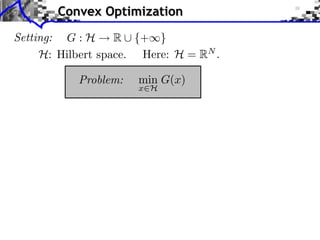
Setting: G : H     R ⇤ {+⇥}
     H: Hilbert space. Here: H = RN .

           Problem:   min G(x)
                      x H
Convex Optimization
Setting: G : H     R ⇤ {+⇥}
     H: Hilbert space. Here: H = RN .

           Problem:    min G(x)
                       x H

Class of functions:                            x         y
  Convex: G(tx + (1   t)y)   tG(x) + (1   t)G(y)   t   [0, 1]
Convex Optimization
Setting: G : H     R ⇤ {+⇥}
     H: Hilbert space. Here: H = RN .

           Problem:    min G(x)
                       x H

Class of functions:                              x         y
  Convex: G(tx + (1   t)y)   tG(x) + (1     t)G(y)   t   [0, 1]

  Lower semi-continuous:     lim inf G(x)   G(x0 )
                             x   x0

  Proper: {x ⇥ H  G(x) ⇤= + } = ⌅
                               ⇤
Convex Optimization
Setting: G : H     R ⇤ {+⇥}
     H: Hilbert space. Here: H = RN .

             Problem:     min G(x)
                          x H

Class of functions:                                 x         y
  Convex: G(tx + (1     t)y)    tG(x) + (1     t)G(y)   t   [0, 1]

  Lower semi-continuous:        lim inf G(x)   G(x0 )
                                x   x0

  Proper: {x ⇥ H  G(x) ⇤= + } = ⌅
                               ⇤

                                0 if x ⇥ C,
Indicator:        C (x)   =
                                +    otherwise.
   (C closed and convex)
1
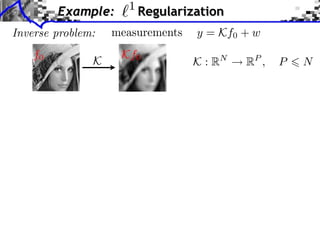
         Example:        Regularization
Inverse problem:   measurements   y = Kf0 + w
    f0              Kf0
               K                  K : RN   RP ,   P   N
1
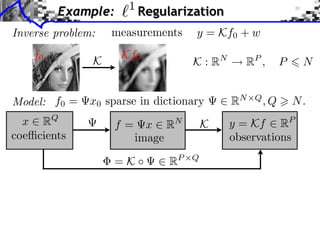
         Example:         Regularization
Inverse problem:   measurements      y = Kf0 + w
    f0               Kf0
               K                     K : RN      RP ,       P    N


Model: f0 =    x0 sparse in dictionary        RN   Q
                                                       ,Q       N.
  x RQ              f=     x R   N
                                         K    y = Kf RP
coe cients               image                observations

                   = K ⇥ ⇥ RP        Q
1
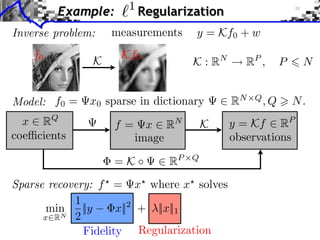
         Example:         Regularization
Inverse problem:   measurements      y = Kf0 + w
    f0               Kf0
               K                     K : RN      RP ,       P    N


Model: f0 =    x0 sparse in dictionary        RN   Q
                                                       ,Q       N.
  x RQ              f=     x R   N
                                         K    y = Kf RP
coe cients               image                observations

                   = K ⇥ ⇥ RP        Q


Sparse recovery: f = x where x solves
            1
       min    ||y     x||2 + ||x||1
      x RN 2
               Fidelity Regularization
1
         Example:          Regularization
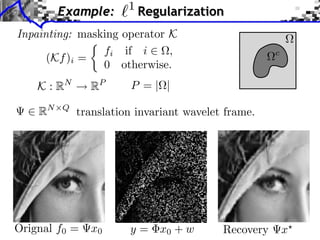
Inpainting: masking operator K
                fi if i      ,                       c
      (Kf )i =
                0 otherwise.
    K : RN     RP       P =| |

    RN   Q
             translation invariant wavelet frame.


Orignal f0 =   x0      y = x0 + w         Recovery       x
Overview
• Subdifferential Calculus

• Proximal Calculus

• Forward Backward

• Douglas Rachford

• Generalized Forward-Backward

• Duality
Sub-differential

Sub-di erential:
      G(x) = {u ⇥ H  ⇤ z, G(z)   G(x) + ⌅u, z   x⇧}
                                             G(x) = |x|


                                             G(0) = [ 1, 1]
Sub-differential

Sub-di erential:
      G(x) = {u ⇥ H  ⇤ z, G(z)       G(x) + ⌅u, z   x⇧}
                                                 G(x) = |x|
Smooth functions:
     If F is C 1 , F (x) = { F (x)}

                                                 G(0) = [ 1, 1]
Sub-differential

Sub-di erential:
        G(x) = {u ⇥ H  ⇤ z, G(z)     G(x) + ⌅u, z   x⇧}
                                                 G(x) = |x|
Smooth functions:
     If F is C 1 , F (x) = { F (x)}

                                                 G(0) = [ 1, 1]
First-order conditions:
    x      argmin G(x)        0     G(x )
            x H
Sub-differential

Sub-di erential:
        G(x) = {u ⇥ H  ⇤ z, G(z)          G(x) + ⌅u, z   x⇧}
                                                      G(x) = |x|
Smooth functions:
     If F is C 1 , F (x) = { F (x)}

                                                      G(0) = [ 1, 1]
First-order conditions:
    x      argmin G(x)            0       G(x )
             x H                                                U (x)

                                                                    x
Monotone operator:        U (x) = G(x)
        (u, v)   U (x)   U (y),       y   x, v    u   0
1
         Example:              Regularization
                      1
     x ⇥ argmin G(x) = ||y                   x||2 + ||x||1
          x RQ        2
⇥G(x) =           ( x   y) + ⇥|| · ||1 (x)
                    sign(xi ) if xi ⇥= 0,
|| · ||1 (x)i =
                    [ 1, 1] if xi = 0.
1
           Example:              Regularization
                        1
       x ⇥ argmin G(x) = ||y                   x||2 + ||x||1
            x RQ        2
 ⇥G(x) =            ( x   y) + ⇥|| · ||1 (x)
                      sign(xi ) if xi ⇥= 0,             xi
  || · ||1 (x)i =
                      [ 1, 1] if xi = 0.
                                                               i
Support of the solution:
 I = {i ⇥ {0, . . . , N 1}  xi ⇤= 0}
1
           Example:               Regularization
                        1
       x ⇥ argmin G(x) = ||y                    x||2 + ||x||1
            x RQ        2
 ⇥G(x) =            ( x    y) + ⇥|| · ||1 (x)
                      sign(xi ) if xi ⇥= 0,              xi
  || · ||1 (x)i =
                      [ 1, 1] if xi = 0.
                                                                        i
Support of the solution:
 I = {i ⇥ {0, . . . , N 1}  xi ⇤= 0}

First-order conditions:                                    i,   y   x
                                                                        i
  s    RN ,          ( x      y) + s = 0
                      sI = sign(xI ),
                      ||sI c || 1.
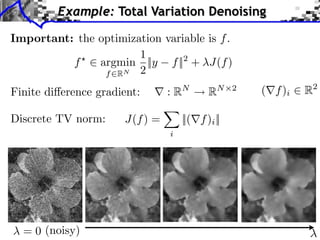
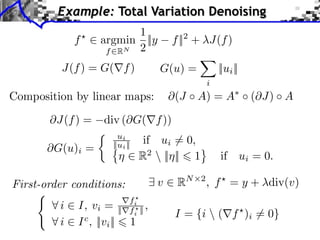
Example: Total Variation Denoising

Important: the optimization variable is f .
                       1
          f ⇥ argmin ||y f ||2 + J(f )
                f RN 2

Finite di erence gradient:      :R   N
                                            R   N 2   ( f )i   R2

Discrete TV norm:     J(f ) =        ||( f )i ||
                                i


  = 0 (noisy)
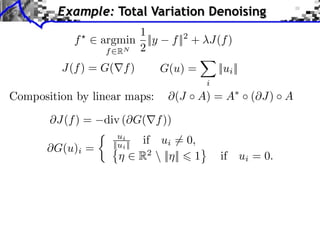
Example: Total Variation Denoising
                      1
            f ⇥ argmin ||y         f ||2 + J(f )
                 f RN 2

         J(f ) = G( f )          G(u) =         ||ui ||
                                            i
Composition by linear maps:         (J    A) = A          ( J) A

        J(f ) =   div ( G( f ))
                     ui
                              if ui ⇥= 0,
       ⇥G(u)i =    ||ui ||
                             R2  || || 1       if ui = 0.
Example: Total Variation Denoising
                       1
             f ⇥ argmin ||y                   f ||2 + J(f )
                  f RN 2

          J(f ) = G( f )                   G(u) =             ||ui ||
                                                          i
Composition by linear maps:                   (J    A) = A              ( J) A

         J(f ) =      div ( G( f ))
                           ui
                                        if ui ⇥= 0,
       ⇥G(u)i =          ||ui ||
                                       R2  || || 1           if ui = 0.

First-order conditions:                   v    RN     2
                                                          , f = y + div(v)
                                fi
        ⇥i   I, vi =         || fi || ,
                                              I = {i  (⇥f )i = 0}
        ⇥i   I c , ||vi ||         1
Overview
• Subdifferential Calculus

• Proximal Calculus

• Forward Backward

• Douglas Rachford

• Generalized Forward-Backward

• Duality
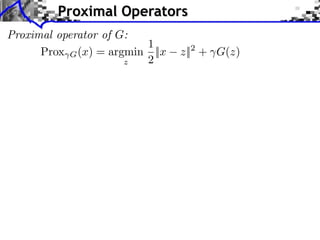
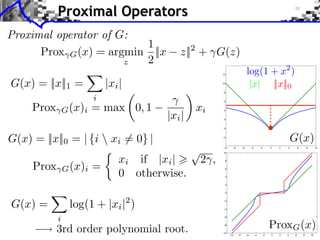
Proximal Operators
Proximal operator of G:
                         1
      Prox G (x) = argmin ||x   z||2 + G(z)
                      z  2
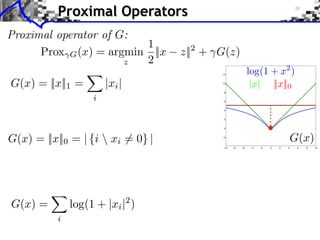
Proximal Operators
Proximal operator of G:
                         1
      Prox G (x) = argmin ||x      z||2 + G(z)
                      z  2
                                          12              log(1 + x2 )
G(x) = ||x||1 =        |xi |              10
                                                           |x| ||x||0
                                           8


                   i                       6


                                           4


                                           2


                                           0


G(x) = ||x||0 = | {i  xi = 0} |          −2
                                                                                 G(x)
                                          −10   −8   −6    −4   −2   0   2   4    6   8   10


G(x) =        log(1 + |xi |2 )
          i
Proximal Operators
Proximal operator of G:
                         1
      Prox G (x) = argmin ||x               z||2 + G(z)
                      z  2
                                                       12                     log(1 + x2 )
G(x) = ||x||1 =              |xi |                     10
                                                                               |x| ||x||0
                                                        8


                         i
     Prox       G (x)i   = max 0, 1
                                                        6


                                                 xi     4


                                         |xi |          2


                                                        0


G(x) = ||x||0 = | {i  xi = 0} |                       −2
                                                                                                               G(x)
                                                       −10     −8        −6        −4        −2    0   2   4       6       8        10


                                 xi if |xi |     2 ,
                                                        10


     Prox       G (x)i   =
                                                         8


                                 0 otherwise.
                                                         6


                                                         4


                                                         2


                                                         0


G(x) =           log(1 + |xi |2 )                      −2


                                                       −4


            i                                          −6


            3rd order polynomial root.
                                                       −8
                                                                                                   ProxG (x)
                                                       −10
                                                             −10    −8        −6        −4    −2   0   2   4   6       8       10
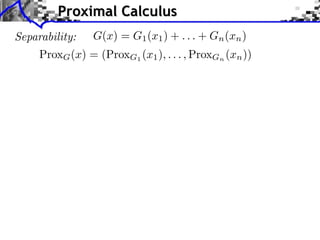
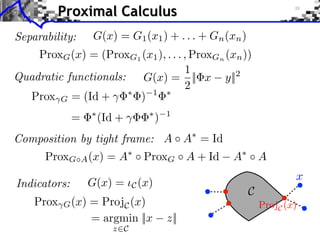
Proximal Calculus
Separability:    G(x) = G1 (x1 ) + . . . + Gn (xn )
     ProxG (x) = (ProxG1 (x1 ), . . . , ProxGn (xn ))
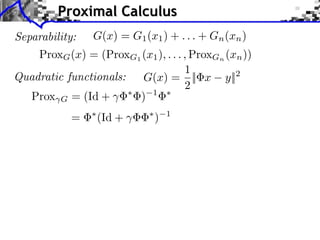
Proximal Calculus
Separability:    G(x) = G1 (x1 ) + . . . + Gn (xn )
    ProxG (x) = (ProxG1 (x1 ), . . . , ProxGn (xn ))
                                     1
Quadratic functionals:  G(x) = || x y||2
                                     2
  Prox G = (Id +       ) 1
            =     (Id +       )   1
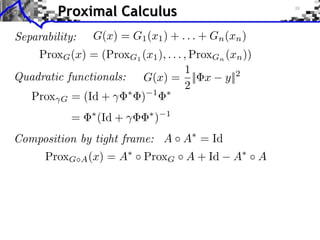
Proximal Calculus
Separability:     G(x) = G1 (x1 ) + . . . + Gn (xn )
    ProxG (x) = (ProxG1 (x1 ), . . . , ProxGn (xn ))
                                     1
Quadratic functionals:  G(x) = || x y||2
                                     2
  Prox G = (Id +       ) 1
            =      (Id +       )   1


Composition by tight frame: A A = Id
      ProxG     A (x)   =A   ProxG A + Id        A     A
Proximal Calculus
Separability:       G(x) = G1 (x1 ) + . . . + Gn (xn )
    ProxG (x) = (ProxG1 (x1 ), . . . , ProxGn (xn ))
                                     1
Quadratic functionals:  G(x) = || x y||2
                                     2
  Prox G = (Id +       ) 1
              =      (Id +              )   1


Composition by tight frame: A A = Id
      ProxG       A (x)   =A      ProxG A + Id     A         A
                                                                     x
Indicators:        G(x) =       C (x)
                                                         C
    Prox   G (x)   = ProjC (x)                               ProjC (x)
                   = argmin ||x             z||
                          z C
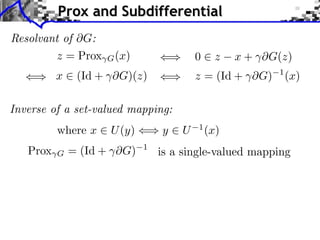
Prox and Subdifferential
Resolvant of G:
         z = Prox   G (x)               0     z   x + ⇥G(z)
          x    (Id + ⇥G)(z)             z = (Id + ⇥G)   1
                                                            (x)

Inverse of a set-valued mapping:
          where x   U (y)       y   U   1
                                            (x)
   Prox   G   = (Id + ⇥G)   1
                                is a single-valued mapping
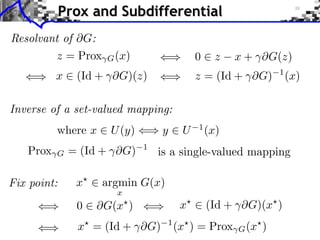
Prox and Subdifferential
Resolvant of G:
         z = Prox   G (x)                  0     z   x + ⇥G(z)
          x    (Id + ⇥G)(z)                z = (Id + ⇥G)       1
                                                                   (x)

Inverse of a set-valued mapping:
          where x    U (y)       y     U   1
                                               (x)
   Prox   G   = (Id + ⇥G)    1
                                 is a single-valued mapping

Fix point:     x    argmin G(x)
                      x
               0    G(x )              x       (Id + ⇥G)(x )
               x⇥ = (Id + ⇥G)     1
                                      (x⇥ ) = Prox   G (x⇥ )
Gradient and Proximal Descents
Gradient descent:   x( +1) = x( )   G(x( ) )       [explicit]
           G is C 1 and G is L-Lipschitz

     Theorem:   If 0 <   < 2/L, x(   )
                                         x a solution.
Gradient and Proximal Descents
Gradient descent:   x( +1) = x( )   G(x( ) )                      [explicit]
           G is C 1 and G is L-Lipschitz

     Theorem:   If 0 <     < 2/L, x(        )
                                                x a solution.

Sub-gradient descent: x(   +1)
                                 = x(   )
                                                v( ) ,   v(   )
                                                                    G(x( ) )

     Theorem:   If       1/⇥, x(   )
                                            x a solution.

           Problem: slow.
Gradient and Proximal Descents
Gradient descent:   x( +1) = x( )   G(x( ) )                             [explicit]
           G is C 1 and G is L-Lipschitz

     Theorem:    If 0 <      < 2/L, x(           )
                                                       x a solution.

Sub-gradient descent: x(    +1)
                                  = x(       )
                                                       v( ) ,   v(   )
                                                                           G(x( ) )

     Theorem:    If        1/⇥, x(   )
                                                 x a solution.

           Problem: slow.
Proximal-point algorithm: x(⇥+1) = Prox                   G (x(⇥) ) [implicit]

     Theorem:    If        c > 0, x(     )
                                                     x a solution.

                Prox   G   hard to compute.
Overview
• Subdifferential Calculus

• Proximal Calculus

• Forward Backward

• Douglas Rachford

• Generalized Forward-Backward

• Duality
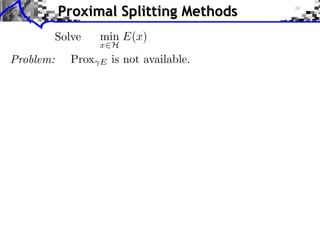
Proximal Splitting Methods
           Solve     min E(x)
                     x H
Problem:      Prox   E   is not available.
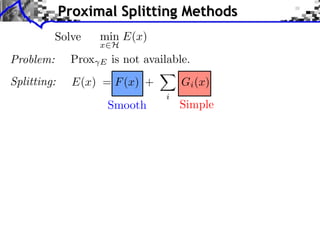
Proximal Splitting Methods
           Solve     min E(x)
                     x H
Problem:      Prox   E   is not available.
Splitting:    E(x) = F (x) +            Gi (x)
                                    i
                         Smooth         Simple
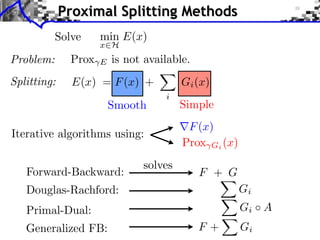
Proximal Splitting Methods
           Solve     min E(x)
                     x H
Problem:      Prox   E   is not available.
Splitting:    E(x) = F (x) +            Gi (x)
                                    i
                         Smooth         Simple
                                         F (x)
Iterative algorithms using:
                                        Prox Gi (x)
                               solves
   Forward-Backward:                         F + G
   Douglas-Rachford:                                  Gi
   Primal-Dual:                                       Gi A
   Generalized FB:                           F+       Gi
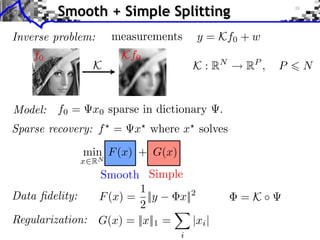
Smooth + Simple Splitting
Inverse problem:    measurements      y = Kf0 + w
    f0                Kf0
                K                     K : RN   RP ,   P   N


Model: f0 =     x0 sparse in dictionary    .
Sparse recovery: f =    x where x solves
              min F (x) + G(x)
             x RN
                Smooth Simple
                        1
Data fidelity:   F (x) = ||y     x||2           =K ⇥
                        2
Regularization: G(x) = ||x||1 =    |xi |
                                  i
Forward-Backward
Fix point equation:
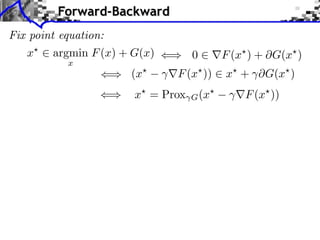
   x    argmin F (x) + G(x)        0       F (x ) + G(x )
           x
                      (x      F (x ))      x + ⇥G(x )
                       x⇥ = Prox   G (x⇥       F (x⇥ ))
Forward-Backward
Fix point equation:
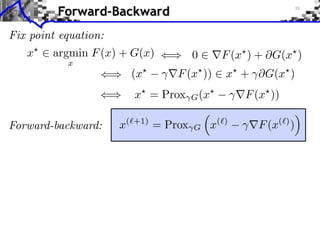
   x    argmin F (x) + G(x)           0       F (x ) + G(x )
           x
                        (x       F (x ))      x + ⇥G(x )
                        x⇥ = Prox     G (x⇥       F (x⇥ ))

Forward-backward:     x(⇥+1) = Prox   G   x(⇥)       F (x(⇥) )
Forward-Backward
Fix point equation:
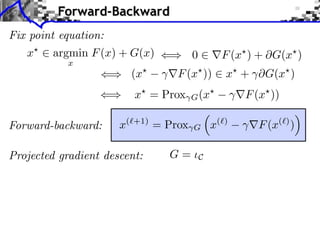
   x    argmin F (x) + G(x)           0         F (x ) + G(x )
           x
                        (x       F (x ))         x + ⇥G(x )
                         x⇥ = Prox    G (x⇥          F (x⇥ ))

Forward-backward:     x(⇥+1) = Prox   G       x(⇥)      F (x(⇥) )

Projected gradient descent:    G=         C
Forward-Backward
Fix point equation:
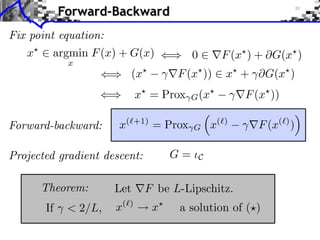
   x     argmin F (x) + G(x)               0         F (x ) + G(x )
             x
                           (x         F (x ))         x + ⇥G(x )
                               x⇥ = Prox   G (x⇥          F (x⇥ ))

Forward-backward:     x(⇥+1) = Prox        G       x(⇥)      F (x(⇥) )

Projected gradient descent:           G=       C


       Theorem:       Let       F be L-Lipschitz.
       If    < 2/L,   x(   )
                                  x   a solution of ( )
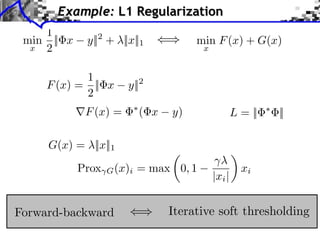
Example: L1 Regularization
    1
 min || x    y||2 + ||x||1             min F (x) + G(x)
  x 2                                    x


            1
     F (x) = || x      y||2
            2
             F (x) =        ( x   y)                 L = ||   ||

     G(x) = ||x||1
                                               ⇥
            Prox   G (x)i   = max 0, 1                 xi
                                             |xi |


Forward-backward                  Iterative soft thresholding
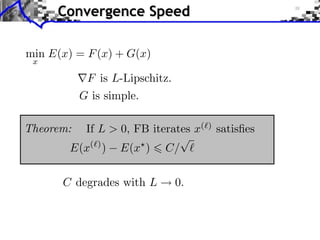
Convergence Speed

min E(x) = F (x) + G(x)
 x

            F is L-Lipschitz.
           G is simple.

Theorem:    If L > 0, FB iterates x(   )
                                           satisfies
        E(x( ) )   E(x )    C/

      C degrades with L         0.
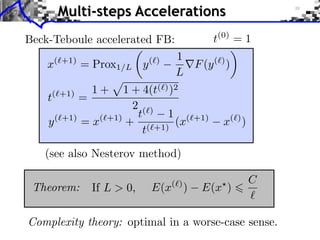
Multi-steps Accelerations
Beck-Teboule accelerated FB:        t(0) = 1
                     ✓                     ◆
      (`+1)             (`)  1
    x       = Prox1/L y        rF (y (`) )
                             L
             1+     1 + 4(t( ) )2
    t( +1) =
                      2()
                       t      1 (
    y ( +1)
            =x( +1)
                    + ( +1) (x         +1)
                                             x( ) )
                        t

   (see also Nesterov method)

                                                      C
 Theorem:    If L > 0,   E(x ( )
                                   )    E(x )


Complexity theory: optimal in a worse-case sense.
Overview
• Subdifferential Calculus

• Proximal Calculus

• Forward Backward

• Douglas Rachford

• Generalized Forward-Backward

• Duality
Douglas Rachford Scheme

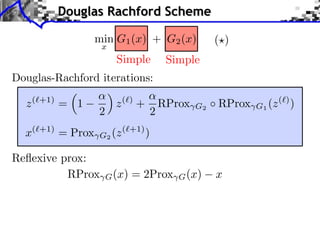
                  min G1 (x) + G2 (x)              ( )
                   x
                        Simple         Simple
Douglas-Rachford iterations:

  z (⇥+1) = 1           z (⇥) +       RProx   G2   RProx   G1 (z (⇥) )
                  2               2
  x(⇥+1) = Prox   G2 (z (⇥+1) )

Reflexive prox:
          RProx       G (x)   = 2Prox    G (x)     x
Douglas Rachford Scheme

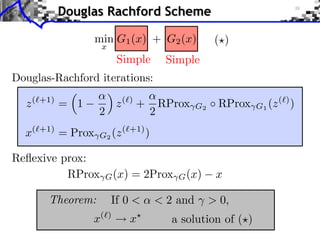
                  min G1 (x) + G2 (x)                 ( )
                   x
                           Simple         Simple
Douglas-Rachford iterations:

  z (⇥+1) = 1              z (⇥) +       RProx   G2   RProx    G1 (z (⇥) )
                  2                  2
  x(⇥+1) = Prox   G2 (z (⇥+1) )

Reflexive prox:
          RProx       G (x)   = 2Prox       G (x)     x

       Theorem:        If 0 <        < 2 and ⇥ > 0,
                x(     )
                              x            a solution of ( )
DR Fix Point Equation

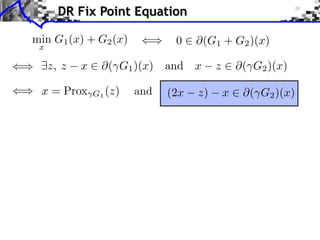
min G1 (x) + G2 (x)             0    (G1 + G2 )(x)
 x

     z, z   x    ⇥( G1 )(x) and x         z       ⇥( G2 )(x)

 x = Prox       G1 (z)   and   (2x   z)       x    ⇥( G2 )(x)
DR Fix Point Equation

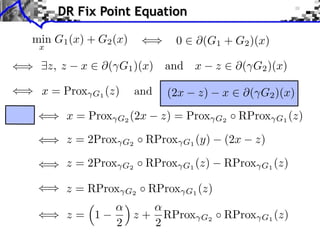
min G1 (x) + G2 (x)                        0       (G1 + G2 )(x)
 x

     z, z     x    ⇥( G1 )(x) and x                      z       ⇥( G2 )(x)

 x = Prox         G1 (z)        and       (2x     z)         x     ⇥( G2 )(x)
            x = Prox    G2 (2x        z) = Prox          G2      RProx    G1 (z)

            z = 2Prox      G2    RProx         G1 (y)        (2x     z)

            z = 2Prox      G2    RProx         G1 (z)        RProx    G1 (z)

        z = RProx          G2     RProx         G1 (z)

            z= 1            z+            RProx    G2        RProx    G1 (z)
                       2              2
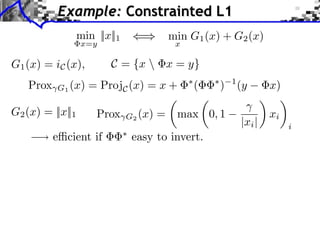
Example: Constrainted L1
                  min ||x||1                min G1 (x) + G2 (x)
                  x=y                        x

G1 (x) = iC (x),         C = {x  x = y}
   Prox   G1 (x) = ProjC (x) = x +
                                                 ⇥
                                                     (   ⇥
                                                             )   1
                                                                     (y      x)

G2 (x) = ||x||1       Prox     G2 (x)   =    max 0, 1                        xi
                                                                     |xi |        i
          e⇥cient if            easy to invert.
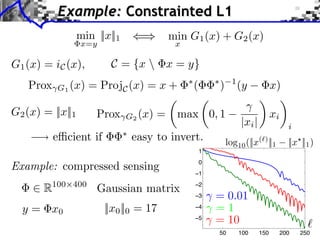
Example: Constrainted L1
                  min ||x||1                min G1 (x) + G2 (x)
                  x=y                        x

G1 (x) = iC (x),         C = {x  x = y}
   Prox   G1 (x) = ProjC (x) = x +
                                                 ⇥
                                                     (       ⇥
                                                                 )     1
                                                                           (y            x)

G2 (x) = ||x||1       Prox     G2 (x)   =    max 0, 1                                    xi
                                                                           |xi |                i
          e⇥cient if            easy to invert.                      log10 (||x( ) ||1          ||x ||1 )
                                                         1

Example: compressed sensing                          −1
                                                         0


       R100   400
                      Gaussian matrix                −2
                                                     −3      = 0.01
  y = x0                ||x0 ||0 = 17                −4      =1
                                                     −5
                                                             = 10
                                                                 50        100     150        200   250
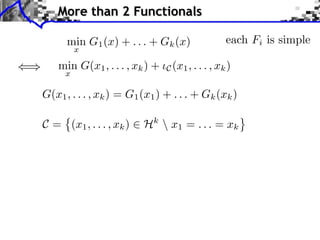
More than 2 Functionals

      min G1 (x) + . . . + Gk (x)                 each Fi is simple
         x

    min G(x1 , . . . , xk ) +   C (x1 , . . . , xk )
     x

G(x1 , . . . , xk ) = G1 (x1 ) + . . . + Gk (xk )

C = (x1 , . . . , xk )   Hk  x1 = . . . = xk
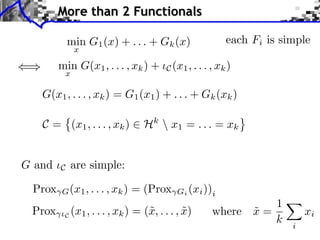
More than 2 Functionals

            min G1 (x) + . . . + Gk (x)                    each Fi is simple
             x

        min G(x1 , . . . , xk ) +        C (x1 , . . . , xk )
         x

   G(x1 , . . . , xk ) = G1 (x1 ) + . . . + Gk (xk )

   C = (x1 , . . . , xk )          Hk  x1 = . . . = xk


G and   C   are simple:

 Prox   G (x1 , . . . , xk )    = (Prox     Gi (xi ))i
                                                                 1
 Prox   ⇥C (x1 , . . . , xk )   = (˜, . . . , x)
                                   x          ˜        where x =
                                                             ˜              xi
                                                                 k      i
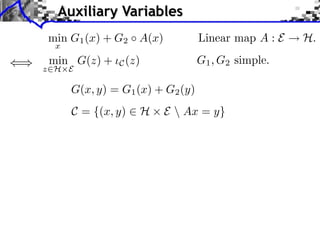
Auxiliary Variables
min G1 (x) + G2 A(x)              Linear map A : E   H.
  x
 min G(z) +    C (z)              G1 , G2 simple.
z⇥H E

      G(x, y) = G1 (x) + G2 (y)
      C = {(x, y) ⇥ H   E  Ax = y}
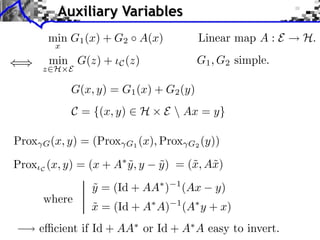
Auxiliary Variables
        min G1 (x) + G2 A(x)                Linear map A : E   H.
          x
        min G(z) +      C (z)               G1 , G2 simple.
       z⇥H E

              G(x, y) = G1 (x) + G2 (y)
              C = {(x, y) ⇥ H       E  Ax = y}

Prox   G (x, y)   = (Prox   G1 (x), Prox G2 (y))

Prox C (x, y) = (x + A y , y
                       ˜          y ) = (˜, A˜)
                                  ˜      x x

                    y = (Id + AA )
                    ˜                 1
                                          (Ax   y)
       where
                   x = (Id + A A)
                   ˜                  1
                                          (A y + x)
       e cient if Id + AA or Id + A A easy to invert.
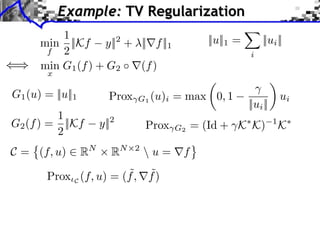
Example: TV Regularization
          1                                   ||u||1 =        ||ui ||
      min ||Kf y||2 + ||⇥f ||1
       f  2                                              i
      min G1 (f ) + G2 (f )
        x

G1 (u) = ||u||1      Prox   G1 (u)i    = max 0, 1                      ui
                                                         ||ui ||
         1
G2 (f ) = ||Kf     y||2         Prox        = (Id + K K)           1
                                                                       K
         2                             G2


C = (f, u) ⇥ RN       RN    2
                                 u = ⇤f
                         ˜ ˜
        Prox C (f, u) = (f , f )
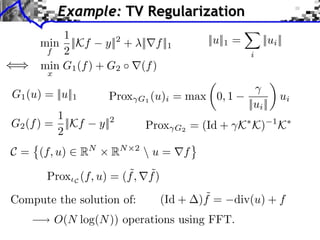
Example: TV Regularization
          1                                    ||u||1 =        ||ui ||
      min ||Kf y||2 + ||⇥f ||1
       f  2                                               i
      min G1 (f ) + G2 (f )
        x

G1 (u) = ||u||1       Prox   G1 (u)i    = max 0, 1                      ui
                                                          ||ui ||
         1
G2 (f ) = ||Kf      y||2         Prox        = (Id + K K)           1
                                                                        K
         2                              G2


C = (f, u) ⇥ RN        RN    2
                                  u = ⇤f
                         ˜ ˜
        Prox C (f, u) = (f , f )
Compute the solution of:           (Id +       ˜
                                              )f =   div(u) + f
            O(N log(N )) operations using FFT.
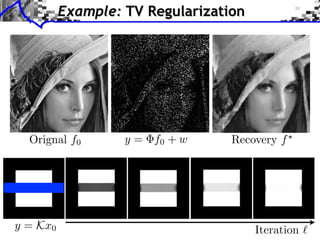
Example: TV Regularization


  Orignal f0       y = f0 + w     Recovery f


y = Kx0                                Iteration
Overview
• Subdifferential Calculus

• Proximal Calculus

• Forward Backward

• Douglas Rachford

• Generalized Forward-Backward

• Duality
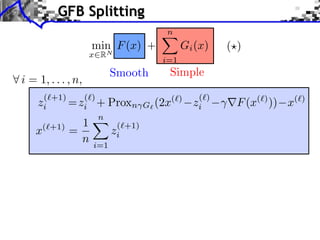
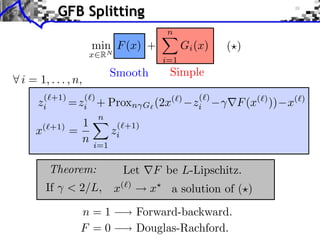
GFB Splitting
                                             n
                        min F (x) +               Gi (x)   ( )
                    x RN
                                            i=1
                              Smooth         Simple
i = 1, . . . , n,
     (⇥+1)    (⇥)                                    (⇥)
    zi     = zi +         Proxn        G   (2x
                                             (⇥)
                                                    zi       F (x(⇥) )) x(⇥)
                  n
              1                ( +1)
    x( +1)
             =                zi
                    n   i=1
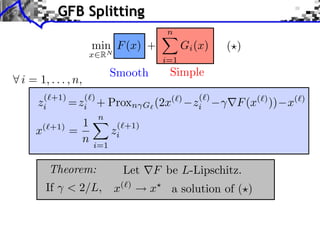
GFB Splitting
                                                 n
                        min F (x) +                    Gi (x)   ( )
                    x RN
                                                 i=1
                              Smooth              Simple
i = 1, . . . , n,
     (⇥+1)    (⇥)                                         (⇥)
    zi     = zi +         Proxn          G   (2x  (⇥)
                                                         zi       F (x(⇥) )) x(⇥)
                  n
              1                ( +1)
    x( +1)
              =               zi
                    n   i=1


        Theorem:                   Let       F be L-Lipschitz.
        If    < 2/L,          x(   )
                                             x     a solution of ( )
GFB Splitting
                                                 n
                        min F (x) +                    Gi (x)   ( )
                    x RN
                                                 i=1
                              Smooth              Simple
i = 1, . . . , n,
     (⇥+1)    (⇥)                                         (⇥)
    zi     = zi +         Proxn          G   (2x  (⇥)
                                                         zi       F (x(⇥) )) x(⇥)
                  n
              1                ( +1)
    x( +1)
              =               zi
                    n   i=1


        Theorem:                   Let       F be L-Lipschitz.
        If    < 2/L,          x(   )
                                             x     a solution of ( )

                  n=1                  Forward-backward.
                  F =0                 Douglas-Rachford.
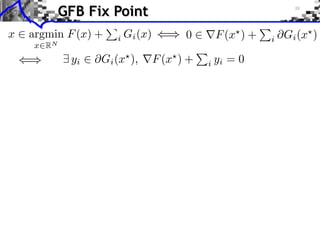
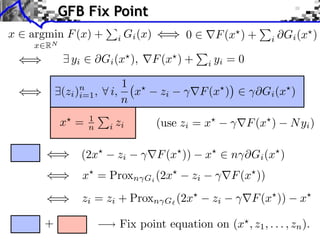
GFB Fix Point
x   argmin F (x) +   i   Gi (x)         0      F (x ) +   i   Gi (x )
    x RN
            yi   Gi (x ),         F (x ) +   i yi   =0
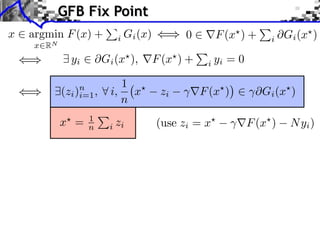
GFB Fix Point
x   argmin F (x) +       i   Gi (x)         0       F (x ) +       i   Gi (x )
    x RN
             yi       Gi (x ),        F (x ) +    i yi   =0

                         1
           (zi )n ,
                i=1    i, x            zi        F (x )        ⇥Gi (x )
                         n
           x =    1
                  n    i zi           (use zi = x             F (x )    N yi )
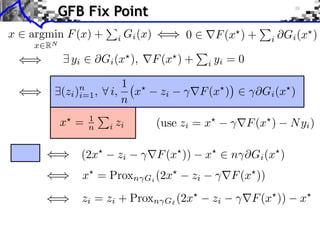
GFB Fix Point
x   argmin F (x) +         i   Gi (x)          0            F (x ) +        i   Gi (x )
    x RN
             yi         Gi (x ),        F (x ) +        i yi     =0

                           1
           (zi )n ,
                i=1      i, x            zi          F (x )            ⇥Gi (x )
                           n
           x =     1
                   n     i zi           (use zi = x                   F (x )      N yi )

                  (2x      zi           F (x ))         x        n ⇥Gi (x )
                  x⇥ = Proxn       Gi (2x⇥         zi            F (x⇥ ))
                  zi = zi + Proxn         G   (2x⇥          zi         F (x⇥ ))     x⇥
GFB Fix Point
x   argmin F (x) +         i   Gi (x)          0            F (x ) +        i   Gi (x )
    x RN
             yi         Gi (x ),        F (x ) +        i yi     =0

                           1
           (zi )n ,
                i=1      i, x            zi          F (x )            ⇥Gi (x )
                           n
           x =     1
                   n     i zi           (use zi = x                   F (x )      N yi )

                  (2x      zi           F (x ))         x        n ⇥Gi (x )
                  x⇥ = Proxn       Gi (2x⇥         zi            F (x⇥ ))
                  zi = zi + Proxn         G   (2x⇥          zi         F (x⇥ ))     x⇥

      +                    Fix point equation on (x , z1 , . . . , zn ).
Block Regularization
        1       2
                     block sparsity: G(x) =                 ||x[b] ||,          ||x[b] ||2 =         x2
                                                                                                      m
                                                      b B                                      m b

iments                            Towards More Complex Penalization
            (2)                 Bk
2
    +       ` 1 `2
                      4
                      k=1   x   1,2

                                                                                          b B1       i b xi
                                 ⇥ x⇥⇥1 =   i ⇥xi ⇥         b B          i   b xi2               +
                                                                                                     i b xi
              N: 256
                                                                                          b B2

                                            b     B


    Image f =            x Coe cients x.
Block Regularization
     1        2
                  block sparsity: G(x) =                    ||x[b] ||,      ||x[b] ||2 =          x2
                                                                                                   m
                                                      b B                                  m b

iments Towards More Complex Penalization
 Non-overlapping decomposition: B = B ... B
                  Towards More Complex Penalization
                Towards More Complex Penalization
                       n
                                                                     1               n

2     G(x) =4 x iBk
      (2)
    + ` ` k=1 G 1,2
                 (x)                        Gi (x) =           ||x[b] ||,
         1    2       i=1                              b Bi

                                                                                  b b 1b1 B1 i b xiixb xi
                                                                                                    22
                                                                                    BB
                            ⇥ x⇥x⇥x⇥⇥1 =i ⇥x⇥x⇥xi ⇥
                                  ⇥=                                                     ++ +
                                                                                               i b i
                               ⇥ ⇥1 ⇥1 = i i ⇥i i ⇥    bb B B i
                                                        Bb           xii2bi2xi2
                                                                   bbx
                                                                   i
             N: 256
                                                                                  b b 2b2 B2 i
                                                                                    BB             xi2 b2xi
                                                                                                 b b xi
                                                                                                 i

                                           b      B


    Image f =              x Coe cients x.             Blocks B1                    B1       B2
Block Regularization
     1        2
                  block sparsity: G(x) =             ||x[b] ||,      ||x[b] ||2 =           x2
                                                                                             m
                                               b B                                  m b

iments Towards More Complex Penalization
 Non-overlapping decomposition: B = B ... B
                  Towards More Complex Penalization
                Towards More Complex Penalization
                       n
                                                              1               n

2     G(x) =4 x iBk
      (2)
    + ` ` k=1 G 1,2
                 (x)                 Gi (x) =           ||x[b] ||,
         1    2       i=1                        b Bi
    Each Gi is simple:                                                    b b 1b1 B1 i b xiixb xi
                                                                            BB
                                                                                            22

                   ⇥ x⇥x⇥x⇥⇥1 =i ⇥xG ⇥xi ⇥ m = b B B i b xii2bi2xi2
                        ⇥ ⇥1 = i ⇥i i                                                x +
                                                                                       i b i
     ⇤ m ⇥ b ⇥ Bi , ⇥ ⇥1Prox i ⇥xi ⇥(x) b max i0, 1
                           =                   Bb        bx                         ++m
             N: 256                                                    ||x[b]b||B            xi2 b2xi
                                                                              2 2 B2
                                                                          b B b        i   b b xi
                                                                                           i

                                    b    B


    Image f =              x Coe cients x.       Blocks B1                   B1        B2
Deconv. + Inpaint. 2min+CP Y ⇥ P K x CP Y + P 1 K2
                   Deconv. x 2Inpaint. min 2 ⇥ ` `
                                            x                                                                                                  x
                                                                                                                                             k=1    x+1,2`          k=1
          log10(E−E
          2                                                                                                                                                1   `2
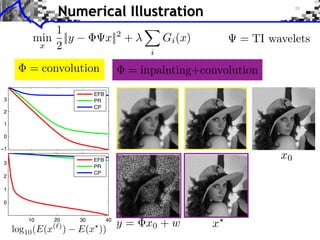
                                        Numerical Illustration


                                                 log10(E−
                             1
                                  Numerical Experiments Experiments
                                    1
                                              Numerical                       1


                                                                                                                                            TI (2)`2 4
                                                                              0

                  ||y x 1 ⇥x||368s PRx 2 minix(x)Y ⇥ K                                                                                   x= + `wavelets x
                                                                                                                                       Bk 2
                             0
            : 283s; tPR: 298s; tCP:: 283s; t : 298s; t (2)
  Deconvolution min 2 Y ⇥ K
         tmin
      −1 EFB
           x 102
                            Deconvolution +GCP: 1` 4
                           −1
                               tEFB 2 +
                                      10 40   20
                                                           368s
                                                      30 1 2 2 40k=1
                                                       `
                                                                                                                                   x   1,2      1    k=1
                       20        30
       3           iteration 3
                             #                   i
                                      EFB iteration #       EFB
             log10(E−Emin)


                                                              log10(E−Emin)
                                                                                          PR                           PR
                             2   = convolution
                                             2   = inpainting+convolution l1/l2
                                                                       l1/l2
                                                                            : 1.30e−03;   CPλ2 : 1.30e−03;             CP 2
                                                                                                                         λ
                      tPR: 173s; tCP 190s noise: 0.025; convol.::it. #50; SNR: 22.49dB #50; SNR: 22.49dB
                                        tEFB: 161s; tPR: 173s; tCP N: 256
          tEFB: 161s; noise: 0.025; :convol.: 2                     190s
                             1
                                  Numerical Experiments            2          1

                                                                              EFB
                                                                                        it.     N: 256
                                                                                                                       EFB
                                                                                                                        (4)                  Bk
                                                                                  Y ⇥P K                           +
                             0                                                0
                                                  log10(E−Emin)

      3                                                                        3
                                                                              1
                                                                              PR
                                                                                                               2       PR          16
 onv. + Inpaint. minx
  2
                                                                              CP
                                                                              2 30
                                                                               2
                                                                                                          x            CP
                                                                                                                        `140`2     k=1   x   1,2
                                      10          20                                      10    40   20        30
      1                                     iteration #
                                                      1                                         iteration #
      0                                                                       0                                         λ4 : 1.00e−03;             λ4 : 1.00e−03;
                                                                                                                         l1/l2                      l1/l2
     tEFB: 283s; tPR: 298s; tCP: 368s
  −1      noise: 0.025; degrad.: 0.4; 0.025; degrad.: 0.4; convol.: 2
                                noise: convol.: 2
                                 −1                         it. #50; SNR: 21.80dB #50; SNR: 21.80dB
                                                                                it.
                             10        20
                                   iteration #
                                                     30
                                                                              EFB
                                                                                    40     10        20
                                                                                                 iteration #
                                                                                                                30            40                         x0
      3
                                                                              PR
min


      2
                                                                              CP
                                                                                                              λ2     : 1.30e−03;                   λ2 : 1.30e−03;
                                                                                                               l1/l2                                l1/l2
      1               noise: 0.025; convol.: 2                                           noise: 0.025; it. #50; SNR: 22.49dB
                                                                                                       convol.: 2                             it. #50; SNR: 22.49dB
10


      0


           log10
                             10        20
                                 (E(x( ) ) #
                                   iteration
                                                    30
                                                  E(x ))
                                                         y = x0 + w                 40
                                                                                                                                   x
                                                                                                               4
Overview
• Subdifferential Calculus

• Proximal Calculus

• Forward Backward

• Douglas Rachford

• Generalized Forward-Backward

• Duality
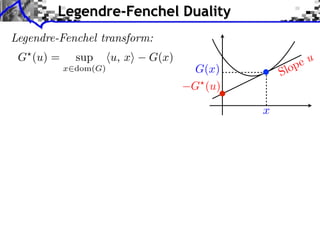
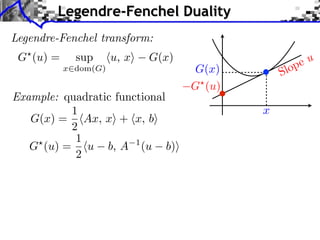
Legendre-Fenchel Duality
Legendre-Fenchel transform:
 G (u) =     sup      u, x   G(x)                     eu
           x dom(G)                 G(x)        S lop
                                    G (u)

                                            x
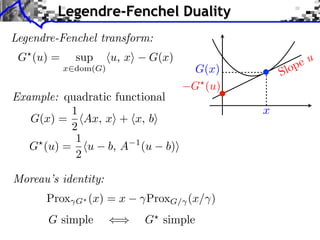
Legendre-Fenchel Duality
Legendre-Fenchel transform:
 G (u) =     sup      u, x   G(x)                     eu
           x dom(G)                 G(x)        S lop
                                    G (u)
Example: quadratic functional
          1                                 x
   G(x) = Ax, x + x, b
          2
           1
   G (u) = u b, A 1 (u b)
           2
Legendre-Fenchel Duality
Legendre-Fenchel transform:
 G (u) =     sup      u, x   G(x)                     eu
           x dom(G)                 G(x)        S lop
                                    G (u)
Example: quadratic functional
          1                                 x
   G(x) = Ax, x + x, b
          2
           1
   G (u) = u b, A 1 (u b)
           2

Moreau’s identity:
      Prox   G   (x) = x     ProxG/ (x/ )
       G simple              G simple
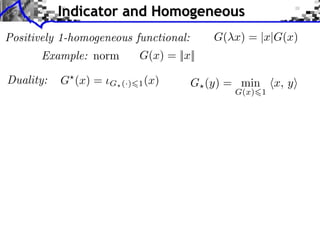
Indicator and Homogeneous
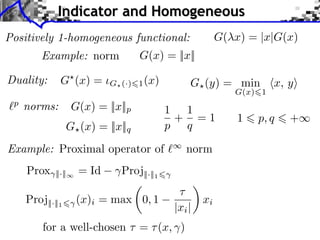
Positively 1-homogeneous functional:      G( x) = |x|G(x)
       Example: norm       G(x) = ||x||

Duality:   G (x) =   G (·) 1 (x)       G (y) = min     x, y
                                              G(x) 1
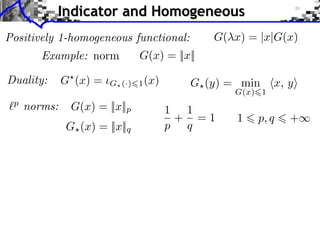
Indicator and Homogeneous
Positively 1-homogeneous functional:          G( x) = |x|G(x)
        Example: norm          G(x) = ||x||

Duality:      G (x) =   G (·) 1 (x)      G (y) = min      x, y
                                                 G(x) 1
 p
     norms:    G(x) = ||x||p          1 1
                                       + =1       1   p, q   +
              G (x) = ||x||q          p q
Indicator and Homogeneous
Positively 1-homogeneous functional:                     G( x) = |x|G(x)
         Example: norm               G(x) = ||x||

Duality:       G (x) =       G (·) 1 (x)        G (y) = min          x, y
                                                            G(x) 1
 p
     norms:          G(x) = ||x||p          1 1
                                             + =1            1   p, q   +
                  G (x) = ||x||q            p q

Example: Proximal operator of                  norm
     Prox    ||·||    = Id     Proj||·||1

     Proj||·||1       (x)i = max 0, 1               xi
                                            |xi |
         for a well-chosen ⇥ = ⇥ (x, )
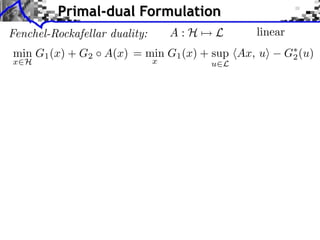
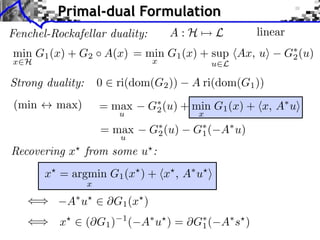
Primal-dual Formulation
Fenchel-Rockafellar duality:       A:H⇥   L     linear
min G1 (x) + G2 A(x) = min G1 (x) + sup hAx, ui      G⇤ (u)
                                                      2
x2H                            x          u2L
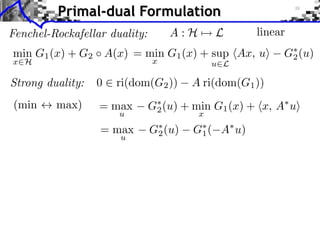
Primal-dual Formulation
Fenchel-Rockafellar duality:       A:H⇥        L       linear
min G1 (x) + G2 A(x) = min G1 (x) + sup hAx, ui             G⇤ (u)
                                                             2
x2H                            x           u2L

Strong duality:   0 2 ri(dom(G2 ))      A ri(dom(G1 ))
(min $ max)       = max        G⇤ (u) + min G1 (x) + hx, A⇤ ui
                                2
                      u                  x

                  = max        G⇤ (u)
                                2       G⇤ (
                                          1    A⇤ u)
                      u
Primal-dual Formulation
Fenchel-Rockafellar duality:        A:H⇥        L       linear
min G1 (x) + G2 A(x) = min G1 (x) + sup hAx, ui              G⇤ (u)
                                                              2
x2H                             x           u2L

Strong duality:       0 2 ri(dom(G2 ))   A ri(dom(G1 ))
(min $ max)           = max     G⇤ (u) + min G1 (x) + hx, A⇤ ui
                                 2
                          u               x

                      = max     G⇤ (u)
                                 2       G⇤ (
                                           1    A⇤ u)
                          u
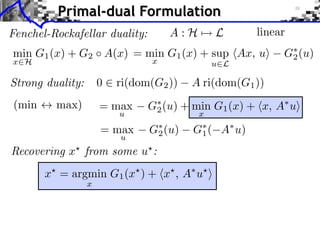
Recovering x? from some u? :
       x? = argmin G1 (x? ) + hx? , A⇤ u? i
                  x
Primal-dual Formulation
Fenchel-Rockafellar duality:            A:H⇥       L       linear
min G1 (x) + G2 A(x) = min G1 (x) + sup hAx, ui                 G⇤ (u)
                                                                 2
x2H                                 x           u2L

Strong duality:       0 2 ri(dom(G2 ))      A ri(dom(G1 ))
(min $ max)           = max        G⇤ (u) + min G1 (x) + hx, A⇤ ui
                                    2
                          u                  x

                      = max        G⇤ (u)
                                    2       G⇤ (
                                              1    A⇤ u)
                          u
Recovering x? from some u? :
       x? = argmin G1 (x? ) + hx? , A⇤ u? i
                  x

   ()      A⇤ u? 2 @G1 (x? )
   () x? 2 (@G1 )          1
                               ( A⇤ u? ) = @G⇤ ( A⇤ s? )
                                             1
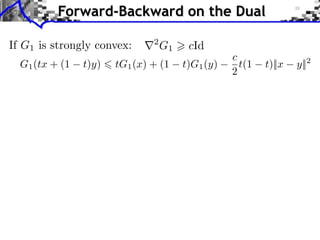
Forward-Backward on the Dual

If G1 is strongly convex:    r2 G1 > cId
                                                 c
  G1 (tx + (1   t)y) 6 tG1 (x) + (1   t)G1 (y)     t(1   t)||x   y||2
                                                 2
Forward-Backward on the Dual

If G1 is strongly convex:     r2 G1 > cId
                                                 c
  G1 (tx + (1   t)y) 6 tG1 (x) + (1   t)G1 (y)     t(1   t)||x   y||2
                                                 2
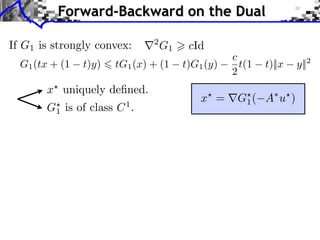
       x? uniquely defined.
                                          x? = rG? ( A⇤ u? )
                                                 1
       G? is of class C 1 .
        1
Forward-Backward on the Dual

If G1 is strongly convex:         r2 G1 > cId
                                                    c
  G1 (tx + (1   t)y) 6 tG1 (x) + (1      t)G1 (y)     t(1   t)||x   y||2
                                                    2
       x? uniquely defined.
                                             x? = rG? ( A⇤ u? )
                                                    1
       G? is of class C 1 .
        1

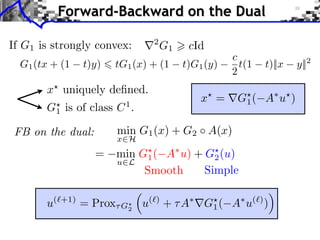
 FB on the dual:       min G1 (x) + G2 A(x)
                       x2H
                   =   min G? ( A⇤ u) + G? (u)
                             1            2
                       u2L
                            Smooth      Simple
                              ⇣                             ⌘
       u(`+1) = Prox⌧ G? u(`) + ⌧ A⇤ rG? ( A⇤ u(`) )
                       2               1
Example: TV Denoising
       1
   min ||f      y||2 + ||⇥f ||1              min ||y + div(u)||2
  f RN 2                                   ||u||

             ||u||1 =       ||ui ||        ||u||    = max ||ui ||
                                                        i
                        i
Dual solution u                   Primal solution f = y + div(u )

                                                   [Chambolle 2004]
Example: TV Denoising
       1
   min ||f         y||2 + ||⇥f ||1               min ||y + div(u)||2
  f RN 2                                       ||u||

                ||u||1 =        ||ui ||        ||u||    = max ||ui ||
                                                            i
                            i
Dual solution u                       Primal solution f = y + div(u )

FB (aka projected gradient descent):                   [Chambolle 2004]

   u(   +1)
              = Proj||·||          u( ) +    (y + div(u( ) ))
                                     ui
  v = Proj||·||  (u)      vi =
                               max(||ui ||/ , 1)
                             2      1
  Convergence if     <           =
                       ||div ⇥||    4
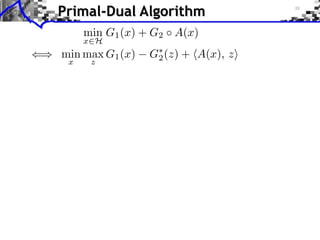
Primal-Dual Algorithm
          min G1 (x) + G2 A(x)
          x H
() min max G1 (x)    G⇤ (z) + hA(x), zi
                      2
      x    z
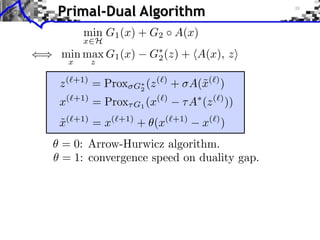
Primal-Dual Algorithm
          min G1 (x) + G2 A(x)
          x H
() min max G1 (x)            G⇤ (z) + hA(x), zi
                              2
      x        z

    z (`+1) = Prox      G⇤
                         2
                             (z (`) + A(˜(`) )
                                        x
    x(⇥+1) = Prox       G1 (x(⇥)          A (z (⇥) ))
    ˜
    x(   +1)
               = x(   +1)
                            + (x(   +1)
                                             x( ) )
    = 0: Arrow-Hurwicz algorithm.
    = 1: convergence speed on duality gap.
Primal-Dual Algorithm
             min G1 (x) + G2 A(x)
             x H
() min max G1 (x)             G⇤ (z) + hA(x), zi
                               2
         x     z

    z (`+1) = Prox       G⇤
                          2
                              (z (`) + A(˜(`) )
                                         x
    x(⇥+1) = Prox        G1 (x(⇥)         A (z (⇥) ))
    ˜
    x(   +1)
               = x(   +1)
                            + (x(   +1)
                                             x( ) )
     = 0: Arrow-Hurwicz algorithm.
     = 1: convergence speed on duality gap.

  Theorem: [Chambolle-Pock 2011]
     If 0             1 and ⇥⇤ ||A||2 < 1 then
    x(   )
               x minimizer of G1 + G2 A.
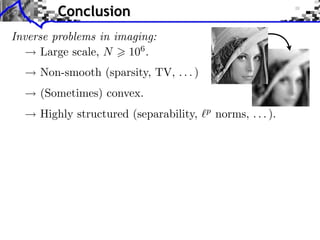
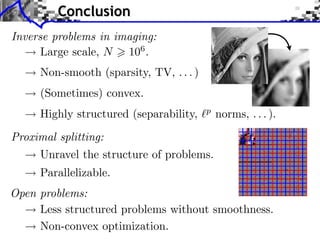
Conclusion
Inverse problems in imaging:
      Large scale, N 106 .
     Non-smooth (sparsity, TV, . . . )
     (Sometimes) convex.
     Highly structured (separability,    p
                                             norms, . . . ).
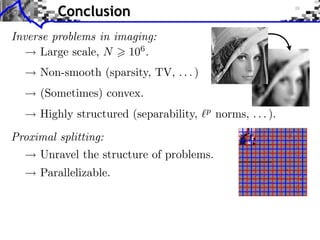
Conclusion
Inverse problems in imaging:
      Large scale, N 106 .
                 Towards More Complex Penalization
     Non-smooth (sparsity, TV, . . . )
     (Sometimes) convex.                                  b B1       i b xi
                                                                           2

                ⇥ x⇥⇥1 =   i ⇥xi ⇥    b B
                                                 2
                                            i p xi               +
     Highly structured (separability,          b
                                                norms, . . . ).
                                                          b B2       i   b xi2
Proximal splitting:
     Unravel the structure of problems.
     Parallelizable.


                               Decomposition G =     k   Gk
Conclusion
Inverse problems in imaging:
      Large scale, N 106 .
                 Towards More Complex Penalization
     Non-smooth (sparsity, TV, . . . )
     (Sometimes) convex.                               b B1       i b xi
                                                                        2

                ⇥ x⇥⇥1 =   i ⇥xi ⇥   b B
                                                2
                                           i p xi             +
     Highly structured (separability,         b
                                               norms, . . . ).
                                                       b B2       i   b xi2
Proximal splitting:
     Unravel the structure of problems.
     Parallelizable.
Open problems:
                        Decomposition G = k Gk
     Less structured problems without smoothness.
     Non-convex optimization.

Signal Processing Course : Convex Optimization

  • 1.
    Convex Optimization for Imaging Gabriel Peyré www.numerical-tours.com
  • 2.
    Convex Optimization Setting: G: H R ⇤ {+⇥} H: Hilbert space. Here: H = RN . Problem: min G(x) x H
  • 3.
    Convex Optimization Setting: G: H R ⇤ {+⇥} H: Hilbert space. Here: H = RN . Problem: min G(x) x H Class of functions: x y Convex: G(tx + (1 t)y) tG(x) + (1 t)G(y) t [0, 1]
  • 4.
    Convex Optimization Setting: G: H R ⇤ {+⇥} H: Hilbert space. Here: H = RN . Problem: min G(x) x H Class of functions: x y Convex: G(tx + (1 t)y) tG(x) + (1 t)G(y) t [0, 1] Lower semi-continuous: lim inf G(x) G(x0 ) x x0 Proper: {x ⇥ H G(x) ⇤= + } = ⌅ ⇤
  • 5.
    Convex Optimization Setting: G: H R ⇤ {+⇥} H: Hilbert space. Here: H = RN . Problem: min G(x) x H Class of functions: x y Convex: G(tx + (1 t)y) tG(x) + (1 t)G(y) t [0, 1] Lower semi-continuous: lim inf G(x) G(x0 ) x x0 Proper: {x ⇥ H G(x) ⇤= + } = ⌅ ⇤ 0 if x ⇥ C, Indicator: C (x) = + otherwise. (C closed and convex)
  • 6.
    1 Example: Regularization Inverse problem: measurements y = Kf0 + w f0 Kf0 K K : RN RP , P N
  • 7.
    1 Example: Regularization Inverse problem: measurements y = Kf0 + w f0 Kf0 K K : RN RP , P N Model: f0 = x0 sparse in dictionary RN Q ,Q N. x RQ f= x R N K y = Kf RP coe cients image observations = K ⇥ ⇥ RP Q
  • 8.
    1 Example: Regularization Inverse problem: measurements y = Kf0 + w f0 Kf0 K K : RN RP , P N Model: f0 = x0 sparse in dictionary RN Q ,Q N. x RQ f= x R N K y = Kf RP coe cients image observations = K ⇥ ⇥ RP Q Sparse recovery: f = x where x solves 1 min ||y x||2 + ||x||1 x RN 2 Fidelity Regularization
  • 9.
    1 Example: Regularization Inpainting: masking operator K fi if i , c (Kf )i = 0 otherwise. K : RN RP P =| | RN Q translation invariant wavelet frame. Orignal f0 = x0 y = x0 + w Recovery x
  • 10.
    Overview • Subdifferential Calculus •Proximal Calculus • Forward Backward • Douglas Rachford • Generalized Forward-Backward • Duality
  • 11.
    Sub-differential Sub-di erential: G(x) = {u ⇥ H ⇤ z, G(z) G(x) + ⌅u, z x⇧} G(x) = |x| G(0) = [ 1, 1]
  • 12.
    Sub-differential Sub-di erential: G(x) = {u ⇥ H ⇤ z, G(z) G(x) + ⌅u, z x⇧} G(x) = |x| Smooth functions: If F is C 1 , F (x) = { F (x)} G(0) = [ 1, 1]
  • 13.
    Sub-differential Sub-di erential: G(x) = {u ⇥ H ⇤ z, G(z) G(x) + ⌅u, z x⇧} G(x) = |x| Smooth functions: If F is C 1 , F (x) = { F (x)} G(0) = [ 1, 1] First-order conditions: x argmin G(x) 0 G(x ) x H
  • 14.
    Sub-differential Sub-di erential: G(x) = {u ⇥ H ⇤ z, G(z) G(x) + ⌅u, z x⇧} G(x) = |x| Smooth functions: If F is C 1 , F (x) = { F (x)} G(0) = [ 1, 1] First-order conditions: x argmin G(x) 0 G(x ) x H U (x) x Monotone operator: U (x) = G(x) (u, v) U (x) U (y), y x, v u 0
  • 15.
    1 Example: Regularization 1 x ⇥ argmin G(x) = ||y x||2 + ||x||1 x RQ 2 ⇥G(x) = ( x y) + ⇥|| · ||1 (x) sign(xi ) if xi ⇥= 0, || · ||1 (x)i = [ 1, 1] if xi = 0.
  • 16.
    1 Example: Regularization 1 x ⇥ argmin G(x) = ||y x||2 + ||x||1 x RQ 2 ⇥G(x) = ( x y) + ⇥|| · ||1 (x) sign(xi ) if xi ⇥= 0, xi || · ||1 (x)i = [ 1, 1] if xi = 0. i Support of the solution: I = {i ⇥ {0, . . . , N 1} xi ⇤= 0}
  • 17.
    1 Example: Regularization 1 x ⇥ argmin G(x) = ||y x||2 + ||x||1 x RQ 2 ⇥G(x) = ( x y) + ⇥|| · ||1 (x) sign(xi ) if xi ⇥= 0, xi || · ||1 (x)i = [ 1, 1] if xi = 0. i Support of the solution: I = {i ⇥ {0, . . . , N 1} xi ⇤= 0} First-order conditions: i, y x i s RN , ( x y) + s = 0 sI = sign(xI ), ||sI c || 1.
  • 18.
    Example: Total VariationDenoising Important: the optimization variable is f . 1 f ⇥ argmin ||y f ||2 + J(f ) f RN 2 Finite di erence gradient: :R N R N 2 ( f )i R2 Discrete TV norm: J(f ) = ||( f )i || i = 0 (noisy)
  • 19.
    Example: Total VariationDenoising 1 f ⇥ argmin ||y f ||2 + J(f ) f RN 2 J(f ) = G( f ) G(u) = ||ui || i Composition by linear maps: (J A) = A ( J) A J(f ) = div ( G( f )) ui if ui ⇥= 0, ⇥G(u)i = ||ui || R2 || || 1 if ui = 0.
  • 20.
    Example: Total VariationDenoising 1 f ⇥ argmin ||y f ||2 + J(f ) f RN 2 J(f ) = G( f ) G(u) = ||ui || i Composition by linear maps: (J A) = A ( J) A J(f ) = div ( G( f )) ui if ui ⇥= 0, ⇥G(u)i = ||ui || R2 || || 1 if ui = 0. First-order conditions: v RN 2 , f = y + div(v) fi ⇥i I, vi = || fi || , I = {i (⇥f )i = 0} ⇥i I c , ||vi || 1
  • 21.
    Overview • Subdifferential Calculus •Proximal Calculus • Forward Backward • Douglas Rachford • Generalized Forward-Backward • Duality
  • 22.
    Proximal Operators Proximal operatorof G: 1 Prox G (x) = argmin ||x z||2 + G(z) z 2
  • 23.
    Proximal Operators Proximal operatorof G: 1 Prox G (x) = argmin ||x z||2 + G(z) z 2 12 log(1 + x2 ) G(x) = ||x||1 = |xi | 10 |x| ||x||0 8 i 6 4 2 0 G(x) = ||x||0 = | {i xi = 0} | −2 G(x) −10 −8 −6 −4 −2 0 2 4 6 8 10 G(x) = log(1 + |xi |2 ) i
  • 24.
    Proximal Operators Proximal operatorof G: 1 Prox G (x) = argmin ||x z||2 + G(z) z 2 12 log(1 + x2 ) G(x) = ||x||1 = |xi | 10 |x| ||x||0 8 i Prox G (x)i = max 0, 1 6 xi 4 |xi | 2 0 G(x) = ||x||0 = | {i xi = 0} | −2 G(x) −10 −8 −6 −4 −2 0 2 4 6 8 10 xi if |xi | 2 , 10 Prox G (x)i = 8 0 otherwise. 6 4 2 0 G(x) = log(1 + |xi |2 ) −2 −4 i −6 3rd order polynomial root. −8 ProxG (x) −10 −10 −8 −6 −4 −2 0 2 4 6 8 10
  • 25.
    Proximal Calculus Separability: G(x) = G1 (x1 ) + . . . + Gn (xn ) ProxG (x) = (ProxG1 (x1 ), . . . , ProxGn (xn ))
  • 26.
    Proximal Calculus Separability: G(x) = G1 (x1 ) + . . . + Gn (xn ) ProxG (x) = (ProxG1 (x1 ), . . . , ProxGn (xn )) 1 Quadratic functionals: G(x) = || x y||2 2 Prox G = (Id + ) 1 = (Id + ) 1
  • 27.
    Proximal Calculus Separability: G(x) = G1 (x1 ) + . . . + Gn (xn ) ProxG (x) = (ProxG1 (x1 ), . . . , ProxGn (xn )) 1 Quadratic functionals: G(x) = || x y||2 2 Prox G = (Id + ) 1 = (Id + ) 1 Composition by tight frame: A A = Id ProxG A (x) =A ProxG A + Id A A
  • 28.
    Proximal Calculus Separability: G(x) = G1 (x1 ) + . . . + Gn (xn ) ProxG (x) = (ProxG1 (x1 ), . . . , ProxGn (xn )) 1 Quadratic functionals: G(x) = || x y||2 2 Prox G = (Id + ) 1 = (Id + ) 1 Composition by tight frame: A A = Id ProxG A (x) =A ProxG A + Id A A x Indicators: G(x) = C (x) C Prox G (x) = ProjC (x) ProjC (x) = argmin ||x z|| z C
  • 29.
    Prox and Subdifferential Resolvantof G: z = Prox G (x) 0 z x + ⇥G(z) x (Id + ⇥G)(z) z = (Id + ⇥G) 1 (x) Inverse of a set-valued mapping: where x U (y) y U 1 (x) Prox G = (Id + ⇥G) 1 is a single-valued mapping
  • 30.
    Prox and Subdifferential Resolvantof G: z = Prox G (x) 0 z x + ⇥G(z) x (Id + ⇥G)(z) z = (Id + ⇥G) 1 (x) Inverse of a set-valued mapping: where x U (y) y U 1 (x) Prox G = (Id + ⇥G) 1 is a single-valued mapping Fix point: x argmin G(x) x 0 G(x ) x (Id + ⇥G)(x ) x⇥ = (Id + ⇥G) 1 (x⇥ ) = Prox G (x⇥ )
  • 31.
    Gradient and ProximalDescents Gradient descent: x( +1) = x( ) G(x( ) ) [explicit] G is C 1 and G is L-Lipschitz Theorem: If 0 < < 2/L, x( ) x a solution.
  • 32.
    Gradient and ProximalDescents Gradient descent: x( +1) = x( ) G(x( ) ) [explicit] G is C 1 and G is L-Lipschitz Theorem: If 0 < < 2/L, x( ) x a solution. Sub-gradient descent: x( +1) = x( ) v( ) , v( ) G(x( ) ) Theorem: If 1/⇥, x( ) x a solution. Problem: slow.
  • 33.
    Gradient and ProximalDescents Gradient descent: x( +1) = x( ) G(x( ) ) [explicit] G is C 1 and G is L-Lipschitz Theorem: If 0 < < 2/L, x( ) x a solution. Sub-gradient descent: x( +1) = x( ) v( ) , v( ) G(x( ) ) Theorem: If 1/⇥, x( ) x a solution. Problem: slow. Proximal-point algorithm: x(⇥+1) = Prox G (x(⇥) ) [implicit] Theorem: If c > 0, x( ) x a solution. Prox G hard to compute.
  • 34.
    Overview • Subdifferential Calculus •Proximal Calculus • Forward Backward • Douglas Rachford • Generalized Forward-Backward • Duality
  • 35.
    Proximal Splitting Methods Solve min E(x) x H Problem: Prox E is not available.
  • 36.
    Proximal Splitting Methods Solve min E(x) x H Problem: Prox E is not available. Splitting: E(x) = F (x) + Gi (x) i Smooth Simple
  • 37.
    Proximal Splitting Methods Solve min E(x) x H Problem: Prox E is not available. Splitting: E(x) = F (x) + Gi (x) i Smooth Simple F (x) Iterative algorithms using: Prox Gi (x) solves Forward-Backward: F + G Douglas-Rachford: Gi Primal-Dual: Gi A Generalized FB: F+ Gi
  • 38.
    Smooth + SimpleSplitting Inverse problem: measurements y = Kf0 + w f0 Kf0 K K : RN RP , P N Model: f0 = x0 sparse in dictionary . Sparse recovery: f = x where x solves min F (x) + G(x) x RN Smooth Simple 1 Data fidelity: F (x) = ||y x||2 =K ⇥ 2 Regularization: G(x) = ||x||1 = |xi | i
  • 39.
    Forward-Backward Fix point equation: x argmin F (x) + G(x) 0 F (x ) + G(x ) x (x F (x )) x + ⇥G(x ) x⇥ = Prox G (x⇥ F (x⇥ ))
  • 40.
    Forward-Backward Fix point equation: x argmin F (x) + G(x) 0 F (x ) + G(x ) x (x F (x )) x + ⇥G(x ) x⇥ = Prox G (x⇥ F (x⇥ )) Forward-backward: x(⇥+1) = Prox G x(⇥) F (x(⇥) )
  • 41.
    Forward-Backward Fix point equation: x argmin F (x) + G(x) 0 F (x ) + G(x ) x (x F (x )) x + ⇥G(x ) x⇥ = Prox G (x⇥ F (x⇥ )) Forward-backward: x(⇥+1) = Prox G x(⇥) F (x(⇥) ) Projected gradient descent: G= C
  • 42.
    Forward-Backward Fix point equation: x argmin F (x) + G(x) 0 F (x ) + G(x ) x (x F (x )) x + ⇥G(x ) x⇥ = Prox G (x⇥ F (x⇥ )) Forward-backward: x(⇥+1) = Prox G x(⇥) F (x(⇥) ) Projected gradient descent: G= C Theorem: Let F be L-Lipschitz. If < 2/L, x( ) x a solution of ( )
  • 43.
    Example: L1 Regularization 1 min || x y||2 + ||x||1 min F (x) + G(x) x 2 x 1 F (x) = || x y||2 2 F (x) = ( x y) L = || || G(x) = ||x||1 ⇥ Prox G (x)i = max 0, 1 xi |xi | Forward-backward Iterative soft thresholding
  • 44.
    Convergence Speed min E(x)= F (x) + G(x) x F is L-Lipschitz. G is simple. Theorem: If L > 0, FB iterates x( ) satisfies E(x( ) ) E(x ) C/ C degrades with L 0.
  • 45.
    Multi-steps Accelerations Beck-Teboule acceleratedFB: t(0) = 1 ✓ ◆ (`+1) (`) 1 x = Prox1/L y rF (y (`) ) L 1+ 1 + 4(t( ) )2 t( +1) = 2() t 1 ( y ( +1) =x( +1) + ( +1) (x +1) x( ) ) t (see also Nesterov method) C Theorem: If L > 0, E(x ( ) ) E(x ) Complexity theory: optimal in a worse-case sense.
  • 46.
    Overview • Subdifferential Calculus •Proximal Calculus • Forward Backward • Douglas Rachford • Generalized Forward-Backward • Duality
  • 47.
    Douglas Rachford Scheme min G1 (x) + G2 (x) ( ) x Simple Simple Douglas-Rachford iterations: z (⇥+1) = 1 z (⇥) + RProx G2 RProx G1 (z (⇥) ) 2 2 x(⇥+1) = Prox G2 (z (⇥+1) ) Reflexive prox: RProx G (x) = 2Prox G (x) x
  • 48.
    Douglas Rachford Scheme min G1 (x) + G2 (x) ( ) x Simple Simple Douglas-Rachford iterations: z (⇥+1) = 1 z (⇥) + RProx G2 RProx G1 (z (⇥) ) 2 2 x(⇥+1) = Prox G2 (z (⇥+1) ) Reflexive prox: RProx G (x) = 2Prox G (x) x Theorem: If 0 < < 2 and ⇥ > 0, x( ) x a solution of ( )
  • 49.
    DR Fix PointEquation min G1 (x) + G2 (x) 0 (G1 + G2 )(x) x z, z x ⇥( G1 )(x) and x z ⇥( G2 )(x) x = Prox G1 (z) and (2x z) x ⇥( G2 )(x)
  • 50.
    DR Fix PointEquation min G1 (x) + G2 (x) 0 (G1 + G2 )(x) x z, z x ⇥( G1 )(x) and x z ⇥( G2 )(x) x = Prox G1 (z) and (2x z) x ⇥( G2 )(x) x = Prox G2 (2x z) = Prox G2 RProx G1 (z) z = 2Prox G2 RProx G1 (y) (2x z) z = 2Prox G2 RProx G1 (z) RProx G1 (z) z = RProx G2 RProx G1 (z) z= 1 z+ RProx G2 RProx G1 (z) 2 2
  • 51.
    Example: Constrainted L1 min ||x||1 min G1 (x) + G2 (x) x=y x G1 (x) = iC (x), C = {x x = y} Prox G1 (x) = ProjC (x) = x + ⇥ ( ⇥ ) 1 (y x) G2 (x) = ||x||1 Prox G2 (x) = max 0, 1 xi |xi | i e⇥cient if easy to invert.
  • 52.
    Example: Constrainted L1 min ||x||1 min G1 (x) + G2 (x) x=y x G1 (x) = iC (x), C = {x x = y} Prox G1 (x) = ProjC (x) = x + ⇥ ( ⇥ ) 1 (y x) G2 (x) = ||x||1 Prox G2 (x) = max 0, 1 xi |xi | i e⇥cient if easy to invert. log10 (||x( ) ||1 ||x ||1 ) 1 Example: compressed sensing −1 0 R100 400 Gaussian matrix −2 −3 = 0.01 y = x0 ||x0 ||0 = 17 −4 =1 −5 = 10 50 100 150 200 250
  • 53.
    More than 2Functionals min G1 (x) + . . . + Gk (x) each Fi is simple x min G(x1 , . . . , xk ) + C (x1 , . . . , xk ) x G(x1 , . . . , xk ) = G1 (x1 ) + . . . + Gk (xk ) C = (x1 , . . . , xk ) Hk x1 = . . . = xk
  • 54.
    More than 2Functionals min G1 (x) + . . . + Gk (x) each Fi is simple x min G(x1 , . . . , xk ) + C (x1 , . . . , xk ) x G(x1 , . . . , xk ) = G1 (x1 ) + . . . + Gk (xk ) C = (x1 , . . . , xk ) Hk x1 = . . . = xk G and C are simple: Prox G (x1 , . . . , xk ) = (Prox Gi (xi ))i 1 Prox ⇥C (x1 , . . . , xk ) = (˜, . . . , x) x ˜ where x = ˜ xi k i
  • 55.
    Auxiliary Variables min G1(x) + G2 A(x) Linear map A : E H. x min G(z) + C (z) G1 , G2 simple. z⇥H E G(x, y) = G1 (x) + G2 (y) C = {(x, y) ⇥ H E Ax = y}
  • 56.
    Auxiliary Variables min G1 (x) + G2 A(x) Linear map A : E H. x min G(z) + C (z) G1 , G2 simple. z⇥H E G(x, y) = G1 (x) + G2 (y) C = {(x, y) ⇥ H E Ax = y} Prox G (x, y) = (Prox G1 (x), Prox G2 (y)) Prox C (x, y) = (x + A y , y ˜ y ) = (˜, A˜) ˜ x x y = (Id + AA ) ˜ 1 (Ax y) where x = (Id + A A) ˜ 1 (A y + x) e cient if Id + AA or Id + A A easy to invert.
  • 57.
    Example: TV Regularization 1 ||u||1 = ||ui || min ||Kf y||2 + ||⇥f ||1 f 2 i min G1 (f ) + G2 (f ) x G1 (u) = ||u||1 Prox G1 (u)i = max 0, 1 ui ||ui || 1 G2 (f ) = ||Kf y||2 Prox = (Id + K K) 1 K 2 G2 C = (f, u) ⇥ RN RN 2 u = ⇤f ˜ ˜ Prox C (f, u) = (f , f )
  • 58.
    Example: TV Regularization 1 ||u||1 = ||ui || min ||Kf y||2 + ||⇥f ||1 f 2 i min G1 (f ) + G2 (f ) x G1 (u) = ||u||1 Prox G1 (u)i = max 0, 1 ui ||ui || 1 G2 (f ) = ||Kf y||2 Prox = (Id + K K) 1 K 2 G2 C = (f, u) ⇥ RN RN 2 u = ⇤f ˜ ˜ Prox C (f, u) = (f , f ) Compute the solution of: (Id + ˜ )f = div(u) + f O(N log(N )) operations using FFT.
  • 59.
    Example: TV Regularization Orignal f0 y = f0 + w Recovery f y = Kx0 Iteration
  • 60.
    Overview • Subdifferential Calculus •Proximal Calculus • Forward Backward • Douglas Rachford • Generalized Forward-Backward • Duality
  • 61.
    GFB Splitting n min F (x) + Gi (x) ( ) x RN i=1 Smooth Simple i = 1, . . . , n, (⇥+1) (⇥) (⇥) zi = zi + Proxn G (2x (⇥) zi F (x(⇥) )) x(⇥) n 1 ( +1) x( +1) = zi n i=1
  • 62.
    GFB Splitting n min F (x) + Gi (x) ( ) x RN i=1 Smooth Simple i = 1, . . . , n, (⇥+1) (⇥) (⇥) zi = zi + Proxn G (2x (⇥) zi F (x(⇥) )) x(⇥) n 1 ( +1) x( +1) = zi n i=1 Theorem: Let F be L-Lipschitz. If < 2/L, x( ) x a solution of ( )
  • 63.
    GFB Splitting n min F (x) + Gi (x) ( ) x RN i=1 Smooth Simple i = 1, . . . , n, (⇥+1) (⇥) (⇥) zi = zi + Proxn G (2x (⇥) zi F (x(⇥) )) x(⇥) n 1 ( +1) x( +1) = zi n i=1 Theorem: Let F be L-Lipschitz. If < 2/L, x( ) x a solution of ( ) n=1 Forward-backward. F =0 Douglas-Rachford.
  • 64.
    GFB Fix Point x argmin F (x) + i Gi (x) 0 F (x ) + i Gi (x ) x RN yi Gi (x ), F (x ) + i yi =0
  • 65.
    GFB Fix Point x argmin F (x) + i Gi (x) 0 F (x ) + i Gi (x ) x RN yi Gi (x ), F (x ) + i yi =0 1 (zi )n , i=1 i, x zi F (x ) ⇥Gi (x ) n x = 1 n i zi (use zi = x F (x ) N yi )
  • 66.
    GFB Fix Point x argmin F (x) + i Gi (x) 0 F (x ) + i Gi (x ) x RN yi Gi (x ), F (x ) + i yi =0 1 (zi )n , i=1 i, x zi F (x ) ⇥Gi (x ) n x = 1 n i zi (use zi = x F (x ) N yi ) (2x zi F (x )) x n ⇥Gi (x ) x⇥ = Proxn Gi (2x⇥ zi F (x⇥ )) zi = zi + Proxn G (2x⇥ zi F (x⇥ )) x⇥
  • 67.
    GFB Fix Point x argmin F (x) + i Gi (x) 0 F (x ) + i Gi (x ) x RN yi Gi (x ), F (x ) + i yi =0 1 (zi )n , i=1 i, x zi F (x ) ⇥Gi (x ) n x = 1 n i zi (use zi = x F (x ) N yi ) (2x zi F (x )) x n ⇥Gi (x ) x⇥ = Proxn Gi (2x⇥ zi F (x⇥ )) zi = zi + Proxn G (2x⇥ zi F (x⇥ )) x⇥ + Fix point equation on (x , z1 , . . . , zn ).
  • 68.
    Block Regularization 1 2 block sparsity: G(x) = ||x[b] ||, ||x[b] ||2 = x2 m b B m b iments Towards More Complex Penalization (2) Bk 2 + ` 1 `2 4 k=1 x 1,2 b B1 i b xi ⇥ x⇥⇥1 = i ⇥xi ⇥ b B i b xi2 + i b xi N: 256 b B2 b B Image f = x Coe cients x.
  • 69.
    Block Regularization 1 2 block sparsity: G(x) = ||x[b] ||, ||x[b] ||2 = x2 m b B m b iments Towards More Complex Penalization Non-overlapping decomposition: B = B ... B Towards More Complex Penalization Towards More Complex Penalization n 1 n 2 G(x) =4 x iBk (2) + ` ` k=1 G 1,2 (x) Gi (x) = ||x[b] ||, 1 2 i=1 b Bi b b 1b1 B1 i b xiixb xi 22 BB ⇥ x⇥x⇥x⇥⇥1 =i ⇥x⇥x⇥xi ⇥ ⇥= ++ + i b i ⇥ ⇥1 ⇥1 = i i ⇥i i ⇥ bb B B i Bb xii2bi2xi2 bbx i N: 256 b b 2b2 B2 i BB xi2 b2xi b b xi i b B Image f = x Coe cients x. Blocks B1 B1 B2
  • 70.
    Block Regularization 1 2 block sparsity: G(x) = ||x[b] ||, ||x[b] ||2 = x2 m b B m b iments Towards More Complex Penalization Non-overlapping decomposition: B = B ... B Towards More Complex Penalization Towards More Complex Penalization n 1 n 2 G(x) =4 x iBk (2) + ` ` k=1 G 1,2 (x) Gi (x) = ||x[b] ||, 1 2 i=1 b Bi Each Gi is simple: b b 1b1 B1 i b xiixb xi BB 22 ⇥ x⇥x⇥x⇥⇥1 =i ⇥xG ⇥xi ⇥ m = b B B i b xii2bi2xi2 ⇥ ⇥1 = i ⇥i i x + i b i ⇤ m ⇥ b ⇥ Bi , ⇥ ⇥1Prox i ⇥xi ⇥(x) b max i0, 1 = Bb bx ++m N: 256 ||x[b]b||B xi2 b2xi 2 2 B2 b B b i b b xi i b B Image f = x Coe cients x. Blocks B1 B1 B2
  • 71.
    Deconv. + Inpaint.2min+CP Y ⇥ P K x CP Y + P 1 K2 Deconv. x 2Inpaint. min 2 ⇥ ` ` x x k=1 x+1,2` k=1 log10(E−E 2 1 `2 Numerical Illustration log10(E− 1 Numerical Experiments Experiments 1 Numerical 1 TI (2)`2 4 0 ||y x 1 ⇥x||368s PRx 2 minix(x)Y ⇥ K x= + `wavelets x Bk 2 0 : 283s; tPR: 298s; tCP:: 283s; t : 298s; t (2) Deconvolution min 2 Y ⇥ K tmin −1 EFB x 102 Deconvolution +GCP: 1` 4 −1 tEFB 2 + 10 40 20 368s 30 1 2 2 40k=1 ` x 1,2 1 k=1 20 30 3 iteration 3 # i EFB iteration # EFB log10(E−Emin) log10(E−Emin) PR PR 2 = convolution 2 = inpainting+convolution l1/l2 l1/l2 : 1.30e−03; CPλ2 : 1.30e−03; CP 2 λ tPR: 173s; tCP 190s noise: 0.025; convol.::it. #50; SNR: 22.49dB #50; SNR: 22.49dB tEFB: 161s; tPR: 173s; tCP N: 256 tEFB: 161s; noise: 0.025; :convol.: 2 190s 1 Numerical Experiments 2 1 EFB it. N: 256 EFB (4) Bk Y ⇥P K + 0 0 log10(E−Emin) 3 3 1 PR 2 PR 16 onv. + Inpaint. minx 2 CP 2 30 2 x CP `140`2 k=1 x 1,2 10 20 10 40 20 30 1 iteration # 1 iteration # 0 0 λ4 : 1.00e−03; λ4 : 1.00e−03; l1/l2 l1/l2 tEFB: 283s; tPR: 298s; tCP: 368s −1 noise: 0.025; degrad.: 0.4; 0.025; degrad.: 0.4; convol.: 2 noise: convol.: 2 −1 it. #50; SNR: 21.80dB #50; SNR: 21.80dB it. 10 20 iteration # 30 EFB 40 10 20 iteration # 30 40 x0 3 PR min 2 CP λ2 : 1.30e−03; λ2 : 1.30e−03; l1/l2 l1/l2 1 noise: 0.025; convol.: 2 noise: 0.025; it. #50; SNR: 22.49dB convol.: 2 it. #50; SNR: 22.49dB 10 0 log10 10 20 (E(x( ) ) # iteration 30 E(x )) y = x0 + w 40 x 4
  • 72.
    Overview • Subdifferential Calculus •Proximal Calculus • Forward Backward • Douglas Rachford • Generalized Forward-Backward • Duality
  • 73.
    Legendre-Fenchel Duality Legendre-Fenchel transform: G (u) = sup u, x G(x) eu x dom(G) G(x) S lop G (u) x
  • 74.
    Legendre-Fenchel Duality Legendre-Fenchel transform: G (u) = sup u, x G(x) eu x dom(G) G(x) S lop G (u) Example: quadratic functional 1 x G(x) = Ax, x + x, b 2 1 G (u) = u b, A 1 (u b) 2
  • 75.
    Legendre-Fenchel Duality Legendre-Fenchel transform: G (u) = sup u, x G(x) eu x dom(G) G(x) S lop G (u) Example: quadratic functional 1 x G(x) = Ax, x + x, b 2 1 G (u) = u b, A 1 (u b) 2 Moreau’s identity: Prox G (x) = x ProxG/ (x/ ) G simple G simple
  • 76.
    Indicator and Homogeneous Positively1-homogeneous functional: G( x) = |x|G(x) Example: norm G(x) = ||x|| Duality: G (x) = G (·) 1 (x) G (y) = min x, y G(x) 1
  • 77.
    Indicator and Homogeneous Positively1-homogeneous functional: G( x) = |x|G(x) Example: norm G(x) = ||x|| Duality: G (x) = G (·) 1 (x) G (y) = min x, y G(x) 1 p norms: G(x) = ||x||p 1 1 + =1 1 p, q + G (x) = ||x||q p q
  • 78.
    Indicator and Homogeneous Positively1-homogeneous functional: G( x) = |x|G(x) Example: norm G(x) = ||x|| Duality: G (x) = G (·) 1 (x) G (y) = min x, y G(x) 1 p norms: G(x) = ||x||p 1 1 + =1 1 p, q + G (x) = ||x||q p q Example: Proximal operator of norm Prox ||·|| = Id Proj||·||1 Proj||·||1 (x)i = max 0, 1 xi |xi | for a well-chosen ⇥ = ⇥ (x, )
  • 79.
    Primal-dual Formulation Fenchel-Rockafellar duality: A:H⇥ L linear min G1 (x) + G2 A(x) = min G1 (x) + sup hAx, ui G⇤ (u) 2 x2H x u2L
  • 80.
    Primal-dual Formulation Fenchel-Rockafellar duality: A:H⇥ L linear min G1 (x) + G2 A(x) = min G1 (x) + sup hAx, ui G⇤ (u) 2 x2H x u2L Strong duality: 0 2 ri(dom(G2 )) A ri(dom(G1 )) (min $ max) = max G⇤ (u) + min G1 (x) + hx, A⇤ ui 2 u x = max G⇤ (u) 2 G⇤ ( 1 A⇤ u) u
  • 81.
    Primal-dual Formulation Fenchel-Rockafellar duality: A:H⇥ L linear min G1 (x) + G2 A(x) = min G1 (x) + sup hAx, ui G⇤ (u) 2 x2H x u2L Strong duality: 0 2 ri(dom(G2 )) A ri(dom(G1 )) (min $ max) = max G⇤ (u) + min G1 (x) + hx, A⇤ ui 2 u x = max G⇤ (u) 2 G⇤ ( 1 A⇤ u) u Recovering x? from some u? : x? = argmin G1 (x? ) + hx? , A⇤ u? i x
  • 82.
    Primal-dual Formulation Fenchel-Rockafellar duality: A:H⇥ L linear min G1 (x) + G2 A(x) = min G1 (x) + sup hAx, ui G⇤ (u) 2 x2H x u2L Strong duality: 0 2 ri(dom(G2 )) A ri(dom(G1 )) (min $ max) = max G⇤ (u) + min G1 (x) + hx, A⇤ ui 2 u x = max G⇤ (u) 2 G⇤ ( 1 A⇤ u) u Recovering x? from some u? : x? = argmin G1 (x? ) + hx? , A⇤ u? i x () A⇤ u? 2 @G1 (x? ) () x? 2 (@G1 ) 1 ( A⇤ u? ) = @G⇤ ( A⇤ s? ) 1
  • 83.
    Forward-Backward on theDual If G1 is strongly convex: r2 G1 > cId c G1 (tx + (1 t)y) 6 tG1 (x) + (1 t)G1 (y) t(1 t)||x y||2 2
  • 84.
    Forward-Backward on theDual If G1 is strongly convex: r2 G1 > cId c G1 (tx + (1 t)y) 6 tG1 (x) + (1 t)G1 (y) t(1 t)||x y||2 2 x? uniquely defined. x? = rG? ( A⇤ u? ) 1 G? is of class C 1 . 1
  • 85.
    Forward-Backward on theDual If G1 is strongly convex: r2 G1 > cId c G1 (tx + (1 t)y) 6 tG1 (x) + (1 t)G1 (y) t(1 t)||x y||2 2 x? uniquely defined. x? = rG? ( A⇤ u? ) 1 G? is of class C 1 . 1 FB on the dual: min G1 (x) + G2 A(x) x2H = min G? ( A⇤ u) + G? (u) 1 2 u2L Smooth Simple ⇣ ⌘ u(`+1) = Prox⌧ G? u(`) + ⌧ A⇤ rG? ( A⇤ u(`) ) 2 1
  • 86.
    Example: TV Denoising 1 min ||f y||2 + ||⇥f ||1 min ||y + div(u)||2 f RN 2 ||u|| ||u||1 = ||ui || ||u|| = max ||ui || i i Dual solution u Primal solution f = y + div(u ) [Chambolle 2004]
  • 87.
    Example: TV Denoising 1 min ||f y||2 + ||⇥f ||1 min ||y + div(u)||2 f RN 2 ||u|| ||u||1 = ||ui || ||u|| = max ||ui || i i Dual solution u Primal solution f = y + div(u ) FB (aka projected gradient descent): [Chambolle 2004] u( +1) = Proj||·|| u( ) + (y + div(u( ) )) ui v = Proj||·|| (u) vi = max(||ui ||/ , 1) 2 1 Convergence if < = ||div ⇥|| 4
  • 88.
    Primal-Dual Algorithm min G1 (x) + G2 A(x) x H () min max G1 (x) G⇤ (z) + hA(x), zi 2 x z
  • 89.
    Primal-Dual Algorithm min G1 (x) + G2 A(x) x H () min max G1 (x) G⇤ (z) + hA(x), zi 2 x z z (`+1) = Prox G⇤ 2 (z (`) + A(˜(`) ) x x(⇥+1) = Prox G1 (x(⇥) A (z (⇥) )) ˜ x( +1) = x( +1) + (x( +1) x( ) ) = 0: Arrow-Hurwicz algorithm. = 1: convergence speed on duality gap.
  • 90.
    Primal-Dual Algorithm min G1 (x) + G2 A(x) x H () min max G1 (x) G⇤ (z) + hA(x), zi 2 x z z (`+1) = Prox G⇤ 2 (z (`) + A(˜(`) ) x x(⇥+1) = Prox G1 (x(⇥) A (z (⇥) )) ˜ x( +1) = x( +1) + (x( +1) x( ) ) = 0: Arrow-Hurwicz algorithm. = 1: convergence speed on duality gap. Theorem: [Chambolle-Pock 2011] If 0 1 and ⇥⇤ ||A||2 < 1 then x( ) x minimizer of G1 + G2 A.
  • 91.
    Conclusion Inverse problems inimaging: Large scale, N 106 . Non-smooth (sparsity, TV, . . . ) (Sometimes) convex. Highly structured (separability, p norms, . . . ).
  • 92.
    Conclusion Inverse problems inimaging: Large scale, N 106 . Towards More Complex Penalization Non-smooth (sparsity, TV, . . . ) (Sometimes) convex. b B1 i b xi 2 ⇥ x⇥⇥1 = i ⇥xi ⇥ b B 2 i p xi + Highly structured (separability, b norms, . . . ). b B2 i b xi2 Proximal splitting: Unravel the structure of problems. Parallelizable. Decomposition G = k Gk
  • 93.
    Conclusion Inverse problems inimaging: Large scale, N 106 . Towards More Complex Penalization Non-smooth (sparsity, TV, . . . ) (Sometimes) convex. b B1 i b xi 2 ⇥ x⇥⇥1 = i ⇥xi ⇥ b B 2 i p xi + Highly structured (separability, b norms, . . . ). b B2 i b xi2 Proximal splitting: Unravel the structure of problems. Parallelizable. Open problems: Decomposition G = k Gk Less structured problems without smoothness. Non-convex optimization.