Inverse Problems
Regularization
www.numerical-tours.com
Gabriel Peyré
Overview
• Variational Priors
• Gradient Descent and PDE’s
• Inverse Problems Regularization
J(f) = ||f||2
W 1,2 =
Z
R2
||rf(x)||dxSobolev semi-norm:
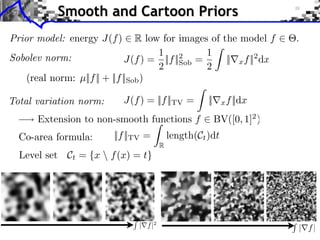
Smooth and Cartoon Priors
| f|2
J(f) = ||f||2
W 1,2 =
Z
R2
||rf(x)||dxSobolev semi-norm:
Total variation semi-norm: J(f) = ||f||TV =
Z
R2
||rf(x)||dx
Smooth and Cartoon Priors
| f|| f|2
J(f) = ||f||2
W 1,2 =
Z
R2
||rf(x)||dxSobolev semi-norm:
Total variation semi-norm: J(f) = ||f||TV =
Z
R2
||rf(x)||dx
Smooth and Cartoon Priors
| f|| f|2
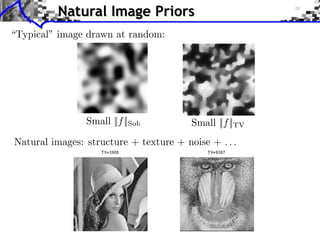
Natural Image Priors
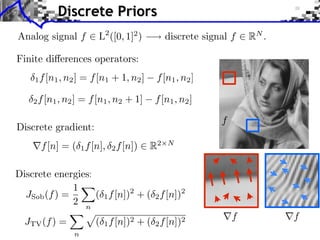
Discrete Priors
Discrete Priors
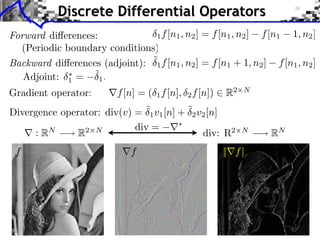
Discrete Differential Operators
Laplacian Operator
Laplacian Operator
Function: ˜f : x 2 R2
7! f(x) 2 R
˜f(x + ") = ˜f(x) + hrf(x), "iR2 + O(||"||2
R2 )
r ˜f(x) = (@1
˜f(x), @2
˜f(x)) 2 R2
Gradient: Images vs. Functionals
Function: ˜f : x 2 R2
7! f(x) 2 R
Discrete image: f 2 RN
, N = n2
f[i1, i2] = ˜f(i1/n, i2/n) rf[i] ⇡ r ˜f(i/n)
˜f(x + ") = ˜f(x) + hrf(x), "iR2 + O(||"||2
R2 )
r ˜f(x) = (@1
˜f(x), @2
˜f(x)) 2 R2
Gradient: Images vs. Functionals
Function: ˜f : x 2 R2
7! f(x) 2 R
Discrete image: f 2 RN
, N = n2
f[i1, i2] = ˜f(i1/n, i2/n)
Functional: J : f 2 RN
7! J(f) 2 R
J(f + ⌘) = J(f) + hrJ(f), ⌘iRN + O(||⌘||2
RN )
rf[i] ⇡ r ˜f(i/n)
˜f(x + ") = ˜f(x) + hrf(x), "iR2 + O(||"||2
R2 )
r ˜f(x) = (@1
˜f(x), @2
˜f(x)) 2 R2
rJ : RN
7! RN
Gradient: Images vs. Functionals
Function: ˜f : x 2 R2
7! f(x) 2 R
Discrete image: f 2 RN
, N = n2
f[i1, i2] = ˜f(i1/n, i2/n)
Functional: J : f 2 RN
7! J(f) 2 R
Sobolev:
rJ(f) = (r⇤
r)f = f
J(f) =
1
2
||rf||2
J(f + ⌘) = J(f) + hrJ(f), ⌘iRN + O(||⌘||2
RN )
rf[i] ⇡ r ˜f(i/n)
˜f(x + ") = ˜f(x) + hrf(x), "iR2 + O(||"||2
R2 )
r ˜f(x) = (@1
˜f(x), @2
˜f(x)) 2 R2
rJ : RN
7! RN
Gradient: Images vs. Functionals
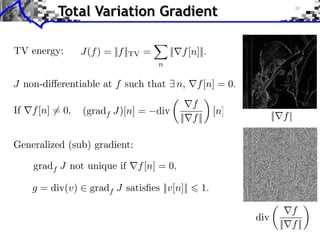
rJ(f) = div
✓
rf
||rf||
◆
If 8 n, rf[n] 6= 0,
If 9n, rf[n] = 0, J not di↵erentiable at f.
Total Variation Gradient
||rf||
rJ(f)
rJ(f) = div
✓
rf
||rf||
◆
If 8 n, rf[n] 6= 0,
Sub-di↵erential:
If 9n, rf[n] = 0, J not di↵erentiable at f.
Cu = ↵ 2 R2⇥N
 (u[n] = 0) ) (↵[n] = u[n]/||u[n]||)
@J(f) = { div(↵) ; ||↵[n]|| 6 1 and ↵ 2 Crf }
Total Variation Gradient
||rf||
rJ(f)
−10 −8 −6 −4 −2 0 2 4 6 8 10
−2
0
2
4
6
8
10
12
−10 −8 −6 −4 −2 0 2 4 6 8 10
−2
0
2
4
6
8
10
12
p
x2 + "2
|x|
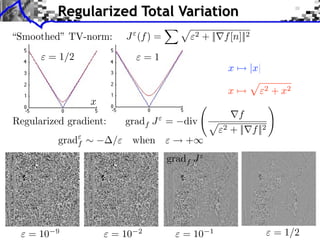
Regularized Total Variation
||u||" =
p
||u||2 + "2 J"(f) =
P
n ||rf[n]||"
−10 −8 −6 −4 −2 0 2 4 6 8 10
−2
0
2
4
6
8
10
12
−10 −8 −6 −4 −2 0 2 4 6 8 10
−2
0
2
4
6
8
10
12
rJ"(f) = div
✓
rf
||rf||"
◆
p
x2 + "2
|x|
rJ" ⇠ /" when " ! +1
Regularized Total Variation
||u||" =
p
||u||2 + "2 J"(f) =
P
n ||rf[n]||"
rJ"(f)
Overview
• Variational Priors
• Gradient Descent and PDE’s
• Inverse Problems Regularization
f(k+1)
= f(k)
⌧krJ(f(k)
) f(0)
is given.
Gradient Descent
and 0 < ⌧ < 2/L, then f(k) k!+1
! f?
a solution of min
f
J(f).
If f is convex, C1
, rf is L-Lipschitz,Theorem:
f(k+1)
= f(k)
⌧krJ(f(k)
) f(0)
is given.
Gradient Descent
and 0 < ⌧ < 2/L, then f(k) k!+1
! f?
a solution of min
f
J(f).
If f is convex, C1
, rf is L-Lipschitz,Theorem:
f(k+1)
= f(k)
⌧krJ(f(k)
) f(0)
is given.
Optimal step size: ⌧k = argmin
⌧2R+
J(f(k)
⌧rJ(f(k)
))
Proposition: One has
hrJ(f(k+1)
), rJ(f(k)
)i = 0
Gradient Descent
Gradient Flows and PDE’s
f(k+1)
f(k)
⌧
= rJ(f(k)
)Fixed step size ⌧k = ⌧:
Gradient Flows and PDE’s
f(k+1)
f(k)
⌧
= rJ(f(k)
)Fixed step size ⌧k = ⌧:
Denote ft = f(k)
for t = k⌧, one obtains formally as ⌧ ! 0:
8 t > 0,
@ft
@t
= rJ(ft) and f0 = f(0)
J(f) =
R
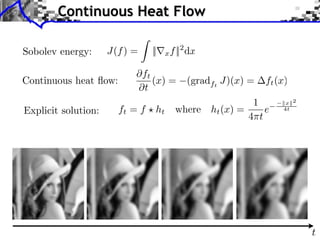
||rf(x)||dxSobolev flow:
@ft
@t
= ftHeat equation:
Explicit solution:
Gradient Flows and PDE’s
f(k+1)
f(k)
⌧
= rJ(f(k)
)Fixed step size ⌧k = ⌧:
Denote ft = f(k)
for t = k⌧, one obtains formally as ⌧ ! 0:
8 t > 0,
@ft
@t
= rJ(ft) and f0 = f(0)
Total Variation Flow
@ft
@t
= rJ(ft)
Noisy observations: y = f + w, w ⇠ N(0, IdN ).
and ft=0 = y
Application: Denoising
Optimal choice of t: minimize ||ft f||
! not accessible in practice.
SNR(ft, f) = 20 log10
✓
||f ft||
||f||
◆
Optimal Parameter Selection
t t
Overview
• Variational Priors
• Gradient Descent and PDE’s
• Inverse Problems Regularization
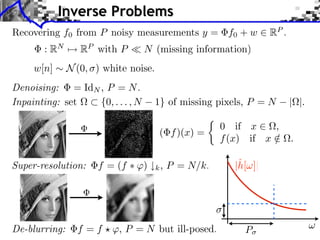
Inverse Problems
Inverse Problems
Inverse Problems
Inverse Problems
Inverse Problems
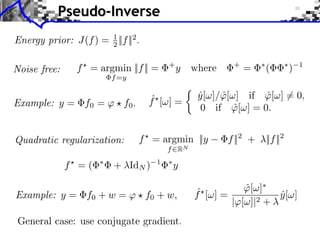
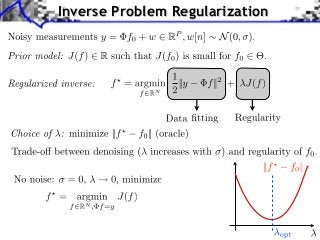
Inverse Problem Regularization
Sobolev prior: J(f) = 1
2 ||rf||2
f?
= argmin
f2RN
E(f) = ||y f||2
+ ||rf||2
(assuming 1 /2 ker( ))
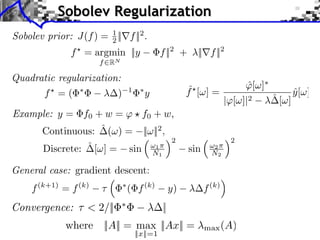
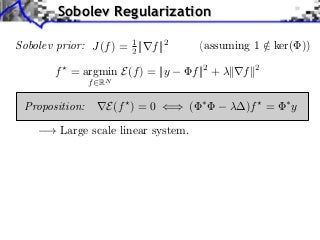
Sobolev Regularization
Sobolev prior: J(f) = 1
2 ||rf||2
f?
= argmin
f2RN
E(f) = ||y f||2
+ ||rf||2
rE(f?
) = 0 () ( ⇤
)f?
= ⇤
yProposition:
! Large scale linear system.
(assuming 1 /2 ker( ))
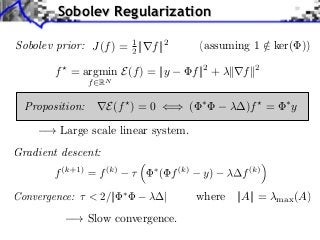
Sobolev Regularization
Sobolev prior: J(f) = 1
2 ||rf||2
f?
= argmin
f2RN
E(f) = ||y f||2
+ ||rf||2
rE(f?
) = 0 () ( ⇤
)f?
= ⇤
yProposition:
! Large scale linear system.
Gradient descent:
(assuming 1 /2 ker( ))
where ||A|| = max(A)
! Slow convergence.
Sobolev Regularization
Convergence: ⇥ < 2/||⇥ ⇥ ||
Mask M, = diagi(1i2M )
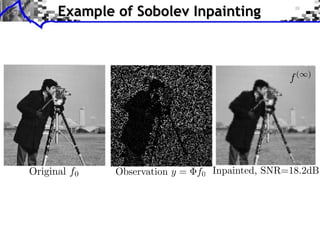
Example: InpaintingFigure 3 shows iterations of the algorithm 1 to solve the inpainting problem
on a smooth image using a manifold prior with 2D linear patches, as defined in
16. This manifold together with the overlapping of the patches allow a smooth
interpolation of the missing pixels.
Measurements y Iter. #1 Iter. #3 Iter. #50
Fig. 3. Iterations of the inpainting algorithm on an uniformly regular image.
5 Manifold of Step Discontinuities
In order to introduce some non-linearity in the manifold M, one needs to go
log10(||f(k)
f( )
||/||f0||)
k k
E(f(k)
)
M
( f)[i] =
⇢
0 if i 2 M,
f[i] otherwise.
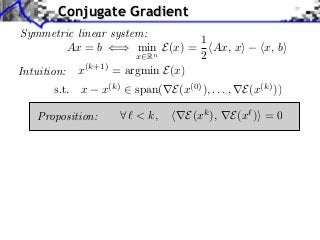
Symmetric linear system:
Conjugate Gradient
Ax = b () min
x2Rn
E(x) =
1
2
hAx, xi hx, bi
Symmetric linear system:
x(k+1)
= argmin E(x)
s.t. x x(k)
2 span(rE(x(0)
), . . . , rE(x(k)
))
Intuition:
Conjugate Gradient
Ax = b () min
x2Rn
E(x) =
1
2
hAx, xi hx, bi
Proposition: 8 ` < k, hrE(xk
), rE(x`
)i = 0
Symmetric linear system:
Initialization: x(0)
2 RN
, r(0)
= b Ax(0)
, p(0)
= r(0)
r(k)
=
hrE(x(k)
), d(k)
i
hAd(k), d(k)i
d(k)
= rE(x(k)
) +
||v(k)
||
||v(k 1)||
d(k 1)
v(k)
= rE(x(k)
) = Ax(k)
b
x(k+1)
= x(k)
r(k)
d(k)
Iterations:
x(k+1)
= argmin E(x)
s.t. x x(k)
2 span(rE(x(0)
), . . . , rE(x(k)
))
Intuition:
Conjugate Gradient
Ax = b () min
x2Rn
E(x) =
1
2
hAx, xi hx, bi
Proposition: 8 ` < k, hrE(xk
), rE(x`
)i = 0
TV" regularization: (assuming 1 /2 ker( ))
f?
= argmin
f2RN
E(f) =
1
2
|| f y|| + J"
(f)
Total Variation Regularization
||u||" =
p
||u||2 + "2 J"(f) =
P
n ||rf[n]||"
TV" regularization: (assuming 1 /2 ker( ))
f(k+1)
= f(k)
⌧krE(f(k)
)
rE(f) = ⇤
( f y) + rJ"(f)
rJ"(f) = div
✓
rf
||rf||"
◆
Convergence: requires ⌧ ⇠ ".
Gradient descent:
f?
= argmin
f2RN
E(f) =
1
2
|| f y|| + J"
(f)
Total Variation Regularization
||u||" =
p
||u||2 + "2 J"(f) =
P
n ||rf[n]||"
TV" regularization: (assuming 1 /2 ker( ))
f(k+1)
= f(k)
⌧krE(f(k)
)
rE(f) = ⇤
( f y) + rJ"(f)
rJ"(f) = div
✓
rf
||rf||"
◆
Convergence: requires ⌧ ⇠ ".
Gradient descent:
f?
= argmin
f2RN
E(f) =
1
2
|| f y|| + J"
(f)
Newton descent:
f(k+1)
= f(k)
H 1
k rE(f(k)
) where Hk = @2
E"(f(k)
)
Total Variation Regularization
||u||" =
p
||u||2 + "2 J"(f) =
P
n ||rf[n]||"
k
Large" TV vs. Sobolev ConvergeSmall"
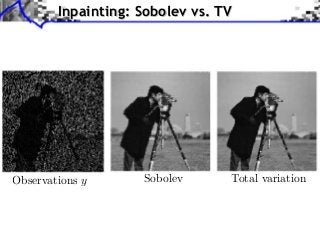
Observations y Sobolev Total variation
Inpainting: Sobolev vs. TV
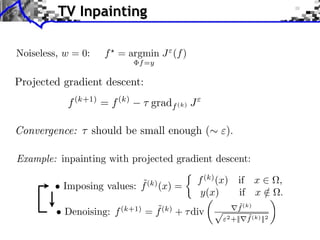
Noiseless problem: f?
2 argmin
f
J"
(f) s.t. f 2 H
Contraint: H = {f ; f = y}.
f(k+1)
= ProjH
⇣
f(k)
⌧krJ"(f(k)
)
⌘
ProjH(f) = argmin
g=y
||g f||2
= f + ⇤
( ⇤
) 1
(y f)
Inpainting: ProjH(f)[i] =
⇢
f[i] if i 2 M,
y[i] otherwise.
Projected gradient descent:
f(k) k!+1
! f?
a solution of (?).
(?)
Projected Gradient Descent
Proposition: If rJ" is L-Lipschitz and 0 < ⌧k < 2/L,
TV
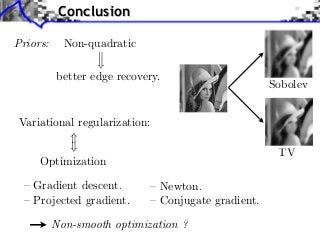
Priors: Non-quadratic
better edge recovery.
=)
Conclusion
Sobolev
TV
Priors: Non-quadratic
better edge recovery.
=)
Optimization
Variational regularization:
()
– Gradient descent. – Newton.
– Projected gradient. – Conjugate gradient.
Non-smooth optimization ?
Conclusion
Sobolev

Signal Processing Course : Inverse Problems Regularization

  • 1.
  • 2.
    Overview • Variational Priors •Gradient Descent and PDE’s • Inverse Problems Regularization
  • 3.
    J(f) = ||f||2 W1,2 = Z R2 ||rf(x)||dxSobolev semi-norm: Smooth and Cartoon Priors | f|2
  • 4.
    J(f) = ||f||2 W1,2 = Z R2 ||rf(x)||dxSobolev semi-norm: Total variation semi-norm: J(f) = ||f||TV = Z R2 ||rf(x)||dx Smooth and Cartoon Priors | f|| f|2
  • 5.
    J(f) = ||f||2 W1,2 = Z R2 ||rf(x)||dxSobolev semi-norm: Total variation semi-norm: J(f) = ||f||TV = Z R2 ||rf(x)||dx Smooth and Cartoon Priors | f|| f|2
  • 6.
  • 7.
  • 8.
  • 9.
  • 10.
  • 11.
  • 12.
  • 13.
    Function: ˜f :x 2 R2 7! f(x) 2 R ˜f(x + ") = ˜f(x) + hrf(x), "iR2 + O(||"||2 R2 ) r ˜f(x) = (@1 ˜f(x), @2 ˜f(x)) 2 R2 Gradient: Images vs. Functionals
  • 14.
    Function: ˜f :x 2 R2 7! f(x) 2 R Discrete image: f 2 RN , N = n2 f[i1, i2] = ˜f(i1/n, i2/n) rf[i] ⇡ r ˜f(i/n) ˜f(x + ") = ˜f(x) + hrf(x), "iR2 + O(||"||2 R2 ) r ˜f(x) = (@1 ˜f(x), @2 ˜f(x)) 2 R2 Gradient: Images vs. Functionals
  • 15.
    Function: ˜f :x 2 R2 7! f(x) 2 R Discrete image: f 2 RN , N = n2 f[i1, i2] = ˜f(i1/n, i2/n) Functional: J : f 2 RN 7! J(f) 2 R J(f + ⌘) = J(f) + hrJ(f), ⌘iRN + O(||⌘||2 RN ) rf[i] ⇡ r ˜f(i/n) ˜f(x + ") = ˜f(x) + hrf(x), "iR2 + O(||"||2 R2 ) r ˜f(x) = (@1 ˜f(x), @2 ˜f(x)) 2 R2 rJ : RN 7! RN Gradient: Images vs. Functionals
  • 16.
    Function: ˜f :x 2 R2 7! f(x) 2 R Discrete image: f 2 RN , N = n2 f[i1, i2] = ˜f(i1/n, i2/n) Functional: J : f 2 RN 7! J(f) 2 R Sobolev: rJ(f) = (r⇤ r)f = f J(f) = 1 2 ||rf||2 J(f + ⌘) = J(f) + hrJ(f), ⌘iRN + O(||⌘||2 RN ) rf[i] ⇡ r ˜f(i/n) ˜f(x + ") = ˜f(x) + hrf(x), "iR2 + O(||"||2 R2 ) r ˜f(x) = (@1 ˜f(x), @2 ˜f(x)) 2 R2 rJ : RN 7! RN Gradient: Images vs. Functionals
  • 17.
    rJ(f) = div ✓ rf ||rf|| ◆ If8 n, rf[n] 6= 0, If 9n, rf[n] = 0, J not di↵erentiable at f. Total Variation Gradient ||rf|| rJ(f)
  • 18.
    rJ(f) = div ✓ rf ||rf|| ◆ If8 n, rf[n] 6= 0, Sub-di↵erential: If 9n, rf[n] = 0, J not di↵erentiable at f. Cu = ↵ 2 R2⇥N (u[n] = 0) ) (↵[n] = u[n]/||u[n]||) @J(f) = { div(↵) ; ||↵[n]|| 6 1 and ↵ 2 Crf } Total Variation Gradient ||rf|| rJ(f)
  • 19.
    −10 −8 −6−4 −2 0 2 4 6 8 10 −2 0 2 4 6 8 10 12 −10 −8 −6 −4 −2 0 2 4 6 8 10 −2 0 2 4 6 8 10 12 p x2 + "2 |x| Regularized Total Variation ||u||" = p ||u||2 + "2 J"(f) = P n ||rf[n]||"
  • 20.
    −10 −8 −6−4 −2 0 2 4 6 8 10 −2 0 2 4 6 8 10 12 −10 −8 −6 −4 −2 0 2 4 6 8 10 −2 0 2 4 6 8 10 12 rJ"(f) = div ✓ rf ||rf||" ◆ p x2 + "2 |x| rJ" ⇠ /" when " ! +1 Regularized Total Variation ||u||" = p ||u||2 + "2 J"(f) = P n ||rf[n]||" rJ"(f)
  • 21.
    Overview • Variational Priors •Gradient Descent and PDE’s • Inverse Problems Regularization
  • 22.
    f(k+1) = f(k) ⌧krJ(f(k) ) f(0) isgiven. Gradient Descent
  • 23.
    and 0 <⌧ < 2/L, then f(k) k!+1 ! f? a solution of min f J(f). If f is convex, C1 , rf is L-Lipschitz,Theorem: f(k+1) = f(k) ⌧krJ(f(k) ) f(0) is given. Gradient Descent
  • 24.
    and 0 <⌧ < 2/L, then f(k) k!+1 ! f? a solution of min f J(f). If f is convex, C1 , rf is L-Lipschitz,Theorem: f(k+1) = f(k) ⌧krJ(f(k) ) f(0) is given. Optimal step size: ⌧k = argmin ⌧2R+ J(f(k) ⌧rJ(f(k) )) Proposition: One has hrJ(f(k+1) ), rJ(f(k) )i = 0 Gradient Descent
  • 25.
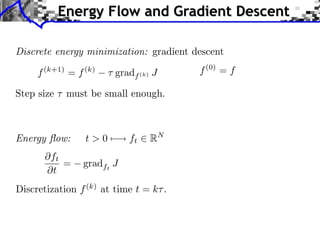
    Gradient Flows andPDE’s f(k+1) f(k) ⌧ = rJ(f(k) )Fixed step size ⌧k = ⌧:
  • 26.
    Gradient Flows andPDE’s f(k+1) f(k) ⌧ = rJ(f(k) )Fixed step size ⌧k = ⌧: Denote ft = f(k) for t = k⌧, one obtains formally as ⌧ ! 0: 8 t > 0, @ft @t = rJ(ft) and f0 = f(0)
  • 27.
    J(f) = R ||rf(x)||dxSobolev flow: @ft @t =ftHeat equation: Explicit solution: Gradient Flows and PDE’s f(k+1) f(k) ⌧ = rJ(f(k) )Fixed step size ⌧k = ⌧: Denote ft = f(k) for t = k⌧, one obtains formally as ⌧ ! 0: 8 t > 0, @ft @t = rJ(ft) and f0 = f(0)
  • 28.
  • 29.
    @ft @t = rJ(ft) Noisy observations:y = f + w, w ⇠ N(0, IdN ). and ft=0 = y Application: Denoising
  • 30.
    Optimal choice oft: minimize ||ft f|| ! not accessible in practice. SNR(ft, f) = 20 log10 ✓ ||f ft|| ||f|| ◆ Optimal Parameter Selection t t
  • 31.
    Overview • Variational Priors •Gradient Descent and PDE’s • Inverse Problems Regularization
  • 32.
  • 33.
  • 34.
  • 35.
  • 36.
  • 37.
  • 38.
  • 39.
  • 40.
    Sobolev prior: J(f)= 1 2 ||rf||2 f? = argmin f2RN E(f) = ||y f||2 + ||rf||2 (assuming 1 /2 ker( )) Sobolev Regularization
  • 41.
    Sobolev prior: J(f)= 1 2 ||rf||2 f? = argmin f2RN E(f) = ||y f||2 + ||rf||2 rE(f? ) = 0 () ( ⇤ )f? = ⇤ yProposition: ! Large scale linear system. (assuming 1 /2 ker( )) Sobolev Regularization
  • 42.
    Sobolev prior: J(f)= 1 2 ||rf||2 f? = argmin f2RN E(f) = ||y f||2 + ||rf||2 rE(f? ) = 0 () ( ⇤ )f? = ⇤ yProposition: ! Large scale linear system. Gradient descent: (assuming 1 /2 ker( )) where ||A|| = max(A) ! Slow convergence. Sobolev Regularization Convergence: ⇥ < 2/||⇥ ⇥ ||
  • 43.
    Mask M, =diagi(1i2M ) Example: InpaintingFigure 3 shows iterations of the algorithm 1 to solve the inpainting problem on a smooth image using a manifold prior with 2D linear patches, as defined in 16. This manifold together with the overlapping of the patches allow a smooth interpolation of the missing pixels. Measurements y Iter. #1 Iter. #3 Iter. #50 Fig. 3. Iterations of the inpainting algorithm on an uniformly regular image. 5 Manifold of Step Discontinuities In order to introduce some non-linearity in the manifold M, one needs to go log10(||f(k) f( ) ||/||f0||) k k E(f(k) ) M ( f)[i] = ⇢ 0 if i 2 M, f[i] otherwise.
  • 44.
    Symmetric linear system: ConjugateGradient Ax = b () min x2Rn E(x) = 1 2 hAx, xi hx, bi
  • 45.
    Symmetric linear system: x(k+1) =argmin E(x) s.t. x x(k) 2 span(rE(x(0) ), . . . , rE(x(k) )) Intuition: Conjugate Gradient Ax = b () min x2Rn E(x) = 1 2 hAx, xi hx, bi Proposition: 8 ` < k, hrE(xk ), rE(x` )i = 0
  • 46.
    Symmetric linear system: Initialization:x(0) 2 RN , r(0) = b Ax(0) , p(0) = r(0) r(k) = hrE(x(k) ), d(k) i hAd(k), d(k)i d(k) = rE(x(k) ) + ||v(k) || ||v(k 1)|| d(k 1) v(k) = rE(x(k) ) = Ax(k) b x(k+1) = x(k) r(k) d(k) Iterations: x(k+1) = argmin E(x) s.t. x x(k) 2 span(rE(x(0) ), . . . , rE(x(k) )) Intuition: Conjugate Gradient Ax = b () min x2Rn E(x) = 1 2 hAx, xi hx, bi Proposition: 8 ` < k, hrE(xk ), rE(x` )i = 0
  • 47.
    TV" regularization: (assuming1 /2 ker( )) f? = argmin f2RN E(f) = 1 2 || f y|| + J" (f) Total Variation Regularization ||u||" = p ||u||2 + "2 J"(f) = P n ||rf[n]||"
  • 48.
    TV" regularization: (assuming1 /2 ker( )) f(k+1) = f(k) ⌧krE(f(k) ) rE(f) = ⇤ ( f y) + rJ"(f) rJ"(f) = div ✓ rf ||rf||" ◆ Convergence: requires ⌧ ⇠ ". Gradient descent: f? = argmin f2RN E(f) = 1 2 || f y|| + J" (f) Total Variation Regularization ||u||" = p ||u||2 + "2 J"(f) = P n ||rf[n]||"
  • 49.
    TV" regularization: (assuming1 /2 ker( )) f(k+1) = f(k) ⌧krE(f(k) ) rE(f) = ⇤ ( f y) + rJ"(f) rJ"(f) = div ✓ rf ||rf||" ◆ Convergence: requires ⌧ ⇠ ". Gradient descent: f? = argmin f2RN E(f) = 1 2 || f y|| + J" (f) Newton descent: f(k+1) = f(k) H 1 k rE(f(k) ) where Hk = @2 E"(f(k) ) Total Variation Regularization ||u||" = p ||u||2 + "2 J"(f) = P n ||rf[n]||"
  • 50.
    k Large" TV vs.Sobolev ConvergeSmall"
  • 51.
    Observations y SobolevTotal variation Inpainting: Sobolev vs. TV
  • 52.
    Noiseless problem: f? 2argmin f J" (f) s.t. f 2 H Contraint: H = {f ; f = y}. f(k+1) = ProjH ⇣ f(k) ⌧krJ"(f(k) ) ⌘ ProjH(f) = argmin g=y ||g f||2 = f + ⇤ ( ⇤ ) 1 (y f) Inpainting: ProjH(f)[i] = ⇢ f[i] if i 2 M, y[i] otherwise. Projected gradient descent: f(k) k!+1 ! f? a solution of (?). (?) Projected Gradient Descent Proposition: If rJ" is L-Lipschitz and 0 < ⌧k < 2/L,
  • 53.
    TV Priors: Non-quadratic better edgerecovery. =) Conclusion Sobolev
  • 54.
    TV Priors: Non-quadratic better edgerecovery. =) Optimization Variational regularization: () – Gradient descent. – Newton. – Projected gradient. – Conjugate gradient. Non-smooth optimization ? Conclusion Sobolev