
Gabriel Peyré
www.numerical-tours.com
Model Selection
with Piecewise
Regular Gauges
Samuel Vaiter
Charles Deledalle
Jalal Fadili
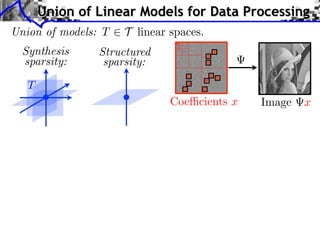
Joint work with:
Joseph Salmon
VISI N
Overview
• Inverse Problems
• Gauge Decomposition and Model Selection
• L2 Stability Performances
• Model Stability Performances
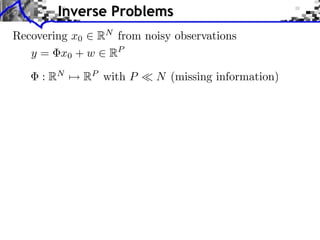
y = x0 + w 2 RP
Inverse Problems
Recovering x0 RN
from noisy observations
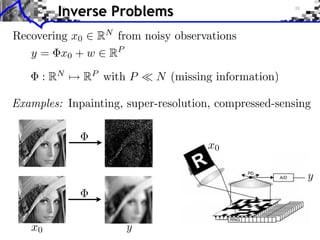
Examples: Inpainting, super-resolution, compressed-sensing
y = x0 + w 2 RP
Inverse Problems
Recovering x0 RN
from noisy observations
x0
x0
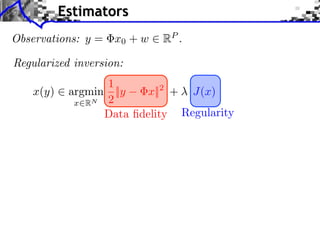
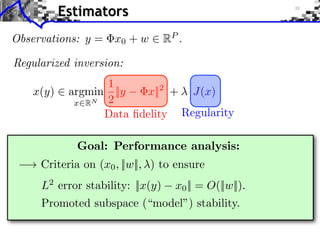
Regularized inversion:
Estimators
x(y) 2 argmin
x2RN
1
2
||y x||2
+ J(x)
Data fidelity Regularity
Observations: y = x0 + w 2 RP
.
L2
error stability: ||x(y) x0|| = O(||w||).
Promoted subspace (“model”) stability.
Goal: Performance analysis:
Regularized inversion:
Estimators
x(y) 2 argmin
x2RN
1
2
||y x||2
+ J(x)
! Criteria on (x0, ||w||, ) to ensure
Data fidelity Regularity
Observations: y = x0 + w 2 RP
.
Overview
• Inverse Problems
• Gauge Decomposition and Model Selection
• L2 Stability Performances
• Model Stability Performances
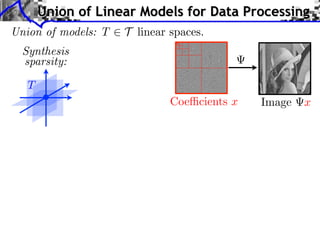
Coe cients x Image x
Union of Linear Models for Data Processing
Union of models: T 2 T linear spaces.
Synthesis
sparsity:
T
Coe cients x Image x
Union of Linear Models for Data Processing
Union of models: T 2 T linear spaces.
Synthesis
sparsity:
T
Structured
sparsity:
Coe cients x Image x
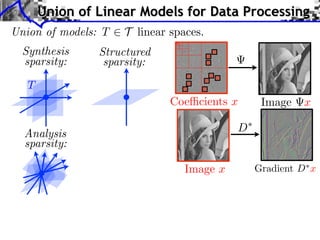
Union of Linear Models for Data Processing
D
Image x Gradient D⇤
x
Union of models: T 2 T linear spaces.
Synthesis
sparsity:
T
Structured
sparsity:
Analysis
sparsity:
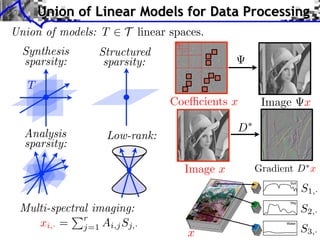
Coe cients x Image x
Multi-spectral imaging:
xi,· =
Pr
j=1 Ai,jSj,·
Union of Linear Models for Data Processing
D
Image x Gradient D⇤
x
Union of models: T 2 T linear spaces.
Synthesis
sparsity:
T
Structured
sparsity:
Analysis
sparsity:
Low-rank:
S1,·
S2,·
S3,·x
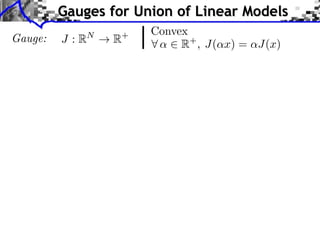
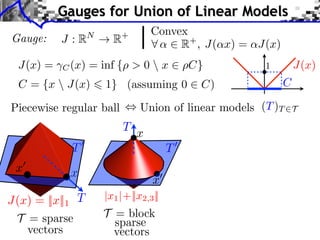
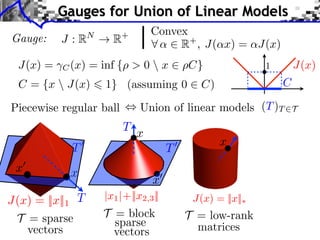
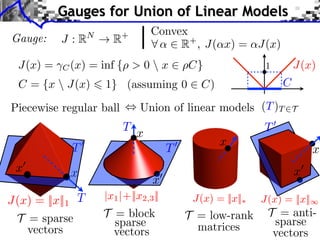
Gauge: J : RN
! R+
8 ↵ 2 R+
, J(↵x) = ↵J(x)
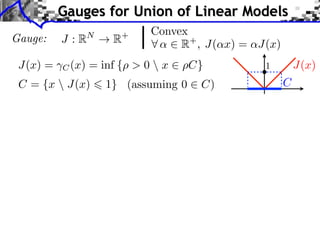
Gauges for Union of Linear Models
Convex
Gauge: J : RN
! R+
8 ↵ 2 R+
, J(↵x) = ↵J(x)
J(x) = C(x) = inf {⇢ > 0  x 2 ⇢C}
C = {x  J(x) 6 1} (assuming 0 2 C)
Gauges for Union of Linear Models
J(x)
C
1
Convex
Gauge:
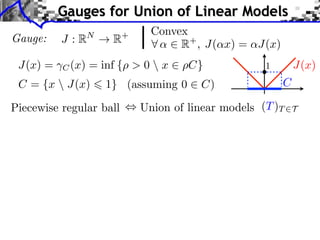
, Union of linear models (T)T 2TPiecewise regular ball
J : RN
! R+
8 ↵ 2 R+
, J(↵x) = ↵J(x)
J(x) = C(x) = inf {⇢ > 0  x 2 ⇢C}
C = {x  J(x) 6 1} (assuming 0 2 C)
Gauges for Union of Linear Models
J(x)
C
1
Convex
x
T
Gauge:
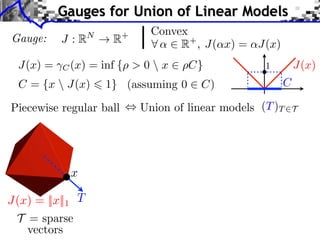
, Union of linear models (T)T 2TPiecewise regular ball
J : RN
! R+
8 ↵ 2 R+
, J(↵x) = ↵J(x)
J(x) = C(x) = inf {⇢ > 0  x 2 ⇢C}
C = {x  J(x) 6 1} (assuming 0 2 C)
Gauges for Union of Linear Models
J(x) = ||x||1
T = sparse
vectors
J(x)
C
1
Convex
x
T
Gauge:
, Union of linear models (T)T 2TPiecewise regular ball
J : RN
! R+
8 ↵ 2 R+
, J(↵x) = ↵J(x)
J(x) = C(x) = inf {⇢ > 0  x 2 ⇢C}
C = {x  J(x) 6 1} (assuming 0 2 C)
Gauges for Union of Linear Models
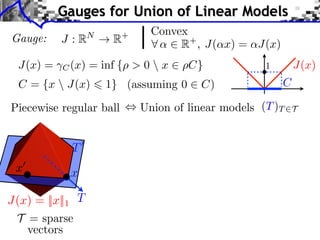
J(x) = ||x||1
x0
T0
T = sparse
vectors
J(x)
C
1
Convex
x
T
Gauge:
, Union of linear models (T)T 2TPiecewise regular ball
J : RN
! R+
8 ↵ 2 R+
, J(↵x) = ↵J(x)
J(x) = C(x) = inf {⇢ > 0  x 2 ⇢C}
C = {x  J(x) 6 1} (assuming 0 2 C)
Gauges for Union of Linear Models
J(x) = ||x||1
x0
T0
T = sparse
vectors
|x1|+||x2,3||
x0
xT
T0
T = block
vectors
sparse
J(x)
C
1
Convex
x
T
Gauge:
, Union of linear models (T)T 2TPiecewise regular ball
J : RN
! R+
8 ↵ 2 R+
, J(↵x) = ↵J(x)
J(x) = C(x) = inf {⇢ > 0  x 2 ⇢C}
C = {x  J(x) 6 1} (assuming 0 2 C)
Gauges for Union of Linear Models
J(x) = ||x||1
T = low-rank
matrices
J(x) = ||x||⇤
x
x0
T0
T = sparse
vectors
|x1|+||x2,3||
x0
xT
T0
T = block
vectors
sparse
J(x)
C
1
Convex
x
T
Gauge:
, Union of linear models (T)T 2TPiecewise regular ball
J : RN
! R+
8 ↵ 2 R+
, J(↵x) = ↵J(x)
J(x) = C(x) = inf {⇢ > 0  x 2 ⇢C}
C = {x  J(x) 6 1} (assuming 0 2 C)
Gauges for Union of Linear Models
J(x) = ||x||1
T = low-rank
matrices
J(x) = ||x||⇤
x
x0
T0
T = anti-
sparse
vectors
J(x) = ||x||1
x
x0
T0
T = sparse
vectors
|x1|+||x2,3||
x0
xT
T0
T = block
vectors
sparse
J(x)
C
1
Convex
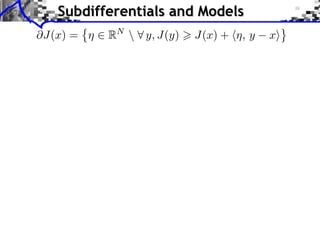
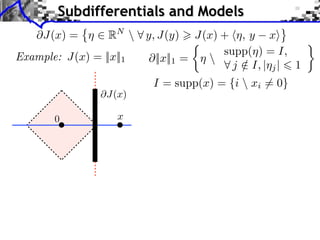
Subdifferentials and Models
@J(x) = ⌘ 2 RN
 8 y, J(y) > J(x) + h⌘, y xi
I = supp(x) = {i  xi 6= 0}
Subdifferentials and Models
Example: J(x) = ||x||1 @||x||1 =
⇢
⌘ 
supp(⌘) = I,
8 j /2 I, |⌘j| 6 1
x
@J(x)
0
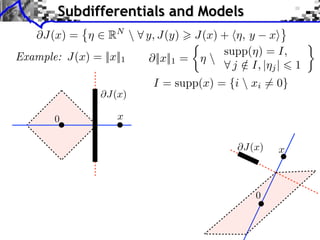
@J(x) = ⌘ 2 RN
 8 y, J(y) > J(x) + h⌘, y xi
x@J(x)
0
I = supp(x) = {i  xi 6= 0}
Subdifferentials and Models
Example: J(x) = ||x||1 @||x||1 =
⇢
⌘ 
supp(⌘) = I,
8 j /2 I, |⌘j| 6 1
x
@J(x)
0
@J(x) = ⌘ 2 RN
 8 y, J(y) > J(x) + h⌘, y xi
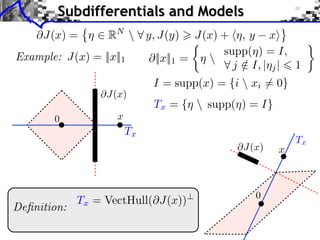
Tx
x@J(x)
0
Definition:
I = supp(x) = {i  xi 6= 0}
Tx = VectHull(@J(x))?
Subdifferentials and Models
Tx = {⌘  supp(⌘) = I}
Example: J(x) = ||x||1 @||x||1 =
⇢
⌘ 
supp(⌘) = I,
8 j /2 I, |⌘j| 6 1
Tx
x
@J(x)
0
@J(x) = ⌘ 2 RN
 8 y, J(y) > J(x) + h⌘, y xi
Tx
x@J(x)
0
Definition:
I = supp(x) = {i  xi 6= 0}
Tx = VectHull(@J(x))?
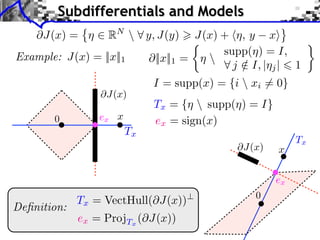
Subdifferentials and Models
ex
ex = ProjTx
(@J(x))
ex = sign(x)
Tx = {⌘  supp(⌘) = I}
Example: J(x) = ||x||1 @||x||1 =
⇢
⌘ 
supp(⌘) = I,
8 j /2 I, |⌘j| 6 1
ex
Tx
x
@J(x)
0
@J(x) = ⌘ 2 RN
 8 y, J(y) > J(x) + h⌘, y xi
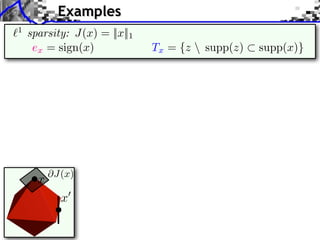
Examples
`1
sparsity: J(x) = ||x||1
ex = sign(x) Tx = {z  supp(z) ⇢ supp(x)}
x0
x @J(x)
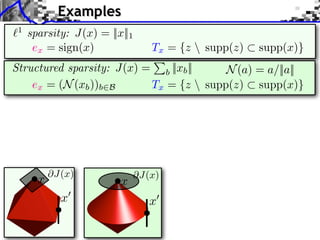
Examples
x0
x
@J(x)
`1
sparsity: J(x) = ||x||1
ex = sign(x) Tx = {z  supp(z) ⇢ supp(x)}
ex = (N(xb))b2B
N(a) = a/||a||Structured sparsity: J(x) =
P
b ||xb||
Tx = {z  supp(z) ⇢ supp(x)}
x0
x @J(x)
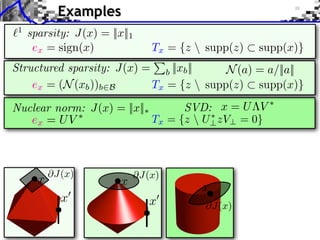
Examples
x0
x
@J(x)
Tx = {z  U⇤
?zV? = 0}ex = UV ⇤
Nuclear norm: J(x) = ||x||⇤ x = U⇤V ⇤
SVD:
`1
sparsity: J(x) = ||x||1
ex = sign(x) Tx = {z  supp(z) ⇢ supp(x)}
ex = (N(xb))b2B
N(a) = a/||a||Structured sparsity: J(x) =
P
b ||xb||
Tx = {z  supp(z) ⇢ supp(x)}
x
@J(x)
x0
x @J(x)
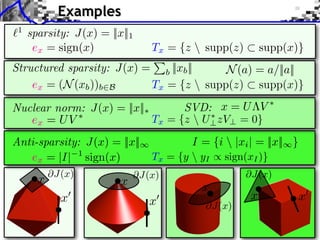
Examples
x0
x
@J(x)
x x0
@J(x)
I = {i  |xi| = ||x||1}Anti-sparsity: J(x) = ||x||1
Tx = {y  yI / sign(xI)}ex = |I| 1
sign(x)
Tx = {z  U⇤
?zV? = 0}ex = UV ⇤
Nuclear norm: J(x) = ||x||⇤ x = U⇤V ⇤
SVD:
`1
sparsity: J(x) = ||x||1
ex = sign(x) Tx = {z  supp(z) ⇢ supp(x)}
ex = (N(xb))b2B
N(a) = a/||a||Structured sparsity: J(x) =
P
b ||xb||
Tx = {z  supp(z) ⇢ supp(x)}
x
@J(x)
x0
x @J(x)
Overview
• Inverse Problems
• Gauge Decomposition and Model Selection
• L2 Stability Performances
• Model Stability Performances
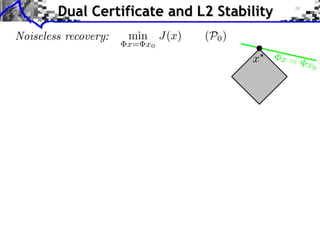
Noiseless recovery: min
x= x0
J(x) (P0)
x = x0
Dual Certificate and L2 Stability
x?
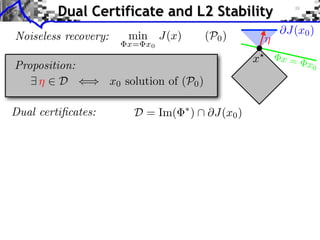
Noiseless recovery: min
x= x0
J(x) (P0)
Dual certificates:
x = x0
⌘
Proposition:
D = Im( ⇤
)  @J(x0)
9 ⌘ 2 D () x0 solution of (P0)
Dual Certificate and L2 Stability
@J(x0)
x?
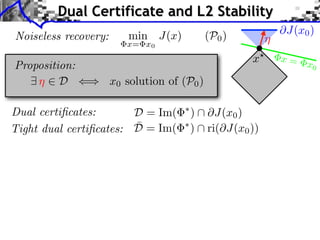
Noiseless recovery: min
x= x0
J(x) (P0)
Dual certificates:
Tight dual certificates:
x = x0
⌘
Proposition:
D = Im( ⇤
)  @J(x0)
¯D = Im( ⇤
)  ri(@J(x0))
9 ⌘ 2 D () x0 solution of (P0)
Dual Certificate and L2 Stability
@J(x0)
x?
Noiseless recovery: min
x= x0
J(x) (P0)
Dual certificates:
Tight dual certificates:
x = x0
⌘
Proposition:
D = Im( ⇤
)  @J(x0)
¯D = Im( ⇤
)  ri(@J(x0))
9 ⌘ 2 D () x0 solution of (P0)
Dual Certificate and L2 Stability
@J(x0)
x?
Theorem:
[Fadili et al. 2013] for ⇠ ||w|| one has ||x?
x0|| = O(||w||)
If 9 ⌘ 2 ¯D and ker( )  Tx0 = {0}
Noiseless recovery: min
x= x0
J(x) (P0)
Dual certificates:
Tight dual certificates:
x = x0
⌘
Proposition:
! The constants depend on N . . .
D = Im( ⇤
)  @J(x0)
¯D = Im( ⇤
)  ri(@J(x0))
9 ⌘ 2 D () x0 solution of (P0)
Dual Certificate and L2 Stability
@J(x0)
x?
Theorem:
[Fadili et al. 2013] for ⇠ ||w|| one has ||x?
x0|| = O(||w||)
If 9 ⌘ 2 ¯D and ker( )  Tx0 = {0}
Noiseless recovery: min
x= x0
J(x) (P0)
Dual certificates:
Tight dual certificates:
x = x0
⌘
Proposition:
[Grassmair 2012]: J(x?
x0) = O(||w||).
[Grassmair, Haltmeier, Scherzer 2010]: J = || · ||1.
! The constants depend on N . . .
D = Im( ⇤
)  @J(x0)
¯D = Im( ⇤
)  ri(@J(x0))
9 ⌘ 2 D () x0 solution of (P0)
Dual Certificate and L2 Stability
@J(x0)
x?
Theorem:
[Fadili et al. 2013] for ⇠ ||w|| one has ||x?
x0|| = O(||w||)
If 9 ⌘ 2 ¯D and ker( )  Tx0 = {0}
Overview
• Inverse Problems
• Gauge Decomposition and Model Selection
• L2 Stability Performances
• Model Stability Performances
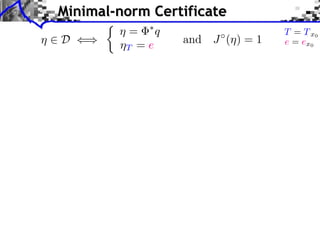
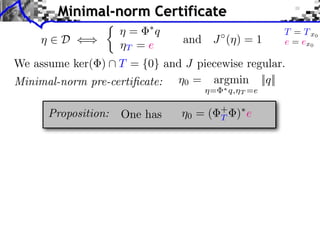
⌘ 2 D () and J (⌘) = 1
Minimal-norm Certificate
⌘ = ⇤
q
⌘T = e
⇢
T = Tx0
e = ex0
⌘ 2 D ()
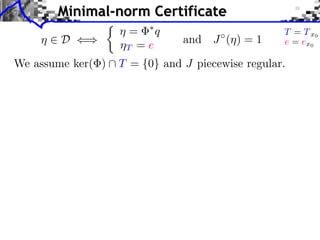
We assume ker( )  T = {0} and J piecewise regular.
and J (⌘) = 1
Minimal-norm Certificate
⌘ = ⇤
q
⌘T = e
⇢
T = Tx0
e = ex0
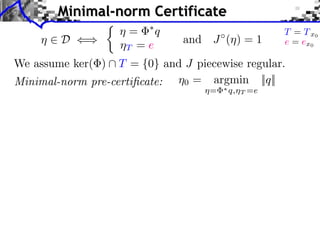
⌘0 = argmin
⌘= ⇤q,⌘T =e
||q||
⌘ 2 D ()
We assume ker( )  T = {0} and J piecewise regular.
and J (⌘) = 1
Minimal-norm Certificate
⌘ = ⇤
q
⌘T = e
Minimal-norm pre-certificate:
⇢
T = Tx0
e = ex0
⌘0 = argmin
⌘= ⇤q,⌘T =e
||q||
⌘ 2 D ()
We assume ker( )  T = {0} and J piecewise regular.
and J (⌘) = 1
Minimal-norm Certificate
Proposition: One has
⌘ = ⇤
q
⌘T = e
Minimal-norm pre-certificate:
⇢
T = Tx0
e = ex0
⌘0 = ( +
T )⇤
e
⌘0 = argmin
⌘= ⇤q,⌘T =e
||q||
⌘ 2 D ()
We assume ker( )  T = {0} and J piecewise regular.
and J (⌘) = 1
Minimal-norm Certificate
Proposition:
||w|| = O(⌫x0 ) and ⇠ ||w||,Theorem:
the unique solution x?
of P (y) for y = x0 + w satisfies
Tx? = Tx0
and ||x?
x0|| = O(||w||) [Vaiter et al. 2013]
One has
⌘ = ⇤
q
⌘T = e
Minimal-norm pre-certificate:
⇢
T = Tx0
e = ex0
⌘0 = ( +
T )⇤
e
If ⌘0 2 ¯D,
[Fuchs 2004]: J = || · ||1.
[Bach 2008]: J = || · ||1,2 and J = || · ||⇤.
[Vaiter et al. 2011]: J = ||D⇤
· ||1.
⌘0 = argmin
⌘= ⇤q,⌘T =e
||q||
⌘ 2 D ()
We assume ker( )  T = {0} and J piecewise regular.
and J (⌘) = 1
Minimal-norm Certificate
Proposition:
||w|| = O(⌫x0 ) and ⇠ ||w||,Theorem:
the unique solution x?
of P (y) for y = x0 + w satisfies
Tx? = Tx0
and ||x?
x0|| = O(||w||) [Vaiter et al. 2013]
One has
⌘ = ⇤
q
⌘T = e
Minimal-norm pre-certificate:
⇢
T = Tx0
e = ex0
⌘0 = ( +
T )⇤
e
If ⌘0 2 ¯D,
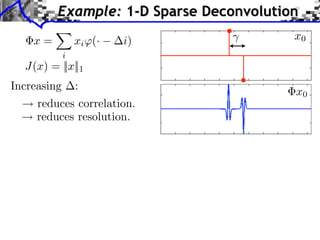
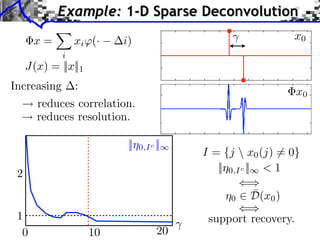
⇥x =
i
xi (· i)
Increasing :
reduces correlation.
reduces resolution.
J(x) = ||x||1
Example: 1-D Sparse Deconvolution
x0
x0
⇥x =
i
xi (· i)
Increasing :
reduces correlation.
reduces resolution.
0 10
2
support recovery.
J(x) = ||x||1
()
||⌘0,Ic ||1 < 1
⌘0 2 ¯D(x0)
I = {j  x0(j) 6= 0}
||⌘0,Ic ||1
Example: 1-D Sparse Deconvolution
x0
x0
20
1
()
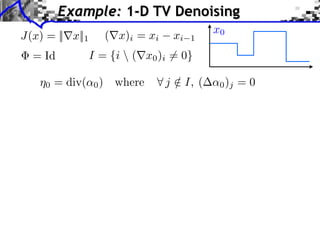
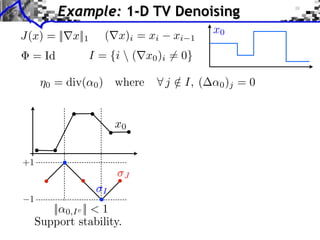
J(x) = ||rx||1 (rx)i = xi xi 1
= Id I = {i  (rx0)i 6= 0}
8 j /2 I, ( ↵0)j = 0⌘0 = div(↵0) where
Example: 1-D TV Denoising
x0
+1
1
I
J
Support stability.
J(x) = ||rx||1 (rx)i = xi xi 1
= Id I = {i  (rx0)i 6= 0}
8 j /2 I, ( ↵0)j = 0⌘0 = div(↵0) where
||↵0,Ic || < 1
Example: 1-D TV Denoising
x0
x0
+1
1
I
J
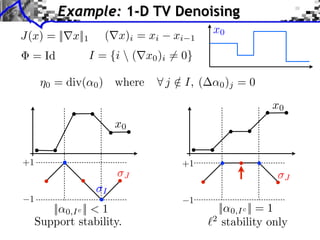
`2
stability onlySupport stability.
x0
J(x) = ||rx||1 (rx)i = xi xi 1
= Id I = {i  (rx0)i 6= 0}
8 j /2 I, ( ↵0)j = 0⌘0 = div(↵0) where
||↵0,Ic || < 1 ||↵0,Ic || = 1
Example: 1-D TV Denoising
+1
1
J
x0
x0
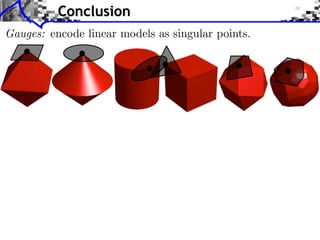
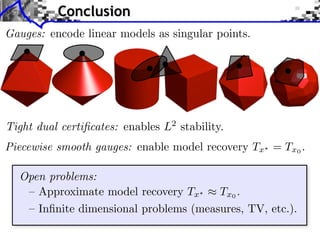
Gauges: encode linear models as singular points.
Conclusion
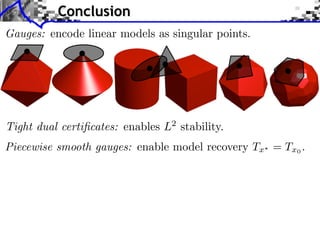
Piecewise smooth gauges: enable model recovery Tx? = Tx0 .
Gauges: encode linear models as singular points.
Tight dual certificates: enables L2
stability.
Conclusion
Piecewise smooth gauges: enable model recovery Tx? = Tx0 .
– Approximate model recovery Tx? ⇡ Tx0 .
Gauges: encode linear models as singular points.
– Infinite dimensional problems (measures, TV, etc.).
Tight dual certificates: enables L2
stability.
Conclusion
Open problems:

Model Selection with Piecewise Regular Gauges

  • 1.
    Gabriel Peyré www.numerical-tours.com Model Selection withPiecewise Regular Gauges Samuel Vaiter Charles Deledalle Jalal Fadili Joint work with: Joseph Salmon VISI N
  • 2.
    Overview • Inverse Problems •Gauge Decomposition and Model Selection • L2 Stability Performances • Model Stability Performances
  • 3.
    y = x0+ w 2 RP Inverse Problems Recovering x0 RN from noisy observations
  • 4.
    Examples: Inpainting, super-resolution,compressed-sensing y = x0 + w 2 RP Inverse Problems Recovering x0 RN from noisy observations x0 x0
  • 5.
    Regularized inversion: Estimators x(y) 2argmin x2RN 1 2 ||y x||2 + J(x) Data fidelity Regularity Observations: y = x0 + w 2 RP .
  • 6.
    L2 error stability: ||x(y)x0|| = O(||w||). Promoted subspace (“model”) stability. Goal: Performance analysis: Regularized inversion: Estimators x(y) 2 argmin x2RN 1 2 ||y x||2 + J(x) ! Criteria on (x0, ||w||, ) to ensure Data fidelity Regularity Observations: y = x0 + w 2 RP .
  • 7.
    Overview • Inverse Problems •Gauge Decomposition and Model Selection • L2 Stability Performances • Model Stability Performances
  • 8.
    Coe cients xImage x Union of Linear Models for Data Processing Union of models: T 2 T linear spaces. Synthesis sparsity: T
  • 9.
    Coe cients xImage x Union of Linear Models for Data Processing Union of models: T 2 T linear spaces. Synthesis sparsity: T Structured sparsity:
  • 10.
    Coe cients xImage x Union of Linear Models for Data Processing D Image x Gradient D⇤ x Union of models: T 2 T linear spaces. Synthesis sparsity: T Structured sparsity: Analysis sparsity:
  • 11.
    Coe cients xImage x Multi-spectral imaging: xi,· = Pr j=1 Ai,jSj,· Union of Linear Models for Data Processing D Image x Gradient D⇤ x Union of models: T 2 T linear spaces. Synthesis sparsity: T Structured sparsity: Analysis sparsity: Low-rank: S1,· S2,· S3,·x
  • 12.
    Gauge: J :RN ! R+ 8 ↵ 2 R+ , J(↵x) = ↵J(x) Gauges for Union of Linear Models Convex
  • 13.
    Gauge: J :RN ! R+ 8 ↵ 2 R+ , J(↵x) = ↵J(x) J(x) = C(x) = inf {⇢ > 0 x 2 ⇢C} C = {x J(x) 6 1} (assuming 0 2 C) Gauges for Union of Linear Models J(x) C 1 Convex
  • 14.
    Gauge: , Union oflinear models (T)T 2TPiecewise regular ball J : RN ! R+ 8 ↵ 2 R+ , J(↵x) = ↵J(x) J(x) = C(x) = inf {⇢ > 0 x 2 ⇢C} C = {x J(x) 6 1} (assuming 0 2 C) Gauges for Union of Linear Models J(x) C 1 Convex
  • 15.
    x T Gauge: , Union oflinear models (T)T 2TPiecewise regular ball J : RN ! R+ 8 ↵ 2 R+ , J(↵x) = ↵J(x) J(x) = C(x) = inf {⇢ > 0 x 2 ⇢C} C = {x J(x) 6 1} (assuming 0 2 C) Gauges for Union of Linear Models J(x) = ||x||1 T = sparse vectors J(x) C 1 Convex
  • 16.
    x T Gauge: , Union oflinear models (T)T 2TPiecewise regular ball J : RN ! R+ 8 ↵ 2 R+ , J(↵x) = ↵J(x) J(x) = C(x) = inf {⇢ > 0 x 2 ⇢C} C = {x J(x) 6 1} (assuming 0 2 C) Gauges for Union of Linear Models J(x) = ||x||1 x0 T0 T = sparse vectors J(x) C 1 Convex
  • 17.
    x T Gauge: , Union oflinear models (T)T 2TPiecewise regular ball J : RN ! R+ 8 ↵ 2 R+ , J(↵x) = ↵J(x) J(x) = C(x) = inf {⇢ > 0 x 2 ⇢C} C = {x J(x) 6 1} (assuming 0 2 C) Gauges for Union of Linear Models J(x) = ||x||1 x0 T0 T = sparse vectors |x1|+||x2,3|| x0 xT T0 T = block vectors sparse J(x) C 1 Convex
  • 18.
    x T Gauge: , Union oflinear models (T)T 2TPiecewise regular ball J : RN ! R+ 8 ↵ 2 R+ , J(↵x) = ↵J(x) J(x) = C(x) = inf {⇢ > 0 x 2 ⇢C} C = {x J(x) 6 1} (assuming 0 2 C) Gauges for Union of Linear Models J(x) = ||x||1 T = low-rank matrices J(x) = ||x||⇤ x x0 T0 T = sparse vectors |x1|+||x2,3|| x0 xT T0 T = block vectors sparse J(x) C 1 Convex
  • 19.
    x T Gauge: , Union oflinear models (T)T 2TPiecewise regular ball J : RN ! R+ 8 ↵ 2 R+ , J(↵x) = ↵J(x) J(x) = C(x) = inf {⇢ > 0 x 2 ⇢C} C = {x J(x) 6 1} (assuming 0 2 C) Gauges for Union of Linear Models J(x) = ||x||1 T = low-rank matrices J(x) = ||x||⇤ x x0 T0 T = anti- sparse vectors J(x) = ||x||1 x x0 T0 T = sparse vectors |x1|+||x2,3|| x0 xT T0 T = block vectors sparse J(x) C 1 Convex
  • 20.
    Subdifferentials and Models @J(x)= ⌘ 2 RN 8 y, J(y) > J(x) + h⌘, y xi
  • 21.
    I = supp(x)= {i xi 6= 0} Subdifferentials and Models Example: J(x) = ||x||1 @||x||1 = ⇢ ⌘ supp(⌘) = I, 8 j /2 I, |⌘j| 6 1 x @J(x) 0 @J(x) = ⌘ 2 RN 8 y, J(y) > J(x) + h⌘, y xi
  • 22.
    x@J(x) 0 I = supp(x)= {i xi 6= 0} Subdifferentials and Models Example: J(x) = ||x||1 @||x||1 = ⇢ ⌘ supp(⌘) = I, 8 j /2 I, |⌘j| 6 1 x @J(x) 0 @J(x) = ⌘ 2 RN 8 y, J(y) > J(x) + h⌘, y xi
  • 23.
    Tx x@J(x) 0 Definition: I = supp(x)= {i xi 6= 0} Tx = VectHull(@J(x))? Subdifferentials and Models Tx = {⌘ supp(⌘) = I} Example: J(x) = ||x||1 @||x||1 = ⇢ ⌘ supp(⌘) = I, 8 j /2 I, |⌘j| 6 1 Tx x @J(x) 0 @J(x) = ⌘ 2 RN 8 y, J(y) > J(x) + h⌘, y xi
  • 24.
    Tx x@J(x) 0 Definition: I = supp(x)= {i xi 6= 0} Tx = VectHull(@J(x))? Subdifferentials and Models ex ex = ProjTx (@J(x)) ex = sign(x) Tx = {⌘ supp(⌘) = I} Example: J(x) = ||x||1 @||x||1 = ⇢ ⌘ supp(⌘) = I, 8 j /2 I, |⌘j| 6 1 ex Tx x @J(x) 0 @J(x) = ⌘ 2 RN 8 y, J(y) > J(x) + h⌘, y xi
  • 25.
    Examples `1 sparsity: J(x) =||x||1 ex = sign(x) Tx = {z supp(z) ⇢ supp(x)} x0 x @J(x)
  • 26.
    Examples x0 x @J(x) `1 sparsity: J(x) =||x||1 ex = sign(x) Tx = {z supp(z) ⇢ supp(x)} ex = (N(xb))b2B N(a) = a/||a||Structured sparsity: J(x) = P b ||xb|| Tx = {z supp(z) ⇢ supp(x)} x0 x @J(x)
  • 27.
    Examples x0 x @J(x) Tx = {z U⇤ ?zV? = 0}ex = UV ⇤ Nuclear norm: J(x) = ||x||⇤ x = U⇤V ⇤ SVD: `1 sparsity: J(x) = ||x||1 ex = sign(x) Tx = {z supp(z) ⇢ supp(x)} ex = (N(xb))b2B N(a) = a/||a||Structured sparsity: J(x) = P b ||xb|| Tx = {z supp(z) ⇢ supp(x)} x @J(x) x0 x @J(x)
  • 28.
    Examples x0 x @J(x) x x0 @J(x) I ={i |xi| = ||x||1}Anti-sparsity: J(x) = ||x||1 Tx = {y yI / sign(xI)}ex = |I| 1 sign(x) Tx = {z U⇤ ?zV? = 0}ex = UV ⇤ Nuclear norm: J(x) = ||x||⇤ x = U⇤V ⇤ SVD: `1 sparsity: J(x) = ||x||1 ex = sign(x) Tx = {z supp(z) ⇢ supp(x)} ex = (N(xb))b2B N(a) = a/||a||Structured sparsity: J(x) = P b ||xb|| Tx = {z supp(z) ⇢ supp(x)} x @J(x) x0 x @J(x)
  • 29.
    Overview • Inverse Problems •Gauge Decomposition and Model Selection • L2 Stability Performances • Model Stability Performances
  • 30.
    Noiseless recovery: min x=x0 J(x) (P0) x = x0 Dual Certificate and L2 Stability x?
  • 31.
    Noiseless recovery: min x=x0 J(x) (P0) Dual certificates: x = x0 ⌘ Proposition: D = Im( ⇤ ) @J(x0) 9 ⌘ 2 D () x0 solution of (P0) Dual Certificate and L2 Stability @J(x0) x?
  • 32.
    Noiseless recovery: min x=x0 J(x) (P0) Dual certificates: Tight dual certificates: x = x0 ⌘ Proposition: D = Im( ⇤ ) @J(x0) ¯D = Im( ⇤ ) ri(@J(x0)) 9 ⌘ 2 D () x0 solution of (P0) Dual Certificate and L2 Stability @J(x0) x?
  • 33.
    Noiseless recovery: min x=x0 J(x) (P0) Dual certificates: Tight dual certificates: x = x0 ⌘ Proposition: D = Im( ⇤ ) @J(x0) ¯D = Im( ⇤ ) ri(@J(x0)) 9 ⌘ 2 D () x0 solution of (P0) Dual Certificate and L2 Stability @J(x0) x? Theorem: [Fadili et al. 2013] for ⇠ ||w|| one has ||x? x0|| = O(||w||) If 9 ⌘ 2 ¯D and ker( ) Tx0 = {0}
  • 34.
    Noiseless recovery: min x=x0 J(x) (P0) Dual certificates: Tight dual certificates: x = x0 ⌘ Proposition: ! The constants depend on N . . . D = Im( ⇤ ) @J(x0) ¯D = Im( ⇤ ) ri(@J(x0)) 9 ⌘ 2 D () x0 solution of (P0) Dual Certificate and L2 Stability @J(x0) x? Theorem: [Fadili et al. 2013] for ⇠ ||w|| one has ||x? x0|| = O(||w||) If 9 ⌘ 2 ¯D and ker( ) Tx0 = {0}
  • 35.
    Noiseless recovery: min x=x0 J(x) (P0) Dual certificates: Tight dual certificates: x = x0 ⌘ Proposition: [Grassmair 2012]: J(x? x0) = O(||w||). [Grassmair, Haltmeier, Scherzer 2010]: J = || · ||1. ! The constants depend on N . . . D = Im( ⇤ ) @J(x0) ¯D = Im( ⇤ ) ri(@J(x0)) 9 ⌘ 2 D () x0 solution of (P0) Dual Certificate and L2 Stability @J(x0) x? Theorem: [Fadili et al. 2013] for ⇠ ||w|| one has ||x? x0|| = O(||w||) If 9 ⌘ 2 ¯D and ker( ) Tx0 = {0}
  • 36.
    Overview • Inverse Problems •Gauge Decomposition and Model Selection • L2 Stability Performances • Model Stability Performances
  • 37.
    ⌘ 2 D() and J (⌘) = 1 Minimal-norm Certificate ⌘ = ⇤ q ⌘T = e ⇢ T = Tx0 e = ex0
  • 38.
    ⌘ 2 D() We assume ker( ) T = {0} and J piecewise regular. and J (⌘) = 1 Minimal-norm Certificate ⌘ = ⇤ q ⌘T = e ⇢ T = Tx0 e = ex0
  • 39.
    ⌘0 = argmin ⌘=⇤q,⌘T =e ||q|| ⌘ 2 D () We assume ker( ) T = {0} and J piecewise regular. and J (⌘) = 1 Minimal-norm Certificate ⌘ = ⇤ q ⌘T = e Minimal-norm pre-certificate: ⇢ T = Tx0 e = ex0
  • 40.
    ⌘0 = argmin ⌘=⇤q,⌘T =e ||q|| ⌘ 2 D () We assume ker( ) T = {0} and J piecewise regular. and J (⌘) = 1 Minimal-norm Certificate Proposition: One has ⌘ = ⇤ q ⌘T = e Minimal-norm pre-certificate: ⇢ T = Tx0 e = ex0 ⌘0 = ( + T )⇤ e
  • 41.
    ⌘0 = argmin ⌘=⇤q,⌘T =e ||q|| ⌘ 2 D () We assume ker( ) T = {0} and J piecewise regular. and J (⌘) = 1 Minimal-norm Certificate Proposition: ||w|| = O(⌫x0 ) and ⇠ ||w||,Theorem: the unique solution x? of P (y) for y = x0 + w satisfies Tx? = Tx0 and ||x? x0|| = O(||w||) [Vaiter et al. 2013] One has ⌘ = ⇤ q ⌘T = e Minimal-norm pre-certificate: ⇢ T = Tx0 e = ex0 ⌘0 = ( + T )⇤ e If ⌘0 2 ¯D,
  • 42.
    [Fuchs 2004]: J= || · ||1. [Bach 2008]: J = || · ||1,2 and J = || · ||⇤. [Vaiter et al. 2011]: J = ||D⇤ · ||1. ⌘0 = argmin ⌘= ⇤q,⌘T =e ||q|| ⌘ 2 D () We assume ker( ) T = {0} and J piecewise regular. and J (⌘) = 1 Minimal-norm Certificate Proposition: ||w|| = O(⌫x0 ) and ⇠ ||w||,Theorem: the unique solution x? of P (y) for y = x0 + w satisfies Tx? = Tx0 and ||x? x0|| = O(||w||) [Vaiter et al. 2013] One has ⌘ = ⇤ q ⌘T = e Minimal-norm pre-certificate: ⇢ T = Tx0 e = ex0 ⌘0 = ( + T )⇤ e If ⌘0 2 ¯D,
  • 43.
    ⇥x = i xi (·i) Increasing : reduces correlation. reduces resolution. J(x) = ||x||1 Example: 1-D Sparse Deconvolution x0 x0
  • 44.
    ⇥x = i xi (·i) Increasing : reduces correlation. reduces resolution. 0 10 2 support recovery. J(x) = ||x||1 () ||⌘0,Ic ||1 < 1 ⌘0 2 ¯D(x0) I = {j x0(j) 6= 0} ||⌘0,Ic ||1 Example: 1-D Sparse Deconvolution x0 x0 20 1 ()
  • 45.
    J(x) = ||rx||1(rx)i = xi xi 1 = Id I = {i (rx0)i 6= 0} 8 j /2 I, ( ↵0)j = 0⌘0 = div(↵0) where Example: 1-D TV Denoising x0
  • 46.
    +1 1 I J Support stability. J(x) =||rx||1 (rx)i = xi xi 1 = Id I = {i (rx0)i 6= 0} 8 j /2 I, ( ↵0)j = 0⌘0 = div(↵0) where ||↵0,Ic || < 1 Example: 1-D TV Denoising x0 x0
  • 47.
    +1 1 I J `2 stability onlySupport stability. x0 J(x)= ||rx||1 (rx)i = xi xi 1 = Id I = {i (rx0)i 6= 0} 8 j /2 I, ( ↵0)j = 0⌘0 = div(↵0) where ||↵0,Ic || < 1 ||↵0,Ic || = 1 Example: 1-D TV Denoising +1 1 J x0 x0
  • 48.
    Gauges: encode linearmodels as singular points. Conclusion
  • 49.
    Piecewise smooth gauges:enable model recovery Tx? = Tx0 . Gauges: encode linear models as singular points. Tight dual certificates: enables L2 stability. Conclusion
  • 50.
    Piecewise smooth gauges:enable model recovery Tx? = Tx0 . – Approximate model recovery Tx? ⇡ Tx0 . Gauges: encode linear models as singular points. – Infinite dimensional problems (measures, TV, etc.). Tight dual certificates: enables L2 stability. Conclusion Open problems: