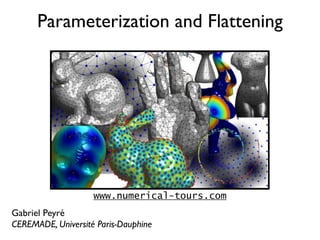
Parameterization and Flattening


                    www.numerical-tours.com
Gabriel Peyré
CEREMADE, Université Paris-Dauphine
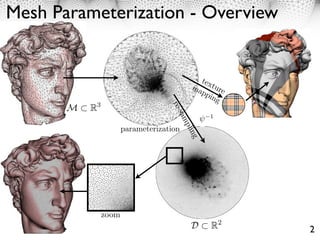
Mesh Parameterization - Overview


                                     tex
                                   ma ture
                                     pp
                                        ing
       M   R3

                parameterization


                                              2
Mesh Parameterization - Overview


                                              tex
                                            ma ture
                                              pp
                                                 ing
           R3


                                    re-
       M


                                     s am
                                                1


                                          pli
                       parameterization


                                           ng


                zoom
                                            D   R2     2
Overview
 • Dirichlet Energy on Meshes
 • Harmonic Parameterization
 • Spectral Flattening
 • Barycentric Coordinates for Warping
 • Geodesic Flattening
 • High Dimensional Data Analysis        3
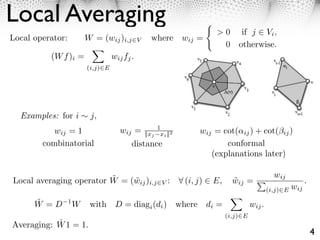
Local Averaging
                                                                          >0        if j Vi ,
Local operator:           W = (wij )i,j        V     where       wij =
                                                                           0       otherwise.
          (W f )i =                 wij fj .
                          (i,j) E


  Examples: for i          j,
           wij = 1                     wij =            1
                                                   ||xj xi ||2        wij = cot( ij ) + cot(⇥ij )
        combinatorial                      distance                          conformal
                                                                         (explanations later)

                         ˜                                                                         wij
Local averaging operator W = (wij )i,j
                              ˜                          V   : ⇥ (i, j)   E,     wij =
                                                                                 ˜                               .
                                                                                                 (i,j) E   wij
      ˜
      W =D        1
                      W    with D = diagi (di ) where di =                               wij .
                                                                               (i,j)⇥E
           ˜
Averaging: W 1 = 1.
                                                                                                                     4
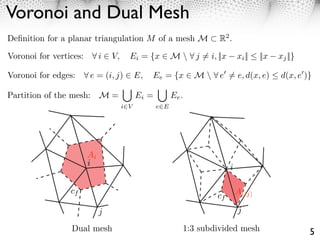
Voronoi and Dual Mesh
Definition for a planar triangulation M of a mesh M              R2 .

Voronoi for vertices: ⇧ i ⇤ V,     Ei = {x ⇤ M  ⇧ j ⌅= i, ||x          xi || ⇥ ||x   xj ||}

Voronoi for edges: ⌅ e = (i, j) ⇥ E,      Ee = {x ⇥ M  ⌅ e ⇤= e, d(x, e)             d(x, e )}

Partition of the mesh: M =             Ei =         Ee .
                                 i V          e E


                     Ai
                     i                                              i

                cf                                                      A(ij)
                                                               cf
                          j                                             j

                 Dual mesh                             1:3 subdivided mesh                     5
Approximating Integrals on Meshes
Approximation of integrals on vertices and edges:
  ⇥
      f (x)dx       Ai f (xi )           Ae f ([xi , xj ]).
    M             i V              e=(i,j) E
                                                                        i

T heorem : ⇥ e = (i, j)       E,                                            A(ij)
                                                                   cf
                 1
 Ae = Area(Ee ) = ||xi        xj ||2 (cot(   ij )   + cot(⇥ij ))            j
                 2
Approximating Integrals on Meshes
Approximation of integrals on vertices and edges:
  ⇥
      f (x)dx       Ai f (xi )           Ae f ([xi , xj ]).
    M              i V                e=(i,j) E
                                                                               i

T heorem : ⇥ e = (i, j)          E,                                                A(ij)
                                                                          cf
                 1
 Ae = Area(Ee ) = ||xi           xj ||2 (cot(   ij )   + cot(⇥ij ))                j
                 2
                                                                          A
Proof:         +     +       =
                                 2
                                                ||AB||
A(ABO) = ||AB||              h = ||AB||                tan( )
                                                   2                  O
                                                                           h
                         2
         ||AB||     ⇤
A(ABO) =        tan                     ( + ⇥)                C
            2       2
                                                                                       B
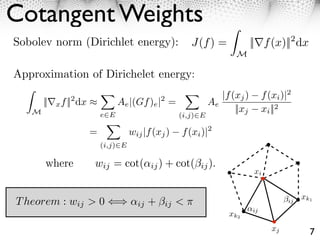
Cotangent Weights
Sobolev norm (Dirichlet energy):   J(f ) =       || f (x)||2 dx
                                             M
Cotangent Weights                                                      ⇧ (i, j) ⇤ E,     wij = 1.
                                  Distance weights: they depends both on the geometry and the to
                                  require faces information,
Sobolev norm (Dirichlet energy):                       J(f ) =                         2 1
                                                                              || f (x)|| dx
                                                                 ⇧ (i, j) ⇤ E, wij =
                                                                                     ||xj xi ||2
                                                                                                 .
                                                                      M
                                  Conformal weights: they depends on the full geometrical realiza
                                  require the face information
Approximation of Dirichelet energy:                           ⇧ (i, j) ⇤ E,    wij = cot(    ij )   + cot(⇥
  ⇥
                                                                  |f (xj ) f (xi )|2
                                Figure 1.2 shows the geometrical meaning of the angles ij and
       ||⇤x f || dx ⇥
              2
                            Ae |(Gf )e | = 2
                                                            Ae
                                                         ij = ⇥(xi , xj , xk1 )
                                                                        ||xj xand ⇥ij = ⇥(xi
                                                                                      2
   M                                                                              i ||
                        e E                        (i,j) E
                                where (i, j, k1 ) ⇤ F and (i, j, k2 ) ⇤ F are the two faces adjacent
                  =           wij |fnext ) f (xiexplanation of these celebrated cotangent
                                in the
                                       (xj section the )|2
                        (i,j) E

       where        wij = cot(           ij )   + cot(⇥ij ).
                                                                              xi


                                                                                            ij
                                                                                                    xk1
                                                                              ij
                                                                    xk2
                                                                                    xj                 7
Cotangent Weights                                                      ⇧ (i, j) ⇤ E,     wij = 1.
                                  Distance weights: they depends both on the geometry and the to
                                  require faces information,
Sobolev norm (Dirichlet energy):                       J(f ) =                         2 1
                                                                              || f (x)|| dx
                                                                 ⇧ (i, j) ⇤ E, wij =
                                                                                     ||xj xi ||2
                                                                                                 .
                                                                      M
                                  Conformal weights: they depends on the full geometrical realiza
                                  require the face information
Approximation of Dirichelet energy:                           ⇧ (i, j) ⇤ E,    wij = cot(    ij )   + cot(⇥
  ⇥
                                                                  |f (xj ) f (xi )|2
                                Figure 1.2 shows the geometrical meaning of the angles ij and
       ||⇤x f || dx ⇥
              2
                            Ae |(Gf )e | = 2
                                                            Ae
                                                         ij = ⇥(xi , xj , xk1 )
                                                                        ||xj xand ⇥ij = ⇥(xi
                                                                                      2
   M                                                                              i ||
                        e E                        (i,j) E
                                where (i, j, k1 ) ⇤ F and (i, j, k2 ) ⇤ F are the two faces adjacent
                  =           wij |fnext ) f (xiexplanation of these celebrated cotangent
                                in the
                                       (xj section the )|2
                        (i,j) E

       where        wij = cot(           ij )   + cot(⇥ij ).
                                                                              xi

                                                                                                    xk1
T heorem : wij > 0           ⇥      ij   + ⇥ij < ⇤                                          ij
                                                                              ij
                                                                    xk2
                                                                                    xj                 7
Overview
 • Dirichlet Energy on Meshes
 • Harmonic Parameterization
 • Spectral Flattening
 • Barycentric Coordinates for Warping
 • Geodesic Flattening
 • High Dimensional Data Analysis        8
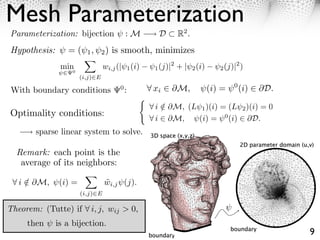
Mesh Parameterization
Parameterization: bijection               : M ⇤ D ⇥ R2 .
Hypothesis:     =(     1,      2)   is smooth, minimizes
              min0             wi,j (|        1 (i)     1 (j)|
                                                              2
                                                                  +|   2 (i)      2 (j)| )
                                                                                        2

                     (i,j) E

With boundary conditions              0
                                          :           ⇥ xi    ⇥M,              (i) =    0
                                                                                            (i)   ⇥D.


                                                       3D space (x,y,z)
                                                                                            2D parameter domain (u,v)


                                                                                       boundary
                                                      boundary                                                     9
Mesh Parameterization
Parameterization: bijection               : M ⇤ D ⇥ R2 .
Hypothesis:     =(     1,      2)   is smooth, minimizes
              min0             wi,j (|        1 (i)     1 (j)|
                                                              2
                                                                  +|   2 (i)      2 (j)| )
                                                                                        2

                     (i,j) E

With boundary conditions              0
                                          :           ⇥ xi    ⇥M,              (i) =    0
                                                                                            (i)       ⇥D.

                                                      ⇥ i / ⇥M, (L 1 )(i) = (L               2 )(i)
                                                                                                 =0
Optimality conditions:                                ⇥ i ⇥M,      (i) = 0 (i)                ⇥D.
   ⇥ sparse linear system to solve.                    3D space (x,y,z)
                                                                                            2D parameter domain (u,v)


                                                                                       boundary
                                                      boundary                                                     9
Mesh Parameterization
Parameterization: bijection                : M ⇤ D ⇥ R2 .
Hypothesis:      =(     1,      2)   is smooth, minimizes
               min0             wi,j (|        1 (i)     1 (j)|
                                                               2
                                                                   +|   2 (i)      2 (j)| )
                                                                                         2

                      (i,j) E

With boundary conditions               0
                                           :           ⇥ xi    ⇥M,              (i) =    0
                                                                                             (i)       ⇥D.

                                                       ⇥ i / ⇥M, (L 1 )(i) = (L               2 )(i)
                                                                                                  =0
Optimality conditions:                                 ⇥ i ⇥M,      (i) = 0 (i)                ⇥D.
    ⇥ sparse linear system to solve.                    3D space (x,y,z)
                                                                                             2D parameter domain (u,v)
  Remark: each point is the
   average of its neighbors:

 ⇥ i / ⇥M,    (i) =             wi,j (j).
                                ˜
                      (i,j) E

Theorem: (Tutte) if      i, j, wij > 0,
     then     is a bijection.
                                                                                        boundary
                                                       boundary                                                     9
Examples of Parameterization


         Combinatorial
         Conformal


  Mesh


                               10
Examples of Parameterization


         Combinatorial
         Conformal


  Mesh


                               11
Application to Remeshing

                       parameterization


                                                               re-sampling
                   1


                              zoom

        P. Alliez et al., Isotropic Surface Remeshing, 2003.                 12
Application to Texture Mapping


                        texture g(u)
        pa
         ra
            m
             et
             er
                iza
                  tio
                   n


                                       color g( (x))
                                                       13
Mesh Parameterization #1
 : S0 ⇥ S   ⇥x   S0 ⇥S0 ,   =0
   S0 ⇥ S                          S


                              S0


                                   14
Mesh Parameterization #1
   : S0 ⇥ S                     ⇥x        S0 ⇥S0 ,            =0
     S0 ⇥ S                                                          S
 Discretization of          :
 W = make_sparse(n,n);
 for i=1:3
     i1 = mod(i-1,3)+1; i2 = mod(i ,3)+1; i3 = mod(i+1,3)+1;
     pp = vertex(:,faces(i2,:)) - vertex(:,faces(i1,:));
     qq = vertex(:,faces(i3,:)) - vertex(:,faces(i1,:));
     % normalize the vectors
     pp = pp ./ repmat( sqrt(sum(pp.^2,1)), [3 1] );
     qq = qq ./ repmat( sqrt(sum(qq.^2,1)), [3 1] );
     % compute angles
     a = 1 ./ tan( acos(sum(pp.*qq,1)) );
     a = max(a, 1e-2); % avoid degeneracy
     W = W + make_sparse(faces(i2,:),faces(i3,:), a, n, n );
     W = W + make_sparse(faces(i3,:),faces(i2,:), a, n, n );
 end
                                                                S0


                                                                     14
Mesh Parameterization #1
   : S0 ⇥ S                     ⇥x        S0 ⇥S0 ,            =0
     S0 ⇥ S                                                          S
 Discretization of          :
 W = make_sparse(n,n);
 for i=1:3
     i1 = mod(i-1,3)+1; i2 = mod(i ,3)+1; i3 = mod(i+1,3)+1;
     pp = vertex(:,faces(i2,:)) - vertex(:,faces(i1,:));
     qq = vertex(:,faces(i3,:)) - vertex(:,faces(i1,:));
     % normalize the vectors
     pp = pp ./ repmat( sqrt(sum(pp.^2,1)), [3 1] );
     qq = qq ./ repmat( sqrt(sum(qq.^2,1)), [3 1] );
     % compute angles
     a = 1 ./ tan( acos(sum(pp.*qq,1)) );
     a = max(a, 1e-2); % avoid degeneracy
     W = W + make_sparse(faces(i2,:),faces(i3,:), a, n, n );
     W = W + make_sparse(faces(i3,:),faces(i2,:), a, n, n );
 end
                                                                S0
Formation of the linear system:
 D = spdiags(full( sum(W,1) ), 0, n,n);
 L = D - W; L1 = L; L1(boundary,:) = 0;
 L1(boundary + (boundary-1)*n) = 1;


                                                                     14
Mesh Parameterization #1
   : S0 ⇥ S                      ⇥x       S0 ⇥S0 ,            =0
     S0 ⇥ S                                                          S
 Discretization of           :
 W = make_sparse(n,n);
 for i=1:3
     i1 = mod(i-1,3)+1; i2 = mod(i ,3)+1; i3 = mod(i+1,3)+1;
     pp = vertex(:,faces(i2,:)) - vertex(:,faces(i1,:));
     qq = vertex(:,faces(i3,:)) - vertex(:,faces(i1,:));
     % normalize the vectors
     pp = pp ./ repmat( sqrt(sum(pp.^2,1)), [3 1] );
     qq = qq ./ repmat( sqrt(sum(qq.^2,1)), [3 1] );
     % compute angles
     a = 1 ./ tan( acos(sum(pp.*qq,1)) );
     a = max(a, 1e-2); % avoid degeneracy
     W = W + make_sparse(faces(i2,:),faces(i3,:), a, n, n );
     W = W + make_sparse(faces(i3,:),faces(i2,:), a, n, n );
 end
                                                                S0
Formation of the linear system:
 D = spdiags(full( sum(W,1) ), 0, n,n);
 L = D - W; L1 = L; L1(boundary,:) = 0;
 L1(boundary + (boundary-1)*n) = 1;


Formation of the RHS and resolution:
  Rx = zeros(n,1); Rx(boundary) = x0;
  Ry = zeros(n,1); Ry(boundary) = y0;
  x = L1  Rx; y = L1  Ry;
                                                                     14
Mesh Parameterization #2
Geometry image: re-sample X/Y/Z coordinates of on a grid.
       store the surface as a color (R/G/B) image.

Exercise: perform the linear interpolation of the parameterization.

Exercise: display the geometry image using a checkboard texture.


                                                                      15
Mesh Parameterization #3
Exercise: Locate the position of the eyes / the mouth
          in the texture and on the mesh.

Exercise: Compute an a ne transformation to re-align the texture.


                                                                    16
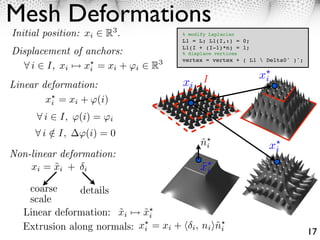
Mesh Deformations
Initial position: xi    R3 .
Displacement of anchors:
    i I, xi     xi = xi +      i   R3
                                             I   xi
Linear deformation:                     xi
        xi = xi + (i)
       i   I,   (i) =    i

       i / I,     (i) = 0


                                                      17
Mesh Deformations
Initial position: xi    R3 .               % modify Laplacian
                                           L1 = L; L1(I,:) = 0;

Displacement of anchors:                   L1(I + (I-1)*n) = 1;
                                           % displace vertices
                                           vertex = vertex + ( L1  Delta0' )';
    i I, xi     xi = xi +      i   R   3

                                                  I               xi
Linear deformation:                        xi
        xi = xi + (i)
       i   I,   (i) =    i

       i / I,     (i) = 0


                                                                                  17
Mesh Deformations
Initial position: xi    R3 .               % modify Laplacian
                                           L1 = L; L1(I,:) = 0;

Displacement of anchors:                   L1(I + (I-1)*n) = 1;
                                           % displace vertices
                                           vertex = vertex + ( L1  Delta0' )';
    i I, xi     xi = xi +      i   R   3

                                                   I              xi
Linear deformation:                        xi
        xi = xi + (i)
       i   I,   (i) =    i

       i / I,     (i) = 0
                                                   ˜
                                                   ni               xi
Non-linear deformation:
    xi = xi + i
          ˜                                        ˜
                                                   xi
   coarse      details
   scale
  Linear deformation: xi
                       ˜    ˜
                            xi
  Extrusion along normals: xi = xi +          i,       ˜
                                                   n i ni
                                                                                  17
Overview
 • Dirichlet Energy on Meshes
 • Harmonic Parameterization
 • Spectral Flattening
 • Barycentric Coordinates for Warping
 • Geodesic Flattening
 • High Dimensional Data Analysis        18
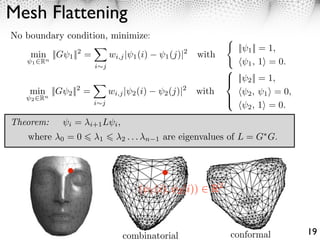
Mesh Flattening
No boundary condition, minimize:
                    ⇥                                                 ||   1 ||= 1,
    minn ||G 1 || =
                 2
                      wi,j | 1 (i)                1 (j)|
                                                        2
                                                            with
     1 ⇥R
                           i j
                                                                      ⇥    1 , 1⇤ = 0.

                           ⇧
                                                                   ⌅ ||
                                                                   ⇤       2 ||= 1,
    minn ||G   2 ||
                   2
                       =         wi,j |   2 (i)   2 (j)|
                                                        2
                                                            with     ⇥     2 , 1 ⇤ = 0,
    2 ⇥R                                                           ⌅
                                                                   ⇥
                                                                           2 , 1⇤ = 0.
                           i j                                       ⇥


                                                                                          19
Mesh Flattening
No boundary condition, minimize:
                    ⇥                                                           ||   1 ||= 1,
    minn ||G 1 || =
                 2
                      wi,j | 1 (i)                         1 (j)|
                                                                 2
                                                                     with
     1 ⇥R
                            i j
                                                                                ⇥    1 , 1⇤ = 0.

                            ⇧
                                                                             ⌅ ||
                                                                             ⇤       2 ||= 1,
    minn ||G    2 ||
                    2
                        =         wi,j |    2 (i)          2 (j)|
                                                                 2
                                                                     with      ⇥     2 , 1 ⇤ = 0,
    2 ⇥R                                                                     ⌅
                                                                             ⇥
                                                                                     2 , 1⇤ = 0.
                            i j                                                ⇥
Theorem:       ⇥i =     i+1 L⇥i ,

    where   0   =0           1        2    ...       n 1   are eigenvalues of L = G⇥ G.


                                                 (   1 (i),    2 (i))   R2


                                      combinatorial                           conformal             19
Proof
Spectral decomposition:   L=G G=D            W =U U
      = diag( i ) where 0 =    1   <   2   ...     n

    U = (ui )n orthonormal basis of Rn .
             i=1                                 u1 = 1


                                                          20
Proof
 Spectral decomposition:        L=G G=D                 W =U U
       = diag( i ) where 0 =             1   <   2   ...     n

     U = (ui )n orthonormal basis of Rn .
              i=1                                          u1 = 1
                   n
E(⇥) = ||G⇥||2 =         i | ⇥, ui ⇥|2
                   i=1            n
If   , 1 = 0, then E(⇥) =                i ai    where ai = | ⇥, ui ⇥|2
                                i=2


                                                                     20
Proof
 Spectral decomposition:           L=G G=D                 W =U U
       = diag( i ) where 0 =             1   <   2       ...           n

     U = (ui )n orthonormal basis of Rn .
              i=1                                              u1 = 1
                   n
E(⇥) = ||G⇥||2 =         i | ⇥, ui ⇥|2
                   i=1             n
If   , 1 = 0, then E(⇥) =                i ai    where ai = | ⇥, ui ⇥|2
                                   i=2
                                                     n
Constrained minimization:           Pnmin                  i ai
                                     i=2 ai =1
                                                     i=2
      linear program: minimum reached at a =                      i.
           ±u2 = argmin E( )
                    , 1⇥=0,|| ||                                           20
Flattening Examples
Main issue: No guarantee of being valid (bijective).


                       combinatorial           conformal
                                                           21
Overview
 • Dirichlet Energy on Meshes
 • Harmonic Parameterization
 • Spectral Flattening
 • Barycentric Coordinates for Warping
 • Geodesic Flattening
 • High Dimensional Data Analysis    22
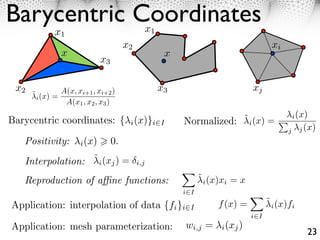
Barycentric Coordinates
            x1
              x
                            x3

x2
     ˜ i (x) = A(x, xi+1 , xi+2 )
                A(x1 , x2 , x3 )


                                    23
Barycentric Coordinates
             x
             x1                                    1
                                        x2
               x                                        x
                              x3

 x2                                                    x3
      ˜ i (x) = A(x, xi+1 , xi+2 )
                 A(x1 , x2 , x3 )
                                                                                        i (x)
Barycentric coordinates: { i (x)}i                     I    Normalized: ˜ i (x) =
                                                                                    j     j (x)
   Positivity:        i (x)        0.
                  ˜
   Interpolation: ⇥i (xj ) =                 i,j

   Reproduction of a ne functions:                                ˜ i (x)xi = x
                                                            i I


                                                                                            23
Barycentric Coordinates
             x
             x1                                    1
                                        x2
               x                                        x
                              x3

 x2                                                    x3
      ˜ i (x) = A(x, xi+1 , xi+2 )
                 A(x1 , x2 , x3 )
                                                                                                   i (x)
Barycentric coordinates: { i (x)}i                     I    Normalized: ˜ i (x) =
                                                                                               j     j (x)
   Positivity:        i (x)        0.
                  ˜
   Interpolation: ⇥i (xj ) =                 i,j

   Reproduction of a ne functions:                                ˜ i (x)xi = x
                                                            i I

Application: interpolation of data {fi }i                              f (x) =          ˜ i (x)fi
                                                              I
                                                                                  i I

                                                                                                       23
Barycentric Coordinates
             x
             x1                                    1
                                        x2                                               xi
               x                                        x
                              x3

 x2                                                    x3                         xj
      ˜ i (x) = A(x, xi+1 , xi+2 )
                 A(x1 , x2 , x3 )
                                                                                                   i (x)
Barycentric coordinates: { i (x)}i                     I    Normalized: ˜ i (x) =
                                                                                               j     j (x)
   Positivity:        i (x)        0.
                  ˜
   Interpolation: ⇥i (xj ) =                 i,j

   Reproduction of a ne functions:                                ˜ i (x)xi = x
                                                            i I

Application: interpolation of data {fi }i                              f (x) =          ˜ i (x)fi
                                                              I
                                                                                  i I
Application: mesh parameterization:                         wi,j =      i (xj )
                                                                                                       23
Mean Value Coordinates
Conformal Laplacian weights:
     ⇥i (x) = cotan( i (x)) + cotan( ˜i (x))          xi+1
       not necessarily positive.
                                               xi     i   i
Mean-value coordinates:                                        x
                                                     ˜i
             tan( i (x)/2) + tan(˜ i (x)/2)               ˜i
    ⇥i (x) =
                        ||x xi ||
        valid coordinates.                                xi
        extend to non-convex coordinates (oriented angles).


    ˜ 1 (x)        ˜ 2 (x)

                                                                   24
Barycentric Coordinates for Warping
 Cage C: polygon with vertices {xi }i I .
 Data points: {yj }j   J    C.      Example: textured grid, 3D model, etc.
 Initialization: data anchoring, compute
           j J, i I,         i,j = i (yj ).

      Satisfies:    yi =           i,j xi
                           i I

 Cage warping:    xi       xi
 Data warping: yj          yj =            i,j xi
                                  i I


                           xi y
    xi    yi                    i

                                                                       25
Harmonic Coordinates
Mean value coordinates:

  “non-physical” behavior,
  passes “through” the cage.


Harmonic mapping:
  ⇥ x C,    i (x) = 0.


Boundary conditions:
   ⇥x   ⇥C,   i (x) =   i (x).
                        0
                                 Mean value   Harmonic


                                                         26
Warping Comparison


 Initial shape   Mean value   Harmonic


                                         27
Overview
 • Dirichlet Energy on Meshes
 • Harmonic Parameterization
 • Spectral Flattening
 • Barycentric Coordinates for Warping
 • Geodesic Flattening
 • High Dimensional Data Analysis        28
Geodesic Distances                            1
                                   def.
Length of a curve (t)     M: L( ) =               W ( (t))|| (t)||dt.
                                          0
Geodesic distance:       dM (x, y) =          min         L( )
                                       (0)=x, (1)=y

Geodesic curve       :   dM (x, y) = L(       )


    Euclidean            Shape      Isotropic W = 1                 Surface   29
Computation of Geodesic Distances
Distance map to a point: Ux0 (x) = dM (x0 , x).
                                                               Ux0
Non-linear PDE:        || Ux0 (x)|| = W (x)
 (viscosity)           Ux0 (x0 ) = 0,                          x0
Upwind finite di erences approximation.
Fast Marching: front propagation in O(N log(N )) operations.


                                                                     30
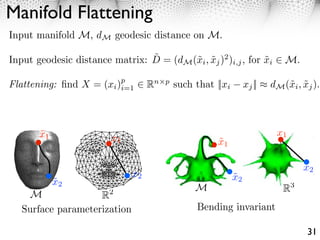
Manifold Flattening
Input manifold M, dM geodesic distance on M.

                                ˜
Input geodesic distance matrix: D = (dM (˜i , xj )2 )i,j , for xi
                                         x ˜                   ˜            M.

Flattening: find X = (xi )p ⇤ Rn
                         i=1
                                      p
                                          such that ||xi        xj || ⇥ dM (˜i , xj ).
                                                                            x ˜


       ˜
       x1                x1
                                                                         x1
                                                     ˜
                                                     x1

                                                                                 x2
                              x2                           ˜
                                                           x2
            ˜
            x2
                                               M                           R3
     M              R2
   Surface parameterization                    Bending invariant

                                                                                  31
Stress Minimization
Geodesic stress: S(X) =           |||xi   xj ||   di,j |2 ,   di,j = dM (˜i , xj )
                                                                         x ˜
                           i,j
                                     1 ()
SMACOF algorithm:      X   ( +1)
                                    = X B(X ( ) )
                                     N                                   di,j
                                        where B(X)i,j =
                                                                     ||xi xj ||
Non-convex functional : X (   )
                                      X local minimizer of S.


                                                                                32
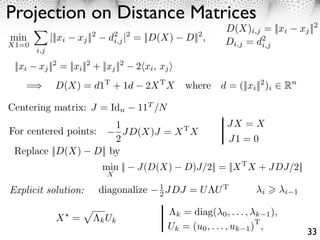
Projection on Distance Matrices
                                                              D(X)i,j = ||xi       xj ||2
min           |||xi   xj ||2   d2 |2 = ||D(X)
                                i,j                  D||2 ,   Di,j = d2
X1=0                                                                  i,j
        i,j

 ||xi   xj ||2 = ||xi ||2 + ||xj ||2   2⇥xi , xj ⇤
    =⇥         D(X) = d1T + 1d           2X T X      where d = (||xi ||2 )i ⇤ Rn


                                                                                     33
Projection on Distance Matrices
                                                              D(X)i,j = ||xi       xj ||2
min           |||xi   xj ||2   d2 |2 = ||D(X)
                                i,j                  D||2 ,   Di,j = d2
X1=0                                                                  i,j
        i,j

 ||xi   xj ||2 = ||xi ||2 + ||xj ||2   2⇥xi , xj ⇤
    =⇥         D(X) = d1T + 1d           2X T X      where d = (||xi ||2 )i ⇤ Rn

Centering matrix: J = Idn              11T /N
                                 1                             JX = X
For centered points:               JD(X)J = X T X
                                 2                             J1 = 0


                                                                                     33
Projection on Distance Matrices
                                                                   D(X)i,j = ||xi       xj ||2
min           |||xi   xj ||2     d2 |2 = ||D(X)
                                  i,j                     D||2 ,   Di,j = d2
X1=0                                                                       i,j
        i,j

 ||xi   xj ||2 = ||xi ||2 + ||xj ||2    2⇥xi , xj ⇤
    =⇥         D(X) = d1T + 1d            2X T X          where d = (||xi ||2 )i ⇤ Rn

Centering matrix: J = Idn               11T /N
                     1                                              JX = X
For centered points:   JD(X)J = X T X
                     2                                              J1 = 0
 Replace ||D(X) D|| by
                               min ||   J(D(X)            D)J/2|| = ||X T X + JDJ/2||
                                X

Explicit solution:             diagonalize     1
                                               2 JDJ       = U UT            i    i 1

                                                    = diag( 0 , . . . , k 1 ),
                                                      k
               X =             k Uk                                       T
                                                 Uk = (u0 , . . . , uk 1 ) ,
                                                                                          33
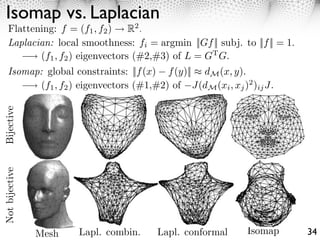
Isomap vs. Laplacian
    Flattening: f = (f1 , f2 )   R2 .
    Laplacian: local smoothness: fi = argmin ||Gf || subj. to ||f || = 1.
        ⇥ (f1 , f2 ) eigenvectors (#2,#3) of L = GT G.
    Isomap: global constraints: ||f (x) f (y)|| ⇥ dM (x, y).
        ⇥ (f1 , f2 ) eigenvectors (#1,#2) of J(dM (xi , xj )2 )ij J.
Bijective
Not bijective


                Mesh   Lapl. combin.   Lapl. conformal       Isomap         34
Bending Invariants of Surfaces
Bending invariants: [Elad, Kimmel, 2003].
Surface M, Isomap dimension reduction: x ⇥ M ⇤   IM (x) ⇥ R3 .


  M


IM


       [Elad, Kimmel, 2003].                                     35
Bending Invariants of Surfaces
Bending invariants: [Elad, Kimmel, 2003].
Surface M, Isomap dimension reduction: x ⇥ M ⇤      IM (x) ⇥ R3 .
Geodesic isometry    :M     M : dM (x, y) = dM ( (x), (y)).
Theorem: up to rigid motion, IM is invariant to geodesic isometries:
   IM (x) = v + U IM ( (x)) where U O(3) and v R3 .

  M


IM


       [Elad, Kimmel, 2003].                                        35
Bending Invariants of Surfaces
Bending invariants: [Elad, Kimmel, 2003].
Surface M, Isomap dimension reduction: x ⇥ M ⇤       IM (x) ⇥ R3 .
Geodesic isometry    :M     M : dM (x, y) = dM ( (x), (y)).
Theorem: up to rigid motion, IM is invariant to geodesic isometries:
   IM (x) = v + U IM ( (x)) where U O(3) and v R3 .

  M


IM


       [Elad, Kimmel, 2003].                [Bronstein et al., 2005]. 35
Bending Invariants


    M


   IM
                     36
Face Recognition


                 Rigid similarity     Non-rigid similarity   Alex

 A. M. Bronstein et al., IJCV, 2005
                                                                    37
Overview
 • Dirichlet Energy on Meshes
 • Harmonic Parameterization
 • Spectral Flattening
 • Barycentric Coordinates for Warping
 • Geodesic Flattening
 • High Dimensional Data Analysis        38
High Dimensional Data Sets


                             39
Graph and Geodesics


                      40
Isomap Dimension Reduction


                             41
Isomap vs PCA Flattening


                           42
Laplacian Spectral Dimension Reduction


                                         43
Parameterization of Image Datasets


                                     44
Library of Images


                    45
When Does it Works?


                      46
Local patches in images


                          47

Mesh Processing Course : Mesh Parameterization

  • 1.
    Parameterization and Flattening www.numerical-tours.com Gabriel Peyré CEREMADE, Université Paris-Dauphine
  • 2.
    Mesh Parameterization -Overview tex ma ture pp ing M R3 parameterization 2
  • 3.
    Mesh Parameterization -Overview tex ma ture pp ing R3 re- M s am 1 pli parameterization ng zoom D R2 2
  • 4.
    Overview • DirichletEnergy on Meshes • Harmonic Parameterization • Spectral Flattening • Barycentric Coordinates for Warping • Geodesic Flattening • High Dimensional Data Analysis 3
  • 5.
    Local Averaging >0 if j Vi , Local operator: W = (wij )i,j V where wij = 0 otherwise. (W f )i = wij fj . (i,j) E Examples: for i j, wij = 1 wij = 1 ||xj xi ||2 wij = cot( ij ) + cot(⇥ij ) combinatorial distance conformal (explanations later) ˜ wij Local averaging operator W = (wij )i,j ˜ V : ⇥ (i, j) E, wij = ˜ . (i,j) E wij ˜ W =D 1 W with D = diagi (di ) where di = wij . (i,j)⇥E ˜ Averaging: W 1 = 1. 4
  • 6.
    Voronoi and DualMesh Definition for a planar triangulation M of a mesh M R2 . Voronoi for vertices: ⇧ i ⇤ V, Ei = {x ⇤ M ⇧ j ⌅= i, ||x xi || ⇥ ||x xj ||} Voronoi for edges: ⌅ e = (i, j) ⇥ E, Ee = {x ⇥ M ⌅ e ⇤= e, d(x, e) d(x, e )} Partition of the mesh: M = Ei = Ee . i V e E Ai i i cf A(ij) cf j j Dual mesh 1:3 subdivided mesh 5
  • 7.
    Approximating Integrals onMeshes Approximation of integrals on vertices and edges: ⇥ f (x)dx Ai f (xi ) Ae f ([xi , xj ]). M i V e=(i,j) E i T heorem : ⇥ e = (i, j) E, A(ij) cf 1 Ae = Area(Ee ) = ||xi xj ||2 (cot( ij ) + cot(⇥ij )) j 2
  • 8.
    Approximating Integrals onMeshes Approximation of integrals on vertices and edges: ⇥ f (x)dx Ai f (xi ) Ae f ([xi , xj ]). M i V e=(i,j) E i T heorem : ⇥ e = (i, j) E, A(ij) cf 1 Ae = Area(Ee ) = ||xi xj ||2 (cot( ij ) + cot(⇥ij )) j 2 A Proof: + + = 2 ||AB|| A(ABO) = ||AB|| h = ||AB|| tan( ) 2 O h 2 ||AB|| ⇤ A(ABO) = tan ( + ⇥) C 2 2 B
  • 9.
    Cotangent Weights Sobolev norm(Dirichlet energy): J(f ) = || f (x)||2 dx M
  • 10.
    Cotangent Weights ⇧ (i, j) ⇤ E, wij = 1. Distance weights: they depends both on the geometry and the to require faces information, Sobolev norm (Dirichlet energy): J(f ) = 2 1 || f (x)|| dx ⇧ (i, j) ⇤ E, wij = ||xj xi ||2 . M Conformal weights: they depends on the full geometrical realiza require the face information Approximation of Dirichelet energy: ⇧ (i, j) ⇤ E, wij = cot( ij ) + cot(⇥ ⇥ |f (xj ) f (xi )|2 Figure 1.2 shows the geometrical meaning of the angles ij and ||⇤x f || dx ⇥ 2 Ae |(Gf )e | = 2 Ae ij = ⇥(xi , xj , xk1 ) ||xj xand ⇥ij = ⇥(xi 2 M i || e E (i,j) E where (i, j, k1 ) ⇤ F and (i, j, k2 ) ⇤ F are the two faces adjacent = wij |fnext ) f (xiexplanation of these celebrated cotangent in the (xj section the )|2 (i,j) E where wij = cot( ij ) + cot(⇥ij ). xi ij xk1 ij xk2 xj 7
  • 11.
    Cotangent Weights ⇧ (i, j) ⇤ E, wij = 1. Distance weights: they depends both on the geometry and the to require faces information, Sobolev norm (Dirichlet energy): J(f ) = 2 1 || f (x)|| dx ⇧ (i, j) ⇤ E, wij = ||xj xi ||2 . M Conformal weights: they depends on the full geometrical realiza require the face information Approximation of Dirichelet energy: ⇧ (i, j) ⇤ E, wij = cot( ij ) + cot(⇥ ⇥ |f (xj ) f (xi )|2 Figure 1.2 shows the geometrical meaning of the angles ij and ||⇤x f || dx ⇥ 2 Ae |(Gf )e | = 2 Ae ij = ⇥(xi , xj , xk1 ) ||xj xand ⇥ij = ⇥(xi 2 M i || e E (i,j) E where (i, j, k1 ) ⇤ F and (i, j, k2 ) ⇤ F are the two faces adjacent = wij |fnext ) f (xiexplanation of these celebrated cotangent in the (xj section the )|2 (i,j) E where wij = cot( ij ) + cot(⇥ij ). xi xk1 T heorem : wij > 0 ⇥ ij + ⇥ij < ⇤ ij ij xk2 xj 7
  • 12.
    Overview • DirichletEnergy on Meshes • Harmonic Parameterization • Spectral Flattening • Barycentric Coordinates for Warping • Geodesic Flattening • High Dimensional Data Analysis 8
  • 13.
    Mesh Parameterization Parameterization: bijection : M ⇤ D ⇥ R2 . Hypothesis: =( 1, 2) is smooth, minimizes min0 wi,j (| 1 (i) 1 (j)| 2 +| 2 (i) 2 (j)| ) 2 (i,j) E With boundary conditions 0 : ⇥ xi ⇥M, (i) = 0 (i) ⇥D. 3D space (x,y,z) 2D parameter domain (u,v) boundary boundary 9
  • 14.
    Mesh Parameterization Parameterization: bijection : M ⇤ D ⇥ R2 . Hypothesis: =( 1, 2) is smooth, minimizes min0 wi,j (| 1 (i) 1 (j)| 2 +| 2 (i) 2 (j)| ) 2 (i,j) E With boundary conditions 0 : ⇥ xi ⇥M, (i) = 0 (i) ⇥D. ⇥ i / ⇥M, (L 1 )(i) = (L 2 )(i) =0 Optimality conditions: ⇥ i ⇥M, (i) = 0 (i) ⇥D. ⇥ sparse linear system to solve. 3D space (x,y,z) 2D parameter domain (u,v) boundary boundary 9
  • 15.
    Mesh Parameterization Parameterization: bijection : M ⇤ D ⇥ R2 . Hypothesis: =( 1, 2) is smooth, minimizes min0 wi,j (| 1 (i) 1 (j)| 2 +| 2 (i) 2 (j)| ) 2 (i,j) E With boundary conditions 0 : ⇥ xi ⇥M, (i) = 0 (i) ⇥D. ⇥ i / ⇥M, (L 1 )(i) = (L 2 )(i) =0 Optimality conditions: ⇥ i ⇥M, (i) = 0 (i) ⇥D. ⇥ sparse linear system to solve. 3D space (x,y,z) 2D parameter domain (u,v) Remark: each point is the average of its neighbors: ⇥ i / ⇥M, (i) = wi,j (j). ˜ (i,j) E Theorem: (Tutte) if i, j, wij > 0, then is a bijection. boundary boundary 9
  • 16.
    Examples of Parameterization Combinatorial Conformal Mesh 10
  • 17.
    Examples of Parameterization Combinatorial Conformal Mesh 11
  • 18.
    Application to Remeshing parameterization re-sampling 1 zoom P. Alliez et al., Isotropic Surface Remeshing, 2003. 12
  • 19.
    Application to TextureMapping texture g(u) pa ra m et er iza tio n color g( (x)) 13
  • 20.
    Mesh Parameterization #1 : S0 ⇥ S ⇥x S0 ⇥S0 , =0 S0 ⇥ S S S0 14
  • 21.
    Mesh Parameterization #1 : S0 ⇥ S ⇥x S0 ⇥S0 , =0 S0 ⇥ S S Discretization of : W = make_sparse(n,n); for i=1:3 i1 = mod(i-1,3)+1; i2 = mod(i ,3)+1; i3 = mod(i+1,3)+1; pp = vertex(:,faces(i2,:)) - vertex(:,faces(i1,:)); qq = vertex(:,faces(i3,:)) - vertex(:,faces(i1,:)); % normalize the vectors pp = pp ./ repmat( sqrt(sum(pp.^2,1)), [3 1] ); qq = qq ./ repmat( sqrt(sum(qq.^2,1)), [3 1] ); % compute angles a = 1 ./ tan( acos(sum(pp.*qq,1)) ); a = max(a, 1e-2); % avoid degeneracy W = W + make_sparse(faces(i2,:),faces(i3,:), a, n, n ); W = W + make_sparse(faces(i3,:),faces(i2,:), a, n, n ); end S0 14
  • 22.
    Mesh Parameterization #1 : S0 ⇥ S ⇥x S0 ⇥S0 , =0 S0 ⇥ S S Discretization of : W = make_sparse(n,n); for i=1:3 i1 = mod(i-1,3)+1; i2 = mod(i ,3)+1; i3 = mod(i+1,3)+1; pp = vertex(:,faces(i2,:)) - vertex(:,faces(i1,:)); qq = vertex(:,faces(i3,:)) - vertex(:,faces(i1,:)); % normalize the vectors pp = pp ./ repmat( sqrt(sum(pp.^2,1)), [3 1] ); qq = qq ./ repmat( sqrt(sum(qq.^2,1)), [3 1] ); % compute angles a = 1 ./ tan( acos(sum(pp.*qq,1)) ); a = max(a, 1e-2); % avoid degeneracy W = W + make_sparse(faces(i2,:),faces(i3,:), a, n, n ); W = W + make_sparse(faces(i3,:),faces(i2,:), a, n, n ); end S0 Formation of the linear system: D = spdiags(full( sum(W,1) ), 0, n,n); L = D - W; L1 = L; L1(boundary,:) = 0; L1(boundary + (boundary-1)*n) = 1; 14
  • 23.
    Mesh Parameterization #1 : S0 ⇥ S ⇥x S0 ⇥S0 , =0 S0 ⇥ S S Discretization of : W = make_sparse(n,n); for i=1:3 i1 = mod(i-1,3)+1; i2 = mod(i ,3)+1; i3 = mod(i+1,3)+1; pp = vertex(:,faces(i2,:)) - vertex(:,faces(i1,:)); qq = vertex(:,faces(i3,:)) - vertex(:,faces(i1,:)); % normalize the vectors pp = pp ./ repmat( sqrt(sum(pp.^2,1)), [3 1] ); qq = qq ./ repmat( sqrt(sum(qq.^2,1)), [3 1] ); % compute angles a = 1 ./ tan( acos(sum(pp.*qq,1)) ); a = max(a, 1e-2); % avoid degeneracy W = W + make_sparse(faces(i2,:),faces(i3,:), a, n, n ); W = W + make_sparse(faces(i3,:),faces(i2,:), a, n, n ); end S0 Formation of the linear system: D = spdiags(full( sum(W,1) ), 0, n,n); L = D - W; L1 = L; L1(boundary,:) = 0; L1(boundary + (boundary-1)*n) = 1; Formation of the RHS and resolution: Rx = zeros(n,1); Rx(boundary) = x0; Ry = zeros(n,1); Ry(boundary) = y0; x = L1 Rx; y = L1 Ry; 14
  • 24.
    Mesh Parameterization #2 Geometryimage: re-sample X/Y/Z coordinates of on a grid. store the surface as a color (R/G/B) image. Exercise: perform the linear interpolation of the parameterization. Exercise: display the geometry image using a checkboard texture. 15
  • 25.
    Mesh Parameterization #3 Exercise:Locate the position of the eyes / the mouth in the texture and on the mesh. Exercise: Compute an a ne transformation to re-align the texture. 16
  • 26.
    Mesh Deformations Initial position:xi R3 . Displacement of anchors: i I, xi xi = xi + i R3 I xi Linear deformation: xi xi = xi + (i) i I, (i) = i i / I, (i) = 0 17
  • 27.
    Mesh Deformations Initial position:xi R3 . % modify Laplacian L1 = L; L1(I,:) = 0; Displacement of anchors: L1(I + (I-1)*n) = 1; % displace vertices vertex = vertex + ( L1 Delta0' )'; i I, xi xi = xi + i R 3 I xi Linear deformation: xi xi = xi + (i) i I, (i) = i i / I, (i) = 0 17
  • 28.
    Mesh Deformations Initial position:xi R3 . % modify Laplacian L1 = L; L1(I,:) = 0; Displacement of anchors: L1(I + (I-1)*n) = 1; % displace vertices vertex = vertex + ( L1 Delta0' )'; i I, xi xi = xi + i R 3 I xi Linear deformation: xi xi = xi + (i) i I, (i) = i i / I, (i) = 0 ˜ ni xi Non-linear deformation: xi = xi + i ˜ ˜ xi coarse details scale Linear deformation: xi ˜ ˜ xi Extrusion along normals: xi = xi + i, ˜ n i ni 17
  • 29.
    Overview • DirichletEnergy on Meshes • Harmonic Parameterization • Spectral Flattening • Barycentric Coordinates for Warping • Geodesic Flattening • High Dimensional Data Analysis 18
  • 30.
    Mesh Flattening No boundarycondition, minimize: ⇥ || 1 ||= 1, minn ||G 1 || = 2 wi,j | 1 (i) 1 (j)| 2 with 1 ⇥R i j ⇥ 1 , 1⇤ = 0. ⇧ ⌅ || ⇤ 2 ||= 1, minn ||G 2 || 2 = wi,j | 2 (i) 2 (j)| 2 with ⇥ 2 , 1 ⇤ = 0, 2 ⇥R ⌅ ⇥ 2 , 1⇤ = 0. i j ⇥ 19
  • 31.
    Mesh Flattening No boundarycondition, minimize: ⇥ || 1 ||= 1, minn ||G 1 || = 2 wi,j | 1 (i) 1 (j)| 2 with 1 ⇥R i j ⇥ 1 , 1⇤ = 0. ⇧ ⌅ || ⇤ 2 ||= 1, minn ||G 2 || 2 = wi,j | 2 (i) 2 (j)| 2 with ⇥ 2 , 1 ⇤ = 0, 2 ⇥R ⌅ ⇥ 2 , 1⇤ = 0. i j ⇥ Theorem: ⇥i = i+1 L⇥i , where 0 =0 1 2 ... n 1 are eigenvalues of L = G⇥ G. ( 1 (i), 2 (i)) R2 combinatorial conformal 19
  • 32.
    Proof Spectral decomposition: L=G G=D W =U U = diag( i ) where 0 = 1 < 2 ... n U = (ui )n orthonormal basis of Rn . i=1 u1 = 1 20
  • 33.
    Proof Spectral decomposition: L=G G=D W =U U = diag( i ) where 0 = 1 < 2 ... n U = (ui )n orthonormal basis of Rn . i=1 u1 = 1 n E(⇥) = ||G⇥||2 = i | ⇥, ui ⇥|2 i=1 n If , 1 = 0, then E(⇥) = i ai where ai = | ⇥, ui ⇥|2 i=2 20
  • 34.
    Proof Spectral decomposition: L=G G=D W =U U = diag( i ) where 0 = 1 < 2 ... n U = (ui )n orthonormal basis of Rn . i=1 u1 = 1 n E(⇥) = ||G⇥||2 = i | ⇥, ui ⇥|2 i=1 n If , 1 = 0, then E(⇥) = i ai where ai = | ⇥, ui ⇥|2 i=2 n Constrained minimization: Pnmin i ai i=2 ai =1 i=2 linear program: minimum reached at a = i. ±u2 = argmin E( ) , 1⇥=0,|| || 20
  • 35.
    Flattening Examples Main issue:No guarantee of being valid (bijective). combinatorial conformal 21
  • 36.
    Overview • DirichletEnergy on Meshes • Harmonic Parameterization • Spectral Flattening • Barycentric Coordinates for Warping • Geodesic Flattening • High Dimensional Data Analysis 22
  • 37.
    Barycentric Coordinates x1 x x3 x2 ˜ i (x) = A(x, xi+1 , xi+2 ) A(x1 , x2 , x3 ) 23
  • 38.
    Barycentric Coordinates x x1 1 x2 x x x3 x2 x3 ˜ i (x) = A(x, xi+1 , xi+2 ) A(x1 , x2 , x3 ) i (x) Barycentric coordinates: { i (x)}i I Normalized: ˜ i (x) = j j (x) Positivity: i (x) 0. ˜ Interpolation: ⇥i (xj ) = i,j Reproduction of a ne functions: ˜ i (x)xi = x i I 23
  • 39.
    Barycentric Coordinates x x1 1 x2 x x x3 x2 x3 ˜ i (x) = A(x, xi+1 , xi+2 ) A(x1 , x2 , x3 ) i (x) Barycentric coordinates: { i (x)}i I Normalized: ˜ i (x) = j j (x) Positivity: i (x) 0. ˜ Interpolation: ⇥i (xj ) = i,j Reproduction of a ne functions: ˜ i (x)xi = x i I Application: interpolation of data {fi }i f (x) = ˜ i (x)fi I i I 23
  • 40.
    Barycentric Coordinates x x1 1 x2 xi x x x3 x2 x3 xj ˜ i (x) = A(x, xi+1 , xi+2 ) A(x1 , x2 , x3 ) i (x) Barycentric coordinates: { i (x)}i I Normalized: ˜ i (x) = j j (x) Positivity: i (x) 0. ˜ Interpolation: ⇥i (xj ) = i,j Reproduction of a ne functions: ˜ i (x)xi = x i I Application: interpolation of data {fi }i f (x) = ˜ i (x)fi I i I Application: mesh parameterization: wi,j = i (xj ) 23
  • 41.
    Mean Value Coordinates ConformalLaplacian weights: ⇥i (x) = cotan( i (x)) + cotan( ˜i (x)) xi+1 not necessarily positive. xi i i Mean-value coordinates: x ˜i tan( i (x)/2) + tan(˜ i (x)/2) ˜i ⇥i (x) = ||x xi || valid coordinates. xi extend to non-convex coordinates (oriented angles). ˜ 1 (x) ˜ 2 (x) 24
  • 42.
    Barycentric Coordinates forWarping Cage C: polygon with vertices {xi }i I . Data points: {yj }j J C. Example: textured grid, 3D model, etc. Initialization: data anchoring, compute j J, i I, i,j = i (yj ). Satisfies: yi = i,j xi i I Cage warping: xi xi Data warping: yj yj = i,j xi i I xi y xi yi i 25
  • 43.
    Harmonic Coordinates Mean valuecoordinates: “non-physical” behavior, passes “through” the cage. Harmonic mapping: ⇥ x C, i (x) = 0. Boundary conditions: ⇥x ⇥C, i (x) = i (x). 0 Mean value Harmonic 26
  • 44.
    Warping Comparison Initialshape Mean value Harmonic 27
  • 45.
    Overview • DirichletEnergy on Meshes • Harmonic Parameterization • Spectral Flattening • Barycentric Coordinates for Warping • Geodesic Flattening • High Dimensional Data Analysis 28
  • 46.
    Geodesic Distances 1 def. Length of a curve (t) M: L( ) = W ( (t))|| (t)||dt. 0 Geodesic distance: dM (x, y) = min L( ) (0)=x, (1)=y Geodesic curve : dM (x, y) = L( ) Euclidean Shape Isotropic W = 1 Surface 29
  • 47.
    Computation of GeodesicDistances Distance map to a point: Ux0 (x) = dM (x0 , x). Ux0 Non-linear PDE: || Ux0 (x)|| = W (x) (viscosity) Ux0 (x0 ) = 0, x0 Upwind finite di erences approximation. Fast Marching: front propagation in O(N log(N )) operations. 30
  • 48.
    Manifold Flattening Input manifoldM, dM geodesic distance on M. ˜ Input geodesic distance matrix: D = (dM (˜i , xj )2 )i,j , for xi x ˜ ˜ M. Flattening: find X = (xi )p ⇤ Rn i=1 p such that ||xi xj || ⇥ dM (˜i , xj ). x ˜ ˜ x1 x1 x1 ˜ x1 x2 x2 ˜ x2 ˜ x2 M R3 M R2 Surface parameterization Bending invariant 31
  • 49.
    Stress Minimization Geodesic stress:S(X) = |||xi xj || di,j |2 , di,j = dM (˜i , xj ) x ˜ i,j 1 () SMACOF algorithm: X ( +1) = X B(X ( ) ) N di,j where B(X)i,j = ||xi xj || Non-convex functional : X ( ) X local minimizer of S. 32
  • 50.
    Projection on DistanceMatrices D(X)i,j = ||xi xj ||2 min |||xi xj ||2 d2 |2 = ||D(X) i,j D||2 , Di,j = d2 X1=0 i,j i,j ||xi xj ||2 = ||xi ||2 + ||xj ||2 2⇥xi , xj ⇤ =⇥ D(X) = d1T + 1d 2X T X where d = (||xi ||2 )i ⇤ Rn 33
  • 51.
    Projection on DistanceMatrices D(X)i,j = ||xi xj ||2 min |||xi xj ||2 d2 |2 = ||D(X) i,j D||2 , Di,j = d2 X1=0 i,j i,j ||xi xj ||2 = ||xi ||2 + ||xj ||2 2⇥xi , xj ⇤ =⇥ D(X) = d1T + 1d 2X T X where d = (||xi ||2 )i ⇤ Rn Centering matrix: J = Idn 11T /N 1 JX = X For centered points: JD(X)J = X T X 2 J1 = 0 33
  • 52.
    Projection on DistanceMatrices D(X)i,j = ||xi xj ||2 min |||xi xj ||2 d2 |2 = ||D(X) i,j D||2 , Di,j = d2 X1=0 i,j i,j ||xi xj ||2 = ||xi ||2 + ||xj ||2 2⇥xi , xj ⇤ =⇥ D(X) = d1T + 1d 2X T X where d = (||xi ||2 )i ⇤ Rn Centering matrix: J = Idn 11T /N 1 JX = X For centered points: JD(X)J = X T X 2 J1 = 0 Replace ||D(X) D|| by min || J(D(X) D)J/2|| = ||X T X + JDJ/2|| X Explicit solution: diagonalize 1 2 JDJ = U UT i i 1 = diag( 0 , . . . , k 1 ), k X = k Uk T Uk = (u0 , . . . , uk 1 ) , 33
  • 53.
    Isomap vs. Laplacian Flattening: f = (f1 , f2 ) R2 . Laplacian: local smoothness: fi = argmin ||Gf || subj. to ||f || = 1. ⇥ (f1 , f2 ) eigenvectors (#2,#3) of L = GT G. Isomap: global constraints: ||f (x) f (y)|| ⇥ dM (x, y). ⇥ (f1 , f2 ) eigenvectors (#1,#2) of J(dM (xi , xj )2 )ij J. Bijective Not bijective Mesh Lapl. combin. Lapl. conformal Isomap 34
  • 54.
    Bending Invariants ofSurfaces Bending invariants: [Elad, Kimmel, 2003]. Surface M, Isomap dimension reduction: x ⇥ M ⇤ IM (x) ⇥ R3 . M IM [Elad, Kimmel, 2003]. 35
  • 55.
    Bending Invariants ofSurfaces Bending invariants: [Elad, Kimmel, 2003]. Surface M, Isomap dimension reduction: x ⇥ M ⇤ IM (x) ⇥ R3 . Geodesic isometry :M M : dM (x, y) = dM ( (x), (y)). Theorem: up to rigid motion, IM is invariant to geodesic isometries: IM (x) = v + U IM ( (x)) where U O(3) and v R3 . M IM [Elad, Kimmel, 2003]. 35
  • 56.
    Bending Invariants ofSurfaces Bending invariants: [Elad, Kimmel, 2003]. Surface M, Isomap dimension reduction: x ⇥ M ⇤ IM (x) ⇥ R3 . Geodesic isometry :M M : dM (x, y) = dM ( (x), (y)). Theorem: up to rigid motion, IM is invariant to geodesic isometries: IM (x) = v + U IM ( (x)) where U O(3) and v R3 . M IM [Elad, Kimmel, 2003]. [Bronstein et al., 2005]. 35
  • 57.
  • 58.
    Face Recognition Rigid similarity Non-rigid similarity Alex A. M. Bronstein et al., IJCV, 2005 37
  • 59.
    Overview • DirichletEnergy on Meshes • Harmonic Parameterization • Spectral Flattening • Barycentric Coordinates for Warping • Geodesic Flattening • High Dimensional Data Analysis 38
  • 60.
  • 61.
  • 62.
  • 63.
    Isomap vs PCAFlattening 42
  • 64.
  • 65.
  • 66.
  • 67.
    When Does itWorks? 46
  • 68.