



Introduction to Sparse Methods
Shadi Albarqouni, M.Sc.
Research Assistant | PhD Candidate
shadi.albarqouni@tum.de
Computer Aided Medical Procedures | Technische Universität München
Machine Learning in Medical Imaging
BioMedical Computing (BMC) Master Program
Computer Aided Medical Procedures | Technische Universität München
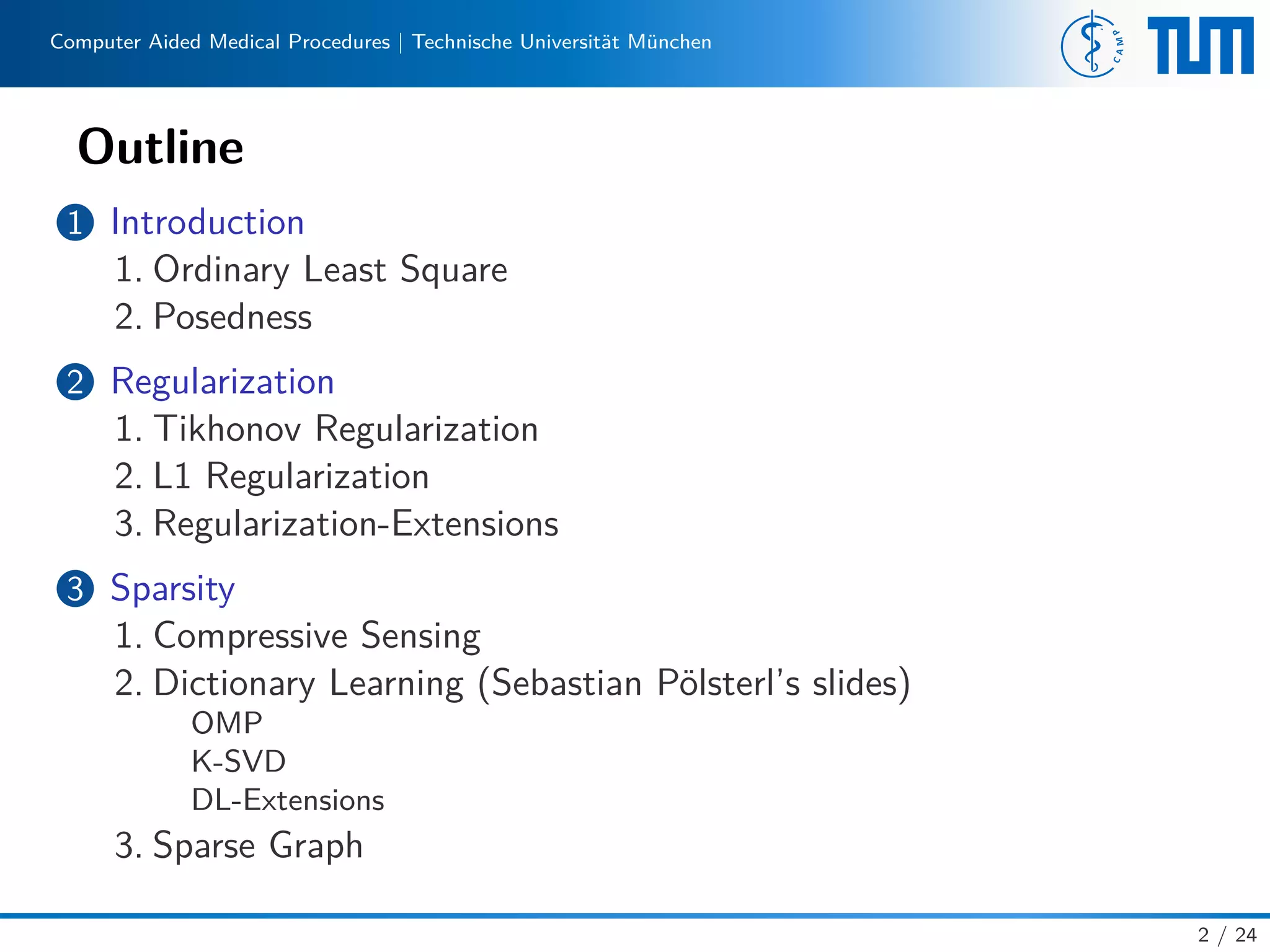
Outline
1 Introduction
1. Ordinary Least Square
2. Posedness
2 Regularization
1. Tikhonov Regularization
2. L1 Regularization
3. Regularization-Extensions
3 Sparsity
1. Compressive Sensing
2. Dictionary Learning (Sebastian Pölsterl’s slides)
OMP
K-SVD
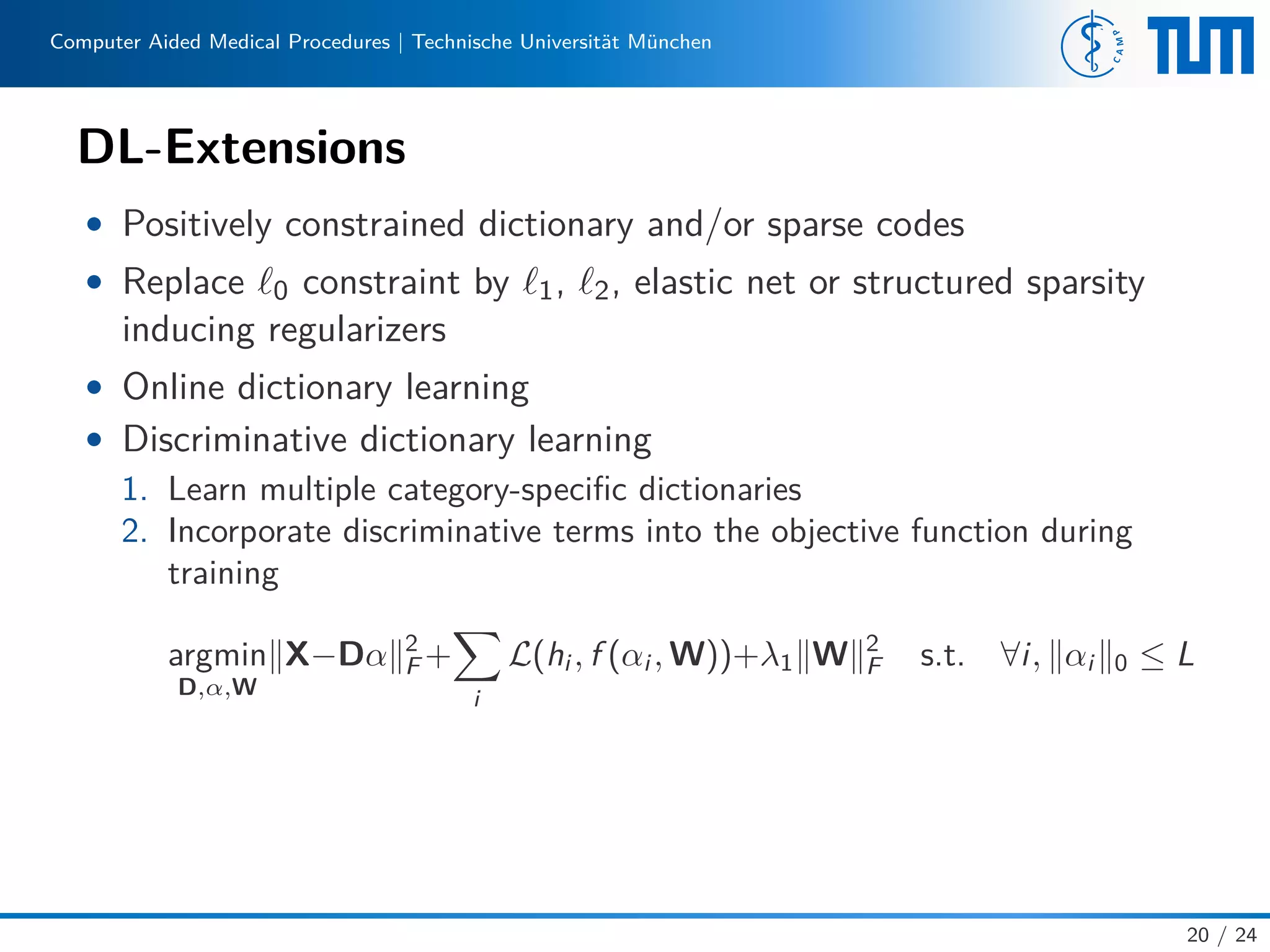
DL-Extensions
3. Sparse Graph
2 / 24
Computer Aided Medical Procedures | Technische Universität München
Notation
• y ∈ Rm is the observed signal/labels
• A ∈ Rm×n is some Blurring, Projection, or Fitting matrix
• x ∈ Rn is the latent signal/samples
• η ∈ Rn is the Gaussian noise
• Objective: Find solution x, such that minimizing the energy of
noise η
Definition (Least Square Error / Maximum Likelihood)
xLS/ML = argmin
x
1
2
y − Ax 2
2
3 / 24
Computer Aided Medical Procedures | Technische Universität München
Ordinary Least Square Error
Closed-form Solution
˜xLS/ML = (AT
A)−1
AT
y
What if:
• A is overdeter-
mined/underdetermined
matrix
−1
−0.8
−0.6
−0.4
−0.2
0
0.2
0.4
0.6
0.8
1
−1
−0.5
0
0.5
1
0
0.5
1
1.5
2
2.5
3
3.5
4 / 24
Computer Aided Medical Procedures | Technische Universität München
Ordinary Least Square Error
Closed-form Solution
˜xLS/ML = (AT
A)−1
AT
y
What if:
• A is overdeter-
mined/underdetermined
matrix
• A is
ill-conditioned
−1
−0.8
−0.6
−0.4
−0.2
0
0.2
0.4
0.6
0.8
1
−1
−0.5
0
0.5
1
0
0.5
1
1.5
2
2.5
3
3.5
4 / 24
Computer Aided Medical Procedures | Technische Universität München
Ordinary Least Square Error
Closed-form Solution
˜xLS/ML = (AT
A)−1
AT
y
What if:
• A is overdeter-
mined/underdetermined
matrix
• A is
ill-conditioned
• A is singular
−1
−0.8
−0.6
−0.4
−0.2
0
0.2
0.4
0.6
0.8
1
−1
−0.5
0
0.5
1
0
0.5
1
1.5
2
2.5
3
3.5
4 / 24
Computer Aided Medical Procedures | Technische Universität München
Posedness
Definition (Well-Posed Problem)
According to Hadamard[1], a problem is well-posed if
1. It has a solution
2. The solution is unique
3. The solution depends continuously on data and parameters.
Define the following, and
explain their impacts:
• ill-posed problem
• well-conditioned
• ill-conditioned
−1
−0.5
0
0.5
1
−1
−0.5
0
0.5
1
0
0.01
0.02
0.03
0.04
0.05
0.06
0.07
0.08
0.09
5 / 24
Computer Aided Medical Procedures | Technische Universität München
Regularization
Definition (Tikhonov Regularization)
xL2 = argmin
x
1
2
y − Ax 2
2 +
λ
2
x 2
2
What happens when we increase x looking for the solution:
−1 −0.8 −0.6 −0.4 −0.2 0 0.2 0.4 0.6 0.8 1
−1
−0.8
−0.6
−0.4
−0.2
0
0.2
0.4
0.6
0.8
1
−1 −0.8 −0.6 −0.4 −0.2 0 0.2 0.4 0.6 0.8 1
−1
−0.8
−0.6
−0.4
−0.2
0
0.2
0.4
0.6
0.8
1
6 / 24
Computer Aided Medical Procedures | Technische Universität München
Regularization
Definition (L1 Regularization)
xL1 = argmin
x
1
2
y − Ax 2
2 +
λ
2
x 1
What happens when we increase x looking for the solution:
−1 −0.8 −0.6 −0.4 −0.2 0 0.2 0.4 0.6 0.8 1
−1
−0.8
−0.6
−0.4
−0.2
0
0.2
0.4
0.6
0.8
1
−1 −0.8 −0.6 −0.4 −0.2 0 0.2 0.4 0.6 0.8 1
−1
−0.8
−0.6
−0.4
−0.2
0
0.2
0.4
0.6
0.8
1
7 / 24
Computer Aided Medical Procedures | Technische Universität München
Regularization-Extensions
Definition (General Regularization)
xRLS/MAP = argmin
x
1
2
y − Ax 2
2 + λP(x)
• Incorporate different regularization terms into the objective
function p-norm x p [2] [3]
x 0 x 1 x 2 x 4
8 / 24
Computer Aided Medical Procedures | Technische Universität München
Regularization-Extensions
Definition (General Regularization)
xRLS/MAP = argmin
x
1
2
y − Ax 2
2 + λP(x)
• Incorporate different regularization terms into the objective
function p-norm x p [2] [3]
x 0 x 1 x 2 x 4
• Use other RKHS function
8 / 24
Computer Aided Medical Procedures | Technische Universität München
Regularization-Extensions
Definition (General Regularization)
xRLS/MAP = argmin
x
1
2
y − Ax 2
2 + λP(x)
• Incorporate different regularization terms into the objective
function p-norm x p [2] [3]
x 0 x 1 x 2 x 4
• Use other RKHS function
• Incorporate CS for Sparse prior assumptions
8 / 24
Computer Aided Medical Procedures | Technische Universität München
Compressive Sensing (CS)
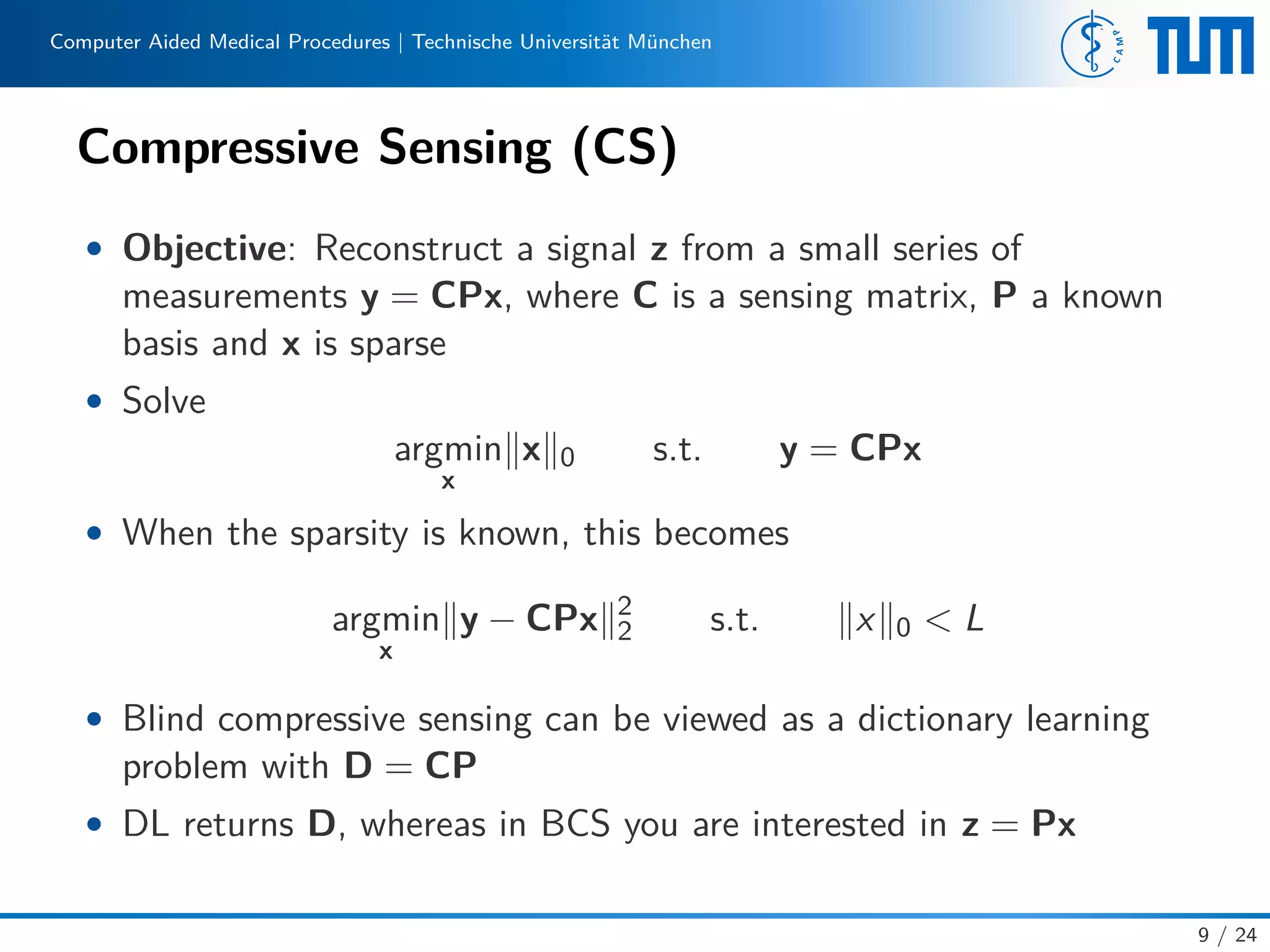
• Objective: Reconstruct a signal z from a small series of
measurements y = CPx, where C is a sensing matrix, P a known
basis and x is sparse
• Solve
argmin
x
x 0 s.t. y = CPx
• When the sparsity is known, this becomes
argmin
x
y − CPx 2
2 s.t. x 0 < L
• Blind compressive sensing can be viewed as a dictionary learning
problem with D = CP
• DL returns D, whereas in BCS you are interested in z = Px
9 / 24
Computer Aided Medical Procedures | Technische Universität München
Dictionary Learning (DL) – Overview
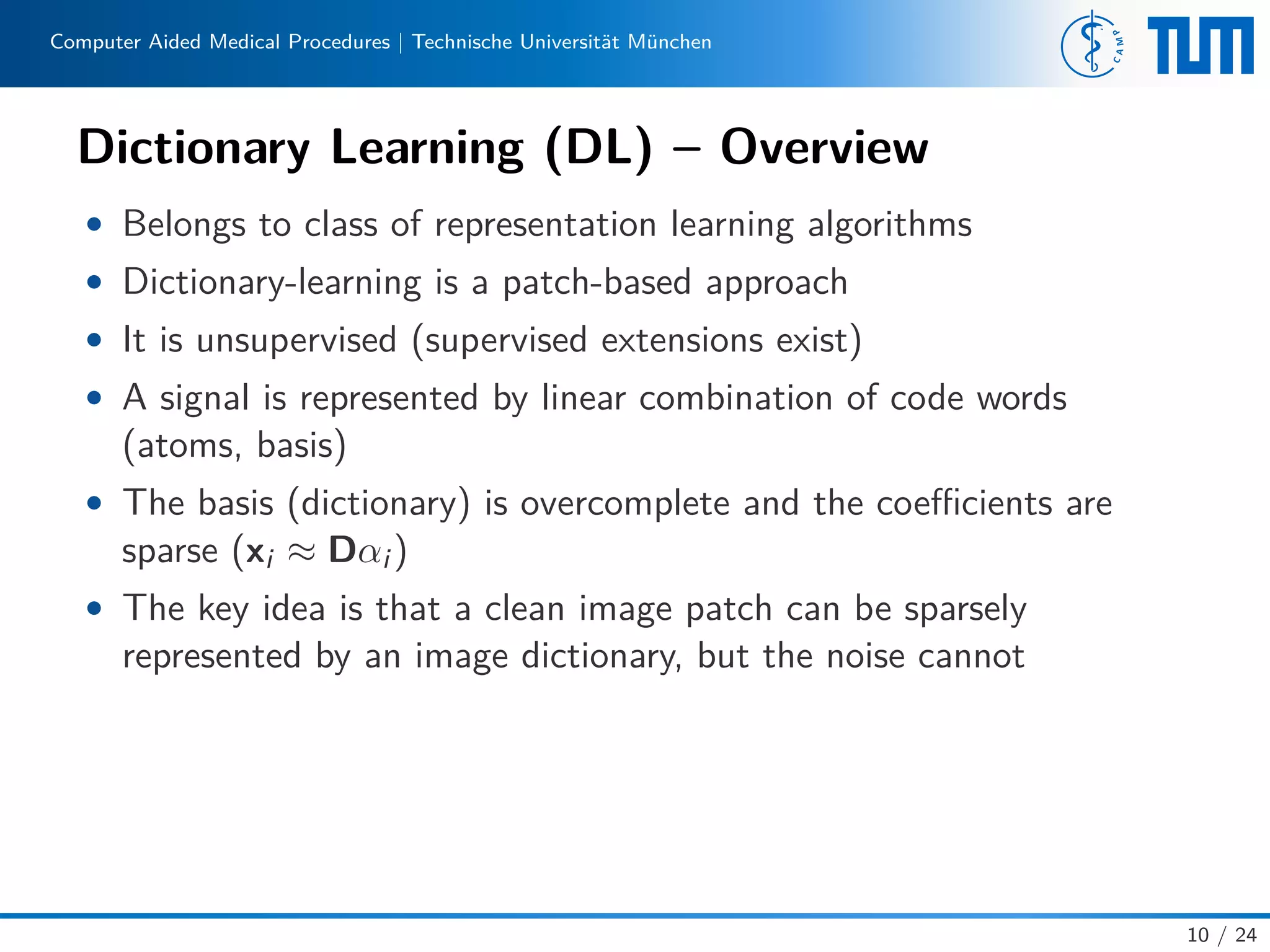
• Belongs to class of representation learning algorithms
• Dictionary-learning is a patch-based approach
• It is unsupervised (supervised extensions exist)
• A signal is represented by linear combination of code words
(atoms, basis)
• The basis (dictionary) is overcomplete and the coefficients are
sparse (xi ≈ Dαi )
• The key idea is that a clean image patch can be sparsely
represented by an image dictionary, but the noise cannot
10 / 24
Computer Aided Medical Procedures | Technische Universität München
Dictionary Learning
Sparse PCA
=
Y D X
• Sparse Dictionary
Dictionary Learning
=
Y D X
• Sparse coefficients
Definition (Dictionary Learning)
argmin
D,α
1
2
X − Dα 2
F s.t. ∀i, αi 0 ≤ L
11 / 24
Computer Aided Medical Procedures | Technische Universität München
Dictionary Learning - Sparse Representation
Notation
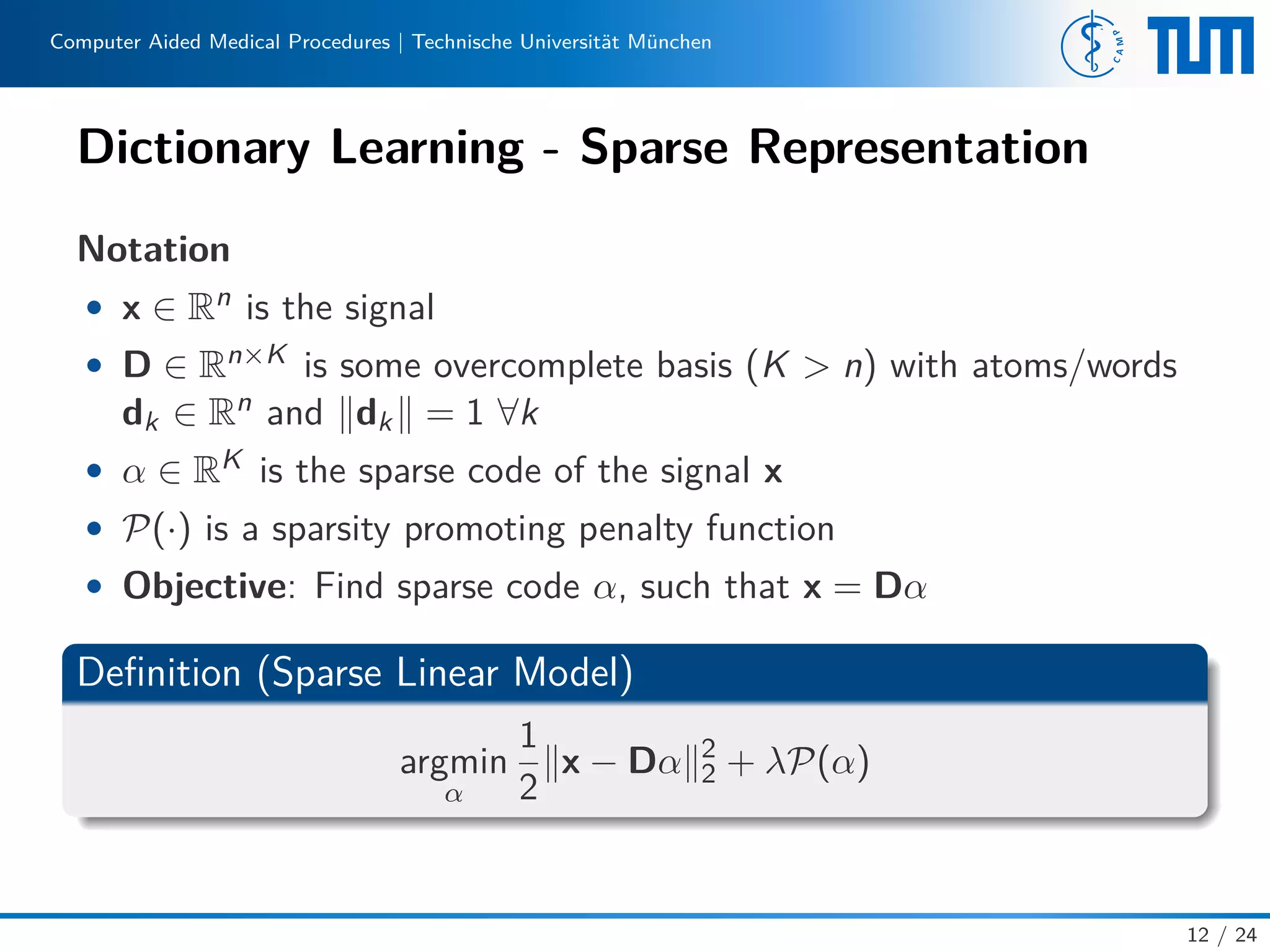
• x ∈ Rn is the signal
• D ∈ Rn×K is some overcomplete basis (K > n) with atoms/words
dk ∈ Rn and dk = 1 ∀k
• α ∈ RK is the sparse code of the signal x
• P(·) is a sparsity promoting penalty function
• Objective: Find sparse code α, such that x = Dα
Definition (Sparse Linear Model)
argmin
α
1
2
x − Dα 2
2 + λP(α)
12 / 24
Computer Aided Medical Procedures | Technische Universität München
Sparsity Promoting Penalty Functions
Definition ( 0 norm)
P(α) = α 0
Definition ( 1 norm)
P(α) = α 1
Definition (Elastic Net)
Pc(α) = c α 1 + (1 − c)
1
2
α 2
2
13 / 24
Computer Aided Medical Procedures | Technische Universität München
Orthogonal Matching Pursuit (OMP)
• Objective Function: argminα
1
2 x − Dα 2
2 s.t. α 0 ≤ L
• Problem is NP-hard, use greedy method instead
• Initialization:
◦ S = ∅ (support)
◦ r ← x (residuals)
• Repeat until convergence:
1. Selection Step:
k∗
← argmax
k
| r, dk | , S ← S ∪ {k∗
}
2. Update Step:
αS ← argmin
αS
x − DSαS
2
2, r ← x − DSαS
14 / 24
Computer Aided Medical Procedures | Technische Universität München
OMP – Update Step
• Again, it can be solved by the closed form solution of LSE
αS = DT
S DS
−1
DT
S y. However, the update step is expensive.
• DT
S DS is symmetric positive-definite and updated by appending a
single row and column
• Its Cholesky factorization requires only the computation of its last
row
• For a large set of signals, Batch-OMP can be used [4]
15 / 24
Computer Aided Medical Procedures | Technische Universität München
K-SVD [5]
• Dictionary learning problem is both non-convex and non-smooth
• Minimize objective function iteratively by
1. fixing D and finding the best sparse codes α
2. updating one atom dk at a time, while keeping all other atoms fixed,
and changing its non-zero coefficients at the same time (support does
not change)
• Pruning step:
◦ Eliminate atoms that are too close to each other
◦ Eliminate atoms that are used by less than b training examples
◦ Replace them with least explained samples
16 / 24
Computer Aided Medical Procedures | Technische Universität München
K-SVD – Dictionary Update
x − Dα 2
F = X −
K
j=1
djαj
T
2
F
=

X −
K
j=k
djαj
T

 − dkαk
T
2
F
= Ek − dkαk
T
2
F
• Fix α and D expect the k-th atom dk, which we want to update
• dkαk
T is a rank-1 matrix ⇒ use SVD
• However, approximating Ek directly would likely remove sparsity
from αk
T
• Solution: Only update coefficients I that correspond to training
examples that use atom dk
17 / 24
Computer Aided Medical Procedures | Technische Universität München
K-SVD – Algorithm
input : Example data X ∈ Rn×N
output: Dictionary D ∈ Rn×K
Randomly initialize D;
repeat
for i = 1 to N do
Solve minαi xi − Dαi
2
2 using a sparse coding algorithm (e.g.
OMP, LASSP, or FISTA);
end
for k = 1 to K do
I ← {j|αkj = 0} ; /* Examples that use atom k */
ER
k ← X:,I − j=k djαj,I /* Restricted error matrix */
Apply SVD decomposition ER
k = UΛVT ;
dk ← U:,1 ; /* Update k-th atom */
α:,I ← V:,1Λ(1, 1) ; /* Update sparse codes */
end
until convergence;
18 / 24
Computer Aided Medical Procedures | Technische Universität München
K-Means
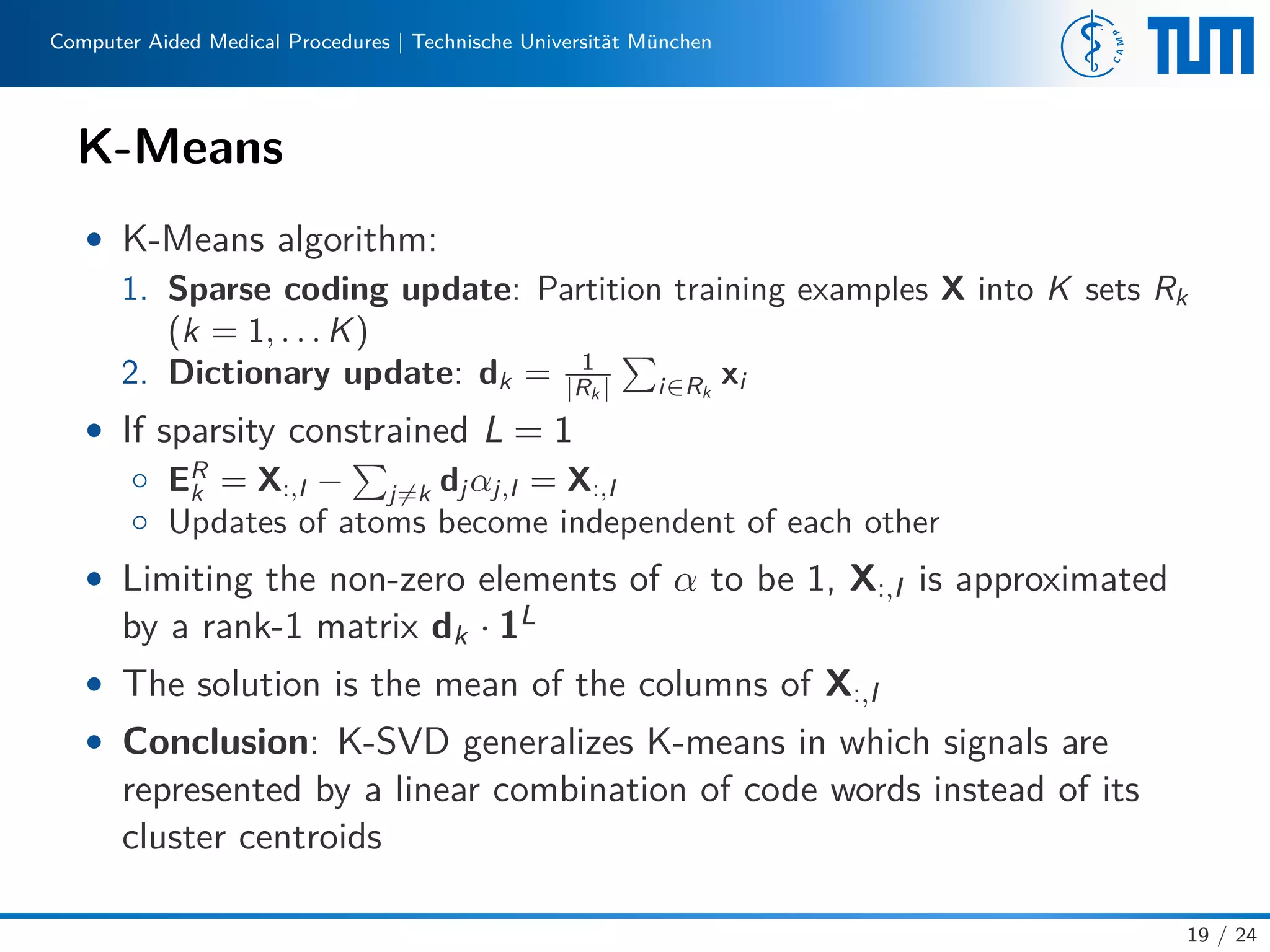
• K-Means algorithm:
1. Sparse coding update: Partition training examples X into K sets Rk
(k = 1, . . . K)
2. Dictionary update: dk = 1
|Rk | i∈Rk
xi
• If sparsity constrained L = 1
◦ ER
k = X:,I − j=k dj αj,I = X:,I
◦ Updates of atoms become independent of each other
• Limiting the non-zero elements of α to be 1, X:,I is approximated
by a rank-1 matrix dk · 1L
• The solution is the mean of the columns of X:,I
• Conclusion: K-SVD generalizes K-means in which signals are
represented by a linear combination of code words instead of its
cluster centroids
19 / 24
Computer Aided Medical Procedures | Technische Universität München
DL-Extensions
• Positively constrained dictionary and/or sparse codes
• Replace 0 constraint by 1, 2, elastic net or structured sparsity
inducing regularizers
• Online dictionary learning
• Discriminative dictionary learning
1. Learn multiple category-specific dictionaries
2. Incorporate discriminative terms into the objective function during
training
argmin
D,α,W
X−Dα 2
F +
i
L(hi , f (αi , W))+λ1 W 2
F s.t. ∀i, αi 0 ≤ L
20 / 24
Computer Aided Medical Procedures | Technische Universität München
Graph - Overview
• Fully connected, undirected, and wighted graph with N vertices
• which corresponds to a patch-wise sample in X
• The graph is represented by G = {ν, ε, ω}, where ν is a set of
vertices N, ε is a set of edges, and ω is a set of weights are
assigned using a heat kernel as follows to build the Adjacency
matrix W
Wij =



e−
xi −xj
2
2
σ2 eij ∈ ε
0 else
• The degree matrix D, where its diagonal elements Dij = j Wij
21 / 24
Computer Aided Medical Procedures | Technische Universität München
Graph Sparse Coding (GraphSC) [6]
• Build up the Normalized Laplacian Matrix ˜L from the transition
one Lt = D−1W
Definition (GraphSC)
argmin
D,α
1
2
x − Dα 2
2 + λ α 0 + Tr(αT ˜Lα)
GraphSC-Extension
• Incorporate semi-supervised discriminative classification [7]
•
22 / 24
Computer Aided Medical Procedures | Technische Universität München
Software
• SPAMS (C++, Matlab, R, Python):
http://spams-devel.gforge.inria.fr/
• CAMP GitLab (C++):
https://campgit.in.tum.de/learning/dictionary
23 / 24
Computer Aided Medical Procedures | Technische Universität München
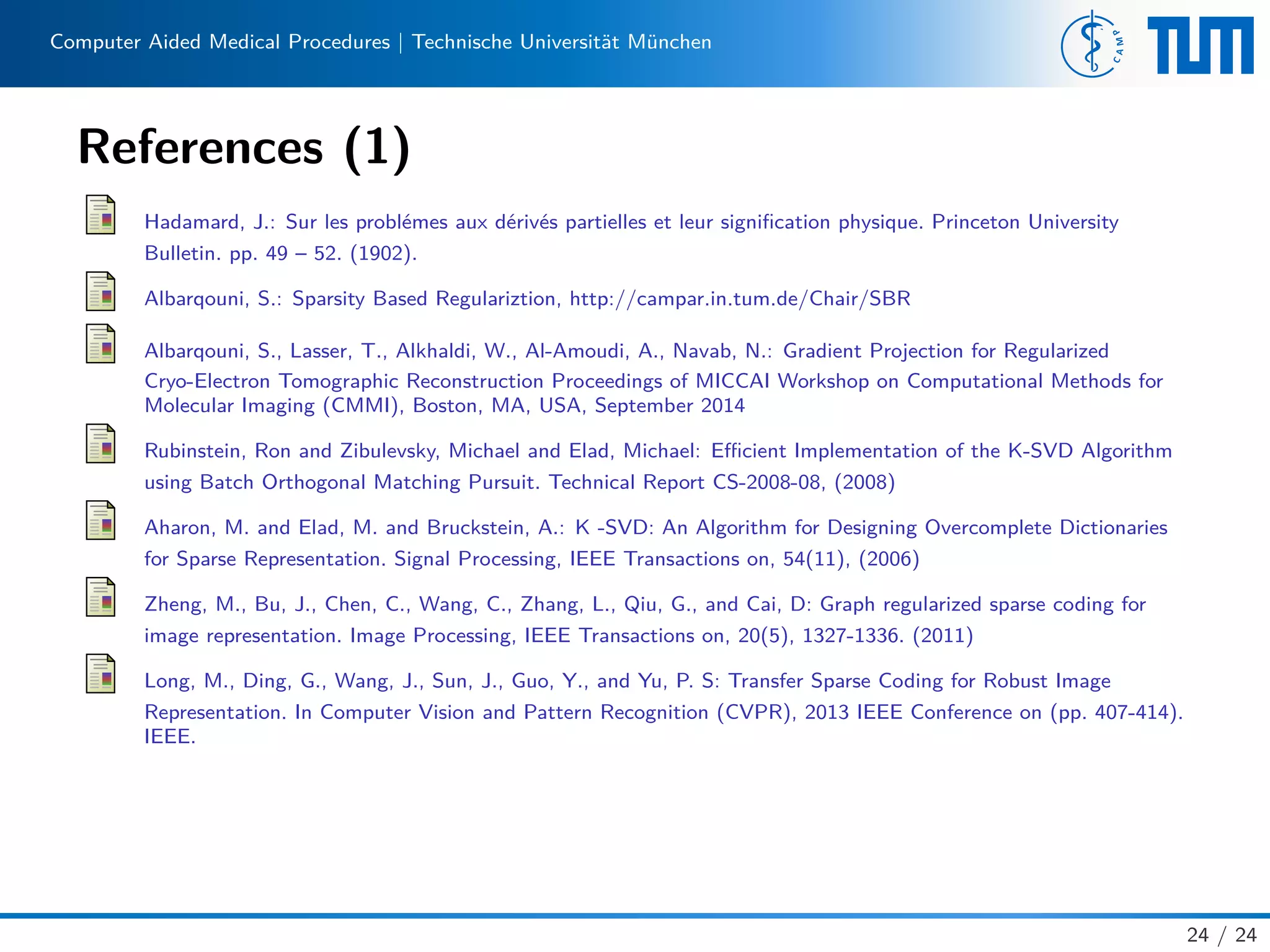
References (1)
Hadamard, J.: Sur les problémes aux dérivés partielles et leur signification physique. Princeton University
Bulletin. pp. 49 – 52. (1902).
Albarqouni, S.: Sparsity Based Regulariztion, http://campar.in.tum.de/Chair/SBR
Albarqouni, S., Lasser, T., Alkhaldi, W., Al-Amoudi, A., Navab, N.: Gradient Projection for Regularized
Cryo-Electron Tomographic Reconstruction Proceedings of MICCAI Workshop on Computational Methods for
Molecular Imaging (CMMI), Boston, MA, USA, September 2014
Rubinstein, Ron and Zibulevsky, Michael and Elad, Michael: Efficient Implementation of the K-SVD Algorithm
using Batch Orthogonal Matching Pursuit. Technical Report CS-2008-08, (2008)
Aharon, M. and Elad, M. and Bruckstein, A.: K -SVD: An Algorithm for Designing Overcomplete Dictionaries
for Sparse Representation. Signal Processing, IEEE Transactions on, 54(11), (2006)
Zheng, M., Bu, J., Chen, C., Wang, C., Zhang, L., Qiu, G., and Cai, D: Graph regularized sparse coding for
image representation. Image Processing, IEEE Transactions on, 20(5), 1327-1336. (2011)
Long, M., Ding, G., Wang, J., Sun, J., Guo, Y., and Yu, P. S: Transfer Sparse Coding for Robust Image
Representation. In Computer Vision and Pattern Recognition (CVPR), 2013 IEEE Conference on (pp. 407-414).
IEEE.
24 / 24

Introduction to Sparse Methods

  • 1.
    Introduction to SparseMethods Shadi Albarqouni, M.Sc. Research Assistant | PhD Candidate shadi.albarqouni@tum.de Computer Aided Medical Procedures | Technische Universität München Machine Learning in Medical Imaging BioMedical Computing (BMC) Master Program
  • 2.
    Computer Aided MedicalProcedures | Technische Universität München Outline 1 Introduction 1. Ordinary Least Square 2. Posedness 2 Regularization 1. Tikhonov Regularization 2. L1 Regularization 3. Regularization-Extensions 3 Sparsity 1. Compressive Sensing 2. Dictionary Learning (Sebastian Pölsterl’s slides) OMP K-SVD DL-Extensions 3. Sparse Graph 2 / 24
  • 3.
    Computer Aided MedicalProcedures | Technische Universität München Notation • y ∈ Rm is the observed signal/labels • A ∈ Rm×n is some Blurring, Projection, or Fitting matrix • x ∈ Rn is the latent signal/samples • η ∈ Rn is the Gaussian noise • Objective: Find solution x, such that minimizing the energy of noise η Definition (Least Square Error / Maximum Likelihood) xLS/ML = argmin x 1 2 y − Ax 2 2 3 / 24
  • 4.
    Computer Aided MedicalProcedures | Technische Universität München Ordinary Least Square Error Closed-form Solution ˜xLS/ML = (AT A)−1 AT y What if: • A is overdeter- mined/underdetermined matrix −1 −0.8 −0.6 −0.4 −0.2 0 0.2 0.4 0.6 0.8 1 −1 −0.5 0 0.5 1 0 0.5 1 1.5 2 2.5 3 3.5 4 / 24
  • 5.
    Computer Aided MedicalProcedures | Technische Universität München Ordinary Least Square Error Closed-form Solution ˜xLS/ML = (AT A)−1 AT y What if: • A is overdeter- mined/underdetermined matrix • A is ill-conditioned −1 −0.8 −0.6 −0.4 −0.2 0 0.2 0.4 0.6 0.8 1 −1 −0.5 0 0.5 1 0 0.5 1 1.5 2 2.5 3 3.5 4 / 24
  • 6.
    Computer Aided MedicalProcedures | Technische Universität München Ordinary Least Square Error Closed-form Solution ˜xLS/ML = (AT A)−1 AT y What if: • A is overdeter- mined/underdetermined matrix • A is ill-conditioned • A is singular −1 −0.8 −0.6 −0.4 −0.2 0 0.2 0.4 0.6 0.8 1 −1 −0.5 0 0.5 1 0 0.5 1 1.5 2 2.5 3 3.5 4 / 24
  • 7.
    Computer Aided MedicalProcedures | Technische Universität München Posedness Definition (Well-Posed Problem) According to Hadamard[1], a problem is well-posed if 1. It has a solution 2. The solution is unique 3. The solution depends continuously on data and parameters. Define the following, and explain their impacts: • ill-posed problem • well-conditioned • ill-conditioned −1 −0.5 0 0.5 1 −1 −0.5 0 0.5 1 0 0.01 0.02 0.03 0.04 0.05 0.06 0.07 0.08 0.09 5 / 24
  • 8.
    Computer Aided MedicalProcedures | Technische Universität München Regularization Definition (Tikhonov Regularization) xL2 = argmin x 1 2 y − Ax 2 2 + λ 2 x 2 2 What happens when we increase x looking for the solution: −1 −0.8 −0.6 −0.4 −0.2 0 0.2 0.4 0.6 0.8 1 −1 −0.8 −0.6 −0.4 −0.2 0 0.2 0.4 0.6 0.8 1 −1 −0.8 −0.6 −0.4 −0.2 0 0.2 0.4 0.6 0.8 1 −1 −0.8 −0.6 −0.4 −0.2 0 0.2 0.4 0.6 0.8 1 6 / 24
  • 9.
    Computer Aided MedicalProcedures | Technische Universität München Regularization Definition (L1 Regularization) xL1 = argmin x 1 2 y − Ax 2 2 + λ 2 x 1 What happens when we increase x looking for the solution: −1 −0.8 −0.6 −0.4 −0.2 0 0.2 0.4 0.6 0.8 1 −1 −0.8 −0.6 −0.4 −0.2 0 0.2 0.4 0.6 0.8 1 −1 −0.8 −0.6 −0.4 −0.2 0 0.2 0.4 0.6 0.8 1 −1 −0.8 −0.6 −0.4 −0.2 0 0.2 0.4 0.6 0.8 1 7 / 24
  • 10.
    Computer Aided MedicalProcedures | Technische Universität München Regularization-Extensions Definition (General Regularization) xRLS/MAP = argmin x 1 2 y − Ax 2 2 + λP(x) • Incorporate different regularization terms into the objective function p-norm x p [2] [3] x 0 x 1 x 2 x 4 8 / 24
  • 11.
    Computer Aided MedicalProcedures | Technische Universität München Regularization-Extensions Definition (General Regularization) xRLS/MAP = argmin x 1 2 y − Ax 2 2 + λP(x) • Incorporate different regularization terms into the objective function p-norm x p [2] [3] x 0 x 1 x 2 x 4 • Use other RKHS function 8 / 24
  • 12.
    Computer Aided MedicalProcedures | Technische Universität München Regularization-Extensions Definition (General Regularization) xRLS/MAP = argmin x 1 2 y − Ax 2 2 + λP(x) • Incorporate different regularization terms into the objective function p-norm x p [2] [3] x 0 x 1 x 2 x 4 • Use other RKHS function • Incorporate CS for Sparse prior assumptions 8 / 24
  • 13.
    Computer Aided MedicalProcedures | Technische Universität München Compressive Sensing (CS) • Objective: Reconstruct a signal z from a small series of measurements y = CPx, where C is a sensing matrix, P a known basis and x is sparse • Solve argmin x x 0 s.t. y = CPx • When the sparsity is known, this becomes argmin x y − CPx 2 2 s.t. x 0 < L • Blind compressive sensing can be viewed as a dictionary learning problem with D = CP • DL returns D, whereas in BCS you are interested in z = Px 9 / 24
  • 14.
    Computer Aided MedicalProcedures | Technische Universität München Dictionary Learning (DL) – Overview • Belongs to class of representation learning algorithms • Dictionary-learning is a patch-based approach • It is unsupervised (supervised extensions exist) • A signal is represented by linear combination of code words (atoms, basis) • The basis (dictionary) is overcomplete and the coefficients are sparse (xi ≈ Dαi ) • The key idea is that a clean image patch can be sparsely represented by an image dictionary, but the noise cannot 10 / 24
  • 15.
    Computer Aided MedicalProcedures | Technische Universität München Dictionary Learning Sparse PCA = Y D X • Sparse Dictionary Dictionary Learning = Y D X • Sparse coefficients Definition (Dictionary Learning) argmin D,α 1 2 X − Dα 2 F s.t. ∀i, αi 0 ≤ L 11 / 24
  • 16.
    Computer Aided MedicalProcedures | Technische Universität München Dictionary Learning - Sparse Representation Notation • x ∈ Rn is the signal • D ∈ Rn×K is some overcomplete basis (K > n) with atoms/words dk ∈ Rn and dk = 1 ∀k • α ∈ RK is the sparse code of the signal x • P(·) is a sparsity promoting penalty function • Objective: Find sparse code α, such that x = Dα Definition (Sparse Linear Model) argmin α 1 2 x − Dα 2 2 + λP(α) 12 / 24
  • 17.
    Computer Aided MedicalProcedures | Technische Universität München Sparsity Promoting Penalty Functions Definition ( 0 norm) P(α) = α 0 Definition ( 1 norm) P(α) = α 1 Definition (Elastic Net) Pc(α) = c α 1 + (1 − c) 1 2 α 2 2 13 / 24
  • 18.
    Computer Aided MedicalProcedures | Technische Universität München Orthogonal Matching Pursuit (OMP) • Objective Function: argminα 1 2 x − Dα 2 2 s.t. α 0 ≤ L • Problem is NP-hard, use greedy method instead • Initialization: ◦ S = ∅ (support) ◦ r ← x (residuals) • Repeat until convergence: 1. Selection Step: k∗ ← argmax k | r, dk | , S ← S ∪ {k∗ } 2. Update Step: αS ← argmin αS x − DSαS 2 2, r ← x − DSαS 14 / 24
  • 19.
    Computer Aided MedicalProcedures | Technische Universität München OMP – Update Step • Again, it can be solved by the closed form solution of LSE αS = DT S DS −1 DT S y. However, the update step is expensive. • DT S DS is symmetric positive-definite and updated by appending a single row and column • Its Cholesky factorization requires only the computation of its last row • For a large set of signals, Batch-OMP can be used [4] 15 / 24
  • 20.
    Computer Aided MedicalProcedures | Technische Universität München K-SVD [5] • Dictionary learning problem is both non-convex and non-smooth • Minimize objective function iteratively by 1. fixing D and finding the best sparse codes α 2. updating one atom dk at a time, while keeping all other atoms fixed, and changing its non-zero coefficients at the same time (support does not change) • Pruning step: ◦ Eliminate atoms that are too close to each other ◦ Eliminate atoms that are used by less than b training examples ◦ Replace them with least explained samples 16 / 24
  • 21.
    Computer Aided MedicalProcedures | Technische Universität München K-SVD – Dictionary Update x − Dα 2 F = X − K j=1 djαj T 2 F =  X − K j=k djαj T   − dkαk T 2 F = Ek − dkαk T 2 F • Fix α and D expect the k-th atom dk, which we want to update • dkαk T is a rank-1 matrix ⇒ use SVD • However, approximating Ek directly would likely remove sparsity from αk T • Solution: Only update coefficients I that correspond to training examples that use atom dk 17 / 24
  • 22.
    Computer Aided MedicalProcedures | Technische Universität München K-SVD – Algorithm input : Example data X ∈ Rn×N output: Dictionary D ∈ Rn×K Randomly initialize D; repeat for i = 1 to N do Solve minαi xi − Dαi 2 2 using a sparse coding algorithm (e.g. OMP, LASSP, or FISTA); end for k = 1 to K do I ← {j|αkj = 0} ; /* Examples that use atom k */ ER k ← X:,I − j=k djαj,I /* Restricted error matrix */ Apply SVD decomposition ER k = UΛVT ; dk ← U:,1 ; /* Update k-th atom */ α:,I ← V:,1Λ(1, 1) ; /* Update sparse codes */ end until convergence; 18 / 24
  • 23.
    Computer Aided MedicalProcedures | Technische Universität München K-Means • K-Means algorithm: 1. Sparse coding update: Partition training examples X into K sets Rk (k = 1, . . . K) 2. Dictionary update: dk = 1 |Rk | i∈Rk xi • If sparsity constrained L = 1 ◦ ER k = X:,I − j=k dj αj,I = X:,I ◦ Updates of atoms become independent of each other • Limiting the non-zero elements of α to be 1, X:,I is approximated by a rank-1 matrix dk · 1L • The solution is the mean of the columns of X:,I • Conclusion: K-SVD generalizes K-means in which signals are represented by a linear combination of code words instead of its cluster centroids 19 / 24
  • 24.
    Computer Aided MedicalProcedures | Technische Universität München DL-Extensions • Positively constrained dictionary and/or sparse codes • Replace 0 constraint by 1, 2, elastic net or structured sparsity inducing regularizers • Online dictionary learning • Discriminative dictionary learning 1. Learn multiple category-specific dictionaries 2. Incorporate discriminative terms into the objective function during training argmin D,α,W X−Dα 2 F + i L(hi , f (αi , W))+λ1 W 2 F s.t. ∀i, αi 0 ≤ L 20 / 24
  • 25.
    Computer Aided MedicalProcedures | Technische Universität München Graph - Overview • Fully connected, undirected, and wighted graph with N vertices • which corresponds to a patch-wise sample in X • The graph is represented by G = {ν, ε, ω}, where ν is a set of vertices N, ε is a set of edges, and ω is a set of weights are assigned using a heat kernel as follows to build the Adjacency matrix W Wij =    e− xi −xj 2 2 σ2 eij ∈ ε 0 else • The degree matrix D, where its diagonal elements Dij = j Wij 21 / 24
  • 26.
    Computer Aided MedicalProcedures | Technische Universität München Graph Sparse Coding (GraphSC) [6] • Build up the Normalized Laplacian Matrix ˜L from the transition one Lt = D−1W Definition (GraphSC) argmin D,α 1 2 x − Dα 2 2 + λ α 0 + Tr(αT ˜Lα) GraphSC-Extension • Incorporate semi-supervised discriminative classification [7] • 22 / 24
  • 27.
    Computer Aided MedicalProcedures | Technische Universität München Software • SPAMS (C++, Matlab, R, Python): http://spams-devel.gforge.inria.fr/ • CAMP GitLab (C++): https://campgit.in.tum.de/learning/dictionary 23 / 24
  • 28.
    Computer Aided MedicalProcedures | Technische Universität München References (1) Hadamard, J.: Sur les problémes aux dérivés partielles et leur signification physique. Princeton University Bulletin. pp. 49 – 52. (1902). Albarqouni, S.: Sparsity Based Regulariztion, http://campar.in.tum.de/Chair/SBR Albarqouni, S., Lasser, T., Alkhaldi, W., Al-Amoudi, A., Navab, N.: Gradient Projection for Regularized Cryo-Electron Tomographic Reconstruction Proceedings of MICCAI Workshop on Computational Methods for Molecular Imaging (CMMI), Boston, MA, USA, September 2014 Rubinstein, Ron and Zibulevsky, Michael and Elad, Michael: Efficient Implementation of the K-SVD Algorithm using Batch Orthogonal Matching Pursuit. Technical Report CS-2008-08, (2008) Aharon, M. and Elad, M. and Bruckstein, A.: K -SVD: An Algorithm for Designing Overcomplete Dictionaries for Sparse Representation. Signal Processing, IEEE Transactions on, 54(11), (2006) Zheng, M., Bu, J., Chen, C., Wang, C., Zhang, L., Qiu, G., and Cai, D: Graph regularized sparse coding for image representation. Image Processing, IEEE Transactions on, 20(5), 1327-1336. (2011) Long, M., Ding, G., Wang, J., Sun, J., Guo, Y., and Yu, P. S: Transfer Sparse Coding for Robust Image Representation. In Computer Vision and Pattern Recognition (CVPR), 2013 IEEE Conference on (pp. 407-414). IEEE. 24 / 24